主题 04 以春节为代表的人类非遗
主题简析
中国非遗文化是中华文化多样性的生动体现。非遗项目种类繁多,涵盖了传统戏剧、传统美术、传统
音乐等多个领域,每一项都独具特色,展现了中华民族丰富多彩的文化面貌。在初中英语教学中融入非遗
文化,有助于学生全面了解和认识中华文化的多样性和包容性,促进学生对不同文化形态的理解和尊重 。
初中英语阅读理解中有关有关以春节为代表的人类非遗主题的阅读材料的特征主要体现如下三个方面:
(1)深入挖掘了中国人类非遗的文化深度。它们详细介绍了诸如春节 、中国剪纸 、京剧 等非遗项目的历
史渊源、文化内涵及独特价值,让学生能够在阅读中领略到中华文化的博大精深。这些非遗项目不仅是中
华民族的文化瑰宝,也是全人类共同的财富,它们的传承与发展体现了中华民族的文化自信和历史责任感。
(2)具有显著的教育意义。通过阅读,学生能够了解到非遗项目背后的故事和技艺,如刺绣 等手工艺品
的精湛工艺,以及非遗传承人在保护和传承这些技艺方面所做的努力。这不仅能够增强学生的文化认同感,
还能够激发他们对传统文化的兴趣和热爱,从而积极参与到非遗的保护与传承中来。(3)展现出了国际
视野。它们提到了非遗项目在国际上的影响力和认可度,如春节等非遗项目被联合国教科文组织列入《人
类非物质文化遗产代表作名录》的事实 。这不仅让学生认识到非遗项目的国际地位和价值,还能够引导他
们思考如何在全球化背景下更好地传承和发展中华文化,促进中外文化交流与互鉴。
词句积累
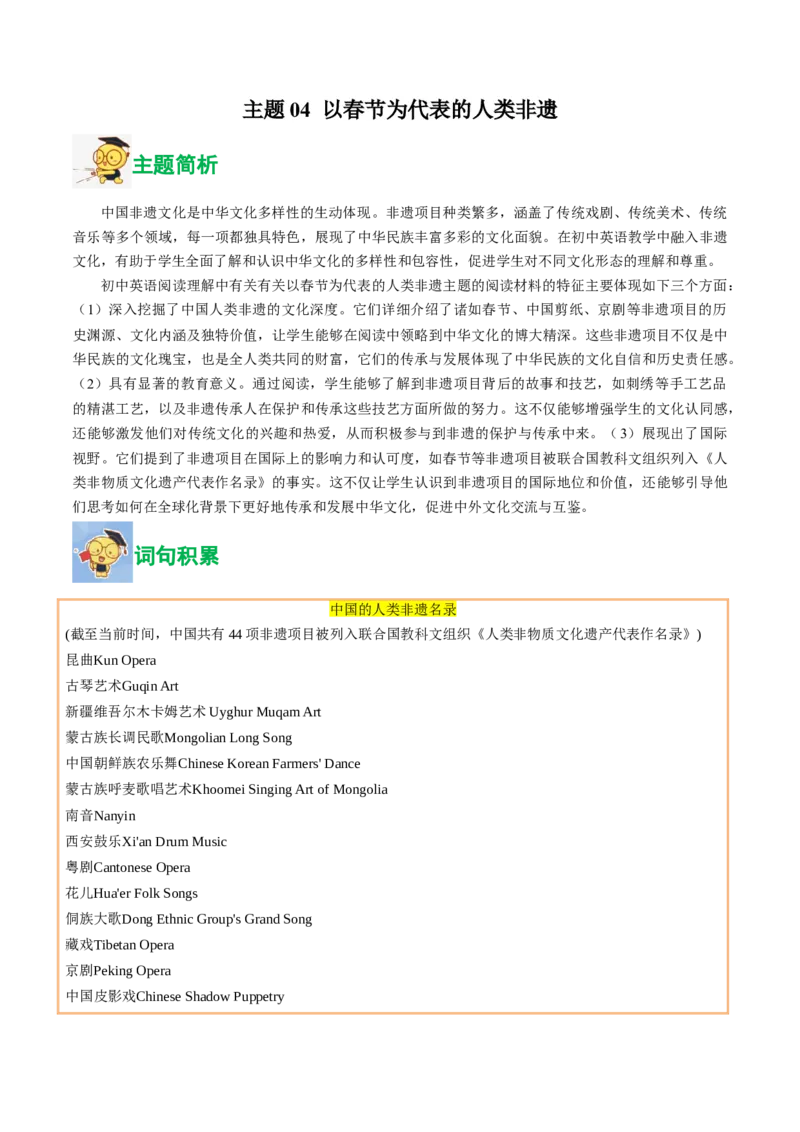
中国的人类非遗名录
(截至当前时间,中国共有44项非遗项目被列入联合国教科文组织《人类非物质文化遗产代表作名录》)
昆曲 Kun Opera
古琴艺术 Guqin Art
新疆维吾尔木卡姆艺术Uyghur Muqam Art
蒙古族长调民歌 Mongolian Long Song
中国朝鲜族农乐舞 Chinese Korean Farmers' Dance
蒙古族呼麦歌唱艺术 Khoomei Singing Art of Mongolia
南音 Nanyin
西安鼓乐 Xi'an Drum Music
粤剧 Cantonese Opera
花儿 Hua'er Folk Songs
侗族大歌 Dong Ethnic Group's Grand Song
藏戏 Tibetan Opera
京剧 Peking Opera
中国皮影戏 Chinese Shadow Puppetry福建木偶戏后继人才培养计划 Training Program for Successors of Fujian Puppetry
中国篆刻 Chinese Seal Engraving
中国雕版印刷技艺 :Chinese Woodblock Printing
中国书法 Chinese Calligraphy
中国剪纸 Chinese Paper Cutting
中国传统木结构建筑营造技艺 Traditional Chinese Wooden Architecture Craftsmanship
南京云锦织造技艺 Nanjing Yunjin Silk Weaving Craftsmanship
热贡艺术 Regong Art
中国蚕桑丝织技艺 Chinese Silk Weaving Craftsmanship
龙泉青瓷传统烧制技艺 Longquan Celadon Traditional Firing Craftsmanship
宣纸传统制作技艺 Xuan Paper Traditional Craftsmanship
黎族传统纺染织绣技艺 Li Ethnic Group's Traditional Textile, Dyeing, Weaving, and Embroidery Craftsmanship
中国木拱桥传统营造技艺 Traditional Chinese Wooden Arch Bridge Building Craftsmanship
中国水密隔舱福船制造技艺 Chinese Watertight Bulkhead Junk Building Craftsmanship
中国活字印刷术 Chinese Movable Type Printing
中医针灸 Traditional Chinese Medicine Acupuncture and Moxibustion
中国珠算 Chinese Abacus
二十四节气 The Twenty-Four Solar Terms
藏医药浴法 Tibetan Medicinal Bath Therapy
太极拳 Taijiquan
送王船 Wangchuan Ceremony
麦西热甫Maxrap
中国传统制茶技艺及其相关习俗 Traditional Chinese Tea Processing Techniques and Related Practices
妈祖信俗 Mazu Beliefs and Customs
羌年 Qiang New Year
玛纳斯 Manas
格萨(斯)尔 Epic of King Gesar
赫哲族伊玛堪 Imakan Epic of the Hezhe Ethnic Group
中国朝鲜族农乐舞 Chinese Korean Farmers' Dance
春节 Spring Festival
主题词汇示例
1.非遗相关词汇
intangible cultural heritage 非物质文化遗产
representative list 代表作名录
UNESCO 联合国教科文组织(United Nations Educational, Scientific and Cultural Organization)
safeguarding 保护transmission 传承
folk customs 民俗
traditional music and dance 传统音乐与舞蹈
craftsmanship 技艺
oral traditions 口头传统
rituals and ceremonies 仪式与典礼
artistic expressions 艺术表达
social practices 社会实践
living heritage 活态遗产
human creativity 人类创造力
cultural diversity 文化多样性
heritage transmission 传承
performing arts 表演艺术
traditional handicrafts 传统手工艺
2.阅读材料中常见的项目示例
Kun Opera 昆曲
Peking Opera 京剧
Shadow Puppetry 皮影戏
Embroidery 刺绣
Paper Cutting 剪纸
Wood Carving 木雕
Iron-sparks show (或 iron flower beating )打铁花
Dragon Dance 舞龙
Acrobatics 杂技
Cross Talk 相声
Suzhou Embroidery 苏绣
Clay Figure 泥人
Blue and White Porcelain 青花瓷
Jingdezhen Porcelain 景德镇瓷
Lacquer Ware 漆器
Bronze Work 青铜器
3. 与非遗相关的其他文化词汇
the four great inventions of ancient China 中国古代四大发明
gunpowder 火药
printing 印刷术
papermaking 造纸术the compass 指南针
Tri-color Glazed Pottery of the Tang Dynasty 唐三彩
traditional chinese medicine 中医
acupuncture 针灸
4.其他词汇
(1)动词
inherit :继承,用于描述非遗的传承过程
preserve :保护,强调对非遗项目的保存和维护
transmit :传播,指非遗文化从一代传到下一代
practice :实践,表示进行非遗相关的活动或技艺展示
embellish :装饰,用于描述非遗项目中如刺绣、剪纸等的装饰性行为
celebrate :庆祝,与非遗相关的节日或庆典活动相关
(2) 形容词
traditional :传统的,用于描述非遗项目的传统性质
outstanding :杰出的,强调非遗项目的卓越性和重要性
unique :独特的,指非遗项目具有与众不同的特点或价值
vivid :生动的,用于形容非遗项目中如绘画、雕塑等的形象逼真
historical :历史的,强调非遗项目具有深厚的历史背景
cultural :文化的,与非遗作为文化遗产的身份相关
拓展阅读
The heart of Spring Festival: Heritage, harmony and hope
Spring Festival marks the beginning of the new year in China, which falls on the first day of the first month of
the Chinese calendar. Chinese people organize a variety of social practices and celebrations to welcome the new
year, expressing blessings and prayers for good fortune, wealth and family reunion.
New year pictures and couplets
The festive vibes of Spring Festival can be found in richly colored decorations wishing for good fortune such
as new year pictures and spring couplets. Spring couplets are red paper strips with black or golden Chinese
characters written on them and are usually hung on doorways.
New year pictures, nianhua in Chinese, usually come in the form of colored woodblock prints. They are used
to ward off evil spirits during Spring Festival and are hung on doors or walls.
The history of new year pictures dates back to Northern Song Dynasty (960-1127) and Ming Dynasty (1368-
1644). The painting style of the pictures varies from different areas in China, with the main themes being heroes,
immortals, auspicious symbols, natural landscapes, babies, beauties, myths, legends and historical events.Some well-known production sites for these pictures include Yangliuqing in Tianjin, Yangjiabu in Weifang,
Shandong province, and Mianzhu in Sichuan province.
Rituals and ancestor worship
People of certain family clans usually organize ancestor worship activities during Spring Festival. They wear
traditional Chinese clothing to worship their ancestors following ceremonial rituals at ancestral temples, and pray
for family harmony, a good harvest and prosperity.
Ethnic groups' celebration of Spring Festival
The Mongolian ethnic group in Qian Gorlos Mongolian autonomous county in the northeastern province of
Jilin blends Spring Festival celebration practices of the Han people with their own ethnic traditions.
They call their celebration Spring Festival of Tsagaan Sar, or white moon, in their dialect. They prepare a feast
with milk tea, mutton soup, dumplings and round pancakes on Chinese New Year's Eve and visit family members
when the new year comes.
Lantern Festival and lantern shows
Lantern Festival falls on the 15th day of the first month of the Chinese calendar during the full moon, and is
part of Spring Festival celebrations. It's a tradition for people to eat tangyuan or yuanxiao — glutinous rice balls —
on the day. People leave the house carrying lanterns at night, visiting lantern shows and solving riddles.
The lantern shows have a history dating back to the Han Dynasty (206 BC-AD 220), and flourished in the
Tang (618-907) and Song (960-1279) dynasties.
China has several lantern shows of great note in Shanghai's Huangpu district, Nanjing's Qinhuai district and
Zigong in the southwestern province of Sichuan for their splendid and magnificent lantern designs.
Shehuo and folk performances
Shehuo, literally translated as "earth and fire" or "community fire", originated from people's worship of the
god of Earth and the god of fire. Celebrations and performances are organized, mainly in the countryside, to
worship the god of Earth and god of fire during Spring Festival to pray for a good harvest, warmth and the ability to
cook.
Many other festive folk performances are also staged during Spring Festival, from the first day to the 15th day
of the first month of the Chinese calendar, such as dragon and lion dances, to express people's happiness. Dragon
and lion dances differ in shape and form based on local customs, and the most well-known dragon dance is fire
dragon dance in Tongliang district, Chongqing, and in Pujiang county in Zhejiang province, which emerged during
the Ming (1368-1644) and Qing (1644-1911) dynasties.
Temple fairs and flower fairs
Days before Spring Festival falls, people purchase flowers, kumquats or persimmons from flower fairs to
decorate their homes.
During Spring Festival, people gather at temple fairs, or miaohui in Chinese, to engage in celebration activities
including religious ceremonies, entertainment, performances, games and shopping.
Beijing has one of China's most famous temple fairs — Changdian temple fair -which has a history traced
back to the Ming Dynasty (1368-1644).
Wenxi flower-shaped bunsFlower-shaped buns, or huamo, from Wenxi county in North China's Shanxi province have a history of about
1,000 years, predominantly seen as emerging around the Ming (1368-1644) and Qing (1644-1911) dynasties.
The multilayered bun resembles blooming flowers from afar. The buns are made at major events including
festival celebrations, weddings or new births.
Representatives
Inheritors play an important role in preserving the nation's cultural heritage together with dedicated
associations and institutes devoted to protecting folk customs.
• Huo Qingshun — 73, inheritor of Yangliuqing new year woodblock prints in Tianjin
• Dong Qiaolan — inheritor of Wenxi flower-shaped bun-making skills in Shanxi province
• Yinglian Society of China — a social organization founded in 1984 to promote couplets culture
• Gu Yeliang — 63, inheritor of lantern-making skills in Nanjing, Jiangsu province
• Yang Fengshan — inheritor of Taolinping shehuo performance in Hebei province
(来源:China Daily Global)
参考译文:
春节的核心:传承、和谐与希望
春节标志着中国新年的开始,农历正月初一。中国人组织各种社会活动和庆祝活动来迎接新年,表达
对好运、财富和家庭团聚的祝福和祈祷。
年画对联
春节的喜庆气氛可以在色彩丰富的新年画和春联等祝福好运的装饰品中找到。春联是红色的纸条,上
面写着黑色或金色的汉字,通常挂在门口。
年画,中国的年画,通常以彩色木版画的形式出现。它们被用来在春节期间驱邪,挂在门上或墙上。
年画的历史可以追溯到北宋(960-1127)和明朝(1368-1644)。这些画的绘画风格因中国不同地区而
异,主题包括英雄、神仙、吉祥符号、自然景观、婴儿、美女、神话、传说和历史事件。
这些照片的一些著名制作地包括天津的杨柳青、山东省潍坊市的杨家埠和四川省绵竹市。
仪式与祖先崇拜
某些家族的人通常在春节期间组织祖先崇拜活动。他们穿着中国传统服装,在祠堂举行仪式,祭拜祖
先,祈求家庭和谐、丰收和繁荣。
少数民族庆祝春节
位于东北吉林省钱戈洛斯蒙古族自治县的蒙古族将汉族的春节庆祝活动与自己的民族传统融为一体。
他们用方言称他们的庆祝活动为察干节,或白月亮。他们在除夕准备了一顿奶茶、羊肉汤、饺子和圆
煎饼的盛宴,并在新年到来时拜访家人。
元宵节和灯展
元宵节在农历正月十五满月期间,是春节庆祝活动的一部分。人们在这一天吃汤圆或元宵是一种传
统。人们晚上提着灯笼离开家,参观灯展,猜灯谜。
灯会的历史可以追溯到汉代(公元前206年-公元220年),并在唐朝(618-907年)和宋朝(960-
1279年)盛行。
中国在上海的黄浦区、南京的秦淮区和西南部四川省的自贡都有几场灯展,因其华丽而壮观的灯笼设
计而备受瞩目。社火与民间表演
社火,直译为“土与火”或“社区火”,源于人们对土地之神和火神的崇拜。春节期间,主要在农村
组织庆祝活动和表演,崇拜大地之神和火神,祈求丰收、温暖和烹饪能力。
春节期间还上演了许多其他节日民间表演,从农历正月初一到十五,如舞龙舞狮,以表达人们的幸
福。舞龙和舞狮因当地风俗而在形状和形式上有所不同,最著名的舞龙是重庆铜梁区和浙江省浦江县的火
龙舞,出现在明朝(1368-1644)和清朝(1644-1911)。
庙会和花市
春节前几天,人们从花市买花、金桔或柿子来装饰他们的家。
春节期间,人们聚集在庙会或庙会上,参加包括宗教仪式、娱乐、表演、游戏和购物在内的庆祝活
动。
北京有中国最著名的庙会之一——长店庙会,它的历史可以追溯到明朝(1368-1644)。
闻喜花形包子
来自中国北方山西省闻喜县的花形包子,或称花模,已有约 1000年的历史,主要出现在明朝(1368-
1644)和清朝(1644-1911)前后。
从远处看,这个多层面包就像盛开的花朵。这些包子是在节日庆典、婚礼或新生儿出生等重大活动中
制作的。
代表
传承人与致力于保护民俗的专门协会和机构一起在保护国家文化遗产方面发挥着重要作用。
•霍庆顺——73岁,天津杨柳青年画传承人
•董巧兰——山西闻喜花包子技艺传承人
•中国迎联会——一个成立于1984年,旨在推广对联文化的社会组织
•顾业良——63岁,江苏省南京市灯笼制作技艺传承人
•杨凤山——河北省桃林坪社火表演的继承人
综合演练
1
Woodcut is a kind of art work on a piece of wood. Many traditional woodcuts are printed either black and
white or simple in color, but reduction woodcuts (绝版木刻) often show rich colors like Western oil paintings.
The reduction woodcuts are famous for their rich colors. On the same piece of wood, the artist cuts and
prints different layers (层) in order. The artwork was listed as an intangible cultural heritage (非物质文化遗产) in
Pu’er city, Yunnan province, in 2009.
Leng Guangmian, 40, is a reduction woodcut artist. He started learning the art at college in 2003. He thinks
that making reduction woodcut prints is just like an amazing journey. “Every time we cut a model on the
woodblock and then print, we never know what it will be like in the end.” As he sees beautiful models layer by
layer, he gets more excited.
But finishing such work is not easy. Before cutting, he needs to plan for the whole print and choose colorsfor different layers. A big print usually takes months to finish.
Leng hopes his artwork can show not only excellent woodcutting skills but also local culture and life. “My
works have two series (系列). One is called the Tea Horse Road, since Pu’er is one of the starting points of that
road. The other is the Disappearing Villages.” Leng said. “Many old villages in Pu’er need rebuilding for safety, so
I want to make people remember their beauty before they are gone.”
1.What’s special about the reduction woodcut?
A.It has one layer. B.It is colorful.
C.It uses a piece of wood. D.It is simple in color.
2.How is the work of making reduction woodcuts?
A.Amazing but difficult. B.Exciting and easy.
C.Boring and hard. D.Boring but easy.
3.What is Leng’s purpose (目的) of making reduction woodcuts?
A.To tell his personal stories. B.To rebuild old local villages.
C.To teach woodcut skills in Yunnan. D.To show local life and culture.
4.What may be the best title for the passage?
A.An artist’s story B.A Chinese artist
C.Making a colorful artwork on wood D.Learning special works in Yunnan
2
The UNESCO added “Spring Festival, social practices of the Chinese people in celebration of the traditional
New Year” to the Representative List of the Intangible Cultural Heritage of Humanity (人类非物质文化遗产代表
作名录) on December 4, 2024.
① The Spring Festival, also called Chinese New Year, is one of the most important festivals practiced in
China and around the world. It is time for people to wish for good things to happen in the future and for everyone to
be happy and healthy.
② Celebrations for the Spring Festival last for 15 days, ending with the Lantern Festival, to give full play
to family gatherings, feasts (宴会), and different cultural activities. Many of these celebrations and events that have
been passed down from generation to generation are practiced in China, Asia and around the world. They include
paper-cuttings, the dragon dance and lantern festival events, together forming the happiest days for those who
celebrate this event.
③ On the second day of the Spring Festival, people traditionally visit temples to pray (祈祷), seek
blessings, and celebrate the Chinese New Year. The temple fairs often provide different activities, including
traditional performances, folk art, and the sale of local handicrafts and foods. Temple fairs symbolize a connection
to tradition, offering a space for spiritual reflection. Visitors may also light incense (香) and make offerings to
deities (神明) for good luck in the coming year, making it both a spiritual (宗教的) and festive (节日的) event.
The Lantern Festival, traditionally held on the 15th day of the Spring Festival, marks the end of Chinese
New Year celebrations. ④ People gather in public spaces to admire the lanterns, solve riddles (谜语) written on
them, and enjoy performances like dragon dances. Many Lantern Festival events, including the famous Zigonglantern show in Southwest China’s Sichuan Province, have been listed as National Intangible Cultural Heritage
items.
1.What is the main idea of the first paragraph?
A.The influence of the Spring Festival.
B.The history of the Spring Festival.
C.The importance of the Spring Festival in China.
D.The UNESCO’s recognition (认可) of the Spring Festival.
2.Which of the following event happens first?
A.The Lantern Festival. B.Family gatherings and feasts.
C.Visiting temples to pray. D.Solving riddles written on lanterns.
3.Which celebration for the Spring Festival is NOT mentioned in the passage?
A.Paper-cuttings. B.The dragon dance.
C.Watching movies. D.Lantern festival events.
4.Which is the most suitable place for this sentence “During this festival, lively lanterns of all shapes and sizes
are shown.”?
A.① B.② C.③ D.④
5.What is the most famous Lantern Festival event mentioned in the text?
A.The dragon dance in Beijing. B.The temple fair in Guangdong.
C.The Zigong lantern show in Sichuan. D.The paper-cutting contest in Shanghai.
3
Kunqu Opera first appeared in the late Yuan Dynasty. It was one of the earliest kinds of drama in China. It was
named after its birthplace, Kunshan. And it was also called Kunshanqiang. Kunqu Opera was listed in the
Intangible Cultural Heritage of Humanity (人类非物质文化遗产) by UNESCO on May 18th, 2001.
Kunqu is famous for its soft sounds and beautiful performances (表演). The musical instruments used in
Kunqu Opera are different from that of Beijing Opera. To match the style of the play better, the flute (长笛) is
widely used instead of the strings (弦乐器). Most of the themes of the stories of Kunqu are love between lovers.
In early days, the opera was made up of many long and short sentences. Later, Kunqu music was changed a
little by famous musician Wei Liangfu in the mid-16th century. The roles of Kunqu include Sheng, Dan, Jing, Mo,
Chou, Wai and Tie. Some famous Kunqu works are The Peony Pavilion《牡丹亭》, The Palace of Eternal Youth
《长生殿》and so on.
1.Why do we call it Kunqu Opera?
A.Because it first appeared in the late Yuan Dynasty.
B.Because it was the earliest kinds of drama in China.
C.Because it was listed in the Intangible Cultural Heritage of Humanity.
D.Because it was named after its birthplace, Kunshan.
2.What is Kunqu famous for?
A.Musical instruments like the flute. B.The themes of the stories.C.Sounds and performances. D.The style of the play.
3.What’s the best title (标题) for this text?
A.Kunqu Opera and Beijing Opera B.Introduction to Kunqu Opera
C.The Beginning of Kunqu Opera D.Kunqu Works and Roles
4
One cannot discuss Chinese music without mentioning the guqin, one of the four arts—along with go,
calligraphy(书法)and painting. It first appeared over 3,000 years ago and stands for China’s solo musical
instrument tradition.
At first, the guqin had only five strings(弦), meaning the five elements(元素)of metal, wood, water,
fire and earth. Later, in Zhou Dynasty, King Wen of Zhou added a sixth string for his son. King Wu of Zhou, added
a seventh string to encourage his army to fight with the Shang.
Ambience was important in playing the guqin. Usually, it was practiced in a quiet setting and never for
public performance. Ancient artists enjoyed performing by a stream in the mountains. The sound of the guqin
mixed with the echoes(回音)from the mountains, until the musician felt he was at one with nature. Playing it in
snow was also an enjoyable activity for ancient artists, who believed the instrument was the purest of its kind in the
world. Also, a night with moonlight was considered wonderful for playing the guqin. Wang Wei(701—761), a
highly talented man of the Tang Dynasty, liked playing it in a bamboo forest on nights with moonlight most.
Guqin pieces are usually three to eight minutes long, with the longest being Guangling Verse, which is 22
minutes long. Other famous pieces include Plum Blossoms in Three Movements, Wild Geese Landing on the
Sandbank and Eighteen Songs of a Nomad Flute.
Nowadays, there are fewer than one thousand well-trained guqin players and perhaps no more than fifty
living masters. The original number of several thousand pieces has greatly reduced to only one hundred works by
today. The guqin and its music was added to the list of the Intangible Cultural Heritage of Humanity(人类非物质
文化遗产)in 2003.
1.Today, the guqin has ________ strings.
A.four B.five C.six D.seven
2.What’s the meaning of the underlined word “Ambience” in Paragraph 3?
A.演奏技巧 B.环境氛围 C.天气状况 D.弹奏曲目
3.According to the passage, playing the guqin ________ is a right choice.
A.at a quiet restaurant B.at a welcome party
C.in a peaceful yard with flowers D.on a dark night with rainstorm
4.According to the passage, which of the following is TRUE?
A.The guqin has a history of less than 3000 years.
B.The strings mean metal, wood, water, fire and stone.
C.The longest guqin piece is Guangling Verse.
D.The guqin is very popular and many people can play it.
5.What does the passage mainly talk about?A.The guqin and its music. B.The guqin and its players.
C.Four Chinese traditional arts. D.The development of guqin music.
5
Chinese traditional paper cutting is an art of cutting out pictures from paper with the help of a pair of scissors
or a knife. In 2009, the Chinese paper cutting was added to the Representative List of the Intangible Culture
Heritage of Humanity (人类非物质文化遗产代表作名录).
Paper cutting originated (起源) in China, which is thought to have begun in the 4th century with the
invention of paper. But long before that, , Chinese people had already used similar skills to cut on leaves,
leather and silk. Therefore, it’s really a long art form that has been practiced in China through many centuries.
The subjects of the paper cutting can be anything, from historical events at fairy tale characters to plants and
animals. The paper cuttings are so vivid that they look like real ones. Paper cutting may sound easy, but actually it
is difficult to do well.
Modern Chinese artists have never stopped trying in different ways. Li Baofeng is a 54-year-old folk artist.
“Traditional paper cuttings are often made with red paper, which seems to be a little boring. So I want to make
something new.” says Li. She has made works in different colors which have amazing effects.
By combining the techniques (技艺) of traditional paper cutting with modern computer-designing, artists
today can produce 3D paper cuttings. They also use more techniques such as chromatic printing (彩色印刷),
woodblock printing (雕版印刷) and air brushing (喷绘) to create livelier works.
Through centuries, Chinese paper cutting has also been introduced into many other countries in Asia and
Europe. Now more and more people love paper cutting works and buy them as gifts for their friends.
1.Which of the following sentence can be put in the __________?
A.when it was in 5th century
B.when paper cutting became popular
C.when paper was invented
D.when paper wasn’t invented
2.The underlined word “combining” in Paragraph 5 probably means “__________” in Chinese.
A.发现 B.创新 C.结合 D.改良
3.The structure of the passage is
A. B.C. D.
6
China has a lot of intangible cultural heritages of humanity (人类非物质文化遗产). Here are five of them.
Peking Opera (2010)
It is a perfect example of Chinese culture. It has a long history and a complete system of stage
performances, its main roles include Sheng, Dan, Jing, Mo and Chou. It uses four main
skills—singing, speech, dance and combat (搏斗).
Acupuncture (针灸) (2010)
It is an ancient form of traditional Chinese medicine. It plays the role of health care and
treatment by regulating the balance of people’s bodies. It began in China at least 2,500 years
ago and later spread to other countries.
Chinese Zhusuan (2013)
Zhusuan was first discovered by Liu Hong. With a long history of 1,800 years, it is
considered as the world’s oldest computer. However, it is different from the modern
computer. It uses an abacus (算盘). It is a symbol of the wisdom of the Chinese people. But
as the world develops so fast, it has lost its role in the 2lst century.
The Twenty-four Solar Terms (2016)
It is called the fifth great invention of China. It was created by ancient Chinese people and it
shows the relationship between the climate and agriculture (农业). And it plays an important
role in Chinese agriculture production and daily life.
Tai Chi (2017)
Tai Chi is a kind of Wushu. It has been practised in China for about 600 years. It also mixes
slow movements and deep breath. Tai Chi is popular with the old people in China, but few
young people would like to pass it on. So the government is trying to encourage more young
people to take part in the Tai Chi.
1.What is a perfect example of Chinese culture?
A.The Twenty-four Solar Terms. B.Peking Opera.
C.Acupuncture. D.Chinese Zhusuan.
2.Why is the Twenty-four Solar Terms so important in our daily life?
A.It appeared about 2,000 years ago.
B.It is known as the fifth great invention of China.
C.It tells the relationship between agriculture and climate.D.It was created by ancient Chinese people to predict weather.
3.Which of the following is NOT mentioned in the passage?
A.The main roles of Peking Opera.
B.Acupuncture is an ancient form of traditional Chinese medicine.
C.The person who first discovered Zhusuan.
D.The reason why few young people would like to pass Tai Chi on.
4.What is the writing purpose of this passage?
A.To advise people to use abacus in their life.
B.To ask people to learn Acupuncture.
C.To let people know more about Twenty-four Solar Terms.
D.To introduce five intangible cultural heritages of humanity of China.
5.Where can we probably read the passage?
A.In a story book B.In an art magazine.
C.In a travelling guide. D.In a culture newspaper.
7
Our grandparents seem to have magic powers sometimes. Give them a Chinese lunar calendar (农历), and
they will know what the weather will be like a few days or even months later. What’s the secret? They are
following the 24 Solar Terms (节气), which is an important part of Chinese culture. And on Nov. 30, 2016, the
United Nations added it to the list of the Intangible Cultural Heritage of Humanity (人类非物质文化遗产).
In ancient times, most Chinese people made their livings on farms. So, weather changes were important to
them. Without satellites (人造卫星), the Internet or the weather report’s help, Chinese ancient people studied the
sun’s movement with a sundial (日晷). They also paid attention to other natural changes such as air temperature,
water and plant growth. As early as the Shang Dynasty, the Chinese people had already established (确立) four
solar terms. During the Zhou Dynasty, eight solar terms marking the four seasons were established. Until the Han
Dynasty, the present 24 Solar Terms was established completely. The terms became their guide to farming work.
For example, the solar term jingzhe is when insects wake up from a long sleep. Farmers take it as a sign of warm
weather and get busy working.
The 24 Solar Terms is regarded as China’s fifth great invention, after paper-making, printing, the compass
and gunpowder. Now, people still say, “Do not show your feet after hanlu.” Why? It’s because the solar term hanlu
marks the coming of cold days.
1.How did the Chinese people establish the 24 Solar Terms?
A.With the help of the Internet.
B.With the help of the weather report.
C.By learning from people working on farms.
D.By studying the sun’s movement and other natural changes.
2.What is the 24 Solar Terms used for?
A.Waking up insects. B.Changing weather.C.Learning Chinese history. D.Guiding people in farming work.
3.Which of the following is TRUE?
A.Our grandparents have magic powers.
B.Jingzhe is regarded as the start of cold weather.
C.The 24 Solar Terms was established step by step.
D.Weather changed more often in ancient times than it does now.
4.The saying in the last paragraph shows ________.
A.why hanlu marks the coming of cold days
B.what the five great inventions of China are
C.how the 24 Solar Terms guides people in their lives
D.why the 24 Solar Terms was regarded as China’s fifth great invention
5.What’s the best title for the passage?
A.The insects on farms B.China’s great inventions
C.The history of the 24 Solar Terms D.The influence of weather changes
8
Tai chi, a centuries-old Chinese martial art and an internationally popular form of exercise, has been added to
the cultural heritage ( 遗 产 ) list of the UNESCO (United Nations Educational, Scientific and Cultural
Organization).
For more than 10 years, China has been trying to have tai chi - also known as taijiquan - recognized officially
by the United Nations Educational, Scientific and Cultural Organization on the Representative List of the Intangible
Cultural Heritage of Humanity (联合国教科文组织人类非物质文化遗产代表作名录). At the time, judges told
China it had applied for too many listings for tai chi to be considered for a place. China was told to reduce
applications from the 12 submitted which included tai chi, Shaolin kung fu, Peking opera and acupuncture (针灸),
Tencent News reported.
“Taijiquan is not just a sport to make people fit, but also contains Chinese culture and philosophy (哲学),”
researcher Yan Shuangjun also told Xinhua News Agency, “The application started in 2008, and now we made a
victory, which will help this sport to reach more places.”
Millions of elderly Chinese people practise it every day in city parks, and celebrities and other public figures
regularly make public references to their practice of it for the health benefits it is said to provide. Gisele Bü-ndchen,
one of the highest-paid models in the world, incorporates tai chi into her daily life, as does her husband, Tom
Brady. Others who have been vocal about its use in their lives include actors Terence Stamp and Paul Adrian,
Bollywood star Kunal Kapoor, and musician RZ.A of the importance to martial artists such as Jackie Chan, Bruce
Lee and Jet Li.1.What can we learn about the applications in 2008?
A.Taijiquan is a Chinese martial art with a short history.
B.The first application of tai chi was accepted in 2008.
C.China thought itself had applied for too many listings.
D.China applied for acupuncture and Peking opera.
2.How does Yan Shuangjun say about tai chi?
A.It is helpless for depression. B.It contains Chinese culture and philosophy.
C.It can weaken the immune system. D.It can lead to severe joint pain.
3.Which of the following best describes tai chi from the last paragraph?
A.Unattractive. B.Inexpensive. C.Confidential. D.Welcomed.
4.In which section of a newspaper may this text appear?
A.Entertainment. B.Health. C.Education. D.Culture.
5.What’s the purpose of the writer writing this passage?
A.He tells us that he has practised Taijiquan for more than 10 years.
B.He tells us that Tai chi is becoming more and more popular in the world.
C.He tells us that he has many foreign friends.
D.He tells us that practicing Tai chi is helpless for some people.
9
Have you astonished by the amazing dance “The Journey of a Legendary Landscape Painting”(《只此青
绿》)on the Chinese Spring Festival Gala. Along with its perfect performance, the background music which was
played by the ancient instrument—Qin was also a highlight.
One cannot discuss Chinese music without mentioning the Chinese seven-string zither(弦), also known as
the guqin, one of the four arts—along with go, calligraphy and painting. It first appeared over 3, 000 years ago and
represents China’s solo musical instrument tradition.
At first, the guqin had only five strings, representing the five elements of metal, wood, water, fire and earth.
Later, in the Zhou dynasty, King Wen of Zhou added a sixth string for his son. King Wu of Zhou, added a seventh
string to encourage his army to fight with the Shang.
Ambience was important in playing the Chinese zither. Usually, it was practiced in quiet setting and never for
public performance.
Ancient artists enjoyed performing by a stream in the mountains. The sound of the guqin mixed with the
echoes(回音)from the mountains, until the musician found himself at one with nature. Playing it in snow was
also a favorite pastime for ancient artists, who believed the instrument was the purest of its kind in the world. Also,
a night with moonlight was considered ideal(理想的)for playing the guqin. Wang Wei(701—761), a highly
talented man of the Tang dynasty, liked playing it in a bamboo forest on nights with moonlight most.
Guqin pieces are usually around three to eight minutes long, with the longest being Guangling Verse, which is
22 minutes long. Other famous pieces include Plum Blossoms in Three Movements(《梅花三弄》), Wild
Geese Landing on the Sandbank(《平沙落雁》)and Eighteen Songs of a Nomad Flute(《胡笳十八拍》).Now, there are fewer than one thousand well-trained guqin players and perhaps no more than fifty living
masters. The original number of several thousand pieces has greatly reduced to only a hundred works by today. The
guqin and its music was added to the list of the Intangible Cultural Heritage of Humanity(人类非物质文化遗
产)in 2003.
1.Today, the guqin has _________ strings.
A.four B.five C.six D.seven
2.What’s the meaning of the underlined word “Ambience” in paragraph3?
A.演奏技巧 B.环境氛围 C.天气状况 D.弹奏曲目
3.According to the passage, playing the guqin _________ is a right choice.
A.at a quiet restaurant B.at a welcome party
C.in a peaceful yard with flowers D.on a dark night with rainstorm
4.According to the passage, which of the following is TRUE?
A.The guqin has a history of less than 3000 years.
B.The strings mean metal, wood, water, fire and stone.
C.The longest guqin piece is Guangling Verse.
D.The guqin is very popular and many people can play it.
5.What does the passage mainly talk about?
A.The guqin and its music. B.The guqin and its players.
C.Four Chinese traditional arts. D.The development of guqin music.
10
Chinese people love tea. Do you like to sit together with your family and drink tea after meals? For
thousands of years, tea has been a popular drink in China. 1
On Nov. 29, 2022, the ways of making traditional Chinese tea and the social practices that go with them
entered UNESCO’s “Representative List of the Intangible Cultural Heritage of Humanity” (《人类非物质文化遗
产代表作名录》). Since ancient times, Chinese people have been planting, picking, making and drinking tea.
2 For example, an old custom is that a host should welcome guests with boiled (煮沸的) tea.
Boiling tea is one of the oldest ways of brewing (沏) Chinese tea. 3 Later, in the Ming dynasty, a faster
way took its place—steeping (浸泡).
However, the old way is now making a comeback among Chinese young people. The topic of weilu zhucha
has had a large number of posts on the Internet. 4
In this way, people can get a taste of a slower life. 5 As one post says, “It’s very relaxing to drink
hot tea, feel the fall breeze (微风), and chat with best friends.”
根据短文内容,从下面选出适当的选项补全短文,有两项是多余的。
A.It started in the Tang dynasty.
B.And they feel more relaxed.
C.Tea is important in everyday life.
D.People sit around a stove (炉子) as they boil tea on it.E.People drink tea when they are thirsty or sleepy.
F.China’s tea culture has a number of social practices.
G.In China, drinking tea can also be a kind of art.