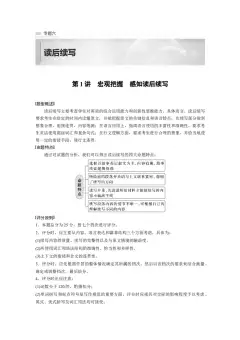
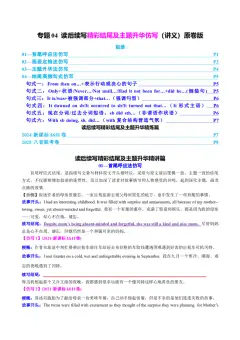
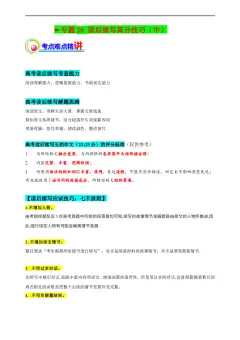
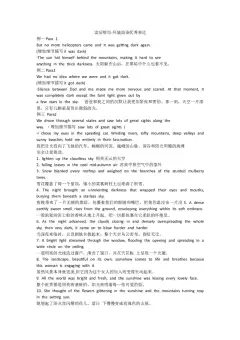
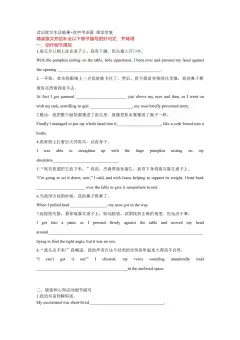
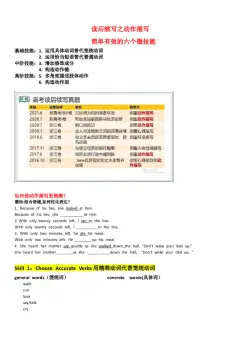
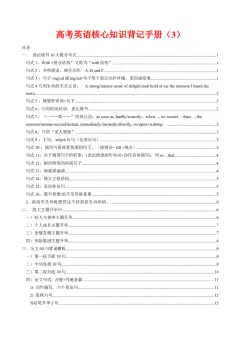
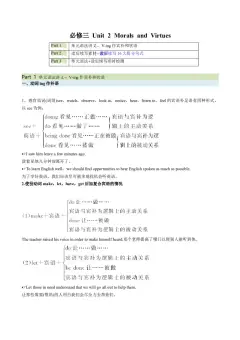
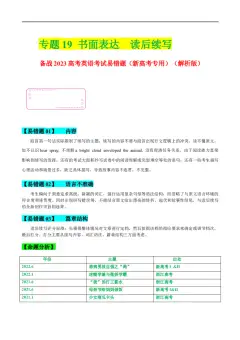
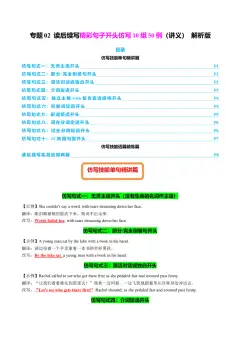
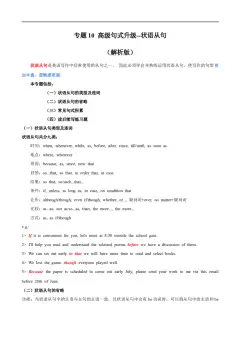
读后续写 10 大语法句式 :
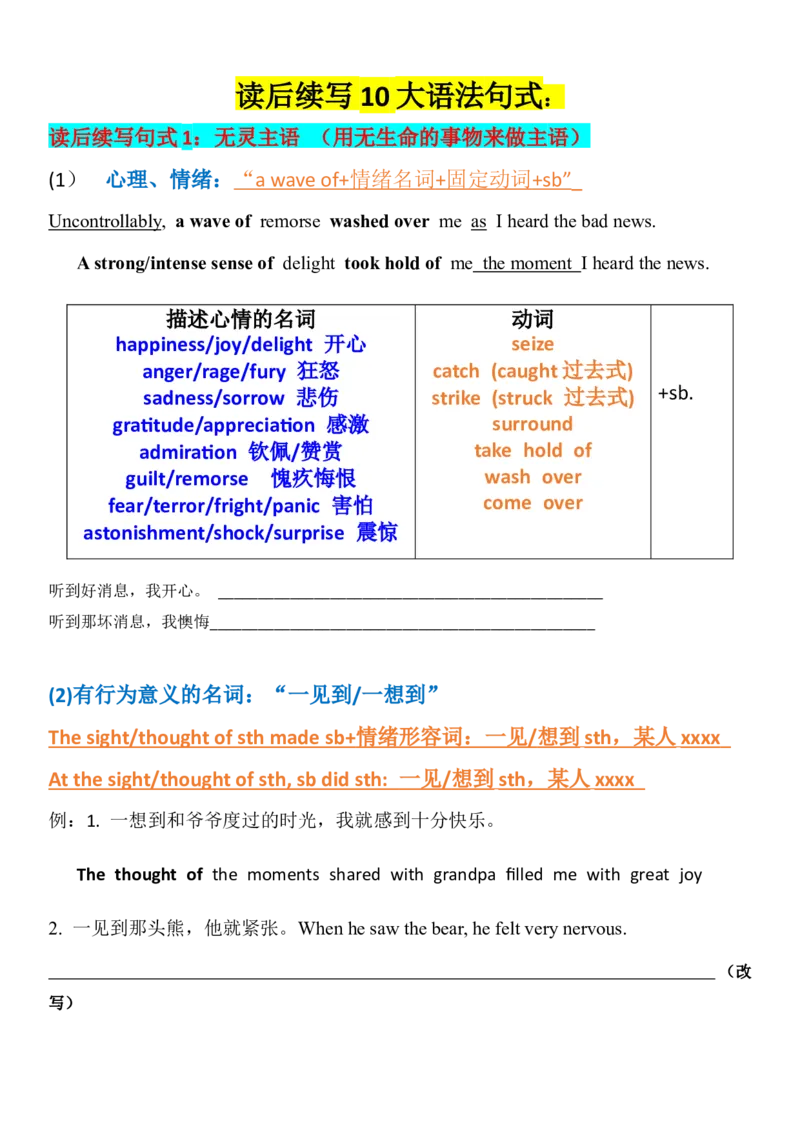
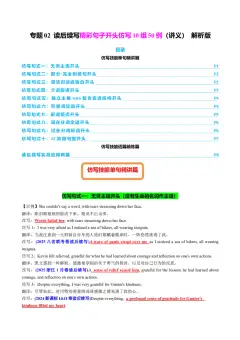
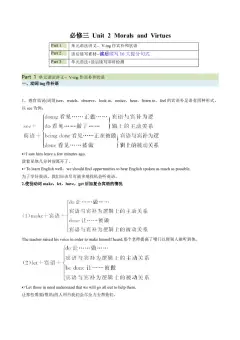
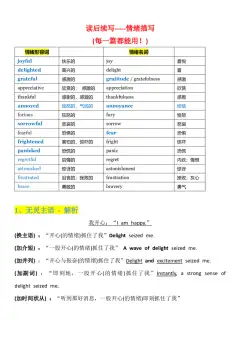
读后续写句式 1:无灵主语 (用无生命的事物来做主语)
(1) 心理、情绪: “ a wave of + 情绪名词 + 固定动词 +sb ”
Uncontrollably, a wave of remorse washed over me as I heard the bad news.
A strong/intense sense of delight took hold of me the moment I heard the news.
描述心情的名词 动词
happiness/joy/delight 开心 seize
anger/rage/fury 狂怒 catch (caught 过去式)
sadness/sorrow 悲伤 strike (struck 过去式) +sb.
gratitude/appreciation 感激 surround
admiration 钦佩/赞赏 take hold of
guilt/remorse 愧疚悔恨 wash over
fear/terror/fright/panic 害怕 come over
astonishment/shock/surprise 震惊
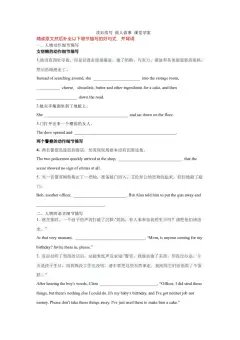
听到好消息,我开心。 ________________________________________________
听到那坏消息,我懊悔________________________________________________
(2)有行为意义的名词:“一见到/一想到”
The sight/thought of sth made sb+ 情绪形容词:一见 / 想到 sth ,某人 xxxx
At the sight/thought of sth, sb did sth: 一见 / 想到 sth ,某人 xxxx
例:1. 一想到和爷爷度过的时光,我就感到十分快乐。
The thought of the moments shared with grandpa filled me with great joy
2. 一见到那头熊,他就紧张。When he saw the bear, he felt very nervous.
(改
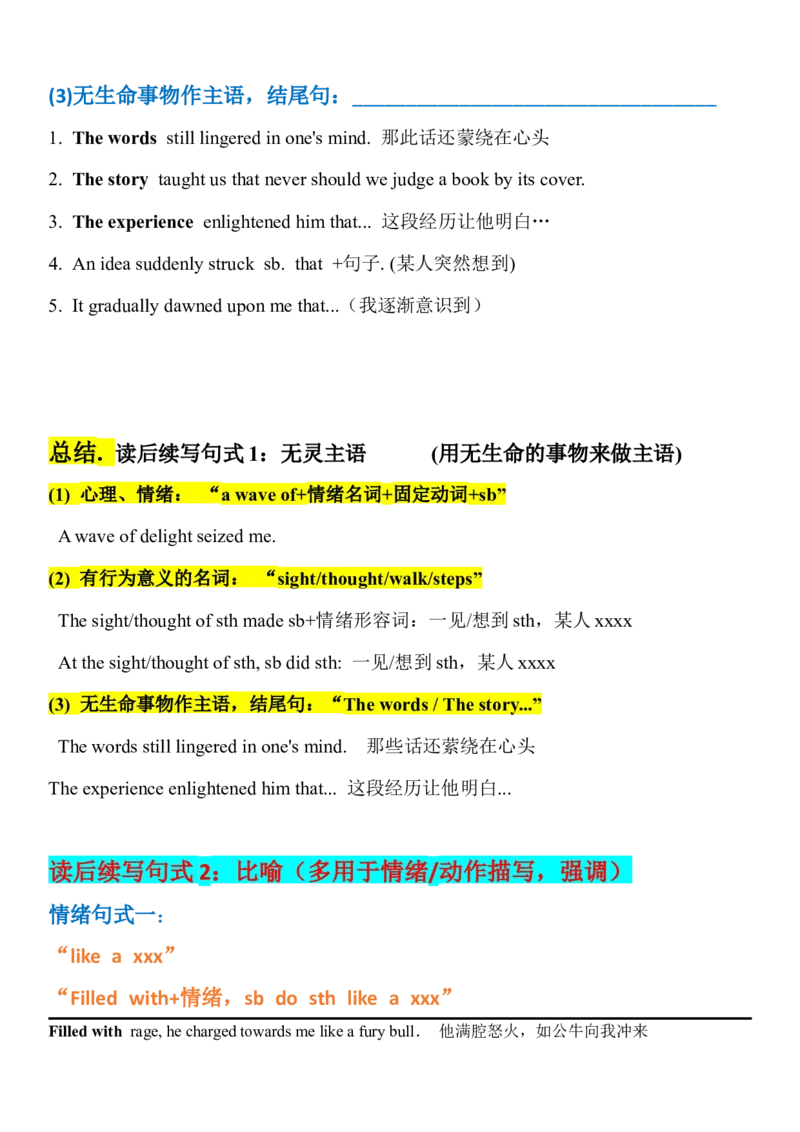
写)(3)无生命事物作主语,结尾句:__________________________________
1. The words still lingered in one's mind. 那此话还蒙绕在心头
2. The story taught us that never should we judge a book by its cover.
3. The experience enlightened him that... 这段经历让他明白…
4. An idea suddenly struck sb. that +句子. (某人突然想到)
5. It gradually dawned upon me that...(我逐渐意识到)
总结. 读后续写句式 1:无灵主语 (用无生命的事物来做主语)
(1) 心理、情绪: “a wave of+情绪名词+固定动词+sb”
A wave of delight seized me.
(2) 有行为意义的名词: “sight/thought/walk/steps”
The sight/thought of sth made sb+情绪形容词:一见/想到sth,某人xxxx
At the sight/thought of sth, sb did sth: 一见/想到sth,某人xxxx
(3) 无生命事物作主语,结尾句:“The words / The story...”
The words still lingered in one's mind. 那些话还萦绕在心头
The experience enlightened him that... 这段经历让他明白...
读后续写句式 2:比喻(多用于情绪/动作描写,强调)
情绪句式一:
“like a xxx”
“Filled with+情绪,sb do sth like a xxx”
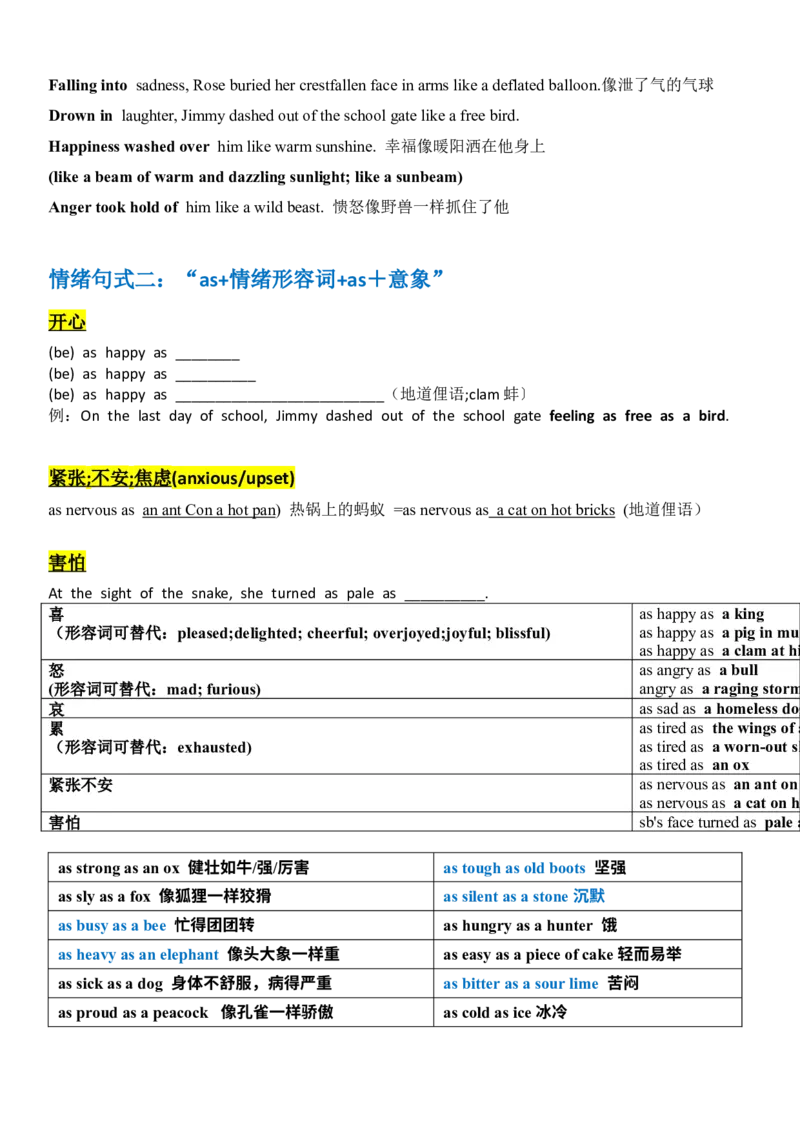
Filled with rage, he charged towards me like a fury bull. 他满腔怒火,如公牛向我冲来Falling into sadness, Rose buried her crestfallen face in arms like a deflated balloon.像泄了气的气球
Drown in laughter, Jimmy dashed out of the school gate like a free bird.
Happiness washed over him like warm sunshine. 幸福像暖阳洒在他身上
(like a beam of warm and dazzling sunlight; like a sunbeam)
Anger took hold of him like a wild beast. 愦怒像野兽一样抓住了他
情绪句式二:“as+情绪形容词+as+意象”
开心
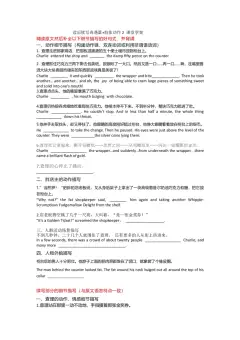
(be) as happy as ________
(be) as happy as __________
(be) as happy as __________________________(地道俚语;clam蚌〕
例:On the last day of school, Jimmy dashed out of the school gate feeling as free as a bird.
紧张 ; 不安 ; 焦虑 (anxious/upset)
as nervous as an ant Con a hot pan) 热锅上的蚂蚁 =as nervous as a cat on hot bricks (地道俚语)
害怕
At the sight of the snake, she turned as pale as __________.
喜 as happy as a king
(形容词可替代:pleased;delighted; cheerful; overjoyed;joyful; blissful) as happy as a pig in mud
as happy as a clam at high tide
怒 as angry as a bull
(形容词可替代:mad; furious) angry as a raging storm
哀 as sad as a homeless dog
累 as tired as the wings of a bird
(形容词可替代:exhausted) as tired as a worn-out shoe
as tired as an ox
紧张不安 as nervous as an ant on a hot pan
as nervous as a cat on hot brick
害怕 sb's face turned as pale as a sheet
as strong as an ox 健壮如牛/强/厉害 as tough as old boots 坚强
as sly as a fox 像狐狸一样狡猾 as silent as a stone 沉默
as busy as a bee 忙得团团转 as hungry as a hunter 饿
as heavy as an elephant 像头大象一样重 as easy as a piece of cake 轻而易举
as sick as a dog 身体不舒服,病得严重 as bitter as a sour lime 苦闷
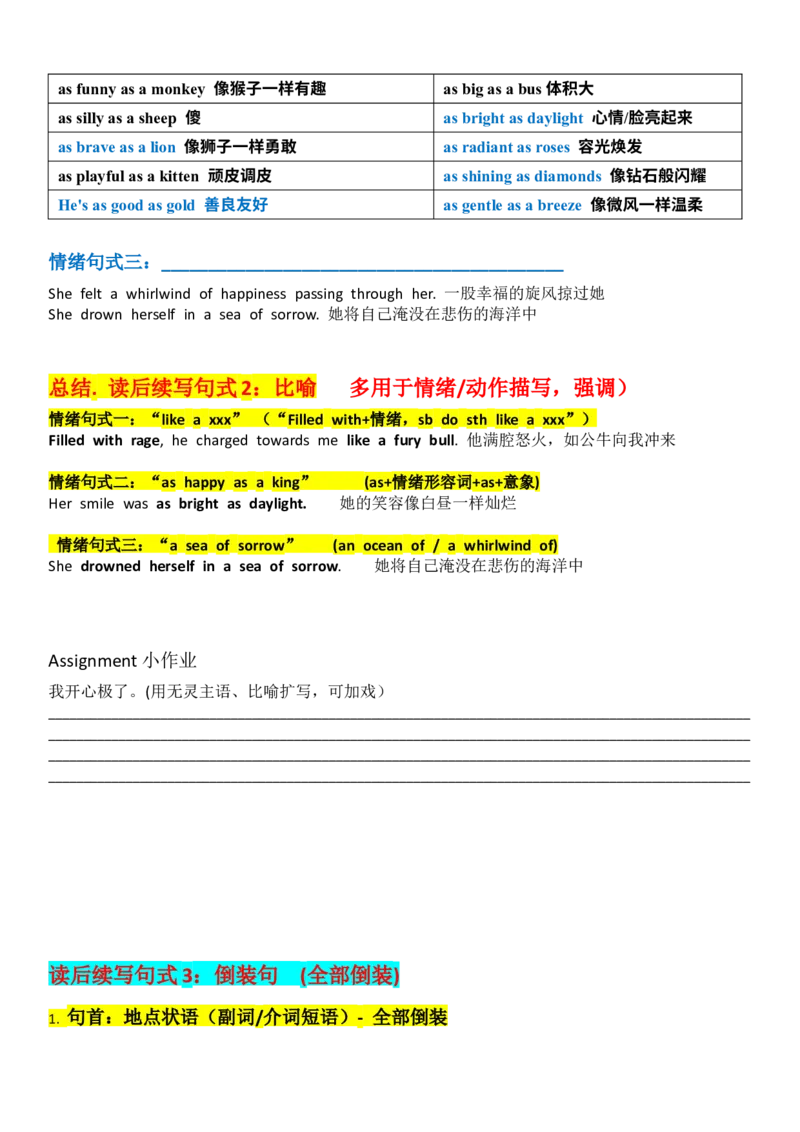
as proud as a peacock 像孔雀一样骄傲 as cold as ice 冰冷as funny as a monkey 像猴子一样有趣 as big as a bus 体积大
as silly as a sheep 傻 as bright as daylight 心情/脸亮起来
as brave as a lion 像狮子一样勇敢 as radiant as roses 容光焕发
as playful as a kitten 顽皮调皮 as shining as diamonds 像钻石般闪耀
He's as good as gold 善良友好 as gentle as a breeze 像微风一样温柔
情绪句式三:___________________________________________
She felt a whirlwind of happiness passing through her. 一股幸福的旋风掠过她
She drown herself in a sea of sorrow. 她将自己淹没在悲伤的海洋中
总结. 读后续写句式 2:比喻 多用于情绪/动作描写,强调)
情绪句式一:“like a xxx” (“Filled with+情绪,sb do sth like a xxx”)
Filled with rage, he charged towards me like a fury bull. 他满腔怒火,如公牛向我冲来
情绪句式二:“as happy as a king” (as+情绪形容词+as+意象)
Her smile was as bright as daylight. 她的笑容像白昼一样灿烂
情绪句式三:“a sea of sorrow” (an ocean of / a whirlwind of)
She drowned herself in a sea of sorrow. 她将自己淹没在悲伤的海洋中
Assignment小作业
我开心极了。(用无灵主语、比喻扩写,可加戏)
____________________________________________________________________________________________________
____________________________________________________________________________________________________
____________________________________________________________________________________________________
____________________________________________________________________________________________________
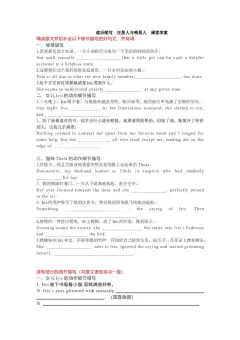
读后续写句式 3:倒装句 (全部倒装)
1.
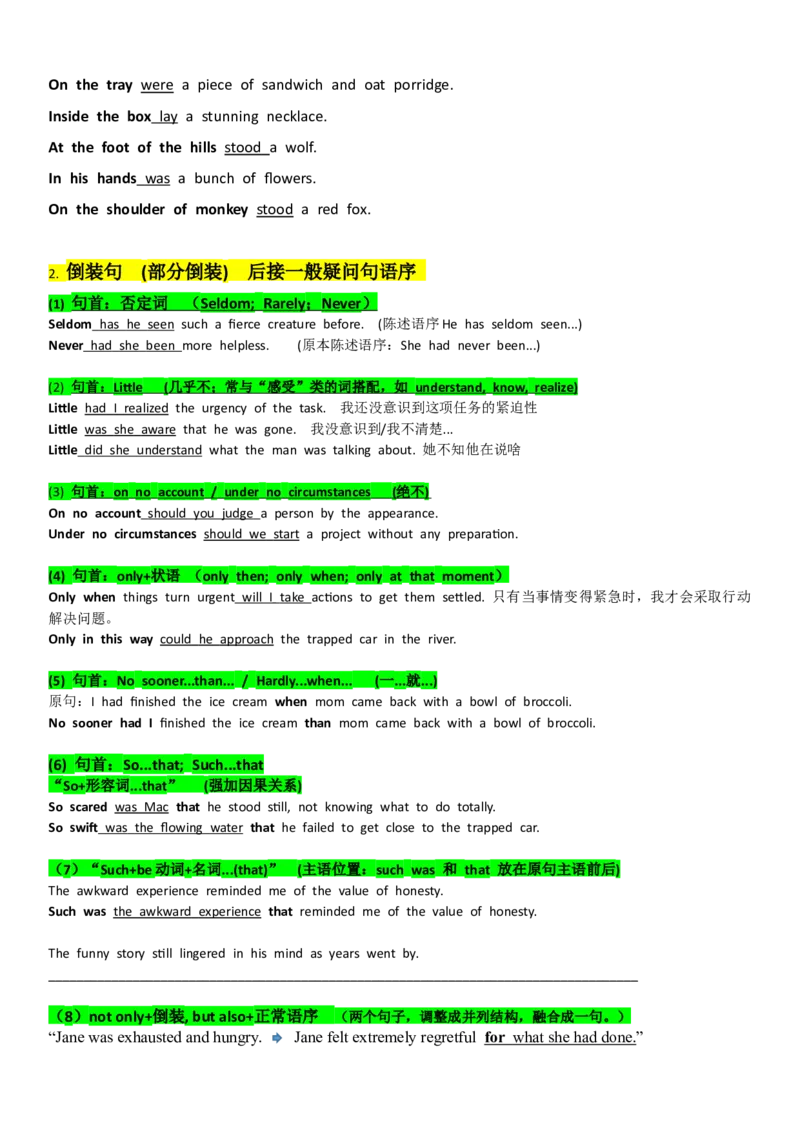
句首:地点状语(副词/介词短语)- 全部倒装On the tray were a piece of sandwich and oat porridge.
Inside the box la y a stunning necklace.
At the foot of the hills stood a wolf.
In his hands wa s a bunch of flowers.
On the shoulder of monkey stood a red fox.
2.
倒装句 (部分倒装) 后接一般疑问句语序
(1) 句首:否定词 ( Seldom ; Rarel y ; Neve r )
Seldom ha s h e seen such a fierce creature before. (陈述语序He has seldom seen...)
Never had sh e been more helpless. (原本陈述语序:She had never been...)
(2) 句首: Littl e ( 几乎不;常与“感受”类的词搭配,如 understand , know , realize )
Little had I realized the urgency of the task. 我还没意识到这项任务的紧迫性
Little was she aware that he was gone. 我没意识到/我不清楚...
Little did sh e understand what the man was talking about. 她不知他在说啥
(3) 句首: on no accoun t / unde r no circumstance s ( 绝不 )
On no account should you judg e a person by the appearance.
Under no circumstances should we start a project without any preparation.
(4) 句首:only+状语 (only then; only when; only at that moment)
Only when things turn urgent wi ll I take actions to get them settled. 只有当事情变得紧急时,我才会采取行动
解决问题。
Only in this way could he approach the trapped car in the river.
(5) 句首:No sooner...than... / Hardly...when... (一...就...)
原句:I had finished the ice cream when mom came back with a bowl of broccoli.
No sooner had I finished the ice cream than mom came back with a bowl of broccoli.
(6) 句首:So...that; Such...that
“So+形容词...that” (强加因果关系)
So scared was Mac that he stood still, not knowing what to do totally.
So swift wa s th e flowin g wate r that he failed to get close to the trapped car.
(7)“Such+be动词+名词...(that)” (主语位置:such was 和 that 放在原句主语前后)
The awkward experience reminded me of the value of honesty.
Such was the awkward experience that reminded me of the value of honesty.
The funny story still lingered in his mind as years went by.
____________________________________________________________________________________
(8)not only+倒装, but also+正常语序 (两个句子,调整成并列结构,融合成一句。)
“Jane was exhausted and hungry. Jane felt extremely regretful for what she had done .”Not only was Jane exhausted and hungry, but she was also extremely regretful for what she had done.
读后续写:倒装句 (练习)
1. I haven't ever felt so lonely. - never
————————————————————————————————————
2. I couldn't work because of the loud noise. - so...that
————————————————————————————————————
3. She didn't play a lot of basketball. - little
————————————————————————————————————
4. Peter didn't understand the situation. If he had, he would have quit. - had
————————————————————————————————————
5. The story hasn't been told correctly. - rarely
————————————————————————————————————
6. She bought the car after he had explained its benefits. - only after
————————————————————————————————————
7. I don't eat pork very often. - seldom
————————————————————————————————————
8. I would have bought a new house if I had had enough money. - had
————————————————————————————————————
9. I will sign the check when you finish the work. - only when
————————————————————————————————————
10. It was a day that we will all remember forever. - such
————————————————————————————————————续写情节句式 4:虚拟语气
① 情态动词+have done (“当初就(不)应该...”)
Looking at the perfect breakfast cooked by their father, they remorsefully thought, they should have
asked him how to make breakfast previously!
看着爸爸煮好的完美早餐,她们懊悔地想,应该先跟爸爸请教怎么做早餐的!
Remorsefully I thought to myself, I shouldn't have angered it. What a terrible try.
我懊悔地想,不应该惹怒它的,真是个糟糕的尝试。
② if only (“要是...就好了”)
Mom said delightedly, if only she could have such a delicious breakfast every day!
妈妈开心地说,要是每天都可以吃到这么美味的早餐就好了!
We should have prepared more bread. / If only we had prepared more bread.
应该多准备一些面包的/要是当时有准备更多面包就好了。
读后续写句式 5:非谓语
① V-ing,主句 | ② 主句,V-ing | ③ Having done sth, 主句
Considering the threat of the bear, we stayed far away from it.
Feeling ecstatic, she dashed out of the room like a wind.
She waved at the helicopter, smiling with relief.
④ V-ed, 主句, V-ing
Relieved and overjoyed, we yelled at the helicopter, trying to catch its attention.
Regretful and embarrassed, I admitted the lack of consideration in my previous behavior, longing for
another chance to make it up.
⑤ To do sth, 主句
To distract the bear, we threw a piece of bread far away.
读后续写句式 6:介词短语
1. with ( with+n.+ 非谓语 doing/done/to do, sb... )With tears welling up in his eyes, he thanked the police with a trembling voice.
With loads of homework to do, I had no options but to deal with it.
With everything well prepared, they carried the breakfast upstairs.
With great joy, poppy jumped high at the sight of the little dog.
2. Without+n, sb would (not) have done sth. (没有 ... 就没有 ... )
Without father’s help, they would have failed.
Without his help, they would not have prepared the breakfast in time.
Without the household chores, I would have finished the paper earlier.
读后续写句式7:独立主格
逻辑主语+ 非谓语(ing/ed/to do、形容词、副词、介短),主句
With tears welling up in his eyes, he thanked the police with a trembling voice.
With loads of homework to do, I had no options but to deal with it.
With everything well prepared, they carried the breakfast upstairs.
读后续写句式 8:间断式句子
1. 副词提前: “Adv.,sb did sth, doing sth”
“I washed the dish reluctantly.” -> Reluctantly, I washed the dish, feeling impatient.
2. 嵌入短语:“sb, 介词短语/从句,do sth”
The helicopter, as expected, had finally arrived.
3. 嵌入打比方:“sb, like+同类人,do sth”
Polar bears — like all wild animals — should be photographed from a safe distance.
I, like many a procrastinator, failed to resist the temptation of entertainments.
4. 嵌入解释:“sb, 同位语/定语从句,do sth”
Bears, a sort of solitary creature / a fierce creature, can be dangerous.
Bears, which are usually solitary creatures, can be dangerous.
读后续写句式 9-10: 偏爱句式1.让步状语从句:“adj.+as/though+主谓” (转折)
Reluctant as I was , I had no choice but to wash the dishes as told. (Though I was reluctant, I had to...
不愿)
Exhausted and hungry as he was , he carried on climbing the mountain.
Ugly though the man wa s, he bore a kind heart as pure as a diamond.
2.强调句:“it was + sb/sth+that+主谓”
It was the man’s generous help that rid her of loads of troubles. 正是这个男人的慷慨帮助让她摆脱了烦
恼
It was not until then that she realized the importance of practice. 直到那时才...
3. 长短句相间:小短句+长句(感叹句; 简单主谓)
It proved a big success. A perfect breakfast was produced by father like magic.
Finally, they made it. A perfect set of breakfast was ready and it’s time to surprise mom.
What a fantastic breakfast! The twins could not wait to show it to their mother.
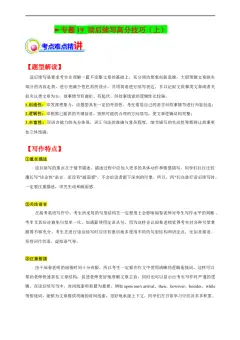
读后续写 句式大合集
1、无灵主语:心理、情绪;行为意义名词;无生命事物作主语/结尾句
2、虚拟语气:情态动词+have done“当初应该”;if only“要是...就好了”
3、独立主格:Tears welling up in his eyes, he thanked the police...
4、拟人比喻:like a xxx; as happy as a king;a sea of sorrow
5、介词短语:with 结构/情绪;without 结构
6、非谓语:V-ing/V-ed/to do,主句 | Having done sth, 主句
7、强调句:“it was + sb/sth+that+主谓”
8、倒装句:地点状语/否定词/only 状语/so...that/not only...but also
9-10、特别句式:隔断式;让步状语 “Difficult as it was,...”;长短句