必修三 Unit 5 The Value of Money
Part 1 单元语法讲义--情态动词/过去将来时
Part 2 读后续写素材--环境描写经典十句
Part 3 单元语法+读后续写即时检测
Part 1 单元语法讲义--情态动词/过去将来时
一、情态动词
一)情态动词基本概念
情态动词本身有词义,但是没有人称和数的变化。情态动词有时态的变化,但是不能独立作谓语。情态动
词可以表示:能力、义务、可能性和允许等等意义;情态动词还可以用来给人们:提出请求、建议、意见
以及提供帮助等等。
二)情态动词基本用法和意义
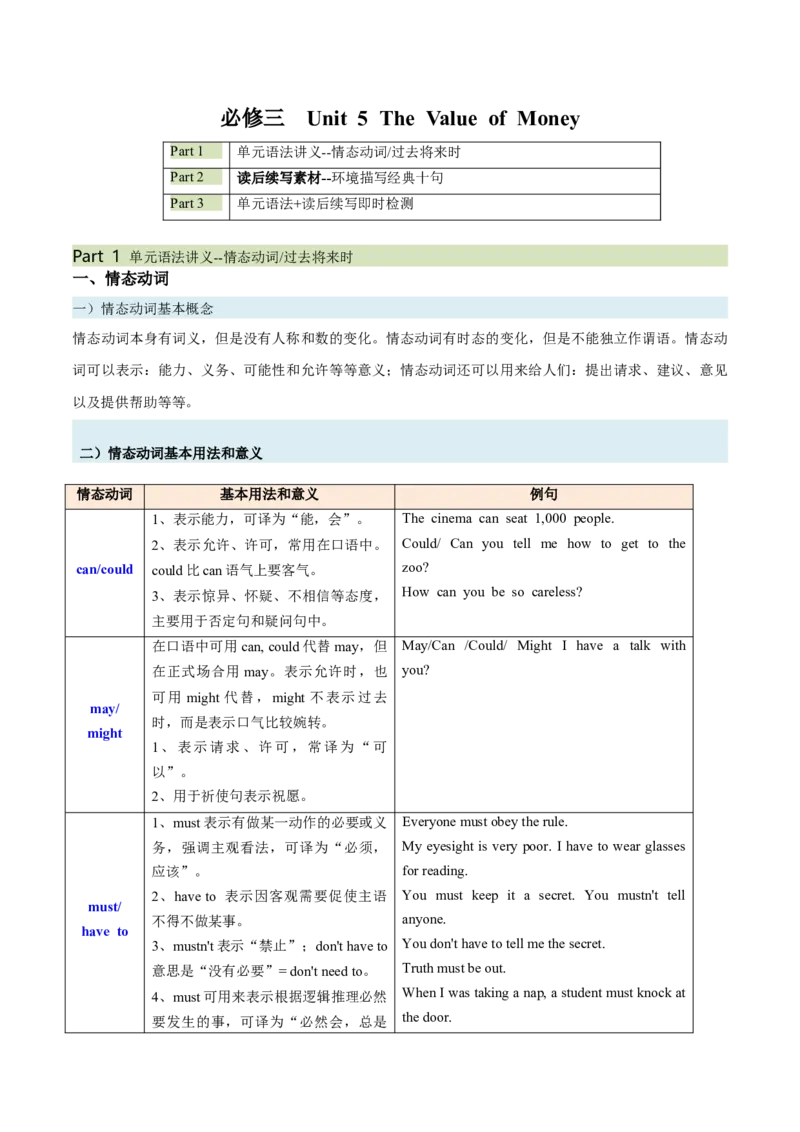
情态动词 基本用法和意义 例句
1、表示能力,可译为“能,会”。 The cinema can seat 1,000 people.
2、表示允许、许可,常用在口语中。 Could/ Can you tell me how to get to the
can/could could比can语气上要客气。 zoo?
3、表示惊异、怀疑、不相信等态度, How can you be so careless?
主要用于否定句和疑问句中。
在口语中可用can, could代替may,但 May/Can /Could/ Might I have a talk with
在正式场合用may。表示允许时,也 you?
可用 might 代替,might 不表示过去
may/
时,而是表示口气比较婉转。
might
1、表示请求、许可,常译为“可
以”。
2、用于祈使句表示祝愿。
1、must表示有做某一动作的必要或义 Everyone must obey the rule.
务,强调主观看法,可译为“必须, My eyesight is very poor. I have to wear glasses
应该”。 for reading.
2、have to 表示因客观需要促使主语 You must keep it a secret. You mustn't tell
must/
不得不做某事。 anyone.
have to
3、mustn't表示“禁止”;don't have to You don't have to tell me the secret.
意思是“没有必要”= don't need to。 Truth must be out.
4、must可用来表示根据逻辑推理必然 When I was taking a nap, a student must knock at
the door.
要发生的事,可译为“必然会,总是会”。
5、must有时可用来表示“偏偏”的意
思。
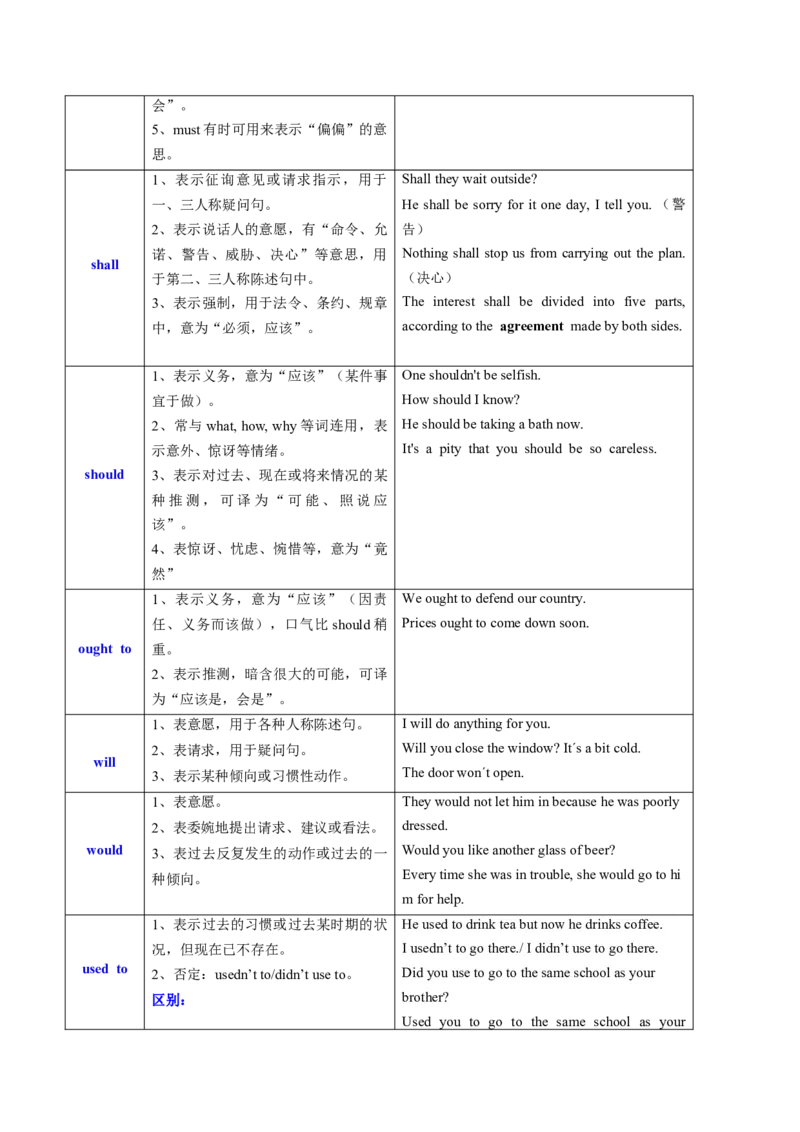
1、表示征询意见或请求指示,用于 Shall they wait outside?
一、三人称疑问句。 He shall be sorry for it one day, I tell you. (警
2、表示说话人的意愿,有“命令、允 告)
诺、警告、威胁、决心”等意思,用 Nothing shall stop us from carrying out the plan.
shall
于第二、三人称陈述句中。 (决心)
3、表示强制,用于法令、条约、规章 The interest shall be divided into five parts,
中,意为“必须,应该”。 according to the agreement made by both sides.
1、表示义务,意为“应该”(某件事 One shouldn't be selfish.
宜于做)。 How should I know?
2、常与what, how, why等词连用,表 He should be taking a bath now.
示意外、惊讶等情绪。 It's a pity that you should be so careless.
should 3、表示对过去、现在或将来情况的某
种推测,可译为“可能、照说应
该”。
4、表惊讶、忧虑、惋惜等,意为“竟
然”
1、表示义务,意为“应该”(因责 We ought to defend our country.
任、义务而该做),口气比 should稍 Prices ought to come down soon.
ought to 重。
2、表示推测,暗含很大的可能,可译
为“应该是,会是”。
1、表意愿,用于各种人称陈述句。 I will do anything for you.
2、表请求,用于疑问句。 Will you close the window? It´s a bit cold.
will
3、表示某种倾向或习惯性动作。 The door won´t open.
1、表意愿。 They would not let him in because he was poorly
2、表委婉地提出请求、建议或看法。 dressed.
would 3、表过去反复发生的动作或过去的一 Would you like another glass of beer?
种倾向。 Every time she was in trouble, she would go to hi
m for help.
1、表示过去的习惯或过去某时期的状 He used to drink tea but now he drinks coffee.
况,但现在已不存在。 I usedn’t to go there./ I didn’t use to go there.
used to 2、否定:usedn’t to/didn’t use to。 Did you use to go to the same school as your
区别: brother?
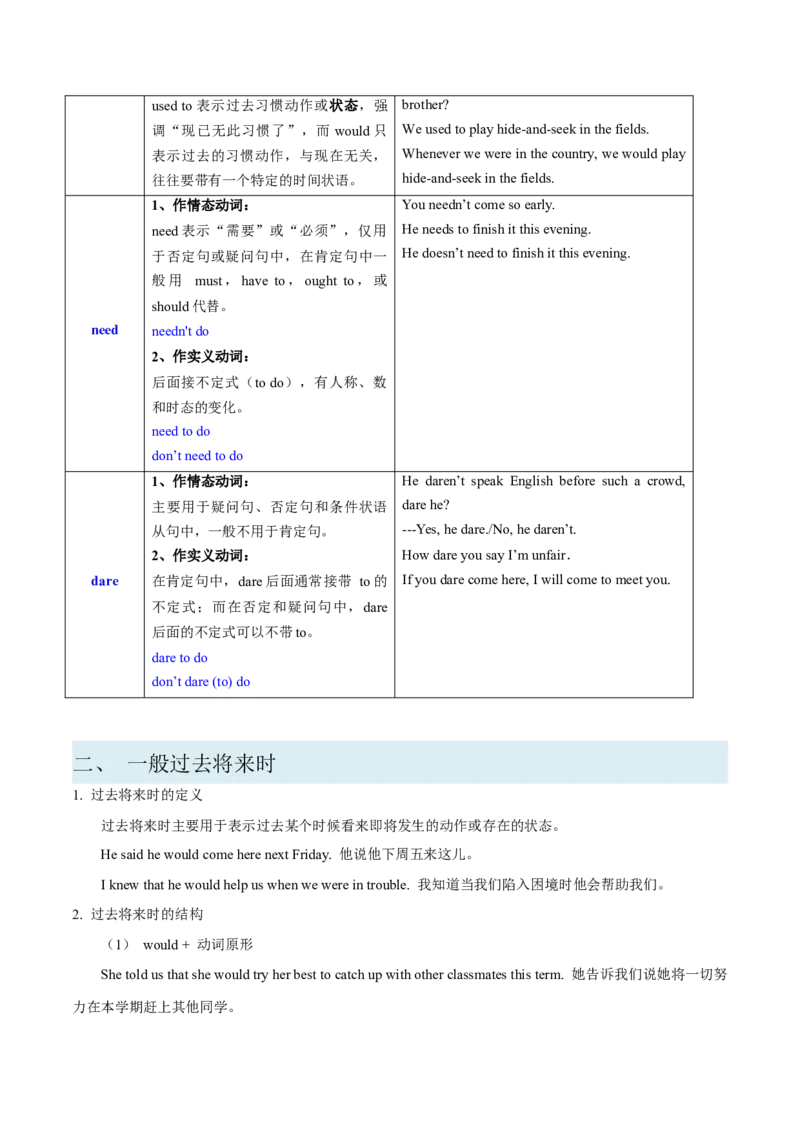
Used you to go to the same school as yourused to表示过去习惯动作或状态,强 brother?
调“现已无此习惯了”,而 would只 We used to play hide-and-seek in the fields.
表示过去的习惯动作,与现在无关, Whenever we were in the country, we would play
往往要带有一个特定的时间状语。 hide-and-seek in the fields.
1、作情态动词: You needn’t come so early.
need表示“需要”或“必须”,仅用 He needs to finish it this evening.
于否定句或疑问句中,在肯定句中一 He doesn’t need to finish it this evening.
般用 must,have to,ought to,或
should代替。
need needn't do
2、作实义动词:
后面接不定式(to do),有人称、数
和时态的变化。
need to do
don’t need to do
1、作情态动词: He daren’t speak English before such a crowd,
主要用于疑问句、否定句和条件状语 dare he?
从句中,一般不用于肯定句。 ---Yes, he dare./No, he daren’t.
2、作实义动词: How dare you say I’m unfair.
dare 在肯定句中,dare后面通常接带 to的 If you dare come here, I will come to meet you.
不定式;而在否定和疑问句中,dare
后面的不定式可以不带to。
dare to do
don’t dare (to) do
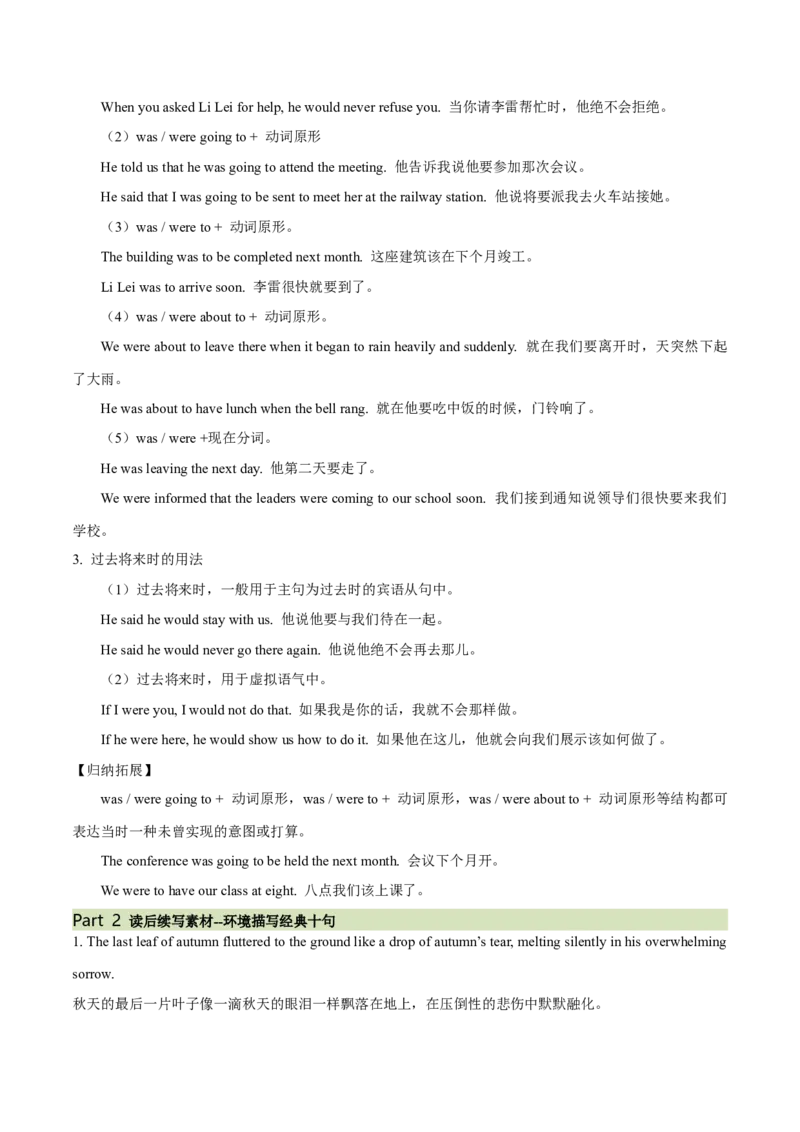
二、 一般过去将来时
1. 过去将来时的定义
过去将来时主要用于表示过去某个时候看来即将发生的动作或存在的状态。
He said he would come here next Friday. 他说他下周五来这儿。
I knew that he would help us when we were in trouble. 我知道当我们陷入困境时他会帮助我们。
2. 过去将来时的结构
(1) would + 动词原形
She told us that she would try her best to catch up with other classmates this term. 她告诉我们说她将一切努
力在本学期赶上其他同学。When you asked Li Lei for help, he would never refuse you. 当你请李雷帮忙时,他绝不会拒绝。
(2)was / were going to + 动词原形
He told us that he was going to attend the meeting. 他告诉我说他要参加那次会议。
He said that I was going to be sent to meet her at the railway station. 他说将要派我去火车站接她。
(3)was / were to + 动词原形。
The building was to be completed next month. 这座建筑该在下个月竣工。
Li Lei was to arrive soon. 李雷很快就要到了。
(4)was / were about to + 动词原形。
We were about to leave there when it began to rain heavily and suddenly. 就在我们要离开时,天突然下起
了大雨。
He was about to have lunch when the bell rang. 就在他要吃中饭的时候,门铃响了。
(5)was / were +现在分词。
He was leaving the next day. 他第二天要走了。
We were informed that the leaders were coming to our school soon. 我们接到通知说领导们很快要来我们
学校。
3. 过去将来时的用法
(1)过去将来时,一般用于主句为过去时的宾语从句中。
He said he would stay with us. 他说他要与我们待在一起。
He said he would never go there again. 他说他绝不会再去那儿。
(2)过去将来时,用于虚拟语气中。
If I were you, I would not do that. 如果我是你的话,我就不会那样做。
If he were here, he would show us how to do it. 如果他在这儿,他就会向我们展示该如何做了。
【归纳拓展】
was / were going to + 动词原形,was / were to + 动词原形,was / were about to + 动词原形等结构都可
表达当时一种未曾实现的意图或打算。
The conference was going to be held the next month. 会议下个月开。
We were to have our class at eight. 八点我们该上课了。
Part 2 读后续写素材--环境描写经典十句
1. The last leaf of autumn fluttered to the ground like a drop of autumn’s tear, melting silently in his overwhelming
sorrow.
秋天的最后一片叶子像一滴秋天的眼泪一样飘落在地上,在压倒性的悲伤中默默融化。2. And the night was so beautiful, so utterly, glamorously beautiful, with its star flowers, and its silence, and its
trees clothed in moonlight.
夜晚是如此美丽,如此彻底,美丽,有星星般的花朵,寂静,树木被月光素裹。
3. The lake was streaming in the strong sun and the outline of the mountains trembled through the heat haze.
湖水在烈日下流淌,山脉的轮廓在热雾中颤抖。(天热
4. Heat licked at their sunburned faces and coiled around their limbs like a great hot blooded. (burning oven)
炎热附着他们晒伤的脸,像热血一样盘绕在他们的四肢上。
5.A strong flow of warmth made its way towards my body.
一股强烈的温暖流向我的身体。
6. I could see my footprints in the snowy path, like a trail of breadcrumbs in the forest showing me the way home.
我可以在雪地的小径上看到我的脚印,就像森林里的面包屑引着我回家的路。
7. Accompanied by sheets of rain, roaring winds swept over the streets, pouring in any corner they could find.
在一片雨的伴随下,狂风席卷了街道,涌入了他们能找到的任何角落。
8. The sky darkened without precaution(防备), the clouds piling up, the wind roaring, and the rain pouring.
(雨)
天空毫无防备地变暗了,云层堆积,风咆哮,倾盆大雨。
9. Rattled the fragile heavens the roaring of thunder, with the dazzling lightening penetrating the gloom of night.
响彻脆弱的天空,咆哮着雷声,耀眼的闪电穿透了夜晚的阴暗。
10. Blinding lightening cracked the dark sky with its stretched black of boundless energy. The thunder clouds
clapped his giant hands as if announcing his unoffendable authority.
耀眼的闪电以其无限能量的伸展黑色打破了黑暗的天空。雷云拍打着他巨大的双手,仿佛在宣布他无与伦
比的权威。
Part 3 单元语法+读后续写即时检测
一、单项选择
1.(2024·天津·二模)I love spring because I______ endure the cold of winter or avoid the burning sun of
summer in spring.
A.mustn’t B.needn’t C.can’t D.shouldn’t
【答案】B
【详解】考查情态动词的用法。句意:我喜欢春天,因为在春天我不必忍受冬天的寒冷或避开夏天的烈日。
A. mustn’t禁止;B. needn’t不必;C. can’t不能;D. shouldn’t不应该。根据句意,春天是一个温和的季节,
不需要避免极端的冷或热,needn’t符合题意,故选B项。2.(2024·天津·模拟预测)When weather permitted, he __________ go to the tea house after dinner to talk with
other old partners every day.
A.might B.should C.could D.would
【答案】D
【详解】考查情态动词词义辨析。句意:只要天气允许,他每天晚饭后都会去茶馆和其他老搭档聊天。A.
might可能;B. should应该;C. could可以;D. would过去常常。由When weather permitted和every day可
知,空格处用would表示过去常常做的事情,故选D。
3.(2024·天津·二模)—Sorry, Tony. I’m too busy to attend the meeting this Saturday.
—Well, you ________ attend it if you truly can’t spare the time.
A.shouldn’t B.needn’t C.can’t D.mustn’t
【答案】B
【详解】考查情态动词。句意:——对不起,托尼。我太忙了,不能参加这个星期六的会议。——嗯,如
果你真的抽不出时间,你就不必参加了。A. shouldn’t不应该;B. needn’t不必;C. can’t不能; D. mustn’t
禁止,不允许。根据“if you truly can’t spare the time.”可知,抽不出时间就不必参加星期六的会议了。故选
B。
4.(2024·天津·二模)The HR director announced, “Candidates _______ remain in your seats until all the papers
have been collected.”
A.can B.shall C.would D.need
【答案】B
【详解】考查情态动词辨析。句意:人力资源总监宣布:“候选人应留在座位上,直到所有试卷都收集完
毕。”A. can 能够,可能;B. shall必须,应该;C. would将,会;D. need需要。根据句意可知,此处表
示规定,应用情态动词shall,表示规定、警告、命令。故选B。
5.(2024·天津和平·三模)My laptop ______ be old, but it still works really well.
A.can B.could C.may D.would
【答案】C
【详解】考查情态动词。句意:我的笔记本电脑或许旧了,但它仍然工作得很好。A.can能够;B.could能
够;C.may或许;D.would将。根据下文but it still works really well,此处表示事实上的可能性,用may ,
can表示逻辑上的可能性。故选C。
6.(23-24高三下·天津南开·阶段练习)I can’t find my wallet now. I________ it in the bus just now, but I’m
not sure.A.should leave B.could have left
C.must have left D.might leave
【答案】B
【详解】考查情态动词表示推测的用法。句意:我现在找不到我的钱包了。我可能刚才在公交车上把它落
下了,但我不确定。should leave表示应该做某事,不符合句意。 could have left表示过去可能做了某事,
符合句意,表示说话者对可能发生的事情的推测。must have left表示对过去发生的事情的肯定推测,但句
中提到“但我不确定”,所以这个选项太绝对了。might leave表示将来可能做某事,不符合句意,因为句
子讨论的是过去发生的事情。故选B项。
7.(2024·天津滨海新·三模)The first attempt at making a lantern proved more challenging than the boy ever
______ have imagined.
A.could B.must C.needn’t D.shouldn’t
【答案】A
【详解】考查情态动词的固定用法。句意:男孩发现,制作灯笼的第一次尝试比他想象的更具挑战性。分
析句子可知,这个题考查的是could have done的固定结构,表示对过去的一种可能性猜测。这个男孩是在
过去想象灯笼是否好做,could have imagined便是这个意思,故选A项。
8.(2024·天津北辰·三模)The high school student answered all the questions properly. In my view, he ______
have read many books.
A.must B.should C.need D.could
【答案】A
【详解】考查情态动词。句意:这个高中生把所有的问题都答得很好。在我看来,他一定读了很多书。
must have done必定做了……(表示对过去的推测),should have done原本该做但是没做,need have done本
需要做某事却没有做,could have done本能做某事却没有做,结合“The high school student answered all the
questions properly.”可知,此处指我认为这个高中生过去一定读了很多书。故选A项。
9.(2024·天津南开·一模)I know he was wrong, but I ________ tell him because he never listens.
A.mustn’t B.daren’t C.needn’t D.oughtn’t
【答案】C
【详解】考查情态动词。句意:我知道他错了,但我不必告诉他,因为他从来不听。A. mustn’t禁止,不
许;B. daren’t不敢;C. needn’t不必;D. oughtn’t不应该。结合because he never listens可知,空格处应表达
“不必”,故用 needn’t。故选C。
10.(2024·天津和平·一模)People liked O. Henry’s stories, because simple as the tales were, they ______finish with a sudden change at the end, to the readers’ surprise.
A.could B.would C.might D.must
【答案】B
【详解】考查情态动词词义辨析。句意:人们喜欢欧·亨利的故事,因为这些故事虽然简单,但往往会在结
尾突然发生变化,让读者感到惊讶。A. could可能;B. would常常;C. might也许;D. must必须。此处表
示过去的习惯,“would + 动词原形”表示过去常常做某事。故选B。
11.(2024·天津·一模)Whenever I visited my grandmother’s house, I ______ rush to the kitchen for the stinky
tofu with excitement.
A.shall B.would C.must D.may
【答案】B
【详解】考查情态动词辨析。句意:从那时起,每当我去奶奶家,我都会兴奋地冲进厨房吃臭豆腐。A.
shall将要,用于一般将来时;B. would将会;C. must必须;D. may可能。根据上文“Whenever I visited
my grandmother’s house”可知,此处主句为过去将来时,为would+动词原形。故选B。
12.(2024·天津·一模)Look, double yellow lines! You park here.
A.wouldn’t B.mustn’t C.needn’t D.daren’t
【答案】B
【详解】考查情态动词词义辨析。句意:看,双黄线!你禁止在这里停车。A. wouldn’t不会;B. mustn’t禁
止;C. needn’t不需要;D. daren’t不敢。由“double yellow lines”可知,句子表示“你禁止在这里停车”,
空格处表示“禁止”,故选B。
13.(23-24高二下·天津·阶段练习)During our trip to the Great Wall last week, I couldn’t stop thinking about
how huge a project it ________ have been to build it in ancient times.
A.must B.could C.should D.need
【答案】A
【详解】考查情态动词辨析。句意:上周我们去长城的时候,我一直在想,在古代修建长城一定是一项多
么浩大的工程啊。A. must必须,一定;B. could可以;C. should应该;D. need需要。结合句意及“to build
it in ancient times”可知,此处表示对过去肯定的推测,指在古代修建长城一定是一项非常浩大的工程,故
选A。
14.(23-24高三下·天津·阶段练习)I advise you to stay away from Mary. Although she is usually easy-going,
she ______be quite annoying sometimes.
A.can B.need C.must D.should【答案】A
【详解】考查情态动词用法。句意:我劝你离玛丽远点。虽然她通常很随和,但有时也很烦人。A. can有
时会;B. need需要;C. must必须;D. should应该。根据“Although she is usually easy-going”可知,此处应
用情态动词can表示“有时会”。故选A。
15.(2024·天津河东·一模)I ______ you about your mistakes, but I didn’t think you would listen to me.
A.could have toldB.must have told C.should tell D.might tell
【答案】A
【详解】考查情态动词 。句意:我本可以告诉你你的错误,但我认为你不会听我的。A. could have done
本可以做某事而没有做;B. must have done一定做过某事;C. should do应该做某事;D. might do可能做某
事。根据“but I didn’t think you would listen to me.”可知,本可以告诉你你的错误。故选A。
16.(23-24高三下·天津南开·开学考试)It is very important that we be honest about what we do not know.
A.need B.will C.must D.can
【答案】C
【详解】考查情态动词。句意:非常重要的是,我们必须诚实地对待我们不知道的事情。根据语境可知,
空处应填情态动词must,表示“必须”,need需要;will表示意愿;can表示能够。故选C项。
17.(2024·天津河北·一模)—The test is very important to us. Do you think so?
—Yes, so we ________ be too careful during the test.
A.mustn’t B.daren’t C.needn’t D.can’t
【答案】D
【详解】考查情态动词。句意:——考试对我们来说非常重要。你认为是吗?——是的,所以我们在考试
时再认真都不为过。A.must't禁止;B.daren't不敢; C.neednt不必;D.can't不能。分析结构可知这向话使
用“can't be too+形容词”的句型,意为“再……都不为过”。故选D。
18.(23-24高三下·重庆·开学考试)Look at the school rules. It says we___________ be late for school.
A.can B.must C.needn’t D.mustn’t
【答案】D
【详解】考查情态动词的辨析。句意:看看校规。上面说我们上学不能迟到。A. can能,可以;B. must必
须,一定;C. needn’t不必;D. mustn’t不应该,不可以,不能。根据上下文可知,校规说我们不能迟到。
故选D。
19.(23-24高三上·天津和平·期末)According to the agreement in the World Meteorological Congress, the
resolution come into effect upon signature.
A.should B.shall C.would D.must【答案】B
【详解】考查情态动词词义辨析。句意:根据世界气象大会的协议,该决议自签署之日起生效。A. should
应该;B. shall 必须,一定,应该;C. would 将,会(will的过去式);D. must 必须。分析句子结构和意
思可知,这里考查shall的用法:当主语是第三人称时,在陈述句中用shall表示义务、强制,命令,允诺
等语气。故选B。
20.(23-24高三上·天津·期末)—I’m leaving for Shanghai tomorrow for the Spring Festival holiday.
—Good for you. Remember to bring more clothes because the winter in Shanghai _______ be very cold
sometimes.
A.would B.shall C.can D.may
【答案】C
【详解】考查情态动词。句意:———我明天要去上海过春节。———真不错。记得多带些衣服,因为上
海的冬天有时会很冷。A. would会,要;B. shall可以,将(常与第一人称连用);C. can可以,可能;D.
may也许,可能。根据下文“be very cold sometimes”可知,此处表示按常理推断的抽象的可能性,应用
can;may通常表示实际的、马上能应验的可能性。故选C项。
21.(23-24高三上·天津河东·期末)I ______ pay Tracy a visit, but I am not sure whether I will have time this
Sunday.
A.should B.might C.would D.could
【答案】A
【详解】考查情态动词。句意:我应该去拜访特蕾西,但我不确定这个星期天是否有时间。根据 but 后的
句意,可以推测出前一句,我应该拜访。should 表示“应该”。might 表示“可能”和“允许”,would
表示“将要”,could 表示“可能性”和“能力”。故选A项。
22.(23-24高三上·天津西青·期末)Peter have been so anxious about the deadline, for he had plenty of time
to complete the project.
A.dare not B.needn’t C.mustn’t D.won’t
【答案】B
【详解】考查情态动词。句意:彼得本不必为最后期限如此焦虑,因为他有充足的时间来完成这个项目。
A. dare not不敢;B. needn’t不必;C. mustn’t禁止;D. won’t不会。needn’t have done表示“本不必做某
事”,根据for he had plenty of time to complete th project可知,needn’t符合题意。故选B项。
23.(23-24高三上·天津和平·期末)They ______ finished the project; it was due on last Friday.
A.must have B.ought to have C.would have D.might have【答案】A
【详解】考查情态动词。句意:他们一定已经完成了这个项目;上星期五就该交了。由句意及it was due
on last Friday可知此处是对过去事实的肯定推测,应用情态动词must+have done的结构,故选A项。
24.(23-24高三上·天津河西·期末)There were no signs that the fire had been set deliberately. It ________ by
a cigarette end, I guess.
A.would have been caused B.should have been caused
C.might have been caused D.must have been caused
【答案】C
【详解】考查情态动词+have done用法辨析。句意:没有迹象表明这场火灾是故意纵火。我猜可能是烟头
引起的。A. would have been caused将会被……引起;B. should have been caused本应该被……引起;C.
might have been caused可能被……引起;D. must have been caused肯定被……引起。根据语境和后文“I
guess”,此处表示主观推测,可能性不大。故选C项。
25.(23-24高三上·天津·阶段练习)My nephew William is still a puzzle to me—sometimes he is as quiet as a
mouse, while he______be fairly active at other times.
A.should B.need C.must D.can
【答案】D
【详解】考查情态动词。句意:我的侄子威廉对我来说仍然是个谜——有时他像老鼠一样安静,而其他时
候他又很活跃。A. should应该,竟然;B. need需要;C. must肯定,必须;D. can能,可能。结合语境与at
other times可知,此处表示对现在情况的推测,情态动词can表示一时的情况,意为“有时侯会……”符
合语境。故选D项。
26.(23-24高三上·天津·阶段练习)I didn’t see Fred in the library this morning. He_____have borrowed that
book.
A.mustn’t B.shouldn’t C.couldn’t D.needn’t
【答案】C
【详解】考查情态动词。句意:今天早上我没在图书馆看到弗雷德。他不可能借了那本书。A. mustn’t禁
止;B. shouldn’t不应该;C. couldn’t不可能;D. needn’t不需要。结合语境可知,此处表示对过去情况的推
测,根据“I didn’t see Fred in the library this morning.”可知,因上午在图书馆没见过Fred,所以推测“不可
能”是Fred借的那本书,应使用情态动词couldn’t符合语境。故选C项。
(2024·辽宁沈阳·模拟预测)阅读下面材料,根据其内容和所给段落开头语续写两段,使之构成一篇完整的短文。续写的词数应为150左右。
It was almost New Year’s Eve, and as I made my way home from work, I decided to stop at the
neighborhood coffee shop in our town—a town that had previously been busy and wealthy but was now poor and
deserted. After parking in a parking lot that was close to the coffee shop, I headed toward the shop door when I
spotted trouble.
What lit a warning light in my mind was a group of teenagers—three boys and a girl, each of whom stood on
a skateboard. I wasn’t alarmed by the way they were dressed, which showed they seemed to be a group of bad
teenagers. Rather, it was the extremely late hour and the fact that they wandered on the sidewalk in a half circle
around an elderly man sitting in a chair that raised a red flag in my mind. Wearing only a very worn-out shirt and
without shoes on his feet, the old man looked positively cold and probably homeless.
He was in trouble with a capital T. Against my better judgment, I went inside the warm store and ordered
nice bread and a cup of coffee while keeping a worried eye on the group outside. Thoughts raced through my mind,
and I was wondering what the intentions of these teenagers were. “What do the teenagers want on earth? Do they
intend to play a bad trick on the old man, make fun of him, or…?” I wondered, anxious. “Whatever it is, they seem
to plan to do something bad to him. Oh, these kids seem to be mean,” I thought and felt upset.
But nothing seemed to be happening. Slightly relieved, I began to enjoy my food. However, minutes after I
finished my food and headed toward my car, something indeed was “going down”. I heard one boy say, “Stand up
and walk.” “Oh, no,” I thought. “The old man is now in real trouble.”
注意:
1. 续写词数应为150左右;
2. 请按如下格式作答。
But wait, I had misjudged the situation.
____________________________________________________________________________________________
____________________________________________________________________________________________
____________________________________________________________________________________________
____________________________________________________________________________________________
____________________________________________________________________________
I looked down, finding the teen was wearing nothing on his feet.
____________________________________________________________________________________________
________________________________________________________________________________________________________________________________________________________________________________________
____________________________________________________________________________________________
____________________________________________________________________________
【答案】Paragraph 1:
But wait, I had misjudged the situation. “How do those feel?” one of the boys asked. “Do they fit?” The old
man took a dozen steps. He stopped, looked at his feet, turned around and walked back. “Yeah, they’re about my
size,” he answered, flashing a smile that was warm on this cold night. The teens, all four, smiled broadly back.
“Keep them. They’re yours,” one of the boys replied. “I want you to have them.”
Paragraph 2:
I looked down, finding the teen was wearing nothing on his feet. I realized the kid had just given the cold and
probably homeless man not only his expensive shoes but also his socks. The other two boys sat nearby, retying their
shoelaces. They also let the man try on their sneakers to find which pair fit the best. The girl, meanwhile, gave the
cold man her oversized sweatshirt. With my heart warmed by the unfolding drama, I went back into the shop and
ordered pieces of bread and cups of coffee. “Have a nice night,” I said as I delivered them. The old man smiled
appreciatively. “You have a nice night, too,” the teens said. I already had.
【导语】本文以人物和事件为线索展开,讲述了作者在下班回家的路上遇到的一群青少年和一位困境中的
老人的故事。
【详解】1. 段落续写:
①由第一段首句内容“但是等等,我错误地判断了形势。”可知,第一段可描写孩子们别不是要戏弄老人,
而是帮助他。
②由第二段首句内容“我低头一看,发现那个少年脚上什么也没穿。”可知,第二段可描写孩子们把自己
的鞋给老人试穿,把合脚的那双送给他。
2. 续写线索:错误地判断了形势——孩子们问是否合脚——发现一位孩子光着脚——明白原委——感到温
暖。
3. 词汇激活
行为类
①走了十几步:take a dozen steps/walk a few steps
②走回:walk back/return
③递给:deliver/hand over
情绪类①感激的:appreciatively/thankfully
【点睛】[高分句型1]“Yeah, they’re about my size,” he answered, flashing a smile that was warm on this cold
night.(that引导的定语从句)
[高分句型2]I realized the kid had just given the cold and probably homeless man not only his expensive shoes but
also his socks.(省略that的宾语从句)