《社会关怀与人间温情之跨文化交流读
后续写句式练习》
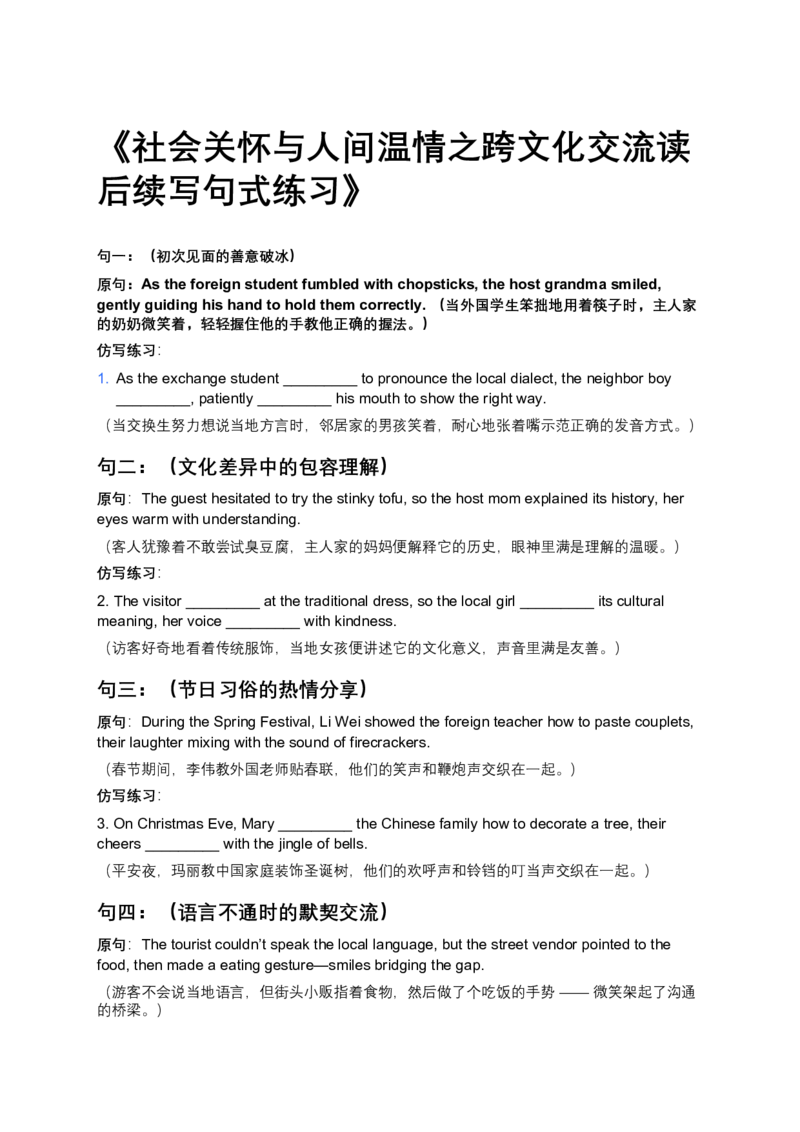
句一:(初次见面的善意破冰)
原句:As the foreign student fumbled with chopsticks, the host grandma smiled,
gently guiding his hand to hold them correctly. (当外国学生笨拙地用着筷子时,主人家
的奶奶微笑着,轻轻握住他的手教他正确的握法。)
仿写练习:
1. As the exchange student _________ to pronounce the local dialect, the neighbor boy
_________, patiently _________ his mouth to show the right way.
(当交换生努力想说当地方言时,邻居家的男孩笑着,耐心地张着嘴示范正确的发音方式。)
句二:(文化差异中的包容理解)
原句:The guest hesitated to try the stinky tofu, so the host mom explained its history, her
eyes warm with understanding.
(客人犹豫着不敢尝试臭豆腐,主人家的妈妈便解释它的历史,眼神里满是理解的温暖。)
仿写练习:
2. The visitor _________ at the traditional dress, so the local girl _________ its cultural
meaning, her voice _________ with kindness.
(访客好奇地看着传统服饰,当地女孩便讲述它的文化意义,声音里满是友善。)
句三:(节日习俗的热情分享)
原句:During the Spring Festival, Li Wei showed the foreign teacher how to paste couplets,
their laughter mixing with the sound of firecrackers.
(春节期间,李伟教外国老师贴春联,他们的笑声和鞭炮声交织在一起。)
仿写练习:
3. On Christmas Eve, Mary _________ the Chinese family how to decorate a tree, their
cheers _________ with the jingle of bells.
(平安夜,玛丽教中国家庭装饰圣诞树,他们的欢呼声和铃铛的叮当声交织在一起。)
句四:(语言不通时的默契交流)
原句:The tourist couldn’t speak the local language, but the street vendor pointed to the
food, then made a eating gesture—smiles bridging the gap.
(游客不会说当地语言,但街头小贩指着食物,然后做了个吃饭的手势 —— 微笑架起了沟通
的桥梁。)
仿写练习:
4. The traveler _________ understand the directions, but the old man _________ a simple
map on the ground, then _________ a walking sign—nods solving the confusion.
(旅行者听不懂指路的话,但老人在地上画了个简单的地图,然后做了个走路的手势 —— 点
头化解了困惑。)
句五:(文化技能的耐心传授)
原句:In the village square, the craftswoman taught the foreign volunteers to weave bamboo
baskets, her rough hands covering their small ones.
(在村广场上,女工匠教外国志愿者编竹篮,她粗糙的手包裹着他们的小手。)
仿写练习:
5. In the kitchen, the chef _________ the overseas students to make dumplings, his skilled
fingers _________ their clumsy ones.
(厨房里,厨师教留学生包饺子,他熟练的手指引导着他们笨拙的手指。)
句六:(异乡遇困时的及时帮助)
原句:The backpacker’s luggage was stolen, and before she could panic, a local couple
offered her a place to stay, their hospitality warm as sunlight.
(背包客的行李被偷了,她还没来得及慌张,一对当地夫妇就邀请她住下,他们的热情像阳光
一样温暖。)
仿写练习:
6. The business traveler’s flight _________ canceled, and before he could worry, a hotel
staff _________ him a free room, their kindness _________ as a warm blanket.
(商务旅行者的航班取消了,他还没来得及担心,酒店工作人员就给了他一间免费房间,他们
的善意像温暖的毯子一样。)
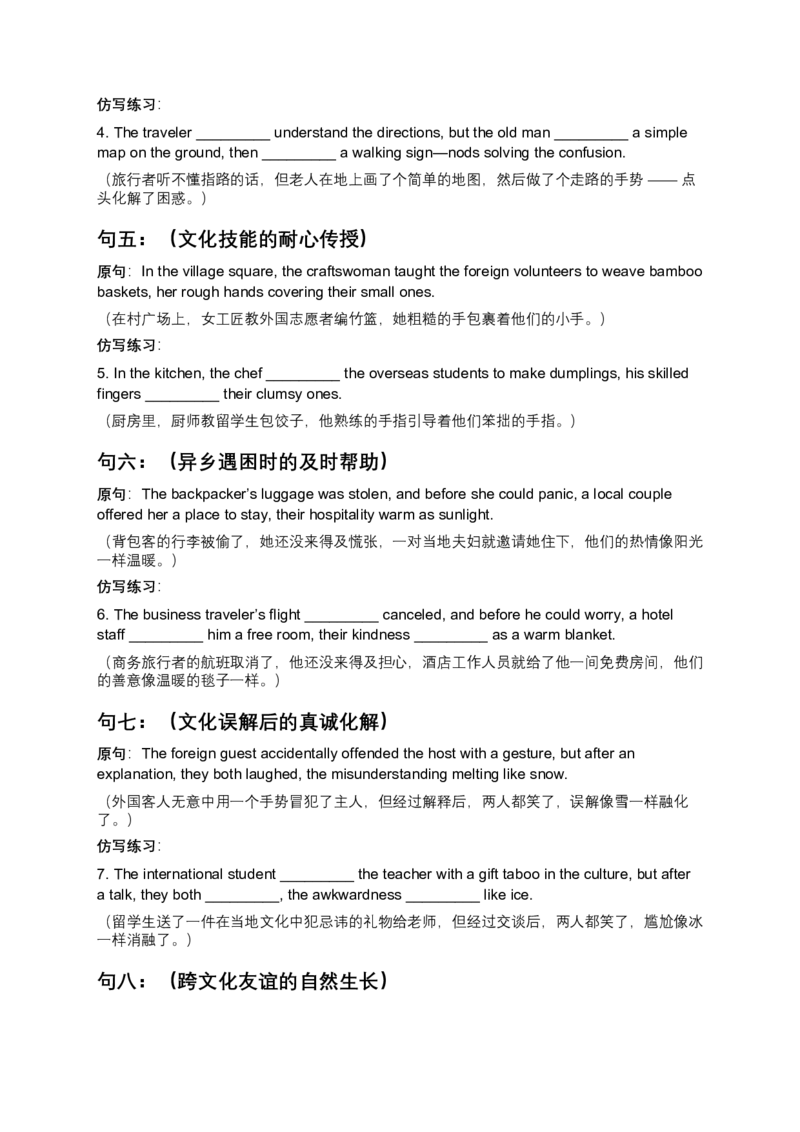
句七:(文化误解后的真诚化解)
原句:The foreign guest accidentally offended the host with a gesture, but after an
explanation, they both laughed, the misunderstanding melting like snow.
(外国客人无意中用一个手势冒犯了主人,但经过解释后,两人都笑了,误解像雪一样融化
了。)
仿写练习:
7. The international student _________ the teacher with a gift taboo in the culture, but after
a talk, they both _________, the awkwardness _________ like ice.
(留学生送了一件在当地文化中犯忌讳的礼物给老师,但经过交谈后,两人都笑了,尴尬像冰
一样消融了。)
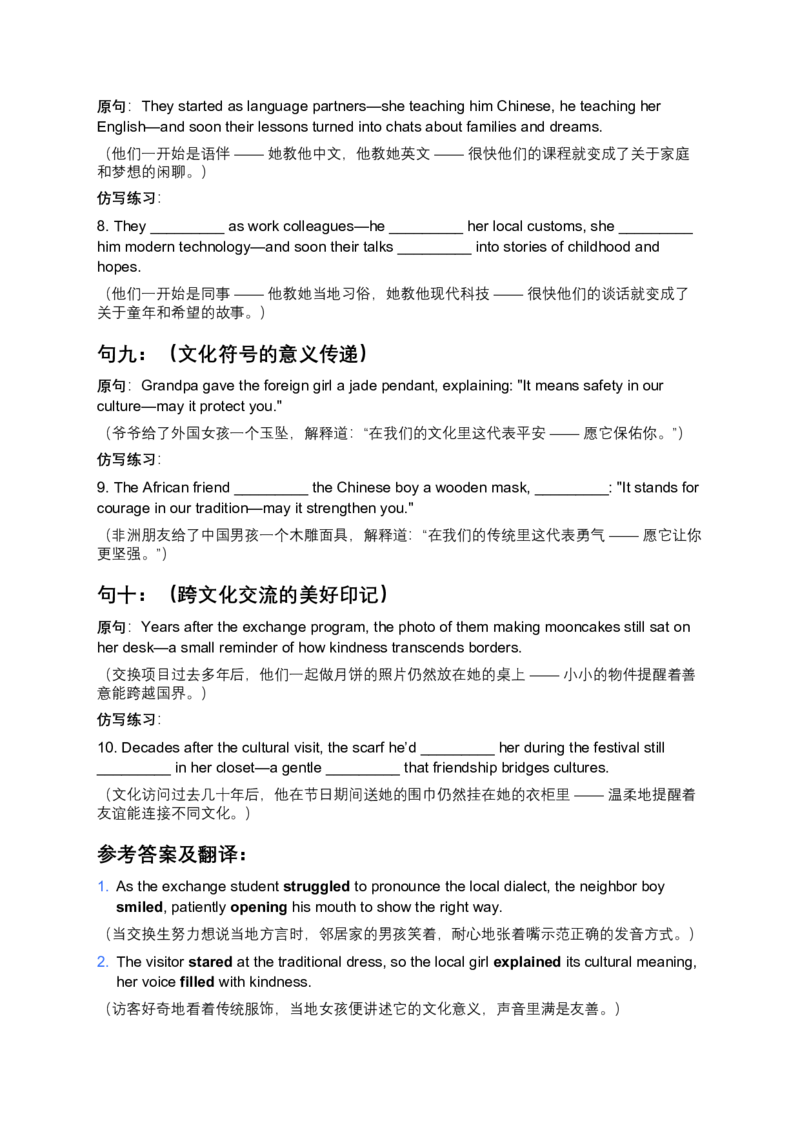
句八:(跨文化友谊的自然生长)
原句:They started as language partners—she teaching him Chinese, he teaching her
English—and soon their lessons turned into chats about families and dreams.
(他们一开始是语伴 —— 她教他中文,他教她英文 —— 很快他们的课程就变成了关于家庭
和梦想的闲聊。)
仿写练习:
8. They _________ as work colleagues—he _________ her local customs, she _________
him modern technology—and soon their talks _________ into stories of childhood and
hopes.
(他们一开始是同事 —— 他教她当地习俗,她教他现代科技 —— 很快他们的谈话就变成了
关于童年和希望的故事。)
句九:(文化符号的意义传递)
原句:Grandpa gave the foreign girl a jade pendant, explaining: "It means safety in our
culture—may it protect you."
(爷爷给了外国女孩一个玉坠,解释道:“在我们的文化里这代表平安 —— 愿它保佑你。”)
仿写练习:
9. The African friend _________ the Chinese boy a wooden mask, _________: "It stands for
courage in our tradition—may it strengthen you."
(非洲朋友给了中国男孩一个木雕面具,解释道:“在我们的传统里这代表勇气 —— 愿它让你
更坚强。”)
句十:(跨文化交流的美好印记)
原句:Years after the exchange program, the photo of them making mooncakes still sat on
her desk—a small reminder of how kindness transcends borders.
(交换项目过去多年后,他们一起做月饼的照片仍然放在她的桌上 —— 小小的物件提醒着善
意能跨越国界。)
仿写练习:
10. Decades after the cultural visit, the scarf he’d _________ her during the festival still
_________ in her closet—a gentle _________ that friendship bridges cultures.
(文化访问过去几十年后,他在节日期间送她的围巾仍然挂在她的衣柜里 —— 温柔地提醒着
友谊能连接不同文化。)
参考答案及翻译:
1. As the exchange student struggled to pronounce the local dialect, the neighbor boy
smiled, patiently opening his mouth to show the right way.
(当交换生努力想说当地方言时,邻居家的男孩笑着,耐心地张着嘴示范正确的发音方式。)
2. The visitor stared at the traditional dress, so the local girl explained its cultural meaning,
her voice filled with kindness.
(访客好奇地看着传统服饰,当地女孩便讲述它的文化意义,声音里满是友善。)
3. On Christmas Eve, Mary taught the Chinese family how to decorate a tree, their cheers
mixing with the jingle of bells.
(平安夜,玛丽教中国家庭装饰圣诞树,他们的欢呼声和铃铛的叮当声交织在一起。)
4. The traveler couldn’t understand the directions, but the old man drew a simple map on
the ground, then made a walking sign—nods solving the confusion.
(旅行者听不懂指路的话,但老人在地上画了个简单的地图,然后做了个走路的手势 —— 点
头化解了困惑。)
5. In the kitchen, the chef showed the overseas students to make dumplings, his skilled
fingers guiding their clumsy ones.
(厨房里,厨师教留学生包饺子,他熟练的手指引导着他们笨拙的手指。)
6. The business traveler’s flight was canceled, and before he could worry, a hotel staff
offered him a free room, their kindness warm as a warm blanket.
(商务旅行者的航班取消了,他还没来得及担心,酒店工作人员就给了他一间免费房间,他们
的善意像温暖的毯子一样。)
7. The international student offended the teacher with a gift taboo in the culture, but after a
talk, they both chuckled, the awkwardness melting like ice.
(留学生送了一件在当地文化中犯忌讳的礼物给老师,但经过交谈后,两人都笑了,尴尬像冰
一样消融了。)
8. They began as work colleagues—he teaching her local customs, she showing him
modern technology—and soon their talks grew into stories of childhood and hopes.
(他们一开始是同事 —— 他教她当地习俗,她教他现代科技 —— 很快他们的谈话就变成了
关于童年和希望的故事。)
9. The African friend gave the Chinese boy a wooden mask, explaining: "It stands for
courage in our tradition—may it strengthen you."
(非洲朋友给了中国男孩一个木雕面具,解释道:“在我们的传统里这代表勇气 —— 愿它让你
更坚强。”)
10.
Decades after the cultural visit, the scarf he’d given her during the festival still hung
in her closet—a gentle reminder that friendship bridges cultures.
(文化访问过去几十年后,他在节日期间送她的围巾仍然挂在她的衣柜里 —— 温柔地提醒着
友谊能连接不同文化。)