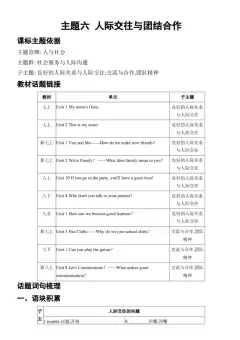
主题九 跨文化交际与节假日活动
课标主题依据
主题范畴: 人与社会
主题群: 历史、社会与文化
子主题: 跨文化沟通与交流,语言与文化;
世界主要国家的文化习俗与文化景观、节假日与庆祝活动
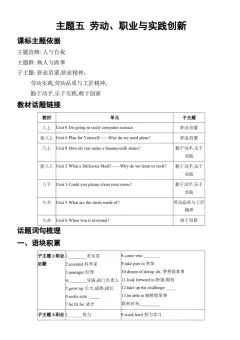
教材话题链接
教材 单元 子主题
七上 Starter Unit 1 Good morning! 跨文化沟通与交流,语言与文化
七上 Unit 1 My name's Gina. 跨文化沟通与交流,语言与文化
新七 Unit 1 You and Me——How do we make 跨文化沟通与交流,语言与文化
上 new friends?
七上 Unit 8 When is your birthday? 世界主要国家的文化习俗与文化景观、
节假日与庆祝活动
新七 Unit 7 Happy Birthday!——Why do we 世界主要国家的文化习俗与文化景观、
上 celebrate birthdays? 节假日与庆祝活动
新八 Unit 1 Happy Holiday——What makes a 世界主要国家的文化习俗与文化景观、
上 great holiday? 节假日与庆祝活动
九全 Unit 2 I think that mooncakes are delicious!世界主要国家的文化习俗与文化景观、
节假日与庆祝活动
九全 Unit 10 You're supposed to shake hands. 世界主要国家的文化习俗与文化景观、
节假日与庆祝活动
话题词句梳理
一、语块积累
子主 跨文化沟通与交流
题1:
1.___________ 握手 8.respect local customs尊重当地习俗
跨文
2.use body language使用肢体语言 9.traditional Chinese culture中国传统文化
化沟
3.drop by ____ 10.build cultural bridges搭建文化桥梁
通与
4._______________________ 使(某11.be of great cultural value 有重要的文化价
交流,
人)感到宾至如归 值
语言
12.________________________有……的悠久与文 5.table manners餐桌礼仪 历史
化 6.avoid misunderstandings避免误解 13._____________________ 对……有影响
7.pass by _____ 我来补充:_________
语言与文化(美德)
1.learn…from…向……学习…… 8.trust each other ____
2.____________ 快速查看;浏览 9.greet sb. 和某人打招呼
3.go over ____ 10.do what you said ____
4.learn by oneself/teach oneself __ 11.avoid wasting food 避免浪费食物
5.___________________ 多次;反复 12.______________ 遵守承诺
地 13.keep a secret 保守秘密
6.catch up with 追上;赶上 我来补充:_________
7.offer a seat 让座
子主 文化习俗与文化景观
题2:
1.______________ 包饺子 8.exciting kung fu performance令人兴奋的功
世界
2.put up couplets 贴对联 夫表演
主要
3.get together聚会;团圆 9.stand for hope and good luck _______
国家
4.eat tangyuan/zongzi吃汤圆/粽子 10.visit places of interest ______
的文
11._________________________ 环游全世界
5.enjoy lanterns ___
化习
6.receive high praise 受到高度赞扬 12.throw water at each other相互泼水
俗与
7.________________________ 最受 我来补充:_________
文化
欢迎的……之一
景
观、 节假日与庆祝活动
节假
1.present/gift 礼物 9.________ 盛装打扮
日与
2.lucky money ___ 10.sweep the tombs扫墓
庆祝
3.______________________ 庆祝节 11.___________________________________
活动
日 _ 向家人和朋友表达感谢
4.eat mooncakes and admire the full 12.a good time to spread joy to everyone
moon _______ around us ___________________
5.decorate the house 装饰房屋 我来补充:_________
6.have New Year's Eve dinner吃年夜
饭
7.eat/have sweet dumplings吃元
宵/汤圆
8.have a spring outing踏青;春游
二、佳句积累子 1.In France, ______________________ put your bread on your plate. 在法国,你不应将
主 你的面包放在盘子上。【九全Unit 10】
题 2.
1:跨__________________________________________________
文 : some shake hands, some hug, and some bow—and all these ways are worth respecting.
化 _____________ :有些握手,有些拥抱,有些鞠躬——所有这些方式都值得尊重。
沟
3.________________________, students can learn more about China's rich culture. At
通
the same time, learning them can help students develop a sense of national pride. 通过学
与
习那些技能,学生们能够更多地了解中国丰富的文化。与此同时,学习那些技能还能
交
帮助学生们培养民族自豪感。
流,
4.Language is a bridge between different cultures and it helps people from all over the
语
world ____________________________. 语言是不同文化之间的桥梁,它帮助来自世
言
界各地的人们更好地相互理解。
与
文
化
子 1.Paper cutting has been around for over 1,500 years. During the Spring Festival, they
主 are put on windows, doors and walls as symbols of
题 _________________________________________. 剪纸已有1 500多年的历史了。
2:世春节期间,人们会把剪纸贴在窗户、门和墙上,以此作为祈求好运和一个快乐的新年
界 的象征。 【九全Unit 5】
主 2.They ___________ bright symbols of happiness and good wishes. 它们(孔明灯)被
要
视为幸福和美好祝愿的鲜明象征。 【九全Unit 5】
国
3.Mooncakes are ___________________________ on the Mid-Autumn night. They
家
_____________________ to the families they love and miss. 月饼是中秋夜晚时圆月
的
的形状。它们寄托着人们对他们所爱与所思念的家人的祝福。 【九全Unit 2】
文
4.The main purpose of this activity is to
化
_____________________________________ and improve
习
students' practical ability. 本次活动的主要目的是 ________ ,同时提高学生的实践
俗
能力。
与
文
化
景
观
、
节
假
日与
庆
祝
活
动
俗 1.When in Rome, do as the Romans do. 入乡随俗。
语 2.Don't put all your eggs in one basket. 不要把所有的鸡蛋放在一个篮子里。
谚 3.The best way to learn a language is to know the culture. 学习一门语言的最佳方式是
语
了解其文化。
4.Language is the road map of a culture. 语言是文化的路线图。
5.Gratitude is the memory of the heart. 感恩是心灵的记忆。
6.Joy is the brightest when blessed with good fortune; the moon is the fullest on the
Mid-Autumn Festival. 人逢喜事精神爽,月到中秋分外明。
教材语篇导入
阅读下面短文,在空白处填入1个适当的单词或括号内单词的正确形式。
New Year is a wonderful time when family and friends come together to say goodbye to
the old year and welcome the new one. The New Year 1. (celebrate) by people all
around the world with music, special food, and fireworks, though the celebration may take
place at different times.
In the US, a famous tradition 2. (involve) the dropping of a big ball in New
York's Times Square. Usually, huge crowds gather 3. (watch), and when the ball
reaches the bottom, everyone wishes each other “Happy New Year!”The Chinese New
Year holds great importance in China. People sweep out dust from their houses, hang
couplets, set 4. fireworks, and enjoy lion or dragon dances. Grandparents, parents, and
children get together to eat delicious food and express best wishes for the whole family. This
reunion shows that family is 5. (huge) important in Chinese culture. In Egypt,
people celebrate Sham El-Nessim in April to mark the 6. (begin) of spring. At this
time, the weather becomes much 7. (bright). People paint eggs as 8. (symbol)
of new life…They also go out and enjoy picnics.
9. New Year festivals are different all over the world, they have one thing in
common. In almost every country, people believe that it is 10. special time to connect
with their family and friends and show hope for the coming year.
[素材改编自九全Unit 2]语块积累
1.hold great importance 具有重要意义;至关重要
2.have one thing in common 有一个共同点
3.connect with 与……联系
佳句仿写
New Year is a wonderful time when family and friends come together to say goodbye
to the old year and welcome the new one. 新年是家人和朋友团聚在一起,告别旧岁、迎
接新年的美好时刻。
(…is a wonderful time when sb. come together to do…and do…)
仿写:中秋节是家庭成员们团聚在一起,吃月饼、赏明月的美好时刻。
____________________________________________________________________
____________________________________________________________
以读促写指导
第一节 阅读下面短文,根据短文内容回答问题。
Dads have Father's Day. Moms have Mother's Day. Kids have Children's Day. But, do
our grandparents have a special holiday? Yes, they do!
The Double Ninth Festival is a special day for elderly people in China. The festival is on
the ninth day of the ninth lunar month every year. As the Chinese word for nine has the same
sound as the word for long, people celebrate the Double Ninth Festival to express their wishes
for long life for elderly people.
There are many traditions for this festival. On that day, families get together and climb
mountains for good luck and in the hope that elderly people will live much longer. They also
drink chrysanthemum wine(菊花酒) and wear zhuyu(茱萸) branches or decorate
their homes with zhuyu leaves to celebrate it. Both chrysanthemum and zhuyu are regarded
as clean plants that can clean houses and protect people against diseases.
Respecting elderly people is shown not only on this special day but also in daily life. For
example, when an older person enters a room, everyone stands up. When there are several
guests at the table, the host usually introduces them from the oldest to the youngest. When
a younger person is presenting something to an older person, two hands are used.It is a traditional virtue(美德) in China to respect elderly people. That is because the
Chinese know that elderly people have knowledge and experience that young people can
learn from. So, in China, people wear their age with pride. Besides, to respect elderly people
is to respect your own future.
1.When is the Double Ninth Festival?
______________________________________________________________
2.Why do people celebrate the Double Ninth Festival?
_______________________________________________________________________
_______________________________________________________________________
__
3.How do people celebrate the Double Ninth Festival?
_______________________________________________________________________
_______________________________________________________________________
_______________________________________________________________________
_______________________________________________________________________
__________
4.What else can we do to show respect for elderly people in daily life?
_______________________________________________________________________
_______________________________________________________________________
_______________________________________________________________________
_________________________________
5.Will you live with the elderly people in your family when you grow up? Why or why
not?
_______________________________________________________________________
_______________________________________________________________________
_______________________________________________________________________
_______
语块积累
1.protect sb. against diseases 帮助某人免受疾病侵害;预防疾病
2.respect elderly people 尊敬老人
3.learn from 向…… 学习佳句仿写
That is because the Chinese know that elderly people have knowledge and experience that
young people can learn from. 那是因为中国人知道,老年人拥有年轻人可以学习的知识
和经验。
(That is because+主语+谓语+宾语从句)
仿写:那是因为学生们知道,老师们拥有他们可以学习的耐心和技能。
_______________________________________________________________________
___________________________
第二节 根据要求完成短文写作。
你校正在组织“探寻传统节日,传承华夏文明”系列活动,校英语报为此发起征文。
假如你是李华,请结合以下要点提示,写一篇题为“My Favorite Traditional Chinese
Festival”的文章投稿学校英语报。
要求:(1)短文必须包含所有提示信息,并适当发挥;
(2)80词左右(标题和开头都已给出,不计入总词数);
(3)文中不得出现真实人名和校名。
My Favorite Traditional Chinese Festival
My favorite traditional Chinese festival is
Step 1——审好题 定方向
1.定主题:围绕“最喜欢的中国传统节日”,阐述以下内容:最喜欢的节日是什么、喜欢
它的原因(包括节日文化内涵与个人情感关联)、节日期间的活动,以及自己为传播
该节日文化所做的事。
2.定文体:说明文
3.定人称: _______
4.定时态: _____
5.定要点:
①What's your favorite traditional Chinese festival? Why?
②What activities do you have during the festival?
③How do you help to spread this festival culture?Step 2——列框架 写句子(以“the Mid-Autumn Festival”为例)
开头(直接点明主题)
My favorite traditional Chinese festival is the Mid-Autumn Festival.
分论点1: What's your favorite traditional Chinese festival? Why?(点明最喜欢的传统
节日及原因)
主题句: My favorite traditional Chinese festival is the Mid-Autumn Festival. It falls on
____________________________________________(农历八月十五).
细节支撑句: I love it because ________________________________(它是家庭团
聚的时刻).
分论点2: What activities do you have during the festival?(描述节日期间的活动)
主题句: On this special day, family members ________________________________
________(无论多远都会回家).
细节支撑句1: We __________________________(一起吃一顿丰盛的晚餐).
细节支撑句2: In the evening, we _________________________________________
_______________________________(坐在外面,欣赏明亮的满月,吃月饼和水果).
分论点3: How do you help to spread this festival culture?(说明助力传播该节日文化的
做法)
主题句: To spread the festival culture, I will ________________________________
(和我的外国朋友分享它).
细节支撑句1: I will tell them ____________________(嫦娥的故事).
细节支撑句2: Also, I will invite them to ______________________(和我一起做月
饼).
结尾(简洁总结+表达希望)
总结句: The Mid-Autumn Festival is _______________________________________
_____________________(关于亲情,并且是中国文化中重要的一部分).
希望句: I hope more people can learn about and love it.
Step 3——成篇章 赏美文
基础版范文 高阶版范文
My Favorite Traditional Chinese My Favorite Traditional Chinese Festival
Festival My favorite traditional Chinese festival is the
My favorite traditional Chinese Mid-Autumn Festival. It ①falls on the fifteenth
festival is the Mid-Autumn Festival. It's day of the eighth lunar month.
on the fifteenth day of the eighth lunar I love it because it is a time for family
month. reunion. On this special day, family members go
I love it because it is a time for home ②no matter how far away they are. We have
family reunion. On this special day, a big dinner together, ③with all kinds of deliciousfamily members go home from far away. food. In the evening, we sit outside, enjoy the
We have a big dinner together. In the ③bright full moon, and eat mooncakes and fruits.
evening, we sit outside, enjoy the moon, The round mooncakes and the full moon make us
and eat mooncakes and fruits. They make feel ④warm and happy.
us happy. To spread the festival culture, I will tell my
To spread the festival culture, I will foreign friends the story of Chang'e and why we
tell foreign friends the story of Chang'e celebrate the Mid-Autumn Festival. Also, I will
and invite them to make mooncakes with invite them to make mooncakes with me.
me. The Mid-Autumn Festival is ④not only a time
The Mid-Autumn Festival is about about family love but also an important part of
family love and an important part of Chinese culture. I hope more people can learn
Chinese culture. I hope more people can about and love it.
learn about and love it.
高阶版范文赏析:
亮点1: 时间表达更精准、高级
用短语“falls on”表达更专业、准确,体现对“节日日期”类表达的精准掌握。
亮点2: 让步状语从句的灵活运用
使用“no matter how+表语(far away)+主语+系动词”的完整让步状语从句结构,
突出“不管距离多远”也要团聚的决心,让“团圆”主题更有感染力。
亮点3: 细节描写更丰富、生动
通过“with all kinds of delicious food”(补充晚餐的“丰富性”细节)与“bright
full moon”(让“月亮”的特征更具体),让内容更饱满。
亮点4: 情感表达与并列结构更细腻
用“make sb. feel + 形容词”结构,且通过“warm and happy”并列两种情感,比单一
的“happy”更细腻,体现对“情感类表达”的丰富化处理;用“not only…but also…”并列
结构,连接“家庭亲情时刻”和“中国文化组成”,体现对节日价值的深度理解。
主题素养提升
一、[2025 湖北改编]短文阅读
Long ago, in ancient China, there was a story about the invention of silk. People believed
that silk was first invented by Leizu, the wife of the Yellow Emperor. Leizu learned how to
make cocoons(蚕茧) into soft and strong cloth. This magical cloth became known as
“silk”, and it was so valuable that it was called “China's Gold”. Following kings' orders, the
Chinese kept the secret of making silk for centuries.
But then, something amazing happened! During the Han Dynasty, the brave officer
Zhang Qian traveled west as far as Central Asia and brought silk there. As years passed by,silk became so important that the trade road from Europe to China got its name—the Silk
Road.
The Silk Road became a busy highway for traders who carried things across deserts and
mountains. From China, people sold silk and tea. In return, they received treasures such as
spices(香料), gold and silver from the West. At the very beginning, it was mainly about
trade; then people began to share ideas, technologies and cultures. For example, Chinese
inventions like papermaking were spread to the West, while new ideas about math and
science came to China.
Most importantly, the Silk Road helped different cultures learn from each other. Art,
music and even language were shared along this ancient road. In places like the Dunhuang
Grottoes(敦煌石窟) in China, you can see how art pieces combined(融合) Eastern
and Western styles into something distinctive. It cannot be seen anywhere else.
The story of the Silk Road tells us how people from faraway lands could become friends
through trade and shared ideas. Today, we remember the Silk Road as one of the greatest
examples of cooperation and exchange in history. It shows us how important it is to learn
about and respect each other's traditions, and that different cultures can work together to
create amazing things.
1.Who invented silk in ancient China?( )
A.Leizu. B.The kings. C.Zhang Qian.
2.What was spread from China to the West according to Paragraph 3?( )
A.Silk and gold.
B.Spices and silver.
C.Tea and papermaking.
3.新考法 细节排序 What is the RIGHT order of the following facts from the passage?
①Zhang Qian traveled west with silk.
②Art and language were shared along the Silk Road.
③Traders from China and the West exchanged things.
④The Chinese were ordered to keep the secret of making silk.( )
A.①→④→③→② B.④→①→③→②C.④→③→②→①
4.What does the underlined word“distinctive” mean in Paragraph 4?( )A.Special. B.Public. C.Popular.
5.What does the story of the Silk Road mainly tell us?( )
A.The introduction of silk cloth.
B.The influence of technology in history.
C.The importance of cross-cultural communication.
二、[2025 长沙模拟]完形填空
The 10,000-li Great Wall of China is a result of hard work and cleverness of laboring
people of past ages. It is one of the greatest 1 in the world.
About 6,000 to 7,000 years ago, our ancestors started to 2 caves(山洞) to live in
plain(平原) areas. As the population grew and production was developed, they dug deep
ditches(沟) around the places where they lived to 3 the attacks(袭击) of animals and
floods. They built earth walls to protect the 4 of family members.
When it came to the Spring and Autumn Period and Warring States Period(春秋战国
时期), there were lots of 5 . In order to protect themselves and their lands, the kingdoms
built up walls in their own lands. The earliest walls were built in the Chu Kingdom and the
Qi Kingdom. Later on, as the wars continued, the Wei, Yan and Qin Kingdoms 6 to build
great walls. The walls of the later three kingdoms formed the basis for Emperor Qin Shi
Huang's 10,000-li Great Wall.
Using local materials was a 7 experience in building the Great Wall. In order to avoid
long-distance transportation and save manpower, materials and money, they used different
building materials in places with different 8 conditions. For example, they built the walls
with sand where there was much sand because sand was 9 .
In 221 BC, Emperor Qin Shi Huang set up a united kingdom. He spent much time and
money 10 the Great Wall upon the earlier ones. Since then, the greatest ancient architecture(建
筑) of the world has towered wonderfully in northern China.
1.A.wonders B.games C.plays
2.A.walk towards B.watch outC.move away from
3.A.prevent B.keep C.help
4.A.activity B.beauty C.safety
5.A.events B.wars C.accidents6.A.joined B.forgot C.refused
7.A.careful B.successful C.peaceful
8.A.historical B.physical C.natural
9.A.cheap B.heavy C.strong
10.A.breaking B.building C.blowing
三、阅读简答
Jiaozi, also known as Chinese dumplings, is a must-have during holidays in northern
China. It dates back to ancient times.
Jiaozi is one of the most important foods in Chinese New Year. Since jiaozi is in the
shape of ancient Chinese gold or silver ingots(银锭), it symbolizes wealth.
Traditionally, the members of a family get together to make dumplings on New Year's
Eve. They may hide a coin in one of the dumplings. The person who finds the coin will be
likely to have good luck. As the Spring Festival marks the start of a new year, people choose
to eat jiaozi in the hope of having a good future in the coming new year.
Based on your taste, you can make different kinds of Chinese dumplings using different
fillings. There is no set rule as to what makes dumpling fillings. They can be anything from
vegetables, meat or seafood. Whatever the fillings are, the wrapping(包) skill needs to be
exquisite(精美的) to make jiaozi good-looking.
As China is a country with a vast territory(幅员辽阔), there are differences in
different areas in ways of making jiaozi or even serving it. For example, dumplings wrappers
are made with a rolling stick in Beijing and Hebei Province, while in some parts of Inner
Mongolia, wrappers are hand-pressed.
1.When did Chinese people probably begin to have jiaozi?
________________
2.What does jiaozi symbolize?
______________________
3.Why do people choose to eat jiaozi on New Year's Eve?
__________________________________________________________________
4.Do people need to follow set rules to make dumpling fillings?
________________5.Do you eat jiaozi with your family during the Spring Festival? What do you think of
jiaozi?
__________________________________________________________
拓展设问:.将短文中画线部分翻译成中文。
________________________________
四、书面表达
年夜饭是中国文化中最重要的团圆饭。年夜饭菜肴丰富、美味,像饺子、年糕
(New Year cake)、鱼等都带有美好的祝愿。请以“The Family Dinner on Spring
Festival Eve”为题,用英语写一篇短文,向外国朋友介绍自己家乡的年夜饭,让他们更好
地了解中国丰富多样的文化习俗。
要求:(1)短文必须包含所有提示信息,并适当发挥;
(2)80词左右(标题和开头都已给出,不计入总词数);
(3)文中不得出现真实人名和校名。
The Importance: the most important dinner,…
FamilyDinner on
What to eat:jiaozi, fish, New Year cake,…
Spring Festival
Why to eat: great meanings, having more luck and becoming better,
Eve
having more than we need, …
The Family Dinner on Spring Festival Eve
The family dinner on Spring Festival Eve is the most important dinner in traditional
Chinese culture. __________________________________________________________
______
____________________________________________________________________
_______________________________________________________________________
_______________________________________________________________________
_______________________________________________________________________
_______________________________________________________________________
_______________________________________________________________________
_______________________________________________________________________
_______________________________________________________________________
_______________________________________________________________________________________________________________________
____________
主题九 跨文化交际与节假日活动
教材语篇导入
1.is celebrated
2.involves
3.to watch
4.off
5.hugely
6.beginning
7.brighter
8.symbols
9.Although/Though
10.a
佳句仿写
The Mid-Autumn Festival is a wonderful time when family members come together to eat
mooncakes and admire the bright moon.
以读促写指导
第一节 阅读下面短文,根据短文内容回答问题。
1.It is on the ninth day of the ninth lunar month every year.
2.Because they want to express their wishes for long life for elderly people./Because they
hope that elderly people will live much longer.
3.Families get together and climb mountains. They also drink chrysanthemum wine and
wear zhuyu branches or decorate their homes with zhuyu leaves./By getting together,
climbing mountains, drinking chrysanthemum wine, wearing zhuyu branches and
decorating homes with zhuyu leaves.4.Offer seats to them in public places./Help them when they cross the street or guide them
through traffic./Speak to them politely./Listen to them carefully when they speak./Let them
go first when waiting in line.(主观题,言之有理即可)
5.Yes, because I think I can learn a lot (of knowledge and experience) from them/I
think that respecting the elderly people is to respect myself/I want to take good care of
them in my life.(主观题,言之有理即可)
佳句仿写
That is because students know that teachers have patience and skills that they can learn
from.
第二节 根据要求完成短文写作。
Step 2——列框架 写句子(以“the Mid-Autumn Festival”为例)
the fifteenth day of the eighth lunar month; it is a time for family reunion; go home no
matter how far away they are; have a big dinner together; sit outside, enjoy the bright
full moon, and eat mooncakes and fruits; share it with my foreign friends; the story of
Chang'e; make mooncakes with me; about family love and an important part of
Chinese culture
主题素养提升
一、[2025 湖北改编]短文阅读
1.A 2.C 3.B 4.A 5.C
二、[2025 长沙模拟]完形填空
1.A 2.C 3.A 4.C 5.B 6.A 7.B 8.C 9.A 10.B
三、阅读简答
1.In ancient times.
2.It symbolizes wealth.
3.Because they hope to have a good future in the coming new year.
4.No(, they don't).
5.Yes, I do. I think it's delicious. (主观题,言之有理即可)
拓展设问: 发现这枚硬币的人很可能会有好运。
四、书面表达On that day, family members get together to enjoy the dinner.; There are all kinds of
delicious foods and drinks at the family dinner. Many of them usually have great meanings.
For example, jiaozi is one of the most popular dishes that are loved by people around the
world. Also, in some places, New Year cake is often the first dish, which means “having
more luck and becoming better”. With a long history, it remains a must-have for many
Chinese people. Making New Year cake is also a chance for family members to get together
at home. Another important dish is fish, which means“having more than we need”.
Everyone likes this family dinner.; This dinner is a Chinese tradition that has been kept
for thousands of years.