热点练 02 中国传统文化&节日与语法填空押题
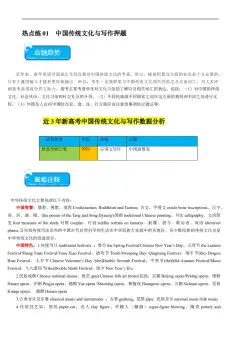
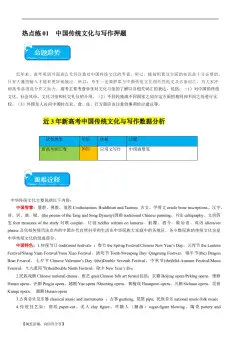
近年来,高考英语语法填空尤其注重对中国传统文化的考查,本主题包括文化节日、宗教节日、个
人的庆祝活动及其庆祝这些活动的经历和感受等。《考试大纲》及课标中节假日与中国传统文化话题涉及
的主要内容有:1.Cultural festivals ( Spring Festivals, New Year's Day, Christmas, etc.);2. Religious
holidays (Christmas, Easter, Ramada, etc.);3. Personal celebrations (birthday, anniversary,
graduation, etc. );4. Describing your own experiences of these activities and stating your preferences,etc.。
预测2024年高考仍然重点考查中国传统文化与节日。
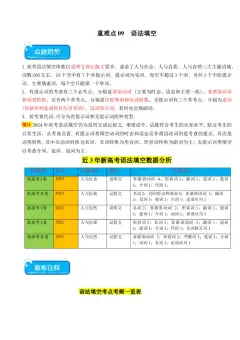
近 3 年新高考中国传统文化&节日与语法填空数据分析
试卷类型 年份 体裁 话题
新高考I 卷 2023 应用文写作 中国美食-小笼包
关于节假日与中国传统文化主题的写作常有以下集中命题方式:
1.介绍某个传统节日习俗,传统文化礼仪或假日活动;
2.描述某个盛大节日活动场面;
3.介绍某个节假日你的安排;
4.西方节日与中国传统节日的冲突;
5.中国传统文化的发扬与保护,尤其非物质文化遗产方面如剪纸、年画、中国结等。
素材积累
(一)阅读词汇整合
【核心单词】
1. pray祈祷
2. parade盛装游行;示威游行
3. reflect v. 体现;展现
reflection n. 反映;反射
4. anniversary周年纪念日
5. ceremony典礼;仪式;礼节6. custom习惯;习俗;风俗
7. sacrifice牺牲;供奉
8. honor荣誉
【高频短语】
1. a celebration of对……的庆祝
2. a mark of… …….的标志;……的表示
3. as a means of作为一种方式
4. within the context of在……的大环境下
5. in memory of /in honor of为纪念……;向……表示敬意
6. drive away赶走
7. pass down传承
8. decorate…with用……装饰
9. broaden ones horizons开阔视野
10. go out of ones way to煞费苦心
典例分析
典例一
(2023年新高考I卷)(2023·全国·统考高考真题)阅读下面短文,在空白处填入 1个适当的单词或括号
内单词的正确形式。
Xiao long bao (soup dumplings), those amazing constructions of delicate dumpling wrappers, encasing hot,
1 (taste) soup and sweet, fresh meat, are far and away my favorite Chinese street food. The dumplings arrive
steaming and dangerously hot. To eat one, you have to decide whether 2 (bite) a small hole in it first,
releasing the stream and risking a spill (溢出), 3 to put the whole dumpling in your mouth, letting the hot
soup explode on your tongue. Shanghai may be the 4 (recognize) home of the soup dumplings but food
historians will actually point you to the neighboring canal town of Nanxiang as Xiao long Bao’s birthplace. There
you will find them prepared differently — more dumpling and less soup, and the wrappers are pressed 5
hand rather than rolled. Nanxiang aside, the best Xiao long bao have a fine skin, allowing them 6 (lift)
out of the steamer basket without tearing or spilling any of 7 (they) contents. The meat should be fresh
with 8 touch of sweetness and the soup hot, clear and delicious.
No matter where I buy them, one steamer is 9 (rare) enough, yet two seems greedy, so I am always
left 10 (want) more next time.
典例二
(2023·广东汕头·校考一模)China is considered the home of tea. Chinese tea had begun to be exported to Japan and Korea before the Tang
Dynasty (618 — 907). In the early period of the 17th century, Chinese tea 1 (export) to Europe. The tea
from China is in great abundance and variety. To tell if a pot of tea is nice you can mainly rely 2 the
color, smell, taste and form.
One of China’s six famous tea types is white tea, 3 gets its name from its silver-white color. It 4
(be) mainly grown and produced in Fujian and Taiwan provinces with a long history, dating back to Northern Song
Dynasty (960 — 1127) in ancient China. Compared with other major types of tea, it distinguishes itself by 5
(it) refreshingly sweet taste and beautiful silver-needle-like shape, thus 6 (enjoy) great popularity among
tea 7 (drink). In addition, the longer it is preserved, the better health-building effects it has. 8
(amazing), it has been proved that if drunk regularly, white tea will greatly benefit people’s physical and mental
health. This is because it can not only protect people from being 9 (strike) by some common diseases,
10 also can effectively relieve symptoms.
(建议用时:8分钟/篇)
1.(2023·浙江宁波·统考一模)阅读下面短文,在空白处填入1个适当的单词或括号内单词的正确形式。
Tai Chi, also noted as Taijiquan, is a traditional Chinese martial art that has evolved into a popular form of
exercise and meditation. 1 (originate) from China's Fujian Province, Tai Chi has a history of over 1,000
years and is deeply rooted in Chinese philosophy and culture. It 2 (characterize) by slow, flowing
movements that promote balance, 3 (flexible), and relaxation.
In recent years, Tai Chi 4 (gain) worldwide recognition for its health benefits. Studies have shown that
practicing Tai Chi can also be helpful for people 5 (reduce) the risk of falls in older adults.
Tai Chi is often practised in groups or classes, 6 students learn from a qualified instructor. There are
many different styles of Tai Chi, each 7 its own unique set of movements and techniques. Beginners are
encouraged to start with the most basic movements and 8 (gradual) build up their skills and knowledge
over time.
9 you are looking for a low-impact exercise, a way to reduce stress, or a close connection to Chinese
culture, Tai Chi offers something for everyone. With regular practice, you can experience the transformative power
of this ancient art form and discover 10 deeper sense of balance and harmony in your life.
2.(2023·浙江宁波·统考模拟预测)阅读下面短文,在空白处填入1个适当的单词或括号内单词的正确形式。
Since the pre-Qin period, Chengdu 11 (be) an important cultural town in China. But 12 really
sets the city apart, culturally, is its opera. An important aspect of Sichuan Opera is 13 magic of “face
changing” where vividly coloured masks are changed within the blink of an eye. In opera gardens and tea houses
across the town, audiences 14 (want) a glimpse of the local culture love to drink tea while listening to
Sichuan Opera and watching face changing.
It is believed that “face changing” has its roots in evolution. Early humans needed survival strategies to avoidfierce animals and foreign 15 (invade). Often, aggressive facial gestures and non-verbal cues were part of
it. The Sichuan Opera is said 16 (bring) this range of emotions on stage.
Once the performance starts, the actor keeps pulling down one mask after 17 in swift movements to
convey different emotions. 18 (astonish), no matter how close one is 19 the stage, they just can’t
tell how the masks change.
In fact, the different kinds of characters and personalities that Sichuan Opera brings alive can 20
(find) among common people. This is why its emotions will continue to resonate with people for a long time.
3.(2023·浙江台州·统考二模)阅读下面材料, 在空白处填入适当的内容(1个单词)或括号内单词的正确形
式。
With a history of more than 2,000 years, the Silk Route dates back to Han dynasty. Through this route, the
Chinese highly 21 (qualify)silk made its fame to the western countries. The merchants in different regions
22 (seek)the opportunity of trading Chinese silk 23 they indeed made their fortune along this route.
That route functioned 24 the life blood of international trade at that time. Meanwhile, the Chinese
civilization 25 (introduce)to the Western countries and vice versa. The Silk Route was considered as a new
chapter 26 (record)the friendship between the European and Asian peoples.
Throughout all these years, many great figures have made significant contributions to the development of the
Silk Route. Today, the Silk Route has a 27 (poet)name called One Belt One Road, aiming to help those
connected regions in culture and economy exchange with a more advanced road. The main cities alongside it are
becoming 28 (large)and more important in helping trade and culture exchange. Many countries have gained
great 29 (benefit)along the trading process. All in all, the ancient Silk Road is more like 30
historical textbook for everyone to read and to know about what happened during that ancient time. It has been
playing a significant role in the development of the civilizations of China.
4.(2023·浙江嘉兴·统考二模)阅读下面短文,在空白处填入1个适当的单词或括号内单词的正确形式。
Tea drinking has been a traditional custom among native Beijingers. Teahouses formed in the Tang
Dynasty,took off in the Song Dynasty and were recorded in YuanQu 31 ( write) in the Yuan Dynasty. As
society developed,private teahouses, tea bars and teahouses with diverse features 32 ( create). Teahouses
often served as centers of social interaction where people came to discuss personal affairs or even 33
( politics) issues.
There are different types of teahouses including Pure Teahouses, Teahouses for Storytelling, Chess
Teouses,etc. In Pure Teahouses, people do nothing but drink tea, most of 34 are unoccupied persons or the
young from the rich family. Teahouses for Storyelling, 35 ( normal) in the afternoon and night, are
welcomed by people with an interest in novels, pingshu and storytelling. Chess Teahouses are popular among those
interested in playing chess.In the Qing Dynasty, there were also Chess Teahouses that served scholars and 36
(official) near Shichahai.
The tea culture has regained its popularity after a long term of dcline. In recent years teahouses with local
characteristics 37 ( appear) in Beijing with the performance of Beijing Opera, or the combination of teaculture, folk customs 38 arts.
Laoshe Teahouse, for example, is widely famous in and beyond China 39 a cultural symbol in
Beijing, where a large number of tea fans gather, 40 (enjoy) its rich tea culture.
5.(2023·江苏南通·统考三模)阅读下面短文,在空白处填入一个适当的单词或括号内单词的正确形式。
China is known as the home of tea. It is said that Shennong discover tea around 2700 B.C. At first, tea
leaves 41 (chew). During the Tang dynasty, 42 (advance) were made in the processing of tea.
The leaves were steamed, oxidized (氧化) and pounded into cake form. This made tea easier 43
(transport) and more pleasing to the tongue.
The earliest batch (批次) of tea is often ready to be picked before Qingming. This precious small output of tea,
widely 44 (seek) after for its outstanding quality, is called Mingqian tea. The seasonal tea is known
45 its tender leaves and fresh flavor. They have 46 better flavor than the later batches which can be
grown overnight.
East China’s Zhejiang province is acknowledged as a major producer of tea. In spring, local hillsides 47
(fill) with tea workers sowing seeds on their land. In the peak seasons, many tourists flood to witness the beautiful
scenery of tea farms for 48 (they), while enjoying a cup of tea.
There are many ways you can experience tea culture in China. You can visit a tea plantation in Hangzhou or
elsewhere to learn 49 tea is grown and harvested. You can sit inside a 50 (tradition) teahouse
and take in the classical atmosphere as you drink tea.
6.(2023·湖南·校联考二模)阅读下面短文,在空白处填入1个适当的单词或括号内单词的正确形式。
What’s the first thing that pops into your mind when you think of wheat straw? Most people would 51
(probable) just see it as a pile of waste in a farmer’s field. However, Wu Cui, an intangible cultural inheritor, can
turn the straw left over from 52 (harvest) wheat into beautiful and eye-catching functional artworks.
The earliest straw-weaving (草编的) 53 ( product) were discovered at Hemudu Cultural Ruins, a
Neolithic cultural site located in eastern China’s Zhejiang province. Straw weaving is 54 method of
manufacturing daily items or artworks. It 55 (list) as a national intangible cultural heritage in 2008.
Wu explains the process of straw weaving: 56 (select) of materials is the first step of a complicated
and labor-intensive process that can take weeks, or even months, to complete. You need to sketch the piece on
paper, 57 requires drawing skills. Next 58 (come) weaving, shaping and preserving of the
work. Even by finishing that process, it does not mean that you will always create a good piece of work, and the
hardest part is 59 (make) it lifelike.
When asked about her plans, Wu says she wants to dig deeper 60 local traditional culture and create
cultural creative products by developing the straw-weaving technique.
7.(2023·江苏·统考二模)阅读下面短文,在空白处填入一个适当的单词或括号内单词的正确形式。
Jingxi Taiping Drum is a traditional form of dancing. With its display of profound cultural elements, it 61
(include) in the first batch (批次) of China’s national intangible cultural heritage (非物质文化遗产) items in 2006.
The 62 (early) historical references of this art date back to the Spring and Autumn Period. At thebeginning of the Qing Dynasty, it started to gain 63 (popular) in and around the capital, and then it was
introduced to Mentougou District of Beijing.
In ancient times, the drums were played 64 New Year’s Eve at the imperial palace to bring peace.
As a result, the performance also became known as the “New Year Drum” by Beijingers. This type of drum dance
is commonly seen 65 (perform) during the last and first month of the lunar year in many local festive
activities, thus expressing 66 (people) hope of a peaceful and prosperous year to come.
During a given performance, drummers perform various dance moves while 67 (hold) the drum in
their left hands and a mallet in their right hands. Traditional Chinese aesthetic (美学的) concepts are reflected in
the drum playing, all of 68 represent distinctive local features.
In the past decades, efforts 69 (make) by Mentougou District to preserve this signature folk dance
culture. Today, the time-honored folk art of the Jingxi Taiping Drum is being taken up by the young people 70
is presenting its lively artistic charm (魅力) on a global stage.
8.(2023·江苏镇江·江苏省镇江第一中学校考模拟预测)阅读下面材料,在空白处填入适当的内容(1个单
词)或所给单词的正确形式。
Acting was, is and always will be the first love of the National Peking Opera Company’s new vice-president,
Tian Lei, Chen Nan reports.
Huguosi Street was one of Beijing’s 71 (busy) commercial roads in the olden days. It also 72
(house) the residence of Peking Opera master Mei Lanfang (1894-1961). Not far from Mei’s address, the first
theater for Peking Opera 73 (perform) was created in 1954, five years after the founding of the People’s
Republic of China.
The neighborhood 74 (change) over the decades, but the theater still stands tall and is 75
(current) managed by the National Peking Opera Company. Tian Lei treasures the hours he spends there, training
and rehearsing (排练). Wearing a costume and 76 (arm) with a prop spear (道具长矛), the 42-year -old
walks confidently across the stage, 77 (practise) a variety of martial art movements, before ending the
drill with a liangxiang (striking a pose on the stage).
Tian has been working with the opera company for 10 years. Its premises (处所) are 78 10 -minute
drive from the theater and his colleagues train there. He, however, prefers the historic stage. “I come to the theater
almost every day because I enjoy the peace and emptiness this building offers. Rehearsing here helps me feel closer
79 the Peking Opera masters 80 once graced the stage,” he says.
9.(2023·江苏·统考一模)阅读下面短文,在空白处填入1个适当的单词或括号内单词的正确形式。
Consisting of a bamboo frame and a 81 (delicate) painted paper surface, Chinese oil-paper
umbrellas have long been viewed as a symbol of China’s tradition of cultural craftsmanship and poetic beauty. Not
just are they an instrument to keep off rain or sunlight, but also works of art 82 (possess)rich cultural
significance and aesthetic(美的)value.
The first oil-paper umbrellas appeared during Eastern Han Dynasty (25-220).Later,they 83 (bring)
overseas to Japan and ancient Korea during the Tang Dynasty (618-907),which is 84 they were known as
“Tang umbrellas”.It takes quite a lot of time and effort to make a traditional Chinese oil-paper umbrella 85 hand. For
example,in Fenshui township in Luzhou, Sichuan Province,craftsmenmust complete more than 90 steps and use
over 100 different tools 86 (create) a single handmade oil-paper umbrella.
Since the appearance of modern mechanical umbrellas, traditional oil-paper umbrellas 87 (suffer)
from declining sales, while 88 number of craftsmen has been on thedecrcase. Fortunately, with the 89
(include) of Fenshui oil-paper umbrellas as one ofChina’s national intangible cultural heritages in 2008, things have
been improving. These greatitems appear in many fashion shows and media publications due to the positive
publicity 90 they have received.
10.(2023·福建宁德·统考模拟预测)阅读下面短文,在空白处填入 1个适当的单词或括号内单词的正确形
式。
A few days ago, the Palace Museum and the Shanghai Kunqu Opera Troupe signed a cooperation agreement
on promotion of the Kunqu Opera. The cooperation has created 91 effective way to promote traditional
culture
The Palace Museum is one of the 92 (large) museums of ancient Chinese culture and art in China. It
used to be the Forbidden City, 93 the emperors of China’s Ming and Qing dynasties lived and conducted
state 94 (affair), and was turned into a museum later.
The Kunqu Opera is one of the oldest types of opera in China. 95 (feature) mild and emotional
melodies, poetic lines and graceful gestures, it can best represent the traditional Chinese arts. The Kunqu Opera
96 (be) under state protection since the PRC was founded.
The cooperation 97 the Palace Museum and the Shanghai Kunqu Opera Troupe is a good attempt to
preserve this opera, which is 98 (real) worth encouraging.
According to the Shanghai Kunqu Opera Troupe, this cooperative project is “a dream coming true after three
years. We aim to bring to life the opera relics 99 (house) in the Palace Museum.”
Some traditional plays recorded and kept in the Palace Museum will be selected and put on show. In addition,
the Troupe will also recover a series of plays and perform 100 (they).
11.(2023·山东淄博·校联考二模)阅读下面短文, 在空白处填入1个适当的单词或括号内单词的正确形式。
Similar to people of other nationalities, ancient Chinese people grasped or tore food with their bare hands at
the beginning. Chopsticks, forks, knives and spoons were used much later, among 101 chopsticks, with a history
of thousands of years, is 102 wonder of Chinese dining utensil(用具).
In ancient China, they were called zhu. Their upper parts are square and 103 (low) parts round, 104 they
are all round. Whatever their shapes, the pair must be identical to each other. 105 (normal), people hold
chopsticks with the right hand to pick up food. The invention of chopsticks fully displayed the dexterity(灵巧)and
106 (intelligent) of the Chinese people. According to some Japanese scholars, to properly handle chopsticks
requires the skillul interaction of over 80 joints(关节)and 50 muscles, and what's more, certain nerves 107
(involve).
Chopsticks, a food picking utensil 108 (make) of bamboo or wood, is widely used by the Hans and some
minority ethnic groups. Some elegant chopsticks 109 Chinese characters are quite artistic. Skilled workers also
combine various hardwoods and metal 110 (create) special designs. It is generally held that chopsticks has begunto be called kuaizi since the Ming Dynasty. However, the term kuaizi was not widely used until the modern times.
12.(2023·山东菏泽·统考二模)阅读下面短文,在空白处填入1个适当的单词或括号内单词的正确形式。
A new adaptation of Chinese mythological stories has won the heart of audiences with its distinctive style. The
animation series, Yao—Chinese Folktales, 111 (gain) more than 110 million views online since it was
released.
The series, co-produced by Shanghai Animation Film Studio and Bilibili, is 112 collection of 20-
minute short films, consisting of eight separate stories 113 (feature) monster-like characters, or yao in
Chinese. The collection, 114 ranges from ancient stories to science fiction, from emotional connection
with hometowns to romantic love 115 from life themes to questions for humanity, presents Chinese
culture and philosophy. For example, the first episode, named “Nobody”, tells a pig monster’s story 116
(base) on the classic Chinese novel Journey to the West. The creative team put the perspective on the little monsters
who used to have blurry faces and didn’t even have names in the story.
Li Zao, general producer, said it was impossible 117 (predict) what the eventual outcome would be
at first. Now, the 118 (favor) comments exceeded the expectations of the creative team. These contained
both the audience’s 119 (recognize) of the work and their hopes of Chinese animation. Besides adapting
120 the taste of the masses, the team also wanted to guide them to appreciate different types of work.
13.(2023·山东日照·日照一中统考二模)阅读下面短文,在空白处填入 1个适当的单词或括号内单词的正
确形式。
Samantha Cristoforetti, the first Italian female astronaut in space, 121 (post) a group of photos and
several Chinese sentences on her Twitter account during her mission at the International Space Station.
Attached to the photos 122 (be) several lines from Preface to Poems Composed at the Orchid
Pavilion, an ancient Chinese calligraphy masterpiece 123 famous Chinese calligrapher Wang Xizhi from
the Eastern Jin Dynasty.
Cristoforetti even gave 124 accurate translation of the lines, saying, “Looking up, I see the vastness of
the universe. 125 (bow) my head, I look at the multitude of the world. The gaze flies, the heart expands,
the joy of the senses can reach its peak, 126 this is true happiness indeed.”
“Her quotation (引语) of the lines shows that she 127 (careful) observed the universe with the vision
of Chinese civilization while observing China from space. Such a quotation is very special, 128 shows her
ambition and a sense of pride,” said Professor Wang Hui from Tsinghua University.
Her quotation also sparked a heated 129 (discuss) among foreign Internet users on social media.
Some netizens said that with her Chinese language capacity, Cristoforetti also has the ability 130 (work) at
the Chinese space station, while others hope that there will be less conflict and more cooperation in the world.
14.(2023·湖北·校联考模拟预测)阅读下面短文,在空白处填入1个适当的单词或括号内单词的正确形式。
Horses, dragons, the Monkey King, and even Sponge Bob Square Pants—you probably wouldn’t expect to see
this collection of animals and pop cultural icons flying together in the sky, 131 this happens every year inWeifang, the “World Kite Capital” in east China’s Shandong Province.
Kites, believed to be the earliest flying objects created by humans, 132 (invent) over 2,000 years ago
in China. 133 (survive)many centuries, kites have become one of the country’s representative traditional
handicrafts, 134 making techniques were included in the list of China’s national intangible cultural heritage
(非物质文化遗产) in 2006.
Weifang, known as a 135 (globe) center of kite culture, is widely regarded as the birthplace of these
popular flying toys. The themes of Weifang kites are 136 (incredible) diverse, ranging from birds and fish
to historical figures and legends.
Today in Weifang, there are virtually no limitations on the shapes or sizes of kites, which can be made 137
(represent) people’s ideals and desires. This 138 (diverse) can be observed at the annual Weifang
International Kite Festival, which has been held on the 139 (three) Saturday in April since 1984. More than
10,000 participants 140 over 30 countries and regions around the world compete in the festival every
year.
15.(2023·湖北·校联考二模)阅读下面短文, 在空白处填入1个适当的单词或括号内单词的正确形式。
A traditional Chinese dance performed underwater in Luoyang, Central China’s Henan Province, 141
(go) viral on social media during the Dragon Boat Festival. The show led to renewed passion among audiences for
traditional Chinese. art and culture.
The 142 (impress) dance is named The Prayer, which was the opening performance of the gala by
Henan Television Station on Saturday.
In the video on social media the underwater actress is seen dancing in colorful traditional Chinese costume.
The short dance, which lasted less than two minutes, was seen as a 143 (combine) of contemporary art
and traditional Chinese culture.
“The water made the costume even more gorgeous and the moves 144 (graceful)!” said one observer
online. Netizens were left 145 (amaze) by both the beauty of the dancer and the 146 (create)
involved in putting 147 the dance underwater.
The dance featured a character from 148 famous ancient Chinese painting Ode to Goddess Luo, the
daughter of a sacred king character Fu Xi in a Chinese tale 149 drowned and then became a goddess.
“The moves were captured underwater at 4. 5 meters from the ground. The team spent a total of 26 hours
under water 150 (complete) the shooting. The film team had to soak themselves in the water in each
shooting session,”Chen Jia, director of the HNTV gala, said to local media.