主题 11 传统节日重要意义
主题简析
初中八年级英语阅读中传统节日重要意义这一主题,巧妙融合语言学习与文化教育,极具价值。从语
言知识积累角度看,学生接触该主题时,能学习 “traditional festival”“cultural heritage”“family
reunion” 等专业词汇,以及 “celebrate the festival”“carry forward traditions” 等实用表达,丰富自身
词汇库,提升语言表达的准确性。在剖析相关文本时,学生通过梳理文章对不同传统节日起源、习俗和价
值的阐述,理清行文逻辑,锻炼分析与归纳能力。从文化教育层面来讲,这一主题引导学生深入理解传统
节日所承载的文化内涵,如春节阖家团圆背后的家庭观念,端午节纪念屈原所蕴含的爱国精神,增强学生
对本民族文化的认同感与自豪感。同时,让学生意识到传统节日在促进家庭和睦、传承文化、凝聚社会方
面的重要作用,提升文化自信,激发传承优秀传统文化的责任感,并在跨文化交流中更好地传播中国文化 。
词句积累
主题表达示例
一、节日概述
1. 词汇
festival(节日)、celebration(庆祝活动)、origin(起源)、custom(习俗)、symbol(象征)
2. 短语
traditional festival(传统节日)、cultural celebration(文化庆典)、historical origin(历史起源)、folk
custom(民间习俗)、festival symbol(节日象征)
3. 句式
Spring Festival is one of the most important traditional festivals in China.(春节是中国最重要的传统节日之
一。)
The origin of Dragon Boat Festival dates back thousands of years.(端午节的起源可追溯到数千年前。)
Each traditional festival has its unique symbols.(每个传统节日都有其独特的象征。)
二、价值阐述
1. 词汇
heritage(遗产)、reunion(团聚)、identity(身份认同)、connection(联系)、harmony(和谐)
2. 短语
cultural heritage(文化遗产)、family reunion(家庭团聚)、cultural identity(文化认同)、social
connection(社会联系)、promote harmony(促进和谐)
3. 句式
Traditional festivals are important parts of our cultural heritage.(传统节日是我们文化遗产的重要组成部
分。)Family reunions during festivals strengthen family bonds.(节日期间的家庭团聚加强了家庭纽带。)
Celebrating traditional festivals helps maintain our cultural identity.(庆祝传统节日有助于保持我们的文化认
同。)
三、活动表达
1. 词汇
celebrate(庆祝)、decorate(装饰)、exchange(交换)、perform(表演)、feast(盛宴)
2. 短语
celebrate festivals(庆祝节日)、decorate houses(装饰房屋)、exchange gifts(交换礼物)、perform
traditional dances(表演传统舞蹈)、have a big feast(享用丰盛的宴席)
3. 句式
People celebrate Mid - Autumn Festival by eating mooncakes and watching the moon.(人们通过吃月饼和赏月
来庆祝中秋节。)
We decorate our houses with red lanterns during Spring Festival.(春节期间我们用红灯笼装饰房子。)
Families gather to have a big feast on important festival days.(在重要节日,家人聚在一起享用丰盛的宴
席。)
拓展阅读
The Significance of Traditional Festivals in Modern Life
In modern life, traditional festivals still hold great importance. These festivals, such as Spring Festival, Mid -
Autumn Festival, and Dragon Boat Festival, have been passed down for generations.
Take Spring Festival as an example. It is the most important traditional festival in China. Before it arrives,
families clean their houses thoroughly, which means getting rid of bad luck and welcoming good fortune. During
the festival, people decorate their houses with red lanterns and couplets. Red is a lucky color in Chinese culture,
symbolizing happiness and prosperity. The most exciting part is the family reunion dinner on New Year's Eve. No
matter how far away they are, family members will come back home. They sit around the table, share delicious
food like dumplings, and talk about their lives. This strengthens the family bonds and gives everyone a sense of
belonging.
Mid-Autumn Festival is also a significant one. On that day, the moon is the fullest and brightest. People sit
outside, enjoy the moonlight, and eat mooncakes together. Mooncakes, round in shape, represent family reunion.
This festival makes family members cherish the time they spend together and helps them remember the importance
of family in this busy modern world.
Dragon Boat Festival is in memory of Qu Yuan, a great poet in ancient China. People hold dragon boat races,
which are full of energy and excitement. The boats move fast on the river, and the shouts of the rowers fill the air.
Eating zongzi is another tradition. These activities remind people of their national heroes and their country's long
history, strengthening their cultural identity.
Traditional festivals in modern life are not only times for celebration but also important carriers of culture andfamily values. They help us remember our roots, bring families closer, and make our lives more colorful.
参考译文:
传统节日在现代生活中的意义
在现代生活中,传统节日仍然非常重要。像春节、中秋节和端午节这些节日,已经传承了好几代人。
以春节为例。它是中国最重要的传统节日。在春节到来之前,家家户户都会彻底打扫房子,这意味着
赶走坏运气,迎接好运。在节日期间,人们用红灯笼和对联装饰房子。红色在中国文化中是幸运色,象征
着幸福和繁荣。最令人兴奋的是除夕的家庭团圆饭。无论离家多远,家庭成员都会回家。他们围坐在桌
旁,分享像饺子这样的美食,谈论他们的生活。这加强了家庭纽带,给每个人一种归属感。
中秋节也是一个重要的节日。在那一天,月亮是最圆最亮的。人们坐在外面,一起赏月、吃月饼。月
饼形状圆圆的,代表着家庭团聚。这个节日让家庭成员珍惜他们共度的时光,帮助他们在这个忙碌的现代
世界中记住家庭的重要性。
端午节是为了纪念中国古代伟大的诗人屈原。人们举行赛龙舟活动,充满活力与激情。船只在河上快
速行驶,划桨手的呐喊声回荡在空中。吃粽子是另一个传统。这些活动让人们想起他们的民族英雄和国家
悠久的历史,增强他们的文化认同感。
现代生活中的传统节日不仅是庆祝的时刻,也是文化和家庭价值观的重要载体。它们帮助我们铭记根
源,拉近家庭成员之间的距离,让我们的生活更加丰富多彩。
综合演练
1
The Dragon Boat Festival is one of the most important traditional festivals in China. It falls on the fifth day
of the fifth lunar month.
This festival is in memory of Qu Yuan, a great poet in ancient China. Qu Yuan loved his country deeply. But
when his country was in danger, he couldn’t save it. In the end, he jumped into the Miluo River. People were so sad
that they rowed boats quickly to try to save him. Later, to stop fish from eating his body, they threw zongzi into the
river. Since then, dragon boat races and eating zongzi have become the main customs of the Dragon Boat Festival.
On the Dragon Boat Festival, people also hang Chinese mugwort (艾草) and calamus (菖蒲). They believe it
can drive away flies, mosquitoes and illnesses, and bring good luck to the family. Besides, children often wear
perfume pouches (香囊), which are sewn with colorful silk cloth and filled with perfumes or herbal medicines.
Nowadays, the Dragon Boat Festival is not only popular in China but also gets more and more attention from
people around the world.
1.When is the Dragon Boat Festival?
A.On the fifth day of the fifth lunar month. B.On the fifth day of the fifth month in the Gregorian calendar.
C.On the fifth day of the fifth lunar year. D.On the fifth day of the fifth year in the Gregorian calendar.
2.Why do people celebrate the Dragon Boat Festival?
A.To celebrate the beginning of summer. B.To remember Qu Yuan.
C.To enjoy dragon boat races. D.To eat delicious zongzi.
3.What do people do to stop fish from eating Qu Yuan’s body according to the story?A.They rowed boats around the river. B.They threw stones into the river.
C.They beat drums to frighten the fish. D.They threw zongzi into the river.
4.What do people believe hanging Chinese mugwort and calamus can do?
A.Make people stronger. B.Bring good luck and drive away bad things.
C.Make the house more beautiful. D.Help people sleep better.
【答案】1.A 2.B 3.D 4.B
【解析】本文是一篇说明文,讲述了中国传统节日——端午节的习俗和历史起源。
1.细节理解题。根据“It falls on the fifth day of the fifth lunar month.”可知,端午节是在农历五月初五。故
选A。
2.细节理解题。根据“This festival is in memory of Qu Yuan, a great poet in ancient China.”可知,端午节是
为了纪念爱国诗人屈原。故选B。
3.细节理解题。根据“Later, to stop fish from eating his body, they threw zongzi into the river.”可知,为了防
止鱼吃掉屈原的身体,人们向河里扔粽子。故选D。
4.细节理解题。根据“They believe it can drive away flies, mosquitoes and illnesses, and bring good luck to the
family.”可知,人们挂艾草和菖蒲是为了带来好运和驱逐不好的事物。故选B。
2
Traditional festivals in China
Hi, there! Welcome to a blog about Chinese culture. Today let’s get to know about the four traditional
festivals in China. They take places on different days and people usually celebrate them in different ways.
The Spring Festival It usually comes in late January or early February. It is a time for family
reunions. We always have a big family dinner. We often wear new clothes and visit our relatives
(亲戚) and friends during that time. Kids can get lucky money during the festival.
Tomb-sweeping Day It usually takes place between April 4th and April 6th. It is a time to
remember our ancestors (祖先). We often go to sweep their tombs (坟墓) and give flowers and
food to them on that day.
The Dragon Boat Festival On the fifth day of the fifth lunar month, we celebrate the Dragon
Boat Festival with dragon boat races. We also eat zongzi. It is a celebration to honour (纪念)
Qu Yuan, who is a great poet in China.
The Mid-Autumn Festival It always comes on the fifteenth day of the eighth lunar month. It is
also a time for family reunions. On that night, we often watch the bright round moon and eat
delicious mooncakes together.
1.How do people celebrate the Spring Festival?
A.By having a big family dinner. B.By sweeping their ancestors’ tombs.
C.By taking part in dragon boat races. D.By watching the bright round moon.
2.When is the Dragon Boat Festival?A.In late January or early February. B.Between April 4th and April 6th.
C.On the fifth day of the fifth lunar month. D.On the fifteenth day of the eighth lunar month.
3.What do people often eat on the Mid-Autumn Festival?
A.Dumplings. B.Biscuits. C.Zongzi. D.Mooncakes.
4.What kind of text is this passage?
A.A story. B.A blog. C.A diary. D.A poster.
【答案】1.A 2.C 3.D 4.B
【解析】本文是一篇博客,文章介绍了四个中国的传统节日。
1.细节理解题。根据“We always have a big family dinner.”可知,春节我们总是有一顿盛大的家庭晚餐。
故选A。
2.细节理解题。根据“On the fifth day of the fifth lunar month, we celebrate the Dragon Boat Festival”可知,
在农历五月初五,我们庆祝端午节。故选C。
3.细节理解题。根据“On that night, we often watch the bright round moon and eat delicious mooncakes
together.”可知,在中秋节,我们品尝美味的月饼。故选D。
4.细节理解题。根据“Hi, there! Welcome to a blog about Chinese culture.”可知,文章开头指出欢迎来到我
的博客,这里将带你领略中国文化的魅力。故选B。
3
The Double Ninth Festival is a traditional Chinese festival that is on the ninth day of the ninth lunar month.
It’s on October 11 this year. It has a history of 1,500 years. In Chinese culture, the number nine is the largest
number and it has the same sound as the Chinese word jiu, which means “a long and healthy life”. It has long been
a day for Chinese people to show love, respect (尊重) and care to old people.
In the past, people climbed mountains on this day to avoid disasters ( 避灾) and wish for good luck.
Nowadays, climbing mountains during the Double Ninth Festival has become a popular activity for people. They
can enjoy the beautiful autumn scenery and exercise when climbing.
Families usually get together on this special day. They have a big meal and chat happily. Children show their
love and respect to the elders by giving them gifts and spending time with them.
During the festival, Chinese people also drink chrysanthemum wine (菊花酒) and eat special cakes called
double ninth cakes. These activities are symbols of good luck and health.
The Double Ninth Festival tells us to love our elders and value (珍惜) family ties. It is a wonderful festival
that passes on the tradition of love, respect and care for old people.
1.The Double Ninth Festival is a celebration for .
A.fathers B.mothers C.old people D.children
2.Why did people climb mountains in the past on the Double Ninth Festival?
A.Because they hoped to stay away from bad things.
B.Because they hoped to drink chrysanthemum wine.
C.Because they hoped to eat double ninth cakes.
D.Because they hoped to exercise and have a long life.3.What is a good way for children to show their love and respect to the elders?
A.Having a big meal and chatting with them.
B.Giving presents and spending time with them.
C.Drinking chrysanthemum wine with them.
D.Climbing mountains happily with them.
4.What is the writer’s purpose (目的) in writing the text?
A.To have big meals with the elders on the Double Ninth Festival.
B.To introduce the history of the Double Ninth Festival to people.
C.To climb mountains with the elders on the Double Ninth Festival.
D.To ask people to love the elders by knowing the Double Ninth Festival.
【答案】1.C 2.A 3.B 4.D
【解析】本文是一篇说明文。文章主要介绍了中国传统节日重阳节。
1.细节理解题。根据第一段“It has long been a day for Chinese people to show love, respect and care to old
people.”可知,重阳节长期以来是中国人向老人表达爱、尊重和关心的日子,所以重阳节是为老年人庆祝的
节日。故选C。
2.细节理解题。根据第二段“In the past, people climbed mountains on this day to avoid disasters and wish for
good luck.”可知,过去人们在重阳节登山是为了避灾和祈求好运。故选A。
3.细节理解题。根据第三段“Children show their love and respect to the elders by giving them gifts and
spending time with them.”可知,孩子们通过给长辈送礼物和陪伴他们来表达对长辈的爱和尊重。故选B。
4.主旨大意题。综合全文,尤其是根据最后一段“The Double Ninth Festival tells us to love our elders and
value family ties.”可知,本文介绍了重阳节的时间、历史、习俗等内容,重点在于强调重阳节爱老敬老的文
化内涵,因此作者写这篇文章是为了通过介绍重阳节让人们关爱老人、珍惜亲情。故选D。
4
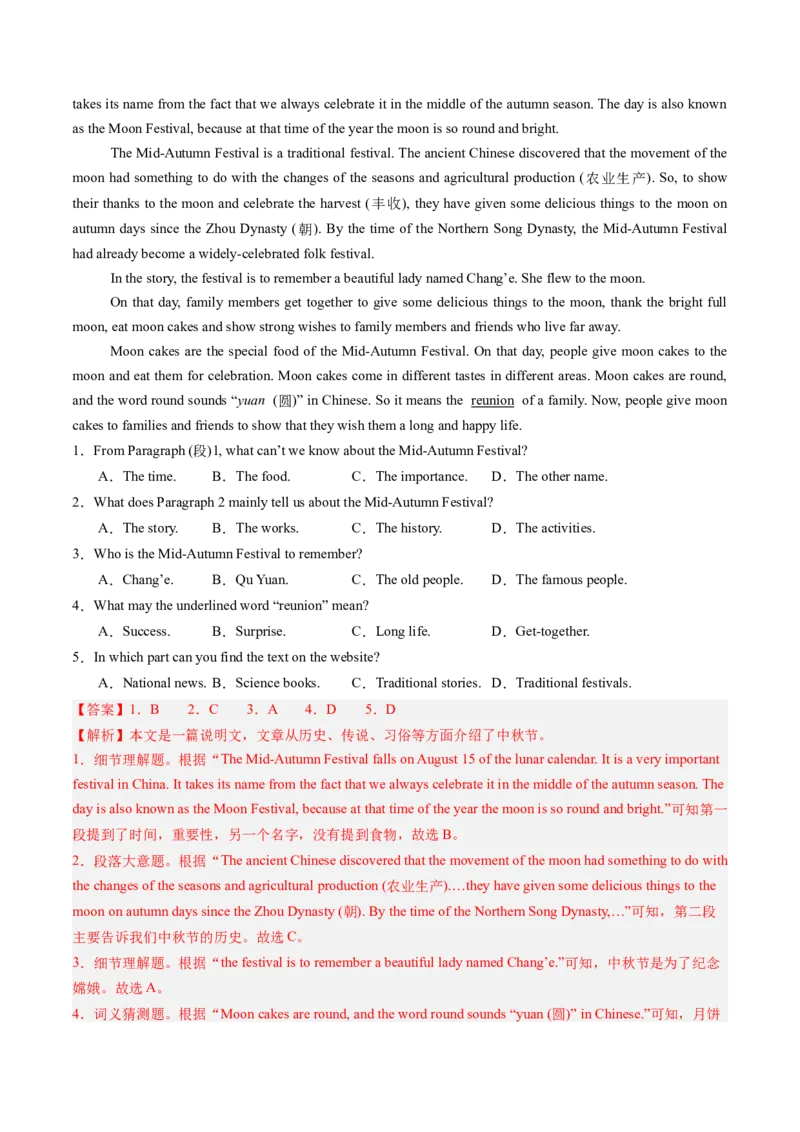
①Chunlian, also known as the Spring Festival couplet, is a very important part of Chinese culture. It has a
very long history and is deeply connected to the celebrations of the Spring Festival.
②A long time ago, chunlian was used to drive away bad spirits and bad luck. There is a story from the Tang
Dynasty about people putting peach wood with pictures of gods of Shenshu and Yulü on their doors. But over time,
these peach wood pieces changed into paper couplets with written words that brought good luck and wishes.
Another story from the Song Dynasty tells us that people wrote lucky words on red paper and put them on their
gates or doors during the Spring Festival.③A special event happened in the Later Shu when the ruler, Meng Chang, asked a minister to write couplets
for him. But he wasn’t happy with the work, so he wrote them himself. These are now considered the first Spring
Festival couplets, and they say, “New Year brings extra happiness, and this festive season is called Everlasting
Spring.”
④During the Ming Dynasty, chunlian became very popular, and that’s when it got its name. Emperor
Hongwu (namely Zhu Yuanzhang), really liked chunlian. He made a rule that every house had to have a chunlian on
their gates on New Year’s Day.
⑤Over the years, the custom of hanging chunlian during the Spring Festival has very widely spread. These
couplets are usually written in a simple, poetic style on red paper. This tradition is still an important part of Chinese
culture and is celebrated with great joy today.
1.What does the underlined word “them” in Paragraph 2 refer to?
A.Pictures of gods. B.Meanings of good wishes.
C.Peach wood pieces. D.Lucky words on red paper.
2.Which can most probably be the first chunlian according to the passage?
A.新年纳余庆,嘉节号长春 B.岁月更新人不老,江山依旧景长春
C.年丰人增寿,春早福满门 D.神州春暖山河秀,华夏龙腾日月新
3.What can we know about chunlian according to the passage?
A.It was invented by Emperor Hongwu. B.It was used to drive away bad spirits.
C.It has a history of ten thousand years. D.It showed one’s great talent in writing.
4.What would be the best structure of the passage?
A.①/②③④⑤ B.①/②③/④⑤ C.①/②③④/⑤ D.①②/③④/⑤
【答案】1.D 2.A 3.B 4.C
【解析】本文是一篇说明文。主要介绍了春联的悠久历史。
1.词句猜测题。根据“Another story from the Song Dynasty tells us that people wrote lucky words on red paper
and put them on their gates or doors during the Spring Festival.”可知,宋代也有一个故事,讲述人们在春节
期间在红纸上写上吉祥的文字;此处指的应是将写上吉祥文字的红纸贴在门口或门上,“them”指的是
“lucky words on red paper”。故选D。
2.词句猜测题。根据“These are now considered the first Spring Festival couplets, and they say, ‘New Year
brings extra happiness, and this festive season is called Everlasting Spring.’”可知,“新年纳余庆,嘉节号长
春”最可能是第一幅春联。故选A。
3.细节理解题。根据“A long time ago, chunlian was used to drive away bad spirits and bad luck.”可知,很久
以前,春联被用来驱散恶灵和厄运。故选B。
4.篇章结构题。第一段总结说明了春联有悠久的历史;第二、三和四段详细描述了春联的历史由来和发
展过程;第五段总结春联至今仍是春节期间的常见习俗和中国文化的重要组成部分;全文为总分总结构。
故选C。
5
The Mid-Autumn Festival falls on August 15 of the lunar calendar. It is a very important festival in China. Ittakes its name from the fact that we always celebrate it in the middle of the autumn season. The day is also known
as the Moon Festival, because at that time of the year the moon is so round and bright.
The Mid-Autumn Festival is a traditional festival. The ancient Chinese discovered that the movement of the
moon had something to do with the changes of the seasons and agricultural production (农业生产). So, to show
their thanks to the moon and celebrate the harvest (丰收), they have given some delicious things to the moon on
autumn days since the Zhou Dynasty (朝). By the time of the Northern Song Dynasty, the Mid-Autumn Festival
had already become a widely-celebrated folk festival.
In the story, the festival is to remember a beautiful lady named Chang’e. She flew to the moon.
On that day, family members get together to give some delicious things to the moon, thank the bright full
moon, eat moon cakes and show strong wishes to family members and friends who live far away.
Moon cakes are the special food of the Mid-Autumn Festival. On that day, people give moon cakes to the
moon and eat them for celebration. Moon cakes come in different tastes in different areas. Moon cakes are round,
and the word round sounds “yuan (圆)” in Chinese. So it means the reunion of a family. Now, people give moon
cakes to families and friends to show that they wish them a long and happy life.
1.From Paragraph (段)1, what can’t we know about the Mid-Autumn Festival?
A.The time. B.The food. C.The importance. D.The other name.
2.What does Paragraph 2 mainly tell us about the Mid-Autumn Festival?
A.The story. B.The works. C.The history. D.The activities.
3.Who is the Mid-Autumn Festival to remember?
A.Chang’e. B.Qu Yuan. C.The old people. D.The famous people.
4.What may the underlined word “reunion” mean?
A.Success. B.Surprise. C.Long life. D.Get-together.
5.In which part can you find the text on the website?
A.National news. B.Science books. C.Traditional stories. D.Traditional festivals.
【答案】1.B 2.C 3.A 4.D 5.D
【解析】本文是一篇说明文,文章从历史、传说、习俗等方面介绍了中秋节。
1.细节理解题。根据“The Mid-Autumn Festival falls on August 15 of the lunar calendar. It is a very important
festival in China. It takes its name from the fact that we always celebrate it in the middle of the autumn season. The
day is also known as the Moon Festival, because at that time of the year the moon is so round and bright.”可知第一
段提到了时间,重要性,另一个名字,没有提到食物,故选B。
2.段落大意题。根据“The ancient Chinese discovered that the movement of the moon had something to do with
the changes of the seasons and agricultural production (农业生产).…they have given some delicious things to the
moon on autumn days since the Zhou Dynasty (朝). By the time of the Northern Song Dynasty,…”可知,第二段
主要告诉我们中秋节的历史。故选C。
3.细节理解题。根据“the festival is to remember a beautiful lady named Chang’e.”可知,中秋节是为了纪念
嫦娥。故选A。
4.词义猜测题。根据“Moon cakes are round, and the word round sounds “yuan (圆)” in Chinese.”可知,月饼是圆的,单词round在汉语中读音是“圆”,划线单词表示“聚在一起”。故选D。
5.推理判断题。本文主要从历史、传说、习俗等方面介绍了中秋节这一传统节日,因此可能来自传统节
日部分。故选D。
6
Laba Festival, is celebrated on the eighth day of the last month of the Chinese lunar calendar and it has a
history of more than 1,200 years.
“La” first appeared in the Shang Dynasty (朝代). In winter, people held a big activity for good luck, which
was later called “La Worship”. It was not until the Han Dynasties that the eighth day of the 12th lunar month was
formally (正式地) made the “Laba Festival”.
Since the Song Dynasty, every family started making Laba Porridge (粥) on that day both in the north and
the south of China. In many places in northern China, the tradition of making Laba garlic is more popular.
________? On La Ba, every business will calculate the income and expenditure (核算收支) of the year.
Garlic, called “Suan” in Chinese, sounds the same as the word “calculate”. On that day, the debtor (债务人) will
send a letter to people who borrowed money from him to say it is time to prepare to pay back the money. There’s an
old saying in Beijing, “Laba porridge, Laba garlic, debtee (债主) sends a letter, debtor pays back the money” Some
debtees may give Laba garlic to kindly remind them to pay back the money. So, Laba garlic is also seen as a
symbol of being honest.
Laba Festival is full of traditional culture. Although the customs and habits may be different in different
places, but what they have in common is the wish for a better future and respect for family traditions.
1.La Ba became a formal festival in the ________.
A.Shang Dynasty B.Song Dynasty C.Han Dynasty D.Qing Dynasty
2.Which of the following can be put in the ________?
A.Why do people like Laba garlic in the north.
B.How do people make Laba garlic in the north.
C.Why do people like Laba porridge in the south.
D.How do people make Laba porridge in the south.
3.The underlined word “remind” in Paragraph 3 means ________.
A.嘱咐 B.提醒 C.逼迫 D.警告
4.What’s the best title for this passage?
A.The Way to Make Laba garlic B.The Way to Make Laba Porridge
C.The History of Laba Festival D.The Traditions of Laba Festival
【答案】1.C 2.A 3.B 4.D
【解析】本文是一篇说明文,主要介绍了中国传统佳节——腊八节。
1.细节理解题。根据“It was not until the Han Dynasties that the eighth day of the 12th lunar month was
formally (正式地) made the ‘Laba Festival’.”可知,直到汉代,腊月初八才被正式定为“腊八节”,故选C。
2.推理判断题。根据“In many places in northern China, the tradition of making Laba garlic is more popular.”
以及下文的内容可知,空格后解释在北方做腊八蒜受欢迎的原因,所以此处询问“北方人为什么喜欢腊八蒜”,故选A。
3.词义猜测题。根据“Some debtees may give Laba garlic to kindly remind them to pay back the money”可知,
提醒他们要还钱,所以remind表示“提醒”,故选B。
4.最佳标题题。通读全文可知,本文主要介绍了腊八节的历史和传统,所以D选项适合本文标题,故选
D。
7
The Huazhao Festival is a traditional flower festival following the Lantern Festival on China’s traditional
festival calendar. With a history of over 2,000 years, the Huazhao Festival was first held in celebration of the birth
of flowers. Since the climate varies (气候变化) in different parts of China, people hold celebrations on the 2nd,
12th, 15th, or 25th day of the second lunar month.
The Huazhao Festival was as important as the Lantern Festival and Mid-Autumn Festival in ancient times.
Nowadays, an increasing number of people in China have begun to celebrate this flower festival again. ▲
Spring outings during the Huazhao Festival were popular in ancient China. Since the festival is in early
spring, it is exactly the time to have an outing to enjoy all kinds of flowers. And people in some places planted
flowers and vegetables. It was said that flowers and vegetables planted on that day would grow easily and rapidly.
Besides, wild vegetables in early spring were believed to be nutritious (有营养的). So a lot of people enjoy picking
wild vegetables at that time.
At the festival, crowded fairs often formed early that day. The flower fair was the most popular. There were a
series of activities at the fair,such as dancing, playing music, and playing games.
People also cut colorful cloth into pieces and tied them to the stems (茎) of flowers, which is called
“shanghong”, as a protection of flowers. If the stems of certain flowers were too thin to stand the cloth, people
would put a thin bamboo stick in the flower pot and tie a piece of red cloth to the stick.
1.Why was the Huazhao Festival set up?
A.To show the beauty of flowers.
B.To celebrate the birth of flowers.
C.To bring different people together.
D.To draw people’s attention to nature.
2.Which of the following can be put in ▲ ?
A.Traditional hanfu is getting popular.
B.The festival has gone through big changes.
C.Here are some customs (习俗) of the festival.
D.Wine made from different flowers was served.
3.People believed wild vegetables in early spring were ________.A.as beautiful as flowers
B.difficult to find
C.easy to pick
D.good for their health
4.What can we learn from the passage?
A.People protected flowers by tying cloth to them.
B.The flower fair was a little boring for people.
C.The Huazhao Festival is celebrated on the same day all over China.
D.The Lantern Festival was less important than the Huazhao Festival.
【答案】1.B 2.C 3.D 4.A
【解析】本文主要介绍了花朝节的起源和庆祝活动。
1.细节理解题。根据“With a history of over 2,000 years, the Huazhao Festival was first held in celebration of
the birth of flowers.”可知,花朝节最早是为了庆祝花的诞生。故选B。
2.推理判断题。根据“Nowadays, an increasing number of people in China have begun to celebrate this flower
festival again.”可知,此处要介绍这个节日的一些习俗,选项C“这里有一些关于这个节日的习俗”符合语境。
故选C。
3.细节理解题。根据“Besides, wild vegetables in early spring were believed to be nutritious (有营养的). So a
lot of people enjoy picking wild vegetables at that time.”可知,人们相信早春吃野菜有益健康。故选D。
4.细节理解题。根据“People also cut colorful cloth into pieces and tied them to the stems (茎) of flowers,
which is called ‘shanghong’, as a protection of flowers.”可知人们用布系在花上来保护它们。故选A。
8
The Double Third Festival is an ancient Chinese festival. It comes on the third day of the third lunar (阴历)
month, so it’s not on the same day every year. The day is said to be the birthday of Yellow Emperor (Huangdi). The
date was fixed after the Wei and Jin dynasties.
In the Eastern Jin Dynasty, people often bath (沐浴) in the river on that day to wash away bad luck. Wang
Xizhi wrote in his LantingjiXu about how people took a bath and wrote poems while drinking. In the Tang Dynasty,
people enjoyed drinks and sightseeing. In the Ming and Qing dynasties, people did activities like throwing stones,
hiking and listening to music.
In modern times, it is mainly celebrated by the people in the southern parts of China. For the Zhuang people
in Guangxi, it is a festival for young people to sing songs and find their true love. Bamboo dancing is another
important activity for them. For the Li and Miao people in Hainan, it is a day for remembering ancestor (祖先). For
the Han people, it is a time to go outside to enjoy flowers and cook eggs with jicai. The Han people believe the
special eggs are good for their health.
1.Why do people in the Eastern Jin Dynasty bath in the river on the Double Third Festival?
A.To wash away bad luck. B.To improve their health.
C.To enjoy the sights. D.To remember ancestors.
2.What is the passage mainly about?A.Different people in China.
B.Different dynasties in China.
C.Why the Double Third Festival is celebrated.
D.How the Double Third Festival is celebrated.
3.What can we learn about the Double Third Festival from the passage?
A.It falls on the third day of March every year.
B.People in the Tang Dynasty celebrate it by listening to music.
C.It is mainly celebrated in the southern parts of China nowadays.
D.In Hainan, it is a day for young people to sing songs and find love.
4.When was the date of the Double Third Festival fixed?
A.In modern time. B.In the Eastern Jin Dynasties.
C.After the Wei and Jin Dynasties. D.Before the birthday of Yellow Emperor.
5.In the Ming and Qing dynasties, people did activities except ________.
A.throwing stonesB.hiking C.listening to music D.sing songs
【答案】1.A 2.D 3.C 4.C 5.D
【解析】本文主要讲述了介绍了“三三节”在各朝代的变迁及人们是如何庆祝这个节日的。
1.细节理解题。根据“In the Eastern Jin Dynasty, people often bath (沐浴) in the river on that day to wash away
bad luck”可知,是为了在河里洗去厄运。故选A。
2.主旨大意题。本文主要讲述了介绍了“三三节”在各朝代的变迁及人们是如何庆祝这个节日的。故选
D。
3.细节理解题。根据“In modern times, it is mainly celebrated by the people in the southern parts of China”可
知,如今,它主要在中国南部地区庆祝。故选C。
4.细节理解题。根据“The date was fixed after the Wei and Jin dynasties.”可知在魏晋之后,日期固定了。故
选C。
5.细节理解题。根据“In the Ming and Qing dynasties, people did activities like throwing stones, hiking and
listening to music.”可知在明清两代,人们进行投掷石头、徒步旅行和听音乐等活动。故选D。
9
As one of the four great traditional Chinese festivals, the Qingming Festival is the most important festival to
sweep the tombs (坟墓) and honor (尊敬) our ancestors (先人).
The Qingming Festival can be dated back to over 2,500 years ago. During Spring and Autumn Period, Jie
Zitui, a loyal (忠诚的) official of the state of Jin followed the Prince Chong’er and cut off meat from his leg for the
prince to eat. Later on, Prince Chong’er returned to his country and became the king of the state of Jin. To thank his
follower, the king invited Jie Zitui to work for the state. But Jie refused, he still wanted to live in the mountains.
The king set fire to the mountain to make Jie out. Unluckily, both Jie and his mother were burned to die in the fire.
In honor of Jie Zitui, the king made the date of Jie’s death as the Cold Food Day and the following day as the
Qingming Festival.
The Qingming Festival usually falls from the fourth to sixth in April every year. When it comes , thetemperature is rising and it is a good time for spring outing. People go outside to enjoy the warm sunshine and
beautiful scenery. In addition, farmers are busy planning to grow beans and plant melons before and after
Qingming.
1.Why do Chinese people celebrate Qingming Festival today?
A.To honor their ancestors. B.To enjoy the warm sunshine.
C.To plant beans and grow melons. D.To enjoy the beautiful scenery.
2.What did the king do to make Jie Zitui out of the mountain?
A.By cutting off his leg. B.By sweeping the tombs.
C.By setting a fire. D.By burning him to die.
3.What was Jie Zitui like according to the passage?
A.Brave. B.Loyal C.Silly. D.Serious.
【答案】1.A 2.C 3.B
【解析】本文告诉我们关于清明节这个中国传统节日的由来,以及这一天人们做什么。
1.细节理解题。根据“ the Qingming Festival is the most important festival to sweep the tombs (坟墓) and
honor (尊敬) our ancestors (先人).”可知,清明节是为了纪念祖先。故选A。
2.细节理解题。根据“The king set fire to the mountain to make Jie out.”可知,为了让他下山,国王放火烧
了山。故选C。
3.推理判断题。根据“During Spring and Autumn Period, Jie Zitui, a loyal (忠诚的) official of the state of Jin
followed the Prince Chong’er and cut off meat from his leg for the prince to eat.”可知,他是忠诚的。故选B。
10
The Lantern Festival is one of the most traditional festivals in China. It is celebrated on the 15th day of the
first month of the Chinese lunar year. It is a “festival within a festival”that is seen as the end of the Spring Festival.
Here is what people usually do at the Lantern Festival.
·Eat Yuanxiao
On the day, people usually eat sweet round dumplings made of glutinous rice flour filled with different kinds
of fillings. The snack is called yuanxiao in Chinese, so the festival is also named the Yuanxiao Festival.
·Guess Lantern Riddles
Guessing lantern riddles is a kind of amusing activity in folk. Being passed down from ancient times,
guessing lantern riddles is a special activity at the Lantern Festival. At first, people hung lantern and fired
firecrackers (鞭炮) to celebrate the Lantern Festival, and then somebody pasted riddles on the lanterns to let people
guess. Slowly, it becomes a custom of the Lantern Festival. Guessing lantern riddles can not only inspire wisdom,
but add more atmospheres (气氛) to the festival.
·Enjoy Beautiful Lantern
On the night of the festival, temples and parks are decorated with colorful lanterns made of paper gauze (薄
纱) and glass, painted with interesting figures, as well as flowers and birds. After eating dinner, people like to walk
around parks to enjoy the beautiful lantern.
·Play the Dragon DanceIn southern China, especially Guangdong and Guangxi, there are also some dragon dance performances in
the streets and lanes. Where there is a dragon dance, where the people enjoy themselves.
1.Why is the Lantern Festival called a “festival with in a festival”?
A.Because it is celebrated during the Chinese New Year. B.Because it is one of the most important
festivals.
C.Because it is as important as other festivals in China. D.Became people do many things at the Lantern
Festival.
2.What’s the meaning of the underlined word “fillings”?
A.prices B.shapes C.stuffings D.tastes
3.What do people usually do to celebrate the Lantern Festival?
①Eat sweet round dumplings. ②Hang lanterns and fire firecrackers. ③Guess lantern riddles.
④Visit relatives and friends. ⑤Enjoy beautiful lanterns. ⑥Play the dragon dance.
A.①②③④⑤ B.①②④⑤⑥ C.②③④⑤⑥ D.①②③⑤⑥
4.Which is right according to the passage?
A.The Lantern Festival is the most traditional festival in China.
B.The Lantern Festival is celebrated on the 15th day of January.
C.Guessing lantern riddles is a custom of the Lantern Festival.
D.Only in northern China, there are some dragon dance performances in the streets and lanes.
5.What’s the best title of the passage?
A.The story of the Lantern Festival B.How to celebrate the Lantern Festival
C.The most important festival in China D.Where to celebrate the Lantern Festival
【答案】1.A 2.C 3.D 4.C 5.B
【解析】本文主要讲了元宵节的时间以及人们如何庆祝元宵节的一些活动。
1.细节理解题。根据第一段“It is a ‘festival within a festival’ that is seen as the end of the Spring Festival. ”可
知,元宵节是在春节末期的一个节日。之所以元宵节被叫成“节日里的节日”,是因为元宵节是在中国农
历新年期间庆祝的节日。故选A。
2.词义猜测题。根据“On the day, people usually eat sweet round dumplings made of glutinous rice flour filled
with different kinds of fillings.”可知,此处介绍元宵里面有各种馅料,故划线单词意为“馅料”,与
stuffings同义。故选C。
3.细节理解题。根据“Eat Yuanxiao”、“Guess Lantern Riddles”、“Enjoy Beautiful Lantern”、“Play
the Dragon Dance”以及“At first, people hung lantern and fired firecrackers (鞭炮) to celebrate the Lantern
Festival”可知,人们通过吃元宵、猜灯谜、欣赏漂亮的灯笼、表演龙舞以及挑灯笼放鞭炮来庆祝元宵节。
故①②③⑤⑥符合。故选D。
4.细节理解题。根据“Slowly, it becomes a custom of the Lantern Festival.”可知,猜灯谜慢慢成为元宵节的
一种习俗。故选C。
5.最佳标题题。通读全文,主要讲了元宵节的时间以及人们如何庆祝元宵节的一些活动。故最佳标题为:
如何庆祝元宵节。故选B。