主题 02 二十四节气与生活
主题简析
二十四节气作为中国传统文化的重要组成部分,不仅深刻反映了季节更替和气候变化,还与人们的日
常生活紧密相连。在初中英语阅读中,这一主题不仅能够帮助学生了解中国古老的历法体系,还能引导他
们体会节气变化对农业生产、日常生活以及自然生态的影响。通过阅读,学生可以了解到每个节气所代表
的气候特征、传统习俗以及与之相关的农耕活动,如“立春”标志着春天的开始,是播种希望、规划新一
年的时刻;“谷雨”则是降雨量增加,对农作物生长至关重要的时期。这些内容不仅丰富了学生的文化知
识,还培养了他们对自然界的观察力和感知力,使他们更加尊重自然、珍惜时节,学会与自然和谐相处 。
此外,二十四节气中蕴含的哲学思想和智慧,如顺应天时、尊重自然规律等,也对学生的价值观形成具有
积极的引导作用 。因此,初中英语阅读中的二十四节气与生活主题,不仅具有文化教育的意义,还促进了
学生全面发展 。
词句积累
二十四节气的英语翻译
立春 Beginning of Spring
雨水 Rain Water
惊蛰 Waking of Insects
春分 Spring Equinox
清明 Clear and Bright(或Pure Brightness)
谷雨 Grain Rain
立夏 Beginning of Summer
小满 Grain Buds
芒种 Grain in Ear
夏至 Summer Solstice
小暑 Slight Heat
大暑 Great Heat
立秋 Beginning of Autumn
处暑 End of Heat
白露 White Dew
秋分 Autumn Equinox
寒露 Cold Dew
霜降 Frost's Descent
立冬 Beginning of Winter小雪 Light Snow
大雪 Heavy Snow
冬至 Winter Solstice
小寒 Slight Cold
大寒 Great Cold
传统习俗示例
春节:Spring Festival
元宵节:Lantern Festival
清明节:Qingming Festival / Tomb Sweeping Day
端午节:Dragon Boat Festival
中秋节:Mid-Autumn Festival
重阳节:Double Ninth Festival
农历:lunar calendar
守岁:staying up(on New Year's Eve)
拜年:pay a New Year's call
祭祖:offer sacrifices to one's ancestors
祭灶:offer sacrifices to the God of Kitchen
春联:Spring Festival couplets
贴倒福:paste the Chinese character "Fu" upside down
喝腊八粥:eat Laba porridge
扫尘/扫房:sweep the dust / spring cleaning
舞狮:Lion Dance
吃元宵:eat Tangyuan / Sweet Rice Dumplings
猜灯谜:guess lantern riddles
拓展阅读
Start of Spring, the first of the 24 solar terms, marks nature's grand opening banquet. As Song Dynasty poet Su
Shi depicts in his poem "River Scenes on a Spring Evening", all things awakens from the winter slumber and life
quietly unfolds in every corner. May this poem usher in a new beginning, filling your life with vitality and vigor
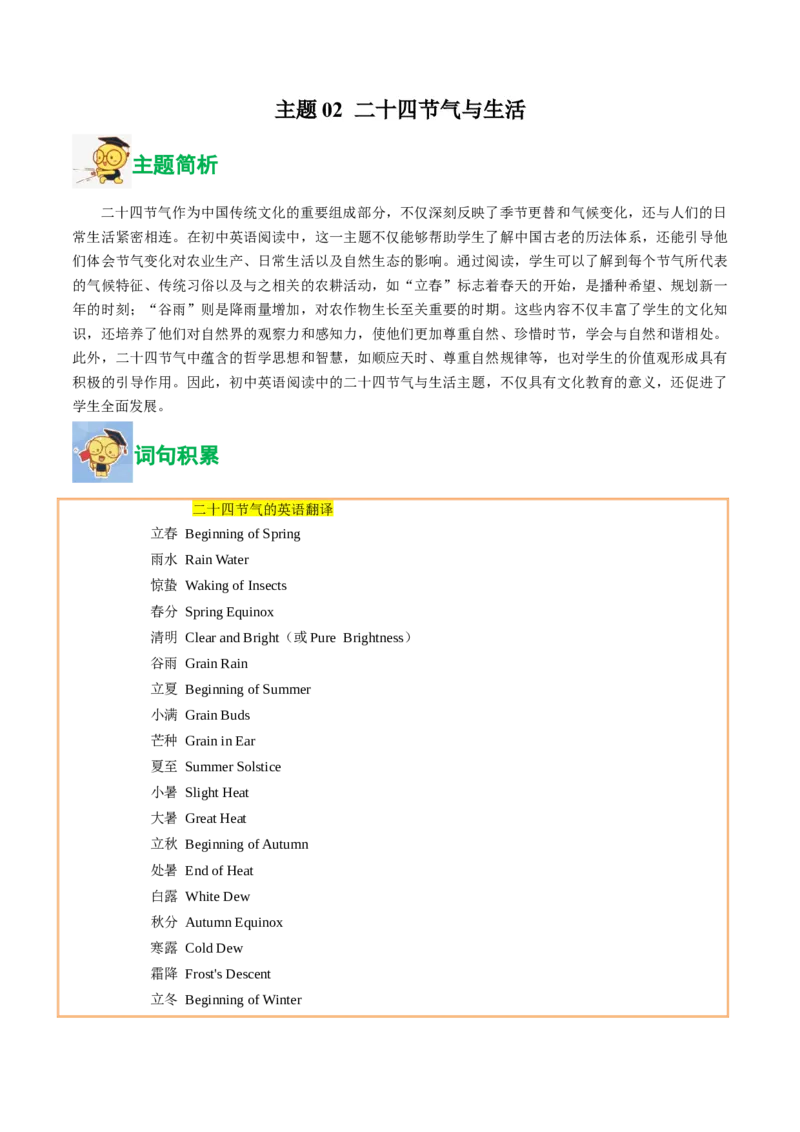
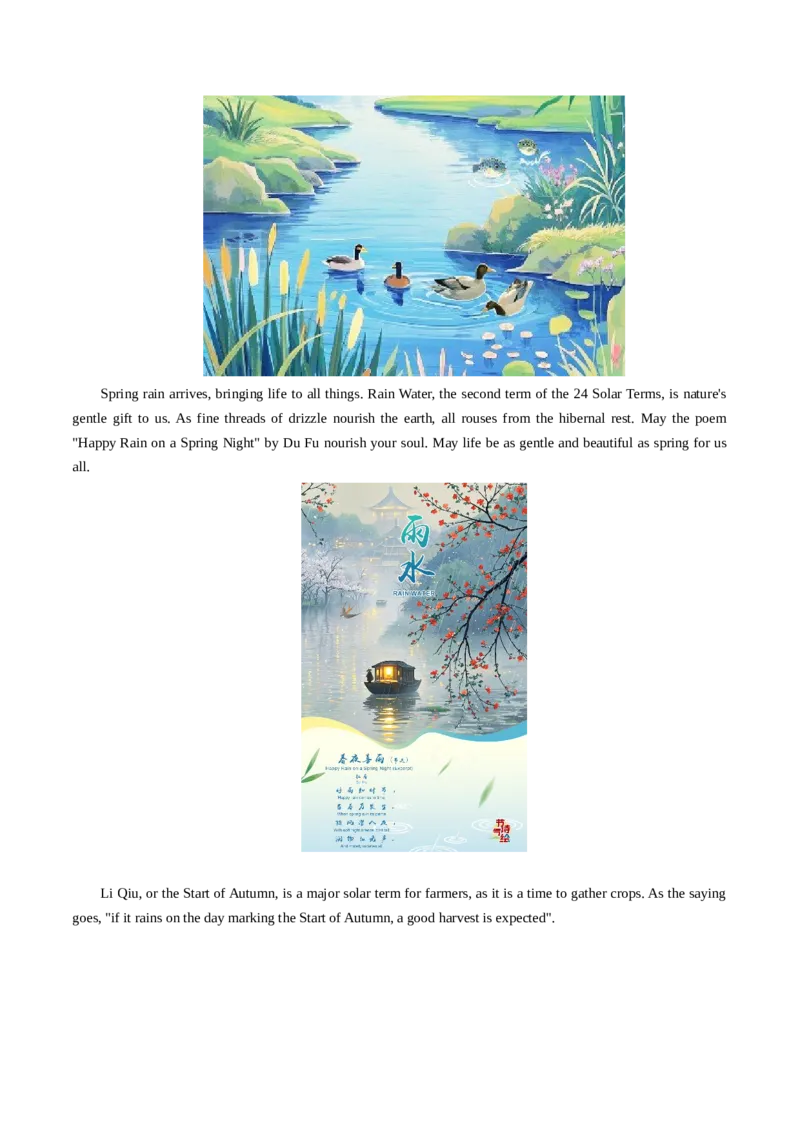
like a day in spring.Spring rain arrives, bringing life to all things. Rain Water, the second term of the 24 Solar Terms, is nature's
gentle gift to us. As fine threads of drizzle nourish the earth, all rouses from the hibernal rest. May the poem
"Happy Rain on a Spring Night" by Du Fu nourish your soul. May life be as gentle and beautiful as spring for us
all.
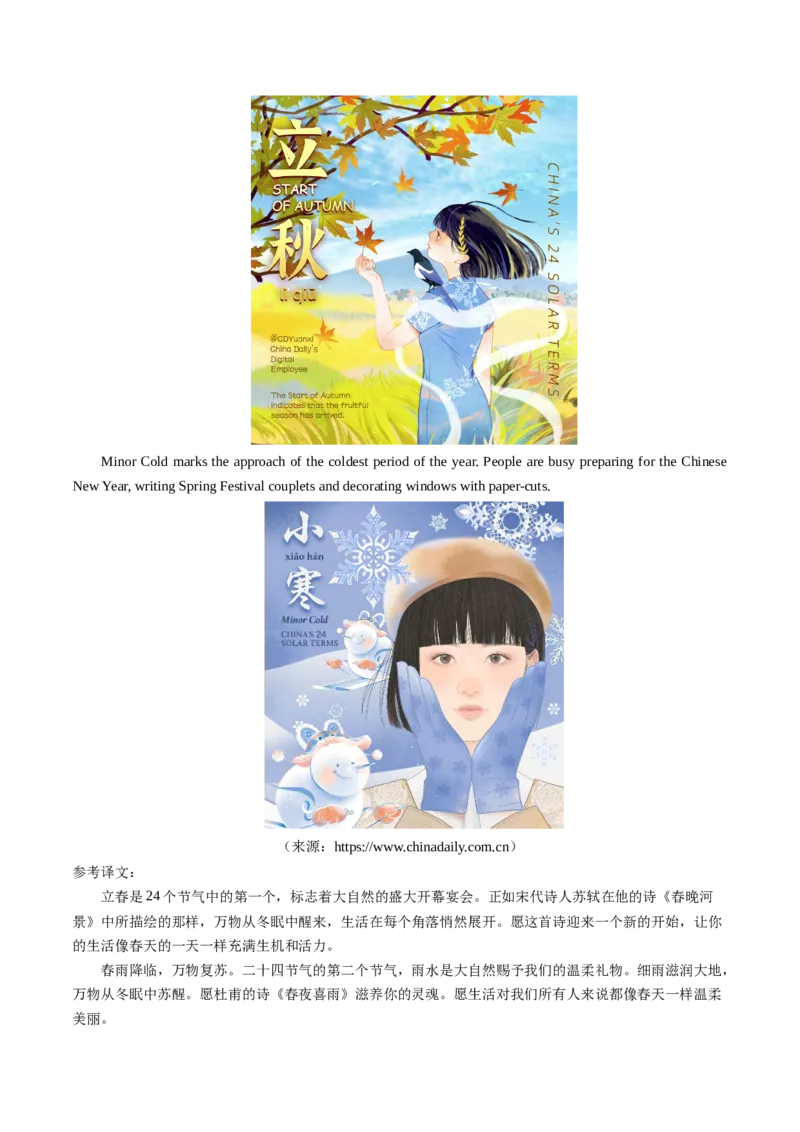
Li Qiu, or the Start of Autumn, is a major solar term for farmers, as it is a time to gather crops. As the saying
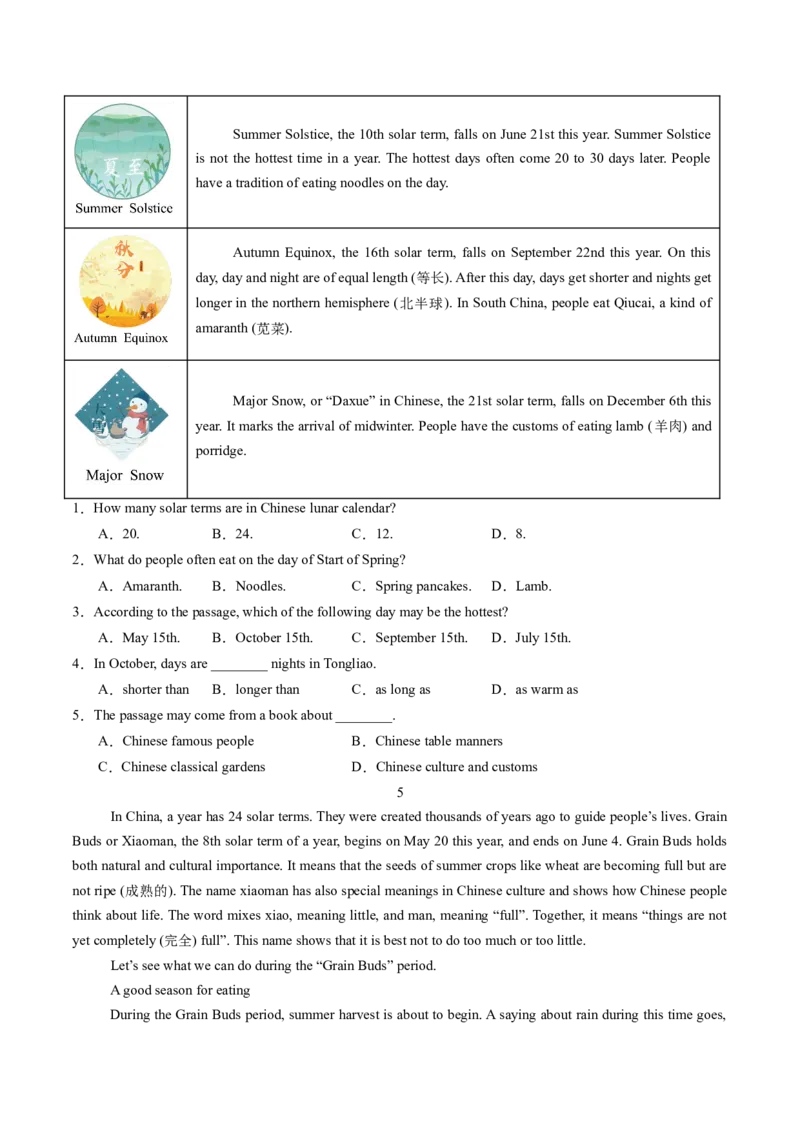
goes, "if it rains on the day marking the Start of Autumn, a good harvest is expected".Minor Cold marks the approach of the coldest period of the year. People are busy preparing for the Chinese
New Year, writing Spring Festival couplets and decorating windows with paper-cuts.
(来源:https://www.chinadaily.com.cn)
参考译文:
立春是24个节气中的第一个,标志着大自然的盛大开幕宴会。正如宋代诗人苏轼在他的诗《春晚河
景》中所描绘的那样,万物从冬眠中醒来,生活在每个角落悄然展开。愿这首诗迎来一个新的开始,让你
的生活像春天的一天一样充满生机和活力。
春雨降临,万物复苏。二十四节气的第二个节气,雨水是大自然赐予我们的温柔礼物。细雨滋润大地,
万物从冬眠中苏醒。愿杜甫的诗《春夜喜雨》滋养你的灵魂。愿生活对我们所有人来说都像春天一样温柔
美丽。立秋,对农民来说是一个重要的节气,因为这是收割庄稼的时候。俗话说,“立秋之日下雨,必有丰
收”。
小寒标志着一年中最冷时期的到来。人们正忙着为中国新年做准备,写春联,用剪纸装饰窗户。
综合演练
1
Pure Brightness Festival, also known as Tomb-sweeping Day in China, falls on the 4th or 5th of April each
year. It was started in the Han Dynasty. On this day, whole families, young and old, with flowers visit the graves of
their ancestors to pay their respects. Following the custom, tomb sweepers clean and tidy the graves, decorate them
with flowers. They burn paper money made for the dead, set off firecrackers and bow before their ancestors’
tombstones. On this day, they don’t cook. Only cold food is served.
However, tomb sweeping is not the only activity during Pure Brightness Festival. This day is also a time for
people to enjoy themselves. Other activities include spring outing, flying kites, planting trees, tasting tea and so on.
In April, everything in nature takes on a new look. Trees turn green, flowers come out and the sun shines brightly.
So it is a good time to be out to appreciate the beauty of nature. People fly kites not only in the daytime but at night.
In the dark, some people fly kites with lanterns, which are called “God’s lanterns”. They plant trees because young
trees which are planted during this period are easy to grow up. And they enjoy tea because the tea produced around
the festival is said to have good quality.
1.The word “tomb” probably means the same as the word “______” in the passage.
A.grave B.tombstone C.ancestor D.custom
2.From the passage we can learn that Pure Brightness Festival in 2014 will be on ______.
A.April 4 B.April 5
C.either April 4 or April 5 D.neither April 4 nor April 5
3.According to the passage, Pure Brightness Festival is ______.
A.a day full of sadness B.Tree Planting Day
C.a combination of sadness and happiness D.a time for people to have fun
4._____ activities are talked about in the passage above.
A.Two B.Three C.Four D.Five
5.Which of the following do you think is the best title for the passage ?
A.A Special Day
B.Pure Brightness Festival in China
C.What the Chinese Do on Tomb-sweeping Day
D.A Chinese Traditional Custom
2
In the long history of about 5,000 years, lots of Chinese festivals were created.Here are some of them.
Spring FestivalSpring Festival is celebrated on the first day of the first month of the lunar calendar(阴历).Traditionally, on
that day, people set off fireworks and pay a visit to their friends and relatives.They usually share jiaozi with their
families, especially the northern Chinese.Also, during the spring festival people don’t sweep the room or argue
with each other.
Pure Brightness Festival
Pure Brightness Festival is on the 15th day after the spring equinox(春分).All over the country, people go to
worship their ancestors(祖先) and clean up the weeds growing on the ancestors’ tombs(坟墓).In some areas,
people are not allowed to use fire to cook food, so they only eat cold food.
Dragon Boat Festival
People celebrate the Dragon Boat Festival on May 5th in the lunar calendar.The traditional activities on that
day are dragon boat races and having zongzi.In some areas, people believe that the day is an evil day (凶日), and
babies under one year old should be taken to their grandma’s to avoid being hurt.
Mid-autumn Festival
Mid-autumn Festival takes place on August 15th in the lunar calendar.It is a special festival when people go
back home, no matter where they are.People get together to enjoy the fullest and brightest moon of the year and
have mooncakes.It is said that men are not allowed to take part in the moon-worship ceremony, because the moon
is a woman.
1.The passage has been written to introduce __________.
A.the Chinese histories B.the Chinese ancestors.
C.the traditional Chinese festivals. D.the traditional activities.
2.What do people usually share with their families during the Spring Festival?
A.Zongzi. B.Jiaozi. C.Mooncakes. D.Cold food.
3.Why do people eat cold food in some areas during the Pure Brightness Festival?
A.Because they are not allowed to use fire to cook food.
B.Because they should go to worship their ancestors.
C.Because they should clean up the weeds.
D.Because they are so busy.
4.People usually have the activities of dragon boat races in China during the ______.
A.Spring Festival. B.Pure Brightness Festival
C.Dragon Boat Festival D.Mid-autumn Festival
5.What is the moon like during the Mid-autumn Festival in the year?
A.It’s the fullest. B.It’s the brightest.
C.It’s the biggest. D.It’s the fullest and brightest.
3
A special time of the year in China called “Lidong”, which means the Start of Winter. Lidong is one of the 24
solar terms (节气) in China. It usually arrives around 7th or 8th November every year.
When Lidong comes, it means winter is starting. The weather gets colder. The days become shorter. Leaveson the trees may fall, and animals start to prepare for the long cold winter. There are some customs around the
beginning of Winter. First, nourishing the winter (补冬). People often eat high-calorie (高热量的) food such as
chicken, duck, beef, mutton and fish to prepare for the coming cold winter. In many places, some families will eat
dumplings. It is said that eating dumplings can keep people’s ears from getting frostbitten (冻伤) in the cold winter.
Second, do sports. To keep warm and strong in the cold winter, people should put on more clothes and do more
exercise, such as walking and running.
Lidong is not only a sign (标志) of the change of seasons but also a time when people come together to
enjoy the simple joys of life. For a farming society, people work hard all the year. On the day of Lidong, they will
take a rest to reward (奖励) their families and prepare for the future.
There is a saying, “If the wheat is covered with three layers of quilts at the beginning of winter, then in the
coming year, the farmer will sleep on a pillow of buns.”
1.When does Lidong usually arrive every year?
A.Around 7th or 8th December. B.Around 7th or 8th November.
C.Around 15th or 16th November. D.Around 20th or 21st November.
2.Why do some families eat dumplings on Lidong according to the text?
A.Because dumplings are very delicious.
B.Because eating dumplings can make people warmer.
C.Because eating dumplings can keep people’s ears from getting frostbitten.
D.Because it’s very happy to have dumplings.
3.What does the underlined sentence “If the wheat is covered with three layers of quilts at the beginning of
winter, then in the coming year, the farmer will sleep on a pillow of buns.” mean?
A.立冬麦盖三层被,来年枕着馒头睡。B.北风潜入悄无踪,未品秋浓已立冬。
C.冬至至后日初长,远在剑南思洛阳。 D.秋将归去冬又至,寒色不遮万山翠。
4.What’s the best title for the text?
A.When is Lidong? B.What is Lidong?
C.What people do on Lidong? D.What people eat on Lidong?
5.In which part of a magazine can you read the text?
A.Science. B.Sports. C.Culture. D.Travel.
4
The traditional Chinese lunar calendar (农历) divides the year into 24 solar terms (节气). It’s very useful for
people’s life and work. Let’s have a look.
Start of Spring, the first solar term of the year, falls on February 4th this year. After
Start of Spring, the daytime is becoming longer and the weather is becoming warmer. And
people eat spring pancakes and spring rolls on the day.Summer Solstice, the 10th solar term, falls on June 21st this year. Summer Solstice
is not the hottest time in a year. The hottest days often come 20 to 30 days later. People
have a tradition of eating noodles on the day.
Autumn Equinox, the 16th solar term, falls on September 22nd this year. On this
day, day and night are of equal length (等长). After this day, days get shorter and nights get
longer in the northern hemisphere (北半球). In South China, people eat Qiucai, a kind of
amaranth (苋菜).
Major Snow, or “Daxue” in Chinese, the 21st solar term, falls on December 6th this
year. It marks the arrival of midwinter. People have the customs of eating lamb (羊肉) and
porridge.
1.How many solar terms are in Chinese lunar calendar?
A.20. B.24. C.12. D.8.
2.What do people often eat on the day of Start of Spring?
A.Amaranth. B.Noodles. C.Spring pancakes. D.Lamb.
3.According to the passage, which of the following day may be the hottest?
A.May 15th. B.October 15th. C.September 15th. D.July 15th.
4.In October, days are ________ nights in Tongliao.
A.shorter than B.longer than C.as long as D.as warm as
5.The passage may come from a book about ________.
A.Chinese famous people B.Chinese table manners
C.Chinese classical gardens D.Chinese culture and customs
5
In China, a year has 24 solar terms. They were created thousands of years ago to guide people’s lives. Grain
Buds or Xiaoman, the 8th solar term of a year, begins on May 20 this year, and ends on June 4. Grain Buds holds
both natural and cultural importance. It means that the seeds of summer crops like wheat are becoming full but are
not ripe (成熟的). The name xiaoman has also special meanings in Chinese culture and shows how Chinese people
think about life. The word mixes xiao, meaning little, and man, meaning “full”. Together, it means “things are not
yet completely (完全) full”. This name shows that it is best not to do too much or too little.
Let’s see what we can do during the “Grain Buds” period.
A good season for eating
During the Grain Buds period, summer harvest is about to begin. A saying about rain during this time goes,“A heavy rainfall makes the river full.” Because of the great increase in rainfall, rivers are full of water, which
makes fish and shrimps big and fat. This is a good time to enjoy them.
Grain Buds is also a season for eating mulberries (桑葚) and bitter herbs (苦菜) which can cool the blood
and remove harmful things from the body.
A key period for flower caring
This time is a good period of the quick growth of flowers. It is also a season when plant diseases and pests
are the most, which makes growing flowers even harder. Caring for your garden becomes even more important than
any other time. If you take good care of them, your plants will be healthier.
_____________
High temperatures and wet days are common during the Grain Buds period. The increase in temperature over
this season may make you get skin illnesses easily. It is also important to exercise during the hot summer days.
Walking, jogging and practicing tai chi are popular.
1.How long does Grain Buds last this year?
A.14 days. B.15 days. C.16 days. D.17 days.
2.Which of the following best matches the meaning of Xiaoman?
A.The couple live happily though they don’t have much money.
B.A poor man hates working and lies down all day long.
C.A rich man often wants to make much more money.
D.A student isn’t happy with his grade and always tries to get higher grades.
3.Grain Buds is NOT a good season to eat ________.
A.fish B.strawberries C.mulberries D.bitter herbs
4.What can we infer from the passage?
A.Xiaoman always falls on May 20 every year.
B.It is easy to look after flowers during Xiaoman.
C.It is not necessary to exercise during Xiaoman.
D.Grain Buds is a good season for fishermen.
5.Which of the following can be filled in the blank?
A.Weather during Grain Buds B.Ways to avoid skin diseases
C.Advice on health D.Exercise for health
6
Ancient Chinese people divided the year into 24 parts.They are called “solar terms”. They tell people when
the weather changes and when to farm.
Awakening of Insects (惊蛰) falls on March 5 and ends on March 19, 2024. As the third solar term in the
solar year, it is the key time for spring agricultural (农业的) activities. Here are 4 traditional things you may not
know about Awakening of Insects.
Spring thunder (雷) cracks the sky
It’s said that around the Awakening of Insects, the earth becomes warm and wet. The hot air near the surfacerises. At the same time,the hot and wet air from the north is strong and creates frequent winds. For this
reason,thunder happens in this period.
Spring ploughing (春耕)
It is an important time for farmers and is widely seen as the beginning of the busiest time for agricultural
work. Old Chinese sayings such as “once the Awakening of Insects comes, spring ploughing never rests” .
A good time for fishing
Around the Awakening of Insects, hibernating (冬眠) animals wake up, and so do fish. They swim from deep
water to shallow water. It is a good time for fishing.
Eating pears
As the weather gets warmer and the air becomes dry, some people often feel their mouths dry, have colds or
coughs. Because a pear is sweet, juicy and cold, they think eating pears can help cool the body and lungs.
1.According to the passage, there are some traditions during the Awakening of Insects except _______.
A.eating pears B.go fishing
C.spring ploughing D.drinking realgar wine
2.What is the key time for spring agricultural (农业的) activities?
A.Awakening of Insects. B.The Spring Festival.
C.The Beginning of spring. D.Rainwater.
3.In 2024, Awakening of Insects lasts _______ days.
A.thirteen B.fourteen C.fifteen D.twenty-four
4.The underline sentence “Once the Awakening of Insects comes, spring ploughing never rests” means _______ .
A.hibernating (冬眠) animals wake up
B.the earth begins to come back to life
C.farmers are busy with their agricultural work
D.spring thunder happen many times
5.Which of the following sentences is TRUE?
A.The Awakening of Insects is the first solar term in 24 solar terms.
B.Solar terms tell people when the weather changes and when to farm.
C.Thunder happens in this period because the hot and wet air from the south is strong and creates frequent
winds.
D.Eating pears can help warm the body and lungs.
7
According to the traditional Chinese lunar calendar (阴历), there are 24 solar terms (节气) in a year. Major
Snow is the 21st solar term of the year. During Major Snow, the temperature drops greatly. Here are three things
you should know about Major Snow.
①________ The snow in North China may last a whole day, covering the ground and blocking (堵塞) the
roads. People can see the beautiful natural scene of “ice blockading for hundreds of miles and snow flying through
thousands of miles”. In the south, snow falls and the world turns white. There is a saying about the snow, “A timelysnow promises a good harvest (瑞雪兆丰年).” As the snow covers the ground, pests (害虫) living through the
winter will be killed by the cold temperature.
②________ People usually lose themselves in the beauty of wintersweet (腊梅) around Major Snow.
Wintersweet usually opens in mid-to-late December in some southern cities of China. Wintersweet comes from
China and is greatly admired in Chinese culture for its resilience during cold winters. With pine and bamboo, it is
regarded as one of the Three Friends of Winter.
③________ Hot porridge can help warm you and make your body healthy in cold weather. In China, it’s
traditional to eat red bean porridge on the first day of Major Snow.
1.What does the underlined word “it” in Paragraph 3 refer to?
A.The cold winter. B.The bamboo. C.Chinese culture.D.Wintersweet.
2.Which is the reason that people eat hot porridge on Major Snow?
A.It can treat illnesses. B.It’s a symbol of good luck.
C.It can make the body warm. D.It’s a wish for a good harvest.
3.Match the title with each paragraph.
a. Eating porridge. b. Having a big meal with family. c. Enjoying the snowscape.
d. Admiring wintersweet. e. Making snowmen.
A.①-e, ②-d, ③-cB.①-c, ②-d, ③-a
C.①-e, ②-a, ③-dD. ①-c, ②-b, ③-a
4.Which of the following is TRUE according to the passage?
A.Chinese people like wintersweet very much.
B.Major Snow is in November.
C.Major Snow is the last solar term of the year.
D.Major Snow is more popular in North China than in South China.
5.Which of the following best shows the structure of the passage?
A. B. C. D.
8
Do you know about Traditional Chinese Medicine (TCM) (中医) ? Many people turn to TCM when they are
not feeling well. If you want to know about it, you can watch Gen Z (《后浪》) .
Gen Z is a popular TV play on Youku. In the play, Ren Xinzheng, a teacher, knows a lot about TCM. He starts
a project (项目) to teach young talents about TCM. Sun Toutou, a girl, gets into Ren’s class and learns how to help
people feel better through TCM. She meets many difficulties, but with her hard work, she becomes an excellent
doctor and helps people through TCM.
In most people’s eyes, TCM is a little boring and serious, and it’s difficult to learn about TCM, but Gen Z
makes it ________ through stories and examples. For example, it talks about the 24 Solar Terms (节气) , the
important times in Chinese culture and what people should do on these important days to stay healthy. When wewatch the TV play, we can follow the timeline (时间线) of the 24 Solar Terms to learn new things and have fun at
the same time!
Millions of people in China like watching Gen Z. People in other countries like Thailand and Malaysia also
like watching it and learning from it. They are interested in TCM and watching the TV play is a great way for them
to learn about TCM and Chinese culture.
Gen Z is really a wonderful show for you to learn about Traditional Chinese Medicine in a fun way! Go and
watch this great show, and you’ll find out the world of TCM for yourself !
1.The writer starts the passage with a ________.
A.song B.story C.question D.saying
2.What does the underlined word “excellent” in Paragraph 2 mean?
A.Serious B.Good C.New D.True
3.What’s the best word for “________” in Paragraph 3?
A.interesting B.boring C.famous D.right
4.What’s the main idea of Paragraph 4?
A.Gen Z talks about TCM in a fun way.
B.People can have fun watching Gen Z on Youku.
C.Gen Z is popular with people in many countries.
D.People can learn about the 24 Solar Terms on Gen Z.
5.The writer wrote the passage mainly to ask people to _______.
A.learn about TCM to stay healthy B.learn from Sun Toutou
C.turn to TCM when feeling bad D.watch this TV play
9
As the spring comes, the weather warms up and the rain falls. The world comes back to life. Chinese people
call this time of the year Jingzhe and it is one of the “solar terms” (节气) in China. This year it comes on the fifth
day of the third month.
It’s time to get up and find food. Farmers start the year’s work. There is sunshine and rain. That’s good for
plants to grow. As the Chinese saying goes, “The whole year’s work depends on a good start in spring.” Everyone
seems to be ready (准备) for the new year’s work. What do we do around Jingzhe?
Feed the “white tiger”
In some old Chinese stories, a white tiger always bites people during Jingzhe. People draw the white tiger on
paper and then put some meat in its mouth. This way, the tiger is fed and will not bite people. Go away, bad luck!
Beat the drums
Some stories are about the god of thunder (雷神). He beats his drum to make spring thunder during Jingzhe.To show their respect, people on the earth also beat drums.
Eat pears
It’s getting warmer around Jingzhe. Pears are sweet and juicy. People believe that eating pears can stop us
getting coughs (咳嗽).
1.When is Jingzhe this year?
A.March 5th.
B.May 5th.
C.May 3rd.
2.Which picture can’t be from Jingzhe?
A. B. C.
3.Why do people on the earth beat drums around Jingzhe?
A.To make spring thunder.
B.To stop getting coughs.
C.To show respect.
4.What does the underlined (划线) saying in paragraph 2 mean?
A.People always start to work on rainy days.
B.Spring is the best time to be ready for the year’s work.
C.It’s important for people to work on a spring morning.
5.What can we learn from the passage?
A.Farmers’ activities in summer.
B.Different weather in different places.
C.Something about a Chinese “solar term”.
10
According to the Chinese lunar calendar, winter months include six solar terms (节气), lidong (the start of
winter), xiaoxue (minor snow), daxue (major snow), dongzhi (winter solstice), xiaohan (minor cold) and
dahang (major cold).
Lidong (in November) is the beginning of winter. On this day, after a year of hard work, people are happy to
have a rest and spend more time with their family. The northern part of China celebrates lidong as the small Spring
Festival. People have dumplings and mutton soup.
Xiaoxue (in November) and daxue (in December) come after lidong. On xiaoxue, northern China can expect
snow and temperatures slowly fall below zero degree. Daxue means even more snow and a bigger temperature
drop.
When dongzhi (in December) comes, it brings the shortest day of the year and the longest night. Many places
can expect the coldest weather. In ancient (古代的) times, people would start counting “nine cold periods” (数九寒
天) from dongzhi. Every cold period has nine days. They believed that after 81 cold days, spring would arrive.Xiaohan (in January) usually brings the lowest temperature of the year. Finally, on dahan (in January), the
cold weather fills the fields with snow. All Chinese people are ready to welcome the Chinese New Year after
dahan. The Spring Festival, China’s most important festival falls at this time.
1.Xiaoxue is usually in_________according to the passage.
A.November B.December C.January D.February
2.People have________ day on dongzhi in a year.
A.the sunniest B.the longest C.the coldest D.the shortest
3.Which of the following is TRUE according to the passage?
A.In winter, there are only eighty-one cold days.
B.On daxue, it must snow heavily in most places.
C.After dahan, people begin to welcome the Spring Festival.
D.Mostly, temperatures fall below zero degree from lidong.
4.What is the best title for the passage?
A.The Festivals in Winter B.Six Solar Terms in Winter
C.The Coldest Time in Winter D.The Weather and Customs in Winter
11
根据短文内容,从短文后的选项中选出能填入空白处的最佳选项。选项中有两项为多余选项。
Cold Dew (寒露), the 17th of the 24 solar terms (节气), started on October 8 in 2024. Cold Dew got its name
from the dew which becomes frost (霜) as temperatures continue to drop.
Compared with the White Dew, the Cold Dew period is much colder, marking the arrival of late autumn.
1 . But in the south, people enjoy some cooler and drier day. During the Cold Dew period, some fruits can be
picked and eaten, especially in central and northern areas of China. Let’s look at more Cold Dew traditions.
Going fishing
During the Cold Dew period, temperatures drop quickly and sunshine cannot reach the deep water, 2 .
The water temperature is relatively high there, which makes the Cold Dew period perfect for fishing.
3
Hiking is one of the traditions for the Double Ninth Festival, which often falls around the Cold Dew. On that
day, people often climb hills with cornels (茱萸) in their hands, 4 . They can also enjoy the beautiful autumn
view high up on the mountains.
Drinking chrysanthemum wine (菊花酒)
The chrysanthemum is the symbol flower of Cold Dew. Besides admiring the beauty of the flowers, 5
. The wine has a good taste and is believed to be good for people’s health. In ancient times, it was called the “wine
of long life” as it was believed to be able to slow down the aging.
A.Go hiking
B.Enjoy the autumn view
C.people also use them to make wine
D.people also give up drinking to keep healthyE.so fish like to swim closer to the surface
F.and they hope to stop or get rid of ill luck in this way
G.People in northern China could soon see frost or even ice and snow
参考答案
1
【答案与解析】试题分析:这篇短文中作者主要讲述了中国的每年4月4日或4月5日的清明节以及清明
节那一天所做的事情。
1.词义猜测题。联系上下文描述,可知此处指的是坟墓。故选A。
2.细节理解题。根据Pure Brightness Festival,falls on the 4th or 5th of April each year.可知2014年清明节在4
月4日或4月5日。故选A。
3.细节理解题。根据This day is also a time for people to enjoy themselves;Other activities include flying
kites, planting trees,可知,清明节不仅仅是祭拜祖先,故选C。
4.细节理解题。根据tomb sweeping;spring outing; flying kites; planting trees,;tasting tea,故选D。
5.细节理解题。根据文章大意可以判断出此文章主要谈论的活动是清明节。故选B。
2
【答案与解析】这篇短文主要介绍了中国的一些传统节日。
1.根据文中In the long history of about 5,000 years, lots of Chinese festivals were created.Here are some of
them.可知,这篇短文介绍了中国的传统节日。故选C。
2.Spring Festival
根据文中They usually share jiaozi with their families, especially the northern Chinese.可知,通常分享饺子吃。
故选B。
3.根据文中Dragon Boat FestivalIn some areas, people are not allowed to use fire to cook food, so they only eat
cold food.可知,因为他们不允许用火做饭。故选A。
4.根据文中People celebrate the Dragon Boat Festival on May 5th in the lunar calendar.The traditional
activities on that day are dragon boat races and having zongzi.可知,在龙州节期间他们通常举行龙舟比赛。
根据题意,故选C。
5.根据文中People get together to enjoy the fullest and brightest moon of the year and have mooncakes可知,在
中秋节月亮又大又亮。故选D。
3
【答案与解析】本文主要介绍了中国的二十四节气之一的立冬。
1.细节理解题。根据“It usually arrives around 7th or 8th November every year.”可知,立冬通常在每年的11
月7日或8日左右到来。故选B。
2.细节理解题。根据“It is said that eating dumplings can keep people’s ears from getting frostbitten (冻伤) in
the cold winter.”可知,据说在寒冷的冬天吃饺子可以防止耳朵冻伤。故选C。
3.词句猜测题。the wheat“小麦”;is covered with“被覆盖”;three layers of quilts“三层被子”;at the
beginning of winter“在冬天开始的时候”;then in the coming year“然后在来年”;the farmer“农民”;will“将要”;sleep“睡觉”;pillow“枕头”;buns“小圆面包”。因此“If the wheat is covered with three
layers of quilts at the beginning of winter, then in the coming year, the farmer will sleep on a pillow of buns.”表示
“立冬麦盖三层被,来年枕着馒头睡。”。故选A。
4.最佳标题题。通读全文内容可知,本文主要介绍了中国的二十四节气之一的立冬。故选项B“什么是立
冬”适合作为本文的标题。故选B。
5.推理判读题。通读全文内容可知,本文主要介绍了中国的二十四节气之一的立冬。故可推知,本文可
能出现在杂志的文化板块。故选C。
4
【答案与解析】本文介绍了四个节气情况。
1.细节理解题。根据“The traditional Chinese lunar calendar (农历) divides the year into 24 solar terms (节气)”
可知,中国农历有24节气。故选B。
2.细节理解题。根据“And people eat spring pancakes and spring rolls on the day.”可知,人们在立春吃春饼
和春卷。故选C。
3.推理判断题。根据“Summer Solstice, the 10th solar term, falls on June 21st this year. Summer Solstice is not
the hottest time in a year. The hottest days often come 20 to 30 days later.”可知,夏至在6月21日。夏至并不是
一年中最热的时候。最热的日子通常会在20到30天后到来。由此推断,7月15号可能是最热的,故选
D。
4.推理判断题。根据“Autumn Equinox Autumn Equinox, the 16th solar term, falls on September 22nd this
year. On this day, day and night are of equal length (等长). After this day, days get shorter and nights get longer in
the northern hemisphere (北半球).”可知,秋分是在9月22日。在这一天,白天和黑夜一样长。在这一天之
后,北半球的白天变短,夜晚变长。所以十月份,通辽的白天比晚上短。故选A。
5.推理判断题。根据“The traditional Chinese lunar calendar (农历) divides the year into 24 solar terms (节气).
It’s very useful for people’s life and work. Let’s have a look.”可知,文章介绍了四个节气情况,所以文章来自
于关于中国文化习俗的书,故选D。
5
【答案与解析】本文主要介绍了与中国传统24节气之一的小满有关的知识,包括小满的含义、时间以及这
个节气适宜做的事情等。
1.细节理解题。根据“Grain Buds or Xiaoman, the 8th solar term of a year, begins on May 20 this year, and
ends on June 4.”可知,今年小满是从5月20日开始,6月4日结束,共计16天。故选C。
2.推理判断题。根据“This name shows that it is best not to do too much or too little.”可知,小满的意思是说
最好不要做得太多或太少。因此A选项“这对夫妇虽然没有多少钱,但生活得很幸福。”符合。故选A。
3.细节理解题。根据“Because of the great increase in rainfall, rivers are full of water, which makes fish and
shrimps big and fat. This is a good time to enjoy them.”及“Grain Buds is also a season for eating mulberries (桑
葚) and bitter herbs (苦菜)”可知,小满是吃鱼、虾、桑葚及苦菜的季节,不是吃草莓的季节。故选B。
4.推理判断题。根据“Because of the great increase in rainfall, rivers are full of water, which makes fish and
shrimps big and fat. This is a good time to enjoy them.”可知,小满降雨量大增,河里装满了水,这使得鱼虾又
大又肥,因此可推知,小满对渔民来说是一个好的季节。故选D。5.最佳标题题。根据“The increase in temperature over this season may make you get skin illnesses easily. It is
also important to exercise during the hot summer days. Walking, jogging and practicing tai chi are popular.”可知,
本段主要是给出在小满时期关于健康方面的建议。故选C。
6
【答案与解析】本文主要介绍了中国24个节气中的惊蛰节气,以及在惊蛰期间的活动。
1.细节理解题。根据黑色小标题可知,ABC都是惊蛰的传统活动,D选项不属于,故选D。
2.细节理解题。根据“Awakening of Insects (惊蛰) falls on March 5 and ends on March 19, 2024. As the third
solar term in the solar year, it is the key time for spring agricultural (农业的) activities”可知,春季农业活动的关
键时间是惊蛰,故选A。
3.细节理解题。根据“Awakening of Insects (惊蛰) falls on March 5 and ends on March 19, 2024.”可知,惊蛰
持续15天,故选C。
4.词句猜测题。根据“It is an important time for farmers and is widely seen as the beginning of the busiest time
for agricultural work.”可知,“惊蛰一到,春耕永不歇”强调农民们正忙于他们的农业工作。故选C。
5.细节理解题。根据“They tell people when the weather changes and when to farm”可知,节气告诉人们什
么时候天气变化,什么时候该耕种。故选B。
7
【答案与解析】本文是一篇说明文,介绍了中国24节气中的第21个节气——大雪。
1.词句猜测题。根据上文“Wintersweet comes from China and is greatly admired in Chinese culture for its
resilience during cold winters”可知,此处“it”指代的是上文提到的腊梅。故选D。
2.细节理解题。根据原文“Hot porridge can help warm you and make your body healthy in cold weather”可知,
热粥可以温暖人体,使身体在寒冷的天气中保持健康。故选C。
3.主旨大意题。通读文中①②③段落可知,第①段主要说的是大雪节气的雪景,与c“欣赏雪景”匹配;
第②段主要说的是腊梅,与d“欣赏腊梅”匹配;第③段主要说的是吃热粥,与a“吃粥”匹配。故选B。
4.细节理解题。根据原文“Wintersweet comes from China and is greatly admired in Chinese culture for its
resilience during cold winters”可知,腊梅在中国文化中备受推崇,中国人很喜欢腊梅。故选A。
5.篇章结构题。通读全文可知,第一段为总写,介绍了24节气中的大雪,第二、三、四段分写了雪景、
腊梅、热粥等三样与大雪有关的事物。故选B。
8
【答案与解析】本文主要介绍电视剧《后浪》及电视剧中展现的中医的一些情况。
1.细节理解题。根据“Do you know about Traditional Chinese Medicine (TCM) (中医) ?”可知,文章是以提
问的方式展开的,故选C。
2.词义猜测题。根据“She meets many difficulties, but with her hard work, she becomes an excellent doctor and
helps people through TCM.”可知,她遇到了很多困难,但在她的努力下,她成为了一名优秀的医生,通过
中医帮助人们。单词“excellent”指的是“优秀的”,故选B。
3.推理判断题。根据“In most people’s eyes, TCM is a little boring and serious, and it’s difficult to learn about
TCM, but Gen Z makes it...through stories and examples.”可知,在大多数人眼里,中医有点枯燥和严肃,中
医很难学习,但《后浪》通过故事和例子让它变得有趣,空处应指的是“有趣的”,故选A。4.段落大意题。根据“Millions of people in China like watching Gen Z. People in other countries like Thailand
and Malaysia also like watching it and learning from it.”及整段的理解可知,主要是介绍《后浪》在许多国家
都很受欢迎,故选C。
5.主旨大意题。根据整个文章的理解可知,文章主要是介绍电视剧《后浪》的一些故事,并提到了中医
的一些事情,其目的是吸引人们看这部电视剧,故选D。
9
【答案与解析】本文主要介绍了中国的一个节气——惊蛰。
1.细节理解题。根据“his year it comes on the fifth day of the third month.”可知今年惊蛰在3月5号。故选
A。
2.细节理解题。根据“Feed the “white tiger””以及“Eat pears”可知惊蛰时,人们会喂“白虎”、吃梨,没
有提到吃饺子。故选A。
3.细节理解题。根据“To show their respect, people on the earth also beat drums.”可知为了表示敬意,地球上
的人们也敲鼓。故选C。
4.词句猜测题。根据“Everyone seems to be ready (准备) for the new year’s work”可知每个人似乎都为新年
的工作做好了准备,故划线部分意为“春天是准备一年工作的最佳时间”。故选B。
5.主旨大意题。通读全文可知,本文主要介绍了中国的一个节气——惊蛰。故选C。
10
【答案与解析】本文主要介绍中国冬季的六大节气:立冬、小雪、大雪、冬至、小寒和大寒。
1.细节理解题。根据“Xiaoxue (in November) and daxue (in December) come after lidong.”可知,小雪节气
通常在十一月。故选A。
2.细节理解题。“When dongzhi (in December) comes, it brings the shortest day of the year and the longest
night. ”可知,冬至日白昼最短,黑夜最长。故选D。
3.细节理解题。根据“All Chinese people are ready to welcome the Chinese New Year after dahan.”可知,大
寒之后,所有中国人要准备迎接春节的到来。故选C。
4.最佳标题。通读全文可知,文章主要介绍中国冬季的六大节气:立冬、小雪、大雪、冬至、小寒和大
寒。所以文章的最佳标题为“冬季六节气”。故选B。
11
【答案与解析】本文主要介绍了寒露节气的相关习俗和现象。
1.根据“Compared with the White Dew, the Cold Dew period is much colder, marking the arrival of late
autumn.”可知,寒露标志着深秋的到来,选项G“中国北方地区很快会看到霜冻甚至冰雪”符合语境。故选
G。
2.根据“During the Cold Dew period, temperatures drop quickly and sunshine cannot reach the deep water,”可
知,水温下降,阳光无法到达深水区,选项E“所以鱼类喜欢游到水面附近”符合语境。故选E。
3.根据“Hiking is one of the traditions for the Double Ninth Festival, which often falls around the Cold Dew.”可
知,这一段在讲徒步爬山,选项A“徒步旅行”符合语境。故选A。
4.根据“On that day, people often climb hills with cornels (茱萸) in their hands,”可知,人们爬山时手持茱萸,
希望以此驱除厄运。选项F“他们希望通过这种方式驱除厄运”符合语境。故选F。5.根据“The chrysanthemum is the symbol flower of Cold Dew. Besides admiring the beauty of the flowers, ”可
知,菊花是寒露的象征花,此处在讲菊花的用处,选项C“人们还用它们来酿酒”符合语境。故选C。