主题 09 文化旅游及其意义
主题简析
初中八年级英语文化旅游及其意义这一主题,巧妙融合了现实生活与语言学习,极具实用价值和教育
意义。在语言学习层面,学生接触这一主题后,能积累 “cultural heritage”“historical site”“ethnic
customs” 等专业词汇,以及 “broaden one’s horizons”“experience local culture” 等实用短语,充实
自身词汇库。阅读与文化旅游相关语篇时,学生需梳理作者对不同文化旅游地的介绍、对旅游价值的阐述
等逻辑关系,有助于锻炼分析与归纳能力。从教育价值来看,该主题引导学生在探索多元文化过程中,理
解和尊重不同地区的文化差异,激发学生对世界的好奇心与探索欲。同时,帮助学生认识到文化旅游在传
播文化、促进交流方面的重要意义,提升文化自信,增强跨文化交流意识,为其走向更广阔的世界做好铺
垫 。
词句积累
主题表达示例
一、描述文化旅游地
1. 词汇
destination(目的地)、temple(寺庙)、castle(城堡)、museum(博物馆)、scenery(风景)、
landmark(地标)
2. 短语
historical site(历史遗迹)、natural wonder(自然奇观)、cultural attraction(文化景点)、tourist
destination(旅游胜地)、ancient architecture(古代建筑)
3. 句式
The Great Wall is one of the most famous tourist destinations in the world.(长城是世界上最著名的旅游胜地之
一。)
The local museum houses a large collection of historical artifacts.(当地博物馆收藏了大量历史文物 。)
This ancient temple has a long and rich history.(这座古老的寺庙有着悠久而丰富的历史。)
二、描述旅游活动体验
1. 词汇
explore(探索)、wander(漫步)、participate(参与)、taste(品尝)、photograph(拍照)
2. 短语
go sightseeing(观光游览)、try local cuisine(品尝当地美食)、join in festivals(参加节日活动)、take
photos(拍照留念)、explore a place on foot(徒步探索一个地方)
3. 句式
We went sightseeing around the city and visited many famous landmarks.(我们在城市里观光游览,参观了许多著名地标。)
Tourists can participate in traditional festivals to experience local culture.(游客可以参加传统节日来体验当地文
化。)
Don’t forget to try local cuisine when traveling.(旅行时别忘了品尝当地美食。)
三、表达旅游的意义
1. 词汇
enrich(丰富)、broaden(拓宽)、promote(促进)、preserve(保护)、appreciate(欣赏)
2. 短语
broaden one’s horizons(拓宽视野)、enrich one’s knowledge(丰富知识)、promote cultural exchange(促进
文化交流)、preserve cultural heritage(保护文化遗产)、increase understanding(增进理解)
3. 句式
Cultural tourism can broaden our horizons and expose us to different cultures.(文化旅游能拓宽我们的视野,让
我们接触不同的文化。)
It helps to preserve cultural heritage and pass it down to future generations.(它有助于保护文化遗产,并将其传
承给后代。)
Traveling promotes cultural exchange between different countries.(旅行促进了不同国家之间的文化交流。)
拓展阅读
How to Be a Friendly Tourist
Nowadays, more and more people like to travel around the world. It's a great way to have fun and learn new
things. But how can we be friendly tourists?
First, learn about the place you are going to visit. Read books or search online to know its history, culture, and
customs. For example, if you visit a temple, find out about the rules there. Maybe you need to take off your shoes
before going in. This shows your respect for the local culture.
Second, protect the environment. Don't throw rubbish everywhere. When you visit a beautiful natural place,
like a mountain or a beach, keep it clean. You can bring a small bag to put your rubbish in and throw it away in a
proper dustbin later. Also, don't pick flowers or damage trees. We should leave these places as beautiful as we
found them.
Third, be kind to the local people. Smile and say hello. If you need help, ask politely. Try to use some simple
local words. For instance, saying “thank you” in the local language can make the locals feel happy. When you buy
things from local shops, be fair in your bargains. Don't be too pushy.
Fourth, respect the local traditions. If there are festivals or special events, watch and learn. But don't do
anything that might disturb them. When taking photos, ask for permission first, especially when you want to take
pictures of local people.
In short, being a friendly tourist means being respectful, helpful, and mindful. By doing so, we can enjoy our
trips more and also make the places we visit more pleasant for others.参考译文:
如何成为友好的游客
如今,越来越多的人喜欢环游世界。这是一种获得乐趣和学习新事物的好方式。但我们怎样才能成为
友好的游客呢?
首先,了解你要去游览的地方。看书或者上网搜索,了解它的历史、文化和习俗。例如,如果你去参
观一座寺庙,先了解那里的规则。也许你需要在进入之前脱掉鞋子。这显示了你对当地文化的尊重。
其次,保护环境。不要到处扔垃圾。当你游览一个美丽的自然景点,比如一座山或者一片海滩时,保
持它的清洁。你可以带一个小袋子装垃圾,之后再把它扔到合适的垃圾桶里。另外,不要摘花或者破坏树
木。我们应该让这些地方保持我们初见时的美丽。
第三,友善对待当地人。微笑并打招呼。如果你需要帮助,礼貌地询问。试着使用一些简单的当地语
言。比如,用当地语言说 “谢谢” 能让当地人感到开心。当你从当地商店买东西时,讨价还价要合理,
不要过于强硬。
第四,尊重当地传统。如果有节日或者特殊活动,好好观看并学习。但不要做任何可能打扰到它们的
事情。拍照时,先征求许可,尤其是当你想给当地人拍照时。
简而言之,成为友好的游客意味着尊重他人、乐于助人并且考虑周到。通过这样做,我们可以更享受
我们的旅行,也能让我们游览的地方对其他人来说更宜人。
综合演练
1
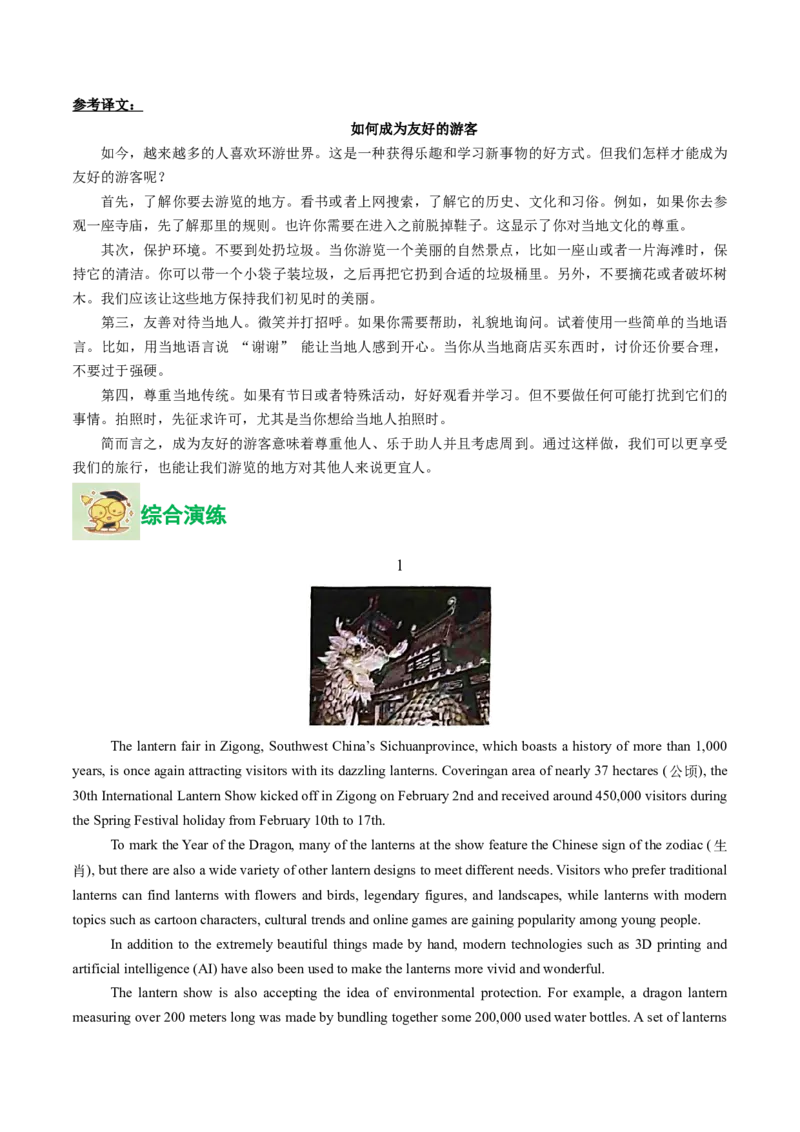
The lantern fair in Zigong, Southwest China’s Sichuanprovince, which boasts a history of more than 1,000
years, is once again attracting visitors with its dazzling lanterns. Coveringan area of nearly 37 hectares (公顷), the
30th International Lantern Show kicked off in Zigong on February 2nd and received around 450,000 visitors during
the Spring Festival holiday from February 10th to 17th.
To mark the Year of the Dragon, many of the lanterns at the show feature the Chinese sign of the zodiac (生
肖), but there are also a wide variety of other lantern designs to meet different needs. Visitors who prefer traditional
lanterns can find lanterns with flowers and birds, legendary figures, and landscapes, while lanterns with modern
topics such as cartoon characters, cultural trends and online games are gaining popularity among young people.
In addition to the extremely beautiful things made by hand, modern technologies such as 3D printing and
artificial intelligence (AI) have also been used to make the lanterns more vivid and wonderful.
The lantern show is also accepting the idea of environmental protection. For example, a dragon lantern
measuring over 200 meters long was made by bundling together some 200,000 used water bottles. A set of lanternsrecreating the famous Chinese statue “Bronze Galloping Horse Treading on a Flying Swallow” from the Eastern
Han Dynasty (25-220 AD) was created by using 21 different kinds of waste materials, including tires, leather and
plastics to form its decorations (装饰).
This year’s show received more than 3,000 children’s artworks from around the world. Some of the art
pieces were turned into lanterns by skilled artisans.
The 30th International Lantern Show will run until July 30th. The sets of lanterns will be updated to keep up
with other traditional Chinese festivals, such as the Qingming FestIval and the Dragon Boat Festival. Visitors can
also enjoy folk arts, and Chinese music performances during their lantern-viewing tours.
1.How does the writer develop the idea in Paragraph 1?
A.By listing numbers. B.By telling a story.
C.By comparing differences. D.By making an example.
2.How many topics of the lantern show are mentioned in Paragraph 2?
A.Six. B.Seven. C.Eight. D.Nine.
3.How does the lantern show express the idea of environmental protection?
A.By making large lanterns. B.By using the modern technologies.
C.By using waste materials. D.By recreating the famous Chinese statue.
4.What is the purpose of writing the passage?
A.To introduce the Lantern fair in Zigong.
B.To suggest we need to protect the environment.
C.To show the importance of the Year of the Dragon.
D.To tell the visitors to watch the show during other festivals.
2
Where do you usually spend your vacations, at well-known (著名的) places or less-known ones? Now, a lot
of young visitors like to take trips to less-known ones in China. Because they think they can spend special and
enjoyable vacations there. People call it “reverse tourism (逆向旅游)”.
There are usually too many visitors on vacation at well-known places. In some places, people can only move
one meter every ten minutes. Too many people usually can’t make the visitors have a good time.
Spending vacations at less-known places is also a good way to save money. The prices of food and hotel
stays are usually high at well-known places. But at less-known ones, they are not.
Another key is that less-known places can bring the feeling of freshness (新鲜). Many visitors might not go
to these less-known places before. Spending vacations there can help them enjoy scenery (风景) they didn't see
before.
Many people think reverse tourism is not a bad thing because visitors have more places to visit. And it can
help people at less-known places to get more money. Also, it can help people make the well-known places more
beautiful.
1.Where do lots of young visitors usually spend their vacations in China now?
A.At well-known places. B.At less-known places.C.At special places. D.At enjoyable places.
2.Which is not the reason (理由) for visiting less-known places?
A.There are usually not many people at less-known places.
B.Less-known places are near.
C.Visiting less-known places can save money.
D.Visiting less-known places can bring the feeling of freshness.
3.What is the purpose (目的) of the passage?
A.To tell us something about reverse tourism.
B.To ask us to take reverse tourism.
C.To help less-known places.
D.To tell us ways to take reverse tourism.
3
In China, Sichuan is a very interesting place in many ways. Here are some of the things that make Sichuan
special.
Sichuan is home to giant pandas. Bamboo is their favorite food. They are cute with black and white fur (皮
毛), so people all over the world like to go to Sichuan to see them in nature parks. They are so amazing that they
become a symbol of China.
Everyone in China knows Sichuan food is super spicy! The reason is the Sichuan pepper, a special kind of
pepper that makes your tongue (舌头) feel like it’s dancing with a little electricity. Try Sichuan hot pot or mapo
tofu to taste it!
In Sichuan, there’s a dream place everyone wants to visit—Jiuzhaigou. The plants there are quite green, the
water is very clear and the air is rather fresh. Tourists say when they visit this place, it’s just like walking in a huge
painting. You can enjoy the beautiful views and feel close to nature.
Sichuan is filled with ancient places that are very old and interesting. The Dujiangyan Irrigation System (灌
溉系统) is a great water project. It was built long time ago and it still helps to water the plants and farms now.
Besides, Du Fu Thatched Cottage (杜甫草堂) is also worth visiting in Chengdu.
So next time you hear about Sichuan, think about pandas, spicy food, pretty scenery and old interesting
places. Sichuan is a lovely place with many amazing stories and cultural treasures to share!
1.How many kinds of special things about Sichuan are there in the text?
A.Two. B.Three. C.Four. D.Five.
2.Why do people like to see pandas?
A.Because they are giant. B.Because they like eating bamboo.
C.Because they live in nature parks. D.Because they’ re cute with black and white fur.
3.How do tourists like Jiuzhaigou?
A.Shining. B.Amazing. C.Crowded. D.Ancient.
4.What can help water the plants and farms in the passage?
A.Sichuan hot pot. B.Jiuzhaigou.C.Du Fu Thatched Cottage. D.The Dujiangyan Irrigation System.
4
As a popular tour operator, Travel China Guide designs a lot of China tour packages (旅游套餐) for
foreigners with the best-selling travel deals to wonderful must-see destinations and offers the best quality services.
We warmly invite you to join us on an exciting vacation. Today we will offer you a three-day private Zhangjiajie in-
depth tour.
Day 1 Arrival in ZhangjiajieWelcome to this charming city, Zhangjiajie. Your guide and driver will pick
you up at airport and drive you to the hotel we booked for you ahead of time. The rest time of the day remains free
for you to relax.
Day 2 Glass Bridge in ZhangjiajieToday, your private Zhangjiajie tour will start with a visit to the
Zhangjiajie Grand Canyon, where you will have a chance to experience the world’s longest and highest glass
bridge, Zhangjiajie Glass Bridge. In addition to an unforgettable experience, it will also give you a special angle to
enjoy the beauty of the Grand Valley.
Afterwards, your guide will lead you to the Baofeng Lake where you will take a scenic boat ride. When you
finish visiting the scenic area, the driver will send you back to the hotel.
Day 3 Away From ZhangjiajieToday your Zhangjiajie tour will continue to go to the Tianmen Mountain,
known as the most beautiful “Hanging Garden” in the world. Tianmen Mountain is named after a natural wonder,
Tianmen Cave, which is a naturally formed hole among thousand-meter high cliffs. In addition to this wonder, you
may also see different old trees, green vines and rare animals there.
Your three-day Zhangjiajie tour package will come to an end here. You will then be driven to the airport and
we will say goodbye there. If you want to have your China tour schedule further, we will be glad to provide detailed
information.
1.What will the visitors do on Day 1?
A.Book a hotel. B.Drive to a hotel.
C.Start with a visit. D.Spend time relaxing freely.
2.What is the world’s longest and highest glass bridge?
A.The Grand Valley. B.London Bridge.
C.Zhangjiajie Glass Bridge. D.HongKong-Zhuhai-Macao Bridge.
3.What can visitors enjoy on Day 3?
A.The Grand Valley. B.The Baofeng Lake.
C.The Tianmen Mountain D.The Tianmen Cave
4.What can we know about Travel China Guide from the text?
A.It can book the hotel after your arrival. B.It offers no pick-up services.
C.It is designed for Chinese visitors. D.It provides traveling services for foreign tourists.
5.In which part of a magazine can the article be found?
A.Traveling. B.Dreams. C.Health. D.Friends.5
Do you know Edinburgh? It is not only very beautiful but also has an amazing history.
The best place to start your visit is Edinburgh Castle. It sits up on the top of Castle Rock and from here you
can see the whole city below you. It gets very busy in summer.
Next, walk down the Royal Mile, through Edinburgh’s 12th-century Old Town. Don’t miss St. Giles’
Cathedral. This amazing museum has floating fish, funny mirrors and a 3D tunnel (隧道) of stars. They also have
shops selling great postcards there.
At the bottom of the Royal Mile is the Queen’s Edinburgh home, the Palace of Holyroodhouse. When the
Queen isn’t there, you can visit the rooms and gardens. Next to the Palace is the Scottish Parliament. Spanish
architect Enric Miralles designed (设计) it. Parts of it look like fishing boats on the beach. There are also roof (屋
顶) gardens and fountains (喷泉). And you can visit it for free!
You should also go to Edinburgh’s New Town. This area isn’t very new actually—it’s over 200 years old!
The most famous street in Edinburgh, called Princes Street, is in New Town. Here you can find Edinburgh’s best
shops.
If you haven’t got much time, you can see Edinburgh with a tour guide. Choose from walking tours, cycle
tours and even ghost tours. These take you through the narrow streets of the Old Town at night, and include scary
stories from the 18th century. Don’t forget to take your raincoat. It often rains in Edinburgh. Have a great time!
1.Where can you start your tour best if you visit Edinburgh?
A.Princes Street. B.St. Giles’ Cathedral.
C.The Royal Mile. D.Edinburgh Castle.
2.What is the same in St. Giles’ Cathedral and Edinburgh’s New Town?
A.They both have shops. B.They both have 3D tunnels.
C.They are both the Queen’s places. D.They both have the most famous streets.
3.Which of the followings can you choose if you have a little time to visit Edinburgh?
① Ghost tours. ②Train tours. ③ Cycle tours. ④ Walking tours.
A.①②③ B.①③④ C.①②④ D.②③④
4.What does the underlined word “it” refer to?
A.Holyroodhouse. B.Edinburgh’s New Town. C.Scottish Parliament. D.
Edinburgh’s Old Town.
5.Where is the text most probably from?
A.A daily newspaper. B.A travel magazine.
C.A film poster. D.A science report.
6
Not every one in the world loves operas. However, the Sydney Opera House has to be truly one of the most
iconic (标志性的) buildings in the world.
The Sydney Opera House was designed by a Danish architect named Jorn Utzon. Its tops are called “shells”
and the design of the “shells” was one of the hardest parts of the project. Jorn Utzon said that the final design of theshells was inspired by peeling an orange. It is said that the shells of all the tops form a ball if connected. Utzon also
developed a protection plan for the building.
Though it is beautiful, the design was very difficult to put into practice because nothing like this was done
before. Sadly, Utzon had to leave in the middle of the building because of high costs and his bad relationship (关系)
with engineers. At last, after 14 years, the building was completed in 1973, at a total cost of about 102 million
Australian dollars. But the architect never returned to Australia to see the completed building.
The Sydney Opera House has been described as the building that changed a nation. It was like, suddenly,
Australia was on the world map. People don’t think Australians just eat pies or go to the beach. They have a
valuable culture, too.
Today, the Opera House hosts over 40 shows a week. There’s something for everyone: operas, ballets,
concerts, pop art and so on. But if you want to watch international performances, you really have to book far, far
ahead.
1.The design of the Sydney Opera House was influenced by ________.
A.a ship that is sailing B.a shell that is in water
C.an orange that is peeled D.a ball that is round
2.When did the architect Utzon start to build the Sydney Opera House ?
A.In1959. B.In 1973. C.In 1980. D.In 1987.
3.The fourth paragraph mainly talks about the ________ of the Sydney Opera House.
A.design B.meaning C.beauty D.shape
4.From the passage, we learn ________.
A.the Sydney Opera House is only a landmark of Australia
B.the architect Jorn Utzon got on well with the engineers
C.the architect Jorn Utzon usually visited the Sydney Opera House after completing it
D.there are over 40 shows in the Sydney Opera House every week
7
Visiting museums can be fun but also tiring. You might spend hours traveling, waiting in line, and walking
through crowded exhibits (展览). But now, new technologies are making museum visits easier and more enjoyable.
With the Google Art Project, you can take free online tours of over 500 museums around the world. This
beautiful website offers pictures and works of art from the museums, explaining details, along with background
information, so you can learn a lot just by looking.
Some apps can also make your museum trips more interesting. The Palace Museum has designed a few apps.
One of them is Han Xizai’s Night Feast based on an ancient painting. Users can see a big picture of Han’s houseand look at the people and their clothes by touching the screen. The Museum of Modern Art in New York City has
an app called MOMA, which allows users to draw their own modern art.
If you still want to visit museums in person, don’t worry. Many museums are using 3D technology which
allows you to “communicate” with their exhibits! For example, an exhibition in Shenzhen is well-known for a 3D
copy of ancient Chinese bronze chimes. Visitors can “play” the chimes by touching them, which helps them
understand the exhibits better.
With these new technologies, visiting museums has become easier and more fun. So why not try it yourself?
1.What is the main idea of the passage?
A.Visiting museums are usually fun but tiring.
B.New technologies make museum visits more enjoyable.
C.The Google Art Project is the new way to visit museums online.
2.How does the Google Art Project help people learn about art?
A.It allows users to draw their own modern art.
B.It provides pictures and background information about the artworks.
C.It allows users to “communicate” with the exhibits using 3D technology.
3.What can users do with the Han Xizai’s Night Feast app?
A.Learn about the people and their clothes in the painting by touching.
B.“Play” ancient Chinese bronze chimes by touching a 3D copy.
C.Take online tours of over 500 museums around the world.
4.Why does the author mention (提及) the bronze chimes in Shenzhen?
A.To help us catch the importance of the bronze chimes.
B.To give an example of how 3D technology is used in museums.
C.To encourage visitors to play musical instruments in museums.
5.According to the passage, what can we infer about the future of museum visits?
A.Most people will no longer visit museums in person.
B.Museums will probably become less popular over time.
C.New technologies will greatly improve the museum experience.
8
Recently, National Geographic noted their top travel trends (趋势)to change the way we travel in 2021.
Here are some of them. Take a look before you book!
Meaningful Adventures
The reason why people love traveling changes all the time. This year, more people are turning to meaningful
adventure activities than just sightseeing and leaving memories with their family and friends. Volunteer tourism is
one of those on the rise. It connects traditional tourism with volunteer work. In this process, travelers can touch
some lives in a special way, make some positive changes in someone’s life and even inspire(鼓舞)hundreds of
others to follow their footsteps.
Micro TripsNowadays, traveling for a long time is a luxury activity for most people, because they have to spend much
more time on work and study. That’s why the idea of micro trips is rapidly growing. Micro trips are visits to certain
destinations (目的地) within a short period, like three or four days. For example, in winter, you can spend several
days traveling to the north to feel the white world of heavy snow, or a one-day trip to a wildlife park far away from
the city center to enjoy the beauty of nature. Traveling overseas in three days is also possible if you choose a nearby
country. Micro trips allow people to take all kinds of short vacations and experience a number of travel
destinations.
_______
Travel is not only about going sightseeing but also about enjoying delicious local food. The year 2021 will
see many more people choosing tasty travel. It means they will take cooking classes and do farm work so that they
can learn about local foods. They may also eat in local private homes or go to Michelin-starred restaurants for
exotic (奇异的) foods. Since food is an important part of culture, it allows food lovers to go beyond a seat at the
table to make a better understanding of different cultures.
1.How does the author (作者) make his point clearly in Paragraph 2?
A.By giving examples. B.By listing numbers.
C.By following the order of time. D.By listing facts.
2.The underlined word “luxury” in Paragraph 3 means “_______” in Chinese.
A.普通的 B.必要的 C.奢侈的 D.华丽的
3.What is the best subtitle (小标题) for the last part of the passage?
A.Delicious Food B.Tasty Travel
C.Table Manners D.Bowls and Plates
4._______ is considered to be a meaningful adventure holiday.
A.Taking a holiday in Chengdu for local food
B.Having a three-day trip in Thailand for relaxation
C.Go swimming in a water park
D.Going to Africa to help save the endangered animals
5.From the passage, we can learn that _______.
A.more and more people are fond of traditional tourism
B.it is impossible to travel abroad in three days
C.trying different local foods helps to know different cultures better
D.a holiday is meaningless without eating lots of good food
9
Hiking is a fun way to get some fresh air and exercise. Here are a few simple tips to help you make sure that
your next hiking trip is both safe and enjoyable.
First, it is always best to hike with at least one other person. Not only is hiking more fun with a friend, it is
also safer. If you get hurt, your friend can go for help. If you decide to hike alone, make sure that you let someone
know where you are going and when you plan to be back. This way, if you get lost or injured, someone will knowwhere to look for you and when to send help.
Next, make sure you have plenty of water. Even if you are only going for a short hike, it is important to have
lots of water on hand so that you avoid dehydration. Plan to bring one liter of water per person per hour of hiking.
You can begin to dehydrate before you even realize it, so make sure to sip your water frequently, even if you are not
very thirsty.
You should also make sure that you are wearing the right clothing. You should wear comfortable, closed-toed
shoes and thick socks. If you're going on a long hike, you might want to bring an extra pair of socks just in case.
Your clothing should be comfortable and easy to move around in. Clothing that is too loose might catch on rocks or
branches, but clothing too tight might become uncomfortable as you walk. You should also wear your clothing in
layers. This way, you can take off or put on layers based on how hot or cold it is outside. A hat and sunscreen are
also a must; your head and skin need protection from the sun even when it is cold out.
These are just a few tips for a basic hiking trip. No matter where, when, or for how long you plan on hiking,
remember: a fun hiking trip is a safe hiking trip.
1.According to the passage, it is more dangerous to hike by yourself because .
A.no one is available to help if you get injured B.you alone have to carry all the heavy things
C.it's easier to get lost D.you will dehydrate faster
2.Jill and Jonas are going on a six-hour hike. Using the information in the passage, we can understand that they
should bring .
A.6 liters of water B.12 liters of water
C.18 liters of water D.24 liters of water
3.The author suggests that you should not wear clothing that is too loose because it .
A.will weigh you down as you walk B.is more difficult to put on
C.can cause you to overheat D.could get caught on something
4.Which of the following is NOT one of the ways in which you should prepare for a hike as mentioned by the
author?
A.Bring enough water B.Carry a map
C.Wear thick socks D.Put on sunscreen
10
Today, we’ll visit a place of strange and silent beauty. As beautiful as this place is, its name provides
evidence of very real danger. We are exploring Death Valley National Park(死亡谷国家公园).
Death Valley is a huge place. It extends more than 225 kilometers across the southern part of California into
the neighboring state(州)of Nevada. Death Valley is a land of beautiful yet dangerous desert and mountains. There
are mountains that reach more than 3, 000 meters into the sky.
Much of Death Valley is flat and dry. In some areas the ground is nothing but salt. Nothing is able to grow in
this salty ground. However, it would be wrong to think that nothing lives in Death Valley. The valley is full of life.
Wild flowers grow very quickly after even a small amount of rain. Several kinds of birds live in Death Valley, as do
mammals and reptiles. Many different snakes live there too.
The area got its name in 1849. That was the year after gold was discovered (发现)in California. Thousandsof people from around the country traveled to the gold mining areas of the state. They were in a hurry to get there
before other people did. One group trying to reach California decided to take a path called the Old Spanish Trail.
By December they had reached Death Valley. But there was a lack(短缺)of water and there were too few plants
for their work animals to eat. The people could not find a pass through the tall mountains to the west of the valley.
Slowly, they began to suffer from a lack of food. To survive, they killed their work animals for food and began to
walk out of the valley. As they left, a woman in the group looked back and said, “Goodbye, death valley.” The
name has never been changed.
Death Valley became a national park in 1994. More than one million people visit the park each year.
1.What does Paragraph 3 want to tells us?
A.Death Valley is full of life. B.Much of Death Valley is flat and dry.
C.Nothing can grow in this salty ground. D.Different animals live in Death Valley.
2.What does the underlined word “survive” mean?
A.become energetic B.continue to live
C.relax oneself D.put on weight
3.Why did the woman call the area Death Valley?
A.Because people didn’t know how to walk out of the valley.
B.Because a group of people lost their lives here.
C.Because the woman was left behind and die there.
D.Because the group of people had a hard time there.
4.Which of the following shows the right structure of the passage?
A. B. C. D.