【冲刺2024高考】高中英语读后续写
(创新话题命题类)新题速递01
原文解读+情节构建+下水文&范文及解读+语言赏析总结+教材衔接
2024年4月广东省深圳二模英语读后续写
创新点:言语的力量:误解、宽恕和成长
阅读下面材料,根据其内容和所给段落开头语续写两段,使之构成一篇完整的
短文。
I didn’t like Del so much. He always called me the nickname “Germy,” which
meant “dirty,” instead of my real name “Jamie.” Besides, he was known as a trouble-
maker in school. So when the head teacher Mr. Smith asked Del to come to his office,
I naturally thought that Del had done something mean to someone. Through the
window, I caught sight of a smaller boy crying. Del seemed unhappy, too.
He did not return to class that day. All of us were discussing what had happened
to him. What else could such an annoying boy do? “He must have hit the boy and was
sent home,” I whispered to my friends. Their eyes widened. It felt good to see them so
interested in what I said.
The next morning, the whole school was talking about Del being expelled (开除)
for beating up a kid. I was surprised that my assumptions were passed on so quickly.
So when Del walked into the classroom, all the kids were shocked. The kids next to
him shifted their desks away. “What’s your problem?” Del asked. “I don’t want you to
attack me,” one kid said. Some laughed. “Yeah, I might,” said Del. I could tell he was
joking, but many kids thought he admitted he did beat up someone.
During recess(课间休息), Del tried to join the kickball game.“Neither team
wants you,”one of the players said.“Why?”Del asked, looking confused.“I always
play with you guys.”They ignored him and went on playing. Del sat by himself while
the rest of the school enjoyed their recess away from him. Del looked lonely and sad,much different from before. I started to feel sorry for him.
Later that day, I learned what really happened. The kid was Del's little brother
and he was crying because their mother fell ill and was sent to hospital. I felt even
sorrier for what I said before. I started a rumor (谣言).
注意:
1. 续写词数应为 150 左右;
2.请按如下格式在答题卡的相应位置作答。
At recess the next day, I saw Del sitting alone watching the kickball
game.________________________________________________________________
Now that Del had forgiven me, I decided to do more before the recess was
over._________________________________________________________________
第一部分 原文解读
1. main characters
Narrator (Jamie): Initially “I” disliked Del due to Del’s teasing and troublesome
behavior. “I” assumed Del hit the little boy and started a rumor. Later I empathized
with him.
Del: Troublemaker, called the narrator “Germy.” Revealed to care for his brother and
his mother.
Smaller Boy (Del’s little brother): Cried during Del’s meeting due to mother’s illness.
Classmates: Interested in rumors, avoided Del.
Kickball Players: Refused Del’s participation.
Mr. Smith: Head teacher.
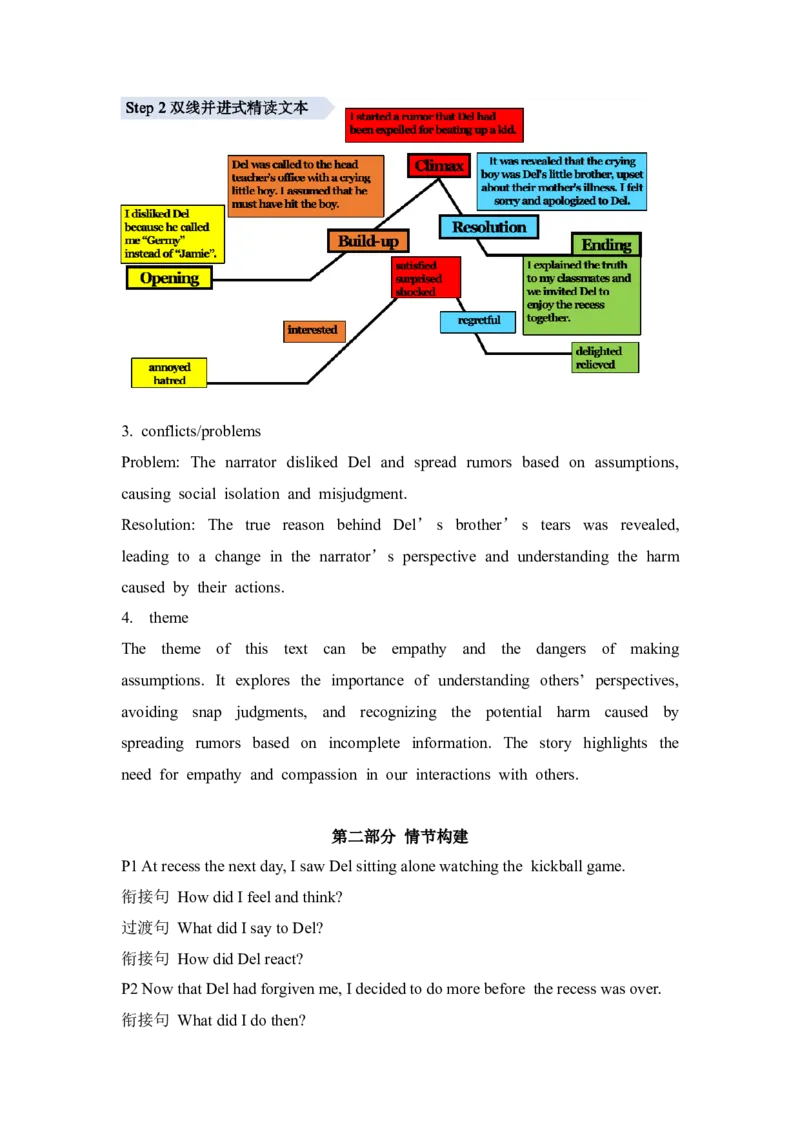
2. plot and emotions3. conflicts/problems
Problem: The narrator disliked Del and spread rumors based on assumptions,
causing social isolation and misjudgment.
Resolution: The true reason behind Del’ s brother’ s tears was revealed,
leading to a change in the narrator’s perspective and understanding the harm
caused by their actions.
4. theme
The theme of this text can be empathy and the dangers of making
assumptions. It explores the importance of understanding others’ perspectives,
avoiding snap judgments, and recognizing the potential harm caused by
spreading rumors based on incomplete information. The story highlights the
need for empathy and compassion in our interactions with others.
第二部分 情节构建
P1 At recess the next day, I saw Del sitting alone watching the kickball game.
衔接句 How did I feel and think?
过渡句 What did I say to Del?
衔接句 How did Del react?
P2 Now that Del had forgiven me, I decided to do more before the recess was over.
衔接句 What did I do then?过渡句 How did the other student react?
过渡句 How did Del feel and do?
第三部分 下水文&范文&解读
下水文
At recess the next day, I saw Del sitting alone watching the kickball game.
Ashamed and embarrassed, I was sitting on pins and needles. I should have grasped
the full picture before speaking about Del. Blaming myself, I finally summoned up
my courage and approached Del inch by inch. At the sight of me, Del beamed with a
mixture of surprise and confusion. “Sorry, Del. It was I who spread the rumor that you
hit the little boy.” I lowered my head and whispered to Del. It seemed ages as I waited
for Del’s response. Unexpectedly, Del didn’t fly into a rage but grinned from ear to
ear. Hearing his laughter and calling my real name as a way of apology, I held my
head up, met his gaze and understood the tension had been dissolved.
Now that Del had forgiven me, I decided to do more before recess was over.
Swift as an arrow, I borrowed a whistle from the classroom and blew it with all my
might. Reluctant as everyone was, they stopped and gathered around me and Del out
of curiosity. Later came my sincere apology and detailed explanation about Del and
his little brother. A ripple of relief surged through me after I finished my
announcement. Meanwhile, to my surprise, thunderous applause erupted, a heartfelt
recognition of my honesty and a symbol of acceptance and welcoming for Del.
Remorseful eyes turned towards Del, expressing apologies and inviting him to enjoy
the recess together. Witnessing the gloomy clouds dissipate and Del’s spirits soar, I
eagerly joined the group during recess, armed with newfound insight and a
determination to refrain from starting rumors based on superficial impressions.
参考范文1
At recess the next day, I saw Del sitting alone watching the kickball game. I hated
the nickname “Germy,” but seeing him isolated(孤立的) was also not what I wanted.
Guilt pushed me to him. (愧疚将我推向他) “What do you want, Germy?” Del asked,
his voice sounding more hurt than angry. I sat next to him and gradually uttered the
whole thing about how my hasty草率的 assumption turned into变成 such a terriblerumor. “I’m sorry. I wish I had never said that,” I apologized, daring not to look into
his eyes. Annoyance and surprise flickered闪过 across his face. But seconds later, he
lowered his head and said quietly, “It’s okay. I guess I wasn’t very nice to you, either.”
His words soothed安抚 me, but I could feel he was still sad.
Now that Del had forgiven me, I decided to do more before the recess was over. I
walked towards the kickball players and called for their attention. Everyone stopped
in surprise. “Del didn’t beat up anyone,” I stated, explaining what actually happened.
Whispers of astonishment spread and finally one player shouted, “Alright, Del, do
you want to join my team?” A smile broke through Del’s gloomy 悲伤的 face, “Yes,
and I want Jamie on it, too!” He glanced at me shyly, and I could tell his use of my
real name was his way of making an apology. Soon the playground was filled with
laughter and talks. But this time they made me realize something—words have the
power to hurt and heal.
参考范文2
At recess the next day, I saw Del sitting alone watching the kickball game. I
walked up to him, so nervous that I could hardly talk. “Hey,” I said. “What do you
want, Germy?” Del said impatiently without taking his eyes off the game. I could feel
something in his voice sounded more hurt than angry. I summoned up my courage and
explained to him the whole story. Surprised and angry, Del looked at me with an
unbelievable look. “I will tell everyone the truth,” I promised. Del’s face softened a
bit. “Okay, Jamie. I owe you an apology too, he said with a shrug. It was the first time
he’d used my real name. I almost smiled. I knew I had done the right thing. (111词)
Now that Del had forgiven me, I decided to do more before recess was over. The
game was still going on. I approached the players and asked them to stop for a
moment. Everyone, including Del, was surprised. “Guys, I am sorry, but I got
something to say.” I admitted that it was I who started the rumor. “Del didn’t beat up
anyone, I said. Upon hearing this, the players were confused for a brief moment but
soon figured out what had really happened. “Hey, welcome back,” They waved to
Del. Del nodded willingly, with a happy look back to his face. Seeing Del playing the
game vigorously, I finally felt relieved that I eventually mended a big mistake. (109词)
范文解读
1."Guilt pushed me to him."这句话使用了“guilt”(内疚)作为推动力,形象地表
达了主人公内心的自责和渴望纠正错误的决心。
2."His voice sounding more hurt than angry."这句话通过对德尔声音的描述,传达
了他的情感状态。使用“hurt”(受伤)而不是“angry”(愤怒)显示了他更深
层次的情感伤害。
3."I apologized, daring not to look into his eyes." “daring not to look into his
eyes”(不敢直视他的眼睛)这个短语描绘了主人公在道歉时的不安和内疚,同
时也显示了德尔可能的失望或痛苦。
3."Annoyance and surprise flickered across his face." 使用“flickered”(闪烁)来
形容情感在脸上的短暂出现,增加了情感的复杂性和德尔反应的真实性。
4. "But seconds later, he lowered his head and said quietly..." “lowered his head”(低
下头)和“said quietly”(轻声说)这两个动作和语气的描述,传达了德尔的宽
容和内心的平和。
4. "A smile broke through Del’s gloomy face..." “broke through”(突破)这个短语
用来描述微笑如何打破德尔阴沉的表情,形象地表达了情绪的转变和积极的变
化。
4. "...his use of my real name was his way of making an apology."
这句话揭示了德尔通过使用主人公的真实名字来表达歉意,这是一种非常细腻
且有力的和解方式。
5. "But this time they made me realize something—words have the power to hurt and
heal." 这句话是故事的主题升华句,简洁而深刻地总结了言语的双重力量。使
用“hurt and heal”(伤害和治愈)作为对比,强调了言语的影响力。
第四部分 语言赏析总结
无灵主语,饱满情绪
Guilt pushed me to him.
Annoyance and surprise flickered across his face.
His words soothed me.Whispers of astonishment spread.
Soon the playground was filled with laughter and talks.
非谓语结构,增加细节
I apologized, daring not to look into his eyes.
I stated, explaining what actually happened.
直接引语,语言协同(回应原文中的直接引语,实在是太妙了!)
“I’m sorry. I wish I had never said that,”
“Del didn’t beat up anyone,”
“Alright, Del, do you want to join my team?”
“Yes, and I want Jamie on it, too!”
独立主格,语法多样
Del asked, his voice sounding more hurt than angry.
从句多样,语言协同
Seeing him isolated was also not what I wanted.(表语从句)
I sat next to him and gradually uttered the whole thing about how my hasty
assumption turned into such a terrible rumor.(宾语从句)
I stated, explaining what actually happened.(宾语从句)
第五部分 教材衔接
新外研版高中英语必修第三册 Unit 1 Knowing me, knowing you。本单元涉
及的主题语境内容是“如何建立并保持良好的人际关系与开展社会交往”。
【Reading】
阅读板块呈现了两封书信,探讨同学之间的问题和解决办法,类型为私人
信件。第一封信是Ben的求助信,描述了一场篮球比赛引发的人际关系问题;
第二封信是回复信,由Agony Aunt给出了建议。教师需引导学生理解两封信的
主要内容,强调处理人际关系和情绪管理的基本理念:“Think before we
speak”。然后,学生可以描述自己在成长过程中遇到的人际关系问题,表达情绪变化,并思考如何更好地进行情绪管理和自我调节。
人教版高中英语教材必修一 Unit 1 Teenage Life
THE FACE-DOWN GENERATION
If you’re reading this, you were probably born in the 2000s. The 21st
century. That would make you young, creative, connected, global, and no doubt
smart. Maybe good-looking, too. Right? But what do other people think about
your generation?
Some adults worry that you’re more interested in the screen in front of
you than the world around you. They think of you as the “ face-down
generation” because you use your phone so much and they wonder how you
will deal with school, friends, and family. Are today’s teenagers too busy
texting and taking selfies to become successful in real life—or “IRL”, as
you would say?
Others adults worry that today’s youth are spoilt and don’t want to face
the challenges of adult life. Many children born in the 1990s and 2000s were
raised by “helicopter parents” who were always there to guide and help
them with a busy schedule filled with homework and extra-curricular activitiessuch as dancing, drawing, or sports. With parents who do everything for them,
today’s youth seem to prefer to live like teenagers even when they are in
their 20s or 30s.
Does the face-down generation need a heads-up? Well, probably not. The
fact is that many of today’s teenagers are better educated and more creative
than past generations. They also seem to be enthusiastic and willing to become
leaders. More young people volunteer to help their communities. There are also
brave young people such as Malala Yousafzai, the teenager who won the 2014
Nobel Peace Prize for pushing girls’ rights to go to school.
If you are one of the face-down generation, there’s reason to be hopeful
about the future. Chances are that you will do great and laugh out loud.
北师大版高中英语教材选择性必修一 Unit 1 Relationships
What is peer pressure and why does it happen? We all want to be part of
a group and feel like we belong to our community. Peer pressure can happen
when we are influenced to do something that we would not usually do
because we want to be accepted by our peers. Children and young adults
especially feel social pressure to conform(v.符合) to the peer group.
How does peer pressure affect people? Peer pressure can influence how
people dress, how they talk, what music they listen to, what attitudes they
adopt and how they behave. Teenagers want to be liked, to fit in and to be
accepted which means peer pressure can be powerful and hard to resist. People
who are low in confidence and unsure of themselves may be more likely to
seek their peers’ approval by going along with risky suggestions or choosing
the “wrong” path. In one study, a student who knew the correct answer to
a question actually gave the wrong answer because all the others in the class
gave the wrong answer and he didn’t want to be different.
Can peer pressure lead to bullying? Peer pressure definitely plays a role in
bullying. If a teenager is seen as weak or different by the majority of their
peers, they can become a target for bullies. Bullies pick easy targets--peoplewho are outside the peer group and whom the group is unlikely to defend.
Unfortunately some bullies are popular and may even lead the peer group,
which means others are less likely to challenge their behaviour.
What can students do to avoid peer pressure? The most important thing is
to build up self-confidence, so that it is easier to say “no” to the peer
group. Students can do this by choosing their friends wisely. It’s a good idea
for teens to surround themselves with positive role models – people who
don’t make fun of them, but accept them and are confident themselves. It’s
also important for young people to think about the consequences of their
actions. If they give in to peer pressure (and perhaps do something that they
know deep down is wrong), what could be the result? If they stop and think
about the consequences, they might make a different decision.