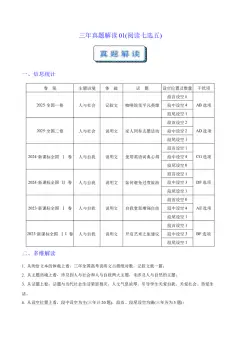
2026 年高考英语三轮押题06:阅读理解之记叙文
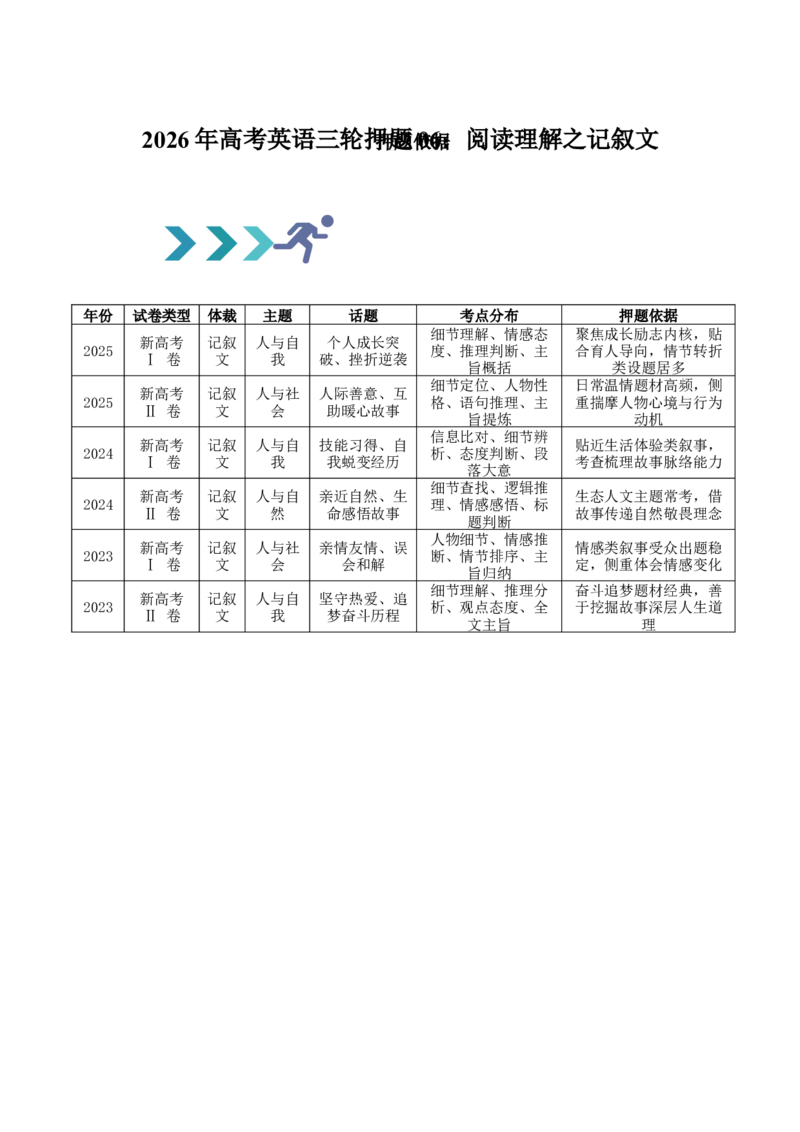
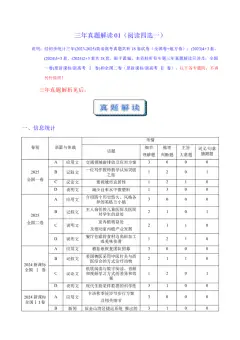
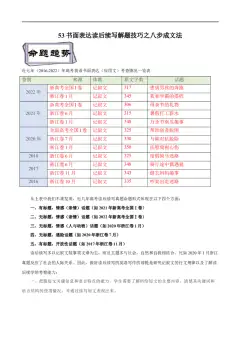
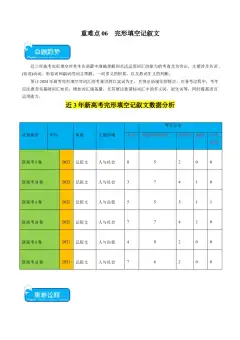
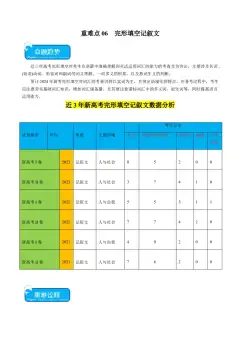
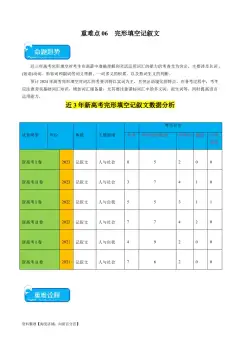
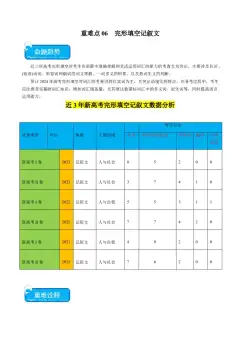
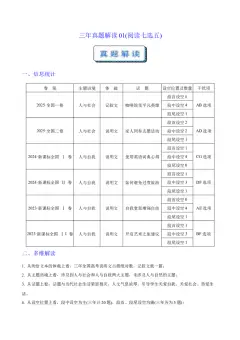
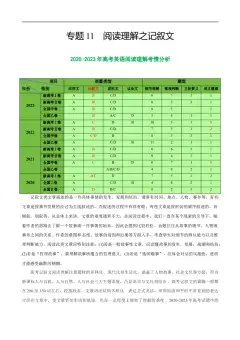
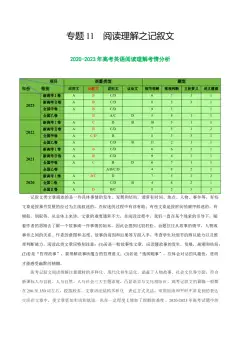
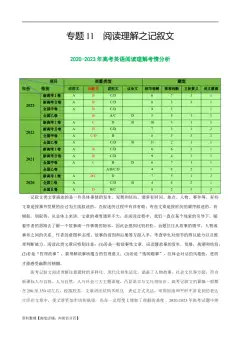
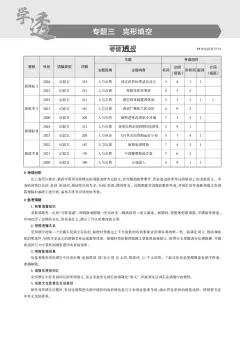
年份
试卷类型
体裁
主题
话题
考点分布
押题依据
2025
新高考
Ⅰ 卷
记叙
文
人与自
我
个人成长突
破、挫折逆袭
细节理解、情感态
度、推理判断、主
旨概括
聚焦成长励志内核,贴
合育人导向,情节转折
类设题居多
2025
新高考
Ⅱ 卷
记叙
文
人与社
会
人际善意、互
助暖心故事
细节定位、人物性
格、语句推理、主
旨提炼
日常温情题材高频,侧
重揣摩人物心境与行为
动机
2024
新高考
Ⅰ 卷
记叙
文
人与自
我
技能习得、自
我蜕变经历
信息比对、细节辨
析、态度判断、段
落大意
贴近生活体验类叙事,
考查梳理故事脉络能力
2024
新高考
Ⅱ 卷
记叙
文
人与自
然
亲近自然、生
命感悟故事
细节查找、逻辑推
理、情感感悟、标
题判断
生态人文主题常考,借
故事传递自然敬畏理念
2023
新高考
Ⅰ 卷
记叙
文
人与社
会
亲情友情、误
会和解
人物细节、情感推
断、情节排序、主
旨归纳
情感类叙事受众出题稳
定,侧重体会情感变化
2023
新高考
Ⅱ 卷
记叙
文
人与自
我
坚守热爱、追
梦奋斗历程
细节理解、推理分
析、观点态度、全
文主旨
奋斗追梦题材经典,善
于挖掘故事深层人生道
理
押题依据
题型一、人与自我-个人成长
词数
话题
体裁
考点
押题理由
约320
职业成长:球队专
职营养师坚守岗
位、持续精进专
业、助力运动员赛
场表现
记叙文
(人物
报道)
细节理解、因果推
理、人物形象判
断、观点态度
贴合高考“人与自我”成长与职业素养主
题,聚焦体育健康、新兴职业热点,题型常
规,侧重考查文本细节抓取与人物品质分
析,是高考高频命题方向。
Nici Mense, the New York Jets’ first full-time dietitian, faces the demanding task of managing the daily
nutritional needs of professional athletes. Recently, she has successfully completed her seventh season with the
team.
Properly fueling players so that they feel the difference in their performance is something she learned while
playing soccer at university. “I found soccer to be more demanding on my body than I had expected, and I needed
to maintain my energy through proper nutrition to match my performance on the field,” she said. “This realization
changed my perspective. I’ve always loved sports and food, so combining the two made the most sense.”
Mense joined the New York Jets and has stayed in tune with the team’s schedule. “My hours vary from time
to time,” she said. “It’s the busiest during training camp through the end of the season. We will work seven days a
week unless it’s our bye week, when we don’t play a game during the season. We ensure players fuel properly
before, during and after practice. They receive recovery shakes, snacks and fruit for post-practice recovery. While
they are in training throughout the day, that’s my time to plan for the weeks ahead.”
Mense describes herself as “obsessed” with her field, constantly evolving and gaining knowledge. “If I am
the same dietitian three years from now, then I am doing something wrong,” she declared. “The more open-minded
I am, and the more I am able to learn as a professional, the better I can help athletes with their goals.”
Occasionally, athletes need a warm-up period when working with a dietitian. “It can be quite challenging to
prove that dietitians are here to help them and that we are not the food police,” said Mense. “There are times when
a player doesn’t listen to the education and injures themselves. But it’s always so awesome to see when it works for
them.” Nevertheless, Mense feels fulfilled in her role and continues to push the athletes, knowing that nutrition is
key to fueling performance, recovery and long-term health.
By staying at the forefront of her field, Mense provides athletes with essential nutrition strategies to support
their performance, recovery, and long-term health. With her dedication and expertise, it’s clear that professional
押题预测
核心题型及具体解决方法
athletes are truly eating their way to victory.
1.What motivated Mense to choose her career?
A.Her experience of playing soccer.
B.Her ambition to make life changes.
C.Her admiration for athletes’ spirits.
D.Her dream of being a professional athlete.
2.What can we learn about Mense?
A.She takes a break when players are in training.
B.She keeps her professional knowledge updated.
C.Her priority is to provide post-game recovery meals.
D.She works seven days a week during the season period.
3.Why does Mense sometimes find it hard to work with the athletes?
A.They put their own interests first.
B.They complain about their diet.
C.They disagree about the schedule.
D.They doubt her role in the team.
4.Which words can best describe Mense?
A.Determined and generous.
B.Humble and innovative.
C.Talkative and open-minded.
D.Enthusiastic and committed.
词数
话题
体裁
考点
押题理由
约345
个人成长:面试临
场失误受挫,直面
调侃、勇敢对峙,
坚守自我收获成长
记叙文
(个人
经历)
情感推理、细节理
解、人物性格判
断、主旨标题归纳
紧扣青少年挫折成长、自我坚守、树立边界
的德育主题,贴合高考立德树人导向,主旨
标题、情感推理为阅读必考高频题型。
I remember perfectly the day I applied for the math preparatory position at the School of Mechanical
Engineering.
The written exam went well, so we moved onto the second stage of the competition, which consisted of
explaining an exercise in front of a panel of professors. Honestly, I was very tense. To make matters worse, my
hands were sweating a lot. When I was assigned the exercise and started solving it on the board, I tried to stay calm.
It was going pretty well, actually, until I said something ridiculous. I said something like: “The area of the triangle
is the base (底) times the height divided by 4.” As soon as I realized my mistake, I corrected myself aloud while
trying to erase the board with my hand, but my sweat made the blackboard look like a crime scene. An old
professor noticed my struggle and said, “I think we’ve seen enough. Thank you.” I left the room with my head
down.
Days later, I found out that I had passed the competition and secured a position. My grade gave me the
opportunity to choose which professor I wanted to work with and I chose the one who had saved me at that
moment, professor Martin!
Before my first tutoring session, some colleagues told me that, in their advanced calculus class, a professor
had shared the story of a girl who had gotten so nervous that she “flooded” the board with sweat and didn’t even
know the area of a triangle.
I felt extremely angry and confronted the professor immediately. I told him how unprofessional it was for
him to mock a student who was just trying her best and if I were truly incompetent, the hiring committee —
including him — was at fault. The professor, surprised, felt very sorry and apologized. I accepted his apology.
No matter how much effort you put in or how well you do, some will focus on your mistakes. What matters
is how you respond. That experience taught me to express my thoughts bravely, to communicate my concerns, and
to set boundaries when I consider something to be unprofessional or unacceptable.
5.How did the author feel when she left the interview room?
A.Extremely nervous.    B.Deeply frustrated.  C.Slightly regretful.  D.Surprisingly calm.
6.Why did the author choose Professor Martin?
A.He offered her a flexible tutoring schedule.
B.He was known for his strict teaching methods.
C.He had helped her during the difficult moment.
D.He was the only professor who gave her a high grade.
7.Which of the following best describes the author?
A.Capable but overly sensitive.
B.Courageous and straightforward.
C.Hardworking but easily discouraged.
D.Remarkably quick but deeply unforgiving.
8.Which of the following is the best title?
A.Sweat, Tears, and a Triangle Mistake.
B.I Made a Mistake — and Got an Apology.
C.I Divided by 4 — and Got the Last Laugh.
D.A Flooded Board, a Divided Formula, and a Job Offer.
词数
话题
体裁
考点
押题理由
约330
生活哲思:对比标
准化菜谱与传统经
验式烹饪,感悟实
践大于教条的生活
记叙文
细节理解、句意推
断、主旨推理、写
作目的判断
属于高考热门生活思辨类话题,融合传统文
化与生活实践,侧重考查学生深度理解与思
辨能力,契合夹叙夹议文体高频考点。
真谛
I used to think recipes were promises. If I followed every line, the cake would rise and dinner would turn out
well. My grandmother would probably have laughed at that. She cooked from memory and attention. “Stop when it
looks right,” she would say. “Add flour until the dough feels soft but not sticky.” To a child who wanted clear
answers, this sounded almost unfair.
Years later, I came across a medieval (中世纪的) recipe for sambocade, a kind of cheesecake. It gave no exact
measurements. It simply told the cook to make a crust, prepare the curds, add sugar, egg whites and elderflowers,
and bake it. At first, I found it nearly useless. How much sugar? How many eggs? How hot should the oven be?
Then I understood: the recipe was not meant to teach a beginner from zero. It was more like a reminder, pointing
back to knowledge learned by watching, touching, smelling and trying again.
That was how my grandmother cooked. Her own recipes were only lists of ingredients kept in an old shoe box.
After she died, my mother threw the box away, thinking it had no value without instructions. I understood her
choice. To anyone else, “flour, eggs, milk, sugar” was hardly a recipe. Yet something was lost with that box — not
complete knowledge, but traces of a way of knowing.
Today, we often expect recipes to protect us from uncertainty. We want grams, minutes and temperatures.
Careful measurement is useful, of course. But cooking is not only measurement. A good cook notices when butter
begins to smell nutty, when dough resists the hand, and when a cake is pale enough to leave the oven. Such
knowledge cannot be fully written down. It must be practiced into the body.
Now, whenever I bake, I still hear my grandmother’s question: “Is it pale enough yet?” It is not exactly a rule. It
is a way of paying attention.
9.Why did the author once find her grandmother’s instructions “almost unfair”?
A.They sounded too old.
B.They lacked clear rules.
C.They changed too often.
D.They used rare ingredients.
10.Why is the medieval recipe mentioned?
A.To introduce a dessert.
B.To question old recipes.
C.To show a similar style.
D.To compare two dishes.
11.What does the shoe box mainly represent?
A.Lost family wealth.
B.Complete cooking records.
C.A forgotten dessert.
D.Knowledge through practice.
12.What is the author’s view on recipes?
A.Accuracy removes uncertainty.
B.Practice gives recipes meaning.
C.Old recipes work better.
D.Good memory matters most.
题型二、人与社会-人际交往
词数
话题
体裁
考点
押题理由
360
社会温情:青年创办无
障碍民宿,免费服务残
障群体,普及无障碍理
念、传递社会人文关怀
记叙文
(人物
纪实)
细节归因、推理判
断、人物品质、主旨
大意
紧扣“人与社会”、青年担当、公
益助残时政热点,弘扬包容向善的
社会正能量,贴合高考德育核心,
是常年高频押题题材。
In Qingdao, a guesthouse named “Yameng’s Home” is marked by a Barbie doll in a wheelchair at its
entrance. Operated by 29-year-old Cui Yameng, it embodies her mission to create a barrier-free environment for
people with disabilities.
Cui’s dedication began in high school through volunteer work, leading her to study special education. Her
travels with physically-challenged friends during university revealed how everyday obstacles like small steps
became significant barriers. This inspired her long-term goal of an accessible hotel. As a practical start, she
transformed her apartment’s first floor into this inclusive guesthouse in 2023. Every detail is designed for
accessibility: a low entrance ramp, lowered kitchen counters, an adjustable bathroom mirror, and customized bed
heights. Cui offers free stays to guests with disabilities, requesting only a personal story in return. Her aim is to
provide dignified and comfortable accommodation.
Her first guest was a young woman who had lost both legs. Cui arranged a tandem ( 双人自行车) bicycle
ride along the coast for her — a first-time experience the guest later shared online. The post inspired many
followers, including one man who embarked on his first solo trip in twenty years. Cui points out that the core issue
is not an absence of accessible facilities, but rather a lack of public awareness about disabilities. Besides the
guesthouse, she works at a local welfare center, organizing activities where children wear blindfolds to experience
daily life without sight to foster public understanding.
Her initiative has created a ripple effect. After gaining online attention, she began receiving requests from
local businesses for accessible design advice. Cui hopes her story empowers others to contribute according to their
capacities. To date, her guesthouse has hosted 28 guests and received international bookings. Cui acknowledges
China’s progress in accessibility, citing supportive laws and improved services. Yet, her ultimate wish is for a future
where such specialized accommodations become unnecessary, as affordable, accessible options are available
everywhere. She sincerely looks forward to that day.
13.What inspired Cui to design the guesthouse?
A.Her work at a welfare center.
B.Volunteer service in her youth.
C.Her academic pursuit of special education.
D.Her travel experiences with disabled friends.
14.What can be inferred about Cui’s influence?
A.She has built business partnerships.
B.She has motivated disabled travelers.
C.She has absorbed government funding.
D.She has transformed traditional hotels.
15.Which of the following best describes Cui?
A.Traditional and cautious.
B.Humorous and ambitious.
C.Romantic and adventurous.
D.Pioneering and compassionate.
16.What can be a suitable title for the text?
A.A Home Without Barriers
B.A Chance for New Business
C.A Hero of Online Campaign
D.A Center for Special Education
词数
话题
体裁
考点
押题理由
350
温情治愈:平等包
容对待残疾孩童,
用真诚善意温暖他
人
记叙文
(温情
叙事)
细节理解、词义猜
测、推理判断、主
旨归纳
经典人文题材,覆盖词义猜测、主旨概括等
必考题型,适配高考真题风格
In 1975, five-year-old Jeff, in a wheelchair, asked to meet Fred Rogers of the Neighborhood rather than
going to Disneyland. It was the family’s own version of “Make-A-Wish,” proposed on the eve of Jeff’s major spinal
(脊椎的) surgery. Jeff later said Mr. Rogers told him he was special and that he was just fine the way he was, and it
gave him confidence.
Jeff’s parents wrote to the television star and got a handwritten reply that led to a breakfast meeting. They
continued to correspond. After the surgery, Rogers wrote to say how glad he was that Jeff’s surgery had gone well.
Then in 1980, Rogers decided to feature a child in a wheelchair on his show for a theme week on all things
mechanical. He remembered Jeff and insisted it had to be him.
On the show, Rogers asked Jeff straightforwardly about his wheelchair and how he came to be in it. Producer
Margy Whitmer recalled Jeff’s appearance on the show: “It was one of the most impressive moments… Here’s this
child who has multiple disabilities, and Fred said, ‘Talk to me about that wheelchair. Talk to me about what’s wrong
with you.’ And this extraordinary kid talked about his medical condition in a matter-of-fact way. Fred presented it
to kids watching the show, as “this is just the way he is.”
This was the philosophy of Fred Rogers’s complete acceptance: there was no topic he wouldn’t address on
air. “We don’t fudge things,” he once said when asked about the sources of the show’s popularity. “People long to
be in touch with honesty.”
Jeff and Rogers didn’t meet again until 1999, when Rogers was being honored with a place in the Television
Hall of Fame. When Jeff rolled onstage to surprise him, Rogers ran up and hugged him as if they were the only two
people in the room. “On behalf of millions of children and grown-ups,” said Jeff, quoting Fred’s own song, “It’s
you I like.”
There wasn’t a dry eye in the well-dressed house.
17.What did Jeff gain from his meeting with Fred Rogers?
A.A good feeling about himself.
B.A promise to be on the show.
C.A solution to his medical problems.
D.A better understanding of mechanics.
18.What do Rogers’s words to Jeff on the show illustrate?
A.His desire to impress the audience.
B.His effort to make Jeff feel special.
C.His openness in discussing disability.
D.His concern about Jeff’s physical health.
19.What does the underlined word “fudge” in paragraph 4 mean?
A.Avoid.
B.Challenge.
C.Mess up.
D.Comment on.
20.What can be a suitable title for the text?
A.An Excellent Neighbor
B.The Power of Acceptance
C.The Value of Friendship
D.A Special Wheelchair Boy
词数
话题
体裁
考点
押题理由
约340
生态公益:民间草
根志愿团队自发开
展城市清洁,守护
公共生态环境
说明文
(社会
现象)
细节理解、推理判
断、作者态度、数
据作用分析
聚焦生态文明、志愿服务、基层治理热点,
贴合绿色发展时代主题,态度判断、例证作
用分析是高考阅读难点高频考点。
Volunteers, wearing gloves, move along the lakeside, with their garbage bags full of rubbish. Some bend
down to pick up wet plastic, while others use nets on poles to fish out wrappers, bottles, etc. from the dirty water.
It’s an unusual sight: young people turning a polluted water body back into its natural state. This lake in Kota,
Rajasthan, has always attracted visitors. But a lack of care has left it full of waste. Now, the sound of collected
rubbish hitting the bags signals the beginning of its rebirth.
This energy comes from Kota Community, an initiative that has developed into one of the city’s most visible
grassroots movements for cleanliness. What started as a small circle of concerned residents has expanded into a
network of students and working professionals who meet regularly, often on Sunday, to clean streets, ancient
stepwells and water bodies. Their guiding motto (标语), “Pehal Ek Kadam” (the first step), reflects the belief that
every transformation begins with one action in the right direction.
The inspiration for the movement came from a personal moment. Recalling how it all began, co-founder of
Kota Community Gulshan Manwani said, “On one fine evening in 2023, when my wife and I were walking around
Kota Barrage, a dam located on the Chambal River, we saw lots of garbage lying around.” The scene refused to
leave him. Manwani and his wife, Mayuri, decided they would clean the spot themselves and put up a simple photo
for a cleanliness drive on their private Instagram page, which would later become Kota Community.
They were excited when they got responses from four to five people expressing interest in the cleanliness
drive. Since then, they have held multiple such drives across the city.
Nowadays, Kota Community works together with the authorities to make sure the collected waste is taken
away and disposed (处理) of properly, ensuring their labor leads to lasting results. Over the past three years, Kota
Community has organized 75 drives across 30 temples and 45 public spaces, steadily reclaiming corners of the city
that had been ignored and left dirty.
21.What do we know about Kota Community from the text?
A.It was founded by a group of students.
B.It focuses on cleaning streets and wells.
C.It holds cleaning drives every weekday. D.It has grown into a popular grassroots group.
22.What inspired Gulshan Manwani to start the cleanliness drive?
A.A motto about transformation.
B.A scene of garbage near the dam.
C.A visit to an ancient stepwell.
D.An urgent call from local authorities.
23.What is the author’s attitude toward the efforts of Kota Community?
A.Appreciative.
B.Doubtful.
C.Neutral.
D.Unsatisfied.
24.Why does the author mention the figures in the last paragraph?
A.To attract more volunteers.
B.To promote scenic spots.
C.To stress authorities’ roles.
D.To show effective efforts.
题型三、人与社会-生活故事
词数
话题
体裁
考点
押题理由
约340
生态公益:民间草
根志愿团队自发开
展城市清洁,守护
公共生态环境
说明文
(社会
现象)
细节理解、推理判
断、作者态度、数
据作用分析
聚焦生态文明、志愿服务、基层治理热点,
贴合绿色发展时代主题,态度判断、例证作
用分析是高考阅读难点高频考点。
Steve Bagmanyan found his calling in a workshop filled with broken instruments. But every year, the shop
brings both joy and heartbreak. Due to budget cuts, the number of technicians has dropped from 60 to just 11,
leaving them to repair instruments for more than half a million students in Los Angeles public schools.
“The work we do is important and needs to be preserved, but it’s becoming a dying craft,” said Bagmanyan,
60, who runs the shop and handles piano repairs. “Children are our future, yet music programs are being cut across
the country.”
However, there is hope for the shop. The Last Repair Shop, a short documentary featuring Bagmanyan and
three other technicians, recently won an Oscar for best documentary short film. The film combines their personal
stories with reflections from students who have found comfort and joy in music.
Few people even knew the shop existed before the documentary’s release. This workshop, in operation since
1959, is believed to be the last of its kind in the country. Bagmanyan and his team provide free instruments and
repairs across the school district, often serving children from low-income families. For many of these children,
public schools are their only source of musical instruments, which wealthier families can more easily afford.
Since the release of the film, public support has soared. Donations have been made to fund more repairs and
strengthen school music programs in Los Angeles. “People are inspired by what we do and want to support a dying
art form,” said Ben Proudfoot, who co-directed the documentary.
Bagmanyan knows that a poorly maintained instrument can discourage a child from learning. “If an
instrument doesn’t work properly, a child might give up on music,” he said. “But when you know the instrument is
going to a student who loves it, it’s impossible not to smile.”
After 21 years of service, Bagmanyan says his cup is full, knowing that children may carry a love of music
with them for a lifetime. “I was planning to retire,” he admitted. “But now I’ll rebuild the shop to what it once was
and keep going a little longer.”
25.What is the challenge faced by Bagmanyan?
A.Old instruments.
B.Declining number of students.
C.Low profitability.
D.Shortage of skilled technicians.
26.What is paragraph 4 mainly about?
A.The career achievements of Bagmanyan.
B.The popularity of the documentary.
C.The unique history of the school district.
D.The importance of the repair shop.
27.How does the documentary impact the shop?
A.It enhances the shop’s public image.
B.It attracts new business opportunities.
C.It helps sustain the shop’s operation.
D.It provides education to the community.
28.Which words can best describe Bagmanyan?
A.Ambitious and independent
B.caring and persistent
C.Cautious and demanding
D.optimistic and generous
词数
话题
体裁
考点
押题理由
约365
文化坚守:老旧乐
器维修店匠人坚守
初心,守护校园音
乐教育与传统文化
记叙文
细节推理、段落主
旨、人物品质、影
响判断
融合文化传承、匠心坚守、青年美育主题,
兼具人文性与正能量,契合高考文化自信与
立德树人双重命题导向。
At 9 am, beneath the shadowless surgical lights of an operating room in a hospital, Ma Haoning’s hands
move with practiced precision over a patient’s spine. Each motion is measured and controlled, navigating the fragile
balance between nerve and bone. More than 10 hours later, those same hands glide over black-and-white piano
keys, conjuring the passionate melodies of the rock band Penicillin under intense stage lights and the roar of
amplifiers.
This contrast is a defining feature of Ma’s life. He lives with a dual identity: an attending physician in the
spinal surgery department of a prestigious hospital and the keyboardist of a well-known rock band. When asked
whether he is “the most rock-and-roll doctor” or “the best surgeon among rock musicians”, Ma answers without
hesitation: “Definitely the former. Being a doctor will always be my main job.”
His response reveals the clear priority within his two lives and reflects a grounded version of the modern
“slashie” — someone who pursues multiple careers or roles at the same time. For Ma, being a slashie is not a vague
attempt to “have it all”, but a deliberate choice to expand life’s breadth and flexibility while remaining anchored in
a stable professional foundation.
His week is carefully structured: two days dedicated to surgery, one day to outpatient clinics, and the
remaining time is split among teaching, research, and patient care and management.
On surgery days, his work often runs late into the night, sometimes stretching into the early hours of the
morning. Band rehearsals are usually squeezed into whatever time remains after work or reserved for weekends.
Ma credits his ability to stay energetic and manage his time effectively to “self-discipline” and “sacrifice”.
Instead of spending his downtime scrolling through short videos, playing video games, or watching much TV, he
channels his limited energy with great focus.
29.What does Ma Haoning think about his dual identity?
A.He hopes to become a full-time musician in the future.
B.He considers his medical career more important than music.
C.He believes being a “slashie” means trying to have everything.
D.He enjoys being called “the best surgeon among rock musicians”.
30.How does Ma Haoning manage his time between work and music?
A.By reducing his working hours at the hospital.
B.By scheduling his week and prioritizing medical duties.
C.By practicing the piano during surgery breaks.
D.By giving up patient care for band rehearsals.
31.Which of the following words best describes Ma Haoning’s personality?
A.Disciplined and focused.
B.Energetic and considerate.
C.Ambitious and humorous.
D.Relaxed and compassionate.
32.What is the best title for the passage?
A.The Daily Routine of a Modern “Slashie”
B.How to Become a Successful Rock Star Doctor
C.A Rock Star Doctor Who Balances Two Worlds
D.The Rise of Rock Music in Chinese Hospitals
词数
话题
体裁
考点
押题理由
约335
多元人生:外科医
生兼顾摇滚音乐人
身份,自律平衡双
重人生、追逐多元
热爱
记叙文
(人物
纪实)
细节理解、推理判
断、人物特质、主
旨概括
贴合当代青年多元发展、自律成长热点,题
材新颖鲜活,打破传统人物叙事,适配高考
创新命题趋势。
For years, Shay Taylor-Allen walked the halls of Yale New Haven Hospital with a mop and cleaning cart,
making sure patient rooms were spotless. Soon, she’ll be walking those same halls with a stethoscope (听诊器) —
this time as a doctor. Her journey didn’t follow a traditional path. After graduating in the top 10 percent of her class
at Wilbur Cross High School in Connecticut, Taylor had the potential to go far — but not the guidance.
At just 18, needing to earn a living, she took a job as a janitor at Yale New Haven Hospital. What started as
a practical decision turned into nearly a decade of hard, honest work, cleaning patient rooms and offices. Then life
took a turn that would change everything.
After a devastating house fire, Taylor’s mother suffered severe lung damage and began struggling to breathe.
After seeking medical treatment from multiple doctors, her mother finally received a diagnosis: vocal cord
dysfunction (功能紊乱), a rare condition that had been overlooked. That moment lit a spark. She wanted to become
a doctor and advocate for patients who weren’t being heard.
The road ahead wasn’t easy. With no clear roadmap, Taylor had to figure out each step on her own — often
starting with a simple online search. She enrolled in classes at Southern Connecticut State University, later earning
a master’s degree from Quinnipiac University to complete the science courses needed for medical school. And
through it all, she kept working. By day, she studied. By night, she returned to the hospital, continuing her janitor
job while saving money for application fees and the MCAT (Medical College Admissions Test).
Her determination paid off. Taylor was accepted into Howard University College of Medicine — and
recently, she received life-changing news. She was matched to a residency at Yale New Haven Hospital. The very
same hospital where her journey began.
33.What can be known about Taylor’s performance at high school?
A.Average.
B.Popular.
C.Friendly.
D.Outstanding.
34.What does the underlined word “janitor” in paragraph 2 probably mean?
A.Doctor.
B.Nurse.
C.Cleaner.
D.Guide.
35.What inspired Taylor to pursue a career in medicine?
A.Her mother’s suffering.
B.Her family’s request.
C.The need to support herself.
D.The desire to earn more.
36.What does the author imply about Taylor’s way to become a doctor?
A.It was planned well in advance.
B.It was a self-effort journey.
C.It was an inspiration for hospitals.
D.She quit her job to focus on studies.
题型四、人与自然
词数
话题
体裁
考点
押题理由
约
380
词
海岛植树护林、生
态家园建设
记叙
文
细节理解、主旨
大意、推理判断
贴合环保生态、社区协作、坚守追梦高频
热点;题型覆盖高考阅读主流考点,叙事
类选材常考人物品格与事件价值,命题模
式贴合统考出题风格
Tasha walked Eigg’s windswept shores, knowing visitors saw her island as treeless. It’s a bit of a
misunderstanding and there’s certainly no shortage of trees on Eigg. Upon taking ownership of the island in 1997,
Tasha and her community signed a Long-Term Forest Plan. It was not merely about planting trees, but about taking
on the commitment to restore and protect the land for future generations. They battled daily to keep trees alive and
successfully protected the woodland.
Decades of effort, however, faced a critical test by 2017. Aging forests required renewal, Tasha refused to
give in. In 2018, she transformed a windswept plot into Eigg’s first tree nursery (苗圃). “We’ll grow warriors born
in this salt air,” she declared, selecting tough native nut trees. Early attempts struggled — rabbits bit baby trees, and
storms knocked down young trees. Undiscouraged, Tasha has worked hard to involve everyone in the community:
Volunteers built storm-proof fencing, children made protective tree guards from recycled materials, and farmers
shared wisdom on soil survival.
Slowly, strength took root. Saplings (树苗) nurtured through violent storms developed deep strong roots.
Within five years, 35,000 locally grown trees have strengthened 31 new acres of woodland. The islanders witness
the rewards. Planting trees and having access to woodlands encourages people to get active outdoors, improving
health and well-being. They have the satisfaction of knowing they’re creating new woodlands for future generations
to explore. There are economic improvements, too, with the creation of seasonal jobs in tree planting and site
maintenance, and in the tree nursery itself.
One rainy afternoon, Tasha found a village girl gently straightening a storm-bent tree. “Will it live?” the
child whispered. “Yes,” Tasha replied, brushing rain from the small trunk. “Like us — it bends but won’t break.”
With another 30,000 or so trees currently being grown in the nursery, Tasha and her community are certainly not
slowing down. Her dream now shelters coasts far beyond Eigg and to neighboring islands. “We want to plant more
trees, grow more trees and sell more trees,” she tells visitors. “And we’ll keep sharing our learning with the
network of smaller nurseries out there.”
37.What did the Long-Term Forest Plan mean for Tasha and her community?
A.A permit to live on the island forever.
B.A formal warning of forests in danger.
C.A business contract promising profits.
D.A responsibility to re-green the island.
38.How did Tasha overcome the nursery’s problems?
A.Introducing selected species.
B.Tending to aging trees.
C.Combining community efforts.
D.Making collective planting tests.
39.What does paragraph 3 mainly talk about?
A.Benefits brought by the nursery on Eigg. B.The expectation for a better life condition.
C.The development of the nursery economy.D.Examples of protecting forests from storms.
40.What can describe Tasha according to her words to the girl and visitors?
A.Humorous and tolerant.
B.Determined and ambitious.
C.Talkative and influential.
D.Independent and passionate.
词数
话题
体裁
考点
押题理由
约348
生态修复:海岛居
民合力植树造林,
克服困境修复岛屿
生态、守护自然家
园
夹叙夹
议
细节理解、问题解
决方式、主旨归
纳、人物品质
紧扣生态文明、人与自然和谐共生热点,贴
合双碳环保时代主题,是高考阅读常年高频
押题的核心题材。
Tasha walked Eigg’s windswept shores, knowing visitors saw her island as treeless. It’s a bit of a
misunderstanding and there’s certainly no shortage of trees on Eigg. Upon taking ownership of the island in 1997,
Tasha and her community signed a Long-Term Forest Plan. It was not merely about planting trees, but about taking
on the commitment to restore and protect the land for future generations. They battled daily to keep trees alive and
successfully protected the woodland.
Decades of effort, however, faced a critical test by 2017. Aging forests required renewal, Tasha refused to
give in. In 2018, she transformed a windswept plot into Eigg’s first tree nursery (苗圃). “We’ll grow warriors born
in this salt air,” she declared, selecting tough native nut trees. Early attempts struggled — rabbits bit baby trees, and
storms knocked down young trees. Undiscouraged, Tasha has worked hard to involve everyone in the community:
Volunteers built storm-proof fencing, children made protective tree guards from recycled materials, and farmers
shared wisdom on soil survival.
Slowly, strength took root. Saplings (树苗) nurtured through violent storms developed deep strong roots.
Within five years, 35,000 locally grown trees have strengthened 31 new acres of woodland. The islanders witness
the rewards. Planting trees and having access to woodlands encourages people to get active outdoors, improving
health and well-being. They have the satisfaction of knowing they’re creating new woodlands for future generations
to explore. There are economic improvements, too, with the creation of seasonal jobs in tree planting and site
maintenance, and in the tree nursery itself.
One rainy afternoon, Tasha found a village girl gently straightening a storm-bent tree. “Will it live?” the
child whispered. “Yes,” Tasha replied, brushing rain from the small trunk. “Like us — it bends but won’t break.”
With another 30,000 or so trees currently being grown in the nursery, Tasha and her community are certainly not
slowing down. Her dream now shelters coasts far beyond Eigg and to neighboring islands. “We want to plant more
trees, grow more trees and sell more trees,” she tells visitors. “And we’ll keep sharing our learning with the
network of smaller nurseries out there.”
41.What did the Long-Term Forest Plan mean for Tasha and her community?
A.A permit to live on the island forever.
B.A formal warning of forests in danger.
C.A business contract promising profits.
D.A responsibility to re-green the island.
42.How did Tasha overcome the nursery’s problems?
A.Introducing selected species.
B.Tending to aging trees.
C.Combining community efforts.
D.Making collective planting tests.
43.What does paragraph 3 mainly talk about?
A.Benefits brought by the nursery on Eigg. B.The expectation for a better life condition.
C.The development of the nursery economy.
D.Examples of protecting forests from storms.
44.What can describe Tasha according to her words to the girl and visitors?
A.Humorous and tolerant.
B.Determined and ambitious.
C.Talkative and influential.
D.Independent and passionate.
词数
话题
体裁
考点
押题理由
约352
生态保护:林业从
业者知错改错,深
耕本土植物保护、
科普生态知识守护
自然
记叙文
(人物
纪实)
细节辨析、目的推
理、主旨概括、事
件归因
兼具思辨性与正能量,聚焦生态保护、知错
善改、社会责任,贴合高考立德树人要求,
设问角度贴合真题考法。
Throwing oneself in native plants may not seem like a recipe for success as a social media influencer. But
meet Kyle Lybarger.
It all started with what Lybarger now recognizes as a terrible mistake. About a decade ago, he was managing
a private forest where the owner let him hunt. The land included an open area, where he decided to plant food for
wildlife. He sprayed (喷洒) it with herbicide (除草剂), put down seeds and cut down some trees to let in more
light. In the dry, shallow soil, the seeds didn’t take. But around the edges of the area, where he hadn’t sprayed or
seeded, the additional sunlight released a beautiful surprise. “I came back up the next summer and it was just like
color everywhere, really crazy-looking plants,” says Lybarger. “I feel like I should know what this plant is.”
After he posted photos of the flowers on Facebook, an expert pointed out some rare and endangered species.
Lybarger realized that he had killed off an area with a wild seed bank of countless species that were ideal for
attracting wildlife, all in order to plant two or three species that weren’t part of the native ecosystem.
Lybarger, a forester by training, found a mission: to save these native species. In a state where more than
90% of the land is privately owned, that has meant knocking on doors to speak with landowners who are
unknowing hosts to rare plants. One morning last spring found Lybarger chatting with Pat Eaton, who has a spot of
endangered glade cress growing on her family’s property. A few miles away, Lybarger pointed out another
endangered species that his social media followers had been instrumental in protecting.
Lybarger thinks his biggest contribution comes through education on social media, influencing people to
grow the native plants that best support declining pollinators (传粉昆虫) and other insects. “One person, one yard,
one-tenth of an acre can make a bigger difference than you think,” he says.
45.What was Lybarger’s mistake?
A.He mixed seeds up.
B.He removed the soil.
C.He posted photos online.
D.He killed native species.
46.Why did Lybarger visit landowners?
A.To purchase their properties.
B.To protect private land plants.
C.To teach planting skills.
D.To seek hunting permission.
47.What does Lybarger do through social media?
A.Keep track of his daily work.
B.Build up his reputation.
C.Educate people about local plants.
D.Offer professional training.
48.What is the text about?
A.A forester’s mission shift.
B.A herbicide spraying method.
C.Endangered plant species.
D.Tips for becoming an influencer.