专题02 高考阅读理解 记叙文
一、考情分析
语篇阅读能力一直是高考英语的考查重点,因此阅读理解是高考英语试卷最重要的内容之一。阅读理
解和七选五在高考卷中分值达50分左右,是决定学生高考英语成绩的一个重要题型。高考中的阅读理解按
照文章体裁通常可以划分为应用文、说明文、记叙文和议论文。文体不同,语篇结构、语言特点和阅读策
略也各有差异。在各类文体中,记叙文占了很大比重。记叙文是一种以记叙为主要表达方式的文章体裁,
分为写人的记叙文和叙事的记叙文,人不离事,事不离人,但写作对象和写作目的有区别。写人的记叙文
以人为写作对象,表现人物的品质特点,而叙事的记叙文以事件为记叙对象,揭示事件对人、对社会的思
想意义。本文将结合近几年高考试题,阐述记叙文阅读理解的命题特点和解题策略。
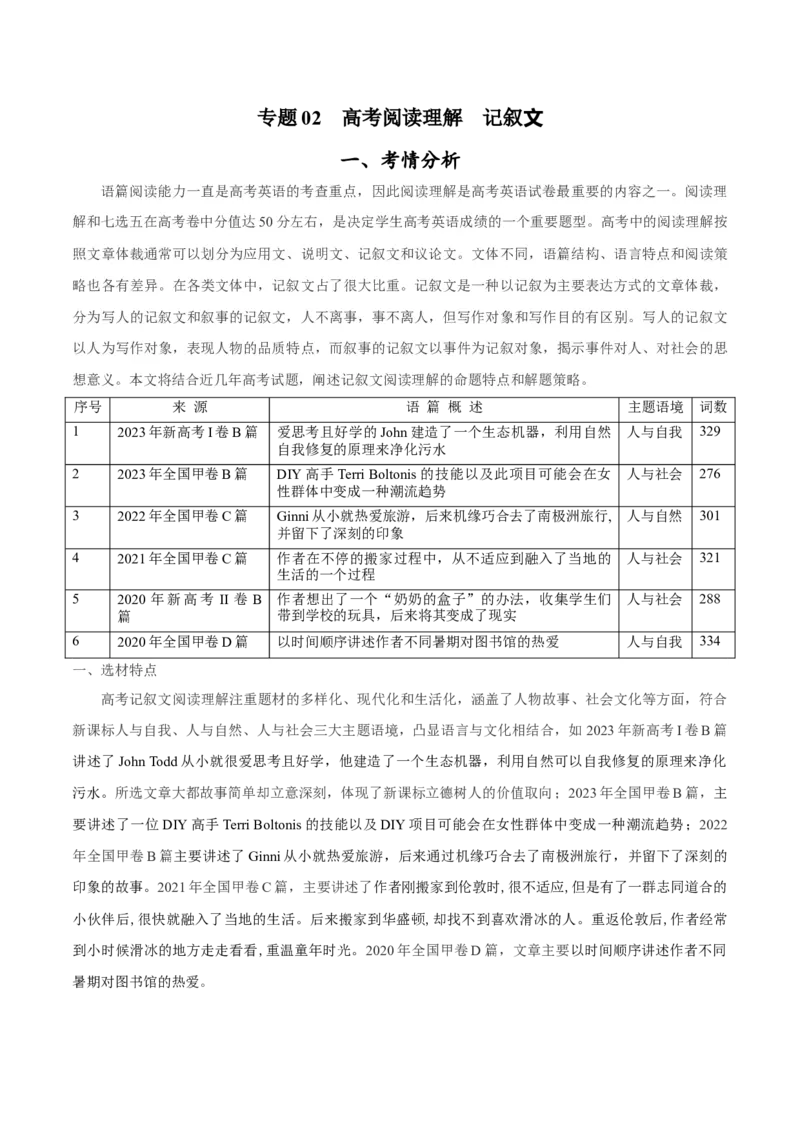
序号 来 源 语 篇 概 述 主题语境 词数
1 2023年新高考I卷B篇 爱思考且好学的John建造了一个生态机器,利用自然 人与自我 329
自我修复的原理来净化污水
2 2023年全国甲卷B篇 DIY高手Terri Boltonis的技能以及此项目可能会在女 人与社会 276
性群体中变成一种潮流趋势
3 2022年全国甲卷C篇 Ginni从小就热爱旅游,后来机缘巧合去了南极洲旅行, 人与自然 301
并留下了深刻的印象
4 2021年全国甲卷C篇 作者在不停的搬家过程中,从不适应到融入了当地的 人与社会 321
生活的一个过程
5 2020 年新高考 II 卷 B 作者想出了一个“奶奶的盒子”的办法,收集学生们 人与社会 288
篇 带到学校的玩具,后来将其变成了现实
6 2020年全国甲卷D篇 以时间顺序讲述作者不同暑期对图书馆的热爱 人与自我 334
一、选材特点
高考记叙文阅读理解注重题材的多样化、现代化和生活化,涵盖了人物故事、社会文化等方面,符合
新课标人与自我、人与自然、人与社会三大主题语境,凸显语言与文化相结合,如2023年新高考I卷B篇
讲述了John Todd从小就很爱思考且好学,他建造了一个生态机器,利用自然可以自我修复的原理来净化
污水。所选文章大都故事简单却立意深刻,体现了新课标立德树人的价值取向;2023年全国甲卷B篇,主
要讲述了一位DIY高手Terri Boltonis的技能以及DIY项目可能会在女性群体中变成一种潮流趋势;2022
年全国甲卷B篇主要讲述了Ginni从小就热爱旅游,后来通过机缘巧合去了南极洲旅行,并留下了深刻的
印象的故事。2021年全国甲卷C篇,主要讲述了作者刚搬家到伦敦时,很不适应,但是有了一群志同道合的
小伙伴后,很快就融入了当地的生活。后来搬家到华盛顿,却找不到喜欢滑冰的人。重返伦敦后,作者经常
到小时候滑冰的地方走走看看,重温童年时光。2020年全国甲卷D篇,文章主要以时间顺序讲述作者不同
暑期对图书馆的热爱。高考记叙文的篇幅一般都在280至350词左右,段落较多。文章语法结构多样化、表达方式灵活,常
用短语和平时不常见到的表达交织在文章中,使文章更加生动和地道,也在一定程度上增加了理解的难度,
如2023年全国甲卷B篇中的猜词题a dab hand (高手),2022年全国甲卷C篇中的flew the nest (指年轻人
离开父母,开始独立生活)、hit home to sb. (切中要害,使人接受),这些均为平时不常见的短语,需要学生
通过上下文灵活推测。
二、命题特点
教育部考试中心公布的《考试说明》对阅读理解要求做了明确的规定,主要考查学生以下能力:理解
主旨与要义、理解文中具体信息、根据上下文推断单词和短语的含义、做出判断和推理、理解文章的基本
结构、理解作者的意图、观点和态度。学生必须理解短文大意、文中重要信息点、作者观点,并深层理解
作者的态度和意图。全国卷的细节题较少,题目类型更多,如主旨题、推断题、词义推断题等,大部分题
目不能直接根据问题从文章中找到答案,更多考查对文章的深层理解。题干疑问词what出现频率最高,
why、which和how兼有但相对较少,题干长度有变长的趋势。选项长度较短,语法结构简单,但词汇量
要求较高,阅读理解很大一部分问题是对文中比较特别的表达内容的考查,阅读理解考查的重点是对原文
的理解而非复杂选项之间的辨析。
三、解题策略
在做记叙文阅读理解题时,我们应该需要遵循三个原则:主旨原则、问题优先原则、证据原则。首先
阅读理解的题目通常会围绕主旨或主线,违背主旨的选项一般不是正确答案;与主旨无关的选项或原文中
细枝末节的信息,即便选项内容正确,一般也不是正确答案。其次,在做阅读理解时,应先看问题,然后
带着问题,根据题干信息去文中寻找答案相关信息,将找到的信息源与选项进行匹配。如果看题干后立即
看选项,可能会被选项的众多信息所干扰,就会有先入为主的感觉,不利于正确理解文章内容,而且也不
容易记住选项信息。最后,在答题时一定要有证据意识,即所选答案一定都能从文章中找到信息源,切忌
根据自己的主观臆断和想法答题,或是根据常识判断,否则很容易失分。
除了主旨题、观点题、作者态度题以外的题目,大多数题目顺序的设计,与原文中各信息源要点顺序
一致。针对这些题目,可以采用区间定位的方法,根据题干信息锁定相应的区间进行答题,一般会在文章
文字较多的段落设题,这样就可以给予更多信息,方便学生理解和答题。即使文章有个别区间没有理解,
不一定会影响其他题目的答题。下文将根据不同题型介绍相应的解题策略。
(一)细节题
细节题几乎是每一篇记叙文阅读理解中都会出现的题型,围绕文章主题考查学生对具体信息点的理解。
学生需要细心审题,使用定位法答题,即先看问题,关注题干中可以帮助定位的关键词(如时间、地名、
人物、重要的动词、名词、形容词等),同时还要关注疑问词(如what、how、why),疑问词不同,信息源的位置可能不同,或正确答案的特点不同。近年来细节题题干中的关键词往往会变换原文中的词汇和
表达,需要学生平时积累词汇表达,理解语法现象。
1. 有些细节题可以直接根据题干中的关键词定位到原文,找到选项的同义替换。
【精准定位】根据题干关键词定位是最快速、有效的方法,学生需在平时训练时,培养精准找出关键
词的能力。
2.有些细节题的题干使用了原文信息的同义表达,因此需要识别题干中的同义表达,然后定位到原文,
选择原文的同义转换。
【精准定位】识别题干中的同义表达的前提是熟悉文章,因此建议快速阅读文章,大致了解文章信息
点的分布,这样可以对题干中的同义表达更敏感、更容易上手。
3.有些细节题可以根据题干关键词快速定位,然后对定位处进行深层理解,正确选项能根据原文总结
概括得到。
【精准定位】阅读理解中的正确答案往往是原文信息的同义替换或总结概括,而正确理解信息源是前
提。
(二)推断题
推断题是属于难度较高的一类题型,需要学生在理解原文字面意思的基础上,通过分析语篇内在逻辑
和理解其中的细节内容的暗示,理解文章深层意义和隐含意义,然后作出一定的推理判断,切忌凭空猜想,
而要以原文内容为依据,对文章信息细致分析、深入挖掘,揭示其深层含义,同时也要注意避免过度推断。
【精准定位】比喻、对比、举例等特殊表达处往往是考点,学生在阅读原文时要留意这些地方。区间
定位是快速定位的重要手段之一,使用区间定位能够帮助学生在没有完全读懂原文的情况下尽可能答对较
多的题。
(三)词义推断题
词义推断题旨在考查学生根据上下文推断词汇和短语的能力,包括超纲词义、熟词生义、代词的指代
关系、俗语、特殊表达等,因此学生不仅需要加强语境中的理解推断能力,也需要在平时注意积累和扩大
词汇量。此类题目可以采用以下几种方法:
1. 利用构词法
积累英语词汇中的前缀、后缀和词根的含义,进而能准确推测出相互组合形成的整体词义,但这种方
法仅限于对一些有词根词缀的单词的考查。
2. 联系上下文语境
联系上下文是最常用和有效的方法,上下文指该词汇或表达所在的句子,以及这个句子的上下句。记
叙文中句子之间或句子内部的逻辑关系主要有同义、反义、解释、因果。
3. 代入法如果上述两种方法都不可行,还可采用将四个选项代入原文,对比选择最合适的一个。
【精准定位】词义推断题有时候可以同时运用构词法、语境和代入法,短语的语义高度依赖上下文内
容和逻辑。
(四)主旨题
主旨题考查学生对文章的整体把握,能否分辨主题和细节,是否具备提纲挈领的能力。主旨题具体分
为主旨大意题、最佳标题题和写作目的题。此类题目需遵循“末位原则”,即不论出现在哪一题,都要最
后做。此类题型可以运用以下几种方法:
1. 根据全文关键词确定主题
关键词为在全文以同一个词或各种同义词、上下义词不断重复出现的词,这往往是全文的中心或主旨。
【精准定位】记叙文的标题题有时候还需要考虑艺术性(如双关、俗语改写等方式),应综合考虑选
择最佳答案。
2. 把握文章逻辑结构
记叙文比较常见的逻辑结构为时间顺序和事情发展顺序,因此可关注文章中表示时间和事情发展过程
的词。
3. 整体把握,从文章叙述的个人故事中体会其传达的信息
【精准定位】主旨题有时候不能直接从文章中找到答案,需要根据人物经历,如前后的转变,如何取
得成就等来体会深层含义。
4. 对于写作目的题,可以结合文章体裁或关注文章首尾处
【精准定位】主旨大意和主旨意图需要加以区分,对应的答案有时候可能不同,主旨意图需要理解文
章背后的深层含义。
对于记叙文阅读理解,把握文章的中心和主旨、主人公或作者的主要观点和态度是十分必要的。考生
需要在平时保持长期的持续性输入,进行泛读和一定量的阅读练习,培养记忆、分析、对比、判断、推理
和综合能力,多反思总结,找到适合自己的策略。
二、真题回顾
(2023年新高考全国I卷)
第一节 (共15小题;每小题2.5分,满分37.5分)
阅读下列短文,从每题所给的A、B、C、D四个选项中选出最佳选项。
B
When John Todd was a child, he loved to explore the woods around his house, observing how nature solved
problems. A dirty stream, for example, often became clear after flowing through plants and along rocks where tinycreatures lived. When he got older, John started to wonder if this process could be used to clean up the messes
people were making.
After studying agriculture, medicine, and fisheries in college, John went back to observing nature and asking
questions. Why can certain plants trap harmful bacteria (细菌)? Which kinds of fish can eat cancer-causing
chemicals? With the right combination of animals and plants, he figured, maybe he could clean up waste the way
nature did. He decided to build what he would later call an eco-machine.
The task John set for himself was to remove harmful substances from some sludge ( 污泥). First, he
constructed a series of clear fiberglass tanks connected to each other. Then he went around to local ponds and
streams and brought back some plants and animals. He placed them in the tanks and waited. Little by little, these
different kinds of life got used to one another and formed their own ecosystem. After a few weeks, John added the
sludge.
He was amazed at the results. The plants and animals in the eco-machine took the sludge as food and began to
eat it! Within weeks, it had all been digested, and all that was left was pure water.
Over the years, John has taken on many big jobs. He developed a greenhouse — like facility that treated
sewage (污水) from 1,600 homes in South Burlington. He also designed an eco-machine to clean canal water in
Fuzhou, a city in southeast China.
“Ecological design” is the name John gives to what he does. “Life on Earth is kind of a box of spare parts for
the inventor,” he says. “You put organisms in new relationships and observe what’s happening. Then you let these
new systems develop their own ways to self-repair.”
24. What can we learn about John from the first two paragraphs?
A. He was fond of traveling. B. He enjoyed being alone.
C. He had an inquiring mind. D. He longed to be a doctor.
25. Why did John put the sludge into the tanks?
A. To feed the animals. B. To build an ecosystem.
C. To protect the plants. D. To test the eco-machine.
26. What is the author’s purpose in mentioning Fuzhou?
A. To review John’s research plans. B. To show an application of John’s idea.
C. To compare John’s different jobs. D. To erase doubts about John’s invention.
27. What is the basis for John’s work?
A. Nature can repair itself. B. Organisms need water to survive.
C. Life on Earth is diverse. D. Most tiny creatures live in groups.【答案】24. C 25. D 26. B 27. A
【解析】这是一篇记叙文。文章讲述了John Todd从小就很爱思考且好学,他建造了一个生态机器,利用
自然可以自我修复的原理来净化污水。
【24题】C 细节理解题。根据第一段“When John Todd was a child, he loved to explore the woods around his
house, observing how nature solved problems. A dirty stream, for example, often became clear after flowing
through plants and along rocks where tiny creatures lived. When he got older, John started to wonder if this process
could be used to clean up the messes people were making. (当约翰·托德还是个孩子的时候,他喜欢探索房子周
围的树林,观察大自然是如何解决问题的。例如,一条肮脏的小溪流经植物和微小生物居住的岩石后,往
往会变得清澈。长大后,约翰开始思考这个过程是否可以用来清理人们制造的混乱)”以及第二段“After
studying agriculture, medicine, and fisheries in college, John went back to observing nature and asking questions.
Why can certain plants trap harmful bacteria (细菌)? Which kinds of fish can eat cancer-causing chemicals? (在大
学学习了农业、医学和渔业之后,约翰又回到了观察自然和提出问题的生活中。为什么某些植物能捕获有
害细菌?哪些鱼类会食用致癌化学物质?)”可知,约翰聪颖好学、好奇心很强。故选C。
【25题】D 细节理解题。根据第三段“After a few weeks, John added the sludge. (几个星期后,约翰把污泥
加了进去)”以及倒数第三段“He was amazed at the results. The plants and animals in the eco-machine took the
sludge as food and began to eat it! Within weeks, it had all been digested, and all that was left was pure water. (他
对结果感到惊讶。生态机器里的动植物把污泥当成了食物,开始吃了起来!几周之内,它就被消化了,只
剩下纯净水)”可知,约翰把污泥放进罐子里是为了测试生态机器。故选D。
【26题】B 推理判断题。根据倒数第二段“Over the years, John has taken on many big jobs. He developed a
greenhouse — like facility that treated sewage (污水) from 1,600 homes in South Burlington. He also designed an
eco-machine to clean canal water in Fuzhou, a city in southeast China. (这些年来,约翰承担了许多重大工作。
他开发了一个类似温室的设施,可以处理来自南伯灵顿1600户家庭的污水。他还设计了一种生态机器来清
洁中国东南部城市福州的运河水)”可推知,作者提到福州的目的是展示约翰想法的应用。故选B。
【27 题】A 推理判断题。根据最后一段“You put organisms in new relationships and observe what’s
happening. Then you let these new systems develop their own ways to self-repair. (你把生物体放在新的关系中,
观察会发生什么。然后让这些新系统自行发展自我修复的方式)”可知,约翰工作的基础是自然可以自我修
复。故选A。
(2023年全国英语甲卷)
第一节 (共15小题;每小题2.5分,满分37.5分)阅读下列短文,从每题所给的A、B、C、D四个选项中选出最佳选项。
B
Terri Boltonis a dab hand when it comes to DIY (do-it-yourself). Skilled at putting up shelves and piecing
together furniture, she never pays someone else to do a job she can do herself.
She credits these skills to her late grandfather and builder Derek Lloyd. From the age of six, Terri, now 26,
accompanied Derek to work during her school holidays. A day’s work was rewarded with £ 5 in pocket money. She
says: “I’m sure I wasn’t much of a help to start with painting the rooms and putting down the flooring throughout
the house. It took weeks and is was backbreaking work, but I know he was proud of my skills.”
Terri, who now rents a house with friends in Wandsworth, South West London, says DIY also saves her from
losing any deposit when a tenancy (租期) comes to an end. She adds: “I’ve moved house many times and I always
like to personalise my room and put up pictures. So, it’s been useful to know how to cover up holes and repaint a
room to avoid any charges when I’ve moved out.”
With millions of people likely to take on DIY projects over that coming weeks, new research shows that more
than half of people are planning to make the most of the long, warm summer days to get jobs done. The average
spend per project will be around £ 823. Two thirds of people aim to improve their comfort while at home. Two fifth
wish to increase the value of their house. Though DIY has traditionally been seen as male hobby, the research
shows it is women now leading the charge.
24. Which is closest in meaning to “a dab hand” in paragraph 1?
A. An artist. B. A winner. C. A specialist. D. A pioneer.
25. Why did Terri’s grandfather give her £ 5 a day?
A. For a birthday gift. B. As a treat for her work.
C. To support her DIY projects. D. To encourage her to take up a hobby.
26. How did Terri avoid losing the deposit on the house she rented?
A. By making it look like before. B. By furnishing it herself.
C. By splitting the rent with a roommate. D. By cancelling the rental agreement.
27. What trend in DIY does the research show?
A. It is becoming more costly. B. It is getting more time-consuming.
C. It is turning into a seasonal industry. D. It is gaining popularity among females.
【答案】24. C 25. B 26. A 27. D
【解析】本文是一篇记叙文,文章主要讲述了一位DIY高手Terri Boltonis的技能以及DIY项目可能会在女
性群体中变成一种潮流趋势。【24题】C 词句猜测题。根据文章第一段画线短语下文“Skilled at putting up shelves and piecing together
furniture, she never pays someone else to do a job she can do herself. (她擅长摆架子和拼接家具,从不付钱给别
人做她自己能做的工作)”可推知,此处指Terri Boltonis是一位DIY高手。C项“A specialist (一位专业人
员)”最接近画线短语“a dab hand”的意思。故选C。
【25】B 推理判断题。根据文章第二段“She credits these skills to her late grandfather and builder Derek
Lloyd. From the age of six, Terri, now 26, accompanied Derek to work during her school holidays. A day’s work
was rewarded with £ 5 in pocket money. (她将这些技能归功于她已故的祖父兼建筑商Derek Lloyd。从六岁起,
现年26岁的Terri就在学校放假期间陪Derek去上班。一天的工作得到了5英镑零花钱的奖励)”以及“It
took weeks and is was backbreaking work, but I know he was proud of my skills. (这花了几个星期的时间,是一
项艰苦的工作,但我知道他为我的技能感到骄傲)”可推知,Terri的祖父每天给她5英镑是作为对她的工作
的鼓励。故选B。
【26题】A 细节理解题。根据文章第三段“So, it’s been useful to know how to cover up holes and repaint a
room to avoid any charges when I’ve moved out. (所以,当我搬出去时,知道如何掩盖漏洞并重新粉刷房间以
避免任何费用是很有用的)”可推知,Terri是通过粉饰房间,让它看起来像以前一样,来避免被扣除租房的
押金的。故选A。
【27题】D 细节理解题。通过文章最后一段“the research shows it is women now leading the charge (研究
表明,现在是女性主导了这项运动)”可知,研究表明,DIY将在女性中越来越受欢迎。故选D。
三、最新模拟试题
(1)
(2023·江苏南京·南京市第一中学校考模拟预测)
We were standing at the top of a church tower. I saw twisting streets leading to the square. “See, my dear,”
Father said gently. “There is more than one way to the square.”
Father’s words always guided me. Dreaming of becoming a fashion designer, I came to Paris, but without
luck. Then one day I met a friend wearing a beautiful sweater. “What an interesting stitch!” I cried. “It was done by
Mrs. Vidian,” my friend explained. “She learned the stitch in Armenia, her native country.” Suddenly I had a daring
idea. Why not design, make and sell my own clothes?
I drew a butterfly pattern and asked Mrs. Vidian to knit it into a sweater. It proved a success. A New York store
wanted 40 sweaters to be ready in two weeks. I accepted the order. My happiness disappeared, however, when Mrs.
Vidian told me it took her almost a week to knit one sweater.I was crushed. Then I remembered father’s words. There must be other Armenian women in Paris who
mastered the special stitch. Then I searched for any Armenians living in Paris. At last I tracked down several. Two
weeks later, the first shipment was on its way to the United States!
From that day on orders poured in. Then came another test. As I was busy getting ready to show my winter
fashions, the sewing girls were called out on strike. Where was the way out this time? I wondered and worried.
Then it dawned on me.
I worked hurriedly. And right on time, my show took place. Some coats had no sleeves; some were only
patterns made of heavy cotton cloth, but on these I attached material to show what colors and textures the clothes
would have when they were finished. What a show! Once again father’s words helped me.
1. What problem did the writer face after accepting the order?
A. It was impossible for Vidian to meet the deadline.
B. The sewing girls were called out on strike.
C. She found it hard to track Armenians living in Paris.
D. There was a shortage of suitable cloth.
2. What do the underlined words “the first shipment” refer to in Paragraph 4?
A. Raw materials. B. More orders. C. The forty sweaters. D. The special stitch.
3. How did the writer deal with the show problem?
A. She put off the show. B. She showed the clothes unfinished.
C. She employed more sewing girls. D. She completed the clothes in a hurry.
4. Which of the following might the writer agree with?
A. Practice makes perfect. B. Like father, like son.
C. Easier said than done. D. All roads lead to Rome.
(2)
(2023·江苏镇江·江苏省镇江第一中学统考二模)
Eugene Newman Parker, a leading figure in heliospheric (日球层的) physics for the past half century, passed
away peacefully at his home in Chicago on Mar. 15. He was 94.
Hailed (誉为) as a visionary in the field of heliophysics, Parker revolutionized our understanding of the sun
and its effects on Earth and other bodies within the solar system. NASA even stated that “the field of heliophysics
exists in large part because of Dr. Eugene Parker. In 2018, Parker became the first living scientist to witness the
launch of a spacecraft that was named in his honor.
Parker is best known for his groundbreaking theory on the existence of a phenomenon called “solar wind”, acontinuous stream of charged particles that flow off the sun. It can become violent, causing space weather that
impacts the Earth. When Parker’s research was published in 1958, his theory was initially met with skepticism (怀
疑) and ridicule by the scientific community. The general view at the time was that the space between planets was
an absolute vacuum (真空), and was thus completely empty of any matter. But, there were no errors in his study or
his calculations, and the theory was later proven to be correct in 1962, when a NASA spacecraft mission to Venus
revealed the constant presence of a supersonic wind—exactly as Parker had predicted.
That experience likely led to the advice Parker often gave young researchers: “If you do something new or
innovative, expect trouble. But think critically about it because if you’re wrong, you want to be the first one to
know that.” Parker never co-authored a paper with his students, thus urging them to be independent.
Parker was humble, straightforward, and wise. His son Eric said, “My sister Joyce and I didn’t get a real feel
for what a ‘big dog’ our dad was in the field.” They got an even better sense when a month after Parker’s death,
they traveled to Lund, Sweden, to accept on his behalf the Crafoord Prize in Astronomy.
1. What can we learn from the second paragraph?
A. A spacecraft was named in memory of Parker.
B. The sun has less effects on Earth than expected.
C. Parker deserved credit for his great contributions.
D. NASA provided new insights into the lunar effect.
2. Why did people view Parker’s theory of “solar wind” skeptically at first?
A. It went against the popular opinion at that time.
B. Some mistakes were found in his calculations.
C. The presence of a supersonic wind was proven by NASA.
D. Matter was believed to exist in the space between planets.
3. What did Parker suggest young researchers do?
A. Seek close cooperation. B. Avoid high expectations.
C. Learn by trial and error. D. Compete against others.
4. What words can be used to describe Parker according to the passage?
A. Straightforward and generous. B. Responsible and accessible.
C. Intelligent yet conservative. D. Distinguished yet modest.
(3)
(2023·浙江·德清县高级中学校考模拟预测)
Eliana Yi dreamed of pursuing piano performance in college, never mind that her fingers could barely reachthe length of an octave (八度音阶). Unable to fully play many works by Romantic-era composers, including
Beethoven and Brahms, she tried anyway — and in her determination to spend hours practicing one of Chopin’s
compositions which is known for being “stretchy”, wound up injuring herself.
“I would just go to pieces,” the Southern Methodist University junior recalled. “There were just too many
octaves. I wondered whether I was just going to play Bach and Mozart for the rest of my life.”
The efforts of SMU keyboard studies chair Carol Leone are changing all that. Twenty years ago, the school
became the first major university in the U.S. to incorporate smaller keyboards into its music program, leveling the
playing field for Yi and other piano majors.
Yi reflected on the first time she tried one of the smaller keyboards: “I remember being really excited because
my hands could actually reach and play all the right notes,” she said. Ever since, “I haven’t had a single injury, and
I can practice as long as I want.”
For decades, few questioned the size of the conventional piano. If someone’s hand span was less than 8.5
inches — the distance considered ideal to comfortably play an octave — well, that’s just how it was.
Those who attempt “stretchy” passages either get used to omitting notes or risk tendon (腱) injury with
repeated play. Leone is familiar with such challenges. Born into a family of jazz musicians, she instead favored
classical music and pursued piano despite her small hand span and earned a doctorate in musical arts.
A few years after joining SMU’s music faculty in 1996, the decorated pianist read an article in Piano and
Keyboard magazine about the smaller keyboards. As Leone would later write, the discovery would completely
renew her life and career.
In 2000, she received a grant to retrofit a department Steinway to accommodate a smaller keyboard, and the
benefits were immediate. In addition to relieving injury caused by overextended fingers, she said, it gave those with
smaller spans the ability to play classic compositions taken for granted by larger-handed counterparts.
Smaller keyboards instill many with new confidence. It’s not their own limitations that have held them back,
they realize; it’s the limitations of the instruments themselves. For those devoted to a life of making music, it’s as if
a cloud has suddenly lifted.
1. What is the similarity between Eliana Yi and Carol Leone?
A. Their interest in jazz extended to classical music.
B. Short hand span used to restrict their music career.
C. They both joined SMU’s music faculty years ago.
D. Romantic-era composers’ music was easy for them.
2. Why did SMU initiate an effort to scale down the piano?A. To reduce the number of octaves. B. To incorporate Bach into its music program.
C. To provide fair opportunities for piano majors. D. To encourage pianists to spend more hours practicing.
3. How did Yi probably feel when she played the retrofitted piano?
A. Confident. B. Frustrated. C. Challenging. D. Determined.
4. Which of the following is the best title of the passage?
A. Who Qualifies as an Ideal Pianist? B. Traditional or Innovative Piano?
C. Hard-working Pianists Pays off D. The Story behind Retrofitted Pianos
(4)
(2022·浙江·浙江大学附属中学校考模拟预测)
That youngsters were glued to online games on their smart phones was a great concern for Ngurang Meena, a
school teacher in Nirjuli. The 30yearold social science teacher, who ran the Ngurang Learning Institute, an adult
literacy centre, said that she felt disheartened when she read student papers. “The graph of student performance is
falling every year. It breaks my heart whenever I see answer sheets — basic grammar skills are missing and there’s
an absence of any cohesive (连贯的) expression. They lack guidance and their reading culture is almost zero,”
Meena said. When her school and the centre she ran had to close due to infectious diseases, she planned to do
something to address the problem.
Inspired by a similar proposal in Mizoram, Meena set up a bookshelf with around 80 books as well as some
benches on the side of the road in Nirjuli on 30 August 2020, where passersby could spend time reading. The
selections included motivational books, biographies and novels as well as comics for young children. “I have to
please the minors with sweets to sit and read, but that is okay,” she laughed.
Meena’s bookshelf became a hit among youngsters who spent hours in the reading corner. Within two months,
her effort became the talk of the town.
Now, generous contributions of books come in from the public and she is even receiving requests to set up
such libraries in other parts of the state, including one in the capital, Itanagar. Since the tiny libraries are far from
the main town, she also lends books out to those who want to read at home.
“I never thought that this would become such a big inspiration,” Meena said. “Since childhood, we have
been told that books are our best friends. The next generation of kids is focused on games and other things. I don’t
want them to head on the wrong track,” she added.
1. What’s the aim of Meena’s reading program?
A. To care for youngsters lacking in reading.
B. To help adults learn some cohesive expression.C. To keep Ngurang Learning Institute running well.
D. To highlight the importance of reading for adults.
2. What did Meena do to encourage young kids to read more?
A. She offered some rewards to them. B. She provided them with transportation.
C. She chose novels with beautiful covers. D. She selected books covering every category.
3. Which words can best describe Meena’s libraries?
A. Small and useless. B. Influential and meaningful.
C. Large but impractical. D. Widespread but unwelcome.
4. What is the best title for the text?
A. Books:Sources of Knowledge B. The Roadside Reading Corner
C. The Library:an Ideal place for the Young D. New Ideas about Setting a Reading Plan
(5)
(2023·山东·山东省实验中学校考二模)
My mother-in-law asked me to climb a mountain in her rural village. We went through tall and weedy expanse
of grass, pulling ourselves up with the help of smooth bamboo trees. Weathered gray rocks dotted tracks only
visible to an experienced hiker. The view we were rewarded with halfway up the mountain, fixing our eyes upon
the colorful pieces of fields and whitewashed homes set against the deep green hills and a sky so blue that it looked
digitally polished, was a side benefit of being there.
Our eyes were mostly on the wild eatable plants that grew on the mountainside. We first came upon the wild
mountain bamboo, a plant that was the main part in my mother-in-law’s salted bamboo shoots that, once preserved,
could be used all year long in cooking. Along the way, we also encountered another precious wild food —
fiddlehead ferns (蕨菜). Those delicate leaves, when stir-fired, were a tasty treat. Once I had purchased fiddleheads
at a market in the US. Yet there we were, picking this prized vegetable on our own, with only our labor as the cost.
What we had collected that afternoon looked the same as any other wild mountain bamboo shoots and
fiddlehead ferns I had seen before in my mother-in-law’s kitchen. And yet, they felt different to me because I had
used my own hands to help pick them and carry them back down the mountain. Spending time and energy
gathering these wild plants gave me a deeper appreciation for the food that ends up on the dinner table.
“Many generations have kept this natural lifestyle. We depend on the mountains for our life,” my mother-in-
law says. Those mountains and rivers supporting her life aren’t some abstract concept. They are right there, outside
her door and within her rural village. Once I saw them through her angle that afternoon, I realized they are closer to
me than I ever imagined.1. Why was the author asked to climb a mountain?
A. To pull some bamboo trees. B. To enjoy its beautiful scenery.
C. To get some wild vegetables. D. To lake some digital pictures.
2. What made the picked fiddlehead ferns different?
A. The fresh leaves. B. The input of labor. C. The rich nutrition. D. The help from Mother-in-law.
3. What does the author want to show by quoting her mother-in-law?
A. Nature feeds villagers and sustains their life. B. City people want to settle down in mountains.
C. Rural areas are inaccessible to some outsiders. D. Farmers dream of changing the natural lifestyle.
4. How does the author sound when telling the story?
A. Humorous. B. Anxious. C. Satisfied. D. Tolerant.
(6)
(2023·山东济南·山东师范大学附中校考模拟预测)
When he went outside during the break, John Buettner would dream of learning the monkey-bars. He uses a
wheelchair, so they aren’t accessible to him — in fact, most of the playground at Glen Lake Elementary School
isn’t. Betsy Julien would look out at the students in their wheelchairs, and thought, “Our playground is not set up
for everybody in the school to play and have fun.”
Now, thanks to this teacher and her students, that dream is about to come true in a bigger way.
Last fall, Julien and a few of her colleagues applied for, and won, a grant for an accessible swing and merry-
go-round. The grant fell $ 35,000 short of the amount the school needed, so Julien asked her class to help raise the
rest.
Her students jumped at the idea, and took it a step further. “Why can’t we make the whole playground
accessible?” said Hadley Mangan. They brainstormed ideas on how to raise money: door-knocking, partnering with
restaurants, handing out flyers, and even cold-calling local businesses. They got to work and reached their goal in a
matter of weeks. Now, they aim to raise $1 million so they can completely transform their playground.
Last week, Julien loaded the students for a field trip to see how the equipment is built and even got to color in
a blueprint of the playground design. Buettner said he could hardly believe how quickly an idea turned into reality.
“All of this equipment is big enough for my friends and I to play on. I just feel some sense of capability.”
Julien speaks through tears, too, when reflecting on the project and the transformation. “Anything we raise
beyond our goal will go towards accessible equipment at neighboring schools. I hope that the world is accepting
and inclusive for every child.”
1. What’s the problem with the school playground?A. Little playing space. B. Limited accessibility.
C. Poor construction funding. D. Narrow wheelchair passage.
2. What does the underlined phrase “a step further” refer to?
A. Donating more money. B. Achieving original goals.
C. Asking more people for help. D. Transforming the whole playground.
3. What can we infer from Buettner’s words?
A. He engages more in donation. B. He has more faith in himself.
C. He becomes an expert in sports. D. He gets more involved in contests.
4. What can we learn from Julien’s story?
A. Hard work matters. B. Kindness bears fruits.
C. Good ideas win favor. D. Trust promotes friendship.
(7)
(2023·湖北荆门·荆门市龙泉中学校考三模)
Todd Bol, a retired businessman, could never have expected that a wooden container he built in his front yard
one day would have the global impact it does today.
Bol built a dollhouse-size structure that looked like a schoolhouse on a post and he put it in his yard as a free
community library to remember his mother, who was a book lover and school teacher. Bol’s design gave birth to
Little Free Library (LFL), a nonprofit organization that seeks to place small, accessible book exchange boxes in
neighborhoods around the world. The concept is simple: Neighbors are invited to share a book, leave a book, or
both. Today, there are over 50,000 of these libraries registered in 70 countries.
Almost everyone can register with LFL and start a library as long as the person keeps it in good shape and
makes sure that book materials are appropriate for his/her neighborhood. Library owners can create their own
library boxes; therefore, the libraries are usually unique in appearance, and there seems to be no limit to the
possibilities. One library in California was built out of a used wine container; another in Texas had tiny stairs and
bright colored walls. Once registered, libraries are assigned a number at LFL’s website. The LFL Index lists the
locations of all libraries with GPS coordinates (坐标) and other information. Owners receive a sign saying “Little
Free Library”.
People say they have been attracted to pick up a book when walking by a Little Free Library, out of curiosity
and because it’s convenient. Some sidewalk librarians say they have met more neighbors since having a little
library in their front yard. Bol is also most proud of the way Little Free Library is bringing communities together.
“It’s started a neighborhood exchange. It gets people talking and more comfortable with their neighbors,” he says.“This leads to them helping each other.”
1. What does the underlined word “design” in Paragraph 2 refer to?
A. A community center. B. A dollhouse on a post.
C. A book exchange box. D. A nonprofit organization.
2. What can we learn about the operation of a Little Free Library?
A. There is no limit to the selection of books.
B. The library can come in any shape and color.
C. The library needs to hire many professional librarians.
D. The owner must first be assigned a number from the LFL website.
3. What can be inferred about Little Free Library?
A. It helps improve GPS functions. B. It connects libraries around the world.
C. It makes reading accessible to the poor. D. It helps restore human connections.
4. Which of the following can be the best title for the text?
A. LFL: A Booster to Shared Reading B. LFL: The Best Place to Meet Neighbors
C. Todd Bol: A Successful Book Businessman D. Reading: An Approach to Improving Yourself
(8)
(2023·湖北·华中师大一附中校考模拟预测)
I truly believe we all have a very special purpose in life, regardless of who we are or where we come from.
After ten years of working for a major Wall Street bank, I wanted to do something challenging. So when I read a
Merrill Lynch advertisement looking to hire more stockbrokers (股票经纪人), with great excitement, I made some
phone calls and arranged to meet with one of its branch vice presidents. After this interview and interviews with
twelve of his top stockbrokers, I eventually landed the job.
The first few months was a struggle. I lived on very little commission (佣金). Night after night, I left the office
weary and exhausted, ready to give up, yet somehow returning the next morning to start anew day. Eventually, all
the hard work paid off. In less than four years, I became one of the top sales people at my branch and increased
personal sales by 1,700 percent. The success earned me a six-figure income, promotion and numerous sales awards.
Toward the end of my fourth year at Merrill Lynch, it hit me that something was missing. I thought long and
hard about my goals. Then I was reminded of the time when I spoke to hundreds of people, while in college as a
student leader, and years later, when I won a “Humorous Speech” championship. It dawned on me that every time I
had a speaking engagement, I always came out of the experience with a wonderful, energetic, peaceful and magical
feeling that was unmatched by anything else I did. I knew the extraordinary public-speaking skills I was blessedwith could enable me to make a lasting difference and transform other people’s lives.
Then I took another daring risk, gave up everything and left the investment business for a more satisfying
career as a motivational speaker. The beginning of my speaking journey was surprisingly similar to what I had first
experienced at Merrill Lynch. However, nothing in the world comes close to the satisfying feeling I get when
thousands of people tell me how much I have made a difference in their lives by motivating them to take risks and
be the best they could be.
1. Why did the author meet with a Merrill Lynch branch vice president?
A. To arrange an interview. B. To make an advertisement.
C. To employ more clerks. D. To get a position.
2. Which of the following best describes the author according to paragraph 2?
A. Tolerant and ambitious. B. Demanding and successful.
C. Tough and competent. D. Optimistic and agreeable.
3. Why did the author leave Merrill Lynch?
A. He hoped to relive college life. B. He wanted to influence others’ lives.
C. He had an engagement. D. His investment was not satisfying.
4. Which is the most suitable title for the text?
A. Speaking Makes a Satisfying Job B. Challenge Your Career Choice
C. Hard Work Pays Off D. Dare to Take Risks