押北京卷第 21-27 题
阅读理解 A、B 篇
【三年考情回顾】
A篇
时间 卷次 主题语境 文体 题型分类
2023年 北京卷 人与社会:成为国际奥委会青年领袖项目要求 应用文 3个细节理解题。
2022年 北京卷 人与自我:同伴辅助学习课程(PASS) 应用文 3个细节理解题。
2021年 北京卷 人与社会:联合国教科文组织的实习项目 应用文 3个细节理解题。
应用文是最贴近日常生活的文体,它包括通知、广告、便条、申请书、个人简介、商品说明与介绍、新闻
报道等,形式多样,题材各异(如图示、表格等),措辞简洁明了,直截了当。具体答题技巧如下:
1. 材料特点
综观近几年的高考英语阅读理解题,其中应用类阅读题内容主要涉及的是与人们生活息息相关的信息,如
产品宣传、服务介绍、招生招聘等。
2. 形式特点
做广告的主要目的就是要让受众了解并记住广告的内容,并为广告上所刊登的内容(产品或服务等)买单。
为了达到这一目的,人们在设计广告时往往会做到:标题醒目,重点突出,条理清楚。
3. 用词特点
广告类阅读材料的用词有"三多"特点:一是人名、地名、专有名词多;二是生词多;三是缩略词、省略
句多。
4. 命题特点
广告类阅读是近几年高考英语阅读理解最常考的题材,在阅读理解的选材中占有很大的比重。命题者的目
的是要考查考生提取信息和处理信息的能力,所以命题的题型多是以获取信息为主的细节理解题。
B篇
时间 卷次 主题语境 文体 题型分类
2023年 1个细节理解题
北京卷 人与自我:作者职业成功的经历 记叙文
3个推理判断题2022年 北京卷 3个细节理解题
人与社会:参加保护自然活动治愈好了焦虑 记叙文
1个推理判断题
2021年 北京卷 3个细节理解题
人与自我:第一印象不总是可信 记叙文
1个推理判断题
1、记叙文基本特点
从历年高考统计数据来看,记叙文内容主要归纳为三个类型:一、人物传记 二、人物故事三、新闻报道
2、“人物传记”类记叙文解题策略
人物传记是高中记叙文考试中常遇到的体裁形式。针对人物传记,学生应该重视文中人物学习以及工
作情况的描写,并且理顺人物出生到死亡的顺序。针对人物不同年龄阶段做过的事情、说过的话进行理
解。主要是针对人物描写时间顺序、生活背景、实践经历、名人名言几个要素进行认知。
3、“人物故事”类记叙文解题策略
要有效地解决英语记叙文阅读中的问题,就必须要理清事件发展的顺序以及人物之间的关系。把握记
叙文的题材,理清作者想要表达的主要意图。有重点地把握人物特征,了解整个事情的来龙去脉,正确地
认识文章的结构以及文章题材倾向。针对叙事为主的记叙文,学生应该注意:
A.记叙的要素(who、when、where、what、why、how)
B. 叙述的人称(第一人称/第三人称)
C.记叙的顺序或方法(顺叙、倒叙和插叙)
D.叙述的线索 (以时间为线索;以地点为线索;以事件发展的过程为线索;以事物的象征意义为线索;
以人物的思想行为及认知的过程为线索)
四、“新闻报道”类记叙文解题策略
新闻报道类阅读理解首先注意新闻“倒金字塔”结构特点,重视“首段”和“段首”,因为这样可以
抓住文章的主旨句,有利于把握文章大意和作者写作意图。
同时,还应学会运用括号法分析长难句,把影响考生理解的各种从句、非谓语动词短语以及复杂介词
短语括起来,从而达到“去枝叶,留主干”的目的,进而准确理解句子含义。
应用文 (2023北京,A)
The International Olympic Committee(IOC)Young Leaders programme empowers talents to make a positive
difference in their communities through sport. Twenty-five Young Leaders are being selected every two years for afour-year period. They promote the Olympic values, spreading the message of sport for good.
To be an IOC Young Leader, you need to first complete the 4-Week Learning Sprint (冲刺).
4-Week Learning Sprint
The 4-Week Learning Sprint, which will take place during November 2023, is a virtual learning programme.
The sessions can be attended live or watched back after they are made available on the IOC channel. Each week,
participants will be asked to complete a topic﹣specific reflection task.
The 4-Week Learning Sprint is open to anyone, with the target audience aged between 20 and 28.
After successfully completing the 4-Week Learning Sprint, you will need to submit a plan for a sport﹣based
project, which you will work on if selected as an IOC Young Leader.
Requirements for the Applicants
•You have successfully completed the 4-Week Learning Sprint.
•You have completed your high school studies.
•You have at least one year of work experience.
•You have strong public speaking skills.
•You are self-motivated and committed.
•You are passionate about creating positive change in your community.
•You are open to being coached and advised by experts and peers (同伴).
•You are able to work with people from different backgrounds.
1. In the 4-Week Learning Sprint, participants will ________.
A. create change in their community B. attend a virtual learning programme
C. meet people from different backgrounds D. promote the IOC Young Leaders project
2. If selected as an IOC Young Leader, one will need to ________.
A. complete a reflection task each week B. watch sports on the IOC channel
C. work on a sport-based project D. coach and advise their peers
3. Which is a requirement for the applicants?
A. Spreading the message of sport for good. B. Having at least one-year work experience.
C. Showing great passion for project planning. D. Committing themselves to becoming an expert.
记叙文(2023北京,B)
Sitting in the garden for my friend's birthday, I felt a buzz(振动) in my pocket. My heart raced when I saw the
email sender's name. The email started off:“Dear Mr Green, thank you for your interest” and “the review process
took longer than expected.” It ended with “We are sorry to inform you...” and my vision blurred(模糊). Theposition—measuring soil quality in the Sahara Desert as part of an undergraduate research programme—had felt
like the answer I had spent years looking for. I had put so much time and emotional energy into applying, and I
thought the rejection meant the end of the road for my science career.
So I was shocked when, not long after the email, Professor Mary Devon, who was running the programme,
invited me to observe the work being done in her lab. I jumped at the chance, and a few weeks later I was equally
shocked—and overjoyed—when she invited me to talk with her about potential projects I could pursue in her lab.
What she proposed didn't seem as exciting as the original project I had applied to, but I was going to give it my all.
I found myself working with a robotics professor on techniques for collecting data from the desert remotely.
That project, which I could complete from my sofa instead of in the burning heat of the desert, not only survived
the lockdown but worked where traditional methods didn't. In the end, I had a new scientific interest to pursue.
When I applied to graduate school, I found three programmes promising to allow me to follow my desired
research direction. And I applied with the same anxious excitement as before. When I was rejected from one that
had seemed like a perfect fit, it was undoubtedly difficult. But this time I had the perspective(视角) to keep it from
sending me into panic. It helped that in the end I was accepted into one of the other programmes I was also excited
about.
Rather than setting plans in stone, I've learned that sometimes I need to take the opportunities that are offered,
even if they don't sound perfect at the time, and make the most of them.
1. How did the author feel upon seeing the email sender's name?
A. Anxious. B. Angry. C. Surprised. D. Settled.
2. After talking with Professor Devon, the author decided to .
A. criticise the review process B. stay longer in the Sahara Desert
C. apply to the original project again D. put his heart and soul into the lab work
3. According to the author, the project with the robotics professor was .
A. demanding B. inspiring
C. misleading D. amusing
4. What can we learn from this passage?
A. An invitation is a reputation. B. An innovation is a resolution.
C. A rejection can be a redirection. D. A reflection can be a restriction.应用文答题策略
1. 先题后文:
先读试题,了解试题考点;明确目的,快速捕捉,获取信息。
2. 原文定位:
根据题干关键词到文中定位答案范围,按照题目顺序依次而下:问题与材料相同→对号入座;问题与原文
相同→同义替换、归纳事实等。
3. 淡化生词:
遇到人名、地名、专有名词等;如与答题无关,直接跳过;涉及答题,则根据语境、构词法等猜词。
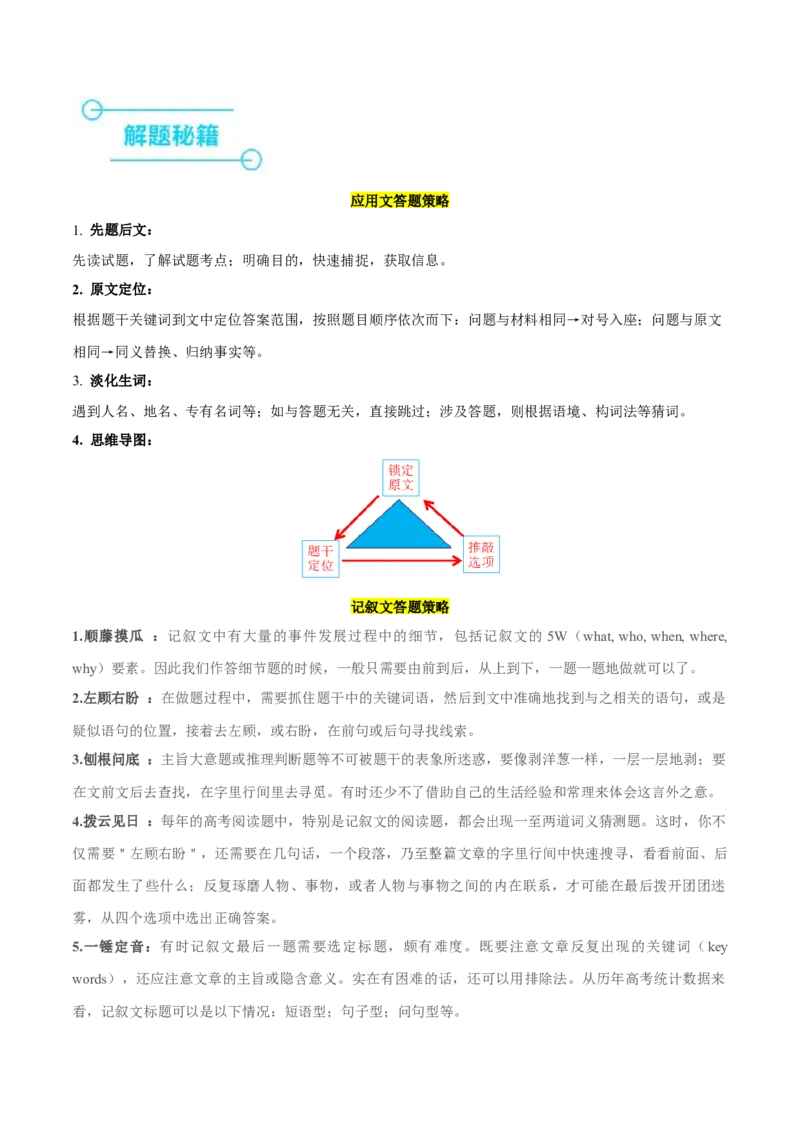
4. 思维导图:
记叙文答题策略
1.顺藤摸瓜 :记叙文中有大量的事件发展过程中的细节,包括记叙文的 5W(what, who, when, where,
why)要素。因此我们作答细节题的时候,一般只需要由前到后,从上到下,一题一题地做就可以了。
2.左顾右盼 :在做题过程中,需要抓住题干中的关键词语,然后到文中准确地找到与之相关的语句,或是
疑似语句的位置,接着去左顾,或右盼,在前句或后句寻找线索。
3.刨根问底 :主旨大意题或推理判断题等不可被题干的表象所迷惑,要像剥洋葱一样,一层一层地剥;要
在文前文后去查找,在字里行间里去寻觅。有时还少不了借助自己的生活经验和常理来体会这言外之意。
4.拨云见日 :每年的高考阅读题中,特别是记叙文的阅读题,都会出现一至两道词义猜测题。这时,你不
仅需要"左顾右盼",还需要在几句话,一个段落,乃至整篇文章的字里行间中快速搜寻,看看前面、后
面都发生了些什么;反复琢磨人物、事物,或者人物与事物之间的内在联系,才可能在最后拨开团团迷
雾,从四个选项中选出正确答案。
5.一锤定音:有时记叙文最后一题需要选定标题,颇有难度。既要注意文章反复出现的关键词(key
words),还应注意文章的主旨或隐含意义。实在有困难的话,还可以用排除法。从历年高考统计数据来
看,记叙文标题可以是以下情况:短语型;句子型;问句型等。应用文
一
(2024·西城区一模)
A
Discovery Pass
With a NSW TrainLink Discovery Pass, you can
• get unlimited booked travel to more than 365 destinations on the NSW TrainLink Regional train and coach
network
• choose a pass that suits your travel plans: 14 days, one month, three months or six months
• choose a class of travel that suits your style: Economy or First Class (Premium).
Please note that you cannot book a child ticket online with a Discovery Pass. You will instead need to call 13
22 32 or visit a sales agent.
Before purchasing a pass, please read the relevant terms and rules. A NSW TrainLink Discovery Pass is non-
refundable and it cannot be assigned to another person.
Prices
Pass type 14 days 1 month 3 months 6 months
Adult Economy $232 $275 $298 $420
Adult Premium $300 $350 $400 $550
Child Economy $121 $143 $154 $220
Child Premium $154 $176 $220 $275
How to purchase a pass and book trips
Step 1: Purchase a Discovery Pass
Choose a time limit and class of travel that suits your needs.
Step 2: Book your trips
After you purchase a Discovery Pass, you have up to one month to book your first trip. The time limit on your
pass will start from the departure date of your first booked trip. All trips must be booked and taken before the
expiry (到期) date indicated on the pass. You must book each trip before you travel.Find out more about ways to book your ticket? Visit our website:
https: /transportnsw.info/tickets-opal/regional-tickets-fares/ways-to-book-your-ticket
1. You can use a NSW TrainLink Discovery Pass to ______.
A. book a child ticket online B. choose a class of travel that suits you
C. choose a weekly, monthly or yearly pass D. get booked travel to unlimited destinations
2. If a mother with a child wants to buy a one-month NSW TrainLink Discovery Pass for Economy Class, she
should pay .
A. $353 B. $418 C. $693 D. $876
3. What can we know about a NSW TrainLink Discovery Pass?
A. A pass can be given to another person.
B. A pass can be refunded to NSW Trains.
C. The time limit on a pass starts from the day of your purchase.
D. You should book your first trip within one month after your purchase.
二
Yellowstone National Park offers a variety of ranger programs throughout the park, and throughout the year.
The following are descriptions of the ranger programs this summer.
Experiencing Wildlife in Yellowstone (May 26 to September 2)
Whether you’re hiking a backcountry trail (小径), camping, or just enjoying the park’s amazing wildlife from
the road, this quick workshop is for you and your family. Learn where to look for animals and how to safely enjoy
your wildlife watching experience. Meet at the Canyon Village Store.
Junior Ranger Wildlife Olympics (June 5 to August 21)
Kids can test their skills and compare their abilities to the animals of Yellowstone. Stay for as little or as long
as your plans allow. Meet in front of the Visitor Education Center.
Canyon Talks at Artist Point (June 9 to September 2)
From a classic viewpoint, enjoy Lower Falls, the Yellowstone River, and the breathtaking colors of the canyon
(峡谷) while learning about the area’s natural and human history. Discover why artists and photographers continue
to be drawn to this special place. Meet on the lower platform at Artist Point on the South Rim Drive for this short
talk.
Photography Workshops (June 19 &July 10)
Enhance your photography skills — join Yellowstone’s park photographer for a hands-on program to inspire
new and creative ways of enjoying the beauty and wonder of Yellowstone.6/19 — Waterfalls &Wide Angles: meet at Artist Point.
7/10 — Wildflowers &White Balance: meet at Washburn Trailhead in Chittenden parking area.
1. Which of the four programs begins the earliest?
A. Photography Workshops. B. Junior Ranger Wildlife Olympics.
C. Canyon Talks at Artist Point. D. Experiencing Wildlife in Yellowstone.
2. What is the short talk at Artist Point about?
A. Works of famous artists. B. Protection of wild animals.
C. Basic photography skills. D. History of the canyon area.
3. Where will the participants meet for the July 10 photography workshop?
A. Artist Point. B. Washburn Trailhead.
C. Canyon Village Store. D. Visitor Education Center.
三
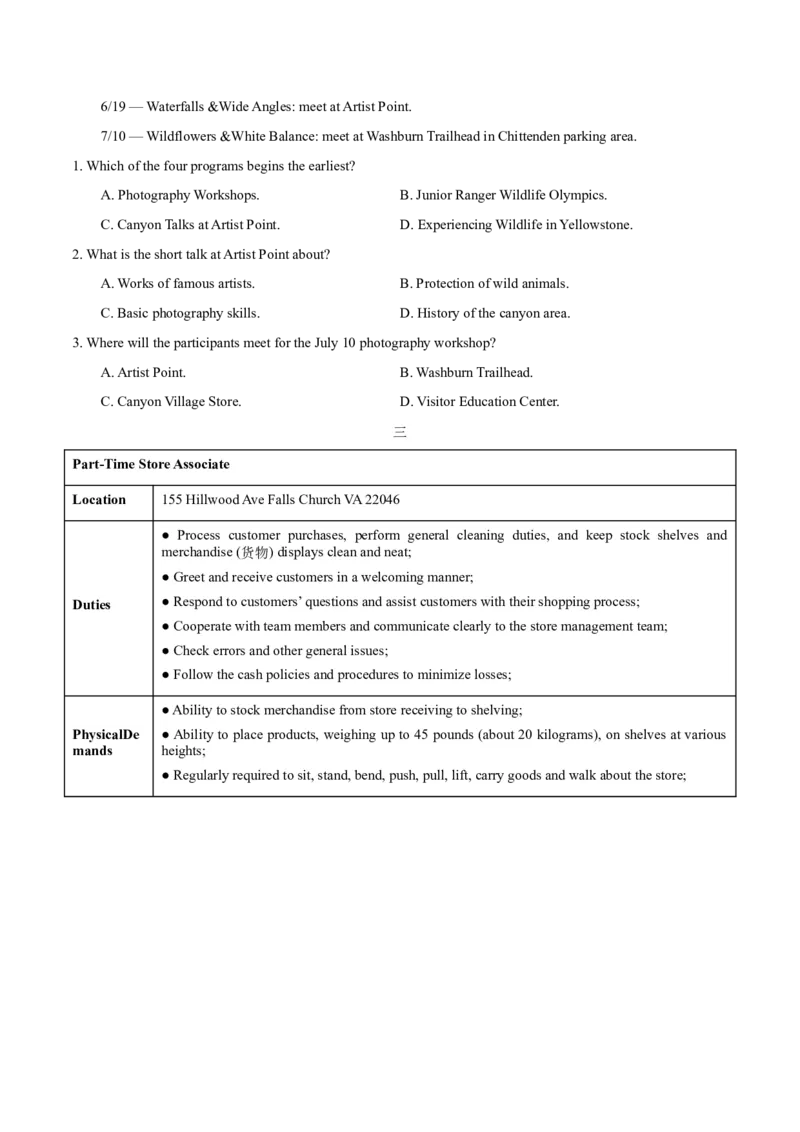
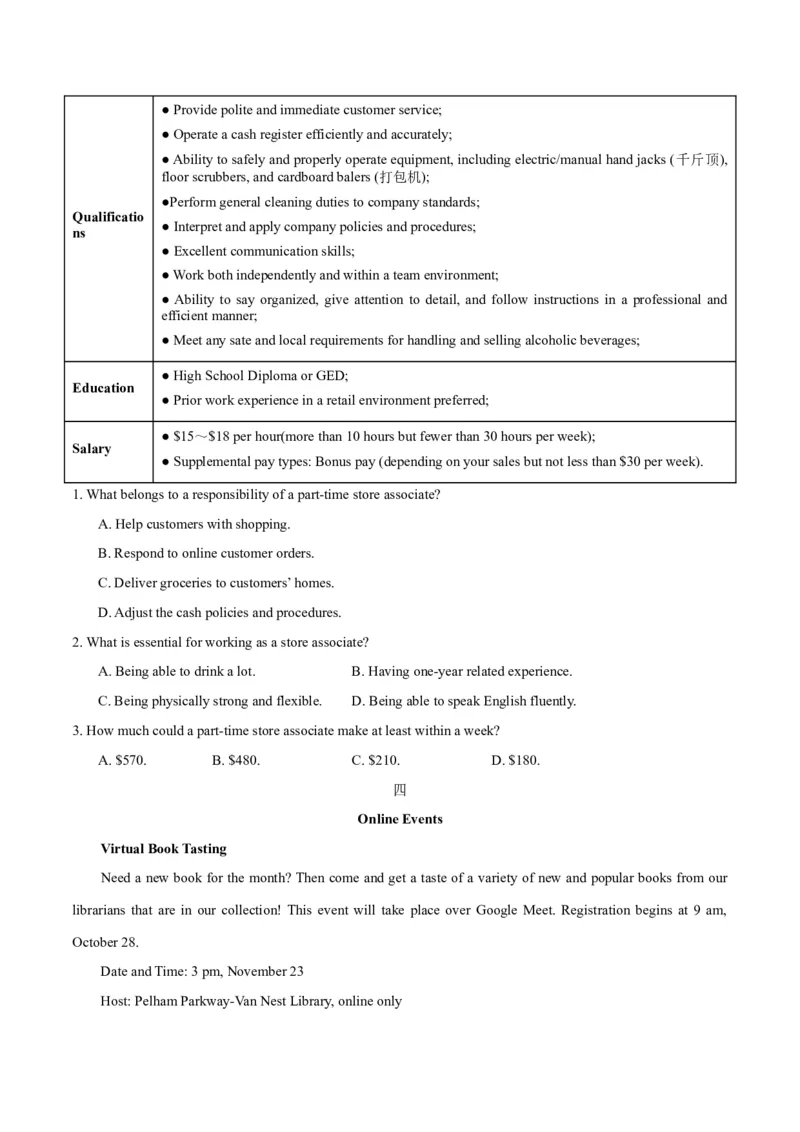
Part-Time Store Associate
Location 155 Hillwood Ave Falls Church VA 22046
● Process customer purchases, perform general cleaning duties, and keep stock shelves and
merchandise (货物) displays clean and neat;
● Greet and receive customers in a welcoming manner;
Duties ● Respond to customers’ questions and assist customers with their shopping process;
● Cooperate with team members and communicate clearly to the store management team;
● Check errors and other general issues;
● Follow the cash policies and procedures to minimize losses;
● Ability to stock merchandise from store receiving to shelving;
PhysicalDe ● Ability to place products, weighing up to 45 pounds (about 20 kilograms), on shelves at various
mands heights;
● Regularly required to sit, stand, bend, push, pull, lift, carry goods and walk about the store;● Provide polite and immediate customer service;
● Operate a cash register efficiently and accurately;
● Ability to safely and properly operate equipment, including electric/manual hand jacks (千斤顶),
floor scrubbers, and cardboard balers (打包机);
●Perform general cleaning duties to company standards;
Qualificatio
● Interpret and apply company policies and procedures;
ns
● Excellent communication skills;
● Work both independently and within a team environment;
● Ability to say organized, give attention to detail, and follow instructions in a professional and
efficient manner;
● Meet any sate and local requirements for handling and selling alcoholic beverages;
● High School Diploma or GED;
Education
● Prior work experience in a retail environment preferred;
● $15~$18 per hour(more than 10 hours but fewer than 30 hours per week);
Salary
● Supplemental pay types: Bonus pay (depending on your sales but not less than $30 per week).
1. What belongs to a responsibility of a part-time store associate?
A. Help customers with shopping.
B. Respond to online customer orders.
C. Deliver groceries to customers’ homes.
D. Adjust the cash policies and procedures.
2. What is essential for working as a store associate?
A. Being able to drink a lot. B. Having one-year related experience.
C. Being physically strong and flexible. D. Being able to speak English fluently.
3. How much could a part-time store associate make at least within a week?
A. $570. B. $480. C. $210. D. $180.
四
Online Events
Virtual Book Tasting
Need a new book for the month? Then come and get a taste of a variety of new and popular books from our
librarians that are in our collection! This event will take place over Google Meet. Registration begins at 9 am,
October 28.
Date and Time: 3 pm, November 23
Host: Pelham Parkway-Van Nest Library, online onlyAudience: teachers, teens/young adults
Lunchtime Virtual Handwriting Den
When was the last time you sent a thank-you note to a beloved one? Come and put pen to paper. Write, chat,
and share (not required but encouraged) in a safe, welcoming, and friendly environment.
Date and Time: 1 pm, November 30
Host: Muhlenberg Community Library, online only
Audience: adults
Family Storytime
Join the staff at Fort Washington Library for a live, online program with songs, rhymes,and favorite read-aloud
books. Both the parent/caregiver and the child must be present during the entire program.
Date and Time: 10: 30 am, December 7
Host: Fort Washington Library, online only
Audience: children, infants (0-18 months old), toddlers (18-36 months old), preschoolers (3-5 years old)
Teen Book Discussion: Sports Books
Come and hear about books about your favorite sports and tell us about yours. This event will take place over
Google Meet. You must register with your email address to receive the link, approximately one day before the
program, to participate.
Date and Time: 3: 30 pm, December 8
Host: Pelham Public Library, online only
Audience: teens/young adults
*Please note: For all events, registration is required online.
1. Who can attend Lunchtime Virtual Handwriting Den?
A. Children. B. Toddlers. C. Adults. D. Teens.
2. Which library offers an event about sports books?
A. Pelham Public Library. B. Muhlenberg Community Library.
C. Fort Washington Library. D. Pelham Parkway-Van Nest Library.
3. What do the four events have in common?
A. They encourage personal experience. B. They take place in the afternoon.
C. They are about telling stories. D. They need online registration.
记叙文一
(2024·丰台区一模)
B
Two-Man Ironman
On Sept.17, 2022, Jeff and his son, Johnny, set out to begin the first of three legs of the Ironman
competition,where competitors must complete a 140 miles of swimming, bicycling and running in under 17 hours.
Not that long ago, Johnny could barely walk a few steps because he was born with cerebral palsy (脑瘫). But his
dream of being a runner never stopped.
From the day Johnny was born, Jeff refused to let his son’s disability hold him back. Determined to show
Johnny that he could pursue his dream of being an athlete, Jeff helped him engage in running. They began waking
up at 4 a.m. so Jeff could run while pushing his son in a special wheelchair called a racing chair. Every morning,
they drove themselves to run increasingly longer distances. Soon, they were entering 5K races, then on to Ironman
competition. Jeff would act as Johnny’s arms and legs, carrying the weight of his son throughout the race.
The race began with a 2.4-mile swim. Settling Johnny into a kayak, Jeff eased himself into the water.
Swimming while dragging another person was very tough. But worst of all, Jeff had to struggle with jellyfish. “I
occupied my mind by counting the number of times I got stung (蛰),” he says.
After the two men completed the tough bike section in roughly nine hours, they set their sights on the final leg
of the race — a 26.2-mile marathon. They’d been competing for 10.5 hours, leaving another 6.5 hours to make their
time.But at Mile 19, Johnny saw the clock ticking down and worried they wouldn’t make the cutoff. Despite the
tiredness, Jeff was convinced they were going all right and then picked up the pace.
With minutes left and 200 feet to the finish line, Jeff stopped to help Johnny out of his racing chair and handed
him his rolling walker. After years of painstaking work, Johnny was determined to finish his races on his own. After
16 hours, 55 minutes and 35seconds,the father and son crossed the finish line together.
As the crowd cheered on an overwhelmed Johnny, a weary Jeff kept a low profle. “My father didn’t want his
finish line moment,” says Johnny, tears in eyes. “He wanted it to be mine.”
1. Why did Jeff lead Johnny to running?
A. To get closer to Johnny. B. To fulfill Johnny’s dream.
C. To discover Johnny’s interest. D. To speed up Johnny’s recovery.
2. What challenged Jeff most in the swimming race?
A. Lack of energy. B. Pain from injuries.C. Mental tiredness. D. Body weight change.
3. Which of the following can best describe Johnny according to the passage?
A. Strong-willed and grateful. B. Warm-hearted and sensitive.
C. Patient and generous. D. Tough and humorous.
4. What does the passage mainly tell us?
A. Actions speak louder than words. B. Fathers are not born; they are made.
C. The value of a loving father has no price. D. Success comes from failures along the journey.
二
(2024·门头沟一模)
B
“Your mother needs a new heart,” my father told me when I called on that December afternoon. An
unrelenting optimist, he spoke as if she merely needed to have a part replaced. But, although my two sisters and I
knew that our mother had heart problems, this news still made us frozen for a while with our eyes widening in
disbelief.
Dr. Marc Semigran of the transplant team reviewed my mother’s medical history. She’d had an irregular and
rapid heartbeat for most of her life. Her present treatment — the use of a series of cardioversions, or electric jolts,
to restore a normal heartbeat — would not work in the long-term. She had an enlarged and weakened heart, as well
as a faulty valve.
“With medication,” Dr. Semigran said, “you have a 60 percent chance of living six months. You could have a
longer life with a transplant, but there are risks. You’re at the top end of the age group of sixty years old. The lungs
and other organs must be healthy and strong. While the transplant surgery is actually a straightforward procedure,
acceptance by the body is the difficult thing.”
My family came together, trying to provide strength and work out what to do. We’d already gone from shock,
over our mother’s condition, to worry that she wouldn’t be a suitable recipient. Despite of the risk, we chose to
believe that she would make it eventually.
Word came later in December that she had been accepted into the programme. Dr. Jeremy Ruskin told us one
of the reasons she had been accepted was that she had such strong family support.
One Monday in May, at about 8 p. m., my mother received a phone call from the hospital that a heart was
available. As she was about to be wheeled off, my father took her face in his hands and looked into her eyes. His
look said everything about their 42-year relationship.The heart transplant operation was successful and the conditions could not have been better.
The irony of the transplant process is that one family’s loss is another’s gain; that tragedy begets fortune. It is a
kind of life after death, our hearts beating beyond us. We developed a feeling of love for this new part, of gratitude
for the doctors, for the process, and for those people who made a decision just for humanity.
1. How did the sisters feel to the news that their mother needed a new heart?
A. Frightened. B. Astonished. C. Worried. D. Annoyed.
2. Which is the factor to affect the possibility of their mother’s heart transplant?
A. Her abnormal heart beat.
B. The age of over sixty years old.
C. Her willingness to the transplant.
D. The adaptation of the new heart in the body.
3. What made the transplant team decide to have the operation?
A. That her lungs were healthy.
B. That a new heart had been found.
C. That her family were expecting the operation.
D. That her family trusted the doctors' medical level.
4. What can we learn from the passage?
A. Family support is of great importance.
B. Fortune favors those who are optimistic.
C. Confidence helps patients overcome difficulties.
D. Getting prepared before accepting a treatment matters.
三
(2024·西城区一模)
B
As this year draws to a close, I still remember the fear I felt on a bright Saturday morning in late September, at
a five-kilometer race in Clarkston, Georgia, as I waited for my 11-year-old son at the finish line.
I knew he could run a 5k in about 30 minutes. When I didn't see him at the 35-minute mark, I began to wonder
what had gone wrong. Had he gotten lost? Was he hit by a car? About an hour earlier, when we drove into town, my
son noticed an insect on my car. It was bright green, no longer than a fingernail. And it was friendly. This little
green thing hopped onto my son's finger, where it stayed for a long, long time. It stayed so long that we eventually
gave it a name: Little Friend.A few minutes before the race, Little Friend jumped off my son’s hand and landed on the sidewalk. But
pedestrian traffic was heavy and unpredictable. Little Friend was in danger. So my son knelt and reached out his
hand. Little Friend came back.
The race was about to start, and the tiny green insect was in for a wild ride. My son would run fast, and the
race would be long, and his arms would swing, and Little Friend would eventually be shaken off.
“You will lose Little Friend,” I told him.
My son nodded, treating the moment with appropriate seriousness.
The race began, and I lost sight of him.
The excitement at the finish line gave way to anxiety when my son did not show up.
I kept asking people if they'd seen him. No one had. And beyond the 40-minute mark, I was in a panic.
But there he was, thank goodness, just ahead of the 45-minute mark.
And there was Little Friend, riding on the upper crook of his right thumb like a very small captain on a very
tall ship.
My predictions had been wrong. My son had not run fast, and he had not lost Little Friend. And these two facts
seemed somehow related. He blamed a cold he was getting over. I suspected it was more than that, but I didn’t
question him too much about it.
We walked back to the car, smiling, and found some bushes in the parking lot that seemed like a good place
for my son to drop off Little Friend.
“Be free,” my son said, and gently put it in the bushes.
My son knew the truth. Sometimes life gives you something beautiful, a fragile, short-lived treasure in your
hand. There is no need to rush ahead. Treat it gently. Enjoy each moment. Hold on while you can.
One day my son will leave too, running off on his own adventure.
1. How did the writer probably feel when he finally saw his son appear in sight?
A. Relieved. B. Depressed. C. Satisfied. D. Disappointed.
2. The son failed to run as fast as his father had expected probably because ________.
A. he was lost B. he was recovering from a cold
C. he was afraid to lose the tiny insect D. he was slowed down by the heavy traffic
3. As for the way his son treated Little Friend, the writer is ________.
A. indifferent B. anxious C. appreciative D. doubtful
4. What will the writer most probably do after the race?
A. Treasure every moment he has with his son.B. Encourage his son to take more adventures.
C. Tell his son to take races seriously.
D. Get more insects for his son.
四
Soaring to 29, 035 feet, the famous Mount Everest had long been considered unclimbable due to the freezing
weather, the obvious potential fall from cliffs and the effects of the extreme high altitude, often called “mountain
sickness.” But that was to be changed by Edmund Hillary.
When he was invited to join the British Everest expedition in 1953, Edmund Hillary was a highly capable
climber. The glacier-covered peaks in his hometown in New Zealand proved a perfect training ground for the
Himalaya. It was his fourth Himalayan expedition in just over two years and he was at the peak of fitness.
On May 28, 1953, Edmund Hillary and Tenzing Norgay, an experienced Sherpa (夏尔巴人) set out and
reached the South Summit by 9 a. m. next day. But after that, the ridge (山脊) slightly fell before rising suddenly in
a rocky spur (尖坡) about 17 meters high just before the true summit. The formation is difficult to climb due to its
extreme pitch because a mistake would be deadly. Scratching at the snow with his ax, Hillary managed to overcome
this enormous obstacle, later to be known as the Hillary Step.
At 11:30 a. m, the two men found themselves standing at the top of the world. “Not until we were about 50
feet of the top was I ever completely convinced that we were actually going to reach the summit.” Hillary later
recounted, “Of course I was very, very pleased to be on the summit, but my first thought was a little bit of surprise.
After all, this is the ambition of all mountaineers.”
Emerging as the first to summit Mount Everest, Hillary Hillary continued by helping explore Antarctica, and
establishing the Himalayan Trust (信托基金), through which he provided a number of beneficial services to the
Himalayan peoples. He also a sizeable legacy that mountain climbers have chased ever since. As a young climber
said, “It was not just Hillary and Tenzing that reached the summit of Mount Everest. It was all of humanity.
Suddenly, all of us could go.”
1. What made Edmund Hillary a capable climber on the 1953 expedition?
A. His undisputed reputation. B. His remarkable physical condition.
C. His previous training on Mount Everest. D. His exceptional ability to adapt to the cold.
2. What does the Hillary Step refer to?
A. A mistake Hillary avoided making. B. A steep spur of rock Hillary conquered.
C. An ax Hillary used to scratch snow. D. A sudden fall of a ridge Hillary skipped.3. What was Hillary’s initial feeling upon reaching the summit of Mount Everest?
A. Overwhelming joy. B. Enormous pride.
C. Complete disbelief. D. A touch of astonishment.
4. What was the impact of Hillary’s achievement on mountaineering?
A. It opens up possibilities for other climbers.
B. It enabled him to give back to his hometown.
C. It left financial benefits for climbers to pursue.
D. It led to friendly regulations for mountaineering.
五
If you ask 100 people what subjects they wish they had been taught in school, there is a chance that the vast
majority of them will complain about the lack of personal finance education. In my case, I did learn a bit about
financing while in school — just not in the classroom. One of my earliest lessons on the basics of budgeting came
from an unlikely source: the cafeteria.
My lunch budget was a set amount each week. Without a plan, it would be all too easy to blow through the
budget long before meeting all expenses. Therefore, my very first budgeting lesson was to make a budget well. A
bit of simple arithmetic (算术) helped me determine exactly how much money I could spend each day if I wanted
to actually have lunch all week.
Besides, my school had relatively diverse lunch offerings. You could not only get the common hot school
lunch but also find many other foods of varying attractions. As far as I was concerned, what attracted me most was
the ice cream. Unfortunately, I couldn’t blow my daily lunch budget on ice cream. And I’d already figured out that
splurging early in the week made for a rough time for the rest of the week. Hence, I learned my second important
budgeting lesson: save for a goal. Because of this lesson, when Friday rolled around, I would have just enough left
over for a wonderful lunch and the highly desirable ice cream.
Nowadays, my budget is a bit more complicated than the lunch budget in the past. Although I no longer have
to save my pennies for a frozen treat, budgeting my money today uses the exact same skills I learned all those years
ago. Actually, whether you’re budgeting for school lunches or credit card bills, the basics remain the same. And it’s
never too early — or too late — to learn how to make a proper budget.
1. What can we learn about the author while she was in school?
A. She showed no interest in financial affairs.
B. She often complained about her school subjects.C. She learned about financing from her own experience.
D. She eagerly expected to get personal finance education.
2. What did the author probably realize after eating at the cafeteria?
A. She should plan her lunch budget carefully.
B. Her health mattered more than anything else.
C. Her budget for lunch was far from reasonable.
D. She should improve her arithmetic as much as possible.
3. What does the underlined word “splurging” in paragraph 3 mean?
A. Trying to save money. B. Making a plan for money.
C. Spending much money freely. D. Being concerned about money.
4. What is the author’s purpose in writing the text?
A. To introduce some lessons about making a budget.
B. To encourage people to learn some budgeting skills.
C. To stress the significance of saving money in our life.
D. To remind people to pay attention to their lunch budget.
六
In recent fast paced life, the demands and pressures of work left me feeling mentally and physically stressed. I
decided to disconnect from my job for a while for a mental break. As a nature lover, without any delay, I came to
Borneo, the world’s third largest island.
Upon arrival, a local offered to be my guide, which was a great bonus for me. He led me through the jungle
and I was immersed in the exploration. One day, the guide turned off the smooth road and took me across a rough
hillside instead. We picked our way gingerly when suddenly, a Rafflesia (大王花) appeared into my view among
those stones. More than delighted, I bent down and put my nose practically to feel the flower’s special flavour.
As I was approaching the end of my trip, there was another thing highlighting my trip. We happened to
encounter the king of the crocodile (鳄鱼), a saltwater crocodile, which can grow to a length of 6 meters. It was
getting dark. When we shone a flashlight towards the muddy shore, little sounds emerged in the darkness as if
something unseen underwater had broken the mud. Taking a second look, we spotted two greedy eyes just above
the water line. Cautiously, we approached it and finally could figure out it was a baby crocodile. Though alarmed, I
could proudly talk big that I had encountered a hungry crocodile in the wild and lived to back.
Though I have settled back into the routine of everyday life now, the experience stays long after the physical
journey ended. I have learned to face life’s challenges with a renewed outlook. Despite the rat race of dailyexistence, try to spare time to spot the breathtaking beauty of nature and the heartfelt connections with others. The
world out there is so fascinating.
1. Why did the author go to Borneo?
A. To connect better with his work.
B. To relieve himself of the pressures.
C. To keep an appointment with a local guide.
D. To reward himself for his promotion in job.
2. What does the underlined word “gingerly” in paragraph 2 mean?
A. Patiently. B. Roughly. C. Cautiously. D. Rapidly.
3. What is the tone of the author when recalling the saltwater crocodile he met?
A. Critical. B. Instructive. C. Regretful. D. Humorous.
4. What does the author advise us to do in the last paragraph?
A. Keep a balance between life and work.
B. Battle with challenges from life and work.
C. Research your destinations ahead of time.
D. Learn more about travel safety knowledge.