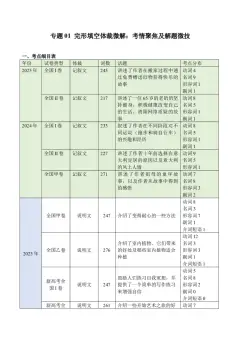
专题一 阅读理解
类型二 体裁破解
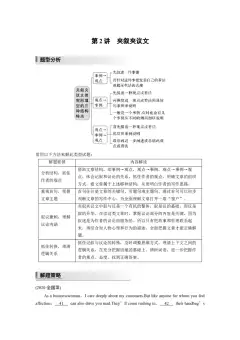
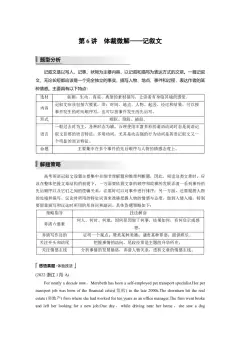
第2 讲 记叙文(夹叙夹议文)
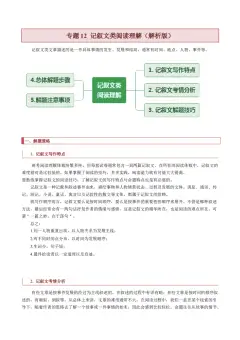
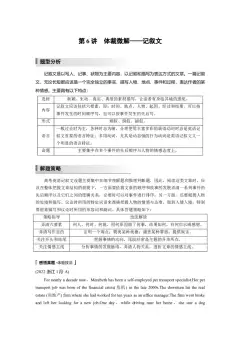
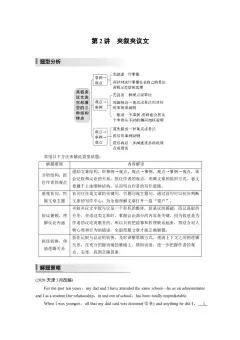
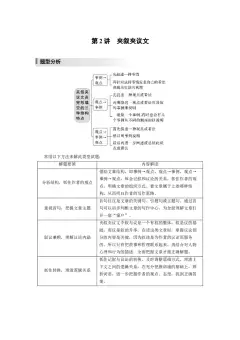
记叙文是一种以写人记事、写景状物为主要内容,以叙述和描写为表达方
式的文章。记叙文是一个相对独立、完整的语篇,包括记叙文的各个要素,即
时间、地点、人物和事情的起因、经过、结果等,采取顺叙、倒叙、插叙等手
法,以一般过去时为主,其他时态为辅,合理使用丰富多彩的谓语动词时态是
记叙文的语言特征;夹叙夹议文是叙述和议论相结合的文章,一般在文章结尾
处出现作者的所感所想。
【辨明题类】
记叙文阅读理解的设题主要是细节理解题和推理判断题,因此,阅读这类文章
时,应该在整体把握文章结构的前提下,要依据文章的顺序和故事的发展以及
逻辑关系,弄清文章的发展脉络,还要根据人物处境的描写、议论时所用词语
来准确把握人物的情感与态度,特别要留意描写和议论时所用的形容词和副
词。
【技法点拨】
1.弄清六要素:何人、何时、何地,因何原因做了何事,结果如何,有何启示
或感想。
2.弄清写作目的:证明一个观点、赞美某种美德、谴责某种罪恶还是提供娱
乐。
3.关注开头和结尾:把握事情的发展动向,尾段经常是主题的升华所在。
4.关注情感主线:分析事情的发展脉络,弄清人物之间的关系,透析文章的情
感主线。
【真题体验】
(2025·北京卷·阅读理解B)
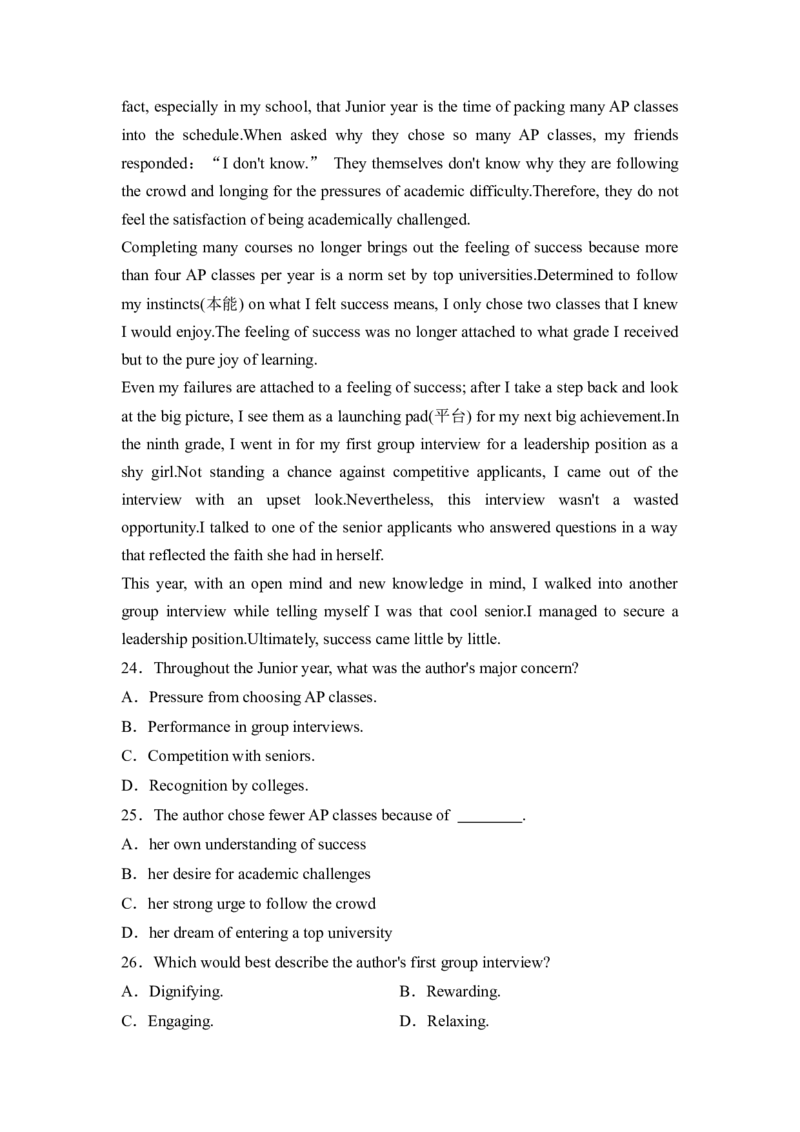
Throughout our Junior year, my classmates and I have been worried about what
colleges will see when they look at our whole life story reduced to a single 200-word
essay.Will the golden word “success” form in their minds when they review our
achievements?Or will they see the big word “fail” in red?The shadow of this
mysterious(神秘的) institution steals away what success means to us.
My first step of redefining success began with course registrations.It is a well-known
fact, especially in my school, that Junior year is the time of packing many AP classes
into the schedule.When asked why they chose so many AP classes, my friends
responded:“I don't know.” They themselves don't know why they are following
the crowd and longing for the pressures of academic difficulty.Therefore, they do not
feel the satisfaction of being academically challenged.
Completing many courses no longer brings out the feeling of success because more
than four AP classes per year is a norm set by top universities.Determined to follow
my instincts(本能) on what I felt success means, I only chose two classes that I knew
I would enjoy.The feeling of success was no longer attached to what grade I received
but to the pure joy of learning.
Even my failures are attached to a feeling of success; after I take a step back and look
at the big picture, I see them as a launching pad(平台) for my next big achievement.In
the ninth grade, I went in for my first group interview for a leadership position as a
shy girl.Not standing a chance against competitive applicants, I came out of the
interview with an upset look.Nevertheless, this interview wasn't a wasted
opportunity.I talked to one of the senior applicants who answered questions in a way
that reflected the faith she had in herself.
This year, with an open mind and new knowledge in mind, I walked into another
group interview while telling myself I was that cool senior.I managed to secure a
leadership position.Ultimately, success came little by little.
24.Throughout the Junior year, what was the author's major concern?
A.Pressure from choosing AP classes.
B.Performance in group interviews.
C.Competition with seniors.
D.Recognition by colleges.
25.The author chose fewer AP classes because of         .
A.her own understanding of success
B.her desire for academic challenges
C.her strong urge to follow the crowd
D.her dream of entering a top university
26.Which would best describe the author's first group interview?
A.Dignifying.
B.Rewarding.
C.Engaging.
D.Relaxing.
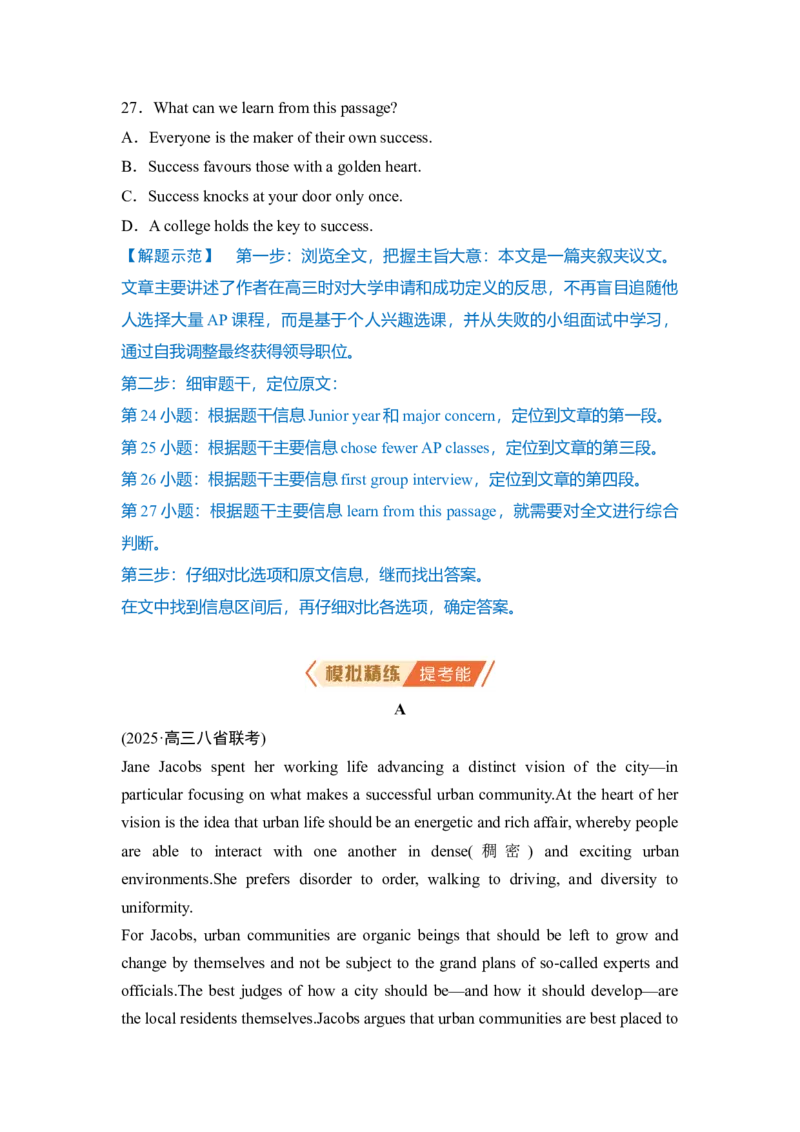
27.What can we learn from this passage?
A.Everyone is the maker of their own success.
B.Success favours those with a golden heart.
C.Success knocks at your door only once.
D.A college holds the key to success.
【解题示范】 第一步:浏览全文,把握主旨大意:本文是一篇夹叙夹议文。
文章主要讲述了作者在高三时对大学申请和成功定义的反思,不再盲目追随他
人选择大量AP 课程,而是基于个人兴趣选课,并从失败的小组面试中学习,
通过自我调整最终获得领导职位。
第二步:细审题干,定位原文:
第24 小题:根据题干信息Junior year 和major concern,定位到文章的第一段。
第25 小题:根据题干主要信息chose fewer AP classes,定位到文章的第三段。
第26 小题:根据题干主要信息first group interview,定位到文章的第四段。
第27 小题:根据题干主要信息learn from this passage,就需要对全文进行综合
判断。
第三步:仔细对比选项和原文信息,继而找出答案。
在文中找到信息区间后,再仔细对比各选项,确定答案。
A
(2025·高三八省联考)
Jane Jacobs spent her working life advancing a distinct vision of the city—in
particular focusing on what makes a successful urban community.At the heart of her
vision is the idea that urban life should be an energetic and rich affair, whereby people
are able to interact with one another in dense( 稠密) and exciting urban
environments.She prefers disorder to order, walking to driving, and diversity to
uniformity.
For Jacobs, urban communities are organic beings that should be left to grow and
change by themselves and not be subject to the grand plans of so-called experts and
officials.The best judges of how a city should be—and how it should develop—are
the local residents themselves.Jacobs argues that urban communities are best placed to
understand how their city functions, because city life is created and sustained through
their various interactions.
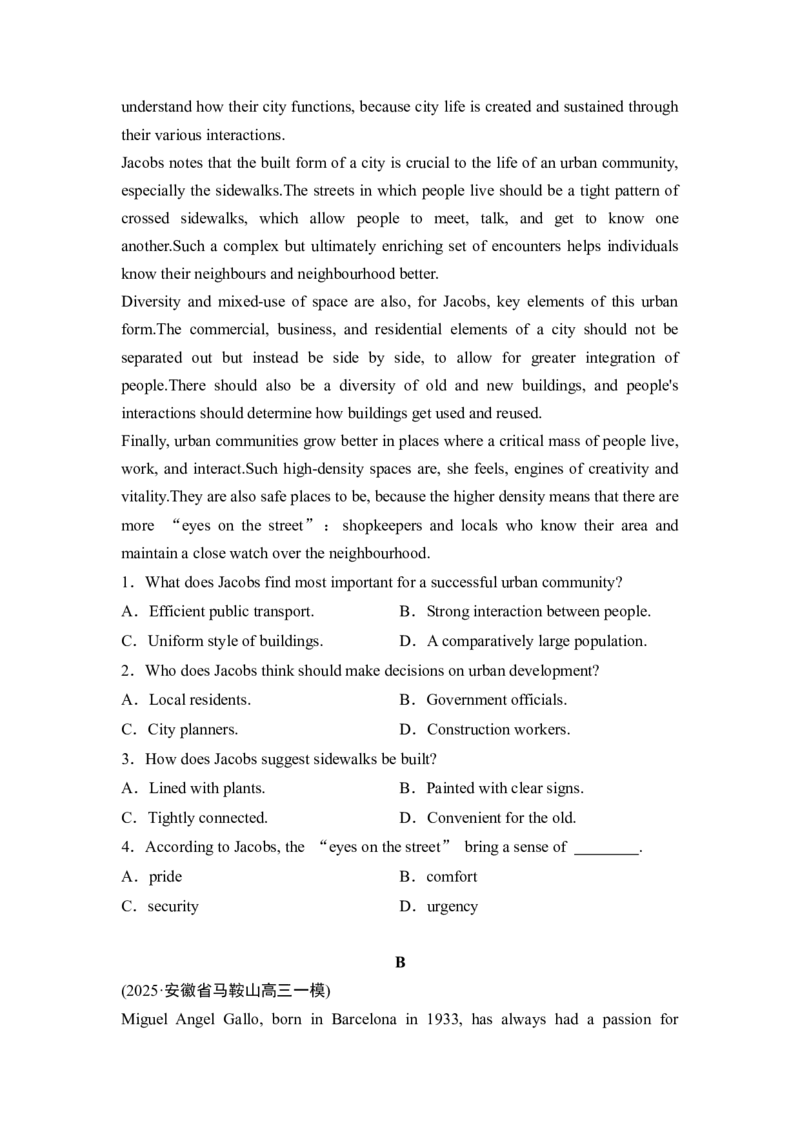
Jacobs notes that the built form of a city is crucial to the life of an urban community,
especially the sidewalks.The streets in which people live should be a tight pattern of
crossed sidewalks, which allow people to meet, talk, and get to know one
another.Such a complex but ultimately enriching set of encounters helps individuals
know their neighbours and neighbourhood better.
Diversity and mixed-use of space are also, for Jacobs, key elements of this urban
form.The commercial, business, and residential elements of a city should not be
separated out but instead be side by side, to allow for greater integration of
people.There should also be a diversity of old and new buildings, and people's
interactions should determine how buildings get used and reused.
Finally, urban communities grow better in places where a critical mass of people live,
work, and interact.Such high-density spaces are, she feels, engines of creativity and
vitality.They are also safe places to be, because the higher density means that there are
more “eyes on the street” :shopkeepers and locals who know their area and
maintain a close watch over the neighbourhood.
1.What does Jacobs find most important for a successful urban community?
A.Efficient public transport.
B.Strong interaction between people.
C.Uniform style of buildings.
D.A comparatively large population.
2.Who does Jacobs think should make decisions on urban development?
A.Local residents.
B.Government officials.
C.City planners.
D.Construction workers.
3.How does Jacobs suggest sidewalks be built?
A.Lined with plants.
B.Painted with clear signs.
C.Tightly connected.
D.Convenient for the old.
4.According to Jacobs, the “eyes on the street” bring a sense of         .
A.pride
B.comfort
C.security
D.urgency
B
(2025·安徽省马鞍山高三一模)
Miguel Angel Gallo, born in Barcelona in 1933, has always had a passion for
art.However, with limited financial resources and 13 children to feed and educate,
becoming an artist was not a practical option for him at the time.And about 10 years
ago, Gallo's wife was diagnosed(诊断) with Alzheimer's disease, and her condition
worsened to the point that she had to move into a care home.This challenging period
marked the beginning of Gallo's artistic journey, when he was already 83 years old.
Gallo initially studied mechanical engineering in Barcelona and later worked for a
company in Zaragoza.In 1966, he pursued management studies at IESE Business
School in Barcelona, and by 1968, he had become an associate professor there.
With his academic background, Gallo was determined to study at a respected
institution.However, when he applied to study art in Barcelona, he was encouraged to
pursue art history instead.He was firm, replying, “No, I want to paint.” The course
was initially set for four years, but due to the need to balance it with his family
commitments, it took Gallo seven years to complete it.He graduated at the age of 90.
Gallo admires Francisco de Zurbarán for his masterful use of white, and Joaquín
Sorolla for his skillful use of light.Reflecting on his artistic journey, he noted,
“Studying art has strengthened my belief that the truly great things in life are
goodness, truth, and beauty.I don't mind making money, but increasingly, those other
things matter most to me.”
Some of Gallo's works were featured in an exhibition in Graus, a small village in the
Pyrenees, where they were displayed for six months.Gallo humbly acknowledged,
“After completing my degree, would I call myself an artist ?I don't know, but at
least now I have a piece of paper that says I am.”
5.What can be learnt about Gallo from paragraphs 1 and 2?
A.He prioritized his family over his interest.
B.He became a professor in his 20s.
C.He had a natural talent for doing business.
D.He lived with poor health for long.
6.What happened to Gallo when he applied to study art in Barcelona?
A.He was required to study longer.
B.He was not advised to paint.
C.He was introduced to other institutes.
D.He was not allowed to get a degree.
7.How has studying art affected Gallo?
A.He has reflected on his health condition.
B.He has become much humbler.
C.He has reinterpreted the meaning of wealth.
D.He has developed true friendships.
8.What is the best title for the text?
A.Miguel Angel Gallo:An Art Genius.
B.Miguel Angel Gallo:A Late Start to Art.
C.An Art Exhibition of Miguel Ángel Gallo.
D.Artistic Principles Set by Miguel Ángel Gallo.
C
(2025·江西省重点中学盟校高三一模)
In college, I usually anticipated icebreaker games at the start of some classes.We
would introduce ourselves.It was fun to see the look of surprise on everyone's face
when I said I was a chemical engineering major in creative writing seminars where
most were English or comparative literature majors.A science major ?In this
building?Is he lost?
Their surprise would usually fade once the semester began and they learned that I
wasn't very good.But it didn't matter; I loved the writing classes.I didn't much care—
how and whether my classes would impact my career.I liked science and writing, so
maybe I'd combine them, or maybe not.
But I know my experience is not exactly typical for scientists.I'm sure some students
love science so intensely, or excel at it so much, that they have no interest in non-
science classes.And science students may find the workload so high that pursuing
outside academic interests is impractical.
But I have this fear that some science students avoid branching out, not because they
don't want to, but because they believe they're not supposed to.They see their peers
keeping their heads down, only focused on science, science, science, and they don't
want to be the freaks( 怪人) who admit loving their optional medieval history
seminar.I've seen this trait in the students I taught.
In college, although my department head let me take writing classes, other professors
didn't share the same open-mindedness.I sometimes doubted whether it was what I
was supposed to do.The science, we're told, either explicitly or implicitly, is the
important part.The other subjects are either requirements to bear or distractions to
give up halfway.A good grade in organic chemistry ?Amazing !You're going
places!A good grade in a poetry seminar?Well...
You can be a scientist and do other things, too—and the time when you're enrolled in
school is a perfect opportunity.In college, so many options for classes!You suddenly
transition from a life where it's presumed that you have known enough to live to one
with a diversity of choices.
So go ahead, add a class, add a hobby.Be well-rounded—yes, that well-rounded.
9.Why did the author, a science student, choose the writing seminar?
A.To play a scientific game.
B.To investigate the brain function.
C.To satisfy his personal pursuit.
D.To seek an opportunity to jump ship.
10.What characteristic does the author find in some of his students?
A.Focusing on doing better at medieval history.
B.Escaping expanding their fields out of peer pressure.
C.Developing outer potential academic interests.
D.Showing no passion for non-science classes naturally.
11.What can we infer from Paragraph 5?
A.Scientists are open-minded in academic study.
B.Every subject makes for your achievements.
C.All the subjects are not attached great importance to.
D.Self-doubt is the cause of poor grades.
12.What is the best title for the text?
A.To Become a Well-Rounded Scientist
B.To Foster a Hobby in College
C.To Author for Science
D.To Specialize in Science in College
D
(2025·湖北省武汉市高三二模)
These days, I have been gathering contributions for Class Notes from my classmates
at the Brearley School.Seven contributions have come in.They are long or short,
emotional or matter-of-fact, and now my job will be to cut and select, rephrase and
quote, and count words from each contributor—our entire collection will have to add
up to no more than six hundred and fifty words.
The tough part is trying to give more or less equal space to each of these life accounts,
since some of us tend to relate incidents in great detail while others are tight-lipped.If
nine of us altogether, including me, contribute notes, then each note is allowed a little
over seventy words.If another contribution comes in at the last minute, we all go
down to about sixty-five.Do I cut out the trip to Costa Rica, or the visit to the nephew
in New Jersey ?The recent grandchild, broken leg, or Scrabble( 拼字游戏)
competition?
Why did I decide I would not mind being a class-notes agent?I suppose I pursue any
piece of writing for two main reasons.First, I like the challenge of trying a new
form.In this case, my task is to rearrange the writings of a range of personalities to
create one fairly smooth whole.The second reason is always emotional.Here, one
source of my emotion was the years-long experience of the school itself.I was also
touched that my classmates suggested me for the job, their sensible reason
being:“You're a writer.”
As a 65-year-old lady, I feel tired sometimes, but I've never stopped valuing every
moment in this job.For me, my classmates are still full of youthful energy, passion, or
disgust or tearful hurt.I'm not sure I'm naturally gifted at turning all these colorful
details into a brief and entertaining account.That's how I do it—quote their own words
as often as I can.
13.What does the author need to do with the contributions?
A.Edit and adjust them.
B.Collect and grade them.
C.Ensure the variety of them.
D.Add personal comments to them.
14.How does the author explain the difficulty of the job?
A.By citing quotes.
B.By listing examples.
C.By making comparisons.
D.By giving definitions.
15.What can we infer about the author from paragraph 3?
A.She prioritizes new forms.
B.She prefers emotional writing.
C.She is hesitant about the role.
D.She is acknowledged by her classmates.
16.What does the author think of the job?
A.It's stressful.
B.It's worthwhile.
C.It's straightforward.
D.It's troublesome.
【限时训练】(限时:60 分钟)
记叙文类
A
(2025·四川省巴中市高三一模)
“Being overly logical and rational is the wrong way to make important life
decisions,” says Michael Puett in his class, after a student asks how to deal with
the issues at the crossroads of life.“Decisions are made from the heart.In Chinese,
‘mind’ and ‘heart’ are inseparable.We would make better decisions when we let
our rational and emotional sides blend(融合) into one.” Puett is one of the scholars
who teach students ancient Chinese philosophy at Harvard University.
Puett has seen more students who are feeling pushed onto a very specific path towards
very concrete career goals.Thus, he set up the course and helped the college students
struggling to find their place in the world figure out how to have a good life and
create a good society.His course has gone viral among the Harvard students.
One of Puett's former students, Adam Mitchell, attracted by Chinese philosophy, was
once at a loss.During that time, majors related to finance and economics were quite
popular.Few students would choose humanities.Adam had intended to major in
economics.But after his introduction to the professor's course, he chose to follow his
own heart and study Chinese, and knew what his life goal was.
Puett believes we should train ourselves to be “spontaneous(率性的)” in daily life,
much like practicing the piano to play effortlessly, instead of relying only on rational
decision-making.At the end of each class, Puett challenges his students to put the
Chinese philosophy into practice in their everyday lives.“I'm not trying to give my
students really big advice.Instead, I just want to give them a sense of what they can do
daily to transform how they live.”
1.What is Puett's suggestion for decision-making?
A.Follow rules and guidelines.
B.Integrate heart and mind.
C.Depend on reason and logic.
D.Rely on emotions and feelings.
2.Why does Puett teach students Chinese philosophy?
A.To spread Chinese culture.
B.To make students more rational.
C.To make his course popular.
D.To offer guidance for a better life.
3.Why does the author mention Adam Mitchell?
A.To show Puett's influence on students.
B.To recommend Puett's course to others.
C.To explain the struggles in philosophy.
D.To inspire major changes in students.
4.What does the last paragraph mainly talk about?
A.Students' learning process.
B.Practical daily tasks.
C.Puett's teaching approach.
D.After-class assignments.
B
(2025·河南省部分名校高三一模)
When you hit middle age, there are some universal truths you begin to notice and
accept, and that goes double when you're traveling with your parents.You really are
turning into your mother(or father)...and maybe that is not such a terrible thing.I
recently spent six days visiting my parents in their winter snowbird home just outside
of Tampa, Florida.Mom and Dad were delighted in the tour guide role here in this
middle ground, not our Indiana hometown and not British Columbia, where I've been
living with my kids for years.
It felt strange at first, me being a “kid” again at age 50.It was a rare window when
I wasn't caring for my own kids and my parents, who were still healthy and mobile
and didn't yet need my care.I could relax.I could play.Without any responsibilities or
distractions, I could savor(尽情享受) just being a daughter.
On this trip, I realized just how much I see myself in my parents.I was a little
surprised to realize this fact didn't make me roll my eyes and make an “I'm turning
into my mother” joke.Instead, I found myself smiling and embracing turning into my
mother and father, because that's exactly who I've always been.
Traveling with my aging parents, I not only realized how lucky I am, but also knew
this could be our last trip together, just the three of us.I couldn't help but reflect on
how delicate life is and how precious these moments of being together are.My parents
are still together, in good health, and have mobility.I can't think of anyone at my age
who is in the same situation with their parents.
On the drive to the airport, Dad launched into his usual sort of closing paragraph that
he does at the end of every visit.He mentioned the highlights of the week and asked
about everyone else's favorite memories from our time together.Then he shifted to
what we wanted to do the next time.I smiled, realizing I do this closing paragraph too,
when I'm saying goodbye to my girls.
5.What does the underlined word “that” in paragraph l refer to?
A.Traveling with parents at middle age.
B.Getting a deeper understanding of life.
C.Turning into a copy of one's parents.
D.Finding more time to accompany parents.
6.Why did the author describe the trip as a rare window?
A.Because there was little time left for her aging parents.
B.Because it was a period to free herself of worries.
C.Because it was a good chance to reflect on herself.
D.Because it offered a valuable memory.
7.What conclusion does the author try to draw while traveling with her parents?
A.We are always kids in our parents' eyes.
B.Parents' present situation mirrors our future.
C.Be grateful and treasure the time with parents.
D.A closing speech to a child is a must for every parent.
8.What is the author's purpose in writing the text?
A.To share her reflection.
B.To introduce a trip.
C.To remember her parents.
D.To urge care for parents.
C
(2025·辽宁省重点中学协作校高三二模)
Emma Carter, a 28-year-old fashion designer, first started exploring ways to reduce
her expenses when she realized her monthly spending was higher than her income.She
searched online for budgeting tips and money-saving strategies and soon discovered
the world of cashback websites and loyalty programs, which she now uses regularly to
save money on her everyday purchases.
“I used to think that saving money meant giving up the things I enjoy,” Emma
says.“But now I realize that with a little effort, I can still enjoy my favorite products
and services while spending less.It's all about being smart with your money.”
Emma's journey began in 2018 when she moved to a new city for work.Facing higher
living costs, she decided to take control of her finances.She started by tracking her
expenses and identifying areas where she could cut back.One of Emma's favorite
money-saving tricks is using cashback apps.After each purchase, she uploads a photo
of her receipt to the app, which then checks it and offers cashback on items that
qualify.“It's like getting paid to shop ,” she says.“I've earned hundreds of
pounds just by doing something I would do anyway.”
In addition to cashback apps, Emma also takes advantage of loyalty programs offered
by her favorite stores.By collecting points every time she shops, she can exchange
them for discounts or free products.“It's a win-win situation,” she explains.“I
get to save money while still buying the things I love.”
“You don't have to make huge changes to see a difference ,” she says.“Even
small savings can add up over time.The key is to stay the course and make saving a
part of your daily routine.”
9.Why did Emma start to save money?
A.She could not make ends meet.
B.She was attracted by budgeting tips.
C.She suffered a decrease in her income.
D.She desired to change her financial habits.
10.What does Emma mean by saying “It's like getting paid to shop” in paragraph
3?
A.She receives discounts on future purchases.
B.She earns money from the stores she shops at.
C.She gets free products from her favorite stores.
D.She earns cashback on her purchases through apps.
11.Which words can best describe Emma?
A.Carefree and creative.
B.Generous and friendly.
C.Ambitious and adventurous.
D.Determined and resourceful.
12.What is Emma's advice on saving money?
A.Seek tips widely online.
B.Make full use of free apps.
C.Be consistent with small savings.
D.Maintain the old lifestyle completely.
【限时训练】(限时:60 分钟)
夹叙夹议文类
A
(2025·河南省五市联考高三一模)
“Where can I find your disability section?” This was the question that baffled
Waterstones staff when asked by Dr Hannah Barham Brown.It should have been a
pretty straightforward answer.Hannah was looking for the part of the shop where non-
fiction books about disability and by disabled authors were kept, but the question
drew a blank.
This is because most bookshops don't have a specific place for non-fiction disabled
books.Where there are sections for non-fiction books on important sections of identity
such as race, gender and social studies, disability has been forgotten about again.
Hannah took to social media to share her disappointment and it resonated(共鸣)with
much of the disabled community.After being asked by one Waterstones staff member
if she could fill a shelf, she sourced a long list that could take up a whole
bookcase.And there is a huge number of them to choose from.There are also some
incredible new and upcoming books by disabled voices.And hopefully, in the coming
years, my own memoir book will also sit alongside them.
From my own experience, the book-writing world is a hard space to access as a
disabled woman.We're constantly told there isn't a market for our books or cheated off
by agents and publishers who say they already have something similar—when often
the only similarity is that we're disabled women.Not having our own section feeds
these problems.The response I've had to this campaign shows that the demand for
these books is there.
Growing up I would get swept up in stories of regular girls having adventures—but as
someone treated with multiple conditions from the age of nine onwards, I very rarely
saw myself in the pages I was pouring over.Growing up I never saw myself in books
and it was one of the reasons I struggled to accept my disabilities.Hopefully disabled
kids will grow up learning they're fine just as they are.
1.What does the underlined word “baffled” in paragraph 1 probably mean?
A.Amused.
B.Moved.
C.Confused.
D.Angered.
2.What is the problem with books for the disabled in the bookstore?
A.Few of them are published.
B.No special areas are for them.
C.The latest ones are in short supply.
D.They are seen as non-fiction books.
3.What can be inferred about the author?
A.She is a writer.
B.She is a teacher.
C.She is a historian.
D.She is a librarian.
4.What is the author's purpose in writing the text?
A.To donate books to the disabled.
B.To promote books from the disabled.
C.To support education for the disabled.
D.To address reading needs for the disabled.
B
(2025·浙江省金华十校高三二模)
Jared was my regular hiking, ice-climbing and mountain-biking fellow.We were on an
overnight trip, just a single night, and what he'd brought for dinner was this :
Rice.Literally nothing else.
This was not a result of him trying to pack as light as possible, nor was it because he
was broke.He wasn't.I tried to convince him to at least put soy sauce(酱油) on it.But
no, Jared wasn't having a bar of it.“I don't need it,” he said flatly.
Now, if he was talking only about outdoors' meals, I'd almost get it.When you're
ravenous after a day of burning off calories walking or climbing or backcountry
skiing in the mountains, how awesome do things taste!I know what you're thinking;
it's simply that, as the saying goes, hunger is the best sauce.And I agree.Absolutely.
But there's more to it than that.Last month, I went down the coast car camping with
my family.One morning, my wife made a statement.“I don't see the point,” she
said.“It's so much work, camping.But the views at home are better.The beds are
more comfortable.It's more peaceful.And at home, the food is better.” I'll admit she's
right about the first three.But the food ?We had a simple pasta one night, snags
another, chicken curry the third, but they all tasted good.Better than at home.And it
wasn't simply that we were hungry; it was because we were camping.
The real point I want to get to is that meals largely taste so good when I'm camping
because I'm reminded of some things easily forgotten at home, where I can simply go
to the cupboard, or the supermarket, and get whatever takes my fancy.Life, when
you're camping, is reduced to its essentials, and I am reminded of how lucky most of
us are to be dry and warm and fed.More importantly, I am reminded that sadly, and in
fact unforgivably, not all of us are.And I am reminded that we, as a society, should do
better for them.
5.Why did Jared bring only rice for dinner on the trip?
A.He didn't like soy sauce.
B.He preferred to travel light.
C.He couldn't afford a better meal.
D.He enjoyed simple outdoor meals.
6.What does the underlined word “ravenous” in the third paragraph mean?
A.Tired.
B.Starving.
C.Fulfilled.
D.Refreshed.
7.What does the author think of camping?
A.It is a test of adaptability.
B.It is a chance to enjoy good food.
C.It is a reminder of the good life he has.
D.It is a bonding experience for his family.
8.What makes the author sad according to the last paragraph?
A.Some people lack the basic necessities of life.
B.Some people fail to appreciate what they have.
C.People easily forget the beauty of simple things.
D.People easily quit camping due to its discomfort.
C
(2025·安徽省黄山市高三二模)
I can't remember how many times I've been asked, “If you could have a superpower,
what would it be?” My answer would always be the same:I'd want the ability to
know what people are thinking.Absolutely, flying and invisibility had crossed my
mind.But every time, I'd always settle on perceiving people's thoughts.As a curious
person, I'm always wondering what is going through someone's head.And what if I
somehow had the superpower I'd always wanted, like Hal Stewart in Megamind, and
was able to hear people's inner voice?
In a friend group, I usually take a backseat in conversations, watching everyone else
interacting and occasionally contributing my opinion.Seeing how people
communicate with each other makes me wonder what is really going on in their
heads.Whether we admit it or not, we always keep some thoughts to ourselves.It's
human nature, after all.Yet our tendency to hide certain feelings and unintentionally
judge others keeps me on edge.It's what makes me want to know what people are
thinking.I'm constantly afraid of what people think of me.Do I look bad ?Did I do
something wrong?
These thoughts often consume me and make me overthink.I overthink people's
reactions, movements and even words.I overthink past conversations I had, wondering
what I could have said instead to make me sound less stupid or more genuine.
Ultimately, I've come to realize that it shouldn't really matter what other people
think.While knowing what people think of me may settle any doubts I have about
myself or a relationship, it's an overwhelmingly(压倒性地) exhausting ability to have.
Indeed, it's not worth wasting time, energy and emotions worrying about whether you
appear cool to someone.You only have so much control over that.Focus on what you
can control, but don't overthink.At the end of Megamind, Hal realizes all his
“superpowers” made him the villain( 坏蛋) .They consumed him; having the
powers wasn't worth it in the end.
So let go.Because in the end, does it really matter what other people think ?No
superpower is 100 percent worth it.
9.What special ability was the author eager to possess?
A.Flying in the air freely.
B.Being made invisible.
C.Controlling others' thoughts.
D.Reading people's minds.
10.How does the author describe himself in a social circle?
A.He dominates conversations.
B.He is a relatively reserved one.
C.He consistently shares his opinions.
D.He is more of a talker than a listener.
11.What is the author's final realization about the superpower?
A.It doesn't appear cool at all.
B.It can't settle any doubts about himself.
C.It can be time-consuming and stressful.
D.It makes him overthink positive things.
12.What can be the best title for the text?
A.Let Go of These Thoughts
B.The Pursuit of Superpower
C.Keep Your Thoughts to Yourself
D.The Burden of Superpower