完形填空——三层递进
目标导航
题文通读,宏观把握,架构了然于胸
做完形填空题,最大的禁忌就是急于求成、贸然行动,不置于语篇大环境下凭主观臆断,造成“只见
树木,不见森林”的片面性错误。正确的做法是:先通读全文和选项,对文意和题目有个大致了解,搞清
楚主旨大意及思考方向后,再进行第二遍精读和答题。如何读文,如何做题,怎样才能高效,本讲将给予
悉心宏观指导。
一、把握4大文体特征——读文求快
(一)常考文体——记叙文
完形填空的文章体裁以记叙文为主,常见的故事基本上可分为餐厅故事、师生关系、家庭生活和个人
奋斗等类型。从叙事方式来看,故事内容基本都遵循“起—承—转—合”的常见记叙文写作思路。从正负
态度来解释,则可分为两种模式:一种为“负—正”,即故事开始就是“坏事”,后来转变为“好事”;
另一种是“正—负—正”,即文章开始平静祥和,中间经历挫折、困难,最终迎来光明美好的结局。两种
模式的共同点在于,无论故事如何开篇,过程都会经历曲折,结尾必然收获美好、充满希望。
总之,完形填空的选材基本都是积极向上、引人向善的文章。了解这些有助于考生理解文章内容、把
握主人公情感走向,进而帮助解题。
(二)常考文体——夹叙夹议文
夹叙夹议类的文章通常是采用叙议结合的写作方法,文章先进行叙述,然后再在段落的结尾或文章的
末尾展开议论,说明故事所包含的哲理或总结出作者的观点。阅读此类文章时,考生要重点关注议论的部
分,从而总结出文章的主旨。
(三)时考文体——议论文
议论文是一种“剖析事物、论述事理、提出主张或发表见解”的说理性文章。议论文三要素是论点(作
者的观点,也就是被证明的对象)、论据(用来证明论点的依据,是说明论点的理由和材料)和论证(运用论据
证明论点的过程与方法)。高考议论型短文分为两种:一种是夹叙夹议型短文;另一种是纯议论型短文。第
一种的基本模式是:叙述事件—抒发感悟—作出结论。第二种的基本模式是:提出问题—分析问题—解决
问题。
(四)时考文体——说明文
说明文是以说明为主要表达方式,用来说明事物、阐明事理的一种文体。它通过揭示概念来说明事物
的特征、本质及其规律性,给人准确的科学知识或传递某种思想。其基本模式是:观点—说明—总结。
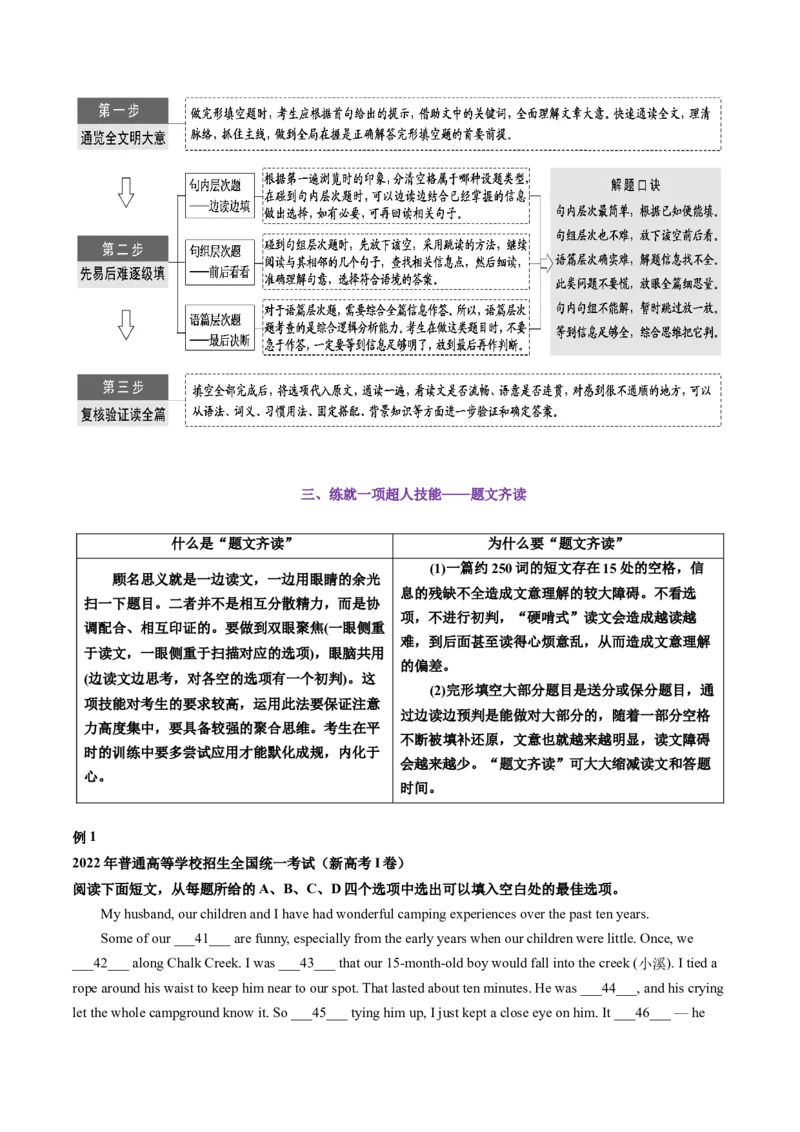
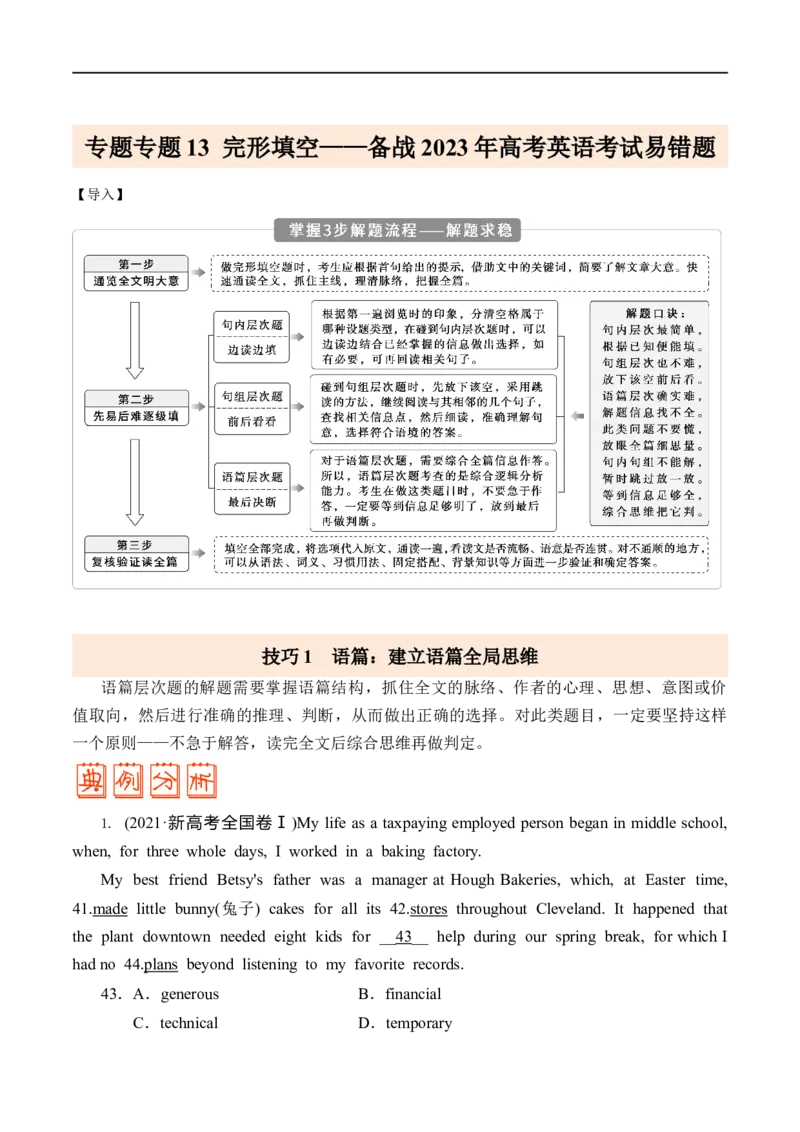
二、掌握3步解题流程——解题求稳三、练就一项超人技能——题文齐读
什么是“题文齐读” 为什么要“题文齐读”
(1)一篇约250词的短文存在15处的空格,信
顾名思义就是一边读文,一边用眼睛的余光
息的残缺不全造成文意理解的较大障碍。不看选
扫一下题目。二者并不是相互分散精力,而是协
项,不进行初判,“硬啃式”读文会造成越读越
调配合、相互印证的。要做到双眼聚焦(一眼侧重
难,到后面甚至读得心烦意乱,从而造成文意理解
于读文,一眼侧重于扫描对应的选项),眼脑共用
的偏差。
(边读文边思考,对各空的选项有一个初判)。这
(2)完形填空大部分题目是送分或保分题目,通
项技能对考生的要求较高,运用此法要保证注意
过边读边预判是能做对大部分的,随着一部分空格
力高度集中,要具备较强的聚合思维。考生在平
不断被填补还原,文意也就越来越明显,读文障碍
时的训练中要多尝试应用才能默化成规,内化于
会越来越少。“题文齐读”可大大缩减读文和答题
心。
时间。
例1
2022年普通高等学校招生全国统一考试(新高考I卷)
阅读下面短文,从每题所给的A、B、C、D四个选项中选出可以填入空白处的最佳选项。
My husband, our children and I have had wonderful camping experiences over the past ten years.
Some of our ___41___ are funny, especially from the early years when our children were little. Once, we
___42___ along Chalk Creek. I was ___43___ that our 15-month-old boy would fall into the creek (小溪). I tied a
rope around his waist to keep him near to our spot. That lasted about ten minutes. He was ___44___, and his crying
let the whole campground know it. So ___45___ tying him up, I just kept a close eye on him. It ___46___ — hedidn’t end up in the creek. My three-year-old, however, did.
Another time, we rented a boat in Vallecito Lake. The sky was clear when we ___47___, but storms move in
fast in the mountains, and this one quickly ___48___ our peaceful morning trip. The ___49___ picked up and
thunder rolled. My husband stopped fishing to _____50_____ the motor. Nothing. He tried again. No
_____51_____. We were stuck in the middle of the lake with a dead motor. As we all sat there _____52_____, a
fisherman pulled up, threw us a rope and towed (拖) us back. We were _____53_____.
Now, every year when my husband pulls our camper out of the garage, we are filled with a sense of
_____54_____, wondering what camping fun and _____55_____ we will experience next.
41. A. ideas B. jokes C. memories D. discoveries
42. A. camped B. drove C. walked D. cycled
43. A. annoyed B. surprised C. disappointed D. worried
44. A. unhurt B. unfortunate C. uncomfortable D. unafraid
45. A. due to B. instead of C. apart from D. as for
46. A. worked B. happened C. mattered D. changed
47. A. signed up B. calmed down C. checked out D. headed off
48. A. arranged B. interrupted C. completed D. recorded
49. A. wind B. noise C. temperature D. speed
50. A. find B. hide C. start D. fix
51. A. luck B. answer C. wonder D. signal
52. A. patiently B. tirelessly C. doubtfully D. helplessly
53. A. sorry B. brave C. safe D. right
54. A. relief B. duty C. pride D. excitement
55. A. failure B. adventure C. performance D. conflict
句群精读,活用方法,稳抓保分题目
通过第一步的通览文章,明白了文章大意、内容梗概后,接下来便是精读文章,做题的过程。完形填
空80%以上的题目都是基础题目,也就是上文提到的句内、句组层次题。对于这些题目,使用“题文齐读
法”在文章的通读环节可预判解答一部分,但这些题目最终答案的确定则需要精读文章,做到解题有理有
据、有法可依。
句内层次题的解题信息分布在本句内,在读懂文意的前提下,利用本句的一些解题信息就可直接做
答。对于此类题目,考生可以边读边填,将原文信息尽量复原。
方法1 利用习惯搭配及固定结构解题
完形填空中经常会考查一些习惯搭配、固定结构和固定句式,这时考生就需要运用习惯搭配及固定结
构来解题。
[典例] I was 43.thrilled! I arrived early at Byron Bay where we were supposed to 44.meet. The bay
was __45__ in sunshine, and there was a group of kayakers around 150m off the shore.45.A.bathed B.clean
C.deep D.formed
[分析] 选A 本题可以利用习惯搭配解题。此处意为“海湾沐浴在阳光中”,be bathed in为固定搭
配,表示“沐浴在……中”。
方法2 利用生活常识和文化背景解题
完形填空的语篇中往往渗透着诸如文化科学、历史地理、风俗民情等方面的知识。考生在做题时,若
能积极地调动自己掌握的文化背景知识和生活常识,巧妙地加以运用,特别是注意中西文化的差异,将会
大大简化复杂的分析与判断过程,节省宝贵的时间,从而轻松地做出正确判断。
[典例] Getting a little 46.closer,_I realized one kayak (皮划艇) was in 47.trouble. “Something's not
48.right!” I took off my Tshirt and __49__ into the water. I saw there were two instructors on board and
a man lying across the middle. He was 50.shaking violently. Linking arms with one of the instructors, I
helped __51__ the young man out of the water. He was unconscious and as I looked at his face, something
52.occurred to me. Those brown eyes were very 53.familiar. “What's his name?” I asked the instructor.
“Ben,” he replied, and immediately I 54.knew. That stranger was my son!
49.A.stared B.sank
C.dived D.fell
51.A.lead B.persuade
C.carry D.keep
[分析] 49.选C 51.选C 这两道题可以利用生活常识和文化背景解题。根据生活常识,第49题我注
意到一个皮划艇出了意外情况,我自然是脱掉T恤衫,“跳进”水里救人,dive意为“跳水”;第51题作
者和一位教练双臂连接,两个人一起应该是将这个不省人事的年轻人“抬”出了水面,用 carry表示
“抬”。
方法3 利用对应成分分析法解题
完形填空文章的上下文之间以及句子内部之间往往有着一定的逻辑关系,它使句子的各个成分之间形
成一定的对应关系。考生可以根据这种逻辑关系找出与未知填空相对应的已知成分,将它作为线索,通过
它推断出未知填空的答案。
[典例]Teresa 56.posted a photo of the chance meeting on a social networking website 57.accompanied
by the touching words:“What a 58.blessing this young man was to our family! He was so __59__ and
kind to do this.”
59.A.smart B.calm
C.sweet D.fair
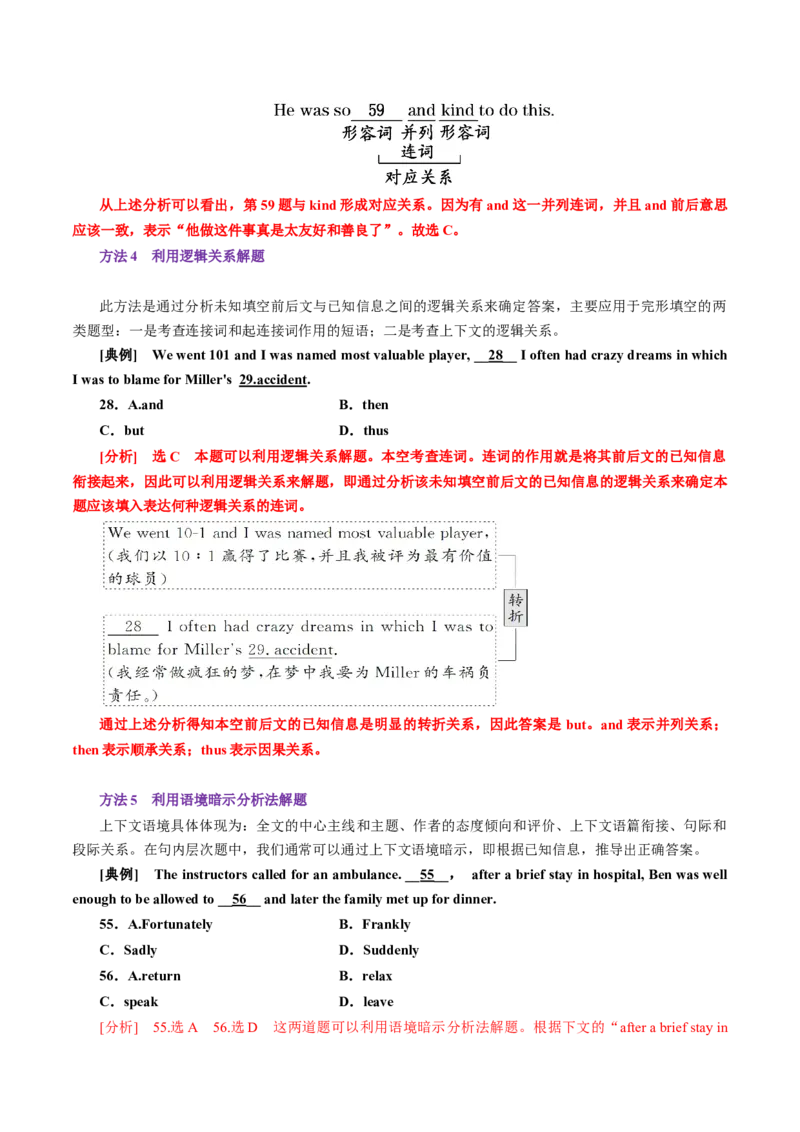
[分析] 选C 本题可以利用对应成分分析法解题。从上述分析可以看出,第59题与kind形成对应关系。因为有and这一并列连词,并且and前后意思
应该一致,表示“他做这件事真是太友好和善良了”。故选C。
方法4 利用逻辑关系解题
此方法是通过分析未知填空前后文与已知信息之间的逻辑关系来确定答案,主要应用于完形填空的两
类题型:一是考查连接词和起连接词作用的短语;二是考查上下文的逻辑关系。
[典例] We went 101 and I was named most valuable player, __28__ I often had crazy dreams in which
I was to blame for Miller's 29.accident.
28.A.and B.then
C.but D.thus
[分析] 选C 本题可以利用逻辑关系解题。本空考查连词。连词的作用就是将其前后文的已知信息
衔接起来,因此可以利用逻辑关系来解题,即通过分析该未知填空前后文的已知信息的逻辑关系来确定本
题应该填入表达何种逻辑关系的连词。
通过上述分析得知本空前后文的已知信息是明显的转折关系,因此答案是 but。and表示并列关系;
then表示顺承关系;thus表示因果关系。
方法5 利用语境暗示分析法解题
上下文语境具体体现为:全文的中心主线和主题、作者的态度倾向和评价、上下文语篇衔接、句际和
段际关系。在句内层次题中,我们通常可以通过上下文语境暗示,即根据已知信息,推导出正确答案。
[典例] The instructors called for an ambulance. __55__, after a brief stay in hospital, Ben was well
enough to be allowed to __56__ and later the family met up for dinner.
55.A.Fortunately B.Frankly
C.Sadly D.Suddenly
56.A.return B.relax
C.speak D.leave
[分析] 55.选A 56.选D 这两道题可以利用语境暗示分析法解题。根据下文的“after a brief stay inhospital”,“well enough”和“later the family met up for dinner” 这些暗示中我们可知Ben“很幸运”,“被
允许出院”。
例2
2022年普通高等学校招生全国统一考试(新高考全国Ⅱ卷)
阅读下面短文,从每题所给的A、B,C、D四个选项中选出可以填入空白处的最佳选项。
Like many young people, Jessica wants to travel the globe. Unlike most of them, this 25-year-old is doing it
___21___ . She and her husband have spent the last two years traveling the world, stopping everywhere from Paris
to Singapore. It might sound like one long, expensive ___22___ , but the couple has an unusual way to make their
travel ___23___ .
They’re part of a new form of the ___24___ economy: an online group of house sitters. Throughout their no-
cost stays in ___25___ homes, they feed pets and water plants in the homeowner’s ___26___ .
It’s not all sightseeing. The two travelers carefully ___27___ their trips, scheduling their days around the pets
that are sometimes difficult to ___28___ . But house sitting also offers a level of ___29___ they can’t find in a
hotel. “It’s like ____30____ at a friend’s house,” Jessica says.
The couple has a high ____31____ rate in getting accepted as house sitters and they always go beyond the
homeowner’s ____32____ . For Jessica, that means ____33____ plenty of pictures of happy pets, keeping the
house ____34____ and leaving a nice small gift before heading to the next house. “You want to make the
homeowner feel that they made the right ____35____ ,” she says.
21. A. indoors B. online C. single-handed D. full-time
22. A. game B. service C. vacation D. procedure
23. A. safe B. busy C. helpful D. affordable
24. A. local B. private C. sharing D. agricultural
25. A. strangers’ B. parents’ C. co-workers’ D. neighbors’
26. A. favor B. defense C. honor D. absence
27. A. plan B. explain C. compare D. complete
28. A. buy B. transport C. choose D. please
29. A. support B. comfort C. control D. attention
30. A. cooking B. staying C. waiting D. studying
31. A. success B. survival C. growth D. unemployment
32. A. budget B. abilities C. expectations D. understanding
33. A. admiring B. donating C. sending D. borrowing
34. A. clean B. open C. simple D. empty
35. A. guess B. decision C. response D. impression
句组层次题是比句内层次题稍难一级的题目,其解题信息分布在空格前后的一组意群之中,解题时需
前瞻后顾,综合意群信息解答。即本句信息不足填,空格前后再找信息源。
方法1 利用语义复现解题复现是一种语义衔接手段,它通过原词、同义词或近义词、反义词、上义词、下义词、同源词或同根
词等重复出现来表达某一概念,使整篇文章上下连贯,有机地衔接在一起。因此,考生可根据文章的具体
情况,理解文章的结构和语境,利用文章中的语义复现来选择正确的答案。
[典例1]When most of us get a text message on our cell phone from an unknown person, we usually say
“sorry, 41.wrong number!” and move on. But when Dennis Williams __42__ a text that clearly wasn't
intended for him, he did something 43.special.
42.A.received B.translated
C.copied D.printed
[分析] 选A 本题可以利用语义复现解题。第42空是上文“get”的同义词复现,故选A项。
[典例2] While high school does not generally encourage students to explore new aspects of life, college
sets the stage for that exploration.I myself went through this __41__ process and found something that has
changed my 42.experience at college for the better: I discovered ASL — American Sign Language (美式手
语).
41.A.searching B.planning
C.natural D.formal
[分析] 选A 本题可以利用语义复现解题。第41空是上文“explore”的近义词复现,故选A项。
方法2 利用作者态度或感情色彩关联解题
在高考完形填空文章中,我们一定要在快速阅读文章的过程中,仔细找出能够反映作者态度和感情色
彩的重要词汇,它们往往是名词、形容词、副词或动词。这些词汇通常是我们做题时重要的参照线索,可
以帮助我们快速确定某些题目的正确答案。
[典例] Two weeks earlier, my son, Ben, had got in touch. He'd moved to England with his mum when
he was three and it had been 13 years since I'd 41.last seen him. So imagine my __42__ when he emailed me
saying he wanted to come to visit me.
42.A.delight B.relief
C.anger D.worry
[分析] 选A 本题可以利用作者态度或感情色彩关联解题。前文提到作者已经 13年没见过自己的儿
子了,因此当儿子发来邮件说他想来看望作者时,作者应该是感到高兴(delight),故A项符合语境。
方法3 利用逻辑关系解题
在句组层次题中,利用逻辑关系解题同样是一种重要的方法。
[典例]Hundreds of people have formed impressions of you through that little device (装置) on your
desk.And they've never actually 41.met you.Everything they know about you 42.came through this device,
sometimes from hundreds of miles away.__43__ they feel they can know you 44.just from the sound of your
voice.That's how powerful the 45.telephone is.
43.A.Thus B.Yet
C.Then D.Indeed
[分析] 选B 本题是典型的考查上下文逻辑关系的题目,可以利用逻辑关系解题。通过上述对本空前后文已知信息的分析,能够发现上下文之间是明显的转折关系,因此答案可以确定
为选项B.Yet。thus“因此”;then“随后”;indeed“的确,确实”。
方法4 利用语境暗示分析法解题
在句组层次题中,有些题目我们往往也需要通过上下文的语境暗示来解题,即根据已知信息,推导出
正确答案。
[典例]On March 19, Dennis got a group text 44.informing him that a couple he didn't know were at the
hospital, waiting for the __45__ of a baby.
“Congratulations! But I think someone was mistaken,” Dennis 46.responded. The baby was born
and update texts were 47.coming_in quickly from the overjoyed grandmother, Teresa.
45.A.wakeup B.recovery
C.growth D.arrival
[分析] 选D 本题可以利用语境暗示分析法解题。根据下文“The baby was born”这一暗示信息可
知,一对夫妇正在等待宝贝的降临,因此选arrival“到来,降临”。
例子3
2022年普通高等学校招生全国统一考试(全国甲卷)
阅读下面短文,从短文后各题所给的A、B、C和D四个选项中,选出可以填入空白处的最佳选项。
You can tell a lot about a man by how he treats his dogs.
For many years, I enjoyed living with my dogs, Tilly and Chance. Their ___41___ was nearly enough to keep
my loneliness at bay. Nearly. Last year, I started dating, but with ___42___. When I first dated Steve, I ___43___
he had a dog, Molly, and a cat, Flora. While I was ___44___ that he was an animal lover, I ___45___ that three
dogs were perhaps too many, and my dogs might attack ___46___, the cat.
The next week we ___47___ our dogs together. It was a hot day. When we paused to catch our ___48___,
Steve got down on one knee. Was he proposing (求婚)? I liked him too, but so ___49___? He poured water from a
bottle into his hand and offered it to my dogs. ______50______, I began to fall for him.
We ______51______ to date, though neither of us brought up the future. And then in late November, Tilly had
an operation on her ______52______. I took the dogs out four times a day, and I worried that Tilly
______53______ climbing the stairs could reopen the wound. Then Steve ______54______ his house. All worked
______55______. The three dogs formed a pack that, with coaching, ______56______ Flora’s space; Steve and I
formed a good team ______57______ for Tilly. We made good housemates.A year later, much to my ______58______, this man produced a little box with a ring and proposed to me. He
did not kneel (跪) down, nor did I ______59______ him to. That’s only for giving ______60______ to the dogs
that brought us together.
41. A. ownership B. membership C. companionship D. leadership
42. A. reservations B. expectations C. confidence D. prejudice
43. A. feared B. doubted C. hoped D. learned
44. A. unsatisfied B. amused C. terrified D. thrilled
45. A. predicted B. worried C. regretted D. insisted
46. A. Flora B. Chance C. Molly D. Tilly
47. A. tied B. walked C. bathed D. fed
48. A. breath B. balance C. attention D. imagination
49. A. calm B. sure C. soon D. real
50. A. By the way B. In that case C. By all means D. In that moment
51. A. continued B. decided C. intended D. pretended
52. A. eye B. tail C. ear D. leg
53. A. secretly B. constantly C. eventually D. unwillingly
54. A. left B. sold C. suggested D. searched
55. A. late B. hard C. fine D. free
56. A. emptied B. respected C. occupied D. discovered
57. A. looking B. caring C. waiting D. calling
58. A. delight B. credit C. interest D. disadvantage
59. A. beg B. trust C. need D. aid
60. A. toys B. awards C. food D. water
全篇思读,着眼几点,智取拉分题目
高考担负着区分考生、选拔人才的功能,因此每篇完形填空中总有2~3道这样的较难题目成为考生取
得优异成绩的“拦路虎”。导致这些题目错选的原因主要有以下几点:①解题信息比较隐含;②干扰项迷
惑性较强;③情感态度较难把握;④惯性思维所致。针对这些题目,考生除了需具备扎实的语言功底外,
还应谨慎小心应对。本讲总结了解答完形填空的5大易错点,旨在让考生遇到此类题目时不要急于求成,
要三思而判。
易错点1 因缺乏全篇关联思维而错选
语篇层次题的解题信息不局限于某一句或某一句群,而是分散在某一段或几段甚至全篇,要求考生理
解整篇文章,抓住全文的脉络、作者的思想、意图或主人公的心理,然后进行准确的推理、判断,从而做
出正确的选择。对于此类题目,一定要坚持这样一个原则——不急于解答,读完全文后综合思维再做判
定。
[典例 1] During my second year at the city college, I was told that the education department was
offering a “free” course, called Thinking Chess, for three credits. I 41.jumped_at the idea of taking the class
because, after all, who doesn't want to 42.save a few dollars? ...Maurice Ashley was kind and smart, a former graduate returning to teach, and this 48.job was no game
for him; he meant business. In his introduction, he made it 49.clear that our credits would be hardearned.
In order to 50.pass the class, among other criteria, we had to write a paper on how we plan to 51.apply
what we would learn in class to our future professions and, 52.eventually,_to our lives. I managed to get an
A in that __53__ and learned life lessons that have served me well beyond the 54.classroom.
53. A.game B.presentation
C.course D.experiment
[分析] 选C 本题是典型的语篇层次题,只看题目所在的句子我们是无法确定答案的,此类题目需要
综合全篇来找线索。本题可以利用语义复现解题。本题为原词复现。第一段“was offering a ‘free’ course”
中的course是第53空的原词复现,故选C项。
[典例2]
...
The 46.story began during my first week at college.I watched as the ASL Club 47.performed their
translation of a song.Both the hand movements and the very 48.idea of communicating without speaking
49.attracted me.What I saw was completely unlike anything I had experienced in the 50.past.This newness
just left me 51.wanting more.
After that, feeling the need to __52__ further, I decided to drop in on one of ASL club's meetings.I only
learned how to 53.sign the alphabet that day.Yet instead of being discouraged by my 54.slow progress, I
was excited.I then made it a point to 55.attend those meetings and learn all I could.
...
52.A.exercise B.explore
C.express D.explain
[分析] 选B 本题是语篇层次题,需要综合空格上一段和空格所在段落来寻找突破口。本题可以利用
文章发展脉络解题。所节选部分文章发展脉络为:大学第一周我观看了美式手语俱乐部的表演→我被表演
所吸引→我想进一步学习更多手语方面的知识→我参加俱乐部的会议。根据文章发展脉络可知,第52题是
在作者观看了美式手语俱乐部的表演后感受到了进一步“探索”(explore)的必要。故答案为B项。
易错点2 因不能正确区分形近(义近)词而错选
完形填空题选项中经常会出现一些形近词或义近词让考生辨析,因为词形相近或意义相近,无形中增
加了难度,如果考生对这些词掌握得不好或不着眼于语篇的意义便很容易选错。
[典例1] I started doing anything I could to help them build a little 25.pride. Most important, I began
to treat them like26.winners. That summer, when the other teams enjoyed their 27.vacations,_we met every
day and 28.practiced passing and kicking the football.
...
From the experience I learned a lot about how the attitude of the leader can 33.affect the members of a
team. Instead of seeing my boys as losers, I pushed and 34.encouraged them. I helped them to see themselves
__35__, and they built themselves into winners.
35.A.honestly B.individuallyC.calmly D.differently
[分析] 选D 四个备选项在形式上非常相似,它们都是副词,部分考生很容易因混淆而失分。联系
上句中的“Instead of seeing my boys as losers”以及上文的“treat them like 26.winners”可知,此处是指“我
帮他们用不同的方式(differently)看待自己”。honestly“老实地,诚实地”;individually“个人地”;
calmly“平静地”。
[典例 2]For a long time Gabriel didn't want to be involved in music at all. In his first years of high
school, Gabriel would look pityingly at the music students, __36__ across the campus with their heavy
instrument cases ...
36.A.travelling B.marching
C.pacing D.struggling
[分析] 选D 四个备选项在含义上比较相近,考生很容易因分不清它们的含义而失分。由空前的
“look pityingly at the music students”以及空后的“heavy instrument cases”可知,Gabriel同情地看着那些背
着重重的乐器箱子、艰难地穿过校园的音乐生,故struggle“艰难地行进”,符合语境。travel“长途行走,
旅行”;march“齐步走,行进”;pace“来回踱步,走来走去”。
易错点3 因不明一词多义或熟词生义而错选
在最近几年的高考完形填空中,一词多义或熟词生义的考查屡见不鲜,这往往也是考生容易忽视的地
方。很多考生由于不懂这些熟词的“新义”而出现思维堵塞,造成了不应有的失分。下面我们选取具有代
表性的试题加以分析,以帮助考生熟悉其命题特点,从而跳出命题人设置的词汇“陷阱”。
[典例 1]Much to the family's surprise, Dennis stuck to his 52.promise! He turned up at the hospital
__53__ gifts for the new mother Lindsey and her baby boy. Lindsey's husband was totally 54.astonished by
the unexpected visit. “I don't think we would have randomly invited him over but we 55.appreciate it and
the gifts.”
53.A.bearing B.collecting
C.opening D.making
[分析] 选A 本文描述一个叫特蕾莎的老妇人沉浸在为人祖母的喜悦当中,她把小宝贝的照片发给
了陌生人丹尼斯,但是丹尼斯却回复短信说他会去医院看望小孩,并与小孩合影。本段主要描述特蕾莎一
家没有想到丹尼斯真的来到医院,还带来了礼物,她们非常感动。bear是一个多义词,用作动词,最常见
的意思为“承受,忍受”,除此之外还有“承担(责任);支撑,承受(重量);显示;带有;携带;生(孩
子);开(花);结(果实)”等。根据语境,在此意为“携带”。
[典例2] One day I 46.met a former classmate of mine who was47.making a lot of money running a
sideline (副业).Since his regular job was48.boring,_I asked him why he just didn't do his sideline
fulltime.He said without the job, he would__49__ have too much time and would just do what I did back in
50.college. He said that if he51.quit the job, he would lose his52.drive to work and succeed.
49.A.luckily B.hardly
C.hopefully D.simply
[分析] 选D 根据句意可知,他说如果没有那份工作,他确实会有很多时间。simply“确实,简
直”。此处simply这个词属于熟词生义,我们比较熟悉它的义项是:简单地,简朴地。易错点4 因词汇理解障碍而错选
在完形填空题的设题上,命题者往往还将一些考生平常容易忽视的词汇设置成选项,从而造成考生错
选。对于这些词汇,考生在平时必须引起重视,背熟记熟。
[典例1]
...
The following term, I __56__ an ASL class. The professor was deaf and any talking was __57__. I soon
realized that the silence was not unpleasant.58.Instead,_if there had been any talking, it would have
59.caused us to learn less.Now, I appreciate the silence and the 60.new way of communication it opens.
56.A.missed B.passed
C.gave up D.registered for
57.A.prohibited B.welcomed
C.ignored D.repeated
[分析] 56.选D 57.选A 后文的语境中介绍了ASL课堂上教授的情况(教授是个失聪的人)以及在课
堂上作者的感悟,由此可判断作者在下学期报名参加了这门课程。故第56题应选择D项,register for表示
“登记,报名参加(课程)”。文中两次出现的“silence”以及“if there had been any talking, it would have
59.caused us to learn less”都表明,在手语课上任何谈话都是被禁止的,故第57题选择A项,prohibit表示
“禁止”。此部分选项中的register for和prohibit都是考生相对陌生的考纲词汇,所以一些考生会因为词汇
积累不够,又不能有效地利用上下文中的提示而失分。
[典例 2] A Toronto man is offering a free roundtheworld air ticket to the right woman. But
__41__apply. You must be named Elizabeth Gallagher and have a Canadian 42.passport.
41.A.benefits B.deposits
C.restrictions D.examinations
[分析] 选C 该选段是文章第一段。空后介绍这位能够获得免费环游世界机票的女士的名字必须是
Elizabeth Gallagher,而且必须持有加拿大护照。这些都是限制条件。故选择 C项,restriction表示“限制规
定”。restriction也在考纲之内,许多考生却因不熟悉这个词汇而造成误选。benefit“优势,好处”;
deposit“订金,押金”;examination“检查,考试”。
易错点5 因惯性思维而错选
在英语学习中,由于种种原因,如考生的母语、知识面、思维习惯等都有可能令考生出现一些思维定
式现象,即不善于思考,考虑问题不全面,导致误解一些题目,从而抑制思维能力的发展。完形填空解题
中因惯性思维而失分常有以下两种情况:
(1)学习单词时受到的思维定式影响
有些考生学习英语单词过于简单化,仅记其中文意思,而不深刻理解其实际用法和英汉用法之间的细
微差异。例如:表示“成功做某事”,不可以用succeed to do sth.来表达。
(2)学习词组或习惯用语时受到的思维定式影响
例如:学习了wait for这个词组以后,有的考生在做题过程中只要碰到wait,后面要接介词时就毫不犹豫地选择for。但在“He stopped his car to wait at the red light.”中就不用for。
[典例 1] One day, when she was five years old, she was walking with her mother in downtown
Winnipeg. They saw a man __36__ out of a garbage can. She asked her mother why he did that, and her
mother said that the man was homeless and hungry.
36.A.jumping B.eating
C.crying D.waving
[分析] 选B 受思维习惯的影响,考生易误选A项,因为jump out of 是常见搭配。但根据下文的
“the man was homeless and hungry”可知,她们看见一个人在垃圾桶里捡东西吃。故选B。
[典例2] __41__ January 26, Billy and three other children had died.
41.A.From B.On
C.By D.After
[分析] 选C 受思维习惯的影响,考生可能会根据“在具体的某一天前用介词on”而误选B项。因为
句子的谓语使用的是过去完成时,因此应用by。“by+时间”与完成时连用,后跟过去的时间时,用过去
完成时;跟将来的时间时,用将来完成时。句意:截至1月26日,Billy和其他三个孩子都去世了。
例子4
2022年普通高等学校招生全国统一考试(全国乙卷)
阅读下面短文,从短文后各题所给的A、B、C和D四个选项中,选出可以填入空白处的最佳选项。
Young children across the globe enjoy playing games of hide and seek. For them, there’s something highly
exciting about ___41___ someone else’s glance and making oneself unable to be seen.
However, we all witness that preschool children are remarkably ___42___ at hiding. They often cover only
their eyes with their hands, leaving the rest of their bodies ___43___.
For a long time, this ineffective hiding method was ___44___ as evidence that children are hopelessly
“egocentric” (自我中心的) creatures. But our ___45___ research results in child developmental psychology
___46___ that idea.
We brought young children aged 2-4 into our Minds in Development Lab at USC. Each ___47___ sat down
with an adult who covered her own eyes or ___48___. We then asked the child if she could ___49___ or hear the
adult. Surprisingly, children replied that they couldn’t. The same ____50____ happened when the adult covered her
own mouth: ____51____ children said that they couldn’t ____52____ to her.
A number of ____53____ ruled out that the children misunderstood what they were being asked. The results
were clear: Our young subjects ____54____ the questions and knew ____55____ what was asked of them. Their
____56____ to the questions reflected their true ____57____ that “I can see you only if you can see me, too.” They
simply ____58____ mutual (相互的) recognition and regard. Our ____59____ suggest when a child “hides” by
putting a blanket over her head, it is not a result of egocentrism. In fact, children consider this method ____60____
when others use it.
41. A. following B. taking C. escaping D. directing
42. A. clever B. bad C. scared D. quick
43. A. exposed B. examined C. untouched D. imbalanced44. A. supported B. guaranteed C. imagined D. interpreted
45. A. disappointing B. mixed C. surprising D. desired
46. A. explained B. confirmed C. contradicted D. tested
47. A. parent B. child C. researcher D. doctor
48. A. feet B. nose C. hands D. ears
49. A. see B. help C. reach D. fool
50. A. event B. thing C. action D. accident
51. A. Yet B. Now C. Soon D. Once
52. A. speak B. listen C. turn D. wave
53. A. instructions B. descriptions C. experiments D. assumptions
54. A. comprehended B. predicted C. explored D. ignored
55. A. partly B. honestly C. vaguely D. exactly
56. A. responses B. approaches C. contribution D. sensitivity
57. A. ability B. belief C. identity D. purpose
58. A. hold back B. relate to C. insist on D. make up
59. A. limitations B. requirements C. theories D. findings
60. A. tentative B. impressive C. creative D. effective
随堂练习
2021 年普通高等学校招生全国统一考试(新高考 I 卷)
My life as a tax-paying employed person began in middle school, when, for three whole days, I worked in a
baking factory.
My best friend Betsy’s father was a manager at Hough Bakeries, which, at Easter time, ____41____ little
bunny ( 兔 子 ) cakes for all its ____42____throughout Cleveland. It happened that the plant downtown
needed eight kids for ____43____ help during our spring break, for which I had no____44____ beyond listening to
my favorite records. I’d ____45____ minimum wage. I’d see how a factory____46____. My parents thought all of
this was a grand idea and called Betsy’s dad with their ____47____.
Our____48____in the factory were simple: Place cakes on a moving belt. Attach icing (糖霜) ears. Apply
icing eyes and nose.____49____ bunny from the belt. This was _____50_____ than it sounds._____51_____ a bit
and the cakes pile up. As I told my parents at dinner that first night, it was all a little more high-pressure than I’d
_____52_____ .
Dad ____53____. The son of a grocer, he’d spent the summers of his childhood_____54_____ food in
Benardsville, New Jersey. This was the sort of work that made you_____55_____ the dollars you earned and
respect those who did the work, he told me.
41. A. sold B. ordered C. made D. reserved
42. A. stores B. families C. schools D. citizens
43. A. generous B. financial C. technical D. temporary
44. A. plans B. problems C. excuses D. hobbies
45. A. offer B. earn C. set D. suggest46. A. worked B. closed C. developed D. survived
47. A. ambition B. permission C. experience D. invitation
48. A. joys B. ideas C. roles D. choices
49. A. Save B. Keep C. Stop D. Remove
50. A. harder B. better C. longer D. cheaper
51. A. Calm down B. Slow down C. Stay on D. Move on
52. A. indicated B. witnessed C. expected D. remembered
53. A. cried B. smiled C. hesitated D. refused
54. A. tasting B. finding C. sharing D. delivering
55. A. withdraw B. donate C. receive D. appreciate
2021年普通高等学校招生全国统一考试(新高考全国II卷)
阅读下面短文,从每题所给的A、B、C、D四个选项中选出可以填入空白处的最佳
Over the past 38 years, Mr. Wang has pretended to be someone else many times,and has even learned to
____21____ different dialects(方言),leading to him being described as an “Oscar-winning actor".
The 60-year-old is not an actor, but a ____22____ However,he is more devoted to his “____23____ "than any
real actor.
In the 1990s, a group of thieves often sold stolen goods with the help of some beggars. To look into the
____24____,Wang disguised(伪装)himself and ____25____ the beggars. Dirty shorts and old shoes gave him
the ____26____ of a real beggar and his convincing dialect soon won him the ____27____ of the beggars.
“I often ____28____ them to drink alcohol. Once they were ____29____,they began to talk a lot,"Wang said.
“I'd then ____30____ myself to use the toilet, ____31____ what the beggars said, and send the ____32____ to my
teammates.”
Wang,who is often in ____33____ situations, is also a judo (柔道) master. “As long as I get close
enough, no criminal can ____34____ from me," he said.
Wang's ____35____ won him several honors, including a National May Day Labor Medal and 11 Citations of
Merit.Paris.
21. A. teach B. compare C. assess D. speak
22. A. lawyer B. doctor C. policeman D. businessman
23. A. role B. study C. family D. audience
24. A. minor B. case C. future D. question
25. A. interviewed B. joined C. arrested D. assisted
26. A. challenge B. experience C. appearance D. freedom
27. A. vote B. sympathy C. permission D. trust
28. A. invited B. forced C. helped D. expected
29. A. drunk B. deserted C. bored D. lost
30. A. guide B. persuade C. excuse D. allow
31. A. refer to B. note down C. ask about D. miss out
32. A. plan B. agreement C. direction D. information33. A. awkward B. dangerous C. unfortunate D. strange
34. A. separate B. recover C. escape D. hear
35. A. courage B. honesty C. kindness D. optimism