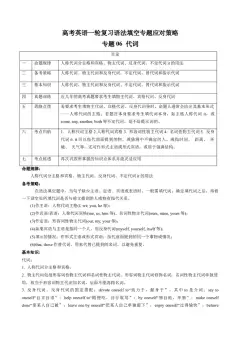
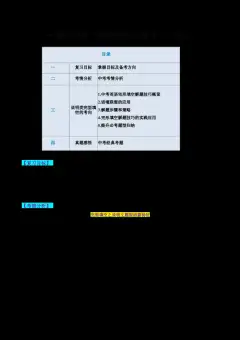
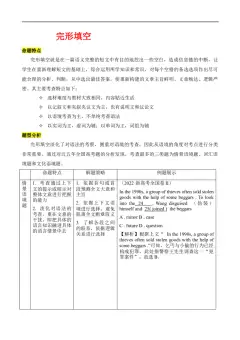
17 完形填空应对策略(宏观分析)
【策略精析】
分析维度1:洞悉文章脉络
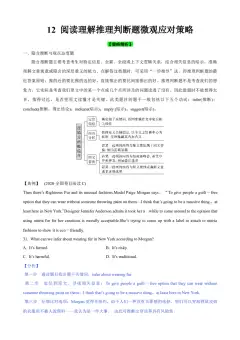
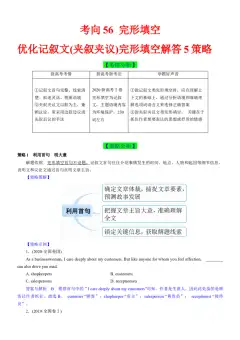
宏观分析是对文章的语篇类型、组织结构等进行分析,通过文章的主题句或主题段落来确定文章的
体裁到底是记叙文、说明文、议论文还是应用文。文体不同,文章的组织结构自然也不同。从近五年的
高考可以看出,完形填空主要考查记叙文或夹叙夹议类的文章。因此,运用美国语言学家拉波夫的叙事
分析模式对完形填空的语篇进行宏观分析,能帮助学生从整体上把握文章的结构。此模式包括点题、指
向、进展、结局、评议和回应六个要素。
(一)点题和指向
1. 点题是叙事者在叙事之前对要讲的内容进行简短的概述,会告诉读者“What was the story about?”。
2. 指向是指叙事者会在文章开头交代清楚故事中的人物以及故事发生的时间和地点等因素,会告诉读者
“Who was involved in the story?”以及“When and where did the story happen?”等。有时候,点题和指
向会一起出现在文章的首句中,这样不仅能使文章中心突出、主题鲜明,而且能给读者留下深刻的印象。
(二)进展和结局
1. 进展是故事本身的发生和发展,是叙事语篇的核心部分。它回答的是“How does the story
develop?”。
2. 结局是指故事发展到最后是一个怎样的结果。它回答的是“How does the story come to an end?”。
(三)评议和回应
1. 评议是作者对所描述的故事所做的一种评论,它体现出作者对故事的态度和看法。
2. 回应是对故事主题的一种升华,对读者起着某种启迪作用,能使读者对故事理解得更深刻并进行深入
的思考。但是有时候,叙事者会把故事的意义留给读者去体会和思考,因此并不是所有的记叙文都具备
回应这一要素。
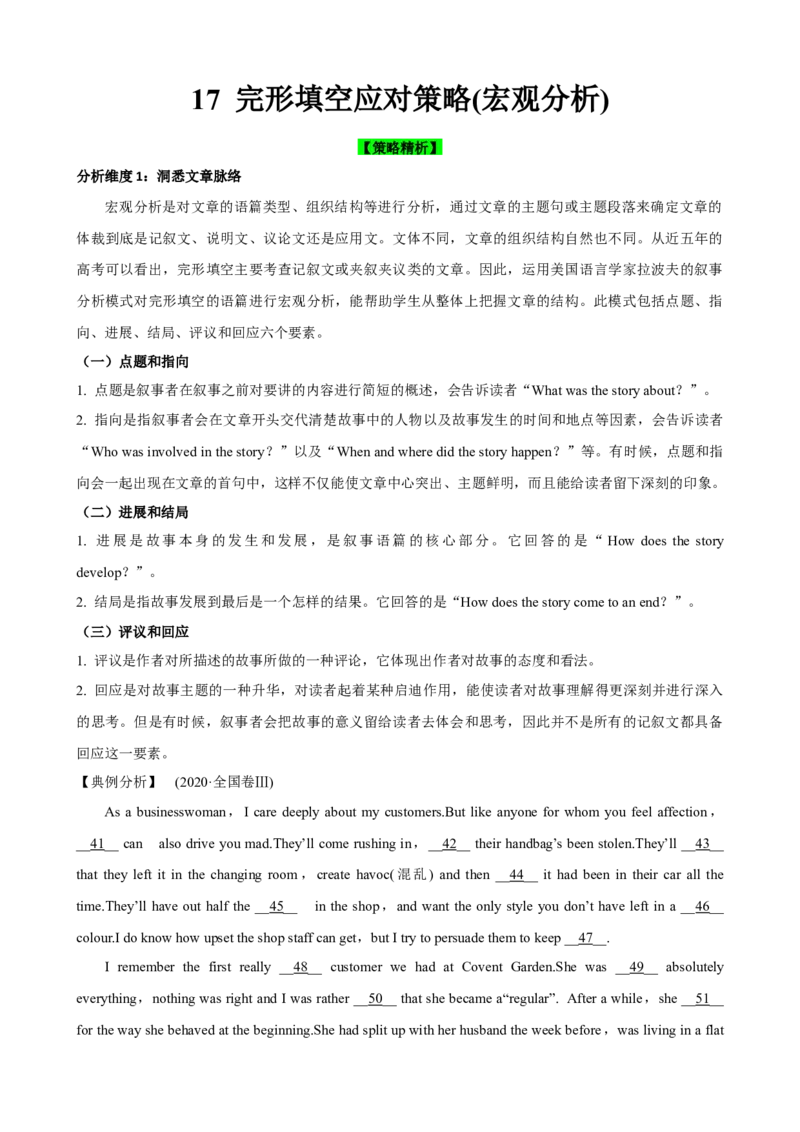
【典例分析】 (2020·全国卷Ⅲ)
As a businesswoman,I care deeply about my customers.But like anyone for whom you feel affection,
__41__ can also drive you mad.They’ll come rushing in,__42__ their handbag’s been stolen.They’ll __43__
that they left it in the changing room,create havoc(混乱) and then __44__ it had been in their car all the
time.They’ll have out half the __45__ in the shop,and want the only style you don’t have left in a __46__
colour.I do know how upset the shop staff can get,but I try to persuade them to keep __47__.
I remember the first really __48__ customer we had at Covent Garden.She was __49__ absolutely
everything,nothing was right and I was rather __50__ that she became a“regular”. After a while,she __51__
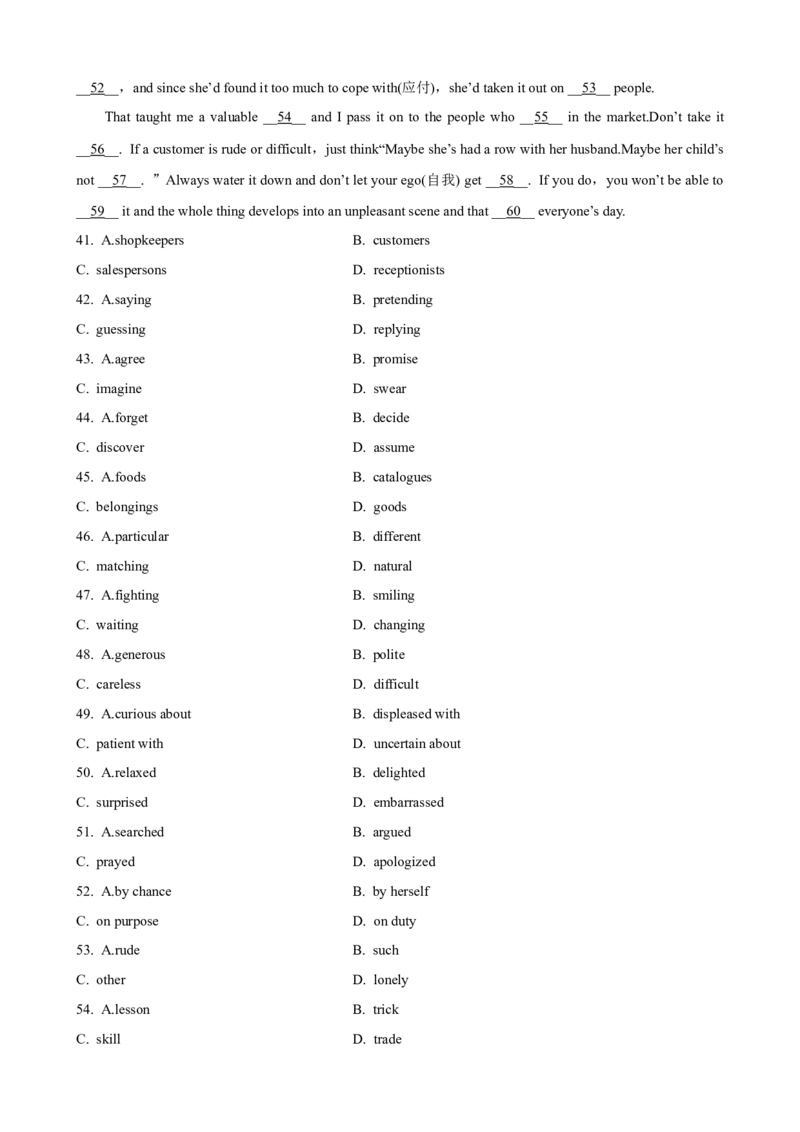
for the way she behaved at the beginning.She had split up with her husband the week before,was living in a flat__52__,and since she’d found it too much to cope with(应付),she’d taken it out on __53__ people.
That taught me a valuable __54__ and I pass it on to the people who __55__ in the market.Don’t take it
__56__. If a customer is rude or difficult,just think“Maybe she’s had a row with her husband.Maybe her child’s
not __57__. ”Always water it down and don’t let your ego(自我) get __58__. If you do,you won’t be able to
__59__ it and the whole thing develops into an unpleasant scene and that __60__ everyone’s day.
41. A.shopkeepers B. customers
C. salespersons D. receptionists
42. A.saying B. pretending
C. guessing D. replying
43. A.agree B. promise
C. imagine D. swear
44. A.forget B. decide
C. discover D. assume
45. A.foods B. catalogues
C. belongings D. goods
46. A.particular B. different
C. matching D. natural
47. A.fighting B. smiling
C. waiting D. changing
48. A.generous B. polite
C. careless D. difficult
49. A.curious about B. displeased with
C. patient with D. uncertain about
50. A.relaxed B. delighted
C. surprised D. embarrassed
51. A.searched B. argued
C. prayed D. apologized
52. A.by chance B. by herself
C. on purpose D. on duty
53. A.rude B. such
C. other D. lonely
54. A.lesson B. trick
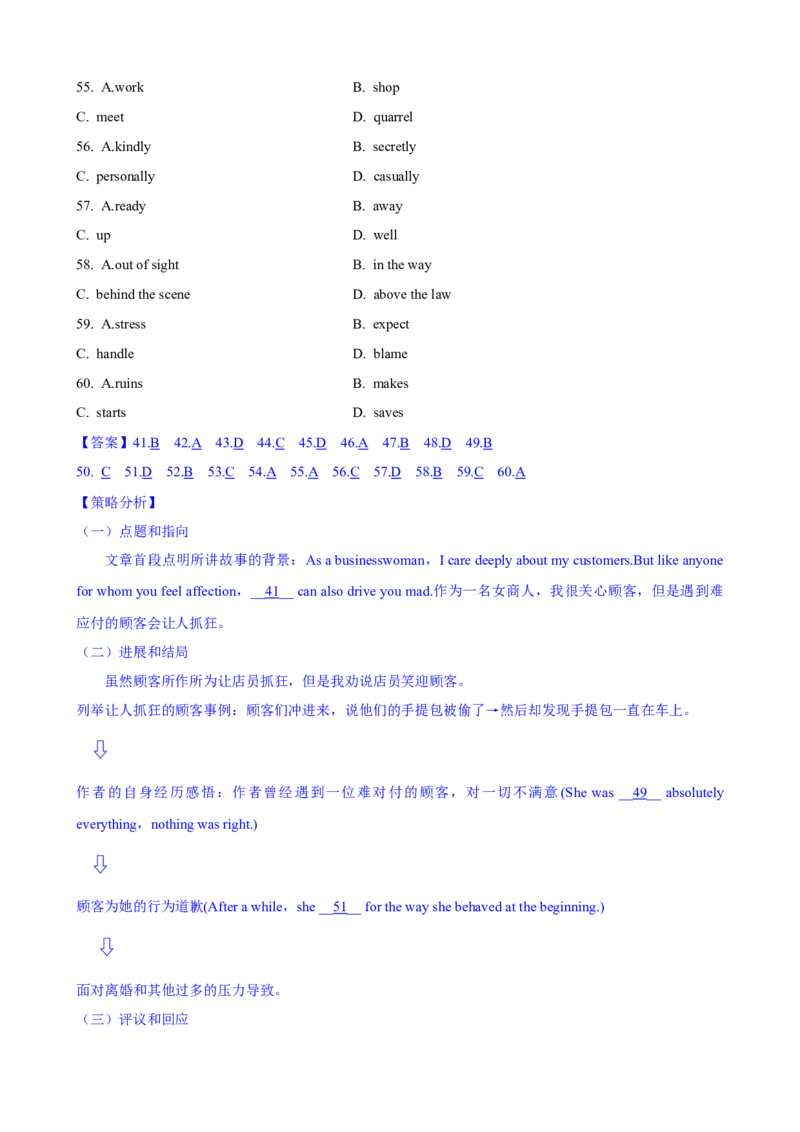
C. skill D. trade55. A.work B. shop
C. meet D. quarrel
56. A.kindly B. secretly
C. personally D. casually
57. A.ready B. away
C. up D. well
58. A.out of sight B. in the way
C. behind the scene D. above the law
59. A.stress B. expect
C. handle D. blame
60. A.ruins B. makes
C. starts D. saves
【答案】41.B 42.A 43.D 44.C 45.D 46.A 47.B 48.D 49.B
50. C 51.D 52.B 53.C 54.A 55.A 56.C 57.D 58.B 59.C 60.A
【策略分析】
(一)点题和指向
文章首段点明所讲故事的背景:As a businesswoman,I care deeply about my customers.But like anyone
for whom you feel affection,__41__ can also drive you mad.作为一名女商人,我很关心顾客,但是遇到难
应付的顾客会让人抓狂。
(二)进展和结局
虽然顾客所作所为让店员抓狂,但是我劝说店员笑迎顾客。
列举让人抓狂的顾客事例:顾客们冲进来,说他们的手提包被偷了→然后却发现手提包一直在车上。
⇩
作者的自身经历感悟:作者曾经遇到一位难对付的顾客,对一切不满意(She was __49__ absolutely
everything,nothing was right.)
⇩
顾客为她的行为道歉(After a while,she __51__ for the way she behaved at the beginning.)
⇩
面对离婚和其他过多的压力导致。
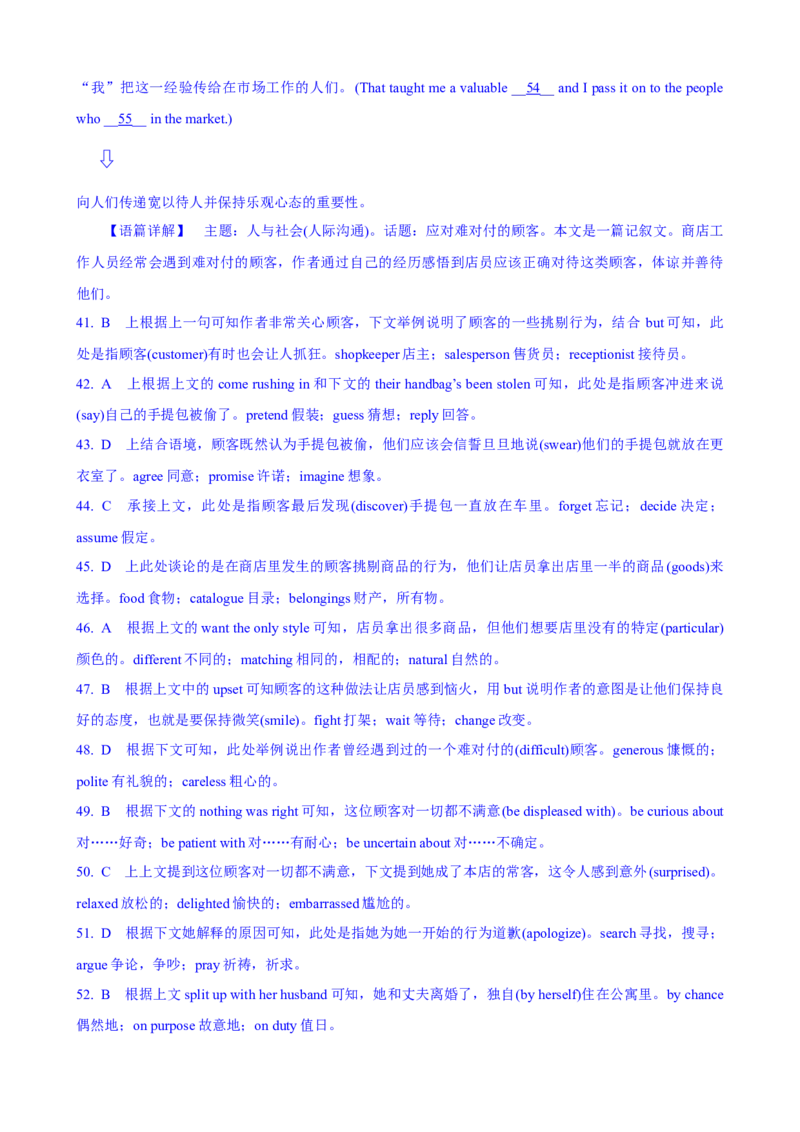
(三)评议和回应“我”把这一经验传给在市场工作的人们。(That taught me a valuable __54__ and I pass it on to the people
who __55__ in the market.)
⇩
向人们传递宽以待人并保持乐观心态的重要性。
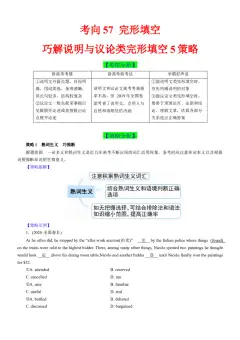
【语篇详解】 主题:人与社会(人际沟通)。话题:应对难对付的顾客。本文是一篇记叙文。商店工
作人员经常会遇到难对付的顾客,作者通过自己的经历感悟到店员应该正确对待这类顾客,体谅并善待
他们。
41. B 上根据上一句可知作者非常关心顾客,下文举例说明了顾客的一些挑剔行为,结合 but可知,此
处是指顾客(customer)有时也会让人抓狂。shopkeeper店主;salesperson售货员;receptionist接待员。
42. A 上根据上文的come rushing in和下文的their handbag’s been stolen可知,此处是指顾客冲进来说
(say)自己的手提包被偷了。pretend假装;guess猜想;reply回答。
43. D 上结合语境,顾客既然认为手提包被偷,他们应该会信誓旦旦地说(swear)他们的手提包就放在更
衣室了。agree同意;promise许诺;imagine想象。
44. C 承接上文,此处是指顾客最后发现(discover)手提包一直放在车里。forget忘记;decide决定;
assume假定。
45. D 上此处谈论的是在商店里发生的顾客挑剔商品的行为,他们让店员拿出店里一半的商品(goods)来
选择。food食物;catalogue目录;belongings财产,所有物。
46. A 根据上文的want the only style可知,店员拿出很多商品,但他们想要店里没有的特定(particular)
颜色的。different不同的;matching相同的,相配的;natural自然的。
47. B 根据上文中的upset可知顾客的这种做法让店员感到恼火,用but说明作者的意图是让他们保持良
好的态度,也就是要保持微笑(smile)。fight打架;wait等待;change改变。
48. D 根据下文可知,此处举例说出作者曾经遇到过的一个难对付的(difficult)顾客。generous慷慨的;
polite有礼貌的;careless粗心的。
49. B 根据下文的nothing was right可知,这位顾客对一切都不满意(be displeased with)。be curious about
对……好奇;be patient with对……有耐心;be uncertain about对……不确定。
50. C 上上文提到这位顾客对一切都不满意,下文提到她成了本店的常客,这令人感到意外(surprised)。
relaxed放松的;delighted愉快的;embarrassed尴尬的。
51. D 根据下文她解释的原因可知,此处是指她为她一开始的行为道歉(apologize)。search寻找,搜寻;
argue争论,争吵;pray祈祷,祈求。
52. B 根据上文split up with her husband可知,她和丈夫离婚了,独自(by herself)住在公寓里。by chance
偶然地;on purpose故意地;on duty值日。53. C 她面对离婚和其他过多的压力,难免会情绪不好,因而迁怒于其他(other)人。此处take it out on表
示“迁怒于……,拿……出气”。
54. A 结合下文作者的认识可知,这件事给作者上了宝贵的一课(lesson)。teach sb a lesson表示“给某人
一个教训”。
55. A 上作者对待顾客的经验自然是想传达给那些在商场里工作(work)的人员。
56. C 根据下文可知,这些难应付的顾客可能有其他原因,店员不能太在意。take sth personally意为
“认为某事针对自己而不悦”。kindly体贴地;secretly秘密地; casually随意地。
57. D 与上文的“Maybe she’s had a row with her husband.(或许她和丈夫吵了一架)”相呼应,此处是说或
许她的孩子身体不适(well),此处well是形容词,意为“身体好的”。
58. B 根据上文可知,顾客可能是因为自身遇到各种麻烦才变得挑剔,所以作者指出店员需要注意不能
让个人的情绪妨碍(in the way)交流和沟通,要去理解顾客。out of sight看不见;behind the scene在幕后;
above the law凌驾于法律之上。
59. C 上本句用if来假设一种后果,如果不能放下个人情绪,可能没法处理(handle)这样的情况。stress
强调;expect预料;blame责怪。
60. A 根据上文的an unpleasant scene可知,遇到这种难处理的情况,处理不好会导致不愉快的场面,将
会毁掉(ruin)大家的一天。
分析维度2:防范失误的策略
1.避免因词汇理解障碍而失分
在完形填空题的设题上,命题者往往还将一些考生平常容易忽视的词汇设置成选项,从而造成考生
错选、对于这些词汇,考生在平时必须引起重视,背熟记牢。
【典例分析】 (2020·全国卷Ⅰ)
If we 42.admit it is a door,they’ll want to go outside __43__. It will drive us crazy.
43. A.gradually B. constantly
C. temporarily D. casually
【分析】 句意:如果我们承认它是一扇门,他们就会不断地想出去。根据下文 I should just 59.accept
repeatedly having to say,“No.We can’t go outside now.”可推测出,孩子们会不断地想出去。故选B。选项
constantly,temporarily,casually都属于低频词,许多考生会由于对词义把握不准而误选。
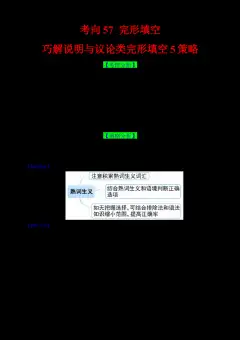
2.避免因不明熟词生义而失分
熟词生义往往是考生容易忽视的地方,很多考生由于不懂这些熟词的“新义”而出现思维堵塞,造
成了不应有的失分。下面我们选取具有代表性的试题加以分析,以帮助考生熟悉其命题特点,从而跳出
命题人设置的词汇“陷阱” 。
【典例分析】 (2019·全国卷Ⅰ)Every year about 40,000 people attempt to climb Kilimanjaro,the highest mountain in Africa.They 41.bring
with them lots of waste.The 42.crowds might damage the beauty of the place.The glaciers( 冰 川 ) are
disappearing,changing the __43____of Kilimanjaro.
43. A.position B. age
C. face D. name
【分析】 根据设空前的“The 42.crowds might damage the beauty of the place.The glaciers(冰川) are
disappearing”可知,人群可能会破坏这个地方的美,冰川也正在消失,由此可推知,这一切正在改变着乞
力马扎罗山的面貌(face),face 此处意为:(地区,机构或活动领域的)外观,面貌。
3.避免因惯性思维而失分
在英语学习中,由于种种原因,如考生的母语干扰、知识面和思维习惯等都有可能令考生出现一些
思维定式现象,即不善于多方位思考,考虑问题不全面,导致错选一些题目,完形填空解题中因惯性思
维而失分常有以下两种情况:
(1)单词运用受到的思维定式影响
有些考生学习英语单词过于简单化,仅记其中文意思,而不深刻理解其实际用法和英汉用法之间的
细微差异。例如:表示“成功做某事”,不可以用succeed to do sth来表达。
(2)短语或习语运用受到的思维定式影响
例如:学习了wait for这个词组以后,有的考生在做题过程中只要碰到wait,后面要接介词时就毫不
犹豫地选择for,但在“He stopped his car to wait at the redlight.”中就不用for。
【典例分析】 (2020·全国卷Ⅰ)
Since our twins began learning to walk,my wife and I have kept telling them that our sliding glass door is just a
window.The 41.reason is obvious.If we 42.admit it is a door,they’ll want to go outside 43.constantly. It will
drive us crazy.The kids apparently know the __44__. But our insisting it’s 45.merely a window has kept them
from 46.attempting millions of requests to open the door.
44. A.result B. danger
C. method D. truth
【分析】 由空后下文But our insisting...to open the door.可知,阻止了他们无数次要求打开这扇门的尝试;
再由下文的I hate lying to the kids.可知,孩子们是知道真相的。但考生受思维定式影响,看到前文The
41.reason is obvious,而误选A项。
分析维度3:理清语篇信息层次
语篇层次题的解题信息不局限于某一句或某一句群,而是分散在某一段或几段甚至全篇,这就要求
考生抓住全文的脉络、作者的思想意图或主角的心理,然后进行准确的推理、判断,从而做出正确的选
择。对于此类题目,一定要坚持这样一个原则——不急于解答,读完全文后综合思维再做判定。【典例分析1】 (2019·全国卷Ⅱ)
It’s about 250 miles from the hills of west-central Iowa to Ehlers’ home in Minnesota.During the long trip
home,following a weekend of hunting,Ehlers 41.thought about the small dog he had seen 42.trembling
alongside the road.He had 43.tried to coax (哄) the dog to him but,frightened,it had 44.run__off.
Back home,Ehlers was troubled by that 45.lost dog.So,four days later,he called his friend Greg,and the
two drove 46.back. After a long and careful 47.search,Greg saw,across a field,the dog moving __48__
away.Ehlers eventually succeeded in coaxing the animal to him.Nervousness and fear were replaced with 49.joy.
It just started licking (舔) Ehlers’ face.
48. A.cautiously B. casually
C. skillfully D. angrily
【分析】 本题是语篇层次题。只看题目所在的句子我们是无法确定答案的,此类题目需要综合全篇来
找线索。根据第一段最后一句中的“frightened”和第二段第二句中的“four days later”并结合下文的
“Nervousness and fear”可知,一只走丢多日的小狗受到惊吓,感到紧张不安和恐惧,因此当 Greg看见它
的时候,它正小心谨慎地(cautiously)移动,casually“随便地”;skillfully“巧妙地,熟练地”;angrily“生气
地”。
【典例分析2】 (2017·全国卷Ⅰ)
...............
The 46.story began during my first week at college.I watched as the ASL Club 47.performed their translation
of a song.Both the hand movements and the very 48.idea of communicating without speaking 49.attracted
me.What I saw was completely unlike anything I had experienced in the 50.past. This newness just left me
51.wanting more.
After that,feeling the need to__52__ further,I decided to drop in on one of ASL club’s meetings.I only learned
how to 53.sign the alphabet that day.Yet instead of being discouraged by my 54.slow progress,I was excited.I
then made it a point to 55.attend those meetings and learn all I could.
............
52. A.exercise B. explore
C. express D. explain
【分析】 本题是语篇层次题。需要综合空格上一段和空格所在段落来寻找突破口。本题可以利用
文章发展脉络解题。所节选部分文章发展脉络为:大学第一周“我”观看了美式手语俱乐部的表演
→“我”被表演所吸引→“我”想进一步学习更多手语方面的知识→“我”参加俱乐部的会议。根据文
章发展脉络可知,第52题是在作者观看了美式手语俱乐部的表演后感受到了进一步“探索(explore)”的必
要。故答案为B项。【策略精练】
1
I would like to suggest that for sixty to ninety minutes each evening all smart phones in the family be put
away.
Let us take a 1 , reasonable look at what the results might be if such a (n) 2 were accepted.
Families might use the time for a real family hour. Without the distraction of phones, they might 3 around
together after dinner and actually talk to one another. In fact, it is well-known that many of our 4 in every
aspect of our life, from the generation gap to the high divorce and to some forms of mental illness are caused at
least 5 by failure to communicate. By using the quiet family hour to 6 our problems,we might get to
know each other better and to like each other better.
On evenings when such a talk is 7 , families could discover other active pastimes(消遣). 8 from
smart phones,forced to find their own 9 ,they might take a ride together to watch the sunset 10
they might take a walk together. With free time and no smart phones,children and adults might discover reading.
They might find there is more 11 in a good book than in an electronic game. According to educators,the
generation 12 with smart phones can hardly write an English sentence, 13 at the college level.
Actually, 14 is often improved through adequate reading. So with more time on books, a more literate(有文
化的)new generation could be a(n) 15 of the quiet hour.
A different 16 of reading might also be done as it was in the past: reading aloud. The quiet hour could
become the story hour. When the quiet hour 17 , we may find it hard to withdraw from our newly-discovered
activities and 18 the next story time.
At first glance, this idea seems radical(极端的). How will we spend the time then? The fact is that it has been
only ten years 19 smart phones came to control our time. Those of us twenty-five and older can remember
childhood without smart phones. It wasn't so 20 as we think.
1. A. regretful B. curious C. casual D. serious
2. A. offer B. opinion C. suggestion D. decision
3. A. turn B. sit C. come D. look
4. A. problems B. questions C. affairs D. situations
5. A. in particular B. in part C. in time D. in total
6. A. discuss B. avoid C. bring D. raise
7. A. acceptable B. unnecessary C. funny D. unpleasant
8. A. Hidden B. Prevented C. Kept D. Freed
9. A. time B. companions C. activities D. responsibility10. A. and B. or C. but D. while
11. A. energy B. honor C. goal D. fun
12. A. growing up B. bringing up C. getting up D. coming up
13. A. yet B. still C. even D. just
14. A. writing B. thinking C. speaking D. listening
15. A. example B. spirit C. right D. product
16. A. aspect B. choice C. form D. step
17. A. starts B. ends C. comes D. lasts
18. A. stop B. set C. expect D. avoid
19. A. before B. since C. until D. after
20. A. difficult B. interesting C. satisfying D. addictive
2
Plenty of people are doing good work in Pakistan. Far away from the center of Islamabad, Pakistan, there is a
21 that provides education to street children.
What encouraged Zeba Husain to start Mashal School was her unpleasant experience in her youth. “Feeling
22 was something that was truly fixed in my mind. I could feel that a person needs to be 23 of this
bad feeling,” she says.
But it was working with refugees (难民) that really gave her a 24 of what some people have go
through. “That was something 25 my life,” Husain says.
26 is something that Husain could 27 in the eyes of the street children when she first 28
them 10 years ago. “I saw these 29 children,” she says, “I asked them, ‘Don’t you go to school?’ and they
responded, ‘Nobody keeps us; nobody wants us.’” Husain knew it was time to 30 her longtime dream
of helping poor people.
As the school gradually grew, the women in the community also became 31 .
“It was very, very 32 that the mothers would come in,” says Husain. She decided to start 33
the women with skills development.
Many of her students have now completed their education, and some are working at restaurants as waiters.
“The 34 of it is that they all want to do something for others,” Husain says.
“Making a 35 for a little time goes a long way because it restores your confidence in humanity (人
性),” she adds.
21. A. hospital B. museum C. market D. school
22. A. unconscious B. independent C. uncomfortable D. irresponsible23. A. tired B. proud C. sure D. free
24. A. dream B. sense C. choice D. opportunity
25. A. transformed B. saved C. devoted D. enjoyed
26. A. Selfishness B. Kindness C. Hopelessness D. Calmness
27. A. show B. see C. say D. lose
28. A. came across B. looked after C. cared about D. contacted with
29. A. disadvantaged B. unpromising C. uncivilized D. upset
30. A. carry out B. act on C. rely on D. come true
31. A. concerned B. enthusiastic C. surprised D. frightened
32. A. confusing B. relaxing C. encouraging D. amusing
33. A. offering B. teaching C. providing D. charging
34. A. beauty B. example C. trust D. purpose
35. A. decision B. devotion C. difference D. distinction
3
Jenifer now lives in Detroit, USA. She thinks she may have a partial solution for two of the country’s big
problems: garbage and 36 . It’s called the Chip Bag Project. The 26-year-old student is asking a favour
of local snack 37 . Rather than litter your empty chip bags, 38 them so she can turn them
into sleeping bags.
Chip-eaters 39 their bags at two locations in Detroit, where Jenifer and her 40 collect
them. It takes about four hours to 41 a sleeping bag, each taking around 300 chip bags. The 42
is a sleeping bag that is “lightweight and waterproof,” Jenifer told the media.
Since its start in 2020, the Chip Bag Project has collected over 800,000 chip bags and, as to last December,
43 110 sleeping bags.
Sure, it would be 44 to raise the money to buy new sleeping bags. But that’s only half the 45
for Jenifer and her fellow volunteers. “We are devoted to making a difference not only socially, but 46 ”
she says.
Of course, there’s the symbolism of recycling bags that would 47 land in the garbage and using
them to help the 48 . And it’s surely a(n) 49 that environmental injustice and poverty often go
hand in hand. As Jenifer told hourdetroit. com: “I think it’s time to 50 connections between all of these
issues.”
36. A. food B. pollution C. poverty D. education
37. A. lovers B. producers C. deliverers D. salesmen38. A. sell B. store C. hold D. donate
39. A. drop off B. take away C. get in D. break up
40. A. parents B. helpers C. classmates D. buyers
41. A. make B. fill C. decorate D. move
42. A. result B. order C. need D. requirement
43. A. distributed B. created C. delivered D. fixed
44. A. worse B. slower C. simpler D. harder
45. A. lesson B. time C. way D. goal
46. A. permanently B. spiritually C. economically D. environmentally
47. A. never B. otherwise C. even D. still
48. A. campers B. strangers C. homeless D. seniors
49. A. belief B. reminder C. rule D. assumption
50. A. value B. research C. perfect D. show
4
When you buy something with money, you feel as if it’s owed by you. 51 , when you receive something
from someone else, the gift is a 52 of something bigger than yourself.
In our living room, we have three shelves of books. We 53 them as the “open source” bookshelf because
our guests can take any book and 54 any book to it. No one 55 it; it’s all based on trust, 56 our home
hosts many events with hundreds of people passing through it.
These books cover various types and you can’t really be 57 what you’ll find. So, my brother happened to
58 a red book the other day. It 59 because it had no title. Since it looked so 60 , he checked it out.
Page one 61 some hand-written words:
To: DJ Burrowes
From: Grandma and Grandpa Burrowes
…
We were 62 . Every page had a quote written in the 63 shaky handwriting of DJ’s grandparents. They
had given it to DJ and DJ, 64 , had given it to us.
A couple of weeks back, DJ 65 to go to China to learn its language and culture. Before leaving, he came
for a(n) 66 at our place, primarily to offer his 67 gratitude. But this gift was over the top. Not only did he
68 such a precious part of himself, but he did so without telling anyone in our house! What a(n) 69 ! For a
few seconds, all of us just stared at it in disbelief.
In shocking silence, we all stood in 70 of the Burrowes for showing us, by their example, what life is allabout. Thank you, DJ, wherever you are!
51. A. Therefore B. Moreover C. Meanwhile D. However
52. A. discovery B. standard C. reminder D. wonder
53. A. regard B. accept C. report D. mistake
54. A. expose B. contribute C. distribute D. deliver
55. A. tracks B. affords C. recommends D. overlooks
56. A. ever since B. in case C. as if D. even though
57. A. guaranteed B. informed C. judged D. questioned
58. A. obtain B. donate C. spot D. review
59. A. worked out B. stood out C. went up D. turned up
60. A. priceless B. fascinating C. delicate D. unusual
61. A. represented B. expressed C. read D. provided
62. A. astonished B. cautious C. frightened D. nervous
63. A. occasionally B. apparently C. partially D. randomly
64. A. in advance B. in turn C. by mistake D. by chance
65. A. promised B. managed C. hesitated D. decided
66. A. event B. discussion C. party D. conference
67. A. natural B. vivid C. silent D. casual
68. A. show off B. take over C. see about D. leave behind
69. A. pity B. offering C. relief D. coincidence
70. A. defence B. memory C. admiration D. favour
5
Thanksgiving Day was near. The first-grade teacher gave her class a fun assignment—to draw a picture of
something for which they were 71 .
Most of the class might be considered economically disadvantaged, but still many would 72 the
holiday with turkey and other 73 goodies of the season. These, the teacher thought, would be the 74
of most of her students’ art.
But Douglas made a different kind of 75 . He was the teacher’s true child of 76 and
unhappiness. As other children played at breaks, Douglas would stand 77 by her side. One could only
guess at the pain Douglas felt behind those 78 eyes.
Yes, his picture was different. When asked to draw a picture of something for which he was thankful, he
drew a 79 . Nothing else.His abstract image 80 the imagination of his peers. Whose hand could it be? One child guessed it
was the hand of a farmer because farmers 81 turkeys. Another suggested a(n) 82 because the
police protect and care for people. And so the discussion went on.
When the children had gone on to other assignments, the teacher paused at Douglas’ desk, 83 , and
asked him whose hand it was.
The little boy looked away and muttered, ”It’s 84 , Madame.“
She recalled the times she had taken his hand and walked with him here or there. How 85 she said,
“Take my hand, Douglas, we’ll go outside.” or, “Let me show you how to hold your pencil.” or, “Let’s do this
together.”
Brushing aside a tear, she went on with her work.
71. A. painful B. grateful C. beautiful D. wonderful
72. A. skip B. remember C. celebrate D. mark
73. A. traditional B. agricultural C. personal D. memorial
74. A. subjects B. courses C. reasons D. comments
75. A. character B. homework C. task D. picture
76. A. surprise B. misery C. satisfaction D. joy
77. A. far B. straight C. close D. out
78. A. happy B. shiny C. sad D. broad
79. A. teacher B. school C. figure D. hand
80. A. inspired B. matched C. defeated D. prevented
81. A. sell B. raise C. eat D. cook
82. A. officer B. soldier C. official D. doctor
83. A. slowed down B. calmed down C. took down D. bent down
84. A. mine B. hers C. yours D. his
85. A. pleasantly B. normally C. soon D. often
6
“A” for Attitude
English was always my favorite subject. In my freshman year of high school, I could write a killer
composition. In my second year, my teacher 86 me to give spelling tests to the class. I had a 87
time of my junior year. Mrs Alexander 88 me to sit at her desk and take over the class when she had to
leave the room. But my senior English class was 89 , as we had a teacher right out of college who 90
college-level work. Every student received a “C” or “D” grade the first quarter. But English was still my favoritesubject.
I graduated from high school, 91 early and had children. 92 about my English, I often
helped my kids with their English homework. And I wrote long articles and beautiful poetry as a columnist (专栏
作家) for a newspaper. Fifteen years later, I went to college, and because I had been an “A” student, I remained an
“A” student. I 93 up to my own expectations.
Yesterday, I 94 my high school report cards when I was reading old papers. That bundle of report
cards 95 back the old days. I remembered sitting in my advisor’s office, 96 that I had
always be excelled at English, and recommending that I did not deserve a “D” from that inexperienced teacher of
my senior year. The advisor was 97 but unable to change a(n) 98 . Reading through my
old report cards revealed something else too. I wanted to 99 them or hide them. I was not an “A”
student in high school English! Somehow, I had 100 myself of this, when the grades clearly reflected
an average student with an 101 “A” or “B” but mostly “C” s.
If I had denied myself according to those grades, I would have never confidently 102 my
writing career. If I had 103 my early grades instead of myself, I would have allowed my fear of
failure to 104 enthusiasm and damage my creativity. Instead, I 105 my younger self as
an “A” English student, except for that undeserved “D”.
86. A. scolded B. consisted C. ordered D. allowed
87. A. bad B. wonderful C. terrible D. different
88. A. forced B. invited C. appointed D. urged
89. A. flexible B. instant C. disappointing D. traditional
90. A. believed B. expected C. argued D. thought
91. A. married B. worked C. succeeded D. progressed
92. A. Sad B. Confident C. Anxious D. Curious
93. A. added B. lived C. grew D. went
94. A. counted B. attended C. forgot D. discovered
95. A. brought B. turned C. held D. kept
96. A. suggesting B. explaining C. reaching D. writing
97. A. impolite B. impatient C. content D. sympathetic
98. A. grade B. attitude C. paper D. shape
99. A. tear B. leave C. cry D. escape
100. A. warned B. squeezed C. played D. convinced
101. A. average B. occasional C. outstanding D. careful102. A. prevented B. protected C. rejected D. sought
103. A. abandoned B. trusted C. given D. doubted
104. A. change B. risk C. defeat D. spend
105. A. viewed B. helped C. sang D. criticized
7
Most of the time, people are well aware of the circumstances of exchange: they exchange this for that. But in
the rare circumstances when they’ve not prepared with gift-giving in return, they can be 106 with
feelings of guilt. Receiving a gift, Jacques Derrida, a French thinker, thought, could make one feel like a 107
trapped in a cycle of economic exchange. People don’t like the feeling of being under obligation (人情债) , and
try to dismiss the 108 they can feel as quickly as possible.
Private gift-giving, as the Frankfurt school theorist Theodor Adorno worried, has become an empty
procedure. There’s no denying that in at least some cases, people give gifts 109 . This has less to do with
gift-giving itself, and more to do with the choosing of gifts. Gift-giving looks like an obligation, and a fairly
110 one at that. Sure, there is giving gifts to lovers, friends and family. But then there is also the world of gift-
giving like Secret Santa Claus, practices that keep gift-giving routines going well 111 the circles of
people we know well enough to make choosing presents 112 .
For these forced occasions, for, say, the coworker we’ve never spoken to, there are pre-printed cards and
commercial guides. Even when the receiver is well-known, people want to 113 the effort needed for
gifting. A relative once sent me a gift basket of dried fruit, nuts and cured meats; both the offending party and I are
vegetarians.
If gift-giving has become more transaction (交易的), with the give-and-take a(n) 114 itself, so has
complimenting.
This 115 choice — fulfill your obligation to return the 116 or resign yourself
to guilt — comes from belonging to a society structured around commodities and their 117 .The
trouble is, if compliments are transactions, feeling that we’re under obligation is a natural state of affairs. To
imagine that we could completely overcome our ways of thinking about compliments, 118 ,
requires 119 our social and economic forms of life. 120 a difficult demand, this
could be the true gift Adorno and Derrida were hoping for.
106. A. proud B. troubled C. happy D. exchange
107. A. owner B. loaner C. donor D. debtor
108. A. prejudice B. inferiority C. inequality D. priority
109. A. reluctantly B. quickly C. carefully D. gladly110. A. affordable B. widespread C. influential D. commercial
111. A. within B. behind C. against D. beyond
112. A. unpleasant B. enjoyable C. adequate D. fashionable
113. A. minimize B. maximize C. complicate D. formalize
114. A. means B. reason C. end D. process
115. A. agreed B. limited C. forced D. suited
116. A. praise B. offence C. greeting D. favour
117. A. application B. promotion C. interaction D. exchange
118. A. therefore B. however C. moreover D. meanwhile
119. A. following B. restoring C. rethinking D. proceeding
120. A. Unless B. While C. Since D. Whether
8
In Florida for Thanksgiving, I was surfing the channel guide for CNN, hoping to find out whether a decision
had been reached in the Michael Brown case (the case of a police officer who shot an unarmed teenager Michael
Brown on Aug. 9, 2014). I said, looking at the television screen, “I hope they 121 him.”
My mother’s tone pierced (刺破) the 122 “Why, why would you hope for that?” I exhaled (吐气),
knowing I was about to have 123 uncomfortable conversation with my mother, the retired 124
“He was unarmed, ma,” I said to her. “ 125 he was a kid.”
To her, even if only for a moment, I was just another asshole (混蛋) on the street. I 126 it in her face,
and it was terrible. She said 127 , “You don’t know the whole story, you haven’t seen the evidence.
Whether you like it or not, cops are innocent 128 proven guilty too.” I stayed 129 as she continued.
“And he wasn’t a kid, he was 130 What if that was me facing Michael Brown? I wouldn’t have 131 a
chance.”
My5′8〞mother couldn’t have 132 a 6′4〞man without a weapon. I would want her to pull out her gun
and fire until she came home to me because that’s my mom and it’s my job to get crazy when I think of her in
133 Just like when I 134 the man who slapped her in face and knocked her to the ground, bile (胆汁)
rises in my throat.
This is my lived experience. I 135 in a household where my mother and stepfather wore guns and
136 They always came home with 137 ; some we could hear, and some 138 in the kitchen. We
gathered together at night with my two younger sisters to watch TV as a family: “Rescue 911,” “America’s Most
Wanted,” “Law & Order,” all the 90s cops shows. We watched “Picket Fences” until the one 139 where
the cop killer got off, and my mother and I had our first uncomfortable conversation when I said he might be140 . After that, we had to boycott(联合抵制)the show.
121. A. forgive B. praise C. free D. accuse
122. A. soul B. air C. throat D. case
123. A. another B. any C. this D. that
124. A. cop B. justice C. housewife D. lawyer
125. A. But B. So C. And D. Yet
126. A. watched B. touched C. saw D. felt
127. A. naturally B. seriously C. mildly D. anxiously
128. A. if B. when C. though D. until
129. A. easy B. awake C. sleepy D. quiet
130. A. enormous B. typical C. energetic D. troublesome
131. A. made B. given C. missed D. stood
132. A. Calmed down B. taken down C. let down D. fallen down
133. A. tears B. despair C. danger D. vain
134. A. picture B. mirror C. shape D. draw
135. A. was born B. was adopted C. brought up D. grew up
136. A. radios B. glasses C. watches D. earphones
137. A. gifts B. stories C. snacks D. shows
138. A. delivered B. enjoyed C. tasted D. whispered
139. A. adventure B. accident C. incident D. contradiction
140. A. lucky B. innocent C. flexible D. ridiculous
9
Christine became more and more anxious as Hurricane Lan gained in strength on Wednesday, sweeping
across southwest Florida. Hours passed without a 141 from her 84-year-old mother. Thursday morning
came. The storm had calmed down overnight, but there was 142 no word. Stuck on the other side of the
country in Las Vegas, Christine 143 help on social media to see if someone could 144 her
mother.
Christine had no way to 145 her mom, Shirley, who lost her cellphone before the storm. Then her
landline (座机) was 146 . Before the storm, an evacuation (撤离) vehicle had 147 her on its
route. With nowhere to go, she rode it out by herself.
By Thursday afternoon, a kind woman came to the 148 . Cheynne had 149 damage to
her own home during the storm, but the Florida resident made her way through chest-high 150 toShirley’s home.
Flooding had cut the mother off from her neighbors and the 151 of her community. She couldn’t
152 on her own because she needs a walker to get around.
When Cheynne walked through the door, there was 153 —the woman was alive and safe. Mother
and daughter were able to speak 154 on the phone, enough to 155 Christine’s worries, but
their conversation was cut short because her mom’s hearing aids had stopped 156 . Still, Cheynne was
able to send her a photo of her mom 157 — safe and sound. Cheynne 158 that evening to
help take Shirley to dry ground.
“I’m 159 for this stranger,” Christine said, “a total stranger. People are 160 ”
141. A. gift B. lesson C. word D. view
142. A. almost B. still C. even D. already
143. A. sought B. deserved C. obtained D. appreciated
144. A. turn to B. refer to C. rely on D. check on
145. A. trust B. persuade C. contact D. forgive
146. A. expensive B. inaccessible C. essential D. independent
147. A. detected B. followed C. missed D. hit
148. A. rescue B. end C. conclusion D. realization
149. A. caused B. limited C. assessed D. sustained
150. A. hardwoods B. floodwaters C. targets D. grasses
151. A. location B. benefit C. absence D. rest
152. A. sleep B. escape C. breathe D. cook
153. A. relief B. regret C. anger D. pride
154. A. frequently B. madly C. briefly D. secretly
155. A. ease B. confirm C. ignore D. mention
156. A. existing B. selling C. charging D. working
157. A. smiling B. crying C. hesitating D. changing
158. A. learned B. failed C. pretended D. returned
159. A. helpful B. thankful C. responsible D. available
160. A. interesting B. honest C. amazing D. humorous
10
Tom is one of the first and one of the most inspiring kids. His passion (激情) is the 161 and he has
been giving to those in need since he was only six.Several years ago, Hurricane Charley 162 near his home in Tampa, Florida. Afterward, he 163
27 pickup trucks full of water. He donated it to aid those who were displaced by the 164 .
Then Tom 165 the Little Red Wagon Foundation to focus on helping homeless kids. There were
1.3 million homeless 166 who live in the United States. “These kids don’t have a 167 . They
don’t have a safe place to sleep at night,” said Tom. “They are out on the 168 not because they want to
be, but because it’s out of their control.”
Tom has led many incredible 169 in his campaign for homeless children. In fact, Tom 170
across the USA, nearly 2,500 miles, from Tampa to Los Angeles to 171 money for homeless kids.
As Tom said, “A journey of a thousand miles begins with a 172 step. Most people don’t walk a
thousand miles, or 2,500, but what it really means is that we all need to take that first step to get something
173 done.”
Tom also lived outside in a box with only a sleeping bag and cardboard for 7 straight days to raise 174
for homelessness. He received over 6,000 cans of 175 food that he delivered to local homeless
shelters.
161. A. disabled B. homeless C. poor D. old
162. A. stopped B. left C. disappeared D. struck
163. A. pushed B. drove C. connected D. selected
164. A. hurricane B. flood C. struggle D. failure
165. A. quit B. created C. invited D. required
166. A. students B. animals C. kids D. adults
167. A. home B. goal C. hope D. school
168. A. islands B. roofs C. stages D. streets
169. A. activities B. institutions C. talks D. battles
170. A. sailed B. walked C. marched D. rushed
171. A. spend B. provide C. raise D. receive
172. A. different B. particular C. fast D. single
173. A. big B. special C. legal D. magical
174. A. standards B. awareness C. data D. questions
175. A. frozen B. recycled C. spared D. donated
11
In denying ourselves the chance to see a situation from different perspectives, we rob (剥夺) ourselves of
many wonderful opportunities. By choosing not to 176 all possible outcomes of a situation, we maychoose a direction that actually 177 us rather than allows us to flourish (茁壮成长).
Since the moment I discovered music as a 178 of mine, I have always known that I don’t want to
teach it. To me, music is something that cannot be 179 . It is not a step-by-step 180 in my
opinion. You must have some sort of talent to build on. 181 , as I began my reluctant (不情愿的)
search for vocal teaching positions, you can imagine my 182 at how rewarding the profession sounded.
The job advertisement was offering a teaching 183 in a highly reputable music school. They 184
that their teachers work to “develop students” and to “prepare them for performances at school and around the
community.” This is something that 185 me. I didn’t realize just how much I 186 to give young
students with a passion for music the same nurturing (培养) in their 187 growth that I received.
I was extremely 188 when I didn’t find many job ads requesting singers or entertainers which I
planned to be. Had I not been 189 , I wouldn’t have considered music teaching nor would I have
discovered all the 190 things that come along with it. By not limiting my path, I suddenly saw many
roads I could follow. So, as the old saying states, “Don’t knock it, til you try it.”
176. A. determine B. achieve C. produce D. consider
177. A. occupies B. limits C. directs D. inspires
178. A. passion B. partner C. guide D. target
179. A. explained B. recorded C. understood D. taught
180. A. routine B. approach C. process D. project
181. A. However B. Therefore C. Besides D. Otherwise
182. A. relief B. embarrassment C. surprise D. excitement
183. A. position B. method C. course D. philosophy
184. A. showed B. suggested C. pretended D. stated
185. A. interested B. amused C. annoyed D. confused
186. A. desired B. hated C. failed D. needed
187. A. healthy B. intellectual C. musical D. physical
188. A. astonished B. motivated C. relaxed D. discouraged
189. A. self-centered B. open-minded C. good-natured D. public-spirited
190. A. strange B. similar C. wonderful D. common
12
My dad came to America from Greece at the very young age of fourteen. He 191 an average of
fourteen hours per day, six to seven days a week,for over thirtyfive years.
Because of his 192 work, he owned many restaurants in New Jersey. He was proud of hisachievements and what he could 193 to his family.
When I was graduating from college, Dad told me he decided to 194 the restaurants and retire(退
休) . “If you are graduating, my 195 is over. I have educated my children and provided for all of you. I
am going to 196 .”
“Great, but what will you do? I 197 know you cooking in the kitchen and serving customers. I
can't imagine you doing anything else, ” I said.
“I am going to play golf!” he 198 .
“Golf? You have never played golf. I never heard you mention golf, ” I was 199 .
And then Dad began to play golf. He taught my brother and me the 200 and shared his interest
with us. Dad would look at us and say, “If you live your life as you play the game of golf, you will be 201
.”
He repeated often, “When you get to the green, stay focused(集中精力的)and hit straight down the fairway
(平坦球道) . Don't think about anything else, and just know where you want to put the ball. Do this and you will
202 your goals.”
Dad wanted us to have 203 and to stay focused on them to achieve success. He also wanted us
to 204 ourselves and take time to have fun with friends and family.
Dad retired at the age of fiftysix and played golf every day until his death at the age of eightysix. What a
205 role model!
191. A. worked B. studied C. practiced D. ran
192. A. dangerous B. light C. poor D. hard
193. A. care B. find C. say D. offer
194. A. open B. sell C. manage D. decorate
195. A. plan B. doubt C. job D. hobby
196. A. retire B. travel C. leave D. cook
197. A. still B. only C. even D. never
198. A. suggested B. accepted C. agreed D. replied
199. A. excited B. ashamed C. shocked D. satisfied
200. A. direction B. game C. custom D. language
201. A. weak B. special C. normal D. successful
202. A. reach B. change C. refuse D. keep
203. A. memories B. goals C. problems D. families
204. A. trust B. organize C. enjoy D. count205. A. terrible B. great C. strange D. simple
13
I take the train to work every morning from a train station near my house. I can get to the station quite
206 because there is a shortcut(捷径) to the station. But in the summer, it can get quite smelly because of
all the 207 . So I always try to 208 through it.Today I was trying to do so as usual
209 something made me stop for a moment.I saw the most beautiful 210 by an old woman
walking in front of me with the help of a white 211 .
She was short and 212 and had white hair. She was walking 213 as each step took
some effort. I hadn’t specially noticed her 214 , until she stopped near a rubbish bin.
She slowly placed her walking stick 215 the rubbish bin.Then she leaned(倚靠) on it with her
right hand. She bent down and 216 the rubbish. She clearly found it 217 and it took her
a while. She 218 some rubbish with her left hand and slowly straightened(挺直) herself up again. All
the while she used the rubbish bin to 219 herself. She threw the rubbish inside the bin and then
220 walking. It all took her great effort.
There’s so much rubbish and no one ever does 221 about it. I was moved to 222
this old woman make such a great effort to keep even a small part of it 223 ! I haven’t been able to
224 thinking about that all day.
I want to follow her example. I’ve decided to pick up rubbish off the 225 if I see it from now on.
I hope people will do the same as I do.
206. A. hard B. early C. easily D. late
207. A. rubbish B. boxes C. bottles D. paper
208. A. walk B. pass C. go D. rush
209. A. so B. until C. when D. because
210. A. back B. act C. mark D. colour
211. A. bike B. stick C. dog D. umbrella
212. A. weak B. rich C. clever D. sad
213. A. quickly B. happily C. angrily D. slowly
214. A. at midnight B. at noon C. at last D. at first
215. A. in B. around C. against D. under
216. A. searched for B. threw away C. reached for D. looked at
217. A. unable B. difficult C. different D. impossible
218. A. picked up B. dropped down C. put in D. lifted up219. A. warm B. enjoy C. support D. hide
220. A. continued B. started C. enjoyed D. remembered
221. A. something B. anything C. everything D. nothing
222. A. feel B. see C. have D. let
223. A. busy B. beautiful C. dirty D. clean
224. A. keep B. stop C. mind D. regret
225. A. wall B. desk C. ground D. classroom
14
It was in the eighth grade at the time that we were having a final test. During the test, the girl sitting next to
me 226 something, but I didn't understand. So I 227 her way and found out that she was
trying to ask me if I had a/an 228 pen. She showed me that hers was out of 229 and would
not write. I happened to have one, so I took it out of my pencil box and put it on her desk.
Later, after the test papers had been 230 the teacher asked me to stay in the room when all the
other students were 231 As soon as we were alone she began to talk to me about what it meant to
232 ; she talked about how important it was to stand on your own two feet and be 233 for your own
acts. For a long time, she talked about honesty and 234 the fact that when people do something
dishonest, they are really 235 themselves. She made me promise that I would think 236
about all the things she had said. I walked out of the room wondering why she had 237 to talk to me
about all those things.
Later on, I found out that she thought I had cheated on the test. I tried to explain about the pen, but all 238
she could say was it seemed very strange to her that I hadn't talked of anything about the pen the day she talked to
me 239 after the test. Even if I tried to explain that I was just doing the girl 240 by letting her
use my pen, I am sure she continued to believe that I had cheated on the test.
226. A. sobbed B. shouted C. whispered D. cried
227. A. set aside B. leaned over C. turned back D. put off
228. A. precious B. extra C. new D. red
229. A. ink B. work C. reach D. petrol
230. A. cut up B. cut out C. turned in D. turned off
231. A. questioned B. abandoned C. trapped D. dismissed
232. A. pick up B. grow up C. pass up D. fade away
233. A. doubtful B. helpful C. responsible D. ready
234. A. shared B. stressed C. discovered D. collected235. A. rebuilding B. decorating C. cheating D. annoying
236. A. awfully B. seriously C. cheerfully D. positively
237. A. pretended B. meant C. managed D. chosen
238. A. what B. that C. which D. whose
239. A. ever B. never C. right D. well
240. A. a duty B. a job C. a service D. a favor
15
School is said to be a temple(殿堂) of knowledge. It is the very first pace that 241 you to the
world and your own self.
My school life is all about the memories. I deeply 242 friendship and all the sport and after-school
243 but also the way that helped me find my interests. I owe(把……归功于) them all to my school life. It
has made me the 244 I am today.
My school life has been full of different 245 over the years. It gave me a variety of opportunities
to 246 not only my learning abilities but also the art and sport skills. It supported me in my sports as
well as 247 me to know all types of people. All of these accounted to make me understand how to
behave 248 and to help me form a 249 which I have today.
There are countless things that make school life the best 250 in one’s life. All of this
eventually is because we are young to make 251 again and again till we realize, stupid enough not to
252 people and do what we feel like doing, and 253 to explore everything we can. Most
importantly, we are still not messed with the 254 feelings of this world. And all of these make us
255 a personality of our own.
241. A. throws B. lends C. devotes D. introduces
242. A. protect B. hide C. treasure D. trust
243. A. quarrels B. examinations C. parties D. activities
244. A. student B. teacher C. person D. parent
245. A. styles B. experiences C. jobs D. sports
246. A. use B. develop C. require D. stress
247. A. advised B. enabled C. selected D. organized
248. A. differently B. normally C. socially D. professionally
249. A. habit B. group C. personality D. club
250. A. stage B. destination C. scene D. event
251. A. mistakes B. preparations C. friends D. experiments252. A. think about B. chat with C. look for D. learn from
253. A. anxious B. curious C. generous D. serious
254. A. positive B. special C. colorful D. ill
255. A. choose B. control C. change D. build