高考英语一轮复习语法填空专题应对策略
专题 09 名词的复数形式
目录
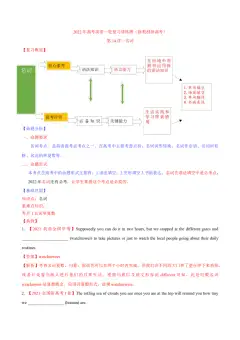
一 命题规律 ①名词复数;②名词所有格;③词性转换。
二 备考策略 当所给提示词是名词:①考虑名词复数;②考虑名词所有格;③考虑词性转换。确
定名词为复数的情况:①some, many, all, these,one of...等复数概念的词所修饰的
名词。②谓语动词是复数,名词作主语时。③根据上下文语境。
三 基本知识 定义,分类,名词由单数变复数,不可数名词(物质名词和抽象名词)
四 真题训练 近几年高考中的名词的复数形式专题训练
五 思路点拨 名词在句中的典型用法就是作主语或宾语(位于及物动词或介词后)。如果括号中所
给词是名词,又是在句中作主语或宾语时,就无需作词类转换,应考虑是否需要用
复数形式;如果用于修饰名词时,则应考虑名词所有格。
六 考点归纳 名词的复数形式和名词的所有格
七 考点练透 再次巩固所掌握的知识点体系并能灵活应用
命题规律:
名词复数;名词所有格;词性转换
备考策略:
当所给提示词是名词:①考虑名词复数;②考虑名词所有格;③考虑词性转换。
确定名词为复数的情况:①some, many, all, these,one of...等复数概念的词所修饰的名词。②谓语动
词是复数,名词作主语时。③根据上下文语境。
基本知识:
1.定义:
名词是什么?词类的一种,属于实词。它表示人、事、物、地点或抽象概念的统一名称。
2.分类:
专有名词:是个别的人、 地、 物、 团体、 机构等的专用名称
普通名词:是许多人或事物的共有名称。
2.1. 专有名词:①. 专有名词中实词的第一个字母要大写。Eg:Beijing, Tom, the People's Republic of China
②. 专有名词如果是含有普通名词的短语, 则必须使用定冠词 the。Eg: the Great Wall, the earth, the moon
③. 姓氏名如果采用复数形式, 则表示该姓氏一家人(复数含义)。Eg: the Greens, the Browns, the Blacks
2.2. 普通名词:普通名词是许多人或事物的共有名称。Eg: pupil, family, man, foot
3. 普通名词:
可数名词:可以用简单的数词进行计数的名词,即可以数得清
不可数名词:不可以用简单的数词进行计数的名词即数不清
可数名词单数:= 1 Eg: boy, girl, dog 复数:≧ 2 Eg: boys, girls, dogs
2.名词由单数变复数:
1.可数名词的复数
(1)规则变化
情况 方法 例词
一般情况 加-s students,teachers,doctors,tables
以s,x,ch,sh结 glasses,dishes,boxes,watches,但stomach和
加-es
尾 month复数形式直接加s,即stomachs和months
以辅音字母+y结尾 变y为i再加-es families,babies,armies,bodies, stories
以元音字母+y结尾 加-s boys,toys monkeys
多变f或fe为v,再加-es thieves,wives,knives,shelves,lives
以f或fe结尾
少数加-s beliefs,proofs,roofs,chiefs
元音字母+o通常加-s radios,videos,zoos,tobaccos
以o结尾
辅音字母+o通常加-es heroes,potatoes,tomatoes
注意:①以-o 结尾的下列名词要加-es:“黑人英雄爱吃土豆、西红柿”,即 Negroes,heroes,
potatoes,tomatoes。
②以-f或-fe结尾的名词需要把f或fe去掉,加-ves:“为了自己活命,小偷和他的妻子手里拿着刀子
和树叶站在架子上,把狼劈成两半”,即 selves,lives,thieves,wives,knives,leaves,shelves,
wolves,halves。
巧记 以-f或-fe结尾的名词
妻子持刀去宰狼,小偷吓得发了慌;躲在架后保己命,半片树叶遮目光。
九个以-f(e)结尾的名词。wife(妻子)、knife(刀子)、wolf(狼)、thief(小偷)、shelf(架子)、self
(自己)、 life(生命)、half(一半)、leaf(树叶)
这些名词以-f(e)结尾变复数时,将-f(e)变v再加es。还有以-self结尾的反身代词复数用法也同样,如:
myself-ourselves. yourself-yourselves.
serf(农奴)、chief(首领)、belief(信仰)、safe(保险柜)、gulf(海湾), proof(证据), roof(屋顶),
cliff(悬崖) 直接加-s变为复数形式。
另外 handkerchief(手帕;头巾)可用两种复数形式。handkerchiefs 或 handkerchieves.
(2)不规则变化child孩子→children, woman→women妇女, man男人→men,tooth牙→teeth,
foot 脚→feet;英尺→ feet,mouse 老鼠→mice,phenomenon 现象→phenomena,
自身变化
medium 传播媒介→media,policewoman→policewomen 女警察 ox 牛→oxen,
的名词
goose鹅→geese analysis分析→analyses basis 基础;根据→bases
crisis危机→crises criterion→criteria标准 bacterium→bacteria细菌
Chinese中国人;sheep 绵羊;deer鹿;series 系列;species物种
单复数同 spacecrafts 宇宙飞船;航天器;crossroads 十字路口; aircrafts 飞行器;
形名词 headquarters总部;总公司;总办事处;means 方式;works 工厂;fish 鱼;fruit 水果
等。其中fish,fruit表示种类时,可加复数词尾,即fishes,fruits
son-in-law→sons-in-law女婿,passer-by→passers-by过路人,
合成名词 story-teller→story-tellers讲故事的人 father-in-law→fathers-in-law岳父/公公
comrade-in-arms→comrades-in-arms战友 editor-in-chief→editors-in-chief主编
由-man(或-woman)构成的派生名词,应把-man(或-woman)变成复数形式-men(或-women) ;但若是由man(或
woman)作前置定语,则常把定语和被修饰词都变成复数,即“men(或 women) +复数名词”。例如:
firewoman→firewomen女消防员 man doctor→men doctors男医生
woman teacher→women teachers 女教师
Every possible means has been tried, but none has worked.每一种可能的方式都已经被尝试了,但是没有起作
用的。
2.不可数名词(物质名词和抽象名词)
(1)只用作不可数名词的名词:advice,furniture,fun, information,news,weather,progress,wealth等。不
可数名词一般没有复数形式, 说明其数量时, 要用有关计量名词。
Eg: a bag of rice→two bags of rice, a piece of paper→three pieces of paper,
a bottle of milk→five bottles of milk.
各种物质的统称:
bread面包 beer啤酒 cloth
布 coffee咖啡
cream奶油 dust尘土 gin杜松子
酒 glass玻璃
gold黄金 ice冰 jam果
酱 oil油
paper纸 sand沙 soap肥皂
stone石头tea茶 water水 wine葡萄
酒 wood木头
抽象名词:
advice忠告/主意 beauty美丽,漂亮 courage勇
气 death死亡
experience经验 fear担心 help帮
助 hope希望
horror恐惧 information消息/信息 knowledge知
识 mercy仁慈
pity同情 relief救济 suspicion
猜疑 work工作
在英文中下例名词也是不可数名词:
baggage行李 camping露营 damage损
害 furniture家具
luggage 行李 parking停车 shopping购
物 weather气候
这些名词和hair(头发)、information(信息)、knowledge(知识)、news(新闻)、rubbish(垃
圾)等在其他语言中有时是可数名词。
不可数名词没有复数形式,不能和a/an一起连用:
I don’t want(any) advice or help.I want(some)information.
我不需要任何忠告或帮助。我想得到一些信息。
He has had no experience in this sort of work.
他干这种活没经验。
这些名词前往往加some(一些),any(任何),no(没有),a lit-tle(少许)等词,或加名词bit
(一点儿),piece(片),slice(一部分)等+of结构:
a bit of news一件消息
a cake of soap一块肥皂
a drop of oil一滴油
a grain of sand一粒沙子
a pane of glass一块玻璃a piece of advice一条忠告
a pot of jam一罐果酱
a sheet of paper一页纸
以上几组词中的大部分在特殊情况下可用为可数名词,可在单数前加a/an,也可变为复数形式:
例如,hair指一个人头上的全部头发时,是不可数名词;如果指每一根毛发时,就是可数的,可以说
one hair(一根头发),two hairs(两根头发等):
Her hair is black.Whenever she finds a grey hair she pulls it out.
她的头发是黑的。她只要发现有一根白发就将它拔掉。
可以说喝beer(啤酒),coffee(咖啡),gin(杜松子酒),但要酒水的时候说a(cup of)coffer
(一杯啤酒),a gin(一杯杜松子酒),two gins(两杯杜松子酒)等。
可以说喝wine(葡萄酒),但必须说enjoy a good wine(品尝一种好酒),喝酒时用a glass或glasses
(玻璃杯),也可以walk ina wood/woods(在小树林里散步)。
experience指某人的经历时是可数名词:
He had an exciting experience/some exciting experiences(=adventure/s)last week.
上星期他有一次/一些激动人心的经历。
work指职业/就业/工作时是不可数名词:
He is looking for work/for a job.
他在求职/找一份工作。
works(只有复数形式)可意为“工厂”或“机器的运转部分”。
works(通常用复数形式)指文学或音乐作品:
Shakespeare’s complete works莎士比亚全集
一些抽象名词具有特殊意义时可带a/an:
这些词有:
a help:
My children are a great help to me.
孩子们是我的得力帮手。
A good map would be a help.
一张好地图可能会有用处。a relief:
It was a relief to sit down.
坐下来感到松了口气。
a knowledge+of:
He had a good knowledge of mathematics.
他深谙数学。
a dislike(讨厌)/dread(害怕)/hatred(仇恨)/horror(害怕)/love(热爱)+of结构也可这
样使用:
a love of music对音乐的爱好
a hatred of violence对暴力的憎恨
a mercy(仁慈)/pity(怜悯)/shame(耻辱)/wonder(惊奇)可以和it引导的that从句一起使
用:
It’s a pity you weren’t here.
你当时不在场太遗憾了。
It’s a shame he wasn’t paid.
他没拿到酬劳真丢人。
it+be+a pity/shame+动词不定式结构也是可能的:
It would be a pity to cut down these trees.
如果把这些树砍掉,那太可惜了。
a fear/fears(忧虑),a hope/hopes(希望),a suspicion/suspicions(猜疑)
这类词可与由there引导的that从句连用:
There is a fear/There are fears that he has been murdered.
恐怕他已经被谋杀了。
也可以用have a suspicion that…结构。
一件事可以arouse a fear/fears,a hope/hopes,a suspicion/suspicions等,意思是引起恐惧/希望/
怀疑等。
(2)抽象名词具体化:抽象名词与a(an)连用,淡化了抽象概念,转化为具体的动作、行为或类别等概念。单词 抽象名词意义 具体化名词意义
success 成功 成功的人或事
pleasure 乐趣 令人高兴的事
beauty 美;美丽 美丽的人或事物
comfort 安慰;慰藉 令人感到安慰的人或事物
danger 危险 危险的人或因素
delight 高兴 令人高兴的事
failure 失败 失败的人或事物
surprise 惊奇 令人惊奇的事情
shock 震惊 令人震惊的事情
pride 骄傲 令人骄傲的人或事情
Your contribution will certainly make the event a huge success.
你的贡献一定会使这个事件很成功。
真题训练:
1.(2023年新课标全国Ⅱ卷·61) They also need to be ready to give ___61___ (interview) in English with
international journalists.
【解析】考查名词复数。根据后文的with international journalists可知 “采访”不止一次,故填
interviews。
2.(2023年全国乙卷·64) But for all its ancient buildings, Beijing is also a place that/which welcomes the fast-
paced development of modern life, with 21st-century architectural ____64____ (wonder) standing side by side
with historical buildings of the past.
【解析】考查名词。本句中的wonder 意为 “奇观”,是可数名词,故填其复数形式wonders。
3.(2022年新高考Ⅰ卷·62) The GPNP’s main goal is to improve connectivity between separate _____________
(population) and homes of giant pandas, and eventually achieve a desired level of population in the wild.
【解析】因population表示“种群;族群”时是可数名词,再由与之并列的homes可知,此处应用复数的
形式,故填populations。
4.(2022年新高考Ⅱ卷·64) “He saved my _______ (son) life,” said Mrs. Brown. “I don’t know how to thank him.”
【解析】因life与son之间是所属关系,故应用名词所有格,故填son’s。
5.(2021年新高考Ⅰ卷·57) The rolling sea of clouds you see once you are at the top will remind you how tiny we
_________ (human) are.
【解析】由are可知,此处应用复数形式,故填humans。6.(2021 年全国甲卷·49) Supposedly you can do it in two hours, but we stopped at the different gates and
_____________ (watchtower) to take pictures…
【解析】因被different修饰,故用复数形式,且前文的gates也有提示,故填watchtowers。
7.(2021 年 全 国 乙 卷 ·69) _________ (activity) there range from whale watching to hiking ( 远 足 ) and
accommodations aim to have a low impact on the natural environment.
【解析】由谓语动词range可知主语应用复数形式。位于句首,首字母应大写,故填Activities。
8.(2018年全国Ⅰ卷·67) Two of the authors of the review also made a study published in 2014 that showed a
mere five to 10 minutes a day of running reduced the risk of heart disease and early deaths from all ________
(cause).
【解析】由前面的all可知,要用复数形式,故填causes。
9.(2017 全国Ⅰ卷·62) This trend, …, has had some unintended side _________(effect) such as overweight and
heart disease…
【解析】表示“一些副作用”,故用复数,从后面举了两种病例也可知用复数,故填effects。
10.(2017全国Ⅱ卷·61) It ran for just under seven kilometers and allowed people to avoid terrible ________
(crowd) on the roads…
【解析】表示泛指的人群,用复数,故填crowds。
11.(2017 全国Ⅲ卷·67) She has turned down several ___________(invitation) to star at shows in order to
concentrate on her studies.
【解析】由前面的several可知,要用复数形式,故填invitations。
12.(2016全国Ⅲ卷·66) Recent _________ (study) show that we are far more productive at work if we take short
breaks regularly.
【解析】作主语用其名词形式,而study表示“研究”本身可以作名词;又由谓语动词 show可知,主语应
为复数,故填studies。
13.(2015全国I卷·65) …seeking the limestone mountain tops and dark waters of the Li River which are pictured
by artists in so many Chinese _________ (painting).
【解析】因被many修饰,故要用复数形式, 故填paintings。
14.(2014 全 国 I 卷 ·49) While there are amazing stories of instant transformation, for most of us the
_________(change) are gradual and require a lot of effort and work, like cleaning up a polluted river.
【解析】作主语要用名词,或者说冠词后应当用名词,change除作动词外也可作名词,所以词性不必变
化;由紧接着的are可知,要用复数形式, 故填changes。
思路点拨:我们知道,名词在句中的典型用法就是作主语或宾语(位于及物动词或介词后)。如果括号中所给词是
名词,又是在句中作主语或宾语时,就无需作词类转换,应考虑是否需要用复数形式;如果用于修饰名词
时,则应考虑名词所有格。
判断是否需要复数形式的4条依据:
1. 依据修饰语。由前面的many, several, few, some, all, both, one of等可知用复数形式。
2. 依据主谓一致。由谓语动词为复数推知主语也应是复数。
3. 依据并列成分。
4. 依据生活常识。
5. 依据列举的例子。
考点归纳:
关于名词,从近几年的高考题来看,在语法填空中只考查了名词的复数形式和名词的所有格。
1. 名词的复数形式
英语中的名词,只要大于一,就要用复数形式,如“一个半小时”要说one and a half hours (=an hour and a
half)。可数名词由单数变复数一般是在词尾加s,但还有以下几点需要牢记:
(1) 以-s, -x, -sh, -ch结尾的,加-es。如:bus—buses, fox—foxes, brush—brushes, approach—approaches等。
例外:stomach—stomachs。
(2) 以“辅音字母+y”结尾的,变 y 为 i,再加-es。如:story—stories, baby—babies, activity—activities,
agency—agencies等。
(3) 以-f(e)结尾的常用词,变f(e)为v, 再加-es。
如:half—halves, life—lives, thief—thieves, knife—knives,self—selves, leaf—leaves, loaf—loaves, wolf—
wolves等。此外,一般直接加s。如:chief—chiefs, roof—roofs, proof—proofs, belief—beliefs, safe—safes(保
险柜)等。
(4) 以-o结尾的有生命的名词,加-es。如:hero—heroes, potato—potatoes, tomato—tomatoes等。 此外,
一般直接加-s。 如:radio—radios, zoo—zoos, photo—photos, piano—pianos等。
(5) 不规则变化的有:man—men, woman—women, foot—feet, tooth—teeth, goose—geese, mouse—mice, child
—children, ox—oxen等。
(6) 单复数同形的有:deer, fish, sheep, aircraft, spacecraft, means等。
2. 名词的所有格
名词所有格表示所有关系,即“某某的”,主要有以下几种情况:
(1) 不以-s结尾的名词(单数或复数),加-’s。如:Jack’s e-mail杰克的电子邮件,children’s books儿童图书,today’s new今天的新闻。
(2) 以-s结尾的复数名词,加-’。如:the girls’ dormitory女生宿舍, the teachers’ reading-room教
师阅览室,five minutes’ walk走路五分钟的路程。
(3) 以-s结尾的单数名词,加-’s或-’。如:our boss’s (boss’) car我们老板的小汽车,Engels’s (Engels’) works
恩格斯的著作。
(4) 双重所有格
名词+of+名词+’s:this watch of my father’s 我父亲的这块手表
名词+of+名词性物主代词:some students of mine 我的一些学生
考点练透:
1. I broke the chocolate into _________(half) and here’s your half.
【解析】句中break/cut sth into halves意思是“把某物分成两半”, 故填halves。
2. The club provides a wide variety of _________ (activity) including tennis, swimming and cycling.
【解析】因被a wide variety of (多种多样的)修饰,故要用复数形式, 故填activities。
3. Her _______ (tooth) are false,but they look very natural.
【解析】由are可知,tooth要用复数形式teeth, 故填teeth。
4. The ______ (deer) in the forest are all dying off from disease.
【解析】由are可知,deer要用复数,但deer, sheep等的复数形式与单数形式相同, 故填deer。
5. He distinguished himself as a student at the ______ (city) leading school.
【解析】在名词前作定语,表示“这个城市的”重点学校,用其所有格形式, 故填city’s。
6. The sisters were treated as local ________ (hero) after rescuing a two-year-old boy from drowning.
【解析】指The sisters,可知hero要用复数,hero, tomato, potato的复数形式是在后面加-es, 故填heroes。
7. Sometimes they attribute their ________ (student) poor comprehension to a lack of intelligence.
【解析】指他们的学生,student应用复数,“学生的”理解力差,故用所有格, 故填students’。
8.The nursery team switches him every few________(day) with his sister so that while one is being
bottle-fed...
【解析】考查名词复数。由 few修饰可数名词复数可知,此空填 days。 every few days 是"每隔几
天"的意思, 故填days。
9.Making Chinese ________ (dish) is seen as especially troublesome.
【解析】 此处dish是可数名词,其前无限定词,故用其复数形式泛指中国菜,故填dishes。10.Last October, while tending her garden in Mora,Sweden, Lena Pahlsson pulled out a handful of
small________ (carrot) and was about to throw them away.
【解析】考查名词单复数。根据上文的"a handful of"可知,此处表示一把小胡萝卜,另外,throw them
away中的them 也指小胡萝卜,所以应用carrot的复数形式carrots。
11. Julie is one of those _________ (woman) who always keep up with the latest fashions.
【解析】被those修饰,故要用复数形式, 故填women。
![《专题09名词的复数形式(解析版)_3.2025英语总复习_2024年新高考资料_3.2024专项复习_[高考字典]2024年高考英语一轮复习语法填空专题应对策略(通用版)》第1页预览](https://static.diaifu.net/ssd/ssd5/wenku/2026-03-11/d7708fc01aab425b7c8175062e83c9f2/d7708fc01aab425b7c8175062e83c9f2_1.webp)
![《专题09名词的复数形式(解析版)_3.2025英语总复习_2024年新高考资料_3.2024专项复习_[高考字典]2024年高考英语一轮复习语法填空专题应对策略(通用版)》第2页预览](https://static.diaifu.net/ssd/ssd5/wenku/2026-03-11/d7708fc01aab425b7c8175062e83c9f2/d7708fc01aab425b7c8175062e83c9f2_2.webp)
![《专题09名词的复数形式(解析版)_3.2025英语总复习_2024年新高考资料_3.2024专项复习_[高考字典]2024年高考英语一轮复习语法填空专题应对策略(通用版)》第3页预览](https://static.diaifu.net/ssd/ssd5/wenku/2026-03-11/d7708fc01aab425b7c8175062e83c9f2/d7708fc01aab425b7c8175062e83c9f2_3.webp)
![《专题09名词的复数形式(解析版)_3.2025英语总复习_2024年新高考资料_3.2024专项复习_[高考字典]2024年高考英语一轮复习语法填空专题应对策略(通用版)》第4页预览](https://static.diaifu.net/ssd/ssd5/wenku/2026-03-11/d7708fc01aab425b7c8175062e83c9f2/d7708fc01aab425b7c8175062e83c9f2_4.webp)
![《专题09名词的复数形式(解析版)_3.2025英语总复习_2024年新高考资料_3.2024专项复习_[高考字典]2024年高考英语一轮复习语法填空专题应对策略(通用版)》第5页预览](https://static.diaifu.net/ssd/ssd5/wenku/2026-03-11/d7708fc01aab425b7c8175062e83c9f2/d7708fc01aab425b7c8175062e83c9f2_5.webp)
![《专题09名词的复数形式(解析版)_3.2025英语总复习_2024年新高考资料_3.2024专项复习_[高考字典]2024年高考英语一轮复习语法填空专题应对策略(通用版)》第6页预览](https://static.diaifu.net/ssd/ssd5/wenku/2026-03-11/d7708fc01aab425b7c8175062e83c9f2/d7708fc01aab425b7c8175062e83c9f2_6.webp)