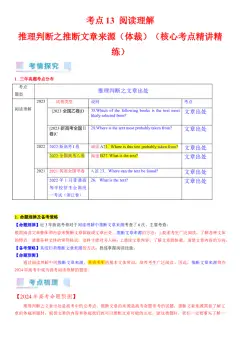
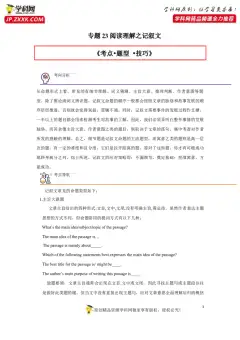
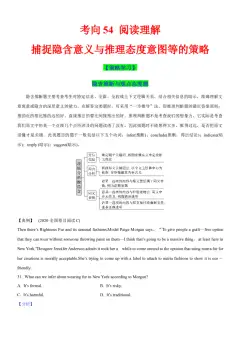
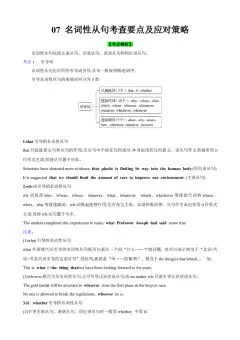
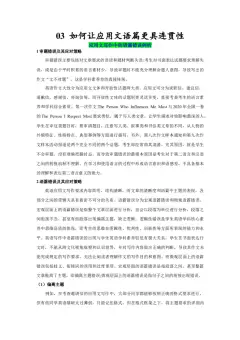
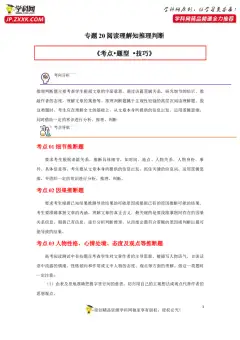
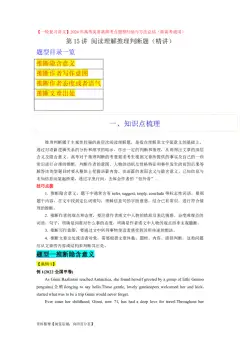
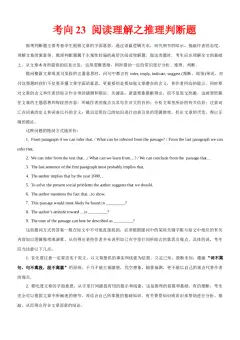
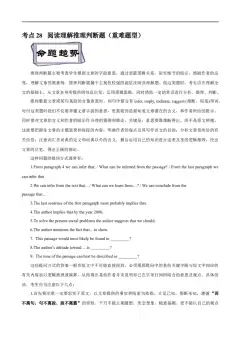
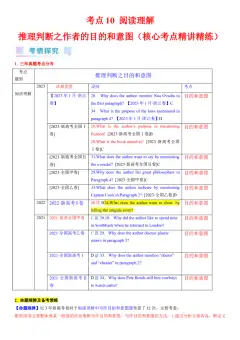
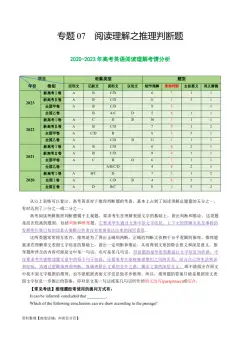
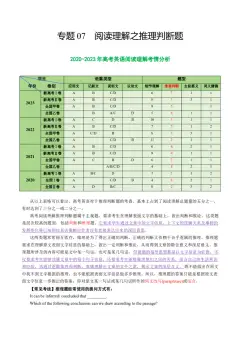
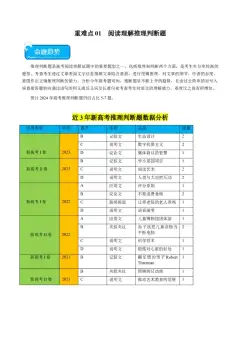
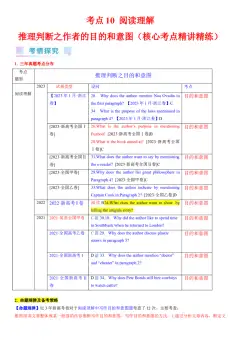
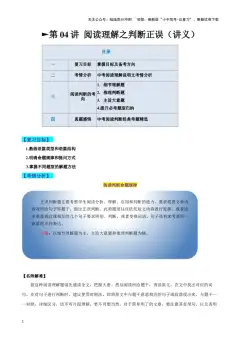
12 阅读理解推理判断题微观应对策略
【策略精析】
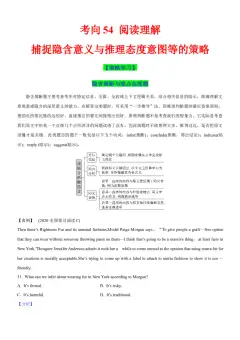
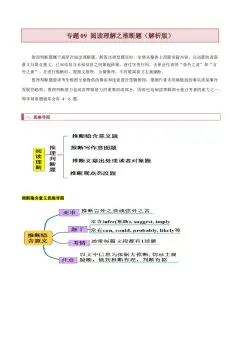
一、隐含推断与观点态度题
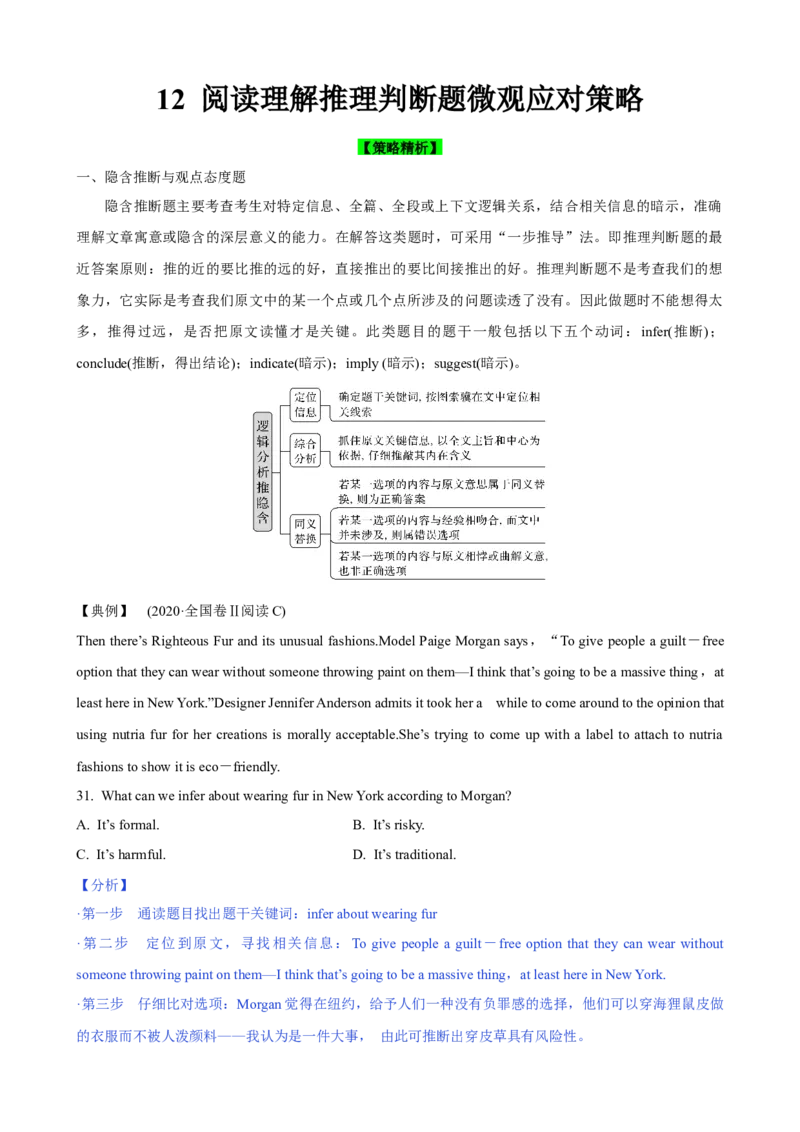
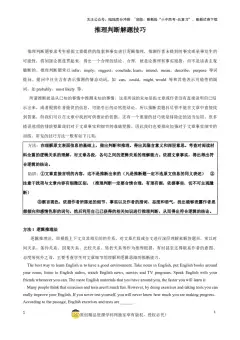
隐含推断题主要考查考生对特定信息、全篇、全段或上下文逻辑关系,结合相关信息的暗示,准确
理解文章寓意或隐含的深层意义的能力。在解答这类题时,可采用“一步推导”法。即推理判断题的最
近答案原则:推的近的要比推的远的好,直接推出的要比间接推出的好。推理判断题不是考查我们的想
象力,它实际是考查我们原文中的某一个点或几个点所涉及的问题读透了没有。因此做题时不能想得太
多,推得过远,是否把原文读懂才是关键。此类题目的题干一般包括以下五个动词:infer(推断);
conclude(推断,得出结论);indicate(暗示);imply (暗示);suggest(暗示)。
【典例】 (2020·全国卷Ⅱ阅读C)
Then there’s Righteous Fur and its unusual fashions.Model Paige Morgan says,“To give people a guilt-free
option that they can wear without someone throwing paint on them—I think that’s going to be a massive thing,at
least here in New York.”Designer Jennifer Anderson admits it took her a while to come around to the opinion that
using nutria fur for her creations is morally acceptable.She’s trying to come up with a label to attach to nutria
fashions to show it is eco-friendly.
31. What can we infer about wearing fur in New York according to Morgan?
A. It’s formal. B. It’s risky.
C. It’s harmful. D. It’s traditional.
【分析】
·第一步 通读题目找出题干关键词:infer about wearing fur
·第二步 定位到原文,寻找相关信息:To give people a guilt-free option that they can wear without
someone throwing paint on them—I think that’s going to be a massive thing,at least here in New York.
·第三步 仔细比对选项:Morgan觉得在纽约,给予人们一种没有负罪感的选择,他们可以穿海狸鼠皮做
的衣服而不被人泼颜料——我认为是一件大事, 由此可推断出穿皮草具有风险性。观点态度题是高考英语阅读理解常考的一种题型,也是考生很容易失分的一种题型。文章作者或文
中人物对某事物所持的情感、观点或态度往往隐含在文章的字里行间或流露于修饰词之中。常见的设问
方式有:
·How does the author feel about...?
·What does the author think of...?
·What is the author’s attitude towards/to...?
·The author’s attitude towards...can be described as ________.
▲4关注1不要
(1)关注首段首尾句,确定文章主题,判断作者的观点态度。
(2)关注but后表示观点态度的语句来判断作者或文中人物的观点。
(3)关注作者所举的例子或者所引用的话语,来判断文章作者或文中人物的态度倾向。
(4)关注文章语言的褒贬去判断作者的态度。
(5)不要将个人的好恶态度糅进题中,要学会分清作者本人的态度和作者引用观点的态度。
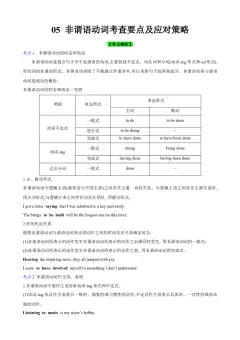
▲4类选项常用词汇
positive积极乐观的;optimistic乐观的;supportive支持的;hopeful有希望
肯定
的;promising有前途的;favourable赞许的
negative否定的,消极的;disapproving 不赞成的;critical 批评的;
否定
unfavourable不赞同的
怀疑 suspicious可疑的,怀疑的;doubtful可疑的
客观 objective客观的;neutral中立的;skeptical怀疑的
【典例】 (2020·全国卷Ⅲ阅读C)
“We floated the idea to my mum of sharing a house,”says Kathryn Whitehead.Rita cuts in:“We spoke more
with Nick because I think it’s a big thing for Nick to live with his mother-in-law.”
And what does Nick think?“From my standpoint,it all seems to work very well.Would I recommend it?
Yes,I think I would.”
29. What is Nick’s attitude towards sharing the house with his mother-in-law?
A. Positive. B. Carefree.
C. Tolerant. D. Unwilling.
【分析】
·第一步 通读题目找出题干关键词:Nick’s attitude towards sharing the house with his mother-in-law
·第二步 定位到原文,寻找相关信息:“From my standpoint,it all seems to work very well.Would I
recommend it? Yes,I think I would.”
·第三步 仔细比对选项:尼克对于与岳母住在一起持积极的态度。
二、写作意图题与文章出处/读者对象题一般情况下,作者在文中不直接陈述自己的意图,而是通过文中所列事物使读者感受到其所传递的
想法。所以,这种题型要求考生具备对作者阐述的内容进行总结和分析的能力,是阅读理解题中较高层
次的题目,它与文章主题不同,但又关系密切,所以可以算作主旨大意题的一种变体。
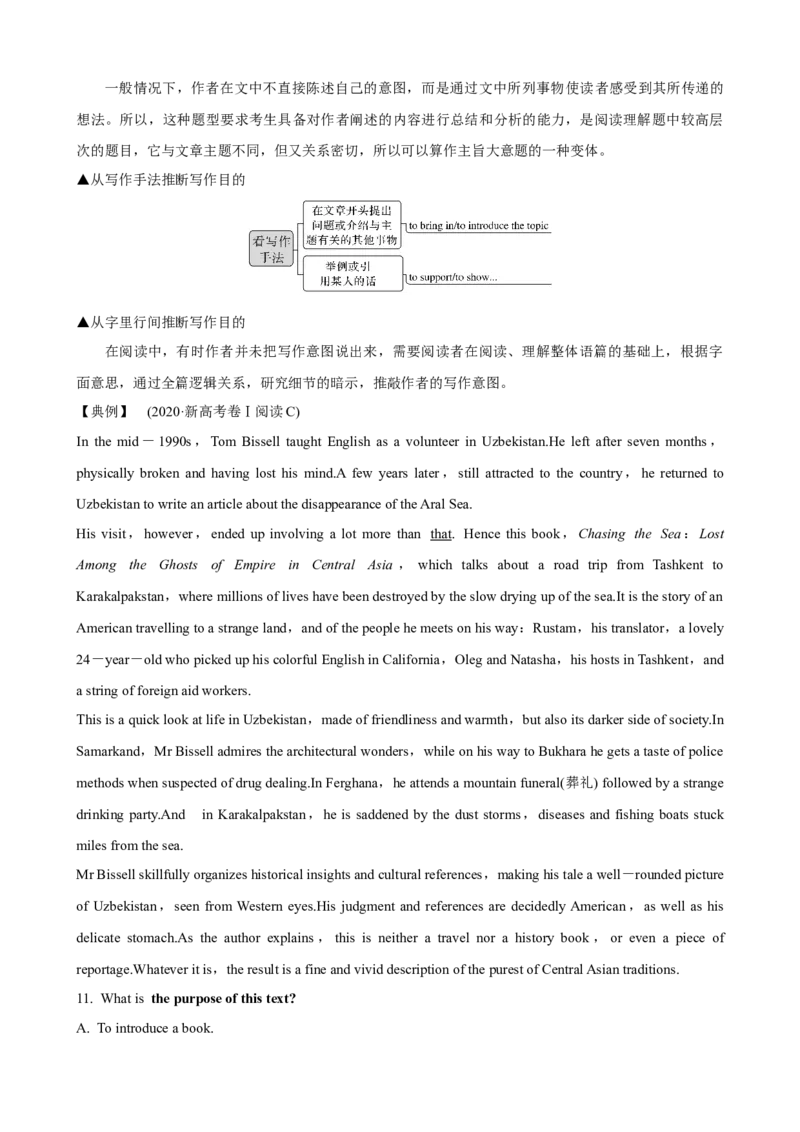
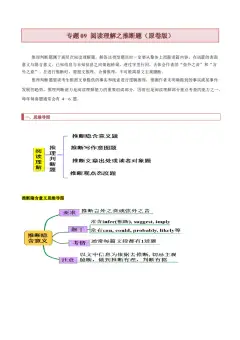
▲从写作手法推断写作目的
▲从字里行间推断写作目的
在阅读中,有时作者并未把写作意图说出来,需要阅读者在阅读、理解整体语篇的基础上,根据字
面意思,通过全篇逻辑关系,研究细节的暗示,推敲作者的写作意图。
【典例】 (2020·新高考卷Ⅰ阅读C)
In the mid-1990s,Tom Bissell taught English as a volunteer in Uzbekistan.He left after seven months,
physically broken and having lost his mind.A few years later,still attracted to the country,he returned to
Uzbekistan to write an article about the disappearance of the Aral Sea.
His visit,however,ended up involving a lot more than that. Hence this book,Chasing the Sea:Lost
Among the Ghosts of Empire in Central Asia , which talks about a road trip from Tashkent to
Karakalpakstan,where millions of lives have been destroyed by the slow drying up of the sea.It is the story of an
American travelling to a strange land,and of the people he meets on his way:Rustam,his translator,a lovely
24-year-old who picked up his colorful English in California,Oleg and Natasha,his hosts in Tashkent,and
a string of foreign aid workers.
This is a quick look at life in Uzbekistan,made of friendliness and warmth,but also its darker side of society.In
Samarkand,Mr Bissell admires the architectural wonders,while on his way to Bukhara he gets a taste of police
methods when suspected of drug dealing.In Ferghana,he attends a mountain funeral(葬礼) followed by a strange
drinking party.And in Karakalpakstan,he is saddened by the dust storms,diseases and fishing boats stuck
miles from the sea.
Mr Bissell skillfully organizes historical insights and cultural references,making his tale a well-rounded picture
of Uzbekistan,seen from Western eyes.His judgment and references are decidedly American,as well as his
delicate stomach.As the author explains,this is neither a travel nor a history book,or even a piece of
reportage.Whatever it is,the result is a fine and vivid description of the purest of Central Asian traditions.
11. What is the purpose of this text?
A. To introduce a book.B. To explain a cultural phenomenon.
C. To remember a writer.
D. To recommend a travel destination.
【分析】
·第一步 审读题目找出题干关键词:the purpose of this text
·第二步 从字里行间推断写作目的:迅速读懂原文理清文章脉络:文章开头引出汤姆·比塞尔写书的背景,
从第二段到最后一段分别介绍了这本书的概要、主要内容和对这本书的评价。
·第三步 仔细比对选项:全文围绕着这本书展开,目的就是向读者介绍并推荐这本书。
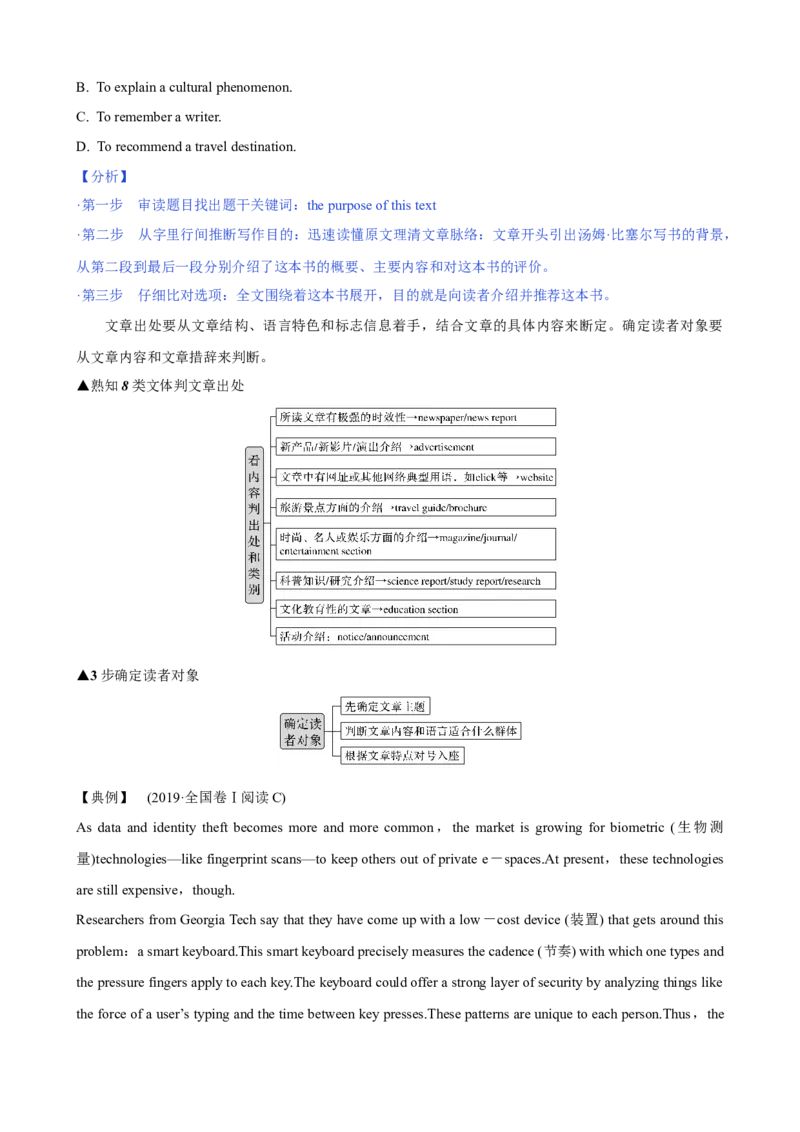
文章出处要从文章结构、语言特色和标志信息着手,结合文章的具体内容来断定。确定读者对象要
从文章内容和文章措辞来判断。
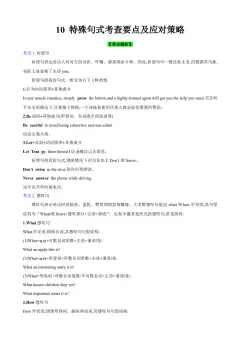
▲熟知8类文体判文章出处
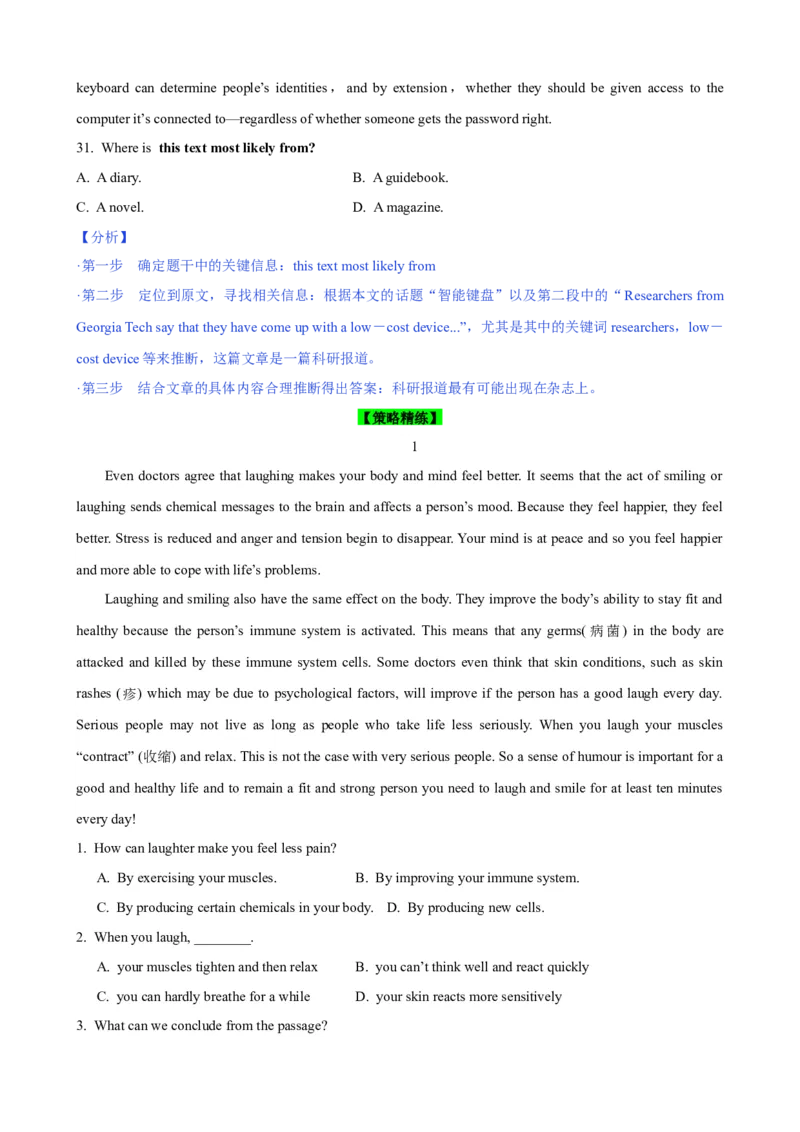
▲3步确定读者对象
【典例】 (2019·全国卷Ⅰ阅读C)
As data and identity theft becomes more and more common,the market is growing for biometric (生物测
量)technologies—like fingerprint scans—to keep others out of private e-spaces.At present,these technologies
are still expensive,though.
Researchers from Georgia Tech say that they have come up with a low-cost device (装置) that gets around this
problem:a smart keyboard.This smart keyboard precisely measures the cadence (节奏) with which one types and
the pressure fingers apply to each key.The keyboard could offer a strong layer of security by analyzing things like
the force of a user’s typing and the time between key presses.These patterns are unique to each person.Thus,thekeyboard can determine people’s identities,and by extension,whether they should be given access to the
computer it’s connected to—regardless of whether someone gets the password right.
31. Where is this text most likely from?
A. A diary. B. A guidebook.
C. A novel. D. A magazine.
【分析】
·第一步 确定题干中的关键信息:this text most likely from
·第二步 定位到原文,寻找相关信息:根据本文的话题“智能键盘”以及第二段中的“Researchers from
Georgia Tech say that they have come up with a low-cost device...”,尤其是其中的关键词researchers,low-
cost device等来推断,这篇文章是一篇科研报道。
·第三步 结合文章的具体内容合理推断得出答案:科研报道最有可能出现在杂志上。
【策略精练】
1
Even doctors agree that laughing makes your body and mind feel better. It seems that the act of smiling or
laughing sends chemical messages to the brain and affects a person’s mood. Because they feel happier, they feel
better. Stress is reduced and anger and tension begin to disappear. Your mind is at peace and so you feel happier
and more able to cope with life’s problems.
Laughing and smiling also have the same effect on the body. They improve the body’s ability to stay fit and
healthy because the person’s immune system is activated. This means that any germs(病菌) in the body are
attacked and killed by these immune system cells. Some doctors even think that skin conditions, such as skin
rashes (疹) which may be due to psychological factors, will improve if the person has a good laugh every day.
Serious people may not live as long as people who take life less seriously. When you laugh your muscles
“contract” (收缩) and relax. This is not the case with very serious people. So a sense of humour is important for a
good and healthy life and to remain a fit and strong person you need to laugh and smile for at least ten minutes
every day!
1. How can laughter make you feel less pain?
A. By exercising your muscles. B. By improving your immune system.
C. By producing certain chemicals in your body. D. By producing new cells.
2. When you laugh, ________.
A. your muscles tighten and then relax B. you can’t think well and react quickly
C. you can hardly breathe for a while D. your skin reacts more sensitively
3. What can we conclude from the passage?A. Laughter can help you live longer.
B. Funny movies can help you with better breathing.
C. Jokes and humour can make you more decisive.
D. People with a good sense of humour don’t get heart disease.
2
At first, the scientists wondered whether it was a mistake. Just 21 days after leaving the Norwegian island of
Spitsbergen, an arctic fox had arrived in Greenland. And in less than three months, it made it to Canada.
The fox averaged nearly 30 miles a day- some days, though, it walked almost 100 miles. “When it started
happening, we thought 'is this really true?” said Arnaud Tarroux, one of the researchers who tracked the female
fox “Was there an deviation in the data?” The scientists found the data was real as the fox kept going. The
creature's travels last year, recorded in a recent paper, surprised Tarroux and his fellow Norwegian researcher Eva
Fuglei, even though the animal is known for its endurance and ability to survive in extreme polar areas.
Scientists already knew that some of the foxes, native to Arctic areas all around the Northern Hemisphere,
made long journeys, but the fox these researchers followed stood out for just how fast it covered more than 2,700
miles. “We didn't really know how they would do that and how long it would take for an individual to do this kind
of trip,” Tarroux said.
The coastal fox the researchers tracked, also known as a blue fox, landed in Ellesmere Island in Canada on 1
July 2018. Of the 50 or 60 animals the scientists put trackers on for a study, it was the only one that dared to go
outside of Norway. The researchers found the fox set off because of a food shortage. The tracker stopped working
in February, so researchers no longer know the fox's location, but it was last discovered on the same Canadian
island in the area of Nunavut.
4. How many miles can the arctic fox travel in a single day at most?
A. Less than 40 kilometers. B. Less than 50 miles.
C. Almost 100 miles. D. Almost 180 miles.
5. What does the underlined word “deviation” in paragraph 2 mean?
A. Proof. B. Joke. C. Mistake. D. Task.
6. Where was the fox after leaving Norwegian island for 3 months?
A. In Canada. B. In Greenland. C. In Arctic areas. D. In Spitsbergen.
7. What can we infer from the text?
A. The fox travelled exactly 2,700 miles. B. 50 or so foxes are outside Norway.
C. The fox landed in Canada last year. D. The fox traveled because of food.
3In the research carried out at Tubingen University, scientists tracked the emotional(情绪的) responses of
Facebook users in Germany and the US. They found that reading other people’s positive posts brought happiness
to 64% of the people.
Think of it this way: Your good news positively influences your friends, who in turn positively influence
their friends. With one positive post, you can brighten up the day of someone you have never met.
Researchers from four universities across the United States partnered with ehairmony, a popular dating
website in America. They found that sharing positive news between partners increased happiness and life
satisfaction.
Sharing your positive news also, research suggests, has direct benefits for you. Communicating a positive
experience, you have had with another person heightens the powerful effect of the positive experience itself,
because you get to relive the experience.
Then, how about negative emotions? An online social network study in the US analyzed data from millions
of Facebook users. And it found that rainfall would negatively affect the emotional content of people’s status
updates(状态更新). And this influenced the negativity of posts made by friends in other cities who were not
experiencing rainfall. Negativity, it showed, brings negativity.
Understanding the impact good and bad news can have on our moods is important for many reasons. The
common aspect of these studies is that they show we want to hear good news and we are using social media as a
medium to create and spread it.
Further evidence for this desire for cheering news can be found in the development of websites such as
Positive News. It has become the world’s first crowd-funded(大众集资的) global media organization since being
established in July. The website is now owned by 1,526 readers, journalists and supporters.
Sharing your good news might seem like a small gesture, but it can have a big effect and provide people with
a life boat in the sea of negativity that is often mainstream media. Isn’t it we guided our own boat?
8. What does Paragraph 2 intend to do?
A. Show us the strong influence of Facebook.
B. Help us rethink the relationship between strangers.
C. Show us the rapid spread of information on the Internet.
D. Help us better understand the online emotional responses.
9. What can you gain from sharing your positive experiences?
A. A chance to go through them again.
B. An opportunity to make new friends.
C. A different view on happiness and life satisfaction.D. An obvious improvement in your communication skills.
10. What does Paragraph 5 mainly talk about?
A. Rainfall affects people’s emotions.
B. Facebook users’ personal data are unsafe.
C. Friends in different cities often chat on Facebook.
D. Negative feelings can also spread through social networks.
11. The popularity of Positive News can show ________.
A. the great importance of the Internet
B. people’s preference for positive news
C. the latest development of social media
D. people’s desire for more online information
4
Experts are warning about the risks of extreme picky eating after a teenager developed permanent sight loss
after living on a diet of chips and crisps.
Since leaving primary school, the teen had been eating only French fries, white bread, as well as an
occasional slice of ham or a sausage.
The adolescent, who cannot be named, had seen his doctor at the age of 14 because he had been feeling tired
and unwell. At that time he was diagnosed with lack of vitamin B12 and put on supplements, but he did not stick
with the treatment or improve his poor diet.
Three years later, he was taken to the Bristol Eye Hospital because of progressive sight loss. Dr Denize Atan,
who treated him at the hospital, said: "His diet was only a portion of chips from the local fish and chip shop every
day. He also used to snack on chips, white bread and sometimes slices of ham or sausage, and not really any fruit
and vegetables."
The teen explained this as a dislike to certain kinds of food that he really could not tolerate, and so chips and
crisps were really the only types of food that he wanted and felt that he could eat.
Dr Aan rechecked the young man's vitamin levels and said "he was low in B12 as well as some other
important vitamins and minerals - copper, selenium and vitamin D. He was not over or underweight, but was
severely malnutritional from his eating disorder. He had lost minerals from his bone, which was really quite
shocking for a boy of his age.”
"He had blind spots right in the middle of his vision," said Dr Atari's assistant. "That means he can't drive and
would find it really difficult to read, watch TV or recognize faces, but he can walk around on his own because he
has got peripheral(周边的)vision.The condition the young man has is treatable if diagnosed early. Left too long, however, the nerve fibres in
the optic nerve(视神经)die and the damage becomes permanent.
Now he has been put on vitamin supplements and sent to a dietitian and a specialist mental health team.
12. What can we know about the boy?
A. He didn't see a doctor. B. He can not see anything now.
C. He has a normal body shape. D. He insisted on taking supplements.
13. What kind of food does the boy refuse to eat?
A. Crisps and chips. B. white bread
C. Ham and sausage. D. fruit and vegetables
14. What can we learn from Dr Atan's words?
A. Vegetables and fruit are the only source of vitamins.
B. Lack of vitamins and minerals may lead to the loss of sigh.
C. The more vitamins we take, the betterr.
D. Loss of minerals from bone causes blindness.
15. What column does the passage belong to?
A. Medicine B. Education
C. Economy D. culture
5
On a day in Arkansas, some fishermen saw a bear cub (幼兽) in a tree. As hours went by, its mother didn't
return. So they called wildlife biologist (生物学家) Eastridge.
The bear cub was sick and hungry, weighing only 5 pounds and with his eyes not completely open. Eastridge
called Lisa Stewart, who works at Appalachian Bear Rescue in Tennessee. Stewart always makes room for a new
cub.
She named the bear Miracle because she thought it was a miracle that he had survived! As soon as she could,
she stopped having contact with the cub so he would not become too used to humans. When the cub arrived,
Stewart cleaned his eyes and put him in a house alone. Since Miracle was already 5 months old, Stewart gave him
bowls of food and another bowl of a special formula (配方奶粉), similar to a bear mother's milk. Sometimes,
Miracle would reach his head out of his house and take some formula or food. But he wasn't eating too much.
Miracle was too weak to be with other bears. So Stewart gave him a toy bear named Buddy. He took it into
his house and covered it with straw (稻草). He fed Buddy, too. Stewart often found the toy covered in formula and
berries and its ears full of apple chunks. Now that Miracle had Buddy, he came out of his house more often and
wanted to eat.After two months, Stewart introduced Miracle to other bears so they could learn from one another. She
avoided any direct contact with Miracle and the other bears. Stewart wanted to make sure they stayed afraid of
humans so they could go back into the wild again. She always hid behind a fence (栅栏) and threw food over the
top secretly. The bears hunted for this food as they would soon do in the wild.
Five months later, Rick Eastridge returned to pick up a healthy 90pound Miracle and another bear from
Arkansas named Rocky. Eastridge loaded the bears into boxes on his truck and transported them back to the wild.
As soon as the bear boxes were opened, the two cubs ran for the woods—where they belonged.
16. A toy bear was given to Miracle in order to .
A. remind him not to waste his food
B. kill his lonely time in his house
C. develop his skills of making friends
D. rid Miracle of its fear of humans
17. Why did Stewart always give food to Miracle in secret?
A. Because he could learn how to find food in the wild.
B. Because he was too weak to be frightened by humans.
C. Because a good relationship could be developed.
D. Because she didn't want to disturb his peaceful life.
18. What is the best title for this passage?
A. An Unusual Bear
B. The Growth of Miracle
C. Rescuing Miracle
D. Contacting Miracle
6
Carol Dweck, a psychologist at Stanford, conducted a study in twelve different New York City schools. She
gave more than 400 fifth graders a relatively easy test consisting of puzzles. After the test, the researcher told the
students their score, and provided them with a single line of praise. Half of the kids were praised for their
intelligence. "You must he smart at this, " the researcher said. The other students were praised for their effort:
"You must have worked really hard."
When Dweck was designing the experiment, she expected the different forms of praise to have a rather
modest effect. After all, it was just one sentence. But it soon became clear that the type of compliment given to
the fifth graders has a dramatic effect.
Then Dweck gave the same fifth graders another test that was designed to be extremely difficult. Both groupsmade unavoidable mistakes. After the second test, the students were given the option of looking either at exams of
kid who did worse or those who did better. Students praised for their intelligence almost always chose to increase
their self-esteem(自尊) by comparing themselves with low-performance students. They wanted to understand their
mistakes, to learn from their errors, to figure out how to do better.
Praising kids for their intelligence encourages them to "look" smart, which means that they shouldn't risk
making a mistake. And this fear of failure ran actually prevent learning. Unless we experience the unpleasant
symptoms of being wrong, directing our attention to the very thing we'd like to ignore, the mind will never revise
its models. We'll keep on making the same mistakes, trading self-improvement for self-esteem. Samuel Beckett
had the right attitude: “Ever tried. Ever failed. No matter. Try Again. Fail again. Fail better."
19. What is the focus of Dweck's study?
A. The development of students' self-esteem.
B. The difference in students' intelligence.
C. The effects of different types of praise.
D. The students' performance in puzzle tests.
20. What does the underlined word “compliment” in paragraph 2 mean?
A. Puzzles. B. Praise.
C. Tests. D. Research.
21. Why do students praised for intelligence compare themselves with those who did worse?
A. To improve their self-respect.
B. To figure out how to do better.
C. To understand their own mistakes.
D. To push themselves to work harder.
22. What can we infer from the last paragraph?
A. Being smart is disadvantageous.
B. Learning from mistakes is necessary.
C. Trying only leads to more failures.
D. Making the same mistakes is unavoidable.
7
NAIROBI—Tin Tin, a Chinese restaurant located in central Nairobi, has been serving local Kenyans for
nearly four decades with its delicious dishes and unique cultural background .
"This is a restaurant definitely worth a try,” said Steven, a local resident in his 30s."It has provided Chinese
food since my grandfatherJ s time. ”According to Henry Tin, the restaurant owner, Tin Tin was established in 1978 at the heart of the Nairobi
Central Business District ? upholding Chinese cuisines while adapting to Kenyan preferences .
For years, it has become a defining part of the city's landmark—Kenya International Conference Center—
attracting lots of office workers nearby and even presidential customers .
"The former president of Kenya, Moi, was a very good customer for us. He came almost always in cash.
Then former president Mwai Kibaki and now president Uhuru. They all like to enjoy our food," Tin said.
Danis, an office worker of an insurance company near the KICC says he is a frequenter of the restaurant.
“ It is the only Chinese restaurant in the highly competitive downtown area. Besides, its food has been
adapted to our taste," Danis said, " My favorite dishes are fried shrimp and fried pork, which you can also find in a
Kenyan restaurant. ”
“ High-quality food consistently served over the decades has helped maintain loyal customers, ” Enoch
Kivunaga said, at Tin Tin.
"My experience depends on the customers・ If I cook good food, they always come back, whether they are
presidents or ministers, ” he said.
Tin said he speaks Swahili well and perfectly pronounces local names, which shows the Chinese culture and
its Kenyan counterpart are quickly combining・"I am a Kenyan Chinese. I love both great countries. ”
23. Why was the Chinese restaurant serving local Kenyans popular there ?
A. Because it supplied its unique Kenyan dishes.
B. Because it created favorite fried shrimp and fried pork .
C. Because it served foods in both Kenyan and Chinese flavor.
D. Because it provided only Chinese food of unique characters .
24. What is Nairobi's landmark ?
A. Tin Tin. B. The Nairobi Central Business District.
C. An insurance company building. D. Kenya International Conference Center.
25. What can we infer about Danis' s remark?
A. Chinese restaurants are highly competitive.
B. He really enjoys the delicious Chinese food now.
C. He only has his favorite dishes in Kenyan restaurant.
D. The Chinese restaurant is the only competitive one there.
26. The author develops the article mainly by.
A. giving accurate data B. following time order
C. comparing different ideas D. recording people's words8
In Central America, sea turtle eggs are a popular cuisine dish. The eggs are hugely and secretly harvested
onto tables, leaving the sea turtles listed as threatened. Yet we simply do not have the ability to continuously guard
large beaches. Scientist Kim William was thinking hard when she had an “aha” moment: How about placing a
fake egg containing a GPS tracker.
That's how the special eggs come in. To build them, Williams and colleagues used a 3D printer. Then, they
fixed in the smallest GPS tracking devices. As mother turtles laid their eggs under cover of night, the researchers
slipped a single spy egg into each nest. Once they are covered in sand with the real ones, it's very difficult to tell
the difference," says Williams.
Of the 101 spy eggs, 95 were taken away while 6 were quickly discovered and left on the beach. The team
received tracking data with the farthest egg travelling 137 kilometers inland and stopping at a local supermarket.
The spy egg sent its final signal the next day from a personal house, suggesting that the research team had tracked
the eggs all the way. The researchers stress that the tracker is not a way to catch local thieves, many of whom are
living in poverty, but rather a tool to better understand how the deal goes.
Still, stopping stealing is not as simple as handing the tracking data over to the police, Across Central
America, trade in sea turtle eggs can be legally ambiguous. In Costa Rica, for example; it is illegal to steal and sell
sea turtle eggs but buying them is not a crime. It is not black and white. Meanwhile, local support is in need above
all. “It, but not tracking with eggs, is the real meat and potatoes of conservation," says Williams.
27. What is the major threat to the existence of sea turtles?
A. Unguarded sea beaches. B. Unsafe GPS trackers.
C. The overhunt of turtle eggs D. The popular dishes of sea turtles.
28. How does Williams explain her study, in Paragraph2?
A. By using an expert's words. B. By clarifying the process.
C. By making a comparison. D. By listing scientific data.
29. The researchers tracked so many spy eggs to_______
A. test the GPS trackers B. look into the whole deal of turtle eggs
C. catch the eggs thieves D. learn about the current situation of sea turtles
30. Which of the following is the best title for the text?
A. Central America Need Wildlife Protection
B. Sea Turtles Draw International Concern
C. GPS Trackers Improve Tracking accuracy
D. Spy Eggs Help Save Endangered Sea Turtles9
What do the random,scribbled(潦草的)drawings crowding the margins(页边空白)of most high school
students’papers mean?When a student is caught doodling(乱画)in class,he will probably be criticized for
daydreaming.But doodling while listening can help with remembering details,rather than implying that the mind is
wandering,according to a study published in the scientific journal Applied Cognitive Psychology.
In an experiment conducted by the Medical Research Council’s Cognition and Brain Sciences Unit in
Cambridge,40 subjects were asked to listen to a two-minute tape giving several names of people and places.Half
of the participants were asked to shade in shapes on a piece of paper at the same time,without paying attention to
neatness,while the rest were given no such instructions.After the tape had finished,all participants in the study
were asked to recall the names of people and places.The doodlers recalled on average 7.5 names of people and
places,compared to only 5.8 by the non—doodlers.
“If someone is doing a boring task,like listening to a dull telephone conversation,they may start to
daydream.”said study researcher,Professor Jackie Andrade,of the School of Psychology,University of
Plymouth.“Daydreaming distracts them from the task,resulting in poorer performance.A simple task,like
doodling,may be enough to stop daydreaming without affecting performance on the main task.”
“In psychology,tests of memory or attention will often use a second task to selectively block a particular
mental process.If that process is important for the main task,then performance will be weakened.But my research
suggests that in everyday life doodling may be something we do because it helps to keep us on track with a
boring,task,rather than being an unnecessary distraction(分心)that we should try to resist doing.”said Andrade.
Dan Ware,a social study teacher,used to consider doodling a distraction from learning,but after teaching kids
with all personality types he learned scribbling away during lectures helps certain students remember more
information.“In my first few years of teaching,I thought,‘Well,this kid isn’t paying attention.He’s
daydreaming.’But I had some really powerful experiences with students and came to understand in many cases
that was their way of focusing,and those students were probably paying more attention than other students.”Ware
said.
31. What do we know about the participants involved in the experiment?
A. Some were asked to note down the information neatly.
B. Some were asked to memorize the names they would hear.
C. Some were instructed to listen to the tape with full attention.
D. Some were instructed to make random drawings on paper.
32. Which of the following will both Jackie Andrade and Dan Ware agree with?
A. Doodling helps some people focus.B. Doodling makes a dull task interesting.
C. Students who doodle perform poorly.
D. Students who doodle lack concentration.
33. What is the best title of the text?
A. Daydreaming Can Sharpen Study Skills
B. Doodling Can Help Memory Recall
C. A Wandering Mind Improves Productivity
D. Distractions Harm Academic Performance
10
Dear Mr. Watson,
I received a cheque for $623 dated 26 January in payment of my recent claim. However, I wish to tell you
how upset I have been by the way your Claims Assessor Mr. Michael Tan handled this claim.
When Mr. Tan first called me, he specifically told me that he believed I had been overcharged, and he would
expect to pay that price for work on a double garage, rather than a single garage like mine. Mr. Tan suggested that
I neither use nor recommend this contractor again. He continued to tell me it was unlikely for me to receive full
payment. Never during this conversation did he mention that the reason for not receiving full payment was
because of the nature of my insurance policy.
Consequently, I wrote to Mr. Lance Ashe to complain about his pricing, stating that I was very upset thinking
that he could have taken advantage by overcharging a 73-year-old woman. Mr. Ashe telephoned me immediately
and explained his charges in detail. He later reported back to me that Mr. Tan explained that I would not receive
full payment because of the type of policy I hold which does not cover wear and tear. This was the first time this
issue had been brought to my attention, so you can imagine my surprise.
When I received Mr. Tan's letter of 2 February, this situation was explained. If this had been explained in the
first place I would have accepted it and would not have questioned Mr. Ashe’s charges. Instead, by telling me
initially that I had been overcharged for this work, he caused a great deal of upset, not only for me but also for Mr.
Ashe.
I believed this claim was handled badly by Mr. Tan from the beginning. Therefore, a great deal of
embarrassment has been caused over this issue.
I felt you should know how disappointed and upset I am. I trust you will look into this and ensure that such
claims are handled more appropriately in the future.
Yours sincerely,
Mrs. Richard34. The author writes this letter to _____.
A. complain about a mishandled case B. inform the manager of a payment
C. demand an apology from Mr. Watson D. require the manager to fire Mr. Tan
35. The underlined words “the contractor” in Para. 2 refer to _____.
A. Mr. Tan B. Mrs. Richard C. Mr. Watson D. Mr. Ashe
36. The author could not receive full payment because _____.
A. her policy doesn't cover some of the items B. the contractor overcharged her for the work
C. Mr. Watson doesn't take the matter seriously D. she spent too much money fixing her garage
37. We can learn from the passage that Mr. Tan works in a/an _________.
A. welfare organization B. nursing house
C. insurance company D. local affairs office
11
Girls are doing better than ever. Don’t let the pandemic block them.
For much of human history and in many places, girls were considered property. Or, at best, subordinate
people, required to obey their fathers until the day they had to start obeying their husbands. Few people thought it
worthwhile to educate them. Even fewer imagined that a girl could grow up to govern Germany, run the IMF or
invent a vaccine.
In most of the world that vision of girlhood now seems not merely old-fashioned but unimaginably remote.
In field after field girls have caught up with boys. Globally, young women now outnumber young men at
university. The speed of change has been violent.
When societies handle girlhood well, the knock-on effects are astonishing. A girl who finishes secondary
school is less likely to become a child bride or a teenager-age mother. Education boosts earning power and widens
choices, so she is less likely to be poor or to suffer domestic abuse.
And she will pass on considerable advantages to later generation. A recent study by Citigroup and Plan
International estimated that, if a group of emerging economies ensured that 100% of their girls completed
secondary school, it could lead to a lasting boost to their GDP of 10% by 2030.
The COVID-19 pandemic could block progress for girls in poor countries, or even reverse it. During
previous disasters, they have often suffered most. When Ebola forced west African schools to close in 2014,many
girls dropped out, never went back and ended up pregnant or as child laborers. UNICEF warns that something
similar could happen with COVID-19—but on a larger scale.
The risk of going backward is real. So it is crucial that, even if governments of poor countries have to tighten
their belts, spending on education and girls should be a top priority.38. The underlined word “subordinate” in the second paragraph could possibly mean ________.
A. lower B. best C. selfless D. adorable
39. According to the text, proper girlhood management is significant because ________.
A. girls have suffered great unfairness
B. girls can perform better than boys in many fields
C. girls play a vital and profound role in the society
D. girls shouldn’t become child brides or teenager age mothers
40. “Ebola” is mentioned in the sixth paragraph to ________.
A. show its relation with COVID 19 B. stress its bad effect on girls
C. arouse public attention to girls D. serve as a helpful reference.
41. What’s the author’s attitude towards girl’s growth?
A. Content and relaxed. B. Disappointed but optimistic.
C. Satisfied but worried. D. Admirable and positive.
12
Bangladesh's floating gardens, built to grow food during flood seasons, could offer a continuous solution for
parts of the world which are likely to suffer from flooding because of climate change, a new study has found.
Bangladesh's floating gardens began hundreds of years ago. The gardens are made from native plants that
float in the rivers and operate almost like rafts (筏), rising and filling with the waters. Historically, they were used
to continue growing food during rainy seasons when rivers were filled with water.
The farmers layer the plants about three feet deep, creating a version of raised-bed gardens that float in the
water. Then, they plant vegetables inside those rafts. As the raft-plants rot away, they release nutrients, which help
feed the vegetable plants.
But as climate change affected the volume of water in those rivers, the researchers wanted to understand
whether Bangladesh's floating gardens could be a continuous farming practice. They interviewed farming families
and found strong evidence that floating gardens provide stability, both in the amount of food available to feed
rural populations and in a farming family's income.
They found that farmers typically use hybrid (杂交) seeds, which must be repurchased each year, to grow a
diverse range of vegetables in the floating gardens. The gardens are also sensitive to pests, so farmers end up
spending some money on both pesticides and fertilizers. But even with those expenses, they found, benefits
outweighed costs. One farmer told the research team that he earns up to four times as much money from the
gardens as from traditional rice fields.
However, before gaining profits, farmers often take out high-interest loans (贷款) to cover the investmentcosts of filling the beds and stocking them with plants. Luckily; there are also lower-interest loans from
responsible government or non-governmental organizations, which could ease that burden.
42. How do vegetable plants grow according to the text?
A. By absorbing nutrition from raft-plants. B. By taking shelter from climate change.
C. By living together with hybrid seeds. D. By moving up and down with raised beds.
43. What might be a reply from farming families interviewed?
A. “Our life becomes tough when rivers flood.” B. “Fewer vegetables are planted when water rises.”
C. “We harvest much more food during rainy seasons.” D. “Climate change has little influence on our
income.”
44. What does the underlined word “outweighed” in paragraph 5 mean?
A. Affected. B. Brought. C. Beat. D. Equaled.
45. What can be inferred from the text?
A. A solution to climate problem has been found.
B. The gardens are built with rotted native plants.
C. Farmers earn more from traditional rice fields.
D. Low-interest loans lighten the stress of farmers.
13
Dillion,
Would you like to deepen your understanding of diversity, equality,and inclusion (DEI) as it relates to the
field of English language teaching? You're invited to join online conversations on these topics as part of a new
reading club in the Diversity, Equality, and Inclusion Community, accessible through my TESOL. Each week
there will be a new article used as a basis for the discussion.
In Week 1, August 9-15, we will discuss "Black Teachers of English in South Korea: Constructing Identities
as a Native English Speaker and English Language Teaching Professional" with author Quanisha D. Charles.
Throughout the week, the author will post questions for discussion for participants to discuss within the discussion
group.
In Week 2, August 16-22, we will discuss "On Issues of Discrimination and Prejudice: What Can TESOL
Practitioners Do to Support and Advocate for Refugee Students?" with author Chatwara Suwanamai Duran.
Suwanamai will post the initial question(s) for discussion and will take part in the discussion.
To participle, join the online community in my TESOL. More details can be found at TESOL International
Association website https://www.tesol.org//dei-reading-club
We look forward to having many meaningful and thoughtful exchanges with you.46. This piece of information is sent by___.
A. DEI B. TESOL International Association
C. Quanisha D. Charles D. Chatwara Suwannamai Duran
47. What is this email aimed at?
A. Asking Dillion to learn how to teach English.
B. Asking Dillion to become a TESOL Practitioner.
C. Inviting Dillion to take part in online discussions.
D. Inviting Dillion to exchange thoughts about my TESOL.
48. What will be talked about with Suwannamai?
A. Becoming a TESOL practitioner.
B. Identities as an English teacher.
C. Helping refugee students.
D. Discrimination in South Korea.
14
49. If the performance starts at 2:30 p.m. on Saturday, what time will it finish?
A. At 3:20 p.m. B. At 5:20 p.m. C. At 7:20 p.m. D. At 9:20 p.m.
50. How much will a man pay for the tickets for himself and his 10-year -old son if he buys the tickets online?
A. £67.50. B. £70. C. £72. D. £73.
51. What number should a group leader call to book the tickets for all his 17 adult visitors?
A. 0844 482 5100. B. 0844 482 5160. C. 0844 482 5165. D. 0844 482 5173.
52. Which activity doesn't a school group have in the theater?A. Visiting the kids' club. B. Joining in the work shops.
C. Having a backstage tour. D. Taking photos with the performers.
53. In the“SEAT PRICES" section, there are four sentences marked A, B, C and D. Please choose the one which
is not related to the main idea of this section.
A. marked A B. marked B C. marked C D. marked D
15
Languages will continue to diverge. Even if English were to become the universal language, it would still
take many different forms. Indeed the same could happen to English as has happened to Chinese: a language of
intellectuals which doesn’t vary hugely alongside a large number of variations used by local peoples.
We will continue to teach other languages in some form, and not just for reasons of practical use. Learning a
language is good for your mental health; it forces you to understand another cultural and intellectual system. So I
hope British education will develop a more rational approach to the foreign languages available to students in line
with their political importance. Because so many people believe it is no longer important to know another
language, I fear that time devoted to language teaching in schools may well continue to decline. But you can argue
that learning another language well is more exhausting than, say, learning to play chess well—it involves
sensitivity to a set of complicated rules, and also to context.
Technology will certainly make a difference to the use of foreign languages. Computers may, for instance,
relieve the hard work that a vast translation represents. But no one who has seen a computer translation will think
it can substitute for live knowledge of the different languages. A machine will always be behind the times. Still
more important is the fact that no computer will ever get at the associations beyond the words associations that
may not be expressed but which carry much of the meaning. In languages like Arabic that context is very
important. Languages come with heavy cultural baggage too—in French or German if you miss the cultural
references behind a word you’re very likely to be missing the meaning. It will be very hard to teach all that to
computer.
All the predictions are that English will be spoken by a declining proportion of the world’s population in the
21st century. I don’t think foreign languages will really become less important, but they might be perceived to be
— and that would in the end be — a very bad thing.
54. According to the text,we can infer that Chinese _______.
A. is a language full of cultural background
B. is narrowly used by local peoples
C. will be regarded as important as English
D. will soon become the universal language55. Which of the following best describes the author’s opinion ?
A. Foreign languages should be taught for political importance.
B. Learning another language is just like learning to play chess well.
C. British education lacks a rational approach to the teaching of foreign languages.
D. Learning a language need to know a country’ cultural and intellectual system.
56. Why can the computer translation make a difference to the use of foreign languages?
A. It can replace for live knowledge of the different languages.
B. It can always keep the pace with the times in the translation.
C. It can reduce the hard work that a vast translation represents.
D. It can express the implied meaning beyond word associations.
57. What is the text mainly about?
A. Learning foreign languages is a challenging job.
B. Learning a language is good for your mental health.
C. Cultural background blocks the understanding of a language.
D. Computers play an important role in learning foreign languages.