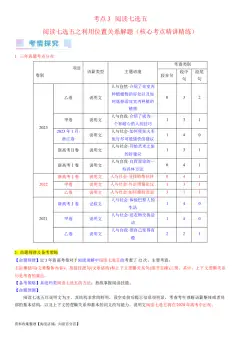
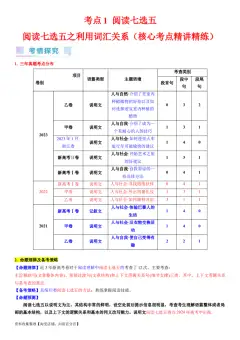
第 27 讲 阅读理解记叙文(核心考点精讲精练)
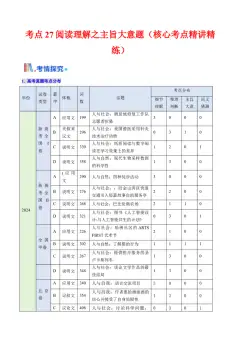
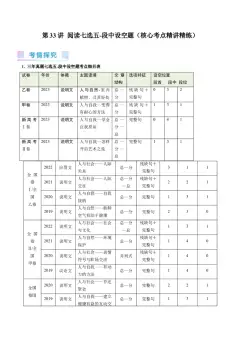
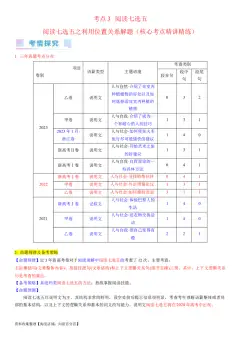
1. 三年真题记叙文考点细目表
时间 卷次 主题语境 字数 题型分类
2023 新高考I卷 人与自然:生态机器净化污水 340+134 2个细节理解题
年
2个推理判断题
新高考** 人与社会:Urban Sprouts花园项目 273 +126 1个细节理解题
错 误 的 表 帮助学生通过体验乡村生活。
2个推理判断题
达式 **卷
1个主旨大意题
全国甲卷 人与自然:DIY 高手 Terri Boltonis 277+137 2个细节理解题
的技能
1个推理判断题
1个词义猜测题
全国乙卷 人与社会:风景摄影师 1个细节理解题
312+147 3个推理判断题
北京卷 人与自我:作者职业成功的经历 385+115 1个细节理解题
3个推理判断题
浙江卷 人与自我:作者如何在家庭中过零浪 350 +157 2个推理判断题
费的生活方式 1个主旨大意题
1个词义猜测题
天津卷
2022 新高考I卷 / / /
年
新高考** 人与社会:孙子把儿童读物当成平板 326+130 3个细节理解题
错 误 的 表 电脑
1个词义猜测题
达式 **卷
全国甲卷 人与社会:Ginni Balinton往南极洲的 305+118 2个细节理解题
旅程
1个推理判断题
1个词义猜测题
全国乙卷 / / /
北京卷 人与社会:参加保护自然活动治愈好 348 +124 3个细节理解题
了焦虑
1个推理判断题
浙江卷 1)人与自我:工作让作者接受真实世 1).329+99 1.)1个细节理解题
界的多样性
2)352+110 2个推理判断题
2)人与自我:Merebeth从事的新工作 2)2个推理判断题
1个词义猜测题
资料整理【淘宝店铺:向阳百分百】 1天津卷 人与自我:获得自尊就要首先学会接 410+187 2个细节理解题
受自己本来的面目
2个推理判断题
1个主旨大意题
2021 新高考I卷 人与自我:钢琴演奏者做翻页师 324 +106 3个细节理解题
年
1个推理判断题
新高考** 1)人与社会:照顾两只老虎幼崽 1)2个细节理解题
错 误 的 表
2)人与社会:奖金帮助别人 317 +120 1个推理判断题
达式 **卷
1个词义猜测题
272+115
2)2个细节理解题
1个推理判断题
1个主旨大意题
全国甲卷 人与自我:适应伦敦新生活 334 +139 3个推理判断题
1个词义猜测题
全国乙卷 / / /
北京卷 人与自我:第一印象不总是可信 379+155 3个细节理解题
1个推理判断题。
浙江卷 6 1. 人与自我:Leslie Nielsen的演艺 279 +116 2个细节理解题
月卷 生涯
1个推理判断题;
2. 人与自我:拍摄自己的旅行
314+130
2个细节理解题
1个主旨大意题
浙江卷1月 人与社会:走失孩子长大之后找回家 347+125 3个细节理解题
卷 人
天 津 卷
( 第 一
次)
天 津 卷 人与自我:爱写作并制定计划一直坚 380+226 3个细节理解题
( 第 二 持下来
2个推理判断题
次)
2. 命题规律及备考策略
【命题规律】
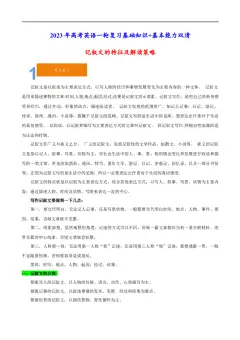
纵观近三年高考试卷,通常一套卷有一篇记叙文,个别试卷选用两篇记叙文。所选的记叙文多以第一
人称或第三人称为主,讲述一个短小精悍、有教育意义的故事,有时也会选用生活中的轶闻趣事。所讲述
的故事题材丰富多样、富有生活气息,多按时间顺序叙述,偶尔也会有倒叙或插叙的
情形。
从语言与结构特点上看,英语记叙文以描写叙述为主,主要描写人物、事件、地点或过程。其特点是:
主题往往隐藏在字里行间,没有直接地表达出来;文章主旨要通过人物、事件来进行提炼;文章大多按时
间跨度、空间顺序、上下顺序来展开。阅读记叙文应采取略读和扫读的方法,快速抓住文中描写的主要内
资料整理【淘宝店铺:向阳百分百】 2容,从整体上把握文章的连贯性,进而大体上揣测出作者的写作意图及文章的情感主线。
从命题上看,记叙文阅读理解以细节理解题和推理判断题为主,以观点态度题、写作意图题、词义猜
测题和代词指代题为辅,难度总体上属于中等程度。记叙文阅读理解题要求考生能理清记叙的顺序与所讲
故事的情节,能准确把握人物的情感态度和作者的写作目的。
【备考策略】
1. 在做阅读理解题时,首先要通读全文,弄清六要素和记叙的顺序,特别要注意文章中提到的多个
时间、地点和人物,理清事件的起因、经过和结果;
2. 然后阅读题干,在文章中查找相关的信息;最后根据查找到的相关信息作出正确的选择。如果文
中所涉及的人物较多,还要弄清人物之间的关系。
3. 一般故事性记叙文,通读全文,了解故事的发生、发展、高潮和结局;寓言哲理类记叙文,要理
解故事所蕴含的哲理意义,尤其关注故事结尾的升华;逸闻趣事,人物传记类记叙文,要体会对话的风格,
感受故事的精髓。
【命题预测】
从近三年命题的发展趋势来看,预测2024年高考记叙文阅读理解试题难度会保持相对稳定,但会继续
考查细节理解题、推理判断题主旨大意题和词义猜测题等题型。
考点一 细节理解题
细节理解题要求考生对阅读材料中的某一具体事实和细节进行理解。它们大都是根据文章中的具体信
息如事实、例证、原因、过程、论述等进行提问的。有些问题可以在文章中直接找到答案,有些则需要我
们在理解的基础上将有关内容系统化才能找到,比如计算、排序、是非判断、图形比较等。
常见的命题方式通常有:
1.特殊疑问句形式。以when, where, what, which, who, how much/many等疑问词开头引出的问题;
2. 以According to… 开头提问方式;
3. 少数试题以填空题的形式,如:
(1)To avoid attracting mountain lions, people are advised________.
(2)By the first sentence of the passage author means that________.
(3)It seems that now a country’s economy depends much on________.
(4)If you are interested in knowing about what people’s life will be, you may visit________.
(5)The policemen were told “to look the other way” (the underlined part in Paragraph 2) so that________ .
资料整理【淘宝店铺:向阳百分百】 3(6)The policeman who said “Good evening” to Rolls wanted to________.
1.同义替换。替换关键词,如把lose one's job换成了be out of work;变换词性,如把important变换
成of importance;改变语态,如主动语态变成被动语态。
2.信息归纳。用精练的语言来概括原文中比较分散或复杂的信息,设置为正确答案。
3.正话反说。把原文中的意思反过来表达而成为正确选项。
1.张冠李戴。是原文信息,但不是题目要求的内容。
2.无中生有。符合常识,但不是文章的内容。
3.曲解文义。与原文极其相似,在细节处有变动。
4.颠倒是非。在意思上与原文大相径庭甚至相反。
5.正误参半。部分正确,部分错误。
一 、直接信息题
【2023年北京卷】Sitting in the garden for my friend’s birthday. I felt a buzz (振动) in my pocket. My heart raced
when I saw the email sender’s name. The email started off: “Dear Mr Green, thank you for your interest” and “the
review process took longer than expected.” It ended with “We are sorry to inform you…”and my vision blurred (模
糊). The position—measuring soil quality in the Sahara Desert as part of an undergraduate research programme —
had felt like the answer I had spent years looking for.
I had put so much time and emotional energy into applying, and I thought the rejection meant the end of the
road for my science career.
So I was shocked when, not long after the email, Professor Mary Devon, who was running the programme,
invited me to observe the work being done in her lab. I jumped at the chance, and a few weeks later I was equally
shocked—and overjoyed—when she invited me to talk with her about potential projects I could pursue in her lab.
What she proposed didn’t seem as exciting as the original project I had applied to, but I was going to give it my all.
...
25. After talking with Professor Devon, the author decided to ________.
A. criticise the review process B. stay longer in the Sahara Desert
C. apply to the original project again D. put his heart and soul into the lab work
资料整理【淘宝店铺:向阳百分百】 4(2023·河南·校联考模拟预测)As a child, I never considered myself an athlete at all as I was very
uncoordinated (不协调的). However, I did love to run because I felt as if I were flying. But this all changed two
years ago when I suffered a knee injury. I was bedridden (卧床不起的) for two weeks and I had a difficult time
moving even short distances. I literally cried myself on my way to the car for a few days.
When therapy wasn’t working well for me, I signed up for a hot yoga class for girls, Bikram Yoga, to be exact.
Starting a yoga practice was truly a godsend (天赐之物) because it helped me gain strength in my knees but, most
importantly, yoga helped me attain a more peaceful state of mind, body and spirit.
Since each class was heated to 105℉, every time I stepped foot in the yoga studio, I’d feel a surge of negative
thoughts come upon me like a big ocean wave. Some of these thoughts were, at the beginning of my practice, so
strong that I walked out of the class several times. However, as the months passed by, I noticed that when I wasn’t
disturbed by my negative thoughts, I could stay in the hot room for longer.
After 3-4 months of practicing hot yoga, I made some progress. I also woke up with so much more energy than
I had before starting my yoga practice and I gradually started losing weight from my body. Yoga literally made me
feel as if I’d taken a bottle of energy drink and just gave me the burst that helped my knee heal and made my
overall health better.
As I saw some of my classmates do poses that looked appealing to me, I started to think maybe I could do
them too. Therefore, yoga helped show me that I had no real limitations physically unless I set those limitations
myself through eating junk food and thinking in negative limiting terms.
Also, practicing yoga in front of a mirror helped me have more confidence and practicing with a group of
people really helped me to feel a greater sense of connection with humanity (人道). Overall, this yoga practice has
helped me to see I’m part of a bigger picture in life!
21.Why did the author decide to attend a yoga class?
A.Her injury wasn’t so serious. B.The treatment was of little use.
C.She attempted to have a charming figure.D.Her parents asked her to have a try there.
24.What inspired the author to think she could do well in yoga?
A.She had completely recovered from her knee injury.
B.She was helped by her trainer with much patience.
C.She was attracted by her classmates’ yoga poses.
资料整理【淘宝店铺:向阳百分百】 5D.She fully understood the theory of yoga.
二、间接信息题
1.【2023年全国甲卷B篇片段】
Terri, who now rents a house with friends in Wandsworth, South West London, says DIY also saves her from
losing any deposit when a tenancy (租期) comes to an end. She adds: “I’ve moved house many times and I always
like to personalise my room and put up pictures, so, it’s been useful to know how to cover up holes and repaint a
room to avoid any charges when I’ve moved out.”
26. How did Terri avoid losing the deposit on the house she rented?
A. By making it look like before. B. By furnishing it herself.
C. By splitting the rent with a roommate. D. By cancelling the rental agreement.
2. (2023·全国乙卷·B 片段) One time my friends and I drove three hours to Devil’s Lake, Wisconsin, to
climb the purple quartz(石英) rock around the lake. After we found a crazy-looking road that hung over a bunch of
rocks, we decided to photograph the scene at sunset. The position enabled us to look over the lake with the sunset
in the background. We managed to leave this spot to climb higher because of the spare time until sunset. However,
we did not mark the route(路线) so we ended up almost missing the sunset entirely. Once we found the place, it
was stressful geeing lights and cameras set up in the limited time. Still, looking back on the photos, they are some
of my best shots though they could have been so much better if I would have been prepared and managed my time
wisely.
26. What can we infer from the author trip with friends to Devil’s Lake?
A. They went crazy with the purple quartz rock.
B. They felt stressed while waiting for the sunset.
C. They reached the shooting spot later than expected.
D. They had problems with their equipment.
1.(2023·福建厦门·统考三模)Dressed in a shiny metallic suit, Katia Krafft’s small frame is overshadowed
by the red curtain of molten rock that bursts from the ground before her. The dramatic moment was captured (捕捉)
in a photo taken atop Iceland’s Krafla volcano in 1984, during the final breathing of a multi-year-long eruption.
资料整理【淘宝店铺:向阳百分百】 6Looking at the image, one can almost feel the volcano’s heat, hear its roar, and sense Krafft’s heart pounding as the
volcanologist does what she loves most: bearing witness to our planet’s strong anger.
Katia Krafft was a fearless pioneer in volcanology, studying the explosive peaks at a time when there were few
women in the field. She was born in the Rhine valley of northeast France in 1942, curing the height of World War
II. The chaotic human world drove both Katia and her husband, Maurice Krafft, also a volcanologist, to seek
comfort in nature. The moment a volcano exploded, they dropped everything to analyze and capture the beauty and
mystery of each event.
The Kraffts used their videos of explosive eruptions to explain the complex risks and uncertainties of these
disasters. It changed the ability to communicate volcano science. Their videos are credited as one of the primary
reasons that officials in the Philippines took the warning signs of Mount Pinatubo’s eruption in 1991 seriously. Yet
the Kraffs didn’t live to see that eruption. The couple died less than two weeks earlier in Japan during a monstrous
eruption, which claimed 41 other lives.
Katia’s impact on volcanology has reached far beyond her death and has encouraged many young women to
study our restless planet. “Katia Krafft is definitely the reason why I’m doing this job,” says Carla Tiraboschi, a
postdoctoral researcher at the University of Minster, Germany. Tiraboschi first saw Katia in a documentary when
she was just six or seven years old and has been crazy about volcanoes ever since. She now studies the processes at
work deep below the volcanic peaks.
2.What can we know about the videos of explosive eruptions?
A.They prevented a natural disaster. B.They served as a warning in Japan.
C.They helped spread volcano science. D.They covered Mount Pinatubo’s eruption.
3.How did Katia influence Carla Tiraboschi?
A.Katia’s death made her restless. B.Katia helped her with her research.
C.Katia’s deeds inspired her career choice. D.Katia taught her to make a documentary.
2.(2023·陕西宝鸡·统考二模)When I was younger, I had been a top student with a strong desire to attend a
top university. But things started to go downhill for me in high school after my parents divorced. Torn between
wanting to be with my mother, who moved to Canada alone with no support, and with my beloved aging
grandfather in Pakistan, I moved back and forth, struggling with my studies. I barely graduated from high school
and entered an ordinary college, feeling that I had already failed.
I got discouraged, and began to suffer from severe depression. The death of my grandfather was the final
straw. With no real hope for the future, I dropped out and returned to my mother and sisters in Canada.
资料整理【淘宝店铺:向阳百分百】 7Then I was riding with a trucking company to help support my mother and sisters. During those long hours on
the road, my grandfather’s last words came back to me: “Please accept the challenges of life and work harder. It is
now or never. I hope you will never disappoint us.” With his words ringing in my ears, I discovered a newfound
resolve. My path suddenly became clear: I had to finish what I had started and go back to school.
To get back on track, I needed to take a full course load while continuing to work enough part-time hours to
help pay the bills. After graduating from high school again, I began university engineering cooperation program, in
which I worked as a paid intern (实习生) every other term, allowing me to keep my student loans in check. At the
same time, I tried my best to focus on my studies. After completing my university, I went on to a master’s and now
a PhD, wining several research awards along the way.
My path to this point has made one thing clear: Never fear failure. I hope I have made my grandfather proud.
5.Which of the following can best describe the author’s life in his first high school?
A.Struggling. B.Ordinary. C.Fruitful. D.Boring.
6.Why did the author drop out of college?
A.He had a big family to support. B.He had to get a well-paid job.
C.He felt hopeless about the future. D.He fought with his classmate.
7.How did the author get the idea of returning to school?
A.He was laughed at by his mother and sisters. B.He was encouraged to win research awards.
C.He was motivated by his grandfather s words. D.He was forced to acquire more skills at work.
考点二 主旨大意题
题型概述
主旨大意题即考查细节理解能力, 又考查深层次的推理、概括能力,难度较大。不仅考查考生略读文章、领
会大意的能力,也对考生的归纳、概括能力提出了较高的要求。文章中没有明显的解题依据,需要考生从
文章中提炼、抽取一些关键词、主干句进行加工概括,才能归纳出文章的主旨。
命题方式:
What is the text mainly about?
What is the best title for the text?
What can be a suitable title for the text?
What's the first/second/third....paragraph mainly about?
What's the main idea discussed in the first/second/.. paragraph?
资料整理【淘宝店铺:向阳百分百】 8怎样理解段落及文章整体的主旨大意
——主题句定位法
文章是由段落组成的。段落是发展一个主题的一群句子,段落围绕着中心思想展开,而段落的中心思
想又是为文章整体的中心思想服务的。寻找具体段落的中心思想的方法是:通过分析篇章结构,找出每小
段的主题句,通过主题句找出文章的主题。找准文章的主题句是确定文章主旨大意的关键。主题是文章要
表达的中心思想,文章的主题句通常都有一个话题,它是文章的核心。“主题句定位法”是一种行之有效
的方法。
但是由于文章的不同,表现的手法也各有不同,主题句出现的位置也不是一成不变的。在许多情况下,
尤其在阅读说明文和议论文时,根据其篇章特点我们可以通过寻找短文的主题句来归纳出文章的主题。主
题句在文章中的位置通常有三种情况:开头、中间、结尾(含在开头结尾同时出现、首尾呼应的主题句)。
因此,仔细阅读这类文章或段落的首尾句是关键。做主旨大意类试题多采用浏览法(skimming),浏览时,
一般不需逐句细读,只选读文章的首段、尾段,或每段的首句和尾句,重点搜索主题线索和主题信息。
文章主题常常可以通过文章的写作方法来体现,有以下五种情况:
1. 中心主题句出现在文首
开门见山,提出主题,随之用细节来解释、支撑或发展主题句所表达的主题思想。这是英语中最常见
的演绎法写作方式,即由一般到特殊,先提出观点,后举例论证,主题句则出现在段首的写作方法。
新闻报道通常就采用这种写法。新闻报道的首句通常称为“新闻导语”,“导语”实际上就是主题句,
是对全文内容的高度概括。大意题、标题一般可在第一句话找到答题依据。
一、段落大意题
【2023年全国乙卷D片段】If you want to tell the history of the whole world, a history that does not privilege
one part of humanity, you cannot do it through texts alone, because only some of the world has ever had texts,
while most of the world, for most of the time, has not. Writing is one of humanity’s later achievements, and until
fairly recently even many literate (有文字的) societies recorded their concerns not only in writing but in things.
32. What is the first paragraph mainly about?
A. How past events should be presented. B. What humanity is concerned about.
C. Whether facts speak louder than words. D. Why written language is reliable.
资料整理【淘宝店铺:向阳百分百】 91.(2023·安徽安庆·安庆一中校考三模)Sagarika Sriram was 10 years old when she started reading
newspaper stories about a planet in trouble, one of which was about turtles with plastic in their stomachs. Sagarika
knew she needed to do something. First, she joined a group which organized cleanup campaigns in her home city,
Dubai “The group helped me understand what an individual can do and how I can really make a difference,” she
says.
Then Sagarika created Kids for a Better World. It’s a digital platform which has brought together nearly
10,000 youths from all over the world with the goal to create a greener world.
Sagarika is now 16. She’s part of a growing number of young climate activists. “We’re the generation that is
going to face the results if the climate crisis is not dealt with,” she says. She believes even individual actions can
create a “ripple effect”. Sagarika says this can build momentum and can move things in the right direction.
Kids for a Better World is for people aged 8 to 16. It teaches them about what they can do to reverse climate
change. They can grow food, plant trees, collect recyclables and avoid using plastic bags. “This is the information
which can help change our future,” Sagarika says.
Dubai is a desert metropolis. Growing up there has made Sagarika very aware of the need for action. Her city
faces the risk of rising temperatures and its water supply is shrinking. She believes young people can bring
attention to these environmental challenges.
Sagarika is all about small actions, but she has big plans. She’d like to go to college in California. While she’s
there, she’ll continue being an activist. She’ll also be running Kids for a Better World. She hopes to inspire others
to fight for a greener planet. Others have inspired her. “We’re creating our own system of inspirational change-
makers,” she says.
19.What does the fourth paragraph mainly tell us?
A.What can help change our future. B.What people should do at present.
C.What Kids for a Better World does. D.What courses are taught on the platform.
2.(2023春·黑龙江哈尔滨·高三哈九中校考期中)When she worked in banking, Irini Tzortzoglou’s idea of
cooking was to pick up a ready meal from Marks &Spencer on her way home, and put it in the oven (烤箱).
But now, since winning the BBC cooking competition Master Chef at the age of 60, with menus inspired by her
Greek heritage (遗产), food has become her life and new career.
资料整理【淘宝店铺:向阳百分百】 10She had not been overly interested in cooking, though as a child, food was an important part of her life.
Tzortzoglou, 64, was born in Greece, where her grandparents’ house was always open, and her grandmother would
often be cooking for dozens of people. Tzortzoglou would help out: “I loved the smells. I loved the processes.”
Tzortzoglou felt very bored after retiring. Then one day her husband said, “Why don’t you try Master Chef
because you always love watching it.”
She was a reasonably good cook, who loved entertaining and could put together a decent dinner party menu
but competing on the show demanded a whole new skill level. “I didn’t want to embarrass myself by leaving in
round one, so I trained myself for a year,” she said.
She put in time, effort and money. She went to Athens to see what was happening with Greek food today. She
ate at Michelin-star restaurants to see what Greek Master Chef and the young chefs were doing. And then she
started practicing. She also started physical training because she could see how tough it was to run around the
kitchen while filming, or stand for hours.
Since her win, Tzortzoglou has become immersed in (沉浸于) Greek food, and has written a cookery book,
Under the Olive Tree. “I don’t have free time, but I love it,” she said. “I feel like a child let loose in a sweet shop.”
35.What is Paragraph 5 mainly about?
A.Tzortzoglou’s love for Greek food. B.Tzortzoglou’s effort to win the competition.
C.Tzortzoglou’s desire to go back to Athens. D.Tzortzoglou’s performance at the competition.
二、文章大意题
【2022 年全国甲卷·B 片段】Ever since her childhood, Ginni, now 71, has had a deep love for travel.
Throughout her career(职业) as a professional dancer, she toured in the UK, but always longed to explore further
When she retired from dancing and her sons eventually flew the nest, she decided it was time to take the plunge.
After taking a degree at Chichester University in Related Arts, Ginni began to travel the world, eventually
getting work teaching English in Japan and Chile. And it was in Chile she discovered she could get last-minute
cheap deals on ships going to Antarctica from the islands off Tierra del Fuego, the southernmost tip of the South
American mainland. “I just decided wanted to go,” she says. “I had no idea about what I’d find there and I wasn’t
nervous, I just wanted to do it. And I wanted to do it alone as I always prefer it that way.”
In March 2008, Ginni boarded a ship with 48 passengers she’d never met before, to begin the journey towards
Antarctica. “From seeing the wildlife to witnessing sunrises, the whole experience was amazing. Antarctica left an
impression on me that no other place has,” Ginni says. “I remember the first time I saw a humpback whale; it just
资料整理【淘宝店铺:向阳百分百】 11rose out of the water like some prehistoric creature and I thought it was smiling at us. You could still hear the
operatic sounds it was making underwater.”
The realization that this is a precious land, to be respected by humans, was one of the biggest things that hit
home to Ginni.
31. What is the text mainly about?
A. A childhood dream. B. An unforgettable experience.
C. Sailing around the world. D. Meeting animals in Antarctica.
1.(2023·湖南衡阳·衡阳市八中校考模拟预测)Before arriving in China, I had read lots of books about
China. Therefore, when I arrived, I was excited to be living in this huge historically and culturally rich country. It
was so greatly different from the UK. The food, the landmarks, the big cities and everyday life—I couldn’t wait to
explore.
However, learning Chinese hadn’t even entered my mind, not because I was lazy, but because I had no
confidence to learn the most difficult language in the world. Besides this, once I moved to China, I lived in
Shanghai. It is an international city, with many people speaking English as a second language. So I thought English
would be sufficient.
But after a year in China I found many expats(侨民) spoke Chinese. Perhaps it was achievable after all? I felt
uncomfortable because so many Chinese people could speak English while I couldn’t even speak the most basic
Chinese. To face the challenge, I decided to begin my language journey and my only regret is that I didn’t start
earlier.
In the two years since starting to learn I have made great progress. Now, I am able to talk in Chinese on many
topics. Learning to speak Chinese isn’t as difficult as I once expected. When I speak to Chinese people in Chinese,
they almost always understand me. The most challenging thing is listening since Chinese people talk at such a
speed. I can’t always understand what’s been said, but my weekly online language exchanges help with this.
Learning Chinese has taken a lot of hard work. But there is still a long way to go before I reach my goal of
fluency(流利). Learning Chinese not only helps me in day-to-day life, but deepens my cultural understanding of
such a great country. So, to all my non-Chinese friends I say this, don’t be afraid, face the challenge and be
confident.
9.What did the writer do after arriving in China?
资料整理【淘宝店铺:向阳百分百】 12A.Read a lot of books about China. B.Couldn’t wait to study Chinese.
C.Tried to learn more about China. D.Missed his life in his home of UK.
10.What does the underlined word “sufficient” probably mean?
A.Enough. B.Important. C.Necessary. D.Possible.
11.Why does the writer think listening is the most challenging?
A.He has a hearing problem.
B.Chinese people speak too fast.
C.Chinese is the most difficult language.
D.He doesn’t know much about many topics.
12.Which is the main idea of the text?
A.A new opinion in learning.
B.Exploring the joy of learning Chinese.
C.The writer’s journey of learning Chinese.
D.The value of learning a new language.
2.(2023·河北衡水·衡水市第二中学校考三模)On November 11, a woman from the United Kingdom set
out to explore Antarctica, in an attempt to become the first female explorer to cross the continent alone and
unsupported.
Preet Chandi aims to cover more than 1,100 miles in a journey that will likely take 70 to 75 days. Pulling all
her supplies on a sled(雪橇) called a pulk, which weighed more than 250 pounds at the start of her journey, the 33-
year-old will battle temperatures of minus 58 degrees Fahrenheit and wind speeds up to 60 miles per hour.
Chandi—also called“Polar Preet”—set a record last year as the first woman of color to complete an
unsupported expedition(探险) to the South Pole. She finished the journey in 40 days—just two days longer than
Joanna Davidson of Sweden, who holds the female world record.
“A lot of people tell me I don’t look like a polar explorer,”Chandi told BBC News’ Sandish Shoker last year
before the trek. “It’s considered out of the norm for an Asian woman to do this—it’s different. And that’s part of
the reason why I wanted to do this—for people who don’t fit a certain image.”
Chandi grew up in an Indian Sikh community in England and joined the Army Reserve at age 19. In 2012, she
graduated from college, becoming the first in her family to earn a degree.
After running her first half-marathon at 20 years old, Chandi’s appetite for greater challenges started to grow.
She has been on hiking and climbing trips across the world, including in Kenya, Morocco, Mexico, Peru, Iceland
and Nepal. Earlier this year, she completed the Marathon des Sables, a week-long, 156-mile ultramarathon in the
资料整理【淘宝店铺:向阳百分百】 13Sahara Desert.
She currently serves in the British Army, organizing training for injured soldiers.
“We are extremely proud to have such a remarkable ambassador, “the General Staff Sharon Nesmith says.
”Captain Chandi has the qualities we seek of all who serve—courage, commitment and the desire to be the best we
can be. ”
16.What is the text mainly about?
A.Setting a world record. B.Challenging oneself.
C.Travelling around the world. D.Seeking a suitable ambassador.
三、标题归纳题
【2023年新高考全国Ⅱ卷B片段】
Turning soil, pulling weeds, and harvesting cabbage sound like tough work for middle and high school kids.
And at first it is, says Abby Jaramillo, who with another teacher started Urban Sprouts, a school garden program at
four low-income schools. The program aims to help students develop science skills, environmental awareness, and
healthy lifestyles.
Jaramillo’s students live in neighborhoods where fresh food and green space are not easy to find and fast food
restaurants outnumber grocery stores. “The kids literally come to school with bags of snacks and large bottles of
soft drinks,” she says. “They come to us thinking vegetables are awful, dirt is awful, insects are awful.” Though
some are initially scared of the insects and turned off by the dirt, most are eager to try something new.
Urban Sprouts’ classes, at two middle schools and two high schools, include hands-on experiments such as soil
testing, flower-and-seed dissection, tastings of fresh or dried produce, and work in the garden. Several times a year,
students cook the vegetables they grow, and they occasionally make salads for their entire schools.
Program evaluations show that kids eat more vegetables as a result of the classes. “We have students who say
they went home and talked to their parents and now they’re eating differently,” Jaramillo says.
She adds that the program’s benefits go beyond nutrition. Some students get so interested in gardening that
they bring home seeds to start their own vegetable gardens. Besides, working in the garden seems to have a calming
effect on Jaramillo’s special education students, many of whom have emotional control issues. “They get outside,”
she says, “and they feel successful.”
7. What can be a suitable title for the text?
资料整理【淘宝店铺:向阳百分百】 14A. Rescuing School Gardens B. Experiencing Country Life
C. Growing Vegetable Lovers D. Changing Local Landscape
1.(2023·湖南长沙·长沙一中校考二模)It’s eight o’ clock on Christmas morning, and Uncle Tom says he
wants to listen to the news. I am wondering why on earth grownups would be interested in the news when there are
important things to be done, such as handing out presents. And then, while I am only half-listening to the radio
broadcast, something surprising happens: The boring newsreader begins talking about a Christmas message from
the Vatican. Hadn’t we heard that report earlier? My older brother, Colin, figures out what’s happening. “Pete, Pete,
it’s a tape recorder! We’ve got our tape recorder!”
Colin and I had both been blind from birth. At the special boarding school in Worcester in western England
that Colin and I attended, a tape recorder of your own was the height of aspiration. However, Colin—better
informed and more realistic about family finances than I was—had no real expectations of getting one. I realized,
much later, that the tape recorder my father had bought us would have cost more than four times his weekly wage.
The new toy, the size of a small suitcase, dominated the rest of the Christmas holidays. I took my first steps
down the path to my career as a broadcaster when I returned to school after the holidays. I would wander round the
school with my microphone, recording my thoughts in the style of the voices I heard on the radio. But ten years
later, after I had started and abandoned a university law course, I drew on the confidence and walked into a BBC
radio station, in the hope of selling myself as a broadcast journalist. A producer at the radio station who was putting
together a weekly program for blind people had seen me. He later phoned me and informed I was admitted.
Twenty-five years later, I presented my first report for BBC TV’s Six O’Clock News, a program my father had
never missed. Although by then he’d been dead for more than a decade, I like to think he’d have realized that his
inspiring Christmas present had changed my life.
4.What’s the best title for this text?
A.Unusual Gift, United Family B.Warm Christmas, Wise Uncle
C.Silent Love, Sound Influence D.Prepared Mind. Promising Job
2.(2023·重庆·重庆南开中学校考三模)Tyra Peralte thought keeping a diary during the pandemic (流行病)
might help her sort out her messy feelings. In April 2020, the mother of two in Montclair, NewJersey, started
writing frankly about the challenges of work, marriage and motherhood during a global crisis.
Peralte wanted to know how other women were doing. So she made an unusual offer. She invited women from
资料整理【淘宝店铺:向阳百分百】 15near and far to fill the remaining lined pages of her black -and-white marbled composition notebook with their own
pandemic tales. She named the project The Travelling Diary.
“I wanted an interaction that felt human,” Peralte says, “and it feels very human to read someone else’s
writing.” She found her first contributor during a conference for entrepreneurs. When she mentioned the diary, a
woman in North Carolina immediately said she would like to write in it.
From there, Peralte posted an article about her idea on Medium in an effort to get more women involved. So
many wanted to participate that Peralte decided to create a website for people to add their names to the queue. She
came up with a system: Each person gets to keep the diary for three days and fill as many pages as she wishes.
Then she is responsible for mailing it to the next person, whose address Peralte provides. Each participant fills the
pages with her own handwriting, and sometimes her own artwork, sharing her stories.
So far, more than 2,000 women from 30 countries have participated, some as far away as South Africa and
Australia. Of course, not all those entries could fit in just one journal. More than 50 of these notebooks are
currently in circulation (流通), and about 20 completed ones are back in Peralte’s possession, including the original
diary with her first entry, about navigating pandemic life and reconnecting with family.
“It is beautiful to have it again and to read it,” she says. “I carry these stories with me on a daily basis.”
8.Which of the following might be the best title for the text?
A.Women’s Diaries B.The Travelling Diary
C.Women, Story-tellers D.Peralte, a Creative Woman
过关检测
Passage 1
(2023·江苏南通·统考三模)Ken Campbell had last attempted running at high school. When his wife,
Susan, injured her foot, she needed support to rejoin her running group, so Campbell went along to keep her
company and share in the recovery. “We were just walking at the beginning,” he says. “And I was heavy. I weighed
over 90kg.” But as the weeks and months passed, the weight fell away, Susan recovered — and Campbell’s abilities
grew. At the age of 63, he ran 50km, and at 70, he ran through the night to complete a 100km ultramarathon.
So how does someone with no sporting precedent (先例) become an ultradistance runner in his 60s and 70s?
Susan had run marathons before her injury. But for Campbell, the turning point came when Susan’s Fleet Feet
running group took to the trails in the Sierra Nevada foothills near their home in Citrus Heights, California.
资料整理【淘宝店铺:向阳百分百】 16Campbell went out to visit Susan’s group, and “the trails were a terrible mess. It had been raining. And I was
running in my road shoes. Slipping and sliding and falling. And I was struggling. I thought, well, I like this a lot but
I could do better.”
What he liked above all was the feeling of “being enveloped by the trail, being embraced by the closeness of
the vegetation and the nearness of the river. I was walking where Native people had walked for thousands of years
and where miners had walked on their way to gold.”
Running the 100km ultramarathon took Campbell 16 hours. When Campbell crossed the fish line at 3am,
Susan handed him a 100km sticker to display on the back of his truck. He already had a 50km one on there. “It is a
public proclamation (声明) that you are part of this community,” he says. “Wherever we park, I see a line of
vehicles with their various stickers and I feel that we area tribe (部落).”
Campbell suffered arthritis before he started running, and is “a candidate for knee replacement”. But for now,
he is holding off on surgery. It could put an end to the running — but the “sense of wellbeing and accomplishment
will carry me on forever”, he says. “If I can’t run, I will walk.”
1.What enabled Campbell to take up running again?
A.He lost weight. B.He trained overnight.
C.His wife accompanied him. D.His wife shared her experience.
2.What did Campbell discover while keeping his wife company on a tail run?
A.The joy of being out in the wild. B.The hardships of Native people.
C.The pleasure of gold mining. D.The mysteries of nature.
3.What did the stickers on the back of Campbell’s truck bring him?
A.A discount on parking. B.A sense of belonging.
C.An enormous income. D.An honour to his wife.
4.What can we learn about Campbell from the text?
A.He’s a determined man. B.He’s a people-pleaser.
C.He is easy to content. D.He is hard to cope with.
Passage 2
(2023·山东聊城·统考三模)I was picking through coat pockets and madly shaking all my old purses and
wallets. I was looking for pennies, quarters — anything that would help me make it to the end of the week. It sure
was feeling heavy.
A hopeless girl in her twenties,I was a single parent, with a one-year-old son and a five-year-old daughter.
Life consisted of ups and downs. One year, I was having baby showers and taking vacations in the mountains
资料整理【淘宝店铺:向阳百分百】 17of Tennessee. The next, I was searching around my small, two-bedroom apartment collecting loose change to buy
food and gas. Suddenly, I found myself becoming poor, and it was hard.
I’ll never forget the joy of finding one penny during my hunt, then two, then fifteen, and then twenty-four,
twenty-five, twenty-six. Every time I found one, I felt excited. Looking back now, I see that it was somewhat ironic
(讽刺的) because I had looked down on pennies at one point in my life.
I sat in my bedroom that night and sorted all the change from my hour-long quest. I smiled and made jokes
with my daughter while we packed our pennies. Her brother joyfully bounced up and down in his bouncer. They
had no idea how many nights I would cry with my face buried in the pillows, wondering how I would keep a roof
over their heads, lights on in the house, and food on the table.
I remember those days like they were yesterday, but I don’t remember them with sadness. I remember them
intentionally because I promised myself that if I were ever to escape the pains of poverty, I would never forget the
value of a penny.
I’ve kept that promise, too.
5.Why did the author shake her old purses?
A.To look for money to pay for their expense. B.To purchase something for her children.
C.To make money at the end of the week. D.To put them into her coat pockets.
6.What do we know about the author?
A.She could make ends meet. B.She often lived a hard life.
C.She was once living well. D.She enjoyed her family life.
7.What is the author’s promise?
A.To help others little by little. B.To find great value in little things.
C.To bring happiness to her children. D.To forget the sad days intentionally.
8.What does this text want to convey?
A.It’s no use crying over spilt milk.
B.We should repair the house before it rains.
C.Each family has its own happiness and unhappiness.
D.One penny is the small seed from which fortunes spring.
Passage 3
(2023·重庆·重庆实验外国语学校校考三模)Jennifer Keelan was a young girl who had dreams of one day
attending college and living a satisfactory life. At age 2, Jennifer was diagnosed with cerebral palsy (脑瘫), leaving
her using a wheelchair. Jennifer was a bright and courageous girl, but when she attempted to attend school with her
资料整理【淘宝店铺:向阳百分百】 18friends, she was sent to separate classes for students with disabilities, regardless of talent. She found herself unable
to attend some school functions, use transit systems and access government buildings. Jennifer accepted the
limitations of her physical life, but not the limitations of the physical world around her.
Jennifer became active in campaigning for the Americans with Disabilities Act. She engaged in peaceful
protests and, at age 7, was arrested in Montreal, a moment in history that shocked North America.
At age 8, Jennifer traveled to Washington, D.C. The shy, yet determined little girl caught the attention of
the country when she climbed up the Capitol steps. It worked. Jennifer met with Congress, and President George H.
W. Bush signed the Americans with Disabilities Act into law.
Jennifer remains an activist today, making sure all people with disabilities are treated fairly and have equal
access to public places, schools and businesses. The only barriers that remain are those of view.
Jennifer wants all of us to know that physical disabilities are not a barrier to friendship, career opportunities or
love. She graduated from Arizona State University with a degree in family and human development. She is now 39
years old and still sharing the message of inclusivity (包容性) . For her, like all of us, making a difference begins
one step at a time, no matter how hard it is. She remains a lifelong activist for the disability rights movement.
1.What prevented Jennifer studying with her friends?
A.Her serious illness. B.Her low intelligence.
C.Her born language barrier. D.Her poor learning ability.
2.What made North America amazed about Jennifer?
A.Her helping the disabled. B.Her being sent to prison.
C.Her entering the Capitol alone. D.Her being elected as president.
3.What happened due to Jennifer’s effort?
A.The law of the United State changed a lot. B.Bush met the representatives of the disabled.
C.Arizona State University accepted the disabled. D.The Americans with Disabilities Act was signed.
4.What is the best title of this text?
A.A Girl Managed to Enter the Congress B.A Girl Makes a Difference to the Country
C.A Girl Succeeded in Attending the College D.A Girl Struggles for the Rights of the Disabled
Passage 4
(2023·安徽马鞍山·统考三模)In Tennessee, you will find a “secret society” that consists of 9 women who
call themselves “The 9 Nanas.” Its mission is simple — to spread happiness by performing random acts of kindness
for those in need. The Nanas have been together since childhood. Several of them were raised by MaMaw and
资料整理【淘宝店铺:向阳百分百】 19PaPaw, a couple that were always doing good for the community.
One day when the 9 Nanas got together, they started recollecting the old days with MaMaw and PaPaw. They
fondly recalled how MaMaw Ruth used to bake and send pound cakes to families who had recently lost someone.
The “sisters” wanted to do good for their community too. So, the “secret society” of “The 9 Nanas” was born.
The ladies kept their ears open as they ran their daily work. Whenever they heard of someone in need, they’d
step in to help. A package would be sent, which would always include one of MaMaw Ruth’s pound cakes and a
note that said “Somebody loves you.”
Believe it or not, the group operated in secret for 30 years! But by then, the husbands had started to get
suspicious. So the 9 Nanas gathered the husbands and spilled the beans. Their husbands wanted in on the fun.
That’s when the operation was taken to the next level!
Now, over 5 years since the husbands uncovered their wives’ secret, the 9 Nanas are still going strong. They
said, “Not everyone is as lucky as we were to have MaMaw and PaPaw to take care of them. So this is our way of
giving back. We want to make sure that happiness happens.”
21.What is the task of the “secret society”?
A.To uncover secrets. B.To search for lost family members.
C.To spread happiness. D.To attend kids for working parents.
22.What inspired the 9 Nanas to start the “secret society”?
A.A thank-you note. B.Their similar interests.
C.A special package. D.Their common memories.
23.Which of the following best explains ”spilled the beans“ underlined in paragraph 4?
A.Told the truth. B.Shared snacks.
C.Asked for help. D.Made promises.
24.Which of the following best describes the 9 Nanas?
A.Practical and polite. B.Humble and humorous.
C.Caring and devoted.D.Outgoing and disciplined.
Passage 5
(2023·福建·统考三模)One grandma in Japan went above and beyond to connect with her grandchildren.
Taechan, a woman in her 70s, began making Gundam models-plastic armor (盔甲) suits inspired by the anime
Mobile Suit Gundam. Her amazing results impressed her grandchildren and sparked an unexpected passion.
Gundam suits are sold as kits by Bandai. They’re sometimes called “Gunpla”, which combines the words
“Gundam” and “plastic model”. Despite being sold in box sets, building these suits of armor can be complicated
资料整理【淘宝店铺:向阳百分百】 20and include numerous tiny pieces that the person has to fit together. Taechan now documents her builds in YouTube
videos.
During these recordings, you see her work at a desk with the manual of illustrated instructions open in front of
her. Each page includes dozens of detailed steps. Taechan, however, is a patient and diligent worker and takes her
time completing each step with care. Her dedication to completing these models really shows in the final product.
When Taechan shared her Gundam results and the reason for making them on Twitter, thousands of people
reacted to her story. Those who are familiar with the process of making these plastic suits were surprised that
Taechan put in such effort, especially considering her health condition. Many also found it endearing that she went
the extra mile to connect with her grandchildren. Best of all, Taechan seems to have found a new hobby for herself,
too!
Even though her hands shake due to chronic (慢性的) illness, she managed to make many impressive plastic
suits that wowed her grandchildren.
17.Why did Taechan make Gundam Models?
A.To kill time. B.To cure her shaking hands.
C.To bond with her grandchildren. D.To become an Internet celebrity.
18.Which of the following can best describe Taechan?
A.Strict and helpful. B.Patient and careful.
C.Healthy and determined. D.Generous and hopeful.
19.What can we infer from the fourth paragraph?
A.People are puzzled about Taechan’s behaviour.
B.People offered Taechan advice on making Gundam models.
C.Taechan’s health condition stopped her making good models.
D.Taechan’s effort to connect with her grandchildren was admired.
20.Where can we probably read the text?
A.In an advertisement. B.In a novel.
C.In a newspaper. D.In a diary.
Passage 6
(2023·福建三明·统考三模)Lin Xi, a 26-year-old lady engaged in electronic disassembly (拆卸)art has
proved with her experience that no effort is in vain.
Lin’s work is to tear apart used electronic products and then present the components in an artistic way. “After
being put back together, the one dusty items will become exhibition pieces that remind the owners of their
资料整理【淘宝店铺:向阳百分百】 21childhood experience, a period of hard work or a deep-rooted memory, ” she says. Initially, Lin has to contact her
customers to learn the stories behind each one and the type of presentation they prefer. Then comes the
disassembly. The components, after being carefully cleaned, will be laid out on a piece of white paper in the desired
order. The final step is to use graphics software, Photoshop, to draw and print a base plate.
Lin gained her popularity on short-video platform Douyin. However, it was not luck that brought Lin her
current success. She first tried her hand at livestreaming in 2017 as a performer singing popular songs on Douyin.
At the time she was a senior at Beijing Foreign Studies University. After graduation, she went to the UK for further
study. During her one-year stay abroad, Lin visited many museums and appreciated exhibitions on different
subjects, varying from insects to dols. She was so fascinated by an exhibit of used light bulbs, which gave her the
inspiration to disassemble electronics and present the components like a decorative painting. She returned to China
in 2019 and taught herself how to use digital design software.
Before officially starting her business, Lin surveyed her followers to see whether they would be interested in
buying electronic disassembly art. It is important to know who your target audience is when running social media
accounts, she explains. Speaking of the future, she notes that there are no big plans, but she will keep focusing on
her daily work.
21.What is the first step of Lin’s work?
A.Tearing apart electronic products.
B.Communicating with the customers.
C.Cleaning the components carefully.
D.Presenting the components artistically.
22.What made Lin Xi start her business?
A.Software Photoshop. B.Platform Douyin.
C.An exhibition. D.A painting.
23.Why did Lin Xi conduct a survey?
A.To satisfy her own curiosity.
B.To locate her target audience.
C.To make her followers interested.
D.To promote her social media account.
24.What can best describe Lin Xi?
A.Brilliant and caring.
资料整理【淘宝店铺:向阳百分百】 22B.Careful and ambitious.
C.Generous and determined.
D.Creative and organized.
Passage 7
(2023·福建泉州·统考三模)Students at Summit Elementary School in Butler, Pennsylvania are growing
more than their minds. Under the guidance of teacher Angela Eyth, they’ve created a productive garden. “The kids
are in charge of everything,” Eyth says.
Eyth and her students launched the gardening project in 2020 after the teacher attended a conference on how to
include lessons about farming in the classroom. Then came the garden. With 16 acres of school district-owned land.
around their building, there was plenty of room.
The project is now two years old, and goes beyond planting and growing: Eyth and her fellow educators
structure lessons in science, math and more around their garden.
“When we grew cabbages my students noticed something was eating the leaves,” Eyth recall. “This led to an
investigation on figuring out what was eating it and how to stop it: the kids analyzed the evidence they found and
acted as engineers in creating ways to keep insects out of the cabbage beds. In 4th grade, we lake the students
outside to estimate the number of bean pods (豆荚) they find.” Eyth continues, “People think gardening should be
separate from core subjects but it’s far from the truth. The kids’ curiosity keeps it rolling.
The kids also keep the produce rolling - SO much so that with a $70,000 donation from Remake
Learning/Grable Foundation, they’re using that money to build a greenhouse at their school. The funds help them
launch an outdoor classroom and open a farm stand at Broad Street that brings fresh fruits, vegetables, herbs and
more to an area of their community where affordable fresh produce is hard to find there. Such areas are often
called “food deserts.”
“Our students discover the value of sharing their harvest with the community surrounding nearby Broad Street
Elementary School.” says Eyth. “They’re so proud of what we’re doing here.”
25.What is the purpose of the project?
A.To prepare students for career planning.
B.To seek new ways of vegetable growing.
C.To allow students to learn by gardening.
D.To encourage students to get close to nature.
26.What do the teachers do with the project at present?
资料整理【淘宝店铺:向阳百分百】 23A.Expand the farming land. B.Integrate relevant subjects.
C.Investigate insects’ activities. D.Estimate the number of vegetables.
27.What can we know about the project?
A.It was launched by the school board.
B.Its experience was introduced at a conference.
C.It built a greenhouse in the “food desert” areas.
D.Its produce benefits the community around.
28.What do the students think of the project?
A.It is tiresome. B.It requires creativity.
C.It is rewarding. D.It needs more donations.
Passage 8
(2023·湖南郴州·统考三模)After spending almost a year and a half in near-total isolation some 230 feet
underground, Beatriz Flamini emerged from a cave in southern Spain and asked: Who’s buying the beer?
The climber and mountaineer had entered the cave in Granada on Nov. 21, 2021, determined to spend 500
days alone-monitored from afar by a group of scientists-to explore the effects of isolation on the human body and
mind.
Flamini was 48 years old when she went down, and 50 when she officially completed the challenge on Friday.
After resurfacig, Flamini embraced supporters, met with her doctors and spent nearly an hour talking to the
reporters who had gathered outside. She told them she was ready for a drink and a shower but could have stayed in
the cave longer.
Flamini’s team says she spent her days reading, drawing, exercising, knitting wooly hats and recording herself
with two GoPros. Spanish production company Dokumalia plans to turn her experience into a documentary, NBC
reports.
Flamini said she’d lost track of time after about two months in the cave, and thought she had only been in
there for some 160 or 170 days. She described the experience as “superb, matchless”, telling reporters that she
never even considered hitting the panic button. “In fact, I didn’t want to come out,” she said.
Flamini’s months in the cave were spent in silence and solitude but not without remote supervision. Before
going underground, she told her team not to contact her under any circumstances, even a family member’s death.
“If it’s no communication, it’s no communication regardless of the circumstances,” she said according to NBC
News. “The people who know me knew and respected that.”
A technical problem forced Flamini to briefly pause the challenge around Day 300, the Associated Press
资料整理【淘宝店铺:向阳百分百】 24reports. She spent eight days in a tent, without making contact with anyone, before returning to the cave.
29.Why did Flamini decide to live in the cave?
A.To experience a new life style in a cave.
B.To test the limit on human living in caves.
C.To investigate how isolation affects human.
D.To break the record of living underground.
30.What did Flamini do in the cave?
A.She made a documentary.
B.She knitted wooly sweater.
C.She worked out on her own.
D.She used GoPros to track time.
31.What did Flamini think of her stay in the cave?
A.It was panic but fulfilling.
B.It was long but rewarding.
C.It was unbearable but valuable.
D.It was awesome and unbeatable.
32.What does the underlined word “solitude” probably mean?
A.Being alone.
B.Being excited.
C.Being independent.
D.Being self-disciplined.
Passage 9
(2023·湖南永州·统考三模)Born on January 15,1622, Molière — real name Jean-Baptiste Poquelin—
remains as central to French culture as Shakespeare to the English-speaking world.
Molière was born into a prosperous household. After studying civil law at the University of Orléans, despite
his father’s attempts to take on the royal appointment of his father, it was to acting that the young Jean-Baptiste was
irresistibly drawn. Acting was considered a disgraceful pursuit at the time, and the young actor lost his father’s
affection entirely when he founded a theater called L’Illustre Théâtre in 1643. Shortly thereafter, Jean-Baptiste
adopted the pen name, Molière.
L’Illustre Theâtre survived for over two years, eventually overcome by debt, and Molière ended up completing
a 24-hour period in prison. After his imprisonment, the French playwright fled Paris at 23 years old and joined a
资料整理【淘宝店铺:向阳百分百】 25troupe (剧团) of actors. The young actor spent 12 years traveling the country with his theater troupe, performing in
small towns and beginning his own work as a writer.
In 1658, Molière returned to Paris and performed for King Louis XIV, who enjoyed his work immensely. The
king awarded him an annual pension, and became a frequent defender of the writer’s work despite political hatred
from influential courtiers. Molière wrote his first great comedy after settling back in Paris. Affected Young
Ladies(1659) mocks the pretensions of upper-class Parisian women. The play angered several important people, a
pattern that would be repeated over the next 14 years, as Molière’s life acquired a long list of enemies both political
and artistic. Over the next 15 years, he wrote over 30 plays, acting in many of them, while in the meantime
managing his own theater company. On February 17, 1673,Molière died of tuberculosis (肺结核) contracted years
earlier after a performance.
33.What did Molière’s father want him to do?
A.Be an actor. B.Adopt a new name.
C.Runa theater company. D.Follow in his father’s footsteps.
34.What most probably made Molière leave Paris?
A.His financial problem. B.Tiredness of acting.
C.His failure as an actor. D.Terible relationship with his colleagues.
35.What features most of Molière’s plays?
A.Social harmony. B.Artistic skills.
C.The fancy court life. D.The ugliness of the upper-class.
36.Which of the following best describes Moliere?
A.Talented and caring. B.Kind and enthusiastic.
C.Determined and devoted. D.Ambitious and generous.
Passage 10
(2023·湖南·校联考三模)I woke to the sound of birds outside my window and lay in bed, going over the
busy day ahead of me. Finally, I got up and attempted to switch on the light — nothing happened. I checked my
phone. No Wi-Fi, no data. With our unstable cell service, there was no way of knowing if we had received alerts fbr
a power failure. I grabbed a sweater, went downstairs, found a flashlight and a match to light the gas stove, and then
boiled water to brew coffee. Outside the window, the falling snow obscured (遮蔽) the sunrise. Deep piles of snow
covered the road.
My work meetings and deadlines, my sons’ classes and tests, my husband’s plans — everything would have to
资料整理【淘宝店铺:向阳百分百】 26wait. Why does this happen today of all days?“ I asked. Thankfully, the wood stove was still going strong. I took a
deep breath. I supposed we had everything we needed.
The house was quiet as I sipped my coffee and cuddled (搂抱) our dog. One by one, my husband and sons
came downstairs and complained about the turn the day had taken.
I opened the curtains to let light in. We gathered around the table and had cereal. After breakfast, my husband
played a game of solitaire. Then my sons joined him in building a house of cards that reached three levels until our
cat jumped up to investigate and knocked it down. We played a round of Scrabble and had my favorite snow day
lunch: grilled cheese and tomato soup.
Then we took a long walk in the woods behind our house, walking along the stream. We spotted deer tracks
and played in the snow that was coming down in big fluffy flakes. When we returned, all the clocks in the house
were blinking. I started to make dinner, happy to have things back to normal — even better than normal.
It was a day that began without electricity, cut off from the rest of the world, and ended with hot chocolate and
power restored. We were recharged by the unexpected gift of a day together.
37.What did the author find when she woke up?
A.Heavy snow trapped the family in the house.
B.The electricity supply had been cut off.
C.It was still early for breakfast.
D.Her phone wouldn’t be turned on.
38.What was the direct impact of the power cut on the author’s family?
A.Their arrangements were upset.
B.They had to serve themselves with simple meals.
C.The family encountered a shortage of supplies.
D.Everyone was angry about this unexpected event.
39.Why did the author describe their family activities on that day?
A.To pave the way for her insight.
B.To present the daily life of the family.
C.To show the close family relationship.
D.To create a lighthearted atmosphere.
40.What did that day mean to the author?
A.It was a temporary disaster.
B.It was a day full of exciting adventures.
资料整理【淘宝店铺:向阳百分百】 27C.It was a lovely day of family togetherness.
D.It was a rare moment of leisure and freedom.
Passage 11
(2023·江苏南京·统考二模)“Dana, how are you feeling today?” I ask, my eyes clocking her dirty
uniform, and the dark circles under her eyes.
“OK,” Dana mumbles(嘟囔).
“Have you eaten today?”
She nods. Another lie.
“Can I get you anything?” But what could I possibly get her? A bedroom of her own? A family with love?
“No, thanks.”
Repeated absence from school recently. She has worn out teachers’ patience. But I don’t want to send her back
to class. What use is it knowing all the square numbers and all the grammatical rules when she has to work out how
to wash, cook and decide between feeding herself or her younger sister?
“A biscuit?” I offer. It works and Dana takes the biscuit I hand her.
I remember the first time I met Dana, the day after she locked herself in the house when her mum abandoned
the family. I remember thinking how young she was to have built such a high wall around herself and how on earth
I could possibly break through. As a social worker, it is my job to knock down such walls no matter how.
I know it would take more than a biscuit to ease out one of her bricks. But I will try.
“How are you feeling?” I push slightly, hoping the biscuit might have softened her.
“OK,” she shrugs(耸肩). I’m about to change topics when her eyes rest on my arm.
“How does that feel, Mia?” Dana stares at me. The sleeve(袖子) of my blouse has rolled up, evidence of how
deep I had put it into the biscuit can. A deep scar(伤疤) along my arm is obvious against my fair skin.
I roll my sleeve back down, “It’s from a fire. It hurt. But everything will be OK when you think it’s OK.”
Dana pauses(停顿) and picks up another biscuit. In that instant, I know something has changed in the room
and we might actually be OK.
1.Why is Dana often absent from school?
A.Because she is slow at schoolwork. B.Because she is struggling with life.
C.Because she locks herself at home. D.Because she desires Mia’s attention.
2.What do we know about Mia?
A.She is eager to remove her scar. B.She is a demanding social worker.
资料整理【淘宝店铺:向阳百分百】 28C.She awakens Dana’s hope for future. D.She improves kid-parent relationship.
3.What does the ending of the text imply?
A.Mia gains a better understanding of Dana. B.The room is full of happiness and harmony.
C.Troubled teens require family care and support. D.A close bond is forming between Mia and Dana.
4.What is a suitable title for the text?
A.OK B.Biscuits C.A white lie D.A deep scar
Passage 12
(2023·江苏·统考二模)On a hot summer afternoon along the Mandavi River, Shweta Hule wraps her sari
around her ankles and bends to pick wild “weeds” from the river and drop them into a bowl. The plants will be
made into fritters (炸果饼), to be served at the little restaurant attached to the B&B Hule manages in the
Indian coastal town of Vengurla.
Wild edible (可食用的) plants are common in kitchens here. Hule’s weed is juicy, which is found in mangrove
forests. Harvesting some of the plant is helping conserve the mangroves, a globally endangered ecosystem of salt-
tolerant trees that stop coastal erosion (侵蚀) and absorb storm damage.
Hule is head of Swamini, a self-help group set up by nine women from a fishing community in Vengurla who
started Mandavi Eco Tourism in 2017. Vengurla is known for its beautiful beaches and seafood, but the climate
crisis has made fishing for a living unsustainable, so people are trying to find other sources of income. They came
up with the idea of running mangrove safaris (观光游) for tourists in Vengurla’s Mandavi River.
The safaris offer visitors a unique hour-long tour of the mangroves. Food has also become a key attraction:
local spicy coconut curries, with homegrown or wild vegetables. Tourists are encouraged to go crabbing, and their
catch is cooked and served.
Hule only discovered recently that the weed was edible when she met tourists from another coastal city. She
researched these leaves and learned that the salty plant is rich in vitamins. She made her own version of the fritters,
with chickpea flour, and presented it at the wild vegetable festival. “It was an instant hit. This boosted the
confidence to include these fritters in our restaurant menu,” says Hule.
Swamini’s lodging house also serves vegetarian meals and plates of fish and crab sourced from the river. “The
satisfaction after the visitors enjoy our meal is the real currency. We had guests from London who were so happy
with our food that they took down the recipe. Such people help our business grow. What more can we want?” says
Hule.
5.Which of the following can best describe the example of Shweta Hule?
资料整理【淘宝店铺:向阳百分百】 29A.Do as the Romans do.
B.Strike while the iron is hot.
C.Kill two birds with one stone.
D.Bite off more than you can chew.
6.What does Swamini offer to visitors?
A.Eco-tours and accommodation.
B.Fishing guide service.
C.Vegetable growing techniques.
D.Hands-on cooking classes.
7.Why were Hule’s fritters well-received?
A.They were less expensive.
B.They were traditional.
C.They had their own features.
D.They got strongly promoted.
8.How did Hule feel about tourists’ obtaining her food recipe?
A.Lost. B.Proud. C.Worried. D.Curious.
Passage1 3
(2023·江苏南京·统考二模)When reading, my mother likes to slice a paragraph or a sentence out and
attach it to the wall of her kitchen. She picks boring sentences that puzzle me. But I prefer copying favorite bright
lines into a journal in soft, gray No. 2 pencil, word by word.
She doesn’t know any of this. There's nothing shocking: for our chatting. we seldom begin certain
conversations though we talk on the phone weekly, sometimes making each other laugh so hard that I choke and
she cries. But what we don't say could fill up rooms. Fights with my father. Small failures in school. Anything that
really upsets us.
My mother has never told me “I love you, Lisa.”—as if the four-word absence explains who I am—so I carry
it with me, like a label on me. The last time she almost spoke the words was two years ago, when she called to tell
me a friend had been in hospital. I said, “I love you, Mom.” She stopped for a while and then said, “Thank you.” I
haven't said it since, but I've wondered why my mother doesn't until I've found a poem that supplies words for the
blank spaces I try to understand in our conversations:
Don’t fill up on bread. I say absent-mindedly. The servings here are huge.
My son, middle-aged, says: Did you really just say that to me?
资料整理【淘宝店铺:向阳百分百】 30What he doesn’t know is that when we’re walking together, I desire to reach for his hand.
It's humble, yet heartbreaking. After copying it down in my journal, I emailed it to mom, adding “This poem
makes me think of you.” My mother doesn’t read poetry—or at least, she doesn’t tell me, and I felt nervous clicking
“Send”.
She never mentioned the poem. But the next time I went home for vacation, I noticed something new in the
kitchen fixed to an antique board: the poem. The board hung above the heater, the warmest spot in the kitchen. The
poem still hangs there. Neither my mother nor I have ever spoken about it.
9.What's the function of paragraph 1?
A.To stress the theme. B.To establish the setting.
C.To represent the characters. D.To create the atmosphere.
10.Which of the following best describes the mother daughter relationship?
A.Shaky. B.Distant. C.Reserved. D.Intense.
11.Why did the author send the poem to her mom?
A.It reminded her of mom's love.
B.She wanted to apologize to mom.
C.It suited mom's taste of literature.
D.She needed an interpretation from mom.
12.What does the poem mean to mom?
A.A memory of golden days.
B.Daughter’s gratefulness to her.
C.A decoration in the plain kitchen.
D.Daughter's understanding of her.
Passage 14
(2023·山东·统考二模)As the world has changed,so has education. Since 2018, Nelly Cheboi and her non-
profit TechLit Africa have been bringing computer technology into schools in Kenya, helping students join the
digital world, and unlock their potential. With its own software programs, curriculum (课程) and teacher training
programs, this non-profit hopes to change Africa.
In 2012, Cheboi received a scholarship to College in Illinois that changed her life. She grew up in poverty in
rural Kenya, watching her mother struggle to support her family alone. Cheboi had no experience with computers
before moving to the US to study. She hand wrote papers and then struggled to type them out on a laptop computer.
Somehow she fell in love with computer science and began a career in the field.But she did not lose sight of her
资料整理【淘宝店铺:向阳百分百】 31origins. “As an undergraduate, I invested all of my income from various campus jobs into my community back in
Kenya,” she said on the TechLit Africa website. But soon she wanted to do more for it and that is how TechLit
Africa began.
Cheboi recalled how her background helped her understand how important technological knowledge could be
for children living in poverty. She built a school with the idea of bringing computer science as part of kids’
curriculum growing up. But she found that it was going to be really hard to impact as many people as possible,
because it was so hard to fund raise. Then in order to reach more students,she introduced computer training to
existing schools. Cheboi physically dragged over 40 recycled computers that had been donated to them by various
tech companies to Kenya in suitcases.
Now, since the non-profit has grown, it works with various companies that help them clean the donated
computers of data and send them to Africa. TechLit Africa runs its own curriculum with its own software programs
in 10 Kenyan schools,and the hope is to increase to 100 throughout Africa by next year. The students love learning
about computers,and in turn are gaining skills that will help them make use of their talents into a way out of
poverty.
13.What has Cheboi been doing since 2018?
A.Boosting her science career.
B.Promoting digital education.
C.Starting a scholarship program.
D.Updating the computer courses.
14.What inspired Cheboi to set up TechLit Africa?
A.Her love for computer science
B.Her desire to help her hometown.
C.Her dream of supporting her family.
D.Her childhood experience in the US.
15.What do we know about Cheboi from Paragraph 3?
A.She hopes to help more kids.
B.She plans to build new schools.
C.She seeks to develop new courses.
D.She calls for donations of computers.
16.Which of the following can best describe Cheboi?
资料整理【淘宝店铺:向阳百分百】 32A.Sensitive. B.Devoted. C.Considerate. D.Cooperative.
Passage 15
(2023·山东滨州·统考二模)My son’s seventh birthday is approaching, so conversation at my house has
naturally turned to organizing his party.
For his sixth birthday, we booked the local trampoline(蹦床) park. This worked out well. But the whole event
cost us hundreds of pounds. This year, I’m trying to convince him that the dinosaur-themed park down the road
offers just as much fun—and you don’t even need to wear special socks! This will be cheaper, because we aren’t
required to hire a space—we can simply buy tickets for his mates.
But I still keep pondering over one thing—party bags. Why should a bunch of seven-year-olds, who have
already been treated to a day out and a mountain of sugar, also be handed a bag full of pound-shop gifts for simply
bothering to show up?
Party bags are an environmental disaster. I reckon my son attends 20 parties per year, and at each party there
are 20 kids in attendance, which means 400 plastic bags in total. Within these 400 bags are perhaps 800 plastic toys,
almost all of which fall apart on the journey home and then get binned instantly. The waste is shocking, and I
don’t want to be part of it.
I know there are some party bag alternatives: one couple I know covered a table with Mr. Men books and got
the kids to choose one each. At another party, I saw the hosts fill a bucket with soft toys and crumpled newspaper,
and do a lucky dip (抽奖). Admirable efforts.
Even if that is a nice try, and even if the contents in the party bags don’t fall apart, so what? Will our guests
think more highly of our child because of the party bags from our party? Will my child’s ability to make and keep
friends be improved?
Well, the tradition for kid’s party bags ends with me, and it ends here, and it ends now. Who’s with me?
17.Why does the author recommend the dinosaur-themed park?
A.Because it’s more enjoyable. B.Because it provides socks.
C.Because it can reduce cost. D.Because it offers free tickets.
18.What may be put in party bags?
A.Gifts brought by guests. B.Gifts prepared by hosts.
C.Gifts distributed by parks. D.Gift a donated by charities.
19.What is the author’s attitude towards party bags?
A.Intolerant. B.Objective. C.Favorable. D.In different.
资料整理【淘宝店铺:向阳百分百】 3320.What do the underlined words “get binned” mean in paragraph 4?
A.Be recycled. B.Be repaired. C.Be thrown away. D.Be given away.
Passage 16
(2023·广东韶关·统考二模)My father, Michael, led me through the outside shed he’d filled with his
paintings. “When I have an exhibition…” he began, pointing to the artworks he’d created, before stopping. Poor Pa,
I thought.
In 1994 he’d been diagnosed with Parkinson’s disease only in his forties. But after finding the right
medication, he could continue on as normal and so had our family—Parkinson’s just wasn’t something we spoke
about.
A husband and father to three, he had had a successful career and had always been extremely creative. Even
when his Parkinson’s advanced, my father decided to attend a painting course. In art lessons, the class practised
painting still life objects, like pears, but my father had other ideas. Inspired by his favourite artist, Jackson Pollock,
a leading abstract expressionist, he began producing abstract pieces. He thought that it helped us to see the world in
a different way. Soon, I realized he was right. When I observed my father’s works, I could interpret each of them in
many ways. While in 2019, my father was diagnosed with kidney cancer and given just three months to live. We all
couldn’t contain our sadness, but we soon received great news that a new form of immunotherapy shrunk the cancer
considerably. As weeks turned to months, it felt like my father was a walking miracle. To our sadness, his health
battles had started to take a toll on him, and as he continued speaking about wanting to share his paintings with the
world, I knew what had to be done.
In October this year, we welcomed the public to “My Kids Could Do That”, my father’s first public showing.
Everyone loved his works. His eyes lit up with pride when he saw the walls filled with his works. I’ve got three of
his pieces in my home and I couldn’t be more proud of what he’s achieved.
21.What can we learn about Michael from Paragraph 1?
A.He imagined his future life.
B.He held an exhibition in the shed.
C.He dreamed of sharing his paintings.
D.He showed off his masterpieces before his child.
22.Which do you think matches Michael’s painting style?
资料整理【淘宝店铺:向阳百分百】 34A. B. C. D.
23.What does the underlined phrase in Paragraph 4 mean?
A.Play a trick on.
B.Cause suffering to.
C.Take advantage of.
D.Leave an impression on.
24.Which of the following best describes Michael?
A.Proud and selfless.
B.Caring and generous.
C.Devoted and responsible.
D.Productive and optimistic.
Passage 17
(2023·广东揭阳·校联考二模)On a Friday evening in December, two weeks before Christmas, I lost my
job. I hadn’t seen it coming. I was excited for the weekend, when my daughter, Kristil, then 12, and I planned to get
our Christmas tree. Then I listened to my voicemail: “We’re sorry but your work assignment has ended as of
today.”My heart sank. I wasn’t just a single mother; I was the only parent. My paycheck was survival.
Over the next week, as my bank account grew smaller, I crazily applied for jobs, but I was defeated.
It had been snowing on and off all morning. I noticed a woman with short white hair struggling to open her car
door against the wind. As she got out, I realized it was my old professor, Mrs. Heffernan. I hadn’t seen her since
we’d met for lunch three months ago.
I’d first met Mrs. Heffernan 10 years earlier when I was her student at Edge wood College. Kristil was 3 at the
time, and I sometimes took her to class. Mrs. Heffernan was understanding and would bring coloring books to
occupy Kristil.
Even after I graduated, Mrs. Heffernan kept in touch. I had grown to love her like family.
I rushed to the front of my building. “What are you doing out in this weather?” I asked as we hugged.
“Well, I tried to call last week but couldn’t get through. Then I called your job and they said you weren’t
working there anymore, so I thought I would come by,” she said. “I have gifts for you and Kristil. ”
资料整理【淘宝店铺:向阳百分百】 35I made her a cup of tea and we talked. Just being in Mrs. Heffernan’s presence gave me hope that things would
be all right.
As she got up to leave she handed me a Christmas card and kissed me on the cheek. I walked her to her car
and waved as she pulled away.
When I opened her card I was in shock. Hundred dollar bills fell onto the table. Tears of gratitude filled my
eyes as I counted. Mrs. Heffernan had given me $1,000.
25.What can we learn about the author from the first paragraph?
A.She was divorcing her husband.
B.She was fired unexpectedly.
C.She sent an e-mail.
D.She couldn’t afford a Christmas tree.
26.What was Heffernan’s real purpose of visiting the author?
A.To have a talk with her.
B.To wish her a merry Christmas.
C.To offer her some financial help.
D.To give her daughter coloring books.
27.What role might Mrs. Heffernan play in the author’s life after graduation?
A.A life advisor. B.A respectable friend.
C.A helpful consultant. D.A professional expert.
28.Which words can best describe Mrs. Heffernan?
A.Friendly and confident. B.Wealthy and optimistic.
C.Warm-hearted and brave. D.Kind-hearted and generous.
Passage 18
(2023·广东湛江·统考二模)I look forward to my half hour train ride to work every morning. I can look out
of the window as it twists and turns itself through neighborhoods with the sun casting its strong lighting on the floor
of the train car. I sometimes get lost in thought while following the light. But the reason I love this ride is that it’s a
reminder of how neighborhoods can change from block to block.
For almost a year now I have been riding this train as I head into the office where I work as a reporter for a
local magazine. I am one of 13 journalists who help report community news in areas that are often forgotten. And
for me, that means covering areas like the one I grew up in.
Last week, as I was on the way to my office, I started wondering how neighborhoods have changed since the
资料整理【淘宝店铺:向阳百分百】 362008 housing crisis. I searched addresses on the city’s southwest side, a neighborhood that has seen a significant
number of residential homes pulled down, I scanned the street views recorded on my phone and saw how the
neighborhood looked in 2007. Then I set out to visit the city block, and that’s when I met 3-year-old Harmony.
Harmony loved collecting rocks for me to hold as I walked down the street with her mother, Marquita. I
already knew what the neighborhood looked like in the past, but Marquita shared more details of the people who
once lived on her block, who were really friendly to each other. However, people today in the neighborhood are
busy with life and seldom say hello to each other. Marquita has lived on this block her entire life, and Harmony has
for most of her short life as well. But the neighborhood that Marquita grew up in will be one obviously different
than the one Harmony will grow to know.
In the end, they smiled at my camera. And then I got back on the train and headed’back to the office to tell
their stories.
29.What makes the author love his train ride to work?
A.Being lost in thought.
B.Admiring the outside views.
C.Enjoying the warm sunshine.
D.Knowing the change of blocks.
30.How did the author find out what the city’s southwest side looked like in the past?
A.By reading earlier reports.
B.By interviewing local people.
C.By watching past street views.
D.By searching his memories.
31.How might Marquita feel when she talked with the author?
A.Sad. B.Nervous.
C.Touched. D.Confused.
32.What is the main purpose of the text?
A.To share a pleasant train ride with us.
B.To tell us the work of a news reporter.
C.To show us a crowded community.
D.To introduce a new neighborhood.
Passage 19
(2023·浙江金华·统考模拟预测)Since I was a little girl growing up in Safranbolu, Turkey, I’ve dreamed of
资料整理【淘宝店铺:向阳百分百】 37exploring the world- from the sandy beaches of Califormia to the northern lights in Iceland. Until a couple of years
ago, I couldn’t have even imagined this happening, but a few months ago my dreams finally became a reality.
I’m more than 7ft (2.15 metres) tall, so travelling is difficult for me. I am the tallest woman in the world, due
to a rare genetic condition called Weaver Syndrome (韦弗综合症), which affects only 50 people.
My childhood was not easy. I was home schooled because of my physical condition and from as early as I can
remember, I knew I looked different from other people. I felt like a child trapped inside an adult’s body. When I
was six, I was already 5ft in tall. As a social norm (标准), people expect men to be bigger and taller than women;
this makes things very difficult for tall women, and I find it upsetting.
I often need to adjust things due to my height. Everything has to be altered to suit me, which can be very hard,
but there are positives, too. I usually buy clothes from brands specializing in plus-size clothing, then alter them. I’ll
find a dress that I like and then get it turned into a top. Bottoms always have to be tailored. It gives me a chance to
be creative.
I’ve always been a very ambitious person. In 2014, when I was 17, I received the title for the tallest living
teenager. I actually applied for it myself, as I saw the record holder at the time was shorter than me.
In 2021 I was named the tallest living woman, and last year I received the titles for the largest hands, longest
fingers and longest back, too. I use these titles as a platform to raise awareness about my condition and also to
empower people to be themselves. I hope to inspire and encourage other people with similar conditions to know
they’re not alone and that anything is possible for them.
1.What makes the author’s childhood challenging?
A.Her homeschooling. B.Her mixed emotions.
C.Her abnormal height. D.Her eagerness to travel.
2.How did the author respond to the titles?
A.She turned down such strange names.
B.She realized her dreams by advertising them.
C.She was ashamed of being against the social norm.
D.She made full use of them to promote public awareness.
3.What can we infer about the author?
A.She longs to help those identical to her.
B.She is an ambitious but stubborn person.
C.She specializes in tailoring her clothes by herself.
资料整理【淘宝店铺:向阳百分百】 38D.She holds the tallest record shorter than the former.
4.What is the best title of the text?
A.I am the tallest woman in the world.
B.My rare genetic condition makes travel tough.
C.The taller you are, the more positive you will be.
D.Being too tall bans me from realizing my dreams.
Passage 20
(2023·福建南平·统考三模)I missed the clear blue skies of home in Colorado over my grandparents’ farm.
Some of my earliest memories were of sitting on my grandfather’s knee while he played his violin. When I was old
enough, I went to college on a music scholarship. But when I came to New York City, I left my violin behind.
“As long as you’ve got music, you’ve got good company, Jane,” my grandfather always said. I didn’t have
either in my life these days. Looking at the gray sky, I was wondering whether I could get auditions- to give a short
performance to be in a film.
The winter sky was starting to turn purple when I heard something unexpected. An orchestra was practicing. I
followed the sounds to the park and saw the musicians practicing. I approached the director during a break. “This is
a community orchestra,” he said. “One you’re welcome to join. All you need is an instrument.” But I couldn’t
afford to buy one and it wasn’t the kind of thing my parents could just ship from Colorado.
As I walked back with heavy steps, a sign made me stop short: Schumacher Violin Maker. From the window, I
saw an old man wearing glasses adjusting the bridge on a violin. I stepped inside and told him my story. When I’d
finished, he said,“So, you need a violin.” I nodded in embarrassment. He surveyed the rows of instruments and
selected a violin with a bright color. “Take it,” he said. “Go and make your music.” I stood there, surprised, as he
handed it to me.
Holding the violin, I felt like I’d just woken up from a dream. But it was real—as real as the strings I was
touching. My heart pounding with excitement, I headed for the park. There was a chair in the orchestra waiting for
me. Playing the violin, I immediately felt at home. I made a ton of friends there. Music had brought me good
company, just as my grandfather had promised.
5.What might be the author’s dream job in New York City?
A.An actress. B.An artist. C.A violinist. D.A composer.
6.How does the author express her mood at different times?
A.By creating dialogues. B.By recording emotional conflicts.
资料整理【淘宝店铺:向阳百分百】 39C.By citing her grandfather’s words. D.By describing the colors of the sky.
7.Who did the author turn to for a violin?
A.Her grandfather. B.Her parents.
C.The shopkeeper. D.The director.
8.What can we infer from the last paragraph about the author?
A.She woke up from her dream. B.She failed in her career attempts.
C.Her grandfather lived in her heart. D.Music gave her a sense of belonging.
真题演练
2023年
Passage 1
【2023年新高考全国Ⅰ卷】When John Todd was a child, he loved to explore the woods around his house,
observing how nature solved problems. A ditry stream, for example, often became clear after flowing through
plants and along rocks where tiny creatures lived. When he got older, John started to wonder if this process could
be used to clean up the messes people were making.
After studying agriculture, medicine, and fisheries in college, John went back to observing nature and asking
questions. Why can certain plants trap harmful bacteria (细菌)? Which kinds of fish can eat cancer-causing
chemicals? With the right combination of animals and plants, he figured, maybe he could clean up waste the way
nature did. He decided to build what he would later call an eco-machine.
The task John set for himself was to remove harmful substances from some sludge (污泥). First, he
constructed a series of clear fiberglass tanks connected to each other. Then he went around to local ponds and
streams and brought back some plants and animals. He placed them in the tanks and waited. Little by little, these
different kinds of life got used to one another and formed their own ecosystem. After a few weeks, John added the
sludge.
He was amazed at the results. The plants and animals in the eco-machine took the sludge as food and began to
eat it! Within weeks, it had all been digested, and all that was left was pure water.
,
Over the years John has taken on many big jobs. He developed a greenhouse-like facility that treated sewage
(污水) from 1,600 homes in South Burlington. He also designed an eco-machine to clean canal water in Fuzhou, a
city in southeast China.
资料整理【淘宝店铺:向阳百分百】 40“Ecological design” is the name John gives to what he does. “Life on Earth is kind of a box of spare parts for
the inventor,” he says. “You put organisms in new relationships and observe what’s happening. Then you let these
new systems develop their own ways to self-repair.”
4. What can we learn about John from the first two paragraphs?
A. He was fond of traveling. B. He enjoyed being alone.
C. He had an inquiring mind. D. He longed to be a doctor.
5. Why did John put the sludge into the tanks?
A. To feed the animals. B. To build an ecosystem.
C. To protect the plants. D. To test the eco-machine.
6. What is the author’s purpose in mentioning Fuzhou?
A. To review John’s research plans. B. To show an application of John’s idea.
C. To compare John’s different jobs. D. To erase doubts about John’s invention.
7. What is the basis for John’s work?
A. Nature can repair itself. B. Organisms need water to survive.
C. Life on Earth is diverse. D. Most tiny creatures live in groups.
Passage 2
【2023年新高考全国Ⅱ卷】Turning soil, pulling weeds, and harvesting cabbage sound like tough work for
middle and high school kids. And at first it is, says Abby Jaramillo, who with another teacher started Urban
Sprouts, a school garden program at four low-income schools. The program aims to help students develop science
skills, environmental awareness, and healthy lifestyles.
Jaramillo’s students live in neighborhoods where fresh food and green space are not easy to find and fast food
restaurants outnumber grocery stores. “The kids literally come to school with bags of snacks and large bottles of
soft drinks,” she says. “They come to us thinking vegetables are awful, dirt is awful, insects are awful.” Though
some are initially scared of the insects and turned off by the dirt, most are eager to try something new.
Urban Sprouts’ classes, at two middle schools and two high schools, include hands-on experiments such as soil
testing, flower-and-seed dissection, tastings of fresh or dried produce, and work in the garden. Several times a year,
students cook the vegetables they grow, and they occasionally make salads for their entire schools.
Program evaluations show that kids eat more vegetables as a result of the classes. “We have students who say
they went home and talked to their parents and now they’re eating differently,” Jaramillo says.
She adds that the program’s benefits go beyond nutrition. Some students get so interested in gardening that
they bring home seeds to start their own vegetable gardens. Besides, working in the garden seems to have a calming
资料整理【淘宝店铺:向阳百分百】 41effect on Jaramillo’s special education students, many of whom have emotional control issues. “They get outside,”
she says, “and they feel successful.”
4. What do we know about Abby Jaramillo?
A. She used to be a health worker. B. She grew up in a low-income family.
C. She owns a fast food restaurant. D. She is an initiator of Urban Sprouts.
5. What was a problem facing Jaramillo at the start of the program?
A. The kids’ parents distrusted her. B. Students had little time for her classes.
C. Some kids disliked garden work. D. There was no space for school gardens.
6. Which of the following best describes the impact of the program?
A. Far-reaching. B. Predictable.
C. Short-lived. D. Unidentifiable.
7. What can be a suitable title for the text?
A. Rescuing School Gardens B. Experiencing Country Life
C. Growing Vegetable Lovers D. Changing Local Landscape
Passage 3
【2023年全国乙卷】 Living in Iowa and trying to become a photographer specializing in landscape (风景)
can be quite a challenge, mainly because the corn state lacks geographical variation.
Although landscapes in the Midwest tend to be quite similar, either farm fields or highways, sometimes I find
distinctive character in the hills or lakes. To make some of my landscape shots, I have traveled up to four hours
away to shoot within a 10-minute time frame. I tend to travel with a few of my friends to state parks or to the
countryside to go on adventures and take photos along the way.
Being at the right place at the right time is decisive in any style of photography. I often leave early to seek the
right destinations so I can set up early to avoid missing the moment I am attempting to photograph. I have missed
plenty of beautiful sunsets/sunrises due to being on the spot only five minutes before the best moment.
One time my friends and I drove three hours to Devil’s Lake, Wisconsin, to climb the purple quartz (石英)
rock around the lake. After we found a crazy-looking road that hung over a bunch of rocks, we decided to
photograph the scene at sunset. The position enabled us to look over the lake with the sunset in the background. We
managed to leave this spot to climb higher because of the spare time until sunset. However, we did not mark the
route (路线) so we ended up almost missing the sunset entirely. Once we found the place, it was stressful getting
lights and cameras set up in the limited time. Still, looking back on the photos, they are some of my best shots
though they could have been so much better if I would have been prepared and managed my time wisely.
资料整理【淘宝店铺:向阳百分百】 424. How does the author deal with the challenge as a landscape photographer in the Midwest?
A. By teaming up with other photographers. B. By shooting in the countryside or state parks.
C. By studying the geographical conditions. D. By creating settings in the corn fields.
5. What is the key to successful landscape photography according to the author?
A. Proper time management. B. Good shooting techniques.
C. Adventurous spirit. D. Distinctive styles.
6. What can we infer from the author trip with friends to Devil’s Lake?
A. They went crazy with the purple quartz rock.
B. They felt stressed while waiting for the sunset.
C. They reached the shooting spot later than expected.
D. They had problems with their emipment.
7. How does the author find his photos taken at Devil’s Lake?
A. Amusing. B. Satisfying.
C. Encouraging. D. Comforting.
Passage 4
【2023年全国甲卷】Terri Bolton is a dab hand when it comes to DIY (do-it-yourself). Skilled at putting up
shelves and piecing together furniture, she never pays someone else to do a job she can do herself.
She credits these skills to her late grandfather and builder Derek Lloyd. From the age of six, Terri, now 26,
accompanied Derek to work during her school holidays. A day’s work was rewarded with £5 in pocket money. She
says: “I’m sure I wasn’t much of a help to start with, painting the rooms and putting down the flooring throughout
the house. It took weeks and is was backbreaking work, but I know he was proud of my skills.”
Terri, who now rents a house with friends in Wandsworth, South West London, says DIY also saves her from
losing any deposit when a tenancy (租期) comes to an end. She adds: “I’ve moved house many times and I always
like to personalise my room and put up pictures, so, it’s been useful to know how to cover up holes and repaint a
room to avoid any charges when I’ve moved out.”
With millions of people likely to take on DIY projects over that coming weeks, new research shows that more
than half of people are planning to make the most of the long, warm summer days to get jobs done. The average
spend per project will be around £823. Two thirds of people aim to improve their comfort while at home. Two fifth
wish to increase the value of their house. Though DIY has traditionally been seen as male hobby, the research
shows it is women now leading the charge.
24. Which is closest in meaning to “a dab hand” in paragraph 1?
资料整理【淘宝店铺:向阳百分百】 43A. An artist. B. A winner. C. A specialist. D. A pioneer.
25. Why did Terri’s grandfather give her £5 a day?
A. For a birthday gift. B. As a treat for her work.
C. To support her DIY projects. D. To encourage her to take up a hobby.
26. How did Terri avoid losing the deposit on the house she rented?
A. By making it look like before. B. By furnishing it herself.
C. By splitting the rent with a roommate. D. By cancelling the rental agreement.
27. What trend in DIY does the research show?
A. It is becoming more costly. B. It is getting more time-consuming.
C. It is turning into a seasonal industry. D. It is gaining popularity among females.
Passage 5
【2023年北京卷】Sitting in the garden for my friend’s birthday. I felt a buzz (振动) in my pocket. My heart
raced when I saw the email sender’s name. The email started off: “Dear Mr Green, thank you for your interest” and
“the review process took longer than expected.” It ended with “We are sorry to inform you…”and my vision
blurred (模糊). The position—measuring soil quality in the Sahara Desert as part of an undergraduate research
programme — had felt like the answer I had spent years looking for.
I had put so much time and emotional energy into applying, and I thought the rejection meant the end of the
road for my science career.
So I was shocked when, not long after the email, Professor Mary Devon, who was running the programme,
invited me to observe the work being done in her lab. I jumped at the chance, and a few weeks later I was equally
shocked—and overjoyed—when she invited me to talk with her about potential projects I could pursue in her lab.
What she proposed didn’t seem as exciting as the original project I had applied to, but I was going to give it my all.
I found myself working with a robotics professor on techniques for collecting data from the desert remotely.
That project, which I could complete from my sofa instead of in the burning heat of the desert, not only survived
the lockdown but worked where traditional methods didn’t. In the end, I had a new scientific interest to pursue.
When I applied to graduate school, I found three programmes promising to allow me to follow my desired
research direction. And I applied with the same anxious excitement as before. When I was rejected from one that
had seemed like a perfect fit, it was undoubtedly difficult. But this time I had the perspective (视角) to keep it from
sending me into panic. It helped that in the end I was accepted into one of the other programmes I was also excited
about.
资料整理【淘宝店铺:向阳百分百】 44Rather than setting plans in stone, I’ve learned that sometimes I need to take the opportunities that are offered,
even if they don’t sound perfect at the time, and make the most of them.
24. How did the author feel upon seeing the email sender’s name?
A. Anxious. B. Angry. C. Surprised. D. Settled.
25. After talking with Professor Devon, the author decided to ________.
A. criticise the review process B. stay longer in the Sahara Desert
C. apply to the original project again D. put his heart and soul into the lab work
26. According to the author, the project with the robotics professor was ________.
A. demanding B. inspiring C. misleading D. amusing
27. What can we learn from this passage?
A. An invitation is a reputation. B. An innovation is a resolution.
C. A rejection can be a redirection. D. A reflection can be a restriction.
2022年记叙文
Passage1
【2022年新高考全国Ⅱ卷】We journalists live in a new age of storytelling, with many new multimedia
tools. Many young people don’t even realize it’s new. For them, it’s just normal.
This hit home for me as I was sitting with my 2-year-old grandson on a sofa over the Spring Festival holiday.
I had brought a children’s book to read. It had simple words and colorful pictures — a perfect match for his age.
Picture this: my grandson sitting on my lap as I hold the book in front so he can see the pictures. As I read, he
reaches out and pokes (戳) the page with his finger.
What’s up with that? He just likes the pictures, I thought. Then I turned the page and continued. He poked the
page even harder. I nearly dropped the book. I was confused: Is there something wrong with this kid?
Then I realized what was happening. He was actually a stranger to books. His father frequently amused the
boy with a tablet computer which was loaded with colorful pictures that come alive when you poke them. He
thought my storybook was like that.
Sorry, kid. This book is not part of your high-tech world. It’s an outdated, lifeless thing. An antique, like your
grandfather. Well, I may be old, but I’m not hopelessly challenged, digitally speaking. I edit video and produce
audio. I use mobile payment. I’ve even built websites.
There’s one notable gap in my new-media experience, however: I’ve spent little time in front of a camera,
since I have a face made for radio. But that didn’t stop China Daily from asking me last week to share a personal
资料整理【淘宝店铺:向阳百分百】 45story for a video project about the integration of Beijing, Tianjin and Hebei province.
Anyway, grandpa is now an internet star — two minutes of fame! I promise not to let it go to my head. But I
will make sure my 2-year-old grandson sees it on his tablet.
4. What do the underlined words “hit home for me” mean in paragraph 2?
A. Provided shelter for me. B. Became very clear to me.
C. Took the pressure off me. D. Worked quite well on me.
5. Why did the kid poke the storybook?
A. He took it for a tablet computer. B. He disliked the colorful pictures.
C. He was angry with his grandpa. D. He wanted to read it by himself.
6. What does the author think of himself?
A. Socially ambitious. B. Physically attractive.
C. Financially independent. D. Digitally competent.
7. What can we learn about the author as a journalist?
A. He lacks experience in his job. B. He seldom appears on television.
C. He manages a video department. D. He often interviews internet stars.
Passage 2
【2022年北京卷】My name is Alice. Early last year, I was troubled by an anxiety that crippled ( 削弱 ) my
ability to do anything. I felt like a storm cloud hung over me. For almost a year I struggled on, constantly staring at
this wall that faced me. My perfectionist tendencies were the main root of this: I wanted to be perfect at whatever I
did, which obviously in life is not possible, but it consumed me.
One day, I attended a presentation by wildlife conservationist Grant Brown at my high school. His presentation
not only awed and inspired me, but also helped emerge an inner desire to make a difference in the world. I joined a
pre-presentation dinner with him and that smaller setting allowed me to slowly build up my courage to speak one-
on-one with him—an idea that had seemed completely impossible. This first contact was where my story began.
A month later, Brown invited me to attend the World Youth Wildlife Conference. Looking back, I now see that
this would be the first in a series of timely opportunities that my old self would have let pass, but that this new and
more confident Alice enthusiastically seized. Shortly after I received his invitation, applications to join the Youth
for Nature and the Youth for Planet groups were sent around through my high school. I decided to commit to
completing the applications, and soon I was a part of a growing global team of young people working to protect
nature. Each of these new steps continued to grow my confidence.
I am writing this just six months since my journey began and I’ve realised that my biggest obstacle ( 障碍 )
资料整理【淘宝店铺:向阳百分百】 46this whole time was myself. It was that voice in the back of my head telling me that one phrase that has stopped so
many people from reaching their potential: I can’t. They say good things come to those who wait; I say: grab every
opportunity with everything you have and be impatient. After all, nature does not require our patience, but our
action.
24. What was the main cause for Alice’s anxiety?
A. Her inability to act her age. B. Her habit of consumption.
C. Her desire to be perfect. D. Her lack of inspiration.
25. How did Grant Brown’s presentation influence Alice?
A. She decided to do something for nature. B. She tasted the sweetness of friendship.
C. She learned about the harm of desire. D. She built up her courage to speak up.
26. The activities Alice joined in helped her to become more ________.
A. intelligent B. confident C. innovative D. critical
27. What can we learn from this passage?
A. Practice makes perfect. B. Patience is a cure of anxiety.
C. Action is worry’s worst enemy. D. Everything comes to those who wait.
Passage 3
【2022年浙江卷6月】Pasta and pizza were on everyone’s lunch menu in my native land of Italy. Everyone
who had such a lunch was fair-skinned and spoke Italian. A few years later, as I stood in the lunch line with my
kindergarten class in a school in Brooklyn, I realized things were no longer that simple. My classmates ranged from
those kids with pale skin and large blue eyes to those with rich brown skin and dark hair. The food choices were
almost as diverse as the students. In front of me was an array of foods I couldn’t even name in my native language.
Fearing that I would pick out something awful, I desperately tried to ask the boy ahead of me for a
recommendation. Unfortunately, between us stood the barrier of language.
Although my kindergarten experience feels like a century ago, the lessons I learned will stick in my mind
forever. For the past three summers, I have worked in a government agency in New York. New immigrants much
like the little girl in the lunch line flooded our office seeking help. I often had to be an interpreter for the Italian-
speaking ones. As I served the role of vital communication link, I was reminded of my desperate struggle to
converse before I learned English. I watched with great sympathy as elderly Italians tried to hold a conversation in
Italian with people who did not speak the language. It suddenly became very clear to me how lucky I was to be
fluent in two languages.
资料整理【淘宝店铺:向阳百分百】 47In New York, a multicultural city, students like me are blessed with a chance to work with a diverse
population. In my English to Italian translations, I’ve learned about social programs that I didn’t know existed. This
work expanded my mind in ways that are impossible inside the four walls of a classroom. Walking through the
streets of Brooklyn today, I am no longer confused by this city’s sounds and smells. Instead, enjoy its diversity.
1. What did the author realize after entering school in Brooklyn?
A. Time passed quickly. B. English was hard to learn.
C. The food was terrible. D. People were very different.
2. Who does “the little girl” in paragraph 2 refer to?
.
A An Italian teacher. B. A government official.
C. The author herself. D. The author’s classmate.
3. How did the summer job benefit the author?
A. It strengthened her love for school. B. It helped sharpen her sense of direction.
C. It opened her eyes to the real world. D. It made her childhood dream come true.
Passage 4
【2022 年浙江卷 1 月】 For nearly a decade now, Merebeth has been a self-employed pet transport
specialist. Her pet transport job was bom of the financial crisis (危机)in the late 2000s. The downturn hit the
real estate (房地产)firm where she had worked for ten years as an office manager. The firm went broke and left
her looking for a new job. One day, while driving near her home, she saw a dog wandering on the road, clearly lost.
She took it home, and her sister in Denver agreed to take it. This was a loving home for sure, but 1, 600 miles away.
It didn't take long for Merebeth to decide to drive the dog there herself. It was her first road trip to her new job.
Merebeth*s pet delivery service also satisfies her wanderlust. It has taken her to every state in the US except
Montana, Washington and Oregon, she says proudly. If she wants to visit a new place, she will simply find a pet
with transport needs there. She travels in all weathers. She has driven through 55 mph winds in Wyoming, heavy
flooding and storms in Alabama and total whiteout conditions in Kansas.
This wanderlust is inherited from her father, she says. She moved their family from Canada to California when
she was one year old, because he wanted them to explore a new place together. As soon as she graduated from high
school she left home to live on Catalina Island off the Californian coast, away from her parents, where she enjoyed
a life of sailing and off-road biking.
It turns out that pet transporting pays quite well at about $30, 000 per year before tax. She doesn't work in
summer, as it would be unpleasantly hot for the animals in the car, even with air conditioning. As autumn comes,
资料整理【淘宝店铺:向阳百分百】 48she gets restless—the same old wanderlust returning. It’s a call she must heed alone, though. Merebeth says,
*'When I am on the road, I'm just in my own world. I've always been independent-spirited and I just feel strongly
that I mush help animals.
1. Why did Merebeth changed her job?
A. She wanted to work near her home.
B. She was tired of working in the office.
C. Her sister asked her to move to Denver.
D. Her former employer was out of business.
2. The word "wanderlust" in paragraph 2 means a desire to ?
A. make money. B. try various jobs.
C. be close to nature. D. travel to different places.
3 What can we learn about Merebeth in her new job?
A. She has chances to see rare animals.
B. She works hard throughout the year.
C. She relies on herself the whole time.
D. She earns a basic and tax-free salary.
Passage 5
【2022年浙江卷6月】Pasta and pizza were on everyone’s lunch menu in my native land of Italy. Everyone
who had such a lunch was fair-skinned and spoke Italian. A few years later, as I stood in the lunch line with my
kindergarten class in a school in Brooklyn, I realized things were no longer that simple. My classmates ranged from
those kids with pale skin and large blue eyes to those with rich brown skin and dark hair. The food choices were
almost as diverse as the students. In front of me was an array of foods I couldn’t even name in my native language.
Fearing that I would pick out something awful, I desperately tried to ask the boy ahead of me for a
recommendation. Unfortunately, between us stood the barrier of language.
Although my kindergarten experience feels like a century ago, the lessons I learned will stick in my mind
forever. For the past three summers, I have worked in a government agency in New York. New immigrants much
like the little girl in the lunch line flooded our office seeking help. I often had to be an interpreter for the Italian-
speaking ones. As I served the role of vital communication link, I was reminded of my desperate struggle to
converse before I learned English. I watched with great sympathy as elderly Italians tried to hold a conversation in
Italian with people who did not speak the language. It suddenly became very clear to me how lucky I was to be
资料整理【淘宝店铺:向阳百分百】 49fluent in two languages.
In New York, a multicultural city, students like me are blessed with a chance to work with a diverse
population. In my English to Italian translations, I’ve learned about social programs that I didn’t know existed. This
work expanded my mind in ways that are impossible inside the four walls of a classroom. Walking through the
streets of Brooklyn today, I am no longer confused by this city’s sounds and smells. Instead, enjoy its diversity.
1. What did the author realize after entering school in Brooklyn?
A. Time passed quickly. B. English was hard to learn.
C. The food was terrible. D. People were very different.
2. Who does “the little girl” in paragraph 2 refer to?
.
A An Italian teacher. B. A government official.
C. The author herself. D. The author’s classmate.
3. How did the summer job benefit the author?
A. It strengthened her love for school. B. It helped sharpen her sense of direction.
C. It opened her eyes to the real world. D. It made her childhood dream come true.
Passage 6
【2022年天津卷第二次】I’m an 18-year-old pre-medical student, tall nd good-looking, with two short story
books and quite a number of essays my credit. Why am I singing such praises of myself? Just to explain that he
attainment of self-pride comes from a great deal of self-love, and to attain it, one must first learn to accept oneself
as one is. That was where my struggle began.
Born and raised in Africa,I had always taken my African origin as burden. My self-dislike was further fueled
when my family had to relocate to Norway, where I attended a high school. Compared to all the white girls around
me, with their golden hair and delicate lips, I ,a black girl, had curly hair and full, red lips. My nose often had a thin
sheet of sweat on it, whatever the weather was. I just wanted to bury myself in my shell crying “I’m so different!”
What also contributed to my self-dislike was my occasional stuttering (口吃), which had weakened my self-
confidence. It always stood between me and any fine opportunity. I’d taken it as an excuse to avoid any public
speaking sessions, and unknowingly let it rule over me.
Fortunately, as I grew older, there came a turning point. One day a white girl caught my eye on the school bus
when she suddenly turned back. To my astonishment, she had a thin sheet of sweat on her nose too, and it was in
November! “Wow,” I whispered to myself, “this isn’t a genetic(遗传的) disorder after all. It’s perfectly normal.”
资料整理【淘宝店铺:向阳百分百】 50Days later, my life took an-other twist(转折). Searching the internet for stuttering cures, I accidentally learned that
such famous people as Isaac Newton and Winston Churchill also stuttered. I was greatly relieved and then an idea
suddenly hit me—if I’m smart, I shouldn’t allow my stuttering to stand between me and my success.
Another boost to my self-confidence came days later as I was watching the news about Oprah Winfrey, the
famous talkshow host and writer—she’s black too! Whenever I think of her story and my former dislike of my
color, I’m practically filled with shame.
Today, I’ve grown to accept what I am with pride; it simply gives me feeling of uniqueness. The idea of self-
love has taken on a whole new meaning for me: there’s always something fantastic about us, and what w need to do
is learn to appreciate it.
41. What affected the author’s adjustment to her school life in Norway!
A. Her appearance
B. Social discrimɪnation.
C. Her changing emotions.
D. The climate in Norway.
42. What did the author’s occasional stuttering bring about according on Paragraph 3?
A. Her lack of self-confidence.
B. Her loss of interest in school.
C. Her unwillingness to greet her classmates.
D. Her desire for chances to improve herself.
43. How did the author feel on noticing the similarity between her and ne girl on the bus?
A. Blessed and proud.
B. Confused and afraid.
C. Amazed and relieved.
D. Shocked and ashamed.
44. What lesson did the author learn from the cases of Newton and Churchill?
A. Great minds speak alike.
B. Stuttering is no barrier to success.
C. Wisdom counts more than hard work.
D. Famous people can’t live with their weaknesses.
45. What can best summarize the message contained in the passage?
A. Pride comes before a fall.
资料整理【淘宝店铺:向阳百分百】 51B. Where there is a will, there is a way.
C. Self-acceptance is based on the love for oneself.
.
D Self-love is key to the attainment of self-pride.
【2022年全国甲卷】As Ginni Bazlinton reached Antarctica, she found herself greeted by a group of little
Gentoo penguins(企鹅) longing to say hello. These gentle, lovely gatekeepers welcomed her and kick-started what
was to be a trip Ginni would never forget.
Ever since her childhood, Ginni, now 71, has had a deep love for travel. Throughout her career(职业) as a
professional dancer, she toured in the UK, but always longed to explore further When she retired from dancing and
her sons eventually flew the nest, she decided it was time to take the plunge.
After taking a degree at Chichester University in Related Arts, Ginni began to travel the world, eventually
getting work teaching English in Japan and Chile. And it was in Chile she discovered she could get last-minute
cheap deals on ships going to Antarctica from the islands off Tierra del Fuego, the southernmost tip of the South
American mainland. “I just decided wanted to go,” she says. “I had no idea about what I’d find there and I wasn’t
nervous, I just wanted to do it. And I wanted to do it alone as I always prefer it that way.”
In March 2008, Ginni boarded a ship with 48 passengers she’d never met before, to begin the journey towards
Antarctica. “From seeing the wildlife to witnessing sunrises, the whole experience was amazing. Antarctica left an
impression on me that no other place has,” Ginni says. “I remember the first time I saw a humpback whale; it just
rose out of the water like some prehistoric creature and I thought it was smiling at us. You could still hear the
operatic sounds it was making underwater.”
The realization that this is a precious land, to be respected by humans, was one of the biggest things that hit
home to Ginni.
8. Which of the following best explains “take the plunge” underlined in paragraph 2?
A. Try challenging things. B. Take a degree.
C. Bring back lost memories. D. Stick to a promise.
9. What made Ginni decide on the trip to Antarctica?
A. Lovely penguins. B. Beautiful scenery.
C. A discount fare. D. A friend’s invitation.
10. What does Ginni think about Antarctica after the journey?
A. It could be a home for her. B. It should be easily accessible.
C. It should be well preserved. D. It needs to be fully introduced.
资料整理【淘宝店铺:向阳百分百】 52.
11 What is the text mainly about?
A. A childhood dream. B. An unforgettable experience.
C. Sailing around the world. D. Meeting animals in Antarctica.
2021年记叙文
Passage1
【2021年新高考全国Ⅰ 卷】By day, Robert Titterton is a lawyer. In his spare on stage beside pianist Maria
Raspopova — not as a musician but as her page turner. “I’m not a trained musician, but I’ve learnt to read music so
I can help Maria in her performance.”
Mr Titterton is chairman of the Omega Ensemble but has been the group’s official page turner for the past four
years. His job is to sit beside the pianist and turn the pages of the score so the musician doesn’t have to break the
flow of sound by doing it themselves. He said he became just as nervous as those playing instruments on stage.
“A lot of skills are needed for the job. You have to make sure you don’t turn two pages at once and make sure
you find the repeats in the music when you have to go back to the right spot.” Mr Titterton explained.
Being a page turner requires plenty of practice. Some pieces of music can go for 40 minutes and require up to
50 page turns, including back turns for repeat passages. Silent onstage communication is key, and each pianist has
their own style of “nodding” to indicate a page turn which they need to practise with their page turner.
But like all performances, there are moments when things go wrong. “I was turning the page to get ready for
the next page, but the draft wind from the turn caused the spare pages to fall off the stand,” Mr Titterton said,
“Luckily I was able to catch them and put them back.”
Most page turners are piano students or up-and-coming concert pianists, although Ms Raspopova has once
asked her husband to help her out on stage.
“My husband is the worst page turner,” she laughed. “He’s interested in the music, feeling every note, and I
have to say: ‘Turn, turn!’ “Robert is the best page turner I’ve had in my entire life.”
24. What should Titterton be able to do to be a page turner?
A. Read music. B. Play the piano.
C. Sing songs. D. Fix the instruments.
25. Which of the following best describes Titterton’s job on stage?
A. Boring. B. Well-paid.
C. Demanding. D. Dangerous.
26. What does Titterton need to practise?
资料整理【淘宝店铺:向阳百分百】 53A. Counting the pages. B. Recognizing the “nodding”.
C. Catching falling objects. D. Performing in his own style.
27. Why is Ms Raspopova’s husband “the worse page turner”?
.
A He has very poor eyesight. B. He ignores the audience.
C. He has no interest in music. D. He forgets to do his job.
Passage 2
【2021年新高考全国Ⅱ 卷】I have worked as a keeper at the National Zoo, Paris for 11 years. Spot and
Stripe are the first tiger cubs that have ever been born here. Globally, a third of Sumatran cubs in zoos don't make it
to adulthood, so I decided to give them round-the-clock care at home.
I've got two children—the younger one, Kynan, was extremely happy about the tigers arriving - but all of us
really looked forward to being part of their lives and watching them grow. I wasn't worried about bringing them
into my home with my wife and kids. These were cubs. They weighed about 2.5 kg and were so small that there
was absolutely no risk.
As they grew more mobile, we let them move freely around the house during the day, but when we were
asleep we had to contain them in a large room, otherwise they'd get up to mischief. We'd come down in the
morning to find they'd turned the room upside down, and left it looking like a zoo.
Things quickly got very intense due to the huge amount of energy required to look after them. There were
some tough times and I just felt extremely tired. I was grateful that my family was there to help. We had to have a
bit of a production line going, making up “tiger milk”, washing baby bottles, and cleaning the floors.
When Spot and Stripe were four months old, they were learning how to open doors and jump fences, and we
knew it really was time for them to go. It was hard for us to finally part with them. For the first few days, Kynan
was always a bit disappointed that the cubs weren't there.
I'm not sad about it. I'm hands-on with them every day at the zoo, and I do look back very fondly on the time
that we had them.
4. Why did the author bring the tiger cubs home?
A. To ensure their survival. B. To observe their differences.
C. To teach them life skills. D. To let them play with his kids.
5. What do the underlined words “get up to mischief” mean in paragraph 3?
A. Behave badly. B. Lose their way. C. Sleep soundly. D. Miss their mom.
6. What did the author think of raising the tiger cubs at home?
A. Boring. B. Tiring. C. Costly. D. Risky.
资料整理【淘宝店铺:向阳百分百】 547. Why did the author decide to send Spot and Stripe back to the zoo?
A. They frightened the children. B. They became difficult to contain.
C. They annoyed the neighbours. D. They started fighting each other.
Passage 3
【2021年新高考全国Ⅱ 卷】A British woman who won a S1 million prize after she was named the World's
Best Teacher will use the cash to bring inspirational figures into UK schools.
Andria Zafirakou,a north London secondary school teacher, said she wanted to bring about a classroom
revolution (变革). “We are going to make a change, ”she said.“I’ve started a project to promote the teaching of the
arts in our schools.”
The project results from the difficulties many schools have in getting artists of any sort - whether an up-and-
coming local musician or a major movie star - into schools to work with and inspire children.
Zafirakou began the project at Alperton Community School, her place of work for the past twelve years. “I've
seen those magic moments when children are talking to someone they are inspired by - their eyes are shining and
their faces light up,” she said. “We need artists . more than ever in our schools."
Artist Michael Craig-Martin said: “Andria's brilliant project to bring artists from all fields into direct contact
with children is particularly welcome at a time when the arts are being downgraded in schools." It was a mistake to
see the arts as unnecessary, he added.
Historian Sir Simon Schama is also a supporter of the project. He said that arts education in schools was not
just an add-on. “It is absolutely necessary. The future depends on creativity and creativity depends on the young.
What will remain of us when artificial intelligence takes over will be our creativity, and it is our creative spirit, our
visionary sense of freshness,that has been our strength for centuries."
8. What will Zafirakou do with her prize money?
A. Make a movie. B. Build new schools.
C. Run a project. D. Help local musicians.
9. What does Craig-Martin think of the teaching of the arts in UK schools?
A. It is particularly difficult. B. It increases artists' income.
C. It opens children's mind. D. It deserves greater attention.
10. What should be stressed in school education according to Schama?
A. Moral principles. B. Interpersonal skills.
C. Creative abilities. D. Positive worldviews.
11. Which of the following is a suitable title for the text?
资料整理【淘宝店铺:向阳百分百】 55A. Bring Artists to Schools B. When Historians Meet Artists
C. Arts Education in Britain D. The World's Best Arts Teacher
Passage 4
【2021年全国甲卷】When I was 9, we packed up our home in Los Angeles and arrived at Heathrow,
London on a gray January morning. Everyone in the family settled quickly into the city except me. Without my
beloved beaches and endless blue—sky days, I felt at a loss and out of place. Until I made a discovery.
Southbank, at an eastern bend in the Thames, is the center of British skateboarding, where the continuous
crashing of skateboards left your head ringing .I loved it. I soon made friends with the local skaters. We spoke our
own language. And my favorite: Safe. Safe meant cool. It meant hello. It meant don't worry about it. Once, when
trying a certain trick on the beam(横杆), I fell onto the stones, damaging a nerve in my hand, and Toby came
over, helping me up: Safe, man. Safe. A few minutes later, when I landed the trick, my friends beat their boards
loud, shouting: “ Safe! Safe! Safe!” And that's what mattered—landing tricks, being a good skater.
When I was 15, my family moved to Washington. I tried skateboarding there, but the locals were far less
welcoming. Within a couple of years, I'd given it up.
When I returned to London in 2004, I found myself wandering down to Southbank, spending hours there. I've
traveled back several times since, most recently this past spring. The day was cold but clear: tourists and Londoners
stopped to watch the skaters. Weaving(穿梭)among the kids who rushed by on their boards, I found my way to
the beam. Then a rail—thin teenager, in a baggy white T—shirt, skidded(滑)up to the beam. He sat next to me.
He seemed not to notice the man next to him. But soon I caught a few of his glances. “I was a local here 20 years
ago,” I told him. Then, slowly, he began to nod his head. “Safe, man. Safe.”
“Yeah,” I said. “Safe.”
8. What can we learn about the author soon after he moved to London?
A. He felt disappointed. B. He gave up his hobby.
C. He liked the weather there. D. He had disagreements with his family.
9. What do the underlined words “Safe! Safe! Safe!” probably mean?
A. Be careful! B. Well done! C. No way! D. Don't worry!
10. Why did the author like to spend time in Southbank when he returned to London?
A. To join the skateboarding. B. To make new friends.
C. To learn more tricks. D. To relive his childhood days
11. What message does the author seem to convey in the text?
A. Children should learn a second language.
资料整理【淘宝店铺:向阳百分百】 56.
B Sport is necessary for children's health.
C. Children need a sense of belonging
D. Seeing the world is a must for children.
Passage 5
【2021年北京卷】I remember the day during our first week of class when we were informed about our
semester(学期) project of volunteering at a non-profit organization.When the teacher introduced us to the
different organizations that needed our help,my last choice was Operation Iraqi Children (OIC).My first
impression of the organization was that it was not going to make enough of a difference with the plans I had in
mind.
Then,an OIC representative gave us some details,which somewhat interested me.After doing some
research, I believed that we could really do something for those kids.When I went online to the OIC website,I
saw pictures of the Iraqi children.Their faces were so powerful in sending a message of their despair(绝望)
and need that I joined this project without hesitation.We decided to collect as many school supplies as possible,
and make them into kits——one kit,one child.
The most rewarding day for our group was project day,when all the efforts we put into collecting the items
finally came together.When I saw the various supplies we had collected,it hit me that every kit we were to build
that day would eventually be in the hands of an Iraqi child.Over the past four months,I had never imagined how
I would feel once our project was completed.While making the kits,I realized that I had lost sight of the true
meaning behind it.I had only focused on the fact that it was another school project and one I wanted to get a good
grade on.When the kits were completed,and ready to be sent overseas,the warm feeling I had was one I would
never forget.
In the beginning,I dared myself to make a difference in the life of another person.Now that our project is
over,I realize that I have affected not only one life,but ten.With our efforts,ten young boys and girls will
now be able to further their education.
24. How did the author feel about joining the OIC project in the beginning?
A. It would affect his/her initial plans.
B. It would involve traveling overseas.
.
C It would not bring him/her a good grade.
D. It would not live up to his/her expectations.
25. What mainly helped the author change his/her attitude toward the project?
资料整理【淘宝店铺:向阳百分百】 57A. Images of Iraqi children. B. Research by his/her classmates.
C. A teacher's introduction. D. A representative's comments.
26. The author's OIC project group would help ten Iraqi children to________..
A. become OIC volunteers B. further their education
C. study in foreign countries D. influence other children
27. What can we conclude from this passage?
A. One's potential cannot always be underrated.
B. First impression cannot always be trusted.
C. Actions speak louder than words.
D. He who hesitates is lost.
Passage 6
【2021年浙江卷6月】Leslie Nielsen’s childhood was a difficult one, but he had one particular shining star
in his life — his uncle, who was a well-known actor. The admiration and respect his uncle earned inspired Nielsen
to make a career (职业) in acting. Even though he often felt he would be discovered to be a no-talent, he moved
forward, gaining a scholarship to the Neighborhood Playhouse and making his first television appearance a few
years later in 1948. However, becoming a full-time, successful actor would still be an uphill battle for another eight
years until he landed a number of film roles that finally got him noticed.
But even then, what he had wasn’t quite what he wanted. Nielsen always felt he should be doing comedy but
his good looks and distinguished voice kept him busy in dramatic roles. It wasn’t until 1980 — 32 years into his
career — that he landed the role it would seem he was made for in Airplane! That movie led him into the second
half of his career where his comedic presence alone could make a movie a financial success even when movie
reviewers would not rate it highly.
Did Nielsen then feel content in his career? Yes and no. He was thrilled to be doing the comedy that he always
,
felt he should do but even during his last few years, he always had a sense of curiosity, wondering what new role
or challenge might be just around the comer. He never stopped working, never retired.
Leslie Nielsen’s devotion to acting is wonderfully inspiring. He built a hugely successful career with little
more than plain old hard work and determination. He showed us that even a single desire, never given up on, can
make for a remarkable life.
1. Why did Nielsen want to be an actor?
A. He enjoyed watching movies. B. He was eager to earn money.
资料整理【淘宝店铺:向阳百分百】 58.
C. He wanted to be like his uncle D. He felt he was good at acting.
2. What do we know about Nielsen in the second half of his career?
A. He directed some high quality movies. B. He avoided taking on new challenges.
C. He focused on playing dramatic roles. D. He became a successful comedy actor.
3. What does Nielsen’s career story tell us?
A. Art is long, life is short. B. He who laughs last laughs longest.
C. It’s never too late to learn. D. Where there’s a will there’s a way.
Passage 7
【2021年浙江卷6月】We live in a town with three beaches. There are two parts less than 10 minutes’ walk
from home where neighborhood children gather to play. However, what my children want to do after school is pick
up a screen — any screen — and stare at it for hours. They are not alone. Today's children spend an average of four
and a half hours a day looking at screens, split between watching television and using the Internet.
In the past few years, an increasing number of people and organisations have begun coming up with plans to
counter this trend. A couple of years ago film-maker David Bond realised that his children, then aged five and three,
were attached to screens to the point where he was able to say “chocolate” into his three-year-old son’s ear without
getting a response. He realised that something needed to change, and, being a London media type, appointed
himself “marketing director from Nature”. He documented his journey as he set about treating nature as a brand to
be marketed to young people. The result was Project Wild Thing, a film which charts the birth of the World
Network, a group of organisations with the common goal of getting children out into nature.
“Just five more minutes outdoors can make a difference,” David Bond says. “There is a lot of really interesting
evidence which seems to be suggesting that if children are inspired up to the age of seven, then being outdoors will
be on habit for life.” His own children have got into the habit of playing outside now: “We just send them out into
the garden and tell them not to come back in for a while.”
Summer is upon us. There is an amazing world out there, and it needs our children as much as they need it. Let
us get them out and let them play.
4. What is the problem with the author’s children?
A. They often annoy their neighbours. B. They are tired of doing their homework.
C. They have no friends to play with D. They stay in front of screens for too long.
5. How did David Bond advocate his idea?
A. By making a documentary film. B. By organizing outdoor activities.
C. By advertising in London media. D. By creating a network of friends.
资料整理【淘宝店铺:向阳百分百】 596. Which of the following can replace the underlined word “charts” in paragraph 2?
A. records B. predicts C. delays D. confirms
7. What can be a suitable title for the text?
A. Let Children Have Fun B. Young Children Need More Free Time
C. Market Nature to Children D. David Bond: A Role Model for Children
Passage 8
【2021年浙江卷1月】 More than 25 years ago, Saroo Brierley lived in rural(农村)India. One day, he
played with his brother along the rail line and fell asleep. When he woke up and found himself alone, the 4-year-old
decided his brother might be on the train he saw in front of him-so he got on.
That train took him a thousand miles across the country to a totally strange city. He lived on the streets, and
then in an orphanage(孤儿院). There, he was adopted by an Australian family and flown to Tasmania.
As he writes in his new book, A Long Way Home, Brierley couldn't help but wonder about his hometown back
in India. He remembered landmarks, but since he didn't know his town's name, finding a small neighborhood in a
vast country proved to be impossible.
Then he found a digital mapping program. He spent years searching for his hometown in the program's
satellite pictures. In 2011, he came across something familiar. He studied it and realized he was looking at a town's
central business district from a bird's-eye view. He thought, “On the right-hand side you should see the three-
platform train station”—and there it was. "And on the left-hand side you should see a big fountain"-and there it
was. Everything just started to match.
When he stood in front of the house where he grew up as a child, he saw a lady standing in the entrance.
"There's something about me, " he thought—and it took him a few seconds but he finally remembered what she
used to look like.
In an interview Brierley says, "My mother looked so much shorter than I remembered. But she came forth and
walked forward, and I walked forward, and my feelings and tears and the chemical in my brain, you know, it was
like a nuclear fusion(核聚变). I just didn't know what to say, because I never thought seeing my mother would
ever come true. And here I am, standing in front of her. ”
1.Why was Brierley separated from his family about 25 years ago?
A.He got on a train by mistake.
B.He got lost while playing in the street.
C.He was taken away by a foreigner.
资料整理【淘宝店铺:向阳百分百】 60D.He was adopted by an Australian family.
2.How did Brierley find his hometown?
A.By analyzing old pictures.
B.By travelling all around India.
C.By studying digital maps.
D.By spreading his story via his book.
3.What does Brierley mainly talk about in the interview?
A.His love for his mother.
B.His reunion with his mother.
C.His long way back home.
D.His memory of his hometown.
Passage 9
【2021年天津卷第二次】When people ask me how I started writing, I find myself describing an urgent need
that I felt to work with language. Having said that, I did not know for a long time what I was looking for. It was not
until I followed this feeling to its source that I discovered I had a passion fbr writing. With some encouragement
from my colleagues, I had one of my poems published. This bit of success, however, was the point where my
problem began.
Back in 1978, I had to travel between three different campuses in the morning, teaching freshman
composition. Afternoons I spent taking my daughter to her ballet and horse-riding lessons. I composed my lectures
on the way, and that was all the thinking time I had. When I returned home, there was not enough of me left fbr
writing after a full working day.
As a way out, I decided to get up two hours before my usual time. My alarm was set fbr 5:00 A.M. The first
day I shut it off because I had placed it within arm's reach. The second day I set two clocks, one on my night table,
and one out in the hallway. I had to jump out of bed and run to silence it before my family was awoken. This was
when my morning writing began.
Since that first morning in 1978, I have been following the habit to this day, not making or accepting many
excuses for not writing. I wrote my poems in this manner for nearly ten years before my first book was published.
When I decided to write a novel, I divided my two hours: the first for poetry, the second fbr fiction. Well or badly, I
wrote at least two pages a day. This is how my novel, The Line of the Sun. was finished. If I had waited to have the
time, I would still be waiting to write my novel.
资料整理【淘宝店铺:向阳百分百】 61What I got out of getting up in the dark to work is the feeling that I am in control. For many people, the initial
sense of urgency to create easily dies away because it requires making the tough decision: taking the time to create,
stealing it from yourself if ifs the only way.
41. What motivated the author to start her writing career?
A. Her strong wish to share.
B. Her keen interest in writing.
C. Her urgent need to make a living.
D. Her passionate desire fbr fame.
42. What problem did the author face when she decided to begin her writing?
A. She was too exhausted to write after a busy day.
B. She had trouble in deciding on her writing style.
C. She had to take time to discipline her daughter.
D. She was unsure about her writing skills.
43. Why did the author place an alarm clock in the hallway?
A. In case the clock in her room broke down.
B. In case she failed to hear the ringing.
C. To force herself out of bed.
D. To wake up her family.
44. How did the author manage to finish her novel?
A. By sticking to writing every morning.
B. By writing when her mind was most active.
C. By drawing inspirations from classic novels.
D. By reducing her teaching hours at school.
45. What can we learn from the author's success in her writing career?
A. It is never too late to change your job.
B. Imaginative ideas die away if not taken in time.
C. A tight schedule is no excuse fbr lack of action.
D. Daily life provides ideas fbr creative writing.
2020年记叙文
资料整理【淘宝店铺:向阳百分百】 62Passage1
【2020年新高考全国Ⅰ 卷(山东卷)】Jenifer Mauer has needed more willpower than the typical college
student to pursue her goal of earning a nursing degree. That willpower bore fruit when Jennifer graduated from
University of Wisconsin-Eau Claire and became the first in her large family to earn a bachelor's degree.
Mauer, of Edgar, Wisconsin, grew up on a farm in a family of 10 children. Her dad worked at a job away from
the farm, and her mother ran the farm with the kids. After high school, Jennifer attended a local technical college,
working to pay her tuition(学费), because there was no extra money set aside for a college education. After
graduation, she worked to help her sisters and brothers pay for their schooling.
Jennifer now is married and has three children of her own. She decided to go back to college to advance her
career and to be able to better support her family while doing something she loves: nursing. She chose the UW-Eau
Claire program at Ministry Saint Joseph's Hospital in Marshfield because she was able to pursue her four-year
degree close to home. She could drive to class and be home in the evening to help with her kids. Jenifer received
great support from her family as she worked to earn her degree: Her husband worked two jobs to cover the bills,
and her 68-year-old mother helped take care of the children at times.
Through it all, she remained in good academic standing and graduated with honors. Jennifer sacrificed(牺牲)to
achieve her goal, giving up many nights with her kids and missing important events to study. ''Some nights my
heart was breaking to have to pick between my kids and studying for exams or papers,'' she says. However, her
children have learned an important lesson witnessing their mother earn her degree. Jennifer is a first-generation
graduate and an inspiration to her family-and that's pretty powerful.
4. What did Jennifer do after high school?
A. She helped her dad with his work.
B. She ran the family farm on her own.
C. She supported herself through college.
D. She taught her sisters and brothers at home.
5. Why did Jennifer choose the program at Ministry Saint Joseph's Hospital in Marshfield?
A. To take care of her kids easily. B. To learn from the best nurses.
C. To save money for her parents. D. To find a well-paid job there.
6. What did Jennifer sacrifice to achieve her goal?
A. Her health. B. Her time with family.
C. Her reputation. D. Her chance of promotion.
资料整理【淘宝店铺:向阳百分百】 637. What can we learn from Jenifer's story?
A. Time is money. B. Love breaks down barriers.
C. Hard work pays off. D. Education is the key to success.
Passage2
【2020年新高考全国Ⅱ 卷(海南卷)】The end of the school year was in sight and spirits were high. I
was back teaching after an absence of 15 years, dealing with the various kinds of "forbidden fruit" that come out of
book bags. Now was the spring of the water pistol.
I decided to think up a method of dealing with forbidden fruit.
"Please bring that pistol to me," I said. "I'm going to put it in my Grandma's Box."
"What's that?" they asked.
"It's a large wooden chest full of toys for my grandchildren," I replied,
,
"You don't have grandchildren " someone said.
"I don't now." I replied. "But someday I will. When I do, my box will be full of wonderful things for them."
My imaginary Grandma's Box worked like magic that spring, and later. Sometimes. students would ask me to
describe all the things I had in it. Then I would try to remember the different possessions I supposedly had taken
away—since I seldom actually kept them. Usually the offender would appear at the end of the day, and I would
return the belonging.
The-years went by, and my first grandchild Gordon was born. I shared my joy with that year's class. Then
someone said, "Now you can use your Grandma's Box." From then on instead of coming to ask their possessions
back, the students would say, "That's okay. Put it in your Grandma's Box for Gordon."
I loved talking about the imaginary box, not only with my students but also with my own children. They
enjoyed hearing about all the forbidden fruit I had collected. Then one Christmas I received a surprise gift—a large,
beautifully made wooden chest. My son Bruce had made my Grandma's Box a reality.
4. What was the author's purpose in having the conversation with the students?
A. To collect the water pistol. B. To talk about her grandchildren.
C. To recommend some toys. D. To explain her teaching method.
5. What do the underlined words "the offender" in paragraph 8 refer to?
A. The student's parent. B. The maker of the Grandma's Box.
.
C. The author's grandchild D. The owner of the forbidden fruit.
6. What did the students do after they learned about the birth of Gordon?
A. They went to play with the baby. B. They asked to see the Grandma's Box.
资料整理【淘宝店铺:向阳百分百】 64C. They made a present for Gordon. D. They stopped asking their toys back.
7. What can we infer about the author?
A. She enjoys telling jokes. B. She is a strict and smart teacher.
C. She loves doing woodwork. D. She is a responsible grandmother
Passage3
【2020年北京卷】For the past five years, Paula Smith, a historian of science, has devoted herself to re-
creating long-forgotten techniques. While doing research for her new book, she came across a 16th-century French
manuscript(手稿)consisting of nearly 1,000 sets of instructions, covering subjects from tool making to finding
the best sand.
The author's intention remains as mysterious(神秘)as his name; he may have been simply taking notes for
his own records. But Smith was struck mainly by the fact that she didn't truly grasp any of the skills the author
described. "You simply can't get an understanding of that handwork by reading about it," she says.
Though Smith did get her hands on the best sand, doing things the old-fashioned way isn't just about playing
around with French mud. Reconstructing the work of the craftsmen(工匠)who lived centuries ago can reveal
how they viewed the world, what objects filled their homes, and what went on in the workshops that produced
them. It can even help solve present-day problems: In 2015, scientists discovered that a 10th-century English
medicine for eve problems could kill a drug-resistant virus.
The work has also brought insights for museums, Smith says. One must know how on object was made in
order to preserve it. What's more, reconstructions might be the only way to know what treasures looked like before
time wore them down. Scholars have seen this idea in practice with ancient Greek and Roman statues. These
sculptures were painted a rainbow of striking colours. We can't appreciate these kinds of details without seeing
works of art as they originally appeared-something Smith believes you can do only when you have a road map.
Smith has put the manuscript's ideas into practice. Her final goal is to link the worlds of art and science back
together: She believes that bringing the old recipes to life can help develop a kind of learning that highlights
experimentation, teamwork, and problem solving.
Back when science—then called “the new philosophy”—took shape, academics looked to craftsmen for help
in understanding the natural world. Microscopes and telescopes were invented by way of artistic tinkering(修补),
as craftsmen experimented with glass to better bend light.
If we can rediscover the values of hands-on experience and craftwork, Smith says, we can marry the best of
资料整理【淘宝店铺:向阳百分百】 65our modern insights with the handiness of our ancestors.
38. How did Smith, feel after reading the French manuscript?
A. Confused about the technical terms.
B. Impressed with its detailed instructions.
C. Discouraged by its complex structure.
D. Shocked for her own lack of hand skills.
39. According to Smith, the reconstruction work is done mainly to _____________.
A. restore old workshops B. understand the craftsmen
C. improve visual effects D. inspire the philosophers
40. Why does the author mention museums?
A. To reveal the beauty of ancient objects.
B. To present the findings of old science.
.
C To highlight the importance of antiques.
D. To emphasise the values of hand skills.
41. Which would be the best title for this passage?
A. Craftsmen Set the Trends for Artists
B. Craftsmanship Leads to New Theories
C. Craftsmanship Makes Better Scientists
D. Craftsmen Reshape the Future of Science
Passage4
【2020年浙江卷1月】I never knew anyone who’d grown up in Jackson without being afraid of Mrs.
Calloway our librarian. She ran Jackson’s Carnegie Library absolutely by herself. SILENCE in big black letters was
on signs hung everywhere. If she thought you were dressed improperly, she sent you straight back home to change
your clothes. I was willing;I would do anything to read.
My mother was not afraid of Mrs. Calloway. She wished me to have my own library card to check out books
for myself, She took me in to introduce me. “Eudora is nine years old and has my permission to read any book she
wants from the shelves, children or adults,” Mother said.
Mrs. Calloway made her own rules about books. You could not take back a book to the library on the same day
you`d taken it out;it made no difference to her that you’d read every word in it and needed another to start. You
could take out two books at a time and two only. So two by two, I read library books as fast as I could go, rushing
them home in the basket of my bicycle. From the minute I reached our house, I started to read. I knew this was
资料整理【淘宝店铺:向阳百分百】 66extreme happiness, knew it at the time.
My mother shared this feeling of mine. Now, I think of her as reading so much of the time while doing
something else. I remember her reading a magazine while taking the part of the Wolf in a game of "Little Red
Riding Hood" with my brother's two daughters. She'd just look up at the right time, long enough to answer– in
character –"The better to eat you with, my dear," and go back to her place in the magazine article.
21. Which of the following best described Mrs. Calloway?
A. diet. B. Strict. C. Humorous. D. Considerate.
22. What do the underlined words "this feeling" refer to in the last paragraph?
A. Desire to read. B. Love for Mrs. Calloway.
C. Interest in games. D. Fear of the library rules.
23. Where is the text probably from?
A. guidebook. B. an autobiography. C. a news report. D. book review.
2019年记叙文
Passage1
【2019年全国卷 Ⅰ】For Canaan Elementary’s second grade in Patchogue, N.Y.,today is speech day ,and
right now it’s Chris Palaez’s turn. The 8-year-old is the joker of the class. With shining dark eyes, he seems like the
of kid who would enjoy public speaking.
But he’s, nervous.“I’m here to tell you today why you should … should…”Chris trips on the“-ld,”a.
pronunciation difficulty for many non-native English speakers. His teacher ,Thomas Whaley ,is next to him,
whispering support.“…Vote for …me …”Except for some stumbles, Chris is doing amazingly well. When he
brings his speech to a nice conclusion ,Whaley invites the rest of the class to praise him.
A son of immigrants, Chris stared learning English a little over three years ago. Whaley recalls(回想起)how at
the beginning of the year,when called upon to read,Chris would excuse himself to go to the bathroom.
Learning English as a second language can be a painful experience. What you need is a great teacher who lets
you make mistakes. “It takes a lot for any student,” Whaley explains,“especially for a student who is learning
English as their new language,to feel confident enough to say,‘I don’t know,but I want to know.’”
Whaley got the idea of this second-grade presidential campaign project when he asked the children one day to
raise their hands if they thought they could never be a president. The answer broke his heart. Whaley says the
project is about more than just learning to read and speak in public. He wants these kids to learn to boast(夸
资料整理【淘宝店铺:向阳百分百】 67耀)about themselves.
“Boasting about yourself,and your best qualities,” Whaley says,“is very difficult for a child who came into
the classroom not feeling confident.”
24. What made Chris nervous?
A. Telling a story. B. Making a speech.
C. Taking a test. D. Answering a question.
25. What does the underlined word “stumbles” in paragraph 2 refer to?
A. Improper pauses. B. Bad manners. C. Spelling mistakes. D. Silly jokes.
26. We can infer that the purpose of Whaley’s project is to _________.
A. help students see their own strengths
B. assess students’ public speaking skills
C. prepare students for their future jobs
D. inspire students’ love for politics
27. Which of the following best describes Whaley as a teacher?
A. Humorous. B. Ambitious. C. Caring. D. Demanding.
Passage 2
【2019年全国卷Ⅱ】“You can use me as a last resort(选择), and if nobody else volunteers,then I will do it.”
This was an actual reply from a parent after I put out a request for volunteers for my kids lacrosse(长曲棍球)club.
I guess that there's probably some demanding work schedule, or social anxiety around stepping up to help for
an unknown sport. She may just need a little persuading. So I try again and tug at the heartstrings. I mention the
single parent with four kids running the show and I talk about the dad coaching a team that his kids aren’t even on
… At this point the unwilling parent speaks up,“Alright. Yes, I’ll do it.”
I’m secretly relieved because I know there’s real power in sharing volunteer responsibilities among many. The
unwilling parent organizes the meal schedule, sends out emails, and collects money for end-of-season gifts.
Somewhere along the way, the same parent ends up becoming an invaluable member of the team. The coach is able
to focus on the kids while the other parents are relieved to be off the hook for another season. Handing out sliced
oranges to bloodthirsty kids can be as exciting as watching your own kid score a goal.
Still, most of us volunteers breathe a sigh of relief when the season comes to a close. That relief is coupled
with a deep understanding of why the same people keep coming back for more: Connecting to the community(社
区)as you freely give your time, money, skills, or services provides a real joy. Volunteering just feels so good.
In that sense, I’m pretty sure volunteering is more of a selfish act than I’d freely like to admit. However, if
资料整理【淘宝店铺:向阳百分百】 68others benefit in the process, and I get some reward too, does it really matter where my motivation lies?
24. What can we infer about the parent from her reply in paragraph l?
A. She knows little about the club.
B. She isn't good at sports.
C. She just doesn't want to volunteer.
D. She's unable to meet her schedule.
25. What does the underlined phrase“tug at the heartstrings”in paragraph 2 mean ?
A. Encourage team work.
B. Appeal to feeling.
C. Promote good deeds.
D. Provide advice.
26. What can we learn about the parent from paragraph 3?
A. She gets interested in lacrosse.
B. She is proud of her kids.
C. She’ll work for another season.
D. She becomes a good helper.
27. Why does the author like doing volunteer work?
A. It gives her a sense of duty.
B. It makes her very happy.
C. It enables her to work hard.
D. It brings her material rewards.
Passage 3
【2019年北京卷】Alice Moore is a teenager entrepreneur(创业者), who in May 2015 set up her business
AilieCandy. By the time she was 13,her company was worth millions of dollars with the
invention of a super-sweet treat that could save kids' teeth,instead of destroying them.
It all began when Moore visited a bank with her dad. On the outing, she was offered
a candy bar. However, her dad reminded her that sugary treats were bad for her teeth. But
Moore was sick of missing out on candies. So she desired to get round the warning, "Why
can't I make a healthy candy that's good for my teeth so that my parents can't say no to
it?" With that in mind, Moore asked her dad if she could start her own candy company. He recommended that she
do some research and talk to dentists about what a healthier candy would contain.
资料整理【淘宝店铺:向阳百分百】 69With her dad's permission, she spent the next two years researching online and conducting trials to get a recipe
that was both tasty and tooth-friendly. She also approached dentists to learn more about teeth cleaning.
Consequently, she succeeded in making a kind of candy only using natural sweeteners, which can reduce oral
bacteria.
Moore then used her savings to get her business of the ground. Afterwards, she and her father secured their
first business meeting with a supermarket owner, who finally agreed to sell Moore's product-Cancandy.
As CanCandy's success grows, so does Moore's credibility as a young entrepreneur. Moore is enthusiastic
about the candy she created, and she's also positive about what the future might bring. She hopes that every kid can
have a clean mouth and a broad smile.
Meanwhile, with her parents' help, Moore is generally able to live a normal teenage life. Although she founded
her company early on in life, she wasn't driven primarily by profit. Moore wants to use her unique talent to help
others find their smiles. She donates 10% of AilicCandy's profits to Big Smiles. With her talent and determination,
it appears that the sky could be the limit for Alice Moore.
34. How did Moore react to her dad's warning?
A. She argued with him. B. She tried to find a way out.
C. She paid no attention. D. She chose to consult dentists.
35. What is special about CanCandy?
A. It is beneficial to dental health. B. It is free of sweeteners.
C. It is sweeter than other candies. D. It is produced to a dentists' recipe.
36. What does Moore expect from her business?
A. To earn more money. B. To help others find smiles.
C. To make herself stand out. D. To beat other candy companies.
37. What can we learn from Alice Moore's story?
A. Fame is a great thirst of the young.
B. A youth is to be regarded with respect.
C. Positive thinking and action result in success.
D. Success means getting personal desires satisfied
Passage 4
【2019年江苏卷】The 65-year-old Steve Goodwin was found suffering from early Alzheimer’s(阿尔楚海默
症). He was losing his memory.
A software engineer by profession, Steve was a keen lover of the piano, and the only musician in his family.
资料整理【淘宝店铺:向阳百分百】 70Music was his true passion, though he had never performed outside the family.
Melissa, his daughter, felt it more than worthwhile to save his music, to which she fell asleep catch night when
she was young. She thought about hiring a professional pianist to work with her father.
Naomi, Melissa’s best friend and a talented pianist, got to know about this and showed willingness to help.
“Why do this?” Steve wondered.
“Because she cares.” Melissa said.
Steve nodded, tears in eye.
Naomi drove to the Goodwin home. She told Steve she’d love to hear him play. Steve moved to the piano and
sat at the bench, hands trembling as he gently placed his fingers on the keys.
Naomi put a small recorder near the piano, Starts and stops and mistakes. Long pauses, heart sinking. But
Steve pressed on, playing for the first time in his life for a stranger.
“It was beautiful." Naomi said after listening to the recording. “The music was worth saving.”
Her responsibility, her privilege, would be to rescue it. The music was still in Steve Goodwin. It was bidden in
rooms with doors about to be locked.
Naomi and Steve met every other week and spent hours together. He’d move his fingers clumsily on the piano,
and then she’d take his place. He struggled to explain what he heard in his head. He stood by the piano, eyes closed,
listening for the first time to his own work being played by someone else.
Steve and Naomi spoke in musical code lines, beats, intervals, moving from the root to end a song in a new
key. Steve heard it. All of it. He just couldn’t play it.
Working with Naomi did wonders for Steve. It had excited within him the belief he could write one last song.
One day, Naomi received an email. Attached was a recording, a recording of loss and love, of the fight. Steve called
it “Melancholy Flower”.
Naomi heard multiple stops and starts, Steve struggling, searching while his wife Joni called him “honey” and
encouraged him. The task was so hard, and Steve, angry and upset, said he was quitting. Joni praised him, telling
her husband this could be his signature piece.
Naomi managed to figure out 16 of Steve’s favorite, and most personal songs. With Naomi’s help, the
Goodwin family found a sound engineer to record Naomi playing Steve’s songs. Joni thought that would be the
end. But it wasn’t.
In the months leading up to the 2016 Oregon Repertory Singers Christmas concert, Naomi told the director she
had a special one in mind: “Melancholy Flower”
资料整理【淘宝店铺:向阳百分百】 71She told the director about her project with Steve. The director agreed to add it to the playing list. But Naomi
would have to ask Steve’s permission. He considered it an honor.
After the concert, Naomi told the family that Steve’s music was beautiful and professional. It needed to be
shared in public.
The family rented a former church in downtown Portland and scheduled a concert. By the day of the show,
more than 300 people had said they would attend.
By then, Steve was having a hard time remembering the names of some of his friends. He knew the path his
life was now taking. He told his family he was at peace.
Steve arrived and sat in the front row, surrounded by his family. The house lights faded. Naomi took the stage.
Her fingers. His heart.
65. Why did Melissa want to save her father’s music?
A. His music could stop his disease from worsening.
B. She wanted to please her dying old father.
C. His music deserved to be preserved in the family.
D. She wanted to make her father a professional.
66. After hearing Steve’s playing, Naomi ________.
A. refused to make a comment on it
B. was deeply impressed by his music
C. decided to free Steve from suffering
D. regretted offering help to her friend
67. How can the process of Steve’s recording be described?
A. It was slow but productive.
B. It was beneficial to his health.
C. It was tiresome for Naomi.
D. It was vital for Naomi’s career.
68. Before Steve finished “Melancholy Flower," his wife Joni _______.
A. thought the music talent of Steve was exhausted
B. didn’t expect the damage the disease brought about
C. didn’t fully realize the value of her husband’s music
D. brought her husband’s music career to perfection
69. How did Steve feel at the concert held in downtown Portland?
资料整理【淘宝店铺:向阳百分百】 72A. He felt concerned about his illness.
B. He sensed a responsibility for music.
C. He regained his faith in music.
D. He got into a state of quiet.
70. What can be a suitable title for the passage?
A. The Kindness of Friends B. The Power of Music
C. The Making of a Musician D. The Value of Determination
资料整理【淘宝店铺:向阳百分百】 73