2023 年高考英语一轮复习基础知识+基本能力双清
阅读理解之推理判断题解读
1
考点复习
【题型解读】
推理判断题主要考查学生根据文章的字面意思,通过语篇逻辑关系,研究细节的暗示,推敲作者的态
度,理解文章的寓意等。推理判断题属于主观性较强的高层次阅读理解题。做这类题时,考生应在理解全
文的基础上,从文章本身所提供的信息出发,运用逻辑思维,同时借助一定的常识进行分析、推理、判断。
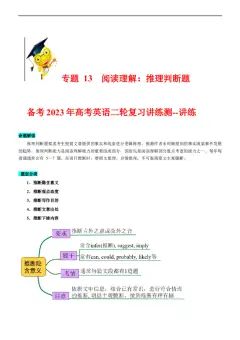
提问整篇文章或某句某段的含蓄意思时,问句中都含有infer, imply, indicate, suggest (推断,暗指)等词。
对付这类题时我们不仅要弄懂文章字面的意思,更重要的是要知道文章潜在的含义,和作者所给的提示。
同时要对文章的含义和作者的暗示作合理的猜测和推论。关键是:意思要靠推断得出,而不是原文照搬。
这就要把握住文章的主题思想和每段的内容;明确作者的观点及其写作该文的目的;分析文章里所给的有
关信息;注意词汇在词典的定义和词典以外的含义;最后运用自己的知识进行由表及里的逻辑推理,挖出
文章的伏笔,得出正确的推论。
这种问题的提问方式通常有:
1. From paragraph 4 we can infer that. / What can be inferred from the passage? / From the last paragraph we
can infer that.
2. We can infer from the text that…/ What can we learn from…? / We can conclude from the passage that…
3. The last sentence of the first paragraph most probably implies that.
4. The author implies that by the year 2080, .
5. To solve the present social problems the author suggests that we should.
6. The author mentions the fact that…to show.
7. This passage would most likely be found in _________?
8. The author’s attitude toward …is _________?
9. The tone of the passage can best be described as _________?
这些提问方式的答案一般在短文中不可能直接找到,必须根据提问中的某些关键字眼与短文中相应的
有关内容加以逻辑推理或演算,从而得出某些作者并未说明却已在字里行间所暗含的意思及观点。具体的
说,考生应当注意以下几点:1. 首先要注意一定要忠实于原文,以文章提供的事实和线索为依据。立足已知,推断未知,遵循“词
不离句,句不离段,段不离篇”的原则。千万不能主观臆想,凭空想象,随意揣测,更不能以自己的观点
代替作者的观点。
2. 要吃透文章的字面意思,从字里行间捕捉有用的提示和线索,这是推理的前提和基础。有的推断,
考生完全可以根据文章中所阐述的细节,再结合自己所掌握的基础知识、有关背景知识或常识来帮助进行
分析、推敲,从而得出符合文章原意的结论。
3. 要对文字的表面信息进行挖掘加工,由表及里,由浅入深,从具体到抽象,从特殊到一般,通过分
析、综合、判断等,进行深层处理,合乎逻辑地推理。不能就事论事,断章取义,以偏概全。
4. 要把握句、段之间的逻辑关系,了解语篇的结构,同时还要体会文章的基调,揣摩作者的态度,摸
准逻辑发展方向,悟出作者的言外之意。
5. 在解答推理性问题时,一定要注意确定推理依据的位置或范围。应清楚所要解答的问题需要针对某
个细节进行推断,还是针对主题思想、作者的意图进行推断。针对细节的推断可运用 scanning的方法,迅
速在材料中确定推理依据的位置或范围,然后再进行推理判断。针对主题思想作推断时,则常常要纵览全
篇文章。
【解答攻略】
一、隐含推断题
隐含推断题主要考查考生对特定信息、全篇、全段或上下文逻辑关系,结合相关信息的暗示,准确理
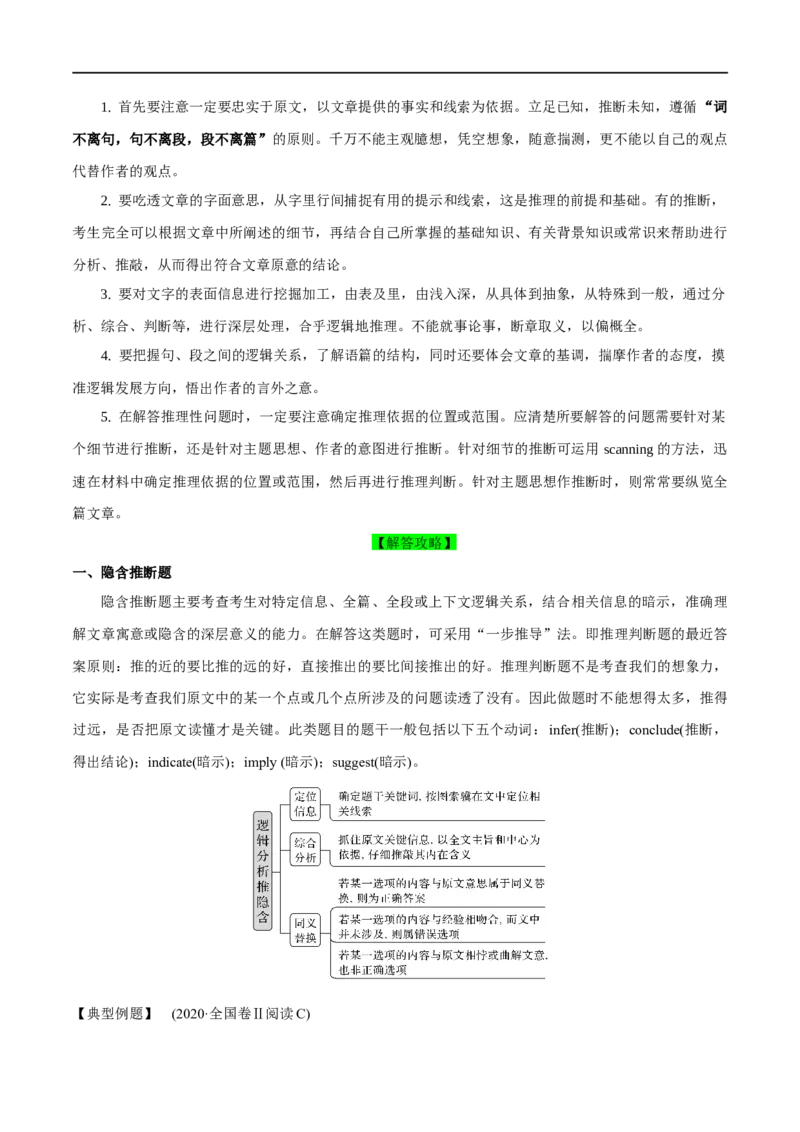
解文章寓意或隐含的深层意义的能力。在解答这类题时,可采用“一步推导”法。即推理判断题的最近答
案原则:推的近的要比推的远的好,直接推出的要比间接推出的好。推理判断题不是考查我们的想象力,
它实际是考查我们原文中的某一个点或几个点所涉及的问题读透了没有。因此做题时不能想得太多,推得
过远,是否把原文读懂才是关键。此类题目的题干一般包括以下五个动词:infer(推断);conclude(推断,
得出结论);indicate(暗示);imply (暗示);suggest(暗示)。
【典型例题】 (2020·全国卷Ⅱ阅读C)Then there’s Righteous Fur and its unusual fashions.Model Paige Morgan says,“To give people a guilt-free
option that they can wear without someone throwing paint on them—I think that’s going to be a massive thing,at
least here in New York.”Designer Jennifer Anderson admits it took her a while to come around to the opinion that
using nutria fur for her creations is morally acceptable.She’s trying to come up with a label to attach to nutria
fashions to show it is eco-friendly.
31.What can we infer about wearing fur in New York according to Morgan?
A.It’s formal. B.It’s risky.
C.It’s harmful. D.It’s traditional.
【分析】
·第一步 通读题目找出题干关键词:infer about wearing fur
·第二步 定位到原文,寻找相关信息:To give people a guilt-free option that they can wear without someone
throwing paint on them—I think that’s going to be a massive thing,at least here in New York.
·第三步 仔细比对选项:Morgan觉得在纽约,给予人们一种没有负罪感的选择,他们可以穿海狸鼠皮做
的衣服而不被人泼颜料——我认为是一件大事, 由此可推断出穿皮草具有风险性。
二、观点态度题
观点态度题是高考英语阅读理解常考的一种题型,也是考生很容易失分的一种题型。文章作者或文中
人物对某事物所持的情感、观点或态度往往隐含在文章的字里行间或流露于修饰词之中。常见的设问方式
有:
·How does the author feel about...?
·What does the author think of...?
·What is the author’s attitude towards/to...?
·The author’s attitude towards...can be described as ________.
注意:
(1)关注首段首尾句,确定文章主题,判断作者的观点态度。
(2)关注but后表示观点态度的语句来判断作者或文中人物的观点。
(3)关注作者所举的例子或者所引用的话语,来判断文章作者或文中人物的态度倾向。
(4)关注文章语言的褒贬去判断作者的态度。
(5)不要将个人的好恶态度糅进题中,要学会分清作者本人的态度和作者引用观点的态度。
选项常用词汇
positive积极乐观的;optimistic乐观的;supportive支持的;hopeful有希望
肯定
的;promising有前途的;favourable赞许的negative否定的,消极的;disapproving 不赞成的;critical 批评的;
否定
unfavourable不赞同的
怀疑 suspicious可疑的,怀疑的;doubtful可疑的
客观 objective客观的;neutral中立的;skeptical怀疑的
注意:以下选项一般不是答案
(1)subjective主观的,一般说明性的文章一定是客观叙述的;
(2)indifferent漠不关心的,作者既然写文章描述,就一定不会漠不关心。
【典型例题】 (2020·全国卷Ⅲ阅读C)
“We floated the idea to my mum of sharing a house,”says Kathryn Whitehead.Rita cuts in:“We spoke more
with Nick because I think it’s a big thing for Nick to live with his mother-in-law.”
And what does Nick think?“From my standpoint,it all seems to work very well.Would I recommend it?Yes,
I think I would.”
29.What is Nick’s attitude towards sharing the house with his mother-in-law?
A.Positive. B.Carefree.
C.Tolerant. D.Unwilling.
【分析】
·第一步 通读题目找出题干关键词:Nick’s attitude towards sharing the house with his mother-in-law
·第二步 定位到原文,寻找相关信息:“From my standpoint,it all seems to work very well.Would I
recommend it? Yes,I think I would.”
·第三步 仔细比对选项:尼克对于与岳母住在一起持积极的态度。
三、写作意图题
通常情况下,作者在文中不直接陈述自己的意图,而是通过文中所列事物使读者感受到其所传递的想
法。所以,这种题型要求考生具备对作者阐述的内容进行总结和分析的能力,是阅读理解题中较高层次的
题目,它与文章主题不同,但又关系密切,所以可以算作主旨大意题的一种变体。
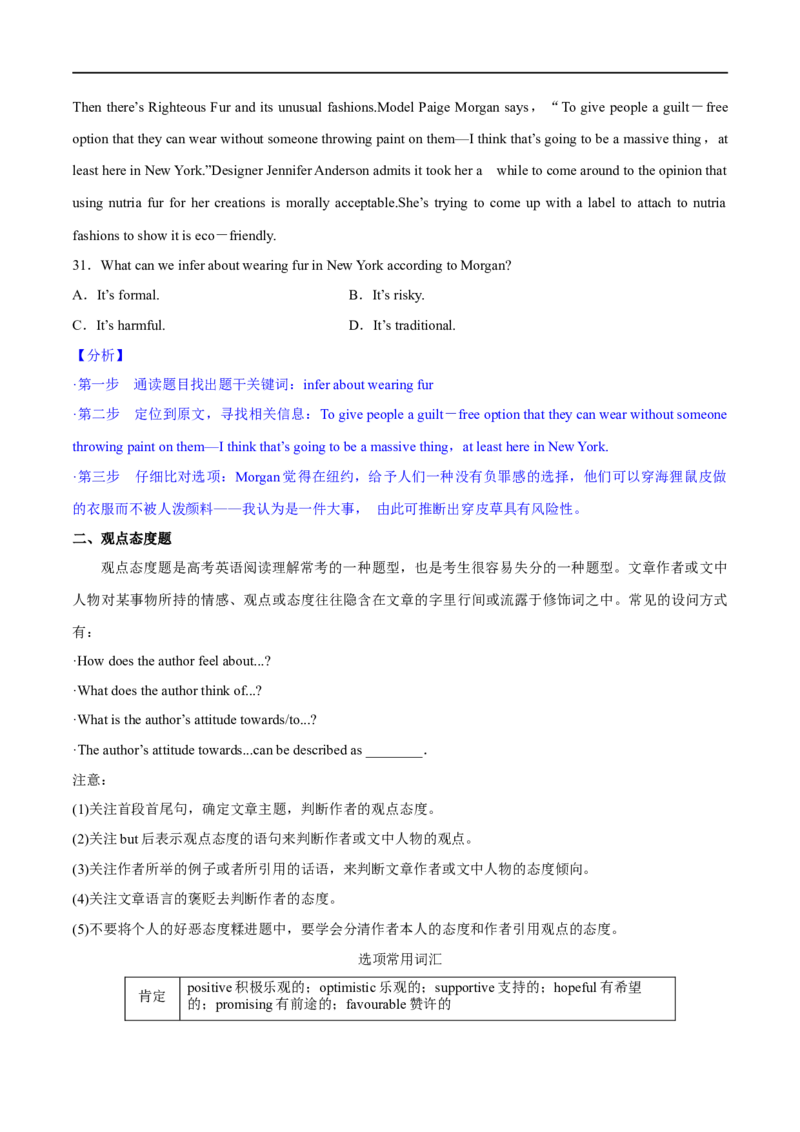
1.从写作手法推断写作目的
2.从字里行间推断写作目的
在阅读中,有时作者并未把写作意图说出来,需要阅读者在阅读、理解整体语篇的基础上,根据字面意思,
通过全篇逻辑关系,研究细节的暗示,推敲作者的写作意图。【典型例题】 (2020·新高考卷Ⅰ阅读C)
In the mid-1990s,Tom Bissell taught English as a volunteer in Uzbekistan.He left after seven months,
physically broken and having lost his mind.A few years later,still attracted to the country,he returned to
Uzbekistan to write an article about the disappearance of the Aral Sea.
His visit,however,ended up involving a lot more than that.Hence this book,Chasing the Sea:Lost Among
the Ghosts of Empire in Central Asia,which talks about a road trip from Tashkent to Karakalpakstan,where
millions of lives have been destroyed by the slow drying up of the sea.It is the story of an American travelling to a
strange land,and of the people he meets on his way:Rustam,his translator,a lovely 24-year-old who
picked up his colorful English in California,Oleg and Natasha,his hosts in Tashkent,and a string of foreign aid
workers.
This is a quick look at life in Uzbekistan,made of friendliness and warmth,but also its darker side of society.In
Samarkand,Mr Bissell admires the architectural wonders,while on his way to Bukhara he gets a taste of police
methods when suspected of drug dealing.In Ferghana,he attends a mountain funeral(葬礼) followed by a strange
drinking party.And in Karakalpakstan,he is saddened by the dust storms,diseases and fishing boats stuck miles
from the sea.
Mr Bissell skillfully organizes historical insights and cultural references,making his tale a well-rounded picture
of Uzbekistan,seen from Western eyes.His judgment and references are decidedly American,as well as his
delicate stomach.As the author explains,this is neither a travel nor a history book ,or even a piece of
reportage.Whatever it is,the result is a fine and vivid description of the purest of Central Asian traditions.
11.What is the purpose of this text?
A.To introduce a book.
B.To explain a cultural phenomenon.
C.To remember a writer.
D.To recommend a travel destination.
【分析】
·第一步 审读题目找出题干关键词:the purpose of this text
·第二步 从字里行间推断写作目的:迅速读懂原文理清文章脉络:文章开头引出汤姆·比塞尔写书的背景,
从第二段到最后一段分别介绍了这本书的概要、主要内容和对这本书的评价。
·第三步 仔细比对选项:全文围绕着这本书展开,目的就是向读者介绍并推荐这本书。
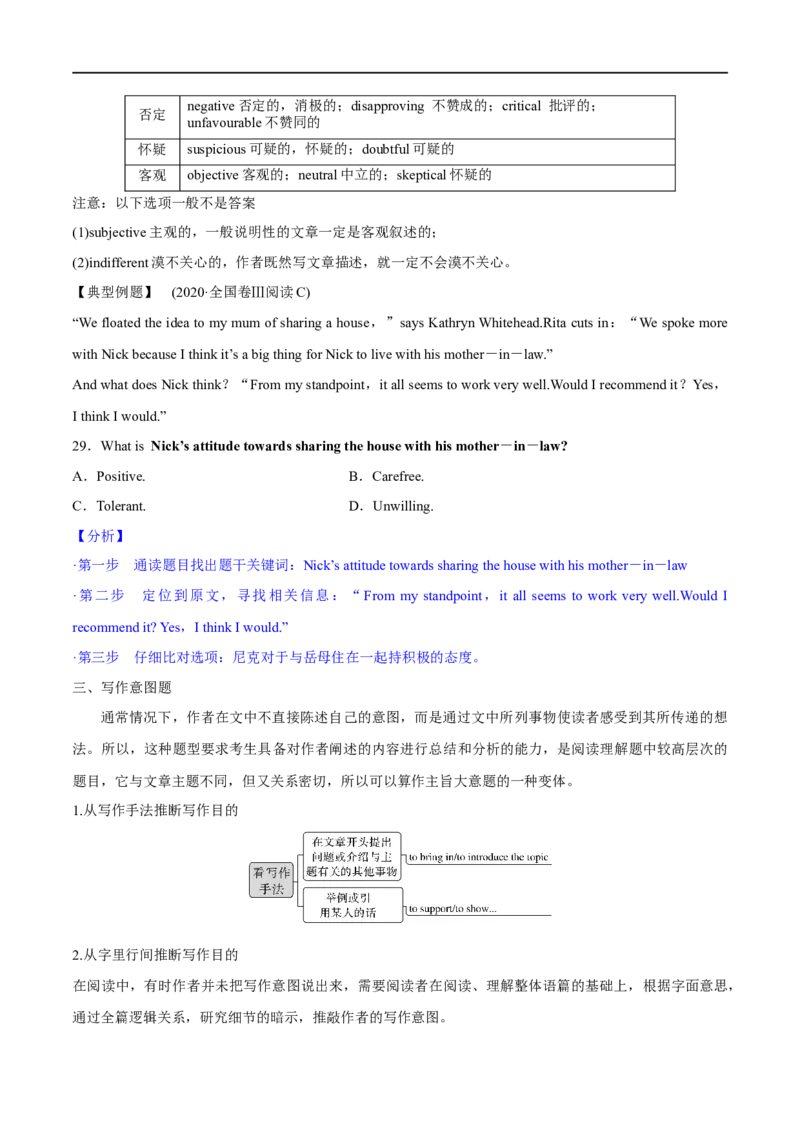
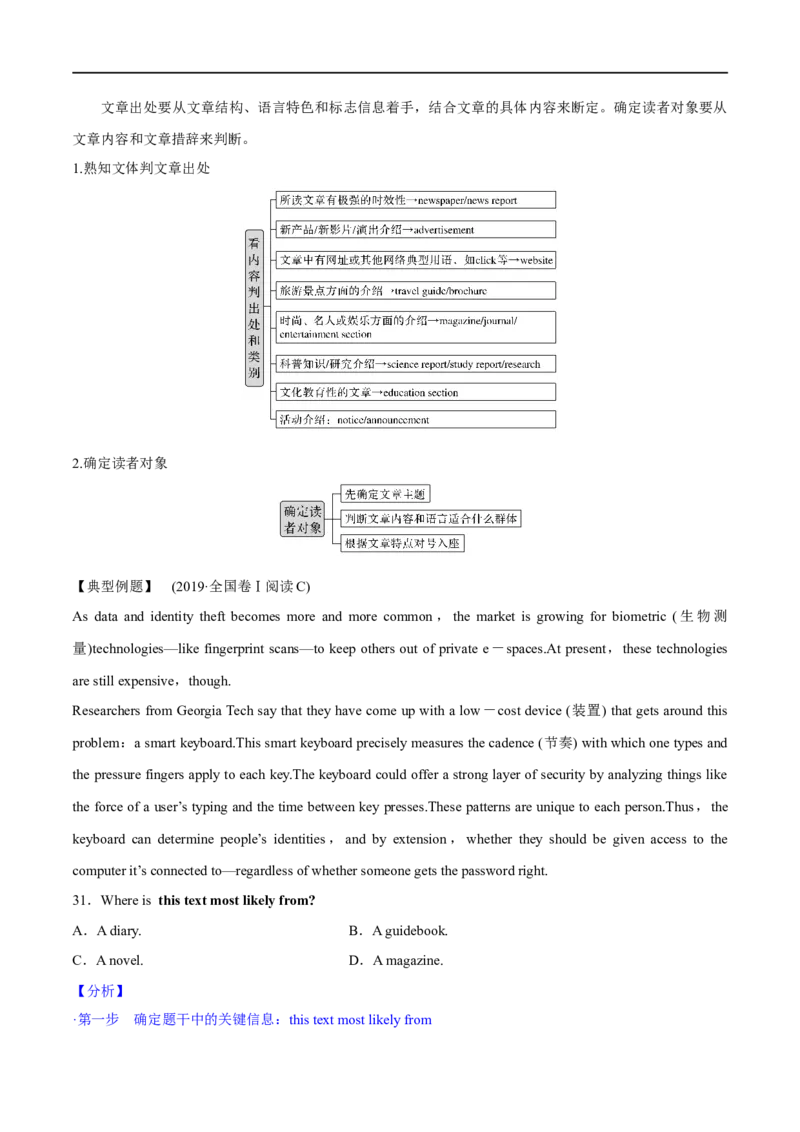
四、文章出处/读者对象题文章出处要从文章结构、语言特色和标志信息着手,结合文章的具体内容来断定。确定读者对象要从
文章内容和文章措辞来判断。
1.熟知文体判文章出处
2.确定读者对象
【典型例题】 (2019·全国卷Ⅰ阅读C)
As data and identity theft becomes more and more common,the market is growing for biometric (生物测
量)technologies—like fingerprint scans—to keep others out of private e-spaces.At present,these technologies
are still expensive,though.
Researchers from Georgia Tech say that they have come up with a low-cost device (装置) that gets around this
problem:a smart keyboard.This smart keyboard precisely measures the cadence (节奏) with which one types and
the pressure fingers apply to each key.The keyboard could offer a strong layer of security by analyzing things like
the force of a user’s typing and the time between key presses.These patterns are unique to each person.Thus,the
keyboard can determine people’s identities,and by extension,whether they should be given access to the
computer it’s connected to—regardless of whether someone gets the password right.
31.Where is this text most likely from?
A.A diary. B.A guidebook.
C.A novel. D.A magazine.
【分析】
·第一步 确定题干中的关键信息:this text most likely from·第二步 定位到原文,寻找相关信息:根据本文的话题“智能键盘”以及第二段中的“Researchers from
Georgia Tech say that they have come up with a low-cost device...”,尤其是其中的关键词researchers,low-
cost device等来推断,这篇文章是一篇科研报道。
·第三步 结合文章的具体内容合理推断得出答案:科研报道最有可能出现在杂志上。
2
能力强化
1
Have you ever loved a destination but couldn’t figure out why — or even a way ——to express your feelings?
That’s my dilemma with Morocco.
In August, I traveled in a country that had long been, on my wish list. I rode a camel, got lost in Medinas, and
ate more couscous (粗麦粉) than was humanly possible.
I loved the trip. Our friendly guide introduced us to the helpful locals. I made friends with my tour mates and
my roommate (which, on a tour, is a huge blessing). I loved being lost in the smell of different spices, and the chaos
of millions of people and the dark red of the Sahara were all I wanted them to be.
There were many moments when I felt like a fish out of water and things didn’t go my way. But I take pleasure
in those moments because it’s when you are pushed out of your comfort zone that you grow. Morocco lived up to
all my expectations, but for some reason, my experience has been hard to express. Why?
One constant in my travels is that of a touchstone, one defining point where the trip all comes together and
acts as a prism (三棱镜) for everything the journey represented . In Costa Rica,it was getting lost in a jungle. In
Thailand, it was meeting those five people who changed my life.
I’m so inconsistent about Morocco because I lack that touchstone. There’s no “whoa” moment. But I have
thousands of little ones - staring at a million stars in the blackness of the desert, discovering new foods with some
amazing Australians on my tour, and befriending the fish sellers.
1. What does the author regard as a huge blessing?
A. Going on a guided trip.
B. Having a helpful guide.
C. Being warmly received by the local people.
D. Getting along well with the fellow travelers.
2. What’s the purpose of the fifth paragraph?.
A. To prove Morocco lacks the touchstone.B. To show his reliance on the touchstone.
C. To compare Morocco with Costa Rica and Thailand.
D. To share his experience in Costa Rica and Thailand.
3. What made the author think the journey amazing?
A. The lack of big moments.
B. The little “whoa” moments.
C. Meeting with five Thai people.
D. Making friends with Australians.
4. What does the author mainly talk about?
A. Unpleasant travel in Morocco.
B. Finding a touchstone on travel.
C. Reflection on traveling in Morocco.
D. Lack of special moments in Morocco.
2
In the small village of Goss in Austria, a century-old brewery tradition had a novel transformation towards
Sustainability (可持续性), Göss in home to the Gösser Brewery, the world’s first large scale zero-carbon brewery.
Owned and operated by the Heineken Group, the world's third-largest beer maker, the Gösser Brewery was
relaunched as a zero-carbon facility in June. The brewery produces 1.4 million bottles of beer every day using a
mix of entirely renewable energy sources, including hydropower, biogas and waste heat. This has brought its
carbon emissions (排放) down from 3, 000 tons a year to zero.
Andreas Werner, brew master at Gösser Brewery said, “Our Cöss brewery may be in a small town but our goal
was to make a big influence. I am proud of what we have achieved for the Heineken Group and want to help our
other breweries and the wider brewing industry makes renewable energy part of their energy mix, just as we have
done.”
The brewery is helping Heineken achieve its commitment to a 40 percent reduction in CO2 emissions from
production by 2022, which is kept in the company’s Brewing a Better World stability strategy.
To power its production, the Gösser Brewery uses 100 percent hydropower sources for eletnicity-35 percent
from biomass for heating, 10 percent from biogas from waste water, 3-5 percent from a solar plant, and 50 percent
from biogas generated from the spent grain fermentation (发酵) tank.
For this creative move towards sustainability, the brewery won the EU Sustainable Energy Award and CitizensChoice Award in June. The awards cognize creative projects in energy efficiency and renewability in Europe. “The
Goss brewery is the stand-out example of this work and our commitment to sustainability,” Roland Verstappen,
Heineken’s director for public and movement affairs said.
5. What is special about the Gösser Brewery?
A. It’s the world’s third largest zero-carbon brewery.
B. No carbon will be given off during its production.
C. It can produce 1.4 million bottles of beer annually.
D. The Heineken group newly opened it to produce more beer.
6. What are the percentages in paragraph 5 about?
A. The resources of making beer.
B. The production of beer bottles.
C. The examples of sustainable energy.
D. The composition of hydropower sources.
7. Why does Roland Verstappen think highly of the Gösser Brewery?
A. It has won two international awards for its creativity.
B. It has helped more industries turn to renewable energy.
C. It has led to the draft of Heineken’s Brewing a Belter World strategy.
D. It has played an important role in Heineken’s achieving its goal of CO2 reduction.
8. What is the text mainly about?
A. A brewery’s creative move to achieve sustainability.
B. Profits gained from the transformation of an old brewery.
C. The brewery industry’s responsibility for protecting the environment.
D. A small business making a big difference by mixing various sources.
3
On 19 March 2018, you were born. I knew absolutely nothing of you and hadn’t even considered adding
another member to our family.
You see, at that time I was becoming increasingly concerned about our teenage daughter. She had been
spending more and more time away from the family, bad tempered and unsociable. She seemed unhappy most of
the time. She had talked of wanting a dog for a long while, so I thought: if I do this for her, it will boost her mood,
get her out more and give her a new focus.
To my surprise, our daughter’s reaction was not what I expected when I introduced the two of you-had 1 madea mistake?
I soon began to understand that you were not going to bring her out of her sadness. Yet you still needed taking
care of, so, naturally, most of the duties of your care fell upon me.
Then, in July, our daughter was diagnosed with anorexia (厌食症). Our lives were turned upside down, as she
faced the biggest challenges of her life. My husband and I had different ideas about what would be the best course
of action to take; the illness sent the whole family into chaos. Without you, I wouldn’t have had the opportunity, to
find clarity. On our walks together, you gave me the freedom to think clearly and rationally (理性地). I found a
calmness that I never would have, had I been at home with Google.
In September, we kept our daughter off school and I looked after her, putting everything else on hold. During
that time I bonded with her and she bonded with you. She rejoined school in the middle of September, and was
slowly but surely on the road to recovery.
Thank you for your constant love and playfulness, and for showing me the simple pleasures of life. But most
of all, thank you for being my light in the dark.
9. Who does the author write the letter to?
A. Her daughter. B. Her dog. C. Her husband. D. Herself.
10. What was the author's purpose of adopting a dog?
A. She needed a lifelong friend.
B. She would like to know more about dogs.
C. She wanted a dog 1o ease the tension in the family.
D. She hoped u dog could relieve her daughter of bad mood.
11. Why was the author grateful to the dog?
A. It cured her daughter of her disease.
B. It made her husband stay elear-minded.
C. It helped her belter deal with the difficult situation in her life.
D. It strengthened the relationship between her daughter and her.
12. What can you infer about the author from the passage?
A. She had anorexia. B. She was a devoted mother.
C. She felt guilty to her dog. D. She recovered from her sadness.
4
When consumers see a food, what they expect makes the palate (味觉) taste certain flavors. The strong
associations between color and flavor are well established in the scientific community. Research on the subjectdates back to the 1970s. For example, consumers expect yellow foods to be sour and black foods to be bitter.
Branding, packaging and color quality of the product itself play a big part in creating and maintaining
expectations. Food brands have long understood this and worked to establish standards. Federal regulations grade
the color of orange juice. Businesses provide color- matching services for companies to select the right color for a
particular product. In some cases, color can overpower other senses and convince people they taste flavors that
aren't there.
The Penn State researchers set out to confirm long-standing research into the relationship between color and
taste. And they found what consumers see when they eat matters as much as- if not more than- what they taste, and
the links could be more flexible than many thought in some cases.
“This might have potential impacts in the food industry if a company were to launch a new flavoured product
with a color. Some consumers might not learn or accept a new color and flavor pairing (配对) as well as others,"
Penn State Food Science doctoral candidate Molly J. Higgins said in a written statement.
But while today's consumers have expectations of flavors of items with different colors, they also have
expectations that natural materials are used. While these materials are often preferable, they present a challenge.
General Mills changed artificial dyes (染料) to natural ones in Trix cereal. Consumer anger followed. Many found
the earthier tones (土黄色) depressing, despite no change in flavor. Chemicals and all, they wanted the original
back. The company eventually switched back, choosing to treat color as being more important than other things.
13. Which of the following is NOT mentioned as for creating and maintaining expectations for products?
A. Color quality. B. Branding. C. Shape. D. Packaging.
14. What do Molly J. Higgins' words suggest in Para. 4?
A. An expected food color attracts consumers more.
B. Most people choose foods based on their colors.
C. Not all consumers welcome a new color-taste pairing.
D. Companies should release new products regularly.
15. Why is General Mills mentioned in the last paragraph?
A. To stress the importance of color in food selection.
B. To stress the possibilities facing food companies.
C. To stress the difficulty in using artificial materials.
D. To stress the difference between color and taste.
16. What can be the theme of the text?A. Why do foods have different colors?
B. How deep are color-taste associations?
C. What factors affect the flavors of food?
D. Do different colors mean different responses?
5
In June 2017, Tiffany Johnson, 34, from North Carolina, was on a ship with her husband, James Johnson,
when they decided to take a ten-minute boat ride from Paradise Island to go snorkeling (浮潜) in the sea.
The couple were enjoying their journey, when Ms Johnson was faced with a shark (鲨鱼), which caught hold
of her arm and tore it off up to the elbow (肘). Ms Johnson said, “I was able to swim back to the boat with my
injured arm lifted up above the water. Once I got to the boat, we used a beach towel as a bandage for my arm.”
She was rushed to the nearest hospital where she underwent an operation that lasted five hours. “Medically, it
does not make sense that I am still alive. I didn't even require blood transfusion (输血). When I really had time to
digest it all, I cried a lot. Not really tears of sadness, but rather pure thankfulness that I was alive. I had just lived
through a near-death experience and I was just so fortunate to still be here,” Ms Johnson said.
In November she had her first robotic hand fitted. She had to learn how to use her arm all over again and
admitted that this was very challenging being a mom of three children. “Everything is different. It doesn't function
the same way as a hand does; it is more like a tool. So it has been a learning experience and I am still learning more
than two years later. This latest version is only a few months old; I can now bring my arm closer to my body. It
functions OK, but I'm still learning,” Ms Johnson said.
In the times when she felt unsure, her belief kept her focused on the things she could control. “Finally, I have
learned that you don't always have a choice when things happen, but you always have a choice in how you respond.
I have been asked to talk with some patients that have had a hard time. It has been good to be able to use this to
help, encourage, and spread hope,” Ms Johnson said.
17. What happened to Ms Johnson in 2017?
A. She fell sick on a ship. B. She got lost on Paradise Island.
C. She was attacked by a shark. D. She was separated from her husband.
18. What can we infer about Ms Johnson's experience from Paragraph 3?
A. It led to her husband's death. B. It was lucky and unexpected.
C. It was an easy thing to accept. D. It made her feel hopeless.
19. What do the underlined words in Paragraph 4 refer to?A. Ms Johnson's real arm. B. Ms Johnson's useless tool.
C. Ms Johnson's youngest child. D. Ms Johnson's new robotic hand.
20. Which of the following can best describe Ms Johnson?
A. Strong and optimistic. B. Proud and careful.
C. Courageous and talkative. D. Creative and determined.
6
We try to give our children so much but sometimes forget to give them the greatest gift, the ability to feel
grateful. Without that, we can never give them enough. Gratitude can be expressed for anything—the sight of
beautiful clouds, our warm home, or a nice meal.
Many of our parents tried to make us feel grateful by pointing out the hungry children in some faraway land.
This often resulted in us offering to send those children the unpleasant clothes or ugly tennis shoes. Just have a look
around us, we know how this happened. All around are material things that they (and we) are led to believe we
must have- -that we have a right to have.
The most important is simply being an example of being grateful for the things in our own lives. In my work
as a school psychologist, a mother with a 9-year-old came to see me for help. We worked out a way to teach him to
feel gratitude- but not to say how fortunate he was. She started by talking about what had gone on in her day that
she was grateful for: a friend who praised her work or the quiet evening without too much washing. Then she asked
him if anything good happened in his day. He got the idea, shared a few things, and it soon became a habit.
So along with all the things on the wish lists, we can add another one: gratitude. It might even help to start by
letting our kids know that, regardless of their appearance, their scores, or their abilities, they are source of gratitude
in our lives.
21. According to the author, gratitude________.
A. may come from everyday life B. should come first on the wish lists
C. is more important than children's scores D. must be taught by teachers in school
22. What is Paragraph 2 mainly about?
A. The situation of children in poor areas.
B. The skill of choosing and sending gifts.
C. The difference between right and wrong.
D. The reason for children's feeling ungrateful.
23. The story of the 9-year-old boy is mainly to show that parents should________.
A. teach their children to forget bad things in lifeB. set an example to children to feel gratefulC. tell their children how lucky they are D. praise their children quite often
24. In which part of a website can we probably find the text?
A. News. B. Jobs. C. Family. D. Arts.
7
Plants: we eat them, juice them-and now it seems we can mine them too!
After a successful experiment on the island of Borneo, the botany professor Alan Baker and a group of
researchers want to introduce phytomining (harvesting minerals from plants) as a better, partial substitute for
traditional mining.
Phytomining, also known as agromining, means collecting metals from live plants. However, this can only be
done with a group of plants known as "hyperaccumulators". There are around 700 identified types worldwide, and
what makes these hyperaccumulators special is that they naturally attract and absorb minerals through their roots-
metals poisonous to other plants-and then store huge, pure concentrations of these minerals in their bodies. The
metals can then be extracted from the plants' sap(汁;液), oil, or sometimes even live tissue.
Baker and his colleagues see a lot of potential in phytomining. Not only can it help meet the growing global
demand for metals, but is a way of undoing some of that damage to the environment by traditional mining.
One of the biggest problems with traditional mining is that it pollutes the surrounding area. Phytomining can
extract metal waste, plus planting the hyperaccumulators would regrow the deforested areas caused by mining
operations. Aside from this, if phytomining is able to replace part of traditional mining, then there would be fewer
instances of bad mining practices like abandoned mines, which pollute the nearby waters. Also, since phytomining
provides metals that are already naturally pure, there is no need to use huge amounts of energy to purify the ore(矿
石).
Phytomining has its drawbacks. Harvesting plants on a large scale is expensive today, compared to traditional
mining. Besides, plants can be wiped out by diseases or unexpected weather conditions.
However, there are many reasons to consider phytomining. After all, we need to make sure that our planet can
keep up and sustainable practices like phytomining give us the hope that our advancement doesn't mean sacrificing
Mother Earth.
25. What makes hyperaccumulators different from other plants?
A. The sap poisonous to other plants.
B. The ability to take in and store minerals.
C. The oil extracted from live plant tissue.D. The concentrations of minerals in their bodies.
26. What is the advantage of phytomining?
A. It can stop deforestation.
B. It may reduce the desertedmines.
C. It uses clean energy to purify the ore.
D. It can't be destroyed by diseases.
27. What is the author's attitude toward phytomining?
A. Pessimistic. B. Indifferent. C. Optimistic. D. Skeptical.
28. What can be the best title for the text?
A. Metals From Plants.
B. The Future of Phytomining.
C. What Are Hyperaccumulators?
D. Benefits of Phytomining.
8
Is there a strange something high up in the world’s tallest mountains? If so, is it a big bear? Is it a monkey? Or
is it a kind of man? No one knows. This mystery has puzzled the world for years.
In 1887, a mountain climber found large footsteps in the snow. They looked like the footsteps of a very large
man. But men don’t walk without shoes in the snow!
In 1906, another climber saw more footsteps. He saw a very large animal standing on two legs. As he watched,
it ran away very quickly. Fifteen years later, a newspaper had new stories about the “something”. A mountain
climber said he had seen the “snowman” walk slowly in the snow. He said it looked like a very large man.
From then on, more and more people had stories to tell. But not until 1951 did a mountain climber bring back
the pictures of large footsteps. The pictures showed clearly that the snowman walked on two legs. So it was not a
bear or a monkey. Could it be an apeman (猿人)? And the mystery keeps growing. Some day, we may find out just
what it is that makes the largest footsteps.
29. The passage is about ________.
A. some mountain climbers
B. some strange animals
C. the snow
D. the mystery of the large footsteps
30. Why were people interested in footsteps?A. Because they were the footsteps of a large bear.
B. Because they looked like the footsteps of a large man.
C. Because they were found in the snow.
D. Because they were found in the mountains.
31. Why did the mystery grow when a mountain climber brought back pictures of large footsteps?
A. They were the footsteps of an apeman.
B. They were the footsteps of a snowman.
C. The pictures showed clearly how the snowman walked.
D. People still don’t know who made the footsteps.
32. Which is the best title?
A. Snow B. The large footsteps
C. A big bear D. Monkey
9
Tobias Weller is nothing short of extraordinary.
At 9-years-old, he’s dealt with things most of us won’t face in our lifetimes. Simple tasks, like standing on his
own two feet, are impossible for him and he requires assistance for most activities we consider basic. But Just
because he’s someone who needs help, that doesn’t mean he can’t give help.
At first Tobias decided to complete a sponsored one-kilometer walk. But for some reasons, the race was
canceled, and Tobias’ plans were destroyed.
The moment young Weller learned about Captain Tom, a 100-year-old British vet who has now raised 41
million dollars for charities by walking in his walker, he decided if a century-year-old man could walk for miles, he
could also make it happen.
Forget the one kilometer, Tobias was going to walk a marathon—26.2 miles—in order to raise money for his
two favorite charities. He went up and down his street for months. First with 50 meters a day, but as he grew
stronger, the distance expanded and eventually he built up to 750 meters a day. It took him 70 days to cross that
finish line, but he did it.
His mother, Ruth Garbutt, presented him with a medal as he crossed the finish line.
She said: “I’m so, so proud of Tobias. I’m bursting with pride for all he’s achieved and how hard he’s worked
during the marathon…He couldn’t push the walker at the start of the marathon and now he can, he can push it on
the flat and he’s proved today he can push it uphill as well.”
Honestly, just wow. The amount of pain and extreme tiredness he must have suffered during his walks isunimaginable. But he never stopped, he just kept pushing, and in the end he raised over $111, 000 for his charities.
“I’m pleased to raise loads of money. Other children who aren’t as lucky as me can benefit from the money
that’s been raised.” Tobias said.
33. Tobias decided to walk a marathon mainly to ________.
A. challenge himself
B. strengthen his body
C. contribute to charities
D. compete with Captain Tom
34. What do we know about Tobias’s marathon?
A. It was canceled finally.
B. It lasted more than two months.
C. Tobias finished it without a walker.
D. Tobias was awarded the first prize.
35. Which of the following words can best describe Tobias?
A. Ambitious and calm. B. Strong-willed and kind.
C. Courageous and honest. D. Determined and cooperative.
10
Turtles have an unfortunate habit of eating plastic objects floating in the sea. These then cannot be broken
down and digested, and may ultimately kill them.
It is widely assumed that this special liking for plastics is a matter of mistaken identity. Floating plastic bags,
for instance, look similar to jellyfish, which many types of turtles love to eat. Yet lota of plastic objects that end up
inside turtles are not similar to jellyfish. Joseph Pfaller of the University of Florida therefore suspects that the smell
of micro-organisms (微生物) which grow on floating plastic objects fools turtles to feed.
Researchers at the University of California noticed that certain chemicals, which are released into the air by
micro-organism — colonised plastics, are those which many seabirds sniff to track down food. These chemicals
mark good places to hunt because they indicate an abundance of the seaweed and bacteria. Since turtles are known
to break the surface and sniff the air when swimming towards their feeding areas, Dr. Pfaller indicated that they are
following these same chemicals, and are fooled into thinking that floating plastic objects are edible.
To test that idea, he and his colleagues set up an experiment. They arranged for 15 of the animals, each around
five months old, to be exposed, in random order, to four smells delivered through a pipe to; the air above an
experimental area. The smells were: the vapour from deionised (去离子) water; the smell of turtle-feeding meal;the smell of a clean plastic bottle; and the smell of a similarly plastic bottle that had been kept in the ocean for five
weeks to allow seaweed and bacteria to grow on it. Two of the smells-the smell of meal and that of five-week-old
bottles-proved far more attractive to the animals than the others.
On the face of it, then, the turtles were responding to the smell of old bottles as if it were the smell of food. In
an unpolluted ocean, pretty well anything which had this smell would be edible-or, at least, harmless.
Unfortunately, five-week-old plastic bottles and their like are not.
36. What is most people's opinion on turtles' special habit?
A. Turtles prefer jellyfish to plastics.
B. Turtles enjoy the taste of plastics.
C. Turtles like being fed with plastic tools.
D. Turtles choose to eat plastics for a mistake.
37. What does the underlined word “edible" in paragraph 3 mean?
A. Fit to eat. B. Pleasant to smell.
C. Far to reach. D. Easy to digest.
38. What can we infer from Dr. Pfaller's research?
A. Many seabirds can track the food.
B. Most animals find food through smells.
C. Two smells are especially favored by turtles.
D. The favored smell leads turtles to seek for food.
39. Why did the author mention the unpolluted ocean at last?
A. To explain why the ocean is polluted.
B. To ask for people to feed turtles proper food.
C. To arouse the awareness of protecting the ocean.
D. To show his agreement on Dr. Pfaller's research.