考点 8 阅读理解
推理判断之文章结构(核心考点精讲精练)
1. 命题规律及备考策略
【命题规律】近3年新高考卷对于阅读理解中没有对推断文章结构进行考查,这不意味着未来不会考查。高考备
考要充分准备未来可能考的题,不是盲目追风必考考过的试题。主要考查:
根据阅读文章整体推断文章结构。推断文章结构的方法:1.从整体出发,辨别文章结构图;2.根据文章的某一段落,
选择文章作者是怎么展开或组织段落的。
【备考策略】系统归类推断文章结构的方法;熟练掌握阅读技能。
【命题预测】
学业水平考试的是高中生的毕业考试,高考是国家选拔创新人才的考试。学考和高考分开考的目的很明确。
高考就是选拔性考试,通过高考英语试题,考查学生的推理判断能力和逻辑思维能力及品质是重要导向。
通过阅读理解中,推断文章结构考查考生的整体观,从全局看问题的能力,在新高考命题中很可能会出现。
推断文章结构的命题依据是:新课程标准中要求学生掌握:主要语篇结构特征。因此,推断文章结构的推理判断
题,有可能在2024年高考中将成为高考阅读理解的题型,应该倍加注意。
【2024年高考命题预测】
推理判断之推断文章结构考点是新课标中明确要考的考点。在当今高考的新改革时代,考查文章结构题最能
考查学生对语篇的整体把控,要求学生必须从大处着眼。预测在2024高考中,推断文章结构题有可能在高考阅读
理解中呈现。
【推理判断之文章结构考点指南】
规律方法:
文章结构主要的设题方式常有:
(1)How is the passage organized?
(2)Which of the following best shows the structure/organization of the passage?
规律方法:如何解决文章结构题?
考查组织结构的文章通常行文组织结构都比较清晰、规范,因此,具备文体、写作方式和文章组织结构方面相
关知识对于有效解答此类题目具有至关重要的作用。
1、记叙文可以采取以时间为序、以地点为序、以故事情节发展为序(开端、发展、高潮、结局)等叙事方式进行
写作。以故事情节为序又可以不按照时间的先后顺序叙述,比如,先写结局,再写其他,最后写高潮,这种叙事
手法叫做倒叙。
2、议论文总体上可以分为四类:
第一类,“提出论点——分论点一——分论点二——分论点三……——结论”;
第二类,“引入段——导出论点——分点论述——结论”;
第三类,“提出问题——分析问题——解决问题”;
第四类,“提出反面观点——批驳反面观点——提出正面观点”。3、说明文往往采取下定义、举例子、列数字、对比或比较等说明方式进行写作,而这些说明方式都是为了使文章
要说明的内容或问题更加清晰明了、真实可信,或者更具说服力。
(2023届江西省赣州市高三下学期二模)
Sleep is reparative. Because we need to repair a lot while we sleep, it’s important to get quality sleep.
Most of us function better in the daytime with routines. We also function better at night with a routine because we want
to keep pace with our natural body rhythms. Each person’s routine may be different — some people wash their face at night,
and some take a bath — just make sure it is a routine. That’s true during the week and on the weekend; consistency matters.
Have a winding down, getting ready for sleep routine, and carry that out at the same time every night. Find things that are
relaxing and help slow you down for sleep. That may be reading, listening to music, meditating, praying — anything that’s
relaxing while also being constructive or healthy.
Typically, people relax and tend to slow everything down at bedtime. As they relax, they take deeper breaths,
increasing oxygen flow, which raises their skin temperature. This is one of the key reasons why we sleep better in a cooler
environment. If your skin temperature increases and your room is already a bit warm, you will be too hot to sleep well.
The exact temperature is a personal matter. The key is that it’s more toward cool than hot. Many consider 68 degrees an
environment that’s neither so cold we shiver nor so hot we sweat. But there’s no scientific evidence for an exact, perfect
sleeping temperature.
At the end of the day, sleep is absolutely crucial for so many reasons. It helps us repair and rejuvenate so we can fight
infection, concentrate, regulate our moods, show up for ourselves and the people in our lives, and basically function as
humans. We can’t make up lost sleep, contrary to what many a night owl might think. So, it’s really high time we should do
all we can to foster the best sleep possible, starting with a cool room and relaxing bedtime routine.
1.What can be inferred from Paragraph 2?
A.A routine can be helpful in getting quality sleep.
B.It’s best to avoid screens before you go to bed.
C.Higher quality of sleep leads to better mental health.
D.Listening to music makes it difficult to stay asleep.
2.What will happen when people relax during sleep at night?
A.They’ll take more regular breaths. B.They’ll feel cooler than in the day.
C.Their skin temperature will rise. D.They will not get enough oxygen.
3.What main point does the author want to make in the last paragraph?
A.Good sleep can be made at any time. B.Sleep is important for many reasons.
C.Try to develop good sleep habits now. D.Lost sleep makes no difference to people.
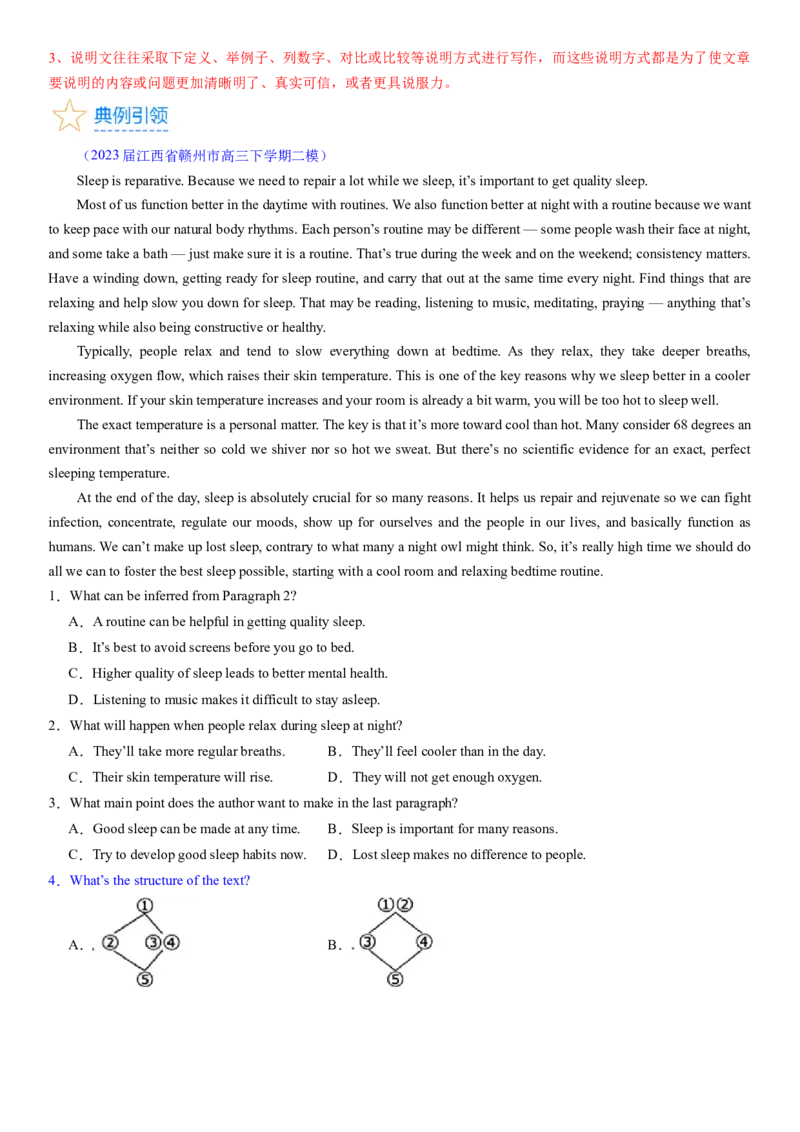
4.What’s the structure of the text?
A. B.C. D.
(2023届山东省潍坊市安丘市高三3月过程检测)
A diet rich in fruit and vegetables and incorporating a daily glass of wine can protect the brain against dementia, a
study suggests. Sticking closely to Mediterranean eating habits, which also include plenty of nuts, seafood, whole grains
and olive oil, has been linked to a 23 per cent lower risk of dementia.
Based on data gathered on 60,000 people via the UK Biobank, a medical database set up in 2006, the researchers
scored participants’ diets for how closely they matched the ideal Mediterranean diet on two scales.
Using one, those whose eating habits were the best match were 23 per cent less likely to develop dementia than those
whose diets least fit the pattern. A diet with a perfect score would involve more than four tablespoons of olive oil, at least
two portions of vegetables and three of fruit per day as well as a glass of wine. It would also include at least three servings
of legumes, 90 grams of nuts, and three servings of fish or shellfish a week. The ideal diet would also involve very little red
or processed meat, avoiding too many sweetened drinks, butter, margarine or cream.
The second scale used similar criteria and a close match on that was linked to a 14 per cent lower risk of dementia. The
findings, published in the journal BMC Medicine, appeared to show a “protective effect regardless of someone’s genetic
risk”.
Dr Susan Mitchell, of Alzheimer’s Research UK, said, “There is a wealth of evidence that eating a healthy, balanced
diet can help reduce the risk of cognitive decline. But the evidence for specific diets is much less clear-cut.” She pointed out
that the study only drew on data from people with white, British or Irish ancestry. She said, “While there are no surefire
ways to prevent dementia yet, a diet rich in fruit and vegetables, along with plenty of exercise and not smoking, all
contribute to good heart health, which in turn helps to protect our brain from diseases that lead to dementia.”
5.What did the study find out?
A.A new way to cure a disease. B.A popular diet to keep balance.
C.A medical database to do research. D.A possible strategy to reduce the risk of dementia.
6.How did the researchers carry out the study?
A.By making comparison. B.By presenting the process.
C.By consulting other studies. D.By analyzing cause and effect.
7.What does Susan Mitchell think of the study?
A.It’s evident. B.It’s limited. C.It’s practical. D.It’s promising.
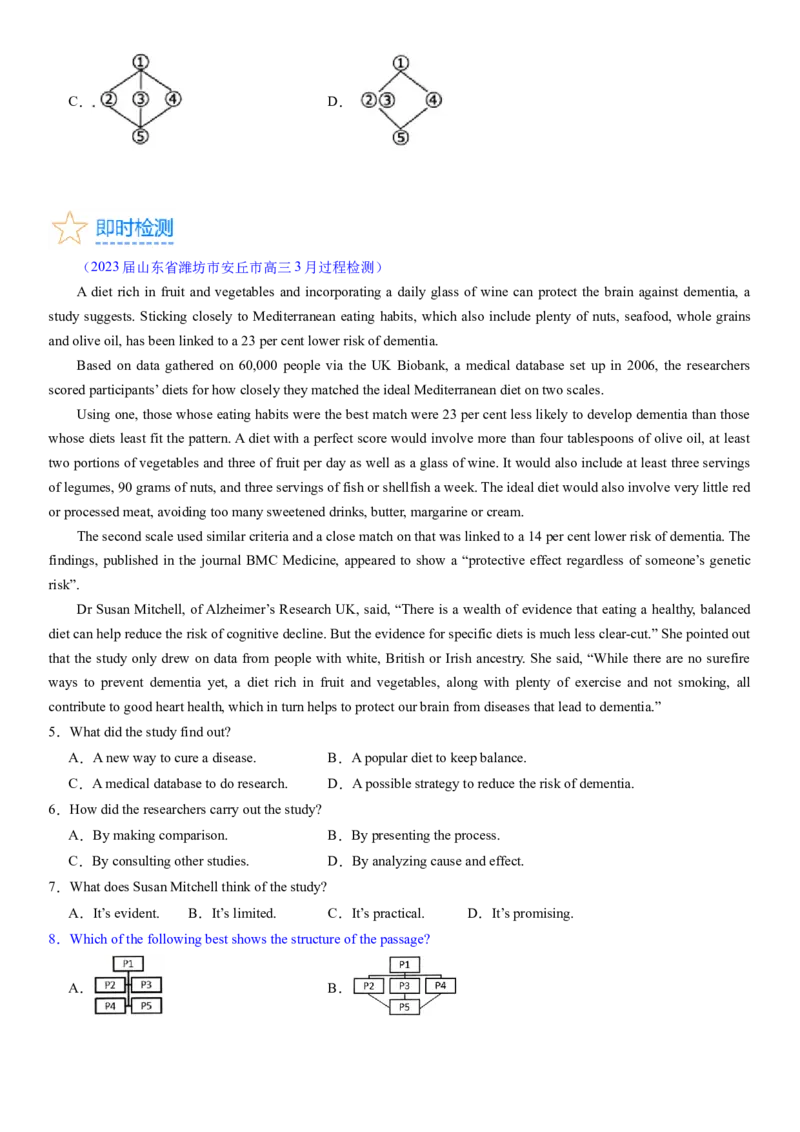
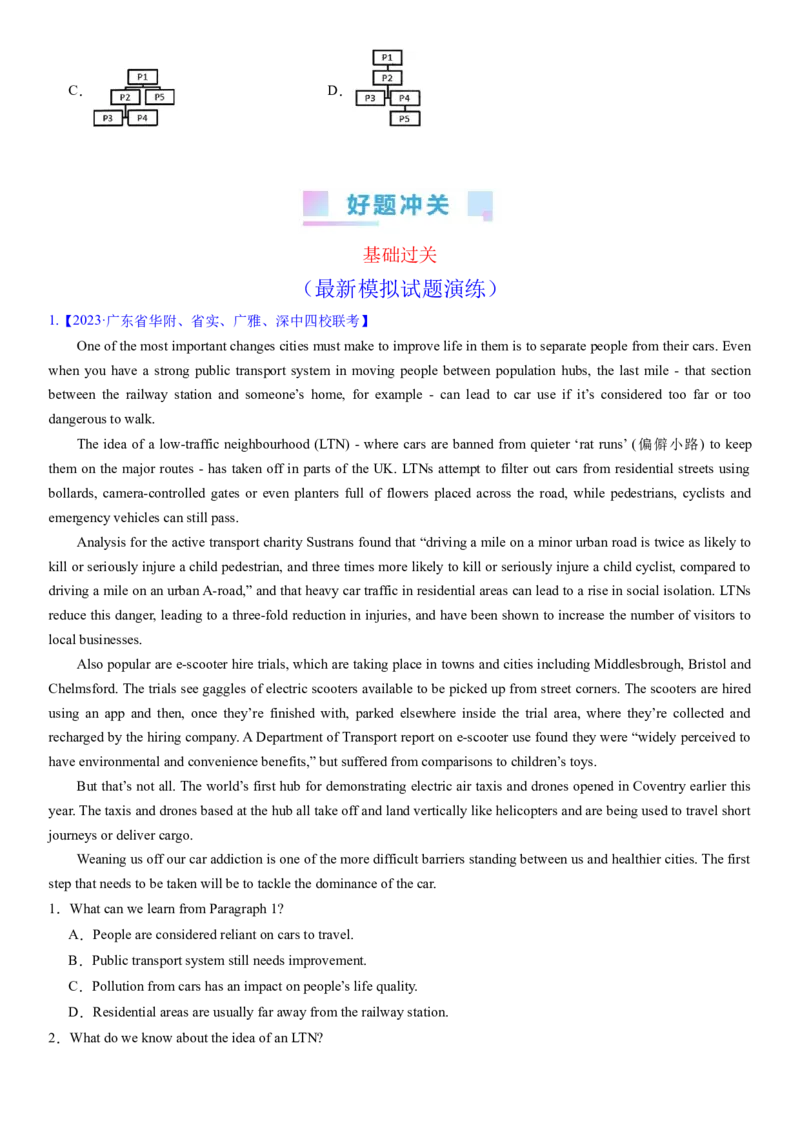
8.Which of the following best shows the structure of the passage?
A. B.C. D.
基础过关
(最新模拟试题演练)
1.【2023·广东省华附、省实、广雅、深中四校联考】
One of the most important changes cities must make to improve life in them is to separate people from their cars. Even
when you have a strong public transport system in moving people between population hubs, the last mile - that section
between the railway station and someone’s home, for example - can lead to car use if it’s considered too far or too
dangerous to walk.
The idea of a low-traffic neighbourhood (LTN) - where cars are banned from quieter ‘rat runs’ (偏僻小路) to keep
them on the major routes - has taken off in parts of the UK. LTNs attempt to filter out cars from residential streets using
bollards, camera-controlled gates or even planters full of flowers placed across the road, while pedestrians, cyclists and
emergency vehicles can still pass.
Analysis for the active transport charity Sustrans found that “driving a mile on a minor urban road is twice as likely to
kill or seriously injure a child pedestrian, and three times more likely to kill or seriously injure a child cyclist, compared to
driving a mile on an urban A-road,” and that heavy car traffic in residential areas can lead to a rise in social isolation. LTNs
reduce this danger, leading to a three-fold reduction in injuries, and have been shown to increase the number of visitors to
local businesses.
Also popular are e-scooter hire trials, which are taking place in towns and cities including Middlesbrough, Bristol and
Chelmsford. The trials see gaggles of electric scooters available to be picked up from street corners. The scooters are hired
using an app and then, once they’re finished with, parked elsewhere inside the trial area, where they’re collected and
recharged by the hiring company. A Department of Transport report on e-scooter use found they were “widely perceived to
have environmental and convenience benefits,” but suffered from comparisons to children’s toys.
But that’s not all. The world’s first hub for demonstrating electric air taxis and drones opened in Coventry earlier this
year. The taxis and drones based at the hub all take off and land vertically like helicopters and are being used to travel short
journeys or deliver cargo.
Weaning us off our car addiction is one of the more difficult barriers standing between us and healthier cities. The first
step that needs to be taken will be to tackle the dominance of the car.
1.What can we learn from Paragraph 1?
A.People are considered reliant on cars to travel.
B.Public transport system still needs improvement.
C.Pollution from cars has an impact on people’s life quality.
D.Residential areas are usually far away from the railway station.
2.What do we know about the idea of an LTN?A.It’s a way to encourage social interaction and local business.
B.It’s a series of measures to reserve the streets to walking residents.
C.It’s a system that employs high technology to keep cars on the main roads.
D.It’s a practice proved effective in keeping children safe from traffic accidents.
3.What’s the structure of the text?
P=Paragraph
A. B.
C. D.
4.What’s the purpose of the text?
A.To call on readers to construct a healthier city.
B.To promote the latest developments in car alternatives.
C.To introduce possible ways to get rid of dependence on cars.
D.To inform citizens of technological advances to tackle social problems.
2.【2023·江西省赣州市期末】
You’ve probably already heard about AI-powered cameras that can recognize people just by analyzing their facial
features, but what if there was a way for artificial intelligence to figure out what you look like just by the sound of your
voice and without comparing your voice to a database? That’s exactly what a team of scientists at MIT has been working on,
and the results of their work are impressive. While their neural network, named Speech2Face, can’t yet figure out the exact
facial features of a human just by their voice, it certainly gets plenty of details right.
Speech2Face is trained in the training data, which is a collection of educational videos from YouTube. “Our model is
designed to reveal statistical connections that exist between facial features and voices of speakers in the training data,” the
creators of Speech2Face said. However, the data does not represent equally the entire world population. Therefore, the
model- -as is the case with any machine learning model- is affected by this uneven distribution of data.
You can tell a lot about a person from the way they speak alone. For example, you can most likely tell if someone is
male or female, or if they are young or old, but Speech2Face goes beyond that. It can determine fairly accurately the shape
of someone’ s nose, cheekbones or jaw from their voice alone, because the way the nose and other bones in our faces are
structured determines the way we sound.
The racial characteristic is also one of the things Speech2Face can figure out with accuracy from listening tosomeone’s voice for just a few milliseconds, as people who come from the same groups tend to have similar qualities or
features. The AI takes a variety of factors into account, and it sometimes produces impressive results, but it’s still a work in
progress.
1.How does Speech2Face recognize a human’s facial features?
A.By the shape of their nose. B.By the sound of their voice.
C.By the expression on their face. D.By the results of data comparison.
2.What can we learn about Speech2Face according to the passage?
A.It can tell a person’s personality by his voice.
B.It can determine where a person comes from.
C.It can tell the size of a person by his voice.
D.It can reconstruct an image of a person’s face.
3.What is the correct structure of the text?
A. B.
C. D.
4.What will the text probably mention about Speech2Face fallowing the last paragraph?
A.Its market future. B.Its features.
C.Its limitations. D.Its applications.
3.【2023届湖北省荆门市龙泉中学高考考前模拟】
The twentieth century saw greater changes than any century before:changes for the better,changes for the worse;
changes that brought a lot of benefits to human beings, changes that put man in danger. Many things caused the changes,
but, in my opinion, the most important was the progress in science.
Scientific research in physics and biology has vastly broadened our views. It has given us a deeper knowledge of the
structure of matter and of the universe; it has brought us a better understanding of the nature of life and of its continuous
development. Technology in the application of science has made big advances that have benefited us in nearly every part of
life.
The continuation of such activitites in the twenty-first century will result in even greater advantages to human beings :
in pure science―a wider and deeper knowledge in all fields of learning ; in applied science―a more reasonable sharing of
material benefits , and better protection of the environment.
Sadly, however, there is another side to the picture. The creativity of science has been employed in doing damage to
mankind. The application of science and technology to the development and production of weapons of mass destruction has
created a real danger to the continued existence of the human race on this planet. We have seen this happen in the case of
nuclear weapons. Although their actual use has so far occurred only in the Second World War , the number of nuclear
weapons that were produced and made ready for use was so large that if the weapons had actually been used, the resultcould have been the ruin of the human race , as well as of many kinds of animals.
William Shakespeare said , “ The web of our life is of a mingled yarn(纱线), good and ill together .” The above brief
review of the application of only one part of human activities—science seems to prove what Shakespeare said . But does it
have to be so? Must the ill always go together with the good ?Are we biologically programmed for war?
17.Which of the following best shows the structure of the passage ?
(①="Paragraph1" , ②=" Paragraph" 2,③=" Paragraph" 3,④=" Paragraph" 4,⑤=" Paragraph" 5)
A. B. C. D.
18.From the fourth paragraph , we can infer that __________.
A.a great many nuclear weapons were actually used for war
B.a large number of nuclear weapons should have been used for war
C.the author is doubtful about the ruin of human beings by nuclear weapons
D.the author is anxious about the huge number of unclear weapons on the earth
19.The underlined word “mingled” in the last paragraph most probably means__________.
A.simple B.mixed C.sad D.happy
20.What you think the author is most likely to suggest if he continues to write ?
A.Further application of science to war.
B.More reading of William Shakespeare.
C.Proper use of science in the new century.
D.Effective ways to separate the good from the ill.
4.【江西省赣州市摸底考试(一模)】
We all know a picky eater (挑食者) or two, or maybe you're the picky eater, avoiding food adventures at all costs,
because you're convinced you'll hate whatever new and bad-looking food is put on your plate. But why is it that some
people are picky eaters while others are willing to try pretty much anything that can be eaten?
There's no single explanation for the picky eating habit. Picky eaters are typically unwilling to try new foods, which
can be the result of your DNA and the way you are treated and educated when you are young. Marcia Pelchat, Ph.D., a
researcher at the Monell Chemical Senses Center in Philadelphia who specializes in food preferences in humans, tells China
Daily, “A group in Finland looked at what we call food neophobia, which literally means 'fear of the new', and they found
that there is some genetic basis for this.”
“Also, if you have parents who don't really like to try anything new, you will also be exposed to fewer new foods,”
Pelchat says. The opposite is also true: Those who try new foods and have positive experiences are then more likely to try
unfamiliar foods in the future.
People who are less adventurous may be more hesitant to try new foods. Trying anything new, food included, requires
you to step outside of your comfort zone. If you're not very adventurous, you may have a tough time with this. People who
seek new adventures or thrills might be more likely to experiment with food. “There is a thrill-seeking personality trait,”
Pelchat says. “It's been shown, especially with spicy food, that there is some connection between trying new foods and thrill
seeking,” she explains.
Most adult picky eaters start as child picky eaters. “It's normal for children to go through a picky stage when they're
toddlers, maybe two or three years old, and that makes sense evolutionarily,” Pelchat says. But as we get older, if we