2024 年 12 月大学英语四级考试真题(第 1 套)
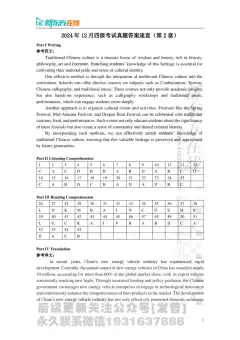
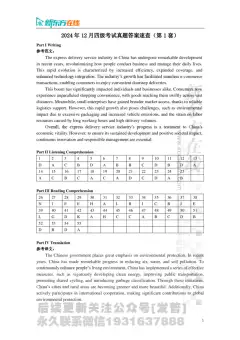
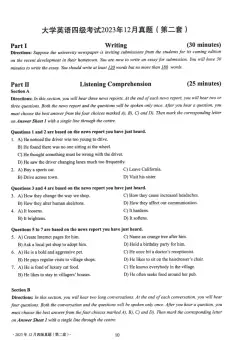
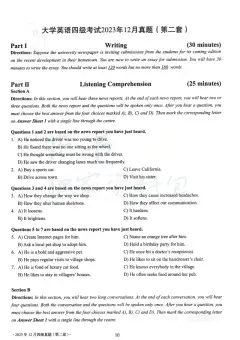
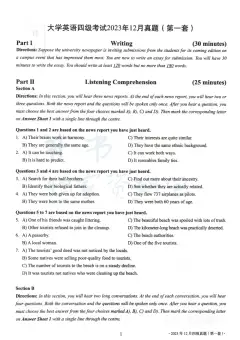
Part I Writing (30 minutes)
Directions: Suppose the business school of your university is conducting a survey to collect
students’ opinions on the express delivery service industry in China. You are to write a response
about its recent development and its impact on people’s lives. You will have 30 minutes to write
the essay. You should write at least 120 words but no more than 180 words.
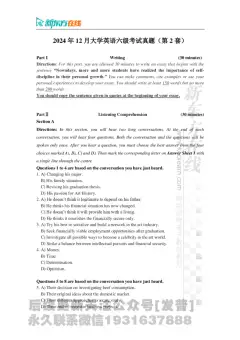
PartⅡ Listening Comprehension (25 minutes)
Section A
Directions: In this section, you will hear three news reports. At the end of each news report,
you will hear two or three questions. Both the news report and the questions will be spoken
only once. After you hear a question, you must choose the best answer from the four choices
marked A), B), C) and D).Then mark the corresponding letter on Answer Sheet 1 with a single
line through the centre.
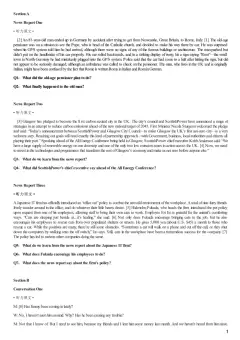
Questions 1 and 2 are based on the news report you have just heard.
1. A) She is making a special effort to be recognized.
B) She has been living in Fayetteville for 25 years.
C) She has been driving a school bus ever since 2009.
D) She is the longest-serving bus driver in Fayetteville.
2. A) The importance of their service to the city.
B) The number of riders they serve in the city.
C) The new proclamation issued early this week.
D) The significance of the event to take place March 18.
Questions 3 and 4 are based on the news report you have just heard.
3. A) Budgeted $56.7 million for the coming school year.
B) Requested to raise teachers’ salaries by 3 percent.
C) Proposed a spending increase by 5.99 percent.
D) Kept raising funds for at least 8 budget cycles.
4. A) Decrease in salaries for school administrators.
B) Reduction in federal and state funding.
C) Firing of less qualified faculty members.
D) Closing down of some less competitive schools.
Questions 5 to 7 are based on the news report you have just heard.
5. A) They often take place in the Scottish highlands.
B) They usually happen in the middle of the night.
C) Their damage can be as serious as that of bombs.
D) Their loud claps can be confused with explosions.
6. A) They sent out a message to calm them down.
B) They promised to stop the construction work.C) They told them the military exercise was over.
D) They set off to inspect the site of the plane crash.
7. A) Keep warm. C) Avoid driving.
B) Take caution. D) Use rail service.
Section B
Directions: In this section, you will hear two long conversations. At the end of each
conversation, you will hear four questions. Both the conversation and the questions will be
spoken only once. After you hear a question, you must choose the best answer from the four
choices marked A),B),C)and D). Then mark the corresponding letter on Answer Sheet
1 with a single line through the centre.
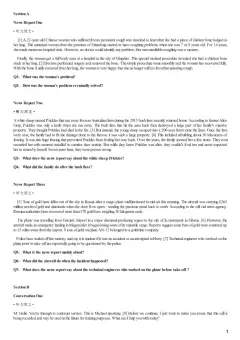
Questions 8 to 11 are based on the conversation you have just heard.
8. A) Why the man is so anxious to buy a new phone.
B) How the man could possibly afford a new phone.
C) How the man got into the habit of being wasteful.
D) Why the man is so fond of using his credit card.
9. A) It is not in fashion any more. C) It is not as fancy as his colleagues’.
B) It goes out of order frequently. D) It lacks functions office work requires.
10. A) It enables him to buy a new phone at a more favorable price.
B) It is a special offer to recent college graduates working in offices.
C) It is available to office workers who have a good enough credit score.
D) It allows him to borrow money without paying interest for six months.
11. A) She borrowed money to pay her debt. C) She enjoys buying a lot of fancy things.
B) She developed a habit of overspending. D) She regrets ignoring the woman’s advice.
Questions 12 to 15 are based on the conversation you have just heard.
12. A) Blog writing and natural resources saving.
B) Joint efforts to improve the local community.
C) Audience participation in The Morning Show.
D) Home ownership and environmental protection.
13. A) Not a realistic size for families. C) Only fit for families of four or less.
B) Not welcomed by most Americans. D) Only suitable for renting to the poor.
14. A) It should be changed. C) It will come true sooner or later.
B) It isn’t easy to realize. D) It doesn’t appeal to average families.
15. A) They help to lower housing prices. C) They are a good choice for many people.
B) They help to save up for larger houses. D) They are vital to reducing waste worldwide.
Section C
Directions: In this section, you will hear three passages. At the end of each passage, you will
hear three or four questions. Both the passage and the questions will be spoken only once. After
you hear a question, you must choose the best answer from the four choices marked A), B), C)
and D). Then mark the corresponding letter on Answer Sheet 1 with a single line through the
centre.Questions 16 to 18 are based on the passage you have just heard.
16. A) Play outdoors and enjoy themselves. C) Take care of their well-being.
B) Beat challenges and take risks. D) Grow up strong and healthy.
17. A) Enable them to develop their motor skills. C) Reduce their stress and depression.
B) Help them to conceal their frustration. D) Prevent them from feeling lonely.
18. A) It begins early. C) It calls for lifelong efforts.
B) It proves demanding. D) It lies in nature experiences.
Questions 19 to 21 are based on the passage you have just heard.
19. A) When companies share their information online.
B) When their job search criteria are met fully.
C) When companies embrace greater diversity.
D) When they find job postings visually attractive.
20. A) Emails in the normal format. C) All companies in the same sector.
B) Major companies in one location. D) Various aspects of a company’s workforce.
21. A) Job security. C) Minimum base salary.
B) Potential pay raises. D) Information about diversity
Questions 22 to 25 are based on the passage you have just heard.
22. A) Positive. C) Important.
B) Original. D) Surprising.
23. A) Dogs match their behavior with kids as much as with adults.
B) Kids and adults alike find in dogs a source of attachment.
C) Kids’ attitude to dogs is influenced by adults.
D) Dogs can help kids in many ways.
24. A) Dogs pay much attention to the kids they live with.
B) Dogs view both adults and kids as social companions.
C) Kids differ from adults in their behavior towards dogs.
D) Kids need to be aware of the risks in playing with dogs.
25. A) Understanding dogs. C) Taking care of dogs.
B) Training dogs. D) Associating with dogs.
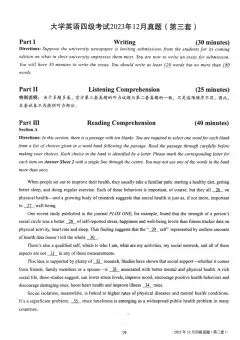
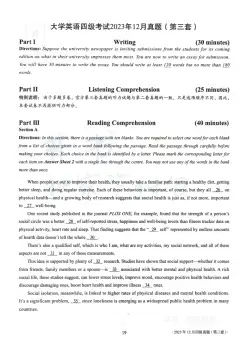
Part III Reading Comprehension (40 minutes)
Section A
Directions: In this section, there is a passage with ten blanks. You are required to select one
word for each blank from a list of choices given in a word bank following the passage. Read
the passage through carefully before making your choices. Each choice in the bank is identified
by a letter. Please mark the corresponding letter for each item on Answer Sheet 2 with a single
line through the centre. You may not use any of the words in the bank more than once.
When Toni Morrison died in 2019, the world lost one of its most influential authors. But
Morrison was not an early success. Her first novel was not published until she was 39, and her
last appeared when she was 84. And Morrison was not 26 in this regard. Numerouswriters produce masterpieces well into their 70s and beyond. Such 27 accomplishments
highlight an important point. Our capacity to speak, write and learn new vocabulary does not
seem to 28 with age. Our eyesight may dim and our recall may weaken, but, by
comparison, our ability to produce and to 29 language is well preserved into older
adulthood.
Indeed, the latest research that has emerged on language and aging shows that language
mastery is a 30 that we begin as infants and continue on for the rest of our lives. Some
aspects of our language abilities, such as our knowledge of word meanings, 31 improve
during middle and late adulthood. One study, for example, found that adults over sixty had an
average vocabulary size of over 21,000 words. The researchers also studied a 32 of
college students and found that their average vocabulary contained 33 16,000 words. In
another study, older adults, with an average age of 75, 34 better than participants in their
youth or middle years on tasks that required them to determine the meaning of words. Thus,
language seems to be a skill that, contrary to what many might 35 , does not weaken with
age.
A) actually F) deteriorate K) rarely
B) approximately G) equivalent L) sample
C) assume H) journey M) undermined
D) component I) literary N) unique
E) comprehend J) performed O) unit
Section B
Directions: In this section, you are going to read a passage with ten statements attached to it.
Each statement contains information given in one of the paragraphs. Identify the paragraph
from which the information is derived. You may choose a paragraph more than once. Each
paragraph is marked with a letter. Answer the questions by marking the corresponding letter
on Answer Sheet 2.
Why it’s wrong to look at work-life balance as an achievement
A) Few topics have been so endlessly analysed as work-life balance. The quest to attain this
mysterious state has dominated discussion around careers for years—especially for
working parents. The concept is often presented as something to achieve, or a goal to reach.
And once you’ve reached it, congratulations: you’ve made it; you’re a successful human
being of the 21st century.
B) But the problem is that we often tell ourselves: “I’m going to put in eight hours’ worth of
work, and then I’m going to put in eight hours’ worth of ‘me time’, which will include my
family, my hobbies, my workout, my everything,” says Anat Lechner, clinical associate
professor of management at New York University. “I don’t think it’s such a simple formula.”
C) And, according to new findings, it may not be. Some researchers are now encouraging us
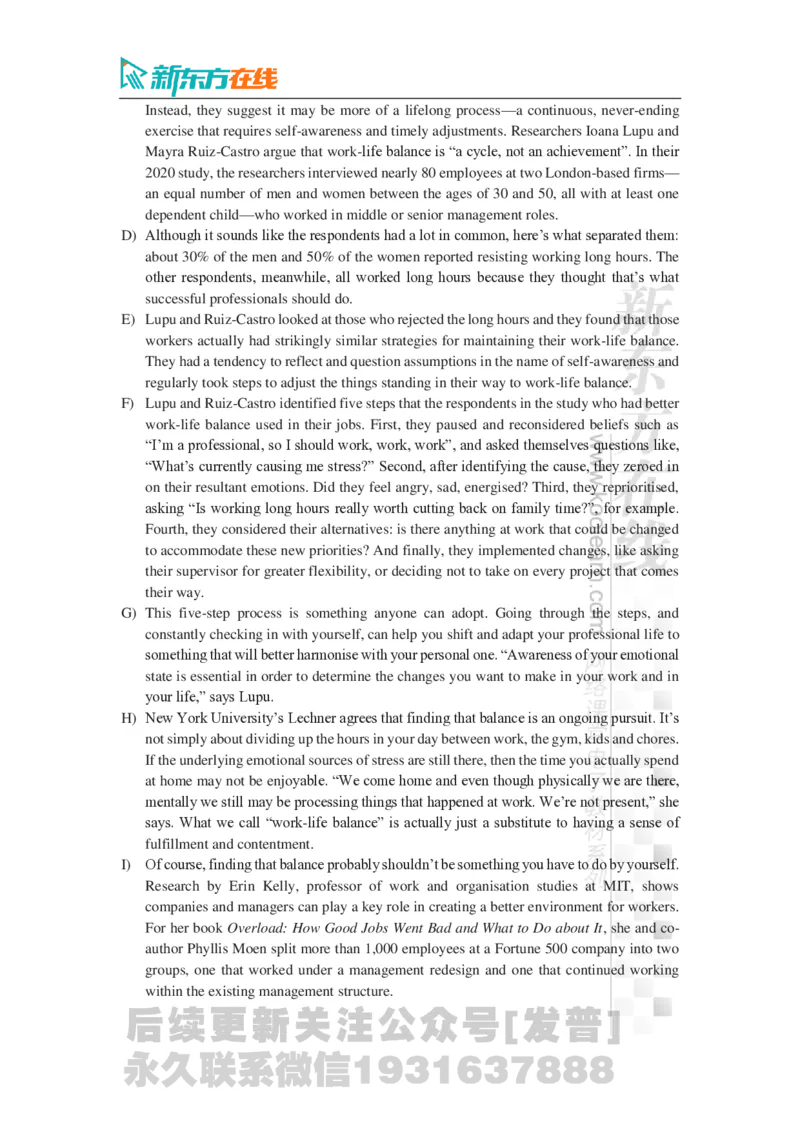
to stop thinking about work-life balance as an achievement that you either hit or don’t.Instead, they suggest it may be more of a lifelong process—a continuous, never-ending
exercise that requires self-awareness and timely adjustments. Researchers Ioana Lupu and
Mayra Ruiz-Castro argue that work-life balance is “a cycle, not an achievement”. In their
2020 study, the researchers interviewed nearly 80 employees at two London-based firms—
an equal number of men and women between the ages of 30 and 50, all with at least one
dependent child—who worked in middle or senior management roles.
D) Although it sounds like the respondents had a lot in common, here’s what separated them:
about 30% of the men and 50% of the women reported resisting working long hours. The
other respondents, meanwhile, all worked long hours because they thought that’s what
successful professionals should do.
E) Lupu and Ruiz-Castro looked at those who rejected the long hours and they found that those
workers actually had strikingly similar strategies for maintaining their work-life balance.
They had a tendency to reflect and question assumptions in the name of self-awareness and
regularly took steps to adjust the things standing in their way to work-life balance.
F) Lupu and Ruiz-Castro identified five steps that the respondents in the study who had better
work-life balance used in their jobs. First, they paused and reconsidered beliefs such as
“I’m a professional, so I should work, work, work”, and asked themselves questions like,
“What’s currently causing me stress?” Second, after identifying the cause, they zeroed in
on their resultant emotions. Did they feel angry, sad, energised? Third, they reprioritised,
asking “Is working long hours really worth cutting back on family time?”, for example.
Fourth, they considered their alternatives: is there anything at work that could be changed
to accommodate these new priorities? And finally, they implemented changes, like asking
their supervisor for greater flexibility, or deciding not to take on every project that comes
their way.
G) This five-step process is something anyone can adopt. Going through the steps, and
constantly checking in with yourself, can help you shift and adapt your professional life to
something that will better harmonise with your personal one. “Awareness of your emotional
state is essential in order to determine the changes you want to make in your work and in
your life,” says Lupu.
H) New York University’s Lechner agrees that finding that balance is an ongoing pursuit. It’s
not simply about dividing up the hours in your day between work, the gym, kids and chores.
If the underlying emotional sources of stress are still there, then the time you actually spend
at home may not be enjoyable. “We come home and even though physically we are there,
mentally we still may be processing things that happened at work. We’re not present,” she
says. What we call “work-life balance” is actually just a substitute to having a sense of
fulfillment and contentment.
I) Of course, finding that balance probably shouldn’t be something you have to do by yourself.
Research by Erin Kelly, professor of work and organisation studies at MIT, shows
companies and managers can play a key role in creating a better environment for workers.
For her book Overload: How Good Jobs Went Bad and What to Do about It, she and co-
author Phyllis Moen split more than 1,000 employees at a Fortune 500 company into two
groups, one that worked under a management redesign and one that continued working
within the existing management structure.J) Under the management redesign, many steps were taken to ensure better work-life balance
and prevent burnout (精疲力竭). Managers were regularly reminded to explicitly support
their employees. Workers were allowed to make changes, like cancelling 9 am meetings.
All of this was done in the name of increasing job satisfaction and giving workers greater
flexibility, and to assure workers that it was something management was committed to.
Unsurprisingly, Kelly and Moen found that employees in the redesign group reported less
stress and less burnout. They were less likely to quit their jobs; indeed, over the next four
years, they were 40% less likely to quit than those who kept working under the old policies.
K) “Work-life balance is understood to be an individual’s response, so people think ‘it’s up to
me to manage the craziness of my work life’”, says Kelly. But organisations need to
examine the demands they’re placing on employees. “The root problem is not how the two
pieces of work and life come together. It’s that we have unrealistic expectations of what
we’re asked to do on the work side.” If your workplace isn’t an environment where work-
life balance is possible in the first place, any effort you attempt to make toward it on a
personal level will be in vain.
L) That’s a conversation that appears to be gathering pace. The new prevalence of remote and
flexible working models will likely all play important roles in how we balance our
professional and personal lives. And if it seems like finding that perfect balance remains
difficult to achieve, the experts say that keeping some perspective can help. For millions of
people, work is about being able to put food on the table. Talking about work-life balance
“is a very privileged conversation”, says Lechner. “If we’re reflecting, maybe we should
also reflect on that.”
36. According to a management expert, work-life balance is not as simple as giving equal
amounts of time to work and personal life.
37. Research found that those who are given greater flexibility at work are less stressed and
more likely to stay in their jobs.
38. Workers who rejected working long hours tended to make regular adjustments in order to
achieve work-life balance.
39. Talking about work-life balance is said to be a privilege reserved for the better-off, not for
those who barely make a living.
40. Knowing one’s emotional state is of utmost importance in deciding what changes to make
for a better work-life balance.
41. More female professionals reported being reluctant to work overtime than their male
counterparts.
42. Without organisational support, any personal effort to maintain work-life balance will be
unsuccessful.
43. The question of how to achieve work-life balance has long been the main subject of
discussion among workers.
44. You may not actually experience emotional wellbeing at home if you remain occupied with
what happened at work.
45. Some researchers suggest that work-life balance is not a goal to achieve, but a process for
life to be adjusted promptly.Section C
Directions: There are 2 passages in this section. Each passage is followed by some questions
or unfinished statements. For each of them there are four choices marked A), B), C) and D).
You should decide on the best choice and mark the corresponding letter on Answer Sheet 2
with a single line through the centre.
Passage One
Questions 46 to 50 are based on the following passage.
The weakening of the human connection to nature might be good for economic growth but
is bad for people. A tipping point was reached in 2020 when human-made materials—such as
steel, concrete and plastic—were found to weigh more than all life on Earth. Continuing to
grow concrete forests rather than real ones is shortsighted. Simply being in the nearest wood
has such health benefits that the Woodland Trust successfully lobbied for it to be prescribed by
doctors.
Yet slipping from popular culture is the wonder and beauty of the natural world. For every
three nature-related words in hit songs of the 1950s, researchers found, there was only slightly
more than one 50 years later. It is not a moment too soon that teenagers will be able to take a
natural history test, given that for decades children have been able to name more video game
characters than wildlife species.
Part of remedying this social disease would be for parliament to pass a “right to grow” law,
allowing anyone to turn underused public spaces into vegetable and fruit gardens. The idea is
for people to get back in touch with the soil—while producing food sustainably.
Vegetable planting has a respectable tradition. In April 1649, locals responded to high
prices and food shortages by cultivating vegetables on common land in Southern England. The
practice of throwing seed bombs to turn vacant plots of land green took off in 1970s New York,
and has been revived (使复活) by green-thumbed (有园艺才能的) social media influencers
who defy local US regulations in a war on ugly spots in cities.
Apart from the urgent task of providing more healthy nutrients to those who increasingly
can’t afford them, publicly accessible fruit and vegetable gardens connect what we eat to where
it comes from—the means of production, if you will. They can make unlovely spaces lovely,
and marry use and beauty as well as help promote a sense of community. Plants are also, of
course, our first defence against species loss and climate change. Such planting is a small step
for humanity—in the right direction.
46. What does the author want to emphasise in the first paragraph?
A) The year 2020 was a big turning point in human history.
B) Economic growth benefits people little in the long run.
C) It is unwise to weaken the human connection to nature.
D) It is harmful to mankind to use human-made materials.
47. What did researchers find about popular culture?
A) It is increasingly detached from the natural world.
B) It is filled with all kinds of video game characters.
C) It is especially appealing to the taste of teenagers.D) It is still impacted by the hit songs of the 1950s.
48. What does the author propose people do?
A) Take measures to ensure sustainable food development.
B) Reconnect with nature through the right to grow.
C) Stand by the parliament in fighting social diseases.
D) Cover public spaces with fruit trees and vegetable plants.
49. What do we learn from the passage about vegetable planting?
A) It all started in 1649 in Southern England.
B) It is protected by US government regulations.
C) It has long been used to increase food supply and improve urban landscape.
D) It has been popularised worldwide with the increasing influence of social media.
50. What can publicly accessible fruit and vegetable gardens do apart from their practical
functions?
A) Raise people’s environmental awareness.
B) Add to the great variety of plant species.
C) Act as the first defence against natural disasters.
D) Enhance people’s community spirit.
Passage Two
Questions 51 to 55 are based on the following passage.
Engineering in the U.S. has long been a male-dominated profession. Fifty years ago, it
looked like that might change.
In 1970, the percentage of women majoring in engineering was less than 1%. In 1979, that
number was 9%. Many hoped women would continue to enter the field at the same rate. But
that’s not what happened. Today, only 21% of engineering majors are women, a number largely
unchanged since 2000.
I am a historian who, along with my colleagues, surveyed 251 women engineers who
graduated from college in the 1970s. These pioneers reflected on the challenges they faced—
and had advice for women entering the field today.
One survey taker explained, “The greatest challenge for me was continuing to believe in
myself, when all the messages I was getting were that I would never be taken seriously or
promoted or given raises at the same rate as men, who were clearly less qualified and not as
smart as I was.”
A chemical engineer who worked in manufacturing agreed, “You have to prove yourself
just because you are female. And you have to work twice as hard!”
A civil engineer said, “We are ‘women engineers.’ People don’t refer to a man as a ‘man
engineer’—he’s an engineer. We are constantly reminded that we don’t truly belong.” Another
civil engineer stated, “On many levels, you’re never quite one of the groups.”
Women also talked about family caregiving responsibilities. A retired vice president from
a major chemical company stated, “Young women engineers are on an equal footing until theyhave children, then they struggle to balance work and family—and compete with men who
don’t have the same household responsibilities.”
But over the years things have changed a lot. Young women engineers are more accepted
mostly because there are just more of them.
Many women engineers hailed the benefits of their chosen career. A program manager in
manufacturing stated that engineering is the best degree. A mechanical engineer said, “It will
give you the flexibility to do almost anything. It is also satisfying to see the effects of what you
have done.”
51. What does the passage say about the engineering profession in the United States?
A) It has seen a change in attitude towards women engineers since 1979.
B) It witnessed a significant increase in women engineers in the 1970s.
C) It has experienced the gradual weakening of male dominance.
D) It boasted the largest number of engineering majors in 2000.
52. What does one survey taker say was her greatest challenge?
A) Not to feel superior to less qualified male engineers.
B) Not to take seriously all the messages she was getting.
C) Not to think highly of her qualifications when promoted or given a pay raise.
D) Not to lose self-confidence though constantly discouraged or unfairly treated.
53. How do women engineers frequently feel according to the two civil engineers?
A) Disqualified on many levels.
B) Excluded from the group.
C) Overworked by their organizations.
D) Looked down upon by male colleagues.
54. What probably makes young women engineers more accepted nowadays?
A) Their success in gaining an equal footing. C) The change in their responsibilities.
B) Their ability to balance work and family. D) The increase in their number.
55. What can we conclude about many female engineers from the statement of a mechanical
engineer?
A) They take great pride in their chosen career.
B) They have reaped the benefits of being flexible.
C) They enjoy doing engineering to the best degree.
D) They have proved capable of doing almost anything.
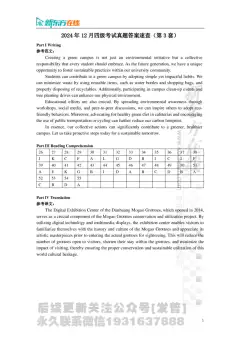
Part Ⅳ Translation (30 minutes)
Directions: For this part, you are allowed 30 minutes to translate a passage from Chinese
into English. You should write your answer on Answer Sheet 2.
中国政府十分重视环境保护。近年来,中国在减少空气、水和土壤污染上取得了显著成
效。为了不断改善人们的生活环境,中国采取了一系列有效措施,包括大力发展清洁能源,
改善公共交通,推广共享单车,实施垃圾分类。通过这些措施,中国的城市和农村正在绿起
来、美起来。中国还积极参与国际合作,为全球环境保护做出了重要贡献。