2024 年 12 月大学英语四级考试真题(第 2 套)
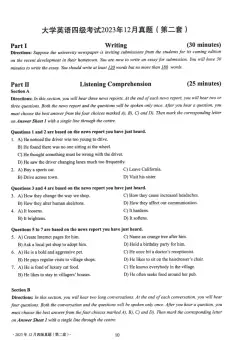
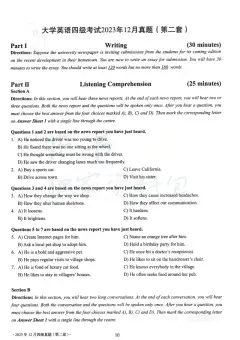
Part I Writing (30 minutes)
Directions: Suppose the university newspaper is inviting submissions from the students for its
coming edition on how to enrich students’ knowledge of traditional Chinese culture. You are
now to write an essay for submission. You will have 30 minutes to write the essay. You should
write at least 120 words but no more than 180 words.
PartⅡ Listening Comprehension (25 minutes)
Section A
Directions: In this section, you will hear three news reports. At the end of each news report,
you will hear two or three questions. Both the news report and the questions will be spoken
only once. After you hear a question, you must choose the best answer from the four choices
marked A), B), C) and D).Then mark the corresponding letter on Answer Sheet 1 with a single
line through the centre.
Questions 1 and 2 are based on the news report you have just heard.
1. A) They will see a 27% higher price to buy natural gas.
B) They will have insufficient heating oil to keep warm.
C) They will have a costly bill to pay to heat their homes.
D) They will experience the coldest winter in four decades.
2. A) Provided additional funding to Low Income Home Energy Assistance Program.
B) Assured U.S. citizens of an increase in energy supplies by the end of this year.
C) Predicted a 10% jump in heating bills for most U.S. households this winter.
D) Decided on this year’s energy assistance package of $8 billion in total.
Questions 3 and 4 are based on the news report you have just heard.
3. A) They care less about their diet now than before.
B) They may lack adequate knowledge of healthy food.
C) They may hold too optimistic a view about their diet.
D) They pay insufficient attention to their choice of food.
4. A) Those who finished 24-hour food questionnaires.
B) Those who fully understood the rating scale.
C) Those who cared about food quality.
D) Those who rated their diet as poor.
Questions 5 to 7 are based on the news report you have just heard.
5. A) They experienced a heartbreaking moment.
B) They gathered together to rescue an elephant.
C) They heard a noise from the bottom of a well.
D) They found an elephant wandering around a well.
6. A) To borrow their crane.
B) To ask them for help.C) To report the strange noise.
D) To get food for the elephant.
7. A) The elephant was able to return to the jungle.
B) The army officers were examined for injuries.
C) The army officers were rewarded for their rescue efforts.
D) The elephant was given medical treatment for many days.
Section B
Directions: In this section, you will hear two long conversations. At the end of each
conversation, you will hear four questions. Both the conversation and the questions will be
spoken only once. After you hear a question, you must choose the best answer from the four
choices marked A),B),C)and D). Then mark the corresponding letter on Answer Sheet
1 with a single line through the centre.
Questions 8 to 11 are based on the conversation you have just heard.
8. A) He found it had caused him much inconvenience.
B) It led him to spend more money than necessary.
C) It was much less secure than paying with cash.
D) He wanted to be less dependent on his phone.
9. A) Living beyond her means.
B) Lack of budgeting strategies.
C) Fashion addiction.
D) Impulse purchasing.
10. A) Eat healthier food with less money.
B) Order food like burgers and chips.
C) Avoid getting addicted to junk food.
D) Pay either in cash or with his phone.
11. A) Making a shopping list. C) Withdrawing cash only once a month.
B) Sticking to his budget. D) Thinking twice before buying something.
Questions 12 to 15 are based on the conversation you have just heard.
12. A) He does not enjoy any ball games.
B) He has to prepare for the future.
C) He has breathing problems.
D) He is not up to anything challenging.
13. A) Soccer. C) Volleyball.
B) Badminton. D) Basketball.
14. A) The possibilities of joining the school sports team.
B) The opportunities of winning some championships.
C) The chances of getting an athletic scholarship later on.
D) The odds of becoming a professional sportsman someday.
15. A) It differs entirely from indoor volleyball.
B) It appeals to both schoolgirls and schoolboys.
C) It is less popular than indoor sports in the country.D) It is completely different from other outdoor games.
Section C
Directions: In this section, you will hear three passages. At the end of each passage, you will
hear three or four questions. Both the passage and the questions will be spoken only once. After
you hear a question, you must choose the best answer from the four choices marked A), B), C)
and D). Then mark the corresponding letter on Answer Sheet 1 with a single line through the
centre.
Questions 16 to 18 are based on the passage you have just heard.
16. A) It usually requires years of preparations.
B) It does a lot of harm to the environment.
C) It often burns over three hundred tonnes of refined fuel.
D) It proves to be the most complicated stage of space missions.
17. A) They are burnt up in outer space. C) They are reused up to 100 times.
B) They are guided back to Earth. D) They are treated as expendable.
18. A) New technologies for bringing back space vehicles for recycling.
B) The technology for meeting the needs of commercial space travel.
C) Many of the technologies to limit the impact of space travel on Earth.
D) The technology for effectively protecting ozone from being destroyed.
Questions 19 to 21 are based on the passage you have just heard.
19. A) It can help unskilled readers feel more secure.
B) It can encourage reluctant readers to read aloud.
C) It can strengthen children’s confidence in others.
D) It can boost children’s interest in communication.
20. A) By motivating children to find out about their favourite pets.
B) By taking children to the library to borrow books on animals.
C) By allowing children to surf the internet about pets by themselves.
D) By showing children how to acquire knowledge about healthy pets.
21. A) By learning that raising pets can do much good.
B) By watching how healthy pets are brought up.
C) By hearing about their peers’ passion for pets.
D) By visiting friends who have household pets.
Questions 22 to 25 are based on the passage you have just heard.
22. A) Send would-be students a packet of information.
B) Update regularly all information on their websites.
C) Inform prospective students of their yearly enrollment.
D) Answer questions raised by applicants and their parents.
23. A) Oversee private institutions directly. C) Supervise all schools consistently.
B) Follow other states’ example. D) Regulate public institutions by law.
24. A) They are resourceful.
B) They are competitive.
C) They provide the best opportunity to realize one’s dream.D) They appeal most to students from other states in the U.S.
25. A) Some students waste much time surfing the net.
B) Students may need to visit too many websites.
C) Students have to search for the information.
D) Some students may lack adequate access.
Part III Reading Comprehension (40 minutes)
Section A
Directions: In this section, there is a passage with ten blanks. You are required to select one
word for each blank from a list of choices given in a word bank following the passage. Read
the passage through carefully before making your choices. Each choice in the bank is identified
by a letter. Please mark the corresponding letter for each item on Answer Sheet 2 with a single
line through the centre. You may not use any of the words in the bank more than once.
Scientists have known that depriving adult mice of vision can increase the sensitivity of
individual neurons (神经元) in the part of the brain devoted to hearing. New research from
biologists at the University of Maryland 26 that sight deprivation also changes the way
brain cells 27 with one another, shifting the mice’s sensitivity to different frequencies.
“This study 28 what we are learning about how manipulating vision can have a
29 effect on the ability of an animal to hear long after the window for auditory (听觉的)
learning was thought to have 30 ,” said Patrick Kanold, senior author of the study.
It was once thought that the sensory regions of the brain were not 31 after a critical
period in childhood. This is why children learn languages much more 32 than adults.
Kanold’s earlier research disproved this idea by showing that depriving adult mice of vision for
a short period increased the sensitivity of individual neurons in the auditory cortex (皮质),
which is devoted to hearing.
Young brains wire themselves according to the sounds they hear frequently, assigning
areas of the auditory cortex to 33 frequencies based on what they are used to hearing.
The researchers found that, in adult mice, a week in the dark also changed the 34 of space
to different frequencies.
“We don’t know why we are seeing these patterns,” Kanold said. “We 35 that it may
have to do with what the mice are paying attention to while they are in the dark.”
A) adaptable F) neutral K) reinforces
B) closed G) permanently L) revealed
C) distribution H) prescribes M) significant
D) interact I) readily N) specific
E) narration J) registered O) speculateSection B
Directions: In this section, you are going to read a passage with ten statements attached to it.
Each statement contains information given in one of the paragraphs. Identify the paragraph
from which the information is derived. You may choose a paragraph more than once. Each
paragraph is marked with a letter. Answer the questions by marking the corresponding letter
on Answer Sheet 2.
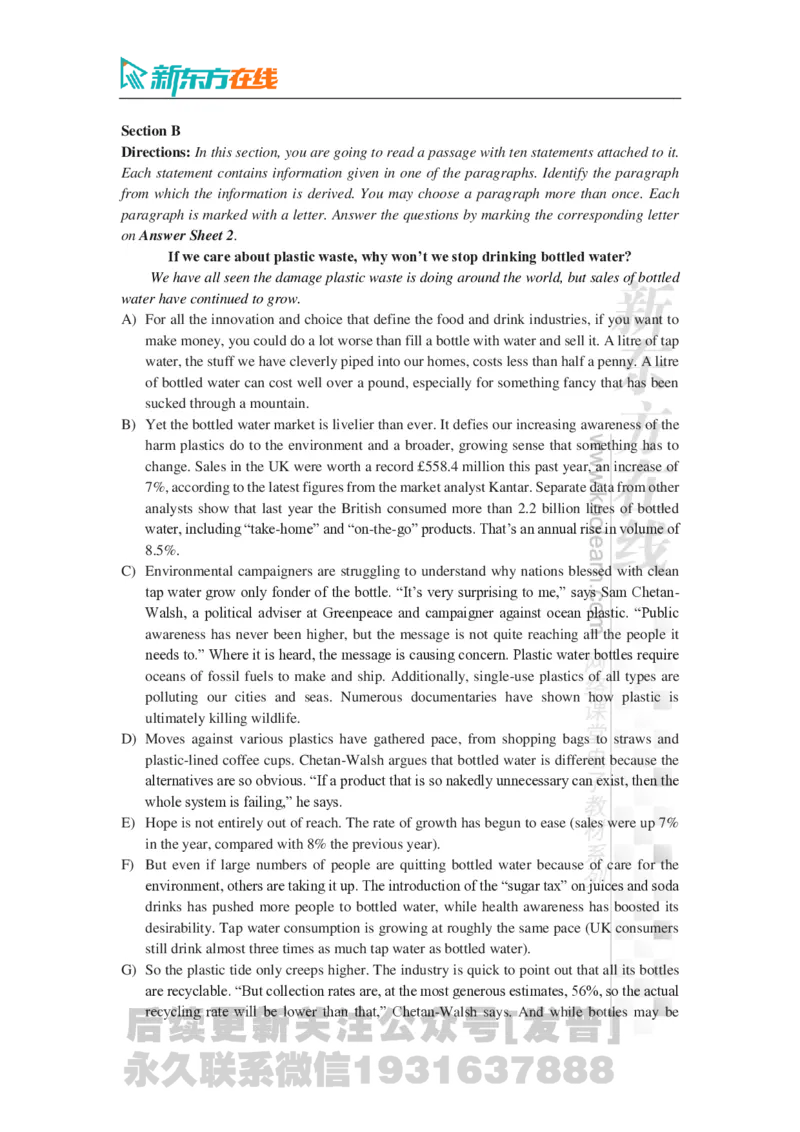
If we care about plastic waste, why won’t we stop drinking bottled water?
We have all seen the damage plastic waste is doing around the world, but sales of bottled
water have continued to grow.
A) For all the innovation and choice that define the food and drink industries, if you want to
make money, you could do a lot worse than fill a bottle with water and sell it. A litre of tap
water, the stuff we have cleverly piped into our homes, costs less than half a penny. A litre
of bottled water can cost well over a pound, especially for something fancy that has been
sucked through a mountain.
B) Yet the bottled water market is livelier than ever. It defies our increasing awareness of the
harm plastics do to the environment and a broader, growing sense that something has to
change. Sales in the UK were worth a record £558.4 million this past year, an increase of
7%, according to the latest figures from the market analyst Kantar. Separate data from other
analysts show that last year the British consumed more than 2.2 billion litres of bottled
water, including “take-home” and “on-the-go” products. That’s an annual rise in volume of
8.5%.
C) Environmental campaigners are struggling to understand why nations blessed with clean
tap water grow only fonder of the bottle. “It’s very surprising to me,” says Sam Chetan-
Walsh, a political adviser at Greenpeace and campaigner against ocean plastic. “Public
awareness has never been higher, but the message is not quite reaching all the people it
needs to.” Where it is heard, the message is causing concern. Plastic water bottles require
oceans of fossil fuels to make and ship. Additionally, single-use plastics of all types are
polluting our cities and seas. Numerous documentaries have shown how plastic is
ultimately killing wildlife.
D) Moves against various plastics have gathered pace, from shopping bags to straws and
plastic-lined coffee cups. Chetan-Walsh argues that bottled water is different because the
alternatives are so obvious. “If a product that is so nakedly unnecessary can exist, then the
whole system is failing,” he says.
E) Hope is not entirely out of reach. The rate of growth has begun to ease (sales were up 7%
in the year, compared with 8% the previous year).
F) But even if large numbers of people are quitting bottled water because of care for the
environment, others are taking it up. The introduction of the “sugar tax” on juices and soda
drinks has pushed more people to bottled water, while health awareness has boosted its
desirability. Tap water consumption is growing at roughly the same pace (UK consumers
still drink almost three times as much tap water as bottled water).
G) So the plastic tide only creeps higher. The industry is quick to point out that all its bottles
are recyclable. “But collection rates are, at the most generous estimates, 56%, so the actual
recycling rate will be lower than that,” Chetan-Walsh says. And while bottles may berecyclable, very few are made of recycled plastic. One water bottle company launched
recycled half-litre “eco” bottles alongside its standard bottles. Another has pledged to use
only recycled plastic across its range by 2025. Chetan-Walsh believes in a ban on single-
use bottles. Bans do exist in some places. Organisers of a famous music festival announced
that water bottles will not be sold this summer. San Francisco has banned them from city
property and events. Last year, the UK government set out plans to ban single-use plastic
from its estate.
H) Water bottlers, unsurprisingly, don’t support bans. But they raise concerns about health
rather than profit margins. Last month one chief executive of a water bottling company said
that bans would “result in greater consumption of sugary drinks, adding to all the health
dangers of obesity, diabetes and tooth decay”. Kinvara Carey, general manager of an
association of the biggest bottled water manufacturers, cites a survey in which people were
asked what they would do if bottled water were not available. “Forty-four per cent would
buy another drink, which is not great, 14% would go without and 4.5% said they would
find a fountain,” she says. “The choice is important.”
I) What if fountains were more numerous, and tap water more clearly available in cafes,
restaurants and elsewhere? Dozens of fountains are being installed in London. There are
similar initiatives elsewhere. Before plastic and the marketing that made people think they
needed bottled water in the first place, fountains were an urban fixture. Greenpeace, among
others, is also pushing for a “deposit return” scheme. This would mean tax on bottled water
would be refunded to customers who returned the plastic for recycling.
J) Even if bottled water sales are growing slightly more slowly, the industry is racing to adapt
to changing concerns and tastes. Flavoured water is booming: sales of the sparkling variety
shot up by 20%, according to the latest analyst data. Meanwhile, international water brands,
as well as a range of new companies, are selling high-end reusable bottles. And if you must
fill them with tap water, why not add flavouring?
K) As the owner of multiple sugary drink brands and bottled water, PepsiCo is facing
challenges on health and environmental fronts. Last year, the company bought SodaStream
(a drinks company that sells machines for making tap water bubbly and then consumers
add flavours) for $3.2 billion. It also launched a range of fancy bottles that work with tap
water and flavour packets. The bottle is reusable. The packets? Not so much, and, yes, they
are made of plastic, although the company invites users to post them back for recycling.
L) As is so often the case, clever marketing can beat reason; awareness is rarely enough.
“There is always this kind of slip between concern, intent and changed behaviour,” says
Giles Quick, an analyst of bottled water. “The best example is five a day, the
recommendation to have at least five portions of fruit and vegetables every day. Almost
everyone is aware of this, but something like 15% of us achieve it.” Unless a far-reaching
bottle ban does come into force, it will be up to consumers to not only demand change—
but to act themselves.
36. Judging from the slowing rate of sales growth, there is still hope to combat bottled water.
37. Bottled water manufacturers base their arguments against bans of plastic bottles on health
concerns rather than on profits.38. Sales of bottled water in Britain hit a record high last year even though people are
increasingly aware that plastics are environmentally unfriendly.
39. It often happens that people can lack reason when faced with skillful marketing.
40. One city on the west coast of America has banned single-use bottles from its property and
events.
41. Manufacturing and shipping of plastic water bottles consume a tremendous amount of fossil
fuels.
42. One large beverage company has adapted its operations when confronted with challenges
from health and environmental advocates.
43. Bottled water is considerably more expensive than tap water.
44. Fountains could be seen in cities before bottled water became popular.
45. More people have taken to bottled water because of their health awareness.
Section C
Directions: There are 2 passages in this section. Each passage is followed by some questions
or unfinished statements. For each of them there are four choices marked A), B), C) and D).
You should decide on the best choice and mark the corresponding letter on Answer Sheet 2
with a single line through the centre.
Passage One
Questions 46 to 50 are based on the following passage.
As a university student, I’ve come to realise just how little I know about money. I’ve come
to the brutal realisation that Australia’s youth are being done a great disservice by not receiving
any consistent financial education.
Diving headfirst into the crash course of starting university, I’ve quickly tried to get myself
up to speed with the financial terms of the modern era to help manage my personal finances.
I’ve read some financial education books, done some online learning, and have spoken to
my nearest and dearest for their pearls of financial wisdom.
There are undoubtedly hundreds of great resources out there for those wishing to improve
their financial literacy, but while I was researching, I still kept wishing that I didn’t have to play
catch-up with the money world. I felt that I was sailing the financial seas with no skills and no
life jacket!
However, after talking to my friends who felt the same, I quickly realised that it wasn’t
my ignorance but the lack of financial education in our schooling system that is leaving high
schoolers seriously behind in the modern world of money.
Let’s compare a theoretical financial education subject to the standard compulsory English
class. On average, English may not be the most popular subject, but it’s consistently on the
schedule throughout high school, with all students graduating fluent in English.
A financial education subject should do just the same. It shouldn’t be just a one-day event
but a course integrated throughout the whole of high school that would allow students to
gradually expand their financial literacy, and would prevent the need for a ‘catch up’ phase
once we’re out on our own after graduation.In the same way that learning a language or new skills takes time, building financial skills
requires practice and years to gradually accumulate bits and pieces of knowledge.
Giving young people the opportunity to become familiar with the world of money would
provide them with a great advantage to enter adulthood with confidence and security so that
they are able to manage their own money and look after themselves.
46. What has the author come to realise since entering university?
A) He needs a crash course on financial terms.
B) He is very much lacking in financial literacy.
C) It requires consistent education to be financially independent.
D) It is unrealistic to give all Australian youth a financial education.
47. How did the author feel in today’s money world?
A) Badly equipped to survive.
B) Ignorant of financial literature.
C) Barely capable of moving ahead.
D) Overwhelmed by the resources online.
48. What did the author realise after talking to his friends?
A) They were as keen as he was on financial matters.
B) The schooling system was to blame for his trouble.
C) High schoolers knew nothing about the modern financial world.
D) Financial courses were as unpopular as compulsory English classes.
49. What is the author’s idea of a financial education course?
A) It should foresee students’ needs after graduation.
B) It should provide students with some basic knowledge.
C) It should be taught the same way as English is taught.
D) It should be integrated into high school education.
50. What would financial literacy do to young people?
A) Allow them to enter adulthood with financial security.
B) Enable them to look after themselves without worrying about money.
C) Render them confident and secure in terms of money management.
D) Help them become familiar with the world of money.
Passage Two
Questions 51 to 55 are based on the following passage.
Chocolates save us from many things, especially emotional distress. They comfort us in
times of trouble, calming down a racing heart by channelling happy calories inside us. We all
have faith in chocolates to delight us in an instant!
Recently, chocolate lovers were heartbroken as scientists claimed that they can become
extinct by 2050! But hey, we have some happy news for you. Scientists can still help save
chocolates from dying out! If you are not aware as to why scientists made the statement about
the death of this wonderful thing, let us tell you the facts. Chocolate trees, whose seeds are usedto make chocolate, grow in the tropical plant world and require very specific weather conditions
to prosper.
Now, fifty percent of the world’s cocoa (可可) beans come from two countries in West
Africa: Côte d’Ivoire and Ghana. Scientists believe that both of these countries will experience
a 3.8°F temperature increase by 2050 due to global warming, endangering the cacao (可可树)
farms in the rainforests. These farms will then have to be shifted to cooler mountainous areas,
which are the natural habitat of wildlife. This will lead to some tough decisions: whether to
grow chocolate or save wildlife.
Unfortunately, the crisis of global warming has already had a serious negative impact on
cacao farms’ yields, leading to the prices of chocolates skyrocketing.
Scientists, however, are trying to find a long-term and eco-friendly solution to this problem!
They are trying to modify the species with a gene-editing technology, which will transform the
seedlings into a species that survives even in a drier and warmer climate.
According to a report by The Business Insider, in the University of California’s new bio-
sciences building, tiny green cacao seedlings are lined up in refrigerated greenhouses for a new
experiment by using a technology called CRISPR. By manipulating the DNA of plants, this
technology is already being used across the world to make plants tougher and cheaper. Similarly,
in this unconventional experiment, scientists will make tiny, precise changes to the DNA of the
seedlings to make the cocoa crops survive in warmer and drier climates.
51. What do people believe chocolates can do?
A) Cheer them up instantly.
B) Create happy calories.
C) Conceal emotional distress.
D) Relieve them of heart trouble.
52. What was scientists’ recent assertion about chocolates?
A) They could become a rare treat in the near future.
B) They could calm people down a bit in times of crisis.
C) They could prevent people from getting heartbroken.
D) They could become unavailable in less than 30 years.
53. What would happen if the cacao farms were shifted to cooler mountainous areas?
A) The natural habitat of wildlife there would be ruined.
B) The cacao farmers would have a tough time to adapt.
C) The rainforests would be shrinking dramatically.
D) The quality of cocoa beans would suffer greatly.
54. What do we learn about the cacao farms in the crisis of global warming?
A) They try to seek help from gene-editing scientists.
B) They decide to move to cooler mountainous areas.
C) They have suffered a lot due to a decrease in produce.
D) They have benefited by raising prices of cocoa beans.
55. What are scientists trying to do in the University of California’s new bio-sciences building?
A) Build rows of refrigerated greenhouses for research on cacao seedlings.
B) Gene-edit cacao seedlings for them to withstand a drier, warmer climate.
C) Produce chocolates with the latest gene-editing technology.D) Transplant the genes of tougher plants to cacao seedlings.
Part Ⅳ Translation (30 minutes)
Directions: For this part, you are allowed 30 minutes to translate a passage from Chinese
into English. You should write your answer on Answer Sheet 2.
近年来,中国新能源汽车产业发展迅速。目前,中国新能源汽车年产量已高达近千万辆,
占全球市场份额超过 60%,出口量不断创出新高。中国政府通过加大资金投入和政策引导,
鼓励新能源汽车企业进行技术创新,不断提高产品在市场上的竞争力。中国新能源汽车产业
的发展不仅有力推动了国内经济发展,也为全球新能源利用和环境保护做出了积极贡献。