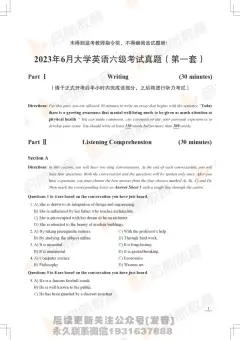
未得到监考教师指令前,不得翻阅该试题册!
2024 年 6 月大学英语四级考试真题(第一套)
Part Ⅰ Writing (30 minutes)
(请于正式开考后半小时内完成该部分,之后将进行听力考试)
Directions Suppose your university is seeking students opinions on whether university canteens should be
:
open to the public. You are now to write an essay to express your view. You will have 30 minutes
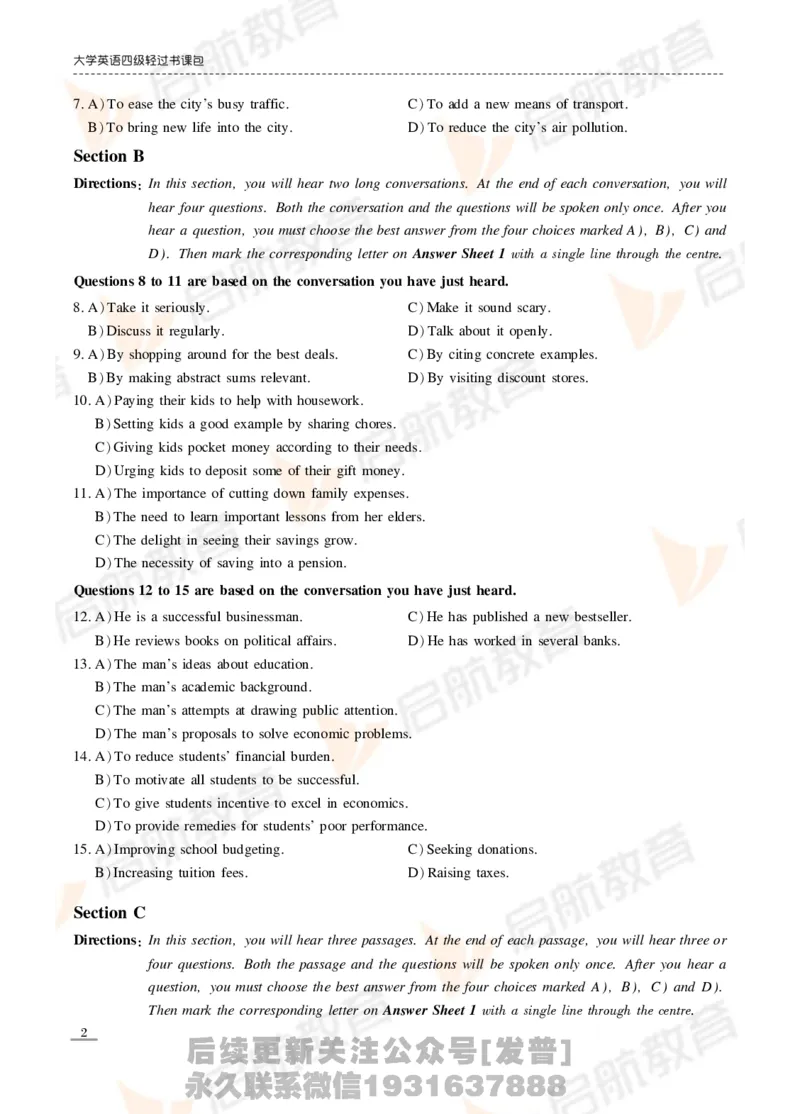
for the task. You should write at least 120 words but no more than 180 words.
Part Ⅱ Listening Comprehension (25 minutes)
Section A
Directions In this section you will hear three news reports. At the end of each news report
:
you will hear two or three questions. Both the news report and the questions will be
spoken only once. After you hear a question you must choose the best answer from
扫码听音频
the four choices marked A B C and D . Then mark the corresponding letter
on Answer Sheet 1 with a single line through the centre.
Questions 1 and 2 are based on the news report you have just heard.
.A It hit a bird shortly after takeoff.
1 )
B Its crew members went on strike.
)
C It narrowly escaped a plane crash when turning around.
)
D Its captain got slightly injured during the forced landing.
)
.A Panic. B Nervous. C Relieved. D Contented.
2 ) ) ) )
Questions 3 and 4 are based on the news report you have just heard.
.A He is now kept in a secure area. C He has been caught a second time.
3 ) )
B He has escaped the zoo once again. D He finally disappeared six days ago.
) )
.A Squeezed. C Disappointed.
4 ) )
B Threatened. D Frustrated.
) )
Questions 5 to 7 are based on the news report you have just heard.
.A It is condemned as a crazy idea. C It is questioned by local residents.
5 ) )
B It is enriching the citys night life. D It is giving rise to safety concerns.
) )
.A Avoid entering one-way streets. C Follow all the traffic rules drivers do.
6 ) )
B Ensure the safety of pedestrians. D Give way to automobiles at all time.
) )
1.A To ease the citys busy traffic. C To add a new means of transport.
7 ) )
B To bring new life into the city. D To reduce the citys air pollution.
) )
Section B
Directions In this section you will hear two long conversations. At the end of each conversation you will
:
hear four questions. Both the conversation and the questions will be spoken only once. After you
hear a question you must choose the best answer from the four choices marked A B C and
D . Then mark the corresponding letter on Answer Sheet 1 with a single line through the centre.
Questions 8 to 11 are based on the conversation you have just heard.
.A Take it seriously. C Make it sound scary.
8 ) )
B Discuss it regularly. D Talk about it openly.
) )
.A By shopping around for the best deals. C By citing concrete examples.
9 ) )
B By making abstract sums relevant. D By visiting discount stores.
) )
.A Paying their kids to help with housework.
10 )
B Setting kids a good example by sharing chores.
)
C Giving kids pocket money according to their needs.
)
D Urging kids to deposit some of their gift money.
)
.A The importance of cutting down family expenses.
11 )
B The need to learn important lessons from her elders.
)
C The delight in seeing their savings grow.
)
D The necessity of saving into a pension.
)
Questions 12 to 15 are based on the conversation you have just heard.
.A He is a successful businessman. C He has published a new bestseller.
12 ) )
B He reviews books on political affairs. D He has worked in several banks.
) )
.A The mans ideas about education.
13 )
B The mans academic background.
)
C The mans attempts at drawing public attention.
)
D The mans proposals to solve economic problems.
)
.A To reduce students financial burden.
14 )
B To motivate all students to be successful.
)
C To give students incentive to excel in economics.
)
D To provide remedies for students poor performance.
)
.A Improving school budgeting. C Seeking donations.
15 ) )
B Increasing tuition fees. D Raising taxes.
) )
Section C
Directions In this section you will hear three passages. At the end of each passage you will hear three or
:
four questions. Both the passage and the questions will be spoken only once. After you hear a
question you must choose the best answer from the four choices marked A B C and D .
Then mark the corresponding letter on Answer Sheet 1 with a single line through the centre.
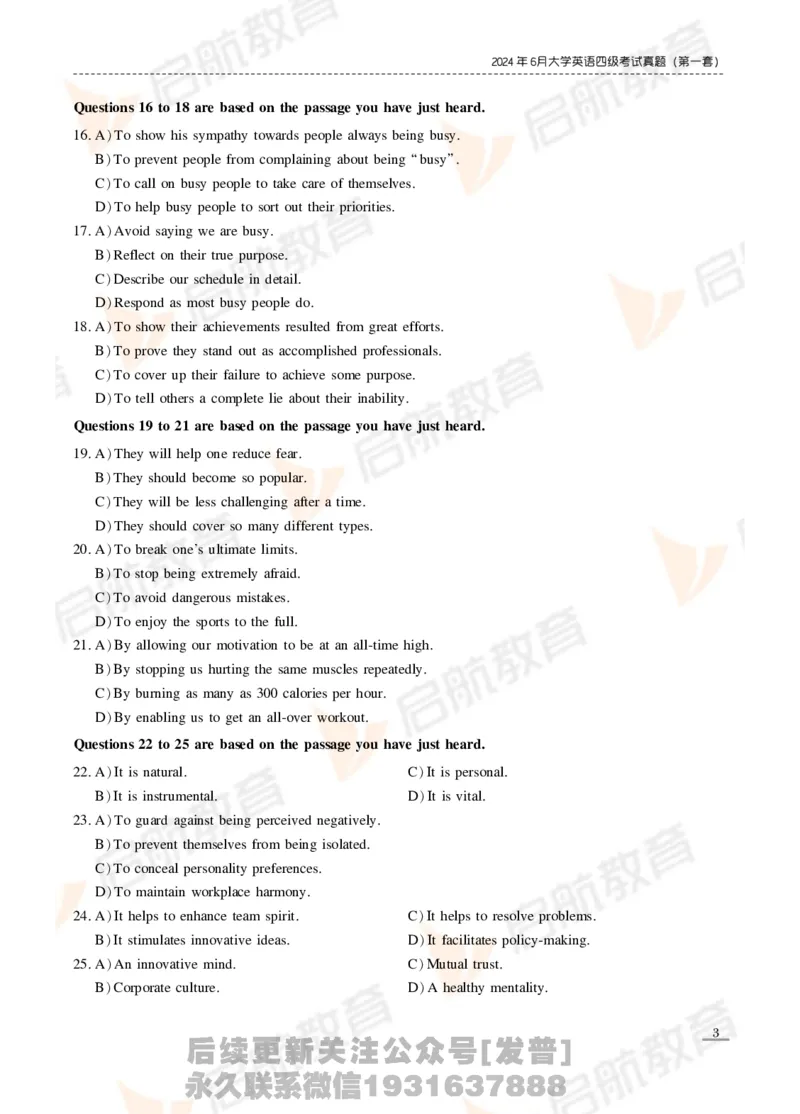
2Questions 16 to 18 are based on the passage you have just heard.
.A To show his sympathy towards people always being busy.
16 )
B To prevent people from complaining about being busy .
) “ ”
C To call on busy people to take care of themselves.
)
D To help busy people to sort out their priorities.
)
.A Avoid saying we are busy.
17 )
B Reflect on their true purpose.
)
C Describe our schedule in detail.
)
D Respond as most busy people do.
)
.A To show their achievements resulted from great efforts.
18 )
B To prove they stand out as accomplished professionals.
)
C To cover up their failure to achieve some purpose.
)
D To tell others a complete lie about their inability.
)
Questions 19 to 21 are based on the passage you have just heard.
.A They will help one reduce fear.
19 )
B They should become so popular.
)
C They will be less challenging after a time.
)
D They should cover so many different types.
)
.A To break ones ultimate limits.
20 )
B To stop being extremely afraid.
)
C To avoid dangerous mistakes.
)
D To enjoy the sports to the full.
)
.A By allowing our motivation to be at an all-time high.
21 )
B By stopping us hurting the same muscles repeatedly.
)
C By burning as many as calories per hour.
) 300
D By enabling us to get an all-over workout.
)
Questions 22 to 25 are based on the passage you have just heard.
.A It is natural. C It is personal.
22 ) )
B It is instrumental. D It is vital.
) )
.A To guard against being perceived negatively.
23 )
B To prevent themselves from being isolated.
)
C To conceal personality preferences.
)
D To maintain workplace harmony.
)
.A It helps to enhance team spirit. C It helps to resolve problems.
24 ) )
B It stimulates innovative ideas. D It facilitates policy-making.
) )
.A An innovative mind. C Mutual trust.
25 ) )
B Corporate culture. D A healthy mentality.
) )
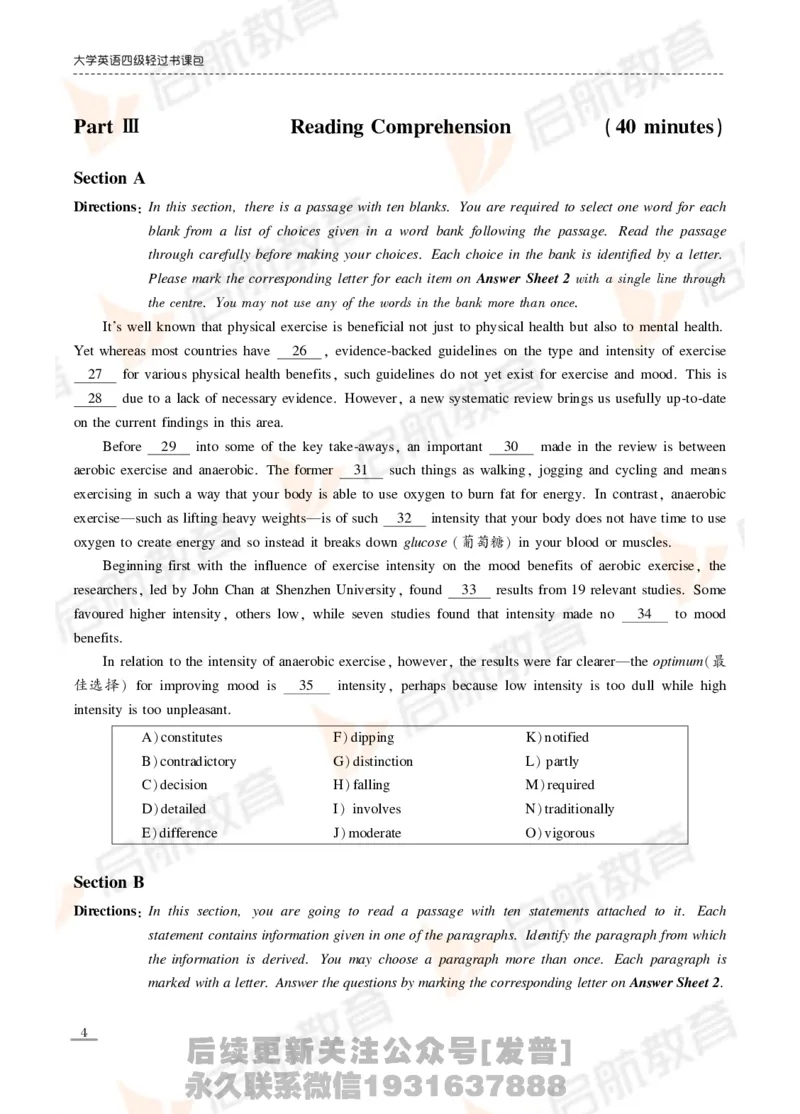
3Part Ⅲ Reading Comprehension (40 minutes)
Section A
Directions In this section there is a passage with ten blanks. You are required to select one word for each
:
blank from a list of choices given in a word bank following the passage. Read the passage
through carefully before making your choices. Each choice in the bank is identified by a letter.
Please mark the corresponding letter for each item on Answer Sheet 2 with a single line through
the centre. You may not use any of the words in the bank more than once.
Its well known that physical exercise is beneficial not just to physical health but also to mental health.
Yet whereas most countries have evidence-backed guidelines on the type and intensity of exercise
26 ,
for various physical health benefits such guidelines do not yet exist for exercise and mood. This is
27 ,
due to a lack of necessary evidence. However a new systematic review brings us usefully up-to-date
28 ,
on the current findings in this area.
Before into some of the key take-aways an important made in the review is between
29 , 30
aerobic exercise and anaerobic. The former such things as walking jogging and cycling and means
31 ,
exercising in such a way that your body is able to use oxygen to burn fat for energy. In contrast anaerobic
,
exercise such as lifting heavy weights is of such intensity that your body does not have time to use
— — 32
oxygen to create energy and so instead it breaks down glucose 葡萄糖 in your blood or muscles.
( )
Beginning first with the influence of exercise intensity on the mood benefits of aerobic exercise the
,
researchers led by John Chan at Shenzhen University found results from relevant studies. Some
, , 33 19
favoured higher intensity others low while seven studies found that intensity made no to mood
, , 34
benefits.
In relation to the intensity of anaerobic exercise however the results were far clearer the optimum 最
, , — (
佳选择 for improving mood is intensity perhaps because low intensity is too dull while high
) 35 ,
intensity is too unpleasant.
A constitutes F dipping K notified
) ) )
B contradictory G distinction L partly
) ) )
C decision H falling M required
) ) )
D detailed I involves N traditionally
) ) )
E difference J moderate O vigorous
) ) )
Section B
Directions In this section you are going to read a passage with ten statements attached to it. Each
:
statement contains information given in one of the paragraphs. Identify the paragraph from which
the information is derived. You may choose a paragraph more than once. Each paragraph is
marked with a letter. Answer the questions by marking the corresponding letter on Answer Sheet 2.
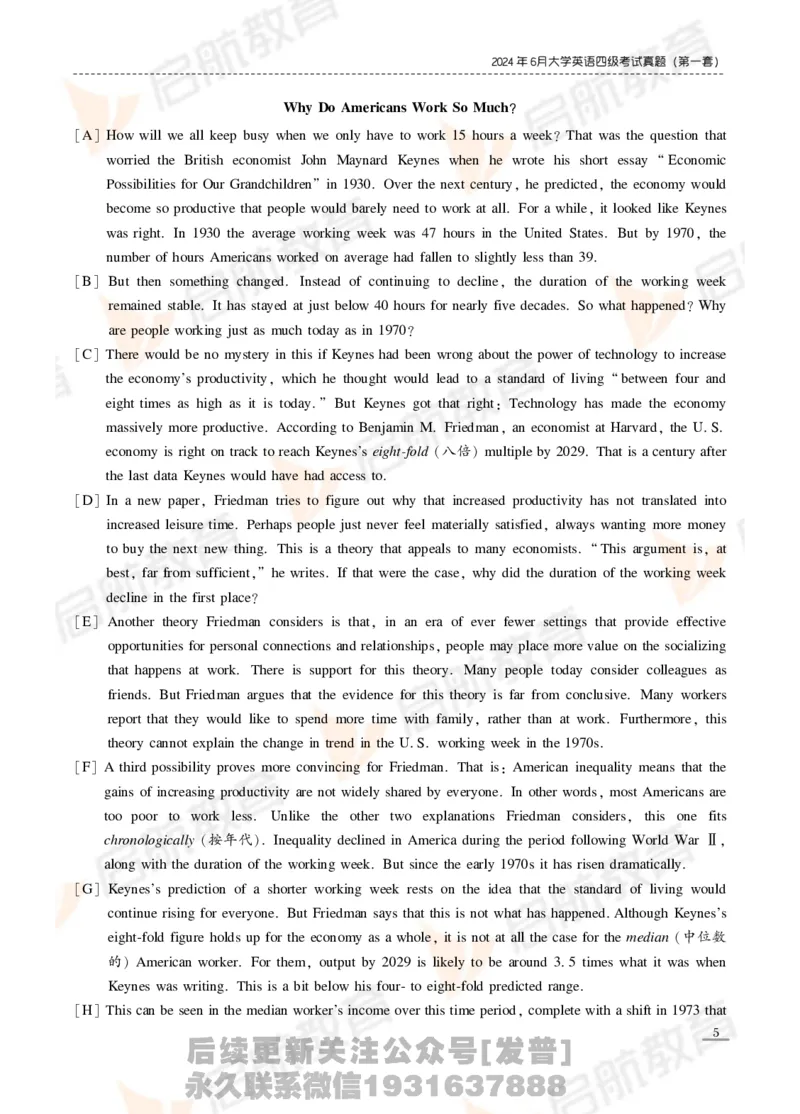
4Why Do Americans Work So Much?
A How will we all keep busy when we only have to work hours a week That was the question that
[ ] 15 ?
worried the British economist John Maynard Keynes when he wrote his short essay Economic
“
Possibilities for Our Grandchildren in . Over the next century he predicted the economy would
” 1930 , ,
become so productive that people would barely need to work at all. For a while it looked like Keynes
,
was right. In the average working week was hours in the United States. But by the
1930 47 1970,
number of hours Americans worked on average had fallen to slightly less than .
39
B But then something changed. Instead of continuing to decline the duration of the working week
[ ] ,
remained stable. It has stayed at just below hours for nearly five decades. So what happened Why
40 ?
are people working just as much today as in
1970?
C There would be no mystery in this if Keynes had been wrong about the power of technology to increase
[ ]
the economys productivity which he thought would lead to a standard of living between four and
, “
eight times as high as it is today. But Keynes got that right Technology has made the economy
” :
massively more productive. According to Benjamin M. Friedman an economist at Harvard the U.S.
, ,
economy is right on track to reach Keyness eight-fold 八倍 multiple by . That is a century after
( ) 2029
the last data Keynes would have had access to.
D In a new paper Friedman tries to figure out why that increased productivity has not translated into
[ ] ,
increased leisure time. Perhaps people just never feel materially satisfied always wanting more money
,
to buy the next new thing. This is a theory that appeals to many economists. This argument is at
“ ,
best far from sufficient he writes. If that were the case why did the duration of the working week
, ,” ,
decline in the first place
?
E Another theory Friedman considers is that in an era of ever fewer settings that provide effective
[ ] ,
opportunities for personal connections and relationships people may place more value on the socializing
,
that happens at work. There is support for this theory. Many people today consider colleagues as
friends. But Friedman argues that the evidence for this theory is far from conclusive. Many workers
report that they would like to spend more time with family rather than at work. Furthermore this
, ,
theory cannot explain the change in trend in the U.S. working week in the s.
1970
F A third possibility proves more convincing for Friedman. That is American inequality means that the
[ ] :
gains of increasing productivity are not widely shared by everyone. In other words most Americans are
,
too poor to work less. Unlike the other two explanations Friedman considers this one fits
,
chronologically 按年代 . Inequality declined in America during the period following World War
( ) Ⅱ,
along with the duration of the working week. But since the early s it has risen dramatically.
1970
G Keyness prediction of a shorter working week rests on the idea that the standard of living would
[ ]
continue rising for everyone. But Friedman says that this is not what has happened.Although Keyness
eight-fold figure holds up for the economy as a whole it is not at all the case for the median 中位数
, (
的 American worker. For them output by is likely to be around . times what it was when
) , 2029 3 5
Keynes was writing. This is a bit below his four- to eight-fold predicted range.
H This can be seen in the median workers income over this time period complete with a shift in that
[ ] , 1973
5fits in precisely with when the working week stopped shrinking. According to Friedman between
, 1947
and the average hourly wage for normal workers those who were not in management roles in
1973 ( )
private industries other than agriculture nearly doubled in terms of what their money could buy. But by
the average hourly wage for ordinary workers had fallen percent from the level in terms of
2013 5 1973
actual purchasing power. Thus though American incomes may have gone up since the amount
, 1973,
that American workers can actually buy with their money has gone down. For most Americans then
, ,
the magic of increasing productivity stopped working around . Thus they had to keep working just
1973 ,
as much in order to maintain their standard of living.
I What Keynes predicted was a very optimistic version of what economists call technological
[ ]
unemployment. This is the idea that less labor will be necessary because machines can do so much. In
Keyness vision the resulting unemployment would be distributed more or less evenly across society in
,
the form of increased leisure. But Friedman says that for Americans reality is much darker. Americans
, ,
now have a labor market in which millions of people those with fewer skills and less education are
— —
seeking whatever poorly paid work they can get. This is confirmed by a recent poll that found that for
,
half of hourly workers their top concern is not that they work too much but that they work too little.
,
This is most likely not because they like their jobs so much. Rather we can assume it is because they
,
need the money.
J This explanation leaves an important question. If the very rich the workers who have reaped above-
[ ] —
average gains from the increased productivity since Keyness time can afford to work less why do they
— ,
continue to work so much Indeed research has shown that the highest earners in America tend to work
?( ,
the most. Friedman believes that for many top earners work is a labor of love. They are doing work
) ,
they care about and are interested in and doing more of it is not necessarily a burden. For them it may
, ,
even be a pleasure. These top earners derive meaning from their jobs and work is an important part of
how they think of themselves. And of course they are compensated for it at a level that makes it worth
, ,
their while.
K Friedman concludes that the prosperity 繁荣 Keynes predicted is here. After all the economy as a
[ ] ( ) ,
whole has grown even more brilliantly than he expected. But for most Americans that prosperity is
,
nowhere to be seen. And as a result neither are those shorter working weeks.
, ,
.Some people view socializing at the workplace as a chance to develop personal relationships.
36
.As ordinary American workers average hourly pay had decreased despite increasing productivity they had
37 ,
to work just as many hours as before to keep their living standards.
.American workers average weekly working time has not changed for nearly half a century.
38
.Friedman believes inequality in the U.S. largely explains why increasing productivity has not resulted in
39
reduced working hours.
.Many economists assume peoples thirst for material things has prevented them from enjoying more leisure
40
time.
.An economists prediction about a shorter average working week seemed to be correct for a time in the
41
th century.
20
6.In the U.S. labor market the primary concern of people with less schooling and fewer skills is to secure
42 ,
any employment even if it is low-paid.
.Keynes was right in predicting that technology would make the economy much more productive.
43
.Many of the highest earners have a keen interest in and love for what they are doing.
44
. According to Keynes there would be a shorter working week with everyones standard of living
45 ,
continuing to rise.
Section C
Directions There are 2 passages in this section. Each passage is followed by some questions or unfinished
:
statements. For each of them there are four choices marked A B C and D . You should
decide on the best choice and mark the corresponding letter on Answer Sheet 2 with a single line
through the centre.
Passage One
Questions 46 to 50 are based on the following passage.
Lao Zi once said Care about what other people think and you will always be their prisoner.
, “ ”
People-pleasing or seeking self-worth through others approval is unproductive and an exhausting way
, ,
to go through life. Why do we allow what others think of us to have so much power over how we feel about
ourselves If its true that you cant please all people all of the time wouldnt it make sense to stop trying
? , ?
Unfortunately sense often isnt driving our behavior. For social beings who desire love and belonging
, ,
wanting to be liked and caring about the effect we have on others is healthy and allows us to make
, ,
connections. However where we get into trouble is when our self-worth is dependent upon whether we win
,
someones approval or not.
This need to be liked can be traced back to when we were children and were completely dependent on
others to take care of us Small children are not just learning how to walk and communicate they are also
: ,
trying to learn how the world works. We learn about who we are and what is expected of us based on
interactions with others so to a four-year-old if Mommy or Daddy doesnt like him or her there is the
, , , ,
danger that they will abandon them. We need to understand that when we desperately want someone to
approve of us its being driven by that little kid part of us that is still terrified of abandonment.
,
As you become more capable of providing yourself with the approval you seek your need for external
,
validation will start to vanish leaving you stronger more confident and yes happier in your life. Imagine
, , , ,
how much time we lose each moment we restrain our authentic selves in an effort to be liked.
If we base our worth on the opinions of others we cheat ourselves of the power to shape our experiences
,
and embrace life not only for others but also for ourselves because ultimately there is no difference. So
, ,
embrace the cliché 老话 and love yourself as its highly doubtful that youll regret it.
( )
.What can we conclude from Lao Zis quotation
46 ?
A We should see through other peoples attempt to make a prisoner of us.
)
B We can never really please other people even if we try as hard as we can.
)
7C We can never be truly free if taking to heart others opinion of us.
)
D We should care about other peoples view as much as they care about our own.
)
.What will happen if we base our self-worth on other peoples approval
47 ?
A Our desire to be loved will be fulfilled.
)
B Our life will be unfruitful and exhausting.
)
C Our identity as social beings will be affected.
)
D Our sense of self will be sharpened and enhanced.
)
.What may account for our need to be liked or approved of
48 ?
A Our desperate longing for interactions with others.
)
B Our understanding of the workings of the world.
)
C Our knowledge about the pain of abandonment.
)
D Our early childhood fear of being deserted.
)
.What can we do when we become better able to provide ourselves with the desired approval
49 ?
A Enjoy a happier life. C Receive more external validation.
) )
B Exercise self-restraint. D Strengthen our power of imagination.
) )
.What does the author advise us to do in the last paragraph
50 ?
A Embrace life for ourselves and for others.
)
B Base our worth on others opinions.
)
C See our experiences as assets.
)
D Love ourselves as we are.
)
Passage Two
Questions 51 to 55 are based on the following passage.
Some people have said aging is more a slide into forgetfulness than a journey towards wisdom.
However a growing body of research suggests that late-in-life learning is possible. In reality education does
, ,
an aging brain good.
Throughout life peoples brains constantly renovate themselves. In the late s British brain scientist
, 1960 ,
Geoffrey Raisman spied growth in damaged brain regions of rats through an electron microscope their brains
;
were forging new connections. This meant brains may change every time a person learns something new.
Of course that doesnt mean the brain isnt affected by the effects of time. Just as height usually
,
declines over the years so does brain volume Humans lose about percent every decade starting in their
, : 4
s. But that reduction doesnt necessarily make people think slower as long as we are alive and functioning
40 ; ,
we can alter our brains with new information and experiences.
In fact scientists now suspect accumulating novel experiences facts and skills can keep peoples minds
, , ,
more flexible. New pathways can strengthen our ever-changing mental structure even as the brain shrinks.
Conventional fixes like word puzzles and brain-training apps can contribute to mental durability. Even
something as simple as taking a different route to the grocery store or going somewhere new on vacation can
keep the brain healthy.
8A desire for new life challenges can further boost brainpower. Research about aging adults who take on
new enterprises shows improved function and memory as well as a reduced risk of mental disease. Openness
—
a characteristic defined by curiosity and a desire for knowledge may also help folks pass brain tests. Some
—
folks are born with this take-in-the-world attitude but those who arent as genetically gifted arent necessarily
,
out of luck. While genes can encourage an interest in doing new things a study in the journal
, 2012
Psychology and Aging found completing reasoning tasks like puzzles and number games can enhance that
desire for novel experiences which can in turn refresh the brain. Thats why brain scientist Richard
, , ,
Kennedy says Its not that old dogs cant learn new tricks. Its that maybe old dogs dont realize why they
“
should.
”
.What do some people think of aging adults
51 ?
A Their wisdom grows as time goes by. C They can benefit from late-in-life learning.
) )
B Their memory gradually deteriorates. D They are likely to have mental health issues.
) )
.What can we conclude from Geoffrey Raismans finding
52 ?
A Brain damage seriously hinders ones learning. C Brains can refresh and improve with learning.
) )
B Brain power weakens slower than we imagine. D Brains forge connections under new conditions.
) )
.What is one thing that helps maintain the health of our brain even as it shrinks
53 ?
A Doing daily routines by conventional means. C Imitating old dogs way of learning new tricks.
) )
B Avoiding worrying about our mental durability. D Approaching everyday tasks in novel ways.
) )
.What does the author say can contribute to the improvement of brain function
54 ?
A Being curious and desiring knowledge. C Rising to lifes challenges and avoiding risks.
) )
B Being eager to pass brain tests at an old age. D Boosting immunity to serious mental diseases.
) )
.What is the finding of the study in the journal Psychology and Aging
55 2012 ?
A Wishing to solve puzzles enhances ones reasoning power.
)
B Playing number games unexpectedly stimulates ones memory.
)
C Desiring new experiences can help to renovate the brain.
)
D Learning new tricks should not be confined to old dogs only.
)
Part Ⅳ Translation (30 minutes)
Directions For this part you are allowed 30 minutes to translate a passage from Chinese into English. You
:
should write your answer on Answer Sheet 2.
汉语中的 福 字 the character fu 表示幸福和好运 是中国传统文化中最常用的吉祥 auspicious
“ ” ( ) , ( )
符号之一 人们通常将一个大大的福字写在红纸上 寓意期盼家庭幸福 社会安定 国家昌盛 春节贴福
。 , 、 、 。
字是民间由来已久的习俗 为了欢庆春节 家家户户都会将福字贴在门上或墙上 表达对幸福生活的向
。 , ,
往 对美好未来的期待 人们有时还将福字倒过来贴 表示幸福已到 好运已到
、 。 , 、 。
9答案速查
Part Writing
Ⅰ
Regarding universities opening their canteens to the public some hold that it is likely to lead to
,
overcrowding while others believe that the benefits outweigh the drawbacks. As far as Im concerned the
, ,
benefits of university canteens being accessible to the public justify the cost.
Firstly allowing non-students to dine in the canteens could be a valuable community service providing
, ,
healthy and affordable meals. Secondly it could also foster a sense of community connection between the
,
university and its surroundings. Last but not least an open university canteen can be expected to contribute to
,
creating a more vibrant and inclusive campus environment.
Therefore we can naturally draw the conclusion that university canteens opening their doors to the public
,
will be a beneficial development despite the potential risks of overcrowding and the possibility of
,
compromising the dining experience for students.
Part Listening Comprehension
Ⅱ
Section A .A .C .B .D .D .C .B .B
1 2 3 4 5 6 7 8
Section B .C .A .D .C .A .B .D
9 10 11 12 13 14 15
Section C .B .A .C .A .C .D .A .D .B .C
16 17 18 19 20 21 22 23 24 25
Part Reading Comprehension
Ⅲ
Section A .D .M .L .F .G .I .O .B .E .J
26 27 28 29 30 31 32 33 34 35
Section B .E .H .B .F .D .A .I .C .J .G
36 37 38 39 40 41 42 43 44 45
Section C .C .B .D .A .D .B .C .D .A .C
46 47 48 49 50 51 52 53 54 55
Part Translation
Ⅳ
The Chinese character fu stands for happiness and good luck and it is one of the most commonly used
,
auspicious symbols in traditional Chinese culture. People usually write a big fu character on a piece of red
paper signifying their expectation of family happiness social stability and national prosperity. It is a long-
, , ,
standing folk custom to put up the fu character during the Spring Festival. To celebrate the Spring Festival
,
every household will paste the fu character on the door or wall to express their aspirations for a happy life and
hopes for a bright future. On occasion people even paste the fu character upside down symbolizing that
, ,
happiness and good fortune have already arrived.
10未得到监考教师指令前,不得翻阅该试题册!
2024 年 6 月大学英语四级考试真题(第二套)
Part Ⅰ Writing (30 minutes)
(请于正式开考后半小时内完成该部分,之后将进行听力考试)
Directions Suppose your university is seeking students opinions on whether university sports facilities should
:
be open to the public. You are now to write an essay to express your view. You will have 30
minutes for the task. You should write at least 120 words but no more than 180 words.
Part Ⅱ Listening Comprehension (25 minutes)
Section A
Directions In this section you will hear three news reports. At the end of each news report
:
you will hear two or three questions. Both the news report and the questions will be
spoken only once. After you hear a question you must choose the best answer from
扫码听音频
the four choices marked A B C and D . Then mark the corresponding letter
on Answer Sheet 1 with a single line through the centre.
Questions 1 and 2 are based on the news report you have just heard.
.A Due to a fire alarm in their apartments.
1 )
B Because of the smoke and heat damage.
)
C Due to the water used to extinguish the flames.
)
D Because of the collapse of the three-story building.
)
.A Investigating the cause of the incident.
2 )
B Helping search for the suspect of the crime.
)
C Rescuing the businessmen trapped in the building.
)
D Checking town records for the property developer.
)
Questions 3 and 4 are based on the news report you have just heard.
.A It plays a less important role in ones health than nutrient intake.
3 )
B It impacts peoples health to a lesser degree than sun exposure.
)
C It is associated with peoples mental health conditions.
)
D It is linked with older adults symptoms of depression.
)
.A It was indefinite. C It was straightforward.
4 ) )
B It was systematic. D It was insignificant.
) )
11Questions 5 to 7 are based on the news report you have just heard.
.A It has helped solve several murder cases.
5 )
B It has become a star police dog in Beijing.
)
C It has surpassed its mother in performance.
)
D It has done better than naturally born dogs.
)
.A To speed up investigation into criminal cases.
6 )
B To test the feasibility of cloning technology.
)
C To cut down training expenses.
)
D To reduce their training time.
)
.A Cloning is too complicated a process.
7 )
B The technology is yet to be accepted.
)
C Cloning is ethically controversial.
)
D The technology is too expensive.
)
Section B
Directions In this section you will hear two long conversations. At the end of each conversation you will
:
hear four questions. Both the conversation and the questions will be spoken only once. After you
hear a question you must choose the best answer from the four choices marked A B C and
D . Then mark the corresponding letter on Answer Sheet 1 with a single line through the centre.
Questions 8 to 11 are based on the conversation you have just heard.
.A He read it somewhere online. C He read an article reviewing it.
8 ) )
B He heard about it from a coworker. D He watched a TV series based on it.
) )
.A His publications. C His address.
9 ) )
B His first book. D His name.
) )
.A Collect a lot more data. C Clarify many new concepts.
10 ) )
B Relax a bit less often. D Read more reference books.
) )
.A Find out the shows most interesting episodes.
11 )
B Watch the series together with the woman.
)
C Get an e-copy of the book to read.
)
D Check to see when the show starts.
)
Questions 12 to 15 are based on the conversation you have just heard.
.A To check the prices of his farm produce.
12 )
B To ask the way to the Newcastle City Hall.
)
C To inquire about the vegetarian food festival.
)
D To seek the mans help with her work on the farm.
)
.A Bakers. B Vendors. C Vegetarians. D Organisers.
13 ) ) ) )
.A The issuing of certificates to vendors. C The festival they are organising.
14 ) )
B The completion of the baking task. D The deadline for application.
) )
12.A The closing date of submission. C The details of the ceremony.
15 ) )
B The website of his company. D The organisers address.
) )
Section C
Directions In this section you will hear three passages. At the end of each passage you will hear three or
:
four questions. Both the passage and the questions will be spoken only once. After you hear a
question you must choose the best answer from the four choices marked A B C and D .
Then mark the corresponding letter on Answer Sheet 1 with a single line through the centre.
Questions 16 to 18 are based on the passage you have just heard.
.A Most scenic sites have been closed. C Health experts advise going outdoors.
16 ) )
B Access to official campsites is limited. D People have more time during the summer.
) )
.A It is strongly opposed by nearby residents. C It has caused environmental concerns.
17 ) )
B It leads to much waste of public money. D It has created conflicts among campers.
) )
.A Look for open land in Scotland. C Avoid getting close to wilderness.
18 ) )
B Leave no trace of their camping. D Ask for permission from authorities.
) )
Questions 19 to 21 are based on the passage you have just heard.
.A They outcompete mythical creatures. C They truly exist in the Amazon region.
19 ) )
B They usually mind their own business. D They resemble alarmingly large snakes.
) )
.A Scar tissue from dolphins fighting. C Unhealed wounds from snake bites.
20 ) )
B Skin infection from water pollution. D Swimming along in seasonal floods.
) )
.A It has been shrinking at an astonishing pace.
21 )
B It has been placed under international protection.
)
C It has been appealing to both freshwater and sea dolphins.
)
D It has been abandoned as a battleground for male dolphins.
)
Questions 22 to 25 are based on the passage you have just heard.
.A About % of young adults call parental support the new normal.
22 ) 58
B Most adult children enjoy increasing sources of financial support.
)
C A full % of the young adults cannot afford to buy a car by themselves.
) 70
D Most early adults cannot sustain their lifestyles without parental support.
)
.A It renders them dependent. C It makes them mentally immature.
23 ) )
B It causes them to lose dignity. D It hinders them from getting ahead.
) )
.A It challenges ones willpower. C It calls for due assistance.
24 ) )
B It results from education. D It defines adulthood.
) )
.A Current lifestyles. C College loans.
25 ) )
B Poor budgeting. D Emergency expenses.
) )
13Part Ⅲ Reading Comprehension (40 minutes)
Section A
Directions In this section there is a passage with ten blanks. You are required to select one word for each
:
blank from a list of choices given in a word bank following the passage. Read the passage
through carefully before making your choices. Each choice in the bank is identified by a letter.
Please mark the corresponding letter for each item on Answer Sheet 2 with a single line through
the centre. You may not use any of the words in the bank more than once.
A team of researchers led by Priyanka Joshi examined the degree to which men and women relied on
communicative abstraction to verbally convey their ideas and emotions. Communicative abstraction
“ ” ,
according to the researchers reflects the tendency of people to use abstract speech that focuses on the broader
, “
picture and purpose of action rather than concrete speech focusing on details and the means of
26 27
action. Interestingly they found that men were far more likely to speak in the abstract than were women.
” ,
To arrive at this the researchers examined the linguistic 语言的 patterns of men and women
28 , ( )
in over blog posts written on websites. To do this the researchers computed abstractness ratings for
600,000 ,
commonly used words in the English language. Words considered to be concrete could be
29 40,000
easily visualized such as table or chair . Words that were more to visualize for example
, “ ” “ ” 30 , ,
justice or morality were considered to be more abstract. They found that men used more abstract
“ ” “ ” 31
language in their blog posts.
What is the of this effect The researchers suggest that power differences between the genders
32 ? —
that is men having more power in society might be a key determinant 决定因素 . For instance in a
, — ( ) ,
follow-up study conducted with a sample of students the researchers power dynamics in an
300 , 33
interpersonal setting to see if this would influence communicative abstraction. They found that participants in
a high-power interviewer role were more likely to give abstract descriptions of behaviors than were participants
in a low-power interviewee role. This suggests that communicating more abstractly does not reflect a
34
tendency of men or women but rather within specific contexts.
35
A approximately F fixed K refraining
) ) )
B attaining G ignored L signals
) ) )
C conclusion H legally M significantly
) ) )
D difficult I manipulated N source
) ) )
E emerges J recommended O ultimate
) ) )
Section B
Directions In this section you are going to read a passage with ten statements attached to it. Each
:
statement contains information given in one of the paragraphs. Identify the paragraph from which
the information is derived. You may choose a paragraph more than once. Each paragraph is
marked with a letter. Answer the questions by marking the corresponding letter on Answer Sheet 2.
14How to better work towards long-term goals
A Hal Hershfield a psychologist at the UCLA Anderson School of Management wanted to know why
[ ] , ,
people werent saving for retirement. Across the board people are living longer. Logically theyll
, ,
need more money to live comfortably in their post-work years. And yet savings rates in the U.S. have
,
gone down in recent decades not up.
,
B To help explain this seemingly irrational behavior Hershfield and his team scanned the brains of study
[ ] ,
participants while asking them to what degree various traits 特征 like honorable or funny
( )— “ ” “ ”—
applied to their current self their future self a current other or a future other. As participants
, , ,
answered Hershfields team recorded which parts of their brains lit up. Unsurprisingly peoples brains
, ,
were most active when thinking about their current selves and least active when thinking about a current
other. But the team found that participants brain activity while considering their future selves more
closely resembled their brain activity while thinking about a current other rather than the current self.
C Put in practical terms when thinking of yourself in a month or a year or a decade your brain registers
[ ] , ,
that person in ways similar to how it would register Taylor Swift or the mailman. Understood in that
way saving for retirement is the equivalent of giving money away to someone else entirely.
,
D In light of Hershfields study one simple question arises Is it possible to make our present selves give
[ ] , :
a damn about our future selves The answers are anything but simple.
?
E Seen through the lens of the present self versus the future self our self-defeating actions like choosing
[ ] , —
to watch television rather than go to the gym suddenly make perfect sense. We get to enjoy the very
—
concrete immediate benefits of our actions while someone else namely our future selves suffers the
, ( , )
hypothetical 假设的 far-off consequences. As a result the decisions we make for our present selves
( ), ,
often look very different from our decisions for our future selves. We believe that tomorrow will be
different. We believe that we will be different tomorrow but in doing so we prioritize our current
; ,
mood over the consequences of our inaction for the future self.
F Understanding our procrastination 拖延 through the lens of the present and future selves were left
[ ] ( ) ,
with three possible solutions The first is to force your future self to do whatever your present self
:
doesnt want to do. The second is to convince your present self that your future self is in fact still
, ,
you. If the central problem is that we think of our future selves as other people it follows that trying to
,
identify more closely with our future selves will encourage us to make better long-term decisions.
G In a follow-up study Hershfield wanted to explore ways to bridge the disconnect between the present
[ ] ,
and future selves and encourage people to save more for retirement. He and his team took photos of
study participants and then used image processing to visually age their faces. Participants were then
,
placed in a virtual reality setting where they could look into a mirror and see their aged selves looking
back at them. Participants who saw their aged selves said they would save % more of their salary for
30
retirement than the control group.
H Whatever your long-term goals may be getting in better shape launching your own business writing a
[ ] — , ,
book thinking about your deadline in terms of days rather than months or years can help you wrap your
—
mind around how close the future really is.
15I The third solution is to forget about your future self and use your present selfs love of instant
[ ]
gratification 满足感 to your advantage. While the two tactics 手段 above can be effective in
( ) ( )
making better long-term choices in the end youre still struggling against human nature. Our brains are
, ,
hard-wired for instant gratification. Instead of fighting your present selfs need for immediate rewards
,
why not use it to your advantage When most of us set goals we focus on long-term results we want to
? ,
see e.g. losing weight getting a promotion retiring in comfort etc. While those visions of our
— , , , ,
future selves can be inspiring when it comes to actually doing the day-to-day work it may be more
, ,
effective to reframe activities in terms of their immediate or at least very near-term rewards.
, ,
J Take writing this article for instance. Its easy for me to imagine how amazing it will feel at the end of
[ ] ,
the workday to have this article done. This isnt just my opinion. Research partners Kaitlin Woolley of
Cornell University and Ayelet Fishbach of the University of Chicago have made a career out of studying
the differences between the goals that people achieve and the ones that fall to the wayside.
K In one study we asked people online about the goals they set at the beginning of the year. Most people
[ ] “ ,
set goals to achieve delayed long-term benefits such as career advancement debt repayment or
, , , ,
improved health. We asked these individuals how enjoyable it was to pursue their goal as well as how
,
important their goal was. We also asked whether they were still working on their goals two months after
setting them. We found that enjoyment predicted peoples goal persistence two months after setting the
goal far more than how important they rated their goal to be Woolley said.
,”
L This pattern held true across a wide variety of goals from exercising to studying to eating healthier foods.
[ ]
For example people ate % more of a healthy food when directed to focus on the good taste rather
, 50
than the long-term health benefits. Other studies have shown a greater uptake of exercise in people who
were told to think of the enjoyment of doing the exercise now rather than future health gains.
M These findings suggest that when it comes to achieving your goals enjoying the process itself is more
[ ] ,
important than wanting the long-term benefits. In other words present self trumps 战胜 future self.
, ( )
Who says instant gratification has to be a bad thing By all means set ambitious long-term goals for
? ,
your future self but when it comes to actually following through day-to-day make sure your present
, ,
self knows whats in it for her too.
.Our brains are genetically determined to satisfy immediate desires.
36
.Taken in a practical way saving for post-work years is like giving money away to others.
37 ,
.Research found that as regards achievement of ones goals it is important to focus more on enjoying the
38 , ,
process than the long-term benefits.
.Regarding our future selves as still being ourselves will help us make better long-term decisions.
39
. Savings rates in America have dropped in recent decades even though peoples life expectancy has
40
increased.
.Researchers found that enjoyment rather than importance enabled people to persist in their goals.
41
.When making decisions we give priority to our current frame of mind without thinking much of the
42 ,
consequences.
.People ate more of a healthy food when they focused on its good taste instead of its long-term benefits.
43
16.As was expected when people thought of their present selves their brains were observed to become more
44 , ,
active.
.Researchers found that participants who saw the images of their aged selves would save more for their later
45
years than those who didnt.
Section C
Directions There are 2 passages in this section. Each passage is followed by some questions or unfinished
:
statements. For each of them there are four choices marked A B C and D . You should
decide on the best choice and mark the corresponding letter on Answer Sheet 2 with a single line
through the centre.
Passage One
Questions 46 to 50 are based on the following passage.
People often wonder why some entrepreneurs have greater success than others. Is it habits connections
, ,
luck work ethic or any other behavior I believe the key to success is willpower. Willpower is the ability to
, ?
control yourself. It is a strong determination that allows you to do something difficult. It is a behavior we are
born with more than one we learn however it is possible to not only learn it but also strengthen it with
; , ,
constant exercise.
Willpower is just like a muscle to keep it strong you need to constantly exercise it. People with a great
;
amount of willpower have the discipline to develop positive successful habits. Even with an incredible amount
,
of talent without the discipline and motivation to create positive habits it can be difficult to achieve success.
, ,
Willpower and habits go hand in hand. It is critical to create good habits and take the actions necessary to
stick to those habits day in and day out for greater success. Almost half of our daily actions are part of our
habits and not decisions so once the correct habits are in place you will automatically perform those tasks on
, ,
a day-to-day basis.
The best way to create and stick to a habit is to have strong motivation. Its easier to change your habits
to lose weight if you have a health issue and you want to be around longer for your kids or if your business
,
is something youre passionate about. Having a valuable outcome associated with a habit will help you stick to
that habit permanently.
The art of self-control is one that most successful individuals have mastered. Self-control enables you to
avoid behaviors that dont contribute to your success and adopt those that do.
Because there is a delayed satisfaction associated with self-control it can be easy to get off track.
,
However if you work on sticking to those small positive habits one day at a time it becomes easier to stay
, ,
strong and achieve that delayed reward. Once a reward is achieved it is much easier to continue sticking to
,
your habits.
.What does the author say we need to do to strengthen our willpower
46 ?
A Keep it under control. C Learn from entrepreneurs.
) )
B Apply it continuously. D Aim at success determinedly.
) )
17.How are almost half of our daily actions performed according to the passage
47 ?
A Out of habit. C Like muscle building.
) )
B With determination. D By self-discipline.
) )
.What will help people stick to doing something constructive automatically
48 ?
A Practising it on a day-to-day basis.
)
B Associating it with improving health.
)
C Possessing a reasonable amount of talent.
)
D Foreseeing the desired outcome it will yield.
)
.How does the art of self-control help us succeed
49 ?
A By allowing us to remain clear-headed permanently.
)
B By enabling us to alter our behaviors constantly.
)
C By enabling us to take positive actions.
)
D By allowing us to avoid taking risks.
)
.Why can it be difficult for us to maintain self-control
50 ?
A Most of us are not in the habit of exercising self-control.
)
B We may not get immediate rewards from self-control.
)
C Self-control tends to be associated with pains.
)
D Self-control only brings about small benefits.
)
Passage Two
Questions 51 to 55 are based on the following passage.
Today most scientific research is funded by government grants companies doing research and
, ,
development and non-profit foundations. As a society we reap the rewards from this science but we also
, , ,
help pay for it. You indirectly support science through taxes you pay products and services you purchase
, ,
and donations you make.
Funding for science has changed with the times. Historically science has been largely supported through
,
private patronage 资助 church sponsorship or simply paying for the research yourself. Today
( ), , ,
researchers are likely to be funded by a mix of grants from various government agencies institutions and
, ,
foundations. Other research is funded by private companies. Such corporate sponsorship is widespread in
some fields. Almost % of U. S. clinical trials in medicine are paid for by private companies. And of
75 ,
course some researchers today still fund small-scale studies out of their own pockets. Most of us cant afford
,
to do nuclear research as a private hobby but birdwatchers rock collectors and others can do real research
, , ,
on a limited budget.
In a perfect world money wouldnt matter all scientific studies would be completely objective. But in
, —
the real world funding may introduce biases. Drug research sponsored by the pharmaceutical 制药的
, ( )
industry is more likely to end up favoring the drug under consideration than studies sponsored by government
grants or charitable organizations. Similarly nutrition research sponsored by the food industry is more likely
,
to end up favoring the food under consideration than independently funded research.
18So what should we make of all this Should we ignore any research funded by companies or special
?
interest groups Certainly not. These groups provide invaluable funding for scientific research. Furthermore
? ,
science has many safeguards in place to catch instances of bias that affect research outcomes. Ultimately
,
misleading results will be corrected as science proceeds however this process takes time. Meanwhile it
; , ,
pays to examine studies funded by industry or special interest groups with extra care. Are the results consistent
with other independently funded studies What do other scientists have to say about this research A little
? ?
examination can go a long way towards identifying bias associated with the funding source.
.What does the passage mainly discuss regarding scientific research
51 ?
A Its foundation. C Its prospect.
) )
B Its rewards. D Its funding.
) )
.What do we learn from the passage about researchers like birdwatchers and rock collectors
52 ?
A They have little access to government funding.
)
B They can do research with limited resources.
)
C They can do amateur work in their own fields.
)
D They have no means for large-scale research.
)
.What would scientific studies look like in a perfect world according to the author
53 ?
A They would be totally unbiased. C They would be responsibly conducted.
) )
B They would be independently funded. D They would be strictly supervised.
) )
.What does the author say about companies and special interest groups
54 ?
A They try hard to pull down the safeguards for research.
)
B They make extra efforts to research their own products.
)
C They provide valuable resources for scientific research.
)
D They reap the most benefits from scientific research.
)
.What does the author think of research funded by industry or special interest groups
55 ?
A Its recommendations should be examined for feasibility.
)
B Its misleading results should be corrected in time.
)
C Its validity should be checked with additional care.
)
D Its hidden biases should be identified independently.
)
Part Ⅳ Translation (30 minutes)
Directions For this part you are allowed 30 minutes to translate a passage from Chinese into English. You
:
should write your answer on Answer Sheet 2.
农历 the lunar calendar 起源于数千年前的中国 根据太阳和月亮的运行规律制定 长期以来 农历
( ) , 。 ,
在农业生产和人们日常生活中发挥着重要作用 古人依据农历记录日期 安排农活 以便最有效地利用
。 、 ,
自然资源和气候条件 提高农作物的产量和质量 中国的春节 中秋节等传统节日的日期都基于农历
, 。 、 。
农历是中国传统文化的重要组成部分 当今依然广为使用
, 。
19答案速查
Part Writing
Ⅰ
Our university is seeking students opinions on whether they should open their sports facilities to the
public. As far as Im concerned opening sports facilities to the public is undoubtedly beneficial.
,
Firstly allowing public access to these facilities can help universities generate additional revenue which
, ,
can be used to improve the quality of the equipment and facilities. This benefits both the students and the
public. Secondly opening up the sports facilities to the public promotes a healthy lifestyle and encourages
,
physical activity. This can help improve theoverall well-being of the community and reduce the risk of chronic
diseases. Moreover there is no doubt that allowing the public to use the sports facilities provides universities
,
with the opportunity to strengthen their ties with the community and create opportunities for collaboration and
partnerships. This can lead to mutual benefits and a sense of unity between the university and the public.
In conclusion it is evident that opening university sports facilities to the public is a multi-win situation.
,
It benefits the university the public and the community as a whole.
, ,
Part Listening Comprehension
Ⅱ
Section A .B .A .C .D .D .D .D .B
1 2 3 4 5 6 7 8
Section B .D .A .C .C .B .D .A
9 10 11 12 13 14 15
Section C .B .C .B .C .A .B .D .A .D .C
16 17 18 19 20 21 22 23 24 25
Part Reading Comprehension
Ⅲ
Section A .O .B .C .A .D .M .N .I .F .E
26 27 28 29 30 31 32 33 34 35
Section B .I .C .M .F .A .K .E .L .B .G
36 37 38 39 40 41 42 43 44 45
Section C .B .A .D .C .B .D .B .A .C .C
46 47 48 49 50 51 52 53 54 55
Part Translation
Ⅳ
The lunar calendar originating in China thousands of years ago is based on the movements of the sun
, ,
and the moon. For a long time it has played a significant role in agricultural production and peoples daily
,
lives.Ancient people relied on the lunar calendar to record dates and arrange farming activities allowing them
,
to utilize natural resources and climatic conditions most effectively thereby enhancing the yield and quality of
,
crops. The dates of traditional Chinese festivals such as the Spring Festival and the Mid-Autumn Festival are
all based on the lunar calendar. The lunar calendar remains an integral part of Chinese traditional culture and
is still widely used today.
20未得到监考教师指令前,不得翻阅该试题册!
2024 年 6 月大学英语四级考试真题(第三套)
Part Ⅰ Writing (30 minutes)
(请于正式开考后半小时内完成该部分,之后将进行听力考试)
Directions Suppose your university is seeking students opinions on whether university libraries should be
:
open to the public. You are now to write an essay to express your view. You will have 30 minutes
for the task. You should write at least 120 words but no more than 180 words.
Part Ⅱ Listening Comprehension (25 minutes)
说明:由于 年 月四级考试全国只考了两套听力 本套真题听力与前两套内容相同 只是选项
2024 6 , ,
顺序不一样 因此在本套真题中不再重复出现
, 。
Part Ⅲ Reading Comprehension (40 minutes)
Section A
Directions In this section there is a passage with ten blanks. You are required to select one word for each
:
blank from a list of choices given in a word bank following the passage. Read the passage
through carefully before making your choices. Each choice in the bank is identified by a letter.
Please mark the corresponding letter for each item on Answer Sheet 2 with a single line through
the centre. You may not use any of the words in the bank more than once.
Over the coming decades millions of jobs will be threatened by robotics and artificial intelligence.
,
Despite intensive academic on these developments there has been little study on how workers
26 , 27
to being replaced through technology.
To find out business researchers at TUM and Erasmus University Rotterdam conducted studies and
, 11
surveys with over persons from several countries.
2,000
The findings show In principle most people view it more when workers are replaced by other
: , 28
people than by robots or intelligent software. This preference however when it refers to peoples
29 , ,
own jobs. When that is the case the majority of workers find it less upsetting to see their own jobs go to
,
robots than to other employees. In the long term however the same people see machines as more threatening
, ,
to their future role in the workforce. These effects can also be observed among people who have recently
become unemployed.
The researchers were able to identify the causes behind these paradoxical results too People
30 , :
21tend to themselves less with machines than with other people. Consequently being replaced by a
31 ,
robot or software less of a threat to their feeling of self-worth. This reduced self-threat could even be
32
observed when participants assumed that they were being replaced by other employees who relied on
technological abilities such as artificial intelligence in their work.
Even when unemployment results from the of new technologies people still judge it in a social
“ 33 ,
context says Christoph Fuchs one of the authors of the study. It is important to understand these
,” , “ 34
effects when trying to manage the massive changes in the working world to minimize in society.
35 ”
A compare F drastically K poses
) ) )
B contradicts G favorably L psychological
) ) )
C conventional H guarantee M react
) ) )
D debate I introduction N reverses
) ) )
E disruptions J modifications O seemingly
) ) )
Section B
Directions In this section you are going to read a passage with ten statements attached to it. Each
:
statement contains information given in one of the paragraphs. Identify the paragraph from which
the information is derived. You may choose a paragraph more than once. Each paragraph is
marked with a letter. Answer the questions by marking the corresponding letter on Answer Sheet 2.
No escape as ‘snow day’ becomes ‘e-learning day’
A Certain institutions such as schools are likely to close when bad weather such as snow flooding or
[ ] , , , ,
extreme heat or cold causes travel difficulties power outages 断供 or otherwise endangers public
, , ( ),
safety. When snowy weather arrives in the US it means the chance of school children benefiting from
,
the long-standing tradition of the snow day when schools are forced to close and students get an
“ ”,
unexpected day off.
B The criterion for a snow day is primarily the inability of school buses to operate safely on their routes and
[ ]
danger to children who walk to school. Often the school remains officially open even though buses do
,
not run and classes are canceled. Severe weather that causes cancellation or delay is more likely in
regions that are less able to handle the situation. Snow days are less common in more northern areas of
the United States that are used to heavy winter snowfall because municipalities are well equipped to
,
clear roads and remove snow. In areas less accustomed to snow even small snowfalls of an inch or two
may render roads unsafe.
C Snow days are a familiar theme in American film and TV shows with children getting the good news
[ ] ,
and then running outside for some seasonal snowman-building and snowball throwing against a
,
background of joyful pop music. But the tradition is now over for pupils in several US states such as
South Carolina Nevada Georgia and Indiana. This academic year many school boards have
, , ,
introduced policies which require students to work from home if the school is shut by snow or extreme
weather. They are known as e-learning days which certainly sounds less fun than a snow day.
“ ”
D Teachers are also losing their snow days and instead will be expected to be on hand to take a virtual
[ ]
22register and answer students questions online. A pilot programme in a school district in Anderson
County South Carolina has supplied students with electronic tablets loaded with assignments to
, ,
complete in the event of a school closure. If it is successful it could be rolled out across the state.
,
E But some parents object to the new policy if the vigorous debate on the Facebook page of Anderson
[ ]
County school district is anything to go by. When it snows let the kids enjoy it said one
“ , ,”
commenter. Another said the decision would ruin school even more and someone else called snow
“ ”,
days a fun part of childhood . But supporters of the policy say it means children will miss fewer days
“ ”
of school. It will also bring to an end a less popular US high school tradition the make-up day
: “ ”,
which requires students in many states to make up the time lost due to weather by working during school
holidays.
F Students in North Carolina already have several make-up days scheduled because of school closures
[ ]
during Hurricane Florence which struck in September. Tom Wilson the superintendent 主管 of
, , ( )
Anderson County school district said the change away from snow days makes practical and financial
,
sense. He said technology has changed every profession so it makes sense to use it to eliminate
, “ ”
make-up days. Adam Baker of the Department of Education in Indiana said e-learning days were proving
a great success . He said most Indiana schools already use digital devices during lessons so it was an
“ ” ,
easy decision to extend this to days when schools are closed. He denies the decision is depriving
“ ”
children of the chance to enjoy the snow. Students are still able to enjoy snow days and outside time
“ ,”
he said. Many have PE and science assignments that have them out enjoying the weather. But local
“ ”
school superintendents in Ohio are resisting proposals to adopt e-learning days. They fear that students
without internet access at home will be disadvantaged by the policy and superintendent Tom Roth is
,
concerned that e-learning days will offer a lower quality of education.
G There are also so-called blizzard bags with assignments that children take home ahead of an expected
[ ] “ ”,
snow closure. But Mr Roth says it is not sufficient as a replacement. I think we still need the class
“
time to give our kids the education that they deserve he said. You cant get that with a blizzard bag
,” “
or doing the work from home like that. Its not going to be as effective.
”
H There is a long-running debate on whether missing days of school affects attainment. In England there
[ ] ,
has been a focus on tackling absenteeism 旷课 from school. The Department for Education DFE
( ) ( )
published research in arguing that missing any days at school could have a negative impact on
2016
results. Even a few days lost in a year could be enough to miss out on getting a good exam grade the
,
DFEs research concluded. This differed from the findings of a study from Harvard University in the
US which concluded that missing a few occasional days because of the weather did not damage
,
learning.
I The Harvard study examined seven years of school results data and could not find any impact from snow
[ ]
closures. What caused more disruption was when schools tried to stay open in bad weather even though
,
many staff and pupils were absent. But weather can make a difference to school results according to
,
another piece of Harvard research published last summer. Its hot weather that has the negative impact.
The results of million school students were examined over years and researchers found a
10 13
significant link between years with extremely hot weather and lower results.
“ ”
23J Its obvious that students should go to school every day to get the most out of education. In cases of
[ ]
extreme weather students dont always have that option. However research shows that authorised
,
absences from school such as during extreme weather are less problematic for students than absences that
are not authorised. This is because unauthorised absences tend to reflect patterns and behaviours of
student disengagement or the possible negative attitudes of parents towards education that students adopt
,
and carry with them through schooling. The level of impact on students educational performance is all to
do with the length of time that a student is absent from school and how regularly this occurs.
.There is opposition to the practice of giving children assignments to take home before extreme weather
36
forces a school closure.
.New policies adopted by many US schools require students to do online learning at home in case of a
37
school closure.
.According to some research extreme hot weather negatively affects students performance.
38 ,
.There is a time-honoured tradition in the US for school kids to stay at home on snow days .
39 “ ”
.Debates on social media show some parents are opposed to ending the snow day tradition.
40 “ ”
.In more northern regions of the US school is less likely to be affected by snowy weather.
41 ,
.Research indicates absences from school with permission do not cause as many problems as those without
42
permission.
.There is objection to e-learning days owing to fear that students with no access to the Internet at home will
43
suffer.
.In a pilot programme students are given electronic devices to do assignments when schools are closed.
44 ,
. A long-standing debate is going on over the impact of school absences on students academic performance.
45
Section C
Directions There are 2 passages in this section. Each passage is followed by some questions or unfinished
:
statements. For each of them there are four choices marked A B C and D . You should
decide on the best choice and mark the corresponding letter on Answer Sheet 2 with a single line
through the centre.
Passage One
Questions 46 to 50 are based on the following passage.
It may sound surprising but you dont have to be interested in fashion or even in history to enjoy
, , ,
Dress Codes How the Laws of Fashion Made History. I happen to be interested in both and ended up
: ,
enjoying the book for completely different reasons.
Richard Thompson Ford is a law professor and you probably wont forget that for even one page. His
,
carefully reasoned arguments packed with examples sound almost like reading a court opinion only maybe
, , ,
wordier. You will probably never think of fashion as a trifle again.
Fords thesis is that the best way to understand what particular fashions meant in any given era is to look
at the restrictions placed on them. Through this lens he shows us that the first laws passed in the s to
, 1200
24ensure that only the nobility were allowed to wear certain fabrics colors and ornaments reflected the rise of
,
the middle class who were now able to imitate some of these fashions. The status of the upper classes was
,
threatened fashion was a tool to preserve it.
;
Ford takes the reader through the evolution of fashion while examining the underlying motivations of
status sex power and personality which he assumes influenced all innovations in fashion in the past and
, , , , , ,
which continue to influence us today. His writing is more than a little dense dense with research clauses
— , ,
and precise adjectives and nouns. But theres also humor and enough interesting episodes to make the writing
appealing. No one is spared his sharp analysis not the easy targets of th century womens crippling 伤害
: 19 (
身体的 fashions nor the modern uniforms of Silicon Valley T-shirts.
)
But the greatest strength of this book on fashion is its intellectual profoundness. Ford asks us to
( !)
question unconscious beliefs to realize that we almost never do so to understand that the simplest choices are
, ,
charged with meaning and yet that meaning can and does change all the time. Consider the fact that a
, 1918
catalog insisted that boys and girls be dressed in the appropriate color. We believe our thinking today is
evolved Ford shows us its not.
;
.What does the author think of the book Dress Codes How the Laws of Fashion Made History
46 : ?
A It is read by people for entirely different reasons.
)
B It is meant for those interested in fashion history.
)
C It makes enjoyable as well as informative reading.
)
D It converts fashion into something for deliberation.
)
.How can people best understand a particular fashion in an era according to Ford
47 , ?
A By examining the restraints imposed on it.
)
B By looking at what the nobility were wearing.
)
C By glancing at its fabrics colors and ornaments.
) ,
D By doing a survey of the upper and middle classes.
)
.What was the aim of the first laws passed regarding fashion in the s
48 1200 ?
A To facilitate the rise of the middle class.
)
B To loosen restrictions on dress codes.
)
C To help initiate some novel fashions.
)
D To preserve the status of the nobles.
)
.What does the author think of Fords writing
49 ?
A It uses comparison and contrast in describing fashions of different eras.
)
B It makes heavy reading but is not lacking in humor or appeal.
)
C It is filled with interesting episodes to spare readers intolerable boredom.
)
D It is characteristic of academics in presenting arguments.
)
.What does the author say is the greatest strength of Fords book
50 ?
A Plentiful information. C Evolved thinking.
) )
B Meaningful choices. D Intellectual depth.
) )
25Passage Two
Questions 51 to 55 are based on the following passage.
The art of persuasion means convincing others to agree with your point of view or to follow your course
of action. For some of us persuasion is an instinctive quality and the power of influencing comes naturally.
,
For the rest of us persuasion skills can be learned and developed over time.
,
Employers place a great value on employees with persuasion skills because they can impact several
aspects of job performance. Besides teamwork and leadership rely heavily on the power of persuasion to get
,
things done. Without persuasion skills employees may not be as committed to or convinced of the importance
,
of an organizations vision and long-term mission. Effective use of persuasion skills will not only help get
your coworkers excited about your ideas itll also help you motivate them to achieve a common goal.
,
In order to learn the art of persuasion at the workplace you need to understand how to handle conflicts
,
and reach agreements. Good communication is the first step in effective persuasion but logic and reasoning
,
are just as important. Before you can get somebody on-board with your goal you should help them
,
understand why they should pursue it. Using visual aids to back up your ideas can help communicate your
ideas better and make compelling arguments so your listeners will come to a logical choice and become fully
committed to your ideas and plans.
Successful persuasion skills are based on your ability to have positive interactions and maintain
meaningful relationships with people. In order to sustain those relationships you must be able to work in their
,
best interests as well. Your coworkers are more likely to agree with you when they succeed alongside you.
The more they achieve and the greater progress they make the more they trust your judgement and strength.
,
We persuade and get persuaded every day were either convincing or being convinced. A vast majority
—
of people prefer collaboration and teamwork over traditional organizational structures no one likes to be told
;
what to do or to be pushed around. Therefore organizations and leaders should adopt powerful persuasion
,
skills to bring about necessary changes.
.What does the author say about the ability to be persuasive in the first paragraph
51 ?
A People may either be born with it or be able to cultivate it.
)
B It proves crucial in making others follow ones course of action.
)
C It refers to the natural and instinctive power of influencing ones coworkers.
)
D People may view it as both a means to convince others and an art of communication.
)
.Why are persuasion skills greatly valued in the workplace
52 ?
A They enable employees to be convinced of their long-term gains.
)
B They enable employees to trust their leaders unconditionally.
)
C They help motivate coworkers to strive for a common goal.
)
D They help an organization to broaden its vision effectively.
)
.What should people do to learn the art of persuasion at the workplace
53 ?
A Acquire effective communication skills.
)
B Avoid getting involved in conflicts with others.
)
26C Understand the reason for pursuing their goals.
)
D Commit themselves fully to their ideas and plans.
)
.When are you more likely to succeed in persuading your coworkers
54 ?
A When they are convinced you work in their interests while sacrificing your own.
)
B When they become aware of the potential strength of the judgements you make.
)
C When they become aware of the meaningful relationships you keep with them.
)
D When they are convinced they will make achievements together with you.
)
.Why are organizations and leaders advised to adopt powerful persuasion skills to bring about necessary
55
changes
?
A To convince employees of the value of collaboration.
)
B To allow for the preferences of most people of today.
)
C To improve on traditional organizational structures.
)
D To adapt to employees ever-changing working styles.
)
Part Ⅳ Translation (30 minutes)
Directions For this part you are allowed 30 minutes to translate a passage from Chinese into English. You
:
should write your answer on Answer Sheet 2.
四合院 siheyuan 是中国一种传统的住宅建筑 其特点是房屋建造在一个院子的四周 将院子合围
( ) , ,
在中间 四合院通常冬暖夏凉 环境舒适 尤其适合大家庭居住 四合院在中国各地有多种类型 其中
。 , , 。 ,
以北京的四合院最为典型 如今 随着现代城市的发展 传统的四合院已逐渐减少 但因其独特的建筑
。 , , ,
风格 四合院对中国文化的传承和中国历史的研究具有重要意义
, 。
27答案速查
Part Writing
Ⅰ
Recently there has been a heated debate on whether university libraries should be open to the public.
,
While some argue that university libraries should remain exclusive to students and faculty others advocate for
,
their openness to the community. From my perspective university libraries should remain closed to the
,
public.
Firstly opening the library to the public could overwhelm the librarys resources affecting the learning
, ,
environment for students and faculty. Secondly there are potential security concerns especially with
, ,
sensitive academic materials. Furthermore it risks undermining the exclusive academic atmosphere
, ,
potentially diluting the librarys educational purpose. Preserving this environment is essential for maintaining
high standards of scholarly pursuit.
Therefore it is essential that universities carefully consider the consequences of opening their library to
,
the public unless they are able to implement a limited public access policy such as designated public hours
, ,
or areas in order to ensure that resources are shared while maintaining the librarys primary function as a
,
learning space for students.
Part Listening Comprehension (略)
Ⅱ
Part Reading Comprehension
Ⅲ
Section A .D . M . G .N . O .A .K . I . L .E
2 6 2 7 2 8 2 9 3 0 3 1 3 2 3 3 3 4 35
Section B .G .C .I .A .E .B .J .F .D .H
36 37 38 39 40 41 42 43 44 45
Section C .C .A .D .B .D .A .C .A .D .B
46 47 48 49 50 51 52 53 54 55
Part Translation
Ⅳ
Siheyuan is a traditional Chinese residential building characterized by houses built around a courtyard
enclosed in the middle. It is often warm in winter and cool in summer providing a cozy and comfortable
,
environment especially suitable for large families to live in. There are many types of Siheyuan throughout
,
China among which the Beijing Siheyuan is the most typical. Nowadays with the development of modern
, ,
cities the traditional Siheyuan has gradually decreased in number but because of its unique architectural
, ,
style Siheyuan is of great significance to the inheritance of Chinese culture and the study of Chinese history.
,
28