未得到监考教师指令前,不得翻阅该试题册!
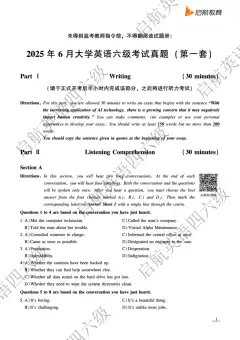
2024 年 6 月大学英语六级考试真题(第一套)
Part Ⅰ Writing (30 minutes)
(请于正式开考后半小时内完成该部分,之后将进行听力考试)
Directions For this part you are allowed 30 minutes to write an essay that begins with the sentence There
:
is a growing awareness of the importance of digital literacy and skills in todays world. You
can make comments cite examples or use your personal experiences to develop your essay. You
should write at least 150 words but no more than 200 words.
You should copy the sentence given in quotes at the beginning of your essay.
Part Ⅱ Listening Comprehension (30 minutes)
Section A
Directions In this section you will hear two long conversations. At the end of each
:
conversation you will hear four questions. Both the conversation and the questions
will be spoken only once. After you hear a question you must choose the best
扫码听音频
answer from the four choices marked A B C and D . Then mark the
corresponding letter on Answer Sheet 1 with a single line through the centre.
Qu estions 1 to 4 are based on the conversat ion you have just heard .
.A Reply to the mans last proposal within a short time.
1 )
B Sign the agreement if one small change is made to it.
)
C Make a sponsorship deal for her client at the meeting.
)
D Give the man some good news regarding the contract.
)
.A They are becoming impatient. C They are used to making alterations.
2 ) )
B They are afraid time is running out. D They are concerned about the details.
) )
.A To prevent geographical discrimination. C To avoid any conflict of interest.
3 ) )
B To tap the food and beverage market. D To reduce unfair competition.
) )
.A It is a potential market for food and beverage.
4 )
B It is very attractive for real estate developers.
)
C It is a negligible market for his company.
)
D It is very different from other markets.
)
Questions 5 to 8 are based on the conversation you have just heard.
.A They are thrilled by a rare astronomic phenomenon.
5 )
1B They are celebrating a big event on mountain tops.
)
C They are enthusiastic about big science-related stories.
)
D They are joined by astronomers all across North America.
)
.A It will be the most formidable of its kind in over a century.
6 )
B It will come closest to Earth in more than one hundred years.
)
C It will eclipse many other such events in human history.
)
D It will be seen most clearly from Denvers mountain tops.
)
.A A blur. C The edge of our galaxy.
7 ) )
B Stars. D An ordinary flying object.
) )
.A Use professional equipment. C Fix their eyes due north.
8 ) )
B Climb to the nearby heights. D Make use of phone apps.
) )
Section B
Directions In this section you will hear two passages. At the end of each passage you will hear three or
:
four questions. Both the passage and the questions will be spoken only once. After you hear a
question you must choose the best answer from the four choices marked A B C and D .
Then mark the corresponding letter on Answer Sheet 1 with a single line through the centre.
Questions 9 to 11 are based on the passage you have just heard.
.A Whether consumers should be warned against ultra-processed foods.
9 )
B Whether there is sufficient scientific consensus on dietary guidelines.
)
C Whether guidelines can form the basis for nutrition advice to consumers.
)
D Whether food scientists will agree on the concept of ultra-processed foods.
)
.A By the labor cost for the final products. C By the extent of chemical alteration.
10 ) )
B By the degree of industrial processing. D By the convention of classification.
) )
.A Increased consumers expenses. C Peoples misunderstanding of nutrition.
11 ) )
B Greater risk of chronic diseases. D Childrens dislike for unprocessed foods.
) )
Questions 12 to 15 are based on the passage you have just heard.
.A They begin to think of the benefits of constraints.
12 )
B They try to seek solutions from creative people.
)
C They try hard to maximize their mental energy.
)
D They begin to see the world in a different way.
)
.A It is characteristic of all creative people.
13 )
B It is essential to pushing society forward.
)
C It is a creative persons response to limitation.
)
D It is an impetus to socio-economic development.
)
.A Scarcity or abundance of resources has little impact on peoples creativity.
14 )
B Innovative people are not constrained in connecting unrelated concepts.
)
C People have no incentive to use available resources in new ways.
)
D Creative people tend to consume more available resources.
)
2.A It is key to a companys survival. C It is essential to meeting challenges.
15 ) )
B It shapes and focuses problems. D It thrives best when constrained.
) )
Section C
Directions In this section you will hear three recordings of lectures or talks followed by three or four
:
questions. The recordings will be played only once. After you hear a question you must choose
the best answer from the four choices marked A B C and D . Then mark the corresponding
letter on Answer Sheet 1 with a single line through the centre.
Questions 16 to 18 are based on the recording you have just heard.
.A Because they are learned.
16 )
B Because they come naturally.
)
C Because they have to be properly personalized.
)
D Because there can be more effective strategies.
)
.A The extent of difference and of similarity between the two sides.
17 )
B The knowledge of the specific expectation the other side holds.
)
C The importance of ones goals and of the relationship.
)
D The approaches one adopts to conflict management.
)
.A The fox. B The owl. C The shark. D The turtle.
18 ) ) ) )
Questions 19 to 21 are based on the recording you have just heard.
.A Help save species from extinction and boost human health.
19 )
B Understand how plants and animals perished over the past.
)
C Help gather information publicly available to researchers.
)
D Find out the cause of extinction of Britains species.
) 66,000
.A It was once dominated by dinosaurs.
20 )
B It has entered the sixth mass extinction.
)
C Its prospects depend on future human behaviour.
)
D Its climate change is aggravated by humans.
)
.A It dwarfs all other efforts to conserve protect and restore biodiversity on earth.
21 ) ,
B It is costly to get started and requires the joint efforts of thousands of scientists.
)
C It can help to bring back the large numbers of plants and animals that have gone extinct.
)
D It is the most exciting most relevant most timely and most internationally inspirational.
) , ,
Questions 22 to 25 are based on the recording you have just heard.
.A Cultural identity. C The Copernican revolution.
22 ) )
B Social evolution. D Human individuality.
) )
.A It is a delusion to be disposed of.
23 )
B It is prevalent even among academics.
)
C It is a myth spread by John Donnes poem.
)
D It is rooted in the mindset of the th century.
) 17
3.A He believes in Copernican philosophical doctrines about the universe.
24 )
B He has gained ample scientific evidence at the University of Reading.
)
C He has found that our inner self and material self are interconnected.
)
D He contends most of our body cells can only live a few days or weeks.
)
.A By coming to see how disruptive such problems have got to be.
25 )
B By realising that we all can do our own bit in such endeavours.
)
C By becoming aware that we are part of a bigger world.
)
D By making joint efforts resolutely and persistently.
)
Part Ⅲ Reading Comprehension (40 minutes)
Section A
Directions In this section there is a passage with ten blanks. You are required to select one word for each
:
blank from a list of choices given in a word bank following the passage. Read the passage
through carefully before making your choices. Each choice in the bank is identified by a letter.
Please mark the corresponding letter for each item on Answer Sheet 2 with a single line through
the centre. You may not use any of the words in the bank more than once.
Its quite remarkable how different genres of music can spark unique feelings emotions and memories.
, ,
Studies have shown that music can reduce stress and anxiety before surgeries and we are all attracted toward
our own unique life soundtrack.
If youre looking to stress you might want to give classical music a try.
26 ,
The sounds of classical music produce a calming effect letting pleasure-inducing dopamine 多巴
27 (
胺 in the brain that helps control attention learning and emotional responses. It can also turn down the
) ,
bodys stress response resulting in an overall happier mood. It turns out a pleasant mood can lead to
, 28
in a persons thinking.
Although there are many great of classical music like Bach Beethoven and Handel none of
29 , ,
these artists music seems to have the same health effects as Mozarts does. According to researchers
,
listening to Mozart can increase brain wave activity and improve function. Another study found that
30
the distinctive features of Mozarts music trigger parts of the brain that are responsible for high-level mental
functions. Even maternity use Mozart to help newborn babies adapt to life outside of the mothers
31
belly.
It has been found that listening to classical music reduces a persons blood pressure. Researchers
32
believe that the calming sounds of classical music may help your heart from stress. Classical music
33
can also be a great tool to help people who have trouble sleeping. One study found that students who had
trouble sleeping slept better while they were listening to classical music.
Whether classical music is something that you listen to on a regular basis or not it wouldnt to
, 34
take time out of your day to listen to music that you find . You will be surprised at how good it makes
35
you feel and the potentially positive change in your health.
4A alleviate F inhibiting K mandatory
) ) )
B clarity G interrogation L recover
) ) )
C cognitive H intrinsically M significantly
) ) )
D composers I loose N soothing
) ) )
E hurt J majestic O wards
) ) )
Section B
Directions In this section you are going to read a passage with ten statements attached to it. Each
:
statement contains information given in one of the paragraphs. Identify the paragraph from which
the information is derived. You may choose a paragraph more than once. Each paragraph is
marked with a letter. Answer the questions by marking the corresponding letter on Answer Sheet 2.
The Curious Case of the Tree That Owns Itself
A In the city of Athens Georgia there exists a rather curious local landmark a large white oak that is
[ ] , , —
almost universally stated to own itself. Because of this it is considered one of the most famous trees in
,
the world. So how did this tree come to own itself and the land around it
?
B Sometime in the l th century a Georgian called Colonel William Jackson reportedly took a liking to the
[ ] 9
said tree and endeavored to protect it from any danger. As to why he loved it so the earliest
,
documented account of this story is an anonymously written front page article in the Athens Weekly
Banner published on August . It states Col. Jackson had watched the tree grow from his
12, 1890 , “
childhood and grew to love it almost as he would a human. Its luxuriant leaves and sturdy limbs had
,
often protected him from the heavy rains and out of its highest branches he had many a time gotten the
,
eggs of the feathered singers. He watched its growth and when reaching a ripe old age he saw the tree
,
standing in its magnificent proportions he was pained to think that after his death it would fall into the
,
hands of those who might destroy it.
”
C Towards this end Jackson transferred by means of a deed ownership of the tree and a little land around
[ ] ,
it to the tree itself. The deed read W. H. Jackson for and in consideration of the great affection which
,“
he bears the said tree and his great desire to see it protected has conveyed unto the said oak tree entire
,
possession of itself and of all land within eight feet of it on all sides.
”
D In time the tree came to be something of a tourist attraction known as The Tree That Owns Itself.
[ ] , ,
However in the early th century the tree started showing signs of its slow death with little that
, 20 , ,
could be done about it. Father time comes for us all eventually even our often long lived tall and leafy
, ,
fellow custodians 看管者) of Earth. Finally on October the over meter tall and -
( , 9,1942, 30 200 400
year old tree fell rumor has it as a result of a severe windstorm and/or via having previously died and
, ,
its roots rotted.
E About four years later members of the Junior Ladies Garden Club whod tended to the tree before its
[ ] , (
unfortunate death tracked down a small tree grown from a nut taken from the original tree. And so it
)
was that on October under the direction of Professor Roy Bowden of the College of Agriculture
9,1946,
at the University of Georgia this little tree was transplanted to the location of its ancestor. A couple of
,
5months later an official ceremony was held featuring none other than the Mayor of Athens Robert L
, ,
McWhorter to commemorate the occasion.
,
F This new tree became known as The Son of the Tree That Owns Itself and it was assumed that as the
[ ] ,
original trees heir it naturally inherited the land it stood on. Of course there are many dozens of other
, ,
trees known to exist descending from the original as people taking a nut from it to grow elsewhere was
,
a certainty. That said to date none of the original trees other children have petitioned the courts for
, ,
their share of the land so it seems all good. In any event The Son of the Tree That Owns Itself still
, ,
stands today though often referred to simply as The Tree That Owns Itself.
,
G This all brings us around to whether Jackson ever actually gave legal ownership of the tree to itself in the
[ ]
first place and whether such a deed is legally binding.
H Well to begin with it turns out Jackson only spent about three years of his life in Athens starting at the
[ ] , , ,
age of from to sort of dismissing the idea that he loved the tree from spending time under
43 1829 1832,
it as a child and watching it grow and then worrying about what would happen to it after he died.
,
Further an extensive search of land ownership records in Athens does not seem to indicate Jackson ever
,
owned the land the tree sits on.
I He did live on a lot of land directly next to it for those three years but whether he owned that land or
[ ] ,
not isnt clear. Whatever the case in a four acre parcel which included the land the tree was on
, 1832 ,
and the neighboring land Jackson lived on among others was sold to University professor Malthus A
, ,
Ward. In the transaction Ward was required to pay Jackson a sum of $ about $
, 1,200 ( 31,000
today either for the property itself or simply in compensation for improvements Jackson had made on
),
the lot. In the end whether he ever owned the neighboring lot or was simply allowed to use it while he
,
allegedly worked at the University he definitely never owned the lot the tree grew on which is the most
, ,
important bit for the topic at hand.
J After Professor Ward purchased the land Jackson and his family purchased a acre parcel a few miles
[ ] , 655
away and moved there. Ten years later in Jackson seemed to have come into financial difficulties
, 1844,
and had his little plantation seized by the Clarke County Sheriffs office and auctioned off to settle the
mortgage. Thus had he owned some land in Athens itself including the land the tree sat on
, , ,
presumably he would have sold it to raise funds or otherwise had it taken as well.
K And whatever the case there Jackson would have known property taxes needed to be paid on the deeded
[ ] ,
land for the tree to be truly secure in its future. Yet no account or record indicates any trust or the like
was set up to facilitate this.
L On top of all this there is no hard evidence such a deed ever existed despite the fact that deed records
[ ] , ,
in Athens go back many decades before Jacksons death in and that it was supposed to have existed
1876
in in the archives according to the original anonymous news reporter who claims to have seen it.
1890
M As you might imagine from all of this few give credit to this side of the story. So how did all of this
[ ] ,
come about then
?
N It is speculated to have been invented by the imagination of the said anonymous author at the Athens
[ ]
Weekly Banner in the aforementioned front page article titled Deeded to Itself which by the way
1890 “ ”,
contained several elements that are much more easily proved to be false. As to why the author would do
6this its speculated perhaps it was a th century version of a click-bait thought exercise on whether it
, 19
would be legal for someone to deed such a non-conscious living thing to itself or not.
O Whatever the case the next known instance of the Tree That Owns Itself being mentioned wasnt until
[ ] ,
in the Centennial Edition of that same paper the Athens Weekly Banner. This featured another
1901 ,
account very clearly just copying the original article published about a decade before only slightly
,
reworded. The next account was in again in the Athens Weekly Banner again very clearly
1906, ,
copying the original account only slightly reworded the th century equivalent of re-posts when the
, , 19
audience has forgotten about the original.
.Jackson was said to have transferred his ownership of the oak tree to itself in order to protect it from being
36
destroyed.
.No proof has been found from an extensive search that Jackson had ever owned the land where the oak tree
37
grew.
.When it was raining heavily Jackson often took shelter under a big tree that is said to own itself.
38 ,
.There is no evidence that Jackson had made arrangements to pay property taxes for the land on which the
39
oak tree sat.
.Professor Ward paid Jackson over one thousand dollars when purchasing a piece of land from him.
40
.It is said the tree that owned itself fell in a heavy windstorm.
41
.The story of the oak tree is suspected to have been invented as a thought exercise.
42
.Jacksons little plantation was auctioned off to settle his debt in the mid- th century.
43 19
.An official ceremony was held to celebrate the transplanting of a small tree to where its ancestor had
44
stood.
.The story of the Tree That Owns Itself appeared in the local paper several times with slight alterations in
45 ,
wording.
Section C
Directions There are 2 passages in this section. Each passage is followed by some questions or unfinished
:
statements. For each of them there are four choices marked A B C and D . You should
decide on the best choice and mark the corresponding letter on Answer Sheet 2 with a single line
through the centre.
Passage One
Questions 46 to 50 are based on the following passage.
It is irrefutable that employees know the difference between right and wrong. So why dont more
employees intervene when they see someone exhibiting at-risk behavior in the workplace
?
There are a number of factors that influence whether people intervene. First they need to be able to see
,
a risky situation beginning to unfold. Second the companys culture needs to make them feel safe to speak
,
up. And third they need to have the communication skills to say something effectively.
,
This is not strictly a workplace problem its a growing problem off the job too. Every day people
;
7witness things on the street and choose to stand idly by. This is known as the bystander effect the more
—
people who witness an event the less likely anyone in that group is to help the victim. The psychology
,
behind this is called diffusion of responsibility. Basically the larger the crowd the more people assume that
, ,
someone else will take care of it meaning no one effectively intervenes or acts in a moment of need.
—
This crowd mentality is strong enough for people to evade their known responsibilities. But its not only
frontline workers who dont make safety interventions in the workplace. There are also instances where
supervisors do not intervene either.
When a group of employees sees unsafe behavior not being addressed at a leadership level it creates the
precedent that this is how these situations should be addressed thus defining the safety culture for everyone.
,
Despite the fact that workers are encouraged to intervene when they observe unsafe operations this
,
happens less than half of the time. Fear is the ultimate factor in not intervening. There is a fear of penalty a
,
fear that theyll have to do more work if they intervene. Unsuccessful attempts in the past are another strong
contributing factor to why people dont intervene they tend to prefer to defer that action to someone else for
—
all future situations.
On many worksites competent workers must be appointed. Part of their job is to intervene when workers
,
perform a task without the proper equipment or if the conditions are unsafe. Competent workers are also
required to stop work from continuing when theres a danger.
Supervisors also play a critical role. Even if a competent person isnt required supervisors need a broad
,
set of skills to not only identify and alleviate workplace hazards but also build a safety climate within their
team that supports intervening and open communication among them.
Beyond competent workers and supervisors its important to educate everyone within the organization
,
that they are obliged to intervene if they witness a possible unsafe act whether youre a designated competent
,
person a supervisor or a frontline worker.
,
.What is one of the factors contributing to failure of intervention in face of risky behavior in the workplace
46 ?
A Slack supervision style.
)
B Unfavorable workplace culture.
)
C Unforeseeable risk.
)
D Blocked communication.
)
.What does the author mean by diffusion of responsibility Line Para.
47 “ ” ( 4, 3)?
A The more people are around the more they need to worry about their personal safety.
)̍ ,
B The more people who witness an event the less likely anyone will venture to participate.
)̍ ,
C The more people idling around on the street the more likely they need taking care of.
) ,
D The more people are around the less chance someone will step forward to intervene.
) ,
.What happens when unsafe behavior at the workplace is not addressed by the leaders
48 ?
A No one will intervene when they see similar behaviors.
)
B Everyone will see it as the easiest way to deal with crisis.
)
C Workers have to take extra caution executing their duties.
)
D Workers are left to take care of the emergency themselves.
)
8.What is the ultimate reason workers wont act when they see unsafe operations
49 ?
A Preference of deferring the action to others.
)
B Anticipation of leadership intervention.
)
C Fear of being isolated by coworkers.
)
D Fear of having to do more work.
)
.What is critical to ensuring workplace safety
50 ?
A Workers be trained to operate their equipment properly.
)
B Workers exhibiting at-risk behavior be strictly disciplined.
)
C Supervisors create a safety environment for timely intervention.
)
D Supervisors conduct effective communication with frontline workers.
)
Passage Two
Questions 51 to 55 are based on the following passage.
The term environmentalist can mean different things. It used to refer to people trying to protect
“ ”
wildlife and natural ecosystems. In the lst century the term has evolved to capture the need to combat
2 ,
human-made climate change.
The distinction between these two strands of environmentalism is the cause of a split within the scientific
community about nuclear energy.
On one side are purists who believe nuclear power isnt worth the risk and the exclusive solution to the
climate crisis is renewable energy. The opposing side agrees that renewables are crucial but says society
,
needs an amount of power available to meet consumers basic demands when the sun isnt shining and the
wind isnt blowing. Nuclear energy being far cleaner than oil gas and coal is a natural option especially
, , , ,
where hydroelectric capacity is limited.
Leon Clarke who helped author reports for the UNs Intergovernmental Panel on Climate Change isnt
, ,
an uncritical supporter of nuclear energy but says its a valuable option to have if were serious about
,
reaching carbon neutrality.
Core to all of this is the degree to which you think we can actually meet climate goals with %
“ 100
renewables he said. If you dont believe we can do it and you care about the climate you are forced to
,” “ , ,
think about something like nuclear.
”
The achievability of universal % renewability is similarly contentious. Cities such as Burlington
100 ,
Vermont have been % renewable for years. But these cities often have small populations occasionally
, “100 ” ,
still rely on fossil fuel energy and have significant renewable resources at their immediate disposal.
Meanwhile countries that manage to run off renewables typically do so thanks to extraordinary hydroelectric
,
capabilities.
Germany stands as the best case study for a large industrialized country pushing into green energy.
,
Chancellor Angela Merkel in announced Energiewende an energy transition that would phase out
2011 ,
nuclear and coal while phasing in renewables. Wind and solar power generation has increased over %
400
since and renewables provided % of the countrys electricity in .
2010, 46 2019
9But progress has halted in recent years. The instability of renewables doesnt just mean energy is often
not produced at night but also that solar and wind can overwhelm the grid during the day forcing utilities to
, ,
pay customers to use their electricity. Lagging grid infrastructure struggles to transport this overabundance of
green energy from Germanys north to its industrial south meaning many factories still run on coal and gas.
,
The political limit has also been reached in some places with citizens meeting the construction of new wind
,
turbines with loud protests.
The result is that Germanys greenhouse gas emissions have fallen by around . % since slower
11 5 2010—
than the EU average of . %.
13 5
.What accounts for the divide within the scientific community about nuclear energy
51 ?
A Attention to combating human-made climate change.
)
B Emphasis on protecting wildlife and natural ecosystems.
)
C Evolution of the term green energy over the last century.
) ‘ ’
D Adherence to different interpretations of environmentalism.
)
.What is the solution to energy shortage proposed by purists opponents
52 ?
A Relying on renewables firmly and exclusively.
)
B Using fossil fuel and green energy alternately.
)
C Opting for nuclear energy when necessary.
)
D Limiting peoples non-basic consumption.
)
.What point does the author want to make with cities like Burlington as an example
53 ?
A It is controversial whether the goal of the whole worlds exclusive dependence on renewables is
)
attainable.
B It is contentious whether cities with large populations have renewable resources at their immediate
)
disposal.
C It is arguable whether cities that manage to run off renewables have sustainable hydroelectric
)
capabilities.
D It is debatable whether traditional fossil fuel energy can be done away with entirely throughout the
)
world.
.What do we learn about Germany regarding renewable energy
54 ?
A It has increased its wind and solar power generation four times over the last two decades.
)
B It represents a good example of a major industrialized country promoting green energy.
)
C It relies on renewable energy to generate more than half of its electricity.
)
D It has succeeded in reaching the goal of energy transition set by Merkel.
)
.What may be one of the reasons for Germanys progress having halted in recent years
55 ?
A Its grid infrastructures capacity has fallen behind its development of green energy.
)
B Its overabundance of green energy has forced power plants to suspend operation during daytime.
)
C Its industrial south is used to running factories on conventional energy supplies.
)
D Its renewable energy supplies are unstable both at night and during the day.
)
10Part Ⅳ Translation (30 minutes)
Directions For this part you are allowed 30 minutes to translate a passage from Chinese into English. You
:
should write your answer on Answer Sheet 2.
中国的传统婚礼习俗历史悠久 从周朝开始就逐渐形成了一套完整的婚礼仪式 有些一直沿用至
, ,
今 如今的中式婚礼习俗已有很大变化 但婚礼庆典仍然十分隆重 婚礼场地经过精心装饰 以象征
。 , 。 ,
喜庆 jubilance 的红色为主色调 摆放着许多祝愿新人幸福的物件 在婚礼上 新人要拜天地
( ) , 。 ,
bow to Heaven and Earth 拜父母和相互对拜 然后设宴招待宾客 并向宾客敬酒致谢 今天 许多
( )、 , , 。 ,
年轻人依然钟情于传统的中式婚礼 体验独特而美好的中国式浪漫
, 。
11答案速查
Part Writing
Ⅰ
There is a growing awareness of the importance of digital literacy and skills in todays world. Indeed in
,
an era where technology permeates every aspect of our lives the importance of digital literacy and skills will
,
become even more apparent.
First of all digital literacy allows individuals to navigate the vast amount of information from accessing
, ,
educational resources to staying updated on the latest trends. Most importantly digital literacy enables
,
individuals to think clearly and rationally about online content protecting them from misinformation.
,
Secondly possessing digital skills such as coding and data analysis is crucial for professional success as
, ,
many jobs today require a deep understanding of technology. Take data analysts for example who need a
,
deep understanding of digital tools and techniques to extract meaningful insights from vast amounts of data
,
thereby highlighting the importance of proficiency in digital tools.
In summary the key viewpoint is that digital literacy and skills are crucial for personal and professional
,
success in the modern world. Only by continuously enhancing our digital capabilities can we stay ahead in a
rapidly evolving digital world.
Part Listening Comprehension
Ⅱ
Section A .B .A .C .C .A .B .A .D
1 2 3 4 5 6 7 8
Section B .A .B .B .D .C .C .D
9 10 11 12 13 14 15
Section C .A .C .B .A .B .D .D .A .D .C
16 17 18 19 20 21 22 23 24 25
Part Reading Comprehension
Ⅲ
Section A .A .I .B .D .C .O .M .L .E .N
26 27 28 29 30 31 32 33 34 35
Section B .C .H .B .K .I .D .N .J .E .O
36 37 38 39 40 41 42 43 44 45
Section C .B .D .A .D .C .D .C .B .B .A
46 47 48 49 50 51 52 53 54 55
Part Translation
Ⅳ
Chinese traditional wedding customs boast a rich history dating back to the Zhou Dynasty where a
, ,
comprehensive set of wedding rites gradually took shape some of which have been carried forward to this
,
day. Nowadays Chinese wedding customs have undergone significant transformations but the celebration
, ,
remains as festive and momentous as ever. The wedding venue is decorated elaborately with red as the main
color symbolizing jubilance and various items that symbolize blessings for the new couple are also
, ,
displayed. At the wedding the bride and groom need to bow to Heaven and Earth their parents and each
, ,
other and then hold a banquet to entertain the guests and toast to them to express gratitude. Today many
, ,
young people still cherish traditional Chinese weddings to experience unique and wonderful Chinese romance.
12未得到监考教师指令前,不得翻阅该试题册!
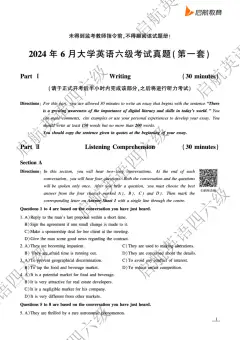
2024 年 6 月大学英语六级考试真题(第二套)
Part Ⅰ Writing (30 minutes)
(请于正式开考后半小时内完成该部分,之后将进行听力考试)
Directions For this part you are allowed 30 minutes to write an essay that begins with the sentence
:
Nowadays more and more college students have come to realize social practice and academic
learning are equally important. You can make comments cite examples or use your personal
experiences to develop your essay. You should write at least 150 words but no more than 200
words.
You should copy the sentence given in quotes at the beginning of your essay.
Part Ⅱ Listening Comprehension (30 minutes)
Section A
Directions In this section you will hear two long conversations. At the end of each
:
conversation you will hear four questions.Both the conversation and the questions
will be spoken only once. After you hear a question you must choose the best
扫码听音频
answer from the four choices marked A B C and D . Then mark the
corresponding letter on Answer Sheet 1 with a single line through the centre.
Qu estions 1 to 4 are based on the conversat ion you have just heard .
.A Read numerous comments users put online.
1 )
B Blended all his food without using a machine.
)
C Searched for the state-of-the-art models of blenders.
)
D Did thorough research on the price of kitchen appliances.
)
.A Eating any blended food. C Using machines to do her cooking.
2 ) )
B Buying a blender herself. D Making soups and juices for herself.
) )
.A Cooking every meal creatively in the kitchen.
3 )
B Paying due attention to his personal hygiene.
)
C Eating breakfast punctually every morning.
)
D Making his own fresh fruit juice regularly.
)
.A One-tenth of it is sugar. C Ones fancy may be tickled by it.
4 ) )
B It looks healthy and attractive. D It contains an assortment of nutrients.
) )
13Questions 5 to 8 are based on the conversation you have just heard.
.A How he has made himself popular as the mayor of Berkton.
5 )
B How the residents will turn Berkton into a tourist attraction.
)
C How charming he himself considers the village of Berkton to be.
)
D How he has led people of Berkton to change the village radically.
)
.A It was developed only to a limited extent.
6 )
B It was totally isolated as a sleepy village.
)
C It was relatively unknown to the outside.
)
D It was endowed with rare natural resources.
)
.A The people in Berkton were in a harmonious atmosphere.
7 )
B The majority of residents lived in harmony with their neighbors.
)
C The majority of residents enjoyed cosy housing conditions.
)
D All the houses in Berkton looked aesthetically similar.
)
.A They have helped boost the local economy.
8 )
B They have made the residents unusually proud.
)
C They have contributed considerably to its popularity.
)
D They have brought happiness to everyone in the village.
)
Section B
Directions In this section you will hear two passages. At the end of each passage you will hear three or
:
four questions.Both the passage and the questions will be spoken only once. After you hear a
question you must choose the best answer from the four choices marked A B C and D .Then
mark the corresponding letter on Answer Sheet 1 with a single line through the centre.
Questions 9 to 11 are based on the passage you have just heard.
.A They have created the smallest remote-controlled walking robot in the world.
9 )
B They are going to publish their research findings in the journal Science Robotics.
)
C They are the first to build a robot that can bend crawl walk turn and even jump.
) , , ,
D They are engaged in research on a remote-controlled robot which uses special power.
)
.A It changes its shape by complex hardware.
10 )
B It is operated by a special type of tiny motor.
)
C It moves from one place to another by memory.
)
D It is powered by the elastic property of its body.
)
.A Replace humans in exploratory tasks.
11 )
B Perform tasks in tightly confined spaces.
)
C Explore the structure of clogged arteries.
)
D Assist surgeons in highly complex surgery.
)
Questions 12 to 15 are based on the passage you have just heard.
.A She threw up in the bathroom. C She dozed off for a few minutes.
12 ) )
14B She slept during the entire ride. D She boasted of her marathon race.
) )
.A They are mostly immune to cognitive impairment.
13 )
B They can sleep soundly during a rough ride at sea.
)
C They are genetically determined to need less sleep.
)
D They constitute about percent of the population.
) 13
.A Whether there is a way to reach elite status.
14 )
B Whether it is possible to modify ones genes.
)
C Whether having a baby impacts ones passion.
)
D Whether one can train themselves to sleep less.
)
.A It is in fact quite possible to nurture a passion for sleep.
15 )
B Babies can severely disrupt their parents sleep patterns.
)
C Being forced to rise early differs from being an early bird.
)
D New parents are forced to jump out of bed at the crack of dawn.
)
Section C
Directions In this section you will hear three recordings of lectures or talks followed by three or four
:
questions.The recordings will be played only once.After you hear a question you must choose
the best answer from the four choices marked A B C and D . Then mark the corresponding
letter on Answer Sheet 1 with a single line through the centre.
Questions 16 to 18 are based on the recording you have just heard.
.A We have poor awareness of how many controversial issues are being debated.
16 )
B No one knows better than yourself what you are thinking about at the moment.
)
C No one can change your opinions more than those who speak in a convincing tone.
)
D We are likely to underestimate how much we can be swayed by a convincing article.
)
.A Their belief about physical punishment changed.
17 )
B Their memory pushed them toward a current belief.
)
C The memory of their initial belief came back to them.
)
D Their experiences of physical punishment haunted them.
)
.A They apparently have little to do with moderate beliefs.
18 )
B They dont reflect the changes of view on physical punishment.
)
C They may not apply to changes to extreme or deeply held beliefs.
)
D They are unlikely to alter peoples position without more evidence.
)
Questions 19 to 21 are based on the recording you have just heard.
.A American moms have been increasingly inclined to live alone.
19 )
B The American population has been on the rise in the past years.
) 25
C American motherhood has actually been on the decline.
)
D The fertility rates in America have in fact been falling sharply.
)
.A More new mothers tend to take greater care of their children.
20 )
B More new mothers are economically able to raise children.
)
15C A larger proportion of women take pride in their children.
)
D A larger proportion of women really enjoy motherhood.
)
.A The meaning of motherhood has changed considerably.
21 )
B More and more mothers go shopping to treat themselves.
)
C More mothers have adult children celebrating the holiday.
)
D The number of American mothers has been growing steadily.
)
Questions 22 to 25 are based on the recording you have just heard.
.A Add to indoor toxic pollutants. C Beautify the home environment.
22 ) )
B Absorb poisonous chemicals. D Soak up surrounding moisture.
) )
.A NASA did experiments in sealed containers resembling the super insulated offices of s.
23 ) 1970
B It was based on experiments under conditions unlike those in most homes or offices.
)
C NASA conducted tests in outer space whose environment is different from ours.
)
D It drew its conclusion without any contrastive data from other experiments.
)
.A Natural ventilation proves much more efficient for cleaning the air than house plants.
24 )
B House plants disperse chemical compounds more quickly with people moving around.
)
C Natural ventilation turns out to be most effective with doors and windows wide open.
)
D House plants in a normal environment rarely have any adverse impact on the air.
)
.A The root cause for misinterpretations of scientific findings.
25 )
B The difficulty in understanding whats actually happening.
)
C The steps to be taken in arriving at any conclusion with certainty.
)
D The necessity of continually reexamining and challenging findings.
)
Part Ⅲ Reading Comprehension (40 minutes)
Section A
Directions In this section there is a passage with ten blanks. You are required to select one word for each
:
blank from a list of choices given in a word bank following the passage. Read the passage
through carefully before making your choices. Each choice in the bank is identified by a letter.
Please mark the corresponding letter for each item on Answer Sheet 2 with a single line through
the centre. You may not use any of the words in the bank more than once.
The Sun Is Also a Star is a truly lovely story of love romance fate and destiny.
, , ,
Natasha is a Jamaican-born immigrant living in America not by choice exactly. Her parents
26 ,
brought her over and created the situation she to be out of.
27
Daniel is an American born of Korean immigrants. He believes in true love fate and all that other
, ,
nonsense that Natasha through scientific reasoning.
28
Daniel and Natasha meet by on the streets of New York on the day that she is to be . She
29 30
doesnt tell him that but does allow him to keep her company while he tries to get her to fall in love with him
over the course of the day.
16Natasha is me. I found her so similar to myself. Shes scientifically-minded practical somewhat
, ,
cynical and always . Her obsession with the universe through a scientific lens is infectious and I
, 31
Daniel seeing that too.
32
Daniel is charming and passionate and has a way with words that even Natashas tough outer
33
shell. By the end of the book I fell in love with both of them.
I used to find romance stories to always be cheap or laughable. I think now I can see the value in
escaping into a story of pure optimism. I got in The Sun Is Also a Star and finished it cover to cover
34
in a weekend. I couldnt wait to get to what I hoped would be a happy ending.
Its nice every once in a while to give in to magic. It doesnt have to be a hard fantasy novel with actual
spells it can be the magic found between two people who just have that special something. That that
, 35
causes them to react and spark when theyre near each other.
A adore F cracks K perpetually
) ) )
B appraise G deported L prescribed
) ) )
C assaults H dismisses M shrewd
) ) )
D chemistry I illegally N skeptical
) ) )
E coincidence J lost O strives
) ) )
Section B
Directions In this section you are going to read a passage with ten statements attached to it. Each
:
statement contains information given in one of the paragraphs. Identify the paragraph from which
the information is derived. You may choose a paragraph more than once. Each paragraph is
marked with a letter. Answer the questions by marking the corresponding letter on Answer Sheet 2.
These are the habits to avoid if you want to make a behavior change
A According to recent research behavioral change involves physical changes in the brain. In the past
[ ] ,
decade researchers have shown that when it comes to the duration of making a new behavior a deep-
,
rooted habit there is not a simple answer. Even for the most productive and disciplined among us
,
undoing something that has become an automatic part of who we are takes more than an overnight
effort. Once weve successfully made that change we then have to make other adjustments to our lives
,
to ensure that we continue to maintain it which is often a whole other challenge in itself.
,
B At its core success in changing and maintaining a behavior rarely occurs without the introduction of
[ ] ,
some sort of system. When there isnt the right framework in place we face a greater likelihood of
,
derailing our hard-earned progress. To ensure success in changing and maintaining a behavior we
,
should stay away from some detrimental habits.
C The first one to avoid is relying on willpower. Think about the last time you vowed to resist a
[ ]
temptation. Perhaps you didnt want to check your phone every minutes or you were determined not
15 ,
to reach for a chocolate bar at p.m. Think about how difficult it must have been not to glance at your
3
phone when it was within reach or not to walk to the vending machine when your afternoon slump hit.
,
D The research on whether we have finite or infinite willpower is inconclusive but experts do generally
[ ] ,
17agree that you cant change and sustain a habit if you rely on your willpower alone. The old military
saying You never rise to the occasion you only sink to the level of training also applies to behavior
“ , ”
change. The idea is simple you repeat something so many times that it becomes automatic.
—
E Think about what else you can change about your surrounding that makes it easier for you to perform this
[ ]
change on a daily basis. This is called your cue. Basically its a trigger to perform that particular
“ ” ,
habit. If you dont want to reach for a sugary treat at p.m. have a box of herbal tea ready at your
3 ,
desk. When p.m. comes around thats your cue to pour yourself a cup of hot water and drink that
3 ,
tea instead of walking to the vending machine.
,
F The second one to avoid is focusing on negative goals. Sometimes its not your process that lets you
[ ] ,
down but the habit that you want to change in the first place. For starters not eating chocolate to beat
, ,
your afternoon slump is a harder goal than swapping chocolate for herbal tea when you reach the
designated time. Your brain wants to find routines that have succeeded in the past and allow you to
repeat those actions again in the future without having to think about them explicitly. However this
,
habit-learning system isnt so effective when it comes to learning not to do something. Thats why rather
than giving up something think about introducing something in its place. Focus on actions you are
,
going to take that will ultimately conflict with the behaviors you want to stop. When your attention is on
doing something new you give your habit system a chance to operate.
,
G The third one to avoid is using the same strategies in different circumstances. Because we are creatures of
[ ]
habit its natural to assume that when we do manage to adopt and sustain a desirable behavior that
, ,
same strategy will work when we want to make another behavior change. But thats not always the case.
Sometimes the system that got you to change one behavior might not work for another.
,
H Sometimes we become accustomed to relying on our guts when it comes to decision-making. This serves
[ ]
us well in certain situations but can hinder us in others especially when we need to consider metrics and
,
data rather than letting our instinct override everything. For example if you want to stop checking your
, ,
email first thing in the morning you might decide to substitute another activity in its place. But if you
,
want to stop indulging in video games simply deciding you will go for a run might not be as effective.
,
You might need to introduce another reinforcement such as meeting a friend and booking an exercise
,
class together.
I The fourth one to avoid is not forgiving ourselves for slipping up. Of course even the best-laid plans fail
[ ] ,
sometimes. You might have stuck to your screen-free nighttime routine for five days and then a big
,
project landed on your desk and you found yourself in bed with your laptop before you went to sleep. Or
you prepared meals on Sunday and stuck to eating healthy dinners at home but by Friday you found
,
yourself so exhausted and opted to order greasy takeout. Life happens and even if your behavior change
is small every single day can prove pretty inflexible and at some point your luck may run out even if
, , ,
just for a day. The perfectionist in you might be screaming to abandon your goals altogether but try to
,
see it in the bigger picture. Just because you might have temporarily strayed off course doesnt mean you
cant start afresh the next day.
J The final one to avoid is discounting small progress. Theres a habit that many perfectionists tend to fall
[ ]
into when they try to establish a behavior change. They focus too much on the big goal and dont take
18the time to celebrate the small progress they make in the process. Your brain responds to rewards. The
basal ganglia the brain region linked to our performance of habits is most active at the beginning of a
, ,
behavior when the habit is cued and at the end when its rewarded. Say your goal is to run five miles
, , ,
three times a week and this week you ran one mile on Monday Wednesday and Friday. Rather than
, , ,
focusing on how far youve gone toward your goal think about how you can reward yourself for the
,
progress youve made. It doesnt have to be big or expensive it can be something as simple as making
;
your favorite fruit juice after your run. Whatever your reward it has to be more than just the activity
,
itself to get you going.
K Initiating a new behavior usually seems like the hardest part of the process of change. However people
[ ] ,
often fail to adequately prepare for maintaining it. One of the reasons for this is because we mistakenly
believe the strategies we used to initiate the change will be equally effective in helping us continue the
change. But they wont. Where changing a strongly deep-rooted habit requires changing our belief about
that habit that penetrates deeply into our lives continually manifesting that wisdom requires that we
,
maintain a positive outlook. If our mood is low the wisdom to behave differently seems to disappear
,
and we go back to eating more and exercising less. The key then to maintaining new behaviors is to be
, ,
happy Which is why its so hard to maintain new behaviors.
!
L Remember overcoming the behavioral inertia that prevents us from implementing new changes like
[ ] , ,
eating a healthy diet or exercising can benefit us in the long run and can improve our physical and
,
mental health. No one was born with habits. They were all learned and can all therefore be
, , ,
unlearned. The question is how badly do you really want to change
: ?
.There is general consensus among experts that willpower alone cannot guarantee ones success in changing
36
and maintaining a habit.
.One need not abandon their goals completely just because they missed their target temporarily they can
37 ;
start anew.
.Research shows it is quite another challenge to maintain a behavioral change after you have initiated it.
38
.It is wrong to assume the strategies we use to start a change of behavior will work equally well in helping
39
maintain it.
.Sometimes it may not be successful to simply substitute one activity with another to effect a change of
40 ,
habit you may need extra reinforcement.
;
.One should introduce something new to replace an old habit instead of simply kicking it.
41
.Perfectionists focus too much on their big target and neglect celebrating the small gains they make in the
42
process.
.It is of great benefit to us in the long term to conquer the inertia that stops us from making behavioral
43
changes.
.The strategy that successfully changed one of your behaviors may not work for some other behavior of
44
yours.
.Without a happy mood it seems that our wisdom to adopt a different behavior vanishes.
45 ,
19Section C
Directions There are 2 passages in this section. Each passage is followed by some questions or unfinished
:
statements. For each of them there are four choices marked A B C and D . You should
decide on the best choice and mark the corresponding letter on Answer Sheet 2 with a single line
through the centre.
Passage One
Questions 46 to 50 are based on the following passage.
The American Dream promises that in the Land of Opportunity any individual can climb the
“ ” ,
economic ladder and prosper through hard work and ambition alone. And yet young Americans today are
,
struggling to earn more than their parents did at the same age and upward mobility in the US actually
,
compares unfavourably to that of other industrialised nations.
So why does the idea of the American Dream persist A new study in the American Journal of Political
?
Science identifies one factor that has been overlooked the influence of reality TV.
:
Reality shows have come to dominate US television over the past years notes Eunji Kim from
20 ,
Vanderbilt University. And the overwhelming majority of these have a rags-to-riches storyline they feature
“ ” :
ordinary Americans who work hard to achieve great economic success. And while these programmes are
regularly among the most-watched shows news broadcasts which paint a more realistic view of the
, —
economic hardship faced by millions of Americans get a much smaller proportion of the viewership.
—
Rags-to-riches stories are ubiquitous 无处不在的 on TV but does watching these programmes
( ) —
actually convince people that economic mobility is easily attainable To find out Kims team had participants
? ,
watch a -minute clip from a reality show with a rags-to-riches storyline. Control participants watched a clip
5
from a reality show that didnt have a rags-to-riches story. After watching the shows participants rated how
,
much they agreed with four statements relating to the American Dream.
The results showed that those whod watched a rags-to-riches clip did indeed have a significantly greater
belief in the American Dream. Interestingly when participants were separated by party affiliation this effect
, ,
was significant among Republicans but not Democrats suggesting that the kind of messages implicit in these
,
TV shows may play into peoples existing socioeconomic beliefs.
Kim also conducted a survey of US residents. They also rated the extent to which they believed
3,000
success in life is related to various internal factors such as ambition and external factors such as family
( ) (
wealth . Finally they read a list of TV programmes and indicated which they regularly watched.
) ,
Participants who were heavy viewers of rags-to-riches programmes or frequent viewers had a stronger
belief in the American Dream than those who never watched such shows.
Kim concludes that rags-to-riches entertainment media are an important cultural force that promotes and
“
perpetuates beliefs in upward mobility . And heres the problem if people mistakenly believe that hard work
” :
is all that is needed for individuals to make a better life for themselves they may be less supportive of policies
,
that could actually combat inequality.
In this era of choice entertainment media are what captures hearts and minds Kim writes. Its
“ , ,” “
political consequences are anything but trivial .
”
20.What do we learn from the passage about young Americans of today
46 ?
A They have greater ambitions than their parents.
)
B They find it difficult to achieve upward mobility.
)
C They have overtaken their parents in terms of earnings.
)
D They envy the opportunities in other industrialised nations.
)
.What does Kims team find about reality TV shows in America
47 ?
A They reinterpret the essence of the popular rags-to-riches culture.
)
B They urge people to achieve economic success through hard work.
)
C They help strengthen peoples conviction in the American Dream.
)
D They feature ordinary Americans striving for social recognition.
)
.What does the author say about news broadcasts in America
48 ?
A They attract far fewer viewers than reality TV.
)
B They are bent on reporting the dark side of life.
)
C They stand in striking contrast with reality TV.
)
D They focus on Americans economic hardships.
)
.What can we infer from the passage about Republicans in general
49 ?
A They believe strongly in the American Dream.
)
B They strive to climb the socio-economic ladder.
)
C They have a very strong affiliation with their party.
)
D They tend to watch more rags-to-riches TV shows.
)
.What is stated about people who believe in upward mobility
50 ?
A They are likely to blame the government for their plight.
)
B They regard political consequences as anything but trivial.
)
C They respect individuals striving to climb the social ladder.
)
D They are less likely to approve of policies to fight inequality.
)
Passage Two
Questions 51 to 55 are based on the following passage.
When someone asks us what do you do we nearly always reply with our occupation. Work for
‘ ?’ ,
many of us is much more than a job. It is the defining aspect of our identity. For many of us it is through
,
our job that we can define ourselves.
Without my job I dont know who I am is a sentence that has been uttered on more than a handful of
“ ,”
occasions from my office chair. Indeed it can be one of the most challenging aspects I work on with clients
,
who have lost or been forced into changing their jobs. This loss provokes an identity crisis much greater than
the loss of the job itself.
One of the things I have come to understand however is that our identity is much more complex than
, ,
we recognise at first glance. If we take the time to reflect we might recognise that as well as our work we can
also identify as a friend a spouse a son or daughter a parent a member of a sports team or religious
, , , ,
21community. We may recognise that we feel and act differently in these roles and relationships than we do at
work. The passive daughter becomes an assertive leader at work. Furthermore our identities at work are not
,
static. They change over time. I myself have been a shop assistant a waitress a student a graduate and a
, , , ,
clinical psychologist. At each stage my ability to adapt to and develop my career identity has been crucial to
my wellbeing. Whilst we like to eliminate uncertainty in our lives at some level we have to manage
uncertainty especially in todays volatile and ever-shifting job market.
,
How we see ourselves is central to the issue of our identity. When we tell ourselves Im good at starting
“
projects but not so great at seeing them through it can become part of our belief system. But if you have the
”
unfortunate experience of an enforced job change you will need to examine those beliefs to see how grounded
in reality they are. You will be required to ask yourself how helpful these beliefs are and consider personal
change. We can change our beliefs behaviours and emotional experience at any time through
,
experimentation practice and conscious self-discipline. In an age where career progression may lead us into
,
new sectors it is ever more important to challenge our sense of self and explore whether you can create a new
experience of your identity by changing the beliefs you hold about yourself in order to expand your career
options. Ultimately it is you who define who you are. You are only your job if you let it be so.
.What do we learn from the passage about ones loss of a job
51 ?
A It compels them to visit a clinical psychologist.
)
B It offers them a chance to play different roles.
)
C It renders them puzzled about who they are.
)
D It forces them to redefine their lifes goals.
)
.What has the author come to understand about our identity
52 ?
A It is crucial to our emotional wellbeing.
)
B It plays a big role in many facets of life.
)
C It reflects our changing status in society.
)
D It is more complicated than it appears.
)
.What does the passage say about our identities at work
53 ?
A They are essential to our self-esteem.
)
B They evolve with the passage of time.
)
C They overrule all other self-perceptions.
)
D They are key to understanding ourselves.
)
.What do we have to do in todays ever-changing job market
54 ?
A Strive to develop our social identity.
)
B Prepare for different career paths.
)
C Try to be assertive at all times.
)
D Learn to manage uncertainty.
)
.What should we do to expand our career options
55 ?
A Alter our perceptions of ourselves. C Look into newly emerging sectors.
) )
B Compare various job opportunities. D Exercise self-discipline consciously.
) )
22Part Ⅳ Translation (30 minutes)
Directions For this part you are allowed 30 minutes to translate a passage from Chinese into English. You
:
should write your answer on Answer Sheet 2.
中国盛产竹子 是最早开发利用竹资源的国家 竹子在中国分布广泛 品种丰富 竹子实用性强
, 。 , 。 ,
用于生产和生活的许多方面 如筷子 桌椅的制作和桥梁 房屋的建造 中国人爱竹 自古以来就有无数
, 、 、 。 ,
文人以竹为主题 创作了绚丽多彩的文学和绘画作品 竹子主干 stem 笔直 象征正直的品格 竹子
, 。 ( ) , 。
具有强大的生命力和适应能力 无论环境多么恶劣 都能够顽强生存 因而寓意坚韧不拔的精神 几千
, , , 。
年来 竹子一直被视为民族品格的象征
, 。
23答案速查
Part Writing
Ⅰ
Nowadays more and more college students have come to realize social practice and academic learning are
equally important. Truly the importance of balancing academic learning and practical experience in college
,
education cannot be overstated.
On one hand academic learning is the cornerstone of a student s education. It provides the theoretical
, ’
knowledge and analytical skills necessary for success in any field. Through rigorous study students gain a
,
deep understanding of their chosen subjects preparing them for complex challenges and problems. On the
,
other hand social practice is also vital. It offers students the opportunity to apply their academic knowledge
,
in real-world settings. By engaging in internships volunteer work or community projects students can gain
, , ,
practical experience and insights that cannot be obtained solely through textbooks. This experience helps them
develop communication skills teamwork abilities and problem-solving techniques that are crucial for success
, ,
in the workplace.
In conclusion the balance between social practice and academic learning is crucial for college students.
,
Both aspects are essential to their personal and professional development. By incorporating both into their
education students can gain the necessary skills and experience to become successful and influential members
,
of society.
Part Listening Comprehension
Ⅱ
Section A .A .B .D .A .D .C .D .A
1 2 3 4 5 6 7 8
Section B .A .D .B .B .C .D .C
9 10 11 12 13 14 15
Section C .D .A .C .C .B .C .B .B .A .D
16 17 18 19 20 21 22 23 24 25
Part Reading Comprehension
Ⅲ
Section A .I .O .H .E .G .N .A .F .J .D
26 27 28 29 30 31 32 33 34 35
Section B .D .I .A .K .H .F .J .L .G .K
36 37 38 39 40 41 42 43 44 45
Section C .B .C .A .A .D .C .D .B .D .A
46 47 48 49 50 51 52 53 54 55
Part Translation
Ⅳ
China is rich in bamboo and it is the first country to develop and utilize this resource. Bamboo is widely
,
distributed in China with a diverse range of species. It is highly functional and is used in various aspects of
,
production and daily life including the making of chopsticks tables and chairs as well as the construction
, , , ,
of bridges and houses. Chinese people have a deep affection for bamboo and since ancient times numerous
, ,
scholars have created brilliant literary and artistic works with bamboo as the theme. The straight stem of
bamboo symbolizes uprightness and integrity. Bamboo has strong vitality and adaptability and can survive
tenaciously no matter how harsh the environment is thus representing the spirit of perseverance. For
,
thousands of years bamboo has been viewed as a symbol of national character.
,
24未得到监考教师指令前,不得翻阅该试题册!
2024 年 6 月大学英语六级考试真题(第三套)
Part Ⅰ Writing (30 minutes)
(请于正式开考后半小时内完成该部分,之后将进行听力考试)
Directions For this part you are allowed 30 minutes to write an essay that begins with the sentence
:
Nowadays cultivating independent learning ability is becoming increasingly crucial for
personal development. You can make comments cite examples or use your personal experiences
to develop your essay. You should write at least 150 words but no more than 200 words.
You should copy the sentence given in quotes at the beginning of your essay.
Part Ⅱ Listening Comprehension (30 minutes)
说明:由于 年 月六级考试全国只考了两套听力 本套真题听力与前两套内容相同 只是选项
2024 6 , ,
顺序不一样 因此在本套真题中不再重复出现
, 。
Part Ⅲ Reading Comprehension (40 minutes)
Section A
Directions In this section there is a passage with ten blanks. You are required to select one word for each
:
blank from a list of choices given in a word bank following the passage. Read the passage
through carefully before making your choices. Each choice in the bank is identified by a letter.
Please mark the corresponding letter for each item on Answer Sheet 2 with a single line through
the centre. You may not use any of the words in the bank more than once.
A rainbow is a multi-colored arc-shaped phenomenon that can appear in the sky. The colors of a
,
rainbow are produced by the reflection and of light through water droplets 小滴 present in the
26 ( )
atmosphere. An observer may a rainbow to be located either near or far away but this phenomenon is
27 ,
not actually located at any specific spot. Instead the appearance of a rainbow depends entirely upon the
,
position of the observer in to the direction of light. In essence a rainbow is an illusion.
28 , 29
Rainbows present a made up of seven colors in a specific order. In fact school children in many
30 ,
English-speaking countries are taught to remember the name Roy G. Biv as an aid for remembering the
“ ”
colors of a rainbow and their order. Roy G. Biv for red orange yellow green blue indigo
“ ” 31 : , , , , , ,
and violet. The outer edge of the rainbow arc is red while the inner edge is violet.
,
A rainbow is formed when light generally sunlight passes through water droplets in the
( ) 32
25atmosphere. The light waves change direction as they pass through the water droplets resulting in two
,
processes reflection and refraction 折射 .When light reflects off a water droplet it simply back in
: ( ) , 33
the opposite direction from where it . When light refracts it takes a different direction. Some
34 ,
individuals refer to refracted light as bent light waves. A rainbow is formed because white light enters the
“ ”
water droplet where it bends in several different directions. When these bent light waves reach the other side
,
of the water droplet they reflect back out of the droplet instead of passing through the water. Since
, 35
the white light is separated inside of the water the refracted light appears as separate colors to the human eye.
,
A bounces F optical K preceding
) ) )
B completely G originates L recklessly
) ) )
C dispersion H perceive M relation
) ) )
D eccentric I permeates N spectrum
) ) )
E hanging J ponder O stands
) ) )
Section B
Directions In this section you are going to read a passage with ten statements attached to it. Each
:
statement contains information given in one of the paragraphs. Identify the paragraph from which
the information is derived. You may choose a paragraph more than once. Each paragraph is
marked with a letter. Answer the questions by marking the corresponding letter on Answer Sheet 2.
Blame your worthless workdays on meeting recovery syndrome
A Phyllis Hartman knows what its like to make ones way through the depths of office meeting hell.
[ ]
Managers at one of her former human resources jobs arranged so many meetings that attendees would
fall asleep at the table or intentionally arrive late. With hours of her day blocked up with unnecessary
meetings she was often forced to make up her work during overtime. I was actually working more
, “
hours than I probably would have needed to get the work done says Hartman who is founder and
,” ,
president of PGHR Consulting in Pittsburgh Pennsylvania.
,
B She isnt alone in her frustration. Between million and million meetings are held each day in the
[ ] 11 55
United States costing most organisations between % and % of their personnel budgets. Every week
, 7 15 ,
employees spend about six hours in meetings while the average manager meets for a staggering
, 23
hours.
C And though experts agree that traditional meetings are essential for making certain decisions and
[ ]
developing strategy some employees view them as one of the most unnecessary parts of the workday.
,
The result is not only hundreds of billions of wasted dollars but an annoyance of what organisational
,
psychologists call meeting recovery syndrome MRS time spent cooling off and regaining focus
“ ( )”:
after a useless meeting. If you run to the office kitchen to get some relief with colleagues after a
frustrating meeting youre likely experiencing meeting recovery syndrome.
,
D Meeting recovery syndrome is a concept that should be familiar to almost anyone who has held a formal
[ ]
job. It isnt ground-breaking to say workers feel fatigued after a meeting but only in recent decades
,
have scientists deemed the condition worthy of further investigation. With its links to organisational
26efficiency and employee wellbeing MRS has attracted the attention of psychologists aware of the need
,
to understand its precise causes and cures.
E Today in so far as researchers can hypothesise MRS is most easily understood as a slow renewal of
[ ] , ,
finite mental and physical resources. When an employee sits through an ineffective meeting their brain
power is essentially being drained away. Meetings drain vitality if they last too long fail to engage
,
employees or turn into one-sided lectures. The conservation of resources theory originally proposed in
,
by Dr Stevan Hobfoll states that psychological stress occurs when a persons resources are
1989 ,
threatened or lost. When resources are low a person will shift into defence to conserve their remaining
,
supply. In the case of office meetings where some of employees most valuable resources are their
,
focus alertness and motivation this can mean an abrupt halt in productivity as they take time to
, ,
recover.
F As humans when we transition from one task to another on the job say from sitting in a meeting to
[ ] , —
doing normal work it takes an effortful cognitive switch. We must detach ourselves from the previous
—
task and expend significant mental energy to move on. If we are already drained to dangerous levels
,
then making the mental switch to the next thing is extra tough. Its common to see people cyber-loafing
after a frustrating meeting going and getting coffee interrupting a colleague and telling them about the
, ,
meeting and so on.
,
G Each persons ability to recover from horrible meetings is different. Some can bounce back quickly
[ ] ,
while others carry their fatigue until the end of the workday. Yet while no formal MRS studies are
currently underway one can loosely speculate on the length of an average employees lag time.
,
Switching tasks in a non-MRS condition takes about to minutes. With MRS it may take as long
10 15 ,
as minutes on average. Its even worse when a worker has several meetings that are separated by
45 30
minutes. Not enough time to transition in a non-MRS situation to get anything done and in an MRS
“ ,
situation not quite enough time to recover for the next meeting says researcher Joseph Allen. Then
, ,” “ ,
add the compounding of back-to-back bad meetings and we may have an epidemic on our hands.
”
H In an effort to combat the side effects of MRS Allen along with researcher Joseph Mroz and colleagues
[ ] , ,
at the University of Nebraska-Omaha published a study detailing the best ways to avoid common traps
, ,
including a concise checklist of dos and donts applicable to any workplace. Drawing from around
200
papers to compile their comprehensive list Mroz and his team may now hold a remedy to the largely
,
undefined problem of MRS.
I Mroz says a good place to start is asking ourselves if our meetings are even necessary in the first place.
[ ]
If all thats on the agenda is a quick catch-up or some non-urgent information sharing it may better suit
, ,
the group to send around an email instead. The second thing I would always recommend is keep the
“
meeting as small as possible says Mroz. If they dont actually have some kind of immediate input
,” “ ,
then they can follow up later. They dont need to be sitting in this hour-long meeting. Less time in
”
meetings would ultimately lead to more employee engagement in the meetings they do attend which
,
experts agree is a proven remedy for MRS.
J Employees also feel taxed when they are invited together to meetings that dont inspire participation says
[ ] ,
Cliff Scott professor of organisational science. It takes precious time for them to vent their emotions
, ,
27complain and try to regain focus after a pointless meeting one of the main traps of MRS. Over time as
—
employees find themselves tied up in more and more unnecessary meetings and thus dealing with
—
increasing lag times from MRS the waste of workday hours can feel insulting.
—
K Despite the relative scarcity of research behind the subject Hartman has taught herself many of the same
[ ] ,
tricks suggested in Mrozs study and has come a long way since her days of being stuck with
,
unnecessary meetings. The people she invites to meetings today include not just the essential employees
,
but also representatives from every department that might have a stake in the issue at hand. Managers
like her who seek input even from non-experts to shape their decisions can find greater support and
, ,
cooperation from their workforce she says.
,
L If an organisation were to apply all suggestions from Mroz and Allens findings the most noticeable
[ ] 22 ,
difference would be a stark decrease in the total number of meetings on the schedule Mroz says. Less
,
time in meetings would ultimately lead to increased productivity which is the ultimate objective of
,
convening a meeting. While none of the counter-MRS ideas have been tested empirically yet Allen says
,
one trick with promise is for employees to identify things that quickly change their mood from negative
to positive. As simple as it sounds finding a personal happy place going there and then coming
, ,
straight back to work might be key to facilitating recovery.
M Leaders should see also themselves as stewards of everyone elses valuable time adds Steven
[ ] “ ”,
Rogelberg author of The Surprising Science of Meetings. Having the skills to foresee potential traps
,
and treat employees endurance with care allows leaders to provide effective short-term deterrents to
MRS.
N Most important however is for organisations to awaken to the concept of meetings being flexible says
[ ] , , ,
Allen. By reshaping the way they prioritise employees time companies can eliminate the very sources
,
of MRS in their tracks.
.Although employees are said to be fatigued by meetings the condition has not been considered worthy of
36 ,
further research until recently.
.Mroz and his team compiled a list of what to do and what not to do to remedy the problem of MRS.
37
.Companies can get rid of the root cause of MRS if they give priority to workers time.
38
. If workers are exhausted to a dangerous degree it is extremely hard for them to transition to the next task.
39 ,
.Employees in America spend a lot of time attending meetings while the number of hours managers meet is
40
several times more.
.Phyllis Hartman has learned by herself many of the ways Mroz suggested in his study and made remarkable
41
success in freeing herself from unnecessary meetings.
.When meetings continue too long or dont engage employees they deplete vitality.
42 ,
.When the time of meetings is reduced employees will be more engaged in the meetings they do
43 ,
participate in.
.Some employees consider meetings one of the most dispensable parts of the workday.
44
.According to Mroz if all his suggestions were applied a very obvious change would be a steep decrease
45 , ,
in the number of meetings scheduled.
28Section C
Directions There are 2 passages in this section. Each passage is followed by some questions or unfinished
:
statements. For each of them there are four choices marked A B C and D . You should
decide on the best choice and mark the corresponding letter on Answer Sheet 2 with a single line
through the centre.
Passage One
Questions 46 to 50 are based on the following passage.
Sarcasm and jazz have something surprisingly in common You know them when you hear them.
:
Sarcasm is mostly understood through tone of voice which is used to portray the opposite of the literal
,
words. For example when someone says Well thats exactly what I need right now their tone can tell
, , “ , ,”
you its not what they need at all.
Most frequently sarcasm highlights an irritation or is quite simply mean.
, , ,
If you want to be happier and improve your relationships cut out sarcasm. Why Because sarcasm is
, ?
actually hostility disguised as humor.
Despite smiling outwardly many people who receive sarcastic comments feel put down and often think
,
the sarcastic person is rude or contemptible. Indeed its not surprising that the origin of the word sarcasm
, ,
derives from the Greek word sarkazein which literally means to tear or strip the flesh off. Hence its no
“ ” “ ” ,
wonder that sarcasm is often preceded by the word cutting and that it hurts.
“ ”
Whats more since actions strongly determine thoughts and feelings when a person consistently acts
, ,
sarcastically it may only serve to heighten their underlying hostility and insecurity. After all when you come
,
right down to it sarcasm can be used as a subtle form of bullying and most bullies are angry insecure or
, — , ,
cowardly.
Alternatively when a person stops voicing negative comments especially sarcastic ones they may soon
, , ,
start to feel happier and more self-confident. Also other people in their life benefit even more because they
,
no longer have to hear the emotionally hurtful language of sarcasm.
Now Im not saying all sarcasm is bad. It may just be better used sparingly like a potent spice in
, —
cooking. Too much of the spice and the dish will be overwhelmed by it. Similarly an occasional dash of
, ,
sarcastic wit can spice up a chat and add an element of humor to it. But a big or steady serving of sarcasm
will overwhelm the emotional flavor of any conversation and can taste very bitter to its recipient.
So tone down the sarcasm and work on clever wit instead which is usually without any hostility and
, ,
thus more appreciated by those youre communicating with. In essence sarcasm is easy while true harmless
, ,
wit takes talent.
Thus the main difference between wit and sarcasm is that as already stated sarcasm is often hostility
, , ,
disguised as humor. It can be intended to hurt and is often bitter and biting. Witty statements are usually in
response to someones unhelpful remarks or behaviors and the intent is to untangle and clarify the issue by
,
emphasizing its absurdities. Sarcastic statements are expressed in a cutting manner witty remarks are
;
delivered with undisguised and harmless humor.
29.Why does the author say sarcasm and jazz have something surprisingly in common
46 ?
A Both are recognized when heard.
)
B Both have exactly the same tone.
)
C Both mean the opposite of what they appear to.
)
D Both have hidden in them an evident irritation.
)
.How do many people feel when they hear sarcastic comments
47 ?
A They feel hostile towards the sarcastic person.
)
B They feel belittled and disrespected.
)
C They feel a strong urge to retaliate.
)
D They feel incapable of disguising their irritation.
)
.What happens when a person consistently acts sarcastically
48 ?
A They feel their dignity greatly heightened.
)
B They feel increasingly insecure and hostile.
)
C They endure hostility under the disguise of humor.
)
D They taste bitterness even in pleasant interactions.
)
.What does the author say about people quitting sarcastic comments
49 ?
A It makes others happier and more self-confident.
)
B It restrains them from being irritating and bullying.
)
C It benefits not only themselves but also those around them.
)
D It shields them from negative comments and outright hostility.
)
.What is the chief difference between a speakers wit and sarcasm
50 ?
A Their clarity. C Their emphasis.
) )
B Their appreciation. D Their intention.
) )
Passage Two
Questions 51 to 55 are based on the following passage.
Variability is crucially important for learning new skills. Consider learning how to serve in tennis.
Should you always practise serving from the exactly same location on the court aiming at the same spot
, ?
Although practising in more variable conditions will be slower at first it will likely make you a better tennis
,
player in the end. This is because variability leads to better generalisation of what is learned.
This principle is found in many domains including speech perception and learning categories. For
,
instance infants will struggle to learn the category dog if they are only exposed to Chihuahuas instead of
, “ ” ,
many different kinds of dogs.
There are over ten different names for this basic principle says Limor Raviv the senior investigator
“ ,” ,
of a recent study. Learning from less variable input is often fast but may fail to generalise to new stimuli.
“ , ”
To identify key patterns and understand the underlying principles of variability effects Raviv and her
,
colleagues reviewed over studies on variability and generalisation across fields including computer
150 ,
science linguistics categorisation visual perception and formal education.
, , ,
30The researchers discovered that across studies the term variability can refer to at least four different
, ,
kinds of variability such as set size and scheduling. These four kinds of variability have never been directly
, “
compared which means that we currently dont know which is most effective for learning says Raviv.
— ,”
The impact of variability depends on whether it is relevant to the task or not. But according to the Mr.
‘
Miyagi principle practising seemingly unrelated skills may actually benefit learning of other skills.
’,
But why does variability impact learning and generalisation One theory is that more variable input can
?
highlight which aspects of a task are relevant and which are not.
Another theory is that greater variability leads to broader generalisations. This is because variability will
represent the real world better including atypical 非典型的 examples.
, ( )
A third reason has to do with the way memory works when training is variable learners are forced to
: ,
actively reconstruct their memories.
Understanding the impact of variability is important for literally every aspect of our daily life. Beyond
“
affecting the way we learn language motor skills and categories it even has an impact on our social lives
, , , ,”
explains Raviv. For example face recognition is affected by whether people grew up in a small community
“ ,
or in a larger community. Exposure to fewer faces during childhood is associated with diminished face
memory.
”
We hope this work will spark peoples curiosity and generate more work on the topic concludes
“ ,”
Raviv. Our paper raises a lot of open questions. Can we find similar effects of variability beyond the brain
“ ,
for instance in the immune system
, ?”
.What does the passage say about infants learning the category dog if they are exposed to Chihuahuas
51 “ ”
only
?
A They will encounter some degree of difficulty.
)
B They will try to categorise other objects first.
)
C They will prefer Chihuahuas to other dog species.
)
D They will imagine Chihuahuas in various conditions.
)
.What does Raviv say about the four different kinds of variability
52 ?
A Which of them is most relevant to the task at hand is to be confirmed.
)
B Why they have an impact on learning is far from being understood.
)
C Why they have never been directly compared remains a mystery.
)
D Which of them is most conducive to learning is yet to be identified.
)
.How does one of the theories explain the importance of variability for learning new skills
53 ?
A Learners regard variable training as typical of what happens in the real world.
)
B Learners receiving variable training are compelled to reorganise their memories.
)
C Learners pay attention to the relevant aspects of a task and ignore those irrelevant.
)
D Learners focus on related skills instead of wasting time and effort on unrelated ones.
)
.What does the passage say about face recognition
54 ?
A People growing up in a small community may find it easy to remember familiar faces.
)
B Face recognition has a significant impact on literally every aspect of our social lives.
)
31C People growing up in a large community can readily recognise any individual faces.
)
D The size of the community people grow up in impacts their face recognition ability.
)
.What does Raviv hope to do with their research work
55 ?
A Highlight which aspects of a task are relevant and which are not to learning a skill.
)
B Use the principle of variability in teaching seemingly unrelated skills in education.
)
C Arouse peoples interest in variability and stimulate more research on the topic.
)
D Apply the principle of variability to such fields of study as the immune system.
)
Part Ⅳ Translation (30 minutes)
Directions For this part you are allowed 30 minutes to translate a passage from Chinese into English. You
:
should write your answer on Answer Sheet 2.
扇子自古以来就深受中国人喜爱 但现在已不只是消暑纳凉的工具 而更多地作为艺术品供人欣
, ,
赏 许多扇子造型优美 做工精良 并绘有山水 花鸟 人物等精美图案 具有很高的艺术价值 中国许
。 、 , 、 、 , 。
多著名画家和书法家喜欢在扇子上作诗绘画 展示其艺术品味 扇子常作为礼物赠予他人 表达美好的
, 。 ,
祝福和真挚的情感 如今 扇子的实用功能已大为减弱 但作为一种文化符号和艺术形式 扇子仍然在
。 , , ,
中国传统文化中扮演着重要角色
。
32答案速查
Part Writing
Ⅰ
Nowadays cultivating independent learning ability is becoming increasingly crucial for personal
,
development. I wholeheartedly support this perspective for the following three reasons.
First of all independent learning equips students with essential skills such as critical thinking problem-
, ,
solving and self-discipline enabling them to take charge of their own education. By engaging in independent
, ,
learning students learn how to set goals manage their time effectively and seek out resources to deepen
, , ,
their understanding of various subjects. Secondly independent learning fosters creativity and curiosity as
, ,
individuals are encouraged to explore their interests and pursue knowledge beyond the constraints of traditional
classroom settings. This approach not only enhances academic performance but also instills a sense of
ownership and responsibility for ones own learning journey. Finally it is crucial to note that the ability to
,
learn independently is a valuable skill that transcends the classroom and prepares individuals for success in an
ever-changing and competitive world.
In summary the key viewpoint is that independent learning is essential for personal growth academic
, ,
success and lifelong learning. It empowers individuals to become motivated and resilient learners who are
, ,
well-equipped to adapt to the modern world.
Part Listening Comprehension 略
Ⅱ ( )
Part Reading Comprehension
Ⅲ
Section A .C . H . M .F . N .O .E . A . G .B
2 6 2 7 2 8 2 9 3 0 3 1 3 2 3 3 3 4 35
Section B .D .H .N .F .B .K .E .I .C .L
36 37 38 39 40 41 42 43 44 45
Section C .A .B .B .C .D .A .D .B .D .C
46 47 48 49 50 51 52 53 54 55
Part Translation
Ⅳ
Since ancient times fans have been deeply loved by Chinese people but now they are not only used as
, ,
a tool for cooling off but also more often as a work of art for people to appreciate. Many fans are beautifully
shaped and finely crafted and painted with exquisite patterns of landscapes flowers and birds and figures
, , , ,
which have high artistic value. Many renowned Chinese painters and calligraphers like to compose poems and
paint on fans to show their artistic tastes. Fans are often given as gifts to others to express good wishes and
sincere feelings. Nowadays the practical function of fans has greatly diminished but as a cultural symbol
, ,
and art form fans still play an important role in Chinese traditional culture.
,
33