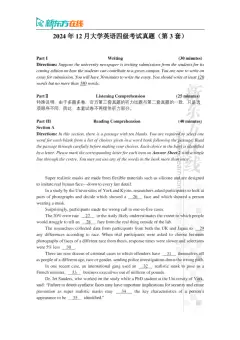
2024 年 12 月大学英语六级考试真题(第 3 套)
Part I Writing (30 minutes)
Directions: For this part, you are allowed 30 minutes to write an essay that begins with the sentence
“College provides a great opportunity for students to explore various possibilities and find the
right path for themselves.” You can make comments, cite examples or use your personal experiences
to develop your essay. You should write at least 150 words but no more than 200 words.
You should copy the sentence given in quotes at the beginning of your essay.
PartⅡ Listening Comprehension (30 minutes)
特殊说明:由于多题多卷,官方第三套真题的听力试题与第二套真题的一致,只是选项
顺序不同,因此,本套试卷不再提供听力部分。
Part III Reading Comprehension (40 minutes)
Section A
Directions: In this section, there is a passage with ten blanks. You are required to select one
word for each blank from a list of choices given in a word bank following the passage. Read
the passage through carefully before making your choices. Each choice in the bank is identified
by a letter. Please mark the corresponding letter for each item on Answer Sheet 2 with a single
line through the centre. You may not use any of the words in the bank more than once.
About 23% of the global population lives in absolute poverty. In developing countries
there is a low life expectancy, a high infant 26 rate, high levels of unemployment and
illiteracy, nutritional levels below acceptable standards and widespread disease with very little
or poor quality medical assistance. Others live 27 wealthy and luxurious lives and so the
wealth is distributed in a very 28 manner. These are the central problems to questions of
charity though charity also includes many other areas such as assisting the elderly.
We all 29 when very rich people pledge to give away most of their billions, but they
are usually left with millions to pass on, still much more than most people would expect to earn
in their lifetime. Even comparatively 30 salaries in the west are very high when compared
globally. Someone on £20,000 could easily afford to give away £2,000 per year and still have
plenty to live on plus some luxuries.
Most people agree that giving to charity is morally 31 but charitable behaviour tends
to be regarded as above and beyond the call of duty. Some argue, however, that charitable
behaviour is morally required. This means that to fail to behave charitably would be wrong.
The majority of arguments in this vein refer to giving aid to poorer nations but they may also
refer to giving time within one’s 32 community. Arguments tend to place different
requirements on people in different income brackets and 33 entirely people who are
merely making ends meet. Some argue that people should all contribute a certain percentage of
their earnings. I will 34 together all those arguments that place a moral requirement on
people to give to charity, despite the fact that there is wide disagreement as to the 35 of
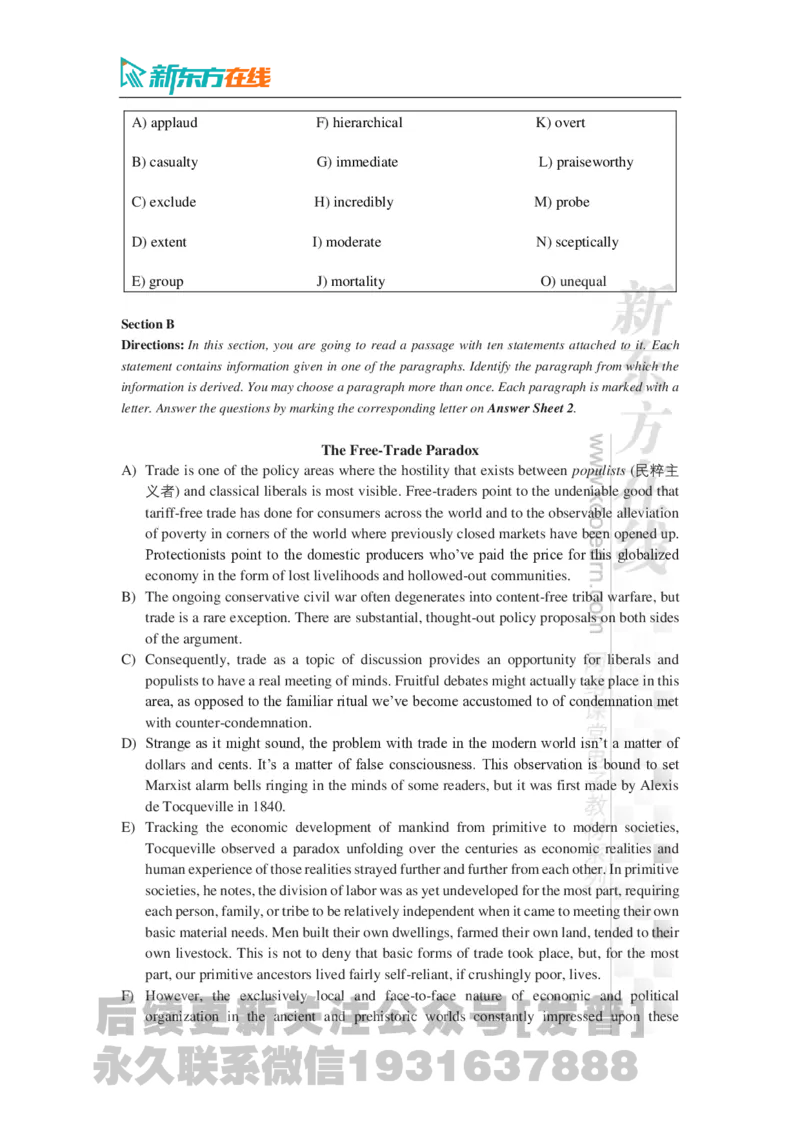
that moral requirement.A) applaud F) hierarchical K) overt
B) casualty G) immediate L) praiseworthy
C) exclude H) incredibly M) probe
D) extent I) moderate N) sceptically
E) group J) mortality O) unequal
Section B
Directions: In this section, you are going to read a passage with ten statements attached to it. Each
statement contains information given in one of the paragraphs. Identify the paragraph from which the
information is derived. You may choose a paragraph more than once. Each paragraph is marked with a
letter. Answer the questions by marking the corresponding letter on Answer Sheet 2.
The Free-Trade Paradox
A) Trade is one of the policy areas where the hostility that exists between populists (民粹主
义者) and classical liberals is most visible. Free-traders point to the undeniable good that
tariff-free trade has done for consumers across the world and to the observable alleviation
of poverty in corners of the world where previously closed markets have been opened up.
Protectionists point to the domestic producers who’ve paid the price for this globalized
economy in the form of lost livelihoods and hollowed-out communities.
B) The ongoing conservative civil war often degenerates into content-free tribal warfare, but
trade is a rare exception. There are substantial, thought-out policy proposals on both sides
of the argument.
C) Consequently, trade as a topic of discussion provides an opportunity for liberals and
populists to have a real meeting of minds. Fruitful debates might actually take place in this
area, as opposed to the familiar ritual we’ve become accustomed to of condemnation met
with counter-condemnation.
D) Strange as it might sound, the problem with trade in the modern world isn’t a matter of
dollars and cents. It’s a matter of false consciousness. This observation is bound to set
Marxist alarm bells ringing in the minds of some readers, but it was first made by Alexis
de Tocqueville in 1840.
E) Tracking the economic development of mankind from primitive to modern societies,
Tocqueville observed a paradox unfolding over the centuries as economic realities and
human experience of those realities strayed further and further from each other. In primitive
societies, he notes, the division of labor was as yet undeveloped for the most part, requiring
each person, family, or tribe to be relatively independent when it came to meeting their own
basic material needs. Men built their own dwellings, farmed their own land, tended to their
own livestock. This is not to deny that basic forms of trade took place, but, for the most
part, our primitive ancestors lived fairly self-reliant, if crushingly poor, lives.
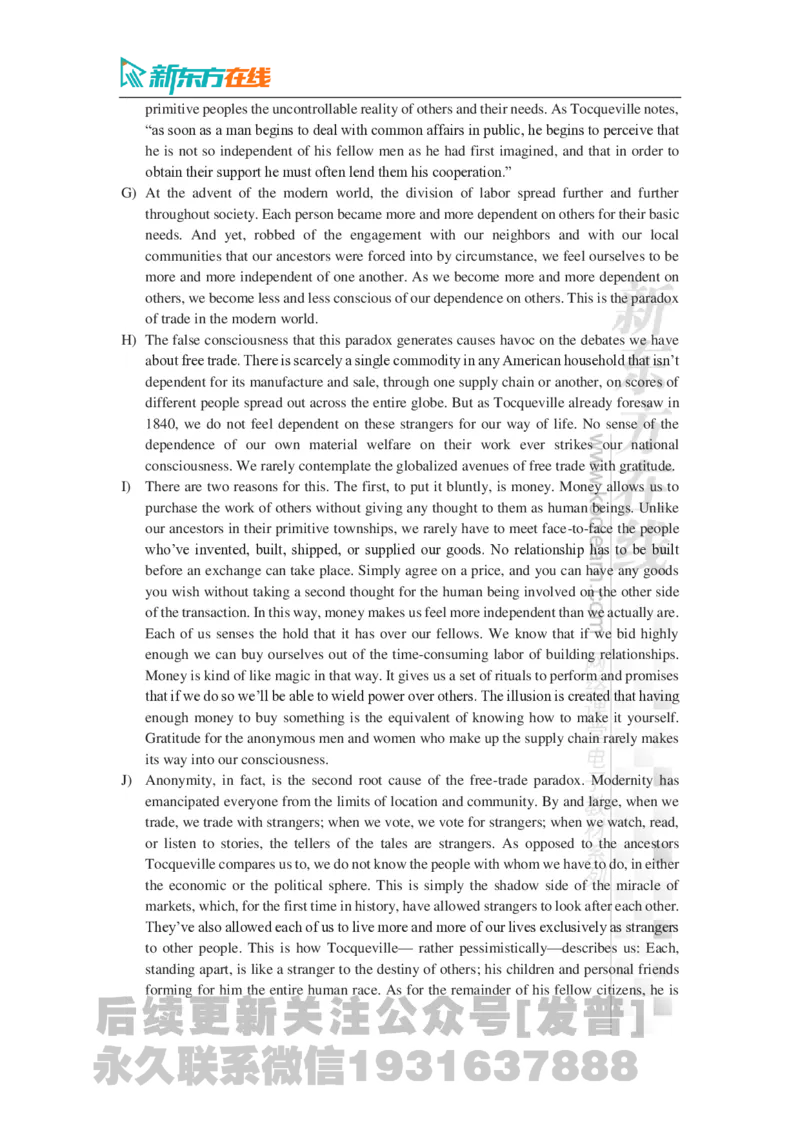
F) However, the exclusively local and face-to-face nature of economic and political
organization in the ancient and prehistoric worlds constantly impressed upon theseprimitive peoples the uncontrollable reality of others and their needs. As Tocqueville notes,
“as soon as a man begins to deal with common affairs in public, he begins to perceive that
he is not so independent of his fellow men as he had first imagined, and that in order to
obtain their support he must often lend them his cooperation.”
G) At the advent of the modern world, the division of labor spread further and further
throughout society. Each person became more and more dependent on others for their basic
needs. And yet, robbed of the engagement with our neighbors and with our local
communities that our ancestors were forced into by circumstance, we feel ourselves to be
more and more independent of one another. As we become more and more dependent on
others, we become less and less conscious of our dependence on others. This is the paradox
of trade in the modern world.
H) The false consciousness that this paradox generates causes havoc on the debates we have
about free trade. There is scarcely a single commodity in any American household that isn’t
dependent for its manufacture and sale, through one supply chain or another, on scores of
different people spread out across the entire globe. But as Tocqueville already foresaw in
1840, we do not feel dependent on these strangers for our way of life. No sense of the
dependence of our own material welfare on their work ever strikes our national
consciousness. We rarely contemplate the globalized avenues of free trade with gratitude.
I) There are two reasons for this. The first, to put it bluntly, is money. Money allows us to
purchase the work of others without giving any thought to them as human beings. Unlike
our ancestors in their primitive townships, we rarely have to meet face-to-face the people
who’ve invented, built, shipped, or supplied our goods. No relationship has to be built
before an exchange can take place. Simply agree on a price, and you can have any goods
you wish without taking a second thought for the human being involved on the other side
of the transaction. In this way, money makes us feel more independent than we actually are.
Each of us senses the hold that it has over our fellows. We know that if we bid highly
enough we can buy ourselves out of the time-consuming labor of building relationships.
Money is kind of like magic in that way. It gives us a set of rituals to perform and promises
that if we do so we’ll be able to wield power over others. The illusion is created that having
enough money to buy something is the equivalent of knowing how to make it yourself.
Gratitude for the anonymous men and women who make up the supply chain rarely makes
its way into our consciousness.
J) Anonymity, in fact, is the second root cause of the free-trade paradox. Modernity has
emancipated everyone from the limits of location and community. By and large, when we
trade, we trade with strangers; when we vote, we vote for strangers; when we watch, read,
or listen to stories, the tellers of the tales are strangers. As opposed to the ancestors
Tocqueville compares us to, we do not know the people with whom we have to do, in either
the economic or the political sphere. This is simply the shadow side of the miracle of
markets, which, for the first time in history, have allowed strangers to look after each other.
They’ve also allowed each of us to live more and more of our lives exclusively as strangers
to other people. This is how Tocqueville— rather pessimistically—describes us: Each,
standing apart, is like a stranger to the destiny of others; his children and personal friends
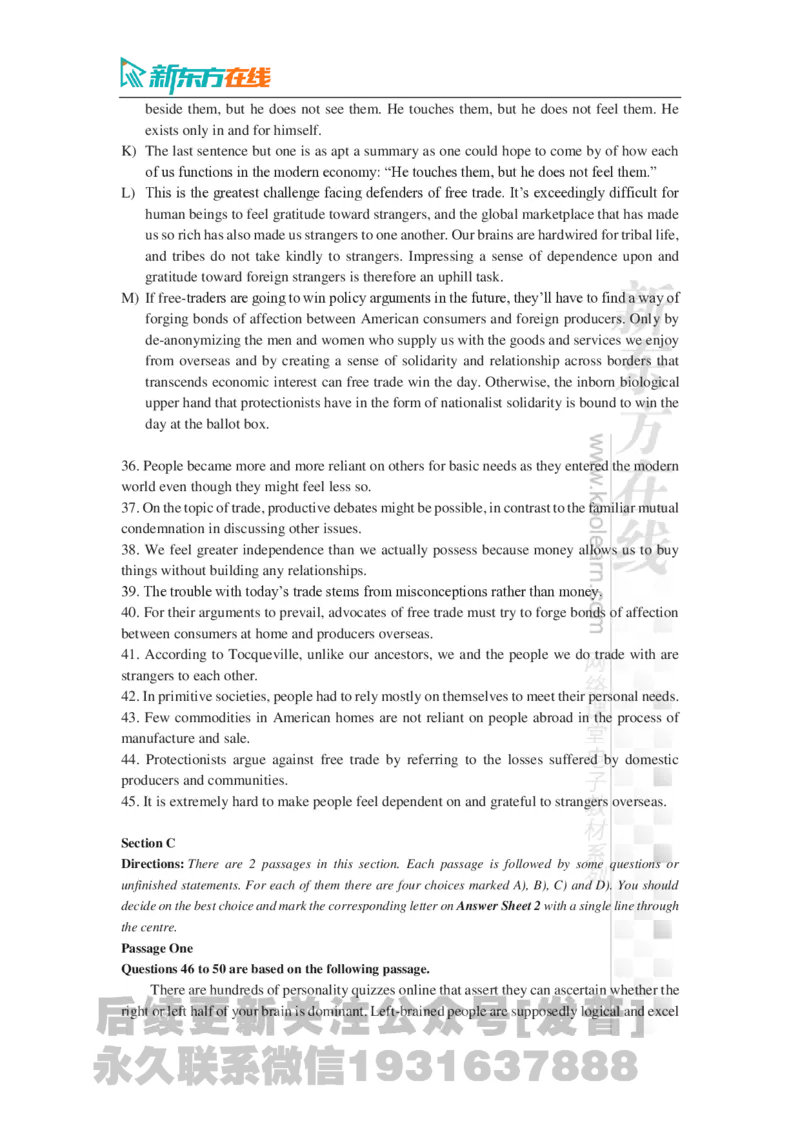
forming for him the entire human race. As for the remainder of his fellow citizens, he isbeside them, but he does not see them. He touches them, but he does not feel them. He
exists only in and for himself.
K) The last sentence but one is as apt a summary as one could hope to come by of how each
of us functions in the modern economy: “He touches them, but he does not feel them.”
L) This is the greatest challenge facing defenders of free trade. It’s exceedingly difficult for
human beings to feel gratitude toward strangers, and the global marketplace that has made
us so rich has also made us strangers to one another. Our brains are hardwired for tribal life,
and tribes do not take kindly to strangers. Impressing a sense of dependence upon and
gratitude toward foreign strangers is therefore an uphill task.
M) If free-traders are going to win policy arguments in the future, they’ll have to find a way of
forging bonds of affection between American consumers and foreign producers. Only by
de-anonymizing the men and women who supply us with the goods and services we enjoy
from overseas and by creating a sense of solidarity and relationship across borders that
transcends economic interest can free trade win the day. Otherwise, the inborn biological
upper hand that protectionists have in the form of nationalist solidarity is bound to win the
day at the ballot box.
36. People became more and more reliant on others for basic needs as they entered the modern
world even though they might feel less so.
37. On the topic of trade, productive debates might be possible, in contrast to the familiar mutual
condemnation in discussing other issues.
38. We feel greater independence than we actually possess because money allows us to buy
things without building any relationships.
39. The trouble with today’s trade stems from misconceptions rather than money.
40. For their arguments to prevail, advocates of free trade must try to forge bonds of affection
between consumers at home and producers overseas.
41. According to Tocqueville, unlike our ancestors, we and the people we do trade with are
strangers to each other.
42. In primitive societies, people had to rely mostly on themselves to meet their personal needs.
43. Few commodities in American homes are not reliant on people abroad in the process of
manufacture and sale.
44. Protectionists argue against free trade by referring to the losses suffered by domestic
producers and communities.
45. It is extremely hard to make people feel dependent on and grateful to strangers overseas.
Section C
Directions: There are 2 passages in this section. Each passage is followed by some questions or
unfinished statements. For each of them there are four choices marked A), B), C) and D). You should
decide on the best choice and mark the corresponding letter on Answer Sheet 2 with a single line through
the centre.
Passage One
Questions 46 to 50 are based on the following passage.
There are hundreds of personality quizzes online that assert they can ascertain whether the
right or left half of your brain is dominant. Left-brained people are supposedly logical and excelat language and math while right-brained people are more imaginative, emotionally intelligent
and skilled with spatial reasoning. There’s just one problem: That’s not how brains work.
Popular science enthusiasts sort of took this idea and ran with it, and it’s become woven
in popular culture now, and it’s not going away.
Despite this enduring belief, there’s no such thing as being “right-brained” or “left-
brained.” Whether you’re someone who tends more towards creativity or logic has nothing to
do with one hemisphere of your brain being dominant over the other. But the actual science of
how the two halves of our brains work together is sometimes stranger than fiction.
The human brain is divided into two hemispheres, the left and right. In all vertebrate (脊
椎的) animals, the right hemisphere controls the left side of the body and vice versa. And
scientists have long known, thanks to the behaviors of patients who suffered brain injuries, that
different areas of the brain do different things.
But many scientists struggled with this idea, because the very suggestion that the left and
right halves of the brain operate differently disrupted the idea that nature tends toward perfect
symmetry.
Work by neuroscientists (神经科学家) has revealed the importance of different
hemispheres of the brain for different activities. However, their research quickly saw some
misinterpretations in the general public: Some presumed creative people must be right-brained
and logical people left-brained. It is proven that not only is personality unrelated to the different
halves of the brain, but people aren’t really right- or left-brained to begin with. The idea that
we have left-dominant people and right-dominant people, and that this is related to personality,
is categorically false. That’s never been supported in the neuroscience community.
Neuroscientists don’t believe that and never have.
What scientists learned is that there are really important differences between the left
hemisphere and the right hemisphere. It’s just that they have nothing to do with personality or
whether cognitive strategy is more logical or free spirited or creative. While researchers have
shown the limitations of how the hemispheres of our brains influence our lives, it’s not difficult
to understand the appeal of such ideas. People are endlessly fascinated by themselves and their
friends, and the subtle differences in how people think about the world are really meaningful to
them. When you come up with an online quiz that tells us something about ourselves, we’re
drawn to that. It’s irresistible. But you have to take it with an enormous grain of salt.
46. What do numerous personality quizzes online claim they are able to do?
A) Distinguish between the two hemispheres of one’s brain.
B) Determine whether one is left-brained or right-brained.
C) Tell if one is more of a linguist or of a mathematician.
D) Ascertain how one’s brain performs different tasks.
47. What does the author say is sometimes stranger than fiction?
A) How one hemisphere of the brain impacts creativity.
B) How the two halves of our brains work alternately.
C) How the two hemispheres of our brains cooperate.
D) How one half of the brain dominates the other.
48. Why did many scientists have difficulty endorsing the idea that different areas of the brain
do different things?A) It contradicts the assumption that the two hemispheres of the brain are symmetrical.
B) It dismisses the view that the universe has been evolving in a consistent manner.
C) It is in conflict with the suggestion that the left and right halves of the brain work
together.
D) It disrupts the idea that the right hemisphere of the brain controls the left side of the
body.
49. What belief have neuroscientists long rejected according to the passage?
A) There are left-dominant people and right-dominant people with different personalities.
B) There are noticeable differences between the left and right hemispheres of the brain.
C) One’s personality is hardly related to the different halves of the brain.
D) Different areas of the brain are responsible for different activities.
50. What are we advised to do with an online quiz that tells us something about ourselves?
A) Challenge its authority.
B) Scrutinize its originality.
C) Evaluate its popularity.
D) Question its reliability.
Passage Two
Questions 51 to 55 are based on the following passage.
One hundred thirty-five students, four teachers, one giant classroom: This is what 9th
grade looks like at Westwood High School, in Mesa, Arizona’s largest school system. There,
an innovative teaching model has taken hold, and is spreading to other schools in the district
and beyond.
Five years ago, faced with high teacher turnover and declining student enrollment,
Westwood’s leaders decided to try something different. Working with professors at Arizona
State University’s teachers college, they piloted a classroom model known as team teaching,
which allows teachers to dissolve the walls that separate their classes across physical or grade
divides.
The teachers share large groups of students—sometimes 100 or more—and rotate between
group instruction, one-on-one interventions, small study groups, or whatever the teachers as a
team agree is a priority that day. What looks at times like chaos is in fact a carefully orchestrated
plan: Each morning, the Westwood teams meet to hammer out a personalized program for every
student the team will focus on that day.
By giving teachers more opportunity to collaborate, Mesa’s administrators hoped to fill
staffing gaps and boost teacher morale and retention. Initial research suggests the gamble could
pay off.
“Teachers are doing fantastic things, but it’s very rare a teacher walks into another room
to see what’s happening,” said Andi Fourlis, superintendent of Mesa Public Schools. “Our
profession is so slow to advance because we are working in isolation.”
Of course, overhauling teaching approaches can’t fix all the frustrations teachers have,
such as low pay, but early results from Mesa show team teaching may be helping to reverse
low morale. In a survey of hundreds of the district’s teachers, researchers found those whoworked on teams reported greater job satisfaction, more frequent collaborations with colleagues,
and more positive interactions with students.
Another benefit of teams, teachers say, is that they can help each other improve their
instruction. During one planning session, English teacher Jeff Hall shared a performance
appraisal with a science teacher: Her recent lecture on something she called “the central dogma
of biology” had bewildered him and their other teammates.
“If the science is too confusing for me, can you imagine the frustration you feel as kids?”
Hall said. But the science teacher, he said, wouldn’t have known about the confusion on her
own.
The model is not for everyone. Some teachers approached about volunteering for a team
have said they prefer to work alone. Team teaching can also be a scheduling nightmare,
especially at schools like Westwood where only some staff work in teams. There are also thorny
questions like how to evaluate four teachers on the performance of 135 students. But for the
time being, it seems to be working.
51. What do we learn about team teaching from the passage?
A) It is generally conducted in classrooms without walls.
B) It allows students to choose teachers they favor most.
C) It prioritizes peer work over classroom instruction.
D) It is closely coordinated despite seeming confusion.
52. What does initial research suggest regarding Westwood’s innovative teaching model?
A) It could help raise teachers’ pay.
B) It could turn out to be a success.
C) It could cut down overall costs.
D) It could end up like a gamble.
53. What did superintendent Andi Fourlis say about the teaching profession?
A) Morale cannot be boosted until teaching models are overhauled.
B) Teachers are simply too busy to visit classes of their colleagues.
C) Progress is slow due to lack of collaboration among teachers.
D) Teachers often do fantastic things without being noticed.
54. What does the author want to show by citing English teacher Jeff Hall’s experience?
A) English teachers and science teachers are complementary in performing their tasks.
B) A teacher of arts and letters is completely puzzled by what a science teacher teaches.
C) The new teaching model helps inform the teacher how their instruction is received.
D) Science teachers will hardly know the confusion they create without a performance
appraisal.
55. What does the author think is one of the difficult problems in implementing the new
teaching model?
A) What to do with teachers working alone.
B) What to include in teaching schedules.
C) How to recruit volunteers for a team.
D) How to assess each teacher’s performance.Part IV Translation (30 minutes)
Directions: For this part, you are allowed 30 minutes to translate a passage from Chinese
into English. You should write your answer on Answer Sheet 2.
遨游太空历来是中华民族的梦想。2003 年,神舟五号飞船发射成功,杨利伟成为
第一个飞入太空的中国宇航员。2008 年,神舟七号升空,翟志刚成为中国历史上首位
进行太空行走的宇航员。近年来,中国航天进入创新发展“快车道”,太空基础设施建设
稳步推进,中国空间站于 2022 年全面建成。中国航天事业的迅速发展在中华民族的历
史上写下了辉煌一页,也为人类文明进步做出了巨大贡献。未来,中国探索太空的脚步
将迈得更稳、更远。