考点 23 阅读理解说明文(核心考点精讲精练)
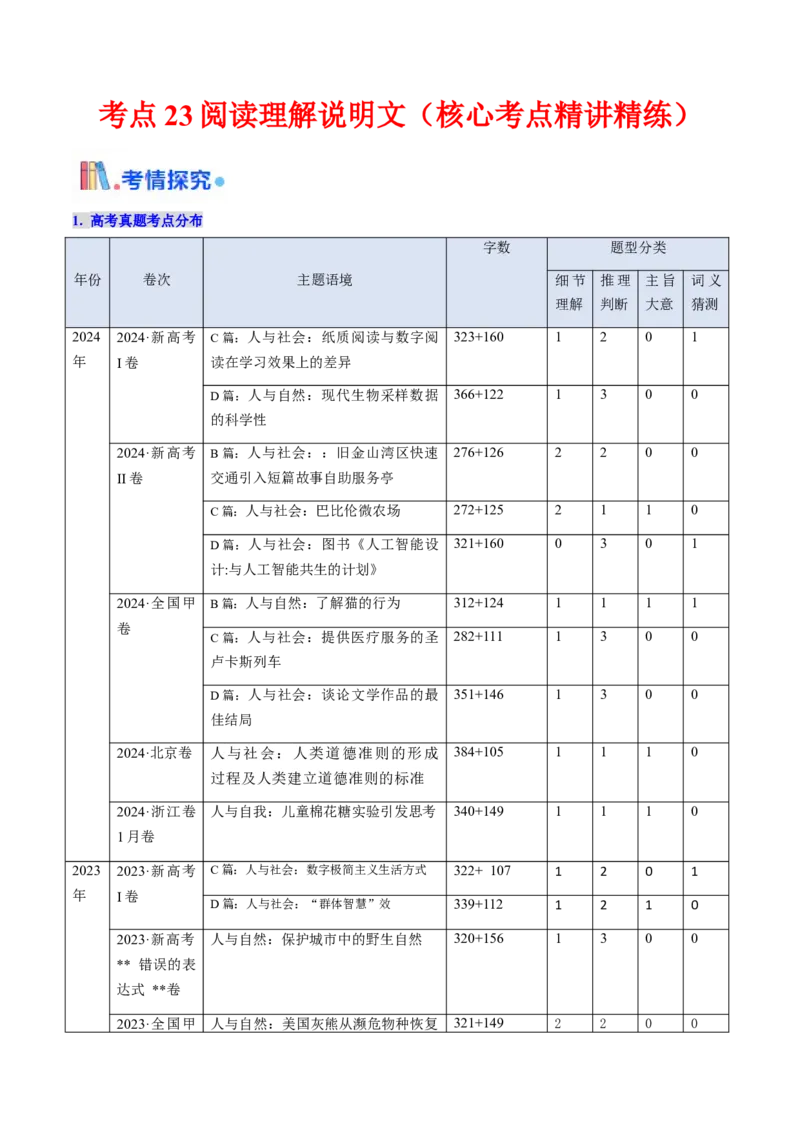
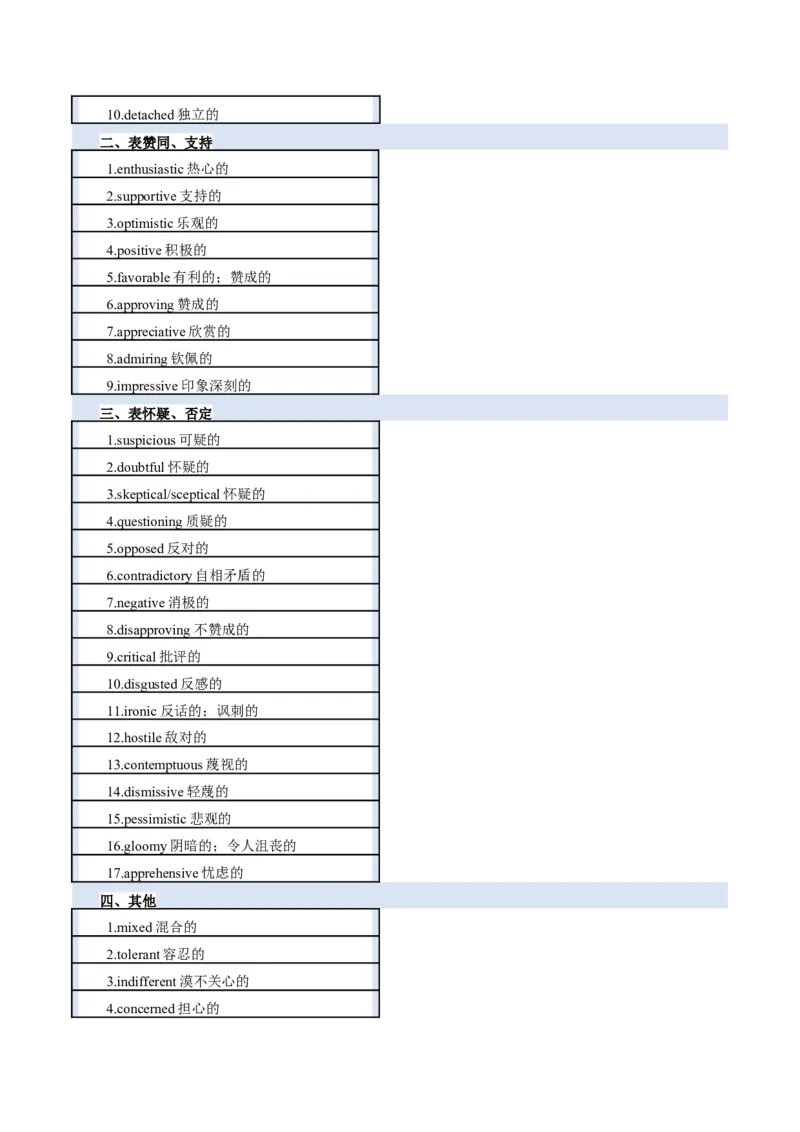
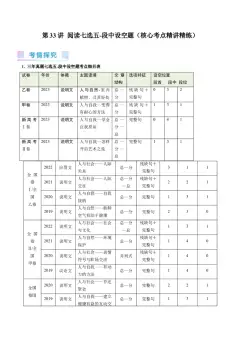
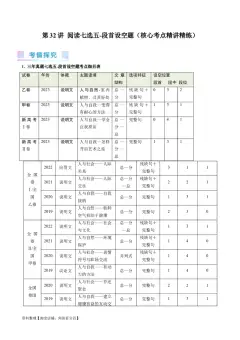
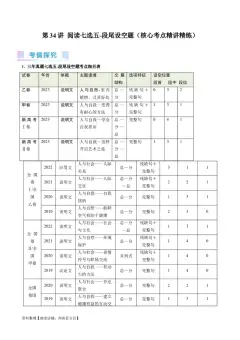
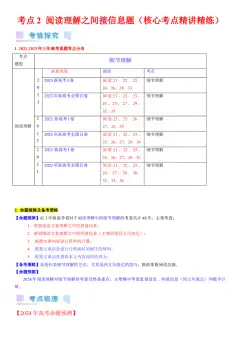
1. 高考真题考点分布
字数 题型分类
年份 卷次 主题语境 细节 推理 主旨 词义
理解 判断 大意 猜测
2024 2024·新高考 C篇:人与社会:纸质阅读与数字阅 323+160 1 2 0 1
年 I卷 读在学习效果上的差异
D篇:人与自然:现代生物采样数据 366+122 1 3 0 0
的科学性
2024·新高考 B篇:人与社会::旧金山湾区快速 276+126 2 2 0 0
II卷 交通引入短篇故事自助服务亭
C篇:人与社会:巴比伦微农场 272+125 2 1 1 0
D篇:人与社会:图书《人工智能设 321+160 0 3 0 1
计:与人工智能共生的计划》
2024·全国甲 B篇:人与自然:了解猫的行为 312+124 1 1 1 1
卷
C篇:人与社会:提供医疗服务的圣 282+111 1 3 0 0
卢卡斯列车
D篇:人与社会:谈论文学作品的最 351+146 1 3 0 0
佳结局
2024·北京卷 人与社会:人类道德准则的形成 384+105 1 1 1 0
过程及人类建立道德准则的标准
2024·浙江卷 人与自我:儿童棉花糖实验引发思考 340+149 1 1 1 0
1月卷
2023 2023·新高考 C篇:人与社会:数字极简主义生活方式 322+ 107 1 2 0 1
年 I卷
D篇:人与社会:“群体智慧”效 339+112 1 2 1 0
2023·新高考 人与自然:保护城市中的野生自然 320+156 1 3 0 0
** 错误的表
达式 **卷
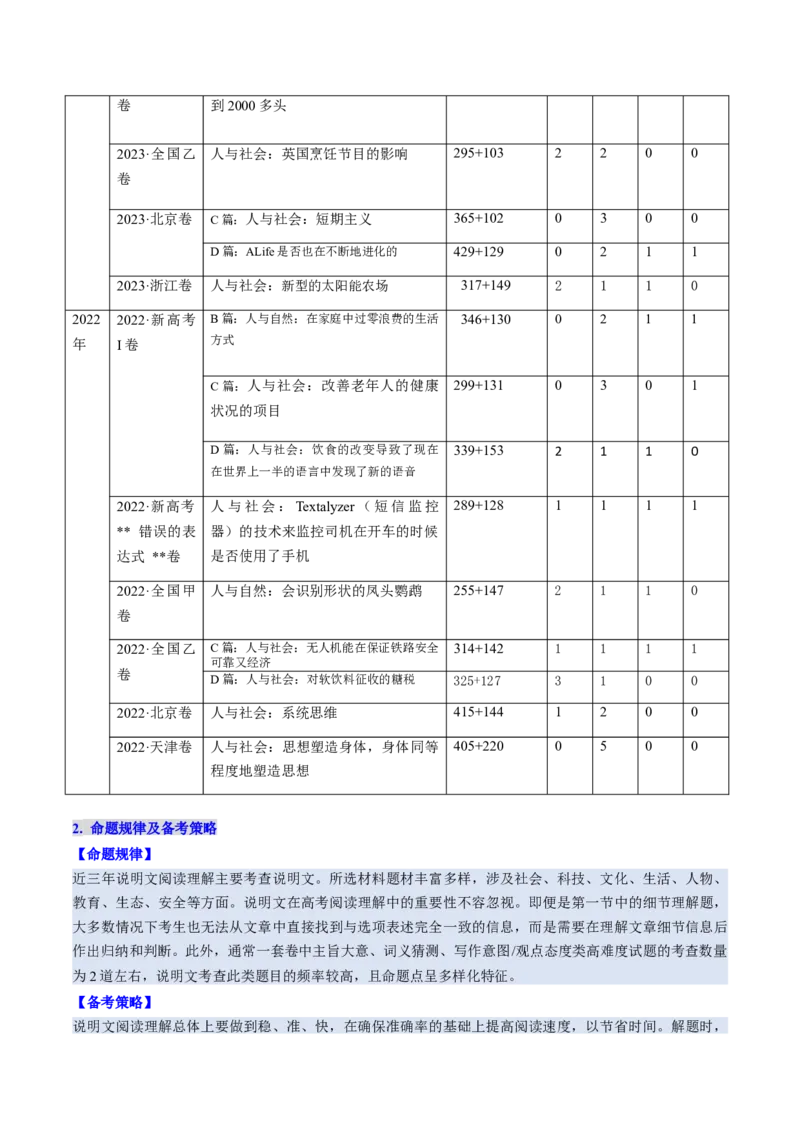
2023·全国甲 人与自然:美国灰熊从濒危物种恢复 321+149 2 2 0 0卷 到2000多头
2023·全国乙 人与社会:英国烹饪节目的影响 295+103 2 2 0 0
卷
2023·北京卷 C篇:人与社会:短期主义 365+102 0 3 0 0
D篇:ALife是否也在不断地进化的 429+129 0 2 1 1
2023·浙江卷 人与社会:新型的太阳能农场 317+149 2 1 1 0
2022 2022·新高考 B篇:人与自然:在家庭中过零浪费的生活 346+130 0 2 1 1
年 I卷 方式
C篇:人与社会:改善老年人的健康 299+131 0 3 0 1
状况的项目
D篇:人与社会:饮食的改变导致了现在 339+153 2 1 1 0
在世界上一半的语言中发现了新的语音
2022·新高考 人与社会:Textalyzer(短信监控 289+128 1 1 1 1
** 错误的表 器)的技术来监控司机在开车的时候
达式 **卷 是否使用了手机
2022·全国甲 人与自然:会识别形状的凤头鹦鹉 255+147 2 1 1 0
卷
2022·全国乙 C篇:人与社会:无人机能在保证铁路安全 314+142 1 1 1 1
可靠又经济
卷
D篇:人与社会:对软饮料征收的糖税 325+127 3 1 0 0
2022·北京卷 人与社会:系统思维 415+144 1 2 0 0
2022·天津卷 人与社会:思想塑造身体,身体同等 405+220 0 5 0 0
程度地塑造思想
2. 命题规律及备考策略
【命题规律】
近三年说明文阅读理解主要考查说明文。所选材料题材丰富多样,涉及社会、科技、文化、生活、人物、
教育、生态、安全等方面。说明文在高考阅读理解中的重要性不容忽视。即便是第一节中的细节理解题,
大多数情况下考生也无法从文章中直接找到与选项表述完全一致的信息,而是需要在理解文章细节信息后
作出归纳和判断。此外,通常一套卷中主旨大意、词义猜测、写作意图/观点态度类高难度试题的考查数量
为2道左右,说明文考查此类题目的频率较高,且命题点呈多样化特征。
【备考策略】
说明文阅读理解总体上要做到稳、准、快,在确保准确率的基础上提高阅读速度,以节省时间。解题时,要做到:
(1)快速浏览主题。快速浏览加粗字体的标题、小标题或加下划线的语句等最重要的信息,以了解语篇
提供的是哪方面的信息,并判定行文方式。
(2)速读题干,跳读定位信息。接下来阅读每一道试题,根据题干定位信息点,并在文章中找出答案或
相关信息。在定位和寻找信息点的时候,可以充分利用加粗字体的标题、小标题、加下划线的语句等重要
信息提高阅读和解题速度,如果每则信息的项目及其位置具有一致性和对应性,就可利用其一致性和对应
性快速查找答案,查找信息时不一定要读完全文。
(3)细读解题信息。最后,根据查找的相关信息,经过思考后选出正确答案。
【命题预测】
从近三年命题的发展趋势来看,预测2025年高考说明文阅读理解试题难度会保持相对稳定,主要考查题型
仍然为细节理解题和推理判断题为主,主旨大意题和词义猜测题为辅。
【必备基础知识】
一、【语篇特点】
说明文阅读理解一般作为全国卷阅谈理解中的CD篇,主要分为两种类型:实验研究和介绍说明型。说明
文是对事物的形状,性质,特征,成果或公用等进行介绍,解释或阐述的文章,把我所说明事物的特征和
本质是理解说明文的关键,说明事物特征的方法很多,主要有定义法,解释法,比较法,比喻法,数字法,
图标法,引用法和距离法等。说明文的特点是客观、简洁、准确、清晰,文章很少表达作者的情感倾向。
阅读说明文的重点在于读懂它说明的事物或事理,了解事物的性质、结构、形成原因、功能;了解事物的
意义和特征等。
二、【解题策略】
1. 首先要注意一定要忠实于原文,以文章提供的事实和线索为依据。立足已知,推断未知,遵循“词不离
句,句不离段,段不离篇”的原则。千万不能主观臆想,凭空想象,随意揣测,更不能以自己的观点代替
作者的观点。
2. 要吃透文章的字面意思,从字里行间捕捉有用的提示和线索,这是推理的前提和基础。有的推断,考生
完全可以根据文章中所阐述的细节,再结合自己所掌握的基础知识、有关背景知识或常识来帮助进行分析、
推敲,从而得出符合文章原意的结论。
3. 要对文字的表面信息进行挖掘加工,由表及里,由浅入深,从具体到抽象,从特殊到一般,通过分析、
综合、判断等,进行深层处理,合乎逻辑地推理。不能就事论事,断章取义,以偏概全。
4. 要把握句、段之间的逻辑关系,了解语篇的结构,同时还要体会文章的基调,揣摩作者的态度,摸准逻
辑发展方向,悟出作者的言外之意。
5. 在解答推理性问题时,一定要注意确定推理依据的位置或范围。应清楚所要解答的问题需要针对某个细
节进行推断,还是针对主题思想、作者的意图进行推断。针对细节的推断可运用scanning的方法,迅速在
材料中确定推理依据的位置或范围,然后再进行推理判断。针对主题思想作推断时,则常常要纵览全篇文
章。
三【说明文中的推理判断题】
【题型解读】推理判断题属于高层次阅读理解题。解答该类型题目时一定要从整体上把握语篇内容。在语篇的表面意义
与隐含意义、已知信息与未知信息之间架起桥梁,透过字里行间,去体会作者的“弦外之音”和“言外之
意”。在进行推断时,要据文推理、合情推理,不可脱离原文主观臆断。推理判断题要求考生根据文章提供
的事实和线索进行逻辑推理,推测作者未明确提到的事实或某事件发展的趋势。
【设题趋势】
常以infer, imply, suggest, conclude, learn, intend, mean, describe, purpose等词提问。
提问中含有表示推测的情态动词,如can, could, might, would 等和其他表示可能性的副词,如probably, possibly
等。
具体的设问方式如:
What can we infer from the (first/.../last) paragraph?
Where does this passage probably come from?
What’s the author’s attitude towards...?
What is the main purpose of the passage?等。
【常考类型】
题型1 深层推断题 周密逻辑分析推断隐含意义
题型2 意图推断题 依据文体特点推断写作意图
题型3 观点态度题 利用语境的褒贬性进行信息推断
题型4 文章出处题 根据文章体裁和内容推断文章出处
【推理判断题解题技巧】
1. 正确选项推理判断题中的正确选项是依据文章的事实或证据推断出的符合逻辑的结论或观点,正确选项
一般具有以下特征:
(1) “立足原文,只推一步”,即根据原文内容,一步即可推得。
(2) 选项中一般不可以出现绝对概念。如only, never, all, absolutely等。
(3) 正确答案的表述一般有一点模糊,会用一些相对能够留有一些余地的词汇,如often, usually, sometimes,
some, may, might, can, could, possibly, probably等。
【干扰选项】
即把文章中作者的观点与其他人的观点混淆在一起。题干问的是作者的观点,选项中出现的
张冠李戴
却是其他人的观点;题干问的是其他人的观点,选项中却出现了作者的观点
这种类型的干扰项往往是基本的生活常识或普遍认可的观点,但在文章中并无相关的信息支
无中生有
撑点。其次,这种干扰项也有可能与设置的问题毫不相干
即推测意义与文章表层意义有区别。推理判断题中有些选项来自文章中的某一句或某几句
曲解文意 话,命题者可能会利用里面的词设计出干扰项,看似表达文章的意思,其实是借题发挥,是对原
文意思的曲解
鱼目混珠类型的干扰项常出现在词句理解类试题的选项中,即利用某个词或句子的字面含义
鱼目混珠
代替其在文章特定语境中的具体含义
为了准确、严密地表达文章内容,命题者特别注意对文意范围的限定,有时通过加上 almost,
all, nearly, more than, normally, usually 等词语对文意范围加以限定。“扩缩范围”干扰法就是
扩缩范围
在选项中通过改变或去掉限制性词语,将信息的范围、程度、感情色彩等改变,从而给考生解
题造成干扰的命题方法
干扰项用了与文章中某一句话相似的句型结构和单词,却在考生易忽视的地方换了几个单词,
偷梁换柱
造成句意的改变01 说明文中的推理判断题之深层推断题(隐含推断题)
主要考查以下几个方面:
(1)细节推断题,即根据文章特定细节进行推断;
(2)综合推断题,即根据全段,甚至全篇,结合多处信息推断文章寓意或深层意义;
(3)逻辑推断题,即严格根据文章中所陈述的事实、论点、例证等一系列材料进行推理,从而得出合乎逻
辑的结论。
(2023·新高考Ⅱ卷·C篇节选) Continued developments in communication technologies were once believed to
make the printed page outdated.
31.What does the author want to say by mentioning the e-reader?
A. The printed book is not totally out of date.
B. Technology has changed the way we read.
C. Our lives in the 21st century are networked.
D. People now rarely have the patience to read.
(2024·山西·模拟预测)A team of scientists from the Center for Cognition and Sociality and the Data
Science Group at the Institute for Basic Science (IBS) made an exciting discovery about how computers and human
brains work similarly when remembering things. They found out that the way artificial intelligence (AI) models,
like those in smart robots, store memories is a lot like how our brain’s memory center, called the hippocampus (海
马体), does it. This part of the brain is really important for feelings and memories.
Understanding how AI learns and keeps information is key to making it smarter. The scientists looked into
how our brains learn and remember by focusing on a special process involving the NMDA receptor, a critical part
of the hippocampus. This receptor works like a smart door in our brain that helps with learning and remembering. It
opens when certain brain chemicals are present, allowing the cell to receive signals and create memories. A specific
element, magnesium, acts like a guard, only letting substances in under the right conditions.
Interestingly, the team found that Transformer, a type of AI model, uses a similar “guarding” method to
manage its memory. They wondered if they could make the Transformer’s memory better by copying the brain’s
process. By adjusting some settings in the Transformer to mimic (模拟、模仿) the brain’s memory door, they
improved its ability to remember things long-term, just like adjusting magnesium levels can affect how well we
remember stuff.
This discovery is a big deal because it shows we can use what we know about the brain to make AI smarter.
C. Justin LEE, a neuroscience (神经学) director at the institute, mentioned that this research was a big step
forward for both AI and brain science. It opens up new ways to understand how the brain works and to create moreadvanced AI based on these insights.
So, in simple terms, scientists have figured out that computers can learn and remember in ways that are
surprisingly similar to us, which could help make them even smarter in the future.
12.What does the term “NMDA receptor” in paragraph 2 most likely refer to?
A.A type of computer virus that attacks AI systems.
B.A new technology for making computers run faster.
C.A component in AI models that predicts future events.
D.A part of the human brain involved in learning and memory.
13.What did the team discover about Transformer?
A.It directly mimics the brain’s memory process.
B.It is unaffected by changes in memory settings.
C.It uses a special method to manage memory.
D.It requires adjustments to enhance long-term memory.
14.What is the significance of the research findings according to C. Justin LEE?
A.It is a new approach to memory organization.
B.It is a crucial step in advancing AI and neuroscience.
C.It is a method for improving short-term memory in AI.
D.It is a breakthrough in understanding AI emotional processing.
02 说明文中的推理判断题之意图推断题
文章主旨是中心思想、文章大意,而写作意图则阐述文章为何表达这个中心思想。在高考中既可能考查全文
的写作意图,又可能考查某处细节或某一段落的写作意图。
常见设问方式:
What is the main purpose of the author writing the text?
The writer of the story wants to tell us that________
The fact... is mentioned by the author to show______
The author writes the last paragraph in order to_____
解题技巧:
1. 关注设问的信息位置:
1)开头提出问题——To attract readers’ attention;To introduce the topic;
2)开头举例,用谚语或者名人名言——To draw the readers’ attention to the top;
3)结尾设问——To attract readers to pay for a trip to some attraction; To call on…; To sell a product or
service;
4)文中引语、事例、研究的数据和研究——To argue against…; To support one’s own idea; To make it
more persuasive (更有说服力的)2. 关注逻辑关系和篇章结构(TEEC 模式)Topic→explanation→example→conclusion 主题+举例子解释或
者证明——To stress/confirm/support sth
常见的说明方法:
1、列数字(list figures): 具体而准确地说明该事物的特点。使说明更有说服力。
2、举例子(give examples): 具体真切地说明了事物的等等特点。
3、引资料(quote): 能使说明的内容更具体、更充实。用引用的方法说明事物的特征,增强说服力。如引用
古诗文、谚语、俗话。引用说明在文章开头,还起到引出说明对象的作用。
4、分类别(by category): 条理清楚地说明了事物的特点,对事物的特征/事理分门别类加以说明,使说明更
有条理性。使说明的内容眉目清楚,避免重复交叉的现象。
5、打比方(make an analogy) : 打比方就是修辞方法中的比喻。生动形象地说明该事物的 xx特点,增强
了文章的趣味性。
6、下定义(draw a definition/ make analysis): 用简明科学的语言对说明的对象/科学事理加以揭示,从而
更科学、更本质、更概括地揭示事物的特征/事理。
7、作比较(make a contrast/comparison): 突出强调了被说明对象的特点(地位、影响等)。
1.【新课标ⅠⅠ卷】Given the astonishing potential of AI to transform our lives, we all need to take action to deal
with our AI-powered future, and this is where AI by Design: A Plan for Living with Artificial Intelligence comes
in. This absorbing new book by Catriona Campbell is a practical roadmap addressing the challenges posed by the
forthcoming AI revolution (变革).
In the wrong hands, such a book could prove as complicated to process as the computer code (代码) that
powers AI but, thankfully, Campbell has more than two decades’ professional experience translating the heady into
the understandable. She writes from the practical angle of a business person rather than as an academic, making for
a guide which is highly accessible and informative and which, by the close, will make you feel almost as smart as
AI.
As we soon come to learn from AI by Design, AI is already super-smart and will become more capable,
moving from the current generation of “narrow-AI” to Artificial General Intelligence. From there, Campbell says,
will come Artificial Dominant Intelligence. This is why Campbell has set out to raise awareness of AI and its future
now-several decades before these developments are expected to take place. She says it is essential that we keep
control of artificial intelligence, or risk being sidelined and perhaps even worse.
Campbell’s point is to wake up those responsible for AI-the technology companies and world leaders-so they
are on the same page as all the experts currently developing it. She explains we are at a “tipping point” in history
and must act now to prevent an extinction-level event for humanity. We need to consider how we want our future
with Al to pan out. Such structured thinking, followed by global regulation, will enable us to achieve greatness
rather than our downfall.AI will affect us all, and if you only read one book on the subject, this is it.
12. What does the phrase “In the wrong hands” in paragraph 2 probably mean?
A. If read by someone poorly educated. B. If reviewed by someone ill-intentioned.
C. If written by someone less competent. D. If translated by someone unacademic.
13. What is a feature of AI by Design according to the text?
A. It is packed with complex codes. B. It adopts a down-to-earth writing style.
C. It provides step-by-step instructions. D. It is intended for AI professionals.
14. What does Campbell urge people to do regarding AI development?
A. Observe existing regulations on it.
B. Reconsider expert opinions about it.
C. Make joint efforts to keep it under control.
D. Learn from prior experience to slow it down.
15. What is the author’s purpose in writing the text?
A. To recommend a book on AI. B. To give a brief account of AI history.
C. To clarify the definition of AI. D. To honor an outstanding AI expert.
(2024·四川·模拟预测)In an era of digital technology, the art of writing by hand has slowly been
downgraded to a past entertainment. However, recent research suggests that this physical act is essential to brain
health and development, having multiple cognitive (认知的) benefits. It is time we should reevaluate the potential
benefits it may have on our mental capacities.
According to numerous studies, writing by hand stimulates more complex and diverse brain connections
essential for encoding new information and forming memories. For instance, a recent investigation found that brain
connectivity patterns were far more complicated and widespread for participants who wrote by hand compared to
those who typed. Thus, it is clear that handwriting has a distinct and significant impact on our brain health.
Handwriting isn’t just good for our brains health—it also has clear, practical benefits. Research has shown
that students who take handwritten notes score significantly higher on quizzes, demonstrating improved learning.
This extends beyond the classroom too. People who recorded information on paper calendars demonstrated more
brain activity and recalled information faster than those who used smartphones. The act of handwriting, therefore,
could be a valuable tool for students preparing for exams and adults managing daily tasks.
Despite its clear benefits, handwriting has been on the decline. However, 25states in the US have
reintroduced writing back into school curriculums. This is a step in the right direction, as previous research has also
indicated that handwriting is essential in children’s brain development. Preliterate (未识字的) children who wrote
by hand demonstrated brain activity in a circuit of the brain used in learning to read, further strengthening the link
between handwriting and cognitive development.
It is clear that handwriting is a valuable activity that has the potential to enhance our brain health, learning,
memory, and problem-solving skills. As we continue to navigate the digital age, it is important not to overlook the
value of this seemingly simple activity. So, the next time you reach for your keyboard, remember the benefits ofpicking up a pen instead.
12.What do people usually think of handwriting at present?
A.It has become an old-fashioned skill. B.It has many cognitive benefits in life.
C.It has been replaced by digital devices. D.It has been a popular entertainment.
13.What does the author mainly show about handwriting in paragraph 3?
A.It is beneficial to brain health. B.It helps students score higher on quizzes.
C.It stimulates diverse brain connection. D.It has good effects on learning and memory.
14.Why is previous research mentioned in paragraph 4?
A.To make a comparison. B.To add further evidence.
C.To show different opinions. D.To explain the brain activity.
15.What’s the purpose of the passage?
A.To illustrate a finding on handwriting. B.To emphasize the importance of handwriting.
C.To show the wide application of handwriting. D.To introduce the artistic value of handwriting.
03 说明文中的推理判断题之观点态度题
推断作者或者文中人物的意图态度题就是指针对文章作者或者文中人物对某事物所持的观点或者态度进行
设问。文章作者或文中人物对某事物所持的情感、观点或态度往往隐含在文章的字里行间或流露于修饰词
之中。
常见的设问方式有:
How does the author feel about...?
What does the author think of...?
What is the author’s attitude towards/to...?
作者的观点和态度一般分为三大类:乐观、支持、赞同;中立、客观;悲观、怀疑、反对、批评。作者的
思想态度往往隐含在文章的字里行间,应特别注意文中表达感情色彩的形容词和副词。
【观点态度词】
一、表中立,客观
1.objective客观的
2.neutral中立的
3.factual事实的
4.disinterested无兴趣的
5.impartial公平的;不偏不倚的
6.impersonal无人情味的
7.unprejudiced无偏见的
8.unbiased无偏见的
9.unconcerned不关心的10.detached独立的
二、表赞同、支持
1.enthusiastic热心的
2.supportive支持的
3.optimistic乐观的
4.positive积极的
5.favorable有利的;赞成的
6.approving赞成的
7.appreciative欣赏的
8.admiring钦佩的
9.impressive印象深刻的
三、表怀疑、否定
1.suspicious可疑的
2.doubtful怀疑的
3.skeptical/sceptical怀疑的
4.questioning质疑的
5.opposed反对的
6.contradictory自相矛盾的
7.negative消极的
8.disapproving不赞成的
9.critical批评的
10.disgusted反感的
11.ironic反话的;讽刺的
12.hostile敌对的
13.contemptuous蔑视的
14.dismissive轻蔑的
15.pessimistic悲观的
16.gloomy阴暗的;令人沮丧的
17.apprehensive忧虑的
四、其他
1.mixed混合的
2.tolerant容忍的
3.indifferent漠不关心的
4.concerned担心的5.sensitive敏感的
6.reserved矜持的
7.conservative保守的;守旧的
8.radical激进的
9.moderate中等的;适度的
10.mild温和的;温顺的
11.subjective主观的
12.inconclusive无定论的
【2024全国甲卷B篇片段】The Saint Lukas train doesn’t accept passengers—it accepts only the sick. The Saint
Lukas is one of five government-sponsored medical trains that travel to remote towns in central and eastern Russia.
Each stop lasts an average of two days, and during that time the doctors and nurses on board provide rural(乡
村)populations with basic medical care, X-ray scans and prescriptions.
...
Doctors see up to 150 patients every day. The train’s equipment allows for basic checkups. “I was very
impressed by the doctors and their assistants working and living in such little space but still staying focused and
very concerned,” says Ducke. “They were the best chance for many rural people to get the treatment they want. ”
11. What is Ducke’s attitude toward the Saint Lukas’ services?
A. Appreciative. B. Doubtful C. Ambiguous. D. Cautious.
(2024·江苏南通·三模)In a recent study of healthy volunteers, National Institutes of Health researchers
discovered that our brains may replay memories of learning new skills when we rest.
NIH researchers have mapped out the brain activity that flows when we learn a new skill, such as playing a
new song on the piano, and found that during short rest the volunteers’ brains rapidly and repeatedly replayed faster
versions of the activity seen while they practiced typing a code. The more a volunteer replayed the activity the
better they performed during subsequent practice sessions.
The study was conducted at the NIH Clinical Center. The team of Dr. Cohen, M.D., senior investigator at
the NIH’s National Institute of Neurological Disorders and Stroke (NINDS), used a highly sensitive scanning
technique to record the brain waves of 33 healthy, right-handed volunteers as they learned to type a five-digit test
code with their left hands. The subjects sat in a chair and under the scanner’s long, cone-shaped cap. An experiment
began when a subject was shown the code “41234” on a screen and asked to type it out as many times as possible
for 10 seconds and then take a 10 second break. Subjects were asked to repeat this cycle of alternating (交替的)practice and rest sessions a total of 35 times.
During the first few trials, the speed at which subjects correctly typed the code improved dramatically and
then leveled off around the 11th cycle. In a previous study, Dr. Cohen’s team showed that most of these gains
happened during short rests, and not when the subjects were typing. Moreover, the gains were greater than those
made after a night’s sleep and were related with a decrease in the size of brain waves, called beta rhythms. In this
new report, the researchers searched for something different in the subjects’ brain waves.
“We wanted to explore the mechanisms (机制) behind memory strengthening seen during wakeful rest.
Several forms of memory appear to rely on the replaying of neural (神经的) activity, so we decided to test this idea
out for procedural skill learning,” said Ethan R. Buch, Ph.D., a staff scientist on Dr. Cohen’s team and leader of
the study. To do this, Dr. Buch developed a computer program which allowed the team to understand the brain
wave activity associated with typing each number in the test code.
Interestingly, they found that the more a volunteer replayed, the better their performance was. “We were a bit
surprised by these last results. Overall, our results support the idea that the replay activity during waking rest may
be a powerful tool that researchers can use to help individuals learn new skills faster and possibly facilitate
recovery from stroke.” said Dr. Cohen.
8.What have NIH researchers recently found?
A.The brain activity slowly flows when we learn a new skill.
B.The value of short practice sessions can’t be overestimated.
C.Short rest makes no difference to the neural replay of the activity.
D.The frequency of brain replay contributes to practice performances.
9.What is mainly talked about in Paragraph 3?
A.The process of the research.
B.The facilities of the research.
C.The application of the research.
D.The preparations of the research.
10.Why did Dr. Buch develop a computer program?
A.To distinguish the first 11 cycles from the later ones.
B.To confirm the role of neural replay in skill learning.
C.To explore the potential effects of procedural learning.
D.To find out the reasons for the changes in brain waves.
11.What does Dr. Cohen think of the research findings?
A.Acceptable.
B.Promising.
C.Shallow.
D.Dismissive.04 说明文中的推理判断题之文章出处题
推断文章出处或类别要从文章内容、语言特色和标志信息着手;确定读者对象要根据文章主题和文章措辞
来判断。
常见设问方式:
This passage would be most likely to be found in____
The passage is probably taken out of _____________
Where does this text probably come from?
Which section of a magazine is this passage probably taken from?
判断文章出处的题目应从文章的体裁和内容着手。一般来说,报纸上的新闻前面会出现日期、地点或通讯
社名称等;广告类文章因其格式特殊,容易辨认;产品说明类文章如器皿、设备的使用说明会有产品名称
或操作方式,而药品的服用说明会告知服用时间、次数、药量等;来自网络的文章一般比较新颖,时效性
强。
Newspaper特征:
1. 首段或首句为新闻归纳(时效性强)。
2.有特殊的文体标示(如Reuters)
Magazine 特征:
1. 内容更加丰富,专题性更强,
2. 话题更详细语言轻松活泼、语言表述更具作者的主体意识。
Research特征:
1. 语言比较专业化,会有一些专业词汇(如Planetary orbit)
2. 内容上严肃且精华,经常出现专业的知识。
常见选项:
A biology textbook(生物教科书)/A magazine /A research paper(研究论文) /A travel brochure(旅游手册)/
A news report(新闻报告)/A booklet(小册子)/A website/a blog(博客;网络日志)/ A guide book/An advertisement
等.
(2023·新高考Ⅱ卷·C篇节选)Reading Art: Art for Book Lovers is a celebration of an everyday object—the book,
represented here in almost three hundred artworks from museums around the world...In this “book of books”,
artworks are selected and arranged in a way that emphasizes these connections between different eras and cultures...
28.Where is the text most probably taken from?
A. An introduction to a book.
B. An essay on the art of writing.
C. A guidebook to a museum.
D.A review of modern paintings.(2024·河北·一模)Many parents confused by how their children shop or socialize, would feel undisturbed
by how they are taught — this sector remains digitally behind. Can artificial intelligence boost the digital sector of
classroom? ChatGPT-like generative AI is generating excitement for providing personalized tutoring to students.
By May, New York had let the bot back into classrooms.
Learners are accepting the technology. Two-fifths of undergraduates surveyed last y car by online tutoring
company Chegg reported using an AI chatbot to help them with their studies, with half of those using it daily.
Chegg’s chief executive told investors it was losing customers to ChatGPT as a result of the technology’s
popularity. Yet there are good reasons to believe that education specialists who harness AI will eventually win over
generalists such as Open AI and other tech firms eyeing the education business.
For one, AI chat bots have a bad habit of producing nonsense. “Students want content from trusted providers,”
argues Kate Edwards from a textbook publisher. Her company hasn’t allowed ChatGPT and other AIs to use its
material, but has instead used the content to train its own models into its learning apps. Besides, teaching isn’t
merely about giving students an answer, but about presenting it in a way that helps them learn. Charbots must also
be tailored to different age groups to avoid either cheating or infantilizing (使婴儿化) students.
Bringing AI to education won’t be easy. Many teachers are behind the learning curve. Less than a fifth of
British educators surveyed by Pearson last year reported receiving training on digital learning tools. Tight budgets
at many institutions will make selling new technology an uphill battle. Teachers’ attention may need to shift
towards motivating students and instructing them on how to best work with AI tools. If those answers can be
provided, it’s not just companies that stand to benefit. An influent in l paper from 1984 found that one-to-one
tutoring improved the average academic performance of students. With the learning of students, especially those
from poorer households, held back, such a development would certainly deserve top marks.
49.What do many parents think remains untouched by AI about their children?
A.Their shopping habits. B.Their social behavior.
C.Their classroom learning. D.Their interest in digital devices.
50.What does the underlined word “harness” in paragraph 2 mean?
A.Develop. B.Use. C.Prohibit. D.Blame.
51.What mainly prevents AI from entering the classroom at present?
A.Many teachers aren’t prepared technically.
B.Tailored chatbots can’t satisfy different needs.
C.AI has no right to copy textbooks for teaching.
D.It can be tricked to produce nonsense answers.
52.Where is the text most probably taken from?
A.An introduction to AI. B.A product advertisement.
C.A guidebook to AI application. D.A review of AI in education.
05 说明文中的主旨大意题文章走势和篇章结构常见的设问方式:
1. What will be discussed further in the coming paragraph?
2.What may the researchers do next according to the last paragraph?
3.What would the author most probably discuss next?
4.Where does the article go next?
5.What would the following paragraph talk about?
[2023·全国乙卷] What comes into your mind when you think of British food? Probably fish and chips, or a
Sunday dinner of meat and two vegetables. But is British food really so uninteresting? Even though Britain has a
reputation for less-than-impressive cuisine, it is producing more top class chefs who appear frequently on our
television screens and whose recipe books frequently top the best seller lists.
Its thanks to these TV chefs rather than any advertising campaign that Britons are turning away from meat-
and-two-veg and ready-made meals and becoming more adventurous in their cooking habits. It is recently reported
that the number of those sticking to a traditional diet is slowly declining and around half of Britains consumers
would like to change or improve their cooking in some way. There has been a rise in the number of students
applying for food courses at UK universities and colleges. It seems that TV programmes have helped change what
people think about cooking.
According to a new study from market analysts, 1 in 5 Britons say that watching cookery programmes on TV
has encouraged them to try different food. Almost one third say they now use a wider variety of ingredients(配料)
than they used to, and just under 1 in 4 say they now buy better quality ingredients than before. One in four adults
say that TV chefs have made them much more confident about expanding their cookery knowledge and skills, and
young people are also getting more interested in cooking. The UKs obsession(痴迷) with food is reflected
through television scheduling. Cookery shows and documentaries about food are broadcast more often than before.
With an increasing number of male chefs on TV, its no longer “uncool” for boys to like cooking.
31.What might the author continue talking about?
A.The art of cooking in other countries.
B.Male chefs on TV programmes.
C.Table manners in the UK.
D.Studies of big eaters.
【2023届山西省长治市部分学校高三下学期三模联合考试】
One of the things that we expect from the ocean is is deep blue color that reflects the sky. Scientists at UC San
Diego Institution of Oceanography along with scientists at the University of Washington have been experimenting
with dyeing (染) the ocean at San Diego beach pink. What could they possibly be up to?
This is being done for a study that examines how freshwater outflows are combining with the ocean surf zone.
The experiment is called Plumes in Nearshore Conditions (PiNC).“I’m excited because this research hasn’t beendone before and it’s a unique experiment,” said Sarah Giddings, a coastal oceanographer leading the study. “The
aim is to understand how freshwater interacts with waves, since it is usually warmer than ocean water and more
buoyant (有浮力的).”
The freshwater is dyed pink so that the team can easily keep track of it when freshwater is added to the
seawater. The dye is environmentally friendly and is then spotted as it makes progress in the water. It is tracked by
sensors on poles that are located along the sand as well as by drones (无人机). There’s also a jet ski with a
fluorometer that tracks the light that is given out from the pink dye. The sensors outside of the surf zone record the
height of the waves, ocean currents and temperature. There are three planned dye releases as of now, and
researchers are hoping that this pink dye experiment will help them record more about how pollutants travel in the
ocean water through these additions of freshwater.
Giddings explained: “We’re bringing together different people with different expertise, such that I think it’s
going to have some great results and impacts. We’ll combine results from this experiment with an older field study
and computer models that will allow us to make progress on understanding how the dyed freshwater spread.”
31.What will researchers probably do next?
A.Build more scientific computer models.
B.Experiment with dyes of different colors.
C.Make a further research into the results.
D.Discuss the results with different experts.
06 说明文中的主旨大意题
主旨大意类题型主要测试学生对文章全面理解和概括的能力,提问的内容可能是全文的大意,也可能
是某段的段落大意,一般不易在文中直接找到答案。怎样把握主旨大意题呢?通常有以下几种方法:
(一)阅读文章的标题或副标题
文章的标题是一篇文章的题眼,通过阅读标题或副标题可以迅速把握文章的主旨大意。
(二)寻找文章的主题句
分析篇章结构,找出文章主题。在许多情况下,尤其在阅读说明文和议论文时,根据其篇章特点我们
可以通过仔细阅读短文的第一句或第二句,即文章的主题句来归纳出文章的主题。若短文由若干段组成,
除仔细阅读第一段的首句外,还须仔细阅读每一段的第一句,即段落中心。通常文章的中心思想包含
在文章的首句,有时也在文章的末句,其他句子都是用来说明和阐述主题句。因此,在确定文章的中
心思想时,要求学生重视阅读文章的首句和末句。但也有一些文章,中心思想常常贯穿在全文中,因
此要求学生综观全文,对段落的内容要融会贯通,对文章透彻理解后归纳总结。
主题句的特点是:
1. 相对于其他句子,它表达的意思比较概括;
2. 主题句一般结构简单;
3. 段落中其他句子必定是用来解释,支撑或发展主题句所表达的思想的。总之,为提高阅读理解能力,在阅读时应抓中心思想,作者意图及关键词语,运用联想,比较,归纳,
推测等方法,得出最佳结论,选择最佳答案,不能主观臆测,把自己的观点强加进去,与文章的观点
混为一谈。经过长时间有计划,有目的的系统训练,使学生加快阅读速度,提高阅读的正确性,使两者
有机地统一起来,以提高学生阅读英语和运用英语进行交际的能力,为继续学习和运用英语切实打好
基础.阅读是一种综合性很强的语言实际活动。我们只有进行大量的课内外阅读,掌握一定的阅读技巧,
正确运用阅读方法,才能有效地提高阅读理解能力。
(三)常用解题方法
(1)定位对照法:
先阅读题干,然后根据问题的要求,按照题目顺序依次有针对性地结合题干中的关键词到文中定位,
阅读相关部分并快速寻找有效信息。再将原文和选项进行比较。当问题与原文材料相同的时候,对号
入座;如果问题与原文不同.则可以同义替换、归纳事实等。
(2)选项分析法:
根据题干中的关键词,找准相关句、段的内容。再仔细对照,排除于文章内容不一致的错误信息,从
而确定选项。
(3)中心精确捕捉法:
根据议论文特点对文章中心段或句进行精准分析。
(四)两种解题步骤
方式一:
1.读开头段,把握中心(中心明确);
2.解“主旨题”以及“主旨相关题”;
3.解“细节题”(先定段,后定句)。
方式二
1.读开头段,把握中心(中心不明确);
2.解“细节题”(先定段,后定句);
3.解“主旨题”以及“主旨相关题”。
【注意事项】
1.不必通读全文,不必千方百计理解文章所有语句;
2.必须首先读好开头与结尾段,快速准确找出文章中心主旨;
3.注意并充分利用文章中所给出的中文提示词。
【2024全国甲卷】Animals can express their needs using a lot of ways. For instance, almost all animals havedistinct vocals (声音) that they rely on to either ask for help, scare away any dangerous animals or look for shelter.
But cats are special creatures who possess amazing vocalization skills. They are able to have entire conversations
with humans using meows and you're able to interpret it. If a pet cat is hungry, it will keep meowing to attract
attention and find food. However, when a cat is looking for affection, they tend to produce stretched and soft
meows. Meowing starts as soon as a baby cat is brought to life and uses it to get the mother's attention and be fed.
Cats have many heightened senses, but their sense of smell is quite impressive. They use their noses to assess
their environment and look out for any signs of danger. They will sniff out specific areas before they choose a place
to relax. However, another way the cats are able to distinguish between situations is by looking for familiar smells.
Your cat will likely smell your face and store the smell in its memory and use it to recognize you in the future.
That's why most pet cats are able to tell immediately if their owners were around any other cats, which they don't
usually like.
Dogs are known for their impressive fetching habit, but cats take this behavior up a notch. Many cats will find
random objects outside and bring them to their owners. This is a very old habit that's been present in all kinds of
predators (食肉动物). Cats bring gifts for their owners to show they love you. These adorable little hunters are just
doing something that it's been in their nature since the beginning of time. So just go along with it!
A. Tips on Finding a Smart Cat B. Understanding Your Cat's Behavior
C. Have Fun with Your Cat D. How to Keep Your Cat Healthy
(2024·湖北·一模)To say that the child learns by imitation and that the way to teach is to set a good
example oversimplifies. No child imitates every action he sees. Sometimes the example the parent wants him to
follow is ignored while he takes over contrary patterns. Therefore we must turn to a more subtle theory than
“Monkey see, monkey do”.
Look at it from the child’s point of view. Here he is in a new situation, lacking a ready response. He is
seeking a response which will gain certain ends. If he lacks a ready response for the situation, and cannot reason out
what to do, he observes a model who seems able to get the right result. In other words, the child looks for an
authority or expert who can show what to do.
There is a second clement at work in this situation. The child may attain his immediate goal only to find that
his method brings criticism from people around. When shouting across the house achieves his immediate end of
delivering a message, he is told that such an action is unpleasant, and that he should walk into the next room to say
his say quietly. Thus, the desire to solve a problem is overlaid by the desire to solve it properly. One early thing the
child learns is that he gets more affection and approval when his parents like his response. If one is to maintain
others’ support and his own self-respect, he must adopt responses his social groups approves.
In finding trial responses, the child does not choose models at random. He imitates the person who seems a
good person to be liked, rather than a person whose social status he wishes to avoid. If the pupil wants to be a good
violinist, he will observe and try to copy the techniques of capable players, rather than those who may most
influence his approach to books.
Admiring one quality often leads us to admire a person as a whole, and he becomes an identifying figure. Weuse some people as models over a wide range of situations, imitating much that they do. We know they are
dependable and rewarding models because imitating them leads to success.
39.What are the last two paragraphs mainly about?
A.How children choose models. B.How children learn by imitation.
C.The motives of children’s imitation. D.The influence of children’s imitation.
40.Which of the following serves as the best title of the passage?
A.Admiration for Children’s Imitation.
B.Misunderstanding of Children’s Imitation.
C.Children’s Imitation: Not a Simple Trick
D.Children’s Imitation: Not Unique to Humans
(最新模拟试题演练)
Passage 01
(2024·湖南长沙·一模)Having high self-control is often seen as a good thing. It’s believed to be the key
to success in life. But as suggested in a theory published by Professor Thomas Lynch, it may not always be a good
thing—and for some, it could be linked to certain mental health problems.
According to Lynch’s theory, everyone leans (偏向) more towards one of two personality styles: under
control or overcontrol. Being under controlled or overcontrolled is neither good nor bad because most of us are
psychologically flexible, and can adapt to different situations. So, regardless of whether we're overcontrolled or
under controlled, this flexibility helps us deal with life's challenges and setbacks in a constructive way.
But when we are much less flexible, both under control and overcontrol can become problematic. Most of us
are probably more familiar with highly under controlled people, who may struggle to control their emotions and
their behaviors may be unpredictable. This can negatively affect their relationships, education, work, and health.
Unfortunately, overcontrol isn't talked about as much. This may be because overcontrolled characteristics—
such as persistence, the ability to make plans and stick to them, pursuing perfection, and being in control of
emotions-are often highly regarded in our society.
However, highly overcontrolled people may struggle to adapt to changes. They may be less open to new
experiences. They may experience bitter feelings of envy towards others, and struggle to relax and have fun in
many social situations. They may also use fewer gestures, and rarely smile or cry. Together, these may make a
person more likely to experience social isolation and loneliness. This may eventually cause their mental health to
worsen.
Alongside his theory, Lynch also developed a treatment designed to treat issues of overcontrol. It helpsovercontrolled people by teaching them how to let go of the need t oalways be in control, be more open about their
emotions, better communicate with other people, and be more flexible in changing situations. Continued work in
the field will hopefully make it easier for people to get the help they need.
1.How does psychological flexibility help people?
A.It backs adjusting to changes effectively.
B.It assists in dealing with similar situations.
C.It supports overcoming physical challenges.
D.It encourages choosing the right personality style.
2.Why is overcontrolled personality less talked about?
A.It is insignificant. B.It is underestimated.C.It fits social values. D.It has
changing features.
3.What can be inferred about highly overcontrolled people in paragraph 5?
A.They ignore their mental health. B.They know little of body gestures.
C.They experience few new emotions. D.They have a poor social support network.
4.What is Lynch’s suggestion for highly overcontrolled people?
A.Accepting more changes. B.Interacting with others more.
C.Evaluating feelings more often. D.Releasing more personal needs.
Passage 02
(2024·河南安阳·一模)There are many fantastic health benefits of exercise, but does exercise affect hair
growth? It may seem unlikely that your workout would be able to provide protection against the seemingly
unavoidable hair loss associated with aging, but there may be some link.
For one, exercise increases blood circulation and oxygen in blood cells, which benefits hair follicles (毛囊).
This can allow the growth phase of hair to be longer. Exercise can also put an end to certain stress, which is one of
the factors involved in hair thinning. Consistent exercise may prevent hair loss. Additionally, exercise will always
have a positive effect on your overall health, thus positively affecting your hair growth as well.
It’s unrealistic to think that a single run or a couple of yoga classes will immediately reverse hair loss and
cause a bunch of new hair strands to spring up.
Interestingly, not all types of exercise are equal when it comes to promoting hair growth. Strength training is
not as good as any sort of aerobic (有氧的) exercise.
Hair loss can be classified into two types: permanent and temporary. Most irreversible hair loss is a product
of your gene (基因), whereas hair loss caused by lifestyle choices is usually temporary and can be changed by
improving your general health.
Although hair loss is not associated with marathon running or any other intense endurance training, it can be
affected if you aren’t taking care of your body to support your training. In addition to exercise, following a healthy
lifestyle, such as getting enough sleep, not smoking and eating a nutrient-dense diet can promote hair growth.
Finally, leaving sweat on your hair after exercise can also make a difference. Hair can become blocked and
weak if sweat stays on the head for a long time. Showering after exercise will prevent this.5.How does exercise benefit the hair according to the text?
A.It can relieve people’s stress.
B.It can help produce some useful chemicals.
C.It takes away some bad things in people’s blood.
D.It increases the number of people’s hair follicles positively.
6.What does the underlined word “reverse” in paragraph 3 mean?
A.Witness. B.Speed. C.Demonstrate. D.Change.
7.Which can be regarded as a permanent factor for hair loss?
A.Exercising habits. B.Lifestyle choices.
C.Genetic weakness. D.Living environment.
8.Why is showering after exercise suggested in the text?
A.To stop sweat from harming hair growth.
B.To keep you smelling pleasant.
C.To better take care of your skin.
D.To make you feel relaxed.
Passage 03
(2024·江西九江·一模)Psychologists have defined nostalgia (怀旧) as self-conscious, socially emotional,
bittersweet but mainly positive. It develops out of happy memories mixed with a longing for the past and the close
relationships we had back then. Often, nostalgia involves five senses. For example, the smell of autumn leaves
might spark an intense longing for your childhood home.
Almost everyone experiences nostalgia, although its object tends to vary throughout life. One survey
conducted by the psychologist Krystine Irene Batcho found that younger people felt more nostalgia for pets, toys,
and holidays than did older people, who felt it more strongly for music. I came of age in the 1980s, and even songs
I found hopelessly annoying back then can fill me with nostalgic emotions.
As my colleague Julie Beck has written, nostalgia was originally viewed as an emotional disorder when it
was first defined in the late 17th century. And, crucially, it often occurs when people are experiencing negative
moods or having bad experiences. Loneliness can be a trigger, as researchers found in 2008. Another is bad
weather.
However, despite its association with negative emotions, nostalgia does not cause or increase unhappiness.
Rather, nostalgia is a defense response to unhappiness, one that brings relief from a negative mood. Psychologists
writing in the Journal of Personality and Social Psychology in 2006 found that stirring nostalgia in experiments
strengthened people’s social bonds, boosted their positive feelings about themselves, and improved their mood.
Similar research has shown that when people feel nostalgia, it can fire their sense of life’s meaning, lower an
existential (存在主义的) reaction to the idea of death, increase spirituality, and raise optimism.
Scholars aren’t sure exactly why nostalgia works; some have inferred that recalling happy memories
strengthens “valued aspects of the self” in situations when we might otherwise feel lonely or unworthy. Either way,its emotional intensity allows the joy of the past to overpower the unpleasantness of the present, a little escapism
that helps get us through the bad times.
9.What do the psychologists think of nostalgia?
A.Always painful. B.Primarily positive.
C.Seldom intense. D.Usually unconscious.
10.Why is the author’s experience mentioned in paragraph 2?
A.To show the objects of nostalgia change with age.
B.To illustrate annoying music often leads to nostalgia.
C.To highlight the young are more likely to be nostalgic.
D.To demonstrate nostalgia has an impact on emotions.
11.In which situation may people easily feel nostalgia?
A.Attending a lively class. B.Engaging in a family reunion.
C.Staying alone in an empty room. D.Joining in a joyful birthday party.
12.What may be a benefit of nostalgia?
A.Maintaining self-respect. B.Shaping personal insights.
C.Escaping from daily chaos. D.Enhancing one’s self-worth.
Passage 04
(2024·山西太原·一模)“Renewable energy development is a critically important component of the
transition away from fossil fuels, making our air cleaner. However, bird death has become an unintended
consequence of renewable energy development,” said Hannah Vander Zanden, an assistant professor of biology at
the University of Florida. Birds can be killed when they hit wind turbines (涡轮机), fly into solar panels they
mistake for bodies of water or get burned by the intense heat from concentrating solar power plants. While the
death rate of birds due to these energy facilities is far less than deaths due to domestic cats and crashes with
buildings, efforts to deal with this new problem are important, scientists say.
Vander Zanden and her colleagues performed geospatial (地理空间的) analyses of stable hydrogen isotope
(氢同位素) data obtained from feathers of 871 individual birds found dead at these renewable energy facilities in
California, which represented 24 species. Results from the study show that the birds killed at the facilities were
from a broad area across the continent. Their geographical origins varied among species and included a mix of local
and nonlocal birds. Researchers found most birds killed at solar facilities were nonlocal and peaked during the
migratory periods of April and September through October. The percentage of migratory birds found at wind
facilities nearly matched that of local birds, at 51%.
“The data can help inform us about the best strategies to use to minimize the deaths,” Vander Zanden said.
“For example, facilities management could work with conservationists to improve the local habitat to help protect
local birds or improve other parts of the species’ range where the migratory birds originate.” The results also
illustrate the power of stable isotope data to assess future population growth or decline patterns for birds due to a
variety of reasons.“Studying the remains of animals like what we did is a noninvasive approach to get information that is
otherwise hard to track and apply to conservation,” Vander Zanden said. “It’s a great way to understand the
mysteries about animals.”
13.What is the new threat to birds according to Vander Zanden?
A.The high-rise buildings. B.The loss of natural habitats.
C.The devastating climate change. D.The rise of renewable energy facilities.
14.What did Vander Zanden and her colleagues discover in their study?
A.Solar facilities were primarily responsible for bird death.
B.Non-migratory birds faced a greater death risk at wind facilities.
C.Migratory birds were more affected by solar facilities than local ones.
D.The bird death rate was closely associated with migration patterns.
15.What can we infer from Vander Zanden’s words?
A.Animals hold many mysteries to humans.
B.The research possesses scientific significance.
C.Keeping track of and analyzing birds is challenging.
D.The remains of dead birds should be well conserved.
16.What does the passage mainly talk about?
A.Renewable energy is a two-edged sword.
B.Solar energy is a major cause of birds’ death.
C.Studying birds promotes energy development.
D.Birds are threatened by renewable energy facilities.
Passage 05
(2024·广东惠州·一模)Hearing live music may be more emotional than listening to a recording of the
same tune because it brings about greater activity in the part of the brain linked to processing emotions:
Sascha Frühholz at the University of Zurich in Switzerland and his team composed 12 pieces of music, each
lasting 30 seconds. Half were written with the aim of expressing negative emotions, such as sadness and anger.
These were slower, less harmonious and included more minor chords (和弦) than the remaining songs, written to
arouse positive emotions.
The researchers then employed 27 people who weren’t musically trained, to listen to these 12 pieces twice —
once performed by a live pianist, which the participants heard through a speaker, and once as a recording. The order
they listened to them was randomly assigned, with 30 seconds of silence in between. People didn’t know when they
were hearing a recording or live music.
While listening to the music, the participants lay in an MRI scanner (扫描仪) so the team could monitor their
brain activity. The pianist then adapted the volume and speed of the piece according to the brain activity. For
example, if someone was showing little activity in response to a positive piece of music, the pianist might play
louder.“Recorded music is not adaptive to now a listener is responding, but live pianists often adapt the music to the
audience to get the best response from them,” says Frühholz.
Live performances of both the negative and positive pieces led to increased brain activity in the left
amygdala, the region of the brain that is strongly linked to assigning sensory stimuli, such as sounds, to certain
emotions.
The recorded tunes caused much less, and more inconsistent, activity in the left amygdala. This matched how
emotive the participants rated each piece of music after the experiment.
The findings show that live music strengthens our emotional response, probably due to its free-flowing and
active nature.
17.Which aspect of live music does Sascha Frühholz’s research focus on?
A.The technical skill of live musicians.
B.The popularity of live music concerts.
C.Its emotional impact on listeners’ brain
D.Its lack of interaction with the audience
18.What made the audience receive the best response from live musicians?
A.Their harmonious tune. B.Their emotional performance.
C.Their adjustment to the listeners. D.Their connection with the audience.
19.How did the researchers conduct the experiment?
A.By analyzing the data. B.By comparing brain activity.
C.By grouping the participants. D.By asking certain questions.
20.Which of the following can be the best title for the text?
A.What could live music bring us?
B.What emotions could live music express?
C.Why does live music make us so emotional?
D.Why does live music outweigh recorded music?
Passage 06
(2024·辽宁大连·一模)Nanako Hama was holding a light envelop. When he tore it open with care, locks
of hair emerged. Many strangers send Hama locks of their hair, hoping to recycle it.
People generate a huge amount of hair waste. Nearly all of that waste ends up in landfill, where it can release
harmful greenhouse gases that contribute to climate change. But hair possesses such useful qualities that it’s a
shame to simply throw it away. That’s why people all around the world, like Hama, have been collecting hair and
finding innovative ways to recycle it, including making mats (垫子) out of it for removing oil leaks.
Hama is part of the nonprofit Matter of Trust (MoT) members working at more than 60 centers dotted across
17 countries, using machines to make hair donated from local salons and individuals into square mats, which are
then used to clean up the floating oil. “Hair is particularly well-suited for this,” says MoT co-founder Lisa Gautier.
“That’s because its rough (粗糙的) sort of outer layer lets oil stick to it.” MoT’s mats have been used in major oil
leaks, including the 2010 Deepwater Horizon and 2007 Cosco Busan incidents.In a 2018 study, Murray, an environmental scientist at the University of Technology Sydney in Australia,
found that mats made of recycled human hair could absorb 0.84 grams of oil onto its surface for every gram of hair
— significantly more than polypropylene, a type of plastic that’s typically used to clean up floating oil. Besides,
hair is also useful as fertilizer (化肥). Hair contains a relatively high nitrogen, a chemical element crucial for plant
growth, and each lock of hair is made of roughly 16 percent of this essential nutrient. Last year, more than 560
gallons of liquid fertilizer made from human hair was sold to farmers in northern Tanzania and the feedback from
the farmers has been very encouraging.
“It’s just a great way to use hair in a productive way. Hair is an answer literally hanging in front of our eyes
— for oil and soil,” Hama says.
21.How does the author introduce the topic in paragraph 1?
A.By detailing the background. B.By presenting a scene.
C.By describing the usage of hair. D.By praising an environmentalist.
22.What purpose can the mat serve?
A.Fertilize the soil. B.Prevent oil leaks. C.Take in harmful gas. D.Clear the
sea of oil.
23.What makes hair special in its innovative use?
A.Its color and strength. B.Its length and amount.
C.Its weight and flexibility. D.Its outside and component.
24.Which best describes the future of hair waste as fertilizer?
A.Uncertain. B.Promising. C.Doubtful. D.Uncontrollable.
Passage 07
(2024·辽宁大连·一模)German physicist Albert Einstein is one of the most famous scientists of all time,
the personification of genius and the subject of a whole industry of scholarship. In The Einsteinian Revolution, two
experts on Einstein’s life and his theory of relativity―Israeli physicst Hanoch Gutfreund and German historian of
science Jurgen Renn—offer an original and penetrating(厚利的) analysis of Einstein’s revolutionary contributions
to physics and our view of the physical world.
By setting Einstein’s work in the long course of the evolution of scientific knowledge, Gutfreund and Renn
discover the popular misconception of Einstein as an unconventional scientific genius who single-handedly created
modern physics—and by pure thought alone.
As a large part of the book explains, Einstein typically argued that science progresses through steady
evolution, not through revolutionary breaks with the past. He saw his theory of relativity not as something from
scratch, but a natural extension of the classical physics developed by pioneers such as Italian astronomer Galileo
Galilei and English physicist Isaac Newton in the sixteenth and seventeenth centuries, as well as nineteenth-century
physicists.
The authors highlight how classical physics cannot be separated cleanly from modem Einsteinian physics.
The book also includes substantial sections on Polish astronomer Nicolaus Copernicus and Galileo whose methods
inspired Einstein. When Einstein considered himself as standing on their shoulders, he meant that, without theircontributions, he would not have formulated(阐述) the theory of relativity.
The Einsteinian Revolution is an important and thought-provoking contribution to the scholarly literature on
Einstein and his surprising scientific creativity between 1905 and 1925. Gutfreund and Renn might not have given
the final answer as to why Einstein, of all people, revolutionized physics in the way that he did. But they argue in
fascinating detail that, to understand his genius, one must take into account not just the earlier history of physics but
also the history of knowledge more broadly. Although not always an easy read, the book will interest physicists and
historians alike.
25.Where is the text most probably taken from?
A.An essay on Albert Einstein. B.An introduction to a book
C.A guidebook to a course. D.A review of physics development
26.What’s the attitude of Gutfreund and Renn to the popular viewpoint on Einstein?
A.Unclear. B.Favorable. C.Dismissive D.Opposing.
27.What does the underlined phrase “from scratch” probably mean?
A.Up to standard B.From nothing.
C.By learning from others. D.With previous knowledge.
28.What does the author mean to say by mentioning the famous physicists?
A.Their ideas were rejected by Einstein,
B.Their devotion to physics impressed Einstein
C.Their researches contributed to Einstein’s success.
D.Their hard work deserved the worldwide respect.
Passage 08
(2024·河南三门峡·一模)When we’re stressed, the brain sends a signal to the adrenal medulla (肾上腺髓
质). That signal causes many unpleasant symptoms. Until recently, most scientists believe that muscles have
nothing to do with stress because they don’t influence how the brain and the adrenal medulla communicate. In fact,
Strick, a leading neuroscientist at the University of Pittsburgh, says he has long been suspicious of claims that
exercises building muscles like yoga can decrease stress. “I need to see that there’s a connection; that there’s a real
biological basis,” he says.
In 2016, Strick decided to study the connection between muscles and stress by using a method he pioneered.
Strick invented a process where he could put a virus into an organ to track the neural network s that connect the
brain and the muscles. “So we injected (注入) the adrenal medulla with a virus, and we tracked it back into the
brain and then mapped which areas influenced the adrenal,” he says. “And that’s where the surprise came.”
Essentially, Strick discovered that our stress response is controlled by more than just the ‘thinking’ part of the brain.
Other parts of the brain, including those controlling our muscles, are also sending signals to the adrenal medulla.
And the area of the brain that communicates with the adrenal receives signals from the core muscles as well. So,
strengthening those muscles, Strick says, can adjust our stress.
When we’re tapping away at a computer in a chair all day, many of us feel more mentally stressed. Strick
recommends strengthening the core muscles so that sitting upright all day becomes more natural. “Slump, and thensit up straight,” he says “And see what the difference they make to your mood.”
Strick also says this discovery was a wake-up call for his own health. He credits his children, who persuaded
him to try yoga years ago. “And I once said, come on, give me a break. I don’t have time,” he says. “But as it turns
out, they’re right.”
29.What can we learn about Strick’s study?
A.He referred to other researchers’ methods.
B.He observed the influence a virus has on the adrenal.
C.He got the result similar to that of previous studies.
D.He found the part of the brain managing muscles can affect stress.
30.What does the underlined word “slump” probably mean in paragraph 3?
A.Sink into a chair. B.Stand up all of a sudden.
C.Stare at something carefully. D.Do intense physical exercise.
31.What does Strick think of yoga at the end of the passage?
A.Favorable. B.Intolerant. C.Doubtful. D.Unclear.
32.Which of the following can be the best title for the text?
A.Why We Are So Easily Stressed B.Benefits of Doing Sports Like Yoga
C.Ways of Strengthening Our Muscles D.Our Muscles Can Affect Our Mood
Passage 09
(2024·湖北·一模)Alan Jamieson remembers seeing it for the first time: a small, black fiber floating in
liquid. It resembled a hair, but when Jamieson examined it under a microscope, he realized that the fiber was
clearly synthetic (人工合成) — a piece of plastic. And worryingly, his student Lauren Brooks had pulled it from
the gut of a small amphipod (片脚类动物) living in one of the deepest parts of the ocean.
For the past decade, Jamieson, a marine biologist at Newcastle University, has been sending vehicles to the
bottom of marine trenches (海沟), which can be as deep as the Himalayas are tall. These landers have collected
amphipods — scavenger relatives of crabs and shrimp that thrive in the depths. Jamieson originally wanted to know
how these animals differ from one distant trench to another. But a few years ago, he decided to analyze their body
for toxic, human-made pollutants, which have been banned for decades but which persist in nature for much longer.
“It’s not a good result,” Jamieson said. “I don’t like doing this type of work.” When he submitted his
findings to a scientific journal, the researchers who reviewed the paper reasonably asked how he could tell that the
fibers were actually plastic. To satisfy the critics, his team chemically analyzed a subset of the fibers and found that
all of it was synthetic.
Food is scarce in the deep, so amphipods eat pretty much anything, which makes them particularly
vulnerable to plastics. And since they sit at the bottom of the ocean food webs, their appetite can upset entire
ecosystems, “They’re like bags of peanuts,” Jamieson says, “Everything else eats amphipods — shrimp, fish — and
they’ll end up consuming plastics, too. And when the fish die, they get consumed by amphipods, and it goes round
and round in circles.”“So what can we do? The International Union for the Conservation of Nature recommends we protect 30
percent of every marine habitat to address human impacts, but that will only help if we’re also sustainably
managing the remaining 70 percent, reducing carbon emissions, and limiting the pollution being dumped in the
ocean in the first place.”
33.Which conclusion can NOT be drawn about the fiber?
A.It has been proved to be generated by human. B.It won’t appear again through human’s efforts.
C.It was found in the body of a small amphipod.D.It indicates plastic pollution in the deep ocean.
34.What docs Jamieson’s research focus on?
A.The food of amphipods.
B.The habitat of amphipods.
C.The difference between amphipods in different trenches.
D.The existence of human-made pollutants in amphipods.
35.What’s the scientific journal’s initial attitude towards Jamieson’s findings?
A.Negative. B.Doubtful. C.Supportive. D.Disapproving.
36.By saying “their appetite can upset entire ecosystems”, the author means ________.
A.amphipods have occupied a lot of ocean space because of their appetite
B.amphipods’ habitat should be protected so as to address human impacts
C.amphipods can produce chain effects since they are food resources of others
D.amphipods consuming too much marine resources affect the balance of nature
Passage 10
(2024·河南三门峡·一模)Whether you’re eating a slice of delicious bread or an extra-chewy chocolate
cookie, it’s always fun to be the taste tester for a friend or relative who loves to bake. And, while eating products
created with love and sugar probably makes you feel good, the baker is obtaining some psychological benefits, too.
Studies have shown that creative activities like baking contribute to an overall sense of well-being. Boston
University professor of brain sciences Donna Pincus explained that there’s “stress relief that people get from having
some kind of an outlet (发泄方式) and a way to express themselves”.
Baking is also a great way to practice mindfulness, because it requires you to focus on following very
straightforward directions in a specific order. In other words, most of the decisions have already been made for you,
allowing you to concentrate on the details while nudging (轻推) your mind away from the stressors and anxieties of
your life outside the kitchen. Julie Ohana, a clinical social worker, explained that baking is effective because it
helps you practice the “balance of the moment and the bigger picture”. While you’re measuring and mixing
ingredients, you’re probably visualizing how they’ll all come together to create a fulfilling final product and
deciding how and when you’ll share it with others.
Sharing your desserts selflessly rather than for attention or competition is another mood-booster, making you
“feel like you’ve done something good for the world, which perhaps increases your meaning in life and connection
with other people,” Pincus said. It can also function as a mode of communication. Susan Whitbourne, professor of
psychological and brain sciences at the University of Massachusetts, said that “it can be helpful for people whohave difficulty expressing their feelings in words to show appreciation, or sympathy with baked goods”.
Baking may not be the be-all and end-all of the cure for mental illness, but anyone in need of lifted spirits
should consider pulling out the flour and warming up the oven.
41.What is the function of the first paragraph?
A.To introduce the theme. B.To draw a conclusion.
C.To offer some advice. D.To illustrate the background.
42.What is the benefit of baking according to Julie Ohana?
A.It is of importance to physical health.
B.It is a great way to encourage exercise.
C.It ensures everything will be in a right order.
D.It helps you to have positive expectations.
43.What do Pincus’s words mean in paragraph 4?
A.Competing can effectively boost our moods.
B.We can catch others’ attention through sharing.
C.Baking contributes to closer social relations.
D.Sharing enables us to express our feelings accurately.
44.In which part of a newspaper will you find the article most probably?
A.Technology. B.Lifestyle. C.Society. D.Education.
2024年
Passage 1
【2024全国甲卷】Animals can express their needs using a lot of ways. For instance, almost all animals have
distinct vocals (声音) that they rely on to either ask for help, scare away any dangerous animals or look for shelter.
But cats are special creatures who possess amazing vocalization skills. They are able to have entire conversations
with humans using meows and you're able to interpret it. If a pet cat is hungry, it will keep meowing to attract
attention and find food. However, when a cat is looking for affection, they tend to produce stretched and soft
meows. Meowing starts as soon as a baby cat is brought to life and uses it to get the mother's attention and be fed.
Cats have many heightened senses, but their sense of smell is quite impressive. They use their noses to assess
their environment and look out for any signs of danger. They will sniff out specific areas before they choose a place
to relax. However, another way the cats are able to distinguish between situations is by looking for familiar smells.
Your cat will likely smell your face and store the smell in its memory and use it to recognize you in the future.
That's why most pet cats are able to tell immediately if their owners were around any other cats, which they don't
usually like.
Dogs are known for their impressive fetching habit, but cats take this behavior up a notch. Many cats will find
random objects outside and bring them to their owners. This is a very old habit that's been present in all kinds ofpredators (食肉动物). Cats bring gifts for their owners to show they love you. These adorable little hunters are just
doing something that it's been in their nature since the beginning of time. So just go along with it!
4. What can be learned about cats' meowing from the first paragraph?
A. It's a survival skill. B. It's taught by mother cats.
C. It's hard to interpret. D. It's getting louder with age.
5. How does a pet cat assess different situations?
A. By listening for sounds. B. By touching familiar objects.
C. By checking on smells. D. By communicating with other cats.
6. Which best explains the phrase "take. . . up notch" in paragraph 3?
A. Perform appropriately. B. Move faster. C. Act strangely. D. Do better.
7. What is a suitable title for the text?
A. Tips on Finding a Smart Cat B. Understanding Your Cat's Behavior
C. Have Fun with Your Cat D. How to Keep Your Cat Healthy
Passage 2
【2024新课标Ⅰ卷】In the race to document the species on Earth before they go extinct, researchers and
citizen scientists have collected billions of records. Today, most records of biodiversity are often in the form of
photos, videos, and other digital records. Though they are useful for detecting shifts in the number and variety of
species in an area, a new Stanford study has found that this type of record is not perfect.
“With the rise of technology it is easy for people to make observations of different species with the aid of a
mobile application,” said Barnabas Daru, who is lead author of the study and assistant professor of biology in the
Stanford School of Humanities and Sciences. “These observations now outnumber the primary data that comes
from physical specimens (标本), and since we are increasingly using observational data to investigate how species
are responding to global change, I wanted to know: Are they usable?”
Using a global dataset of 1.9 billion records of plants, insects, birds, and animals, Daru and his team tested
how well these data represent actual global biodiversity patterns.
“We were particularly interested in exploring the aspects of sampling that tend to bias (使有偏差) data, like
the greater likelihood of a citizen scientist to take a picture of a flowering plant instead of the grass right next to it,”
said Daru.
Their study revealed that the large number of observation-only records did not lead to better global coverage.
Moreover, these data are biased and favor certain regions, time periods, and species. This makes sense because the
people who get observational biodiversity data on mobile devices are often citizen scientists recording their
encounters with species in areas nearby. These data are also biased toward certain species with attractive or eye-
catching features.
What can we do with the imperfect datasets of biodiversity?
“Quite a lot,” Daru explained. “Biodiversity apps can use our study results to inform users of oversampled
areas and lead them to places — and even species — that are not well-sampled. To improve the quality of
observational data, biodiversity apps can also encourage users to have an expert confirm the identification of theiruploaded image.”
32. What do we know about the records of species collected now?
A. They are becoming outdated. B. They are mostly in electronic form.
C. They are limited in number. D. They are used for public exhibition.
33. What does Daru’s study focus on?
A. Threatened species. B. Physical specimens.
C. Observational data. D. Mobile applications.
34. What has led to the biases according to the study?
A. Mistakes in data analysis. B. Poor quality of uploaded pictures.
C. Improper way of sampling. D. Unreliable data collection devices.
35. What is Daru’s suggestion for biodiversity apps?
A. Review data from certain areas. B. Hire experts to check the records.
C. Confirm the identity of the users. D. Give guidance to citizen scientists.
Passage 3
【2024 全国甲卷】The Saint Lukas train doesn’t accept passengers—it accepts only the sick. The Saint
Lukas is one of five government-sponsored medical trains that travel to remote towns in central and eastern Russia.
Each stop lasts an average of two days, and during that time the doctors and nurses on board provide rural(乡
村)populations with basic medical care, X-ray scans and prescriptions.
“People started queuing to make an appointment early in the morning,” says Emile Ducke, a German
photographer who traveled with the staff of the Saint Lukas for a two-week trip in November through the vast
regions(区域)of Krasnoyarsk and Khakassia.
Russia’s public health care service has been in serious need of modernization. The government has struggled
to come up with measures to address the problem, particularly in the poorer, rural areas east of the Volga River,
including arranging doctor’s appointments by video chat and expanding financial aid programs to motivate doctors
to practice medicine in remote parts of the country like Krasnoyarsk.
The annual arrival of the Saint Lukas is another attempt to improve the situation. For 10 months every year,
the train stops at about eight stations over two weeks, before returning to the regional capital to refuel and
restock(补给). Then it starts all over again the next month. Most stations wait about a year between visits.
Doctors see up to 150 patients every day. The train’s equipment allows for basic checkups. “I was very
impressed by the doctors and their assistants working and living in such little space but still staying focused and
very concerned,” says Ducke. “They were the best chance for many rural people to get the treatment they want. ”
8. How is the Saint Lukas different from other trains?
A. It runs across countries. B. It reserves seats for the seniors.
C. It functions as a hospital. D. It travels along a river.
9. What can we infer from paragraph 3 about Krasnoyarsk?
A. It is heavily populated. B. It offers training for doctors.
C. It is a modern city. D. It needs medical aid.10. How long can the Saint Lukas work with one supply?
A. About a year. B. About ten months.
C. About two months. D. About two weeks.
11. What is Ducke’s attitude toward the Saint Lukas’ services?
A. Appreciative. B. Doubtful C. Ambiguous. D. Cautious.
Passage 4
【2024新课标ⅠⅠ卷】We all know fresh is best when it comes to food. However, most produce at the store
went through weeks of travel and covered hundreds of miles before reaching the table. While farmer’s markets are
a solid choice to reduce the journey, Babylon Micro-Farm (BMF) shortens it even more.
BMF is an indoor garden system. It can be set up for a family. Additionally, it could serve a larger audience
such as a hospital, restaurant or school. The innovative design requires little effort to achieve a reliable weekly
supply of fresh greens.
Specifically, it’s a farm that relies on new technology. By connecting through the Cloud, BMF is remotely
monitored. Also, there is a convenient app that provides growing data in real time. Because the system is
automated, it significantly reduces the amount of water needed to grow plants. Rather than watering rows of soil,
the system provides just the right amount to each plant. After harvest, users simply replace the plants with a new
pre-seeded pod (容器) to get the next growth cycle started.
Moreover, having a system in the same building where it’s eaten means zero emissions (排放) from
transporting plants from soil to salad. In addition, there’s no need for pesticides and other chemicals that pollute
traditional farms and the surrounding environment.
BMF employees live out sustainability in their everyday lives. About half of them walk or bike to work. Inside
the office, they encourage recycling and waste reduction by limiting garbage cans and avoiding single-use plastic.
“We are passionate about reducing waste, carbon and chemicals in our environment,” said a BMF employee.
8. What can be learned about BMF from paragraph 1?
A. It guarantees the variety of food. B. It requires day-to-day care.
C. It cuts the farm-to-table distance. D. It relies on farmer’s markets.
9. What information does the convenient app offer?
A. Real-time weather changes. B. Current condition of the plants.
C. Chemical pollutants in the soil. D. Availability of pre-seeded pods.
10. What can be concluded about BMF employees?
A. They have a great passion for sports.
B. They are devoted to community service.
C. They are fond of sharing daily experiences.
.
D They have a strong environmental awareness.
11. What does the text mainly talk about?
A. BMF’s major strengths. B. BMF’s general management.
C. BMF’s global influence. D. BMF’s technical standards.Passage 4
【2024浙江1月卷】On September 7, 1991, the costliest hailstorm (雹暴) in Canadian history hit Calgary’s
southern suburbs. As a result, since 1996 a group of insurance companies have spent about $2million per year on
the Alberta Hail Suppression Project. Airplanes seed threatening storm cells with a chemical to make small ice
crystals fall as rain before they can grow into dangerous hailstones. But farmers in east-central Alberta —
downwind of the hail project flights — worry that precious moisture (水分) is being stolen from their thirsty land
by the cloud seeding.
Norman Stienwand, who farms in that area, has been addressing public meetings on this issue for years
“Basically, the provincial government is letting the insurance companies protect the Calgary-Edmonton urban area
from hail,” Mr. Stienwan d says, “but they’re increasing drought risk as far east as Saskatchewan.”
The Alberta hail project is managed by Terry Krauss, a cloud physicist who works for Weather Modification
Inc. of Fargo, North Dakota. “We affect only a very small percentage of the total moisture in the air, so we cannot
be cousing drought.” Dr. Krauss says. “In fact, we may be helping increase the moisture downwind by creating
wetter ground.”
One doubter about the safety of cloud seeding is Chuck Doswell, a research scientist who just retired from the
University of Oklahoma. “In 1999, I personally saw significant tornadoes (龙卷风) form from a seeded storm cell
in Kansas,” Dr. Doswell says. “Does cloud seeding create killer storms or reduce moisture downwind? No one
really knows, of course, but the seeding goes on.”
Given the degree of doubt, Mr. Stienwand suggests, “it would be wise to stop cloud seeding.” In practice,
doubt has had the opposite effect. Due to the lack of scientific proof concerning their impacts, no one has succeeded
in winning a lawsuit against cloud-seeding companies. Hence, private climate engineering can proceed in relative
legal safety.
8. What does the project aim to do?
A. Conserve moisture in the soil. B. Prevent the formation of hailstones.
C. Forecast disastrous hailstorms. D. Investigate chemical use in farming.
9. Who are opposed to the project?
A. Farmers in east-central Alberta. B. Managers of insurance companies.
C. Provincial government officials. D. Residents of Calgary and Edmonton
10. Why does Dr. Doswell mention the tornadoes he saw in 1999?
A. To compare different kinds of seeding methods.
B. To illustrate the development of big hailstorms.
C. To indicate a possible danger of cloud seeding.
D. To show the link between storms and moisture.
11. What can we infer from the last paragraph?
A. Scientific studies have proved Stienwand right.
B. Private climate engineering is illegal in Canada.
C. The doubt about cloud seeding has disappeared.D. Cloud-seeding companies will continue to exist.
Passage 5
【2024北京卷】Franz Boas’s description of Inuit (因纽特人) life in the 19th century illustrates the probable
moral code of early humans. Here, norms (规范) were unwritten and rarely expressed clearly, but were well
understood and taken to heart. Dishonest and violent behaviours were disapproved of; leadership, marriage and
interactions with other groups were loosely governed by traditions. Conflict was often resolved in musical battles.
Because arguing angrily leads to chaos, it was strongly discouraged. With life in the unforgiving Northern Canada
being so demanding, the Inuit’s practical approach to morality made good sense.
The similarity of moral virtues across cultures is striking, even though the relative ranking of the virtues may
vary with a social group’s history and environment. Typically, cruelty and cheating are discouraged, while
cooperation, humbleness and courage are praised. These universal norms far pre-date the concept of any moralising
religion or written law. Instead, they are rooted in the similarity of basic human needs and our shared mechanisms
for learning and problem solving. Our social instincts (本能) include the intense desire to belong. The approval of
others is rewarding, while their disapproval is strongly disliked. These social emotions prepare our brains to shape
our behaviour according to the norms and values of our family and our community. More generally, social instincts
motivate us to learn how to behave in a socially complex world.
The mechanism involves a repurposed reward system originally used to develop habits important for self-care.
Our brains use the system to acquire behavioural patterns regarding safe routes home, efficient food gathering and
dangers to avoid. Good habits save time, energy and sometimes your life. Good social habits do something similar
in a social context. We learn to tell the truth, even when lying is self-serving; we help a grandparent even when it is
inconvenient. We acquire what we call a sense of right and wrong.
Social benefits are accompanied by social demands: we must get along, but not put up with too much. Hence
self-discipline is advantageous. In humans, a greatly enlarged brain boosts self-control, just as it boosts problem-
solving skills in the social as well as the physical world. These abilities are strengthened by our capacity for
language, which allows social practices to develop in extremely unobvious ways.
32. What can be inferred about the forming of the Inuit’s moral code?
A. Living conditions were the drive. B. Unwritten rules were the target.
C. Social tradition was the basis. D. Honesty was the key.
33. What can we learn from this passage?
A. Inconveniences are the cause of telling lies. B. Basic human needs lead to universal norms.
C. Language capacity is limited by self-control. D. Written laws have great influence on virtues.
34. Which would be the best title for this passage?
A. Virtues: Bridges Across Cultures B. The Values of Self-discipline
C. Brains: Walls Against Chaos D. The Roots of Morality
Passage 6
【2024 浙江 1 月卷】The Stanford marshmallow (棉花糖) test was originally conducted by psychologist
Walter Mischel in the late 1960s. Children aged four to six at a nursery school were placed in a room. A singlesugary treat, selected by the child, was placed on a table. Each child was told if they waited for 15 minutes before
eating the treat, they would be given a second treat. Then they were left alone in the room. Follow-up studies with
the children later in life showed a connect ion between an ability to wait long enough to obtain a second treat and
various forms of success.
As adults we face a version of the marshmallow test every day. We’ re not tempted (诱惑) by sugary treats, but
by our computers, phones, and tablets — all the devices that connect us to the global delivery system for various
types of information that do to us what marshmallows do to preschoolers.
We are tempted by sugary treats because our ancestors lived in a calorie-poor world, and our brains developed
a response mechanism to these treats that reflected their value — a feeling of reward and satisfaction. But as we’ve
reshaped the world around us, dramatically reducing the cost and effort involved in obtaining calories, we still have
the same brains we had thousands of years ago, and this mismatch is at the heart of why so many of us struggle to
resist tempting foods that we know we shouldn’t eat.
A similar process is at work in our response to information. Our formative environment as a species was
information-poor, so our brains developed a mechanism that prized new information. But global connectivity has
greatly changed our information environment. We are now ceaselessly bombarded (轰炸) with new information.
Therefore, just as we need to be more thoughtful about our caloric consumption, we also need to be more
thoughtful about our information consumption, resisting the temptation of the mental “junk food” in order to
manage our time most effectively.
12. What did the children need to do to get a second treat in Mischel’s test?
A. Take an examination alone. B. Show respect for the researchers.
C. Share their treats with others. D. Delay eating for fifteen minutes.
13. According to paragraph 3, there is a mismatch between ___________.
A. the calorie-poor world and our good appetites
B. the shortage of sugar and our nutritional needs
C. the rich food supply and our unchanged brains
D. the tempting foods and our efforts to keep fit
14. What does the author suggest readers do?
A. Absorb new information readily. B. Be selective information consumers.
C. Use diverse information sources. D. Protect the information environment.
15. Which of the following is the best title for the text?
A. Eat Less, Read More B. The Bitter Truth about Early Humans
C. The Later, the Better D. The Marshmallow Test for Grownups
2023年
Passage 1
【2023年新高考全国Ⅰ卷】The goal of this book is to make the case for digital minimalism, including a
detailed exploration of what it asks and why it works, and then to teach you how to adopt this philosophy if you
decide it’s right for you.To do so, I divided the book into two parts. In part one, I describe the philosophical foundations of digital
minimalism, starting with an examination of the forces that are making so many people’s digital lives increasingly
intolerable, before moving on to a detailed discussion of the digital minimalism philosophy.
Part one concludes by introducing my suggested method for adopting this philosophy: the digital declutter.
This process requires you to step away from optional online activities for thirty days. At the end of the thirty days,
you will then add back a small number of carefully chosen online activities that you believe will provide massive
benefits to the things you value.
In the final chapter of part one, I’ll guide you through carrying out your own digital declutter. In doing so, I’ll
draw on an experiment I ran in 2018 in which over 1,600 people agreed to perform a digital declutter. You’ll hear
these participants’ stories and learn what strategies worked well for them, and what traps they encountered that you
should avoid.
The second part of this book takes a closer look at some ideas that will help you cultivate (培养) a sustainable
digital minimalism lifestyle. In these chapters, I examine issues such as the importance of solitude (独处) and the
necessity of cultivating high-quality leisure to replace the time most now spend on mindless device use. Each
chapter concludes with a collection of practices, which are designed to help you act on the big ideas of the chapter.
You can view these practices as a toolbox meant to aid your efforts to build a minimalist lifestyle that words for
your particular circumstances.
8. What is the book aimed at?
A. Teaching critical thinking skills. B. Advocating a simple digital lifestyle.
C. Solving philosophical problems. D. Promoting the use of a digital device.
9. What does the underlined word “declutter” in paragraph 3 mean?
A. Clear-up. B. Add-on. C. Check-in. D. Take-over.
10. What is presented in the final chapter of part one?
A. Theoretical models. B. Statistical methods.
C. Practical examples. D. Historical analyses.
11. What does the author suggest readers do with the practices offered in part two?
A. Use them as needed. B. Recommend them to friends.
C. Evaluate their effects. D. Identify the ideas behind them.
Passage 2
【2023年新高考全国Ⅰ卷】On March 7, 1907, the English statistician Francis Galton published a paper
which illustrated what has come to be known as the “wisdom of crowds” effect. The experiment of estimation he
conducted showed that in some cases, the average of a large number of independent estimates could be quite
accurate.
This effect capitalizes on the fact that when people make errors, those errors aren’t always the same. Some
people will tend to overestimate, and some to underestimate. When enough of these errors are averaged together,
they cancel each other out, resulting in a more accurate estimate. If people are similar and tend to make the same
errors, then their errors won’t cancel each other out. In more technical terms, the wisdom of crowds requires that
people’s estimates be independent. If for whatever reasons, people’s errors become correlated or dependent, theaccuracy of the estimate will go down.
But a new study led by Joaquin Navajas offered an interesting twist (转折) on this classic phenomenon. The
key finding of the study was that when crowds were further divided into smaller groups that were allowed to have a
discussion, the averages from these groups were more accurate than those from an equal number of independent
individuals. For instance, the average obtained from the estimates of four discussion groups of five was
significantly more accurate than the average obtained from 20 independent individuals.
,
In a follow-up study with 100 university students the researchers tried to get a better sense of what the group
members actually did in their discussion. Did they tend to go with those most confident about their estimates? Did
they follow those least willing to change their minds? This happened some of the time, but it wasn’t the dominant
response. Most frequently, the groups reported that they “shared arguments and reasoned together.” Somehow,
these arguments and reasoning resulted in a global reduction in error. Although the studies led by Navajas have
limitations and many questions remain the potential implications for group discussion and decision-making are
enormous.
12. What is paragraph 2 of the text mainly about?
A. The methods of estimation. B. The underlying logic of the effect.
C. The causes of people’s errors. D. The design of Galton’s experiment.
13. Navajas’ study found that the average accuracy could increase even if ________.
A. the crowds were relatively small B. there were occasional underestimates
C. individuals did not communicate D. estimates were not fully independent
14. What did the follow-up study focus on?
A. The size of the groups. B. The dominant members.
C. The discussion process. D. The individual estimates.
15. What is the author’s attitude toward Navajas’ studies?
A. Unclear. B. Dismissive. C. Doubtful. D. Approving.
Passage 3
【2023年新高考全国Ⅱ卷】Reading Art: Art for Book Lovers is a celebration of an everyday object — the
book, represented here in almost three hundred artworks from museums around the world. The image of the reader
appears throughout history, in art made long before books as we now know them came into being. In artists’
representations of books and reading, we see moments of shared humanity that go beyond culture and time.
In this “book of books,” artworks are selected and arranged in a way that emphasizes these connections
between different eras and cultures. We see scenes of children learning to read at home or at school, with the book
as a focus for relations between the generations. Adults are portrayed (描绘) alone in many settings and poses —
absorbed in a volume, deep in thought or lost in a moment of leisure. These scenes may have been painted hundreds
of years ago, but they record moments we can all relate to.
Books themselves may be used symbolically in paintings to demonstrate the intellect (才智), wealth or faith of
the subject. Before the wide use of the printing press, books were treasured objects and could be works of art in
their own right. More recently, as books have become inexpensive or even throwaway, artists have used them as the
raw material for artworks — transforming covers, pages or even complete volumes into paintings and sculptures.
Continued developments in communication technologies were once believed to make the printed pageoutdated. From a 21st-century point of view, the printed book is certainly ancient, but it remains as interactive as
any battery-powered e-reader. To serve its function, a book must be activated by a user: the cover opened, the pages
parted, the contents reviewed, perhaps notes written down or words underlined. And in contrast to our increasingly
networked lives where the information we consume is monitored and tracked, a printed book still offers the chance
of a wholly private, “off-line” activity.
8. Where is the text most probably taken from?
A. An introduction to a book. B. An essay on the art of writing.
C. A guidebook to a museum. D. A review of modern paintings.
9. What are the selected artworks about?
A. Wealth and intellect. B. Home and school.
C. Books and reading. D. Work and leisure.
10. What do the underlined words “relate to” in paragraph 2 mean?
A. Understand. B. Paint.
C. Seize. D. Transform.
11. What does the author want to say by mentioning the e-reader?
A. The printed book is not totally out of date.
B. Technology has changed the way we read.
C. Our lives in the 21st century are networked.
D. People now rarely have the patience to read.
Passage 4
【2023年新高考全国Ⅱ卷】As cities balloon with growth, access to nature for people living in urban areas
is becoming harder to find. If you’re lucky, there might be a pocket park near where you live, but it’s unusual to
find places in a city that are relatively wild.
Past research has found health and wellness benefits of nature for humans, but a new study shows that
wildness in urban areas is extremely important for human well-being.
The research team focused on a large urban park. They surveyed several hundred park-goers, asking them to
submit a written summary online of a meaningful interaction they had with nature in the park. The researchers then
examined these submissions, coding (编码) experiences into different categories. For example, one participant’s
experience of “We sat and listened to the waves at the beach for a while” was assigned the categories “sitting at
beach” and “listening to waves.”
Across the 320 submissions, a pattern of categories the researchers call a “nature language” began to emerge.
After the coding of all submissions, half a dozen categories were noted most often as important to visitors. These
include encountering wildlife, walking along the edge of water, and following an established trail.
Naming each nature experience creates a usable language, which helps people recognize and take part in the
activities that are most satisfying and meaningful to them. For example, the experience of walking along the edge
of water might be satisfying for a young professional on a weekend hike in the park. Back downtown during a
workday, they can enjoy a more domestic form of this interaction by walking along a fountain on their lunch break.
“We’re trying to generate a language that helps bring the human-nature interactions back into our daily lives.And for that to happen, we also need to protect nature so that we can interact with it,” said Peter Kahn, a senior
author of the study.
12. What phenomenon does the author describe at the beginning of the text?
A. Pocket parks are now popular. B. Wild nature is hard to find in cities.
C. Many cities are overpopulated. D. People enjoy living close to nature.
13. Why did the researchers code participant submissions into categories?
A. To compare different types of park-goers. B. To explain why the park attracts tourists.
C. To analyze the main features of the park. D. To find patterns in the visitors’ summaries.
14. What can we learn from the example given in paragraph 5?
A. Walking is the best way to gain access to nature.
B. Young people are too busy to interact with nature.
C. The same nature experience takes different forms.
D. The nature language enhances work performance.
15. What should be done before we can interact with nature according to Kahn?
A. Language study. B. Environmental conservation.
C. Public education. D. Intercultural communication.
Passage 5
【2023年全国乙卷】What comes into your mind when you think of British food? Probably fish and chips, or
a Sunday dinner of meat and two vegetables. But is British food really so uninteresting? Even though Britain has a
reputation for less-than-impressive cuisine, it is producing more top class chefs who appear frequently on our
television screens and whose recipe books frequently top the best seller lists.
It’s thanks to these TV chefs rather than any advertising campaign that Britons are turning away from meat-
and-two-veg and ready-made meals and becoming more adventurous in their cooking habits. It is recently reported
that the number of those sticking to a traditional diet is slowly declining and around half of Britain’s consumers
would like to change or improve their cooking in some way. There has been a rise in the number of students
applying for food courses at UK universities and colleges. It seems that TV programmes have helped change what
people think about cooking.
According to a new study from market analysts, 1 in 5 Britons say that watching cookery programmes on TV
has encouraged them to try different food. Almost one third say they now use a wider variety of ingredients (配料)
than they used to, and just under 1 in 4 say they now buy better quality ingredients than before. One in four adults
say that TV chefs have made them much more confident about expanding their cookery knowledge and skills, and
young people are also getting more interested in cooking. The UK’s obsession (痴迷) with food is reflected through
television scheduling. Cookery shows and documentaries about food are broadcast more often than before. With an
increasing number of male chefs on TV, it’s no longer “uncool” for boys to like cooking.
8. What do people usually think of British food?
A. It is simple and plain. B. It is rich in nutrition.
C. It lacks authentic tastes. D. It deserves a high reputation.
9. Which best describes cookery programme on British TV?A. Authoritative. B. Creative. C. Profitable. D. Influential.
10. Which is the percentage of the people using more diverse ingredients now?
A. 20%. B. 24%. C. 25%. D. 33%.
11. What might the author continue talking about?
A. The art of cooking in other countries. B. Male chefs on TV programmes.
C. Table manners in the UK. D. Studies of big eaters.
Passage 6
【2023年全国甲卷】Grizzly bears, which may grow to about 2.5 m long and weigh over 400 kg, occupy a
conflicted corner of the American psyche — we revere (敬畏) them even as they give us frightening dreams. Ask
the tourists from around the world that flood into Yellowstone National Park what they most hope to see, and their
answer is often the same: a grizzly bear.
“Grizzly bears are re-occupying large areas of their former range,” says bear biologist Chris Servheen. As
grizzly bears expand their range into places where they haven’t been seen in a century or more, they’re increasingly
being sighted by humans.
The western half of the U.S. was full of grizzlies when Europeans came, with a rough number of 50,000 or
more living alongside Native Americans. By the early 1970s, after centuries of cruel and continuous hunting by
settlers, 600 to 800 grizzlies remained on a mere 2 percent of their former range in the Northern Rockies. In 1975,
grizzlies were listed under the Endangered Species Act.
Today, there are about 2,000 or more grizzly bears in the U.S. Their recovery has been so successful that the
U.S. Fish and Wildlife Service has twice attempted to de-list grizzlies, which would loosen legal protections and
allow them to be hunted. Both efforts were overturned due to lawsuits from conservation groups. For now, grizzlies
remain listed.
Obviously, if precautions (预防) aren’t taken, grizzlies can become troublesome, sometimes killing farm
animals or walking through yards in search of food. If people remove food and attractants from their yards and
campsites, grizzlies will typically pass by without trouble. Putting electric fencing around chicken houses and other
farm animal quarters is also highly effective at getting grizzlies away. “Our hope is to have a clean, attractant-free
place where bears can pass through without learning bad habits,” says James Jonkel, longtime biologist who
manages bears in and around Missoula.
32. How do Americans look at grizzlies?
A. They cause mixed feelings in people.
B. They should be kept in national parks.
C. They are of high scientific value.
D. They are a symbol of American culture.
33. What has helped the increase of the grizzly population?
.
A The European settlers’ behavior.
B. The expansion of bears’ range.
C. The protection by law since 1975.
D. The support of Native Americans.34. What has stopped the U. S. Fish and Wildlife Service from de-listing grizzlies?
A. The opposition of conservation groups.
B. The successful comeback of grizzlies.
C. The voice of the biologists.
D. The local farmers’ advocates.
35. What can be inferred from the last paragraph?
A. Food should be provided for grizzlies.
B. People can live in harmony with grizzlies.
C. A special path should be built for grizzlies.
D. Technology can be introduced to protect grizzlies.
Passage 7
【2023年北京卷】In recent years, researchers from diverse fields have agreed that short-termism is now a
significant problem in industrialised societies. The inability to engage with longer-term causes and consequences
leads to some of the world’s most serious problems: climate change, biodiversity collapse, and more. The historian
Francis Cole argues that the West has entered a period where “only the present exists, a present characterised at
once by the cruelty of the instant and by the boredom of an unending now”.
It has been proved that people have a bias (偏向) towards the present, focusing on loud attractions in the
moment at the expense of the health, well-being and financial stability of their future selves or community. In
business, this bias surfaces as short-sighted decisions. And on slow-burning problems like climate change, it
translates into the unwillingness to make small sacrifices (牺牲) today that could make a major difference
tomorrow. Instead, all that matters is next quarter’s profit, or satisfying some other near-term desires.
These biased perspectives cannot be blamed on one single cause. It is fair to say, though, that our
psychological biases play a major role. People’s hesitancy to delay satisfaction is the most obvious example, but
there are others.One of them is about how the most accessible information in the present affects decisions about the
future. For instance, you might hear someone say: “It’s cold this winter, so I needn’t worry about global
warming.”Another is that loud and urgent matters are given too much importance, making people ignore longer-
term trends that arguably matter more. This is when a pop star draws far more attention than, say, gradual
biodiversity decline.
As a psychologist once joked, if aliens (外星人) wanted to weaken humanity, they wouldn’t send ships; they
would invent climate change. Indeed, when it comes to environmental transformations, we can develop a form of
collective “poor memory”, and each new generation can believe the state of affairs they encounter is nothing out of
the ordinary. Older people today, for example, can remember a time with insect-covered car windscreens after long
drives. Children, on the other hand, have no idea that insect population has dropped dramatically.
28. The author quotes Francis Cole mainly to ________.
A. draw a comparison
B. introduce a topic
C. evaluate a statement
D. highlight a problem29. What can be inferred from the last paragraph?
A. Climate change has been forgotten.
B. Lessons of history are highly valued.
C. The human mind is bad at noting slow change.
D. Humans are unwilling to admit their shortcomings.
30. What does the author intend to tell us?
A. Far-sighted thinking matters to humans.
B. Humans tend to make long-term sacrifices.
C. Current policies facilitate future decision-making.
D. Bias towards the present helps reduce near-term desires.
Passage 8
,
【2023年北京卷】What is life? Like most great questions this one is easy to ask but difficult to answer.
The reason is simple: we know of just one type of life and it’s challenging to do science with a sample size of one.
The field of artificial life-called ALife for short — is the systematic attempt to spell out life’s fundamental
principles. Many of these practitioners, so-called ALifers, think that somehow making life is the surest way to
really understand what life is.
So far no one has convincingly made artificial life. This track record makes ALife a ripe target for criticism,
such as declarations of the field’s doubtful scientific value. Alan Smith, a complexity scientist, is tired of such
complaints. Asking about “the point” of ALife might be, well, missing the point entirely, he says. “The existence of
a living system is not about the use of anything.” Alan says. “Some people ask me, ‘So what’s the worth of artificial
life?’ Do you ever think, ‘What is the worth of your grandmother?’”
As much as many ALifers hate emphasizing their research’s applications, the attempts to create artificial life
could have practical payoffs. Artificial intelligence may be considered ALife’s cousin in that researchers in both
fields are enamored by a concept called open-ended evolution (演化). This is the capacity for a system to create
essentially endless complexity, to be a sort of “novelty generator”. The only system known to exhibit this is Earth’s
biosphere. If the field of ALife manages to reproduce life’s endless “creativity” in some virtual model, those same
principles could give rise to truly inventive machines.
Compared with the developments of Al, advances in ALife are harder to recognize. One reason is that ALife is
a field in which the central concept — life itself — is undefined. The lack of agreement among ALifers doesn’t help
either. The result is a diverse line of projects that each advance along their unique paths. For better or worse, ALife
mirrors the very subject it studies. Its muddled (混乱的) progression is a striking parallel (平行线) to the
evolutionary struggles that have shaped Earth biosphere.
Undefined and uncontrolled, ALife drives its followers to repurpose old ideas and generated novelty. It may
be, of course, that these characteristics aren’t in any way surprising or singular. They may apply universally to all
acts of evolution. Ultimately ALife may be nothing special. But even this dismissal suggests something:perhaps,
just like life itself throughout the universe, the rise of ALife will prove unavoidable.
31. Regarding Alan Smith’s defence of ALife, the author is .
A. supportive B. puzzled C. unconcerned D. doubtful32. What does the word “enamored” underlined in Paragraph 3 most probably mean?
A. Shocked. B. Protected. C. Attracted. D. Challenged.
33. What can we learn from this passage?
A. ALife holds the key to human future. B. ALife and AI share a common feature.
C. AI mirrors the developments of ALife. D. AI speeds up the process of human evolution.
34. Which would be the best title for the passage?
A. Life Is Undefined. Can AI Be a Way Out?
B. Life Evolves. Can AI Help ALife Evolve, Too?
C. Life Is Undefined. Can ALife Be Defined One Day?
D. Life Evolves. Can Attempts to Create ALife Evolve, Too?
Passage 9
【2023 年浙江 1 月卷】According to the Solar Energy Industry Association, the number of solar panels
installed(安装)has grown rapidly in the past decade, and it has to grow even faster to meet climate goals. But all of
that growth will take up a lot of space, and though more and more people accept the concept of solar energy, few
like large solar panels to be installed near them.
Solar developers want to put up panels as quickly and cheaply as possible, so they haven’t given much thought
to what they put under them. Often, they’ll end up filling the area with small stones and using chemicals to control
weeds. The result is that many communities, especially in farming regions, see solar farms as destroyers of the soil.
“Solar projects need to be good neighbors,” says Jordan Macknick, the head of the Innovative Site Preparation
and Impact Reductions on the Environment(InSPIRE)project. “They need to be protectors of the land and
contribute to the agricultural economy.” InSPIRE is investigating practical approaches to “low-impact” solar
development, which focuses on establishing and operating solar farms in a way that is kinder to the land. One of the
easiest low-impact solar strategies is providing habitat for pollinators(传粉昆虫).
Habitat loss, pesticide use, and climate change have caused dramatic declines in pollinator populations over
the past couple of decades, which has damaged the U.S. agricultural economy. Over 28 states have passed laws
related to pollinator habitat protection and pesticide use. Conservation organizations put out pollinator-friendliness
guidelines for home gardens, businesses, schools, cities—and now there are guidelines for solar farms.
Over the past few years, many solar farm developers have transformed the space under their solar panels into a
shelter for various kinds of pollinators, resulting in soil improvement and carbon reduction. “These pollinator-
friendly solar farms can have a valuable impact on everything that’s going on in the landscape,” says Macknick.
32.What do solar developers often ignore?
A.The decline in the demand for solar energy.
B.The negative impact of installing solar panels.
C.The rising labor cost of building solar farms.
D.The most recent advances in solar technology.
33.What does InSPIRE aim to do?
A.Improve the productivity of local farms.
B.Invent new methods for controlling weeds.C.Make solar projects environmentally friendly.
D.Promote the use of solar energy in rural areas.
34.What is the purpose of the laws mentioned in paragraph 4?
A.To conserve pollinators. B.To restrict solar development.
C.To diversify the economy. D.To ensure the supply of energy.
35.Which of the following is the best title for the text?
A.Pollinators: To Leave or to Stay B.Solar Energy: Hope for the Future
C.InSPIRE: A Leader in Agriculture D.Solar Farms: A New Development
Passage 10
2022年阅读理解说明文
Passage 1
【2022年新高考全国Ⅰ 卷】Like most of us, I try to be mindful of food that goes to waste. The arugula (芝
麻菜)was to make a nice green salad, rounding out a roast chicken dinner. But I ended up working late. Then
friends called with a dinner invitation. I stuck the chicken in the freezer. But as days passed, the arugula went bad.
Even worse, I had unthinkingly bought way too much; I could have made six salads with what I threw out.
In a world where nearly 800 million people a year go hungry, “food waste goes against the moral grain,” as
Elizabeth Royte writes in this month’s cover story. It’s jaw-dropping how much perfectly good food is thrown away
— from “ugly” (but quite eatable) vegetables rejected by grocers to large amounts of uneaten dishes thrown into
restaurant garbage cans.
Producing food that no one eats wastes the water, fuel, and other resources used to grow it. That makes food
waste an environmental problem. In fact, Royte writes, “if food waste were a country, it would be the third largest
producer of greenhouse gases in the world.”
If that’s hard to understand, let’s keep it as simple as the arugula at the back of my refrigerator. Mike Curtin
sees my arugula story all the time — but for him, it's more like 12 bones of donated strawberries nearing their last
days. Curtin is CEO of DC Central Kitchen in Washington, D.C., which recovers food and turns it into healthy
meals. Last year it recovered more than 807,500 pounds of food by taking donations and collecting blemished (有
瑕疵的) produce that otherwise would have rotted in fields. And the strawberries? Volunteers will wash, cut, and
freeze or dry them for use in meals down the road.
,
Such methods seem obvious yet so often we just don’t think. “Everyone can play a part in reducing waste,
whether by not purchasing more food than necessary in your weekly shopping or by asking restaurants to not
include the side dish you won’t eat,” Curtin says.
4. What does the author want to show by telling the arugula story?
A. We pay little attention to food waste. B. We waste food unintentionally at times.
C. We waste more vegetables than meat. D. We have good reasons for wasting food.
5. What is a consequence of food waste according to the test?A. Moral decline. B. Environmental harm.
C. Energy shortage. D. Worldwide starvation.
6. What does Curtin’s company do?
A. It produces kitchen equipment. B. It turns rotten arugula into clean fuel.
C. It helps local farmers grow fruits. D. It makes meals out of unwanted food.
7. What does Curtin suggest people do?
A. Buy only what is needed. B. Reduce food consumption.
.
C Go shopping once a week. D. Eat in restaurants less often.
Passage 2
【2022年新高考全国Ⅰ 卷】The elderly residents (居民) in care homes in London are being given hens to
look after to stop them feeling lonely.
The project was dreamed up by a local charity (慈善组织) to reduce loneliness and improve elderly people’s
wellbeing, It is also being used to help patients suffering dementia, a serious illness of the mind. Staff in care homes
have reported a reduction in the use of medicine where hens are in use.
Among those taking part in the project is 80-year-old Ruth Xavier. She said: “I used to keep hens when I was
younger and had to prepare their breakfast each morning before I went to school. ”
“I like the project a lot. I am down there in my wheelchair in the morning letting the hens out and down there
again at night to see they’ve gone to bed.”
“It’s good to have a different focus. People have been bringing their children in to see the hens and residents
come and sit outside to watch them. I’m enjoying the creative activities, and it feels great to have done something
useful.”
There are now 700 elderly people looking after hens in 20 care homes in the North East, and the charity has
been given financial support to roll it out countrywide.
Wendy Wilson, extra care manager at 60 Penfold Street, one of the first to embark on the project, said:
“Residents really welcome the idea of the project and the creative sessions. We are looking forward to the benefits
and fun the project can bring to people here.”
Lynn Lewis, director of Notting Hill Pathways, said: “We are happy to be taking part in the project. It will
really help connect our residents through a shared interest and creative activities.”
8. What is the purpose of the project?
A. To ensure harmony in care homes. B. To provide part-time jobs for the aged.
C. To raise money for medical research. D. To promote the elderly people’s welfare.
9. How has the project affected Ruth Xavier?
A. She has learned new life skills. B. She has gained a sense of achievement.
C. She has recovered her memory. D. She has developed a strong personality.
10. What do the underlined words “embark on” mean in paragraph 7?
A. Improve. B. Oppose. C. Begin. D. Evaluate.
11. What can we learn about the project from the last two paragraphs?
A. It is well received. B. It needs to be more creative.C. It is highly profitable. D. It takes ages to see the results.
Passage 3
【2022年新高考全国Ⅰ 卷】Human speech contains more than 2,000 different sounds, from the common
“m” and “a” to the rare clicks of some southern African languages. But why are certain sounds more common than
others? A ground-breaking, five-year study shows that diet-related changes in human bite led to new speech sounds
that are now found in half the world’s languages.
More than 30 years ago, the scholar Charles Hockett noted that speech sounds called labiodentals, such as “f”
and “v”, were more common in the languages of societies that ate softer foods. Now a team of researchers led by
Damián Blasi at the University of Zurich, Switzerland, has found how and why this trend arose.
They discovered that the upper and lower front teeth of ancient human adults were aligned (对齐), making it
hard to produce labiodentals, which are formed by touching the lower lip to the upper teeth. Later, our jaws
changed to an overbite structure (结构), making it easier to produce such sounds.
The team showed that this change in bite was connected with the development of agriculture in the Neolithic
period. Food became easier to chew at this point. The jawbone didn’t have to do as much work and so didn’t grow
to be so large.
Analyses of a language database also confirmed that there was a global change in the sound of world
languages after the Neolithic age, with the use of “f” and “v” increasing remarkably during the last few thousand
years. These sounds are still not found in the languages of many hunter-gatherer people today.
This research overturns the popular view that all human speech sounds were present when human beings
evolved around 300,000 years ago. ”The set of speech sounds we use has not necessarily remained stable since the
appearance of human beings, but rather the huge variety of speech sounds that we find today is the product of a
complex interplay of things like biological change and cultural evolution,“ said Steven Moran, a member of the
research team.
12. Which aspect of the human speech sound does Damián Blasi’s research focus on?
A. Its variety. B. Its distribution. C. Its quantity. D. Its development.
13. Why was it difficult for ancient human adults to produce labiodentals?
A. They had fewer upper teeth than lower teeth.
B. They could not open and close their lips easily.
C. Their jaws were not conveniently structured.
.
D Their lower front teeth were not large enough.
14. What is paragraph 5 mainly about?
A. Supporting evidence for the research results.
B. Potential application of the research findings.
C. A further explanation of the research methods.
D. A reasonable doubt about the research process.
15. What does Steven Moran say about the set of human speech sounds?
A. It is key to effective communication. B. It contributes much to cultural diversity.
C. It is a complex and dynamic system. D. It drives the evolution of human beings.Passage 4
【2022年新高考全国Ⅱ卷】Over the last seven years, most states have banned texting by drivers, and public
service campaigns have tried a wide range of methods to persuade people to put down their phones when they are
behind the wheel.
Yet the problem, by just about any measure, appears to be getting worse. Americans are still texting while
driving, as well as using social networks and taking photos. Road accidents, which had fallen for years, are now
rising sharply.
That is partly because people are driving more, but Mark Rosekind, the chief of the National Highway Traffic
Safety Administration, said distracted(分心)driving was "only increasing, unfortunately. "
"Big change requires big ideas. " he said in a speech last month, referring broadly to the need to improve road
safety. So to try to change a distinctly modern behavior, lawmakers and public health experts are reaching back to
an old approach: They want to treat distracted driving like drunk driving.
An idea from lawmakers in New York is to give police officers a new device called the Textalyzer. It would
work like this: An officer arriving at the scene of a crash could ask for the phones of the drivers and use the
Textalyzer to check in the operating system for recent activity. The technology could determine whether a driver
had just texted, emailed or done anything else that is not allowed under New York's hands-free driving laws.
"We need something on the books that can change people's behavior,” said Félix W. Ortiz, who pushed for
the state's 2001 ban on hand-held devices by drivers. If the Textalyzer bill becomes law, he said, "people are going
to be more afraid to put their hands on the cell phone. "
8. Which of the following best describes the ban on drivers' texting in the US?
A. Ineffective. B. Unnecessary.
C. Inconsistent. D. Unfair.
9. What can the Textalyzer help a police officer find out?
A. Where a driver came from. B. Whether a driver used their phone.
C. How fast a driver was going. D. When a driver arrived at the scene.
10. What does the underlined word "something" in the last paragraph refer to?
A. Advice. B. Data. C. Tests. D. Laws.
11. What is a suitable title for the text?
A. To Drive or Not to Drive? Think Before You Start
B. Texting and Driving? Watch Out for the Textalyzer
C. New York Banning Hand-Held Devices by Drivers.
D. The Next Generation Cell Phone: The Textalyzer-
Passage 5
【2022年全国乙卷】Can a small group of drones(无人机)guarantee the safety and reliability of railways
and, at the same time, help railway operators save billions of euros each year? That is the very likely future of
applying today’s “eyes in the sky” technology to making sure that the millions of kilometres of rail tracks and
infrastructure(基础设施)worldwide are safe for trains on a 24/7 basis.
Drones are already being used to examine high-tension electrical lines. They could do precisely the same thingto inspect railway lines and other vital aspects of rail infrastructure such as the correct position of railway tracks
and switching points. The more regularly they can be inspected, the more railway safety, reliability and on-time
performance will be improved. Costs would be cut and operations would be more efficient(高效)across the board.
That includes huge savings in maintenance costs and better protection of railway personnel safety. It is
calculated that European railways alone spend approximately 20 billion euros a year on maintenance, including
sending maintenance staff, often at night, to inspect and repair the rail infrastructure. That can be dangerous work
that could be avoided with drones assisting the crews’ efforts.
By using the latest technologies, drones could also start providing higher-value services for railways, detecting
faults in the rail or switches, before they can cause any safety problems. To perform these tasks, drones for rail
don’t need to be flying overhead. Engineers are now working on a new concept: the rail drones of the future. They
will be moving on the track ahead of the train, and programmed to run autonomously. Very small drones with
advanced sensors and AI and travelling ahead of the train could guide it like a co-pilot. With their ability to see
ahead, they could signal any problem, so that fast-moving trains would be able to react in time.
8. What makes the application of drones to rail lines possible?
A. The use of drones in checking on power lines. B. Drones’ ability to work at high altitudes.
C. The reduction of cost in designing drones. D. Drones’ reliable performance in remote areas.
9. What does “maintenance” underlined in paragraph 3 refer to?
A. Personnel safety. B. Assistance from drones.
C. Inspection and repair. D. Construction of infrastructure.
10. What function is expected of the rail drones?
.
A To provide early warning. B. To make trains run automatically.
C. To earn profits for the crews. D. To accelerate transportation.
11. Which is the most suitable title for the text?
A. What Faults Can Be Detected with Drones
B. How Production of Drones Can Be Expanded
C. What Difficulty Drone Development Will Face
.
D How Drones Will Change the Future of Railways
Passage 6
【2022年全国乙卷】The Government's sugar tax on soft drinks has brought in half as much money as
Ministers first predicted it would generate, the first official data on the policy has shown.
First announced in April, 2016, the tax which applies to soft drinks containing more than 5g of sugar per
100ml, was introduced to help reduce childhood obesity(肥胖). It is believed that today's children and teenagers
are consuming three times the recommended level of sugar, putting them at a higher risk of the disease.
Initially the sugar tax was expected to make £520m a year for the Treasury. However, data of the first six
months showed it would make less than half this amount. At present it is expected to generate £240m for the year
ending in April 2019, which will go to school sports.
It comes after more than half of soft drinks sold in shops have had their sugar levels cut by manufacturers(制
造商)so they can avoid paying the tax. Drinks now contain 45 million fewer kilos of sugar as a result ofmanufacturers' efforts to avoid the charge, according to Treasury figures. Since April drinks companies have been
forced to pay between 18p and 24p for every litre of sugary drink they produce or import, depending on the sugar
content.
However, some high sugar brands, like Classic Coca Cola, have accepted the sugar tax and are refusing to
change for fear of upsetting consumers. Fruit juices, milk-based drinks and most alcoholic drinks are free of the tax,
as are small companies manufacturing fewer than 1m litres per year.
Today's figures, according to one government official, show the positive influence the sugar tax is having by
raising millions of pounds for sports facilities(设施)and healthier eating in schools. Helping the next generation
to have a healthy and active childhood is of great importance, and the industry is playing its part.
12. Why was the sugar tax introduced?
A. To collect money for schools. B. To improve the quality of drinks.
C. To protect children’s health. D. To encourage research in education.
13. How did some drinks companies respond to the sugar tax?
A. They turned to overseas markets. B. They raised the prices of their products.
C. They cut down on their production. D. They reduced their products’ sugar content.
14. From which of the following is the sugar tax collected?
A. Most alcoholic drinks. B. Milk-based drinks. C. Fruit juices. D. Classic Coke.
15. What can be inferred about the adoption of the sugar tax policy?
A. It is a short-sighted decision. B. It is a success story.
C. It benefits manufacturers. D. It upsets customers.
Passage 7
【2022年全国乙卷】Can a small group of drones(无人机)guarantee the safety and reliability of railways
and, at the same time, help railway operators save billions of euros each year? That is the very likely future of
applying today’s “eyes in the sky” technology to making sure that the millions of kilometres of rail tracks and
infrastructure(基础设施)worldwide are safe for trains on a 24/7 basis.
Drones are already being used to examine high-tension electrical lines. They could do precisely the same thing
to inspect railway lines and other vital aspects of rail infrastructure such as the correct position of railway tracks
and switching points. The more regularly they can be inspected, the more railway safety, reliability and on-time
performance will be improved. Costs would be cut and operations would be more efficient(高效)across the board.
That includes huge savings in maintenance costs and better protection of railway personnel safety. It is
calculated that European railways alone spend approximately 20 billion euros a year on maintenance, including
sending maintenance staff, often at night, to inspect and repair the rail infrastructure. That can be dangerous work
that could be avoided with drones assisting the crews’ efforts.
By using the latest technologies, drones could also start providing higher-value services for railways, detecting
faults in the rail or switches, before they can cause any safety problems. To perform these tasks, drones for rail
don’t need to be flying overhead. Engineers are now working on a new concept: the rail drones of the future. They
will be moving on the track ahead of the train, and programmed to run autonomously. Very small drones with
advanced sensors and AI and travelling ahead of the train could guide it like a co-pilot. With their ability to seeahead, they could signal any problem, so that fast-moving trains would be able to react in time.
8. What makes the application of drones to rail lines possible?
A. The use of drones in checking on power lines. B. Drones’ ability to work at high altitudes.
C. The reduction of cost in designing drones. D. Drones’ reliable performance in remote areas.
9. What does “maintenance” underlined in paragraph 3 refer to?
A. Personnel safety. B. Assistance from drones.
C. Inspection and repair. D. Construction of infrastructure.
10. What function is expected of the rail drones?
.
A To provide early warning. B. To make trains run automatically.
C. To earn profits for the crews. D. To accelerate transportation.
11. Which is the most suitable title for the text?
A. What Faults Can Be Detected with Drones
B. How Production of Drones Can Be Expanded
C. What Difficulty Drone Development Will Face
.
D How Drones Will Change the Future of Railways
Passage 8
【2022年全国乙卷】The Government's sugar tax on soft drinks has brought in half as much money as
Ministers first predicted it would generate, the first official data on the policy has shown.
First announced in April, 2016, the tax which applies to soft drinks containing more than 5g of sugar per
100ml, was introduced to help reduce childhood obesity(肥胖). It is believed that today's children and teenagers
are consuming three times the recommended level of sugar, putting them at a higher risk of the disease.
Initially the sugar tax was expected to make £520m a year for the Treasury. However, data of the first six
months showed it would make less than half this amount. At present it is expected to generate £240m for the year
ending in April 2019, which will go to school sports.
It comes after more than half of soft drinks sold in shops have had their sugar levels cut by manufacturers(制
造商)so they can avoid paying the tax. Drinks now contain 45 million fewer kilos of sugar as a result of
manufacturers' efforts to avoid the charge, according to Treasury figures. Since April drinks companies have been
forced to pay between 18p and 24p for every litre of sugary drink they produce or import, depending on the sugar
content.
However, some high sugar brands, like Classic Coca Cola, have accepted the sugar tax and are refusing to
change for fear of upsetting consumers. Fruit juices, milk-based drinks and most alcoholic drinks are free of the tax,
as are small companies manufacturing fewer than 1m litres per year.
Today's figures, according to one government official, show the positive influence the sugar tax is having by
raising millions of pounds for sports facilities(设施)and healthier eating in schools. Helping the next generation
to have a healthy and active childhood is of great importance, and the industry is playing its part.
12. Why was the sugar tax introduced?
A. To collect money for schools. B. To improve the quality of drinks.
C. To protect children’s health. D. To encourage research in education.13. How did some drinks companies respond to the sugar tax?
A. They turned to overseas markets. B. They raised the prices of their products.
C. They cut down on their production. D. They reduced their products’ sugar content.
14. From which of the following is the sugar tax collected?
A. Most alcoholic drinks. B. Milk-based drinks. C. Fruit juices. D. Classic Coke.
15. What can be inferred about the adoption of the sugar tax policy?
A. It is a short-sighted decision. B. It is a success story.
C. It benefits manufacturers. D. It upsets customers.
Passage 9
【2022年全国甲卷】Goffin’s cockatoos, a kind of small parrot native to Australasia, have been shown to
have similar shape-recognition abilities to a human two-year-old. Though not known to use tools in the wild, the
birds have proved skilful at tool use while kept in the cage. In a recent experiment, cockatoos were presented with a
box with a nut inside it. The clear front of the box had a “keyhole” in a geometric shape, and the birds were given
five differently shaped “keys” to choose from. Inserting the correct “key” would let out the nut.
In humans, babies can put a round shape in a round hole from around one year of age, but it will be another
year before they are able to do the same with less symmetrical (对称的) shapes. This ability to recognize that a
shape will need to be turned in a specific direction before it will fit is called an “allocentric frame of reference”. In
the experiment, Goffin’s cockatoos were able to select the right tool for the job, in most cases, by visual recognition
alone. Where trial-and-error was used, the cockatoos did better than monkeys in similar tests. This indicates that
Goffin’s cockatoos do indeed possess an allocentric frame of reference when moving objects in space, similar to
two-year-old babies.
The next step, according to the researchers, is to try and work out whether the cockatoos rely entirely on visual
clues (线索), or also use a sense of touch in making their shape selections.
4. How did the cockatoos get the nut from the box in the experiment?
A. By following instructions. B. By using a tool.
C. By turning the box around. D. By removing the lid.
5. Which task can human one-year-olds most likely complete according to the text?
A. Using a key to unlock a door. B. Telling parrots from other birds.
C. Putting a ball into a round hole. D. Grouping toys of different shapes.
6. What does the follow-up test aim to find out about the cockatoos?
A. How far they are able to see. B. How they track moving objects.
C. Whether they are smarter than monkeys. D. Whether they use a sense of touch in the test.
7. Which can be a suitable title for the text?
A. Cockatoos: Quick Error Checkers B. Cockatoos: Independent Learners
C. Cockatoos: Clever Signal-Readers D. Cockatoos: Skilful Shape-Sorters
Passage 10
【2022年全国甲卷】As Ginni Bazlinton reached Antarctica, she found herself greeted by a group of little
Gentoo penguins(企鹅) longing to say hello. These gentle, lovely gatekeepers welcomed her and kick-started whatwas to be a trip Ginni would never forget.
Ever since her childhood, Ginni, now 71, has had a deep love for travel. Throughout her career(职业) as a
professional dancer, she toured in the UK, but always longed to explore further When she retired from dancing and
her sons eventually flew the nest, she decided it was time to take the plunge.
After taking a degree at Chichester University in Related Arts, Ginni began to travel the world, eventually
getting work teaching English in Japan and Chile. And it was in Chile she discovered she could get last-minute
cheap deals on ships going to Antarctica from the islands off Tierra del Fuego, the southernmost tip of the South
American mainland. “I just decided wanted to go,” she says. “I had no idea about what I’d find there and I wasn’t
nervous, I just wanted to do it. And I wanted to do it alone as I always prefer it that way.”
In March 2008, Ginni boarded a ship with 48 passengers she’d never met before, to begin the journey towards
Antarctica. “From seeing the wildlife to witnessing sunrises, the whole experience was amazing. Antarctica left an
impression on me that no other place has,” Ginni says. “I remember the first time I saw a humpback whale; it just
rose out of the water like some prehistoric creature and I thought it was smiling at us. You could still hear the
operatic sounds it was making underwater.”
The realization that this is a precious land, to be respected by humans, was one of the biggest things that hit
home to Ginni.
8. Which of the following best explains “take the plunge” underlined in paragraph 2?
A. Try challenging things. B. Take a degree.
C. Bring back lost memories. D. Stick to a promise.
9. What made Ginni decide on the trip to Antarctica?
A. Lovely penguins. B. Beautiful scenery.
C. A discount fare. D. A friend’s invitation.
10. What does Ginni think about Antarctica after the journey?
A. It could be a home for her. B. It should be easily accessible.
C. It should be well preserved. D. It needs to be fully introduced.
.
11 What is the text mainly about?
A. A childhood dream. B. An unforgettable experience.
C. Sailing around the world. D. Meeting animals in Antarctica.
Passage 11
【2022 年北京卷】“What would the world be if there were no hunger?” It’s a question that Professor
Crystal would ask her students. They found it hard to answer, she wrote later, because imagining something that
isn’t part of real life—and learning how to make it real—is a rare skill. It is taught to artists and engineers, but
much less often to scientists. Crystal set out to change that, and helped to create a global movement. The result—an
approach known as systems thinking—is now seen as essential in meeting global challenges.
Systems thinking is crucial to achieving targets such as zero hunger and better nutrition because it requires
considering the way in which food is produced, processed, delivered and consumed, and looking at how those
things intersect (交叉 ) with human health, the environment, economics and society. According to systems
thinking, changing the food system—or any other network—requires three things to happen. First, researchers needto identify all the players in that system; second, they must work out how they relate to each other; and third, they
need to understand and quantify the impact of those relationships on each other and on those outside the system.
Take nutrition. In the latest UN report on global food security, the number of undernourished (营养不良
)people in the world has been rising, despite great advances in nutrition science. Tracking of 150 biochemicals in
food has been important in revealing the relationships between calories, sugar, fat and the occurrence of common
diseases. But using machine learning and artificial intelligence, some scientists propose that human diets consist of
at least 26,000 biochemicals—and that the vast majority are not known.This shows that we have some way to travel
before achieving the first objective of systems t hinking - which,in this example, is to identify more constituent
parts of the nutrition system.
A systems approach to creating change is also built on the assumption that everyone in the system has equal
power. But as some researchers find, the food system is not an equal one. A good way to redress (修正 ) such
power imbalance is for more universities to do what Crystal did and teach students how to think using a systems
approach.
More researchers, policymakers and representatives from the food industry must learn to look beyond their
direct lines of responsibility and adopt a systems approach. Crystal knew that visions alone don’t produce results,
but concluded that “we’ll never produce results that we can’t envision”.
28. The author uses the question underlined in Paragraph 1 to ________.
A. illustrate an argument B. highlight an opinion
C. introduce the topic D. predict the ending
29. What can be inferred about the field of nutrition?
A. The first objective of systems thinking hasn’t been achieved.
B. The relationships among players have been clarified.
C. Machine learning can solve the nutrition problem.
D. The impact of nutrition cannot be quantified.
30. As for systems thinking, which would the author agree with?
A. It may be used to justify power imbalance.
B. It can be applied to tackle challenges.
C. It helps to prove why hunger exists.
D. It goes beyond human imagination.
Passage 12
【2022 年浙江卷 6 月】All around the world, there are small changes taking place. At the side of roads,
behind school playgrounds and on all kinds of unloved pieces of land across towns and cities, tiny forests barely the
size of tennis courts are appearing, making a great place for both wildlife and local people who may not normally
have easy access to nature. This is the Tiny Forest movement, which aims to prove that the best things in life really
do come in small packages.
Tiny forests were first pioneered as a concept in the 1970s by Dr Miyawaki, a Japanese botanist. As he went
on to share his concept with others, the idea soon took off in India and other countries before eventually reaching
Europe, where it became popular in places like France, Belgium and the Netherlands.So how does it work? Louise Hartley, who is leading the Tiny Forest project in the UK, explains that the
process begins by identifying areas in which a tiny forest could have the biggest influence. “We focus on urban
areas where access to nature is often not that easy”, says Hartley. “We see it as a chance to try to break the growing
disconnect between people and nature.”
In a Tiny Forest, there must be a minimum of 600 trees, and the trees are planted much closer together and
without chemicals or fertilisers (肥料). There are usually around 30 different kinds of all-native tree species (物种).
This variety, coupled with the fact that tiny forests grow up to ten times faster than standard forests, means they
attract a rich abundance of wildlife. It’s also thought that these places could help reduce the risk of flooding,
remove carbon from the atmosphere and fight climate change, as well as improving the mental health of those
living locally.
4. What do we know about the Tiny Forest movement?
A. It has achieved notable success. B. It is led by number of schools.
C. It began in Europe in the 1970s. D. It will spread to the countryside.
5. What is the purpose of the project led by Hartley in the UK?
A. To promote eco-tourism. B. To improve forestry research.
C. To popularise gardening. D. To get people close to nature.
6. What is special about the trees in a Tiny Forest?
A. They are small in size. B. They are thickly planted.
C. They are foreign species. D. They are heavily fertilised.
Passage 13
【2022 年浙江卷 6 月】Many people believe that working to the maximum is the secret to success, but
research has found that moderation(适度) also gets results on the job.
In a study led by Ellen Langer of Harvard University, researchers asked people to translate sentences into a
new a made-up language. Subjects who practiced the language moderately beforehand made fewer errors than those
who practiced extensively or not at all. High levels of knowledge can make people too attached to traditional ways
of viewing problems across fields the arts, sciences, and politics. High conscientiousness is related to lower job
performance, especially in simple jobs where it doesn’t pay to be a perfectionist.
How long we stay on the clock and how we spend that time are under careful examination in many
workplaces. The young banker who eats lunch at his desk is probably seen as a go-getter, while his colleagues who
chat over a relaxed conference-room meal get dirty looks from the corner office. “People from cultures that value
relationships more than ours does are shocked by the thought of eating alone in front of a computer”, says Art
Markman, a professor of psychology at the University of Texas, Austin. Social interaction has been shown to lift
mood(情绪) and get people thinking in new directions and in ways that could help improve any post-lunch effort.
Markman also promotes off-task time. “Part of being a good thinker is experiencing things that are seemingly
unrelated to what you are working on at the moment but give you fresh ideas about your work,” he says. “Also,
there is a lot of research showing that a positive mood leads to higher levels of productivity and creativity. So, when
people do things to increase their life satisfaction, they also make themselves more effective at work.”
7. What does Ellen Langer’s study show?A. It is worthwhile to be a perfectionist B. Translation makes people knowledgeable.
C. Simpler jobs require greater caution. D. Moderate effort produces the best result.
8. The underlined word “go-getter” in paragraph 3 refers to someone Who_______.
A. is good at handling pressure B. works hard to become successful
C. a has a natural talent for his job. D. gets on well with his co-workers
9. What can be inferred from the last paragraph?
A. A good thinker is able to inspire other people.
B. Experience unrelated to your job is useless.
C. A cheerful mood helps make a creative mind.
D. Focusing on what you do raises productivity.
10. What does the text seem to advocate?
A. Middle-of-the-road work habits. B. Balance between work and family.
C. Long-standing cultural traditions. D. Harmony in the work environment.
Passage 14
【2022 年浙江卷 1 月】 The United States rose to global power on the strength of its technology, and the
lifeblood that technology has long been electricity. By providing long-distance communication and energy,
electricity created the modem world. Yet properly understood, the age of electricity is merely the second stage in
the age of steam, which began a century earlier.
"It is curious that no one has put together a history of both the steam and electric revolutions.*' writes Maury
Klein in his book The Power Makers, Steam, Electricity, and the Men Invented Modem America. Klein, a noted
historian of technology, spins a narrative so lively that at times it reads like a novel.
The story begins in the last years of the 18th century in Scotland, where Watt perfected "the machine that
changed the world*'. Klein writes, "America did not invent the steam engine, but once they grasped its passwords
they put it to more uses than anyone else."
Meanwhile, over the course of 19th century, electricity went from mere curiosity to a basic necessity. Morse
invented a code for sending messages over an electromagnetic circuit. Bell then gave the telegraph a voice. Edison
perfected an incandescent bulls that brought electric light into the American home.
Most importantly, Edison realized that success depended on mass electrification, which he showed in New
York City. With help from Tesla, Westinghouse's firm developed a system using alternating current, which soon
became the major forms of power delivery.
To frame his story, Klein creates the character of Ned, a fictional witness to the progress brought about by the
steams and electric revolutions in America during one man's lifetime. It's a technique that helps turn a long
narrative into an interesting one.
4. What is Klein's understanding of the age of electricity?
A. It is closely linked to the steam age.
B. It began earlier than proper thought.
C. It is a little-studied period of history.
D. It will come to an end sooner or later.5. What can be inferred about Ned?
A. He was born in New York City. B. He wrote many increasing stories,
C. He created an electricity company.
D. He lived mainly in the 19th century.
6. What is the text?
A. A biography. B. A book review. C. A short story. D. A science report.
Passage 15
【2022年浙江卷1月】 The benefits of regular exercise are well documented but there ?s a new bonus to
add to the ever-growing list. New researchers found that middle-aged women who were physically fit could be
nearly 90 percent less likely to develop dementia in later life, and as they did, it came on a decade later than less
sporty women.
Lead researcher Dr. Helena Horder, of the University of Gothenburg in Sweden, said : "These findings are
exciting because ifs possible that improving people's cardiovascular ('ll、血管 )fitness in middle age could
delay or even prevent them from developing dementia. ”
For the study, 191 women with an average age of 50 took a bicycle exercise test until they were exhausted to
measure their peak (最大值的) cardiovascular capacity. The average peak workload was measured at 103
watts.
A total of 40 women met the criteria for a high fitness level, or 120 watts or higher. A total of 92 women were
in the medium fitness category; and 59 women were in the low fitness category, defined as a peak workload of 80
watts or less, or having their exercise tests stopped because of high blood pressure, chest pain or other
cardiovascular problems.
These women were then tested for dementia six times over the following four decades. During that time, 44 of
the women developed dementia. Five percent of the highly fit women developed dementia, compared to 25 percent
of the women with medium fitness and 32 percent of the women with low fitness.
"However, this study does not show cause and effect between cardiovascular fitness and dementia, it only
shows an association. More research is needed to see if improved fitness could have a positive effect on the risk of
dementia and also to look at when during a lifetime a high fitness level is most important. " She also admitted that a
relatively small number of women were studied, all of whom were form Sweden, so the results might not be
applicable to other groups.
7. What is on the ever-growing list mentioned in the first paragraph?
A. Positive effects of doing exercises.
B. Exercises suitable for the middle-aged.
C. Experimental studies on diseases.
D. Advantages of sporty woman over man
8. Why did the researchers ask the woman to do bicycle exercise?
A. To predict their maximum heart rate.
B. To assess their cardiovascular capacity
C. To change their habits of working out
D. To detect their potential health problems9. What do we know about Dr Horder's study?
A. It aimed to find a cure for dementia.
B. Data collection was a lengthy process.
C. Some participants withdrew from it.
D. The results were far from satisfactory.
10. Which of the following is the best title for the text?
A. More Women Are Exercising to Prevent Dementia
B. Middle-Aged Women Need to Do More Exercise
C. Fit Women Are Less Likely to Develop Dementia
D. Biking Improves Women*s Cardiovascular Fitness
Passage 16
【2022 年浙江卷 6 月】All around the world, there are small changes taking place. At the side of roads,
behind school playgrounds and on all kinds of unloved pieces of land across towns and cities, tiny forests barely the
size of tennis courts are appearing, making a great place for both wildlife and local people who may not normally
have easy access to nature. This is the Tiny Forest movement, which aims to prove that the best things in life really
do come in small packages.
Tiny forests were first pioneered as a concept in the 1970s by Dr Miyawaki, a Japanese botanist. As he went
on to share his concept with others, the idea soon took off in India and other countries before eventually reaching
Europe, where it became popular in places like France, Belgium and the Netherlands.
So how does it work? Louise Hartley, who is leading the Tiny Forest project in the UK, explains that the
process begins by identifying areas in which a tiny forest could have the biggest influence. “We focus on urban
areas where access to nature is often not that easy”, says Hartley. “We see it as a chance to try to break the growing
disconnect between people and nature.”
In a Tiny Forest, there must be a minimum of 600 trees, and the trees are planted much closer together and
without chemicals or fertilisers (肥料). There are usually around 30 different kinds of all-native tree species (物种).
This variety, coupled with the fact that tiny forests grow up to ten times faster than standard forests, means they
attract a rich abundance of wildlife. It’s also thought that these places could help reduce the risk of flooding,
remove carbon from the atmosphere and fight climate change, as well as improving the mental health of those
living locally.
4. What do we know about the Tiny Forest movement?
A. It has achieved notable success. B. It is led by number of schools.
C. It began in Europe in the 1970s. D. It will spread to the countryside.
5. What is the purpose of the project led by Hartley in the UK?
A. To promote eco-tourism. B. To improve forestry research.
C. To popularise gardening. D. To get people close to nature.
6. What is special about the trees in a Tiny Forest?
A. They are small in size. B. They are thickly planted.
C. They are foreign species. D. They are heavily fertilised.Passage 17
【2022 年浙江卷 6 月】Many people believe that working to the maximum is the secret to success, but
research has found that moderation(适度) also gets results on the job.
In a study led by Ellen Langer of Harvard University, researchers asked people to translate sentences into a
new a made-up language. Subjects who practiced the language moderately beforehand made fewer errors than those
who practiced extensively or not at all. High levels of knowledge can make people too attached to traditional ways
of viewing problems across fields the arts, sciences, and politics. High conscientiousness is related to lower job
performance, especially in simple jobs where it doesn’t pay to be a perfectionist.
How long we stay on the clock and how we spend that time are under careful examination in many
workplaces. The young banker who eats lunch at his desk is probably seen as a go-getter, while his colleagues who
chat over a relaxed conference-room meal get dirty looks from the corner office. “People from cultures that value
relationships more than ours does are shocked by the thought of eating alone in front of a computer”, says Art
Markman, a professor of psychology at the University of Texas, Austin. Social interaction has been shown to lift
mood(情绪) and get people thinking in new directions and in ways that could help improve any post-lunch effort.
Markman also promotes off-task time. “Part of being a good thinker is experiencing things that are seemingly
unrelated to what you are working on at the moment but give you fresh ideas about your work,” he says. “Also,
there is a lot of research showing that a positive mood leads to higher levels of productivity and creativity. So, when
people do things to increase their life satisfaction, they also make themselves more effective at work.”
7. What does Ellen Langer’s study show?
A. It is worthwhile to be a perfectionist B. Translation makes people knowledgeable.
C. Simpler jobs require greater caution. D. Moderate effort produces the best result.
8. The underlined word “go-getter” in paragraph 3 refers to someone Who_______.
A. is good at handling pressure B. works hard to become successful
C. a has a natural talent for his job. D. gets on well with his co-workers
9. What can be inferred from the last paragraph?
A. A good thinker is able to inspire other people.
B. Experience unrelated to your job is useless.
C. A cheerful mood helps make a creative mind.
D. Focusing on what you do raises productivity.
10. What does the text seem to advocate?
A. Middle-of-the-road work habits. B. Balance between work and family.
C. Long-standing cultural traditions. D. Harmony in the work environment.
Passage 18
【2022年天津卷第二次】Is it true that our brain alone is responsible fo human cognition(认知)? What about
our body? Is it possible for thought and behavior to originate from somewhere other than our brain? Psychologists
who study Embodied Cognition(EC) ask similar questions. The EC theory suggests our body is also responsible for
thinking or problem-solving. More precisely, the mind shapes the body and the body shapes the mind in equal
measure.If you think about it for a moment, it makes total sense. When you smell something good or hear amusing
sounds, certain emotions are awakened. Think about how newborns use their senses to understand the world around
them. They don’t have emotions so much as needs—they don’t feel sad, they’re just hungry and need food. Even
unborn babies can feel their mothers’ heartbeats and this has a calming effect. In the real world,they cry when
they’re cold and then get hugged. That way, they start to as-sociate being warm with being loved.
Understandably, theorists have been arguing for years and still disagree on whether the brain is the nerve
centre that operates the rest of the body. Older Western philosophers and mainstream language researchers believe
this is fact, while EC theorises that the brain and body are working together as an organic supercomputer,
processing everything and forming your reactions.
Further studies have backed up the mind-body interaction. In one ex-periment, test subjects(实验对象) were
asked to judge people after being handed a hot or a cold drink. They all made warm evaluations when their
fingertips perceived warmth rather than coolness. And it works the other way too; in another study, subjects’
fingertip temperatures were measured after being“included” in or “rejected” from a group task. Those who were
included felt physically warmer.
For further proof, we can look at the metaphors(比喻说法) that we use without even thinking. A kind and
sympathetic person is frequently referred to as one with a soft heart and someone who is very strong and calm in
difficult situations is often described as solid as a rock. And this kind of metaphorical use is common across
languages.
Now that you have the knowledge of mind-body interaction, why not use it? If you’re having a bad day,a
warm cup of tea will give you a flash of pleasure. If you know you’re physically cold, warm up before making any
interpersonal decisions.
46. According to the author, the significance of the EC theory lies in ________.
A. facilitating our understanding of the origin of psychology
B. revealing the major role of the mind in human cognition
C. offering a clearer picture of the shape of human brain
D. bringing us closer to the truth in human cognition
47. Where does the new borns’ understanding of their surroundings start from?
A. Their personal looks.
B. Their mental needs.
C. Their inner emotions.
D. Their physical feelings.
48. The experiments mentioned in Paragraph 4 further prove________.
A. environment impacts how we judge others
B. how body temperature is related to health
C. the mind and the body influence each other
D. how humans interact with their surroundings
49. What does the author intend to prove by citing the metaphors in Paragraph 5?
A. Human speech is alive with metaphors.B. Human senses have effects on thinking.
C. Human language is shaped by visual images.
D. Human emotions are often compared to natural materials.
50. What is the author’s purpose in writing the last paragraph?
A. To share with the reader ways to release their emotions.
B. To guide the reader onto the path to career success.
C. To encourage the reader to put EC into practice.
D. To deepen the reader’s understanding of EC.
2021年阅读理解说明文
Passage1
【2021年新高考全国Ⅰ 卷】When the explorers first set foot upon the continent of North America, the
skies and lands were alive with an astonishing variety of wildlife. Native Americans had taken care of these
precious natural resources wisely. Unfortunately, it took the explorers and the settlers who followed only a few
decades to decimate a large part of these resources. Millions of waterfowl ( 水 禽 ) were killed at the hands of
market hunters and a handful of overly ambitious sportsmen. Millions of acres of wetlands were dried to feed and
house the ever-increasing populations, greatly reducing waterfowl habitat.
In 1934, with the passage of the Migratory Bird Hunting Stamp Act (Act), an increasingly concerned nation
took firm action to stop the destruction of migratory ( 迁徙的) waterfowl and the wetlands so vital to their
survival. Under this Act, all waterfowl hunters 16 years of age and over must annually purchase and carry a Federal
Duck Stamp. The very first Federal Duck Stamp was designed by J.N. “Ding” Darling, a political cartoonist from
Des Moines, lowa, who at that time was appointed by President Franklin Roosevelt as Director of the Bureau of
Biological Survey. Hunters willingly pay the stamp price to ensure the survival of our natural resources.
About 98 cents of every duck stamp dollar goes directly into the Migratory Bird Conservation Fund to
purchase wetlands and wildlife habitat for inclusion into the National Wildlife Refuge System — a fact that ensures
,
this land will be protected and available for all generations to come. Since 1934 better than half a billion dollars
has gone into that Fund to purchase more than 5 million acres of habitat. Little wonder the Federal Duck Stamp
Program has been called one of the most successful conservation programs ever initiated.
28. What was a cause of the waterfowl population decline in North America?
A. Loss of wetlands. B. Popularity of water sports.
C. Pollution of rivers. D. Arrival of other wild animals.
29. What does the underlined word “decimate” mean in the first paragraph?
A. Acquire. B. Export.
C. Destroy. D. Distribute.
30. What is a direct result of the Act passed in 1934?
A. The stamp price has gone down. B. The migratory birds have flown away.
C. The hunters have stopped hunting. D. The government has collected money.
31. Which of the following is a suitable title for the text?
A. The Federal Duck Stamp Story B. The National Wildlife Refuge SystemC. The Benefits of Saving Waterfowl D. The History of Migratory Bird Hunting
Passage2
D
【2021年新高考全国Ⅰ 卷】 Popularization has in some cases changed the original meaning of emotional
(情感的) intellingence. Many people now misunderstand emotional intelligence as almost everything desirable in a
person's makeup that cannot be measured by an IQ test, such as character, motivation, confidence, mental stability,
optimism and “people skills.” Research has shown that emotional skills may contribute to some of these qualities,
but most of them move far beyond skill-based emotional intelligence.
We prefer to describe emotional intelligence as a specific set of skills that can be used for either good or bad
purposes. The ability to accurately understand how others are feeling may be used by a doctor to find how best to
help her patients, while a cheater might use it to control potential victims. Being emotionally intelligent does not
necessarily make one a moral person.
Although popular beliefs regarding emotional intelligence run far ahead of what research can reasonably
support, the overall effects of the publicity have been more beneficial than harmful. The most positive aspect of this
popularization is a new and much needed emphasis (重视) on emotion by employers, educators and others
interested in promoting social well-being. The popularization of emotional intelligence has helped both the public
and researchers re-evaluate the functionality of emotions and how they serve people adaptively in everyday life.
Although the continuing popular appeal of emotional intelligence is desirable, we hope that such attention will
excite a greater interest in the scientific and scholarly study of emotion. It is our hope that in coming decades,
advances in science will offer new perspectives (视角) from which to study how people manage their lives.
Emotional intelligence, with its focus on both head and heart, may serve to point us in the right direction.
32. What is a common misunderstanding of emotional intelligence?
A. It can be measured by an IQ test. B. It helps to exercise a person’s mind.
C. It includes a set of emotional skills. D. It refers to a person’s positive qualities.
33. Why does the author mention “doctor” and “cheater” in paragraph 2?
A. To explain a rule. B. To clarify a concept.
C. To present a fact. D. To make a prediction.
34. What is the author’s attitude to the popularization of emotional intelligence?
A. Favorable. B. Intolerant.
C. Doubtful. D. Unclear.
35. What does the last paragraph mainly talk about concerning emotional intelligence?
A. Its appeal to the public. B. Expectations for future studies.
C. Its practical application. D. Scientists with new perspectives.
Passage3
【2021年新高考全国Ⅱ 卷】An Australian professor is developing a robot to monitor the health of grazing
cattle, a development that could bring big changes to a profession that's relied largely on a low-tech approach for
decades but is facing a labor shortage.Salah Sukkarieh, a professor at the University of Sydney, sees robots as necessary given how cattlemen are
aging. He is building a four-wheeled robot that will run on solar and electric power. It will use cameras and sensors
to monitor the animals. A computer system will analyze the video to determine whether a cow is sick. Radio tags
(标签) on the animals will measure temperature changes. The quality of grassland will be tracked by monitoring the
shape, color and texture (质地) of grass. That way, cattlemen will know whether they need to move their cattle to
another field for nutrition purposes.
Machines have largely taken over planting, watering and harvesting crops such as com and wheat, but the
monitoring of cattle has gone through fewer changes.
For Texas cattleman Pete Bonds, it's increasingly difficult to find workers interested in watching cattle. But
Bonds doesn't believe a robot is right for the job. Years of experience in the industry - and failed attempts to use
technology - have convinced him that the best way to check cattle is with a man on a horse. Bonds, who bought his
first cattle almost 50 years ago, still has each of his cowboys inspect 300 or 400 cattle daily and look for signs that
an animal is getting sick.
Other cattlemen see more promise in robots. Michael Kelsey Paris, vice president of the Oklahoma
Cattlemen's Association, said a robot could be extremely useful given rising concerns about cattle theft. Cattle tend
to be kept in remote places and their value has risen, making them appealing targets.
12. What is a problem with the cattle-raising industry?
A. Soil pollution. B. Lack of workers.
C. Aging machines. D. Low profitability.
13. What will Sukkarieh's robot be able to do?
A. Monitor the quality of grass. B. Cure the diseased cattle.
C. Move cattle to another field. D. Predict weather changes.
14. Why does Pete Bonds still hire cowboys to watch cattle?
A. He wants to help them earn a living. B. He thinks men can do the job better.
C. He is inexperienced in using robots. D. He enjoys the traditional way of life.
15. How may robots help with cattle watching according to Michael Kelsey?
A. Increase the value of cattle. B. Bring down the cost of labor.
C. Make the job more appealing. D. Keep cattle from being stolen.
Passage4
【2021年全国甲卷】Port Lympne Reserve, which runs a breeding (繁育) programme, has welcomed the
arrival of a rare black rhino calf (犀牛幼崽). When the tiny creature arrived on January 31, she became the 40th
black rhino to be born at the reserve. And officials at Port Lympne were delighted with the new arrival, especially
as black rhinos are known for being difficult to breed in captivity (圈养).
Paul Beer, head of rhino section at Port Lympne, said: “Obviously we're all absolutely delighted to welcome
another calf to our black rhino family. She's healthy, strong and already eager to play and explore. Her mother,
Solio, is a first-time mum and she is doing a fantastic job. It's still a little too cold for them to go out into the open,
but as soon as the weather warms up, I have no doubt that the little one will be out and about exploring and playing
every day.”The adorable female calf is the second black rhino born this year at the reserve, but it is too early to tell if the
calves will make good candidates to be returned to protected areas of the wild. The first rhino to be born at Port
Lympne arrived on January 5 to first-time mother Kisima and weighed about 32kg. His mother, grandmother and
great grandmother were all born at the reserve and still live there.
According to the World Wildlife Fund, the global black rhino population has dropped as low as 5500, giving
the rhinos a “critically endangered” status.
4. Which of the following best describes the breeding programme?
A. Costly. B. Controversial. C. Ambitious. D. Successful.
5. What does Paul Beer say about the new-born rhino?
A. She loves staying with her mother. B. She dislikes outdoor activities.
C. She is in good condition D. She is sensitive to heat.
6. What similar experience do Solio and Kisima have?
A. They had their first born in January. B. They enjoyed exploring new places
C. They lived with their grandmothers. D. They were brought to the reserve young
7. What can be inferred about Porn Lympne Reserve?
A. The rhino section will be open to the public.
B. It aims to control the number of the animals.
C. It will continue to work with the World Wildlife Fund.
D. Some of its rhinos may be sent to the protected wild areas.
Passage5
【2021年全国乙卷】You’ve heard that plastic is polluting the oceans — between 4.8 and 12.7 million tonnes
enter ocean ecosystems every year. But does one plastic straw or cup really make a difference? Artist Benjamin Von
Wong wants you to know that it does. He builds massive sculptures out of plastic garbage, forcing viewers to re-
examine their relationship to single-use plastic products.
At the beginning of the year, the artist built a piece called “Strawpocalypse,” a pair of 10-foot-tall plastic
waves, frozen mid-crash. Made of 168,000 plastic straws collected from several volunteer beach cleanups, the
sculpture made its first appearance at the Estella Place shopping center in Ho Chi Minh City, Vietnam.
Just 9% of global plastic waste is recycled. Plastic straws are by no means the biggest source(来源)of
plastic pollution, but they’ve recently come under fire because most people don’t need them to drink with and,
because of their small size and weight, they cannot be recycled. Every straw that’s part of Von Wong’s artwork
likely came from a drink that someone used for only a few minutes. Once the drink is gone, the straw will take
centuries to disappear.
In a piece from 2018, Von Wong wanted to illustrate(说明) a specific statistic: Every 60 seconds, a
truckload’s worth of plastic enters the ocean. For this work, titled “Truckload of Plastic,” Von Wong and a group of
volunteers collected more than 10,000 pieces of plastic, which were then tied together to look like they’d been
dumped(倾倒) from a truck all at once.
Von Wong hopes that his work will also help pressure big companies to reduce their plastic footprint.
28. What are Von Wong’s artworks intended for?A. Beautifying the city he lives in. B. Introducing eco-friendly products.
C. Drawing public attention to plastic waste. D. Reducing garbage on the beach.
29. Why does the author discuss plastic straws in paragraph 3?
A. To show the difficulty of their recycling.
B. To explain why they are useful.
C. To voice his views on modern art.
D. To find a substitute for them.
30. What effect would “Truckload of Plastic” have on viewers?
A. Calming. B. Disturbing.
C. Refreshing. D. Challenging.
.
31 Which of the following can be the best title for the text?
A. Artists’ Opinions on Plastic Safety
B. Media Interest in Contemporary Art
C. Responsibility Demanded of Big Companies
D. Ocean Plastics Transformed into Sculptures
Passage6
【2021年全国乙卷】During an interview for one of my books, my interviewer said something I still think
about often. Annoyed by the level of distraction(干扰)in his open office, he said, “That’s why I have a
membership at the coworking space across the street — so I can focus”. His comment struck me as strange. After
all, coworking spaces also typically use an open office layout(布局). But I recently came across a study that
shows why his approach works.
The researchers examined various levels of noise on participants as they completed tests of creative thinking.
They were randomly divided into four groups and exposed to various noise levels in the background, from total
silence to 50 decibels(分贝), 70 decibels, and 85 decibels. The differences between most of the groups were
statistically insignificant; however, the participants in the 70 decibels group — those exposed to a level of noise
similar to background chatter in a coffee shop — significantly outperformed the other groups. Since the effects
were small, this may suggest that our creative thinking does not differ that much in response to total silence and 85
decibels of background noise.
But since the results at 70 decibels were significant, the study also suggests that the right level of background
noise — not too loud and not total silence — may actually improve one’s creative thinking ability. The right level
of background noise may interrupt our normal patterns of thinking just enough to allow our imaginations to wander,
without making it impossible to focus. This kind of “distracted focus” appears to be the best state for working on
creative tasks.
So why do so many of us hate our open offices? The problem may be that, in our offices, we can’t stop
ourselves from getting drawn into others’ conversations while we’re trying to focus. Indeed, the researchers found
that face-to-face interactions and conversations affect the creative process, and yet a coworking space or a coffee
shop provides a certain level of noise while also providing freedom from interruptions.
32. Why does the interviewer prefer a coworking space?A. It helps him concentrate. B. It blocks out background noise.
C. It has a pleasant atmosphere. D. It encourages face-to-face interactions.
33. Which level of background noise may promote creative thinking ability?
A. Total silence. B. 50 decibels C. 70 decibels. D. 8 5 decibels.
34. What makes an open office unwelcome to many people?
A. Personal privacy unprotected. B. Limited working space.
C. Restrictions on group discussion. D. Constant interruptions.
35. What can we infer about the author from the text?
A. He’s a news reporter.
B. He’s an office manager.
C. He’s a professional designer.
D. He’s a published writer.
Passage7
【2021年北京卷】Hundreds of scientists, writers and academics sounded a warning to humanity in an open
letter published last December: Policymakers and the rest of us must engage openly with the risk of global collapse.
Researchers in many areas have projected the widespread collapse as “a credible scenario(情景) this century”.
A survey of scientists found that extreme weather events, food insecurity, and freshwater shortages might
create global collapse. Of course, if you are a non-human species, collapse is well underway.
The call for public engagement with the unthinkable is especially germane in this moment of still-
uncontrolled pandemic and economic crises in the world's most technologically advanced nations. Not very long
ago, it was also unthinkable that a virus would shut down nations and that safety nets would be proven so
disastrously lacking in flexibility.
The international scholars’ warning letter doesn't say exactly what collapse will look like or when it might
happen. Collapseology, the study of collapse, is more concerned with identifying trends and with them the dangers
of everyday civilization. Among the signatories(签署者) of the warning was Bob Johnson, the originator of the
“ecological footprint” concept, which measures the total amount of environmental input needed to maintain a given
lifestyle. With the current footprint of humanity, “it seems that global collapse is certain to happen in some form,
possibly within a decade, certainly within this century,” Johnson said in an email.
“Only if we discuss the consequences of our biophysical limits,” the December warning letter says, “can we
have the hope to reduce their speed, severity and harm”. And yet messengers of the coming disturbance are likely to
be ignored. We all want to hope things will turn out fine. As a poet wrote,
Man is a victim of dope(麻醉品)
In the incurable form of hope.
The hundreds of scholars who signed the letter are intent(执着) on quieting hope that ignores preparedness.
“Let's look directly into the issue of collapse,” they say, “and deal with the terrible possibilities of what we see there
to make the best of a troubling future.”
28. What does the underlined word “germane” in Paragraph 3 probably mean?
A. Scientific. B. Credible.C. Original. D. Relevant.
29. As for the public awareness of global collapse, the author is________.
A. worried B. puzzled
C. surprised D. scared
30. What can we learn from this passage?
A. The signatories may change the biophysical limits.
B. The author agrees with the message of the poem.
C. The issue of collapse is being prioritized.
D. The global collapse is well underway.
Passage8
【2021年浙江卷6月】If you ever get the impression that your dog can "tell" whether you look content or
annoyed, you may be onto something. Dogs may indeed be able to distinguish between happy and angry human
faces, according to a new study
Researchers trained a group of 11 dogs to distinguish between images(图像)of the same person making either
a happy or an angry face. During the training stage, each dog was shown only the upper half or the lower half of the
person's face. The researchers then tested the dogs' ability to distinguish between human facial expressions by
showing them the other half of the person's face on images totally different from the ones used in training. The
researchers found that the dogs were able to pick the angry or happy face by touching a picture of it with their noses
more often than one would expect by random chance.
The study showed the animals had figured out how to apply what they learned about human faces during
training to new faces in the testing stage. "We can rule out that the dogs simply distinguish between the pictures
based on a simple cue, such as the sight of teeth," said study author Corsin Muller. "Instead, our results suggest that
the successful dogs realized that a smiling mouth means the same thing as smiling eyes, and the same rule applies
to an angry mouth having the same meaning as angry eyes."
"With our study, we think we can now confidently conclude that at least some dogs can distinguish human
facial expressions," Muller told Live Science.
At this point, it is not clear why dogs seem to be equipped with the ability to recognize different facial
expressions in humans. "To us, the most likely explanation appears to be that the basis lies in their living with
humans, which gives them a lot of exposure to human facial expressions," and this exposure has provided them
with many chances to learn to distinguish between them, Muller said.
8. The new study focused on whether dogs can_________.
A. distinguish shapes B. make sense of human faces
C. feel happy or angry D. communicate with each other
9. What can we learn about the study from paragraph 2?
A. Researchers tested the dogs in random order.
B. Diverse methods were adopted during training.
C. Pictures used in the two stages were differentD. The dogs were photographed before the lest.
10. What is the last paragraph mainly about?
A. A suggestion for future studies. B. A possible reason for the study findings.
C. A major limitation of the study D. An explanation of the research method.
Passage9
【2021年浙江卷1月】 At the start of the 20th century, an American engineer named John Elfreth Watkins
made predictions about life today. His predictions about slowing population growth, mobile phones and increasing
height were close to the mark. But he was wrong in one prediction: that everybody would walk 10 miles a day.
Today, in Australia, most children on average fall 2, 000 steps short of the physical activity they need to avoid
being overweight. In the early 1970s, 40 per cent of children walked to school, while in 2010, it was as low as 15
per cent.
The decline is not because we have all become lazy. Families are pressed for time, many with both parents
working to pay for their house, often working hours not of their choosing, living in car-dependent neighborhoods
with limited public transport.
The other side of the coin is equally a deprivation: for health and well-being, as well as lost opportunities(机
会)for children to get to know their local surroundings. And for parents there are lost opportunities to walk and
talk with their young scholar about their day.
Most parents will have eagerly asked their child about their day, only to meet with a “good”, quickly followed
by "I'm hungry". This is also my experience as a mother. But somewhere over the daily walk more about my son's
day comes out. I hear him making sense of friendship and its limits. This is the unexpected and rare parental
opportunity to hear more.
Many primary schools support walking school-bus routes(路线), with days of regular, parent-
accompanied walks. Doing just one of these a few times a week is better than nothing. It can be tough to begin and
takes a little planning-running shoes by the front door, lunches made the night before, umbrellas on rainy days and
hats on hot ones-but it's certainly worth trying.
4.Why does the author mention Watkins' predictions in the first paragraph?
A.To make comparisons. B.To introduce the topic.
C.To support her argument. D.To provide examples.
5.What has caused the decrease in Australian children's physical activity?
A.Plain laziness. B.Health problems.
C.Lack of time. D.Security concerns.
6.Why does the author find walking with her son worthwhile?
A.She can get relaxed after work. B.She can keep physically fit.
C.She can help with her son's study. D.She can know her son better.
Passage10
【2021年浙江卷1月】 Researchers say they have translated the meaning of gestures that wild chimpanzees
(黑猩猩) use to communicate. They say wild chimps communicate 19 specific messages to one another with a"vocabulary" of 66 gestures. The scientists discovered this by following and filming groups of chimps in Uganda,
and examining more than 5,000 incidents of these meaningful exchanges.
Dr Catherine Hobaiter, who led the research, said that this was the only form of intentional communication to
be recorded in the animal kingdom. Only humans and chimps, she said, had a system of communication where they
deliberately sent a message to another group member.
"That's what's so amazing about chimp gestures," she said. "They're the only thing that looks like human
language in that respect. ”
Although previous research has shown that apes and monkeys can understand complex information from
another animal's call, the animals do not appear to use their voices intentionally to communicate messages. This
was a significant difference between calls and gestures, Dr Hobaiter said.
Chimps will check to see if they have the attention of the animal with which they wish to communicate. In one
case, a mother presents her foot to her crying baby, signaling:" Climb on me. " The youngster immediately jumps
on to its mothers back and they travel off together. "The big message from this study is that there is another species
(物种) out there. that is meaningful in its communication, so that's not unique to humans," said Dr Hobaiter.
Dr Susanne Shultz, an evolutionary biologist from the University of Manchester, said the study was
praiseworthy in seeking to enrich our knowledge of the evolution of human language. But, she added, the results
were "a little disappointing".
"The vagueness of the gesture meanings suggests either that the chimps have little to communicate, or we are
still missing a lot of the information contained in their gestures and actions," she said. "Moreover, the meanings
seem to not go beyond what other animal convey with non-verbal communication. So, it seems the gulf remains. "
7.What do chimps and humans have in common according to Dr Hobaiter?
A.Memorizing specific words. B.Understanding complex information.
C.Using voices to communicate. D.Communicating messages on purpose.
8.What did Dr Shultz think of the study?
A.It was well designed but poorly conducted.
B.It was a good try but the findings were limited.
C.It was inspiring but the evidence was unreliable.
D.It was a failure but the methods deserved praise.
9.What does the underlined word "gulf" in the last paragraph mean?
A.Difference. B.Conflict. C.Balance. D.Connection.
10.Which of the following is the best title for the text?
A.Chimpanzee behaviour study achieved a breakthrough
B.Chimpanzees developed specific communication skills
C.Chimpanzees: the smartest species in the animal kingdom
D.Chimpanzee language: communication gestures translated
Passage11
【2021年天津卷第二次】In the fictional worlds of film and TV, artificial intelligence (Al) has beendescribed as so advanced that it is indistinguishable from humans. But what if we're actually getting closer to a
world where Al is capable of thinking and feeling?
Tech company UneeQ is heading for its "digital humans", which appear life like on the screen not only in
terms of language, but also because of facial movements: raised eyebrows, a smile, even a nod. They look close to a
human, but not quite.
What lies beneath UneeQ9 s digital humans? Their 3D faces are modeled on actual human features. Speech
recognition enables them to understand what a person is saying, and natural language processing is used to work
out a response. Meanwhile, another Al company, Soul Machines, is taking a more biological approach, with a
"digital brain", that imitates aspects of the human brain to adjust the emotions "fblt" and "expressed" by its "digital
people".
Shiwali Mohan, an Al scientist at the Palo Research Center, is skeptical of these digital beings. "They're
humanlike in their looks and the way they sound, but that in itself is not being human," she says. "Human qualities
also involve how you think, how you approach problems, and how you break them down; and that takes a lot of
algorithmic (算 法)design. Designing for human-level intelligence is a different attempt than designing images that
behave like humans." She then continues, “If something looks like a human, we have high expectations of them,
but they might behave differently in ways that humans just instinctively (直觉地)know how other humans react.
Yet the demand is there, with UneeQ seeing high adoption of its digital employees across the financial, health
care, and commercial sectors (行业). "Unless these sectors make their business models much more efficient
digitally, they might be left behind," says Chetan Dube, UneeQ9s CEO.
Some other companies are taking their digital beings a step further, enabling organizations and individuals to
create digital humans themselves using free-access platforms they provide. "The biggest motivation for such
platforms is to popularize Al," Dube says.
Mohan is cautious about this approach, yet she supports the purpose behind these digital beings and is
optimistic about where they are headed. "As we develop more advanced Al technology, we would then have to use
new ways of communicating with that technology,she says. "'Hopefully, all of that is designed to support humans in
their goals."
46. According to Para. 2, in what respect(s) do UneeQ9s "digital humans" resemble human beings?
A. In the way they move around.
B. In the way they act and react.
C. In observation and analysis.
D. In speech and facial expressions.
47. Soul Machines’digital brain is a technological breakthrough because it .
A. leams to make proper emotional responses
B. tends to imitate human beings' tone vividly
C. recognizes the speech sounds it receives
D. processes the natural language it hears
48. In Mohan's opinion, what human quality is lacking in digital beings?
A. Calculating brain..
B Language skills.
C. Instinctive judgements.
D. Problem-solving ability.
49. What makes many sectors employ digital humans?
A. The fear of falling behind in efficiency.
B. The urgency to promote e-commerce.
C. The wish to spread digital technology.
D. The need to upgrade the health care system.
50. What does Mohan think of the future of digital beings?
A. It's well planned.
B. It is promising.
C. It is uncertain.
D. It's quite hopeless.
Passage12
【2021年天津卷第二次】Art is everywhere. Any public space has been carefully designed by an artistic
mind to be both functional and beautiful. Why, then, is art still so widely considered to be "the easy subject" at
school, insignificant to wider society, a waste of time and effort?
Art can connect culture with commercial products in a way that not many other things can; art generates
money and holds significant emotional and cultural value within communities. When people attend a concert, they
are paying for music, sure, maybe even hotel rooms, meals, and transport, but they also gain an incredible
experience, a unique atmosphere and a memory that will go through the rest of their lives. People don't just want
material things anymore, they want to experience life一the arts are a perfect crossover (交迭)between culture
and commerce.
Furthermore, the arts can bring communities together, reducing loneliness and making people feel safer. Social
bonds are created among individuals when they share their arts experiences through reflection and discussion, and
their expression of common values through artworks in honour of events significant to a nation's experience.
The arts clearly have a pretty positive impact on physical and psychological health. It is found that people who
frequent cultural places or participate in artistic events are more likely to gain good health compared to those who
do not; more engagement with the arts is linked to a higher level of people's wellbeing. The Royal Society of Public
Health discovered that music and art, when used in hospitals, help to improve the conditions of patients by reducing
stress, anxiety and blood pressure.
Children who are involved with the arts make greater achievements in their education: those engaged with
drama have greater literary ability while others taking part in musical practice exhibit greater skills in math and
languages. Kids with preference fbr the arts have a greater chance of finding employment in the future.
Participating in the arts is essential fbr child development; encouraging children to express themselves in
constructive ways could help to form healthy emotional responses in later life.
Vital to human life, art is celebrated and used by nations across the world for various purposes. Life without
art would be boring and dead still, fbr art is a part of what makes us human.51. Art products differ from most other commercial products because .
A. most people purchase them for collection
B. they are more expensive and less accessible
C. they have both commercial and cultural values
D. their prices may climb up as time passes
52. By sharing their arts experiences, community members can .
A. keep the community safe from illnesses
B. develop a stronger tie between them
C. learn to appreciate their own works of art
D. offer honourable solutions to their problems
53. What can we learn about people who are involved in artistic activities?
A. They enjoy better living conditions.
B. They like to compare themselves with others.
C. They are particularly good at both music and art.
D. They tend to be healthier physically and mentally.
54. How does kids' engagement with the arts benefit them?
A. It promotes their academic performance and emotional growth.
B. It gives them more confidence in exhibiting their learning skills.
C. It inspires their creativity in designing their future career.
D. It helps to make responsible people out of them.
55. What is the best title for this passage?
A. How Art Cures Our Hearts
B. Art: A Blessing to Humankind
C. How Art Benefits Communities
D. Art: A Bridge Between Cultures
Passage13
【2021年天津卷第一次】 A trial project by the Montreal Children's Hospital suggested that the use of
medical hypnosis(催眠)can reduce pain and anxiety in patients. The project also resulted in a reduction in the
amount of medicines used to perform medical-imaging imaging(医学影像) procedures.
“During the examination children don't move. It works perfectly. It's amazing,“ said Johanne L'Ecuyer, a
medical-imaging technologist at the hospital.
The project was inspired by a French team from Rouen University Hospital Centre where examinations are
done under hypnosis instead of general anesthesia(麻醉).
A French medical-imaging technologist-also a hypnotist — was invited to train a few members in the medical-
imaging department of the children's hospital. In all, 80 examinations were conducted for the project between
January and September, 2019, focusing on the imaging procedures that would cause anxiety.
Hypnosis is not a state of sleep: It is rather a modified(改变的)state of consciousness. The technologist will
guide the patient to this modified state—an imaginary world that will disassociate itself more and more from theprocedure that follows.
“The technologist must build up a story with the patient," Ms. L'Ecuyer said. "The patient is left with the
power to choose what he wants to talk about. Do you play sports? Do you like going to the beach? We establish a
subject that we will discuss throughout the procedure."
Everything that happens next during the procedure must be related to this story — an injection (注射)
becomes the bite of an insect; the heat on the skin becomes the sensation of the sun and a machine that rings
becomes a police car passing nearby.
“The important thing is that the technologist associates what is happening outside the patient's body with what
the patient sees in his head," Ms. L'Ecuyer said. "It requires creativity on the part of the technologist, imagination, a
lot of patience and kindness."
The procedure appealed to the staff a lot when it was introduced in January. It spread like wildfire that
someone from France was here to train the technologists," Ms. L'Ecuyer said. She added that she had a line of
staff at her door wanting to take the training.
45.One of the results produced by the trial project is ________ .
A.a better understanding of children
B.less use of certain medicines
C.new medical-imaging technology
D.an improved reputation of the hospital
46.The French technologist came to the children's hospital to ________.
A.assist in treating a patient
B.carry out hypnosis training
C.start up a new department
D.learn about the procedure
47.According to Paragraph 5, hypnosis works by ________.
A.creating a perfect world for patients
B.forcing patients into a state of deep sleep
C.putting patients into an unconscious state
D.leading patients' consciousness away from reality
48.What can we learn about the story used in the procedure?
A.It should keep pace with the procedure.
B.It reflects the patient's creativity.
C.It is selected by the technologist.
D.It tells what doctors are doing to the patient.
49.The procedure was received among the staff with ________.
A.uncertainty
B.enthusiasm
C.worryD.criticism
50.What is the passage mainly about?
A.An easy way to communicate with patients.
B.The standard method of conducting hypnosis.
C.An introduction of medical-imaging technology.
D.The use of hypnosis in medical-imaging procedures.