2026 年高考英语全国一卷能力提升卷
注意事项:
1.答题前,先将自己的姓名、准考证号填写在试卷和答题卡上, 并将条形码粘贴在答题卡上的指定位
置。
2. 作答选择题时,选出每小题答案后,用 2B 铅笔把答题卡上对应题目的答案标号涂黑;如需改动,
用橡皮擦干净后,再选涂其它答案标号。回答非选择题时, 将答案写在答题卡上。写在试卷、草稿纸和答题
卡上的非答题区域均无效。
3. 考试结束后,请将本试卷和答题卡一并交回。
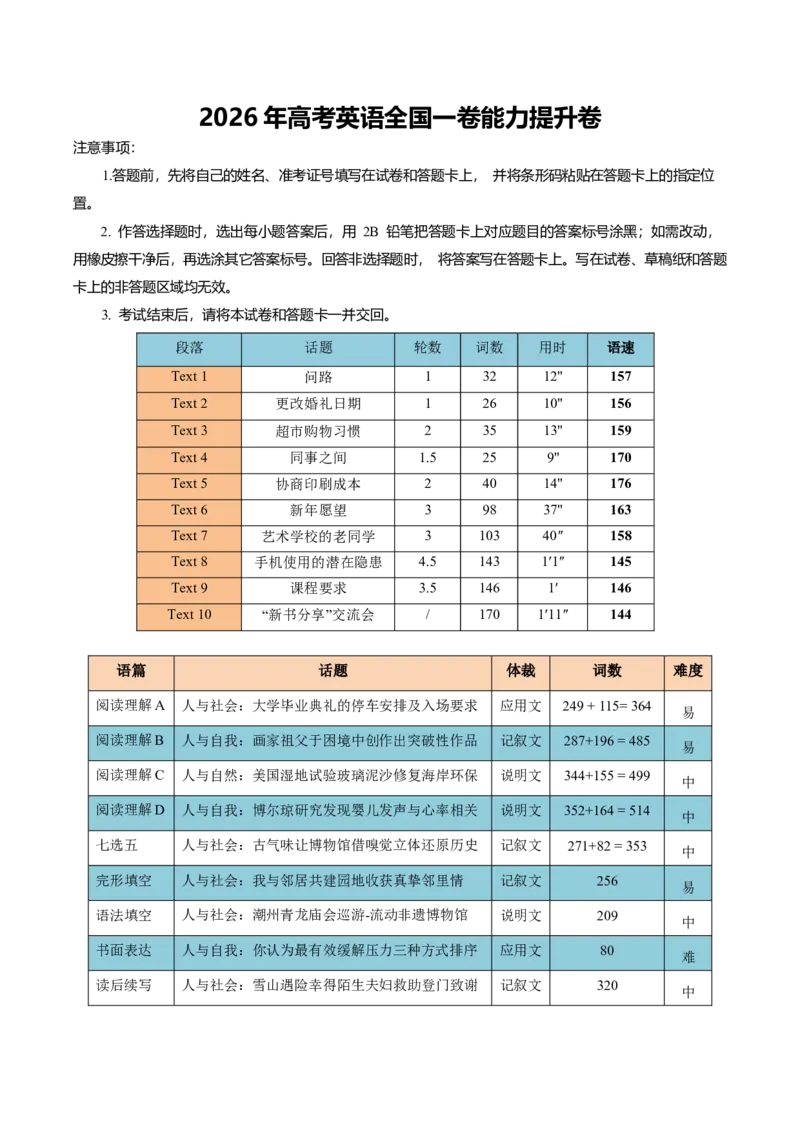
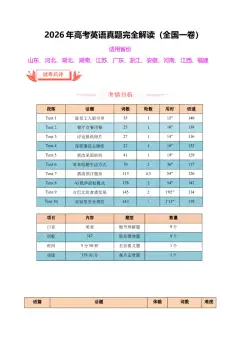
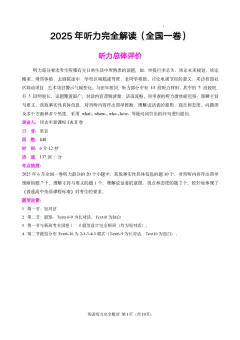
段落
话题
轮数
词数
用时
语速
Text 1
问路
1
32
12''
157
Text 2
更改婚礼日期
1
26
10''
156
Text 3
超市购物习惯
2
35
13''
159
Text 4
同事之间
1.5
25
9''
170
Text 5
协商印刷成本
2
40
14''
176
Text 6
新年愿望
3
98
37''
163
Text 7
艺术学校的老同学
3
103
40″
158
Text 8
手机使用的潜在隐患
4.5
143
1′1″
145
Text 9
课程要求
3.5
146
1′
146
Text 10
“新书分享”交流会
/
170
1′11″
144
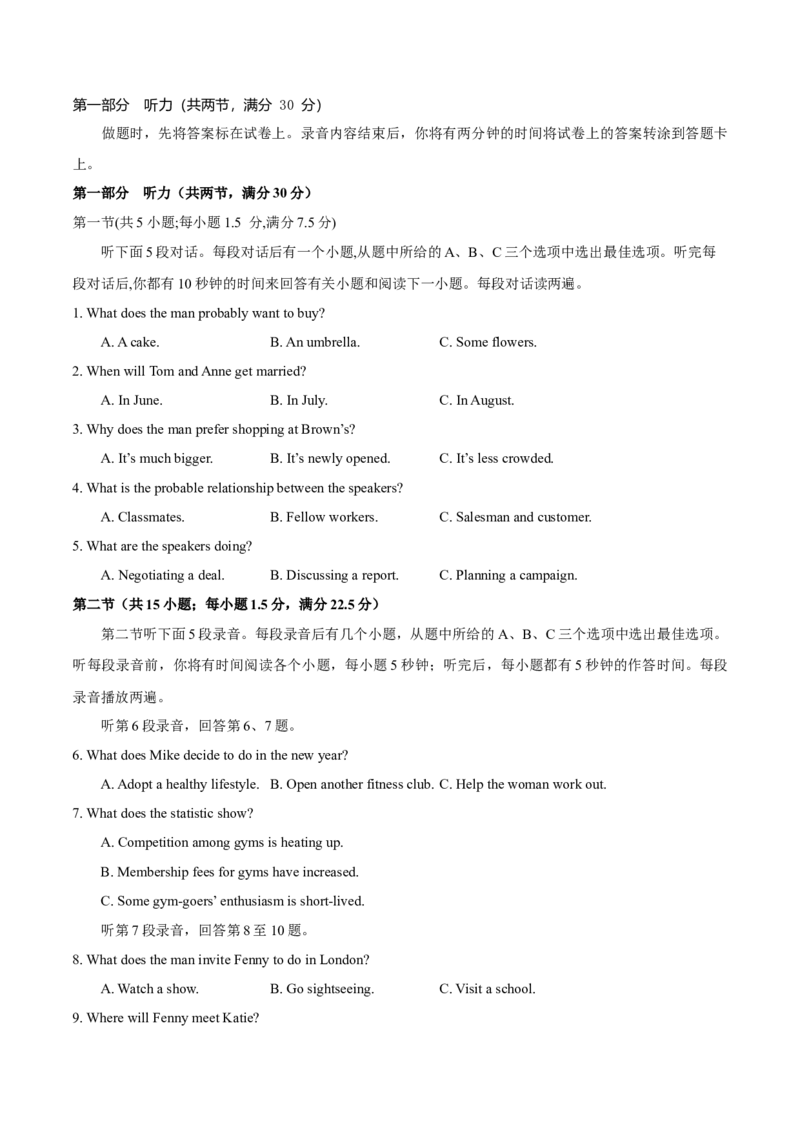
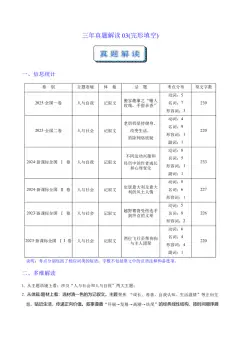
语篇
话题
体裁
词数
难度
阅读理解A
人与社会:大学毕业典礼的停车安排及入场要求
应用文
249 + 115= 364
易
阅读理解B
人与自我:画家祖父于困境中创作出突破性作品
记叙文
287+196 = 485
易
阅读理解C
人与自然:美国湿地试验玻璃泥沙修复海岸环保
说明文
344+155 = 499
中
阅读理解D
人与自我:博尔琼研究发现婴儿发声与心率相关
说明文
352+164 = 514
中
七选五
人与社会:古气味让博物馆借嗅觉立体还原历史
记叙文
271+82 = 353
中
完形填空
人与社会:我与邻居共建园地收获真挚邻里情
记叙文
256
易
语法填空
人与社会:潮州青龙庙会巡游-流动非遗博物馆
说明文
209
中
书面表达
人与自我:你认为最有效缓解压力三种方式排序
应用文
80
难
读后续写
人与社会:雪山遇险幸得陌生夫妇救助登门致谢
记叙文
320
中


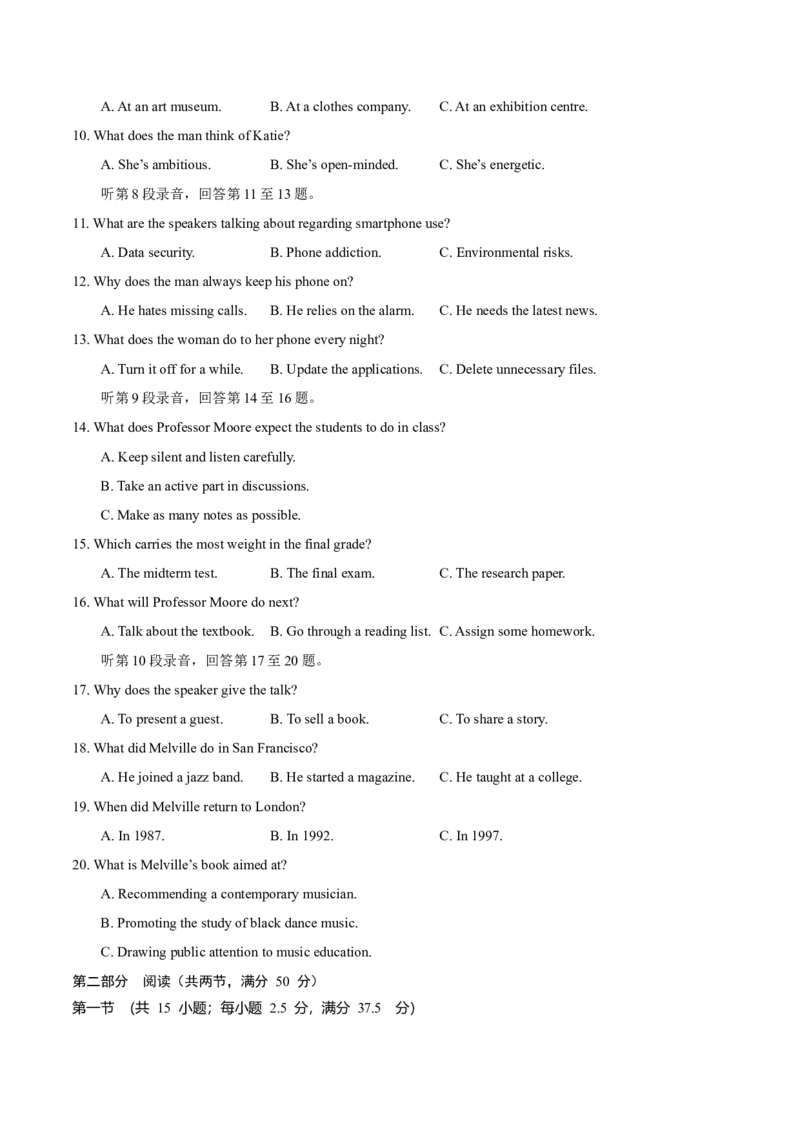
第一部分
听力(共两节,满分30 分)
做题时,先将答案标在试卷上。录音内容结束后,你将有两分钟的时间将试卷上的答案转涂到答题卡
上。
第一部分  听力(共两节,满分30 分)
第一节(共5 小题;每小题1.5 分,满分7.5 分)
听下面5 段对话。每段对话后有一个小题,从题中所给的A、B、C 三个选项中选出最佳选项。听完每
段对话后,你都有10 秒钟的时间来回答有关小题和阅读下一小题。每段对话读两遍。
1. What does the man probably want to buy?
A. A cake.
B. An umbrella.
C. Some flowers.
2. When will Tom and Anne get married?
A. In June.
B. In July.
C. In August.
3. Why does the man prefer shopping at Brown’s?
A. It’s much bigger.
B. It’s newly opened.
C. It’s less crowded.
4. What is the probable relationship between the speakers?
A. Classmates.
B. Fellow workers.
C. Salesman and customer.
5. What are the speakers doing?
A. Negotiating a deal.
B. Discussing a report.
C. Planning a campaign.
第二节(共15 小题;每小题1.5 分,满分22.5 分)
第二节听下面5 段录音。每段录音后有几个小题,从题中所给的A、B、C 三个选项中选出最佳选项。
听每段录音前,你将有时间阅读各个小题,每小题5 秒钟;听完后,每小题都有5 秒钟的作答时间。每段
录音播放两遍。
听第6 段录音,回答第6、7 题。
6. What does Mike decide to do in the new year?
A. Adopt a healthy lifestyle. B. Open another fitness club. C. Help the woman work out.
7. What does the statistic show?
A. Competition among gyms is heating up.
B. Membership fees for gyms have increased.
C. Some gym-goers’ enthusiasm is short-lived.
听第7 段录音,回答第8 至10 题。
8. What does the man invite Fenny to do in London?
A. Watch a show.
B. Go sightseeing.
C. Visit a school.
9. Where will Fenny meet Katie?
A. At an art museum.
B. At a clothes company.
C. At an exhibition centre.
10. What does the man think of Katie?
A. She’s ambitious.
B. She’s open-minded.
C. She’s energetic.
听第8 段录音,回答第11 至13 题。
11. What are the speakers talking about regarding smartphone use?
A. Data security.
B. Phone addiction.
C. Environmental risks.
12. Why does the man always keep his phone on?
A. He hates missing calls.
B. He relies on the alarm.
C. He needs the latest news.
13. What does the woman do to her phone every night?
A. Turn it off for a while.
B. Update the applications.
C. Delete unnecessary files.
听第9 段录音,回答第14 至16 题。
14. What does Professor Moore expect the students to do in class?
A. Keep silent and listen carefully.
B. Take an active part in discussions.
C. Make as many notes as possible.
15. Which carries the most weight in the final grade?
A. The midterm test.
B. The final exam.
C. The research paper.
16. What will Professor Moore do next?
A. Talk about the textbook.
B. Go through a reading list. C. Assign some homework.
听第10 段录音,回答第17 至20 题。
17. Why does the speaker give the talk?
A. To present a guest.
B. To sell a book.
C. To share a story.
18. What did Melville do in San Francisco?
A. He joined a jazz band.
B. He started a magazine.
C. He taught at a college.
19. When did Melville return to London?
A. In 1987.
B. In 1992.
C. In 1997.
20. What is Melville’s book aimed at?
A. Recommending a contemporary musician.
B. Promoting the study of black dance music.
C. Drawing public attention to music education.
第二部分  阅读(共两节,满分 50 分)
第一节 (共 15 小题;每小题 2.5 分,满分 37.5  分)
阅读下列短文,从每题所给的 A 、B 、C 、D 四个选项中选出最佳选项。
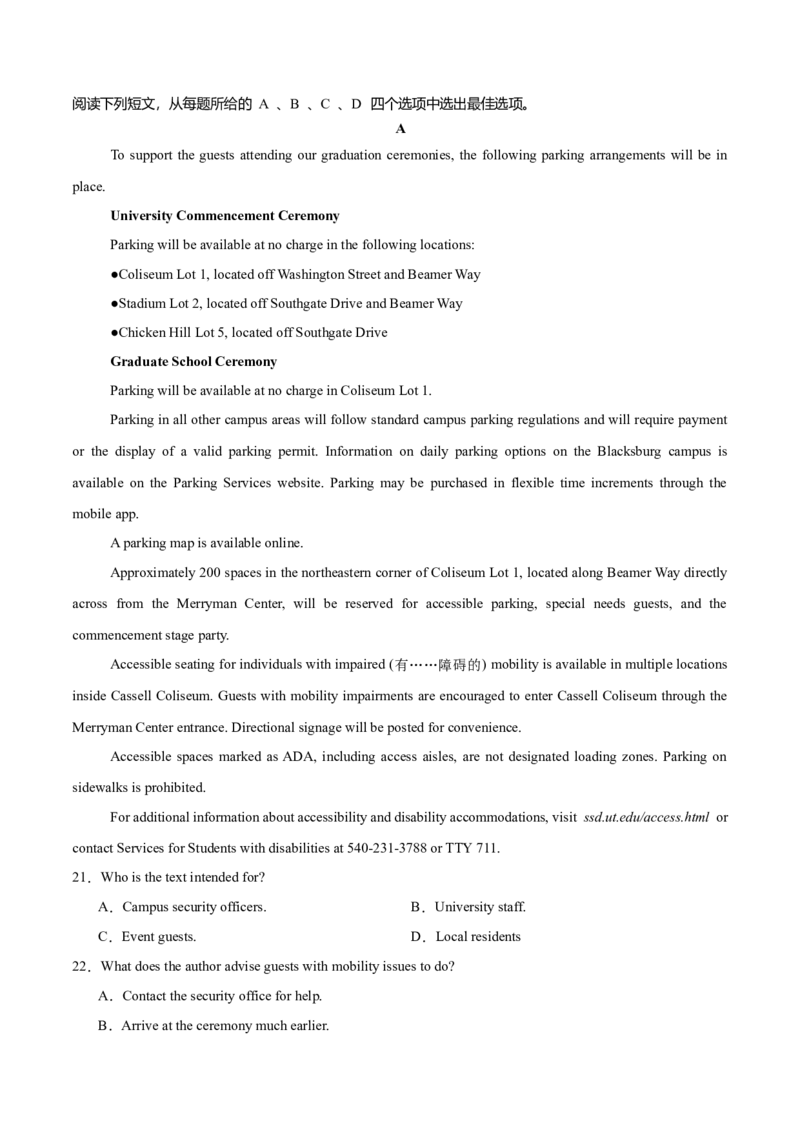
A
To support the guests attending our graduation ceremonies, the following parking arrangements will be in
place.
University Commencement Ceremony
Parking will be available at no charge in the following locations:
●Coliseum Lot 1, located off Washington Street and Beamer Way
●Stadium Lot 2, located off Southgate Drive and Beamer Way
●Chicken Hill Lot 5, located off Southgate Drive
Graduate School Ceremony
Parking will be available at no charge in Coliseum Lot 1.
Parking in all other campus areas will follow standard campus parking regulations and will require payment
or the display of a valid parking permit. Information on daily parking options on the Blacksburg campus is
available on the Parking Services website. Parking may be purchased in flexible time increments through the
mobile app.
A parking map is available online.
Approximately 200 spaces in the northeastern corner of Coliseum Lot 1, located along Beamer Way directly
across from the Merryman Center, will be reserved for accessible parking, special needs guests, and the
commencement stage party.
Accessible seating for individuals with impaired (有……障碍的) mobility is available in multiple locations
inside Cassell Coliseum. Guests with mobility impairments are encouraged to enter Cassell Coliseum through the
Merryman Center entrance. Directional signage will be posted for convenience.
Accessible spaces marked as ADA, including access aisles, are not designated loading zones. Parking on
sidewalks is prohibited.
For additional information about accessibility and disability accommodations, visit ssd.ut.edu/access.html or
contact Services for Students with disabilities at 540-231-3788 or TTY 711.
21.Who is the text intended for?
A.Campus security officers.
B.University staff.
C.Event guests.
D.Local residents
22.What does the author advise guests with mobility issues to do?
A.Contact the security office for help.
B.Arrive at the ceremony much earlier.
C.Purchase parking via the mobile app.
D.Enter through the Merryman Center entrance.
23.What is the primary purpose of this notice?
A.To advertise campus parking facilities.
B.To explain parking rules for a special event.
C.To criticize illegal parking behaviors.
D.To promote the use of a mobile parking app.
B
I’ve always been drawn to tales of how creativity emerges under the most unexpected pressure, revealing a
raw gift that comfort zones rarely show. A story my grandfather, a painter, often told comes to mind whenever I
face my own artistic blocks.
In his late fifties, Grandpa was invited to a major group exhibition. He had spent weeks preparing delicate
watercolor pieces. But the night before the opening, disaster struck: the package containing his brushes, paints and
fine paper went missing. All that remained in the exhibition hall was a pile of rough, oversized wooden boards and
a box of cheap charcoal (木炭) left behind by workers. Convinced he would have to pull out, Grandpa sat alone in
the silent hall, staring at the boards.
Then something shifted. Almost in a flash of inspiration, he picked up a piece of charcoal and began to draw
directly on the wood. The rough surface, which he had initially hated, forced his hand into bold, sweeping strokes
he had never dared attempt. The grain of the wood guided lines in ways smooth paper never could. By dawn, he
had produced a series of black-and-white works unlike anything he had ever created — raw, expressive, and
powerfully alive.
Those unplanned drawings became the talk of the exhibition. Critics described them as “a pure explosion of
emotion”. Grandpa later told me, “That night, I wasn’t painting from skill; I was painting from necessity. And that
necessity unlocked a side of me I never knew existed.” His words stayed with me. When the familiar is taken away,
we are often pushed to discover a purer creative force. It is precisely in moments of discomfort that our true
potential decides to surface.
24.What can we learn from the first paragraph?
A.The author got inspired by his grandpa.
B.Comfort zones contributed to unfolding people’s talent.
C.The grandfather shared painting skills with the author.
D.The author disbelieved that creativity was from pressure.
25.What unexpected difficulty did Grandpa face before the exhibition?
A.The invited critics refused to attend.
B.His artworks were damaged in the disaster.
C.The gallery asked him to change his painting style.
D.His materials got lost and only rough boards were left.
26.How did Grandpa view that night’s experience?
A.As a turning point that unfolded his hidden potential.
B.As a lesson on the importance of proper tools.
C.As a disaster caused by his poor preparation.
D.As a night he wasted on worthless boards.
27.What message does the author want to convey?
A.Skills come from hard work over time.
B.Great art depends on perfect planning.
C.We should never give up our familiar tools.
D.Discomfort often brings out our hidden strengths.
C
In the 1960s, the once-fertile wetland of Bayou Bienvenue in southeast Louisiana fell victim to saltwater
invasion, ruining the native trees. Today, this area has become a living laboratory for innovative coastal restoration
approaches that could help protect exposed communities from increasingly powerful hurricanes and address waste
management challenges.
At the heart of this restoration effort sits a 10-meter-width artificial island constructed from an
unconventional mixture of recycled glass ground (磨) into sand and Mississippi River sediment (沉淀物). Nearby,
a control island made entirely of sediment allows scientists to conduct comparative studies on plant growth and
ecosystem development. This project, led by community ecologist Sunshine Van Bael from Tulane University,
seeks to determine whether glass sand mixtures could serve as an alternative material for coastal ecosystem
restoration projects.
As climate change intensifies sea level rise and coastal erosion (侵蚀), wetlands and mangrove forests are
increasingly threatened. Traditional restoration approaches typically rely on sediment, which pose two significant
challenges: limited availability and potential ecological disturbance to surrounding habitats in the process of
collecting sediment. The glass sand solution addresses both issues while also tackling waste management concerns,
as millions of tons of glass end up in landfills annually.
Van Bael’s team specifically examined wetland plants, including various grasses and trees, growing them in
five-gallon containers holding either Mississippi River sediment, glass sand, or an even mixture of both. The
research findings are auspicious. Plants grown in glass-sediment mixtures performed as well as those grown only
in sediment. Similarly promising results emerged from another study focusing on salt marsh grasses native to
Mississippi, with one species even thriving in a mixture containing 75 percent glass sand.
Over the next five years, Van Bael and her colleagues will continue monitoring the experimental islands,
with plans to construct two additional islands for further study. As coastal communities worldwide face intensifying
climate threats, this creative integration of waste management and ecosystem restoration offers an example of how
innovative thinking can help address complex environmental challenges while building more resistant landscapes.
28.What is the project aimed at?
A.To reduce pollution of Mississippi.
B.To test a new restoration material.
C.To grow various wetland plants.
D.To build wider artificial islands.
29.What does the underlined word “auspicious” in paragraph 4 mean?
A.Alarming.
B.Unexpected.
C.Encouraging.
D.Impractical.
30.What does the author imply in the last paragraph?
A.Coastal communities offer innovative solutions.
B.Waste management is the core of climate action.
C.The project provides a new angle for eco-protection.
D.Van Bael’s team has completed the experimental task.
31.What can be a suitable title for the text?
A.Climate Change:A Factor for Coastal Erosion
B.Glass Waste: A Challenge to Coastal Ecosystems
C.Wetland Plants: A Foundation to Climate Protection
D.Recycled Glass: An Innovation for Coastal Restoration
D
The soft, gentle sounds of a baby’s first expressions, like little whispers of joy and wonder to parents, are
actually signs that the baby’s heart is working steadily together with developing speech.
Jeremy I. Borjon, assistant professor of psychology at the University of Houston, published research in
Proceedings of the National Academy of Sciences showing that a baby’s first sweet sounds and early attempts at
forming words are directly linked to the baby’s heart rate.
For babies, producing recognizable speech is more than a cognitive (认知的) process. It is a motor skill that
requires them to learn to coordinate ( 协调) multiple muscles of varying functions across their bodies. This
coordination is directly linked to ongoing fluctuations (波动) in heart rate.
Borjon investigated whether fluctuations in heart rate are consistent with vocal ( 声音的) production and
word production in 24-month-old babies. “It turns out that babies were most likely to vocalize when their heart rate
fluctuation reaches a local peak (maximum) or local trough (minimum),” reports Borjon. “Vocalizations produced
at the peak were longer than expected by chance. Vocalizations produced just before the trough, while the heart rate
is decreasing, were more likely to be recognized as words by listeners.”
Borjon and his team measured a total of 2, 708 vocalizations produced by 34 babies aged between 18 and 27
months while the babies played with a caregiver. Babies in this age group typically don’t speak whole words yet,
and only a small part of the vocalizations — about 10.3% — can be reliably identified as words by listeners. “Every
sound a baby makes helps their brain and body learn how to coordinate with each other, eventually leading to
speech,” Borjon said.
The findings have implications for understanding language development and potential early indicators of
speech and communication disorders. “Understanding how the autonomic nervous system relates to baby
vocalizations throughout development is a critical area of future research for understanding how language emerges,
as well as to identify risk factors for atypical (非典型的) language development,” said Borjon.
32.What is the focus of the research regarding babies?
A.Caregivers’ role in early speech.
B.The importance of body coordination.
C.Motor skills’ impact on early speech.
D.Heart rate’s connection to early speech.
33.What does paragraph 3 aim to stress?
A.The challenges of learning to speak.
B.The importance of body coordination.
C.The theoretical foundation of the study. D.The importance of cognitive development.
34.When are babies’ sounds most likely recognized as words?
A.The heart rate is stable.
B.The heart rate is increasing.
C.The heart rate is slowing down.
D.The heart rate is at a peak.
35.What is a potential benefit of the research for parents?
A.To teach children to speak early.
B.To detect babies’ speech delays earlier.
C.To monitor babies’ heart rate better.
D.To improve parent-child communication.
第二节 (共 5 小题;每小题 2.5 分,满分 12.5 分)
阅读下面短文,从短文后的选项中迭出可以填入空白处的最佳选项。选项中有两项为多余选项。
What’s the first thing you notice when you step into a museum? Is it the long-faded colors of ancient artifacts
or the sounds of visitors discussing what they see?     36     Some locations might even offer an eatable treat
inspired by an ancient recipe. Museums allow us to indirectly experience the past by tapping into our primary
senses — sight, hearing, touch, taste.     37
“Representations of the past are often scentless (无气味的), but smell probably played a huge role in many
historical realities,” says Barbara Huber, an archaeologist in Germany.     38     She and her workmates tracked
down some molecular (分子的) remains that can let us smell the past. Through trial and error, they created Scent of
the Afterlife, a mix of scent that would have accompanied mummification processes in ancient Egypt.
“    39     One of the reasons is that it is incredibly hard to study. The scents and smells in the past were
already gone before archaeologists could come and investigate the sites,” says Huber. Luckily, new chemical and
biomolecular methods in archaeology have kind of reopened the door to continue to study these things.
“These molecules that we detect can tell us a lot about ancient materials. At the same time, when we
reconstruct them like we did with Scent of the Afterlife, we can bring a piece of the past to visitors today.     40
” says Huber. “If you enter a room and can somehow smell how it must have smelled in a mummification room in
ancient Egypt, you’re experiencing the history in a different way. History isn’t something we only see.”
A.It can also enrich our understanding of smells.
B.However, more often than not, smell is missing.
C.Smell has long been ignored in studying the past.
D.Maybe there’s a copy of a sculpture you can touch.
E.And the exhibit in the museum is not just a displayed object.
F.This “aha moment” changed her attitude towards the research.
G.The obvious absence of scent in the study of history inspired her.
第三部分  语言运用(共两节,满分 30 分)
第一节  (共 15 小题;每小题 1 分,满分 15 分)
阅读下面短文,从每题所给的 A 、B 、C 、D 四个选项中选出最佳选项。
Last year when I moved to a new neighborhood, I felt lonely. Most residents knew each other well — sharing
stories,     41     with groceries, even remembering pets’ names. But I kept to myself, busy with work and
42     my old town. I thought loneliness was part of city life until I saw an overgrown community     43

at the street corner. A sign read, “Grow together, share together.” That weekend, I took gloves and a shovel to     44
a small section of the garden, just to pass time. To my surprise, an elderly man named Mr. Torres     45     me.
He brought a bag of fresh tomato seeds and a smile, “This used to be the     46     of the neighborhood.” he
said. Soon, more neighbors came: Mia, a teenager, helped pull weeds and     47     sunflower seeds; Mrs. Li
taught me to pick ripe cucumbers; the librarian brought homemade snacks for everyone.
But then, a late frost hit. My cabbage died, leaving me     48    . But Mrs. Li gave me carrot seedlings,
and Mr. Torres shared frost protection     49    . With their help, my patch recovered. By summer, the garden
50     sunflowers, tomatoes, and fragrant herbs. Every Saturday, we had a harvest     51    , swapping
vegetables and stories. I felt connected at last.
Later, when I traveled for work, neighbors     52     my plants. I realized the garden grew not just
vegetables, but     53    . Now, I help Mrs. Li with groceries, and Mia and I plant sunflowers     54    .
Connection needs efforts. Small     55    , I learned, build real connection.
41.A.providing
B.dealing
C.helping
D.mixing
42.A.forgetting
B.leaving
C.visiting
D.missing
43.A.park
B.garden
C.yard
D.square
44.A.clear
B.cover
C.dig
D.water
45.A.followed
B.stopped
C.guided
D.joined
46.A.midpoint
B.symbol
C.heart
D.pride
47.A.pick
B.sow
C.collect
D.store
48.A.relaxed
B.surprised
C.discouraged
D.satisfied
49.A.plants
B.tools
C.seeds
D.tips
50.A.bloomed
B.closed
C.failed
D.appeared
51.A.donation
B.trade
C.share
D.distribution
52.A.threw away
B.looked after
C.pulled up
D.picked out
53.A.relationships
B.responsibilities
C.independence
D.respect
54.A.hurriedly
B.secretly
C.hardly
D.yearly
55.A.plants
B.meetings
C.acts
D.words
第二节  (共 10 小题;每小题 1.5 分,满分 15 分)
阅读下面短文,在空白处填入 1 个适当的单词或括号内单词的正确形式。
The Qinglong Temple Fair, serving as an important link connecting Chaozhou communities both domestic
and overseas,    56   (be) a significant part of Chaozhou’s traditional culture. Many tourists have an urge    57
(participate) in this event. But if you don’t know the local history, some customs may be beyond your    58
(comprehend).
The Qinglong Ancient Temple was superior    59    all other local temples in some aspects. It was named
after the frequently    60   (see) green snakes wandering near the temple without doing harm to people.
Annually, the Qinglong Temple Fair    61   (hold) from the 13th day to the 28th day of the first lunar
month. The festival involves parading the wooden statue,    62    is known as Laoye, through the streets in a
celebratory activity. The whole town would eagerly come out to witness the parade,    63   (pray) for favorable
weather, family safety and business success.
This year, the parade, with    64    number of participants, started from Qinglong Ancient Temple, passed
through various tourist spots and major streets in the city, and then returned to Qinglong Ancient Temple.
This temple fair is a moving museum of intangible cultural heritage. It     65    (genuine) shows
Chaoshan people’s attachment to their cultural identity rooted in their hometown and their love for their home
country.
第四部分  写作(共两节,满分 40 分)
第一节 (满分 15 分)
你校英语报 “Opinion” 栏目正在征稿,请从三种缓解压力的方式中按重要性排序,并阐述理由。
A. 户外运动 Outdoor Sports B. 倾诉谈心 Talk with Friends C. 静心阅读 Quiet Reading
注意:
(1)写作词数应为 80 个左右;
(2)请按答题卡给定标题格式作答。
Ranking My Stress Relief Ways
第二节 (满分 25 分)
阅读下面材料,根据其内容和所给段落开头语续写两段,使之构成一篇完整的短文。
Jean set off for a mountain trip in the Sierra Nevada, a famous mountainous area in California.She had a
deep love for outdoor adventures (冒险) and was always prepared for her trips. She had taken many wild mountain
trips there before, so she was quite familiar with the local terrain (地形) and road conditions. However, right after
she climbed up to a mountain top, a sudden terrible storm arrived without any warning. It began to snow heavily at
once, and very soon, she found herself trapped in the middle of a violent snowstorm.
Standing at the highest point for miles around, Jean was at great risk of being hit by lightning.She gave up
the original plan of going back along the fixed trail (小径) and chose to climb down the steep and icy mountain
slope carefully, believing in her climbing experience and skills.
Unluckily, during one difficult part on the way, Jean suddenly slipped and fell more than 100 feet down the
rocky mountain. She was lucky enough to stay alive after the fall, but she suffered serious injuries, with many
broken bones and terrible body pain.
Worse still, because of the extreme weather, there was no signal on her mobile phone, which made it totally
impossible for her to call anyone for help. Jean had no choice but to walk slowly through deep snow all the way
back to the starting trailhead. Throughout the journey back, Jean suffered continuously from great pain. When she
finally walked with difficulty into a parking lot, Jean immediately fell down to the ground. It had been exactly one
day since she fell down from the mountain. Her clothes were all covered with blood, and she was too tired to hold
on, nearly passing out on the spot.
Just then, a car pulled in. A man was driving, with his wife in the passenger seat.
注意:1.续写词数应为150 个左右;
2.请按如下格式在答题卡的相应位置作答。
Seeing Jean’s condition, the man jumped out to help.
____________________________________________________________________________________________
____________________________________________________________________________________________
____________________________________________________________________________________________
As soon as Jean left the hospital, she managed to get the couple’s address.
____________________________________________________________________________________________
____________________________________________________________________________________________
____________________________________________________________________________________________