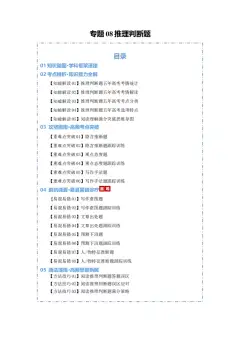
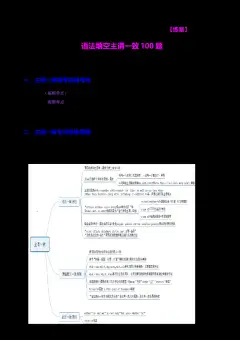
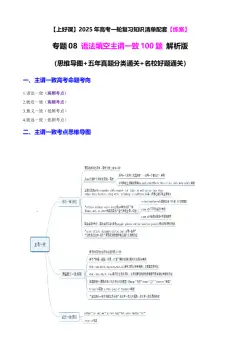
清单08 语法填空之2022-2026 高考真题话题分类
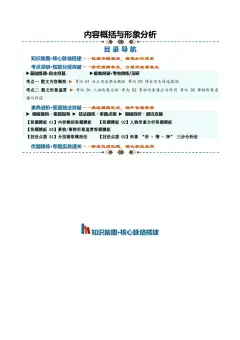
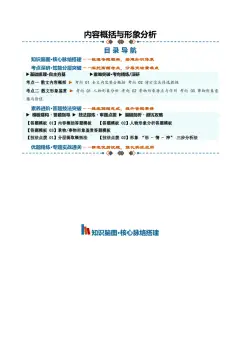
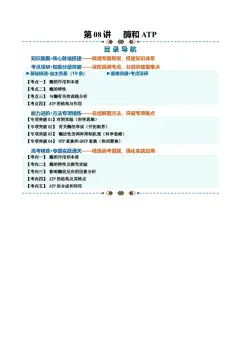
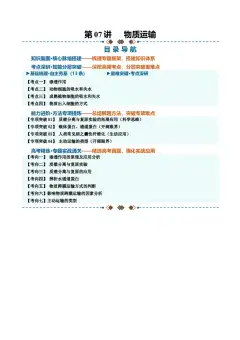
目录导航
01 知识脑图·核心脉络搭建——梳理专题框架,搭建知识体系
02 考点深研·知能分层突破——深挖高频考点,分层突破重难点
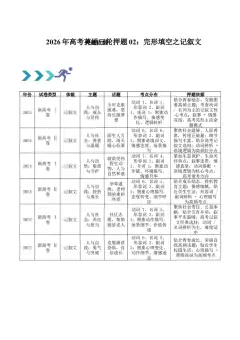
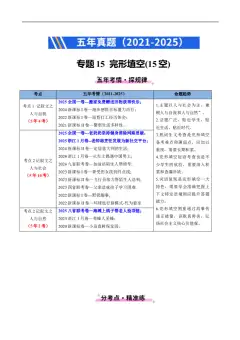
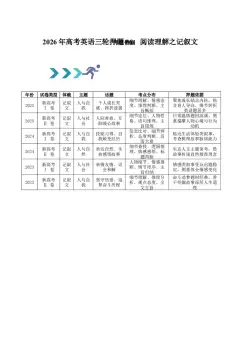
分类一  记叙文—生活故事
1.2026 全国二卷---作者首次清晨跟随老师体验太极课程的经历与感悟;
2.2026 浙江1 月卷—作者回忆童年时与母亲一起度过的快乐时光;
3.2025 全国二卷---从美国到浙江农村生活感受;
4.2023 新课标II 卷--动物园教英语;
5.2022 新课标全国II—修理工救坠落孩子;
6.2022 全国甲卷—失明男子徒步一带一路国家
分类二  说明文-传统文化
1.2026 全国一卷---中国农村集市“大集”的日期、频率、历史渊源以及现代赶集的场景;
2.2025 全国一卷---以围棋为灵感的艺术展览;
3.2024 新课标I 卷--古丝绸之路丝路花园互鉴;
4.2024 新课标II 卷—跨文化交流--汤显祖和莎士比亚互鉴;
5.2023 新课标I 卷—美食小笼包;
6.2023 全国甲卷—寓言故事智慧和意义;
7.2023 全国乙卷—魅力北京新旧结合;
8.2023 浙江1 月卷—北京胡同;
9.2022 新课标全国I 卷—大熊猫国家公园;
10.2022 全国乙卷--庆祝国际茶日
分类三  说明文-科学技术
1.2025 浙江1 月卷—服装租赁因经济环保流行;
2.2024 全国甲卷—美国国家公园;
3.2024 浙江1 月卷—商家促销;
4.2022 年浙江6 月卷—给盲人展示触觉画;
5. 2022 年浙江1 月卷—减少飞行应对气候挑战;
03 优题精练·专题实战通关——精选优质试题,强化实战应用
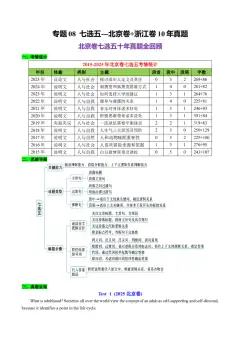
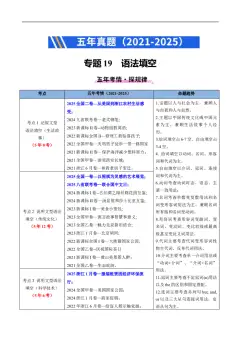
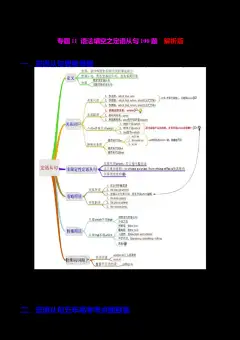
知识脑图·核心脉络搭建
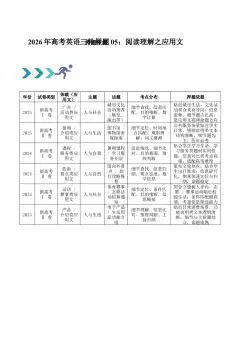
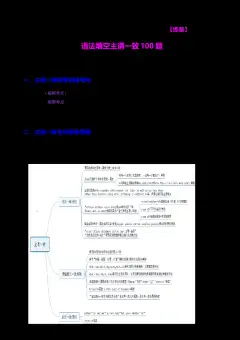
分类
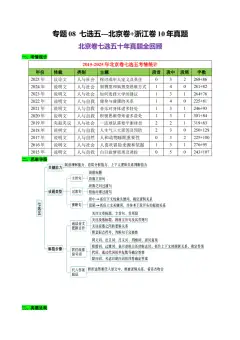
五年考情(2022-2026)
 记叙文-生活故事
2026 全国二卷---作者首次清晨跟随老师体验太极课程的经历与感悟;
2026 浙江1 月卷—作者回忆童年时与母亲一起度过的快乐时光;
2025 全国二卷---从美国到浙江农村生活感受;
2023 新课标II 卷--动物园教英语;
2022 新课标全国II—修理工救坠落孩子;
2022 全国甲卷—失明男子徒步一带一路国家
说明文-传统文化
2026 全国一卷---中国农村集市“大集”的日期、频率、历史渊源以及现代赶集的
场景;
2025 全国一卷---以围棋为灵感的艺术展览;
2024 新课标I 卷--丝绸之路对英格兰花园的影响;
2024 新课标II 卷—跨文化交流--汤显祖和莎士比亚互鉴;
2023 新课标I 卷—美食小笼包;
2023 全国甲卷—寓言故事智慧和意义;
2023 全国乙卷—魅力北京新旧结合;
2023 浙江1 月卷—北京胡同;
2022 新课标全国I 卷—大熊猫国家公园;
2022 全国乙卷--庆祝国际茶日
说明文-科学技术
2025 浙江1 月卷—服装租赁因经济环保流行;
2024 全国甲卷—美国国家公园;
2024 浙江1 月卷—商家促销;
2022 年浙江6 月卷—给盲人展示触觉画;
2022 年浙江1 月卷—减少飞行应对气候挑战;
优题精练●专题实战通关
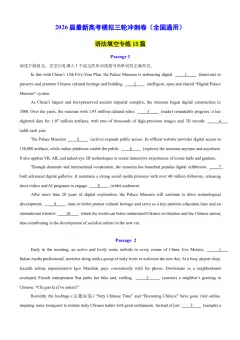
类型1 记叙文—生活故事(6 篇)
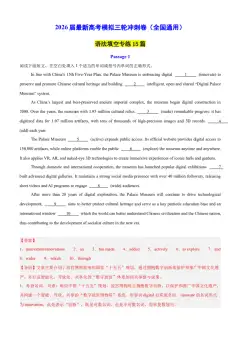
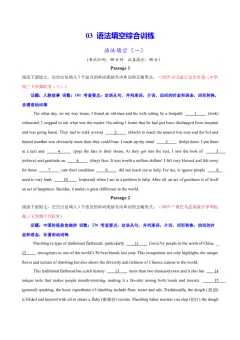
Passage 1
(2026 全国Ⅱ卷--作者首次清晨跟随老师体验太极课程的经历与感悟)
My first time doing tai chi
For the first 15 minutes of my tai chi (太极) class, we remain ____56____ (entire) in one spot to warm up.
Angela, a tai chi ____57____ (instruct) with twenty-eight years of experience, says that a successful hour of tai chi
is an hour with no negative thoughts. “Your mind ____58____ body go together. That’s all that matters.”
Although not a morning person, I begin my lesson with Angela and about twenty others at a Sydney
community centre courtyard at 7 am. “Put your ____59____ (foot) parallel (平行), and use your dan tian to hold
up your body,” she says.
In tai chi, the dan tian is your qi core and qi in Chinese means life force. Now, I ____60____ (suppose) to
feel the weight on my legs and sink my dan tian.
We move on to tai chi positions, of ____61____ there are forty-two in the style that Angela teaches. Today,
we will only be doing the first nine. The movements have ____62____ (describe) names like “holding the bowl”
and “grabbing the bird’s tail.”
During most of the class, we follow Angela and concentrate on making tiny, isolated (单独) movements. Then,
Angela gets us to try the nine movements on our own. I keep my eyes ____63____ a woman to my right and try to
copy her movements, but unfortunately I soon lose focus.
At the end of the lesson, I feel wide awake, despite it still ____64____ (be) early at 8 am. It’s time for my
dan tian ____65____ (meet) another life force: coffee.
Passage 2
(2026 浙江1 月卷-作者回忆童年时与母亲一起度过的快乐时光)
There are few people who could find joy in waiting for a microwave (微波炉) ____36____ (finish) heating,
but my mum did it. One of my earliest memories is being held ____37____ her arms, counting down the flashing
green ____38____ (number) together. Mum is small, but I remember feeling so high up there. She would dance us
left and right around the kitchen, our eyes ____39____ (watch) the microwave like it was a space rocket
countdown, ____40____ (excite) and tension building to that final moment: BEEP! The microwave had a loud
alarm, but we overshadowed that noise with our own performance, tipping our heads back and shouting into the air-
a scream ____41____ always ended in laughter.
My mum would find fun even when completing the most boring of tasks. I remember ____42____ (push) in
a supermarket trolley (手推车) over ____43____ uneven car park ground like riding a rollercoaster. She would
speed up, the wind blowing our hair back ____44____ my tiny voice singing out, “Weeee-eee-eee!”
I realise now that Mum didn’t find the joy in these tasks: she created it. Who cares if neighbours can hear you
singing along to a microwave? Life is full of so many ____45____ (seeming) uneventful moments, but we can
turn any of them into a celebration.
Passage 3
 (2025 全国二卷--从美国到浙江农村生活感受)
I was born and raised in Cleveland, Ohio in the United States. Yet now, I live in the countryside of Zhejiang,
China with my Chinese husband and his family,     56    bamboo and tea bushes (灌木) grow wild in the
mountains, chickens are always free-range, and     57     (center) heating doesn’t exist.
Nothing in my life before prepared me     58     this one-and to be sure, the first time I came here I never
imagined I would ever feel comfortable in this area. But it’s amazing how you can adapt     59     learn in a
new environment. Over time, I’ve found     60     (I) feeling extremely at home here. And in the process, I’ve
experienced things that really surprise me at times. The “sunshine scent (香味)” of freshly sunned clothes     61
(be) one of them.
     Growing up, my family and our neighbors never used clotheslines to dry clothing. denying me the chance
62     (discover) one of the great wonders of sunshine — the sweet “sunshine scent” after sunning clothes for an
entire day. The sun-dried clothes smell especially pleasant where I live, thanks to the     63     (absent) of smog
and plenty of blue sky     64     (afternoon) with lots of fresh air.
If you’ve never experienced the “sunshine scent” from a sheet or shirt     65     (leave) to sun for a day,
well, you’re missing out on one of life’s wonders.
Passage 4
(2023 新课标II 卷--动物园教英语)
Whenever I tell people that I teach English at the Berlin Zoo, I almost always get a questioning look. Behind
it, the person is trying to figure out who exactly I teach…the animals?
Since June 2017, right before the    56    (arrive) of the two new pandas, Meng Meng and Jiao Qing, I have
been helping the panda keepers at the zoo to feel more comfortable and    57    (confidence) speaking English.
And who do they speak English    58   ?
Not the pandas, even though    59    language used for the medical training instructions is actually English.
They talk to the flood of international tourists and to    60    (visit) Chinese zookeepers who often come to
check on the pandas, which are on loan from China. They also need to be ready to give    61    (interview) in
English with international journalists. This is    62    they need an English trainer.
So, what are they learning?   63    (basic), how to describe a panda’s life. It’s been an honor to watch the
panda programme develop    64    to see the pandas settle into their new home. As a little girl, I    65
(wish) to be a zookeeper when I grew up. Now, I’m living out that dream indirectly by helping the panda keepers
do their job in English.
Passage 5
(2022 新课标全国II 卷--修理工救坠落孩子)
Henry Tyler made the catch of the year on the weekend. When he saw a young child hanging from a sixth-
floor apartment balcony (阳台), Henry ran one hundred metres, jumped over a 1.2-metre fence, and held out his
arms to catch the     56    (fall) child.
Eric Brown, only three years old, knocked Henry down when he fell. The boy is in the hospital and doctors
say he'll be OK.
    57     Brown family live in an apartment building outside Toronto. On the day of the accident, Mrs.
Brown was at work and Eric was at home with his father. They both fell     58    (sleep) while watching TV.
Eric woke up a little later when he heard children playing outside. He pushed a chair onto the balcony, and
climbed up     59    (see) them. When he looked down, he     60    (accidental ) slipped and fell over the
edge. He hung on for a few minutes     61     screamed for his father, but his father didn't hear him.
Henry     62    (fix) his car when he heard the screams. He looked up and saw Eric hanging from the
balcony. He quickly     63    (throw) his tools aside, and started running, arms out.
He saved my     64    (son) life," said Mrs. Brown. "I don't know     65     to thank him.”
"I just didn't want the boy to be hurt," said Henry.
Passage 6
(2022 全国甲卷--失明男子徒步一带一路国家)
A visually-challenged man from Beijing recently hiked ( 徒步) 40 days to Xi’an, as a first step     61

(journey) the Belt and Road route (路线) by foot.
On the 1,100. Kilometer journey, the man Cao Shengkang,    62     lost his eyesight at the age of eight in a
car accident, crossed 40 cities and counties in three province. Inspired by the Belt and Road Forum for International
Cooperation    63     (hold) in Beijing, Cao decided to cover the route by hiking as a tribute ( 致敬) to the
ancient Silk Road.   64     friend of his, Wu Fan, volunteered to be his companion during the trip.
Cao and Wu also collected garbage along the road, in order to promote environmental    65    (protect).
Cao believes this will make the hiking trip even more    66     (meaning). The two of them collected more than
1,000 plastic bottles along the 40-day journey.
In the last five years, Cao    67     (walk) through 34 countries in six continents, and in 2016, he reached
the top of Kilimanjaro, Africa’s    68     (high) mountain.
Now, Cao has started the second part of his dream to walk along the Belt and Road route. He flew 4, 700
kilometers    69     Xi’an to Kashgar on seat 20,   70     (plan) to hike back to Xi’an in five months.
类型2 说明文—传统文化(10 篇)
Passage 1
 (2026 全国Ⅰ卷--中国农村集市“大集”的日期、频率、历史渊源以及现代赶集的场景)
Daji, or big open-air fairs, typically take place on specific dates of the lunar calendar, for example, on dates
with five or seven as the last digit. It is also common for them ____56____ (hold) during traditional Chinese
holidays such as the Spring Festival and the Mid-Autumn Festival, as well as other local festivals. The exact dates
and ____57____ (frequent) of daji vary from region to region.
Daji originated from the ancient folk custom of trading goods, which dates back to ____58____ Han Dynasty.
As transportation and communication ____59____ (be) underdeveloped at that time, it was very difficult for
households to obtain daily ____60____ (necessity). As a solution, people gathered at specific locations on set days
to trade their surplus (剩余的) items ____61____ what they needed.
In addition to being venues for buying and selling, daji are occasions for socializing and entertainment.
People from near and far crowd into these markets on daji days. ____62____ (draw) by the aroma (香味) of
street food, they line up in front of stands ____63____ serve steaming dumplings and hot noodle soup. While
eating and enjoying street performances, they chat with each other and share stories of their daily lives. Before
____64____ (head) home, they fill their shopping bags with fresh fruit and vegetables from local farmers, at prices
significantly ____65____ (cheap) than those found in supermarkets.
Passage 2
(2025 全国Ⅰ卷--以围棋为灵感的艺术展览)
An exhibition at the Jiushi Art Museum in Shanghai is featuring artwork inspired by Go, or weiqi in Chinese,
56       originated in China more than 4,000 years ago.
Go is one of     57       earliest binary-based (基于二元的) games. The movements of the black and
white pieces reflect the basic ideas of Eastern philosophy, according to Tu Ningning, who is in charge of the
exhibition.
“The exhibition brings together Go culture, cutting-edge technology and contemporary art,” says Tu. “We
hope     58       (present)the rather abstract Go game and AI in a visual context, and initiate dialogues with
minimalist art, conceptual art and expressionism.”
“In a Go game, each move should serve a long-term goal. You try to lead the opponent into your trap and force
them to follow your     59      (guide) till they lose,” explains Wang Wei, a Go player among the visitors to
the exhibition.
“The players’ personalities     60      (reveal) during the game, and one’s weaknesses are exposed to the
opponent,” she adds. “A decent winner always     61      (try) to beat the opponent     62       no more
than one or two points as a gesture (姿态) of respect for the other side. ”
Tu says that the balance between the black and white pieces, the beauty in the     63      (strategy)
placement of the pieces,     64       the energy flow following each move inspired artists to create oil
paintings, sculptures,     65       (digital) generated pictures and silk-screen prints for the exhibition.
Passage 3
(2024 新课标I 卷-丝绸之路对英格兰花园的影响)
Heatherwick Studio recently built a greenhouse at the edge of the National Trust’s Woolbeding Gardens.
This beautiful structure, named Glasshouse, is at the centre of a new garden that shows how the Silk Road
influences English gardens even in modern times.
The latest    56    (engineer) techniques are applied to create this protective    57    (function)
structure that is also beautiful. The design features ten steel “sepals (萼片)” made of glass and aluminium (铝).
 These sepals open on warm days    58    (give) the inside plants sunshine and fresh air. In cold weather,
the structure stays    59    (close) to protect the plants.
Further, the Silk Route Garden around the greenhouse    60    (walk) visitors through a journey
influenced by the ancient Silk Road, by which silk as well as many plant species came to Britain for    61
first time. These plants included modern Western    62    (favourite) such as rosemary, lavender and
fennel. The garden also contains a winding path that guides visitors through the twelve regions of the Silk
Road. The path offers over 300 plant species for visitors to see, too.
The Glasshouse stands    63    a great achievement in contemporary design, to house the plants of the
southwestern part of China at the end of a path retracing ( 追溯) the steps along the Silk Route    64
brought the plants from their native habitat in Asia to come to define much of the    65    (rich) of
gardening in England.
Passage 4
(2024 新课标Ⅱ卷--跨文化交流--汤显祖和莎士比亚互鉴)
Chinese cultural elements commemorating (纪念) Tang Xianzu,    56      is known as “the Shakespeare of
Asia,” add an international character to Stratford-upon-Avon, William Shakespeare’s hometown.
Tang and Shakespeare were contemporaries and both died in 1616. Although they could never have met, there
are common     57      (theme)in their works, said Paul Edmondson, head of research for the Shakespeare
Birthplace Trust. “Some of the things that Tang was writing about     58      (be) also Shakespeare’s concerns.
I happen to know that Tang’s play The Peony Pavilion (《牡丹亭》) is similar in some ways     59      Romeo
and Juliet.”
A statue commemorating Shakespeare and Tang was put up at Shakespeare’s Birthplace Garden in 2017. Two
years later, a six-meter-tall pavilion,    60      (inspire)by The Peony Pavilion,    61      (build)at the Firs
Garden, just ten minutes’ walk from Shakespeare’s birthplace.
Those cultural elements have increased Stratford’s international     62      (visible), said Edmondson,
adding that visitors walking through the Birthplace Garden were often amazed     63      (find)the connection
between the two great writers.
    64      (recall)watching a Chinese opera version of Shakespeare’s play Richard III in Shanghai and
meeting Chinese actors who came to Stratford a few years ago to perform parts of The Peony Pavilion, Edmondson
said, “It was very exciting to hear the Chinese language     65      see how Tang’s play was being performed.”
Passage 5
(2023 新课标I 卷--美食小笼包)
Xiao long bao (soup dumplings), those amazing constructions of delicate dumpling wrappers, encasing hot,
56     (taste) soup and sweet, fresh meat, are far and away my favorite Chinese street food. The dumplings arrive
steaming and dangerously hot. To eat one, you have to decide whether    57     (bite) a small hole in it first,
releasing the stream and risking a spill (溢出),   58     to put the whole dumpling in your mouth, letting the hot
soup explode on your tongue. Shanghai may be the    59     (recognize) home of the soup dumplings but food
historians will actually point you to the neighboring canal town of Nanxiang as Xiao long hao’s birthplace. There
you will find them prepared differently- more dumpling and less soup, and the wrappers are pressed    60

hand rather than rolled. Nanxiang aside, the best Xiao long bao have a fine skin, allowing them    61     (lift)
out of the steamer basket without allowing them tearing or spilling any of    62     (they) contents. The meat
should be fresh with    63     touch of sweetness and the soup hot, clear and delicious.
No matter where I buy them, one steamer is    64     (rare) enough, yet two seems greedy, so I am always
left    65     (want) more next time.
Passage 6
(2023 全国甲卷---寓言故事智慧和意义)
For thousands of years, people have told fables (寓言)   61    (teach) a lesson or to pass on wisdom. Fables
were part of the oral tradition of many early cultures, and the well-known Aesop’s fables date to the    62   (six)
century, B. C. Yet, the form of the fable still has values today,   63    Rachel Carson says in “A Fable for
Tomorrow”
Carson uses a simple, direct style common to fable. In fact, her style and tone (口吻) are seemingly directed at
children. “There was once a town in the heart of America,    64    all life seemed to enjoy peaceful existence
with is surroundings,” her fable begins,   65    (borrow) some familiar words from many age-old fables. Behind
the simple style, however, is a serious message    66    (intend) for everyone.
   67    (difference) from traditional fables, Carson’s story ends with an accusation instead of a moral. She
warns of the environmental dangers facing society, and she teaches that people must take responsibility   68
saving their environment.
The themes of traditional fables often deal with simple truths about everyday life. However, Cason’s theme is
a more weighty    69    (warn) about environmental destruction. Carson proves that a simple lyric form that has
been passed down through the ages can still    70    (employ) today to draw attention to important truths.
Passage 7
(2023 全国乙卷--魅力北京新旧结合)
Beijing is a city bridging the ancient and the modern. From Buddhist temples to museums, narrow hutong
61    royal palaces, it is home to more than 3,000 years of glorious history even down to its layout, with the city
keeping its carefully    62    (build) system of ring roads.
But for all its ancient buildings, Beijing is also a place    63    welcomes the fast-paced development of
modern life, with 21st-century architectural    64    (wonder) standing side by side with historical buildings of
the past.
It is a distinct visual contrast (反差) that shouldn’t work,   65    somehow these two very different worlds
make a good combination.   66    (visit) several times over the last 10 years, I    67    (amaze) by the co-
existence of old and new, and how a city was able to keep such a rich heritage (遗产) while constantly growing. As
a photographer, I have spent the last two years    68    (record) everything I discovered.
The    69    (remark) development of this city, which is consciously designed to protect the past while
stepping into the modern world,   70    (mean) there is always something new to discover here, and I could be
photographing Beijing for the next 50 years.
Passage 8
(2023 浙江1 月卷---北京胡同)
During China’s dynastic period, emperors planned the city of Beijing    56      arranged the residential
areas according to social classes. The term “hutong”,   57      (original)meaning “water well” in Mongolian,
appeared first during the Yuan Dynasty.
In the Ming Dynasty, the center was the Forbidden City,   58     (surround)in concentric(同心的)circles by
the Inner City and Outer City. Citizens of higher social classes    59      (permit) to live closer to the center of
the circles. The large siheyuan of these high-ranking officials and wealthy businessmen often    60      (feature)
beautifully carved and painted roof beams and pillars(柱子). The hutongs they formed were orderly, lined by    61
(space) homes and walled gardens. Farther from the center lived the commoners and laborers. Their siheyuan were
far smaller in scale and    62      (simple)in design and decoration, and the hutongs were narrower.
Hutongs represent an important cultural element of the city of Beijing. Thanks to Beijing’s long history    63
capital of China, almost every hutong has its stories, and some are even associated with historic    64

(event). In contrast to the court life and upper-class culture represented by the Forbidden City, the Summer Palace,
and the Temple of Heaven, the hutongs reflect    65      culture of grassroots Beijingers.
Passage 9
(2022 新课标全国I 卷--大熊猫国家公园)
The Chinese government recently finalized a plan to set up a Giant Panda National Park(GPNP).    56

(cover)an area about three times    57      size of Yellowstone National Park, the GPNP will be one of the first
national parks in the country. The plan will extend protection to a significant number of areas that    58

(be)previously unprotected, bringing many of the existing protected areas for giant pandas under one authority    59
(increase)effectiveness and reduce inconsistencies in management.
After a three-year pilot period, the GPNP will be officially set up next year. The GPNP    60

(design)to reflect the guiding principle of “protecting the authenticity and integrity(完整性)of natural ecosystems,
preserving biological diversity, protecting ecological buffer zones,   61     leaving behind precious natural
assets(资产)for future generations”. The GPNP’s main goal is to improve connectivity between separate    62

(population)and homes of giant pandas, and    63      (eventual)achieve a desired level of population in the
wild.
Giant pandas also serve    64      an umbrella species(物种), bringing protection to a host of plants and
animals in the southwestern and northwestern parts of China. The GPNP is intended to provide stronger protection
for all the species    65      live within the Giant Panda Range and significantly improve the health of the
ecosystem in the area.
Passage 10
(2022 全国乙卷---庆祝国际茶日)
May 21st this year marks the first International Tea Day, which was named officially     61      the
United Nations on November 27th, 2019. To celebrate     62       festival, a number of events took place at the
Chinese Businessman Museum in Beijing on Thursday.
The chairman of the China Culture Promotion Society     63       (address) the opening ceremony. “As a
main promoter of the International Tea Day, the birthplace of tea and the     64       (large) tea-producing
country, China has a     65       (responsible)to work with other countries to promote the healthy development
of the tea industry. It can help to build a community with a     66       (share) future for mankind,” he said.
The “First International Tea Day Tea Road Cooperative Initiative” issued ( 发布) at the ceremony calls for
people working in the tea industry to come together to promote international cooperation     67       cultural
exchanges. A four-year tea promotion —Tea Road Cooperative Plan—was also issued in accordance with the
initiative.
    68       (strengthen)the connection with young people, the event included a number of public
promotional activities on social media,     69       (invite) twenty-nine tea professionals from around the
world to have thirty-six hours of uninterrupted live broadcasts.
The Chinese Ancient Tea Museum was officially unveiled ( 揭幕) at the ceremony, opening     70

(it)first exhibition: The Avenue of Truth—A Special Exhibition of Pu’er Tea.
类型3 说明文—科学技术(5 篇)
Passage 1
(2025 浙江1 月卷--服装租赁因经济环保流行)
The price of fashion – economically and environmentally – has led to the rise of    56    new way of
dressing, and it’s beginning to take off in Australia, too. As people now choose to wear more clothes fewer    57
(time), clothing rental services have become increasingly popular.
“I think it’s an amazing idea,” says Tanya Perilli, who owns a clothing rental shop. “Customers today look past
the fact that something is secondhand and focus instead    58    the fact that they have something unique to wear
59    are not overstuffing their own wardrobes (衣柜) or contributing to landfill.”
Tanya’s shop offers fashion clothes for women    60    (rent) rather than purchase them outright, providing
a less expensive    61    (solve) to one-time event dressing. The concept    62    (be) certainly not new –
men have been renting good suits for decades – but for female shoppers, it is just taking off. This clothing-as-
service model follows the broader societal movement towards shared economies.
Tanya is also looking beyond special-occasion dresses to less formal clothing,    63    she plans to package
as capsule wardrobes and offer to travellers, such as those headed to weddings abroad, with a longer-term rental
period. “I really want to make this work for    64    (people) lives today, and I know that doesn’t always mean
65    (return) a dress on the Monday after a special weekend,” she says.
Passage 2
(2024 全国甲卷--美国国家公园)
Although parks of all sizes and types exist at any level, the national parks, in particular, tend               61
(catch) our attention because of their large size and variety. They are    62    (treasure) of American heritage
(遗产). How did the national park system come about? On a cool, starry night in mid-September 1870, four men
relaxed before a campfire along the Firehole River in    63    is now
northwestern Wyoming. They    64

(be) part of a 15-member exploring party that had spent almost five awesome weeks in witness of the natural
beauties there.
What should    65    (do) with such a beautiful place? They wondered out loud. This area, with    66

(it) unique and breathtaking natural beauty, must be well preserved    67    all people of the nation to enjoy - as
a national park. They all agreed and vowed (承诺) to promote the idea at the   68    ( complete ) of their
journey. Their promotional work paid off. Two years later, 18 years before Wyoming became a state, Yellowstone
became the first national park in the United States and the world. Yellowstone was the    69    ( large) United
States national park - 2.2 million acres - until Wrangell-Saint Elias in southern Alaska,    70    became a
national monument in 1978, took the honors as a national park in 1980 with 12.3 million acres.
Passage 3
(2024 浙江1 月卷--商家促销)
The shelves in most supermarkets are full of family-size this and multi-buy that. However, if you’re shopping
for one, buying extra     56     (benefit) from price reductions doesn’t make sense. Either your shopping is then
too heavy to carry home     57     you can’t use what you’ve bought while it’s still fresh.
Of course, shops are not charities — they price goods in the way     58     will make them the most
money. If most of their customers are happy to buy larger quantities, that’s     59     they’ll promote. But that
leaves the solo (单独) customers out of pocket and disappointed.
Many supermarkets are no longer doing “buy one get one free” promotions because of the     6

(criticize) that they lead to waste. Consumers prefer money off individual items. However, though it’s nice to get a
few cents off a pack of sausages, it would help even more if they could sometimes     61     (offer) in smaller
packs. Even the biggest sausage fan doesn’t want to eat them every day.
If your supermarket sells loose produce, then buying smaller quantities is easier. Over the last two years, some
supermarkets     62     (start) selling chicken or salad in packs     63     (design) with two halves
containing separate portions (份). Then, when you use one section,    64     other stays fresh.
Who knows, perhaps some of the more forward-looking     65     (one) may yet come out with a whole
range of “just for you” pack sizes with special offers as well.
Passage 4
(2022 年浙江6 月卷--给盲人展示触觉画;
To understand a painting, we’re taught to look for color, composition, and light. But how can a painting     56
(appreciate)by someone who’s blind? Through touch, the one thing gallery signs tell you not     57       (do).
John Olson, a former     58       (photograph)and his team turn paintings into fully textured 3D models.
The tactile(可触知的)paintings work as a way to show art to     59       blind because we don’t see with
just Our eyes: We see with our brains. Research in the field of neuroplasticity-the brain’s adaptability-shows that
the visual cortex( 大脑皮层)is made active by touch. Blind people recognize shapes with their     60

(exist) senses, in a way similar to that of     61      (sight )people, says Ella Striem-Amit, a Harvard scientist.
Luc Gandarias, who’s now thirteen, went blind suddenly     62      age seven. When he felt a 3D version
of Leonardo da Vinci’s “Mona Lisa” he     63      (notice)her smile right away. ”I can actually feel what you
see when you look at it,” he said.
For Luc, this means     64      (independent). "The feeling of being able to see it     65      to form
my opinion is like breaking down another wall as a blind person.”
Passage 5
(2022 年浙江1 月卷--减少飞行应对气候挑战)
Kim Cobb, a professor at the Georgia Institute of Technology in Atlanta, is one of a small but growing
minority of academics   56   are cutting back on their air travel because of climate change. Travelling to
conferences, lectures, workshops, and the like frequently by plane   57  (view) as important for scientists to get
together and exchange information. But Cobb and others   58   (be) now questioning that idea pushing
conferences to provide more chances to participate remotely, and   59  (change) their personal behavior to do
their part in dealing with the climate change crisis. On a website called No Fly Climate Sci, for example,  60
(rough) 200 academics - many of them climate scientists   61   (promise) to fly as little as possible since the
effort started two years ago.
Cobb, for her party, started to ask conference organizers who invited her to speak   62   she could do so
remotely; about three-quarters of   63   time, they agreed. When the answer was no, she declined the   64
(invite). That approach brought Cobb's air travel last year down by 75%, and she plans   65  (continue) the
practice. "It has been fairly rewarding", she says, "a really positive change."