2027 年高考英语一轮复习能力突破(结构化知识+题型提升
练)
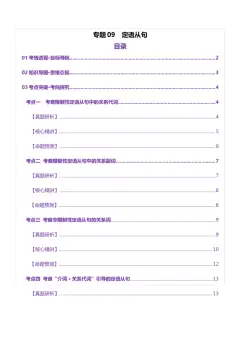
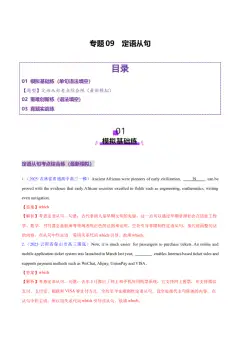
专题09 定语从句
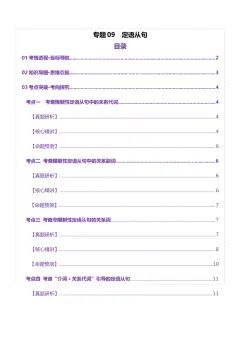
目录
第一部分 必备知识结构化清单
         梳理必备的语言知识点,夯实语言基础能力
第二部分 知识运用题型强化练
         必备知识与能力提升练,提升语言运用能力
◇Part 01  必备知识结构化清单
知|识|清|单
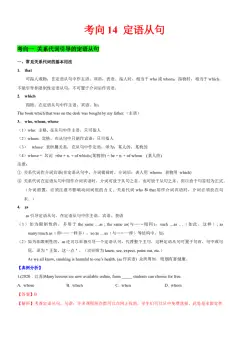
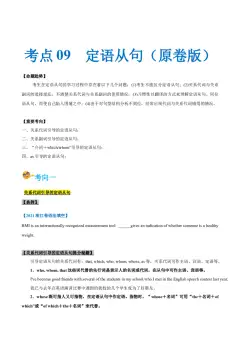
真题分析
【真题再现】
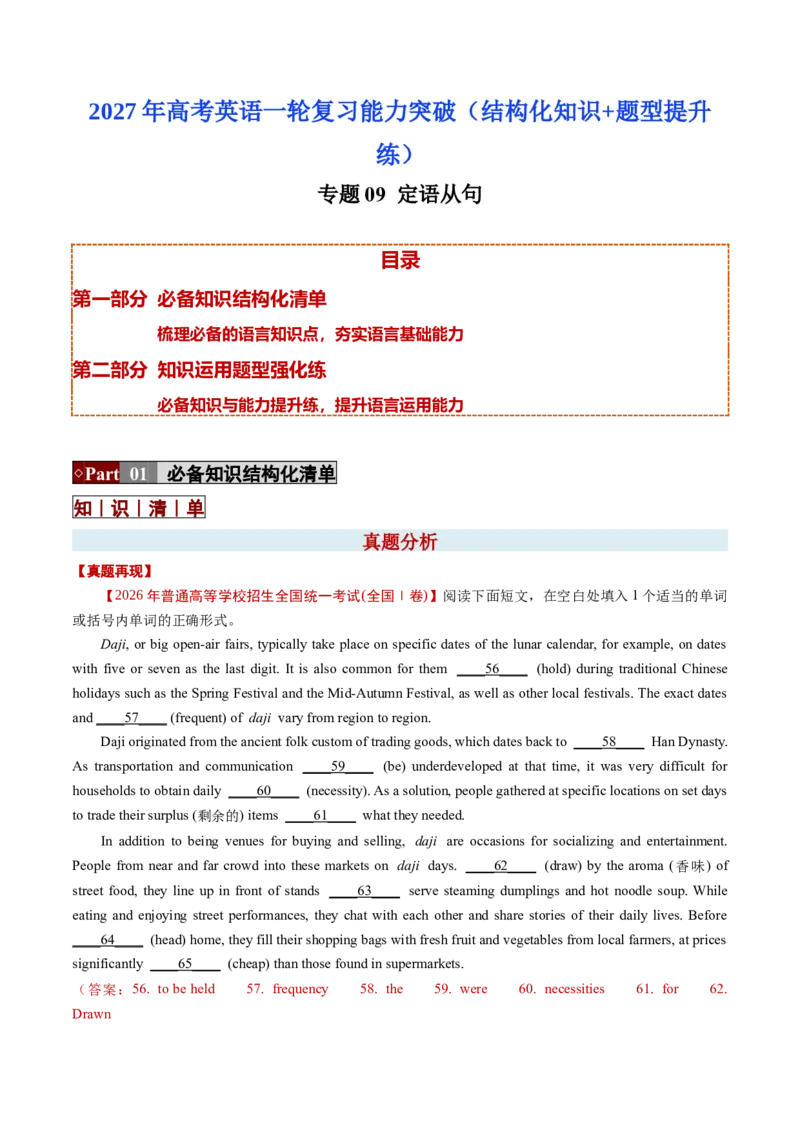
【2026 年普通高等学校招生全国统一考试(全国Ⅰ卷)】阅读下面短文,在空白处填入1 个适当的单词
或括号内单词的正确形式。
Daji, or big open-air fairs, typically take place on specific dates of the lunar calendar, for example, on dates
with five or seven as the last digit. It is also common for them ____56____ (hold) during traditional Chinese
holidays such as the Spring Festival and the Mid-Autumn Festival, as well as other local festivals. The exact dates
and ____57____ (frequent) of daji vary from region to region.
Daji originated from the ancient folk custom of trading goods, which dates back to ____58____ Han Dynasty.
As transportation and communication ____59____ (be) underdeveloped at that time, it was very difficult for
households to obtain daily ____60____ (necessity). As a solution, people gathered at specific locations on set days
to trade their surplus (剩余的) items ____61____ what they needed.
In addition to being venues for buying and selling, daji are occasions for socializing and entertainment.
People from near and far crowd into these markets on daji days. ____62____ (draw) by the aroma (香味) of
street food, they line up in front of stands ____63____ serve steaming dumplings and hot noodle soup. While
eating and enjoying street performances, they chat with each other and share stories of their daily lives. Before
____64____ (head) home, they fill their shopping bags with fresh fruit and vegetables from local farmers, at prices
significantly ____65____ (cheap) than those found in supermarkets.
(答案:56. to be held    57. frequency    58. the    59. were    60. necessities    61. for    62.
Drawn
63. that/which    64. heading    65. cheaper)
【要点分析】
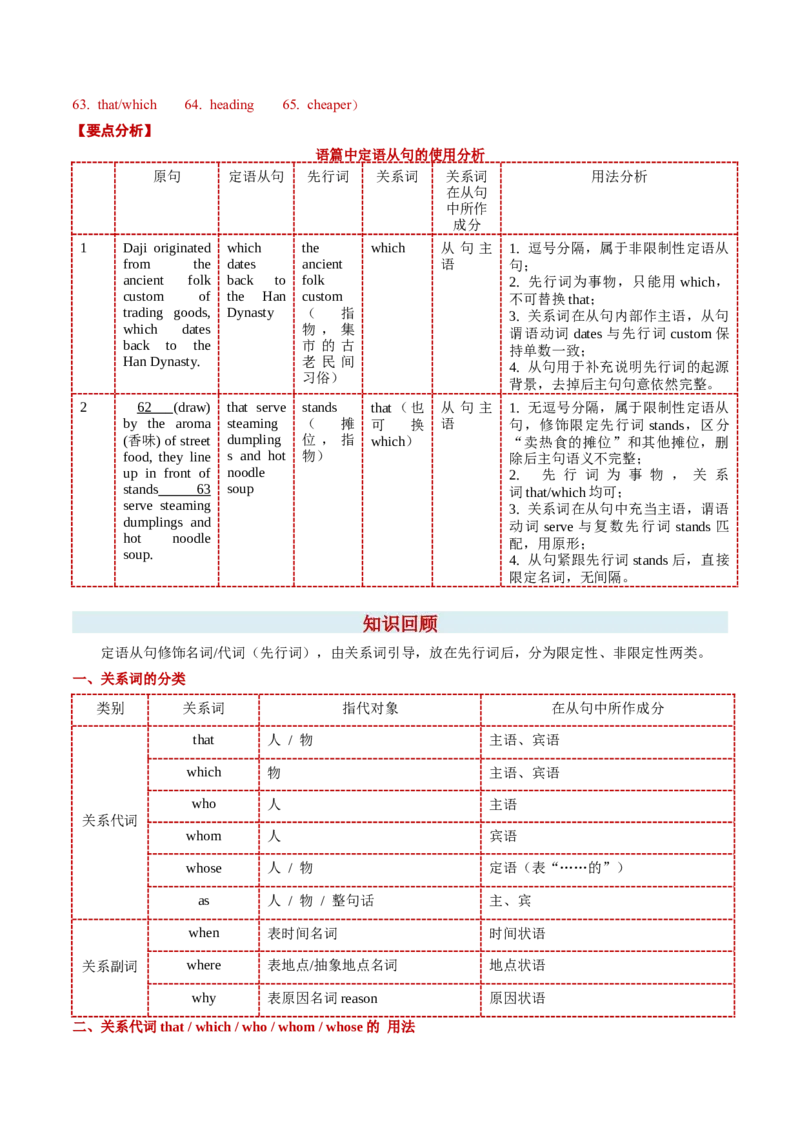
语篇中定语从句的使用分析
原句
定语从句
先行词
关系词
关系词
在从句
中所作
成分
用法分析
1
Daji originated
from

the
ancient folk
custom

of
trading goods,
which dates
back to the
Han Dynasty.
which
dates
back to
the Han
Dynasty
the
ancient
folk
custom
(
指
物,集
市的古
老民间
习俗)
which
从句主
语
1. 逗号分隔,属于非限制性定语从
句;
2. 先行词为事物,只能用which,
不可替换that;
3. 关系词在从句内部作主语,从句
谓语动词dates 与先行词custom 保
持单数一致;
4. 从句用于补充说明先行词的起源
背景,去掉后主句句意依然完整。
2
62

    (draw)
by the aroma
(香味) of street
food, they line
up in front of
stands
63
serve steaming
dumplings and
hot

noodle
soup.
that serve
steaming
dumpling
s and hot
noodle
soup
stands
(
摊
位,指
物)
that (也
可
换
which)
从句主
语
1. 无逗号分隔,属于限制性定语从
句,修饰限定先行词stands,区分
“卖热食的摊位”和其他摊位,删
除后主句语义不完整;
2. 先行词为事物,关系
词that/which 均可;
3. 关系词在从句中充当主语,谓语
动词serve 与复数先行词stands 匹
配,用原形;
4. 从句紧跟先行词stands 后,直接
限定名词,无间隔。
知识回顾
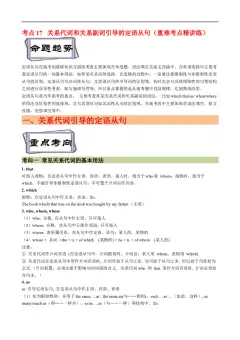
定语从句修饰名词/代词(先行词),由关系词引导,放在先行词后,分为限定性、非限定性两类。
一、关系词的分类
类别
关系词
指代对象
在从句中所作成分
关系代词
that
人 / 物
主语、宾语
which
物
主语、宾语
who
人
主语
whom
人
宾语
whose
人 / 物
定语(表“……的”)
as
人 / 物 / 整句话
主、宾
关系副词
when
表时间名词
时间状语
where
表地点/抽象地点名词
地点状语
why
表原因名词reason
原因状语
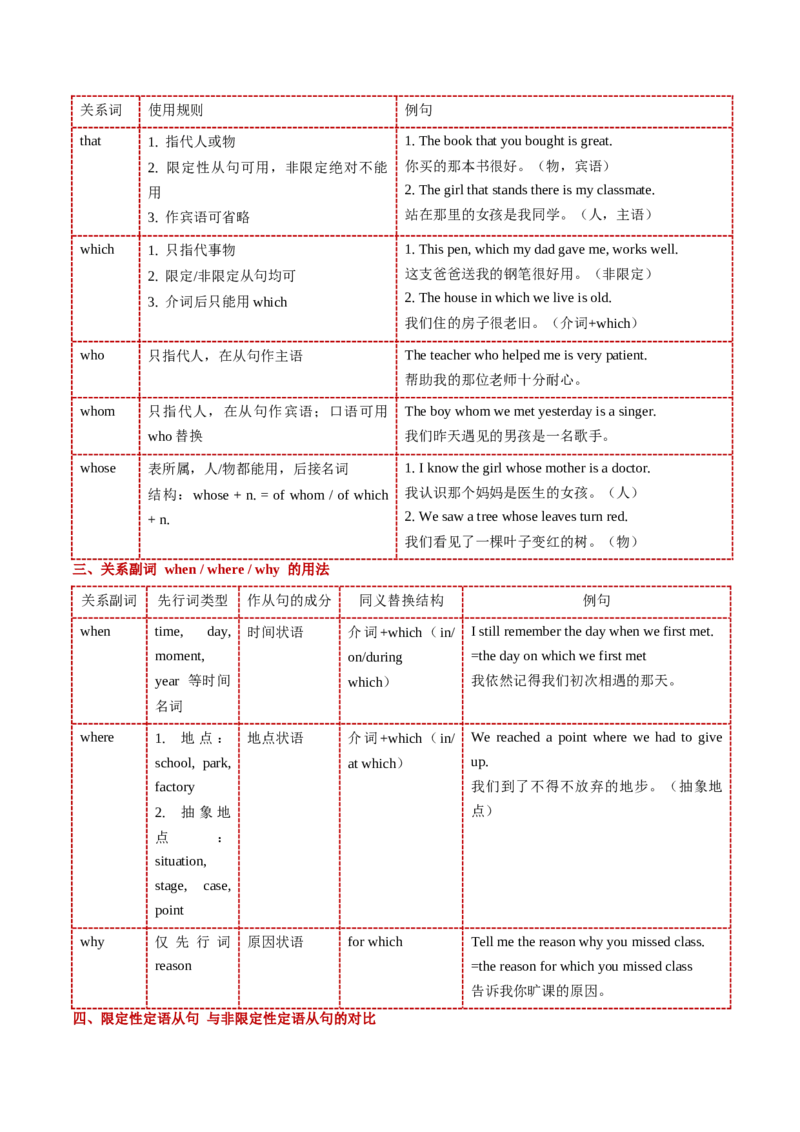
二、关系代词that / which / who / whom / whose 的 用法
关系词
使用规则
例句
that
1. 指代人或物
2. 限定性从句可用,非限定绝对不能
用
3. 作宾语可省略
1. The book that you bought is great.
你买的那本书很好。(物,宾语)
2. The girl that stands there is my classmate.
站在那里的女孩是我同学。(人,主语)
which
1. 只指代事物
2. 限定/非限定从句均可
3. 介词后只能用which
1. This pen, which my dad gave me, works well.
这支爸爸送我的钢笔很好用。(非限定)
2. The house in which we live is old.
我们住的房子很老旧。(介词+which)
who
只指代人,在从句作主语
The teacher who helped me is very patient.
帮助我的那位老师十分耐心。
whom
只指代人,在从句作宾语;口语可用
who 替换
The boy whom we met yesterday is a singer.
我们昨天遇见的男孩是一名歌手。
whose
表所属,人/物都能用,后接名词
结构:whose + n. = of whom / of which
+ n.
1. I know the girl whose mother is a doctor.
我认识那个妈妈是医生的女孩。(人)
2. We saw a tree whose leaves turn red.
我们看见了一棵叶子变红的树。(物)
三、关系副词 when / where / why 的用法
关系副词
先行词类型
作从句的成分
同义替换结构
例句
when
time, day,
moment,
year 等时间
名词
时间状语
介词+which(in/
on/during
which)
I still remember the day when we first met.
=the day on which we first met
我依然记得我们初次相遇的那天。
where
1. 地点:
school, park,
factory
2. 抽象地
点
:
situation,
stage, case,
point
地点状语
介词+which(in/
at which)
We reached a point where we had to give
up.
我们到了不得不放弃的地步。(抽象地
点)
why
仅先行词
reason
原因状语
for which
Tell me the reason why you missed class.
=the reason for which you missed class
告诉我你旷课的原因。
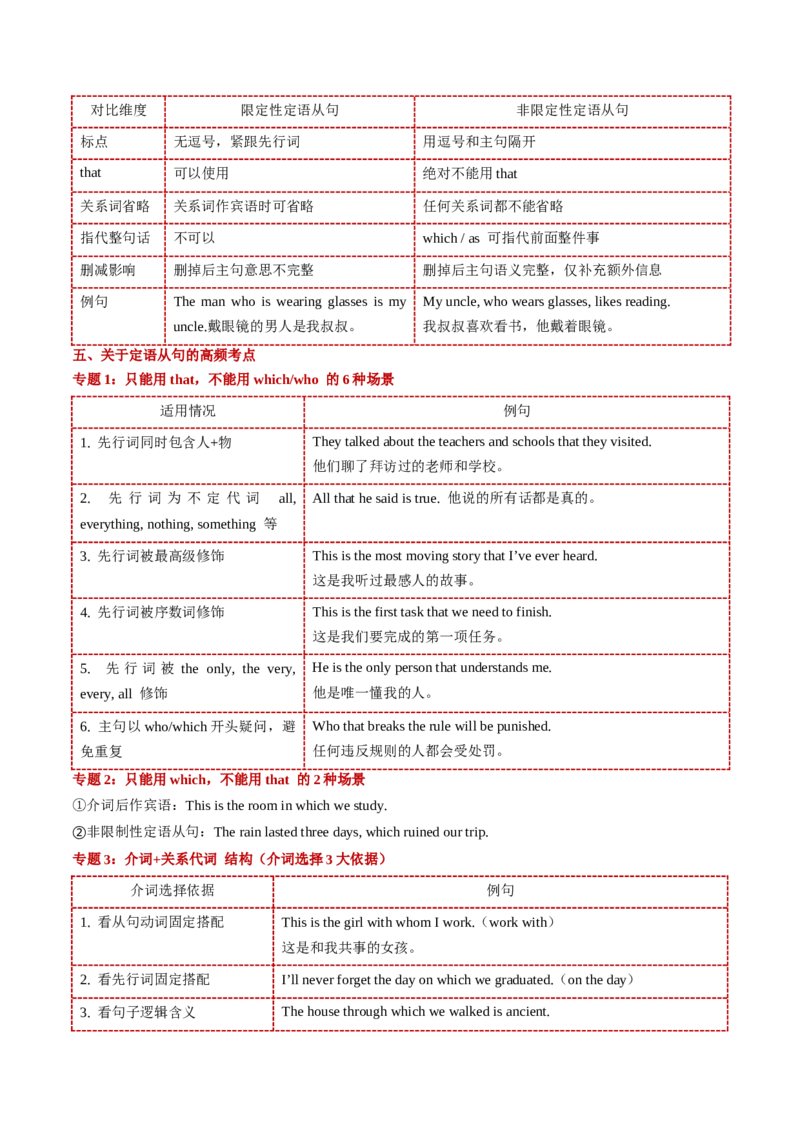
四、限定性定语从句 与非限定性定语从句的对比
对比维度
限定性定语从句
非限定性定语从句
标点
无逗号,紧跟先行词
用逗号和主句隔开
that
可以使用
绝对不能用that
关系词省略
关系词作宾语时可省略
任何关系词都不能省略
指代整句话
不可以
which / as 可指代前面整件事
删减影响
删掉后主句意思不完整
删掉后主句语义完整,仅补充额外信息
例句
The man who is wearing glasses is my
uncle.戴眼镜的男人是我叔叔。
My uncle, who wears glasses, likes reading.
我叔叔喜欢看书,他戴着眼镜。
五、关于定语从句的高频考点
专题1:只能用that,不能用which/who 的6 种场景
适用情况
例句
1. 先行词同时包含人+物
They talked about the teachers and schools that they visited.
他们聊了拜访过的老师和学校。
2. 先行词为不定代词 all,
everything, nothing, something 等
All that he said is true. 他说的所有话都是真的。
3. 先行词被最高级修饰
This is the most moving story that I’ve ever heard.
这是我听过最感人的故事。
4. 先行词被序数词修饰
This is the first task that we need to finish.
这是我们要完成的第一项任务。
5. 先行词被the only, the very,
every, all 修饰
He is the only person that understands me.
他是唯一懂我的人。
6. 主句以who/which 开头疑问,避
免重复
Who that breaks the rule will be punished.
任何违反规则的人都会受处罚。
专题2:只能用which,不能用that 的2 种场景
①介词后作宾语:This is the room in which we study.
②非限制性定语从句:The rain lasted three days, which ruined our trip.
专题3:介词+关系代词 结构(介词选择3 大依据)
介词选择依据
例句
1. 看从句动词固定搭配
This is the girl with whom I work.(work with)
这是和我共事的女孩。
2. 看先行词固定搭配
I’ll never forget the day on which we graduated.(on the day)
3. 看句子逻辑含义
The house through which we walked is ancient.
我们穿过的那栋房子很古老。
专题4:as 和 which 引导非限制性定语从句的区分
区别点
as
which
位置
可放主句前、中、后
只能放在主句末尾
翻译
正如、如同
这一点、这件事
固定搭配
as we know, as is known to all
无固定搭配
例句
As we all know, practice makes perfect.
众所周知,熟能生巧。
He failed the exam, which made his mom
sad.他考试失利,这让他妈妈很难过。
基|础|练|习
一、阅读下面短文,在空白处填入1 个适当的单词或括号内单词的正确形式。
Smart home technology is transforming the way we live. Devices that

 1

  (consider) luxuries a few
years ago are now becoming

 2

  (necessity) in many households. From voice-controlled assistants to
automated lighting systems, these innovations promise to make our lives

 3

  (convenient) and efficient than
before.
However, experts warn that this convenience comes at

 4

  cost. Privacy ( 隐私) concerns have
emerged as a major issue.
  5

  many devices collecting vast amounts of personal data. A recent study has
revealed that smart speakers can

 6

  (accident) activate and record private conversations without users’
knowledge.     7       worries privacy advocates most is that some devices continue to collect data even when they are
turned off.
Despite these risks, the smart home market continues to grow rapidly. Analysts predict that in the near future,
nearly every new home
  8
   (feature) some form of smart technology. The key challenge lies in balancing
innovation with security,

 9

  ensures that convenience does not compromise our fundamental right to privacy.
10
       (drive) by such concerns, manufacturers are now racing to develop better encryption (加密) methods.
二、根据上述语篇的相关内容,按要求用定语从句改写句子。
原句
要求
合并后的句子
1
 Some devices were considered
①

luxuries a few years ago.
 The devices are now becoming
②

necessities in many households.
用限制性定语
从句合并两
句,先行词为
devices
2
 Many smart home devices collect
①

vast amounts of personal data.
 The devices are widely used in
②

modern households.
用限制性定语
从句合并两
句,先行词为
devices
3
 Smart speakers can accidentally
①

activate and record private
conversations.
 The smart speakers store users’
②

private information secretly.
用限制性定语
从句合并两
句,先行词为
smart speakers
4
 The key challenge lies in
①

balancing innovation with security.
 This thing ensures that
②

convenience does not compromise
our fundamental right to privacy.
用非限制性定
语从句合并两
句,which 指
代前文整件事
5
 Manufacturers are racing to
①

develop better encryption methods.
 The encryption methods can
②

protect users’ personal data.
用限制性定语
从句合并两
句,先行词为
encryption
methods
◇Part 02  知识运用题型强化练
一、阅读理解
1
Reading shouldn’t be a one-way street. With this Smart Annotation (批注) Kit, you move from being a passive
reader to an active thinker.
This kit helps you:
● Capture your thoughts — write down questions, connections, and ideas as they come to you.
● Remember more — research shows that handwriting improves memory and comprehension.
● Read with purpose — use colors and notes to track themes, characters, or key arguments.
● Make books yours — turn every book you read into a personal record of your thinking journey.
Whether you’re studying for an exam, preparing for a book club, or just reading for pleasure, this kit gives you
the tools to engage deeply with every page.
What’s Included
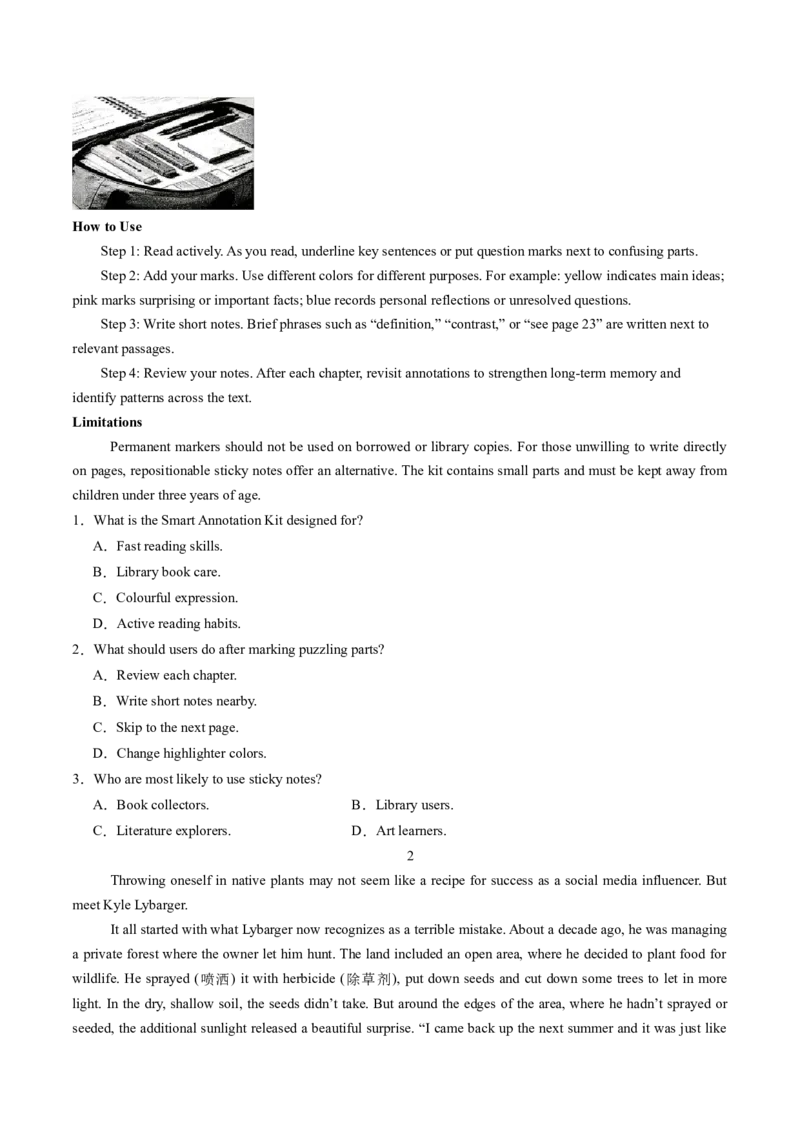
● 3 color-coded highlighters (yellow, pink, blue)
● 2 fine-tip pens (black, red)
● 50 repositionable sticky notes
● 1 quick-start guide
How to Use
Step 1: Read actively. As you read, underline key sentences or put question marks next to confusing parts.
Step 2: Add your marks. Use different colors for different purposes. For example: yellow indicates main ideas;
pink marks surprising or important facts; blue records personal reflections or unresolved questions.
Step 3: Write short notes. Brief phrases such as “definition,” “contrast,” or “see page 23” are written next to
relevant passages.
Step 4: Review your notes. After each chapter, revisit annotations to strengthen long-term memory and
identify patterns across the text.
Limitations
Permanent markers should not be used on borrowed or library copies. For those unwilling to write directly
on pages, repositionable sticky notes offer an alternative. The kit contains small parts and must be kept away from
children under three years of age.
1.What is the Smart Annotation Kit designed for?
A.Fast reading skills.
B.Library book care.
C.Colourful expression.
D.Active reading habits.
2.What should users do after marking puzzling parts?
A.Review each chapter.
B.Write short notes nearby.
C.Skip to the next page.
D.Change highlighter colors.
3.Who are most likely to use sticky notes?
A.Book collectors.
B.Library users.
C.Literature explorers.
D.Art learners.
2
Throwing oneself in native plants may not seem like a recipe for success as a social media influencer. But
meet Kyle Lybarger.
It all started with what Lybarger now recognizes as a terrible mistake. About a decade ago, he was managing
a private forest where the owner let him hunt. The land included an open area, where he decided to plant food for
wildlife. He sprayed (喷洒) it with herbicide (除草剂), put down seeds and cut down some trees to let in more
light. In the dry, shallow soil, the seeds didn’t take. But around the edges of the area, where he hadn’t sprayed or
seeded, the additional sunlight released a beautiful surprise. “I came back up the next summer and it was just like
color everywhere, really crazy-looking plants,” says Lybarger. “I feel like I should know what this plant is.”
After he posted photos of the flowers on Facebook, an expert pointed out some rare and endangered species.
Lybarger realized that he had killed off an area with a wild seed bank of countless species that were ideal for
attracting wildlife, all in order to plant two or three species that weren’t part of the native ecosystem.
Lybarger, a forester by training, found a mission: to save these native species. In a state where more than
90% of the land is privately owned, that has meant knocking on doors to speak with landowners who are
unknowing hosts to rare plants. One morning last spring found Lybarger chatting with Pat Eaton, who has a spot of
endangered glade cress growing on her family’s property. A few miles away, Lybarger pointed out another
endangered species that his social media followers had been instrumental in protecting.
Lybarger thinks his biggest contribution comes through education on social media, influencing people to
grow the native plants that best support declining pollinators (传粉昆虫) and other insects. “One person, one yard,
one-tenth of an acre can make a bigger difference than you think,” he says.
4.What was Lybarger’s mistake?
A.He mixed seeds up.
B.He removed the soil.
C.He posted photos online.
D.He killed native species.
5.Why did Lybarger visit landowners?
A.To purchase their properties.
B.To protect private land plants.
C.To teach planting skills.
D.To seek hunting permission.
6.What does Lybarger do through social media?
A.Keep track of his daily work.
B.Build up his reputation.
C.Educate people about local plants.
D.Offer professional training.
7.What is the text about?
A.A forester’s mission shift.
B.A herbicide spraying method.
C.Endangered plant species.
D.Tips for becoming an influencer.
3
Scammers (骗子) are becoming tricky, turning to the Internet to better cheat their targets out of money. This
includes using deep fakes (冒充者) to present themselves as someone else. Now, AI is being used in the fightback
with Telecom Company O2 applying an AI granny in the action.
Daisy, an AI grandma created by British Telecom Company O2 as the cleverest scam fighter, is a new AI tool
with the voice of a grandmother designed to talk with scammers and “waste as much of their time as possible”.
Basically, she rambles on (絮叨) about anything and everything to keep them away from real people.
While Daisy may sound like a human, she is actually an AI large language model with the character
application of a grandma. The company worked with known scam artists to train Daisy and used a method called
Number Seeding to get Daisy’s phone number added to a list of online “mugs lists” — lists used by scammers
targeting UK users. She functions by listening to the scammers and translating their voice to text. The AI then
searches its large database to find a suitable reply, based on the specific scam training she’s received, and translates
that text answer to speech for Daisy to reply. All this happens in seconds with no additional input needed.
The goal is to keep the scammer on the phone for as long as possible by trapping them in a lifelike, but
lengthy conversation. “Daisy is turning the tables on scammers — outsmarting them at their own pitiless game
simply by keeping them on the line,” Murray Mackenzie, Director of Fraud at O2, explained.
O2 also hopes to draw attention to scams by warning users to be careful about who they may be speaking to.
“No matter how good someone on the other end of the phone may be, they aren’t always who you think they are,”
Murray said. “In terms of tips and tricks, whether you’re shopping online, reviewing your emails, or receiving an
out-of-the-blue phone call, it’s important to always remain watchful.”
8.How does the AI granny fight against scammers?
A.By taking up scammers’ time.
B.By keeping scammers interested.
C.By telling scammers funny stories.
D.By talking scammers into quitting.
9.Why does Daisy receive scam training?
A.To recognize scammers’ tricks.
B.To react to scammers properly.
C.To improve her translation skills.
D.To make herself more creative.
10.What do the underlined words “turning the tables on” probably mean?
A.Serving.
B.Educating.
C.Tracking.
D.Defeating.
11.What is Murray’s suggestion to the users?
A.Stop answering calls.
B.Use particular software.
C.Raise anti-scam awareness.
D.Avoid shopping online.
4
Social responsibility means caring about others and doing things to make the world a better place. Many
young people wonder where to start, but the answer is simple.     12
One way is through community service. Take 16-year-old Lila from Toronto for example. She noticed many
elderly people in her neighborhood felt lonely. She started a “Chat & Help” group with her classmates, visiting
seniors every weekend, helping with shopping, and teaching them basic phone skills.     13     More than 50
elders looked forward to their weekly visits. Such acts let you see direct results and learn to understand others’
needs.
    14     A group of high school students in Portland, Oregon, saw rubbish in their local park and rivers.
Instead of waiting for others to act, they organized monthly clean-up days and put up signs about recycling. Their
efforts not only made the area cleaner but also inspired other schools to start similar projects.
Listening to others and using your voice also build responsibility. When 17-year-old Marcus from Chicago
learned that some students at his school could not afford lunch, he did not stay silent.     15     Then he
presented a plan to the school for a free lunch program for poor students. His courage to speak up led to a change
that helped over 80 students.
Finally, reflecting on your actions helps grow responsibility. After volunteering or helping others, take time
to think about what you have learned and how you can do better next time.     16     Remember, social
responsibility is not a task to check off but a way of life that makes you and the world around you stronger.
A.Within six months, over 30 teens joined.
B.He collected data about those needy students.
C.He does not need to solve big problems alone.
D.Caring for the environment shows responsibility.
E.Just begin with what you know and who you can help.
F.This habit turns one-time acts into lifelong care for others.
G.Small acts like reducing plastic use help take responsibility.
附加题:结合上述阅读语篇的内容,按照表格中的改写要求用定语从句合并句子。
题号
阅读语篇原文中提取的句子
改写要求
合并后的句子
1
This kit helps you capture your
①

thoughts.
Your thoughts come to you as you
②

read.
用关系代词指代
事物,合并两
句,使用限制性
定语从句
2
The kit includes 3 color-coded
①

highlighters.
The highlighters are yellow, pink
②

and blue.
用which 引导定
语从句修饰先行
词highlighters
3
You should not use permanent
①

markers on library copies.
Library copies are borrowed
②

books.
用that 引导定语
从句修饰library
copies
4
Readers can use sticky notes.
①
The

sticky

notes

are
②

repositionable.
合并句子,用
which 修饰先行
词sticky notes
5
Lybarger knocked on doors to talk
①

with landowners.
The landowners host rare native
②

plants unknowingly.
用who 引导定语
从句修饰指人的
先
行
词
landowners
6
He found an open area.
①
He decided to plant food for
②

wildlife in the area.
用where 引导表
地点的定语从句
修饰an open area
7
He discovered lots of wild plant
①

species.
The species are ideal for attracting
②

wildlife.
用that 引导定语
从句修饰plant
species
8
Daisy is a new AI tool.
①
The tool is created by O2 to fight
②

against scammers.
用which 引导定
语从句修饰AI
tool
9
Scammers use online “mugs lists”.
①
The lists store phone numbers of
②

UK users.
合并两句,
which 指代先行
词mugs lists
10
Marcus presented a plan to his
①

school.
The plan provided free lunch for
②

poor students.
用that 引导限制
性定语从句修饰
先行词a plan
二、完形填空
Many of us have seen elderly people working long after their peers ( 同龄人) have retired. For some, it is
a(n)     17    . It keeps them busy and their minds sharp. But for others, every single shift is a     18     —
aching bodies pushing through exhaustion, just to     19    .
Robert retired 13 years ago, but when his wife suddenly fell ill, he began working as a delivery driver. “Not
many employers want to     20     us at our age,” Robert said. So the elderly man threw himself into work with
a quiet stubbornness (顽强) that     21     younger delivery drivers half his age. While they     22     wait
times and declined low-paying     23    , Robert accepted them all.
One afternoon, homeowner Anna happened to     24     her Ring camera and saw Robert struggling
through pouring rain,     25     the coffee with his jacket as he climbed her porch steps (门廊阶梯). She was
so      26      that she stormed inside and questioned her daughter, “Why did you have to order coffee on a
rainy day? You have two legs and a      27      five feet away.” Then she posted the video online, and started a
GoFundMe for Robert.
Within five days, strangers donated nearly $1 million. Anna was so moved by the      28      of
strangers that she personally handed Robert the check. Robert is      29     , but says he still wants to deliver
30     . He says the work gave him a sense of purpose when he needed it most, and he won’t      31      it
now that he simply doesn’t.
17.A.memory
B.choice
C.challenge
D.experience
18.A.struggle
B.warning
C.proof
D.relief
19.A.insist
B.escape
C.relax
D.survive
20.A.consult
B.honour
C.hire
D.assist
21.A.surprised
B.shamed
C.threatened
D.convinced
22.A.put aside
B.relied on
C.narrowed down
D.complained about
23.A.orders
B.routes
C.excuses
D.requests
24.A.sell
B.fix
C.check
D.relocate
25.A.exchanging
B.covering
C.heating
D.packaging
26.A.confused
B.embarrassed
C.regretful
D.annoyed
27.A.kitchen
B.market
C.neighbour
D.cook
28.A.loyalty
B.curiosity
C.generosity
D.honesty
29.A.nervous
B.satisfied
C.worried
D.grateful
30.A.occasionally
B.eventually
C.instantly
D.efficiently
31.A.transform
B.abandon
C.forget
D.recommend
三、语法填空
阅读下面短文,在空白处填入1 个适当的单词或括号内单词的正确形式。
With the popularity of Pop Mart characters, it is no surprise that Pop Mart’s first theme park located in
Beijing’s Chaoyang Park — POP LAND —     32     (become) a top destination for fans recently.
On a warm mid-April afternoon, inside the park, a group of young British     33     (tourist) laughed,
took photos, and discovered the stories behind the toy figures they had long collected back home.
Present were the student union representatives (代表) from different UK universities,     34     came to
Chaoyang district to experience Chinese culture, explore     35     (advance) technology and build bridges of
understanding.
“I had no idea that all these different characters were under Pop Mart,” said Maximilian Camara. He had
bought a Crybaby blind box at a London mall, only     36     (discover) later that the unusual little toy had
taken British social media by storm.
For Molokwu, the visit brought an unexpected joy. “I loved the Powerpuff Girls growing up. I didn’t even
know Molly was one of them — and she’s in Pop Land!” She     37     (proud) showed off a limited-edition
headphone case.     38     impressed her even more was the brand’s IP protection. “If you come here, you can
see all of this, but you won’t find it anywhere else. It offers a chance for fans to take pictures with the toy maker’s
flagship characters in different settings,     39     (range) from a European-inspired white castle to a leafy tree
house,” she added. Leaving Pop Mart, Molokwu was still deeply absorbed     40     the beauty of Chaoyang
Park.
The students also walked the Great Wall, watched a robot do a backflip and experienced eye-tracking
technology      41      (design) to assist people with mobility issues at the Zhongguancun (Chaoyang) Internet
3.0 Park.
四、写作
    假定你是李华,你现在正面临选科,内心十分迷茫。请给你的外国朋友Dave 写一封电子邮件,内容
包括:
(1)说明写信原因;
(2)描述问题和征询建议;
(3)表示感谢。
注意:
(1)写作词数应为80 个左右;
(2)请按如下格式在答题卡的相应位置作答。
Dear Dave,
____________________________________________________________________________________________
____________________________________________________________________________________________
____________________________________________________________________________________________
____________________________________________________________________________________________
_________________________________
Yours,
Li Hua