第29 讲  状语从句
目  录
模拟·基础演练.......................................................................................................................................1
重难·创新演练.....................................................................................................................................11
真题·实战演练.....................................................................................................................................24
 模拟·基础演练
考查重点:状语从句的识别和区分,理解不同连词对应的不同意思,能在语法填空和阅读
理解中正确理解上下文意思。
题型一 根据意思,在空格处填入适当的词,使语句通顺。
考向01 when/while/since/until 等引导的时间状语从句
根据意思,在空格处填入适当的词,使语句通顺。
1______ the alarm went off, all roommates put down their phones and rushed to the playground.
答案:When
考点:when 引导时间状语从句(短暂动作时间点)
解析:考查when 引导时间状语从句,用于描述瞬间、短暂动作发生的时间。句意翻译:当闹钟响起时,
所有室友放下手机冲向操场。
2______ my grandparents were enjoying tea in the yard, I was finishing my exam papers in the bedroom.
答案:While
考点:while 引导时间状语从句(延续性同步动作)
解析:考查while 引导时间状语从句,从句多用进行时态,强调主从句两个持续性动作同时发生。句意翻
译:爷爷奶奶在院子里品茶时,我正在卧室里完成试卷。
3.I have never contacted my deskmate ______ we left junior high school four years ago.
答案:since
考点:since 引导时间状语从句(现在完成时标志)
解析:考查since 引导时间状语从句,从句用一般过去时,主句常用现在完成时,意为“自从……以
来”。句意翻译:自从四年前初中毕业分开后,我就再也没有联系过我的同桌。
4.The little girl didn’t fall asleep ______ her elder sister came home from night shift.
答案:until
考点:not...until 引导时间状语从句
解析:考查固定结构not...until 引导时间状语从句,意为“直到……才……”。句意翻译:这个小女孩直到
姐姐夜班回家才睡着。
5.______ I caught sight of his expression, I realized he had made a mistake.
答案:The moment
考点:the moment 引导时间状语从句(一……就……)
解析:考查名词短语the moment 引导时间状语从句,等同于as soon as,表即刻动作。句意翻译:我一看到
他的神情,就意识到他出错了。
6.______ you finish all your daily tasks, you can relax and watch short videos for half an hour.
答案:Once
考点:once 引导时间状语从句(一旦)
解析:考查once 引导时间状语从句,表条件性时间,意为“一旦”。句意翻译:一旦你完成所有日常任
务,就可以放松刷半小时短视频。
考向02 because/since/ as 等引导的原因状语从句
1.He failed to join the school sports meeting ______ he suffered from a bad cold at home.
答案:because
考点:because 引导原因状语从句(直接原因)
解析:考查because 引导原因状语从句,用于解释主句动作发生的直接、核心原因。句意翻译:他没能参
加校运动会,因为他在家重感冒了。
2.______ the weather was warm and sunny, we decided to go hiking in the mountain forest.
答案:Since/As
考点:since/as 引导原因状语从句(已知显而易见原因)
解析:考查since/as 引导原因状语从句,多用于众所周知、显而易见的原因,语气弱于because。句意翻
译:因为天气温暖晴朗,我们决定去山林徒步。
考向03 if/unless 等引导的条件状语从句
1.You will not master oral English ______ you stick to daily recitation and practice.
答案:unless
考点:unless 引导否定条件状语从句(除非/如果不)
解析:考查unless 引导条件状语从句,相当于if...not,遵循主将从现原则。句意翻译:除非你坚持每天背
诵练习,否则你无法掌握英语口语。
2.______ you keep exercising regularly, your physical condition will get better gradually.
答案:If
考点:if 引导真实条件状语从句
解析:考查if 引导真实条件状语从句,遵循“主将从现”语法规则。句意翻译:如果你坚持规律锻炼,你
的身体状态会逐渐变好。
3.You can borrow the library books ______ you return them before the deadline.
答案:as long as
考点:as long as 引导条件状语从句(只要)
解析:考查as long as 引导条件状语从句,用于限定主句成立的条件。句意翻译:只要你在截止日期前归
还,就可以借阅图书馆的书籍。
4.______ the rain pours heavily tomorrow, we will still carry out the outdoor activity.
答案:Even if
考点:even if 引导让步条件状语从句(即使)
解析:考查even if 引导让步条件状语从句,表假设性让步。句意翻译:即使明天大雨倾盆,我们依旧会开
展户外活动。
5.______ you won a large sum of prize money, how would you spend it?
答案:If
考点:if 引导虚拟条件状语从句
解析:考查if 引导虚拟条件句,对现在/将来不可能发生的事情进行假设,从句用一般过去时。句意翻译:
如果你中了一大笔奖金,你会如何支配这笔钱?
考向04 Although/Though 等引导的让步状语从句
1.______ he is over 60 years old, he still keeps running every morning to build up his body.
答案:Although/Though
考点:although/though 引导让步状语从句(虽然、尽管)
解析:考查让步状语从句引导词although/though,不可与but 连用,表转折让步关系。句意翻译:尽管他已
经六十多岁了,他依旧坚持每天晨跑强身健体。
2.______ challenging the competition is, we must stick to the end and finish it.
答案:However
考点:however 引导让步状语从句(无论多么)
解析:考查however 引导让步状语从句,结构为however+形容词/副词+主谓,表让步。句意翻译:无论这
场比赛多么具有挑战性,我们都必须坚持到底、完成比赛。
考向05 so that/in case 等引导的结果状语从句
1.The documentary was ______ touching ______ lots of viewers were deeply moved.
答案:so; that
考点:so...that...引导结果状语从句
解析:考查so...that...句型,so 后接形容词/副词,意为“如此……以至于……”,表结果。句意翻译:这
部纪录片如此感人,以至于很多观众深受触动。
2.It was ______ a wonderful experience ______ all of us hoped to take part in it again.
答案:such; that
考点:such...that...引导结果状语从句
解析:考查such...that...句型,such 后接名词短语,意为“如此……以至于……”。句意翻译:这是一次如
此美好的经历,我们所有人都希望再次参与。
考向06 so that 引导的目的状语从句
1.We set off early ______ we could catch the earliest bus to the city center.
答案:so that
考点:so that 引导目的状语从句
解析:考查so that 引导目的状语从句,表主句动作的目的,从句常含情态动词。句意翻译:我们早早出
发,以便赶上前往市中心的首班公交车。
2.Carry a raincoat with you ______ it rains in the evening.
答案:in case
考点:in case 引导目的状语从句(以防)
解析:考查in case 引导目的状语从句,表预防、以防意外情况发生。句意翻译:随身带一件雨衣,以防晚
上下雨。
考向07 非谓语动词(状语从句省略)
1.When ______ (interview) about his favorite hobby, the boy said he loved playing basketball most.
答案:asked
考点:状语从句省略+过去分词作状语
解析:考查状语从句省略用法,从句主语与主句主语一致且含be 动词,可省略主语和be 动词;主语the
boy 与interview 为被动关系,用过去分词。句意翻译:当被问及最喜欢的爱好时,这个男孩说他最爱打篮
球。
题型二 阅读理解
阅读下列短文,从每题所给的A、B、C、D 四个选项中选出最佳选项。
A(2026 肥城一模)
Healthy Eating Plate
Use the Healthy Eating Plate as a guide for creating healthy, balanced meals-whether served at the table or
packed in a lunch box.
Building a Healthy and Balanced Diet
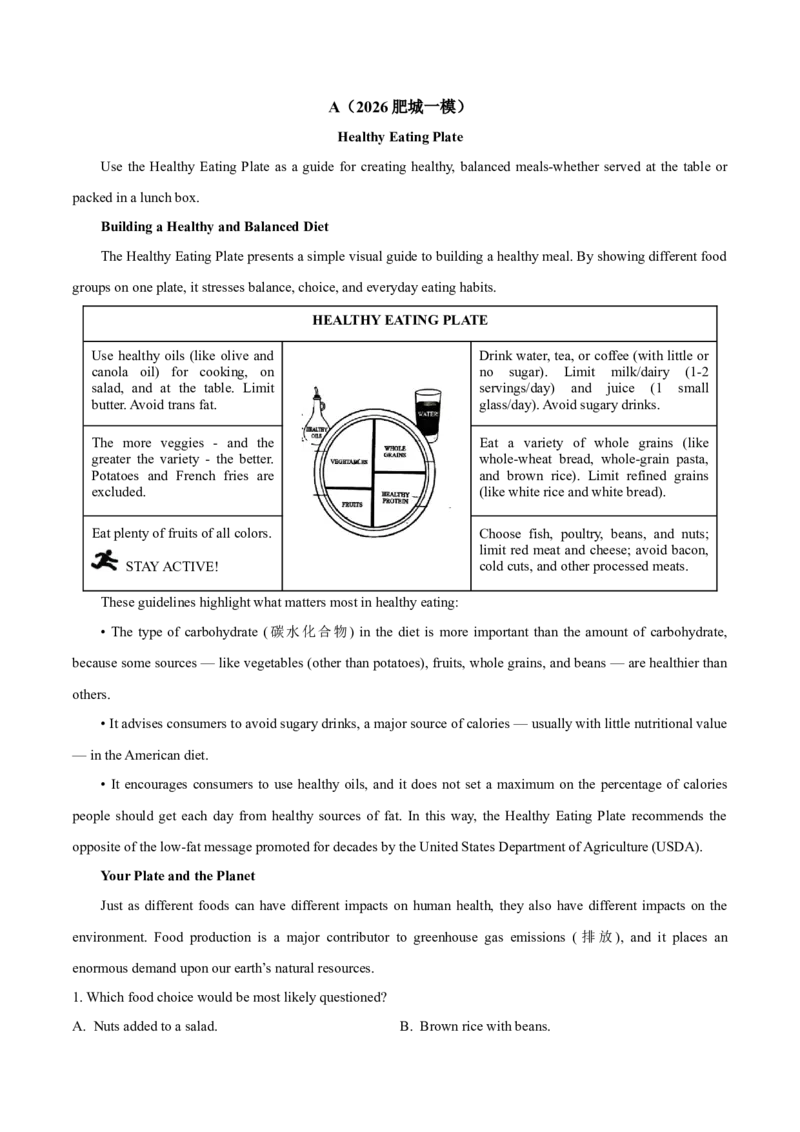
The Healthy Eating Plate presents a simple visual guide to building a healthy meal. By showing different food
groups on one plate, it stresses balance, choice, and everyday eating habits.
HEALTHY EATING PLATE
Use healthy oils (like olive and
canola oil) for cooking, on
salad, and at the table. Limit
butter. Avoid trans fat.
Drink water, tea, or coffee (with little or
no sugar). Limit milk/dairy (1-2
servings/day) and juice (1 small
glass/day). Avoid sugary drinks.
The more veggies - and the
greater the variety - the better.
Potatoes and French fries are
excluded.
Eat a variety of whole grains (like
whole-wheat bread, whole-grain pasta,
and brown rice). Limit refined grains
(like white rice and white bread).
Eat plenty of fruits of all colors.
 STAY ACTIVE!
Choose fish, poultry, beans, and nuts;
limit red meat and cheese; avoid bacon,
cold cuts, and other processed meats.
These guidelines highlight what matters most in healthy eating:
• The type of carbohydrate (碳水化合物) in the diet is more important than the amount of carbohydrate,
because some sources — like vegetables (other than potatoes), fruits, whole grains, and beans — are healthier than
others.
• It advises consumers to avoid sugary drinks, a major source of calories — usually with little nutritional value
— in the American diet.
• It encourages consumers to use healthy oils, and it does not set a maximum on the percentage of calories
people should get each day from healthy sources of fat. In this way, the Healthy Eating Plate recommends the
opposite of the low-fat message promoted for decades by the United States Department of Agriculture (USDA).
Your Plate and the Planet
Just as different foods can have different impacts on human health, they also have different impacts on the
environment. Food production is a major contributor to greenhouse gas emissions ( 排放), and it places an
enormous demand upon our earth’s natural resources.
1. Which food choice would be most likely questioned?
A. Nuts added to a salad.
B. Brown rice with beans.
C. Steamed fish with vegetables.
D. Bacon served with white bread.
2. What is the main message of the Healthy Eating Plate?
A. To count calories first.
B. To follow a low-fat diet.
C. To cut carbohydrate intake.
D. To focus on diet quality
3. Why is the USDA mentioned in the text?
A. To explain how food policies are made.
B. To highlight the changes in dietary views.
C. To show that the Plate takes official advice.
D. To support the idea of limiting fat consumption.
【答案】1. D    2. D    3. B
【解析】
【导语】本文是一篇说明文。文章介绍了“健康饮食餐盘”的具体指南,包括各类食物的选择建议,以及
其与传统饮食观念的不同和对环境的考量。
【1 题详解】
细节理解题。根据表格中“Limit refined grains (like white rice and white bread).(限制精制谷物(如白米和白面
包))”以及“avoid bacon, cold cuts, and other processed meats.(避免培根、冷切肉和其他加工肉类)”可知,培根
属于要避免的加工肉类,白面包属于要限制的精制谷物,所以D 项“培根配白面包”这个食物选择最可能
受到质疑。故选D 项。
【2 题详解】
细节理解题。根据表格下面内容“•The type of carbohydrate (碳水化合物) in the diet is more important than
the amount of carbohydrate, because some sources — like vegetables (other than potatoes), fruits, whole grains,
and beans — are healthier than others.(•饮食中碳水化合物的种类比数量更重要,因为一些来源——如蔬菜(土
豆除外)、水果、全谷物和豆类——比其他来源更健康)”以及对各类食物选择的具体建议可知,健康饮食餐
盘的核心是关注饮食的质量,而非单纯的数量或热量等。故选D 项。
【3 题详解】
推理判断题。根据倒数第二段中“In this way, the Healthy Eating Plate recommends the opposite of the low-fat
message promoted for decades by the United States Department of Agriculture (USDA).(通过这种方式,健康饮
食餐盘建议的与美国农业部(USDA)几十年来推广的低脂理念相反)”可知,提及美国农业部是为了突出健康
饮食餐盘代表的饮食观念和传统低脂观念的不同,体现了饮食观念的变化。故选B 项。
B(2026 肥城一模)
I admit that I didn’t give the topic of rest much thought until my body forced me to slow down. For the first
time in my life, rest was not a choice but something I had to accept. I stayed in bed with medicine and my phone
nearby, assuming that lying still meant I was resting. When I began to feel slightly better, I got up to do a few basic
chores, only to be very quickly wiped out. That was the moment I figured out that resting to recover would require
a great deal more time spent laying around than I had expected.
So back to bed I went, where I scrolled (刷屏), texted, and checked my phone like I normally would, without
thinking twice about it. Yet, I still felt unwell. In looking for information on how to feel better, I came across an
article that included a curious piece of advice: everyday “thinking” activities, such as checking emails, planning
shopping and making decisions, also use energy. It was a genuine light-bulb moment. I had never considered that
resting for my health was not the same as simply relaxing in my downtime.
While rest can feel like one of those “I know it when I see it” concepts, I would argue that many of us don’t.
Rest isn’t limited to being physically in bed or taking a short break. If your body is still but your mind is racing —
running through long to-do lists or things you feel you “should” be doing — you are not meaningfully resting.
Mental effort, after all, is some of our most energetically demanding work.
Over time, it became clear to me that resting isn’t as easy as it sounds. If you grew up in an environment
where rest was seen as something for lazy people, or if it was seen as something that was not productive, then the
thought of rest can set off anxiety. Yet rest is not a luxury. It is a necessary response to anything that wears the body
down, from everyday stress to long-term exhaustion.
Now, I see rest as an active process– one that requires listening to the body and responding with care. True rest
is not laziness. It is an experience of balance, of harmony between what we feel, what we do, and what we need.
4. What did the author assume rest to be?
A. Physical stillness.
B. Emotional ease.
C. chore avoidance.
D. Personal entertainment.
5. What does the underlined phrase “a genuine light-bulb moment” in paragraph 2 refer to?
A. A sense of relief.
B. A flash of curiosity.
C. A rise in frustration.
D. A shift in understanding.
6. Which of the following disagrees with the author’s idea of “meaningful rest”?
A. Lying down with soft music.
B. Sleeping after doing housework.
C. Sitting still and planning your to-do list.
D. Taking a walk without thinking about tasks.
7. What is the author’s purpose in writing the text?
A. To emphasize the need of rest.
B. To warn against risks of overwork.
C. To challenge her misconception of rest.
D. To share her journey of improving health.
【答案】4. A    5. D    6. C    7. C
【解析】
【导语】本文是一篇记叙文。文章讲述了作者生病后对“休息”的认知转变过程,从最初认为“身体不动
就是休息”,到意识到真正的休息需要身心兼顾,是一个需要主动关照身体需求的过程。
【4 题详解】
细节理解题。根据第一段中的“I stayed in bed with medicine and my phone nearby, assuming that lying still
meant I was resting.(我躺在床上,身边放着药和手机,以为身体躺着不动就是在休息。)”可知,作者最初认
为休息就是身体保持静止。故选A 项。
【5 题详解】
词句猜测题。根据第二段“So back to bed I went, where I scrolled, texted, and checked my phone like I
normally would, without thinking twice about it. Yet, I still felt unwell.In looking for information on how to feel
better, I came across an article that included a curious piece of advice: everyday ‘thinking’ activities, such as
checking emails, planning shopping and making decisions, also use energy. It was a genuine light-bulb moment. I
had never considered that resting for my health was not the same as simply relaxing in my downtime.(于是我回到
床上,像往常一样刷手机、发信息、查看消息,完全没多想。然而,我依然感觉不舒服。在寻找如何让自
己感觉更好的信息时,我偶然看到一篇文章,其中有一条奇怪的建议:日常的“思考”活动,如查看电子
邮件、计划购物和做决定,也会消耗能量。这是一个genuine light-bulb moment。我从未想过为了健康而休
息与在业余时间简单放松是不一样的。)”可知,作者生病卧床时一直刷手机、处理琐事,却依然感到不
适,直到看到文章提到“思考类活动也会消耗精力”,才意识到“休息≠身体不动”。这个发现让作者对
休息的认知发生了彻底改变,因此“a genuine light-bulb moment”指的是认知上的突然转变。故选D 项。
【6 题详解】
推理判断题。根据第三段中的“If your body is still but your mind is racing — running through long to-do lists
or things you feel you ‘should’ be doing — you are not meaningfully resting.(如果你的身体静止不动,但大脑却
在高速运转——反复琢磨长长的待办清单或那些你觉得“应该”做的事,那你就不是在进行真正有意义的
休息。)”可知,坐着不动却规划待办清单的行为,不符合作者所认为的“有意义的休息”。故选C 项。
【7 题详解】
推理判断题。根据最后一段“Now, I see rest as an active process– one that requires listening to the body and
responding with care. True rest is not laziness. It is an experience of balance, of harmony between what we feel,
what we do, and what we need.(现在,我把休息看作是一个积极的过程——一个需要倾听身体并用心回应的
过程。真正的休息不是懒惰。它是一种平衡的体验,是我们感受、行为和需求之间的和谐。)”以及全文内
容可知,作者以自身经历为切入点,讲述了自己从“认为身体不动就是休息”的错误认知,到理解“真正
的休息需要身心兼顾”的转变过程,所以作者的写作目的是纠正自己对休息的误解。故选C 项。
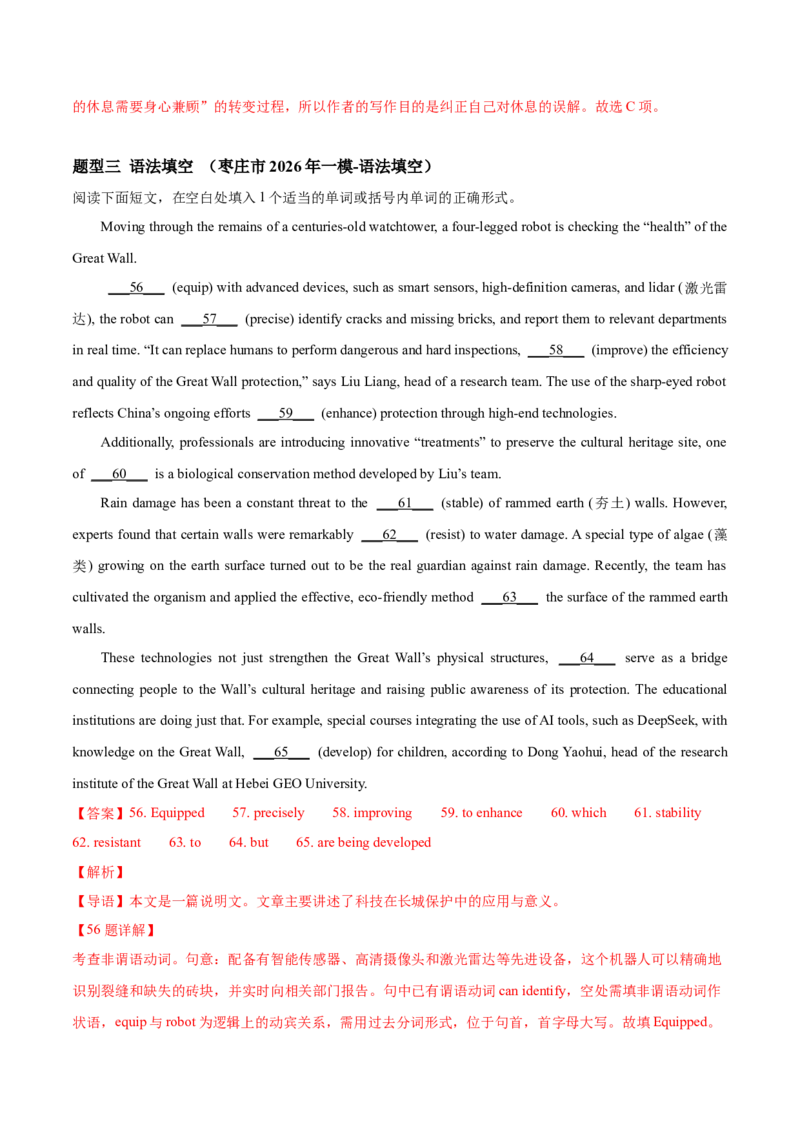
题型三 语法填空 (枣庄市2026 年一模-语法填空)
阅读下面短文,在空白处填入1 个适当的单词或括号内单词的正确形式。
Moving through the remains of a centuries-old watchtower, a four-legged robot is checking the “health” of the
Great Wall.
 ___56___ (equip) with advanced devices, such as smart sensors, high-definition cameras, and lidar (激光雷
达), the robot can ___57___ (precise) identify cracks and missing bricks, and report them to relevant departments
in real time. “It can replace humans to perform dangerous and hard inspections, ___58___ (improve) the efficiency
and quality of the Great Wall protection,” says Liu Liang, head of a research team. The use of the sharp-eyed robot
reflects China’s ongoing efforts ___59___ (enhance) protection through high-end technologies.
Additionally, professionals are introducing innovative “treatments” to preserve the cultural heritage site, one
of ___60___ is a biological conservation method developed by Liu’s team.
Rain damage has been a constant threat to the ___61___ (stable) of rammed earth (夯土) walls. However,
experts found that certain walls were remarkably ___62___ (resist) to water damage. A special type of algae (藻
类) growing on the earth surface turned out to be the real guardian against rain damage. Recently, the team has
cultivated the organism and applied the effective, eco-friendly method ___63___ the surface of the rammed earth
walls.
These technologies not just strengthen the Great Wall’s physical structures, ___64___ serve as a bridge
connecting people to the Wall’s cultural heritage and raising public awareness of its protection. The educational
institutions are doing just that. For example, special courses integrating the use of AI tools, such as DeepSeek, with
knowledge on the Great Wall, ___65___ (develop) for children, according to Dong Yaohui, head of the research
institute of the Great Wall at Hebei GEO University.
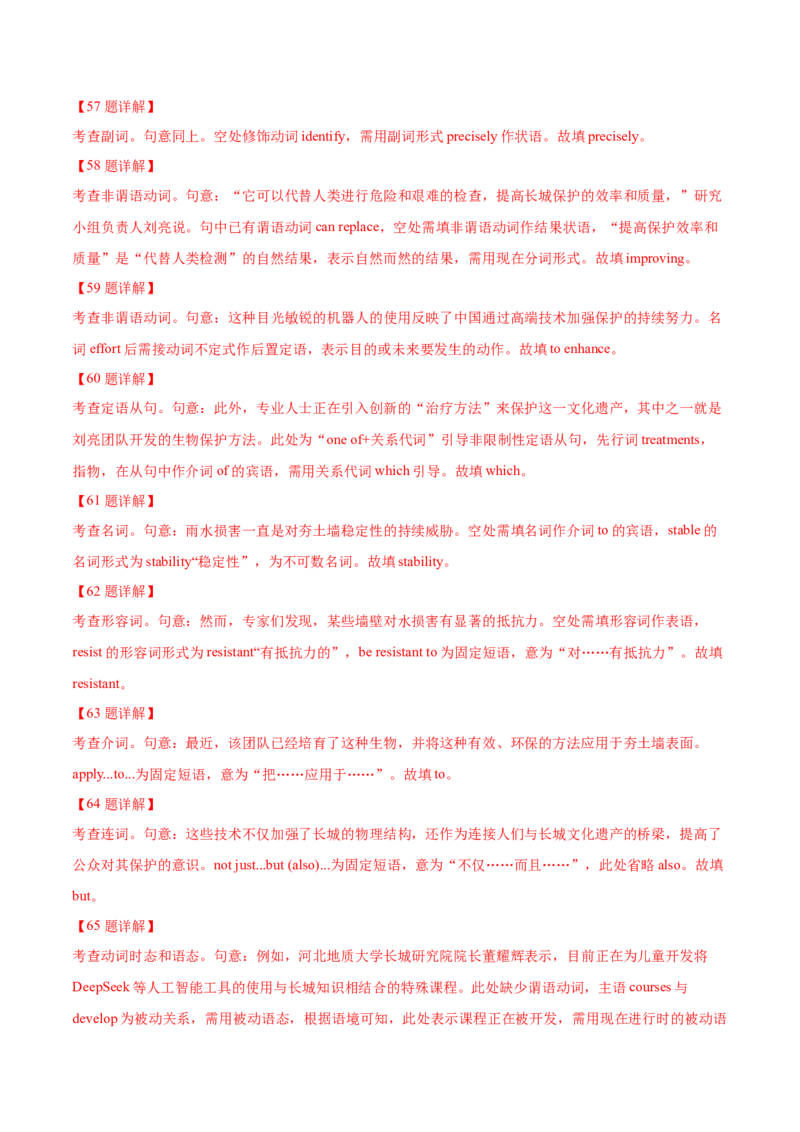
【答案】56. Equipped    57. precisely    58. improving    59. to enhance    60. which    61. stability

62. resistant    63. to    64. but    65. are being developed
【解析】
【导语】本文是一篇说明文。文章主要讲述了科技在长城保护中的应用与意义。
【56 题详解】
考查非谓语动词。句意:配备有智能传感器、高清摄像头和激光雷达等先进设备,这个机器人可以精确地
识别裂缝和缺失的砖块,并实时向相关部门报告。句中已有谓语动词can identify,空处需填非谓语动词作
状语,equip 与robot 为逻辑上的动宾关系,需用过去分词形式,位于句首,首字母大写。故填Equipped。
【57 题详解】
考查副词。句意同上。空处修饰动词identify,需用副词形式precisely 作状语。故填precisely。
【58 题详解】
考查非谓语动词。句意:“它可以代替人类进行危险和艰难的检查,提高长城保护的效率和质量,”研究
小组负责人刘亮说。句中已有谓语动词can replace,空处需填非谓语动词作结果状语,“提高保护效率和
质量”是“代替人类检测”的自然结果,表示自然而然的结果,需用现在分词形式。故填improving。
【59 题详解】
考查非谓语动词。句意:这种目光敏锐的机器人的使用反映了中国通过高端技术加强保护的持续努力。名
词effort 后需接动词不定式作后置定语,表示目的或未来要发生的动作。故填to enhance。
【60 题详解】
考查定语从句。句意:此外,专业人士正在引入创新的“治疗方法”来保护这一文化遗产,其中之一就是
刘亮团队开发的生物保护方法。此处为“one of+关系代词”引导非限制性定语从句,先行词treatments,
指物,在从句中作介词of 的宾语,需用关系代词which 引导。故填which。
【61 题详解】
考查名词。句意:雨水损害一直是对夯土墙稳定性的持续威胁。空处需填名词作介词to 的宾语,stable 的
名词形式为stability“稳定性”,为不可数名词。故填stability。
【62 题详解】
考查形容词。句意:然而,专家们发现,某些墙壁对水损害有显著的抵抗力。空处需填形容词作表语,
resist 的形容词形式为resistant“有抵抗力的”,be resistant to 为固定短语,意为“对……有抵抗力”。故填
resistant。
【63 题详解】
考查介词。句意:最近,该团队已经培育了这种生物,并将这种有效、环保的方法应用于夯土墙表面。
apply...to...为固定短语,意为“把……应用于……”。故填to。
【64 题详解】
考查连词。句意:这些技术不仅加强了长城的物理结构,还作为连接人们与长城文化遗产的桥梁,提高了
公众对其保护的意识。not just...but (also)...为固定短语,意为“不仅……而且……”,此处省略also。故填
but。
【65 题详解】
考查动词时态和语态。句意:例如,河北地质大学长城研究院院长董耀辉表示,目前正在为儿童开发将
DeepSeek 等人工智能工具的使用与长城知识相结合的特殊课程。此处缺少谓语动词,主语courses 与
develop 为被动关系,需用被动语态,根据语境可知,此处表示课程正在被开发,需用现在进行时的被动语
态,主语为复数名词,be 动词用are。故填are being developed。
重难·创新演练
设题创新:  覆盖时间 / 条件 / 让步 / 原因 / 目的 / 结果 / 地点 / 方式八大类状语
从句,素材涵盖中医药、AI、航天、非遗、乡村振兴、生态保护、国际传播等
一、填空根据意思,在空格处填入适当的词,使语句通顺。
1.【新情境
中医药出海】
・
(2026
山东济南
一模)
・
・
______ TCM gains global popularity, many foreign
young people choose to study acupuncture in Chinese medical colleges。
【答案】While/Although/Though
【解析】句意:尽管中医药在全球愈发受欢迎,仍有许多外国青年专程来华医学院学习针灸。空处引导让
步状语从句,while/although/though 均表 “虽然、尽管”,置于句首符合语境。
2.【新情境・AI 翻译人文思辨】(2026
浙江杭州
二模)
・
・
AI can translate texts within seconds, ______
it cannot grasp the subtle cultural connotations hidden in ancient poems。
【答案】but/while
【解析】句意:人工智能数秒就能完成文本翻译,但无法读懂古诗中含蓄的文化内涵。while 此处引导让
步状语从句,表对比转折;but 为并列连词,亦符合逻辑。
3.【新情境
嫦娥探月工程】
・
(2026
四川成都
一模)
・
・
The astronauts will carry out rock sampling
______ the lunar rover reaches the preset landing zone。
【答案】as soon as/when
【解析】句意:月球车一抵达预设着陆区,航天员就会开展月岩采样工作。as soon as 引导时间状语从
句,表 “一…… 就”;when 表 “当…… 时”,均适配航天操作时序语境。
4.【新情境
木拱桥非遗传承】
・
(2026
福建宁德
二模)
・
・
Local craftsmen keep recording construction
skills ______ these precious ancient techniques disappear forever。
【答案】in case/lest
【解析】句意:当地匠人持续记录营造技艺,以防这些珍贵古法彻底失传。in case/lest 引导目的状语从
句,意为 “以防、免得”,非遗保护专属新考法。
5.【新情境
乡村生态湿地修复】
・
(2026
江苏苏州
一模)
・
・
You can find rare water birds ______ the
wetland ecological restoration project has been fully carried out。
【答案】where
【解析】句意:在湿地生态修复工程全面落地的地方,能见到珍稀水鸟。where 引导地点状语从句,表
“在…… 的地方”,区别于定语从句,无先行词,为高频易混新角度。
6.【新情境
古籍数字化工程】
・
(2026
河南郑州
三模)
・
・
It took researchers three years ______ they
finished digitizing over 10,000 volumes of ancient medical books。
【答案】before
【解析】句意:研究人员耗时三年,才完成上万册古医籍数字化工作。固定句型 It took + 时间段 +
before…,表 “过了多久才……”,时间状语从句经典创新句式。
7.【新情境
绿色低碳出行】
・
(2026
广东广州
二模)
・
・
We cannot reach carbon neutrality ______ every
citizen sticks to low-carbon daily lifestyles。
【答案】unless
【解析】句意:除非每位市民坚持低碳生活,否则我们无法实现碳中和。unless 引导条件状语从句,等同
于 if…not,环保主题高频考点。
8.【新情境
国风短视频国际传播】
・
(2026
湖南长沙
一模)
・
・
Young creators shoot short videos of paper-
cutting ______ more overseas audiences can understand Chinese folk art。
【答案】so that/in order that
【解析】句意:青年创作者拍摄剪纸短视频,以便更多海外观众了解中国民间艺术。so that/in order that 引
导目的状语从句,后接完整从句,区别于不定式 to do。
9.【新情境
青年基层支教】(
・
2026
河北石家庄
二模)
・
・
______ you volunteer to teach in mountain
villages, you will witness children’s thirst for knowledge。
【答案】If/When
【解析】句意:如果你去山村支教,就会亲眼看见孩子们对知识的渴望。if 引导条件状语从句(主将从
现);when 引导时间状语从句,双答案适配模拟命题趋势。
10.【新情境・AI 智能农耕】(2026
安徽合肥
一模)
・
・
Farmers adjust soil humidity automatically ______
the intelligent sensor sends out warning signals。
【答案】once/whenever
【解析】句意:一旦智能传感器发出预警,农户就能自动调节土壤湿度。once 表 “一旦”,whenever 表
“每当”,均引导时间状语从句,智慧农业新情境。
11.【新情境
太极拳海外推广】
・
(2026
陕西西安
三模)
・
・
______ Tai Chi looks slow and gentle, it
effectively improves people’s physical fitness。
【答案】Though/While
【解析】句意:虽然太极拳动作舒缓柔和,却能有效提升人体体能。while 置于句首引导让步状语从句,
侧重前后对比,中西文化对比新考法。
12.【新情境
海洋生物保护】
・
(2026
山东青岛
二模)
・
・
The government sets strict fishing limits ______
marine resources will not be over-exploited。
【答案】so that
【解析】句意:政府出台严格禁渔规定,确保海洋资源不被过度开采。so that 引导目的状语从句,表
“以便、为了”,海洋生态保护热点素材。
13.【新情境
红色文旅研学】(
・
2026
江西南昌
一模)
・
・
Tourists usually feel deeply touched ______ they
visit the old revolutionary base areas。
【答案】when/as
【解析】句意:游客参观革命老区时,内心常会深受触动。when/as 引导时间状语从句,as 强调伴随同步
发生,红色文化命题新角度。
14.【新情境
数字文物博物馆】
・
(2026
湖北武汉
二模)
・
・
The exhibition hall is designed ______ visitors
can appreciate cultural relics via VR technology。
【答案】in order that
【解析】句意:展厅专门设计,方便游客借助 VR 技术观赏文物。in order that 引导目的状语从句,可置
于句中,比 so that 书面性更强,博物馆数字化新情境。
15.【新情境
沙漠光伏治沙】
・
(2026
内蒙古呼和浩特
一模)
・
・
Plants grow well ______ solar panels
provide proper shade and reduce land evaporation。
【答案】because/as/since
【解析】句意:植物长势良好,因为光伏板提供适度遮阴、减少土地蒸发。because/as/since 引导原因状语
从句,光伏治沙复合创新素材。
16.【新情境
非遗英歌舞展演】
・
(2026
广东汕头
三模)
・
・
The performers will not stop the show ______
all the audience finish watching the full performance。
【答案】until
【解析】句意:要等所有观众完整看完演出,表演者才会结束表演。not…until 固定搭配,“直到……
才”,时间状语从句必考结构,潮汕非遗特色情境。
17.【新情境
深空探测望远镜】
・
(2026
云南昆明
二模)
・
・
Scientists keep observing distant galaxies
______ they can find clues to the origin of the universe。
【答案】so that
【解析】句意:科学家持续观测遥远星系,以期找到宇宙起源的线索。so that 引导目的状语从句,天文航
天前沿素材。
18.【新情境
全民阅读书香乡村】
・
(2026
山西太原
一模)
・
・
______ a village builds a public library,
local residents gain easier access to high-quality reading resources。
【答案】Where
【解析】句意:凡是建成乡村图书馆的村落,村民都能便捷获取优质阅读资源。where 引导地点状语从
句,表 “凡是…… 之处”,书面化高级考法。
19.【新情境
跨境电商国货出海】
・
(2026
浙江宁波
一模)
・
・
Many overseas customers choose Chinese
goods ______ they are both affordable and well-made。
【答案】because
【解析】句意:许多海外消费者选购国货,因为它们物美价廉。because 引导原因状语从句,跨境电商经
济热点情境。
20.【新情境
传统制茶技艺】
・
(2026
福建武夷山
二模)
・
・
Tea farmers must control fire temperature
precisely ______ the tea leaves get burnt during processing。
【答案】lest/in case
【解析】句意:茶农必须精准把控火候,避免制茶过程中茶叶烤焦。lest/in case 引导否定含义的目的状语
从句,传统茶文化小众新考法。
21.【新情境
低碳城市交通】
・
(2026
天津
一模)
・
・
______ we cut down the use of private cars, air
pollution in downtown areas will stay severe。
【答案】Unless
【解析】句意:除非减少私家车使用,否则城区空气污染难以缓解。unless=if not,条件状语从句高频易错
点,双碳城市新情境。
22.【新情境
古籍修复师匠心】
・
(2026
江苏南京
三模)
・
・
The master worked day and night ______ the
broken ancient scroll could be fully restored before the museum opening。
【答案】in order that
【解析】句意:修复大师日夜赶工,为了在博物馆开馆前完整修复破损古卷。in order that 引导目的状语从
句,古籍修复人文素材。
23.【新情境
极地科考站建设】
・
(2026
黑龙江哈尔滨
二模)
・
・
Researchers wear thick protective suits
______ they carry out field surveys in freezing polar regions。
【答案】whenever/when
【解析】句意:科考人员只要在极寒地区开展实地勘测,都会穿上厚重防护服。whenever 强调 “无论何
时、每当”,极地科考前沿情境。
24.【新情境
国风汉服海外走秀】
・
(2026
广西南宁
一模)
・
・
______ many Western audiences know little
about Hanfu at first, they fall in love with it after watching the fashion show。
【答案】Although/Even if
【解析】句意:尽管不少西方观众起初对汉服一无所知,但看完走秀后都会心生喜爱。even if 强化让步语
气,中外文化交流创新考法。
25.【新情境
智慧校园心理健康系统】
・
(2026
北京海淀
一模)
・
・
The system sends psychological
reminders ______ students show signs of learning anxiety in daily data。
【答案】as soon as/whenever
【解析】句意:一旦学生日常数据出现学习焦虑信号,系统就会推送心理疏导提示。as soon as/whenever
引导时间状语从句,智慧校园心理健康热点情境。
二、语法填空
阅读下面短文,在空白处填入1 个适当的单词或括号内单词的正确形式。
Passage 1
【新情境·中国文化遗产·外销工艺文明互鉴】(2026·辽宁高三三模)Canton Export Fans, an exhibition
now underway at Chengdu Museum, in Sichuan province’s capital, shows beautiful fans that ________ 1 ________
(ship) from Guangdong province to clients ________ 2 ________ (primary) in Europe and North America in the
18th and 19th centuries.
Among the many exported products from China to the world in history, fans were, and still ________ 3
________ (be), viewed as a unique form of art and craftsmanship on which Eastern and Western cultures blended in
a ________ 4 ________ (fascinate) manner.
There are folding, round and rectangular fans ________ 5 ________ (make) of paper, cloth and sandalwood,
sometimes inlaid with shells ________ 6 ________ attached with wood carvings. Some fans were painted with
Chinese landscapes and life scenes, opening a window into the East for those living in the west. Some other fans
were ordered to show the very Western patterns ________ 7 ________ in turn exposed the Chinese to a different
culture far away. For both the skilled craftsmen who created ________ 8 ________ (they) and the distant clients
across generations and continents, these fans served ________ 9 ________ (bear) the deepest emotions and
personal stories.
The fans are from Guangdong Museum, and on display until May 31. It is worth noting that this exhibition not
only presents delicate crafts but also functions ________ 10 ________ a bridge connecting Eastern and Western
cultures.
【答案】
1.were shipped 2.primarily 3.are 4.fascinating 5.made
6.or 7.that 8.them 9.to bear 10.as
【导语】本文介绍成都博物馆举办广东外销扇专题展览。外销扇于近代远销欧美,形制材质丰富,融合中
西美术元素,承载跨地域人文情感,成为东西方文化交流的重要载体。
【解析】
1.考查一般过去时被动语态。先行词fans 与ship 构成被动关系,时间状语in the 18th and 19th centuries 为
过去时间,主语为复数,故填were shipped。
2.考查副词。此处修饰介词短语in Europe and North America,需用副词primarily 表示“主要地”。
3.考查一般现在时。and still 并列前文were,此处描述扇子当下的定位,主语fans 为复数,填are。
4.考查-ing 形容词。修饰事物manner,表达“极具吸引力的”,用fascinating。
5.考查过去分词作后置定语。fans 和make 是被动关系,填made。
6.考查并列连词。镶嵌贝壳、搭配木雕为二选一的装饰方式,表选择填or。
7.考查限制性定语从句关系代词。先行词patterns 被the very 修饰,从句缺主语,只能用that。
8.考查人称代词宾格。作动词created 的宾语,指代fans,填them。
9.考查非谓语动词。固定搭配serve to do sth. 意为“用来承担/发挥……作用”,填to bear。
10.考查固定介词搭配。function as 表示“充当,作为”,填as。
Passage 2
【新情境·数字文保·长城AI 数字化修复】(2026·北京高三二模)Traditional protection of the Great
Wall used to rely on manual surveys, ________ 1 ________ took workers months to record wall damages. Now AI
technology ________ 2 ________ (bring) revolutionary changes to the conservation of this world cultural heritage.
Researchers have developed an intelligent drone system ________ 3 ________ (scan) every section of the Great
Wall automatically. Equipped with high-definition cameras and infrared sensors, drones can capture tiny cracks
hidden in bricks ________ 4 ________ are invisible to human eyes. The collected data ________ 5 ________
(send) to a cloud platform, where algorithms analyze damage levels accurately.
Unlike human workers who risk ________ 6 ________ (climb) steep broken walls, drones can reach remote
and dangerous areas without any safety threats. Local cultural officials say the AI system has cut survey time by
over 70%, ________ 7 ________ (great) lowering labor costs.
What’s more, the digital models built from drone data serve ________ 8 ________ reliable reference for future
restoration projects. Every brick’s position and condition is stored permanently, ________ 9 ________ (allow) later
generations to track changes of the Great Wall over centuries. It is obvious that technology has become a powerful
helper ________ 10 ________ cultural heritage protection.
【答案】
1.which 2.has brought 3.to scan 4.that 5.are sent
6.climbing 7.greatly 8.a 9.allowing 10.in
【导语】文章对比传统人工长城勘测与现代AI 无人机数字化保护技术,介绍智能设备在长城损伤排查、
数据存档、修复参考方面的优势,体现科技赋能文物保护的新理念。
【解析】
1.考查非限制性定语从句。指代前面整件事,从句缺主语,用关系代词which。
2.考查现在完成时。now 结合后文成果,强调技术已经带来改变,主语AI technology 单数,填has
brought。
3.考查不定式作目的状语。研发无人机系统是为了自动扫描长城,填to scan。
4.考查定语从句。先行词cracks,从句缺主语,指物,用that。
5.考查一般现在时被动。数据是被上传云端,主语data 复数,填are sent。
6.考查非谓语动词。固定搭配risk doing sth. 冒险做某事,填climbing。
7.考查副词。修饰非谓语lowering,用副词greatly。
8.考查不定冠词。reference 为可数名词单数,表“一份参考依据”,填a。
9.考查现在分词作结果状语。前文整件事带来的自然结果,填allowing。
10.考查介词。in cultural heritage protection 在文物保护领域,固定搭配。
三、阅读理解
Passage 1
【新情境·非遗文化出海】(2026·辽宁·三模)Canton Export Fans, an exhibition now underway at
Chengdu Museum, in Sichuan province’s capital, shows beautiful hand-painted fans that once served as iconic
Chinese cultural messengers to the Western world in the 18th and 19th centuries. Most of the exhibits are delicate
folding fans and round fans made in Guangdong province for export. Painted with traditional Chinese landscapes,
flower-and-bird patterns and folk stories, these fans were extremely popular among European nobles and ordinary
citizens during the Qing Dynasty.
At that time, Guangzhou was the only Chinese port open to foreign trade. A large number of skilled fan
craftsmen gathered there, forming a complete industrial chain covering design, production and sales. Different from
domestic fans, export fans fully absorbed Western aesthetic tastes. For example, some fans adopted Western
perspective painting techniques, while others added European architectural elements and figure stories on the basis
of traditional Chinese painting styles. This unique integration of Chinese and Western art made Canton export fans
stand out in the global market.
However, with the changes of international trade patterns and the rapid development of modern industry, the
handmade fan export industry gradually declined in the 20th century. A great number of classic fan-making
techniques were on the verge of being lost. In recent years, with the rising awareness of intangible cultural heritage
protection, local institutions and young craftsmen have begun to inherit and innovate the ancient craft. They
combine traditional fan-making skills with modern design, integrate trendy cultural elements, and launch new fan
products suitable for modern life and international aesthetics.
The ongoing exhibition not only reproduces the prosperous history of Canton export fans, but also displays the
innovative achievements of contemporary inheritors. It offers a new perspective for the public to understand the
communication and integration of Chinese and Western cultures in modern history, and inspires more people to pay
attention to the inheritance and innovation of traditional handicrafts.
32. What do we know about Canton export fans?
A. They were mainly sold to domestic citizens.
B. They adopted pure Western painting styles.
C. They originated in Sichuan province.
D. They were popular in European markets.
33. Why did Canton export fans gain global popularity?
A. They had a complete production industrial chain.
B. They blended Chinese and Western artistic features.
C. They were made by skilled foreign craftsmen.
D. They adopted modern design techniques.
34. What is the current situation of the fan-making craft?
A. It has been completely lost.
B. It is revived through innovation.
C. It remains unchanged for centuries.
D. It dominates the modern handicraft market.
35. What is the main purpose of the exhibition?
A. To promote the inheritance of traditional fan craft.
B. To show the prosperity of ancient foreign trade.
C. To introduce Western ancient art techniques.
D. To attract foreign investment in cultural industry.
【答案】32.D  33.B  34.B  35.A
【解析】
【导语】本文是一篇说明文。文章介绍了广东外销扇的历史兴衰、中西融合的艺术特色,以及当代非遗传
承人的创新发展,展现了中国传统手工艺的文化价值与时代活力。
32 题详解】细节理解题。根据第一段“these fans were extremely popular among European nobles and ordinary
citizens during the Qing Dynasty”可知,广东外销扇在欧洲市场十分受欢迎。故选D。
33 题详解】细节理解题。根据第二段“This unique integration of Chinese and Western art made Canton export
fans stand out in the global market”可知,中西艺术融合的特色是其风靡全球的核心原因。故选B。
34 题详解】推理判断题。根据第三段“local institutions and young craftsmen have begun to inherit and
innovate the ancient craft... launch new fan products”可知,传统制扇工艺通过创新实现了复兴。故选B。
35 题详解】主旨意图题。根据最后一段“It offers a new perspective... inspires more people to pay attention to
the inheritance and innovation of traditional handicrafts”可知,展览的核心目的是推动传统制扇工艺的传承与
发展。故选A。
Passage 2
【新考法·思辨类议论文·反思认知】(2026·山东·二模)
For a long time, intelligence has been narrowly defined as the ability to learn quickly and remember
knowledge. Schools and society always value people who can absorb information efficiently and answer questions
accurately. However, in the era of information explosion, the ability to rethink is far more valuable than fixed
knowledge and rigid thinking. Rethinking means challenging existing opinions, correcting wrong judgments, and
updating cognition according to new facts.
Many people tend to form fixed mindsets in the process of growth. They are used to trusting their past
experience and refusing to accept new ideas. This cognitive inertia makes people fall into thinking traps and miss
opportunities for progress. In contrast, people who are good at rethinking hold a growth mindset. They regard
doubts and mistakes as important ways to improve themselves, rather than signs of incompetence.
In his new book, a psychologist divides rethinking ability into three core dimensions. The first is individual
rethinking, which refers to self-reflection on one’s own decisions and behaviors. The second section examines how
we can encourage other people to think again. The author cites various cases, from debate champions winning
competitions through guiding opponents to rethink, to musicians changing public prejudice through rational
communication. The third dimension is collective rethinking, which focuses on how organizations and industries
break group fixed thinking to achieve innovative development.
Cultivating rethinking ability is particularly important for teenagers. In the age of artificial intelligence, basic
knowledge memory can be completely replaced by machines. What really distinguishes individuals is the ability to
screen information, question authority and optimize thinking. Rethinking is not negating the past blindly, but
keeping an open and rational attitude, which is the core literacy of modern talents.
28. What is the traditional definition of intelligence?
A. The ability to update cognition constantly.
B. The capacity to learn and memorize knowledge.
C. The skill to rethink existing problems.
D. The courage to challenge authority.
29. What does the underlined phrase "cognitive inertia" in paragraph 2 mean?
A. Fixed thinking habit
B. Creative thinking mode
C. Positive self-reflection
D. Rapid information absorption
30. Which case may be included in the second part of the book?
A. A company reforms its industry model collectively.
B. A student corrects his own learning mistakes.
C. A friend persuades others to try new lifestyles.
D. A teacher reflects on his teaching methods.
31. What is the best title for the text?
A. The Limitation of Traditional Intelligence
B. Growth Mindset vs Fixed Mindset
C. How to Cultivate Individual Creativity
D. Rethinking, a Key Modern Competence
【答案】28.B  29.A  30.C  31.D
【解析】
【导语】本文是一篇议论文。文章打破传统智力认知,提出在信息时代,反思、重构认知的能力比固有知
识储备更重要,并介绍了反思能力的维度与培养意义。
28 题详解】细节理解题。根据第一段首句“intelligence has been narrowly defined as the ability to learn
quickly and remember knowledge”可知,传统智力的定义是学习和记忆知识的能力。故选B。
29 题详解】词义猜测题。根据前文“form fixed mindsets... trusting their past experience and refusing to accept
new ideas”可知,该词指代人们固守过往经验、拒绝新事物的固定思维习惯。故选A。
30 题详解】推理判断题。根据第三段“The second section examines how we can encourage other people to
think again”可知,第二部分主题是说服、鼓励他人反思改变。C 选项劝说他人尝试新的生活方式符合该主
题。故选C。
31 题详解】主旨大意题。全文围绕“反思能力”展开,阐述其重要性、分类与时代价值,D 选项精准概括
文章核心。故选D。
四、完形填空 【新情境·青年公益·社区敬老】(2026·福建·三模)
I used to think volunteer work was boring and time-consuming. It was not until I joined a community elderly care
project that I totally 36 my opinion. Last winter vacation, my classmates and I volunteered to 37 the elderly living
alone in our community.
At first, I felt 38 and awkward when talking with the seniors. I worried I had nothing in 39 with them and would
make the atmosphere embarrassing. To my surprise, the elderly were all gentle and 40 . They shared their youthful
stories, life experiences and simple wisdom with us patiently. We helped them clean their houses, 41 their daily
necessities and taught them to use smart phones to chat with children and watch short videos.
Gradually, I found every minute of the volunteer work was 42 . Many empty-nest elderly suffer from loneliness and
lack of daily care. Our small company and help could bring them great 43 and warmth. What moved me most was
their sincere smiles and repeated thanks. Unlike school study which focuses on knowledge 44 , volunteer work
teaches me practical life lessons.
This experience also made me realize that youth means 45 . Teenagers should not only focus on personal growth,
but also take social 46 . Small kindness can also create big changes. I have 47 stuck to volunteer work till now. It
has become a precious 48 in my growth journey, reminding me to be grateful and 49 to help others. I believe every
effort of kindness will 50 .
36. A. changed   B. expressed   C. ignored   D. held
37. A. visit     B. praise     C. follow   D. train
38. A. excited   B. nervous    C. angry    D. relaxed
39. A. sight     B. trouble    C. common   D. need
40. A. strict    B. shy        C. cold     D. friendly
41. A. check     B. prepare    C. consume  D. sell
42. A. worthwhile B. useless   C. difficult D. boring
43. A. pressure  B. comfort    C. honor    D. profit
44. A. application B. exploration C. accumulation D. creation
45. A. responsibility B. freedom C. privilege D. adventure
46. A. advantage  B. risk       C. responsibility D. credit
47. A. rarely    B. constantly C. never    D. occasionally
48. A. memory    B. dream      C. goal     D. challenge
49. A. hesitant  B. willing    C. afraid   D. unable
50. A. pay off   B. come back  C. break out D. take place
【答案】36.A 37.A 38.B 39.C 40.D 41.B 42.A 43.B 44.C 45.A 46.C 47.B 48.A 49.B 50.A
【解析】
【导语】本文是一篇记叙文。作者通过参与社区独居老人志愿服务的经历,改变了对公益的偏见,领悟到
青年的社会责任与善意的价值。
36 题详解】动词辨析。前文作者认为志愿工作枯燥耗时,参与项目后彻底“改变”看法。change 改变;
express 表达;ignore 忽视;hold 持有。故选A。
37 题详解】动词辨析。此处指志愿“探访”社区独居老人。visit 探访;praise 赞扬;follow 跟随;train 训
练。故选A。
38 题详解】形容词辨析。根据awkward(尴尬的)可知,作者初期交流很紧张。nervous 紧张的;excited
兴奋的;angry 生气的;relaxed 放松的。故选B。
39 题详解】固定搭配。have nothing in common with sb. 与某人毫无共同之处。故选C。
40 题详解】形容词辨析。老人温柔友善,愿意分享人生故事。friendly 友好的;strict 严格的;shy 害羞的;
cold 冷漠的。故选D。
41 题详解】动词辨析。志愿者帮老人打扫房屋、准备生活用品。prepare 准备;check 检查;consume 消
耗;sell 售卖。故选B。
42 题详解】形容词辨析。作者发现志愿工作十分值得。worthwhile 值得的;useless 无用的;difficult 困难
的;boring 无聊的。故选A。
43 题详解】名词辨析。陪伴与帮扶能给老人带来慰藉与温暖。comfort 慰藉;pressure 压力;honor 荣誉;
profit 利益。故选B。
44 题详解】名词辨析。学校学习侧重知识积累,志愿工作收获人生经验。accumulation 积累;application 应
用;exploration 探索;creation 创造。故选C。
45 题详解】名词辨析。这段经历让作者明白青春意味着责任。responsibility 责任;freedom 自由;privilege
特权;adventure 冒险。故选A。
46 题详解】固定搭配。take social responsibility 承担社会责任。故选C。
47 题详解】副词辨析。作者此后一直坚持志愿工作。constantly 持续地;rarely 很少;never 从不;
occasionally 偶尔。故选B。
48 题详解】名词辨析。这段经历是成长中珍贵的回忆。memory 回忆;dream 梦想;goal 目标;challenge 挑
战。故选A。
49 题详解】形容词辨析。时刻心怀感恩、乐于助人。willing 乐意的;hesitant 犹豫的;afraid 害怕的;
unable 无法的。故选B。
50 题详解】短语辨析。每一份善意付出终会得到回报。pay off 取得回报;come back 回来;break out 爆
发;take place 发生。故选A。
真题·实战演练
高频考点:when、while、as 等引导的状语从句,时间状语从句、让步状语从句、原因状语从句等
一、填空根据意思,在空格处填入适当的词,使语句通顺。
1.(2026·全国新高考Ⅰ卷·语法填空)______ the customer grabs the handmade drink from her hand, she always
smiles warmly and greets every guest sincerely.
【答案】As/When
【解析】考查时间状语从句。句意:当顾客从她手中接过手工饮品时,她总会温柔微笑,真诚接待每位客
人。as、when 均可引导时间状语从句,意为“当……的时候”,位于句首单词首字母需大写。
2.(2026·浙江1 月首考·语法填空)She would speed up on the country road, the wind blowing our hair back
______ we shouted happily together to enjoy the beautiful scenery.
【答案】while/as/when
【解析】考查时间状语从句。句意:她会在乡间小路上加速行驶,风吹拂着我们的头发,我们一同开心呼
喊欣赏美景。句中两个动作同步发生,while/as/when 引导时间状语从句,表动作同步伴随。
3.(2025·新课标Ⅱ卷·语法填空)______ he set out on his long-distance fitness journey three years ago, the
young man has gained thousands of followers on social media.
【答案】Since
【解析】考查时间状语从句。句意:自从三年前开启长途健身之旅,这个年轻人在社交媒体收获了上万粉
丝。since 引导时间状语从句,意为“自从”,主句通常搭配现在完成时态,句首首字母大写。
4.(2024·新课标Ⅱ卷·语法填空)______ the two painters could never meet in real life, their artworks share
many similar creative themes.
【答案】Although/Though/While
【解析】考查让步状语从句。句意:尽管两位画家从未在现实中相见,他们的作品却拥有许多相似创作主
题。although/though/while 置于句首可引导让步状语从句,表“尽管、虽然”,体现前后语义转折关系。
5.(2024·新课标Ⅰ卷·语法填空)The athlete kept training every single day ______ he finally got the chance to
take part in international cycle races.
【答案】until
【解析】考查时间状语从句。句意:这位运动员日复一日坚持训练,直到终于获得参加国际自行车赛事的
机会。until 引导时间状语从句,意为“直到……为止”,适配主句持续进行的动作语境。