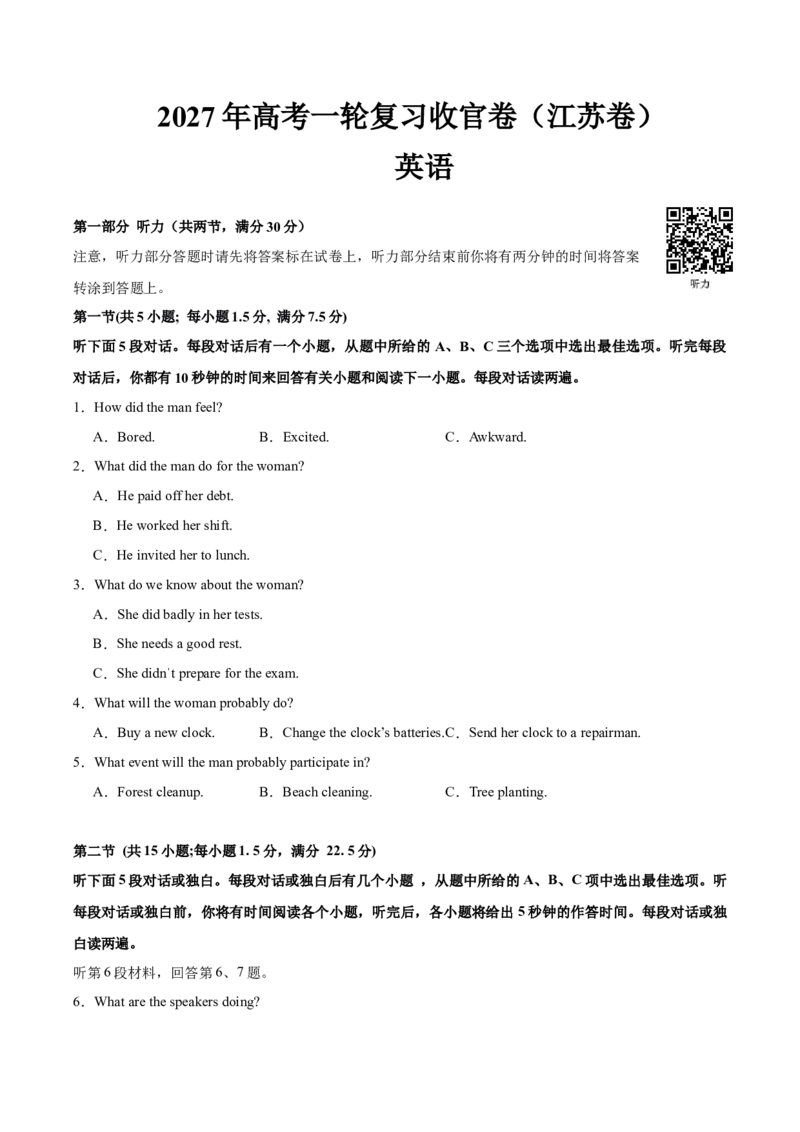
2027 年高考一轮复习收官卷(江苏卷)
  英语
第一部分 听力(共两节,满分30 分)
注意,听力部分答题时请先将答案标在试卷上,听力部分结束前你将有两分钟的时间将答案
转涂到答题上。
第一节(共5 小题; 每小题1.5 分, 满分7.5 分)
听下面5 段对话。每段对话后有一个小题,从题中所给的A、B、C 三个选项中选出最佳选项。听完每段
对话后,你都有10 秒钟的时间来回答有关小题和阅读下一小题。每段对话读两遍。

1.How did the man feel?
A.Bored.
B.Excited.
C.Awkward.
2.What did the man do for the woman?
A.He paid off her debt.
B.He worked her shift.
C.He invited her to lunch.
3.What do we know about the woman?
A.She did badly in her tests.
B.She needs a good rest.
C.She didnˈt prepare for the exam.
4.What will the woman probably do?
A.Buy a new clock.
B.Change the clock’s batteries.C.Send her clock to a repairman.
5.What event will the man probably participate in?
A.Forest cleanup.
B.Beach cleaning.
C.Tree planting.
第二节 (共15 小题;每小题1. 5 分,满分 22. 5 分)
听下面5 段对话或独白。每段对话或独白后有几个小题 ,从题中所给的A、B、C 项中选出最佳选项。听
每段对话或独白前,你将有时间阅读各个小题,听完后,各小题将给出5 秒钟的作答时间。每段对话或独
白读两遍。
听第6 段材料,回答第6、7 题。
6.What are the speakers doing?
A.Booking a train ticket.
B.Preparing for a journey.
C.Making a shopping list.
7.What do the speakers decide to do?
A.Carry a cooking pot.
B.Buy a backpack.
C.Shorten the list.
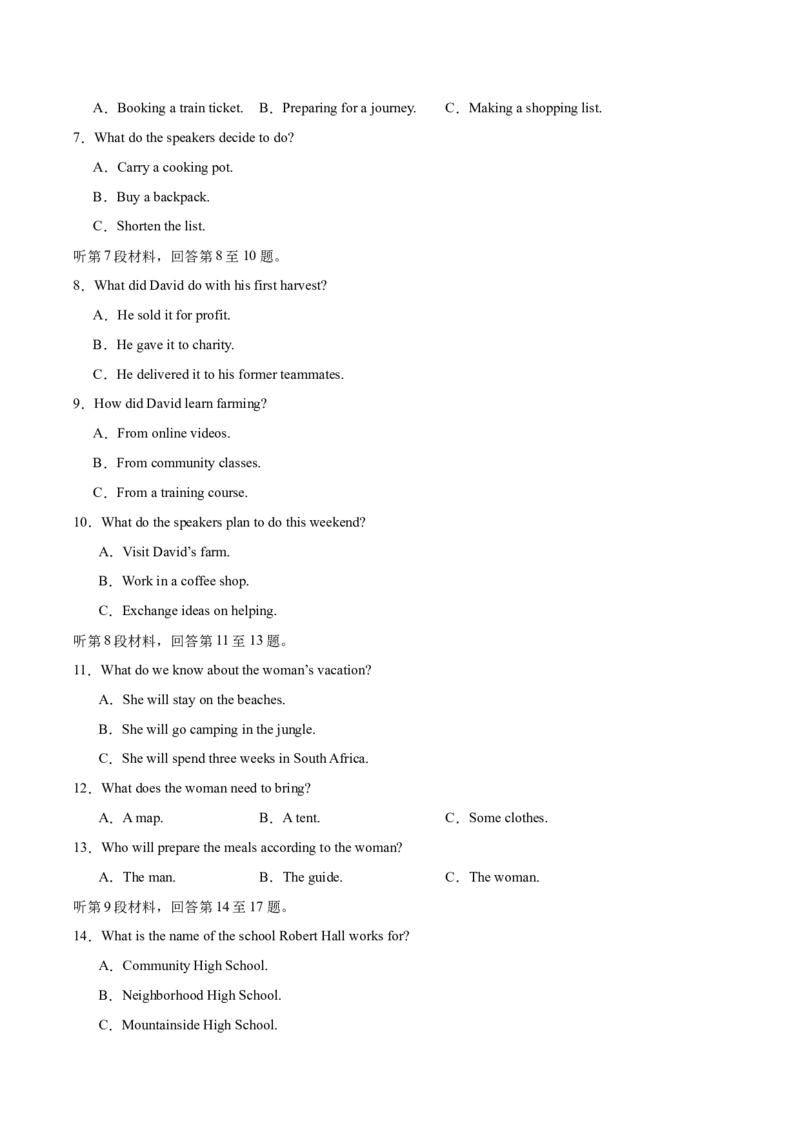
听第7 段材料,回答第8 至10 题。
8.What did David do with his first harvest?
A.He sold it for profit.
B.He gave it to charity.
C.He delivered it to his former teammates.
9.How did David learn farming?
A.From online videos.
B.From community classes.
C.From a training course.
10.What do the speakers plan to do this weekend?
A.Visit David’s farm.
B.Work in a coffee shop.
C.Exchange ideas on helping.
听第8 段材料,回答第11 至13 题。
11.What do we know about the woman’s vacation?
A.She will stay on the beaches.
B.She will go camping in the jungle.
C.She will spend three weeks in South Africa.
12.What does the woman need to bring?
A.A map.
B.A tent.
C.Some clothes.
13.Who will prepare the meals according to the woman?
A.The man.
B.The guide.
C.The woman.
听第9 段材料,回答第14 至17 题。
14.What is the name of the school Robert Hall works for?
A.Community High School.
B.Neighborhood High School.
C.Mountainside High School.
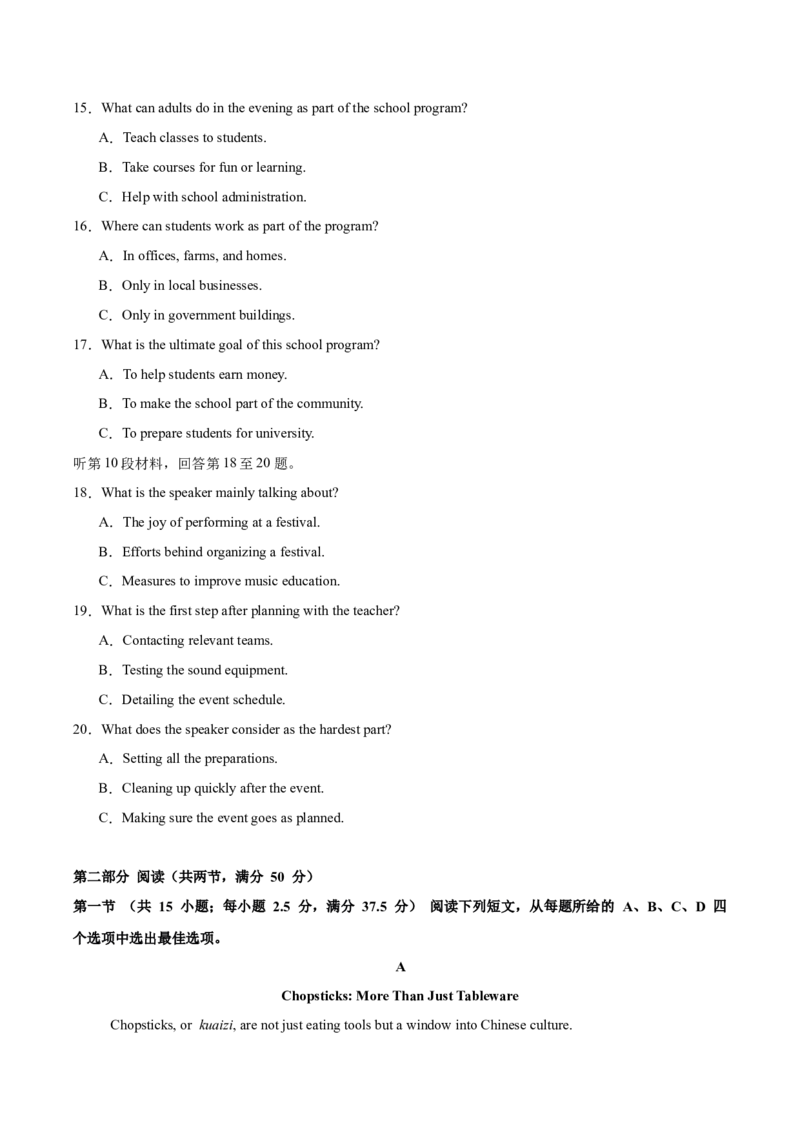
15.What can adults do in the evening as part of the school program?
A.Teach classes to students.
B.Take courses for fun or learning.
C.Help with school administration.
16.Where can students work as part of the program?
A.In offices, farms, and homes.
B.Only in local businesses.
C.Only in government buildings.
17.What is the ultimate goal of this school program?
A.To help students earn money.
B.To make the school part of the community.
C.To prepare students for university.
听第10 段材料,回答第18 至20 题。
18.What is the speaker mainly talking about?
A.The joy of performing at a festival.
B.Efforts behind organizing a festival.
C.Measures to improve music education.
19.What is the first step after planning with the teacher?
A.Contacting relevant teams.
B.Testing the sound equipment.
C.Detailing the event schedule.
20.What does the speaker consider as the hardest part?
A.Setting all the preparations.
B.Cleaning up quickly after the event.
C.Making sure the event goes as planned.
第二部分 阅读(共两节,满分 50 分)
第一节 (共 15 小题;每小题 2.5 分,满分 37.5 分) 阅读下列短文,从每题所给的 A、B、C、D 四
个选项中选出最佳选项。
A
Chopsticks: More Than Just Tableware
Chopsticks, or kuaizi, are not just eating tools but a window into Chinese culture.
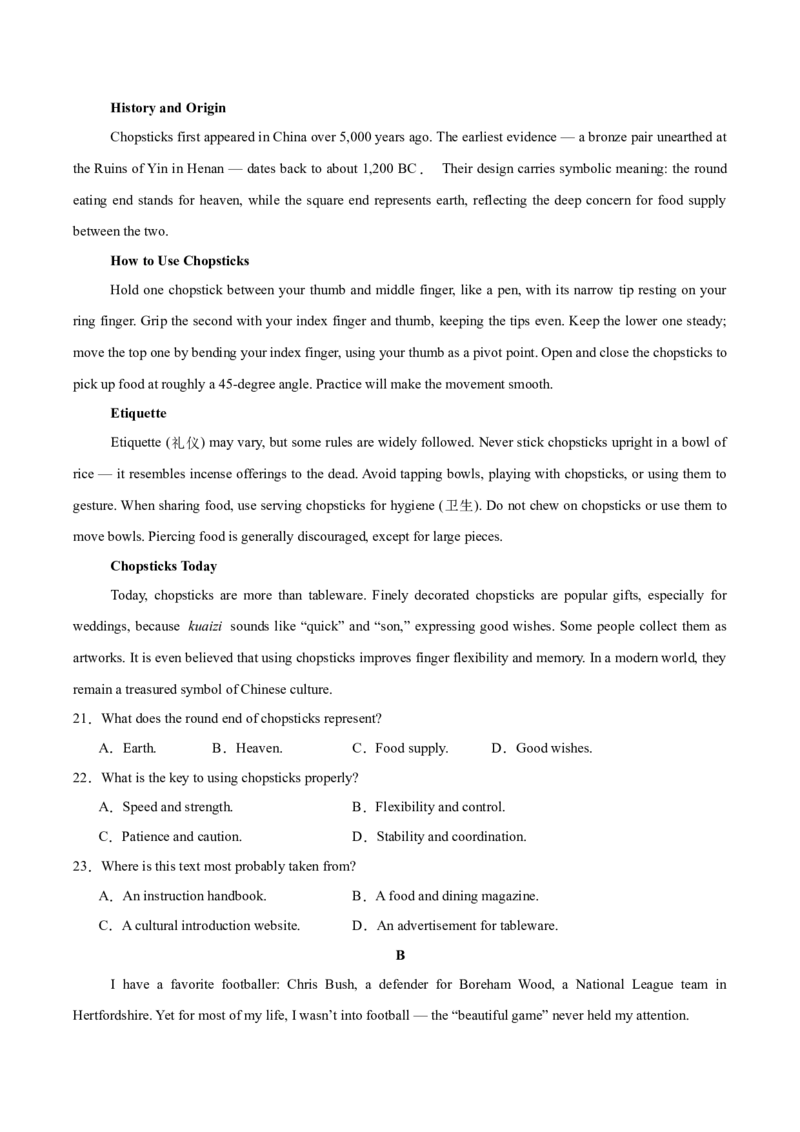
History and Origin
Chopsticks first appeared in China over 5,000 years ago. The earliest evidence — a bronze pair unearthed at
the Ruins of Yin in Henan — dates back to about 1,200 BC. Their design carries symbolic meaning: the round
eating end stands for heaven, while the square end represents earth, reflecting the deep concern for food supply
between the two.
How to Use Chopsticks
Hold one chopstick between your thumb and middle finger, like a pen, with its narrow tip resting on your
ring finger. Grip the second with your index finger and thumb, keeping the tips even. Keep the lower one steady;
move the top one by bending your index finger, using your thumb as a pivot point. Open and close the chopsticks to
pick up food at roughly a 45-degree angle. Practice will make the movement smooth.
Etiquette
Etiquette (礼仪) may vary, but some rules are widely followed. Never stick chopsticks upright in a bowl of
rice — it resembles incense offerings to the dead. Avoid tapping bowls, playing with chopsticks, or using them to
gesture. When sharing food, use serving chopsticks for hygiene (卫生). Do not chew on chopsticks or use them to
move bowls. Piercing food is generally discouraged, except for large pieces.
Chopsticks Today
Today, chopsticks are more than tableware. Finely decorated chopsticks are popular gifts, especially for
weddings, because kuaizi sounds like “quick” and “son,” expressing good wishes. Some people collect them as
artworks. It is even believed that using chopsticks improves finger flexibility and memory. In a modern world, they
remain a treasured symbol of Chinese culture.
21.What does the round end of chopsticks represent?
A.Earth.
B.Heaven.
C.Food supply.
D.Good wishes.
22.What is the key to using chopsticks properly?
A.Speed and strength.
B.Flexibility and control.
C.Patience and caution.
D.Stability and coordination.
23.Where is this text most probably taken from?
A.An instruction handbook.
B.A food and dining magazine.
C.A cultural introduction website.
D.An advertisement for tableware.
B
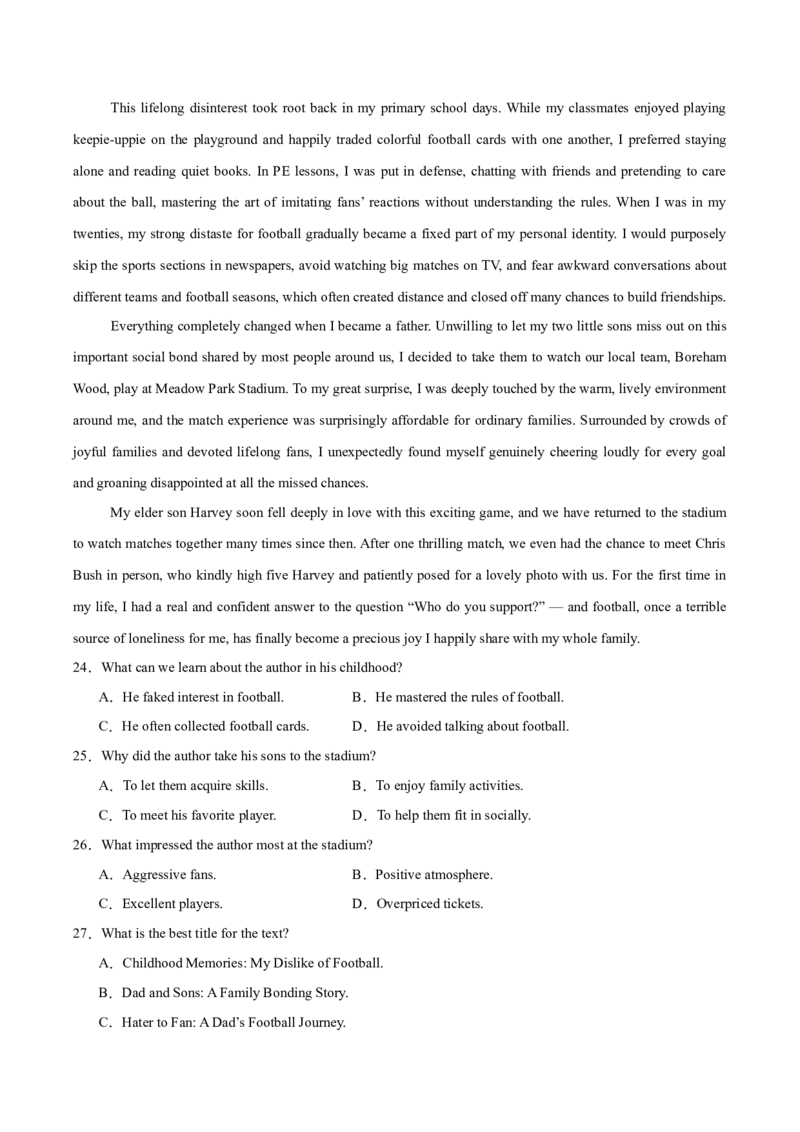
I have a favorite footballer: Chris Bush, a defender for Boreham Wood, a National League team in
Hertfordshire. Yet for most of my life, I wasn’t into football — the “beautiful game” never held my attention.
This lifelong disinterest took root back in my primary school days. While my classmates enjoyed playing
keepie-uppie on the playground and happily traded colorful football cards with one another, I preferred staying
alone and reading quiet books. In PE lessons, I was put in defense, chatting with friends and pretending to care
about the ball, mastering the art of imitating fans’ reactions without understanding the rules. When I was in my
twenties, my strong distaste for football gradually became a fixed part of my personal identity. I would purposely
skip the sports sections in newspapers, avoid watching big matches on TV, and fear awkward conversations about
different teams and football seasons, which often created distance and closed off many chances to build friendships.
Everything completely changed when I became a father. Unwilling to let my two little sons miss out on this
important social bond shared by most people around us, I decided to take them to watch our local team, Boreham
Wood, play at Meadow Park Stadium. To my great surprise, I was deeply touched by the warm, lively environment
around me, and the match experience was surprisingly affordable for ordinary families. Surrounded by crowds of
joyful families and devoted lifelong fans, I unexpectedly found myself genuinely cheering loudly for every goal
and groaning disappointed at all the missed chances.
My elder son Harvey soon fell deeply in love with this exciting game, and we have returned to the stadium
to watch matches together many times since then. After one thrilling match, we even had the chance to meet Chris
Bush in person, who kindly high five Harvey and patiently posed for a lovely photo with us. For the first time in
my life, I had a real and confident answer to the question “Who do you support?” — and football, once a terrible
source of loneliness for me, has finally become a precious joy I happily share with my whole family.
24.What can we learn about the author in his childhood?
A.He faked interest in football.
B.He mastered the rules of football.
C.He often collected football cards.
D.He avoided talking about football.
25.Why did the author take his sons to the stadium?
A.To let them acquire skills.
B.To enjoy family activities.
C.To meet his favorite player.
D.To help them fit in socially.
26.What impressed the author most at the stadium?
A.Aggressive fans.
B.Positive atmosphere.
C.Excellent players.
D.Overpriced tickets.
27.What is the best title for the text?
A.Childhood Memories: My Dislike of Football.
B.Dad and Sons: A Family Bonding Story.
C.Hater to Fan: A Dad’s Football Journey.
D.Chris Bush: A Local Football Legend.
C
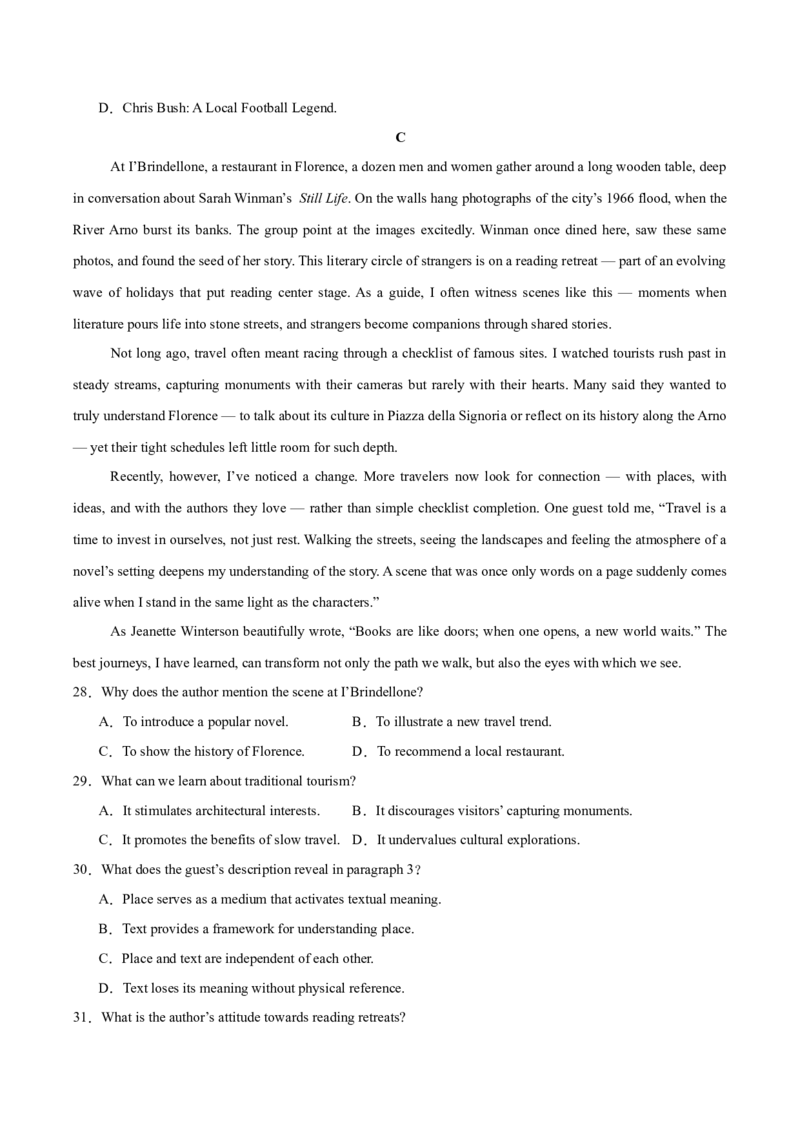
At I’Brindellone, a restaurant in Florence, a dozen men and women gather around a long wooden table, deep
in conversation about Sarah Winman’s Still Life. On the walls hang photographs of the city’s 1966 flood, when the
River Arno burst its banks. The group point at the images excitedly. Winman once dined here, saw these same
photos, and found the seed of her story. This literary circle of strangers is on a reading retreat — part of an evolving
wave of holidays that put reading center stage. As a guide, I often witness scenes like this — moments when
literature pours life into stone streets, and strangers become companions through shared stories.
Not long ago, travel often meant racing through a checklist of famous sites. I watched tourists rush past in
steady streams, capturing monuments with their cameras but rarely with their hearts. Many said they wanted to
truly understand Florence — to talk about its culture in Piazza della Signoria or reflect on its history along the Arno
— yet their tight schedules left little room for such depth.
Recently, however, I’ve noticed a change. More travelers now look for connection — with places, with
ideas, and with the authors they love — rather than simple checklist completion. One guest told me, “Travel is a
time to invest in ourselves, not just rest. Walking the streets, seeing the landscapes and feeling the atmosphere of a
novel’s setting deepens my understanding of the story. A scene that was once only words on a page suddenly comes
alive when I stand in the same light as the characters.”
As Jeanette Winterson beautifully wrote, “Books are like doors; when one opens, a new world waits.” The
best journeys, I have learned, can transform not only the path we walk, but also the eyes with which we see.
28.Why does the author mention the scene at I’Brindellone?
A.To introduce a popular novel.
B.To illustrate a new travel trend.
C.To show the history of Florence.
D.To recommend a local restaurant.
29.What can we learn about traditional tourism?
A.It stimulates architectural interests.
B.It discourages visitors’ capturing monuments.
C.It promotes the benefits of slow travel.
D.It undervalues cultural explorations.
30.What does the guest’s description reveal in paragraph 3?
A.Place serves as a medium that activates textual meaning.
B.Text provides a framework for understanding place.
C.Place and text are independent of each other.
D.Text loses its meaning without physical reference.
31.What is the author’s attitude towards reading retreats?
A.Objective.
B.Dismissive.
C.Skeptical.
D.Favorable.
D
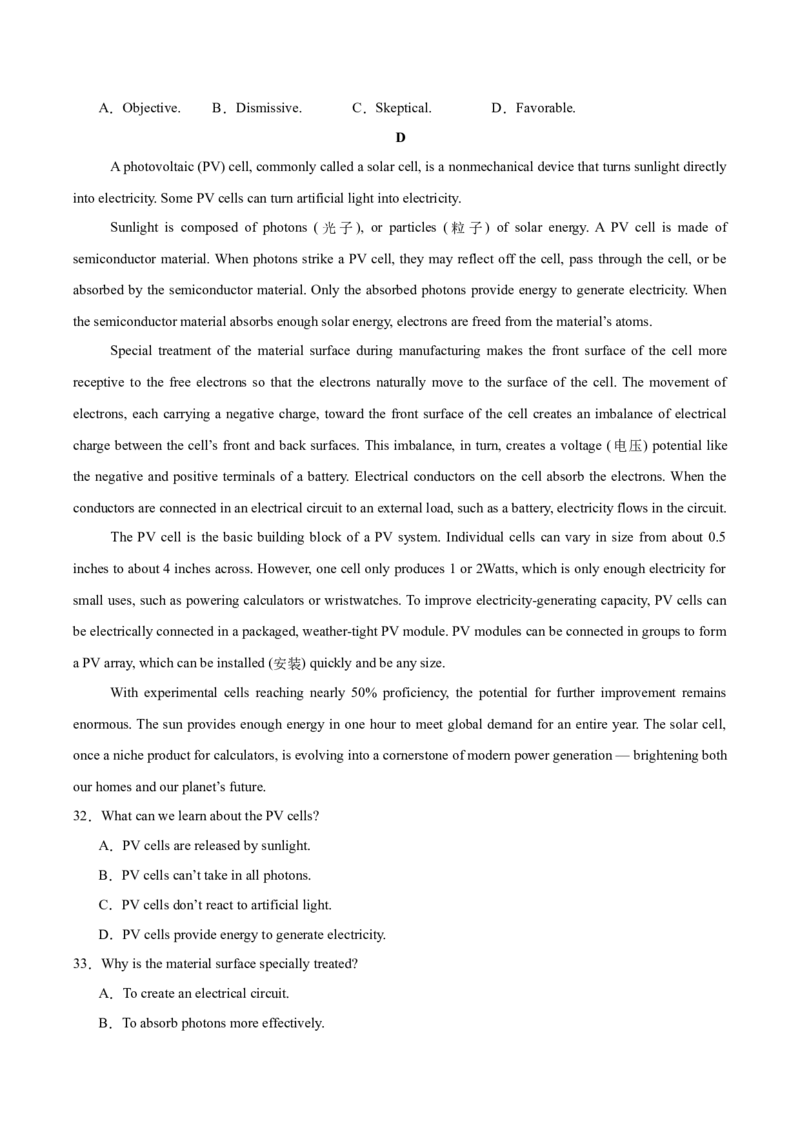
A photovoltaic (PV) cell, commonly called a solar cell, is a nonmechanical device that turns sunlight directly
into electricity. Some PV cells can turn artificial light into electricity.
Sunlight is composed of photons ( 光子), or particles ( 粒子) of solar energy. A PV cell is made of
semiconductor material. When photons strike a PV cell, they may reflect off the cell, pass through the cell, or be
absorbed by the semiconductor material. Only the absorbed photons provide energy to generate electricity. When
the semiconductor material absorbs enough solar energy, electrons are freed from the material’s atoms.
Special treatment of the material surface during manufacturing makes the front surface of the cell more
receptive to the free electrons so that the electrons naturally move to the surface of the cell. The movement of
electrons, each carrying a negative charge, toward the front surface of the cell creates an imbalance of electrical
charge between the cell’s front and back surfaces. This imbalance, in turn, creates a voltage (电压) potential like
the negative and positive terminals of a battery. Electrical conductors on the cell absorb the electrons. When the
conductors are connected in an electrical circuit to an external load, such as a battery, electricity flows in the circuit.
The PV cell is the basic building block of a PV system. Individual cells can vary in size from about 0.5
inches to about 4 inches across. However, one cell only produces 1 or 2Watts, which is only enough electricity for
small uses, such as powering calculators or wristwatches. To improve electricity-generating capacity, PV cells can
be electrically connected in a packaged, weather-tight PV module. PV modules can be connected in groups to form
a PV array, which can be installed (安装) quickly and be any size.
With experimental cells reaching nearly 50% proficiency, the potential for further improvement remains
enormous. The sun provides enough energy in one hour to meet global demand for an entire year. The solar cell,
once a niche product for calculators, is evolving into a cornerstone of modern power generation — brightening both
our homes and our planet’s future.
32.What can we learn about the PV cells?
A.PV cells are released by sunlight.
B.PV cells can’t take in all photons.
C.PV cells don’t react to artificial light.
D.PV cells provide energy to generate electricity.
33.Why is the material surface specially treated?
A.To create an electrical circuit.
B.To absorb photons more effectively.
C.To direct the movement of the electrons.
D.To free electrons from the material’s atoms.
34.How can PV technology meet larger electricity demands?
A.By making the size of the cells smaller.
B.By adapting it to various kinds of weather.
C.By increasing the number of connected cells.
D.By improving the efficiency of installation.
35.What does the last paragraph mainly talk about?
A.The prospects of PV technology.
B.The cornerstone of power generation.
C.The future development of our planet.
D.The stereotypes of new forms of energy.
第二节 (共5 小题;每小题2.5 分,满分12.5 分)
根据短文内容,从短文后的选项中选出能填入空白处的最佳选项。选项中有两项为多余选项。
Nowadays, many people talk about AI but only recite definitions or know nothing about technical terms. I
believe that there are these 4 terms that, if you actually understand them, you’ll be miles ahead of almost everyone
else in the room. Let’s start.
Tokens
36     Instead, they process small text pieces known as tokens. For example, the sentence “I love pizza” can
be broken into 3 tokens: “I”, “love”, “pizza”. Tokens are the atoms (原子) of AI language. The way your prompt
(提示词) gets split into tokens directly affects how the AI responds.     37
Context window
It’s the total amount of text measured in tokens that an AI model can see and consider at one time. This
includes everything: your instructions, any documents you’ve shared, and the model’s own replies.     38
What is the practical lesson? If you’re working on something important like summarizing a long document or
analyzing data, always be aware that your AI might be forgetting earlier parts of your conversation.
Temperature
When you ask an AI to write something, there’s a setting known as temperature, which decides how random or
predictable the output will be. Higher= more creative, lower= more predictable. So here’s the unwritten rule that
most people don’t know: If you’re using AI for writing fiction, increase the temperature.     39     If you’re
using AI for factual tasks, you want low temperature. The AI should be precise, not creative.
Hallucination
Hallucination is when an AI gives out wrong answers with absolute confidence. Why does this happen? AI
language models are not databases. They don’t look up facts. They predict the next most likely token based on
patterns they learned during training.     40
A.AI models don’t read words or even letters.
B.This generates surprising plots and fresh ideas.
C.It’s the advantage of almost every useful AI product.
D.So we should never trust AI blindly for vital information.
E.Understand it, and you’ll see why some prompts work better.
F.This helps you know why your AI assistant is acting confused.
G.Think of it as a whiteboard— old content must be erased when full.
第三部分:语言运用(共两节,满分 30 分)
第一节:(共15 小题;每小题 1 分,满分15 分)
阅读下面短文,从短文后各题所给的 A、B、C 和 D 四个选项中,选出可以填入空白处的最佳选项。
With tools in his hands, Zhou Wenjun starts his daily patrol (巡逻) along the Simatai part of the Great Wall.
Every morning in Beijing’ s Miyun District, the local     41     climbs the steep mountain, checks for
possible structural dangers and clears away rubbish and plants. He has kept this     42     for more than ten
years.
Built in the early years of the Ming Dynasty, the Simatai part is     43    steep. Some slopes are over 70
degrees,     44     patrollers to climb on all fours. “Every brick here is     45    ,” Zhou says. While
walking, he     46     loose bricks in the woods and puts them together beside the wall for future repair work.
Some bricks have words on them dating back to 1577, which record the soldiers and workers who built the wall
nearly 450 years ago.
Over the past 14 years, Zhou has walked about 10,000 kilometers along the Great Wall. His     47

consists of a 10-kilogram backpack filled with water, snacks, trash bags, a measuring tape, and a first-aid kit. His
main     48     is to protect the site, but he also     49     tourists when they are in trouble and keeps an eye
on behaviors that could cause damage to the site.
For these years, Zhou has     50     his protection initiatives to the digital world. He runs a live-
streaming account with over 70,000     51    , sharing the history and culture of the Great Wall. By     52

the defense system and the daily life of ancient soldiers online, he has become well-known as a knowledgeable
“farmer broadcaster” of the Great Wall.
Besides Zhou, the protection team at Simatai currently consists of 22 members, most of whom are local
villagers like him. They are part of more than 380 Great Wall protectors in Beijing. For Zhou, protecting the Great
Wall has become a way of     53    , rather than a job.     54     the work is physically tiring, he continues
to     55     his patrols to ensure that more people understand the importance of preserving this global heritage
site.
41.A.officer
B.villager
C.soldier
D.teacher
42.A.routine
B.adventure
C.strategy
D.contribution
43.A.slightly
B.relatively
C.terribly
D.hardly
44.A.persuading
B.encouraging
C.requiring
D.allowing
45.A.valuable
B.accessible
C.useful
D.fantastic
46.A.fixes
B.leaves
C.throws
D.collects
47.A.arrangement
B.package
C.system
D.equipment
48.A.benefit
B.assignment
C.direction
D.process
49.A.looks for
B.turns to
C.helps out
D.cheers up
50.A.adapted
B.applied
C.exported
D.extended
51.A.subscribers
B.actors
C.donors
D.influencers
52.A.memorizing
B.explaining
C.repairing
D.recognizing
53.A.standard
B.prize
C.life
D.income
54.A.Since
B.While
C.Once
D.Unless
55.A.design
B.picture
C.track
D.cover
第二节:(10 个小题;每小题1.5 分,满分15 分)
阅读下列短文,根据短文内容或括号内所给词的恰当形式填空。
The vibrant spirit of Dongying recently filled the halls of the Midland Downtown Library in the United
States,     56     (turn) a quiet afternoon into a celebration of the Chinese New Year. For local children in
attendance, it was more than a holiday event; it was an     57     (introduce) to their sister city — a place where
the Yellow River meets the Bohai Sea.
From the wisdom of Sun Tzu, a military strategist from ancient China,     58     the artistry of handmade
lacquer fans ( 漆扇), Dongying’s heritage fascinated     59     audience. The city’s mascots, named He
Dongdong and Hai Yingying, became instant favorites, acting as cultural ambassadors to a new generation of
American friends.
This growing friendship began in the summer of 2024,     60     youth from Texas visited the Yellow
River Delta. They     61     (stand) at the impressive estuary (河口湾), explored ancient military history, and
shared meals     62     bridged the cultural gap. Those 10 days turned official ties into lifelong memories.
The story continues in Midland’s classrooms. At the top-ranked Carver Center, students listen to stories of
Dongying with a new sense of wonder, viewing the distant city not as a dot on a map, but     63     a friend
across the ocean. As     64     (prepare) begin for the study tour to Dongying in 2026, the groundwork is being
laid for more students and teachers     65     (cross) the Pacific, ensuring that the seeds of friendship planted
today will grow for years to come.
第四部分  写作(共两节,满分40 分)
第一节(满分 15 分)
66.你校英文报正在征集关于“高中是否应系统开设职业生涯规划课程”讨论稿件。请你以“Is a Career
Planning Course Necessary in High School?”为题,写一篇短文投稿,内容包括:
(1) 你的观点;
(2) 阐述理由。
注意: (1) 词数80 左右;(2) 短文题目已给出,不计入总词数
Is a Career Planning Course Necessary in High School
____________________________________________________________________________________________
____________________________________________________________________________________________
____________________________________________________________________________________________
____________________________________________________________________________________________
第二节  (满分 25 分)
67.阅读下面材料,根据其内容和所给段落开头语续写两段,使之构成一篇完整的短文。
Tom, a hard-working junior high school student, was buried in thick review books and exercise papers all
day long. Faced with endless daily tests and heavy learning tasks, he spared no effort to make progress step by step.
Every day, he devoted himself fully to his studies, hoping to lay a solid foundation for his future studies. For him,
every moment of study was precious, and a peaceful, undisturbed learning environment was essential to efficient
revision.
However, an unexpected trouble came to him. A flock of birds built their nests in the tall old tree just outside
his classroom window. From early morning till sunset, the birds kept singing loudly and non-stop. The sharp and
continuous chirping cut through the quiet classroom again and again, easily breaking his train of thought.
Whenever he tried to memorize key knowledge or focus on difficult exercises, the noisy sounds would distract him
at once. Gradually, he grew restless and frustrated.
As the monthly exam approached, his stress built up day by day. One tired evening, after wasting plenty of
time and failing to finish his homework smoothly because of the noise, he could no longer hold back his
annoyance. He took up his pen and wrote a heartfelt letter to the principal (校长), earnestly requesting the school to
clear away the bird nests so that students could study in peace.
He mailed the letter with mixed feelings, not sure whether his request would be approved. In the following
days, he waited anxiously, still troubled by the bird songs and unable to settle down. He tried hard to ignore the
noise, yet his anger never faded away. He even felt a little disappointed, worrying that no one would notice his
trouble.
注意:
(1)续写词数应为150 个左右;
(2)请按照如下格式在答题卡的相应位置作答。
Several days later, the principal invited him for a walk.
____________________________________________________________________________________________
____________________________________________________________________________________________
____________________________________________________________________________________________
____________________________________________________________________________________________
___________________________
Moved and enlightened, Tom followed the principal’s advice.
____________________________________________________________________________________________
____________________________________________________________________________________________
____________________________________________________________________________________________
____________________________________________________________________________________________
___________________________