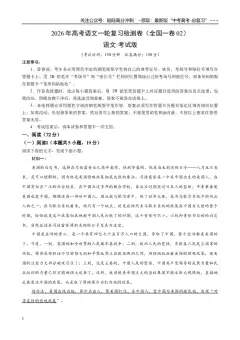
2027 年高考一轮复习阶段性检测卷(全国一卷
02)
 英语
第一部分 听力(共两节,满分30 分)
注意:听力部分答题时请先将答案标在试卷上,听力部分结束前你将有两分钟的时间将答案转涂到答题卡
上。
第一节(共5 小题; 每小题1.5 分, 满分7.5 分)
听下面5 段对话。每段对话后有一个小题,从题中所给的A、B、C 三个选项中选出最佳选项。听完每段
对话后,你都有10 秒钟的时间来回答有关小题和阅读下一小题。每段对话读两遍。

1.What does Tom’s wife value most in a gift?
A.High price.
B.Beautiful appearance.
C.Sincere care.
2.When will the woman see Doctor Smith?
A.This morning. B.After 4 p.m. this afternoon.
C.Tomorrow afternoon.
3.What will the man get for free?
A.A plastic bag.
B.Separate food boxes.C.A paper bag.
4.How does the man sound?
A.Worried.
B.Calm.
C.Interested.
5.What have the speakers probably been doing recently?
A.Preparing for a lecture.
B.Collecting boxes for a poster.
C.Working on a recycling program.
第二节 (共15 小题;每小题1. 5 分,满分 22. 5 分)
听下面5 段对话或独白。每段对话或独白后有几个小题 ,从题中所给的A、B、C 项中选出最佳选项。听
每段对话或独白前,你将有时间阅读各个小题,听完后,各小题将给出5 秒钟的作答时间。每段对话或独
白读两遍。
听第6 段材料,回答第6、7 题。
6.What does the woman want to know?
A.Where to plant a tree.
B.Where to park her car.
C.Where to put up a sign.
7.Where is the sign?
A.Opposite the building.
B.Around the corner.
C.Behind a tree.
听第7 段材料,回答第8、9 题。
8.What is the relationship between the speakers?
A.Mother and son.
B.Father and daughter.
C.Husband and wife.
9.When does the news start tonight?
A.At nine o’clock.
B.At a quarter to eleven.
C.At eleven o’clock.
听第8 段材料,回答第10 至12 题。
10.What is the man struggling with?
A.His final exam.
B.His class project.
C.His research proposal.
11.What aspect of city life interests the man?
A.Jobs and money.
B.Family relationships.
C.Education and culture.
12.Where will the speakers meet on Thursday afternoon?
A.In the library.
B.In the lecture hall.
C.In the woman's office.
听第9 段材料,回答第13 至16 题。
13.Where is the exhibition being held?
A.In the artist’s house.
B.In the gallery.
C.In the town square.
14.What are his paintings about?
A.The daily scenes in his life.
B.The beauty of famous towns. C.The death
of a young talent.
15.When was the artist born?
A.In 1830.
B.In 1892.
C.In 1922.
16.What does the man especially love about the paintings?
A.They recorded the local history.
B.They surprised the discoverers.
C.They showed the painter’s whole life.
听第10 段材料,回答第17 至20 题。
17.What problem does the family face?
A.The family lacks enough space.
B.They have a tight housing budget.
C.They have no place to work from home.
18.Why does the woman hesitate about moving?
A.She would lose her personal space.
B.She worries about travel time to work.
C.She dislikes unfamiliar neighborhoods.
19.What does the man say about nearby schools?
A.They have big class sizes.
B.They are close to public transport.
C.They offer better learning conditions.
20.What do the couple decide to do next?
A.Visit potential new homes.
B.Talk to the children first.
C.Contact a moving company.
第二部分 阅读(共两节,满分 50 分)
第一节 (共 15 小题;每小题 2.5 分,满分 37.5 分) 阅读下列短文,从每题所给的 A、B、C、D 四
个选项中选出最佳选项。
A
Our halls of residence are spread across four residential campuses, each with its own unique features, dining
options and facilities.City campus
Want to be at the heart of the city and close to our University campus? Then City Campus is the place for you.
These halls are located either north or south of the University campus. If you choose to live north of campus, you’ll
be a short walk or bus ride from the city center. South of the campus is just a 10-minute walk from the
action.Fallowfield campus
Located about 2.5 km south of the main University campus, Fallowfield is a lively and popular suburb. Almost like
a town within the city, Fallowfield is known for its social scene, giving you plenty of opportunities to meet new
people.Victorin Park
Situated between the City and Fallowfield campuses, Victoria Park offers the best of both worlds – easy access to
both academic and social activities. Set in leafy green surroundings, it provides a calm and pleasant environment
for living and studying. This area is packed with restaurants and shops offering a wide range of international
cuisine and groceries.Riverside campus
Want easy campus access without city noise? Riverside Campus might be perfect for you. Located by the
calm riverbanks, it provides a peaceful escape from the busy city, while still being close to the main University
campus. The central campus is about 3 km away and easily reachable.
21.What is special about City campus?
A.It is located along a famous road.
B.It holds regular academic activities.
C.It offers two distinct residential areas.
D.It features a dynamic social environment.
22.What can a student enjoy if they live in Victoria Park?
A.Easy access to the university’s library.
B.A colorful nightlife with many choices.
C.Leafy riverside paths for daily walks.
D.Green scenery and diverse cuisine.
23.Which is the best choice for students who want a quiet place?
A.City campus.
B.Fallowfield campus.C.Riverside campus.
D.Victoria Park.
B
In April 2026, some of the world’s most powerful technology companies made a striking announcement:
they are now using artificial intelligence — AI — to help build and improve AI itself. Companies like OpenAI,
Anthropic, and Google DeepMind have quietly set a new goal: to create AI systems that can do their own research
and automate (使自动化) the process of scientific discovery.
Anthropic, the company behind the popular AI assistant Claude, recently revealed that its AI now writes up
to 90 percent of the company’s own code — the instructions that tell computers what to do. Meanwhile, OpenAI,
one of the world’s leading AI labs, has announced plans to launch an “AI research intern ( 实习生)” within six
months. This intern would be able to independently handle a small number of specific research problems —
without any help from a human.
The idea of AI improving itself is not new, but the speed at which it is now happening has surprised many
experts. Jakub Pachocki, OpenAI’s chief scientist, told MIT Technology Review that he believes we are
approaching a point where AI models could work “indefinitely” — meaning continuously — on complex tasks,
much like a human researcher. “We will have an era where there are entire research labs inside data centers,” he
said.
However, this exciting vision also raises serious concerns. Experts warn that self-improving AI systems
could become difficult to control. If an AI makes errors in one step of a long chain of tasks, those mistakes could
build up — a problem known as “error accumulation (积累)”. A more alarming worry is that such systems could be
used to design dangerous tools, including biological weapons or cyberattacks.
Despite the risks, many in the tech industry remain optimistic. They argue that self-improving AI could
speed up progress in science and medicine, helping researchers find cures for diseases faster than ever before. The
question is not whether this technology will arrive — but whether humanity will be prepared when it does.
24.What is the new target set by three major AI companies?
A.Building AI to automate its own research.B.Applying AI to cure diseases more quickly.
C.Using AI to train more research interns. D.Developing AI to write software code.
25.What can be concluded from Jakub Pachocki’s words?
A.Data centers will be replaced by modern labs soon.
B.AI will carry out long-term complicated research work.
C.Some jobs for human researchers might disappear gradually.
D.AI is able to finish research projects within one single night.
26.Why are some experts concerned about self-improving AI?
A.It may slow down medicine research.
B.It may suffer accumulated task errors.
C.It may occupy too many server facilities. D.It may waste plenty of energy resources.
27.Which of the following can be the best title for the passage?
A.Hidden Dangers of Self-Improving AI
B.Great Value of Self-Improving AI
C.Fast Progress of Self-Improving AI
D.Double sides of Self-Improving AI
C
In an era filled with short videos, 15-second social media posts, and endless phone notifications, deep
reading — the slow, focused practice of engaging with long texts — is often seen as an outdated habit. However,
growing research in brain science and education warns that the decline of deep reading is quietly harming young
people’s intellectual and emotional growth.
According to a 2025 study by the American Psychological Association, teenagers’ average attention span has
dropped from 12 seconds in 2010 to just 8 seconds in 2025 — even shorter than a goldfish’s. Researchers link this
directly to the rise of “skimming culture,” where people scan digital content for key words instead of reading
carefully. While skimming is useful for processing large amounts of information fast, it cannot replace the
cognitive benefits of deep reading.
Unlike skimming, deep reading requires continuous focus and critical thinking. When reading long, complex
texts, our brains connect ideas, follow logical arguments, and imagine described scenes. This strengthens the
prefrontal cortex (前额叶皮层) — the brain area controlling decision-making, problem-solving, and emotional
regulation. A 2024 Stanford University study found that students who did regular deep reading scored 23% higher
on critical thinking tests than those who only read short digital content.
Beyond cognitive gains, deep reading fosters empathy. Reading literary stories lets us step into characters’
lives, share their feelings, and see the world through their eyes. This helps young people understand others — a
vital skill in an increasingly divided world.
Critics argue deep reading is inefficient in the digital age, where information is abundant and time limited.
But this misses the point: deep reading is not just about learning facts. It builds the ability to understand, analyze,
and care about the world. As leading brain scientist Maryanne Wolf said: “We read not only to know others’
experiences, but to become people who think deeply, feel deeply, and act wisely.”
28.What is the purpose of mentioning goldfish in the text?
A.To show goldfish have short attention spans.
B.To compare human and fish brain structures.
C.To criticize teenagers’ screen addiction.
D.To highlight teens’ even shorter attention span.
29.What is directly supported by the 2024 Stanford study?
A.Deep reading strengthens the prefrontal cortex.
B.Skimming helps process information quickly.
C.Deep reading improves critical thinking test scores.
D.Attention spans have dropped since 2010.
30.What is the author’s attitude toward the critics’ view?
A.He thinks it ignores something.
B.He finds it completely wrong.
C.He agrees with their concern.
D.He is unsure about the truth.
31.What is the main idea of the text?
A.Skimming works better than deep reading now.
B.Less deep reading hurts young people’s growth.
C.Short videos and social media lengthen people’s attention.
D.Young people think deep reading is old-fashioned.
D
Music has long been known for its ability to help people feel better, and when combined with artificial
intelligence (AI), this healing effect becomes more accurate. This is shown by the new AI music therapy machine
displayed at the World Artificial Intelligence Conference in Shanghai. Developed by the Shanghai Conservatory of
Music, this machine offers personalized healing experiences for users.
Inside the machine, users wear special devices that check their brain activity and heart rate while sitting in
comfortable chairs that feel like zero gravity. They relax to soft background music with natural sounds, such as
birds singing or water flowing, and watch real-time information about their brain and body on a screen. Before the
therapy starts, users fill out a form about their health and birth date. AI combines this information with real-time
body data to create personalized music and matching pictures. After the session, they get a report on their therapy
and a customized music plan.
The machine works by turning each person’s unique brain signals into sound waves through special
computer programs. AI quickly studies personal characteristics and real-time body signs to make suitable sound
environments, meeting both general and individual needs for healing through sound. It brings technology and art
together, based on years of research by the conservatory’s lab.
This creative tool has many uses: it can help with sleep problems, low mood, and support babies born too
early, children with special needs, and elderly people’s health care. It is already working with hospitals like
Shanghai Huashan Hospital to help children with special needs, reduce pain, and ease exam stress for students.
Experts say AI is playing a bigger role in mental health care. Besides music therapy, AI can find emotional
changes from social media posts or talks to spot risks of low mood. It also guides patients through mental health
exercises and helps train children with special needs using virtual reality systems. As AI and music work together,
they bring new hope for better mental and physical health.
32.Why is AI music therapy more effective?
A.Creating relaxing music with AI and natural sounds.
B.Achieving better targeting and effects with AI.
C.Being developed by well-known music schools.
D.Bringing more comfort with zero-gravity chairs.
33.What does the underlined word “customized” mean?
A.Suitable for a specific person.
B.Designed for customers.
C.Easy to understand and follow.
D.Created by professional musicians
34.How does the machine make personalized sound environments?
A.By creating sound waves and analyzing personal features.
B.By using VR to simulate natural environments.
C.By meeting different healing needs.
D.By picking the user’s favourite sounds and music.
35.What can we infer from the text?
A.AI-plus-music will be the top health care tool.
B.Traditional music therapy works poorly without AI.
C.This music therapy tool may have various values.
D.Personalized music therapy is a must for people.
第二节 (共5 小题;每小题2.5 分,满分12.5 分)
根据短文内容,从短文后的选项中选出能填入空白处的最佳选项。选项中有两项为多余选项。
We all face quantities of stresses in day-to-day living, whether at work, in the home, or anywhere in between.   36
Here’s how stress can help us on an everyday basis.
 Sharpen your memory.
◆
Did you ever notice that sometimes when you are stressed, your memory seems to improve? Remember that test
you passed where the answers seemed to come out of nowhere?   37   It's because of stress hormones(荷尔
蒙)that increase your alertness(机敏) when it’s most needed.
◆   38
Successful employees turn stress into motivation. Have you ever noticed that you get the least amount of work
done when you have the fewest deadlines? Too little stress can affect how much you actually get done. When you
take risks and choose to get over the difficulty, it improves your mental toughness and self-confidence.
 Helping you resist the attack of illness.
◆
   39   Believe it or not, the right kind of stress can help your body’s defenses against illness. When you get sick,
stress causes you to make hormones that battle threats to your health. That burst of stress is helpful to your immune
system when your body faces a threat.
 Making your life more interesting.
◆
Think about some stressful situations that we consciously put ourselves in to make life more interesting and
enjoyable, like asking someone out on a first date, conquering a known fear, or learning something new. These may
not immediately come to mind when you think of stress because of the positive outcomes.   40
A.Helping you get an advantage at work.
B.Helping you get through difficult times.
C.This will happen whenever you are stressed.
D.That’s one way your brain responds to stress.
E.You need a healthy immune system to help fight off diseases.
F.But they’re the types that can help you achieve fulfillment and happiness.
G.But handled properly, stress can have many benefits for the body and mind.
第三部分:语言运用(共两节,满分 30 分)
第一节:(共15 小题;每小题 1 分,满分15 分)
阅读下面短文,从短文后各题所给的 A、B、C 和 D 四个选项中,选出可以填入空白处的最佳选项。
When I first signed up to volunteer at the local animal shelter, my primary goal was simply to     41

my community service hours. I had pictured myself comfortably petting furry puppies. Reality, however, quickly
42     me.
I was assigned to the “Special Care” area, cleaning cages and feeding dogs that were too old, sick, or     43
to be adopted. Among them was Buster, a massive mix-breed dog barking ( 吠)     44     at anyone
approaching.
For the first two weeks, I tried my best to     45     Buster, quickly sliding his food in and stepping back,
terrified of an attack. One rainy afternoon, few visitors came, and the shelter was unusually     46    . Sitting
quietly, I noticed Buster stopped barking. He slowly paced forward, letting out a soft, pitiful whine (呜咽).
Cautiously, I     47     my hand. Instead of baring his teeth, Buster pressed his wet nose against my
fingers. At that moment, I realized his aggressive behaviour was simply out of     48    . Having been hurt
before, he was trying to protect himself from further     49    .
Over the next month, I dedicated extra time to Buster. I learned to      50      his body language and
speak softly. Slowly but surely, the wall of      51      between us began to break down.
Months later, an elderly couple came and      52      Buster. Watching him leave, I felt both sadness and
pride. This experience profoundly reshaped me. We shouldn’t hastily (草率地)      53      others by their
defensive masks. Those who seem hardest to love often      54      it most. Volunteering was no longer about
logging hours; it was about      55      a genuine connection.
41.A.complete
B.record
C.enjoy
D.extend
42.A.relieved
B.confused
C.struck
D.comforted
43.A.weak
B.fierce
C.shy
D.ugly
44.A.violently
B.nervously
C.joyfully
D.gently
45.A.ignore
B.avoid
C.observe
D.calm
46.A.messy
B.tense
C.deserted
D.crowded
47.A.held back
B.reached out
C.shook off
D.put down
48.A.sadness
B.anger
C.hunger
D.fear
49.A.loss
B.regret
C.pain
D.stress
50.A.read
B.restrict
C.change
D.copy
51.A.distrust
B.coldness
C.silence
D.impatience
52.A.rescued
B.cured
C.bought
D.adopted
53.A.reject
B.judge
C.control
D.hurt
54.A.hide
B.doubt
C.need
D.resist
55.A.expecting
B.keeping
C.sharing
D.building
第二节:(10 个小题;每小题1.5 分,满分15 分)
阅读下列短文,根据短文内容或括号内所给词的恰当形式填空。A moderate level of weekend catch-up sleep
can relieve tiredness and help the body recover. However, more isn’t always better. A study     56     (publish)
in Preventive Medicine, an American journal, shows that catching up on sleep for more than three hours     57
(significant) increases the risk of systemic inflammation.
You can’t contract sleep, but you can’t overdo it either — even on weekends. Research from Shanghai Jiao
Tong University School of Medicine and other     58     (institution) suggests there’s a “golden” sleep
duration: around 7.32 hours (about 7 hours and 19 minutes) is best for health.
Long sleep duration     59     (associate) with chronic inflammation, depression, obstructive sleep
apnoea, and reduced physical activity. Clinical observations also show that people,     60     regularly sleep
less than 6 hours or more than 9 hours, tend to have     61     (high) risks of metabolic syndrome, diabetes, and
mortality.
Go to bed and wake up at roughly the same time every day, even on weekends. Limit naps     62     20–
30 minutes, and avoid napping late in the day.     63     (strength) your sleep-wake cycle: exercise more during
the day, and in the 1–2 hours before bed, avoid screens, intense exercise, caffeine, alcohol, and heavy or sugary
snacks. Instead, read or listen to calming music.
    64     weekend lie-in of 1–2 hours is fine, but sleeping much later than your weekday schedule
disrupts your body clock,     65     (affect) inflammation, hormones, and metabolism.
第四部分  写作(共两节,满分40 分)
第一节(满分 15 分)
假定你是某国际学校学生李华,你校正在举办“Me &My School”活动,邀请学生分享珍藏的照片。你的照
片将作为优秀作品在校园公众号展出。请为其配一段英文说明(请勿出现真实的校园信息),内容包括:
(1)描述照片;
(2)分享照片背后的故事。
注意:
(1)写作词数应为80 个左右;
(2)请按如下格式在答题卡的相应位置作答。
Me & My School
If there’s one picture that sums up my favorite school memory, this is it.
____________________________________________________________________________________________
____________________________________________________________________________________________
____________________________________________________________________________________________
____________________________________________________________________________________________
____________________________________________________________________________________________
____________________________________________________________________________________________
第二节  (满分 25 分)
阅读下面材料,根据其内容和所给段落开头语续写两段,使之构成一篇完整的短文。 When Chris
entered high school, he described himself as “a thin kid... really shy and socially awkward” with little faith in his
own abilities. He loved playing baseball but always doubted his skills. He would often stand at the back during
team tryouts, hoping nobody would notice him. When his teammates talked about their achievements, Chris just
listened in silence, believing he had nothing worth sharing. After hearing about Joe Yager’s gym — a small training
space where players can only enter by invitation — Chris and his father showed up nervously, hoping for a chance.
“We’re here for training,” they said cautiously, standing at the doorway. At first, Joe Yager had to refuse: the
gym was already full, and he stuck strictly to his rule. Chris felt his heart sink. He lowered his head and turned
away without a word. But as the pair walked out, their heads low with clear disappointment, Yager felt a sudden
pull at his heart. He saw something in the boy — a quiet hunger for change that reminded him of his younger self.
He called out, “Hey, wait a minute.” That quick decision would go on to change Chris’s life completely.
Chris was overjoyed yet still shy. He was very quiet, not the type to walk up to someone and ask for help.
During the first few training sessions, he would stand in the corner, afraid of doing something wrong. Yager,
however, saw hidden talent beneath the nervousness and chose to help him when no one else would. “He was the
one who reached out his hand and said, ‘Hey, I can help you,’” Chris later recalled with deep thankfulness. Those
simple words planted a seed of hope in the boy’s heart — a seed that, with time and care, would grow into a strong
desire to pass on that same kindness.
注意:1. 续写词数应为150 左右;2. 请按如下格式作答。
Paragraph 1:
Under Yager’s patient guidance, Chris began his training with new-found determination.
____________________________________________________________________________________________
____________________________________________________________________________________________
____________________________________________________________________________________________
____________________________________________________________________________________________
____________________________________________________________________________________
Paragraph 2:
Gradually, Chris not only excelled in sports, but also transformed himself into a confident and inspiring
young man.
____________________________________________________________________________________________
____________________________________________________________________________________________
____________________________________________________________________________________________
____________________________________________________________________________________________
____________________________________________________________________________________