第 08 讲 名词性从句 (讲)
【考纲考情】
名词从句是英语高考常考点之一。在高考中主要考查点有:考查名词从句连接词(特别是what/
that/whether在名词从句中的运用)、it形式主语句式、it形式宾语句式、名词从句和定语从句的区别等。
名词从句的考查常出现在高考试题中的语法填空、改错、书面表达中,尤其是what/that/whether引导
的名词从句。
【考点梳理】
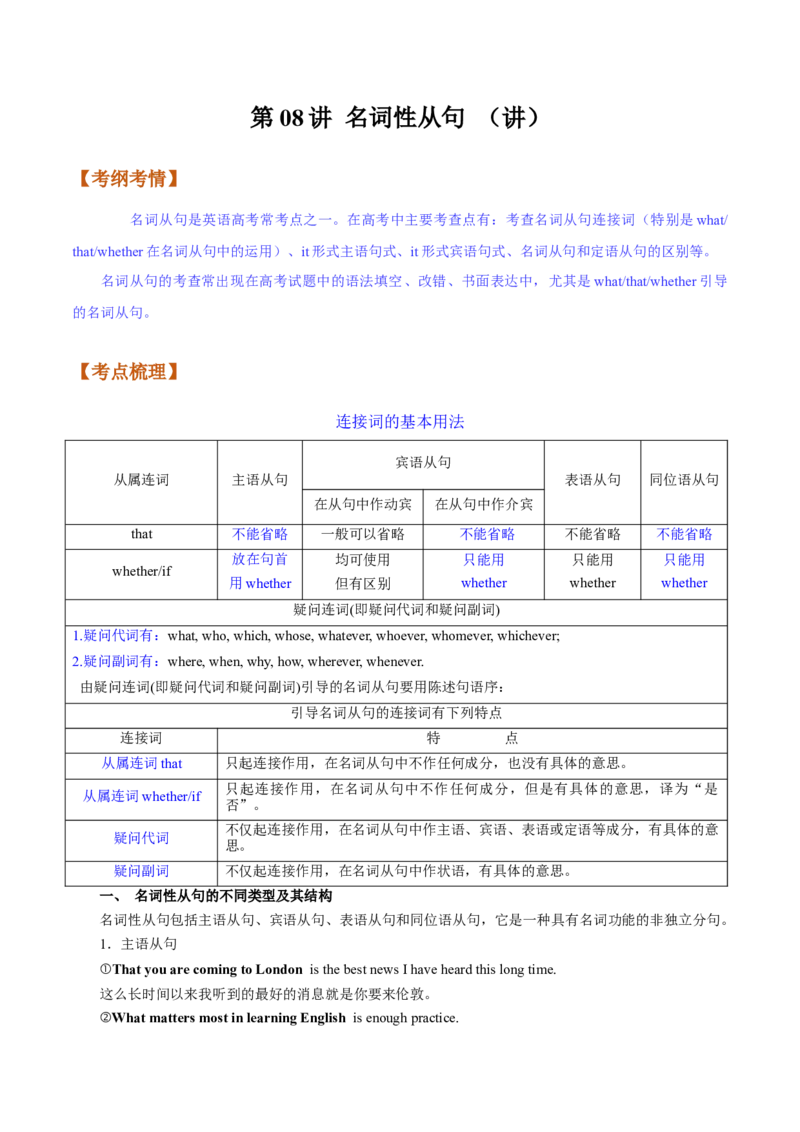
连接词的基本用法
宾语从句
从属连词 主语从句 表语从句 同位语从句
在从句中作动宾 在从句中作介宾
that 不能省略 一般可以省略 不能省略 不能省略 不能省略
放在句首 均可使用 只能用 只能用 只能用
whether/if
用whether 但有区别 whether whether whether
疑问连词(即疑问代词和疑问副词)
1.疑问代词有:what, who, which, whose, whatever, whoever, whomever, whichever;
2.疑问副词有:where, when, why, how, wherever, whenever.
由疑问连词(即疑问代词和疑问副词)引导的名词从句要用陈述句语序:
引导名词从句的连接词有下列特点
连接词 特 点
从属连词that 只起连接作用,在名词从句中不作任何成分,也没有具体的意思。
只起连接作用,在名词从句中不作任何成分,但是有具体的意思,译为“是
从属连词whether/if
否”。
不仅起连接作用,在名词从句中作主语、宾语、表语或定语等成分,有具体的意
疑问代词
思。
疑问副词 不仅起连接作用,在名词从句中作状语,有具体的意思。
一、 名词性从句的不同类型及其结构
名词性从句包括主语从句、宾语从句、表语从句和同位语从句,它是一种具有名词功能的非独立分句。
1.主语从句
①That you are coming to London is the best news I have heard this long time.
这么长时间以来我听到的最好的消息就是你要来伦敦。
②What matters most in learning English is enough practice.学习英语最重要的是足够的训练。
③It is none of your business what other people think about you. Believe yourself.
其他人怎么认为你,不关你的事,你尽管相信你自己。
④It is obvious to the students that they should get well prepared for their future.
显而易见,学生应该为他们的未来做好充分准备。
主语从句的结构:
(1)(连接词+主语+谓语+其他)+主句谓语+其他。
(2)It(形式主语)+主句谓语+其他+(连接词+主语+谓语+其他)。
2.宾语从句
①I'm afraid (that) I can't accept your invitation.
恐怕我不能接受你的邀请。
②Tom is a nice boy except that he is sometimes late for school.
汤姆除了有时候上学迟到外,是个很不错的男孩。
③I find it necessary that we should spend more time practising spoken English.
我发现花更多时间练习英语口语是必要的。
④I don't think that you should go abroad in the future.
我认为你将来不应该出国。
宾语从句的结构:
(1)及物动词(短语)/介词+连接词+从句主语+从句谓语+其他。
(2)及物动词+it+宾补+连接词+从句主语+从句谓语+其他。
(3)表示情感的形容词+连接词+从句主语+从句谓语+其他。
3.表语从句
①My decision is that all of us are to start at 6 o'clock tomorrow morning.
我的决定是我们所有人明天早上6点出发。
②The reason for his absence is that his daughter suddenly fell ill.
他缺席的原因是他的女儿突然病了。
③As is known to us, China is no longer what she used to be.
众所周知,中国再也不是从前的样子了。
④One reason for her preference for city life is that she can have easy access to places like stores and
restaurants.
她偏爱城市生活的一个原因是她可以很方便地进入像商店和饭店这样的地方。
表语从句的结构:
系动词+连接词+从句主语+从句谓语+其他。
4.同位语从句
①They made an official request that the meeting be postponed.
他们已经正式请求将会议推迟。
②The problem whether we should continue to do the experiment has been solved.
我们是否应该继续做实验的问题已经解决了。③I have no idea when he will come back.
我不知道他将何时回来。
④I made a promise to myself that this year, my third year in Senior school, would be different.
我向自己保证:今年——我高中的第三年——将会是不同的一年。
同位语从句的结构:
名词+连接词+从句主语+从句谓语+其他。
注意:不难发现,同位语从句的结构与定语从句的结构极其相似,但同位语从句是对前面的表示抽象
概念的名词的内容作进一步地解释说明,而定语从句是对前面的名词进行修饰、限制。
同位语从句常放在feeling,news,doubt,problem,promise,idea等名词后,而定语从句不受此限制。
试比较:
The news that they had won the game soon spread over the whole school. (同位语从句;that从句是对
news内容的具体解释说明;that不作成分)
他们赢得比赛的消息很快传遍了整个学校。
The news (that) you told me yesterday was really disappointing.(定语从句;that从句对news进行修饰限定;
that在从句中作宾语,故可省略)
你昨天告诉我的消息真的令人失望。
二、 名词性从句的连接词
名词性从句的常见连接词有:that, whether, what, which, who, whom, whatever, whichever, whoever,
whomever, when, where, why, how, how many, how much等,根据其在从句中的功能可分为三类:
1.从句中缺少主语或宾语时,选择以下连接词:what(ever), which(ever), who(ever), whom(ever)。
通常情况下,which是在语境中提供了范围才会使用,否则,指事物时使用what(ever)。
①What was most important to her, she told me, was her family.(主语从句,what在从句中作主语)
她告诉我,对她来说最重要的是她的家人。
②The employers often give the job to whoever they believe has work experience with a strong sense of duty.
(宾语从句,whoever在从句中作主语)
雇主们经常会把工作给他们认为有工作经验并且有强烈责任感的人。
③Whichever book he bought would be paid for.
无论他买了哪一本书,都要付款。
2.从句中不缺少主语或宾语,而是缺少状语成分,此时则用when, where, why, how, how many/much
等带有语义的连接词。
①Some students even have no idea why they are studying, so they waste much time playing.(同位语从句,
缺语义,连接词在从句中作原因状语)
一些学生甚至都不知道为什么学习,所以他们浪费很多时间玩儿。
②She always thinks of how she can work well. (宾语从句,缺语义,连接词在从句中作状语)
她总是在想怎样能把工作做好。
③Where the English evening will be held hasn't yet been announced. (主语从句,缺语义,连接词在从句
中作状语)
英语晚会将在哪里举行,还没有宣布。3.从句中既不缺少成分,又语义完整,则用连接词that。
①It is decided that the meeting has been put off till next Monday. (主语从句,不缺成分和语义)
已经决定将会议推迟到下周一。
②He gave us a suggestion that we should practise speaking English in class. (同位语从句,不缺成分和语
义)
他建议我们在课堂上练习说英语。
③Tom has admired my daughter for a long time, but the question is that she doesn't love him at all.(表语从
句,that不作任何成分,无语义,只起连接作用)
汤姆已经爱慕我女儿很久了,然而问题是我女儿一点也不爱他。
4.whether与if的用法
(1)表语从句和同位语从句常用whether引导,不用if;当主语从句放于句首时,也常用whether引导,
不用if;当it作形式主语,主语从句放在后面时用whether或if引导均可,但是如果被后置的主语从句中含
有表选择意义的or时,必须用whether;与or not直接连用时,也必须用whether。
①Whether the meeting will be held is still a problem.(主语从句放于句首)
是否要开会仍然是个问题。
→The problem is whether the meeting will be held.(表语从句)
问题是是否将举行会议。
→I have no idea whether the meeting will be held.(同位语从句)
我不知道是否将举行会议。
②It is doubtful whether/if he will come here.(主语从句放于句末)
他是否要来这儿还令人怀疑。
③It makes no difference whether he comes or not.
他来不来无关紧要。
(2)whether和if都可以引导宾语从句,表示“是否”,在口语或间接引语中两者可以互换使用,但在
有些情况下,whether和if的用法有一定的区别。
a.在及物动词后
(×)I don't care whether he doesn't come.(whether从句中不能用否定式)
(√)I don't care whether he comes or not.
(√)I don't care whether or not he comes.
(×)I don't care if or not he comes.(if不与or not直接连用)
(√)I don't know whether to go there.(whether+to do)
b.在介词后
在介词后常用whether,不用if。
④It depends on whether you can do the work well.
那取决于你是否能做好这项工作。
三、 名词性从句的疑难点
1.that不可省略的情况(1)that引导主语从句且从句置于句首时,that不可省略。
①That he failed in the exam made his parents disappointed.
他考试不及格,这使他父母很失望。
(2)that引导表语从句或同位语从句时,一般不可省略。
②The truth is that I didn't go there.
事实是我没有去那里。
③The news that our team has won is true.
我们队赢了的消息是真的。
(3)当that引导的从句作介词的宾语时,that通常不能省略。
④They share little in common except that they are from the same country.
除了来自同一个国家之外,他们几乎没有共同点。
(4)当主句谓语后接两个或两个以上的宾语从句时,可以省略第一个that,其他的that不可省略。
⑤I believe (that) you've done your best and that things will get better.
我相信你已经尽力了,而且情况会好起来的。
(5)当it作形式宾语时,在that引导的宾语从句中,that也不可省略。
⑥He has made it clear that he will not give in.
他不会屈服的,他已经表明了这一点。
(6)当that引导的宾语从句与主句谓语动词之间有插入语或与从句主语之间有插入语时,that通常不可
省略。
⑦He announced, believe it or not, that he would never forgive her.
信不信由你,他宣布他绝不会原谅她。
2.whever和no matter wh的区别
whever既可以引导名词性从句,又可以引导让步状语从句,而no matter wh只能引导让步状语从句。
①I will give this dictionary to whoever wins the first prize in the English contest.(宾语从句)
我将把这本字典赠给在英语竞赛中获得一等奖的人。
②Whoever/No matter who wins the first prize in the English contest, I will give this dictionary to him.(状语
从句)
不管谁在英语竞赛中获得一等奖,我都会把这本字典赠给他。
3.表示“要求,建议,命令;坚持”的词后跟名词性从句时,从句中的谓语动词用“should+do”,
其中should可以省略
①The boss ordered that the task (should) be completed by noon.(宾语从句)
老板命令(我们)在中午之前完成任务。
②The doctor's advice is that I (should) rest more and drink more.(表语从句)
医生建议我多休息、多喝水。
③It was proposed that this matter (should) be discussed at the next meeting.(主语从句)
有人提议这事在下次会议上讨论。
④The boss refused the demand that she (should) do the work alone.(同位语从句)老板拒绝了她单独做那项工作的请求。
4.宾语从句的时态
(1)主句的谓语动词如果是一般现在时或一般将来时,从句的谓语动词可用任何所需要的时态。
①He says that he studies at school from Monday to Friday.
他说他从周一至周五都在学校学习。
②I know that she didn't tell you that she would go to America next month.
我知道她没有告诉你她下个月要去美国。
③He will tell us what happened to him during our absence.
他会告诉我们,我们不在期间他出了什么事。
(2)主句的谓语动词是一般过去时时,从句的谓语动词通常用相应的过去时。
④The boy said that there were no classes on Sunday afternoon.
那个男孩说周日下午没有课。
⑤My Chinese teacher asked me if I was reading the book Red and Black when he came in.
我的语文老师问我他进来时我是否在读《红与黑》这本书。
(3)如果从句表示客观事实或真理,不管主句的谓语动词是何种时态,从句都要用一般现在时。
⑥As a child, I was told that the moon has no light of its own. I didn't believe it.
孩提时,人们告诉我月亮自身不会发光,我不相信。
5.as if/as though, because, why也可引导表语从句。
①It looked as if it was going to rain.
看起来天好像要下雨。
②That's because he didn't work hard enough.
那是因为他不够努力工作。
③That was why I asked for three days' leave.
那就是为什么我请了三天假。
注意:because引导表语从句时,主句主语不能是reason或cause,而且since和as不能引导表语从句。
【题型剖析】
用适当的词填空
1.A researcher comments, “Our surprise________ teenagers say they get along well with their parents comes
because of a brief period in our social history when teenagers were regarded as different beings.”
【答案】that
【解析】考查同位语从句。句意:一位研究人员评论道:“青少年说他们和父母相处得很好,这让我们感
到惊讶,因为在我们的社会历史上,青少年被视为不同的人。”名词surprise后面是同位语从句,用于说
明surprise的具体内容,从句的主语是teenagers,谓语是say,宾语是they get along well with their parents,
不缺少成分,句意完整,故用只起连接作用的that,引导同位语从句。
故填:that。2.________ Gabriela was experiencing was a cultural clash in expectations. She was used to her previous work
environment where the team leader and manager took control and made decisions.
【答案】What
【解析】考查主语从句。句意:加布里埃拉正在经历的事情是预料之中的文化冲突。她已经习惯了以前的
工作环境,在这种环境中,团队领导和经理控制并做出决定。分析句子结构可知,设空处应用连词引导主
语从句,且从句谓语动词was experiencing后缺宾语,应由连接代词what引导。设空处位于句首,首字母
需大写。
故填:What。
3.They can run at the speed of an Olympic runner, but only for a minute and a half or so. ________ is interesting
is their cube-shaped poop (粪便).
【答案】What
【解析】考查主语从句。句意:他们可以以奥林匹克运动员的速度奔跑,但只能跑一分半钟左右。有趣的
是它们的立体便便。“ is interesting”是主语从句,从句缺乏主语,意为“什么”,用what引导主语从
句,位于句首,首字母大写。
故填:What。
4.Wang Fang, a conservation biologist at Fudan University, said________ would be affected by the mine and
hydropower projects are not only animals but also the region’s climate patterns in the long run.
【答案】what
【解析】考查主语从句。句意:复旦大学的保护生物学家王方说,从长远来看,受矿山和水电项目影响的
不仅是动物,还有该地区的气候模式。分析句子可知,“_____would be affected by the mine and hydropower
projects”是主语从句,空格处单词在该从句中作主语,表示“(受矿山和水电项目影响的)事情或事物”,应
用连接代词what引导该从句。
故填:what。
5.Before the prohibition of mining started, a series of activities had damaged its ecosystem. However, Wang was
optimistic ________ the damage could be repaired.
【答案】that
【解析】考查宾语从句。句意:在禁止采矿之前,一系列活动已经破坏了其生态系统。然而,王对损坏可
以修复持乐观态度。分析句子可知,句子应用连词引导宾语从句,从句中不缺成分且意义完整,应由连接
词that引导。
故填:that。
6.But now, Rowling has revealed Edinburgh is actually not where the writing began. “I was renting a room in aflat over________ was then sports shop,” Rowling said on Twitter, with an image of where she resided at the time
of writing the first book.
【答案】what
【解析】考查宾语从句。句意:但现在,罗琳透露爱丁堡实际上不是写作开始的地方。罗琳在推特上说:
“我在当时还是一家体育用品商店的公寓里租了一个房间。”她还配了一张自己在写第一本书时所住的地
方的照片。介词over后接宾语从句,从句缺少主语,且指物,所以用连接代词what引导宾语从句。故填
what。