第 09 讲 并列句和状语从句 (讲)
【考纲考情】
高考主要考查状语从句连接词及并列连词的正确运用,其次是状语从句的省略(非谓语动
词短语与状语从句之间的转换);另外注意状语从句和定语从句、名词性从句的区别;状语从句和强调句型
的区别。
状语从句及并列句的考查常出现在高考试题中的语法填空、改错和书面表达中。
【考点梳理】
一、 并列连词与并列句
连词常分为并列连词和从属连词两大类。
并列句是由两个或两个以上简单句构成。在并列句中,这些简单句常由并列连词连在一起。并列连词
所连接的简单句被称为分句。并列连词之前可用也可不用逗号。
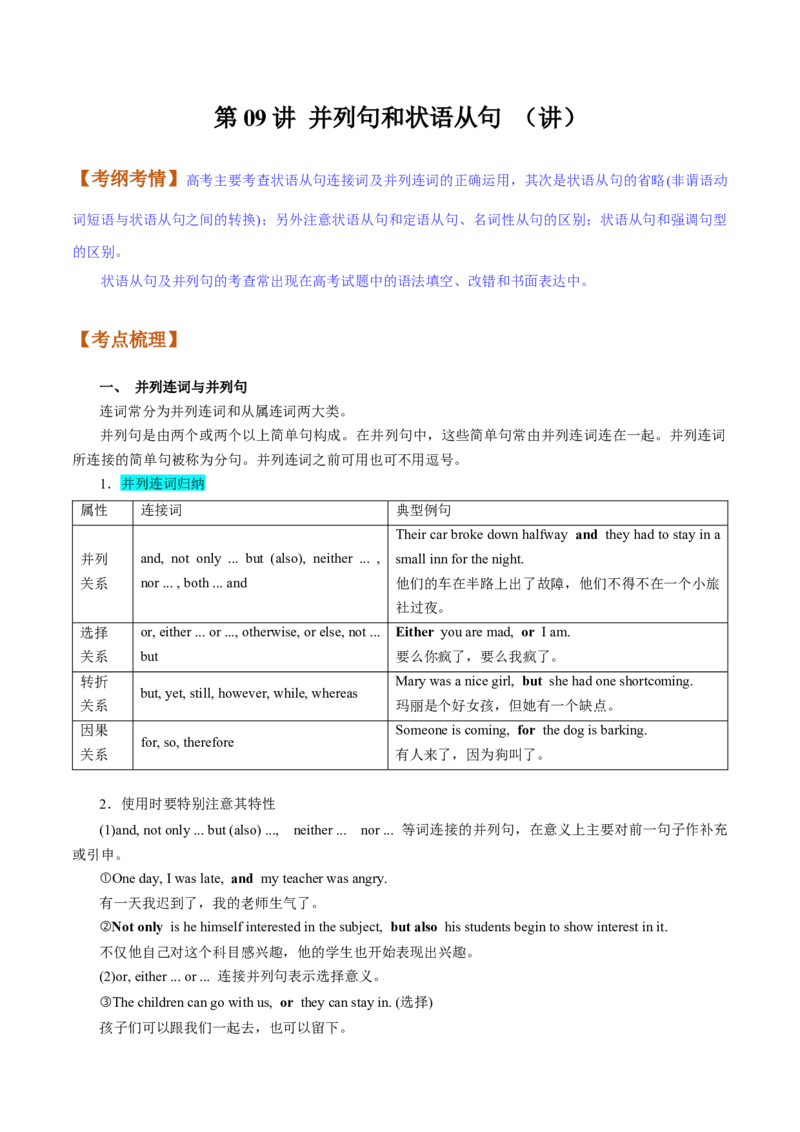
1.并列连词归纳
属性 连接词 典型例句
Their car broke down halfway and they had to stay in a
并列 and, not only ... but (also), neither ... , small inn for the night.
关系 nor ... , both ... and 他们的车在半路上出了故障,他们不得不在一个小旅
社过夜。
选择 or, either ... or ..., otherwise, or else, not ... Either you are mad, or I am.
关系 but 要么你疯了,要么我疯了。
转折 Mary was a nice girl, but she had one shortcoming.
but, yet, still, however, while, whereas
关系 玛丽是个好女孩,但她有一个缺点。
因果 Someone is coming, for the dog is barking.
for, so, therefore
关系 有人来了,因为狗叫了。
2.使用时要特别注意其特性
(1)and, not only ... but (also) ..., neither ... nor ... 等词连接的并列句,在意义上主要对前一句子作补充
或引申。
①One day, I was late, and my teacher was angry.
有一天我迟到了,我的老师生气了。
②Not only is he himself interested in the subject, but also his students begin to show interest in it.
不仅他自己对这个科目感兴趣,他的学生也开始表现出兴趣。
(2)or, either ... or ... 连接并列句表示选择意义。
③The children can go with us, or they can stay in. (选择)
孩子们可以跟我们一起去,也可以留下。④The workers were cheerful, or at least they appeared to be cheerful. (换个说法)
工人们非常高兴,或者说他们至少表现得很高兴。
⑤Be careful, or you will break your neck. (否定条件)
小心点,否则你会折断脖子的。
3.注意事项
(1)“祈使句+and/or+陈述句”句型
该句型中的祈使句表示条件,后面的陈述句表示结果。and表示前后句意思的顺延,or表示前后句意
思的转折。
①Go straight on, and you'll see a church.
一直向前走,你就会看到一座教堂。
②Don't turn off the computer before closing all programs, or you could have problems.
在关闭所有程序前不要关闭电脑,要不然会出问题的。
具体运用中,该句型中的祈使句常省略为名词短语等。
③One more minute, and we can finish the job much better.
再给一分钟,我们会把工作做得更好。
(2)but/while/however的区别
but表示意义的转折;while既表示转折又表示对比;however为表示转折意义的副词,常用逗号与句
子其他部分隔开。
④Neighbors should do all they can to avoid disturbing other people, but there are times when some level of
disturbance is unavoidable.
邻居们应尽可能避免烦扰别人,但是很多时候有些打扰是不可避免的。
⑤There's no way of knowing why one man makes an important discovery while another man, also intelligent,
fails.
为什么一个人会作出一个重要的发现,而另一个人,也很聪明但是失败了,这不得而知。(表示两种情
况的对比)
(3)并列连词when的用法
when可作并列连词,意为“正在这时”,表示某件事正在发生或刚刚发生时,突然发生另一动作。
⑥Tom was about to close the window when his attention was caught by a bird.
汤姆正要关窗户,这时他的注意力被一只鸟吸引住了。
⑦One Friday, we were packing to leave for a weekend away when my daughter heard cries for help.
一个礼拜五,我们正在收拾行李去度周末,这时我的女儿听到求救的呼喊。
⑧He had just finished his homework when his mother asked him to play the piano.
他刚完成作业母亲就让他弹钢琴。
(4)表示因果关系的并列连词(含连接副词)for, so, thus, therefore等的用法
⑨We must start early, for it will take two hours to drive to the airport.
我们必须早点动身,因为开车去机场得花两个小时。
⑩The shops were closed so I didn't get any milk.商店都关门了,所以我没买到牛奶。
注意:for引出的分句只能后置,并用逗号与前面的句子隔开;它主要用来表示推测性的原因,或附带
解释说明前一分句的情况。so用于连接两个句子,第一个叙述原因,第二个表示结果,且 because不能与
so连用。
二、 从属连词和状语从句
(一)、时间状语从句
1.when, while, as 引导的时间状语从句
(1)when 表示“当……时;在……期间”。
①When I lived there, I used to go to the seashore on Sundays.
我住在那里时,星期天常到海滨去。
(2)while 表示“在……期间”,从句中常用延续性动词。
②Please don't talk so loud while others are working.
在别人工作的时候,请别这么大声音说话。
(3)as表示“一边……一边……,随着……”。
③As time goes on, it's getting warmer and warmer.
随着时间的推移,天气变得越来越温暖了。
注意:(1)如果主句表示的是短暂性动作,而从句用延续性动词的进行时表示在一段时间内正在进行
的动作时,when/while/as 可以互换使用。
When/While/As I was walking down the street, I came across an old friend of mine.
我正沿着大街走时,碰巧遇到了我的一位老朋友。
(2)when还可表原因,意为“既然”。
How can I help them to understand when they won't listen to me?
既然他们不听我说,我怎么帮他们理解?
2.as soon as, immediately, directly, instantly, the moment, the minute, the instant, no sooner ... than ...,
hardly/scarcely ... when ... 和once(一……就……)
这些从属连词引导的从句都表示从句的动作一发生,主句的动作随即就发生,常译为“一……
就……”。从句中常用一般时态代替将来时。
①The moment I heard the voice,I knew Father was coming.
我一听到那个声音就知道父亲来了。
②The boy burst into tears immediately he saw his mother.
那男孩一见到他妈妈便放声大哭。
注意:(1)no sooner ... than ...,hardly/scarcely ... when ... 句型的时态运用:主句的谓语动词应用过去完
成时,而than与when引导的从句谓语动词应用一般过去时。此外,当把 no sooner和hardly/scarcely提到
句首时,应用倒装语序。
He had no sooner finished his speech than the students started cheering.
→No sooner had he finished his speech than the students started cheering.
他刚完成演讲学生们就开始欢呼起来。
(2)“on+v.ing”和“on+one's+n.”结构。当v.ing和n.在意义上相对应时,这两个结构可以互换。On arriving the station, the thief was arrested.
刚到火车站,这个小偷就被逮捕了。
On his arrival in Paris he was recognized as a noble and thrown into prison.
他刚到巴黎,就被认出是位贵族并被投入监狱。
3.till, until和not ... until引导的时间状语从句
(1)“延续性动词(肯定式)+until/till”表示“动作延续到……为止”。
①We walked along the river until/till it was dark.
我们沿着河散步,一直到天黑。
(2)“瞬间动词/延续性动词(否定式)+until/till”表示“直到……才发生”。
②He didn't know anything about it until/till I told him.
直到我告诉他,他才知道这件事。
(3)强调句型:It is/was not until ... that ...
③It was not until the professor came that we began the experiment.
直到教授来了,我们才开始做实验。
注意:(1)till不可以置于句首,而until可以。
Until you told me I had no idea of it.
直到你告诉我,我才知道这件事。
(2)not until置于句首,主句要用倒装结构。
Not until the film began did she arrive.
直到电影开始她才到。
4.before与since引导的时间状语从句
(1) before与since的常用句式。
连词 词义 常用句式
It will be+一段时间+before ... 过……时间才……
在 … … 之 前 ; 还 未 … …
It will not be/was not long+before ... 不久就会/没多久
before 就……;……才……;还没来得
就……
及……就……
It was+时间段+before ... 过了……(时间)才……
It is/has been+一段时间+since ... (从句用一般过去时)
since 自从……以来,……
It was+一段时间+since ... (从句用过去完成时)
①Some time passed before my stepfather and I got used to each other.(……之后才……)
继父和我相处一段时间后才彼此习惯。
②Someone called me up in the midnight, but he hung up before I could answer the phone.(还没来得及……
就……)
有人半夜给我打电话,但我还没来得及接就挂断了。
③It will be two years before he leaves the country.
再过两年他才会离开这个国家。
(2) since引导的从句如果用非延续性动词,所表示的动作自从句谓语动词所表示的动作开始时算起;若用延续性动词,所表示的动作自从句谓语的动作或状态的完成或结束时算起。
④It's two years since we arrived here.
我们到这儿两年了。
⑤It's three years since we lived here.
我们不住在这里有三年了。
5.“It+be+时间+从句”句型
“It+be+时间+从句”句型是高考考查的热点,其中连接词的选择是个难点。突破这个难点的关键是
要把握好句意,根据句意的需要选择合适的连接词:
(1)表示“再过多长时间某事才会发生”,用“It will be+时间段+before从句”。
①It will be three weeks before we have the next exam.
再过三周我们就要进行下一次考试了。
(2)表示“自……以来有多长时间了”,用“It be+时间段+since从句”,如果主句用一般现在时,从
句用一般过去时;如果主句用一般过去时,则从句用过去完成时。
②It is three years since he joined the army.
自从他参军以来已经三年了。
③He said it was three years since he had joined the army.
他说他参军已三年了。
(3)“It be+时间状语+that+其他”构成强调句型,意思是“正是在某一时间发生了某事”。
④It was at six o'clock that we got home.
正是在六点我们到了家。
(4)“It be+时间点+when从句”表示“某事发生在什么时间”,it指代时间。
⑤It was six o'clock when we got home.
当我们到家的时候六点了。
6.every time, each time, next time, the last time等名词短语用来引导时间状语从句,表示“每当……,
每次……,下次……,上次……”等
①Every/Each time I was in trouble, he would come to help me out.
每当我处于困境,他就会来帮助我。
②Next time you come, do remember to bring your son here.
下次你来的时候,一定记着把你儿子带来。
③The last time she saw James, he was lying in bed.
上次她看见詹姆斯的时候,他正躺在床上。
(二)、条件状语从句
1.if和unless引导的条件状语从句。if表示正面的条件,意为“如果”;unless(=if ... not)表示反面
的条件,意为“除非,如果不”。
①If you had come a few minutes earlier, you would have met him.
要是你早来几分钟就碰到他了。
②You'll fail the exam unless you study hard(=if you don't study hard).
除非你努力学习,否则你考试会不及格。2.in case, on condition that, providing(that), provided (that),supposing (that), suppose (that)
等词汇意思相近,意为“万一,假使,假如,在……条件下”。
①In case there is a fire, what will we do first?
万一发生火灾,我们首先要做什么?
②Suppose/Supposing(that) they refuse us, who else can we turn to for help?
假如他们拒绝了我们,我们还能求助于谁?
③They agreed to lend us the car on condition that we returned it before the weekend.
他们同意把车借给我们,条件是我们在周末前归还。
3.as long as(=so long as)引导语气强烈的条件状语从句,意为“只要”。
As long as you don't lose heart, you will succeed.
你只要不灰心,就会成功。
4.在“祈使句+and/or/or else/otherwise+陈述句”句型中,祈使句在意义上相当于条件状语从句。
①Run faster and you'll catch the bus.
跑快点,你就会赶上公共汽车的。
②Work hard, otherwise you'll fail.
努力干,要不你就会失败的。
5.if only “如果……就好了”和only if “只有”也可以引导条件状语从句。但是当only if置于句首时,
主句部分倒装。
①If only I were as clever as you.
我要是像你一样聪明就好了。
②Only if a teacher has given permission is a student allowed to leave the classroom.
学生只有得到老师的许可才能离开教室。
(三)、让步状语从句
1.although/though(尽管,虽然),even though/even if(即使)引导的让步状语从句
although与though两者意思相同,一般可互换,都可以与yet, still或nevertheless连用,但不能和but连
用。
①He is unhappy, though/although he has a lot of money.
虽然他很有钱,但他并不幸福。
②Although/Though it was raining hard, yet they went on playing football.
虽然雨下得很大,但他们还是继续踢足球。
③Even though/if it rains tomorrow, we'll go there.(陈述语气)
即使明天下雨,我们也要去那里。
④Even if I wanted to marry you, my parents would not agree.(虚拟语气)
即使我想和你结婚,我父母也不会同意。
⑤He went out even though it was raining.
尽管在下雨,他还是出去了。
注意:though还可用作副词,意为“可是,然而”,置于句末。
He said he would come; he didn't, though.他说他会来,可是没有来。
2.as或though引导让步状语从句时倒装的情况
as或though从句一般放在主句之前,常用倒装语序。从句中的表语、状语或动词原形置于句首。若表
语是单数名词,前置时要省略冠词。
①Child as/though he is, he can tell the names of all the cars.
尽管他是孩子,但他能辨认出所有车的名字。
②Much as/though I like it, I won't buy it, for it's too expensive.
虽然我很喜欢它,但不会买,因为它太贵了。
注意:though引导的从句可以像as引导的从句一样用倒装语序,但是although引导的从句只能用正常
语序。注意比较下面的说法:
(√)Smart though/as she is, she doesn't study hard.
(√)Though she is smart, she doesn't study hard.
(√)Although she is smart, she doesn't study hard.
(×)Smart although she is, she doesn't study hard.
(×)As she is smart, she doesn't study hard.
3.whether ... or ... (不管……还是……);疑问词+ever与no matter+疑问词(不管……;无论……)
①Whether she comes here or we go there, the topic of the discussion will remain unchanged.
不管是她来这儿还是我们去那儿,讨论的话题都不会变。
②Whatever(=No matter what) you say, he won't believe you.
无论你说什么,他都不会相信你。
③Whoever you are (=No matter who you are), you must obey the rules.
无论你是谁,都要遵守规则。
注意: whoever, whatever, whomever, whichever还可以引导名词性从句。
You can take whatever you like.(宾语从句)
你喜欢什么就可以拿什么。
4.while也可作从属连词引导让步状语从句,相当于although
While I admit that there are problems, I don't agree that they cannot be solved.
尽管我承认有问题存在,但我并不认为这些问题不能解决。
(四)、地点状语从句
1.地点状语从句是指在复合句中作地点状语的从句,表示空间关系,可置于句首、句中或句末,通常
由从属连词where, wherever等引导。
①We should go where the Party needs us most.
我们应到党最需要我们的地方去。
②You are free to go wherever you like.
你愿意去哪里就去哪里。
③Where there is a will, there is a way.
有志者,事竟成。
④Wherever there is smoke, there is a fire.无火不生烟。(无风不起浪)
2.注意区分where引导的定语从句与状语从句。
①You'd better make a mark where you have any question.(状语从句)
②You'd better make a mark at the place where you have any question.(定语从句)
你最好在有问题的地方做一下标记。
注意:如何判断一个从句是不是地点状语从句呢?对于地点状语从句,我们要知道,这类状语从句用
于说明谓语动作发生的地点,通常跟在谓语动词(短语)后面,where前没有表示地点的先行词,知道这
一点,就会很容易判断出句子是不是地点状语从句。
(五)、原因状语从句
1.引导原因状语从句的连词主要有:because, as, since等。并列连词for也可表示原因。每个连词的
含义不尽相同。
能否回 能否被
连词 位置 内涵 语气
答why 强调
because
主句前或后 直接因果关系 强 能 能
(因为)
as(由于) 主句前或后
since/now 通常位于主句 双方都知道的原因 弱 不能 不能
that(既然) 前
for
位于句后 用于补充说明的原因 弱 不能 不能
(因为)
①He was criticized by the teacher, because he was late for class.
因为他迟到了,老师批评了他。
②I can't go with you, as I have a lot of work to do.
我不能和你一起去,因为我有很多工作要做。
③Now that/Since everyone is here, we can begin our discussion.
既然大家都在这儿,我们可以开始讨论了。
2.when(既然),seeing that (鉴于,由于),considering that (考虑到),in that(因为)等也可以引导原
因状语从句。
①It was foolish of you to take a taxi when you could walk there in five minutes.
既然步行5分钟就能到那里,你却去乘出租汽车,真够愚蠢的。
②Seeing that there were less than half the members present, the meeting had to be postponed.
鉴于到会的成员还没一半,会议只好延期举行。
(六)、目的状语从句
引导目的状语从句的连词有:so that, in order that, for fear that, in case (以防),lest等。
1.so that与in order that
这两个连词都表示“为了,以便”,引导的目的状语从句常与情态动词 can, could,may, might等连用。
in order that引导的从句可以置于主句之前或之后,而so that引导的从句只能置于主句之后。①I am studying hard so that/in order that I can enter a famous university.
为了能上一所名牌大学,我一直努力学习。
②In order that we could save time we used the computer.
我们使用计算机是为了节省时间。(此时不可使用so that)
2.for fear that表示“生怕,以免”,in case表示“以防”。
①Batteries must be kept in dry places for fear that electricity should leak away.
电池应该放在干燥的地方,以免漏电。
②I'll keep a seat for you in case you should change your mind.
我给你留个座位,没准儿你会改变主意。
(七)、结果状语从句
常用来引导结果状语从句的引导词或短语有so that, so ... that ... , such ... that ... 。
1.结构形式
①There was so little food at home that we had to go out to buy some.
家里快没食物了,我们只好出去买一些。
②Mike is such an honest worker that we all believe him.
→Mike is so honest a worker that we all believe him.
迈克是一个如此诚实的工人,以至于我们都相信他。
③He has made such rapid progress that he was praised by his teacher three times a day.
他取得了如此快的进步,以致老师一天表扬了他三次。
注意:区别so ... that和such ... that的用法:
名前such,形、副so,that从句跟在后;
多多少少必用so,特别注意是little;
“小”用such,“少”用so。
2.当so或such置于句首时,主句要用倒装语序。
①So clever a student was he that he was able to work out all the difficult problems.
他是一个如此聪明的学生,以至于他能解决所有的难题。
②Such was the force of the explosion that all the windows were broken.
爆炸的威力如此巨大,以致所有的窗户都被震破了。
3.so/such ... that ... 引导的结果状语从句与so/such ... as ... 引导的定语从句的区别。
(1)so/such ... that ... 引导结果状语从句时,that在从句中不作任何成分,只起连接作用。
①It is such a moving film that we all want to see it.
这是一部如此感人的电影,以至于我们都想去看。
(2)so/such ... as ... 中,as引导定语从句,as在从句中作主语或宾语。
②It is such a moving film as we all want to see.
这是一部感人的、我们都想看的电影。
(八)、方式状语从句1.方式状语从句常由as, just as, as if/though等引导,多置于主句之后。
①You ought to write as he does.
你应该像他那样写。
②He did as (he had been) told.
他遵嘱而行。
2.as if或as though引导的方式状语从句一般用虚拟语气,但如果从句所陈述的情况很可能实现,也
可用陈述语气。
①He likes to talk big as if/though he were an important person.
他老爱说大话,就仿佛他是一位重要人物似的。
②He walked as though/if he was drunk.
他走起路来就像喝醉了一样。
(九)、比较状语从句
1.as ... as ...; not so/as ... as ...; the same ... as ... 表示相同程度的比较,肯定句用as ... as ...,否定句可
用not as ... as或not so ... as。
He doesn't run so/as fast as Jack (does).
他跑得不如杰克快。
2.than表示不同程度的比较,主句中用形容词或副词的比较级。
①He runs less fast than me.
他跑得没我快。
②It was more expensive than I thought.
它比我想象的要贵。
3.the+比较级,the+比较级,表示“越……就越……”
The more you eat, the fatter you will be.
吃得越多,你将越胖。
【题型剖析】
用适当的词填空
1....the Renaissance was over it was time for a new era -- the Age of Reason.
2.They are ________ interesting books that I want to read them once more.
3.Mark needs to learn Chinese ________ his company is opening a branch in Beijing.
4.She went on working though________(blame)by the manager.
5.The boy was so tired ________ he fell asleep on the bus.
6.___ the numbers of such developments are relatively small, the market in the future is large.
7.I’ve never seen such a thing before; it is not half ______ wide as it is long.
8.________ the average age of the population increases, there are more and more old people to care for.
9.Researchers have found, in their experiment, that a baby's cries can cause unique emotional responses in thebrain, making it impossible for us to ignore them ________ we are parents or not.
10.________ he worked very hard, he didn’t finish the task on time.