专题09 主旨大意题
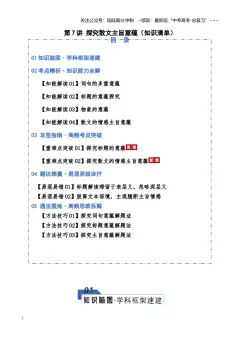
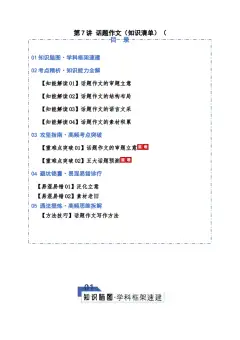
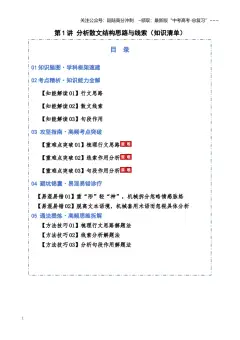
目录
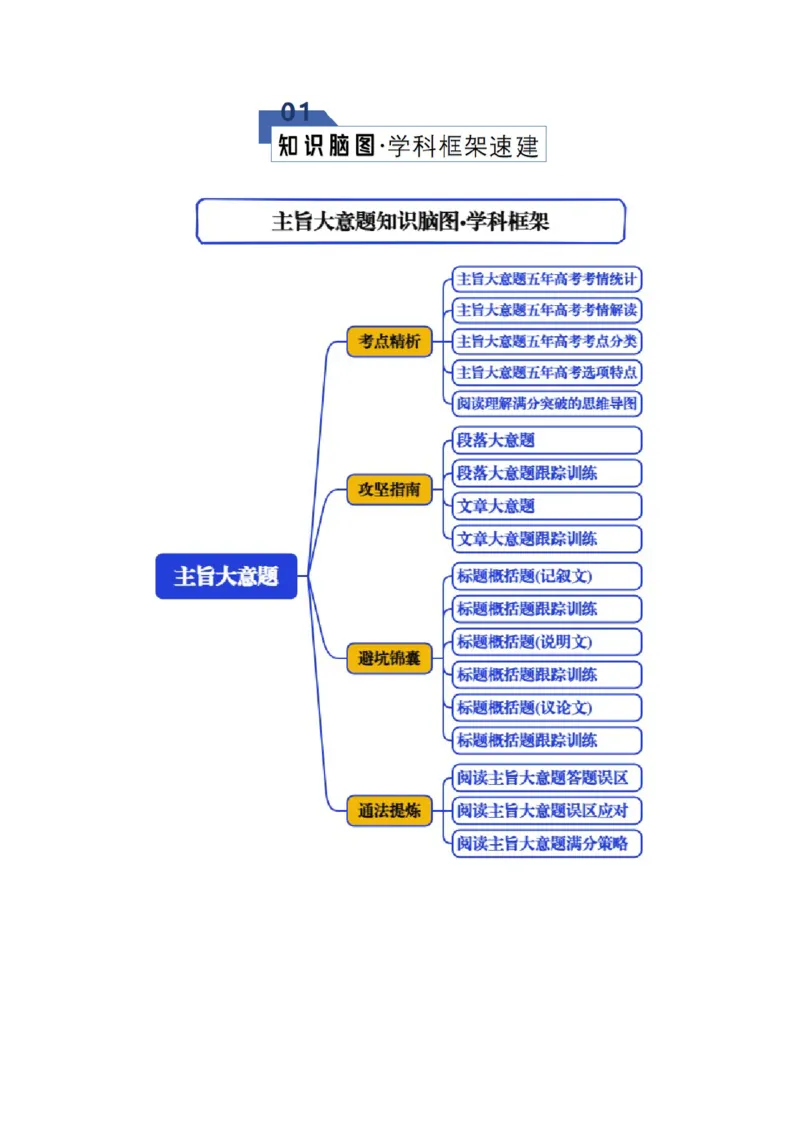
01 知识脑图·学科框架速建
02 考点精析·知识能力全解
【知能解读01】主旨大意题五年高考考情统计
【知能解读02】主旨大意题五年高考考情解读
【知能解读03】主旨大意题五年高考考点分类
【知能解读04】主旨大意题五年高考选项特点
【知能解读05】阅读理解满分突破思维导图
03 攻坚指南·高频考点突破
【重难点突破01】段落大意题
【重难点突破02】段落大意跟踪训练
【重难点突破03】文章大意题
【重难点突破04】文章大意题跟踪训练
04 避坑锦囊·易混易错诊疗
【易混易错01】标题概括题(记叙文)
【易混易错02】标题概括题跟踪训练
【易混易错03】标题概括题(说明文)
【易混易错04】标题概括题跟踪训练
【易混易错05】标题概括题(议论文)
【易混易错06】标题概括题跟踪训练
05 通法提炼·高频思维拆解
【方法技巧01】阅读主旨大意题答题误区
【方法技巧02】阅读主旨大意题误区应对
【方法技巧03】阅读主旨大意题满分策略
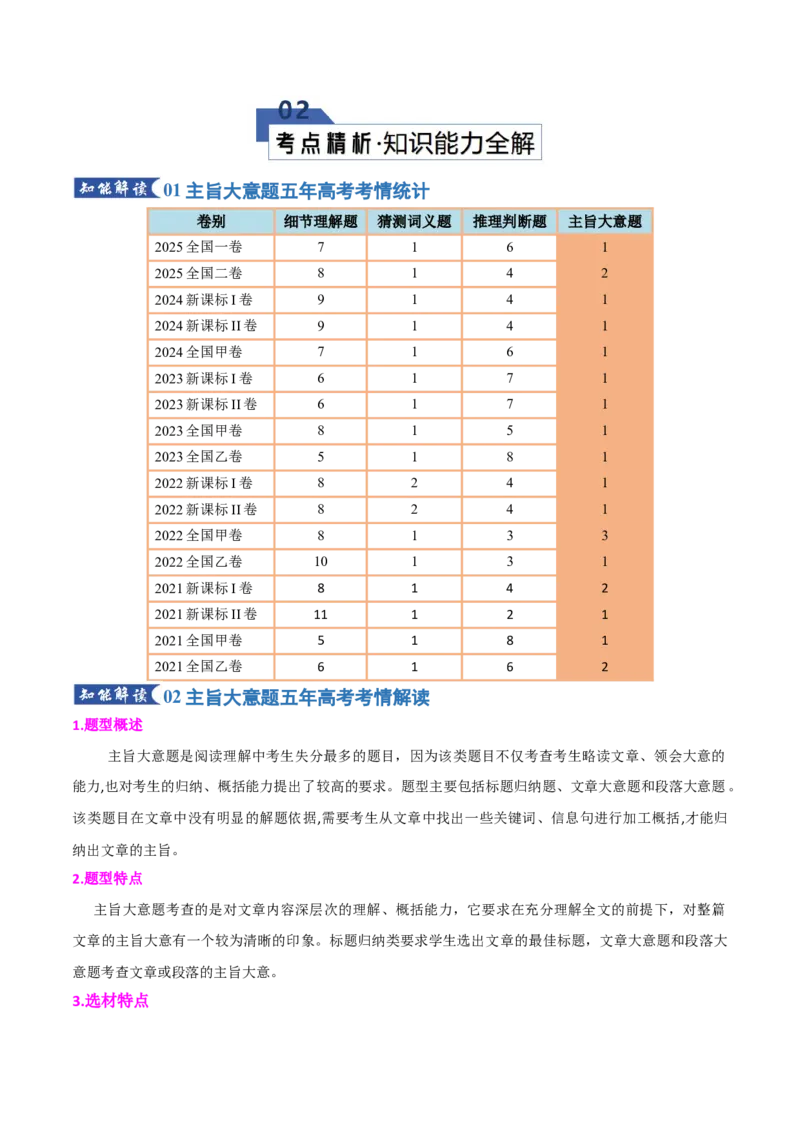
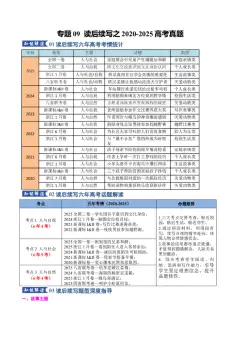
01 主旨大意题五年高考考情统计
卷别
细节理解题
猜测词义题
推理判断题
主旨大意题
2025 全国一卷
7
1
6
1
2025 全国二卷
8
1
4
2
2024 新课标I 卷
9
1
4
1
2024 新课标II 卷
9
1
4
1
2024 全国甲卷
7
1
6
1
2023 新课标I 卷
6
1
7
1
2023 新课标II 卷
6
1
7
1
2023 全国甲卷
8
1
5
1
2023 全国乙卷
5
1
8
1
2022 新课标I 卷
8
2
4
1
2022 新课标II 卷
8
2
4
1
2022 全国甲卷
8
1
3
3
2022 全国乙卷
10
1
3
1
2021 新课标I 卷
8
1
4
2
2021 新课标II 卷
11
1
2
1
2021 全国甲卷
5
1
8
1
2021 全国乙卷
6
1
6
2
02 主旨大意题五年高考考情解读
1.题型概述
主旨大意题是阅读理解中考生失分最多的题目,因为该类题目不仅考查考生略读文章、领会大意的
能力,也对考生的归纳、概括能力提出了较高的要求。题型主要包括标题归纳题、文章大意题和段落大意题。
该类题目在文章中没有明显的解题依据,需要考生从文章中找出一些关键词、信息句进行加工概括,才能归
纳出文章的主旨。
2.题型特点
主旨大意题考查的是对文章内容深层次的理解、概括能力,它要求在充分理解全文的前提下,对整篇
文章的主旨大意有一个较为清晰的印象。标题归纳类要求学生选出文章的最佳标题,文章大意题和段落大
意题考查文章或段落的主旨大意。
3.选材特点
题材更加丰富多样,涵盖记叙文、说明文、议论文等各种文体,主题涉及社会热点、科技发展、文化
交流、环境保护、人文历史、健康生活等多个领域,要求考生具备广泛的知识背景。
4.命题特点
特殊疑问句形式:以when、where、what、which、who、why、how 等疑问词开头引出的问题;通常涉及
推断作者态度、文章出处、文章类型、写作意图、下段话题等。
主旨大意题旨在考查考生归纳概括以及辨别主要信息和次要信息的能力,是阅读理解中的高难度题。
概括全文大意最简单的方法就是把每段的大意串起来考虑。该类题主要考查标题归纳题、文章大意题和段
落大意题。常见的设问方式有:
1.What is the best title of the passage?
2.Which of the following is the best title for the text?
3.What is the passage mainly about?
4.What is the main idea of the second paragraph?
5.What is the first/second/...paragraph mainly about?
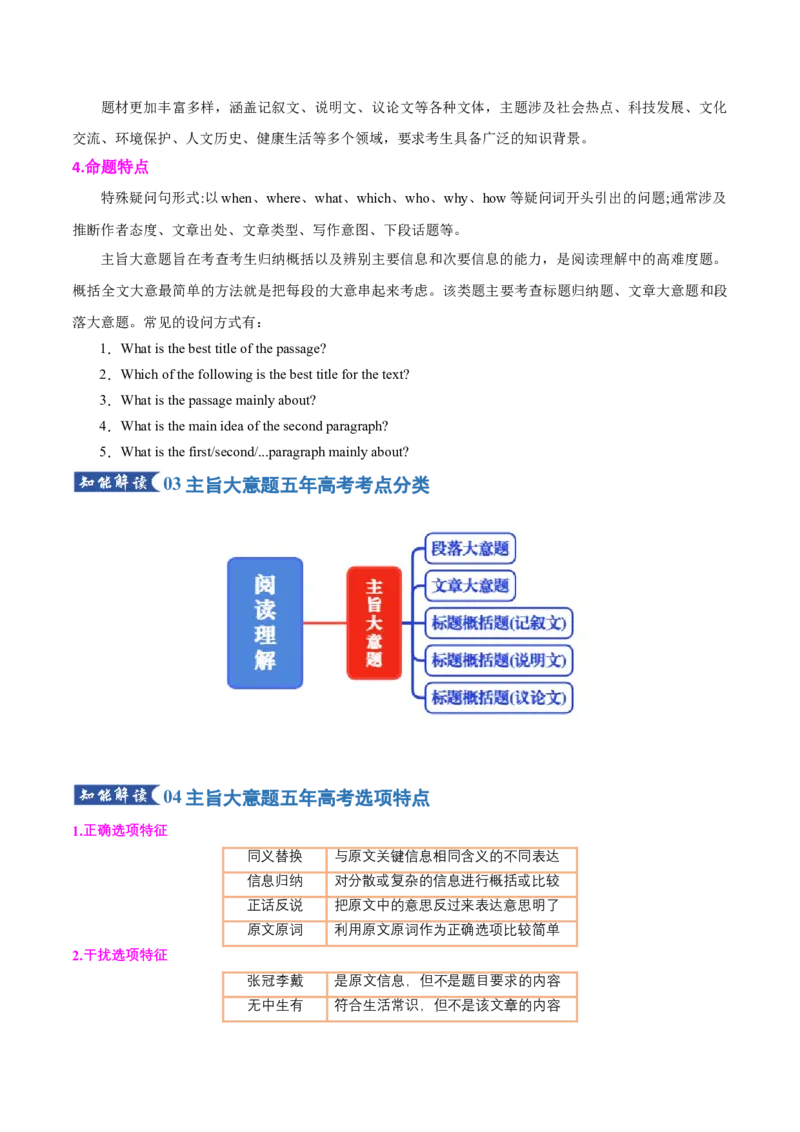
03 主旨大意题五年高考考点分类
04 主旨大意题五年高考选项特点
1.正确选项特征
同义替换
与原文关键信息相同含义的不同表达
信息归纳
对分散或复杂的信息进行概括或比较
正话反说
把原文中的意思反过来表达意思明了
原文原词
利用原文原词作为正确选项比较简单
2.干扰选项特征
张冠李戴
是原文信息,但不是题目要求的内容
无中生有
符合生活常识,但不是该文章的内容
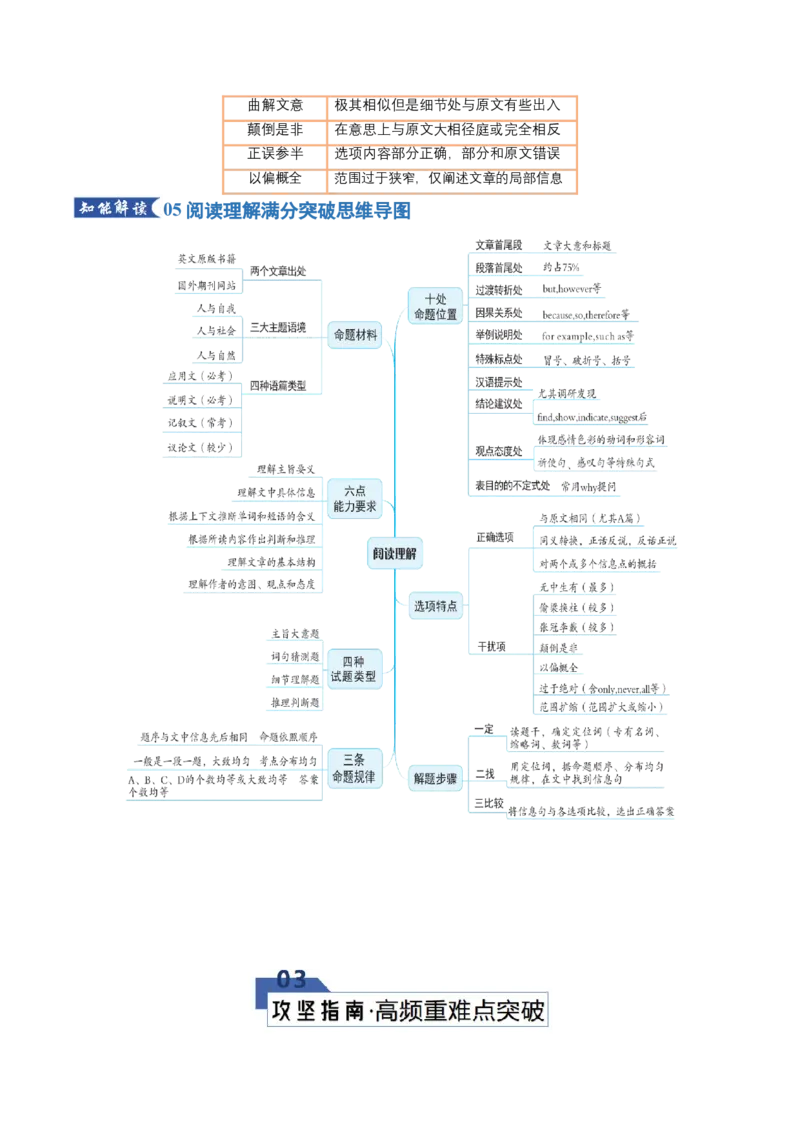
曲解文意
极其相似但是细节处与原文有些出入
颠倒是非
在意思上与原文大相径庭或完全相反
正误参半
选项内容部分正确,部分和原文错误
以偏概全
范围过于狭窄,仅阐述文章的局部信息
05 阅读理解满分突破思维导图
01 段落大意题
1.题型解读
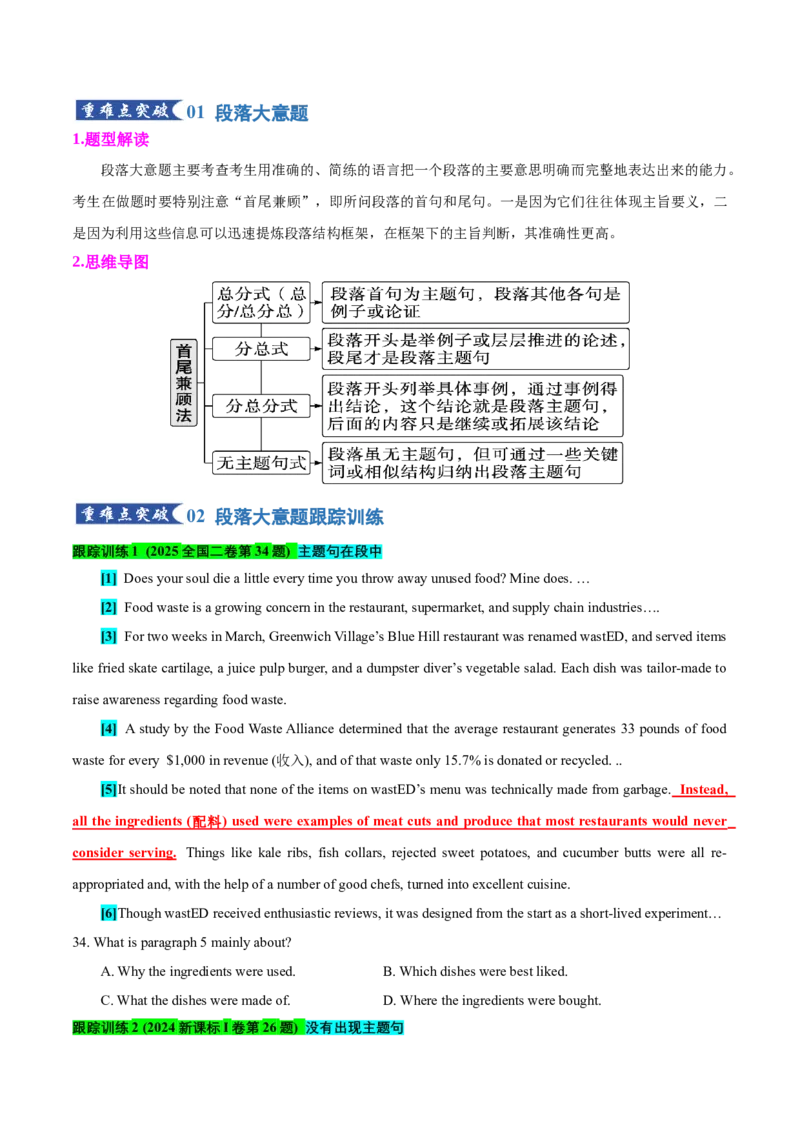
段落大意题主要考查考生用准确的、简练的语言把一个段落的主要意思明确而完整地表达出来的能力。
考生在做题时要特别注意“首尾兼顾”,即所问段落的首句和尾句。一是因为它们往往体现主旨要义,二
是因为利用这些信息可以迅速提炼段落结构框架,在框架下的主旨判断,其准确性更高。
2.思维导图
02 段落大意题跟踪训练
跟踪训练1 (2025 全国二卷第34 题) 主题句在段中
[1] Does your soul die a little every time you throw away unused food? Mine does. …
[2] Food waste is a growing concern in the restaurant, supermarket, and supply chain industries….
[3] For two weeks in March, Greenwich Village’s Blue Hill restaurant was renamed wastED, and served items
like fried skate cartilage, a juice pulp burger, and a dumpster diver’s vegetable salad. Each dish was tailor-made to
raise awareness regarding food waste.
[4] A study by the Food Waste Alliance determined that the average restaurant generates 33 pounds of food
waste for every $1,000 in revenue (收入), and of that waste only 15.7% is donated or recycled. ..
[5]It should be noted that none of the items on wastED’s menu was technically made from garbage. Instead,
all the ingredients (

 配料

 ) used were examples of meat cuts and produce that most restaurants would never


consider serving. Things like kale ribs, fish collars, rejected sweet potatoes, and cucumber butts were all re-
appropriated and, with the help of a number of good chefs, turned into excellent cuisine.
[6]Though wastED received enthusiastic reviews, it was designed from the start as a short-lived experiment…
34. What is paragraph 5 mainly about?
A. Why the ingredients were used.
B. Which dishes were best liked.
C. What the dishes were made of.
D. Where the ingredients were bought.
跟踪训练2 (2024 新课标I 卷第26 题) 没有出现主题句
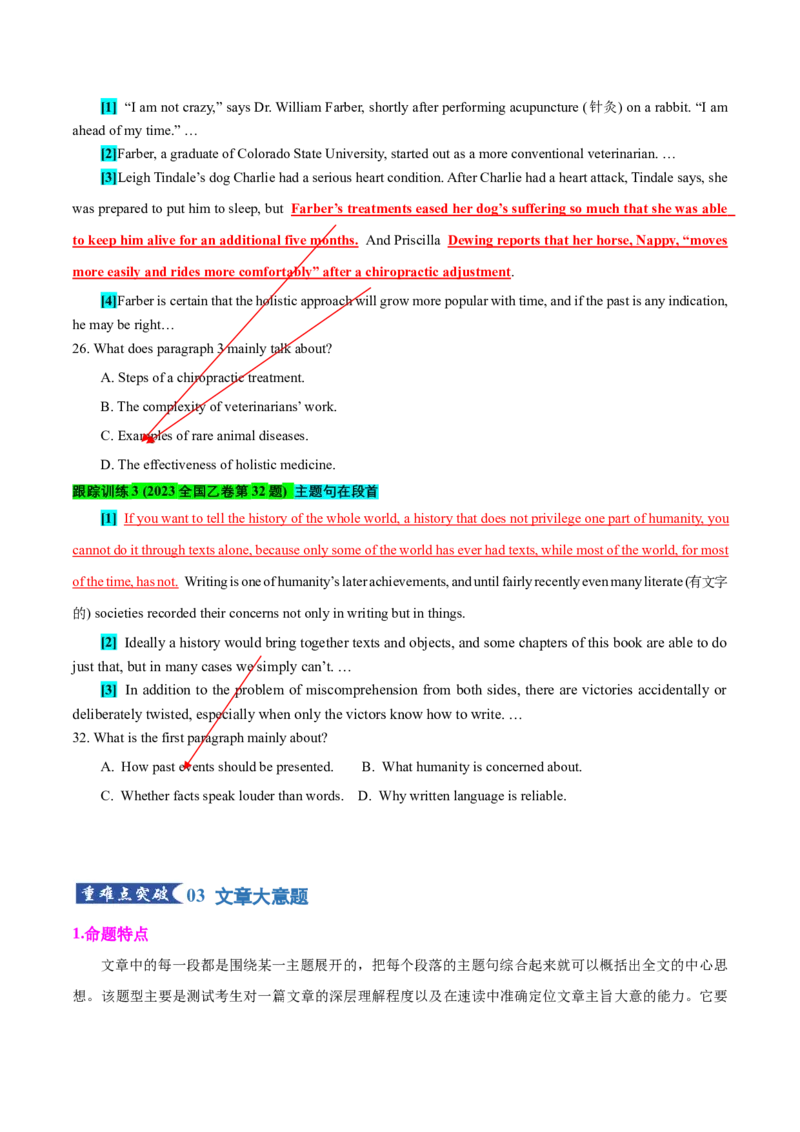
[1] “I am not crazy,” says Dr. William Farber, shortly after performing acupuncture (针灸) on a rabbit. “I am
ahead of my time.” …
[2]Farber, a graduate of Colorado State University, started out as a more conventional veterinarian. …
[3]Leigh Tindale’s dog Charlie had a serious heart condition. After Charlie had a heart attack, Tindale says, she
was prepared to put him to sleep, but Farber’s treatments eased her dog’s suffering so much that she was able
to keep him alive for an additional five months. And Priscilla Dewing reports that her horse, Nappy, “moves
more easily and rides more comfortably” after a chiropractic adjustment.
[4]Farber is certain that the holistic approach will grow more popular with time, and if the past is any indication,
he may be right…
26. What does paragraph 3 mainly talk about?
A. Steps of a chiropractic treatment.
B. The complexity of veterinarians’ work.
C. Examples of rare animal diseases.
D. The effectiveness of holistic medicine.
跟踪训练3 (2023 全国乙卷第32 题) 主题句在段首
[1] If you want to tell the history of the whole world, a history that does not privilege one part of humanity, you
cannot do it through texts alone, because only some of the world has ever had texts, while most of the world, for most
of the time, has not. Writing is one of humanity’s later achievements, and until fairly recently even many literate (有文字
的) societies recorded their concerns not only in writing but in things.
[2] Ideally a history would bring together texts and objects, and some chapters of this book are able to do
just that, but in many cases we simply can’t. …
[3] In addition to the problem of miscomprehension from both sides, there are victories accidentally or
deliberately twisted, especially when only the victors know how to write. …
32. What is the first paragraph mainly about?
A. How past events should be presented.    B. What humanity is concerned about.
C. Whether facts speak louder than words.  D. Why written language is reliable.
03 文章大意题
1.命题特点
文章中的每一段都是围绕某一主题展开的,把每个段落的主题句综合起来就可以概括出全文的中心思
想。该题型主要是测试考生对一篇文章的深层理解程度以及在速读中准确定位文章主旨大意的能力。它要
求考生在理解全文的基础上能较好地运用概括、判断、归纳、推理等逻辑思维的方法,对文章进行高度概
括或总结,属于高层次题。
2.设问方式
1.What is the main theme/topic/idea of this/the passage/text?
2.What does the text/passage mainly focus on?
3.What is the passage/text mainly about?
4. What does the passage mainly focus on?
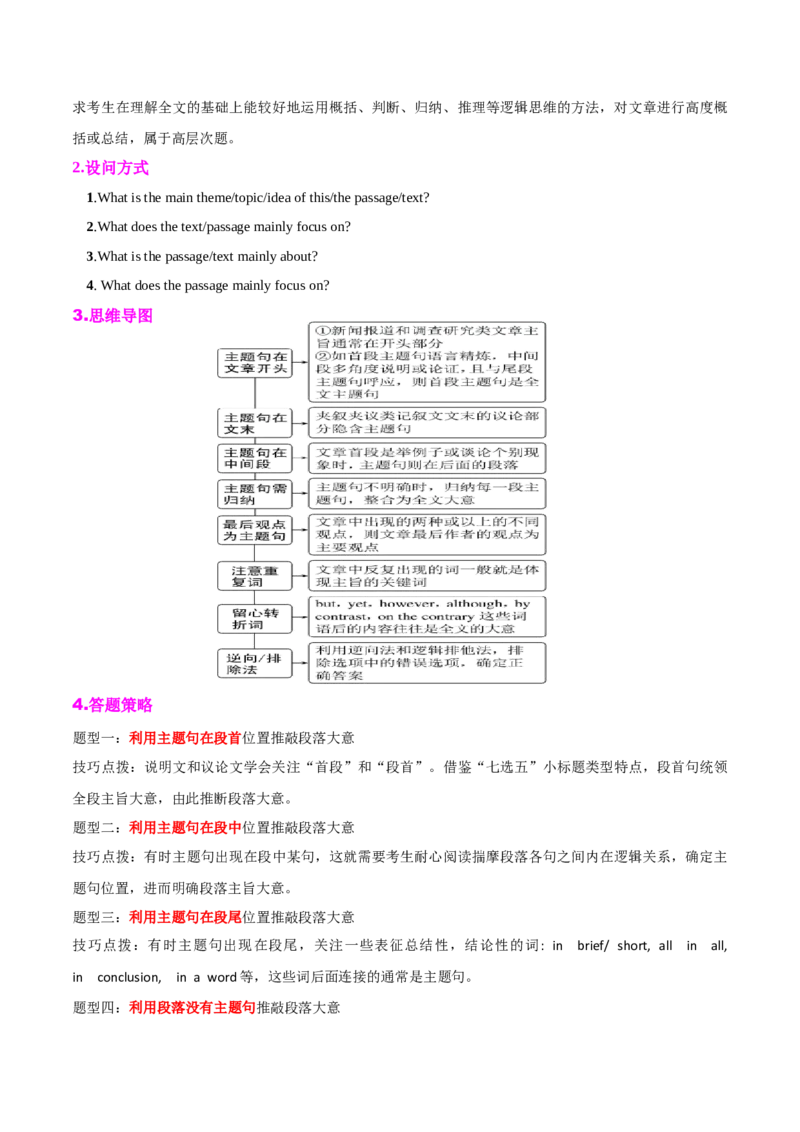
3.思维导图
4.答题策略
题型一:利用主题句在段首位置推敲段落大意
技巧点拨:说明文和议论文学会关注“首段”和“段首”。借鉴“七选五”小标题类型特点,段首句统领
全段主旨大意,由此推断段落大意。
题型二:利用主题句在段中位置推敲段落大意
技巧点拨:有时主题句出现在段中某句,这就需要考生耐心阅读揣摩段落各句之间内在逻辑关系,确定主
题句位置,进而明确段落主旨大意。
题型三:利用主题句在段尾位置推敲段落大意
技巧点拨:有时主题句出现在段尾,关注一些表征总结性,结论性的词: in brief/ short, all in all,
in conclusion, in a word 等,这些词后面连接的通常是主题句。
题型四:利用段落没有主题句推敲段落大意
技巧点拨:有时候段落没有出现主题句,需要考生自己总结提炼,难度更大。
题型五:利用“总-分-总”结构推敲语篇主旨大意题
技巧点拨:有时候段落没有出现主题句,需要考生自己总结提炼,难度更大。
04 文章大意题跟踪训练
跟踪训练1 (2024 新课标II 卷第31 题)
We all know fresh is best when it comes to food. However, most produce at the store went through weeks of
travel and covered hundreds of miles before reaching the table. While farmer’s markets are a solid choice to reduce
the journey, Babylon Micro-Farm (BMF) shortens it even more.
BMF is an indoor garden system. It can be set up for a family. Additionally, it could serve a larger audience such
as a hospital, restaurant or school. The innovative design requires little effort to achieve a reliable weekly supply of
fresh greens.
Specifically, it’s a farm that relies on new technology. By connecting through the Cloud, BMF is remotely
monitored. Also, there is a convenient app that provides growing data in real time. Because the system is automated, it
significantly reduces the amount of water needed to grow plants. Rather than watering rows of soil, the system
provides just the right amount to each plant. After harvest, users simply replace the plants with a new pre-seeded
pod (容器) to get the next growth cycle started.
Moreover, having a system in the same building where it’s eaten means zero emissions (排放) from transporting
plants from soil to salad. In addition, there’s no need for pesticides and other chemicals that pollute traditional farms
and the surrounding environment.
BMF employees live out sustainability in their everyday lives. About half of them walk or bike to work. Inside
the office, they encourage recycling and waste reduction by limiting garbage cans and avoiding single-use plastic.
“We are passionate about reducing waste, carbon and chemicals in our environment,” said a BMF employee.
28. What can be learned about BMF from paragraph 1?
A. It guarantees the variety of food.
B. It requires day-to-day care.
C. It cuts the farm-to-table distance.
D. It relies on farmer’s markets.
29. What information does the convenient app offer?
A. Real-time weather changes.
B. Current condition of the plants.
C. Chemical pollutants in the soil.
D. Availability of pre-seeded pods.
30. What can be concluded about BMF employees?
A. They have a great passion for sports.
B. They are devoted to community service.
C. They are fond of sharing daily experiences.
D They have a strong environmental awareness.
31. What does the text mainly talk about?
A. BMF’s major strengths.
B. BMF’s general management.
C. BMF’s global influence.
D. BMF’s technical standards.
跟踪训练2 (2022 全国甲卷第31 题)
As Ginni Bazlinton reached Antarctica, she found herself greeted by a group of little Gentoo penguins(企鹅)
longing to say hello. These gentle, lovely gatekeepers welcomed her and kick-started what was to be a trip Ginni
would never forget.
Ever since her childhood, Ginni, now 71, has had a deep love for travel. Throughout her career( 职业) as a
professional dancer, she toured in the UK, but always longed to explore further When she retired from dancing and
her sons eventually flew the nest, she decided it was time to take the plunge.
After taking a degree at Chichester University in Related Arts, Ginni began to travel the world, eventually getting
work teaching English in Japan and Chile. And it was in Chile she discovered she could get last-minute cheap deals
on ships going to Antarctica from the islands off Tierra del Fuego, the southernmost tip of the South American
mainland. “I just decided wanted to go,” she says. “I had no idea about what I’d find there and I wasn’t nervous, I
just wanted to do it. And I wanted to do it alone as I always prefer it that way.”
In March 2008, Ginni boarded a ship with 48 passengers she’d never met before, to begin the journey towards
Antarctica. “From seeing the wildlife to witnessing sunrises, the whole experience was amazing. Antarctica left an
impression on me that no other place has,” Ginni says. “I remember the first time I saw a humpback whale; it just
rose out of the water like some prehistoric creature and I thought it was smiling at us. You could still hear the operatic
sounds it was making underwater.”
The realization that this is a precious land, to be respected by humans, was one of the biggest things that hit
home to Ginni.
28. Which of the following best explains “take the plunge” underlined in paragraph 2?
A. Try challenging things.
B. Take a degree.
C. Bring back lost memories.
D. Stick to a promise.
29. What made Ginni decide on the trip to Antarctica?
A. Lovely penguins.
B. Beautiful scenery.
C. A discount fare.
D. A friend’s invitation.
30. What does Ginni think about Antarctica after the journey?
A. It could be a home for her.
B. It should be easily accessible.
C. It should be well preserved.
D. It needs to be fully introduced.
31. What is the text mainly about?
A. A childhood dream.
B. An unforgettable experience.
C. Sailing around the world.
D. Meeting animals in Antarctica.
01 标题概括题(记叙文)
1.设题特点
记叙文标题概括题题目要求考生在理解文章的基础上,结合文章的体裁和结构,从所给的选项中选出
适合文章的标题。注意标题的特点:精准性、概括性和新颖性。 此类标题往往比较含蓄,有时候是文章反
复出现的关键词,有时候是文章的线索词。
2.思维导图
3.解题策略
首先,关注文章首尾段,尤其是尾段往往是夹叙夹议主题升华部分,与标题更有千丝万缕关系。
其次,逐一研读四个选项,考虑范围是否太大太小太偏,兼顾文章反复出现的线索词,特别是名词。
02 标题概括题跟踪训练
跟踪训练 (2023 新课标II 卷第27 题)
Turning soil, pulling weeds, and harvesting cabbage sound like tough work for middle and high school kids.
And at first it is, says Abby Jaramillo, who with another teacher started Urban Sprouts, a school garden program at
four low-income schools. The program aims to help students develop science skills, environmental awareness, and
healthy lifestyles.
Jaramillo’s students live in neighborhoods where fresh food and green space are not easy to find and fast food
restaurants outnumber grocery stores. “The kids literally come to school with bags of snacks and large bottles of soft
drinks,” she says. “They come to us thinking vegetables are awful, dirt is awful, insects are awful.” Though some are
initially scared of the insects and turned off by the dirt, most are eager to try something new.
Urban Sprouts’ classes, at two middle schools and two high schools, include hands-on experiments such as soil
testing, flower-and-seed dissection, tastings of fresh or dried produce, and work in the garden. Several times a year,
students cook the vegetables they grow, and they occasionally make salads for their entire schools.
Program evaluations show that kids eat more vegetables as a result of the classes. “We have students who say
they went home and talked to their parents and now they’re eating differently,” Jaramillo says.
She adds that the program’s benefits go beyond nutrition. Some students get so interested in gardening that they
bring home seeds to start their own vegetable gardens. Besides, working in the garden seems to have a calming effect
on Jaramillo’s special education students, many of whom have emotional control issues. “They get outside,” she says,
“and they feel successful.”
24. What do we know about Abby Jaramillo?
A. She used to be a health worker.
B. She grew up in a low-income family.
C. She owns a fast food restaurant.
D. She is an initiator of Urban Sprouts.
25. What was a problem facing Jaramillo at the start of the program?
A. The kids’ parents distrusted her.
B. Students had little time for her classes.
C. Some kids disliked garden work.
D. There was no space for school gardens.
26. Which of the following best describes the impact of the program?
A. Far-reaching.
B. Predictable.
C. Short-lived.
D. Unidentifiable.
27. What can be a suitable title for the text?
A. Rescuing School Gardens
B. Experiencing Country Life
C. Growing Vegetable Lovers
D. Changing Local Landscape
03 标题概括题(说明文)
1.设题特点
思维品质体现英语学科核心素养的心智特征,而标题概括题较好地反映了学生的思维品质。此类题旨
在考查考生通过阅读文章正确获取文章主旨,推断文章的主题、标题、段落大意、中心思想的能力,即考
查考生归纳概括以及辨别主要信息和次要信息的能力。它既考查阅读理解能力,又考查深层次的推理、概
括能力。 说明文在高考阅读理解中占比较高,应引起足够注意。
2.思维导图
3.解题策略
首先,特别关注说明文“倒三角形”结构,重视文章首段主题引领作用。
其次,如果首段较长的话,重视but, now, however 往往是文章核心话题。
第三,除了“首段”还应注意每段“段首”可能是本段主题句,分要点。
第四,注意研读标题的话题与首段对照,排除法逐步缩小范围去伪存真。
04 标题概括题跟踪训练
跟踪训练1 (2022 全国甲卷第27 题) 首段首句概括文章主旨
Goffin’s cockatoos, a kind of small parrot native to Australasia, have been shown to have similar shape-
recognition abilities to a human two-year-old. Though not known to use tools in the wild, the birds have proved skilful
at tool use while kept in the cage. In a recent experiment, cockatoos were presented with a box with a nut inside it.
The clear front of the box had a “keyhole” in a geometric shape, and the birds were given five differently shaped
“keys” to choose from. Inserting the correct “key” would let out the nut.
In humans, babies can put a round shape in a round hole from around one year of age, but it will be another year
before they are able to do the same with less symmetrical (对称的) shapes. This ability to recognize that a shape will
need to be turned in a specific direction before it will fit is called an “allocentric frame of reference”. In the experiment,
Goffin’s cockatoos were able to select the right tool for the job, in most cases, by visual recognition alone. Where
trial-and-error was used, the cockatoos did better than monkeys in similar tests. This indicates that Goffin’s cockatoos
do indeed possess an allocentric frame of reference when moving objects in space, similar to two-year-old babies.
The next step, according to the researchers, is to try and work out whether the cockatoos rely entirely on visual
clues (线索), or also use a sense of touch in making their shape selections.
24. How did the cockatoos get the nut from the box in the experiment?
A. By following instructions.
B. By using a tool.
C. By turning the box around.
D. By removing the lid.
25. Which task can human one-year-olds most likely complete according to the text?
A. Using a key to unlock a door.
B. Telling parrots from other birds.
C. Putting a ball into a round hole.
D. Grouping toys of different shapes.
26. What does the follow-up test aim to find out about the cockatoos?
A. How far they are able to see.
B. How they track moving objects.
C. Whether they are smarter than monkeys.
D. Whether they use a sense of touch in the test.
27. Which can be a suitable title for the text?
A. Cockatoos: Quick Error Checkers
B. Cockatoos: Independent Learners
C. Cockatoos: Clever Signal-Readers
D. Cockatoos: Skilful Shape-Sorters
跟踪训练2 (2022 新高考Ⅰ卷第21 题) 首段引出话题,尾段概括主旨
When Sonja Detrinidad opened her online shop selling houseplants, she didn’t have high hopes for it. But the
opposite happened: She was flooded, shipping out 1,200 orders in June of 2020 alone. In the past year, Detrinidad
sent out more than 70,000 plants. Her success is just one example of increased time at home leading to an explosion
in the houseplant industry.
“Plants are in fashion right now,” says Dr. Melinda Knuth, a researcher from the University of Florida. “People
who live in plant-rich environments report a higher life satisfaction rating, ” she says. “Adding more nature to our
environment can change our mood and how we think.” Plants can improve our state of mind in a few ways but the
biggest is by decreasing our level of cortisol, the stress hormone (激素) in our body.
“Students who are around plants perform better academically than students who are in a classroom without
plants,” says Knuth. “This productivity also translates into the workplace for adults. Our study showed that there was
a 30% decrease in sick leave for people who were in plant-rich workplaces.”
If you’re among the groups of people who are enjoying the mental and physical health benefits of
surrounding yourself with plants, don’t beat yourself up if one (or a few!) doesn’t make it. “Doctors practice
medicine and lawyers practice law and you should allow yourself the practice it takes to sustain a plant. Tending to
plants is an exercise in patience and learning. Be invested in taking care of it, but if it dies, go get another one,”
Detrinidad says.
28. How was Detrinidad’s business when it started?
A. It faced tough competition.
B. It suffered a great loss.
C. It got lots of financial support.
D. It went surprisingly well.
29. What is one of Knuth’s findings about plants?
A. They appeal more to students.
B. They purify the environment.
C. They raise the cortisol level.
D. They enhance productivity.
30. What does Detrinidad try to explain by mentioning doctors and lawyers?
A. The necessity of social skills.
B. The meaning of sustainability.
C. The importance of repeated efforts.
D. The value of professional opinions.
31. What can be a suitable title for the text?
A. Time to Replace Houseplants
B. Plants Boost Your Mood
C. Tips on Choosing Houseplants
D. Plants Brighten Your Home
05 标题概括题(议论文)
1.题型解读
议论文说理性强,语言庄重,逻辑缜密,常用难词、长词和复杂句,给我们的阅读理解带来一定难度。
议论文是运用逻辑推理和证明来阐述某一观点、看法和主张的文体。这类文章或从正面提出某种见解,或
驳斥别人的错误观点,以说服读者同意自己的观点为主要目的。议论文一般有论点、论据和论证三个要素。
论点是议论文的核心,即中心思想,是论据和论证的服务对象。论据是作者所引用的用以支持和证明论点
的材料,这些材料可以是名人名言、事实例证或统计数据等。论证是作者组织、运用论据的手法。
2.思维导图
3.解题步骤
①抓住论点找主旨。议论文的核心是论点,通常在首段或结尾段明确提出。标题应直接反映文章的核心观
点,避免偏离或过于宽泛。例如,若文章讨论“数字阅读与纸质阅读的差异”,标题可能为“纸质阅读与
数字阅读:效果之辩”。
②关注文章结构。议论文常采用“提出问题—分析问题—解决问题”的结构。标题需体现这一逻辑关系,
如“如何提升阅读效率:从理论到实践”。
③结合选项特点。议论文标题多以问句或陈述句呈现,语言简洁且针对性强。例如,“人工智能:机遇还
是挑战?”或“论创新思维的重要性”。
④排除干扰选项。选项若仅涵盖部分内容,而非全文主旨,可排除以偏概全错误。注意选项中主语、宾语
等细节是否与原文一致,避免被偷换概念误导。
06 标题概括题跟踪训练
跟踪训练1 (2025 全国一卷第31 题)
While safety improvements might have been made to our streets in recent years, transport studies also show
declines in pedestrian (行人) mobility, especially among young children. Many parents say there’s too much traffic
on the roads for their children to walk safely to school, so they pack them into the car instead.
Dutch authors Thalia Verkade and Marco te Brömmelstroet are bothered by facts like these. In their new book
Movement: How to Take Back Our Streets and Transform Our Lives, they call for a rethink of our streets and the role
they play in our lives.
Life on city streets started to change decades ago. Whole neighbourhoods were destroyed to make way for new
road networks and kids had to play elsewhere. Some communities fought back. Most famously, a Canadian journalist
who had moved her family to Manhattan in the early 1950s led a campaign to stop the destruction of her local park.
Describing her alarm at its proposed replacement with an expressway, Jane Jacobs called on her mayor (市长) to
champion “New York as a decent place to live, and not just rush through.” Similar campaigns occurred in Australia
in the late 1960s and 1970s as well.
Although these campaigns were widespread, the reality is that the majority of the western cities were completely
redesigned around the needs of the motor car. The number of cars on roads has been increasing rapidly. In Australia
we now have over twenty million cars for just over twenty-six million people, among the highest rate of car ownership
in the world.
We invest a lot in roads that help us rush through, but we fail to account for the true costs. Do we really recognise
what it costs us as a society when children can’t move safely around our communities? The authors of Movement
have it right: it’s time to think differently about that street outside your front door.
28. What phenomenon does the author point out in paragraph 1?
A. Cars often get stuck on the road.
B. Traffic accidents occur frequently.
C. People walk less and drive more.
D. Pedestrians fail to follow the rules.
29. What were the Canadian journalist and other campaigners trying to do?
A. Keep their cities livable.
B. Promote cultural diversity.
C. Help the needy families.
D. Make expressways accessible.
30. What can be inferred about the campaigns in Australia in the late 1960s and 1970s?
A. They boosted the sales of cars.
B. They turned out largely ineffective.
C. They won government support.
D. They advocated building new parks.
31. What can be a suitable title for the text?
A. Why the Rush?
B. What’s Next?
C. Where to Stay?
D. Who to Blame?
01 阅读主旨大意题答题误区
1. 以偏概全:误把细节当主旨
误区表现:考生易将文中具体事例或局部信息当作全文核心,忽略整体脉络。
例如:2023 年全国卷I 卷D 篇:文章围绕“人类语言中某些发音(如 /f/ 和 /v/)因饮食变化而普及”
展开,干扰项设计为“古代人类牙齿结构的具体变化”,考生若仅关注牙齿结构的描述,会误选该细节选
项,而正确答案应为“饮食演变对语言发音的影响”。
2. 过度推断:主观延伸未提及的内容
误区表现:脱离文本事实,根据个人经验或常识进行无依据推断。
例如:2024 年全国乙卷阅读C 篇:文章介绍 “电商平台通过大数据分析优化物流配送”,干扰项设
置为 “未来电商将完全取代实体店”,考生若受“电商发展趋势”常识影响,易误选此选项,而原文仅客
观描述物流优化,未涉及对实体店的替代关系。
3. 忽略首尾段及转折词:错失主题句定位
误区表现:未重点关注文章首尾段及 but、however 等转折词后的内容,导致主题句定位错误。
例如:2024 年新高考卷I 阅读A 篇:文章首段点明“智能穿戴设备通过实时健康数据监测,改变人们
的运动习惯”,尾段呼应“技术与健康管理的深度融合”,但部分考生因未通读首尾段,误选 “设备硬件
设计的创新细节”。
4. 混淆文体特征:未针对性解题
误区表现:未区分议论文、说明文、记叙文的文体差异,采用统一解题思路。
例如:2023 年全国甲卷阅读 D 篇(议论文):文章通过对比 “传统教育模式与线上教育的优劣”,
论证 “混合式学习的必要性”,考生需重点关注首段论点句 “教育模式需适应数字化时代需求”。
02 阅读主旨大意题误区应对
1.强化主题句定位训练
每日选取三篇不同体裁(议论文、说明文、记叙文等)的高考真题阅读文章,按照文体特点定位主题
句。如议论文重点关注首段论点句和尾段总结句,快速找出主题句并划出关键词,总结文章主旨。训练一
周后,对比分析不同体裁主题句位置的规律,形成快速定位的直觉。
2.高频词筛选练习
利用真题阅读材料,制作 “高频词筛选卡片”。阅读文章时,将重复出现 3 次及以上的名词、名词
短语标注出来,思考其与文章主旨的关联。每周整理一次高频词,分析同一主题(如科技类、环保类)文
章中高频词的共性与差异,提高通过高频词把握主旨的能力。
3.干扰项分析笔记
建立 “主旨大意题错题本”,将每次练习中的错误选项分类整理(以偏概全、过度推断等)。针对每
个错误选项,详细分析其与原文的偏差,如 “选项 A 只涉及文章第二段的一个细节,未涵盖全文关于人
工智能应用的多个方面,属于以偏概全”。每周回顾错题本,强化对干扰项特征的识别。
4.错题反思总结
每次模拟考试或练习后,针对主旨大意题的错题,进行深度反思。不仅要明确错误原因,还要思考如
何在下次答题时避免类似错误。例如,若因忽略转折词导致主旨判断失误,在下次阅读时,提前圈出
but、however 等转折词,提醒自己重点关注其后内容。
03 阅读主旨大意题满分策略
1.阅读理解议论文细节理解题注意落实“定位原文”和“同义替换”技巧。
2.重视议论文“总分(总)”结构,特别是首段和段首的独特引领作用。
3.推理判断题注意源于文章又高于文章,防止偏离主旨或推理过度。
4.标题概括题重视三性:概括性、简洁性和新颖性;同时联系首段和关键词。
5.议论文长难句落实“括号法”--(从句)(非谓语)(介词短语)(名词短语)。
6.满分策略:读题干→找原文→做标记→留痕迹→看选项→扣字眼。
真题专区:研读高考真题,洞悉高考命题规律,探寻满分做题技巧和应试思维
01(2023 新课标I 卷)
On March 7, 1907, the English statistician Francis Galton published a paper which illustrated what has come to
be known as the “wisdom of crowds” effect. The experiment of estimation he conducted showed that in some cases,
the average of a large number of independent estimates could be quite accurate.
This effect capitalizes on the fact that when people make errors, those errors aren’t always the same. Some
people will tend to overestimate, and some to underestimate. When enough of these errors are averaged together, they
cancel each other out, resulting in a more accurate estimate. If people are similar and tend to make the same errors,
then their errors won’t cancel each other out. In more technical terms, the wisdom of crowds requires that people’s
estimates be independent. If for whatever reasons, people’s errors become correlated or dependent, the accuracy of
the estimate will go down.
But a new study led by Joaquin Navajas offered an interesting twist (转折) on this classic phenomenon. The key
finding of the study was that when crowds were further divided into smaller groups that were allowed to have a
discussion, the averages from these groups were more accurate than those from an equal number of independent
individuals. For instance, the average obtained from the estimates of four discussion groups of five was significantly
more accurate than the average obtained from 20 independent individuals.
In a follow-up study with 100 university students, the researchers tried to get a better sense of what the group
members actually did in their discussion. Did they tend to go with those most confident about their estimates? Did
they follow those least willing to change their minds? This happened some of the time, but it wasn’t the dominant
主旨大意题综合能力提升
response. Most frequently, the groups reported that they “shared arguments and reasoned together.” Somehow, these
arguments and reasoning resulted in a global reduction in error. Although the studies led by Navajas have limitations
and many questions remain the potential implications for group discussion and decision-making are enormous.
32. What is paragraph 2 of the text mainly about?
A. The methods of estimation.
B. The underlying logic of the effect.
C. The causes of people’s errors.
D. The design of Galton’s experiment.
33. Navajas’ study found that the average accuracy could increase even if ________.
A. the crowds were relatively small
B. there were occasional underestimates
C. individuals did not communicate
D. estimates were not fully independent
34. What did the follow-up study focus on?
A. The size of the groups.
B. The dominant members.
C. The discussion process.
D. The individual estimates.
35. What is the author’s attitude toward Navajas’ studies?
A. Unclear.
B. Dismissive.
C. Doubtful.
D. Approving.
02(2025 浙江1 月卷)
A novel design approach to gardening has been gaining in popularity worldwide. Referred to as matrix planting,
this approach aims for nature to do a lot more of the heavy lifting in the garden, and even some of the designing.
Eschewing fertilizers (化肥) and power tools, it’s based on an elegantly simple principle: to garden more like nature
does.
The concept was born when German city planners sought to plant large areas of parkland after World War II in
a reproducible way that would need minimal maintenance. Planners created planting mixes that could be used
modularly (模块化). In a matrix garden, plants with similar cultural needs are grouped so that they will grow together
above and below ground, forming a cooperative ecosystem that conserves water and discourages weeds.
Dutch plantsman and designer Piet Oudolf’s gardens popularized this style, adding artistic flavors to the planting
mixes while playing with color and form, including four-season interest and serving the needs of wildlife. Beautiful
year-round, they invite you to enjoy the smallest detail, from the sound of grasses in the gentle wind to the sculpture of
odd-looking seed heads.
It takes a lot of thought to look this natural. While matrix gardens appear wild, they are carefully planned, with
cultural needs the first consideration. Led by the concept of “right plant, right place,” they match plants that enjoy
the same soil, sun and weather conditions, and arrange them according to their patterns of growth.
The benefits are substantial for both gardener and planet. With human inputs dramatically reduced, the garden’s
ecology can develop well. Established matrix gardens should not need the life support we give most gardens: fertilizer,
dividing, regular watering. Compared to traditional garden plots, they increase carbon absorption, reduce storm water
runoff and boost habitat and biodiversity significantly.
28. What does the underlined word “Eschewing” in the first paragraph mean?
A. Running out of.
B. Keeping away from.
C. Putting up with.
D. Taking advantage of.
29. Why was the idea of matrix planting introduced?
A. To control weeds in large gardens.
B. To bring in foreign species of plants.
C. To conserve soil and water resources.
D. To develop low-maintenance parkland.
30. Which of the following best describes Piet Oudolf’s gardens?
A. Traditional.
B. Odd-looking.
C. Tasteful.
D. Well-protected.
31. Which of the following can be a suitable title for the text?
A. The future of gardening is WILD
B. Nature treats all lives as EQUALS
C. Matrix gardens need more CARE
D. Old garden plots work WONDERS
03(2024 浙江1 月卷)
The Stanford marshmallow (棉花糖) test was originally conducted by psychologist Walter Mischel in the late
1960s. Children aged four to six at a nursery school were placed in a room. A single sugary treat, selected by the
child, was placed on a table. Each child was told if they waited for 15 minutes before eating the treat, they would be
given a second treat. Then they were left alone in the room. Follow-up studies with the children later in life showed
a connect ion between an ability to wait long enough to obtain a second treat and various forms of success.
As adults we face a version of the marshmallow test every day. We’ re not tempted (诱惑) by sugary treats, but
by our computers, phones, and tablets — all the devices that connect us to the global delivery system for various
types of information that do to us what marshmallows do to preschoolers.
We are tempted by sugary treats because our ancestors lived in a calorie-poor world, and our brains developed
a response mechanism to these treats that reflected their value — a feeling of reward and satisfaction. But as we’ve
reshaped the world around us, dramatically reducing the cost and effort involved in obtaining calories, we still have
the same brains we had thousands of years ago, and this mismatch is at the heart of why so many of us struggle to
resist tempting foods that we know we shouldn’t eat.
A similar process is at work in our response to information. Our formative environment as a species was
information-poor, so our brains developed a mechanism that prized new information. But global connectivity has
greatly changed our information environment. We are now ceaselessly bombarded (轰炸) with new information.
Therefore, just as we need to be more thoughtful about our caloric consumption, we also need to be more thoughtful
about our information consumption, resisting the temptation of the mental “junk food” in order to manage our time
most effectively.
32. What did the children need to do to get a second treat in Mischel’s test?
A. Take an examination alone.
B. Show respect for the researchers.
C. Share their treats with others.
D. Delay eating for fifteen minutes.
33. According to paragraph 3, there is a mismatch between ___________.
A. the calorie-poor world and our good appetites
B. the shortage of sugar and our nutritional needs
C. the rich food supply and our unchanged brains
D. the tempting foods and our efforts to keep fit
34. What does the author suggest readers do?
A. Absorb new information readily.
B. Be selective information consumers.
C. Use diverse information sources.
D. Protect the information environment.
35. Which of the following is the best title for the text?
A. Eat Less, Read More
B. The Bitter Truth about Early Humans
C. The Later, the Better
D. The Marshmallow Test for Grownups
模拟专区:精选名校真题好题,帮你锤炼做题技巧,助力冲刺备考圆梦高考
04(2025·广西南宁·一模)
As pressure grows to get artificial colors out of the U.S. food supply, the shift may well start at Abby Tampow’s
laboratory desk. Tampow is part of the team at Sensient Technologies Corp., a top dye-maker (色素生产商), helping
thousands of U. S. businesses change colors for products like cereals and sports drinks.
Last week, U. S. health officials announced plans to persuade food companies to voluntarily remove petroleum-
based (石油基的) artificial dyes by the end of 2026. Health Secretary Robert F. Kennedy Jr. called them “poisonous
compounds” that endanger children’s health and development, citing limited evidence of potential health risks.
But making the change from the petroleum-based dyes to colors taken from vegetables, fruits, flowers and
even insects won’t be easy, fast, or cheap, said Monica Giusti, an Ohio State University food color expert. “If all
companies were to remove artificial colors from their products, the supply of the natural alternatives would not be
enough,” Giusti said.
“It’s not like there’s 150 million pounds of beet juice sitting around waiting on the off chance the whole market
may switch,” said Paul Manning, the company’s chief executive. Natural dyes are harder to make and use than
artificial colors. They are less consistent in color, less stable and subject to changes related to acidity, heat, and light.
Also, a natural color costs about 10 times more to make than the artificial version.
In 2016, food giant General Mills removed artificial dyes from Trix cereal, switching to natural sources. But
the cereal lost its neon colors and became less vibrant, resulting in consumers’ negative reaction. Trix fans said they
missed the bright colors and familiar taste of the cereal. In 2017, the company switched back.
Kennedy, the health secretary, said U. S. officials have an “understanding” with food companies to phase out
artificial colors. Industry officials told The Associated Press that there is no formal agreement. However, several
companies have said they plan to accelerate a shift to natural colors in some of their products.
1.What can be inferred about Abby Tampow’s work?
A.She works to replace artificial colors.
B.She develops a new artificial color.
C.She markets cereals and sports drinks.
D.She researches health risks of colors.
2.Why are health officials urging the removal of petroleum-based dyes?
A.To lower the production costs.
B.To prevent possible health risks.
C.To promote natural alternatives.
D.To push food companies’ reform.
3.What is paragraph 4 mainly about?
A.Why natural dyes are hard to make.
B.Which dyes are more popular.
C.What limitations natural dyes have.
D.How natural dyes are produced.
4.What can be learned about General Mills’ attempt?
A.Health is a top concern in food companies.
B.Color is a powerful driver of consumer behavior.
C.Taste is the decisive factor in the food sales.
D.Source is the priority in food color research.
05(25-26 高三上·广西·开学考试)
Why did the cow go to Hollywood? Because it wanted to be in the moo-vies! Get it? Because “moo” is the
sound a cow makes!
This is an example of a dad joke. Anyone can make a dad joke — you don’t have to be a parent. Most of the
time it’s just a joke that uses a very obvious and predictable pun (双关语). Dad jokes are usually thought to be pretty
harmless, and maybe even cause feelings of love.
And researchers have found that humor may actually be an important tool for parents. A team from the US
wanted to find out more about the effect humor can have when it is used by parents when raising their children. More
than 300 people aged between 18 and 45 took part in a survey. They were asked to say whether they agreed or
disagreed with a number of statements about humor in parenting. These included their memories of whether humor
was used by their own parents, and if they might use it with their own children.
More than 70% of the participants said they believed humor can be a useful tool in parenting. And 55% said
that they had been raised by parents who used humor in their parenting. The study also found that people whose
parents used humor were more likely to say they had a good relationship with their parents. Many participants even
said they’d like to take a course to learn about how they could use humor in parenting.
So why does it work? The researchers said family life can be stressful, and humor can be a good way to reduce
stress levels in the home. But that doesn’t just mean telling more dad jokes—humor could be used instead of anger
to relieve a stressful situation, for example.
1.How did the author introduce the phrase “dad joke”?
A.By giving an example.
B.By making a definition.
C.By explaining where to use it.
D.By showing its hidden meaning.
2.In which aspect do researchers plan to figure out the function of humor?
A.Family harmony.
B.Social gatherings.
C.Parenting skills.
D.Parenting stress.
3.What is paragraph 4 mainly about?
A.The benefits of using humor in education.
B.Different types of humor used by parents.
C.The disadvantages of humor in family relationships.
D.Participants’ views on the use of humor in parenting.
4.What might be talked about in the following paragraph?
A.How humor deals with pressure.
B.What effect humor has on home.
C.Which humor should be stressed.
D.Why humor makes people happy.
06(2025·浙江宁波·模拟预测)
CPR and basic first aid care are skills that millions acquire. Now this same type of training is available for
mental health. Sigma Theta Alpha (STA), a professional health organization at UConn (University of Connecticut),
has taken the lead to bring the program to campus, ensuring each student can benefit from it.
Mental Health First Aid training is a national initiative that is performed locally by Mental Health Connecticut, a
statewide non-profit organization. The group has come to UConn three times for training. “We introduce information
on mental illness with the basic facts. We don’t teach how to diagnose — we do the opposite. Labeling and jumping
to conclusions based on symptoms and behaviors are harmful and dangerous, because that is for professionals,” says
Valerie Cooper, a community educator for the organization.
Like CPR, Mental Health First Aid is a universal experience taught the same way everywhere. The program is
split into classroom-style work, watching videos, and simulation of real-life issues. The action plan taught works
under the acronym of ALGEE — Assess for risk of harm, Listen non-judgmentally, Give reassurance and information,
Encourage appropriate professional help, and Encourage self-help and other support strategies. “Being a mental health
first aider is to listen non-judgmentally and create a space of trust,” says Cooper. “We teach people that listening will
be more important than anything they say.”
UConn nursing major Lisa Iwanicki, 18, is a member of Sigma Theta Alpha. Iwanicki says she got a lot out of
the simulation activities. “It was cool to be in a room with people who wanted to help make a change. It was not just
about learning the signs of mental illness, but what someone can do in the community to help,” says Iwanicki.
“Recovery is possible. The most important thing is to keep people hopeful. You have to try and try.”
1.What is the aim of Sigma Theta Alpha?
A.To evaluate students’ behaviors.
B.To teach students basic first aid skills.
C.To treat students’ health issues.
D.To enhance students’ mental well-being.
2.What should be stressed in communication according to Valerie Cooper?
A.Giving personal suggestions.
B.Avoiding rush judgement.
C.Creating a private space.
D.Reducing interaction.
3.What did Lisa Iwanicki learn according to the last paragraph?
A.The best way to treat mental illness.
B.The key to providing assistance.
C.The benefits of helping the community. D.The different signs of body recovery.
4.What is the passage mainly about?
A.A student care project at UConn.
B.Development of CPR skills.
C.A professional health organization.
D.Campus activities of UConn.
07(24-25 高二下·湖南长沙·期末)
A few years ago, you went on a vacation with friends, creating lasting memories — walking along the beach,
swimming in the sea, and enjoying breathtaking sunsets. However, the trip wasn't all smooth sailing; long drives,
food issues, and unpredictable weather. Yet, over time, you tend to remember the beautiful moments while the
inconveniences fade . This is known as rosy retrospection, a cognitive , bias (认知偏见) where people recall past
experiences more positively than they felt during the actual event.
The phenomenon can be understood as the complex interaction of cognitive mechanisms that shape our memory
processes When recalling memories, our brains tend to focus on positive details and downplay negative aspects,
which helps maintain emotional well-being. Nostalgia (怀旧) also plays a significant role, as it arouses feelings of
warmth and belonging, leading us to view the past more positively. Additionally, our current emotional state and self-
enhancement bias can influence how we remember past events, making them seem more favorable.
While some individuals who focus more on negative experiences may be at a higher risk of mood disorders
such as depression, rosy retrospection can elevate our moods, increase life satisfaction, and even help us cope with
difficult present circumstances by providing a sense of continuity and positive self-identity.
However, rosy retrospection occasionally creates an unrealistic view of the past, which can head people to
make decisions that are not based on reality but rather on their idealized memories. It's one of the reasons why we
might repeatedly return to unhealthy relationships. The longer the time that has passed since the event, the more likely
we are to let the, good memories outweigh the bad memories and perhaps even forgive unforgivable behavior.
Understanding and acknowledging this cognitive bias can be crucial for making accurate and beneficial decisions.
1.How do people with rosy retrospection generally recall past experiences?
A.They forget negative moments easily.
B.They recall breathtaking details repeatedly.
C.They remember adventurous trips more clearly.
D.They view former experiences more positively.
2.What is paragraph 2 mainly about?
A.The meaning of rosy retrospection.
B.The reasons for rosy retrospection.
C.The role of nostalgia in shaping memories.
D.The ways of keeping emotional well-being.
3.What does the underlined word “evaluate” in paragraph 3 probably mean?
A.Boost.
B.Expose.
C.Assess.
D.Ignore.
4.What negative consequence may rosy retrospection cause?
A.It may give rise to incorrect judgments.
B.It may lead to a constant state of depression.
C.It may make people miss out on opportunities.
D.It may raise people's unwillingness to face reality.
08(2025·湖北·模拟预测)
I was in a meeting, and my phone lit up with endless notifications (消息提示). “Is it urgent news? A friend’s
engagement? A crisis?” The fear of missing out or otherwise appearing irresponsible in work tore me apart... You
must have been there too.
A Stylist research reveals 50% of British adults struggle to keep up with rapid group chats, with the average
person involved in 83 of them. It’s a clear sign that our lives are more connected than ever, yet often feel emotionally
empty. But why exactly do they have the potential to fuel such negative emotions?
For most, even if they choose to go against the pressure to stay online all the time, skipping chats means
facing a great number of unread messages later, which only poses greater stress to catch up.
Besides, there’s a lack of real connection. “Group chats can make us feel like we’re surrounded by people, yet
still somehow on the outside,” says psychologist Abby Rawlinson. If everyone’s chatting and you’re not part of the
flow — or your message gets no replies — it can stir up that quiet ache of invisibility. Scientists have found that
social rejection, even in digital form, activates the same brain regions as physical pain does, thus causing stress and
despair.
“The emotional aspect of group interactions is subtle and often unspoken, which shapes how we feel we are
seen, included and valued,” says Rawlinson. Over time, these patterns start to mirror real-life social hierarchy (等级
制度) — even if no one’s doing it consciously.
This all rings true. But instead of falling into a rabbit hole where my message goes unanswered in a group
chat and I wonder if I’m the problem, blaming myself for it, I mentally put myself in others’ shoes and think: If I
don’t respond for a while, will they be mad? Probably not. I remind myself that group chats are just a tool that helps
us stay in touch.
1.Why does the author mention her meeting experience?
A.To present a common dilemma.
B.To highlight her popularity.
C.To warn against improper use of phones.D.To indicate her responsibility for work.
2.What is a negative effect of unanswered messages?
A.They mean more unread messages.
B.They lead to a feeling of being ignored.
C.They result in unfair social ranks.
D.They remind people of physical pain.
3.What does the underlined phrase “a rabbit hole” in the last paragraph refer to?
A.The tendency for self-criticism.
B.The pressure to stay constantly online.
C.The fear of missing out in group chats.
D.The urge to endlessly check notifications.
4.What is the text mainly about?
A.The popularity of group chats.
B.Ways to improve group chats.
C.The emotional cost of group chats.
D.Social inequality revealed in group chats.
09(2025·广西南宁·一模)
With their stiff leaves and large flowers, bromeliads can add drama to a plant stand or window sill. Though
they are not the flashiest of houseplants, some pollution scientists are ready to give them credit. Their new data show
these plants are experts at cleaning the air.
Paints, furniture, photocopiers and printers, cleaning supplies and dry-cleaned clothes can all release volatile
organic chemicals, or VOCs. Chronic VOC exposure poses serious health risks, from dizziness and asthma to potential
organ damage and cancer. But certain types of greenery can suck the pollutants up, which keeps them safely away
from us. Chemist Vadoud Niri’s found that a single bromeliad can remove at least 80 percent of six different VOCs
from the air inside a 76-liter container. His team tested five houseplants against eight VOCs, finding bromeliads
outperformed others. Only two VOCs, dichloromethane and trichloromethane were ignored by all plants.
Plants absorb VOCs from the air, explains medicinal chemist Webe Kadima. Those gases enter through tiny
openings in plant leaves and stems. Once inside, the plant’s enzymes (酶) break down the VOCs into smaller, harmless
chemicals.
Of course, a house, or even a bedroom, is much bigger than the container Niri and his team used. But their
work suggests people might breathe easier if they can figure out what type and how many plants it takes to clean the
air in a room. This is important because indoor air usually has three to five times greater concentrations of VOCs than
outdoor air.
Niri says he plans to test how many houseplants it takes to clean the air in an average-size room. After that, he
will repeat the experiment in a nail salon. With bottles of nail polish and remover, the air in those salons tends to have
high levels of VOCs, he notes.
While special air filtering machines might do the same job as green plants, they cost a lot more, Niri says. And
they are nowhere near as pretty as a bromeliad, especially one in bloom.
1.What is one of Niri’s findings about bromeliads?
A.They beat machines in air cleaning.
B.They lead in VOCs removal during tests.
C.They absorb most pollutants in a room. D.They break down VOCs through enzymes.
2.What does Webe Kadima try to explain in paragraph 3?
A.The necessity to solve air pollution.
B.The pollutant removal process of plants.
C.The medical value of plants’ enzymes.
D.The absorption capability of different plants.
3.What will be the focus of Niri’s research?
A.Designing cheap air-filtering device.
B.Researching blooming bromeliads.
C.Repeating the tests in various salons.
D.Testing plant performance in larger space.
4.What can be a suitable title for the text?
A.Plants: Efficient VOCs Remover
B.Enzyme: Air Pollution Solution
C.Bromeliads: Nature’s Air Purifier
D.Nail Salons: Indoor VOCs Producer
10(24-25 高三下·河北秦皇岛·阶段练习)
Bering Sea snow crabs (蟹) are well suited for Arctic (北极的) conditions. But the southeastern Bering Sea is
changing to more subarctic conditions through a process called borealization (北方化), according to a report released
by the National Oceanic and Atmospheric Administration. It’s a process that’s also happening in ecosystems on land
in Alaska. As a result, cold-water species like snow crabs move away or struggle to survive, while species typically
found in warmer regions may spread into borealized areas.
“Like an Arctic ecosystem on land around Kotzebue is traditionally tundra and frozen, you don’t have plants.
But as you borealize, you get more plants, even trees. So you can imagine what a huge transformation it is to go from
treeless areas to forests. And it’s the same type of thing going from ice-associated to ice-free all year,” Mike Litozov,
the lead author of the report, said.
This borealization, brought on by human-caused climate change, has more negative effects on snow crabs in
the southeastern Bering Sea. That includes shifts in food availability for snow crabs, which means the species may
face starvation, and an increased incidence of bitter crab disease. These were all evident in 2018–2019 when the
special barrier — a cold pool of water in the Bering Sea — disappeared, bringing on extreme ecosystem changes that
allowed different species of groundfish to move further north. Litozov and his team had previously confirmed that a
combination of these factors caused the crash of snow crab populations between the years 2018 and 2019, when the
species decreased by more than 90%. The population still hasn’t recovered.
After the last two back-to-back years without a commercial fishery, fishermen have also not fully recovered.
The new report indicates the fishery may be entirely displaced in the coming decades. “The recent changes are not
part of a one-off event and ecosystem-wide changes are expected to continue to affect snow crab populations in the
future,” Litozov said.
1.What can be learned about borealization?
A.It is unique to the Bering Sea.
B.It is usually a natural process.
C.It can cause biodiversity changes.
D.It has a negative worldwide effect.
2.Why does Litozov mention Kotzebue’s ecosystem?
A.To show the pace of Arctic warming.
B.To explain the impact of borealization.
C.To illustrate the value of the ecosystem.
D.To discuss features of Arctic conditions.
3.What challenge do snow crabs face?
A.The food shortage.
B.The fishery development.
C.The threat from fish.
D.The delay of cold pools.
4.What’s the best title of the text?
A.Climate Change Hits Arctic Wildlife
B.Borealization Is Becoming a New Trend
C.Bering Sea Will Lose Snow Crabs Soon
D.Ecological Shifts Drive Snow Crab Decline
11(24-25 高二下·山西大同·期末)
Blumberg, a senior lecturer in the math department at University of Houston Downtown, sold her mother’s
place in favor of something smaller. While packing up, she found her late mother’s three knit sweaters in various
stages of construction. She knew exactly who they were intended for: the first, a blue and white garment, was for her
mother; the second, all purple, was for Blumberg; and the third was for Blumberg’s daughter.
She brought them to a local knitting store to be finished. The employees there, in turn, put her in contact with
another shop, where a worker asked her, “Have you ever heard of Loose Ends?” Blumberg hadn’t. She would learn
Loose Ends is a nonprofit organization that matches people who have unfinished work from loved ones, who have
either passed away or become disabled, with crafters in their area who can finish quilting, knitting and other projects,
all at no charge. It has 30,000 volunteer “finishers” who have taken over about 3,500 projects since its launch.
Blumberg contacted Loose Ends, and they linked her up with a nearby finisher, Anna, to take over her mother’s
work. “All I could do when I met Anna was give her a big hug,” Blumberg said, tearing up. “It’s unbelievable how
special this project is. Otherwise, I would have spent a fortune to get this done.”
Anna spent months on the sweaters, and said she’s happy to have a part in what she saw as a beautiful story
that could bind generations. The project reminded her of her own family: her grandmother was a knitter as well, until
arthritis made it hard to complete those delicate knitting movements. “It’s making sure people have these physical
objects that you can hug when you’re missing a person. That’s a big deal,” said she.
1.How were her mother’s knit sweaters when Blumberg found them?
A.Uncleaned.
B.Unfinished.
C.Undecorated.
D.Uncoloured.
2.What do we know about Loose Ends?
A.It comforts those who lost loved ones.
B.It repairs valued personal possessions.
C.It matches crafters with those in need.
D.It makes individually tailored sweaters.
3.What can be inferred from what Blumberg said?
A.She regretted asking volunteers for help.B.She expected to learn more from Anna.
C.She disliked the organization’s project. D.She’s grateful for Anna’s generous help.
4.Which one can be the best title for the text?
A.A Tight-Knit Community
B.The Knitting Skills
C.An Enthusiastic Volunteer
D.The Knit Sweaters