专题12 阅读理解一轮复习难点突破3(名师点津+名校模拟)原卷版
目录
数据推算题3 篇
P2
【名师点津】
P2
【高考真题】
P2
【名校模拟】
P3
猜测词义题3 篇
P6
【名师点津】
P6
【高考真题】
P7
【名校模拟】
P8
记叙文选标题3 篇
P11
【名师点津】
P11
【高考真题】
P12
【名校模拟】
P13
说明文选标题3 篇
P15
【名师点津】
P15
【高考真题】
P16
【名校模拟】
P17
间接信息题3 篇
P19
【名师点津】
P19
【高考真题】
P20
【名校模拟】
P21
心理效应题3 篇
P22
【名师点津】
P22
【高考真题】
P23
【名校模拟】
P24
数据计算题3 篇
【名师点津】
一、解题小妙招
数字计算细节理解题一般会涉及时间、 年龄、价钱、数量、距离等的简单计算。英语阅读中的数字
计算必须要找出计算背后所隐含的信息。这些“暗”信息会涉及对某个难句的理解,从这个角度上讲,理
解文中相应的复杂句是解这类题的关键。
数字计算细节理解题的话题有: 广告类; 故事类; 普知识类; 史地自然类;文化教育类。设问方式以
when, in which year, how many/much 等疑问词开头引出问题。
1.原文定位:依据题干关键词,然后寻读原文,同时标记数字、时间、年代等相关信息。
2.理清关系:数据与原文数据的逻辑关系,并进行加减乘除计算。
3. 特别关注:decade 十年fortnight 两周double 两倍score 二十dozen 十二off 减价discount 折扣。
二、零失误小妙招
1.做题留痕,依据题干在原文圈划答题区间;
2.划掉错项,去伪存真,快速作答提升效率;
3.错题反思,专用笔记本记录错因举一反三。
【高考真题】
(2025 全国I 卷) The greening of planes, trains and automobiles
Moving goods and people around the world is responsible for a large part of global CO2 emissions (排放). As
the world races to decarbonize everything, it faces particular problems with transportation — which accounts for
about a quarter of our energy-related greenhouse gas emissions. Here’s the breakdown of the emissions in 2018 for
different modes of transport.
The fuels for transport need to be not just green, cheap and powerful, but also lightweight and safe enough to
be carried around. Each mode of transport has its specific fuel needs. Much is still to be settled, but here are some
of the solutions to get us going green.
PLANES — Synthetic hydrocarbons
The hardest sector to decarbonize is aviation.
One long-term option for sustainable fuel for
planes is to make hydrocarbons from recycled
air.
CARS — Batteries
Batteries are energy-efficient and electric
cars can plug into existing systems and
services. New solid-state batteries will take a
car farther on a single charge.
TRAINS — Electricity
Some trains are already
electrified through rails or
wires; others can be made
electric in pretty simple
ways.
TRUCKS — Hydrogen
fuel cells
Hydrogen fuel cells are a
lighter choice than batteries
for trucks, but making green
hydrogen is expensive.
SHIPS — Liquid ammonia
Liquid ammonia is easy to
keep and transport, but it is
hard to ignite ( 点燃) and
requires an engine redesign.
This energy transition (变革) is global, and the amount of renewable energy the world will need is “a little bit
mind-blowing,” says mechanical engineer Keith Wipke at the National Renewable Energy Laboratory. It’s
estimated that the global demand for electricity could more than double by 2050. Fortunately, analyses suggest that
renewables are up to the task. “We need to speed up the development of green energy, and it will all get used,” says
Wipke.
21. What percentage of global transport emissions did road vehicles account for in 2018?
A. 11.6%.
B. 45.1%.
C. 74.5%.
D. 86.1%.
22. Which mode of transport can go green comparatively easily?
A. Planes.
B. Trucks.
C. Trains.
D. Ships.
23. What does Wipke suggest regarding energy transition?
A. Limiting fuel consumption.
B. Putting more effort into renewables.
C. Improving energy efficiency.
D. Making electricity more affordable.
【名校模拟】
(25-26 高三上·山东济南·开学考试)Freshwater is vital for all life on our planet. Yet, in many places
around the globe, our management of freshwater resources is becoming unsustainable. Understanding the
interconnectedness and complexity of local and regional freshwater issues is critical to living sustainably on Earth.
That’s why the National Geographic Society and the Nature Conservancy have joined forces to develop a program
centered around a unique remote externship (校外实习) program for young adults worldwide.
The Experience
Throughout the externship, you will learn about freshwater conservation careers from weekly webinars (研
讨会) featuring the National Geographic Society and the Nature Conservancy experts, your own research, and
informative interviews conducted with local conservation organizations.
During this externship, you will also:
·Gain knowledge of freshwater conservation issues and strategies through resources and case studies
provided by the two partner organizations.
·Engage with local leaders, conservationists, and community members to grasp freshwater-related challenges
and their impacts on the community.
·Apply primary and secondary research methods to investigate existing conservation initiatives and identify
local freshwater issues.
·Conduct landscape and gap analyses to uncover conservation gaps and propose actionable solutions.
·Develop written and visual storytelling skills to effectively communicate key issues and community-based
action strategies.
Qualifications
We are seeking young people aged 18-25 from around the globe interested in learning about introductory
conservation approaches. No prior work experience or coursework in conservation or environmental topics is
required. The program values diversity in beliefs, cultures, and backgrounds.
Duration and Rewards
Start Date
July 14th, 2025
Format
Fully remote
Program Options
Duration
Hours/week
Hourly Rate
Additional Rewards
4 weeks
10
$5
$20
8 weeks
10
$6
$30
Note: Those who finish all required tasks (whether for the 4-week track or the 8-week track) will be qualified
for an additional reward.
1. What is the purpose of this externship program?
A. To promote international cooperation.
B. To provide a hands-on field experience.
C. To introduce freshwater-related careers.
D. To help understand freshwater challenges.
2. What might participants do during the externship?
A. Raise funds for the program.
B. Document global case studies.
C. Put forward workable solutions.
D. Engage in making local policies.
3. How much will an 8-week extern earn at most upon full completion?
A. $200.
B. $220.
C. $510.
D. $480.
(25-26 高三上·安徽·阶段练习)Guided Tour for United Nations Headquarters
Visit the United Nations in the heart of New York City! Guided tours offer an engaging way to explore the
United Nations Headquarters. Visit the Security Council Chamber (会议厅), the Trusteeship Council Chamber, and
the Economic and Social Council(ECOSOC) Chamber. Learn about how the United Nations addresses issues such
as climate change, peace and security, human rights, and how you can support the Sustainable Development Goals.
Due to high-level meetings of Heads of State and Government, United Nations Headquarters and Chambers may
sometimes close to the public on very short notice.For entry
Register Online: All visitors to United Nations Headquarters must register on the United Nations Security
Website prior to arrival. Click here to register.
Bring Valid (合法的) Identification: All visitors aged 16 and older must bring a valid, original, government-
issued photo ID from a UN Member State or Non-Member Observer State to present at entry. Acceptable forms
include passport, driver’s license and national identity card.
Please note: Only original, physical IDs are accepted ( no photocopies or digital images). For security reasons,
children under 5 years of age are not permitted on tour.Hours of operation
Weekdays: First tour leaving at 9:30, last tour leaving at 4:45. Please plan to arrive 60 minutes before your
tour.
The UN Headquarters is closed on weekends and public holidays.Rates for 2025
Adult: $29.00
Student(Ages 13+): $20.00
Child (Ages 5-12): $17.00
4. What can be expected during the tour?
A. A visit to four Chambers.
B. Participation in several high-level meetings.
C. The design for climate projects.
D. A knowledge of the routine work of the UN.
5. What is a must for visitors to take the tour?
A. Reaching the age of 16.
B. Registering online before arrival.
C. Bringing a passport copy.
D. Presenting an original photograph,
6. How much should a couple with a 11-year-old pay for the tour?
A. $46.
B. $49.
C. $75.
D. $78.
猜测词义题3 篇
【名师点津】
猜词词义小策略
在阅读理解中,通常通过信息指代类的题目考查考生对于上下文衔接关系以及文章基本结构的把握。
信息指代类题目在高考英语中有两种:名词(短语)指代题和代词指代题。本专题我们就如何解答名词(短语)
指代题进行相关技巧的点拨。
解答名词(短语)指代题时,可以按照如下步骤进行:
1.定位:返回原文,找出名词(短语)所在句;
2.代入:将四个选项代入该名词(短语),看意思是否通顺;
3.匹配:联系上下文,读懂相关句子的含义,进一步分析四个选项,选出符合上下文语境的最佳答案。
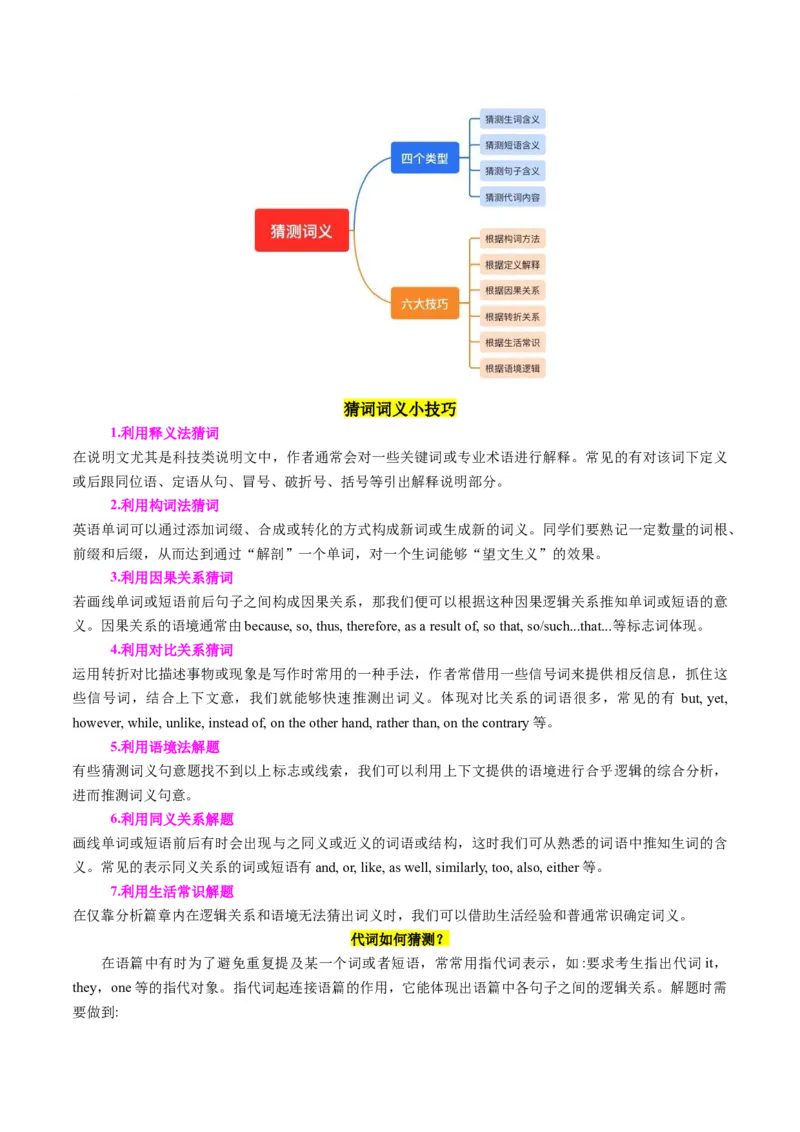
猜词词义思维导图
猜词词义小技巧
1.利用释义法猜词
在说明文尤其是科技类说明文中,作者通常会对一些关键词或专业术语进行解释。常见的有对该词下定义
或后跟同位语、定语从句、冒号、破折号、括号等引出解释说明部分。
2.利用构词法猜词
英语单词可以通过添加词缀、合成或转化的方式构成新词或生成新的词义。同学们要熟记一定数量的词根、
前缀和后缀,从而达到通过“解剖”一个单词,对一个生词能够“望文生义”的效果。
3.利用因果关系猜词
若画线单词或短语前后句子之间构成因果关系,那我们便可以根据这种因果逻辑关系推知单词或短语的意
义。因果关系的语境通常由because, so, thus, therefore, as a result of, so that, so/such...that...等标志词体现。
4.利用对比关系猜词
运用转折对比描述事物或现象是写作时常用的一种手法,作者常借用一些信号词来提供相反信息,抓住这
些信号词,结合上下文意,我们就能够快速推测出词义。体现对比关系的词语很多,常见的有but, yet,
however, while, unlike, instead of, on the other hand, rather than, on the contrary 等。
5.利用语境法解题
有些猜测词义句意题找不到以上标志或线索,我们可以利用上下文提供的语境进行合乎逻辑的综合分析,
进而推测词义句意。
6.利用同义关系解题
画线单词或短语前后有时会出现与之同义或近义的词语或结构,这时我们可从熟悉的词语中推知生词的含
义。常见的表示同义关系的词或短语有and, or, like, as well, similarly, too, also, either 等。
7.利用生活常识解题
在仅靠分析篇章内在逻辑关系和语境无法猜出词义时,我们可以借助生活经验和普通常识确定词义。
代词如何猜测?
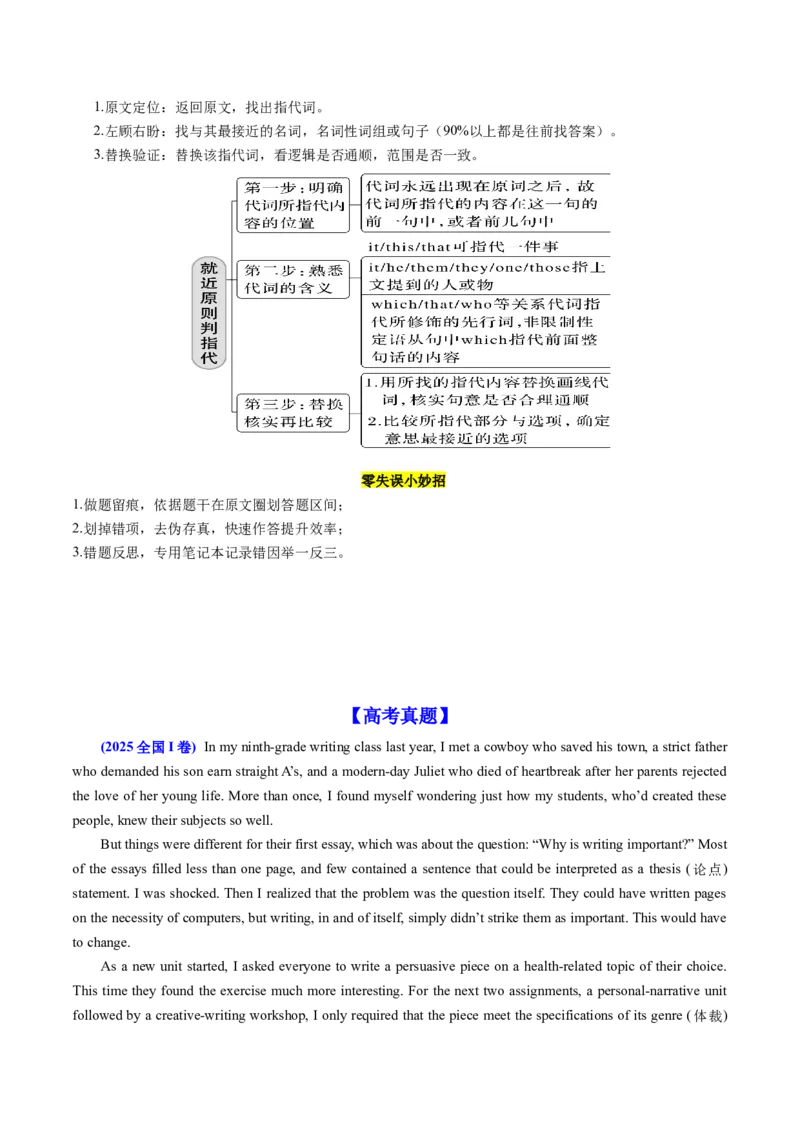
在语篇中有时为了避免重复提及某一个词或者短语,常常用指代词表示,如:要求考生指出代词it,
they,one 等的指代对象。指代词起连接语篇的作用,它能体现出语篇中各句子之间的逻辑关系。解题时需
要做到:
1.原文定位:返回原文,找出指代词。
2.左顾右盼:找与其最接近的名词,名词性词组或句子(90%以上都是往前找答案)。
3.替换验证:替换该指代词,看逻辑是否通顺,范围是否一致。
零失误小妙招
1.做题留痕,依据题干在原文圈划答题区间;
2.划掉错项,去伪存真,快速作答提升效率;
3.错题反思,专用笔记本记录错因举一反三。
【高考真题】
(2025 全国I 卷) In my ninth-grade writing class last year, I met a cowboy who saved his town, a strict father
who demanded his son earn straight A’s, and a modern-day Juliet who died of heartbreak after her parents rejected
the love of her young life. More than once, I found myself wondering just how my students, who’d created these
people, knew their subjects so well.
But things were different for their first essay, which was about the question: “Why is writing important?” Most
of the essays filled less than one page, and few contained a sentence that could be interpreted as a thesis ( 论点)
statement. I was shocked. Then I realized that the problem was the question itself. They could have written pages
on the necessity of computers, but writing, in and of itself, simply didn’t strike them as important. This would have
to change.
As a new unit started, I asked everyone to write a persuasive piece on a health-related topic of their choice.
This time they found the exercise much more interesting. For the next two assignments, a personal-narrative unit
followed by a creative-writing workshop, I only required that the piece meet the specifications of its genre ( 体裁)
and that it contain a thesis. The results were staggering. The students took on diverse topics and turned in stories,
10 to 20 pages each, with characters that broadened my view and touched my heart.
I walked into class believing that writing is important as a means of communication. However, my students
demonstrated something more important to me. When the final bell rang in June, I walked away with a yearbook
full of messages about writing’s most powerful significance — the ability to connect people, to put us in another’s
skin, to teach us what it means to be human.
24. Who are the people mentioned at the beginning of paragraph 1?
A. Ninth graders.
B. Students’ parents.
C. Modern writers.
D. Fictional characters.
25. Why did the students perform poorly in writing their first essay?
A. They were not given enough time.
B. They had a very limited vocabulary.
C. They misunderstood the question.
D. They had little interest in the topic.
26. What does the underlined word “staggering” in paragraph 3 mean?
A. Mixed.
B. Amazing.
C. Similar.
D. Disturbing.
27. What does the author’s experience show?
A. Teaching is learning.
B. Still waters run deep.
C. Knowledge is power.
D. Practice makes perfect.
(2025 全国II 卷) Kathy Ho teaches high school inside Lucile Packard Children’s Hospital Stanford (LPCH).
“Sometimes I don’t like saying that I’m a teacher,” says Ho. “People get in their minds an idea of what teachers do,
but that’s not really what it is here.”
“Here” is room 386, where each year, about 500 LPCH patients also become students. The hospital school is
free of parents, doctors, and medical procedures. It’s a place of learning. About half of Ho’s students stay for a
week or less; others are there for more than a year. Most of Ho’s students will recover, which means that preparing
them to return to school is an increasingly important component of care.
Still, in room 386, academics don’t come first. Physical health and mental health are the priority. “If you’re
scared about something and thinking only about that, there’s no way you’re going to be able to learn,” Ho says.
“I’m a coach, an adviser, and a comforter, and that’s what it means to be a hospital teacher.”
There are up to 30 students at any given time in Ho’s class. She generally works with their regular teachers to
get lessons and tests being used at their home schools. Some teachers don’t give the kids any assignments; they
express sympathy instead. “I feel like it is a disservice to the kids,” Ho says. “They think their teachers don’t care
about their schoolwork.”
Ho recognizes the psychological benefit of helping kids keep up with their peers (同龄人) outside the hospital.
“I actually think the medicine is only a small piece for some problems,” says Julie Good, director of pain
management services at LPCH. “It’s about problem-solving around what it means to have a full life. Those kids
have dreams. School can keep those dreams alive by giving kids a way to learn and grow.”
24. Who does Ho teach at LPCH?
A. Sick children.
B. Young nurses.
C. Medical students.
D. Patients’ parents.
25. What is a characteristic of Ho’s job?
A. Prioritizing academics.
B. Encouraging innovation.
C. Treating various diseases.
D. Playing multiple roles.
26. What does the underlined word “it” refer to in paragraph 4?
A. Offering regular lessons.
B. Paying extra attention.
C. Assigning no schoolwork.
D. Showing no sympathy.
27. How does the hospital school benefit the students according to Good?
A. It eases peer pressure.
B. It helps them live in hope.
C. It frees them from aches.
D. It entertains them with stories.
【名校模拟】
(25-26 高三上·山东济南·开学考试)Have you ever felt so stressed that you just sort of froze? Your body
goes still, you can’t feel much but, at the same time, your senses are working overtime. You know you must act
soon; but it’s as if something is stopping you. This “freezing”, or tonic immobility in academic terms, is an adaptive
defense response to stress or danger.
When we freeze, our heart rate drops and our blood pressure changes. Our pupils might become wider. A
flood of hormones (荷尔蒙) spread quickly, readying us for action. It can all happen within seconds.
While fight-or-flight seems logical for survival, freezing appears counterproductive — potentially too much
to handle, making us incapable of acting or making a decision. But is that really all that’s going on? Not according
to Prof Karin Roelofs, a neuroscientist who studies freezing at Radboud University.“Many people think that
freezing is a kind of shutdown of the system,” she says.“What we actually find is that in threatening situations,
freezing actually helps gain more information, prepare actions, and improve perception and decision-making.”
Freezing acts like an emergency flow state: watchful, not petrified.
Importantly, this response can be trained. Roelofs highlights two groups controlling freezing: living statues,
street performers maintaining extreme stillness and snipers ( 狙击手) requiring absolute stillness while making
decisions. Lab research confirms this. A virtual reality shooting game showed players with stronger freezing
responses performed better and decided faster. Freezing doesn’t slow responses. “Brain noise reduces. Perception
increases. You make better decisions faster,” Roelofs clarifies.
But let’s say you’re not a sniper, or don’t spend your weekends as a living statue. What if you’re about to
take an exam or lead a big business meeting? Those situations involving social pressure, may not be life or death,
but still can cause freezing. The key is to use this response through training, particularly focused breathing:
maintain slow, rhythmic exhalation (有节奏的呼气). Instead of feeling out of control, you can master it and —
sniper or not — take your best shot.
1. What happens in “freezing” according to the text?
A. Awareness is lost.
B. The heart pounds.
C. Senses are sharper.
D. The breath quickens.
2. What does the underlined word “petrified” in Paragraph 3 probably mean?
A. Confused.
B. Panicked.
C. Distressed.
D. Occupied.
3. Why are living statues and snipers mentioned in Paragraph 4?
A. To contrast response types.
B. To illustrate freezing causes.
C. To support response training.
D. To criticize stressful professions.
4. How should students manage exam freezing according to the text?
A. Seek professional help.
B. Apply trained breathing.
C. Hold breath to stay still.
D. Make last-minute revisions.
(25-26 高三上·安徽·阶段练习)Think there’s nothing more healthy than a bag of popcorn and a classic
children’s animated film ( 动画片)? Think again, say Canadian researchers. Researchers did their research by
watching 135 popular North American films from 1937 to today. The films included 45 children’s animated movies
and 90 dramatic films for adults. “Rather than being the healthy form of entertainment, they are full of on-screen
death and murder.”
Researchers found that the parents of heroes or heroines died most often in children’s films. They were five
times more likely to be killed than they were in films for adults. “There was no evidence that these results had
changed over time since Snow White in 1937, when Snow White’s stepmother, the evil queen, was struck by
lightning, forced off a cliff (悬崖), and crushed by a big rock,” the authors wrote.
Sometimes the death happens at the very beginning of the film. About four minutes and three seconds into
Finding Nemo, Nemo’s mother gets eaten by a barracuda fish. In Tarzan, the main character’s parents are killed by
a leopard four minutes and eight seconds into the movie. The researchers found that two-thirds of the cartoons
showed the death of an important character, compared with half of the adult dramas. Researchers watched deadly
animal attacks in five films (A Bug’s Life, The Croods, How to Train Your Dragon, Finding Nemo and Tarzan);
shootings in three films (Bambi, Peter Pan and Pocahontas); and deadly stabbings (刺伤) in two films (Sleeping
Beauty and The Little Mermaid).
“On-screen death and violence can be frightening to young children and can have strong and long-lasting
effects. This might be a problem when children haven’t been prepared.”
5. What did the research find?
A. On-screen violence in kids’ films.
B. Dramatic plots in animated films.
C. Adults’ favorite cartoon movies.
D. Children’s favorites in the cinema.
6. What does the underlined word “they” in Paragraph 2 refer to?
A. Heroes and heroines.
B. Parents of main characters.
C. Deaths in films for adults.
D. Children’s animated films.
7. What message does the author want to convey by mentioning many films?
A. Deadly animal attacks are the theme.
B. Animated films are favored by adults.
C. Various violence can occur now and then. D. Wildlife is the main role in animated films.
8. What is the best title for the text?
A. Problems Explained to Kids
B. Dramatic Films for Children
C. Weaknesses in animated Films
D. Harmful Acts in Kids’ Films
记叙文选标题题3 篇
【名师点津】
记叙文标题三大特点
1. 概括性:语言高度凝练而形式简短
2. 针对性:标题外延与文章内容相符
3. 醒目性:能够激发读者的阅读欲望
记叙文选标题三大方法
1. 主题句法
记叙文一般没有明显的主题句,需要根据文中叙述的内容和线索来概括文章大意,但是如果文章末段出现
说理性的句子,则这个句子为主题句。
2. 关键词法
全文中无明显主题句时,我们可以利用文章中的关键词。任何一篇文章都是围绕某个主题展开的,因此,
有的文章中最明显的特点之一是有一个反复出现的中心词,即关键词,也叫做主题词。抓住了它,便容易
抓住文章的中心。
3. 逆向思维法
在两个选项看上去都十分正确无法选择时,试着从选项出发,想象一下如果自己以此选项来写文章会有哪
些内容,然后把它与文章的内容比较,逐一排除,缩小范围,接近的即为正确选项。
记叙文选标题三大策略
1.正面肯定法
在理解文章主旨的基础上,揣摩哪个选项能准确概括主旨。
2.反面否定法
撇开原文,拿各个备选项去尝试用它们写出来的“文章”将是什么内容,然后和原文对照,一一排除荒谬
者。
3.排除干扰法
研究干扰项里面的中心词、修饰词的变化、结构、新奇性、概括力等。文章的标题应该新颖奇特,易激发
读者的好奇心,吸引读者注意力。
【高考真题】
(2023 新课标II 卷) Turning soil, pulling weeds, and harvesting cabbage sound like tough work for middle
and high school kids. And at first it is, says Abby Jaramillo, who with another teacher started Urban Sprouts, a
school garden program at four low-income schools. The program aims to help students develop science skills,
environmental awareness, and healthy lifestyles.
Jaramillo’s students live in neighborhoods where fresh food and green space are not easy to find and fast food
restaurants outnumber grocery stores. “The kids literally come to school with bags of snacks and large bottles of
soft drinks,” she says. “They come to us thinking vegetables are awful, dirt is awful, insects are awful.” Though
some are initially scared of the insects and turned off by the dirt, most are eager to try something new.
Urban Sprouts’ classes, at two middle schools and two high schools, include hands-on experiments such as soil
testing, flower-and-seed dissection, tastings of fresh or dried produce, and work in the garden. Several times a year,
students cook the vegetables they grow, and they occasionally make salads for their entire schools.
Program evaluations show that kids eat more vegetables as a result of the classes. “We have students who say
they went home and talked to their parents and now they’re eating differently,” Jaramillo says.
She adds that the program’s benefits go beyond nutrition. Some students get so interested in gardening that
they bring home seeds to start their own vegetable gardens. Besides, working in the garden seems to have a calming
effect on Jaramillo’s special education students, many of whom have emotional control issues. “They get outside,”
she says, “and they feel successful.”
24. What do we know about Abby Jaramillo?
A. She used to be a health worker.
B. She grew up in a low-income family.
C. She owns a fast food restaurant.
D. She is an initiator of Urban Sprouts.
25. What was a problem facing Jaramillo at the start of the program?
A. The kids’ parents distrusted her.
B. Students had little time for her classes.
C. Some kids disliked garden work.
D. There was no space for school gardens.
26. Which of the following best describes the impact of the program?
A. Far-reaching.
B. Predictable.
C. Short-lived.
D. Unidentifiable.
27. What can be a suitable title for the text?
A. Rescuing School Gardens
B. Experiencing Country Life
C. Growing Vegetable Lovers
D. Changing Local Landscape
【名校模拟】
(25-26 高三上·河北·阶段练习)My mother and father emigrated from India to America in 1988. My
brother and I were born soon after, making us both the first American-born members of our family. Upon coming to
America, our parents worked extremely hard to make a living, and, as such, sacrifices were made to ensure a better
life for all of us.
Our father worked seven days a week, and our mother would work all day. I remember waving good-bye to
my mother every morning as she drove off to work, and then I walked to school alone with a house key dangling
(悬挂) on a chain around my neck. After school, I would come home to an empty house. When my mother finally
came home, she had to clean and prepare dinner and didn’t have time to help me with my homework or play with
me. Looking back, I realize that this helped shape my independence and resourcefulness, because I had to figure
out how to do things on my own.
But at the time, I was angry. In the mid-1990s, everyone else’s mother stayed home and went to the parent-
teacher association and school field trips, and I didn’t want to be different. I also remember having only one
birthday party as a boy; my parents were always too busy working. I swore that when I became a parent, I would do
things differently.
Since making a living was always a struggle for my parents, education was very important to them. My
father believed that we could use education to make our life better. He would always say, “People can take away
your house or your possessions, but they can never take away what you have learned.”
I had high expectations of myself as well, so I worked all through high school and was able to put myself
through college. I attended the University of California for my undergraduate studies, majoring in business
management and design, and then later went to Northwestern University to get my MBA in marketing and finance.
Finally, a ray of light found its way into my life.
1. What was the author’s parents’ life in America like?
A. It was tough.
B. It was colorful.
C. It was interesting.
D. It was lonely.
2. What impact did the author’s family have on his growth?
A. It made him always ignore his studies.
B. It made him independent and intelligent.
C. It caused him to do many things differently.
D. It caused him to feel disappointed with others.
3. What does the author’s experience mainly show?
A. Education changes life.
B. Dreams will always come true.
C. Failure makes people ambitious.
D. Family’s care leads to success.
4. Which of the following may be the best title for the text?
A. Parents’ Hard Work
B. The So-called Difference
C. The Value of Education
D. Our History of Struggle
(25-26 高三上·江西抚州·阶段练习)When Sandra Mejia received news in 2023 that her beloved plant
store, Plant Chica, had to close within 90 days, her heart sank. The store — first opened as a pop-up store in 2018
and later turned into a greenhouse in a repurposed auto body shop — had become a gathering spot for locals.
Although business was slow during the winter of 2023, Mejia was always feeling positive about the store because
having a physical store was her dream.“We were having a really hard time letting go of it,” said Mejia. “I felt like I
was never going to find anything as special as that space.”
But hope arrived unexpectedly. A community organization read about her story and reached out. Robbie Lee,
from a local nonprofit organization, thought Mejia might be a good fit for what his organization was trying to build
in Leimert Park. “She seemed to have some strong connection to the South L.A. community,” Lee explained. He
believed Mejia’s passion matched their vision for a cultural center in Los Angeles. So, he decided to help her find a
new place.
After viewing several locations, Mejia discovered a suitable place. In late 2024, the new Plant Chica opened.
The redesigned greenhouse, with gravel paths and a weather-resistant dome (圆屋顶), became an instant favorite.
The new space is special for another reason: The open space allows Mejia to more easily facilitate the community
events and cooperation she is known for.
When Amorette Brooms, a fellow small business owner, faced the closure of her business, Mejia offered her
free space at Plant Chica. This action turned into a sustainable model: currently, four local marketers operate their
businesses rent-free within the greenhouse. “This model gives small businesses a chance to grow,” Brooms said.
For Mejia, Plant Chica is more than a plant store. It's proof that when people come together, beautiful things grow.
Reflecting on her journey, Mejia shared, “My son cut the ribbon at both stores. That's the lesson - when
things get tough, don't give up. Find new paths forward.”
5. How did Sandra Mejia feel about the news in 2023?
A. Excited about making a change.
B. Depressed and completely at a loss.
C. Indifferent due to slow winter sales.
D. Relieved to end the struggling business.
6. What made Robbie Lee determined to help Mejia?
A. Her knowledge of gardening.
B. Her chance of drawing visitors.
C. Her cultural ties and community spirit.
D. Her experience in running businesses.
7. What is the key benefit of Mejia’s rental model according to Brooms?
A. It greatly increases Plant Chica’s profits.
B. It makes her store a popular check-in spot.
C. It promotes competition among businesses.
D. It helps small businesses to survive and grow.
8. What can be a suitable title for the text?
A. Plant Chica’s Rebirth: Unity and Hope
B. A Greenhouse’s Architectural Transformation
C. A New Running Model for Plant Chica
D. Surviving Challenges: Small Businesses in Crisis
说明文选标题题3 篇
【名师点津】
说明文标题错误三大特征
1. 范围太宽泛
选项太过于宽泛,与文章内容相距甚远。
2. 范围太具体
选项死扣文章某一细节不适合用于标题。
3. 范围太偏颇
选项内容过于偏颇,明显偏离文章主旨。
说明文选标题三大方法
1.主题段法
标题段一般在文章的第
一段和最后一段,一般来说第一段
经常提出文章的主题或最后一段总结文章的主题,知道了文章的主题也就知道了文章的中心,把中心概括
成一句话或一个短语即是文章的标题。
2. 主题句法
解题的关键要抓住每段的首尾句,要注意贯穿文章始终的词语。通过寻找文章的主题句,并对主题句进行
概括和提炼,从而确定文章的标题。
2. 关键词法
任何一篇文章都是围绕某个主题展开的,因此有的文章中最明显的特点之一是有一个反复出现的中心词,
即关键词,也叫做主题词。抓住了它,便容易抓住文章的中心。
说明文选标题三大策略
1.正面肯定法
在理解文章主旨的基础上,揣摩哪个选项能准确概括主旨。
2.反面否定法
撇开原文,拿各个备选项去尝试用它们写出来的“文章”将是什么内容,然后和原文对照,一一排除荒谬
者。
3.排除干扰法
研究干扰项里面的中心词、修饰词的变化、结构、新奇性、概括性等。文章的标题应该新颖奇特,易激发
读者的好奇心,吸引读者注意力。
【高考真题】
(2025 全国II 卷) When Sonja Detrinidad opened her online shop selling houseplants, she didn’t have high
hopes for it. But the opposite happened: She was flooded, shipping out 1,200 orders in June of 2020 alone. In the
past year, Detrinidad sent out more than 70,000 plants. Her success is just one example of increased time at home
leading to an explosion in the houseplant industry.
“Plants are in fashion right now,” says Dr. Melinda Knuth, a researcher from the University of Florida.
“People who live in plant-rich environments report a higher life satisfaction rating, ” she says. “Adding more nature
to our environment can change our mood and how we think.” Plants can improve our state of mind in a few ways
but the biggest is by decreasing our level of cortisol, the stress hormone (激素) in our body.
“Students who are around plants perform better academically than students who are in a classroom without
plants,” says Knuth. “This productivity also translates into the workplace for adults. Our study showed that there
was a 30% decrease in sick leave for people who were in plant-rich workplaces.”
If you’re among the groups of people who are enjoying the mental and physical health benefits of surrounding
yourself with plants, don’t beat yourself up if one (or a few!) doesn’t make it. “Doctors practice medicine and
lawyers practice law and you should allow yourself the practice it takes to sustain a plant. Tending to plants is an
exercise in patience and learning. Be invested in taking care of it, but if it dies, go get another one,” Detrinidad
says.
28. How was Detrinidad’s business when it started?
A. It faced tough competition.
B. It suffered a great loss.
C. It got lots of financial support.
D. It went surprisingly well.
29. What is one of Knuth’s findings about plants?
A. They appeal more to students.
B. They purify the environment.
C. They raise the cortisol level.
D. They enhance productivity.
30. What does Detrinidad try to explain by mentioning doctors and lawyers?
A. The necessity of social skills.
B. The meaning of sustainability.
C. The importance of repeated efforts.
D. The value of professional opinions.
31. What can be a suitable title for the text?
A. Time to Replace Houseplants
B. Plants Boost Your Mood
C. Tips on Choosing Houseplants
D. Plants Brighten Your Home
【名校模拟】
(25-26 高三上·四川成都·阶段练习)With self-driving cars gaining popularity in today’s automobile
landscape, the issue of legal liability (法律责任) in the case of an accident has become more relevant.
Research in human-vehicle interaction has shown even systems designed to automate driving are far from
being error-proof. Besides, recent evidence points to drivers’ limited understanding of what these systems can and
cannot do as a contributing factor to system misuse. A recent study tackles the issue of over-trusting drivers and the
resulting system misuse from a legal viewpoint. It looks at what the manufacturers of self-driving cars should
legally do to ensure that drivers understand how to use the vehicles appropriately.
One solution suggested in the study involves requiring buyers to sign end-user license agreements (EULAs) ,
similar to the terms and conditions that require agreement when using new software products. But this is far from
ideal. The agreement may not provide enough information to the driver, leading to confusion about the nature of the
requests for agreement and their implications. Further, most end users don’t read EULAs. A 2017 study shows 91
percent of people agree to them without reading. Among young people, 97 percent agree without reviewing the
terms.
The issue is that, unlike using a smartphone app, operating a car has intrinsic and serious safety risks,
whether the driver is human or software. And human drivers need to consent (准许) to take responsibility for the
outcomes of the software and hardware.
“Warning fatigue” and distracted driving are also causes for concern. For example, a driver, annoyed after
receiving continuous warnings, could decide to just ignore the message. Or, if the message is presented while the
vehicle is in motion, it could represent a distraction. Given these limitations and concerns, even if this mode of
obtaining consent is to move forward, it likely won’t fully protect automakers from their legal liability, should the
system malfunction or an accident occur.
Driver training for self-driving vehicles can help ensure that drivers fully understand system capabilities and
limitations. This needs to occur beyond the vehicle purchase. Recent evidence shows even relying on the
information provided by the seller is not going to answer many questions. All of this considered, the road forward
for self-driving cars is not going to be a smooth ride after all.
1. What can we learn from recent studies in human-vehicle interaction?
A. Automatic driving systems are not immune to errors.
B. Driverless vehicles may be misused by some people.
C. Self-driving car makers aren’t aware of the legal matters.
D. Drivers have limited knowledge of the automatic systems.
2. What is the problem with requiring buyers to sign EULAs?
A. Drivers aren’t willing to take responsibility.
B. End users find the terms complex to interpret.
C. The information provided may cause confusion.
D. Most users sign them without reading the terms.
3. What would drivers do when they suffer from “warning fatigue”?
A. Be distracted easily by the message.
B. Rest a while to avoid fatigue driving.
C. Waste no time keeping the car moving.
D. Take no action despite repeated warnings.
4. Which would be the best title for the passage?
A. How Can We Reduce Self-Driving Risks?
B. Who’s to Blame if a Self-Driving Car Crashes?
C. Are Self-Driving Systems Truly Safe and Legal?
D. Where Will the Human-Vehicles Interaction Lead?
(25-26 高三上·广东·阶段练习)Scientists are advancing brain-computer interface (BCI) technology with
a breakthrough system that translates inner speech into audible words. Developed by US researchers, this “thought
decoder (解码器)” achieved 74% accuracy in converting the imagined speech of four paralyzed volunteers into
sound.
Unlike earlier BCIs, which relied on brain signals from attempted speech or writing, the new device directly
interprets neural patterns linked to phonemes (speech units), aiming to restore fluent communication for those with
speech or motor disabilities.
The system works by implanting sensors in the motor cortex ( 运动皮层), the brain region controlling
movement, including speech. As volunteers think of words, machine learning algorithms ( 算法) analyze neural
activity to identify phoneme patterns and reconstruct sentences. Stanford neuroscientist Benyamin Meschede-Krasa
explains, “If you just have to think about speech instead of actually trying to speak, it’s potentially easier and
faster.”
Researchers discovered overlapping brain signals between attempted and imagined speech, but the system
could distinguish them through probability calculations. For example, it recognized 125,000 words by linking
frequent phoneme combinations. “These patterns are a similar but smaller version of attempted speech activity,”
notes Stanford’s Frank Willett, adding, “We decoded them well enough to prove the principle, but not as well as
attempted speech.”
There’s still a long way to go here, and the BCI often fell far short of that 74% maximum accuracy rating.
However, by utilizing upgraded implant technology and mapping more of the brain for thought cues, the
researchers are confident that the system can be quickly improved over the next few years.
Another issue to overcome is the potential for translating, logging, and speaking out inner monologues that
are intended to be kept private — not something you want in a BCI. Safeguards like thinking of a special password
start and stop decoding could be implemented here, the researchers suggest. This concept was trialed in the
experiments with 98 percent accuracy.
This follows other progress, such as a recent real-time thought-decoding study (personalized to one
individual). “The future of BCIs is bright,” Willett says. “This gives hope that speech BCIs may one day restore
communication as fluent and natural as conversational speech.”
5. How does the new BCI system differ from earlier models?
A. It uses external sensors instead of implants.
B. It requires physical movement to generate speech.
C. It relies on brain signals from attempted writing only.
D. It directly decodes neural patterns associated with inner speech.
6. What can we infer from Paragraph 3?
A. Benyamin Meschede-Krasa invented the new BCI system.
B. The motor cortex is only responsible for speaking movements.
C. Machine learning plays a key role in linking brain signals to words.
D. The new BCI needs users to silently speak words to generate neural signals.
7. What privacy concern is raised about the BCI system?
A. It stores thoughts without user approval.
B. It might decode unintended private thoughts.
C. It cannot differentiate between multiple users.
D. It requires users to share mental passwords publicly
8. Which of the following is the best title for the text?
A. BCIs: The Future of Medical Implants.
B. Breakthrough in Decoding Imagined Speech.
C. The Morals of Translating Inner Monologues.
D. Overcoming Paralysis Through Brain Technology.
间接信息题3 篇
【名师点津】
“间接信息题”的最优处理方法:
第一、快速通读全文,把握大意。细节理解题分直接细节理解题、间接细节理解题和综合细节理解题。
第二、结合题干锁定原文答题区间,圈划关键词句,留意正确选项与原文之间是同义转换或高度概括。
第三、比对选项内容,采用“排除法”,防止偷换概念、以偏概全、过于绝对化等确定最佳答案。
【高考真题】
(2024 新课标I 卷) In the race to document the species on Earth before they go extinct, researchers and citizen
scientists have collected billions of records. Today, most records of biodiversity are often in the form of photos,
videos, and other digital records. Though they are useful for detecting shifts in the number and variety of species in
an area, a new Stanford study has found that this type of record is not perfect.
“With the rise of technology it is easy for people to make observations of different species with the aid of a
mobile application,” said Barnabas Daru, who is lead author of the study and assistant professor of biology in the
Stanford School of Humanities and Sciences. “These observations now outnumber the primary data that comes
from physical specimens (标本), and since we are increasingly using observational data to investigate how species
are responding to global change, I wanted to know: Are they usable?”
Using a global dataset of 1.9 billion records of plants, insects, birds, and animals, Daru and his team tested
how well these data represent actual global biodiversity patterns.
“We were particularly interested in exploring the aspects of sampling that tend to bias (使有偏差) data, like
the greater likelihood of a citizen scientist to take a picture of a flowering plant instead of the grass right next to it,”
said Daru.
Their study revealed that the large number of observation-only records did not lead to better global coverage.
Moreover, these data are biased and favor certain regions, time periods, and species. This makes sense because the
people who get observational biodiversity data on mobile devices are often citizen scientists recording their
encounters with species in areas nearby. These data are also biased toward certain species with attractive or eye-
catching features.
What can we do with the imperfect datasets of biodiversity?
“Quite a lot,” Daru explained. “Biodiversity apps can use our study results to inform users of oversampled
areas and lead them to places – and even species – that are not well-sampled. To improve the quality of
observational data, biodiversity apps can also encourage users to have an expert confirm the identification of their
uploaded image.”
32. What do we know about the records of species collected now?
A. They are becoming outdated.
B. They are mostly in electronic form.
C. They are limited in number.
D. They are used for public exhibition.
33. What does Daru’s study focus on?
A. Threatened species.
B. Physical specimens.
C. Observational data.
D. Mobile applications.
34. What has led to the biases according to the study?
A. Mistakes in data analysis.
B. Poor quality of uploaded pictures.
C. Improper way of sampling.
D. Unreliable data collection devices.
35. What is Daru’s suggestion for biodiversity apps?
A. Review data from certain areas.
B. Hire experts to check the records.
C. Confirm the identity of the users.
D. Give guidance to citizen scientists.
【名校模拟】
(25-26 高三上·浙江杭州·阶段练习)We all pursue an ideal weight number for health and confidence,
often using childhood memories, online calculators or BMI charts. However, Dr. Yoni Freedhoff warns these
methods fail to consider individual differences. Our bodies change dramatically with age due to metabolism (新陈
代谢) and lifestyle.
For decades, Body Mass Index (BMI) dominated weight assessments. This simple height-weight calculation
sorts people from underweight to overweight. Yet Dr. Melanie Jay from NYU points out its problems: BMI gives
the same ranges for 20-year-old athletes and 70-year-old grandparents. It ignores muscle mass, bone density, and
health conditions, sometimes regarding fit individuals as overweight. Recent studies show that nearly 30% of
people classified as overweight by BMI actually have healthy body fat percentages and normal metabolic profiles.
Newer metrics like the Body Roundness Index (BRI) focus on waist size instead of weight. “Belly fat is
more dangerous than overall weight,” says Dr. Jay. Research indicates fat around organs produces harmful
chemicals linked to diabetes and heart disease. However, even BRI has limitations — it can’t distinguish between
fat types or account for medical conditions affecting belly size, such as digestive disorders.
Doctors increasingly emphasize overall health markers over specific weights. “Instead of focusing on
a’magic number,’ we examine blood pressure, cholesterol (胆固醇), sleep quality and energy levels,” notes Dr. Jay.
For those with weight-related conditions, even 5-10% weight loss can significantly improve health. A 2023 study
found patients who achieved modest weight reduction showed better health markers than those pursuing extreme
weight loss.
The healthiest weight, experts agree, isn’t found on charts but through sustainable habits. “When you eat
nutritiously and stay active, your body finds its natural healthy weight,” advises Dr. Freedhoff. For some,
medications or surgery may help, but the real goal is lifestyle change — not to achieve an ideal number on your
scale. True health,after all, is measured not by a momentary reading on a scale, but by the daily choices that nourish
both body and life.
1. Why does the author mention 20-year-old athletes and 70-year-old grandparents?
A. To show BMI’s limitations.
B. To prove BMI’s popularity.
C. To describe BMI’s main users.
D. To introduce BMI’s target group.
2. What is the main advantage of BRI?
A. It clarifies different kinds of fat.
B. It evaluates all types of body fat.
C. It measures highly risky body fat.
D. It identifies harmful chemicals in fat.
3. What is Dr. Jay’s suggestion for weight assessment?
A. Stopping using BMI.
B. Focusing on specific weights.
C. Considering multiple health signs.
D. Adopting rapid weight loss approaches.
4. What does the author think of people’s pursuing an ideal weight number?
A. Reasonable.
B. Unhelpful.
C. Dangerous.
D. Practical.
(25-26 高三上·浙江嘉兴·阶段练习)In 2006, as a 10-year-old living in one of Delhi’s busiest markets, I
would often run downstairs to buy milk, eggs or vegetables for my mother. The shopkeepers knew me by face and
often guessed my order before I even spoke. These small market runs taught me more than I realised at the time —
quick mental maths, conversations with strangers, and backup plans when a shop was shut. So much unintentional
learning.
Over time, these routines became daily comfort. Whether it was me or my mother, we enjoyed the smiles,
brief chats, and snacks along the way — small moments that quietly held our lives together.
Now, things are different. With Blinkit, Zepto, and Instamart, groceries arrive in 10 minutes. While I still
enjoy shopping in the market after work, my mother begins her day by comparing prices on apps and ordering
everything with a few taps (点击). The grocery trips that once lifted her mood, improved her health, and helped her
stay connected with the neighbourhood have disappeared. The joy of being known, of interacting, is dying.
And it’s not just her. Many of us now rely more on apps and less on people. Our growing reliance on instant
delivery is reducing those everyday moments of interaction. There’s the financial cost too. When you’re too tired or
too busy to plan your groceries, you end up ordering in pieces — adding things you don’t need just to hit the free-
delivery minimum.
Of course, these apps are a gift on tough days when we’re sick or short on time. But next time you feel like
opening a grocery app, try walking to your local shop instead. You might come back with more than just groceries
— a smile, a quick chat, and a sense of connection. Sometimes, the cost of convenience isn’t what you pay. It’s
what you miss.
5. What does the author think of early market runs?
A. Adventurous.
B. Valuable.
C. Tiring.
D. Complex.
6. How did the author’s mother change her shopping habit later?
A. She turned to online shopping.
B. She visited groceries with neighbours.
C. She cared about discounts in stores.
D. She ordered whatever lifted her mood.
7. What concerns the author about instant delivery?
A. It takes away small social moments.
B. It involves paying extra service fees.
C. It results in poor physical condition.
D. It makes people addicted to shopping.
8. What is implied in the last paragraph?
A. A shared gift doubles its joy.
B. Convenience comes at a cost.
C. A smile is free but worth a lot.
D. Rush breaks human connection.
心理效应题3 篇
【名师点津】
“心理效应题”的最优处理方法:
第一、该类文章多出现在C 篇或D 篇位置,属于说明文,多用来介绍心理学术语或现象。
第二、重点抓首段首句和每段段首句。若第一段过长,关注Now, But, However 之后才是关键。
第三、结合题干锁定原文答题区间,圈划关键词句,尤其是学会用括号法破解长难句。
第四、比对选项细微差别,不妨采用“排除法”或“逆向思维法”,去伪存真确定答案。
【高考真题】
(2023 全国乙卷) On March 7, 1907, the English statistician Francis Galton published a paper which
illustrated what has come to be known as the “wisdom of crowds” effect. The experiment of estimation he
conducted showed that in some cases, the average of a large number of independent estimates could be quite
accurate.
This effect capitalizes on the fact that when people make errors, those errors aren’t always the same. Some
people will tend to overestimate, and some to underestimate. When enough of these errors are averaged together,
they cancel each other out, resulting in a more accurate estimate. If people are similar and tend to make the same
errors, then their errors won’t cancel each other out. In more technical terms, the wisdom of crowds requires that
people’s estimates be independent. If for whatever reasons, people’s errors become correlated or dependent, the
accuracy of the estimate will go down.
But a new study led by Joaquin Navajas offered an interesting twist (转折) on this classic phenomenon. The
key finding of the study was that when crowds were further divided into smaller groups that were allowed to have a
discussion, the averages from these groups were more accurate than those from an equal number of independent
individuals. For instance, the average obtained from the estimates of four discussion groups of five was
significantly more accurate than the average obtained from 20 independent individuals.
In a follow-up study with 100 university students, the researchers tried to get a better sense of what the group
members actually did in their discussion. Did they tend to go with those most confident about their estimates? Did
they follow those least willing to change their minds? This happened some of the time, but it wasn’t the dominant
response. Most frequently, the groups reported that they “shared arguments and reasoned together”. Somehow,
these arguments and reasoning resulted in a global reduction in error. Although the studies led by Navajas have
limitations and many questions remain, the potential implications for group discussion and decision-making are
enormous.
32. What is paragraph 2 of the text mainly about?
A. The methods of estimation.
B. The underlying logic of the effect.
C. The causes of people’s errors.
D. The design of Galton’s experiment.
33. Navajas’ study found that the average accuracy could increase even if ________.
A. the crowds were relatively small
B. there were occasional underestimates
C. individuals did not communicate
D. estimates were not fully independent
34. What did the follow-up study focus on?
A. The size of the groups.
B. The dominant members.
C. The discussion process.
D. The individual estimates.
35. What is the author’s attitude toward Navajas’ studies?
A. Unclear.
B. Dismissive.
C. Doubtful.
D. Approving.
【名校模拟】
(25-26 高三上·辽宁·阶段练习)One day, while sitting in a busy Viennese restaurant in the 1920s, Russian
psychologist Bluma Zeigarnik noticed that the waiters could successfully remember the details of the orders for the
tables that had yet to receive and pay for their food. As soon as the food was delivered and the check was closed,
however, the waiters’ memories of the orders seemed to disappear from their minds.
Zeigarnik conducted a series of experiments to study this phenomenon. She asked participants to complete a
series of 18 to 22 simple tasks, including things like making a clay figure, constructing a puzzle, or completing a
math problem. Half of the tasks were interrupted before the participants could complete them. Meanwhile, the
participants were able to work on the others until they were done. Afterwards, the participants were asked to tell the
experimenter about the tasks they worked on. An initial group of participants recalled interrupted tasks 90% better
than the tasks they completed, and a second group of participants recalled interrupted tasks twice as well as
completed tasks.
Other studies have failed to copy the Zeigarnik effect, and evidence demonstrates that there are a number of
factors that impact the effect. This is something Zeigarnik accounted for in the discussion of her original research.
She suggested that things like the timing of an interruption, the motivation to successfully complete a task, how
tired an individual is, and how difficult they believe a task is, will all impact one’s recall of an unfinished task.
The Zeigarnik effect can also be useful for students who are studying for an exam. The effect tells us that
breaking up study sessions can actually improve recall. So instead of studying intensely for an exam all in one
sitting, breaks should be scheduled in which the student focuses on something else. This will automatically cause
thoughts about the information that must be remembered, which will enable the student to review and consolidate
(巩固) it, leading to better recall when they take the exam.
1. What phenomenon does the author describe in paragraph 1?
A. Customers delayed ordering food.
B. Waiters had a bad instant memory.
C. Waiters memorized unfinished orders.
D. Customers only focused on efficiency.
2. What can be inferred from Zeigarnik’s experiments?
A. Interrupted tasks were better remembered. B. Participants failed to finish simple tasks.
C. Participants thought tasks uneasy.
D. Interrupted tasks were important.
3. What does paragraph 3 mainly talk about?
A. Hidden principles of Zeigarnik effect.
B. Elements that affect Zeigarnik effect.
C. Tips that help improve memory.
D. Impacts of sudden disturbance.
4. How can students apply the Zeigarnik effect?
A. By making use of leisure time.
B. By intensifying targeted drills.
C. By keeping learning without cease.
D. By valuing discontinuous learning.
(25-26 高三上·安徽·阶段练习)In eight experiments, the researchers asked adults to describe what
typical children are like. After focusing on children in this way, participants later indicated higher motivation
towards sympathetic values, such as helpfulness and social justice, and they reported greater compassion for the
difficult situations for other adults.
In a field study, the researchers found that when no children were present and all passers-by were adults on a
shopping street, adult passers-by made one donation every ten minutes. But when children and adults were equally
present, adult passers-by made two donations every ten minutes.
These effects could not be accounted for by higher footfall (人流) during busy times. Instead, they suggested
that the presence of children can make adults behave more generously and donate more often.
Interestingly, these findings point to a widely applicable effect. The researchers observed that the “child
salience effect” was obvious among both parents and non-parents, men and women, younger and older participants,
and even among those who had relatively negative attitudes towards children.
Lead researcher Dr Lukas Wolf from the Department of Psychology explains, “While previous evidence has
shown that we are typically more helpful and sympathetic towards children, no research has been done to examine
whether the presence of children alone encourages us to be more pro-social towards others in general. Our research
addresses this gap by showing that the presence of children brings out broad pro-social motivation and donation
behavior towards causes not directly related to children.”
Dr Wolf says that this potential for widespread effects is important because it indicates society needs to
consider new ways to involve children more directly in various aspects of life. “Our findings showing the
importance of children for sympathetic behavior in society provide a glimpse of a much bigger impact,” he says.
He adds, “The finding calls for more integration of children in contexts where adults make important long-
term decisions, such as on climate change. Various initiatives over recent years have been established to raise the
importance of youth voices, for example Children’s Parliament.”
5. The purpose of the research is to examine ________.
A. who are more sympathetic — children or adults
B. if being around kids makes adults more generous
C. when adults have more sympathy for others
D. whether adults’ behavior can motivate kids’ sympathy
6. What can be learned from the field study?
A. The footfall greatly influenced the result.
B. The result went against the researchers’ assumption.
C. The presence of kids affected adults’ decisions.
D. Adults were willing to give in public places.
7. What is special about the research?
A. It made adults more friendly to children.
B. It applied the “child salience effect” to the experiments.
C. It found kids’ presence encouraged adults’ kindness to others.
D. It involved people with relatively negative attitudes to children.
8. What will Dr Wolf probably agree with?
A. Adults should set more examples for children.
B. There is a need for adults to spend more time with children.
C. The society should focus more on children’ growth.
D. Children should have more chances to have their voices heard.
(24-25 高三上·广东·阶段练习)The ban on cigarette advertising in the early 1970s in the United
States serves as a fascinating case study in the field of public health campaigns and their unintended consequences.
Despite the government’s intention to discourage smoking and reduce related health risks, the ban led to an
unexpected outcome: an increase in cigarette sales for the major tobacco companies.
The reason for this unexpected outcome can be traced to the principles of game theory, particularly the
prisoner’s dilemma paradox (悖论). Just as in the prisoner’s dilemma, where cooperation leads to the best outcome
for both parties, the tobacco companies would benefit collectively if none of them advertised. This action would
create fairness in competition, ensuring that no individual company gains an edge by advertising.
However, the dilemma arises when considering the potential actions of competitors. If one tobacco company
decides to ignore the ban and advertise its products, it stands to gain a significant market share and increased sales
compared to its non-advertising competitors. This creates a situation where each company faces the urge to
advertise, fearing that their competitors may do the same and leave them at a disadvantage.
In the end, most tobacco companies decided to play it safe and invested in advertising, despite the ban, to
avoid being left behind in the competitive landscape. This strategic decision reflects the uncertainty and strategic
considerations that shape business decisions, even in the face of regulations aimed at public health goals.
This application of game theory provides valuable insight into the complexities of influencing human
behavior through policy interventions. While well-intended efforts such as advertising bans may seem
straightforward in theory, the realities of strategic decision-making and competitive dynamics often lead to
unforeseen outcomes. As such, understanding the complexities of game theory can provide valuable insight for
policymakers seeking to design more effective interventions and address complex societal challenges.
1. What is a direct result of the ban in the 1970s?
A. Cut in tax income.
B. Reduction in health risks.
C. Rise in tobacco sales.
D. Cooperation of companies.
2. How can all competitors benefit in the prisoner’s dilemma?
A. They fully trust each other and follow the regulations.
B. They act independently and pursue their own interests.
C. They increase their market share at the expense of others.
D. They ignore competition and focus on their own strategies.
3. Why do most tobacco companies finally choose to advertise?
A. To avoid intense competition.
B. To gain a competitive advantage.
C. To shape better business images.
D. To achieve public health goals.
4. What can be the most suitable title for the passage?
A. A Good Intention Fails
B. A Ban on Cigarette Advertising Ends in Smoke
C. A Ban Boosts Public Health
D. A Dilemma Concerns Cigarette Campaign