考前猜押02 阅读理解心理学说明文

1.押题指导原则:
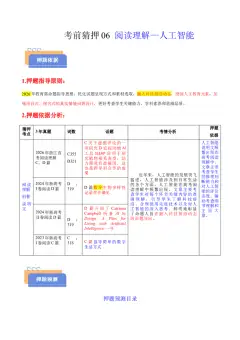
2026 年教育部命题指导思想:优化试题呈现方式和素材选取,融入科技前沿动态,浸润人文教育元素,加
强项目式、探究式的真实情境问题设计,更好考查学生关键能力、学科素养和思维品质。
2.押题依据分析:
猜押
考点
3 年真题
词数
话题
考情分析
押题
依据
阅读
理解
科普
说明
文
2026 年浙江首
考阅读理解C
C355
D 关于虚假评论的一
项研究
新高考阅读理解科普说明文特
点:近年来,社会心理学在高考阅
读理解中频繁出现,和科技说明
文相比,心理学类的文章理解更
难些,学生有关心理学的背景知
识相对匮乏,造成理解难度加
大。文章主要考查学生对每个环
节关键内容的准确理解,引导学
生认识自我、了解他人并建立良
好的人际关系,提升发现问题、
分析问题、解决问题的能力。鲜
明地彰显了命题人旨在培养新一
代青年学子独立思考、理性判断
的教育导向。
高考心理
学说明文
说明某种
现象、某
个心理学
原理。说
明文的总
体结构通
常分为三
个部分:
说明对
象、说明
过程和归
纳总结。
2025 年全国二
卷阅读C 篇
C264
C 室内植物对人们心
理健康和工作效率的
积极影响
2025 年1 月浙
江卷阅读D 篇
D370
D 篇新技术呈现人类
特质时人们试图使其
去性别化
2024 年1 月浙
江卷阅读D 篇
D333
D 篇信息化时代我们
作为成年人每天都在
面对棉花糖测试,信
息轰炸让我们摄入了
太多精神“ 垃圾食
品”
2023 年新高考
I 卷阅读D 篇
D
:
337
D 篇“群体智慧”效
应
押题预测目录
一、心理学上的效应类文章
二、心理学理论——兰花与蒲公英理论
三、心理学实验
四、心理学与日常生活
五、心理学现象分析
 一、心理学上的效应类文章
押题1
词数
话题
体裁
考点
押题理由
315
外语效应
说明
文
细节理解
推理判断
主旨大意
心理学类说明文是英语阅读理解中的重要题型,掌握其结
构、语言特点和常见话题是提高成绩的关键。此类话题是高
考命题常用的素材,关注心理健康是涉及每个人的幸福生
活。
Psychologists have become increasingly interested in how switching between languages influences thinking
— a phenomenon known as the “foreign language effect”. Unlike linguistic determinism, which suggests a
language’s structure shapes thought, this effect stems from the general experience of using a second language, often
making people more rational and open-minded.
Research pioneered by Professor Boaz Keysar shows this strongly influences moral reasoning. When
considering the “trolley problem” — whether to sacrifice one life to save five — people are twice as likely to make
the utilitarian ( 实用主义的) choice when using their second language. The emotional distance provided by a
foreign language appears to reduce instincts (本能) reactions.
The effect also reduces classic cognitive biases. People’s distaste for financial loss is much less strong when
bets are presented in a foreign language. Speaking a second language can also lessen how easily we are influenced
by how information is framed and our reluctance to quit failing projects. Similarly, the “bias blind spot”, where
people believe they are less biased than others, diminishes when thinking in another tongue. Over a decade of
research, the effect has proven consistent and repeatable.
Beyond decision-making, the foreign language effect impacts memory. Recalling traumatic events in a
second language causes less emotional distress. Recent studies show it also reduces false memories: When
presented with misleading information, people are better at avoiding errors if the material is in their foreign
language, as they engage in more careful, deliberative thinking when processing information in a non-native
tongue.
In our globalized world, this research suggests a practical cognitive tool. Deliberately switching to a second
language can help us become more detached and objective. Whether evaluating investments, processing personal
upsets, or considering controversial policies, using a foreign language can provide valuable emotional distance and
reduce automatic reactions. For language learners, this is an unexpected payoff; for others, it’s a compelling reason
to start learning.
1.What does paragraph 3 indicate about the effect?
A.It is a surprising new discovery.
B.It requires a long time to prove.
C.It turns out to be reliable over time.
D.Its mechanisms are fully understood.
2.Why are people less likely to form false memories when recalling in a foreign language?
A.They give top priority to correctness.
B.They get in a more thoughtful process.
C.They engage in more automatic thinking. D.They avoid thinking about difficult topics.
3.What is a practical benefit of applying the effect in real life?
A.Reducing automatic reactions entirely.
B.Ensuring perfectly reasonable decisions.
C.Accelerating the decision-making process.
D.Increasing objectivity and emotional distance.
4.What is the main idea of the text?
A.Benefits of using a second language.
B.Discussion on linguistic determinism.
C.Necessity of learning a second language. D.Challenges of learning foreign languages.
押题2
词数
话题
体裁
考点
押题理由
354
鸵鸟效应
说明文
细节理解
推理判断
猜测词义
主旨大意
心理学类说明文是英语阅读理解中的重要题型,掌握其结
构、语言特点和常见话题是提高成绩的关键。此类话题是高
考命题常用的素材,关注心理健康是涉及每个人的幸福生
活。
In a world overflowing with information, it may seem odd that people often go out of their way not to learn
something. Whether it’s skipping a follow-up doctor’s appointment or refusing to read an unsettling news article,
this tendency has a name: the “Ostrich (鸵鸟) Effect,” just like the bird supposedly burying its head in the sand.
Researchers at the University of Chicago set out to understand when and why this occurs.
In one experiment, children aged from 5 to 10 were asked to imagine their favorite and least favorite candy.
Then came the choice: Would they like to watch a video about why eating that candy was bad for their teeth?
Children at the age of 5 or 6 wanted to know — good or bad, the information itself was exciting. Older children,
however, hesitated. They were much less interested in hearing about the downsides of their favorite treat, though
they had no problem learning why their least favorite candy was bad.
So why do children transform from fearless learners into strategic avoiders? The answer lies in emotions.
Information is not neutral ( 中立的) — it often carries consequences for how we feel. News about our health,
abilities, or beliefs can trigger disappointment, anxiety, or shame. By avoiding knowledge, people protect
themselves, at least in the short term, from negative emotions.
Sparing ourselves from distress can be protective, yet when avoidance becomes habitual, the costs can
outweigh the benefits. At a personal level, refusing to learn important medical information can endanger health. At
a societal level, avoidance may entrench political divides or rigid beliefs. When people deliberately tune out
perspectives that challenge their worldview, they lose opportunities for growth, understanding, and connection.
At its core, the Ostrich Effect reveals something deeply human. We are curious creatures, but also fragile
ones. We want to know, yet we fear what knowing might mean. This push and pull shapes our decisions every day.
This is why researchers stress the importance of teaching children not only to embrace curiosity, but also to develop
resilience (韧性) and always grab the chance to learn, adapt, and succeed.
1.Which of the following shows the “Ostrich Effect”?
A.A student actively seeks feedback from teachers.
B.A woman turns a blind eye to her credit card bills.
C.A boy refuses to attend his cousin’s birthday party.
D.An employee buries himself in research and data analysis.
2.Why does the “Ostrich Effect” occur?
A.It blocks out distractions.
B.It keeps us from feeling bad.
C.It helps us see things positively.
D.It encourages independent thinking.
3.What does the underlined word “entrench” in paragraph 4 mean?
A.Expose.
B.Remove.
C.Deepen.
D.Transform.
4.Which of the following is a suitable title for the text?
A.Why Not Knowing Can Seem So Sweet
B.Why Embracing Curiosity Truly Matters
C.The Ostrich Effect: Comfort is the Best Option
D.From Candy to Curiosity: The Evolution of Resilience
押题3
词数
话题
体裁
考点
押题理由
333
莫扎特效
应
说明文
细节理解
推理判断
主旨大意
心理学类说明文是英语阅读理解中的重要题型,掌握其结
构、语言特点和常见话题是提高成绩的关键。此类话题是高
考命题常用的素材,关注心理健康是涉及每个人的幸福生
活。
Can music help you concentrate at work? Researchers from the University of Wales Institute in Cardiff
conducted a new study, and it has some interesting results.
The research examined the ability of 25 people, aged 18 to 30, to remember information while listening to
various sounds. In one task they had to remember a list of eight consonant (辅音) letters, which were dictated to
them.
Participants in the study were tested under three different conditions: in a quiet environment, while listening
to music they liked, and while listening to music they didn’t like. The participants generally did better when they
were working in silence. The background music seemed to make memorization and recall more difficult. However,
scientists also found that listening to music before doing the tests seemed to help concentration.
“Despite describing their self-selected music as more pleasant, their performance was poor, just as it was
when they listened to music they disliked,” explained one of the researchers. So, even if you’re listening to music
you like, it’ll still interfere with your work.
This would appear to contradict the findings of scientists who have researched what is popularly known as
the “Mozart Effect”. This concept was invented by French scientist Dr. Alfred A .Tomatitis in 1991. Tomatitis
published a book, Why Mozart?, which described what he believed were the healing powers of listening to
Mozart’s music.
He also suggested that Mozart’s music could aid brain development. Later studies indicated it might enhance
children’s spatial intelligence, leading to a widespread belief that classical music could boost a child’s IQ. The
governor of the state of Georgia even once advocated allocating over $100,000 annually to supply classical CDs to
every newborn in the state.
Another study seemed to further contradict the idea that music could help with concentration. The
researchers found that surveyed university students mostly preferred studying in silence. Those listening to music
preferred instrumental songs, saying that lyrics are distracting.
So, if you’re studying for an exam, turn off your music!
1.Under which condition did participants perform best in the University of Wales study?
A.Prior exposure to music.
B.Listening to disliked music.
C.Working in silence.
D.Listening to favorite music.
2.What is suggested about the impact of the “Mozart Effect”?
A.It has led to some real-world practices.
B.It has been proven to enhance adult intelligence.
C.It mainly promotes the enjoyment of classical music.
D.It originates from governmental educational policies.
3.What is paragraph 7 mainly about?
A.Lyrics distract more than tunes.
B.Instrumental music aids concentration.
C.Students’ music tastes vary widely.
D.Quiet is often preferred for study.
4.What can be inferred about background music?
A.It best aids creative work.
B.Its effects are inconsistent across studies.
C.It improves performance in concentration tasks.
D.It affects people differently based on preference.
 押题4
词数
话题
体裁
考点
押题理由
327
弗林效应
说明文
细节理解
推理判断
猜测词义
心理学类说明文是英语阅读理解中的重要题型,掌握其结
构、语言特点和常见话题是提高成绩的关键。此类话题是高
考命题常用的素材,关注心理健康是涉及每个人的幸福生
活。
George Orwell once wrote that every generation “imagines itself to be more intelligent than the one that
went before it, and wiser than the one that comes after it”. Today, the second part of that observation makes people
feel more concerned than ever, as modern technology is supposedly destroying the minds and cognitive ( 认知的)
abilities of children and young people.
For decades, scientists have noted the occurrence of the Flynn effect, which essentially describes how each
generation is more intelligent than the previous one. But in recent years, this trend seems to be slowing down. Some
think this shows that smartphones and screen time are hurting young minds. However, there may be other more
positive reasons for this change.
The Flynn effect is declining because there is no longer an apparent difference in intelligence scores. Many
would interpret this as meaning young people are becoming less intelligent. However, it could also mean older
people are retaining more of their cognitive abilities as they age, which possibly arises from early-life education,
healthcare, and access to information for those born in the 20th century.
Basically, the narrowing intelligence gap between older and younger people is more likely to be a sign of
things getting better, not worse. There are still concerns about how technology affects young people’s thinking. But
many of these fears may be exaggerated. True, there is evidence that too much screen time can hurt attention spans,
but these problems often come from unhelpful habits, not because of lasting brain damage.
It also helps to consider how we assess intelligence. Old-style standardized tests may not precisely define
intelligence of today’s youth, who grow up in a very different world from their parents.
It is common to think that young people today are intellectually inferior, but the evidence doesn’t support it.
The truth is that the world is becoming more complex, and both young and old are adapting to deal with this — just
in different ways.
1.Why is George Orwell quoted in the first paragraph?
A.To make a comparison.
B.To present a phenomenon.
C.To raise a concern.
D.To introduce an argument.
2.What does the underlined word “retaining” in Paragraph 3 mean?
A.Keeping.
B.Losing.
C.Valuing.
D.Ignoring.
3.Which of the following will the author probably agree with?
A.The Flynn effect is likely to disappear in the near future.
B.Too much screen time may cause permanent brain damage.
C.Standardized tests should be canceled for future generations.
D.The narrowing intelligence gap signals progress rather than decline.
4.What is the author’s attitude to the idea of young people’s intellectual inferiority?
A.Favorable.
B.Cautious.
C.Opposed.
D.Indifferent.
二、心理学理论——兰花与蒲公英理论
押题1
词数
话题
体裁
考点
押题理由
298
兰花与蒲
公英理论
说明文
细节理解
主旨大意
心理学类说明文是英语阅读理解中的重要题型,掌握其结
构、语言特点和常见话题是提高成绩的关键。此类话题是高
考命题常用的素材,关注心理健康是涉及每个人的幸福生
活。
People have diverse personalities. If you were to associate your grandparents with flowers, what types of
flowers would they be? A theory called “orchids and dandelions” (兰花与蒲公英) was introduced to describe how
people respond and adapt to their environment. Just like orchids that need specific conditions to thrive and can
struggle in tough situations, some people display a similar nature. On the other hand, dandelions, like weeds, can
grow almost anywhere and stay strong even in difficult environments.
Initially, the theory, which first came out in 2005, was created to understand how kids grow up. But in 2022,
Canadian scholars discovered it might also apply to older people. They investigated the lifestyle activities of more
than 3,530 older adults, such as doing activities with grandchildren and playing card games, and then analyzed the
influence of these activities on their cognitive (认知的) health, including whether their cognitive patterns changed.
The cognitive patterns of “dandelion” elders appear stable, which means that they tend to have better
cognitive health, showing great adaptation and an ability to handle difficulties. Dandelion-type seniors usually
possess strong social networks, engage positively with family members and the community, and always seek out
the silver linings in life experiences. Embracing diverse hobbies or careers, they actively communicate with the
world and realize their values. Their optimistic outlook allows them to find satisfaction and joy in life.
To the contrary, orchid-type seniors, who tend to have more dramatic changes in cognitive patterns, maintain
minimal communication with the outside world and have limited social connections. While deeply passionate about
one or two hobbies or careers, they tend to focus solely on these interests. Although they may do well in familiar
environments, disadvantageous conditions lead them to overreact and struggle, as explained by the website China
Science Communication.
1.What does the “orchids and dandelions” theory mainly describe?
A.How people differ in adapting.
B.Why grandparents love flowers.
C.Why people need specific care.
D.How flowers vary with situations.
2.How did the 2022 study further the theory?
A.By exploring activities’ styles.
B.By extending the theory to elders.
C.By focusing on children’s growth.
D.By engaging card games as subjects.
3.Which is the best description of “dandelion” elders?
A.They rely on others’ guidance much.
B.They center on single hobbies.
C.They stay steady in tough conditions.
D.They worry about daily troubles.
4.What can be the suitable title of the text?
A.Diverse Cognitive Functions
B.New Insights into Aging Theory
C.Hobbies Boosting Brain Development D.Personality Theory’s New Application
押题2
词数
话题
体裁
考点
押题理由
353
心态研究
说明文
细节理解
推理判断
心理学类说明文是英语阅读理解中的重要题型,掌握其结
构、语言特点和常见话题是提高成绩的关键。此类话题是高
考命题常用的素材,关注心理健康是涉及每个人的幸福生
活。
For some of us, the word “mindset” might be an unscientific cliches (陈词滥调). A recent research, though,
is showing that our mindset can powerfully shape our lives, thanks to its impact on our perception, motivation and
behavior.
“We think of mindset as a belief about how the world works that, in turn, shapes your interpretations of the
world and your responses to events, as well as your goals,” says David Yeager at the University of Texas at Austin.
It was Carol Dweck at Stanford University who first popularized this concept. She was initially interested in
people’s beliefs about intelligence and how these affected their academic achievement.
In psychological questionnaires, some people will strongly agree with statements like “Your intelligence is
something very basic about you that you can't change very much”. These people are said to have a “fixed mindset”.
Others are more likely to accept statements like “No matter how much intelligence you have, you can always
change it quite a bit”. They are said to have a “growth mindset”. Dweck’s research found that people in the latter
group tended to be more likely to persevere after failure and were more willing to take on challenges outside their
comfort zone — two behaviors that encourage intellectual development.
Inspired by Dweck’s research, psychologists have now uncovered many other mindsets that might affect our
health and prosperity. Alia Crum, also at Stanford University, has pioneered research on “stress mindsets”, showing
that people who believe that stress is enhancing and energizing tend to cope better with life’s challenges than those
who believe that stress is harmful.
Mindset research has at times been misinterpreted. The scientists behind it would never propose that a
positive mindset can work miracles. “Do people with the growth mindset believe that anyone with proper
motivation and education can become Einstein or Beethoven?” Dweck wrote. “No, but they believe that a person’s
true potential is unknown and unknowable.”
So, a positive attitude can’t create instant riches. But it can help us to put in the necessary efforts to reach our
goals — and to cope with the tears along the way.
1.What did Carol Dweck focus on at the beginning of mindset research?
A.Ways to popularize mindset.
B.Differences among mindsets.
C.Reasons for unscientific cliches.
D.Impacts of mindset on intellectual performance.
2.What do people with growth mindset tend to do?
A.Avoid taking on challenges.
B.Keep on going after setbacks.
C.Give up shifting after failure.
D.Change intelligence quite often.
3.Why does the writer mention Einstein and Beethoven in Paragraphs 5?
A.To illustrate mindset can be overvalued at times.
B.To state mindset is a good tool to hold back tears.
C.To prove mindset may help us explore our potential.
D.To explain mindset may have many negative influences.
4.What is the author’s purpose in writing the text?
A.To compare different behaviors.
B.To clarify a misinformed conception.
C.To analyze motivations and responses.
D.To illustrate an effective approach to studying.
押题3
词数
话题
体裁
考点
押题理由
351
多巴胺戒
断
说明文
细节理解
推理判断
猜测词义
心理学类说明文是英语阅读理解中的重要题型,掌握其结
构、语言特点和常见话题是提高成绩的关键。此类话题是高
考命题常用的素材,关注心理健康是涉及每个人的幸福生
活。
In recent years, a trend known as the “dopamine detox” ( 多巴胺戒断) has become popular, especially
among young people who feel stressed out by constant digital stimulation. During a detox, participants avoid
activities that bring quick pleasure — such as scrolling through social media, eating junk food, playing video games
or watching endless online content. Supporters believe that modern life overstimulates the brain, making it harder
for people to enjoy simple moments. A period of self-control, they claim, can help people reset and find joy in
ordinary experiences again.
What truly is behind this trend, however, is not scientific proof but people’s dissatisfaction with their own
habits. Many feel stuck in cycles shaped by notifications ( 通知) and the feed controlled by big data. But
neuroscientists point out that the scientific explanation behind dopamine detox is misleading. Dopamine is not
simply a pleasure chemical, nor is it something that runs out. It plays essential roles in movement, learning, and
decision-making. Its loss, as seen in illnesses such as Parkinson’s disease, leads to serious problems. Within the
brain’s reward system, dopamine signals when an outcome is better or worse than expected, gradually helping to
turn repeated behaviors into automatic habits.
Habits can be beneficial because they save mental effort. Yet they can also lock people when the behavior
continues even without real enjoyment. Digital platforms take advantage of this tendency by providing quick,
unpredictable rewards that keep users ensnared. In this sense, taking an intentional break can indeed weaken old
patterns — not by “repairing” dopamine, but through the brain’s natural ability to change.
Studies show that short breaks from social media may have limited impact, possibly because people feel left
out. Longer breaks, especially when taken as a group, seem more effective. In one British study, students stayed off
social media for three weeks and later reported better sleep and improved mood.
A dopamine detox, then, is less scientifically grounded treatment and more a practical way to reset habits. Its
real value lies in helping people regain focus, reduce unhealthy routines, and make room for activities that truly
enrich their lives.
1.What leads to the rise of the dopamine detox?
A.Public’s eagerness to follow a trend.
B.The recommendation from the experts.
C.The misinterpretation of dopamine’s function.
D.People’s disappointment with their behavioral patterns.
2.What do we know about dopamine?
A.It is vital to human well-being.
B.It is easily exhausted if overused.
C.It serves merely as a pleasure chemical.
D.It prevents the formation of automatic habits.
3.What does the underlined word “ensnared” in paragraph 3 mean?
A.Alarmed.
B.Trapped.
C.Examined.
D.Informed.
4.What is the author’s attitude towards the dopamine detox?
A.Objective.
B.Unclear.
C.Critical.
D.Uncaring.
三、心理学实验
押题1
词数
话题
体裁
考点
押题理由
351
通过对比 “天才” 与 “社交
者” 群体的思想实验,表明情商
带来的社交联结比智商更能推动
知识传播和团队、群体的成功
说明文
细节理解
推理判断
心理学类说明文是英语阅读理解中的重
要题型,掌握其结构、语言特点和常见
话题是提高成绩的关键。此类话题是高
考命题常用的素材,关注心理健康是涉
及每个人的幸福生活。
When it comes to getting ahead, is IQ or EQ more important? There are tons of studies that weigh in on the
question, using a wide range of approaches, but according to Joseph Henrich, a professor of human biology at
Harvard, who studies how cultures evolve, a little bit of math can settle the question once and for all.
Henrich’s insight comes from his book The Secret of Success. In an interesting thought experiment, he
imagines two contrasting societies. The first is populated by “Geniuses”, individuals of extraordinary intelligence.
However, their cognitive brilliance comes at a social cost — they are awkward and each has only one friend. The
second society consists of “Butterflies”. While far less intelligent — taking vastly longer to make a breakthrough
— they are highly sociable, with each Butterfly having ten friends.
The experiment models how innovation spreads. Individuals can either discover something new themselves
or learn it from a friend, though learning from others is assumed to be only 50% effective. The results are striking.
Despite their superior individual creativity, fewer than one in five Geniuses (18%) ultimately possess the new
innovation. Conversely, an overwhelming 99.9% of Butterflies come to know it, though only 0.1% figured it out on
their own. This dramatic difference highlights a powerful truth: a strong, interconnected social network is a far
more effective engine for spreading knowledge and progress than a collection of isolated, brilliant minds.
This insight has direct implications for building effective teams and organizations. While intelligent
“Geniuses” are essential for generating original ideas, a team composed solely of them may struggle. Their ideas
often remain confined, failing to gain notice or be adopted by others. Therefore, organizations should pair such
brilliant thinkers with “Butterflies” — socially attuned individuals who excel at communication, connection, and
rapidly adopting and disseminating successful practices from those around them.
While individual intelligence (IQ) is undoubtedly valuable for creating new concepts, the experiment
demonstrates that collective achievement depends heavily on the social fabric that binds a group together. For a
team or society to truly thrive and propagate ideas, the connective power of social skills (EQ) proves to be
ultimately more critical than raw cognitive horsepower alone.
1.How did Harvard professor Joseph Henrich conduct his thought experiment?
A.By quoting the conclusion of the previous researches.
B.By analyzing the statistics collected in former experiment.
C.By listing the causes and effects of the debate.
D.By comparing the results of two different groups.
2.What can be inferred from the results of the experiment?
A.Individual intelligence is useless in a group setting.
B.Having more friends guarantees personal success.
C.The speed and scale of learning are enhanced by social networks.
D.Geniuses are not interested in learning from others.
3.Based on the article’s advice for building a team, what is the likely outcome of having only “Geniuses” in an
organization?
A.Many brilliant ideas will be generated and spread quickly.
B.Ideas may be created but fail to gain recognition within the group.
C.The organization will become the most innovative in its field.
D.Team members will develop stronger social skills over time.
4.What is the author’s overall attitude towards the role of EQ compared to IQ in achieving group success?
A.IQ-prioritized. B.Neutral.
C.EQ-focused.
D.Uncertain.
押题2
词数
话题
体裁
考点
押题理由
362
一项具体的心理学实
验,探讨了儿童与教育
类人机器人互动时的社
会行为与认知
说明文
细节理解
推理判断
主旨大意
心理学类说明文是英语阅读理解中的重要题
型,掌握其结构、语言特点和常见话题是提高
成绩的关键。此类话题是高考命题常用的素
材,关注心理健康是涉及每个人的幸福生活。
The presence of robots in schools is no longer surprising. We already know that robots and virtual assistants
can support constructive educational outcomes and healthy social development in children. It also turns out that
they can increase children’s engagement in learning. Robots in education can be programmed in a variety of ways.
For example, they can adapt teaching methods to individual students’ needs, boost students’ motivation and
engagement through fun, or provide immediate feedback.
However, Konrad Maj, first author of the study, emphasizes that it is important to remember that interactions
with robots also raise certain concerns, such as whether long-term contact with them will negatively impact
children’s social behavior. This leads to fundamental questions: How do elementary school children treat humanoid
robots? Are they polite to them, and willing to attribute (赋予) human-like qualities to them? This is the focus of
researchers: Konrad Maj, Ariadna Go bicka, and Zuzanna Siwińska in a new study.
In the study, the researchers used a 120-centimeter-tall humanoid robot, Pepper, with a child-like appearance.
The study participants included 251 children aged 7—12. The researchers considered two aspects: the robot’s
communicative style toward humans (polite or commanding) and its “gender” (female or male). During the study,
children were introduced to a robot that imitated (模仿) animals for them, and observed its reaction to an attempt to
take its photo (either polite or with a firm message not to do so), to which they were instructed to respond. They
then answered questions about Pepper — for example, whether they thought it could be happy, dream, or imagine
things.
It turned out that children interacting with a polite robot usually responded politely, even when the robot was
commanding — showing social norms outweighed imitation. Younger children and girls were more likely to
personify the robot, especially when it was polite, female, and matched gender expectations. Polite robots were also
seen as more human-like than commanding ones.
The results suggest that tailoring a robot’s communication to children’s developmental level and social
expectations can boost engagement and support learning — and as robots enter classrooms, understanding how kids
perceive them will be key to making them effective learning partners.
1.What is the main idea of the first paragraph?
A.The functions of virtual assistants.
B.The benefits of robots in education.
C.The engagement with technology.
D.The programming methods for robots.
2.What did the researchers try to study?
A.Why female robots treat children politely.
B.What gender children assign to robots.
C.Whether children obey robots’ commands.
D.How children treat and personify robots.
3.How did the researchers mainly conduct the study?
A.By conducting controlled experiments.
B.By comparing data from previous studies.
C.By interviewing parents about their children.
D.By tracking children’s long-term performance.
4.What is a finding of the study according to paragraph 4?
A.Robots tend to weaken social norms.
B.Older children show more politeness.
C.Children’s politeness comes from imitation.
D.Polite robots are perceived as more human.
押题3
词数
话题
体裁
考点
押题理由
365
盲目推崇积极思考
可能带来隐藏危害
的过程
说明文
细节理解
推理判断
猜测词义
心理学类说明文是英语阅读理解中的重要题型,掌
握其结构、语言特点和常见话题是提高成绩的关
键。此类话题是高考命题常用的素材,关注心理健
康是涉及每个人的幸福生活。
We often hear the same advice from parents, teachers and self-help books: “Think positive, and everything
will get better.” For years, I guided my students and friends with this idea. I told them that a positive mind is the
key to solving life’s difficulties and that they should never give in to negative feelings. I truly believed that positive
thinking could magically fix any problem.
Then I started to dig deeper into this so-called “positive thinking culture” as a psychologist. I studied
different social groups and interviewed hundreds of people about how they dealt with stress and failure. What I
discovered completely changed my mind.
Many people nowadays treat positive thinking as a necessary life skill. Especially in difficult times, people
are told to focus only on the bright side and avoid sad or angry thoughts. Supporters argue that positive thinking
builds confidence, reduces stress, and helps people move on quickly from hard experiences. It has become such a
popular idea that we seldom question whether it actually works for everyone.
However, my research shows that forcing positivity often does more harm than good. It can exacerbate
people’s mental stress and deepen feelings of loneliness. When people are told to “just cheer up” during serious
difficulties, they may hide their true feelings and refuse to seek help. Worse still, this culture unfairly blames the
victims. If someone remains sad or fails to improve, society often thinks it is their own fault for “not being positive
enough”. This creates hidden unfairness toward people who are already struggling in life.
What’s more, the “positive thinking only” culture benefits certain groups more. Companies and social media
influencers often promote this idea because it makes people accept their difficulties passively instead of asking for
real changes. Workers who keep “thinking positive” may silently stand low pay and heavy work without
complaining. In this way, the blind positivity that is widely celebrated actually serves the needs of those in power.
1.What did the author advise people to do for years?
A.Develop life skills actively.
B.Focus on positive thinking.
C.Solve problems independently.
D.Ask for help when feeling down.
2.How did the author feel after his research on positive thinking?
A.Doubtful about further study.
B.Satisfied with its wide influence.
C.Surprised by its hidden harm.
D.Confident of its practical value.
3.What does the underlined word “exacerbate” in Paragraph 4 most probably mean?
A.Reduce.
B.Worsen.
C.Relieve.
D.Cause.
4.What does the author say about the “positive thinking only” culture?
A.It helps workers improve their living standards.
B.It encourages people to fight for social changes.
C.It equally supports every group in modern society.
D.It makes people passively accept unfair situations.
押题4
词数
话题
体裁
考点
押题理由
338
明知选择会带
来伤害却仍执
意为之的原因
说明文
细节理解
推理判断
主旨大意
心理学类说明文是英语阅读理解中的重要题型,掌握其结
构、语言特点和常见话题是提高成绩的关键。此类话题是高
考命题常用的素材,关注心理健康是涉及每个人的幸福生
活。
Why do some people keep making choices that hurt them, even when the outcomes are obvious? A new
study led by UNSW Sydney’s Dr Philip Jean-Richard-dit-Bressel has found that for a small number of people, the
problem isn’t due to a lack of motivation or capacity, but rather a persistent failure to connect their actions with its
consequences.
The paper, published recently in Nature Communications Psychology, details a simple online learning game
where participants are faced with making choices that lead to either reward or punishment. Researchers observed
three distinct behavioural types.
There were Sensitives — those who worked out which choices led to bad outcomes and changed their
behaviour to avoid them. Next were the Unawares — people who didn’t work it out, but were able to modify their
strategies once they were shown the error of their ways. The third group — and the ones who the researchers were
most interested in — were the Compulsives, who continued to make the wrong choices even after being shown
where their strategy was letting them down.
“We found that some people just don’t learn from experience,” said Dr Jean-Richard-dit-Bressel. “Even
when they’re motivated to avoid harm and are paying attention, they fail to realise their own behaviour is causing
the problem.”
While the researchers are careful not to overstate the findings, the results of the punishment-learning-game
experiments could inform the way we tailor treatments for self-destructive behaviour like gambling ( 赌博), drug
and alcohol addictions. “Of course, real life is far more complex than the simple game we designed,” Dr Jean-
Richard-dit-Bressel said. “But the patterns we’re seeing, where people ignore both experience and information, are
similar to what we see in gambling and other compulsive behaviours.”
The research also has important implications for public health messaging. Currently, most campaigns rely on
providing information — about smoking, drinking, diet, or financial risks — with the assumption that people will
act on it. But this study suggests that for some, like Compulsives, a different kind of intervention may be needed.
1.What does Dr Philip Jean-Richard-dit-Bressel’s research focus on?
A.Key elements in choice-making.
B.Opportunity cost in choice-making.
C.The link between choices and outcomes.D.The causes of self-destructive choices.
2.What do we know about the Compulsives?
A.They lack the ability to concentrate.
B.They fail to recognize bad outcomes.
C.They are unable to learn from experience.
D.They are unwilling to admit their mistakes.
3.What is paragraph 5 mainly about?
A.A limitation of the research.
B.An explanation of the research methods.
C.Supporting evidence for the research results. D.Potential application of the research findings.
4.What does the author think of current public health messaging?
A.It’s inaccessible.
B.It’s insufficient.
C.It’s misleading.
D.It’s unnecessary.
押题5
词数
话题
体裁
考点
押题理由
351
介绍了人类对被认可的需
求、“静止脸”实验、人
生的“第一教育”以及共
情能力的培养等相关内容
说明文
细节理解
推理判断
猜测词义
心理学类说明文是英语阅读理解中的重要题
型,掌握其结构、语言特点和常见话题是提
高成绩的关键。此类话题是高考命题常用的
素材,关注心理健康是涉及每个人的幸福生
活。
“Recognition is the first human quest,” the journalist Andy Crouch writes in his book The Life We are
Looking for. Babies come out of the womb (子宫) looking for a face that will see them, a parent or a caretaker who
will attend to their needs. When their needs are not seen, they are emotionally hurt.
Psychologists sometimes conduct “still face” experiments in which mothers are asked not to respond to their
babies’ attempts to gain attention. When the babies send out signals for love and care, the mothers remain
expressionless. At first, the babies appear uneasy. Soon, they cry in sorrow. These experiments are not designed to
cause harm, but to reveal how deeply human beings depend on being recognized by others.
Such experiences form what may be called the first education of life. From the very beginning, every child is
searching for answers to basic questions: Am I safe? How does love work? Am I worthy? Even in babyhood, we
internalize the answers to these questions based on what we see and how we are treated. This education does not
end in childhood but continues into later adulthood, shaping how people see themselves and relate to others.
The above fact tells us that everyone needs attention, so people need to develop empathy — a set of social
and emotional skills that allow them to understand others. But how to develop it? One of the earliest skills related
to empathy is mirroring. Mirroring means accurately catching the emotion of the person in front of you.
A person who is good at mirroring is quick to experience others’ emotions. He is able to smile at smiles and
frown at frowns. This happens because a powerful way to understand another person’s feelings is to live them out
yourself in your own body. Through such shared emotional experiences, empathy is gradually formed rather than
naturally given.
When people experience reliable and empathetic recognition, they feel safe. And a person who feels safe
because of others’ empathetic presence is more likely to see the world as a wider, more open, and happier place.
1.Why do psychologists conduct “still face” experiments?
A.To stop emotional hurt to babies.
B.To test mothers’ reactions to babies.
C.To teach adults some parenting skills.
D.To study babies’ needs for recognition.
2.What does the author suggest about “the first education of life”?
A.It lasts through a life time.
B.It is formed by relations to schools.
C.It ends in early childhood.
D.It is gained by proposing questions.
3.What does the underlined phrase “live them out” probably mean in paragraph 5?
A.Hide the feelings.
B.Ease the feelings.
C.Feel the feelings.
D.Overcome the feelings.
4.What can be inferred from the last paragraph?
A.The world makes people more empathetic.
B.Recognition shapes people’s world view.
C.Emotional safety promotes independence.
D.Happiness comes after showing empathy.
四、心理学与日常生活
押题1
词数
话题
体裁
考点
押题理由
356
探讨通过控制呼吸减轻压力背
后的科学依据,以及相关研究
的成果与局限
说明文
细节理解
推理判断
猜测词义
主旨大意
心理学类说明文是英语阅读理解中的重要
题型,掌握其结构、语言特点和常见话题
是提高成绩的关键。此类话题是高考命题
常用的素材,关注心理健康是涉及每个人
的幸福生活。
In central London, groups of young professionals regularly meet at a meditation ( 冥想) studio called
7Breaths. Their main activity is not typical yoga or meditation, but a specific practice called “breathwork”. In these
classes, an instructor guides participants to focus on and control their breathing. The goal is simple: to feel less
stressed.
The idea that controlling your breath can calm your mind is not new. For example, ancient Hindu texts
written over 2,000 years ago described “pranayama”, a yoga practice focused on breath control. But does it really
work for everyone? To answer this, scientists use randomised-controlled trials (RCTs).
A 2023 analysis of 12 such studies, involving 785 people, examined the effect of slow breathing on stress.
The results showed that participants who did breathwork felt more stress reduction than those in the control groups.
The positive effect was small but clear, and similar to what is sometimes seen with online treatment.
However, there are some reasons to be careful. In several of these studies, the control groups were people on
a waiting list for mental health treatment. Waiting for help can sometimes make people feel worse, which could
make the breathwork group seem more effective by comparison.
A more recent study from Stanford University tested different daily five-minute breathing exercises for one
month. While all participants felt better at first, only those doing structured breathwork continued to feel their mood
improve over time. One method, “cyclic sighing” (two short breathing-ins followed by a long breathing out),
showed the best results.
How can just breathing change your mood? One theory is that it serves as distraction from negative
thoughts, which is the key mechanism. Focusing closely on breathing leaves little room for other thoughts.
Science also shows that slow, controlled breathing can increase “heart-rate variability”—a measure of the
variation in time between heartbeats. Low levels are often linked to conditions like depression. There is even
animal research suggesting that the brain circuits (脑回路) for slow breathing and stress regulation are
connected.
While the scientific evidence is still developing, the practice has very few risks and may soon become a
recognized tool for improving mental well-being.
1.Why do people attend breathwork classes at 7Breaths?
A.To learn ancient yoga techniques.
B.To achieve mental relaxation.
C.To practice special meditation.
D.To study stress-related disorders.
2.What does paragraph 4 focus on about the research?
A.The function of the control group.
B.The limitation of previous studies.
C.The effect of breath control practice.
D.The link between breathing and health.
3.What does the underlined word “distraction” in paragraph 6 mean?
A.A complete removal of worry.
B.A way to strengthen memory.
C.Something that takes attention away.
D.Something that causes deep thinking.
4.What can be a suitable title for the text?
A.The Science Behind Breathwork for Stress
B.7Breaths: A London Studio’s Success Story
C.Ancient Wisdom: Breath Control Practices
D.A Comparison of Modern Breathing Methods
押题2
词数
话题
体裁
考点
押题理由
334
真正的快乐源于人
与人之间具体、独
特的相处与体验
说明文
推理判断
主旨大意
心理学类说明文是英语阅读理解中的重要题型,掌
握其结构、语言特点和常见话题是提高成绩的关
键。此类话题是高考命题常用的素材,关注心理健
康是涉及每个人的幸福生活。
This is depressing: people are using AI to solve escape room puzzles and cheat at trivia nights. It’s like going
into a corn maze (迷宫) and just wanting a straight line to the end. Surely, that is the definition of wrecking your
own fun.
I’m puzzled how anyone could enjoy using a large language model (LLM) to sound “clever” or participate in
any AI-hacked hobby. It doesn’t matter much, I suppose — this isn’t AI as existential threat. But it matters for fun
— let the bots take our work, but not our joy! I wouldn’t tell anyone how to enjoy themselves — I’m no expert on
fun, and would definitely end up sounding like an AI-generated Substack if I did (hug a tree, speak to a stranger,
laugh with loved ones). But I have been thinking what makes me feel most vividly alive and I’m aiming to do more
of it — my individual fightback against the “impersonal universal”.
The first one is singing. I expect AI to search through musical classics to compose great songs, but it can’t
produce the entertainment of my small choir composed of very particular humans. We’re not the most polished
singers, but listening to one another and trying to blend (融合) our voices gives me an intense sense of connection.
Occasionally, everything comes together and we produce a few seconds of surprising beauty. When it doesn’t, it’s
fun anyway.
I also get a fair amount of joy from people — I say this as a lifelong introvert ( 内向的人). When I try to
identify my most reliable source of pleasure, it’s wandering round a strange city looking at its inhabitants. What are
people wearing, eating, talking about; what annoys them; what kind of dogs do they have? It’s an all-you-can-eat
human buffet.
That’s the secret for me: AI can explain what we are as a whole, but it blends all our colours to a muddy
brown; it can’t capture the joy of the absolutely particular.
1.What does the underlined word “wrecking” in the first paragraph mean?
A.Ruining.
B.Creating.
C.Enjoying.
D.Spreading
2.Which of the following would the author disapprove of?
A.Following AI-generated suggestions.
B.Encouraging others to enjoy themselves.
C.Taking advantage of AI in the workplace.
D.Making use of AI in recreational activities.
3.What is the problem of AI-generated music?
A.It is impersonal.
B.It is unoriginal.
C.It is serious.
D.It is complex.
4.What does the author imply in the last paragraph?
A.AI is less intelligent than humans.
B.True joy lies in individual uniqueness.
C.Particularity is the key to improving AI. D.The whole is more than the sum of its parts.
押题3
词数
话题
体裁
考点
押题理由
335
介绍收藏爱好对人认
知、心理与社交等方
面的积极作用
说明文
细节理解
推理判断
主旨大意
心理学类说明文是英语阅读理解中的重要题型,掌
握其结构、语言特点和常见话题是提高成绩的关
键。此类话题是高考命题常用的素材,关注心理健
康是涉及每个人的幸福生活。
My husband, Brandon, has been collecting toys since 17, beginning with a 3-inch Obi-Wan Kenobi, more
Star Wars figures following, and eventually, our three-car garage became packed with his collectibles.
He’s far from alone. Research estimates that one in three adults collects something, a pastime linked to
significant cognitive and psychological benefits.
I have always been struck by Brandon’s remarkably sharp memory. I wondered if his lifelong collecting
habit actively trained his brain. Neuroscientist Shirley Mueller confirms its possibility. She explains building a
meaningful collection demands research, planning, and organization, all of which stimulate the brain’s executive
functions, serving as an effective mental exercise enhancing skills like working memory and strategic thinking.
Beyond cognition, collecting engages the brain’s pleasure center, offering comfort without negative side
effects. Functional MRI studies reveal that acquiring a meaningful item activates the same neural pathways as joy,
fueled by anticipation. Psychologically, the hobby allows individuals to set tangible and achievable goals,
promoting a strong sense of competence, progress, and personal control. This rewarding sense of agency likely
explains why many turned to collecting for comfort and stability during periods of uncertainty — a key reason why
the hobby saw a visible increase in popularity during the pandemic, even among newcomers.
Additionally, collecting often involves positive nostalgia (怀旧). Revisiting cherished memories and items
can activate the body’s relaxation response, reducing stress and promoting calm. “It’s a way for the collector to
temporarily let go of burdens and find joy,” says Mueller. This also agrees with the “pleasure principle.”
Furthermore, collecting fulfills fundamental humans’ social needs. The community it creates satisfies the
need for connection and relatedness. Engaging with fellow enthusiasts builds social bonds and support, which are
crucial for emotional well-being.
For Brandon, his collection is not merely connected to the past. It is a living and evolving project that
continuously sharpens his mind, offers comfort to his spirit, and connects him to a story much larger than himself.
It is a personal legacy built on joy, learning, and connection.
1.Why did collecting become more popular during the pandemic?
A.People had much more time at home.
B.The positive nostalgia people had for old items.
C.The value of collectibles increased.
D.It provided a sense of control and comfort.
2.What does Paragraph 6 mainly focus on?
A.The fulfillment of fundamental human needs.
B.The social benefits from the collection circles.
C.The cognitive improvement through collection.
D.The great importance of emotional well-being.
3.What can we infer about Brandon’s collection from the text?
A.It is primarily intended for investment. B.It costs him too much time and money.
C.It serves as a connector with his children.
D.It is a personal meaningful lifelong project.
4.What is the writer’s main purpose of writing the article?
A.To discuss the economic trends in the collectibles market.
B.To advocate taking up collecting as a beneficial hobby.
C.To explain the various science-backed benefits of collecting.
D.To share a touching personal story about her husband’s collection.
押题4
词数
话题
体裁
考点
押题理由
298
外貌对个人心
理、社交及职
业机会的影响
说明文
细节理解
猜测词义
心理学类说明文是英语阅读理解中的重要题型,掌握其
结构、语言特点和常见话题是提高成绩的关键。此类话
题是高考命题常用的素材,关注心理健康是涉及每个人
的幸福生活。
Studies have indicated that physical appearance can greatly influence a person's mental well-being, social
interactions and opportunities in life. Attractive people often benefit from social biases, while those seen as less
attractive may face challenges like lower confidence, social exclusion and fewer opportunities.
A 2022 investigation explored how society's attitudes toward appearance shape interpersonal
communication. Participants were shown photos of people with different looks and asked to rate their intelligence,
likability and trustworthiness. The results were clear: people considered more attractive received higher ratings in
all categories. Furthermore, attractive people were more likely to be described as confident and capable, while less
attractive individuals were often marginalized or associated with negative stereotypes. This bias was especially
noticeable in group settings, where attractive people were more likely to be included and listened to during
discussions.
The emotional impact of this bias is also significant. Attractive people often have higher self-respect because
they get more praises and positive feedback. However, this advantage comes with pressure, as attractive individuals
may feel stressed about maintaining their appearance,leading to anxiety as they age. On the other hand, less
attractive people often struggle with feelings of low self- worth, which contribute to depression and anxiety.
The workplace is also affected by these biases. Research shows that attractive people are more likely to be
hired, promoted and earn higher salaries. Employers often naturally link attractiveness to ability, confidence and
leadership qualities. This creates a disadvantage for people who don't meet traditional beauty standards, forcing
them to work harder to gain recognition.
To address these biases, researchers emphasize the importance of promoting inclusivity and challenging
conventional social concepts. By encouraging self- acceptance and appreciating different kinds of beauty, society
can create a fairer environment that values individuals for their character and abilities, not just their appearance.
1.What is a consequence of being considered less attractive according to paragraph 1?
A.They are more likely to be socially isolated.
B.They are never given preferential treatment.
C.They tend to have worse interpersonal skills.
D.They tend to have worse interpersonal skills.
2.What impacts can appearance bias have on people?
A.Employers value looks over abilities.
B.Attractive people have better mental health.
C.Both attractive and less attractive face emotional challenges.
D.Less attractive people are less likely to succeed in career life.
3.How can society create a fairer environment?
A.By overlooking outer beauty.
B.By meeting social expectations.
C.By applying universal beauty standards.D.By advocating enjoying diverse beauty.
4.What is the author's purpose in writing the text?
A.To explain how appearance impacts people's life.
B.To appeal for a fairer and more inclusive society.
C.To address the psychological effects of appearance.
D.To argue that only attractive people can succeed in life.
押题5
词数
话题
体裁
考点
押题理由
361
社交关系对幸福健康生活的重
要性,并鼓励人们接受改变性
格的想法
说明文
细节理解
推理判断
猜测词义
主旨大意
心理学类说明文是英语阅读理解中的重要
题型,掌握其结构、语言特点和常见话题
是提高成绩的关键。此类话题是高考命题
常用的素材,关注心理健康是涉及每个人
的幸福生活。
When seeking mental health support, you are often told you shouldn’t try to change-you are perfectly
imperfect. Personality has traditionally been defined as a pretty stable collection of characteristics. Indeed, you
might believe you are controlled by the genetic hand when it comes to things like how agreeable you are. These
ideas are nonsense.
There is plenty of evidence that our personalities are more fluid ( 易变的) than we think, stimulating
fascination with the craft of personality change to improve our lives. For example, a 2024 study found that three
months of digital coaching reliably increased characteristics like emotional stability and diligence.
Other characteristics provide further support for the fluidity of personality. Most people will label themselves
purely as extroverts (外向) or introverts (内向). But Carl Jung, who coined these terms, said that there is no such
thing as a “pure” introvert or extrovert. Some of us may be more likely to enjoy the role of chief party entertainer,
while others tend to prefer quietly adapting to their surroundings, but these preferences are flexible. Who you are
on a cold winter Wednesday is likely to be different from who you are on a sunny Saturday.
Whatever your tendencies, getting enough social connection is crucial for your well-being. Displaying
extroverted characteristics is linked with being better able to bear the physical effects of stress. The Harvard Study
of Adult Development, an 80-year project tracking the lives of about 700 men in order to understand the core
components of a happy and healthy life, found that nothing matters more to that end than lively social
relationships.
Even if you file yourself as a pure introvert, embracing a more social attitude may be easier than you think. It
is the strength of someone’s identity as an introvert, more than how highly they score on characteristics of
introversion, that makes them uncomfortable when reminded to act more outgoing. This indicates that a looser hold
of self-image can help to drive conscious change.
Challenging the idea of rigid personality types could make us all happier. But first, you might need to accept
a painful truth: maybe trying to change isn’t such a bad idea.
1.What is a common misunderstanding of personality?
A.It is fixed and stable.
B.It can be changed easily.
C.It is determined by one’s life.
D.It has nothing to do with genes.
2.Why does the author mention the 2024 study and Carl Jung’s view?
A.To give examples of personality change craft.
B.To express a preference for certain personalities.
C.To offer evidence supporting personality fluidity.
D.To criticize the traditional definition of personality.
3.What do the underlined words “that end” in paragraph 4 refer to?
A.The conclusion of the study.
B.A happy and healthy life.
C.The eighty-year project.
D.A key to social connection.
4.Which of the following is the best title for the text?
A.Time for a New You
B.Secrets of Happiness
C.Identifying Personality Types
D.Accepting Who You Are
五、心理学现象分析
押题1
词数
话题
体裁
考点
押题理由
368
表情可能是认知与情绪
交互作用、具有社交目
的性的新视角
说明文
细节理解
猜测词义
主旨大意
心理学类说明文是英语阅读理解中的重要题型,
掌握其结构、语言特点和常见话题是提高成绩的
关键。此类话题是高考命题常用的素材,关注心
理健康是涉及每个人的幸福生活。
Facial expressions are central to social life, yet scientists still don’t fully understand how the brain produces
them. For decades, one influential theory has held that what appears on your face is largely an emotional reflex —
an honest, automatic readout of what you feel inside. But that view struggles to explain the fact that we often tailor
our expressions to the moment.
To find out what’s going on in the brain during facial expressions, researchers turned to monkeys. They
recorded neural ( 神经的) activity while the animals interacted with one another in the lab. The team’s results
published in Science came as a surprise: the monkeys’ expressions, from a threatening face to a friendly “lip-
smacking”, were generated by both the medial cortex (内侧皮层) and lateral cortex (外侧皮层). These two brain
regions were long thought to operate independently, but the study showed that both of them participated in the
production of all kinds of facial expressions.
The two regions did, however, run at different speeds. Activity in the lateral cortex reoriented quickly, to
coordinate the rapid facial movements that make for smooth social interaction. By contrast, things happen at a more
leisurely pace in the medial cortex, perhaps allowing it to track slow-changing contextual factors that influence
facial expressions. What’s more, both neural patterns show up before facial movements do, suggesting the brain
prepares expressions in advance.
This all raises a question: Do monkeys intentionally plan the faces they make? That’s the interpretation
evolutionary psychologists explore in the new study. If facial expressions are partly voluntary, they may be less like
emotional mirrors and more like “tools for social influence”, as the researchers put it. At the very least, they seem
to arise from complex interactions between emotion and cognition.
Alan Fridlund, a social and evolutionary psychologist who was not involved in this study, has no trouble
believing monkeys hold their faces strategically. But he doubts that staged, lab-bound interactions can capture the
full reality of monkeys’ communications, or the neural activity underlying it; ideally, future research would take
place in the monkeys’ natural environment. Still, Fridlund says, the new study “tells us in infinitely more detail how
we can investigate the neurology of facial displays.”
1.What does the study reveal about the medial cortex and lateral cortex?
A.They record neural activities.
B.They perform different functions.
C.They cooperate to create expressions.
D.They stimulate the conveyance of emotions.
2.What does the underlined word “reoriented” in Paragraph 3 mean?
A.Shifted.
B.Decreased.
C.Appeared.
D.Expanded.
3.What is Alan Fridlund’s suggestion for future research?
A.Collecting specific data.
B.Experimenting in nature.
C.Detailing the observations.
D.Expanding research subjects.
4.Which of the following is a suitable title for the text?
A.What matters to socialization?
B.Decode the signals of emotions
C.Facial expressions mirror emotions
D.Are facial displays made intentionally?
押题2
词数
话题
体裁
考点
押题理由
357
恐怖片粉
丝的多样
动机和心
理复杂性
说明文
细节理解
推理判断
心理学类说明文是英语阅读理解中的重要题型,掌握其结
构、语言特点和常见话题是提高成绩的关键。此类话题是高
考命题常用的素材,关注心理健康是涉及每个人的幸福生
活。
Horror fans have been painted with the same broad and bloody brush for decades: labelled as cold, unfeeling
thrill-seekers who delight in others’ suffering. Film critics have described the fans and creators of films like Friday
the 13th and Saw as “very sick people”. But I argue that these assumptions are all wrong.
The misconceptions about horror fans were seemingly supported by evidence presented in an analysis from
2007. But the analysis is only as strong as the studies it summarizes. In this case, they had poorly defined variables.
For example, the two studies with the strongest association with low empathy examined participant enjoyment of
torture and short clips that concluded with cruel murders and no satisfactory resolution. These measures probably
won’t tell you much about horror fans. The authors of the analysis admitted deep in the discussion section that the
link between empathy and enjoyment of horror disappeared when those studies were removed.
In 2024, I published a set of studies that directly addressed the question of horror fandom and empathy. The
results were striking. Using standardised assessments, horror fans scored higher on empathy and compassion.
When my colleagues and I examined the motivations of horror fans at frightening attractions, we found that
“adrenaline junkies” represent only one subset. We also found a group we called “dark copers”, who use horror to
process difficult emotions. Another group, “white knucklers,” confront fear to learn about themselves. The three-
type model reveals that many fans aren’t just motivated by adrenaline (肾上腺素). But there is one common trait
among them.
My research has identified morbid curiosity (猎奇) as the most powerful predictor of horror fandom. It is this
tendency to seek out information about threatening or death-related phenomena that drives a fascination with horror
media. Studies show that people with higher levels of this curiosity demonstrate better preparedness for real crises
and show increased resilience during stressful life events.
The evidence paints a picture of horror fans being empathetic, curious and psychologically complicated.
Horror is a proof to human adaptability and our remarkable capacity to find meaning, connection and even growth
in the face of our deepest fears.
1.What is a conventional wisdom about horror fans?
A.They lack empathy.
B.They tend to fall sick.
C.They desire comfort.
D.They seek uniqueness.
2.What is the limitation of previous studies?
A.They ignore the essence of humanity.
B.The variables’ definition is indefinite.
C.They rely much on participants’ feelings.
D.The incomplete discussion is misleading.
3.Why is the three-type model mentioned in paragraph 4?
A.To introduce types of horror fans.
B.To show motivations of horror fans.
C.To group fans based on their emotions.
D.To compare different levels of curiosity.
4.What is the author’s attitude towards horrors?
A.He doubted them.
B.He dismissed them.
C.He approved of them.
D.He brushed them aside.
押题3
词数
话题
体裁
考点
押题理由
367
介绍了“冒名顶替综合
征”这一心理学现象
说明文
细节理解
推理判断
心理学类说明文是英语阅读理解中的重要题
型,掌握其结构、语言特点和常见话题是提
高成绩的关键。此类话题是高考命题常用的
素材,关注心理健康是涉及每个人的幸福生
活。
Many high achievers in science and technology fields carry a secret fear. Despite their excellent grades and
awards, they worry that others will soon discover they do not truly belong. They feel like frauds. In their minds,
their success is not due to talent or hard work. Instead, they believe it is just luck or good timing. This
psychological pattern is known as “impostorism.” It is different from low self-esteem. Even with clear proof of
ability, these individuals doubt themselves constantly.
Recent research by Jiyun Elizabeth Shin from Binghamton University shows how common this feeling is.
Her study found that nearly all women in graduate STEM programs experience impostor feelings. The number is
even higher for women of color. These women feel like intellectual cheats. They think people overestimate their
intelligence. They live in fear of being exposed as incompetent and undeserving of their positions.
Why does success feel like luck? Impostorism changes how people view their achievements. They cannot
accept that they earned their success. Instead, they credit outside factors. This makes them worry that they cannot
repeat their success. For women in STEM, negative stereotypes make this worse. Society often wrongly suggests
that women lack natural ability in these fields. When few women are seen in leadership roles, it reinforces the
doubt. This makes it harder for them to believe in their own skills.
The consequences of these feelings are serious. Shin’s research links impostorism to poor mental health and
burnout. It also leads many to consider dropping out of their programs. A fixed mindset, which believes ability
cannot change, makes things worse. If people think they cannot grow, any failure seems to prove they were never
good enough. However, adopting a flexible view of ability can help reduce these fears.
Although many high achievers suffer in silence, talking about it matters. Keeping these feelings secret
increases stress and isolation. Open conversations can be a powerful step toward healing. While more research is
needed to find the best solutions, social support is already known to help. By sharing their stories, women in STEM
can realize they are not alone. This connection may protect their emotional well-being and encourage them to stay
in their chosen fields.
1.What is the main characteristic of people suffering from impostorism?
A.They lack actual professional skills.
B.They attribute success to external chances.
C.They suffer from severe depression daily.
D.They refuse to accept any form of awards.
2.Why do negative stereotypes affect women in STEM more deeply?
A.They prevent women from entering universities.
B.They suggest women rely only on luck for jobs.
C.They make it hard to accept personal achievements.
D.They force women to hide their true intelligence.
3.What can be inferred about a “fixed mindset” from the text?
A.It helps people avoid taking unnecessary risks.
B.It encourages people to seek social support actively.
C.It turns small failures into proof of incompetence.
D.It guarantees high achievements in scientific fields.
4.What is the author’s purpose in writing the last paragraph?
A.To call for more financial support for researchers.
B.To emphasize the value of open communication.
C.To criticize the current education system strictly.
D.To list all the symptoms of mental health issues.