考前猜押07 阅读理解—医疗和健康

1.押题指导原则:
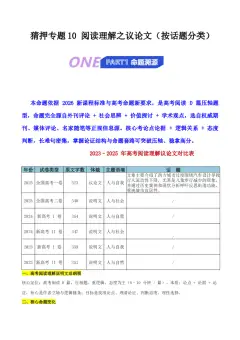
2026 年教育部命题指导思想:优化试题呈现方式和素材选取,融入科技前沿动态,浸润人文教育元素,加
强项目式、探究式的真实情境问题设计,更好考查学生关键能力、学科素养和思维品质。
2.押题依据分析:
猜押
考点
3 年真题
词数
话题
考情分析
押题
依据
阅读
理解
科普
说明
文
2024 年
全国甲卷
阅读C 篇
C276
C 篇为乡村居民提供基本医疗
检查和治疗,改善当地医疗条
件
新高考阅读理解医学科普
说明文遵循“了解现状—聚
焦问题—分析原因—提出建
议”的逻辑进行设计,考查
学生对每个环节关键内容的
准确理解,引导学生培养科
学探究精神,提升发现问
题、分析问题、解决问题的
能力。鲜明地彰显了命题人
旨在培养新一代青年学子独
立思考、理性判断的教育导
向。
高考阅读材
料中与医
学、健康相
关的文章占
较高的比
重。通常是
有关特殊疾
病的机理、
疾病治疗、
疾病预防、
中医治疗、
医学实验等
内容。
2024 年
新高考Ⅰ
卷阅读B
篇
B298
D 威廉·法伯(William Farber)博
士在从针灸中受益后,将综合
医疗应用于动物,并取得了初
步成效
2022 年
新高考Ⅱ
卷阅读D
篇
D
:
348
D 篇锻炼对于心脏的好处
押题预测目录
一、中医治疗方法
二、植入芯片技术
三、人工移植手术
四、艺术与疾病治疗
五、预防疾病
六、医学新技术
七、疑难疾病机理研究
 一、中医治疗方法
押题1
词数
话题
体
裁
考点
押题理由
322
拔火罐的操作方式以
及背后的治疗原理
说
明
文
细节理解
推理判断
猜测词义
高考阅读材料中与医学、健康相关的文章占较高的比
重。通常是有关特殊疾病的机理、疾病治疗、疾病预
防、中医治疗、医学实验等内容。
Cupping (拔火罐) is an alternative therapy which uses suction (抽吸) to increase blood flow and potentially
reduce pain. As well as getting cupping done by a professional, there’s a growing range of at-home cupping devices
now available, ranging from silicon cups to smart electronic powered devices. They claim to offer the benefits at
home, helping with pain reduction, increased circulation and relaxation.
Cupping has been practised for thousands of years, and can be traced back to ancient Chinese and Egyptian
medicine. Recently, cupping has become famous as a form of alternative medicine, thanks to the red marks it can
leave and celebrity fans like Michael Phelps.
Glass, plastic or silicon cups are placed onto the skin for several minutes creating suction on localised areas.
It’s thought this encourages blood flow to improve circulation and reduce pain, although there is no firm agreement
on how it works and no single theory can explain the full effects of cupping.
While it’s popular, there’s only limited scientific evidence on the benefits of cupping. A study found it can be
useful to decrease pain levels and improve blood flow to affected areas with low adverse effects.
“The suction causes smaller capillaries (毛细血管) in the skin to rupture, causing the circular bruise (瘀伤),
and keeping the body in repair mode as the body has to repair these small capillaries and make fresh blood flow to
the area days after the treatment,” Dr Tom Ingegno, author of The Cupping Book says.
Cupping is low risk, but it’s not suitable for everyone, especially pregnant women, cancer patients and those
with organ failure.
Cupping is known as a complementary treatment and sports performance coach Arj Thiruchelvam believes
that cupping devices do have a place but they should be used as an additional bonus to other methods. “Sleep,
nutrition, light cardiovascular work and regular stretching all seem to have a more solid evidence-base for
recovery,” he says.
1.Which of the following makes at-home cupping an alternative therapy?
A.Its budget-friendly cost.
B.Its benefits and convenience.
C.Its professional guidance.
D.Its safe and labour-saving devices.
2.Why is Michael Phelps mentioned in paragraph 2?
A.To tell us the history of cupping.
B.To prove how cupping functions.
C.To show how cupping gets popular.
D.To reveal celebrities’ preferences.
3.What does the underlined word “rupture” mean in paragraph 5?
A.Heal.
B.Form.
C.Bend.
D.Break.
4.What does Thiruchelvam think of cupping?
A.It is good for skin repair.
B.It has a certain positive effect.
C.It is suitable for home health care.
D.It can’t be replaced by other treatments.
押题2
词数
话题
体
裁
考点
押题理由
272
介绍中国古代医学哲
学及其影响
说
明
文
细节理解
推理判断
主旨大意
高考阅读材料中与医学、健康相关的文章占较高的比
重。通常是有关特殊疾病的机理、疾病治疗、疾病预
防、中医治疗、医学实验等内容。
Two British professionals, film producer James Eden and acupuncturist (针灸医师) Gerad Kite, have co-
authored a new book, The Untapped Self, making ancient Chinese medical philosophy accessible to today’s
anxious global audience. Their joint work began when Eden first visited Kite’s London clinic for stress relief,
unknowingly starting a journey that would later lead to this joint project.
Kite, an experienced specialist with 35 years in the field, describes acupuncture as “one of China’s greatest
cultural gifts”. His experience with acupuncture in the 1980s San Francisco changed his life. He left his previous
career and went to study under J.R. Worsley, who first brought Chinese acupuncture to the West. Kite uses an
approach called five-element acupuncture. This approach works by fixing imbalances in the body to bring back its
natural state of balance, not just by dealing with the symptoms.
Since starling his London clinic in 1990, Kite has given about 50,000 treatments while teaching around 50
students each year. His new book shares ten patients’ stories showing how acupuncture’s philosophy helps people
find calmer, more balanced lives. Co-author Eden brought his own special view — as a long-time meditation (冥
想) enthusiast who spent six months at China’s Wudang Mountain learning tai chi and kung fu, which deepened his
understanding of Chinese medicine.
Both authors feel deeply thankful for China’s medical tradition and value China’s work in connecting
traditional wisdom with modern science. “By supporting research,” Kite says, “China shows how ancient wisdom
can work alongside modem medicine.” They see their purpose as sharing this healing knowledge, shown by
traditional Chinese medicine’s growing worldwide reach through acupuncture, herbs and related practices.
1.What is the book The Untapped Self about?
A.Health care.
B.Scientific research.
C.Film production.
D.Personal biography.
2.What can we learn about Kite according to the passage?
A.He taught 50 students in his London clinic.
B.He devoted much effort to spreading acupuncture.
C.He first experienced acupuncture with J.R. Worsley.
D.He spent six months learning tai chi and kung fu in China.
3.What is Kite’s attitude towards China’s medical tradition?
A.Proud and confident.
B.Interested but doubtful.
C.Respectful and grateful.
D.Impressed but confused.
4.Which can best summarize the passage?
A.A popular book, long effect.
B.An ancient wisdom, deep impact.
C.An acupuncture clinic, great value.
D.A professional writer, good insight.
押题3
词数
话题
体
裁
考点
押题理由
386
自制汤品有助于对抗疟疾的
研究,阐述研究过程、结果
及科学家对传统草药疗法的
重视
说
明
文
细节理解
推理判断
主旨大意
高考阅读材料中与医学、健康相关的文章占较高
的比重。通常是有关特殊疾病的机理、疾病治
疗、疾病预防、中医治疗、医学实验等内容。
A new study suggests that some homemade soups — made of chicken, beef or vegetables — might help fight
malaria.
Jake Baum of the Imperial College London led the research. He asked children at a London school to bring
in homemade clear soups that their families would make to treat a fever. The children were from many different
cultural backgrounds. The soups were then exposed to the parasite ( 寄生虫) that creates 99.7 percent of malaria
cases in Africa, the World Health Organization, WHO, explained. Of the 56 soups tested, five were more than 50
percent effective in containing the growth of the parasite. Two were as effective as one drug now used to treat
malaria. And four soups were more than 50 percent effective at preventing parasites from aging to the point that
they could infect mosquitoes that spread the disease. Baum and his team reported their results recently in the
publication Archives of Disease in Childhood.
“When we started getting soups that worked — in the lab under very restricted conditions — we were really
happy and excited,” Baum said in an email to Agence France Presse. Baum also noted that it was unclear which
foods made the soups effective against malaria. “If we were serious about going back and finding the ingredient,
like good scientists, we’d have to do it in a very standardized way,” he said. The soups came from families from
different ethnic histories, including Europe, North Africa and the Middle East. They had several main ingredients,
including chicken, beef and green vegetables. Baum said the vegetarian soups showed similar results to the soups
with meat.
Baum said his aim was in part to show children that scientific research can turn an herbal cure into a man-
made medicine. He noted the research of Dr. Tu Youyou of China. In the 1970s, she found that the herb quinhao
was an effective antimalarial treatment. The herb has been used in Eastern medicine for two thousand years. Tu’s
research led to the manmade drug artemisinin,a drug now widely used to treat malaria. She won the Nobel Prize in
2015. More and more people are becoming resistant to the drugs that treat the disease, which kills about 400,000
people a year. That means scientists will have “look beyond chemistry” and find new drugs, Baum adds.
1.What does paragraph 2 focus on?
A.The spread of malaria.
B.The growth and aging of parasites.
C.The influences of Baum’s research.
D.The research findings on homemade soups.
2.What can we infer from Baum’s research?
A.The tested soups are not made in the standardized way.
B.Meat soups probably outperform vegetarian soups in the lab.
C.There’s a long way to go before identifying the things that work.
D.Regional characteristics make a big difference in the effect of soups.
3.Why does Baum mention Dr. Tu Youyou in the last paragraph?
A.To highlight Dr. Tu’s contributions.
B.To recall Dr. Tu’s research process.
C.To prove the value of non-chemical cures.
D.To reveal the fact of people’s drug resistance.
4.What is Baum’s attitude towards chemical drugs?
A.Doubtful.
B.Positive.
C.Neutral.
D.Unconcerned.
押题4
词数
话题
体
裁
考点
押题理由
303
针灸等替代疗法在动物治疗
中日益流行
说
明
文
细节理解
推理判断
主旨大意
高考阅读材料中与医学、健康相关的文章占较高
的比重。通常是有关特殊疾病的机理、疾病治
疗、疾病预防、中医治疗、医学实验等内容。
“I am not crazy,” says Dr. William Farber, shortly after performing acupuncture ( 针灸) on a rabbit. “I am
ahead of my time.” If he seems a little defensive, it might be because even some of his coworkers occasionally
laugh at his unorthodox approach to treating animals. But Dr. Farber is not alone in his belief that alternative
therapies like acupuncture can be effective for animals. In fact, the use of such therapies is growing in popularity
among veterinarians across the country.
One of the main reasons for this trend is the increasing recognition that animals, like humans, can benefit
from a holistic approach to health care. Traditional Western medicine often focuses on treating specific symptoms
or diseases, while alternative therapies take into account the whole body, mind, and spirit of the animal. This can
lead to more comprehensive and long-lasting results.
Another factor is the growing body of research that supports the effectiveness of alternative therapies. For
example, several studies have shown that acupuncture can be helpful in treating pain, neurological disorders, and
other conditions in animals. Massage therapy has also been found to reduce stress and improve circulation, while
herbal remedies can boost the immune system and aid in digestion.
In addition to these benefits, alternative therapies can also be a more natural and less invasive option for
animals. Many pet owners are hesitant to subject their furry friends to harsh chemicals or invasive procedures, and
alternative therapies offer a gentler alternative.
However, it is important to note that alternative therapies should not be used as a substitute for traditional
veterinary care. Instead, they should be used in conjunction with conventional treatments to provide the best
possible care for animals. Veterinarians who offer alternative therapies should also be properly trained and certified
to ensure the safety and effectiveness of the treatments.
1.Why does Dr. William Farber seem defensive?
A.Because he is really crazy.
B.Because he is ahead of his time.
C.Because some of his coworkers laugh at his unorthodox approach to treating animals.
D.Because he doesn’t believe alternative therapies can be effective for animals.
2.What is the main reason for the growing popularity of alternative therapies among veterinarians?
A.The increasing recognition that animals can benefit from a holistic approach to health care.
B.The growing body of research that supports the effectiveness of alternative therapies.
C.That alternative therapies are more natural and less invasive.
D.That many pet owners prefer alternative therapies.
3.What does the author think of alternative therapies?
A.They can completely replace traditional veterinary care.
B.They should be used in conjunction with traditional veterinary care and veterinarians should be properly
trained.
C.They are useless and have no scientific basis.
D.They are only suitable for some specific animals.
4.Which of the following can be the best title for the text?
A.Alternative Therapies for Animals: A Growing Trend
B.Dr. William Farber’s Unorthodox Treatment
C.The Advantages of Traditional Veterinary Care
D.Research on Alternative Therapies for Humans
二、植入芯片技术
押题1
词数
话题
体裁
考点
押题理由
333
科学家通过在患者眼内植
入微型电子芯片,帮助患
有年龄相关性黄斑变性
(AMD) 的患者恢复部分中
心视力
说明文
细节理解
推理判断
主旨大意
猜测词义
高考阅读材料中与医学、健康相关的文章占较
高的比重。通常是有关特殊疾病的机理、疾病
治疗、疾病预防、中医治疗、医学实验等内
容。
Scientists have made a breakthrough in vision restoration by inserting tiny electronic chips into the back of
patients’ eyes. The chips measure just two millimetres wide — about the thickness of a grain of rice.
A trial involved 38 patients with an eye disease called age-related macular degeneration (AMD). It mostly
affects older people and makes the centre of their vision unclear. About 600,000 people in the UK have AMD.
The trial took place at 17 hospitals in five European countries, including the UK. The patients had a type of
AMD called “dry AMD”, which damages cells at the back of the eyes that detect light. Those cells transform light
into electrical signals for the brain to process vision. When the cells are damaged, people can’t see properly.
Currently, there is no cure.
The tiny “bionic” chips can give people back some sight. Bionic means a man-made object that acts as a
body part. The patients get a pair of glasses with a built-in video camera and a small pocket sized black box that
processes the data.
When the patients wear the glasses and look at something, the camera captures images and sends the data to
the black box, which makes the images clearer. By using infrared signals ( 红外信号), the information is sent
wirelessly to the chip beneath the patients’ retina (视网膜). This chip relays signals through the optic nerve to the
brain, which requires some training to understand the images they see.
Patients can only see in black and white, but it has greatly elevated the lives of those treated. Seventy-year-
old Sheila Irvine was one patient who took part in the trial. She is registered as blind, but now can read books and
do crosswords. “It is amazing,” she said in an interview. “I am one happy bunny.”
“Blind patients are actually able to have meaningful central vision restoration, which has never been done
before,” noted Mahi Mugit, an associate professor at University College London, commenting on the trial’s
outcomes.
1.What is the effect of “dry AMD”?
A.It results in complete vision loss.
B.It mainly impacts young adults.
C.It blocks any signal to the brain.
D.It harms light-detecting function.
2.What does paragraph 5 mainly talk about?
A.How the entire system works.
B.Why infrared signals are used.
C.When patients train their brains.
D.What makes up the electronic chip.
3.What does the underlined word “elevated” in paragraph 6 probably mean?
A.Restricted.
B.Disturbed.
C.Extended.
D.Improved.
4.What is Mahi Mugit’s attitude towards the new device?
A.Indifferent.
B.Doubtful.
C.Optimistic.
D.Critical.
押题2
词数
话题
体裁
考点
押题理由
329
脑机接口(BMI)技术上的突
破性进展,通过帮助瘫痪
患者恢复自主行动与社会
参与能力
说明文
细节理解
推理判断
主旨大意
高考阅读材料中与医学、健康相关的文章占较
高的比重。通常是有关特殊疾病的机理、疾病
治疗、疾病预防、中医治疗、医学实验等内
容。
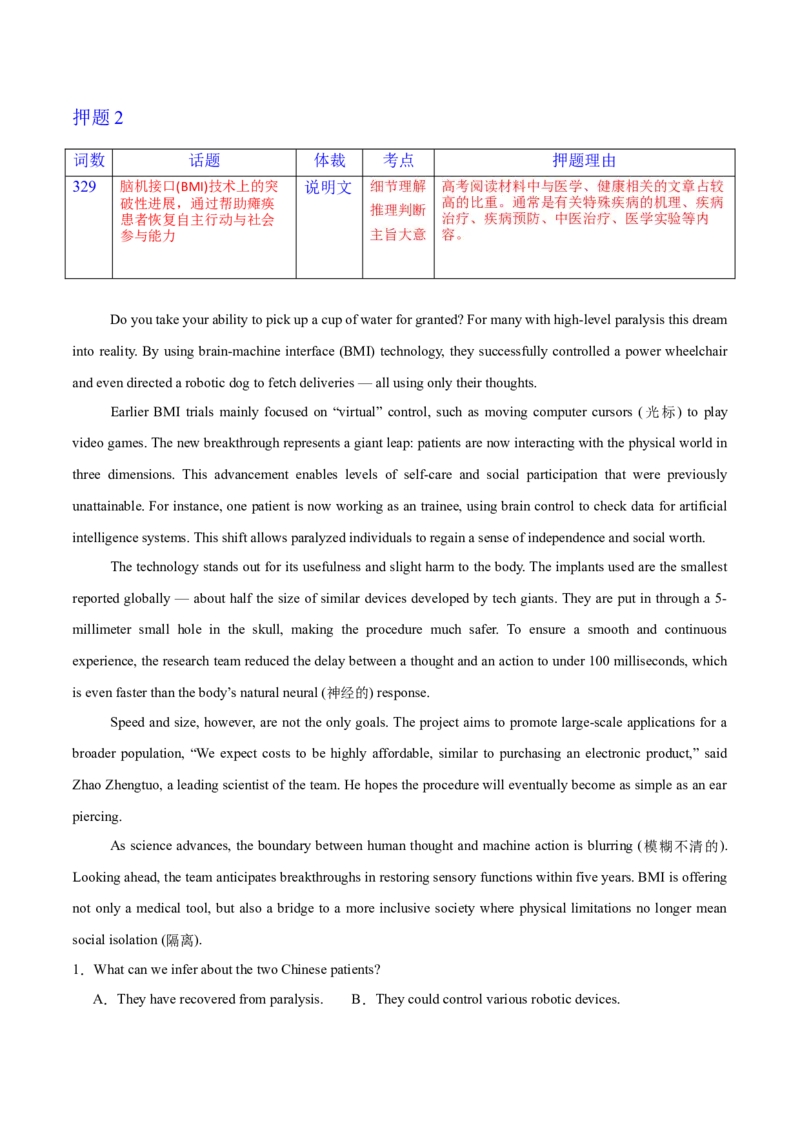
Do you take your ability to pick up a cup of water for granted? For many with high-level paralysis this dream
into reality. By using brain-machine interface (BMI) technology, they successfully controlled a power wheelchair
and even directed a robotic dog to fetch deliveries — all using only their thoughts.
Earlier BMI trials mainly focused on “virtual” control, such as moving computer cursors ( 光标) to play
video games. The new breakthrough represents a giant leap: patients are now interacting with the physical world in
three dimensions. This advancement enables levels of self-care and social participation that were previously
unattainable. For instance, one patient is now working as an trainee, using brain control to check data for artificial
intelligence systems. This shift allows paralyzed individuals to regain a sense of independence and social worth.
The technology stands out for its usefulness and slight harm to the body. The implants used are the smallest
reported globally — about half the size of similar devices developed by tech giants. They are put in through a 5-
millimeter small hole in the skull, making the procedure much safer. To ensure a smooth and continuous
experience, the research team reduced the delay between a thought and an action to under 100 milliseconds, which
is even faster than the body’s natural neural (神经的) response.
Speed and size, however, are not the only goals. The project aims to promote large-scale applications for a
broader population, “We expect costs to be highly affordable, similar to purchasing an electronic product,” said
Zhao Zhengtuo, a leading scientist of the team. He hopes the procedure will eventually become as simple as an ear
piercing.
As science advances, the boundary between human thought and machine action is blurring (模糊不清的).
Looking ahead, the team anticipates breakthroughs in restoring sensory functions within five years. BMI is offering
not only a medical tool, but also a bridge to a more inclusive society where physical limitations no longer mean
social isolation (隔离).
1.What can we infer about the two Chinese patients?
A.They have recovered from paralysis.
B.They could control various robotic devices.
C.They managed to do some tasks with BMI.
D.They were the first to test BMI technology.
2.What is Paragraph 3 mainly about?
A.The remarkable advantages of BMI technology.
B.The tiny size of the implants used in BMI.
C.The neural response speed of the human body. D.The safe procedures for BMI implantation.
3.What do we learn about BMI’s future?
A.It will contribute to isolation.
B.It can serve as a cure for paralysis.
C.It might blur social boundaries.
D.It may become accessible to the public.
4.What’s the author’s attitude towards BMI technology?
A.Neutral.
B.Doubtful.
C.Favorable.
D.Critical.
三、人工移植手术
押题1
词数
话题
体裁
考点
押题理由
355
因人类肾脏供体短缺,美
国医生开展猪肾移植试验
说明文
细节理解
推理判断
高考阅读材料中与医学、健康相关的文章占较
高的比重。通常是有关特殊疾病的机理、疾病
治疗、疾病预防、中医治疗、医学实验等内
容。
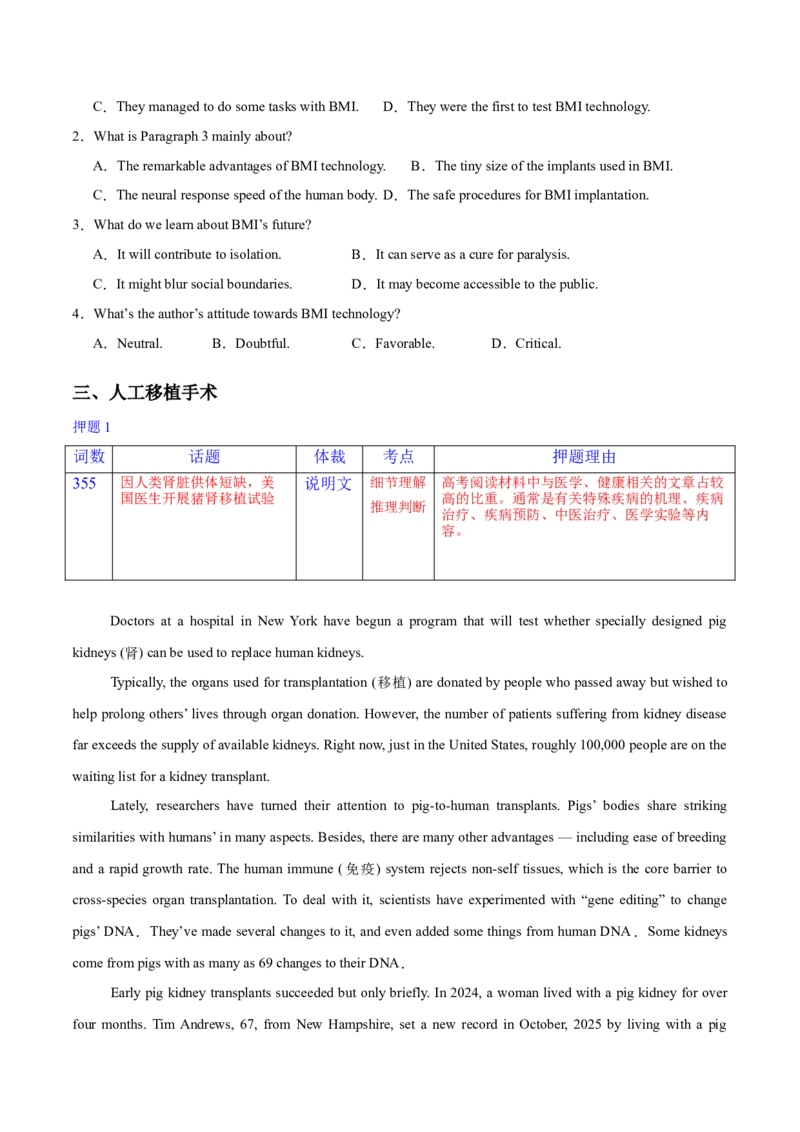
Doctors at a hospital in New York have begun a program that will test whether specially designed pig
kidneys (肾) can be used to replace human kidneys.
Typically, the organs used for transplantation (移植) are donated by people who passed away but wished to
help prolong others’ lives through organ donation. However, the number of patients suffering from kidney disease
far exceeds the supply of available kidneys. Right now, just in the United States, roughly 100,000 people are on the
waiting list for a kidney transplant.
Lately, researchers have turned their attention to pig-to-human transplants. Pigs’ bodies share striking
similarities with humans’ in many aspects. Besides, there are many other advantages — including ease of breeding
and a rapid growth rate. The human immune (免疫) system rejects non-self tissues, which is the core barrier to
cross-species organ transplantation. To deal with it, scientists have experimented with “gene editing” to change
pigs’ DNA.They’ve made several changes to it, and even added some things from human DNA.Some kidneys
come from pigs with as many as 69 changes to their DNA.
Early pig kidney transplants succeeded but only briefly. In 2024, a woman lived with a pig kidney for over
four months. Tim Andrews, 67, from New Hampshire, set a new record in October, 2025 by living with a pig
kidney for nearly nine months. He is still waiting for a human transplant, but his long success has encouraged
many. Now, a company called United Therapeutics has begun a government-approved pig kidney transplant trial. It
started with six patients, but could eventually involve 50. The trial’s first transplant was announced in early
November 2025, with the successful surgery at NYU Langone Health.
Many people have doubts about the trial, thinking it is of little practical use and that its costs are high.
However, personally, the pig kidney transplant trial could help scientists answer many questions. It’ll provide new
information about the safety — as well as the challenges. It’ll also teach them which gene edits work best. Most
importantly, it could help them find ways to help patients live longer with pig transplants.
1.Why is the statistic mentioned in paragraph 2?
A.To show the organ donation source.
B.To compare transplant success rates.
C.To highlight the new trial’s necessity.
D.To criticize Americans’ poor health care.
2.Why do researchers conduct gene editing on pig kidneys?
A.To make them more fit for use in people.B.To keep them from viruses.
C.To copy the features of human kidneys. D.To improve human immunity.
3.What does paragraph 4 try to explain about pig kidney transplants?
A.The new trial assumptions.
B.The initial achievements.
C.The recent patients’ conditions.
D.The surgical innovation details.
4.What is the author’s attitude to the trial program?
A.Tolerant.
B.Doubtful.
C.Unclear.
D.Favorable.
押题2
词数
话题
体裁
考点
押题理由
323
首个利用患者自身细胞和
材料3D 打印的完整心脏的
突破性进展
说明文
细节理解
推理判断
高考阅读材料中与医学、健康相关的文章占较
高的比重。通常是有关特殊疾病的机理、疾病
治疗、疾病预防、中医治疗、医学实验等内
容。
Heart disease is the leading cause of death in the United States. A transplant (移植) is the only treatment
available to patients with end-stage heart failure, but there is a severe shortage of heart donors. That means there’s
an urgent need to develop new ways to regenerate a diseased heart. Now the good news is that the world’s first
complete 3D-printed heart, made using the patient’s own cells and materials, has been created in a lab.
Until now, success has been limited to printing only simple tissues without blood vessels (血管). “This is the
first time anyone has successfully printed an entire heart anywhere,” said team leader Tal Dvir.
The 3D-printed heart is only about a third the size of an actual human heart and it doesn’t actually work. But
it’s a groundbreaking step toward engineering customized (定制的) organs that can be transplanted with less risk of
rejection. Dvir noted that scientists have managed to print a 3D structure of a heart before, but not with cells or
blood vessels. The use of biological materials from a patient is key to successful engineering of tissues and organs.
Ideally, the biomaterial should possess the same biochemical and mechanical properties of the patients’ own
tissues. This way, their bodies will be less likely to reject the organ, making transplants much safer.
While the 3D-printed heart is about a third the size of a human heart, the same technology can be used to
print a normal-sized one. The team’s next step is to culture ( 培养) printed hearts in the lab and “teach them to
behave” like real hearts. Then, researchers plan to transplant the 3D-printed heart into lab animals.
“Our results demonstrate the potential of our approach to engineering personalized tissue and organ
replacement in the future,” Dvir said. “Maybe in 10 years, there will be organ printers in the finest hospitals around
the world, and these procedures will be conducted routinely.”
1.What can be inferred from the world’s first complete 3D-printed heart?
A.It makes organ transplants risk-free.
B.It bridges gaps in biological organ printing.
C.It solves the donor shortage for heart transplants.
D.It has the same properties as natural heart tissues.
2.What does Dvir imply about the previous 3D-printed heart structures in paragraph 3?
A.They were ready for transplant to animals.
B.They matched the size of real human hearts.
C.They lacked cell-based biological components.
D.They contained complete blood vessel networks.
3.What will Dvir’s team do in the future?
A.They will first test printed hearts on humans.
B.They will focus on curing early heart failure.
C.They will change the biological materials used.
D.They will improve the heart’s functional performance.
4.What’s Dvir’s attitude towards the 3D printing technology?
A.Positive.
B.Doubtful.
C.Negative.
D.Indifferent.
押题3
词数
话题
体裁
考点
押题理由
326
猪肺异种移植实验及该技
术意义
说明文
细节理解
推理判断
主旨大意
高考阅读材料中与医学、健康相关的文章占较
高的比重。通常是有关特殊疾病的机理、疾病
治疗、疾病预防、中医治疗、医学实验等内
容。
The shortage of transplantable organs is a major global medical challenge, but a medical team from China
seems to have found one of the most promising solutions to this problem.
“Here, we report a case of pig-to-human lung xenotransplantation (异种移植), in which a lung from a pig
was transplanted into a 39-year-old brain-dead male human recipient following a brain haemorrhage (大出血),” the
researchers wrote in a study published in the journal Nature Medicine.
Before the procedure, the scientists edited six genes of the pig to remove proteins that could trigger severe
immune responses in humans, thus reducing rejection risks.
In the experimental surgery, the team transplanted the left lung of the gene-edited pig into a brain-dead man,
while leaving his original right lung undamaged. Post-surgery monitoring showed the transplanted lung maintained
gas exchange functions for up to nine days, without signs of immediate rejection or active infection.
However, complications emerged: lung edema (水肿) was observed within 24 hours, and antibody-mediated
rejection appeared on day 6, leading to the ending of the experiment on day 9.
International experts praised the achievement as a “milestone” in addressing the global shortage of lung
donors, though they noted that further research is needed to improve gene editing and immunosuppressive (免疫抑
制的) therapies before clinical application.
Xenotransplantation technology holds great significance. Taking pigs as donors for xenotransplantation as an
example, pig organs are similar to human organs in terms of tissue structure and physiological functions.
Meanwhile, pigs have a relatively distant genetic relationship with humans, which reduces the risk of transmitting
zoonotic diseases. Additionally, pigs have the advantages of low breeding costs, rich varieties, and excellent
reproductive capabilities, making them ideal candidate donors for xenotransplantation. If this technology can be
successfully developed and widely applied, it will effectively ease the severe global shortage of organ donors,
bringing new hope to a large number of patients waiting for organ transplants and giving them the opportunity to
regain their lives.
1.What can we learn from the first three paragraphs?
A.The shortage of transplantable organs will soon be solved.
B.A lung from a pig saved a brain-dead male human recipient.
C.A Chinese medical team saved a man from brain haemorrhage.
D.Special gene editing is necessary to reduce potential rejection risks.
2.Which statement about the lung transplant is true?
A.It was a total failure and needed more research.
B.It was the first case of organ xenotransplantation.
C.Lung edema and rejection led to the ending of the experiment.
D.The transplanted lung failed to exchange gas in the man’s body.
3.What is the attitude of international experts towards this experiment?
A.Negative.
B.Positive.
C.Doubtful.
D.Objective.
4.What is the main idea of the last paragraph?
A.Pigs are genetically similar to humans.
B.Pigs are perfect for xenotransplantation.
C.Xenotransplantation technology is of great importance.
D.Xenotransplantation technology still has a long way to go.
四、艺术与疾病治疗
押题1
词数
话题
体裁
考点
押题理由
312
世界首个AI 音乐治疗舱,
包括其工作原理、操作过
程以及潜在的应用场景
说明文
细节理解
主旨大意
高考阅读材料中与医学、健康相关的文章占较
高的比重。通常是有关特殊疾病的机理、疾病
治疗、疾病预防、中医治疗、医学实验等内
容。
Music has long been known for its treating power. When combined with artificial intelligence (AI), this
power becomes more precise and widely available. A leading example is the world’s first AI music therapy pod (治
疗仓) developed by a group of researchers in a college — Shanghai Conservatory of Music. This idea, shared by Li
Xiaomuo, a leader of the Research Institute of the college, resonated (共鸣) throughout the recent World Artificial
Intelligence Conference in Shanghai.
The innovative therapy pod represents a mix of technology and art. Everyone’s brainwaves are unique and
can be turned into sound through AI algorithms ( 算法). AI quickly finds personal patterns and creates sound
environment based on real-time body signals.
To use the pod, users first fill out a personal health form. Inside the pod, they wear devices to monitor brain
activity and heart rate, sit in special chairs and watch a screen showing their real-time body data. Relaxing natural
sounds like birds or streams are playing around them, creating a calm environment. After each experience, users
receive a report and a personalized music recommendation, which can improve focus, aid relaxation, and stabilize
heart rates.
Experts say the pod has made breakthroughs in using body data to match music, offering dynamic personal
treating plans, and combining sound engineering with biosensing (生物传感) and AI. It has potential uses for sleep
problems, depression, and even helping children with mental problems or early-born babies.
The researchers of the project are now working with hospitals. It will soon be used in mental health centers
and Shanghai Huashan Hospital to assist in treating kids with mental problems, relieve pain, and provide
psychological comfort for students with exam anxiety. Researchers are also creating virtual reality tools for future
cognitive and emotional training. This technology marks a hopeful step forward in making science-based healing
through music a reality for more people.
1.What makes the power of music more precise in this study?
A.The application of biosensing.
B.The personalized treatment plans.
C.The advanced screen technology.
D.The successful combination with AI.
2.What is the uniqueness of people’s brainwaves used to do?
A.Provide a screen with real data.
B.Create tailored sound environment.
C.Comfort students with exam anxiety.
D.Find personal brain patterns with music.
3.What is paragraph 3 mainly about?
A.What makes the pod innovative.
B.Where the therapy pod is used.
C.How the therapy pod is operated.
D.Who invented the therapy pod.
4.What can we learn about the therapy pod?
A.It has been widely used in schools.
B.It is only for treating sleep disorders.
C.It is being applied in medical settings. D.It helps doctors identify emotional risks.
押题2
词数
话题
体裁
考点
押题理由
340
分享诗歌和人文活动在医
疗环境中的实践
议论文
细节理解
推理判断
高考阅读材料中与医学、健康相关的文章占较
高的比重。通常是有关特殊疾病的机理、疾病
治疗、疾病预防、中医治疗、医学实验等内
容。
As a senior resident, I often distributed poems to my team, printing and posting them above the computers in
our hospital workrooms. Once, during a rare quiet moment in the ICU, with permission from my colleagues, I read
a couple of poems out loud. I remember watching my colleagues’ eyes close and their bodies visibly relax as the
words washed over them.
Since then, I have shared poems — my own and others’ — in talks at my institution and across the country.
I’ve also led other healthcare providers in creative writing exercises during workshops, lectures and classes. Many
institutions host book clubs, story slams, film screenings and other opportunities for medical learners to engage
with the humanities (人文学科).
While poetry can be frightening to some, many contemporary poems provide approachable emotional
experiences. Pieces like Safiya Sinclair’s “Notes on the State of Virginia” fully illustrate how a place that seems
innocent or even beautiful to some can be upsetting to others. Monica Sok’s “ABC for Refugees” powerfully paints
a portrait of a young child caught between languages and cultures — a reality that many pediatric (儿科的) patients
face. “Ode to Small Towns” by Tyree Daye overturns common assumptions about rural life. In “Medical History”,
Nicole Sealey shares a patient’s perspective on a part of health care that, for many of my students and colleagues,
has been reduced to a series of check boxes on a computer screen. These and other poems provide fertile ground for
enhanced understanding of the human condition, as well as inspiration for a clinician’s own potentially
transformative reflective writing.
The possibilities for cooperation between literature and medicine are wide open. I believe all clinicians have
a role in recognizing and dealing with how everyone has been shaped by an unreasonable society. The history,
sociopolitical context, imaginative perspective and reflective practices the humanities offer may improve the
practice of medicine. Through understanding others’ experiences and reflecting critically on their own, every
clinician can move closer to being the kind of healer they intend to be.
1.What can we infer about the author's practice of sharing poems?
A.It started in the ICU and has expanded to multiple settings.
B.It focuses only on creating original poems for medical teams.
C.It has replaced other humanities activities in medical institutions.
D.It is mainly carried out through public lectures across the country.
2.Whose poem may change people's beliefs about the countryside?
A.Monica Sok’s.
B.Tyree Daye’s.
C.Safiya Sinclair’s.
D.Nicole Sealey’s.
3.What does Nicole Sealey’s work seem to imply?
A.Doctors should have better medical skills.
B.It's urgent to upgrade the medical equipment.
C.There's room for improvement in medical care.
D.A patient can be treated from different perspectives.
4.Which statement does the author probably agree with?
A.The humanities help make a better doctor.
B.The clinicians are to shape our future society.
C.Doctors must learn from each other’s experiences.
D.Reflective writing greatly benefits a doctor’s skills.
押题3
词数
话题
体裁
考点
押题理由
374
用音乐帮助术后患者缓解
疼痛
议论文
细节理解
推理判断
主旨大意
高考阅读材料中与医学、健康相关的文章占较
高的比重。通常是有关特殊疾病的机理、疾病
治疗、疾病预防、中医治疗、医学实验等内
容。
Nurse Rod Salaysay works with all kinds of instruments in the hospital. In the recovery unit of UC San
Diego Health, Salaysay helps patients manage pain after surgery. Along with medications, he offers tunes on
request and sometimes sings. Patients often smile or nod along. Salaysay even sees changes in their vital signs like
lower heart rate and blood pressure, and some may request fewer painkillers. Salaysay is a one-man band, but he’s
not alone. Over the past two decades, live performances and recorded music have flowed into hospitals and doctors’
offices as research grows on how songs can help ease pain.
The idea of using recorded music to lessen pain associated with dental surgery began in the late 19th century
before local anesthetics (麻醉药) were available. Today researchers are studying what conditions make music most
effective.
Researchers at Erasmus University Rotterdam in the Netherlands conducted a study on 548 participants to
see how listening to five genres of music—classical, rock, pop, urban and electronic — extended their ability to
tolerate acute pain, as measured by exposure to very cold temperatures.
“The more people listened to a favorite genre, the more they could tolerate pain,” said co-author Dr. Emy
van der Valk Bouman. “A lot of people thought that classical music would help them more. Actually, we are finding
more evidence that what’s best is just the music you like.”
The exact reasons are still unclear, but it may be because familiar songs activate more memories and
emotions, she said. The simple act of choosing is itself powerful, said Claire Howlin, director of the Music and
Health Psychology Lab at Trinity College Dublin, who co-authored a study that suggested allowing patients to
select songs improved their pain tolerance. “It’s one thing that people can have control over if they have a chronic
condition — it gives them agency,” she said.
Hanley, the Florida State psychologist, co-authored a preliminary study suggesting daily attentive listening
might reduce chronic (慢性的) pain. “Music has a way of lighting up different parts of the brain,” he said, “so
you’re giving people this positive emotional bump that takes their mind away from the pain.” It’s a simple
prescription (处方) with no side effects, some doctors now say.
1.How does the author lead to the topic of the text?
A.By citing historical records.
B.By using a real-life example.
C.By sharing professional opinions.
D.By quoting a famous proverb.
2.What is most effective in pain tolerance according to the Erasmus University study?
A.Classical music.
B.Electronic music.
C.The genre the listener prefers.
D.Rock music.
3.Which statement will Hanley most probably agree with?
A.Families choose music for patients.
B.Casual listening lessens chronic pain.
C.Focused listening may alleviate pain.
D.Inspiration al songs cheer patients up.
4.What is the best title for the text?
A.The History of Music Therapy
B.The Differences among Music Genres
C.Nurse Salaysay’s Singing Career
D.How Music Helps Patients Manage Pain
五、预防疾病
押题
词数
话题
体裁
考点
押题理由
317
简易锻炼加上定制宣教融
入基层公卫服务可降低农
村老人跌倒风险,方案低
成本高效,适用于资源匮
乏地区
说明文
细节理解
推理判断
高考阅读材料中与医学、健康相关的文章占较
高的比重。通常是有关特殊疾病的机理、疾病
治疗、疾病预防、中医治疗、医学实验等内
容。
A study by China’s Harbin Medical University has found that integrating simplified exercise training and
tailored health education into the country’s basic public health services can significantly reduce fall risks among
rural elderly, tackling the “invisible killer” that affects the senior population.
Though easily neglected, falls have ranked among the leading causes of accidental injuries and deaths in the
elderly over the past three decades, said Tian Maoyi, vice dean of the university’s School of Public Health and one
of the lead researchers of the study, noting that China now has a considerable size of population aged 60 and above.
To address this problem, the research team developed a comprehensive intervention project led by village
doctors that included simplified exercises targeting lower limb muscle strength and balance, as well as health
education videos narrated in local dialects.
In partnership with disease control and prevention centers and medical colleges across multiple provinces,
the team conducted a randomized controlled trial involving 2,610 participants aged 60 and above who were at high
risk of falling.
Wang Yongchen, head of general medicine at the Second Affiliated Hospital of Harbin Medical University,
who was also part of the study, said that only 29.7 percent of participants in the intervention group reported at least
one fall, substantially lower than the 38.3 percent in the control group. The fall incidence rate also decreased from
1.4 falls per person per year in the control group to 0.8 in the intervention group, while the injury rate dropped from
21.6 to 15.2 percent. The elderly participants who received the intervention also experienced significant
improvements in functional mobility and health-related quality of life, Wang added.
He explained that the study employs an approach that utilizes China’s existing primary healthcare network
without depending on high-end medical equipment or specialized rehabilitation physicians (康复师). This method
could provide a practical healthcare solution for elderly populations in resource-limited countries and regions.
1.What is the “invisible killer” in the text?
A.Ignored falls. B.Deadly injuries.
C.Various accidents.
D.Serious diseases.
2.What did the research team do to settle the problem?
A.They built new health centers in villages.
B.They used instructive videos and easier exercises.
C.They trained specialized rehabilitation physicians.
D.They provided high-end equipment and better medicine.
3.Why did the team conduct a randomized controlled trial?
A.To collect data from different groups.
B.To study causes of falls in the elderly.
C.To test the effect of the intervention project. D.To assess overall health quality of participants.
4.What is Wang’s attitude toward the prospect of the approach?
A.Unclear.
B.Doubtful.
C.Dismissive.
D.Optimistic.
六、医学新技术
押题1
词数
话题
体裁
考点
押题理由
323
中国科学家研发的一种新
型“骨胶水
(Bone-02)”,它能在3
分钟内快速修复骨折
说明文
细节理解
推理判断
高考阅读材料中与医学、健康相关的文章占较
高的比重。通常是有关特殊疾病的机理、疾病
治疗、疾病预防、中医治疗、医学实验等内
容。
Breaking a bone could soon mean a far quicker recovery. Chinese scientists have developed a new “bone
glue” called “Bone-02” that can repair broken bones in just three minutes without tools, like screws and plates, or
repeat surgeries, reports Global Times. Developed by a research team from East China's Zhejiang Province.
“Bone-02” imitates nature’s own engineering to heal broken bones quickly and safely.
The development of “Bone-02”was inspired by oysters ( 牡蛎), which stick stubbornly to underwater
surfaces despite waves and constant moisture. Lin Xianfeng, associate chief orthopaedic surgeon at Sir Run Run
Shaw Hospital and the lead researcher, drew this inspiration after observing the natural phenomenon. Back in 2016,
while working as a resident physician, Lin noticed that even the most experienced surgeons needed hours to fix
broken bones with far-from-ideal results — this challenge drove him to seek alternatives. Notably, attempts to
create bone glues date to the 1940s but were abandoned due to biocompatibility ( 生物相容性) issues; currently,
orthopaedic surgeons only use soft substances to stick broken bones together and fill in gaps between them, but
none of these materials truly function as bone glues.
“Bone-02” can achieve precise fixation in two to three minutes, even in blood-rich surgical sites. Unlike
metal implants ( 植入物) requiring a second removal operation, the glue is naturally absorbed as bones heal,
removing extra risks and procedures. Tested in over 150 patients, laboratory and clinical trials showed it achieved a
maximum bonding force over 400 pounds, a shear strength of approximately 0.5 MPa (兆帕), and a compressive
strength of around 10 MPa — suggesting the glue could replace traditional steel plates and screws while lowering
infection or rejection risks from foreign implants.
If successful on a larger scale, “Bone-02” will shorten surgeries, improve recovery times, and spare patients
other illnesses. Today, his team’s product may offer what surgeons worldwide have been seeking for decades: a fast,
safe, and body-friendly solution to bone repair.
1.What inspired the invention of “Bone-02”?
A.Oysters’ external form.
B.Oysters’ self-healing method.
C.Oysters’ living environment.
D.Oysters’ underwater behavior.
2.Why did Lin seek new bone repair methods?
A.To develop soft substances.
B.To reduce the fee of surgery.
C.To improve surgical outcome.
D.To help experienced surgeons.
3.What does the data in paragraph 3 indicate?
A.The effectiveness of “Bone-02”.
B.The great efforts of Lin’s team.
C.The risks from foreign implants.
D.The accuracy of the trial results.
4.What might Lin’s team do next?
A.Cooperate with other researchers.
B.Conduct follow-up experiments.
C.Study symptoms of other illnesses.
D.Seek more body-friendly solutions.
押题2
词数
话题
体裁
考点
押题理由
364
基于虚拟现实和视频的疼
痛缓解方法及其原理
说明文
细节理解
推理判断
高考阅读材料中与医学、健康相关的文章占较
高的比重。通常是有关特殊疾病的机理、疾病
治疗、疾病预防、中医治疗、医学实验等内
容。
For decades, treatment options for chronic ( 慢性) pain have been limited, expensive, or inaccessible.
Decades of neuroscience show that attention, expectation, and perception play a decisive role in how pain is
experienced. This insight has led researchers to unlikely testing grounds: virtual reality (VR) and imagining relief.
One of the earliest scientists to explore VR’s potential for pain relief is Hunter Hoffman, a psychologist at
the University of Washington. He developed an immersive environment called “Snow World” to help children
undergoing burn wound care. In the virtual landscape, patients threw snowballs while listening to music. The
program has been shown in many clinical studies to reduce both pain and anxiety during burn wound care.
“The driving factor is distraction.” says Zina Trost, a VR pain researcher. “The visual system is so primary in
people. And if pain does not have your attention, you are not in pain. This kind of immersive distraction works
especially well for short-term pain.
Virtual reality isn’t the only way to tap into the brain’s pain-processing systems. Jian Kang, a researcher at
Harvard University, is exploring whether watching a video can ease chronic pain. In a November 2025 study, Kang
invited individuals with chronic lower back pain to participate and asked them to watch short videos. In one
version, a person underwent acupuncture (针灸). In another video, it showed a simple touch with cotton sticks on a
lower back. In both cases, participants were asked to imagine experiencing the same bodily experience
What surprised the researchers was that both videos helped. The effect was stronger in the video acupuncture
group — an average of 1.7 points lower in perceived pain — but the cotton-stick videos also produced meaningful
relief. This is comparable to some results for real acupuncture. Neuroscience has found that sensory imagery and
real bodily experience often engage the identical brain regions — a finding that could explain how the video
produces its effect.
VR and video-based approaches are still being studied and their reach remains restricted by awareness and
access. But their relatively low cost and ease of use could make them easier to scale. These two approaches are
bringing fresh drive to the field.
1.What inspired researchers to test VR and imagining relief?
A.The low effectiveness of pain medicine. B.Findings on pain-related mental factors.
C.Patients’ demand for cheaper pain care. D.Lack of progress in pain research methods.
2.How does VR help with pain relief according to Zina Trost?
A.It reduces long-term pain via music.
B.It blocks pain signals in the brain.
C.It boosts visual system’s sensitivity.
D.It shifts people’s attention from pain.
3.Why can watching videos relieve pain?
A.The videos lower patients’ pain expectations.
B.Both videos distract patients with pleasant stories.
C.Real acupuncture effects are transferred through screens.
D.Imagined and real experiences involve the same brain areas.
4.What does the author think about the two approaches?
A.Limited but promising.
B.Costly but reliable. C.Novel but unsustainable. D.Useful
but inflexible.
押题3
词数
话题
体裁
考点
押题理由
354
一项关于基因编辑药物的
研究,该研究表明单次注
射实验性基因编辑药物可
安全有效地降低胆固醇,
可能为终身有效
说明文
细节理解
推理判断
猜测词义
高考阅读材料中与医学、健康相关的文章占较
高的比重。通常是有关特殊疾病的机理、疾病
治疗、疾病预防、中医治疗、医学实验等内
容。
A single infusion ( 注射) of an experimental gene-editing drug appears safe and effective for cutting
cholesterol, possibly for life, according to a small early study released Saturday.
The study, which involved 15 volunteers, found one infusion of a drug that uses the CRISPR gene-editing
technique could safely reduce cholesterol, as well as levels of harmful triglycerides, by about half. Dr. Luke Laffin,
a preventative cardiologist at the Cleveland Clinic who helped conduct the study, said, “Rather than a lifetime
worth of medicine, we have the potential to give people a cure. It’s very exciting.” The study’s results were
presented at the American Heart Association’s annual meeting and published in The New England Journal of
Medicine.
Heart disease is the leading cause of death in the US, killing nearly 700, 000 people every year. One major
reason is that many people stop taking their cholesterol-lowering medications. If future research confirms the
findings of this study, the gene-editing approach could become a powerful weapon against heart disease, freeing
people from the need to take statins and other drugs every day.
Yet experts consider that much more research is needed. Dr. Eric Topol, a cardiologist at Scripps Research,
noted that gene-editing is currently expensive and long-term safety is still unclear. “The idea of an inexpensive,
one-and-done treatment is a fantasy at the moment,” he said. Other scientists agree that more studies are needed to
prove its protection against cardiovascular disease.
The treatment involves infusing the drug into the bloodstream so it can travel to the liver and disable a gene
called ANGPTL3, which is involved in producing cholesterol and triglycerides. Dr. Steven Nissen, another
preventive cardiologist at the Cleveland Clinic, explained, “It’s a knockout of the gene. It cuts it. And after that, the
gene no longer functions.”
Samarth Kulkarni, CEO of CRISPR Therapeutics, which sponsored the study, said the approach “could
potentially impact millions of people around the world.” Similar research by Verve Therapeutics in Boston also
shows hopeful results. Researchers are now planning larger, longer studies to see if this one-time treatment can
safely protect people from heart attacks and strokes for life.
1.What is the advantage of the CRISPR gene-editing drug?
A.It reduces triglycerides by more than 70%.
B.It has been proven safe for long-term use.
C.It needs a single treatment instead of daily intake. D.It can be used to treat a wide range of diseases.
2.What is Dr. Eric Topol’s attitude towards the CRISPR gene- editing treatment?
A.Optimistic.
B.Cautious.
C.Enthusiastic.
D.Indifferent.
3.Which is closest in meaning to the underlined word “knockout” in Paragraph 5?
A.A sudden failure.
B.A complete removal.
C.A temporary pause.
D.A minor adjustment.
4.What can be inferred about the future of the gene- editing treatment?
A.It will soon replace other daily statins due to its one- time effect.
B.It will become accessible to millions of people in the near future.
C.It can safely protect people from heart attacks and strokes for life.
D.It will have promising future while it requires further research.
押题4
词数
话题
体裁
考点
押题理由
327
2 毫米微型机器人
说明文
细节理解
推理判断
猜测词义
高考阅读材料中与医学、健康相关的文章占较
高的比重。通常是有关特殊疾病的机理、疾病
治疗、疾病预防、中医治疗、医学实验等内
容。
Stanford assistant professor Ruike Zhao published a groundbreaking medical breakthrough in Nature: using
a tiny 2 mm micro-robot, she increased the success rate of blood clot ( 血块) removal from a mere 11% to an
amazing 90%, sending shock waves through the medical world.
In modern society, about one in every dozen people may experience a blood clot in their lifetime. It is widely
known that blood clots are the leading cause of strokes (中风) and heart attacks. During treatment, the ability to
quickly and effectively restore blood flow becomes a matter of life and death.
Unfortunately, traditional mechanical methods have a low success rate. The process is like trying to pick up
broken tofu with chopsticks — not only is success unlikely, but the situation may deteriorate. Blood clots may
break apart while being pressed, resulting in small pieces stuck in hard-to-reach areas.
However, Professor Zhao’s 2 mm micro-robot enters blood vessels and, using high-speed rotation ( 旋转),
generates forces to reduce the clot size to 5%. It’s like when you press and rub soft things, like hair, between your
hands. The force makes them stick together into a small ball. The micro-robot works similarly, using pressure to
bring the clot components together, making them easier to remove. This process requires no drugs, causes no vessel
damage, and effectively releases trapped red blood cells back into blood.
What’s astonishing is that this innovation is inspired from subway TBMs, tunnel-boring machines (盾构机).
The way tunnel-boring machines efficiently handle hard soil and rock in narrow spaces inspired the creation. This
brilliant Chinese researcher miniaturized the enormous underground machine to a size tens of thousands of times
smaller and adapted it for use in human blood vessels.
Currently, the technology has been successfully tested on pigs. While most of these studies remain in the
laboratory phase, the breakthrough itself is exciting. This technology may soon extend beyond blood clots to
address issues like kidney stones or gallstones.
1.What can be inferred about blood clots from paragraph 2?
A.They are more common in elderly people.
B.They can lead to life-threatening situations.
C.They are a rare but serious medical condition.
D.They may result from strokes and heart attacks.
2.What does the underlined word “deteriorate” in paragraph 3 probably mean?
A.Improve gradually.
B.Turn more tolerable.C.Become more stable. D.Worsen
unexpectedly.
3.How does the author illustrate the working principle of the micro-robot?
A.By giving a vivid example.
B.By listing its technical details.
C.By quoting the inventor’s words.
D.By comparing it with other robots.
4.What is the best title for the text?
A.The Danger of Blood Clots to Human HealthB.How Subway TBMs Inspire Medical Devices
C.How a Tiny Robot Changes Blood Clot TreatmentD.The Application of Micro-Robots in Various Fields
七、疑难疾病机理研究
押题1
词数
话题
体裁
考点
押题理由
320
小神经胶质细胞在焦虑行
为中扮演着“加速器”和
“刹车”的角色
说明文
细节理解
推理判断
主旨大意
高考阅读材料中与医学、健康相关的文章占较
高的比重。通常是有关特殊疾病的机理、疾病
治疗、疾病预防、中医治疗、医学实验等内
容。
Anxiety disorders, a common mental health problem, affect roughly one in five people. For a long time,
scientists believed anxiety was controlled only by neurons in the brain. However, a new study from the University
of Utah has identified an unexpected player: a type of immune cell called microglia ( 小神经胶质细胞).
Researchers discovered that two groups of these cells act like an “accelerator” and a “brake” for anxious behavior,
challenging old ideas about how the brain works.
Microglia are not typical neurons (神经元) that send signals across the body. Initially, scientists noticed that
when they interfered with a specific group of microglia known as Hoxb8, mice became anxious. But confusingly,
when they blocked the activity of all microglia at once, the mice behaved normally. This led to a new theory:
perhaps the two types of microglia had opposite effects. The Hoxb8 cells might act as a “brake” to prevent anxiety,
while other microglia might function as an “accelerator” to promote it.
To test this, scientists conducted a unique experiment by moving microglia into mice that lacked these cells
entirely. When only the “accelerator” cells (non-Hoxb8) were transplanted, the mice showed high anxiety, such as
cleaning themselves too much and avoiding open areas. In contrast, mice given only the “brake” cells (Hoxb8)
remained calm. Most importantly, when both types were present, they created a perfect balance, and the mice
behaved normally. The “brake” cells effectively canceled out the effects of the “accelerator” cells.
This discovery could change the way anxiety disorders are treated. It suggests the brain’s immune system
plays a crucial role in mental health. The researchers explain that humans have similar microglia populations. Since
most current medicines target neurons, they may not address the root cause. Future treatments could focus on
boosting the “brake” cells or reducing the “accelerator” cells, helping patients regain control over their anxiety.
This represents a major shift in the field of mental health.
1.What happened to the mice when they received only non-Hoxb8 microglia?
A.They lost the ability to clean themselves.
B.They showed signs of extreme anxiety.
C.They became more interested in open spaces.
D.Their anxiety levels remained unchanged.
2.What can be inferred about the current anxiety medications?
A.They are mostly ineffective for patients.
B.They are too expensive for most people.
C.They may not target the fundamental cause of anxiety.
D.They often produce serious side effects.
3.Which of the following is the best title for the passage?
A.Neurons: The Master Control of Anxiety
B.A New Discovery about Anxiety and Its Treatment
C.The Harmful Effects of Anxiety Disorders
D.How to Live a Life Free from Anxiety
4.What does the author suggest about the future of anxiety treatment?
A.It will focus on correcting the balance of immune cells.
B.It will completely stop using drugs that target neurons.
C.It will depend heavily on complex brain surgeries.
D.It will face greater challenges due to the new findings.
押题2
词数
话题
体裁
考点
押题理由
325
抑郁症治疗研究中的重要
突破
说明文
细节理解
推理判断
主旨大意
高考阅读材料中与医学、健康相关的文章占较
高的比重。通常是有关特殊疾病的机理、疾病
治疗、疾病预防、中医治疗、医学实验等内
容。
Depression is a global mental health challenge affecting millions. While some existing treatments can offer
rapid relief, their use is often limited due to serious side effects and a lack of understanding of how they work. For
decades, the exact biological processes behind these powerful therapies have remained a mystery, preventing
doctors from fully using their benefits and managing their risks. This situation has made developing better
treatments a top priority for medical researchers.
Now, a breakthrough by Chinese scientists has shed light on this mystery. Using a new observation method,
they discovered a common mechanism behind two major therapies. They found that both treatments cause a sharp
and lasting increase in a key brain chemical in areas that control mood. This shared starting point was previously
unknown and represents a major step forward in understanding how to fight depression more effectively.
This discovery is particularly important for one of the treatments, a powerful medicine. The research shows
it works mainly by changing cell energy, not through a process previously thought to cause side effects like
unpleasant mental experiences. Based on this new understanding, the team has already developed new medicines.
In animal tests, these new drugs showed strong antidepressant effects with far fewer side effects, offering hope for
safer future treatments.
The research has also opened a door to non-drug treatments. Scientists discovered that a simple physical
method, a brief and controlled special breathing exercise, can also activate this brain chemical pathway. Animal
studies showed this method is both safe and effective, producing a powerful antidepressant effect without medicine.
This suggests a completely new, simple, and low-cost way to help people with depression.
Building on this finding, a treatment device based on the breathing technique is being developed. Initial tests
show it is safe and affordable. The team aims to complete clinical trials and introduce this new therapy to the
market in the coming years, promising a new era in the treatment of depression.
1.What does the passage want to convey?
A.The effectiveness of different antidepressant drugs.
B.A breakthrough in understanding and treating depression.
C.The wider use of a specific fast-acting treatment.
D.The side effects of current depression therapies.
2.What did the new research reveal about the powerful medicine?
A.It works by a process that directly causes side effects.
B.Its primary function is related to cell energy changes.
C.It is the only treatment that increases the brain chemical.
D.Its effects on mood are slower than previously thought.
3.What can be inferred about the new breathing-based therapy?
A.It will completely replace the need for medicine.
B.It is considered a promising future treatment.
C.It is more effective than the drug-based treatments.
D.It is already widely used in hospitals across China.
4.Why is the discovery of a common mechanism important?
A.It proves that all depression treatments are the same.
B.It allows for the creation of safer and improved treatments.
C.It shows that physical methods are better than drugs.
D.It helps doctors choose the right strategy for individuals.
押题3
词数
话题
体裁
考点
押题理由
332
三位科学家在免疫系统工
作机制上的突破性发现
——调节性T 细胞及其关键
基因Foxp3
说明文
细节理解
推理判断
高考阅读材料中与医学、健康相关的文章占较
高的比重。通常是有关特殊疾病的机理、疾病
治疗、疾病预防、中医治疗、医学实验等内
容。
Three scientists made groundbreaking discoveries on the working mechanism of the immune system ( 免疫
系统). They identified “regulatory T cells,” which function as the immune system’s security guards, preventing
immune cells from attacking the body’s own tissues and causing severe autoimmune diseases.
The immune system’s primary role is to distinguish foreign microbes (细菌) from the body’s own cells and
then attack them. However, microbes can develop similarities to human cells. If this pretence succeeds, it can lead
to a form of biological “friendly fire,” where the immune system mistakenly attacks the body’s own cells.
It was long believed that the immune system was mainly protected by T cells that can recognize and kill
microbes. However, some puzzling autoimmune reactions pointed to the existence of another, more complex
regulator. Immunologist Shimon is among the scientists who conducted further research. In 1995, he discovered in
mice that there is a particular group of immune cells, which he named “regulatory T cells,” working as the body’s
security guards that stop immune cells from attacking self-tissues.
Meanwhile in the early 2000s, bio-technologists Brunkow and Ramsdell investigated why a specific type of
mouse was particularly sensitive to autoimmune diseases. Their experiments took many years. While mapping a
mouse’s genome (基因组) today takes only days, back then it was like looking for a needle in a huge pile of straw.
They finally found the source of trouble was a variation of the gene named Foxp3, and further discovered that a
similar error in a human’s gene causes IPEX syndrome, a serious autoimmune disease.
Afterwards, Shimon linked their research to his own, proving that Foxp3 aids in the creation and the
operation of regulatory T cells, ensuring that the immune system is strong enough to fight off microbes and at the
same time controlled enough not to injure the body.
Their foundational discoveries have paved the way for potential new treatments for autoimmune conditions,
as well as more effective cancer treatments and reduced complications after organ transplants.
1.What is the result of “friendly fire”?
A.Killing of foreign microbes.
B.Wrong attack on human cells.
C.Immune cells’ development.
D.Microbes’ successful disguise.
2.Why did Shimon conduct the mice research?
A.To win an award.
B.To solve a puzzle.
C.To treat a disease.
D.To defend a belief.
3.What’s the purpose of mentioning “a needle in a huge pile of straw” in paragraph 4?
A.To introduce the long history of medical science.
B.To emphasize the important role of the lab mice.
C.To stress the difficulty of doing the experiments.
D.To show the rareness of an autoimmune disease.
4.What is the root reason of autoimmune diseases according to the discoveries?
A.An error happens to the Foxp3 gene.
B.Regulatory T cells are distinguished.
C.The immune system is under attack.
D.Microbes force into the human body.
押题4
词数
话题
体裁
考点
押题理由
337
发现汗液可以帮助检测糖
尿病和帕金森病等疾病
说明文
细节理解
推理判断
高考阅读材料中与医学、健康相关的文章占较
高的比重。通常是有关特殊疾病的机理、疾病
治疗、疾病预防、中医治疗、医学实验等内
容。
Scientists say sweat can help detect diseases like diabetes and Parkinson’s. Their paper, to be published soon,
demonstrates how sweat samples are easier to work with than traditional testing methods.
For most people, sweat is just an annoyance during workouts or hot summer days. But researchers are
discovering that those tiny droplets contain a wealth of health information, including markers for diseases, drug
use, and even harmful metal exposure. Unlike blood draws that require needles and trained professionals, sweat
collection is painless, and can be done continuously using wearable sensors. Actually, doctors have long used it to
identify cystic fibrosis, a disease passed down from parents. Recent technological advances have dramatically
expanded what sweat can reveal.
For people with diabetes who traditionally must prick (扎) their fingers multiple times daily to check blood
sugar, sweat glucose (葡萄糖) monitoring could be life-changing. A study involving seven diabetic individuals
found a strong link between sweat glucose and blood glucose levels when samples were collected properly to
prevent contamination from the skin surface. Parkinson’s disease research has also produced particularly notable
results. In one study involving 150 individuals, researchers examined sebum, the oily secretion ( 分泌物) often
mixed with sweat, and found distinct fat-related substances in Parkinson’s patients compared to healthy individuals.
These differences in fat composition could serve as disease markers.
Modern sweat analysis increasingly relies on wearable sensors: devices that stick to the skin and
continuously monitor sweat. Recent innovations have tackled one of the biggest challenges, getting enough sweat
for analysis. Some devices now use a technique called iontophoresis that applies mild electrical current to stimulate
sweat production on demand, obviating the need to wait for natural sweat. Besides, AI could help get meaningful
health predictions from the sensor data, though this also raises questions about computational power, data storage
needs, and privacy protections for personal health information.
However, challenges remain — sweat composition changes with diet, activity and individuals, and more
studies are needed to confirm which sweat markers are helpful for medical checks.
1.What can be learned about sweat testing from paragraph 2?
A.It is used widely in hospitals.
B.It is not completely new.
C.It has already beaten blood test.
D.It hasn’t been studied sufficiently.
2.How does the author present the application of sweat testing?
A.By analyzing statistics.
B.By stating arguments.
C.By giving examples.
D.By explaining concepts.
3.What does the underlined word “obviating” in paragraph 4 mean?
A.Recovering.
B.removing.
C.Recording.
D.Requiring.
4.What is the best title for the text?
A.Sweat Analysis Faces Many Challenges B.Sweat Contains Certain Key Health Markers
C.Sweat Analysis Drives Emerging Technologies
D.Sweat Enables Painless Health Monitoring
押题5
词数
话题
体裁
考点
押题理由
347
精神疾病的根源可能在于
大脑细胞的能量供应问题
说明文
细节理解
推理判断
高考阅读材料中与医学、健康相关的文章占较
高的比重。通常是有关特殊疾病的机理、疾病
治疗、疾病预防、中医治疗、医学实验等内
容。
Dr. Bruce Cohen, a leading expert in brain science, is changing our understanding of mental illnesses. For a
long time, scientists believed these problems were caused by chemical imbalances in the brain. However, Dr.
Cohen’s research points to a different root cause: issues with how brain cells produce and use energy. By using new
lab techniques to grow living brain cells from patients, his team has discovered that this energy problem is common
in many disorders, including schizophrenia and bipolar disorder. This breakthrough could lead to far more effective
treatments.
The brain is the body’s most energy-demanding organ. Dr. Cohen argues that when this energy supply is
disturbed, it affects how brain cells connect and communicate. This energy-based view challenges the old chemical
theory. The most hopeful aspect is that these energy defects might be correctable even before a person shows clear
signs of illness. This opens a new door for preventing mental health conditions, rather than just trying to manage
them after they develop.
Beyond the lab, Dr. Cohen also wants to change how mental illnesses are diagnosed. He believes that putting
patients into fixed categories with labels like “schizophrenia” is unhelpful. Instead, he advocates for a system that
describes a patient’s specific symptoms and experiences. This approach would reduce the shame linked to such
labels and give doctors a more precise, scientific understanding of each individual, leading to more personalized
care.
Dr. Cohen’s influence extends beyond research. As a former hospital president, he successfully improved
both patient care and scientific output. His leadership style focused on supporting frontline staff and cutting
unnecessary bureaucracy. He proved that combining scientific excellence with compassionate, practical
management can transform struggling institutions into world-class centers for healing and discovery.
Looking to the future, Dr. Cohen is optimistic. He believes that with new technologies, preventing mental
disorders is becoming an achievable goal. He encourages the scientific community to support creative and risky
research, not just safe, predictable studies. His vision is a global collaboration where discoveries are shared openly,
allowing everyone to work together to solve the mystery of mental illness.
1.Why does Dr. Cohen propose a new diagnostic system?
A.To make the diagnostic process quicker for doctors.
B.To help patients choose more suitable medicines.
C.To group patients for more convenient research.
D.To better reflect biological facts and reduce social shame.
2.What can be inferred about the traditional chemical imbalance theory?
A.It has been totally proven false by new evidence.
B.It was the main focus of Dr. Cohen’s early career.
C.It may not fully explain the complexity of mental illness.
D.It is still the most effective basis for all treatments.
3.Dr. Cohen’s leadership experience suggests that he values ______.
A.financial income above all else
B.strict control over research projects
C.the well-being of his staff members
D.personal management of patient care
4.What is the main purpose of this passage?
A.To introduce Dr. Cohen’s revolutionary ideas on mental illness.
B.To argue that energy problems are the sole cause of brain disorders.
C.To compare different methods of treating psychiatric patients.
D.To describe the personal difficulties Dr. Cohen overcame.