猜押专题03  完形填空(说明文和议论文)

本命题依据2026 新课程标准与高考命题新要求,聚焦议论文、说明文
两大新增体裁,适配“思维品质提升、逻辑推理深化、语篇类型多样化”核心
导向。
一、2026 年高考完形填空:议论文+说明文总纲领
体  裁
命题占比
结构特点
考查核心
难  度
议论文
60%
提出论点→分析论证→总结升华
逻辑关系、观点态
度、论点论据一致性
中档→偏难
说明文
40%
定义介绍→特征阐释→应用、影响
事实信息、说明顺
序、概念理解、客观
描述
基础→中档
二、核心命题变化
① 由单一记叙文,全面转向说理、知识、逻辑类语篇。
② 强化批判性思维与逻辑论证,淡化情感叙事。
③ 连接词、抽象名词、逻辑动词考查大幅增加。
④ 解题从 “情感共情” 转为逻辑推导 + 信息匹配。
三、语篇核心特征
结构逻辑
① 议论文:总 — 分 — 总,观点鲜明,论证严谨,以转折、因果、递进、对比等逻辑推进
② 说明文:定义→特征 / 方法 / 原因→效果 / 应用,条理清晰,层次分明
语言特点
① 逻辑性强,逻辑连接词密集,客观严谨,信息密度高
② 议论文侧重态度立场与价值判断,说明文无强烈情感色彩、信息准确
篇幅范围:210–260 词,长难句增多,对语篇整体理解要求更高
价值导向:积极正向,贴合高中生认知,聚焦成长、学习、社会、科学与文化
四、2026 高频猜押话题
一、个人成长与素养类
① 自律与专注的重要性
② 挫折与失败的积极意义
③ 乐观心态与心理健康
④ 责任担当与个人成长
⑤ 合作精神与独立思考的平衡
二、学习认知与思维类
① 阅读与终身学习的价值
② 网络时代的理性思考与信息辨别
③ 高效学习方法与时间管理
三、健康生活与实践类
① 健康科普:睡眠、运动、饮食、心理
② 环保低碳与绿色生活
③ 人际交往与有效沟通技巧
四、文化科普与科技类
① 中华优秀传统文化(节气、习俗、礼仪)
② 人工智能与日常生活应用
③ 自然现象与科学常识
五、通用解题逻辑
① 先通读全文,抓住核心主旨(论点 / 说明对象),定位首尾主题句
② 以逻辑连接词为突破口,精准判断句间逻辑关系
③ 紧扣语篇立场与客观信息,论据支撑论点、信息匹配概念,杜绝主观臆断
④ 纠结选项优先对比作者态度、逻辑方向、语义一致性进行判定
六、备考启示
① 精读训练议论文、说明文。
② 积累逻辑连接词、论证词、说明顺序词
③ 解题先抓论点、说明对象,再看细节与逻辑
④ 每道题明确逻辑依据,杜绝语感蒙题
⑤ 素材优先:成长哲理、学习方法、科普文化、社会理性思考。

考点1 个人成长与素养类(人与自我
哲理思辨)
・

命题说明:
命题立意:立德树人,聚焦自我管理、抗挫坚韧、责任担当、积极心态。
结构:总—分—总、观点—论证—结论
内容:心理 / 教育哲理,侧重自律、挫折、心态、责任、独立与合作
词汇:抽象名词、情感态度词、高频动词 / 短语
逻辑:转折、因果、对比、递进
能力:语境推理、词义辨析、逻辑判断
Passage 1
主题:Self-discipline and Focus 自律与专注
出处:Psychology Today ( 2025 , Willpower & Self-Control)
Self-discipline is not about self-punishment but a conscious     1       for your long-term goals. Many people
misunderstand it as a restriction that limits freedom,     2     , it is the key to real freedom and meaningful progress
in life. Without focus, even the most gifted talent can be     3       aimlessly in the busy modern world full of endless
distractions.
People who     4       small daily rules gradually develop strong willpower and inner strength, which supports
them through hard moments. A 2023 study shows that individuals with     5      self-control perform 35% better
academically and professionally over time. They     6      temporary pleasure for lasting achievements and future
growth.
Digital distractions     7       our attention easily in modern life, stealing time and energy we need for growth.
To    8       focus, we need clear plans and firm boundaries in daily life. It is not easy to     9      from meaningless
entertainment, but the long-term reward is great and life-changing.Self-discipline brings responsibility and
maturity.
When you     10
      your promises, you gain trust and respect from others. Optimism     11

   as you see
progress from consistent efforts. Failure becomes a lesson     12
        a destructive blow.
In short, self-discipline and focus     13
      the path to personal growth. They shape not only daily habits but
also     14
      . To live a meaningful life, we must learn to     15
       our minds wisely and bravely, and keep moving
forward even when we face difficulties and doubts along the way. True growth never comes easy, but with self-
control and clear goals, we can turn small daily efforts into amazing results and build a life full of purpose and
achievement.
1.
A.cry
B. care
C. fight
D. prepare
2.
A.therefore
 B. however
C. meanwhile
D. moreover
3.
A.wasted
B. protected
C. raised
D. discovered
4.
A.stick to
B. give up
C. turn to
D. depend on
5.
A.weak
B. regular
C. steady
D. limited
6.
A.take
B. trade
C. make
D. change
7.
A.attract
B. ignore
C. lose
D. share
8.
A.hide
B. show
C. keep
D. avoid
9.
A.recover
B. die
C. pull away
D. get along
10. A.break
B. keep
C. record
D. doubt
11.
A.fades
B. disappears
C. drops
D. grows
12. A.rather than
B. other than
C. more than
D. less than
13. A.block
B. pave
C. cover
D. cross
14. A.bodies
B. dreams
C. characters
D. problems
15. A.control
B. disturb
C. cheat
D. feel
Passage 2
主题:Growth Through Failure 挫折中成长
出处:Harvard Education Review (2024, Resilience & Mindset)
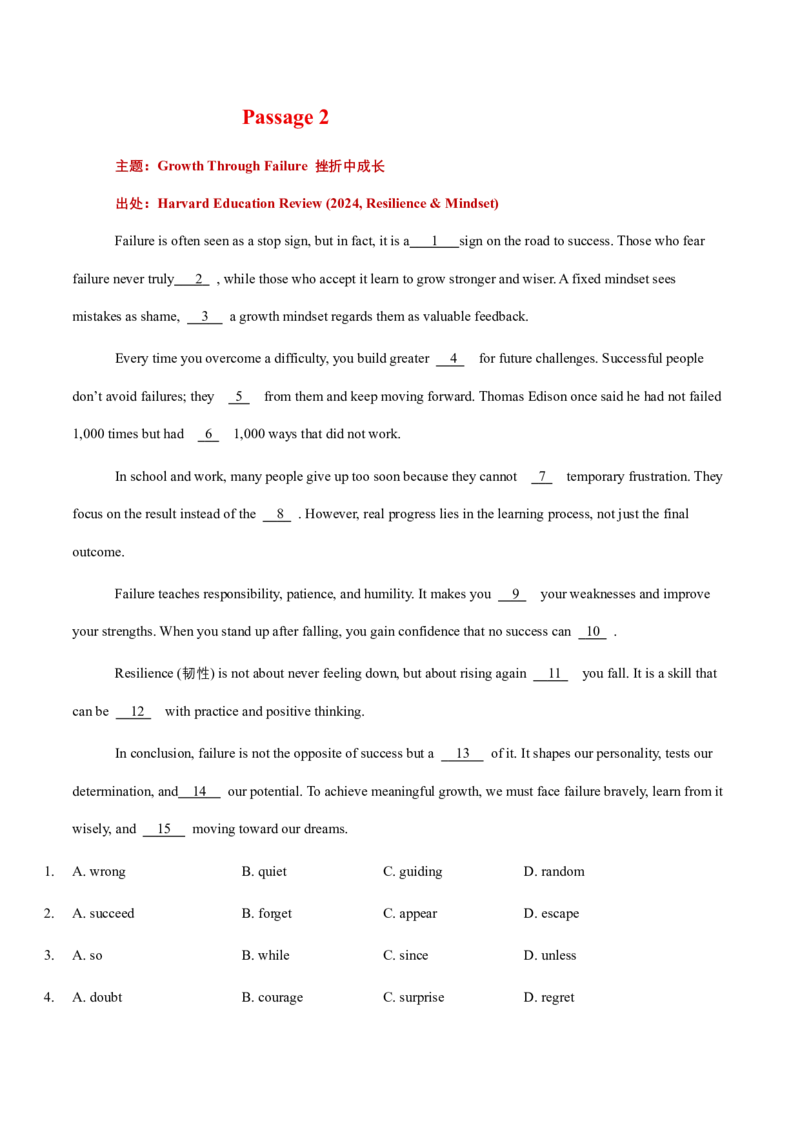
Failure is often seen as a stop sign, but in fact, it is a      1        sign on the road to success. Those who fear
failure never truly      2     , while those who accept it learn to grow stronger and wiser. A fixed mindset sees
mistakes as shame,     3       a growth mindset regards them as valuable feedback.
Every time you overcome a difficulty, you build greater     4     for future challenges. Successful people
don’t avoid failures; they    5      from them and keep moving forward. Thomas Edison once said he had not failed
1,000 times but had    6      1,000 ways that did not work.
In school and work, many people give up too soon because they cannot    7      temporary frustration. They
focus on the result instead of the     8     . However, real progress lies in the learning process, not just the final
outcome.
Failure teaches responsibility, patience, and humility. It makes you     9      your weaknesses and improve
your strengths. When you stand up after falling, you gain confidence that no success can   10
     .
Resilience (韧性) is not about never feeling down, but about rising again     11
      you fall. It is a skill that
can be     12
      with practice and positive thinking.
In conclusion, failure is not the opposite of success but a     13
       of it. It shapes our personality, tests our
determination, and    14
       our potential. To achieve meaningful growth, we must face failure bravely, learn from it
wisely, and     15
       moving toward our dreams.
1.
A. wrong
B. quiet
C. guiding
D. random
2.
A. succeed
B. forget
C. appear
D. escape
3.
A. so
B. while
C. since
D. unless
4.
A. doubt
B. courage
C. surprise
D. regret
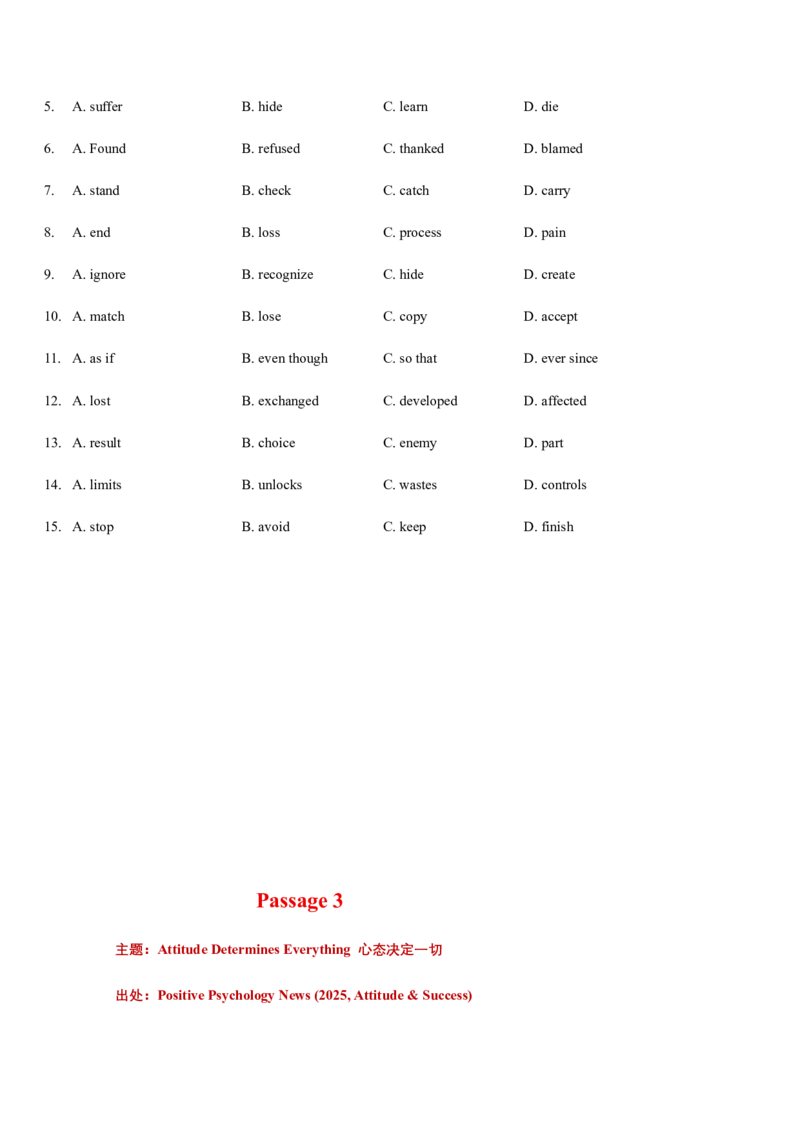
5.
A. suffer
B. hide
C. learn
D. die
6.
A. Found
B. refused
C. thanked
D. blamed
7.
A. stand
B. check
C. catch
D. carry
8.
A. end
B. loss
C. process
D. pain
9.
A. ignore
B. recognize
C. hide
D. create
10. A. match
B. lose
C. copy
D. accept
11.
A. as if
B. even though
C. so that
D. ever since
12. A. lost
B. exchanged
C. developed
D. affected
13. A. result
B. choice
C. enemy
D. part
14. A. limits
B. unlocks
C. wastes
D. controls
15. A. stop
B. avoid
C. keep
D. finish
Passage 3
主题:Attitude Determines Everything 心态决定一切
出处:Positive Psychology News (2025, Attitude & Success)
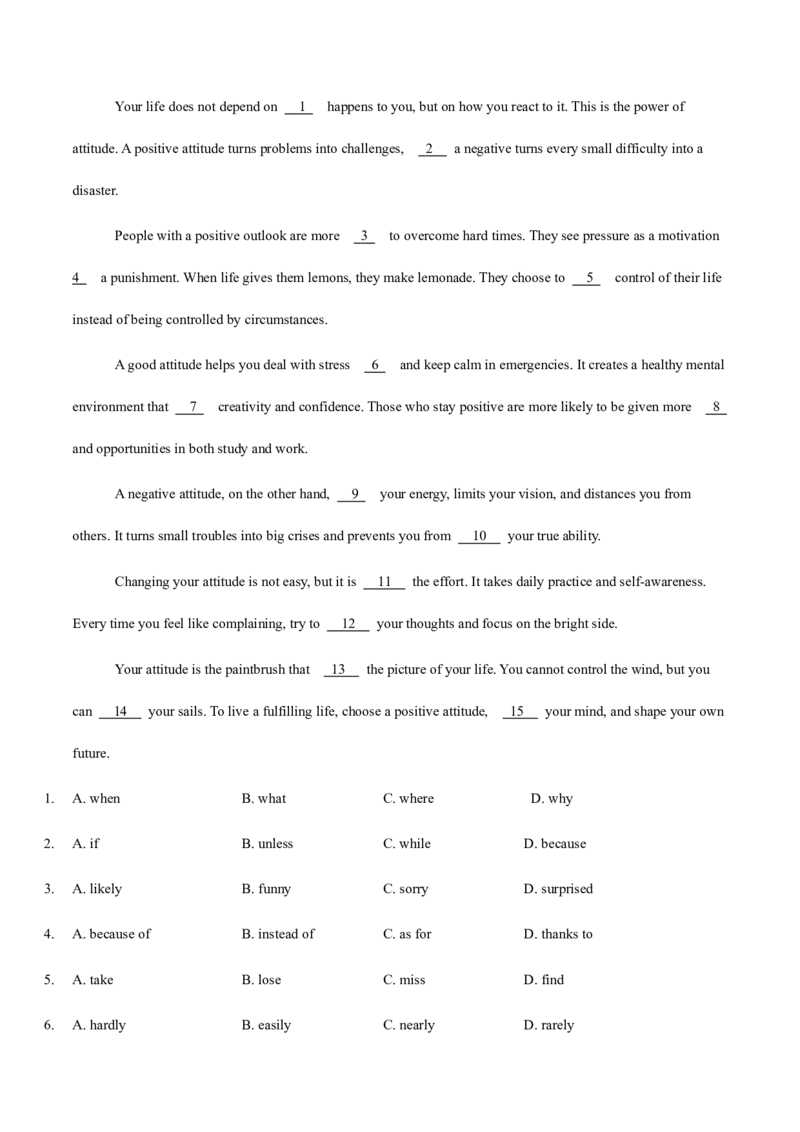
Your life does not depend on     1     happens to you, but on how you react to it. This is the power of
attitude. A positive attitude turns problems into challenges,    2      a negative turns every small difficulty into a
disaster.
People with a positive outlook are more    3      to overcome hard times. They see pressure as a motivation
4      a punishment. When life gives them lemons, they make lemonade. They choose to     5      control of their life
instead of being controlled by circumstances.
A good attitude helps you deal with stress    6      and keep calm in emergencies. It creates a healthy mental
environment that     7      creativity and confidence. Those who stay positive are more likely to be given more    8
and opportunities in both study and work.
A negative attitude, on the other hand,     9      your energy, limits your vision, and distances you from
others. It turns small troubles into big crises and prevents you from     10
       your true ability.
Changing your attitude is not easy, but it is     11
       the effort. It takes daily practice and self-awareness.
Every time you feel like complaining, try to     12
       your thoughts and focus on the bright side.
Your attitude is the paintbrush that    13

    the picture of your life. You cannot control the wind, but you
can     14
       your sails. To live a fulfilling life, choose a positive attitude,    15
       your mind, and shape your own
future.
1.
A. when
B. what
C. where
 D. why
2.
A. if
B. unless
C. while
D. because
3.
A. likely
B. funny
C. sorry
D. surprised
4.
A. because of
B. instead of
C. as for
D. thanks to
5.
A. take
B. lose
C. miss
D. find
6.
A. hardly
B. easily
C. nearly
D. rarely
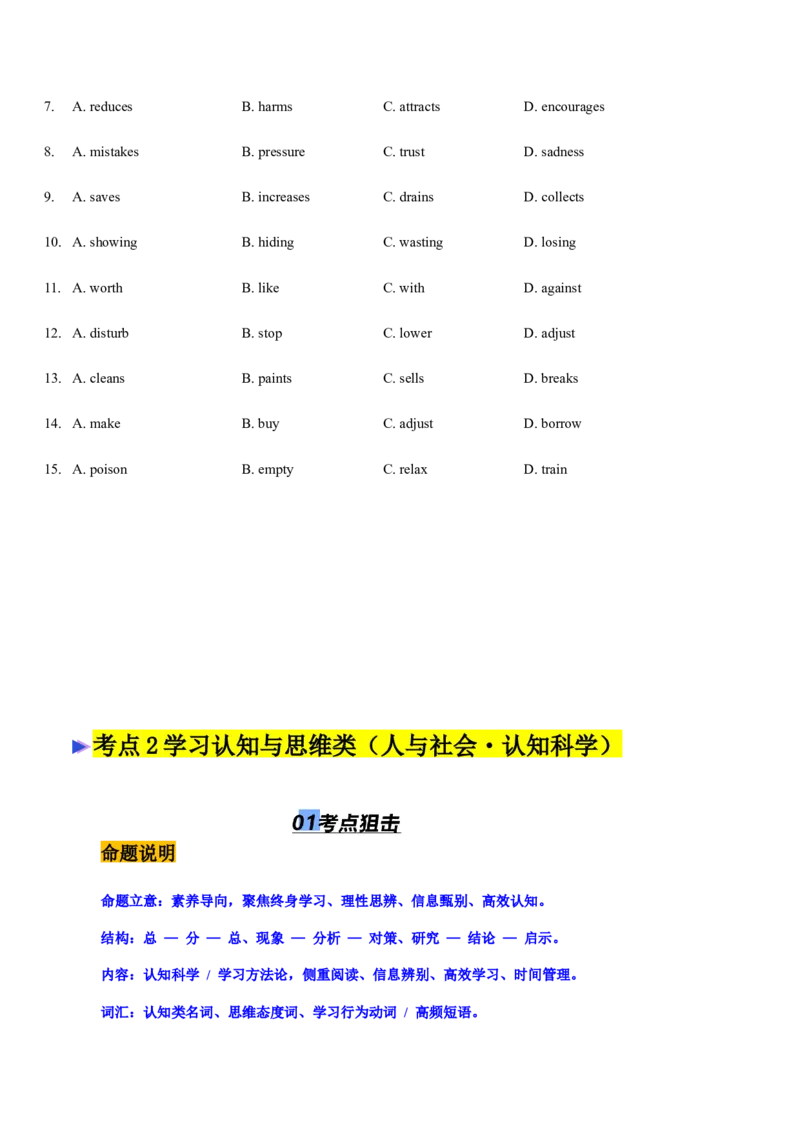
7.
A. reduces
B. harms
C. attracts
D. encourages
8.
A. mistakes
B. pressure
C. trust
D. sadness
9.
A. saves
B. increases
C. drains
D. collects
10. A. showing
B. hiding
C. wasting
D. losing
11.
A. worth
B. like
C. with
D. against
12. A. disturb
B. stop
C. lower
D. adjust
13. A. cleans
B. paints
C. sells
D. breaks
14. A. make
B. buy
C. adjust
D. borrow
15. A. poison
B. empty
C. relax
D. train
考点2 学习认知与思维类(人与社会
认知科学)
・
命题说明
命题立意:素养导向,聚焦终身学习、理性思辨、信息甄别、高效认知。
结构:总 — 分 — 总、现象 — 分析 — 对策、研究 — 结论 — 启示。
内容:认知科学 / 学习方法论,侧重阅读、信息辨别、高效学习、时间管理。
词汇:认知类名词、思维态度词、学习行为动词 / 高频短语。
逻辑:因果、递进、对比、例证、转折。
能力:语境推理、词义辨析、逻辑判断、细节理解。
Passage 1
主题:Reading and Lifelong Learning 阅读与终身学习
出处:Educational Leadership (2025, Lifelong Learning & Cognitive Growth)
Reading is not just a hobby for spare time, but a powerful     1     to lifelong learning and personal wisdom.
In a world changing faster than ever, the people who     2       are those who never stop reading and thinking.
Many people regard reading as a task for school only,     3     , it is a lifelong journey that enriches our mind
and broadens our horizon. Books    4       us to different cultures, history, and wisdom that we cannot experience in
person. They help us develop critical thinking and     5       our view of the world.
A 2024 study shows that regular readers have stronger comprehension skills and are more     6      at solving
real-life problems. They can     7       information quickly and form reasonable judgments. Reading    8      our
vocabulary, improves our writing, and sharpens our mind.
In the digital age, many people are     9       to short videos and fragmented information, paying little
attention to deep reading. This makes their thinking shallow and    10
      their ability to focus. Deep reading,   11
, trains patience, concentration and deep thinking.
Lifelong learning through reading builds    12
       and adaptability. It allows us to keep up with social
development and seize new opportunities. We should not     13
      reading when we leave school; instead, we
should make it a daily    14
     .
In short, reading is the key to continuous growth. It    15
      the way we think, shapes our values, and leads
us to a wiser and more meaningful life.
1.
A. Door
 B. rule
. secret
D. result
2.
A. Disappear
 B. succeed
C. escape
D. retire
3.
A. Therefore
 B. however
C. meanwhile
D. moreover
4.
A. limit
B. add
C. expose
D. lead
5.
A. widen
B. check
C. copy
D. lock
6.
A. weak
B. slow
C. skilled
D. nervous
7.
A. ignore
B. process
C. waste
D. forget
8.
A. reduces
B. harms
C. enriches
D. breaks
9.
A. addicted
B. used
C. close
D. related
10. A. improves
B. develops
C. damages
D. controls
11.
A. in general
B. by contrast
C. in addition
D. after all
12. A. weakness
B. humility
C. flexibility
D. anxiety
13. A. start
B. stop
C. enjoy
D. avoid
14. A. habit
B. burden
C. joke
 D. disease
15. A. blocks
B. covers
C. changes
D. loses
Passage 2
主题:Rational Thinking in the Digital Age 网络时代理性思考与信息辨别
出处:MIT Technology Review (2025, Media Literacy & Critical Thinking)
We live in an age of information explosion, where news and messages spread     1     through social media.
Not all information is    2      , and many online stories are misleading or even false. Learning to tell fact from fiction
has become a necessary   3      for everyone.
Many people   4     everything they read online without thinking. They spread rumors blindly, which causes
misunderstanding and even social   5.     Rational thinkers,   6    , check the source of information before believing
or sharing it. They ask: Who made this? Is there evidence? Is it   7    or opinion?
Critical thinking helps us   8     false information and avoid being fooled. It requires us to look   9    the
surface and analyze the truth behind messages. A reliable information source usually has   10
     data, clear logic
and a qualified publisher.
The Internet is   11
    , but it can also be full of lies and extreme ideas. We should not be    12
     by first
impressions. Instead, we should compare different sources and think   13
    .
Media literacy (媒介素养) is not just for experts. It is a basic skill for   14
     citizens. It protects us from
being controlled by online noise and helps us make wise decisions.
In a word, rational thinking and information literacy are more important than ever. They help us    15

wisely in the digital world and become responsible Internet users.
1.
A.slowly
B. rapidly
C. hardly
D. occasionally
2.
A.false
B. reliable
C. funny
D. empty
3.
A.skill
B. test
C. dream
D. mistake
4.
A.doubt
B. trust
C. refuse
D. create
5.
A.peace
B. progress
C. panic
D. improvement
6.
A.therefore
B. however
C. thus
D. besides
7.
A.fact
B. feeling
C. interest
D. effort
8.
A.spread
B. recognize
C. copy
D. remember
9.
A.up
B. after
C. for
D. beyond
10. A.unproven
B. accurate
C. unclear
D. wrong
11.
A.useless
B. convenient
C. boring
D. harmful
12. A.cheated
B. helped
C. encouraged
D. warned
13. A.blindly
B. carelessly
C. independently
D. passively
14. A.modern
B. lazy
C. wild
D. ancient
15. A.behave
B. fight
C. cheat
D. regret
、
Passage 3
主题:Efficient Learning & Time Management 高效学习与时间管理
出处:American Psychological Association (2025, Learning & Productivity)
Effective learning does not depend on how long you sit at your desk, but on how     1      you use your time.
Many students study for hours but achieve little, because they lack proper time management and efficient learning
2      .
Time is a     3      resource that can never be regained once lost. Successful learners plan their time     4
and set clear goals. They divide big tasks into small steps and     5       them one by one. This makes difficult work
easy to    6      .
Procrastination (拖延) is the biggest enemy of efficient learning. It    7      time, reduces motivation and
leads to last-minute stress. People who procrastinate often     8     difficult tasks until it is too late. To beat
procrastination, we should start at once and     9       small steps first.
Efficient learners also know how to     10
       attention and avoid distractions. They turn off unnecessary
notifications and focus on one task    11

   a time. Multitasking may seem productive, but in fact it    12

efficiency and causes mistakes.
Review and reflection are also     13

    for long-term memory. Regular review helps us    14

knowledge and make it part of our long-term memory. Good learning methods save time, improve understanding
and build     15
     .
In short, efficient learning and wise time management are the keys to academic success and personal
progress.
1.
A. wisely
B. slowly
C. lazily
D. separately
2.
A. habits
B. tools
C. methods
D. stories
3.
A. renewable
B. wasteful
C. valuable
D. common
4.
A. carelessly
B. secretly
C. seriously
D. wisely
5.
A. avoid
B. finish
C. refuse
D. cancel
6.
A. handle
B. throw
C. buy
D. paint
7.
A. saves
B. creates
C. wastes
D. fixes
8.
A. start
B. finish
C. end
D. delay
9.
A. take
B. make
C. change
D. break
10. A. lose
B. focus
C. share
D. attract
11.
A. at
B. in
C. on
D. for
12. A. increases
B. improves
C. lowers
D. enriches
13. A. useless
B. important
C. harmful
D. easy
14. A. forget
B. ignore
C. digest
D. lose
15. A. worry
B. confidence
C. trouble
D. sadness
考点3 健康生活与实践类(人与自然
科普应用)
・
命题说明
命题立意:立德树人,聚焦身心健康、绿色环保、人际和谐,倡导科学健康的生活方式、低碳环保的
责任意识、友善包容的交往理念。
结构:总—分—总、观点—论证—结论
内容:科学作息与运动饮食、心理调适、低碳绿色生活、人际交往沟通、共情与包容
词汇:健康养生词、环保低碳词、人际交往词、情感态度词、高频动词/固定短语
逻辑:转折、因果、对比、递进、并列
能力:语境推理、词义辨析、逻辑判断、固定搭配、主题复现。
Passage 1
主题:Healthy Living: Sleep, Exercise and Diet 健康科普:睡眠、运动、饮食、心理
出处:Healthline (2025, Physical & Mental Wellness)
True health is not just the absence of illness, but a balanced state of physical, mental and emotional well-
being. Many people     1      healthy living with extreme diets or intense workouts, but in fact, it lies in small,
consistent daily      2       .
Quality sleep is the foundation of good health. Without enough     3       sleep, our body cannot repair itself,
and our mind stays unclear and tired. It is recommended that adults    4        7 to 9 hours of sleep each night to keep
energetic and focused.
Regular exercise is equally important. It not only     5       our body but also lifts our mood by releasing
happy chemicals in the brain. Even 30 minutes of moderate exercise, like walking or cycling, can greatly    6
stress and anxiety.
A balanced diet is another key part. We should     7      fresh fruits, vegetables and whole grains instead of
processed food high in sugar and oil. Eating wisely    8      our immune system and keeps us away from many
diseases.
Mental health is just as important as physical health. We should learn to    9      negative emotions and find
healthy ways to relax, such as reading or listening to music.    10

   ourselves and avoiding too much pressure are
necessary for long-term wellness.
Many people     11
       healthy habits because they think they are too hard to keep, but small changes make a
big difference.     12
      , going to bed 30 minutes earlier or drinking more water every day can bring amazing
health benefits.
In short, healthy living is a lifelong    13
        . It is not about perfection but about making wise choices. By
14

    good sleep, exercise, diet and mental balance, we can    15

    a strong, healthy and happy life.
1. A. compare
B. confuse
C. mix
D. share
2. A. habits
B. tests
C. risks
D. challenges
3. A. shallow
B. long
C. deep
D. short
4. A. get
B. waste
C. miss
D. forget
5. A. weakens
B. strengthens
C. harms
D. shapes
6. A. increase
B. create
C. reduce
D. cause
7. A. avoid
B. choose
C. sell
D. check
8. A. breaks
B. lowers
C. boosts
D. destroys
9. A. hide
B. control
C. ignore
D. increase
10. A. Pressuring
B. Hurting
C. Pushing
D. Accepting
11. A. take up
B. give up
C. stick to
D. turn to
12. A. In short
B. For example
C. At last
D. In addition
13. A. journey
B. task
C. burden
D. dream
14. A. losing
B. keeping
C. changing
D. finding
15. A. live
B. make
C. find
D. receive
Passage 2
主题:Low-carbon Life and Green Protection 环保低碳与绿色生活
出处:National Geographic (2025, Environmental Protection & Sustainable Living)
The earth is our only home, and protecting it is a duty for everyone.    1     , many people still live a wasteful
life and pay little attention to environmental problems. It is time for us to    2     small green changes and live a low-
carbon life.
Low-carbon life means reducing energy waste and carbon emissions in daily life. It does not require us to
make great sacrifices, but to    3     simple habits into our daily routine. For example, we can   4     lights and
electrical appliances when leaving a room, and use both sides of paper to   5    waste.
Transportation is another important part. We can choose walking, cycling or public transport instead of
driving private cars as often as possible. This not only reduces air pollution but also   6    traffic jams and keeps us
healthy.
We should also learn to    7     waste. Sorting garbage and recycling useful things like bottles and paper can
turn waste into treasure. It is a simple but   8    way to protect the environment.
Many people think individual actions make no difference, but   9     , every small effort adds up. If everyone
makes a small change, the   10
     will be huge. Green living is not a trend but a   11
     for our future.
Planting trees is also a meaningful action. Trees can absorb carbon dioxide and   12
     the air, making our
environment fresher and more beautiful. We can also   13
     more plants at home to improve the living
environment.
Protecting the environment is not a   14

  task but a daily practice. Every small kind act to the earth is
valuable. Let's start with ourselves,   1  5     green habits and build a better home for the next generation.
1. A. Therefore
B. However
C. Moreover
D. Besides
2. A. avoid
B. refuse
C. take
D. forget
3. A. add
B. remove
C. leave
D. change
4. A. turn on
B. turn off
C. turn up
D. turn down
5. A. increase
B. create
C. collect
D. cut
6. A. causes
B. avoids
C. adds
D. faces
7. A. deal with
B. give up
C. throw away
D. pick up
8. A. useless
B. powerful
C. funny
D. boring
9. A. in fact
B. in short
C. at first
D. at last
10. A. problem
B. result
C. cost
D. pain
11. A. choice
B. burden
C. punishment
D. shame
12. A. pollute
B. clean
C. waste
D. damage
13. A. sell
B. buy
C. grow
D. cut
14. A. small
B. easy
C. hard
 D. big
15. A. develop
B. break
C. lose
D. check
Passage 3
主题:Interpersonal Communication and Relationship 人际交往与有效沟通技巧
出处:Psychology Today (2025, Communication & Social Skills)
Good communication is the key to good relationships. Whether with family, friends or classmates, we need
to learn to   1     effectively to avoid misunderstanding and conflict. Many people   2    communication with talking
a lot, but truly effective communication is more about listening and understanding.
Listening is the most important part of good communication. When others are talking, we should listen   3
and avoid cutting in or thinking about our own reply. Listening with full attention shows   4     and makes others
feel valued.
When we express our thoughts, we should speak    5     and politely. Avoiding angry words or blaming others
can   6     many unnecessary conflicts. Tell others how we feel instead of criticizing them, and this will make
communication much    7    .
Empathy is also crucial in communication. It means trying to   8      others' feelings and stand in their shoes.
When we understand others' positions, it is easier to reach a   9     and solve problems together.
Many conflicts   10
     because of poor communication. People often focus on proving themselves right
instead of understanding each other.   11
     , small misunderstandings can turn into big fights and damage long-term
relationships.
Body language is another important part of communication. Smiling, making eye contact and keeping an
open posture can make our messages more   12
     and friendly. It helps us connect with others better.
Good communication is not a   13

  that we are born with, but a skill we can learn and  14
     . By
practicing listening, speaking politely and being empathetic, we can   15
     warm and healthy relationships with
everyone around us.
1. A. argue
B. communicate
C. fight
D. compete
2. A. compare
B. mix
C. confuse
D. share
3. A. carefully
B. carelessly
C. quickly
D. angrily
4. A. disrespect
B. doubt
C. respect
D. fear
5. A. rudely
 B. clearly
C. secretly
D. loudly
6. A. cause
B. create
C. avoid
D. increase
7. A. harder
B. smoother
C. angrier
 D. slower
8. A. ignore
B. understand
C. hurt
D. dislike
9. A. agreement
B. disagreement
 C. result
D. task
10. A. solve
 B. disappear
C. arise
D. end
11. A. However
B. Therefore
C. Moreover
D. Besides
12. A. cold
B. boring
C. warm
D. strict
13. A. skill
B. gift
C. habit
D. rule
14. A. lose
B. forget
C. improve
 D. hide
15. A. build
B. break
C. damage
D. change
考点4 文化科普与科技类(文化意识
科技科普)
・
命题说明
1. 命题立意:立德树人,传承中华优秀传统文化,增强文化自信;关注科技发展与日常生活的融合,
倡导科学理性思维,兼顾文化底蕴与科学素养。
2. 结构:总—分—总、观点—论证—结论
3. 内容:中华传统节气习俗、传统礼仪、文化传承;人工智能应用、科技便利;自然现象、科学常识
4. 词汇:传统文化词、科技术语、自然科学词、情感态度词、高频动词/固定短语
5. 逻辑:转折、因果、递进、并列、解释说明
6. 能力:语境推理、词义辨析、逻辑判断、固定搭配、文化常识运用
Passage 1
主题:Chinese Traditional Solar Terms 中华优秀传统文化(节气、习俗、礼仪)
出处:China Daily (2025, Traditional Chinese Culture)
The 24 Solar Terms are a precious treasure of Chinese traditional culture. Created by ancient Chinese
farmers thousands of years ago, they are a special   1     of the changes in seasons and climate, guiding people's
daily life and agricultural    2    .
Ancient Chinese people   3     the sun's movement and natural changes carefully. They divided a year into 24
equal parts,   4    each part a solar term. Each solar term has its unique meaning and related    5     . For example, the
Spring Equinox means day and night are equally long, while the Winter Solstice is the shortest day in a year.
These solar terms are not only   6    for farming but also connected with people's daily life, food and
customs. Many solar terms have special   7     . On the Double Ninth Festival, people climb mountains and respect
the elderly; on Tomb-sweeping Day, people    8     their ancestors and sweep tombs.
Some solar terms also have related food traditions. People eat dumplings during the Winter Solstice and   9
to stay warm, while they eat spring rolls during the Beginning of Spring to welcome the coming of spring. These
food customs carry people's   10

  for a healthy and happy life.
In modern times, many young people   11
     the importance of traditional solar terms, but they are still
valuable cultural heritage. They  12
     the wisdom of ancient Chinese people and show our unique culture to the
world.
Nowadays, more and more people are   13

  to learn about solar terms. Schools teach students traditional
culture, and some solar terms are even celebrated as   14

  festivals. We should   15
     this precious cultural
heritage and pass it down from generation to generation.
1. A. way
B. record
C. story
D. rule
2. A. work
B. rest
C. activities
D. games
3. A. ignored
B. watched
C. hated
D. forgot
4. A. naming
B. calling
C. giving
D. making
5. A. customs
B. books
C. songs
D. paintings
6. A. useless
B. important
C. boring
D. hard
7. A. meanings
B. celebrations
C. foods
D. stories
8. A. honor
B. blame
C. forget
D. leave
9. A. drink
B. eat
C. wear
D. sleep
10. A. wishes
B. doubts
C. fears
D. sadness
11. A. understand
B. realize
C. ignore
D. remember
12. A. hide
B. show
C. carry
D. lose
13. A. unwilling
B. ready
C. afraid
D. unable
14. A. traditional
B. national
C. funny
D. boring
15. A. value
B. throw
C. damage
D. change
Passage 2
主题:AI in Daily Life 人工智能与日常生活应用
出处:Wired UK (2025, Technology & Daily Life)
Artificial Intelligence (AI) is no longer a faraway science fiction idea. It has quietly come into our daily life
and    1    the way we live, work and study in many ways. From smart phones to home robots, AI is making our life
easier and more   2    .
In the past, people had to do many things   3     , but now AI can help finish them quickly. For example,
smart home systems can   4    lights, temperature and electrical appliances automatically. When we wake up in the
morning, the curtains open by themselves, and the room is already at a   5     temperature.
AI also plays a great role in study. Many students use AI learning apps to   6     their weak points and study
more efficiently. The apps can   7    personalized study plans according to each student's learning speed and
progress,   8      traditional one-size-fits-all study ways.
When it comes to transportation, AI makes travel much safer and more convenient. Navigation apps use AI
to    9     traffic conditions in real time and guide us to take the best route,   10

  traffic jams and saving time. Some
new cars even have AI-powered driving assistance to   11
     accidents.
Of course, AI also has some   12
     problems, such as personal information safety. But we should not refuse
this   13

  technology because of small problems. Instead, we should use it in a right way and make it   14
     us
better.
Technology is always developing, and AI will become more advanced in the future. It will not   15

people, but help us do better in all fields of life. We should keep an open mind and enjoy the convenience that AI
brings.
1. A. changed
B. kept
C. hated
D. stopped
2. A. difficult
B. convenient
C. boring
D. tiring
3. A. easily
B. by hand
C. quickly
D. on time
4. A. break
B. control
C. sell
D. fix
5. A. high
 B. low
C. comfortable
D. cold
6. A. find
B. hide
C. ignore
D. increase
7. A. take
B. make
C. refuse
D. buy
8. A. replacing
B. keeping
C. following
D. improving
9. A. ignore
B. check
C. guess
D. imagine
10. A. causing
B. increasing
C. avoiding
D. meeting
11. A. cause
B. prevent
C. record
D. report
12. A. small
B. big
C. important
D. serious
13. A. useless
B. helpful
C. harmful
D. old
14. A. serve
B. hurt
C. cheat
D. fight
15. A. help
B. replace
C. encourage
D. support
Passage 3
主题:Natural Phenomena and Basic Science 自然现象与科学常识
出处:National Geographic Kids (2025, Science & Nature)
We see different natural phenomena around us every day, but few of us really understand why they    1.

From rainbows in the sky to seasons changing, most natural phenomena are based on basic scientific   2.
Learning about them not only helps us know the world better but also makes our life more    3
A rainbow is one of the most beautiful natural phenomena. It appears when sunlight passes through small
water   4      in the air, usually after rain. The light splits into different   5    , making a colorful arc in the sky. Many
people think rainbows can only be seen after rain, but in fact, they can also appear near waterfalls or on sunny days
with heavy mist.
Seasonal changes are another common phenomenon. The four seasons happen because the earth   6
around the sun. When part of the earth is closer to the sun, it is summer; when it is   7     away, it is winter. This
change also    8     the growth of plants and the activities of animals, forming a balanced natural cycle.
Many people are afraid of thunder and lightning, but they are also normal natural phenomena. Lightning is
caused by the movement of electric charges in clouds, and thunder is the   9    made by lightning heating the air.
We should stay away from open places and tall trees during thunderstorms to keep   10
  .
Some other small phenomena, like water turning into ice in winter or leaves falling in autumn, are also   11

by scientific rules. We often take them for granted, but if we   12

  carefully, we can find science everywhere in
our life.
Understanding natural phenomena teaches us to be curious and   13

  the world. It helps us tell the
difference between science and superstition, and makes us think more   14
    . We should keep observing and
learning to   15
     the secrets of nature and science.
1. A. disappear
B. happen
C. die
 D. end
2. A. rules
B. stories
C. dreams
D. mistakes
3. A. meaningless
B. interesting
C. boring
D. tiring
4. A. stones
B. drops
C. trees
 D. hills
5. A. parts
B. sizes
C. shapes
D. colors
6. A. turns
B. runs
C. travels
D. moves
7. A. farther
B. closer
C. higher
D. lower
8. A. stops
B. influences
C. harms
D. destroys
9. A. light
B. sound
C. smell
D. taste
10. A. safe
B. dangerous
C. warm
D. cold
11. A. controlled
B. broken
C. stopped
D. made
12. A. ignore
B. observe
C. forget
 D. hate
13. A. fear
B. respect
C. damage
D. change
14. A. blindly
B. wisely
C. angrily
D. sadly
15. A. discover
B. hide
C. cover
D. lose