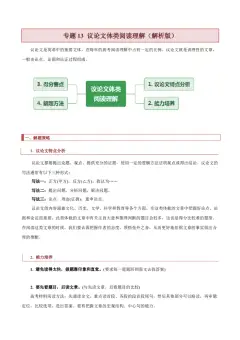
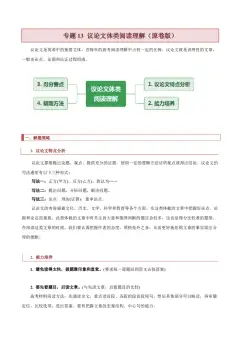
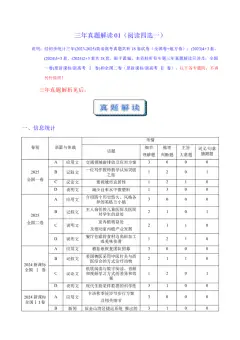
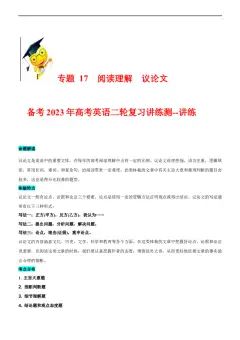
专题三 完形填空
类型二 体裁破解
第4 讲 议论文
【辨明题类】
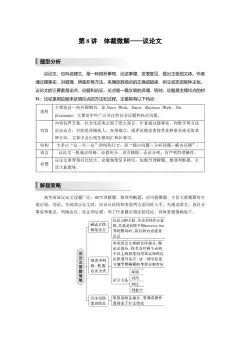
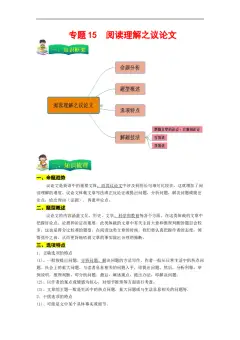
议论文是一种剖析事物、论述原理、发表见解或提出主张的说理性文章。其目
的不仅是客观地解释事物,还力图说服读者相信并接受某一观点。其特点决定
了其为高考完形填空中难度最大的一种体裁。典型的议论文一般由论点(提出问
题,即what)、论据(分析问题,即why)和论证(解决问题,即how)三部分组
成。
议论文的论点的3 种提出方式
(1)开门见山式:提出论点→引用具体的论据→总结全文;
(2)导入式:叙述具体的事情或现象→针对问题,提出论点→用论据说明论点;
(3)结尾式:列举生活中的现象→分析具体现象→得出结论。
【技法点拨】
1.抓住首句,明确论点。议论文完形填空的首句一般是主旨句,作者通常在文
章的首段提出总论点,然后在每段的首句提出分论点。
2.议论文的尾段就是结论,也是对论点的照应,不可忽视。
【真题体验】
(广东高考)
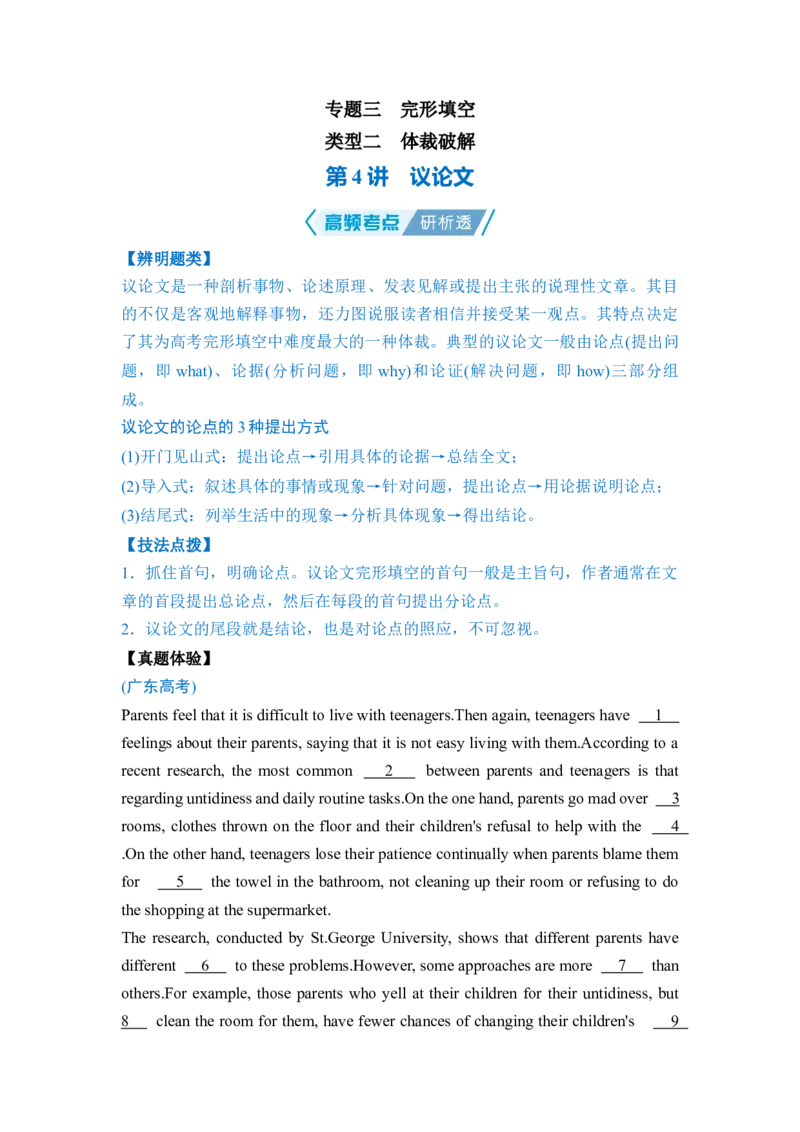
Parents feel that it is difficult to live with teenagers.Then again, teenagers have   1
feelings about their parents, saying that it is not easy living with them.According to a
recent research, the most common   2   between parents and teenagers is that
regarding untidiness and daily routine tasks.On the one hand, parents go mad over   3
rooms, clothes thrown on the floor and their children's refusal to help with the   4
.On the other hand, teenagers lose their patience continually when parents blame them
for    5   the towel in the bathroom, not cleaning up their room or refusing to do
the shopping at the supermarket.
The research, conducted by St.George University, shows that different parents have
different   6   to these problems.However, some approaches are more   7   than
others.For example, those parents who yell at their children for their untidiness, but
8   clean the room for them, have fewer chances of changing their children's    9
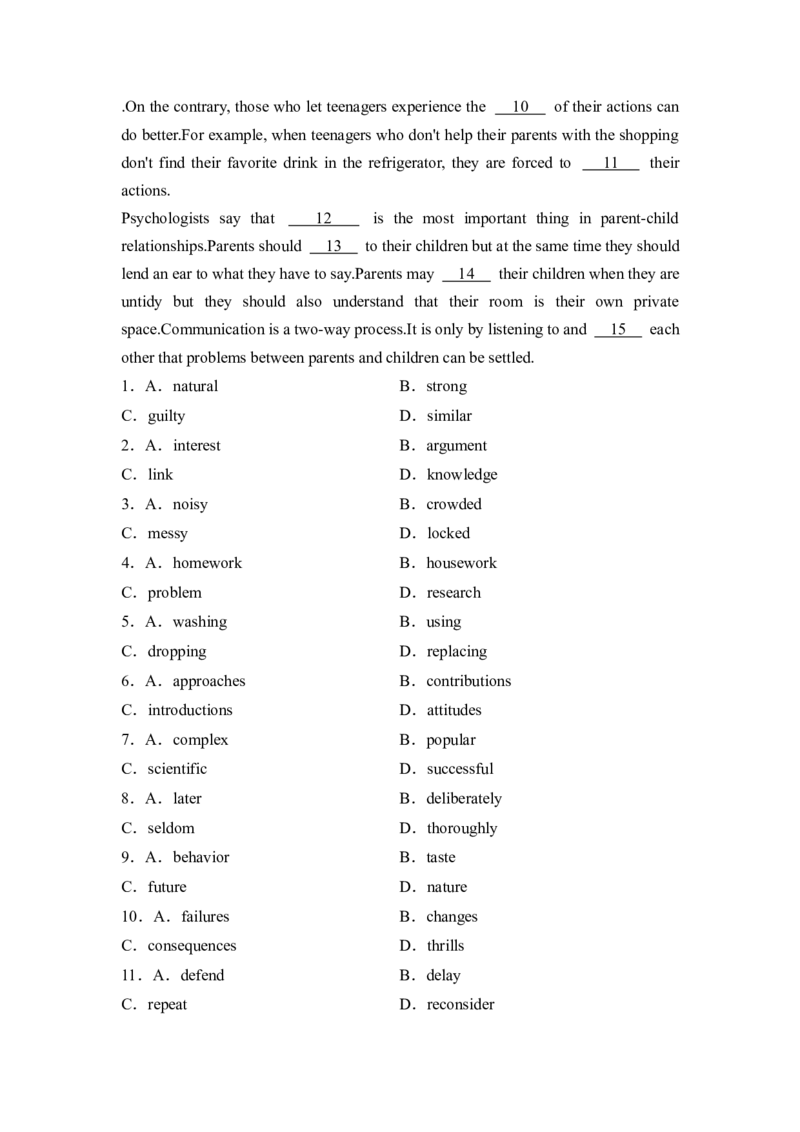
.On the contrary, those who let teenagers experience the   10   of their actions can
do better.For example, when teenagers who don't help their parents with the shopping
don't find their favorite drink in the refrigerator, they are forced to   11   their
actions.
Psychologists say that   12   is the most important thing in parent-child
relationships.Parents should   13   to their children but at the same time they should
lend an ear to what they have to say.Parents may   14   their children when they are
untidy but they should also understand that their room is their own private
space.Communication is a two-way process.It is only by listening to and   15   each
other that problems between parents and children can be settled.
1.A.natural
B.strong
C.guilty
D.similar
2.A.interest
B.argument
C.link
D.knowledge
3.A.noisy
B.crowded
C.messy
D.locked
4.A.homework
B.housework
C.problem
D.research
5.A.washing
B.using
C.dropping
D.replacing
6.A.approaches
B.contributions
C.introductions
D.attitudes
7.A.complex
B.popular
C.scientific
D.successful
8.A.later
B.deliberately
C.seldom
D.thoroughly
9.A.behavior
B.taste
C.future
D.nature
10.A.failures
B.changes
C.consequences
D.thrills
11.A.defend
B.delay
C.repeat
D.reconsider
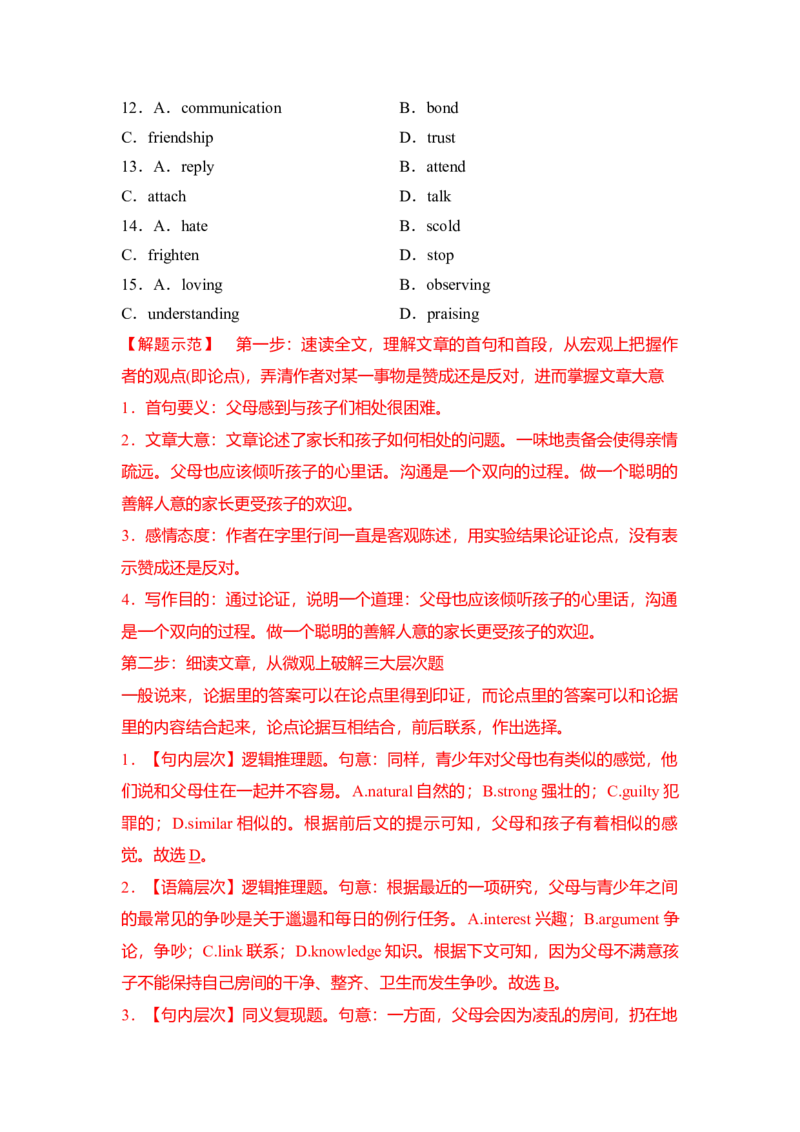
12.A.communication
B.bond
C.friendship
D.trust
13.A.reply
B.attend
C.attach
D.talk
14.A.hate
B.scold
C.frighten
D.stop
15.A.loving
B.observing
C.understanding
D.praising
【解题示范】 第一步:速读全文,理解文章的首句和首段,从宏观上把握作
者的观点(即论点),弄清作者对某一事物是赞成还是反对,进而掌握文章大意
1.首句要义:父母感到与孩子们相处很困难。
2.文章大意:文章论述了家长和孩子如何相处的问题。一味地责备会使得亲情
疏远。父母也应该倾听孩子的心里话。沟通是一个双向的过程。做一个聪明的
善解人意的家长更受孩子的欢迎。
3.感情态度:作者在字里行间一直是客观陈述,用实验结果论证论点,没有表
示赞成还是反对。
4.写作目的:通过论证,说明一个道理:父母也应该倾听孩子的心里话,沟通
是一个双向的过程。做一个聪明的善解人意的家长更受孩子的欢迎。
第二步:细读文章,从微观上破解三大层次题
一般说来,论据里的答案可以在论点里得到印证,而论点里的答案可以和论据
里的内容结合起来,论点论据互相结合,前后联系,作出选择。
1.【句内层次】逻辑推理题。句意:同样,青少年对父母也有类似的感觉,他
们说和父母住在一起并不容易。A.natural 自然的;B.strong 强壮的;C.guilty 犯
罪的;D.similar 相似的。根据前后文的提示可知,父母和孩子有着相似的感
觉。故选D。
2.【语篇层次】逻辑推理题。句意:根据最近的一项研究,父母与青少年之间
的最常见的争吵是关于邋遢和每日的例行任务。A.interest 兴趣;B.argument 争
论,争吵;C.link 联系;D.knowledge 知识。根据下文可知,因为父母不满意孩
子不能保持自己房间的干净、整齐、卫生而发生争吵。故选B。
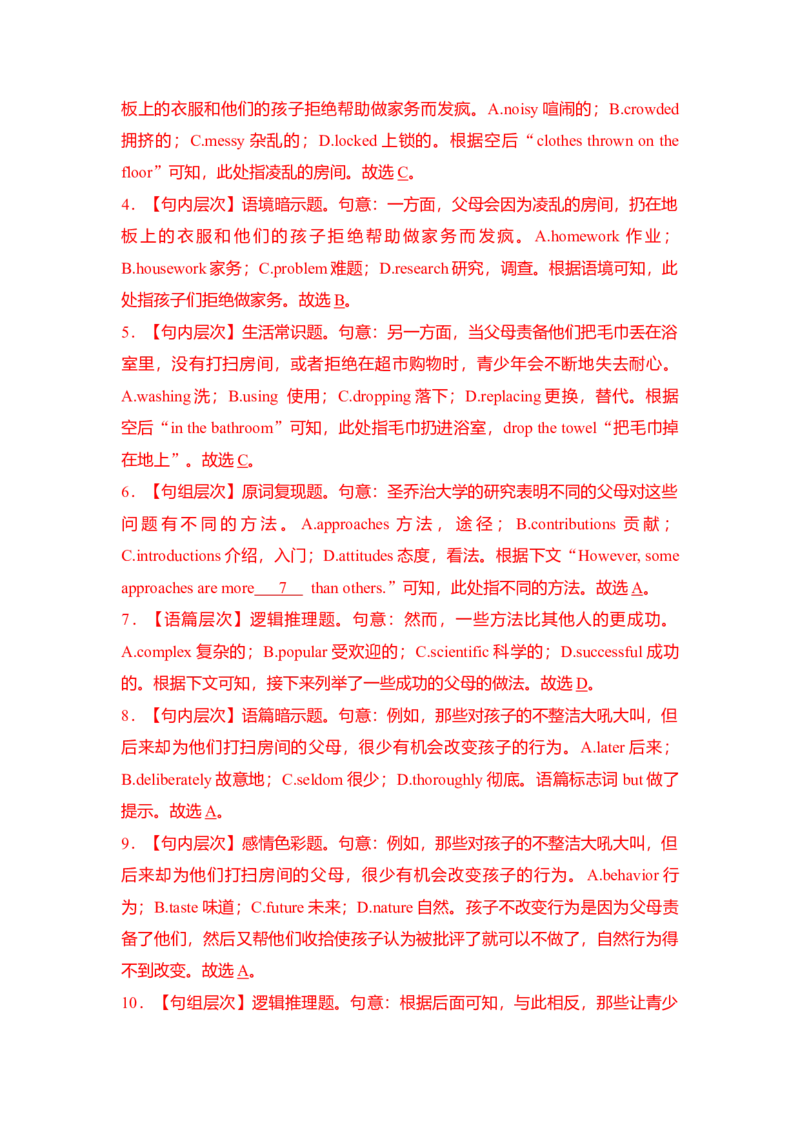
3.【句内层次】同义复现题。句意:一方面,父母会因为凌乱的房间,扔在地
板上的衣服和他们的孩子拒绝帮助做家务而发疯。A.noisy 喧闹的;B.crowded
拥挤的;C.messy 杂乱的;D.locked 上锁的。根据空后“clothes thrown on the
floor”可知,此处指凌乱的房间。故选C。
4.【句内层次】语境暗示题。句意:一方面,父母会因为凌乱的房间,扔在地
板上的衣服和他们的孩子拒绝帮助做家务而发疯。A.homework 作业;
B.housework 家务;C.problem 难题;D.research 研究,调查。根据语境可知,此
处指孩子们拒绝做家务。故选B。
5.【句内层次】生活常识题。句意:另一方面,当父母责备他们把毛巾丢在浴
室里,没有打扫房间,或者拒绝在超市购物时,青少年会不断地失去耐心。
A.washing 洗;B.using 使用;C.dropping 落下;D.replacing 更换,替代。根据
空后“in the bathroom”可知,此处指毛巾扔进浴室,drop the towel“把毛巾掉
在地上”。故选C。
6.【句组层次】原词复现题。句意:圣乔治大学的研究表明不同的父母对这些
问题有不同的方法。A.approaches 方法,途径;B.contributions 贡献;
C.introductions 介绍,入门;D.attitudes 态度,看法。根据下文“However, some
approaches are more   7   than others.”可知,此处指不同的方法。故选A。
7.【语篇层次】逻辑推理题。句意:然而,一些方法比其他人的更成功。
A.complex 复杂的;B.popular 受欢迎的;C.scientific 科学的;D.successful 成功
的。根据下文可知,接下来列举了一些成功的父母的做法。故选D。
8.【句内层次】语篇暗示题。句意:例如,那些对孩子的不整洁大吼大叫,但
后来却为他们打扫房间的父母,很少有机会改变孩子的行为。A.later 后来;
B.deliberately 故意地;C.seldom 很少;D.thoroughly 彻底。语篇标志词but 做了
提示。故选A。
9.【句内层次】感情色彩题。句意:例如,那些对孩子的不整洁大吼大叫,但
后来却为他们打扫房间的父母,很少有机会改变孩子的行为。A.behavior 行
为;B.taste 味道;C.future 未来;D.nature 自然。孩子不改变行为是因为父母责
备了他们,然后又帮他们收拾使孩子认为被批评了就可以不做了,自然行为得
不到改变。故选A。
10.【句组层次】逻辑推理题。句意:根据后面可知,与此相反,那些让青少
年体验他们的行为的结果的父母可以做得更好。A.failures 失败;B.changes 变
化;C.consequences 结果;D.thrills 兴奋,震颤。根据下文“For example, when
teenagers who don't help their parents with the shopping don't find their favorite drink
in the refrigerator, they are forced to   11   their actions.”可知,此处指让青少
年体验他们的行为的结果。故选C。
11.【句内层次】语篇暗示题。句意:例如,当青少年不帮助他们的父母购物
时,他们在冰箱里就找不到他们最喜爱的饮料,这样他们就被迫重新考虑他们
的行动。A.defend 防御;B.delay 耽搁;C.repeat 重复;D.reconsider 重新考虑。
根据语境可知,此处指青少年被迫重新考虑他们的行动。故选D。
12.【句组层次】近义复现题。句意:心理学家说交流是家长和孩子关系中最
重要的事。A.communication 交流;B.bond 结合;C.friendship 友谊;D.trust 信
任。根据下文“lend an ear to”可知,有沟通才会消除隔阂和误解。故选A。
13.【句内层次】固定搭配题。句意:父母应和子女交谈 ,但同时也应该听一
听他们要说什么。A.reply 回答;B.attend 参加;C.attach 附加,系;D.talk 谈
论。根据空后“at the same time they should lend an ear to what they have to say”
可知,此处是talk to“和……交谈”。故选D。
14.【句内层次】生活常识题。句意:当孩子们的房间凌乱时,父母可以责备
他们,但他们也应该明白他们的房间是他们的私人空间。A.hate 讨厌;B.scold
责备;C.frighten 吓唬;D.stop 停止。根据空后 “when they are untidy”和常识
可知,父母会责备孩子们。故选B。
15.【语篇层次】首尾呼应题。句意:沟通是一个双向的过程。它只有通过倾
听和理解对方,父母与子女之间的问题才可以得到解决。A.loving 爱;
B.observing 观察;C.understanding 理解;D.praising 表扬。这是最后结论,照应
开头。故选C。
第三步:重读文章,从逻辑上修正错误
初选之后,代入答案,把违背上下文逻辑关系的错误改正过来。
A
(2025·安徽省合肥市庐阳区合肥八中高三三模)
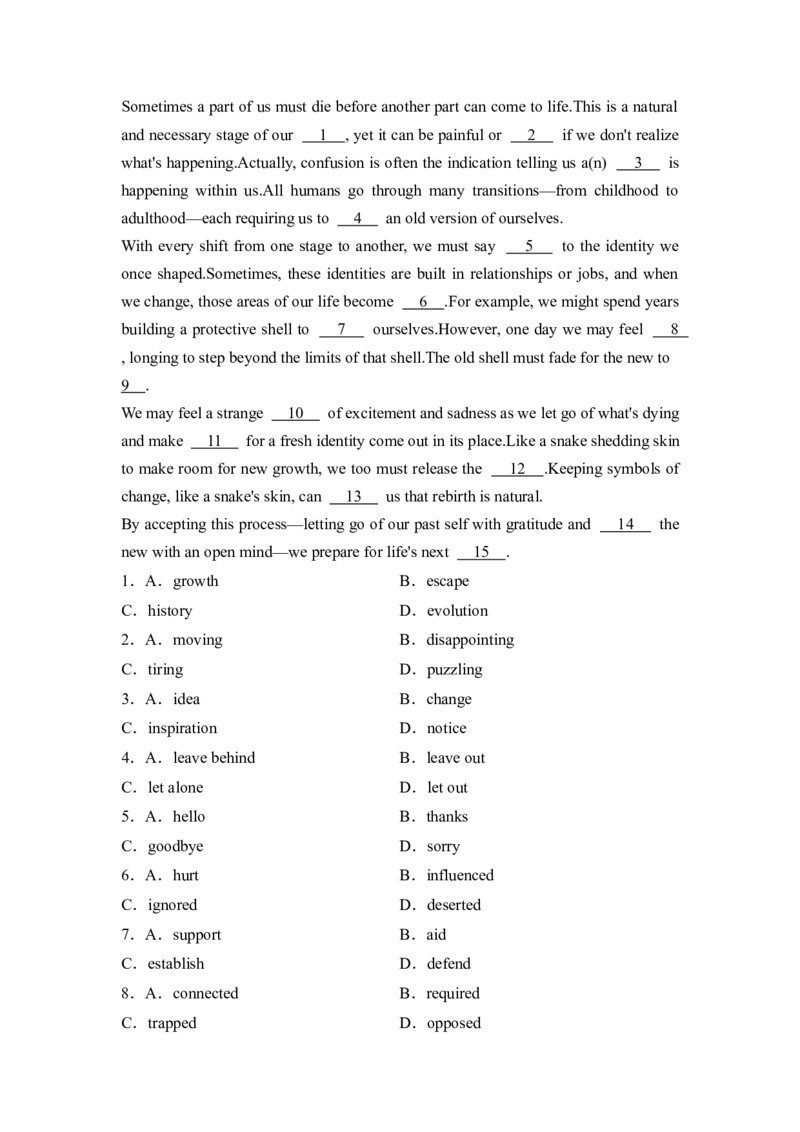
Sometimes a part of us must die before another part can come to life.This is a natural
and necessary stage of our   1  , yet it can be painful or   2   if we don't realize
what's happening.Actually, confusion is often the indication telling us a(n)   3   is
happening within us.All humans go through many transitions—from childhood to
adulthood—each requiring us to   4   an old version of ourselves.
With every shift from one stage to another, we must say   5   to the identity we
once shaped.Sometimes, these identities are built in relationships or jobs, and when
we change, those areas of our life become   6  .For example, we might spend years
building a protective shell to   7   ourselves.However, one day we may feel   8
, longing to step beyond the limits of that shell.The old shell must fade for the new to
9  .
We may feel a strange   10   of excitement and sadness as we let go of what's dying
and make   11   for a fresh identity come out in its place.Like a snake shedding skin
to make room for new growth, we too must release the   12  .Keeping symbols of
change, like a snake's skin, can   13   us that rebirth is natural.
By accepting this process—letting go of our past self with gratitude and   14   the
new with an open mind—we prepare for life's next   15  .
1.A.growth
B.escape
C.history
D.evolution
2.A.moving
B.disappointing
C.tiring
D.puzzling
3.A.idea
B.change
C.inspiration
D.notice
4.A.leave behind
B.leave out
C.let alone
D.let out
5.A.hello
B.thanks
C.goodbye
D.sorry
6.A.hurt
B.influenced
C.ignored
D.deserted
7.A.support
B.aid
C.establish
D.defend
8.A.connected
B.required
C.trapped
D.opposed
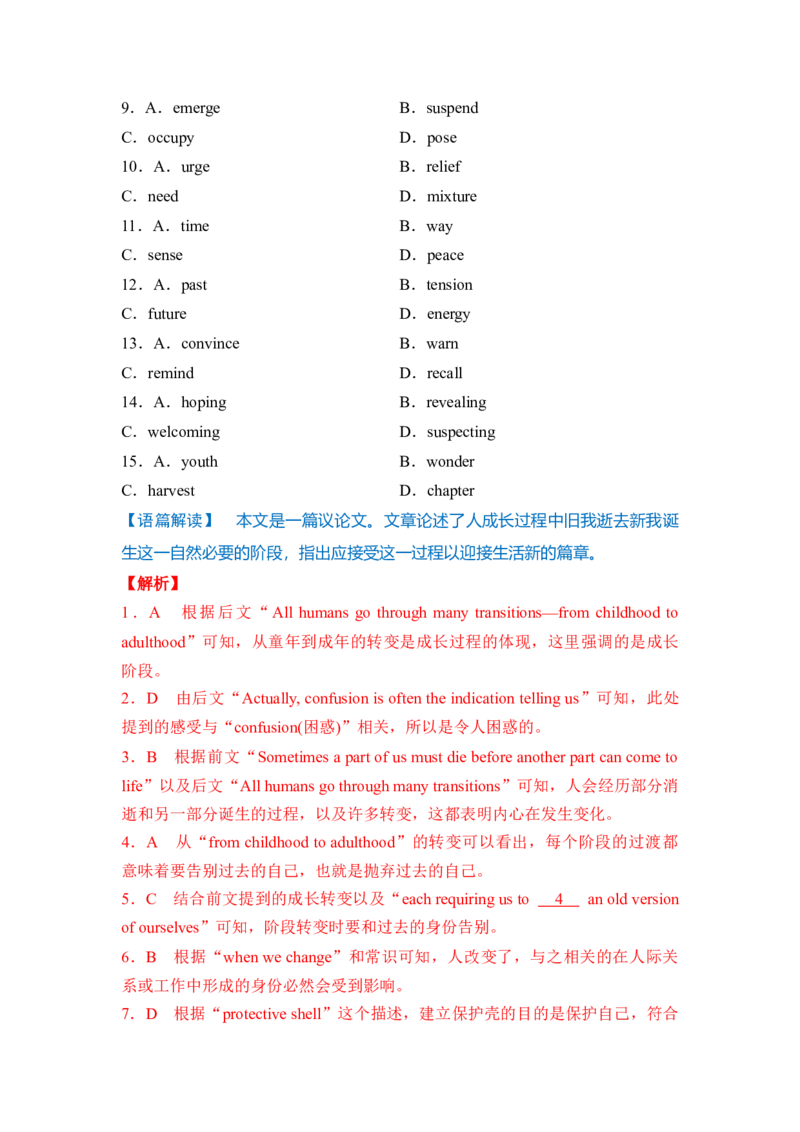
9.A.emerge
B.suspend
C.occupy
D.pose
10.A.urge
B.relief
C.need
D.mixture
11.A.time
B.way
C.sense
D.peace
12.A.past
B.tension
C.future
D.energy
13.A.convince
B.warn
C.remind
D.recall
14.A.hoping
B.revealing
C.welcoming
D.suspecting
15.A.youth
B.wonder
C.harvest
D.chapter
【语篇解读】 本文是一篇议论文。文章论述了人成长过程中旧我逝去新我诞
生这一自然必要的阶段,指出应接受这一过程以迎接生活新的篇章。
【解析】
1.A 根据后文“All humans go through many transitions—from childhood to
adulthood”可知,从童年到成年的转变是成长过程的体现,这里强调的是成长
阶段。
2.D 由后文“Actually, confusion is often the indication telling us”可知,此处
提到的感受与“confusion(困惑)”相关,所以是令人困惑的。
3.B 根据前文“Sometimes a part of us must die before another part can come to
life”以及后文“All humans go through many transitions”可知,人会经历部分消
逝和另一部分诞生的过程,以及许多转变,这都表明内心在发生变化。
4.A 从“from childhood to adulthood”的转变可以看出,每个阶段的过渡都
意味着要告别过去的自己,也就是抛弃过去的自己。
5.C 结合前文提到的成长转变以及“each requiring us to   4   an old version
of ourselves”可知,阶段转变时要和过去的身份告别。
6.B 根据“when we change”和常识可知,人改变了,与之相关的在人际关
系或工作中形成的身份必然会受到影响。
7.D 根据“protective shell”这个描述,建立保护壳的目的是保护自己,符合
逻辑。
8.C “longing to step beyond the limits of that shell”表明渴望突破限制,说明
之前是感觉被困在壳里了。
9.A 结合前文“one day we may feel   8  ”以及“the old shell must fade”可
知,旧壳褪去后新的才会出现,符合事物发展规律。emerge 出现;suspend 暂
停;occupy 占据;pose 造成。
10.D 句意:当我们放下正在消逝的东西,为一个全新的身份腾出空间时,
我们可能会感到一种奇怪的兴奋和悲伤交织的感觉。根据“excitement and
sadness”可知,兴奋和悲伤是两种不同的情绪,这里表达的是它们混合在一起
的奇怪感觉。
11.B 根据前文“The old shell must fade for the new to   9  .”可知,旧的褪
去为新的出现创造条件,也就是为新身份腾出空间;make way for“为……腾出
空间”。
12.A 因为把人放下旧身份和蛇蜕皮作类比,蛇蜕皮是抛弃旧的外皮,对应
人要放下过去。
13.C 根据“Keeping symbols of change, like a snake's skin”以及“that rebirth
is natural”可知,保留蛇蜕这种变化的象征,目的是提醒我们重生是自然的过
程。
14.C 句意:通过接受这个过程——带着感激之情放下过去的自己,以开放
的心态迎接新的自己——我们为生活的下一个篇章做好准备。前文提到“letting
go of our past self”,与之相对,这里应该是以开放心态迎接新的自己。
15.D 结合前文描述的人在不同阶段的转变以及成长过程,这里把生活的不
同阶段比喻成不同的篇章,所以是为下一个篇章做准备。
B
(2025·上海市奉贤中学高三三模)
Sufficient research has shown that when people believe that their managers are truly
listening to their ideas and concerns, work relationships grow stronger, engagement
rises, and performance improves.That's why bosses have regular one-on-ones with
their   1   reports, and new division heads go on listening tours.
However, studies also show that such practices often are   2  —in part because
many managers simply aren't good listeners.When we conducted a comprehensive
review of 117 academic papers on workplace listening, we found that this skill is far
easier to describe than to   3  .
Why?Because listening is an   4   activity that requires empathy, patience, and the
ability to respond to what you hear.And because it can be so   5   demanding,
particularly when the subject matter is complex or emotionally charged, people often
take shortcuts.
Take Google's all-company Friday meetings.For years these were biweekly open
forums( 论坛) where company leaders would share   6  , discuss strategic
developments, and take questions from employees.They played a critical role in
maintaining a culture of   7   at the company.As Laszlo Bock, Google's former vice
president of people operations, once explained, they   8   “everything from
whether the mix of food in the cafés is too healthy to really significant questions
around whether our strategy with a particular country or product is good or evil”.
9  , in 2019 Sundar Pichai, Google's CEO, decided that the meetings were no longer
working.Employees wanted to talk about controversial issues like the company's
handling of hate speech, and discussions were often   10   to the press.Pichai made
them less regular and changed their   11  .It seems that listening to everyone had
gotten too difficult.
Similar situations have played out at Activision Blizzard, where an attempt to address
misconduct claims during a company town hall led to a massive strike, with workers
complaining that leaders were   12   rather than meaningfully addressing their
concerns, and at Amazon, where employees said that a daily survey designed to
evaluate staff well-being was being prejudiced by managers' direct pressure to give
13   answers and by worries that responses wouldn't be kept privately protected.
Listening without   14   action or explanation leads employees to believe their
efforts—and yours—have been pointless.There is a fix for this:Always complete the
communication cycle.Before ending a conversation, restate what you've heard,
identify the next steps for action, and   15   a timeline for checking back in.That
emphasizes forward momentum (势头) and ensures accountability.
1.A.direct
B.external
C.former
D.temporary
2.A.chaotic
B.beneficial
C.ineffective
D.innovative
3.A.document
B.debate
C.define
D.display
4.A.automatic
B.adaptive
C.instant
D.intentional
5.A.mentally
B.physically
C.financially
D.visually
6.A.policies
B.updates
C.successes
D.gossips
7.A.competition
B.trust
C.excellence
D.diversity
8.A.advocated
B.highlighted
C.covered
D.transferred
9.A.Therefore
B.However
C.Similarly
D.Alternatively
10.A.leaked
B.announced
C.recommended
D.assigned
11.A.agenda
B.duration
C.format
D.theme
12.A.denying
B.minimizing
C.justifying
D.resolving
13.A.honest
B.random
C.positive
D.vague
14.A.dynamic
B.periodic
C.urgent
D.subsequent
15.A.agree on
B.comment on
C.leave out
D.stretch out
【语篇解读】 本文是一篇议论文。文章论述了倾听在工作场所的重要性以及
当前存在的问题。研究表明倾听能加强工作关系、提高员工参与度和工作表
现。
【解析】
1.A 根据“have regular one-on-ones”可知,老板通常是和直属下属进行一对
一交流,“direct reports”指直属下属。
2.C 句意:然而,研究也表明这种做法往往是无效的——部分原因是许多管
理者根本不是好的倾听者。A .chaotic 混乱的;B.beneficial 有益的;
C.ineffective 无效的;D.innovative 创新的。根据“in part because many managers
simply aren't good listeners”可知,这种做法往往是无效的。
3.D 句意:当我们对 117 篇关于职场倾听的学术论文进行全面回顾时,我
们发现这种技能说起来容易做起来难(描述起来容易展示出来难)。A.document
记录;B.debate 辩论;C.define 定义;D.display 展示,表现。根据“far easier to
describe”可知,此处说倾听容易描述,结合转折词“than”及语境,这里是展
示这种技能很难。
4.D 句意:因为倾听是一种有意识的活动,需要同理心、耐心以及对所听到
内容做出回应的能力。A.automatic 自动的;B.adaptive 适应的;C.instant 立即
的;D.intentional 有意识的。根据“requires empathy, patience, and the ability to
respond to what you hear”可知,从需要同理心等可知倾听不是自动发生的,而
是有意识去做的。
5.A 句意:而且因为它可能在精神上要求很高,特别是当主题复杂或充满情
感时,人们常常走捷径。A.mentally 精神上地;B.physically 身体上地;
C.financially 经济上地;D.visually 视觉上地。根据“when the subject matter is
complex or emotionally charged”可知,主题复杂或充满情感时,倾听需要在精
神上高度集中等,对精神要求高。
6.B 句意:多年来,这些会议是每两周一次的开放论坛,公司领导会在会上
分享最新消息,讨论战略发展,并回答员工的问题。A.policies 政策;B.updates
最新消息,更新;C.successes 成功;D.gossips 流言蜚语。根据“discuss strategic
developments, and take questions from employees”可知,公司领导在会议上分享
与公司发展相关的最新消息。
7.B 句意:它们在维持公司的信任文化方面发挥了关键作用。A.competition
竞争;B.trust 信任;C.excellence 卓越;D.diversity 多样性。领导分享消息、回
答问题等有助于建立员工对公司的信任。
8.C 句意:正如谷歌前人力运营副总裁 Laszlo Bock 曾经解释的那样,它们
涵盖了“从咖啡馆的食物搭配是否过于健康,到关于我们在某个特定国家或产
品的战略是好是坏等真正重要的问题”。A.advocated 提倡;B.highlighted 强
调;C.covered 涵盖;D.transferred 转移。根据“everything from whether the mix
of food in the cafés is too healthy to really significant questions around whether our
strategy with a particular country or product is good or evil”可知,会议内容涵盖
各种问题。
9.B 句意:然而,在2019 年,谷歌首席执行官Sundar Pichai 决定这些会议不
再有效。A.Therefore 因此;B.However 然而;C.Similarly 相似地;
D.Alternatively 或者。前文说会议有重要作用,这里说会议不再有效,是转折关
系。
10.A 句意:员工们想谈论有争议的问题,比如公司对仇恨言论的处理,而
讨论内容经常被泄露给媒体。A.leaked 泄露;B.announced 宣布;
C.recommended 推荐;D.assigned 分配。根据“to the press”可知,讨论内容被
透露给媒体。
11.C 句意:Pichai 减少了会议的频率并改变了会议形式。A.agenda 议程;
B.duration 持续时间;C.format 形式;D.theme 主题。根据“Pichai made them
less regular”可知,减少频率,改变会议形式。
12.B 句意:类似的情况也发生在Activision Blizzard,在公司的一次市政厅
会议上试图解决不当行为指控,却引发了大规模罢工,员工们抱怨领导们在淡
化问题,而不是有意义地解决他们的担忧,在亚马逊,员工们表示,一项旨在
评估员工福祉的每日调查,因管理者直接施压要求给出积极的答案,以及担心
回答不会得到保密,而存在偏见。A.denying 否认;B.minimizing 使最小化,淡
化;C.justifying 证明… … 合理;D.resolving 解决。根据“ rather than
meaningfully addressing their concerns”可知,领导淡化问题。
13.C 根据常识可知,管理者施压肯定是希望得到积极答案,A.honest 诚实
的;B.random 随机的;C.positive 积极的;D.vague 模糊的。
14.D 句意:倾听后没有后续行动或解释会让员工认为他们的努力——以及
你的努力——都是毫无意义的。A.dynamic 动态的;B.periodic 定期的;C.urgent
紧急的;D.subsequent 随后的。根据“leads employees to believe their efforts—
and yours—have been pointless”可知,这里强调倾听之后要有后续行动。
15.A 句意:在结束对话之前,重述你所听到的内容,确定下一步行动,并
就跟进时间达成一致。A.agree on 就……达成一致;B.comment on 对……发表
评论;C.leave out 遗漏;D.stretch out 伸展。根据“restate what you've heard,
identify the next steps for action”可知,这里指就跟进时间双方达成一致。
※小贴士:完形填空五大易错点
高考是选拔性考试,试题有难度梯度。完形填空中总会有几道较难题目成为考
生取得优异成绩的“拦路虎”。导致这些题目失分的原因主要有以下几点:①
解题信息比较隐蔽;②干扰项迷惑性较强;③情感态度较难把握;④惯性思维
所致。针对这些题目,考生除了需要具备扎实的语言功底外,还应谨慎小心应
对。
易错点1 因缺乏全篇关联思维而错选
语篇层次题的解题信息不局限于某一句或某一句组,而是分散在某一段或几段
甚至全篇,这就要求考生理解整篇文章,抓住全文的脉络、作者的思想、意图
或主人公的心理,然后进行准确的推理、判断,从而做出正确的选择。对于此
类题目,一定要坚持这样一个原则:不急于解答,读完全文后综合考虑再做判
定。
易错点2 因不能正确区分形/义近词(组)而错选
完形填空题选项中经常会出现一些形近词(组)或义近词(组)让考生辨析,因为形
式相近或意义相近,无形中增加了难度,如果考生掌握得不好或不着眼于语篇
的意义便很容易选错。
易错点3 因词汇理解障碍而错选
在完形填空题的设题上,命题者往往还将一些考生平常容易忽视的词汇设置成
选项,从而造成考生错选。对于这些词汇,考生在平时必须高度重视。
易错点4 因不明一词多义或熟词生义而错选
在最近几年的高考完形填空中,对于一词多义或熟词生义的考查屡见不鲜,这
往往也是考生容易忽视的地方。很多考生由于不懂这些熟词的“新义”而出现
思维堵塞,造成了不应有的失分。
易错点5 因惯性思维而错选
在英语学习中,由于种种原因,如考生的母语、知识面、思维习惯等都有可能
使考生产生一些思维定式,即不善于思考,考虑问题不全面,从而抑制思维能
力的发展,误选一些题目。有些考生学习英语单词过于简单化,只记忆中文意
思,而不深刻理解实际用法和英汉用法之间的细微差异。例如:表示“成功做
某事”,不可以用succeed to do sth.来表达。学习词组或习惯用语时也会受到思
维定式影响。例如:学习了wait for 这个词组以后,有的考生在做题过程中只要
碰到wait,后面要接介词时就毫不犹豫地选择for。但在“He stopped his car to
wait at the red light.”中就不用for。