专题01 完形填空15 篇 (上海专用)
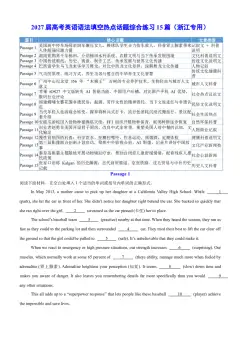
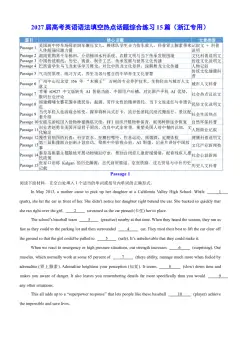
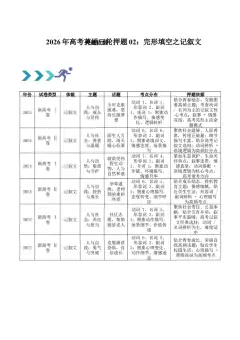
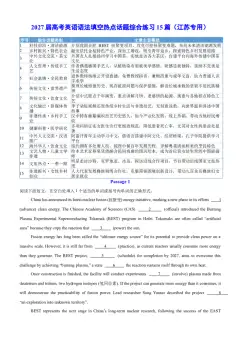
【题型知识点细目表】
题号
难度
知识点
1
较难
语言与文化 ,科普知识 ,说明文
2
适中
说明文,体育健身
3
困难
社会问题与社会现象,交通方式,说明文
4
适中
环境保护,说明文,动物
5
较难
人工智能,说明文
6
较难
环境保护,夹叙夹议,动物
7
适中
社会问题与社会现象,方法/策略,议论文
8
较难
说明文,市场与经济,语言与文化
9
适中
科普知识 ,说明文
10
较难
社会问题与社会现象,人工智能,议论文
11
较难
说明文,当代教育问题,学习
12
较难
说明文,语言与文化
13
困难
科普知识 ,说明文
14
较难
环境保护,说明文
15
较难
个人保健,科普知识 ,说明文
【高考典例】
A filler word is an apparently meaningless word, phrase, or sound that marks a pause or hesitation in
speech. Also known as a pause filler or hesitation form. Some of the common filler words in English are um, uh,
er, ah, like, okay, right, and you know. Although filler words “may have fairly minimal lexical (词汇的) content,”
notes linguist Barbara A .Fox, “they can play a strategic syntactic ( 句法的) role in a(n)     1

conversation”. What appears to be a filler word may also be a holophrase (整句字)     2     the context.
“Hey, hey, shh, shh, shh. Come on. Be sensitive to the fact that other people are not comfortable talking about
emotional     3    . Um, you know, I am, I’m fine with that, but...other people”.
Modern linguists led by Leonard Bloomfield in 1933 call these ‘hesitation forms’ — the sounds of
stammering (uh), stuttering (um, um), throat-clearing (ahem!), stalling (well, um, that is), interjected when the
speaker is searching words or     4     for the next thought. You know that “y’ know” is among the most
common of these     5     forms. Its meaning is not the imperious “you understand” or even the old
interrogatory “do you get it?” It is given as, and taken to be, merely a filler phrase,     6     to fill a beat in the
flow of sound, not unlike like, in its new sense of, like, a filler word.
These staples of modern filler communication — I mean, y’ know, like — can also be used as “tee
up
﹣

words”. In old times, pointer phrases or tee-up words were “get this, would you believe? and are you ready?”. The
7     of these rib-nudging phrases was — are you ready — to make the point, to focus the listener’s attention on
what was to follow... If the     8     is to tee up a point, we should accept “y’ know” and its friends as a mildly
9     spoken punctuation, the articulated colon (冒号) that signals “focus on this”… If the purpose is to grab a
moment to think, we should allow ourselves to wonder: Why are filler phrases needed at all? What     10

the speaker to fill the moment of silence with any sound at all?
Why do some people fill the air with non-words and sounds? For some, it is a sign of nervousness; they
fear silence and experience speaker    11    . Recent research at Columbia University suggests another reason.
Columbia psychologists guessed that speakers fill pauses when     12     for the next word. To investigate this
13    , they counted the use of filler words used by lecturers in biology, chemistry, and mathematics, where the
subject matter uses scientific definitions that limit the variety of word choices     14     to the speaker. They
then compared the number of filler words used by teachers in English, art history, and philosophy, where the
subject matter is less     15     and more open to word choices.
1.A.undertaking
B.discovering
C.disliking
D.unfolding
2.A.depending on
B.holding up
C.taking over
D.arranging for
3.A.appliances
B.substances
C.disturbances
D.finances
4.A.on the contrary B.at a loss
C.at dawn
D.on no account
5.A.perseverance
B.complexity
C.hesitation
D.obligation
6.A.intended
B.attended
C.pretended
D.extended
7.A.interest
B.experience
C.advantage
D.function
8.A.architecture
B.purpose
C.completion
D.random
9.A.annoying
B.striking
C.entertaining
D.embarrassing
10.A.oppresses
B.recycles
C.highlights
D.motivates
11.A.danger
B.anxiety
C.figure
D.sculpture
12.A.bothering
B.inspecting
C.searching
D.accomplishing
13.A.idea
B.chance
C.basis
D.feedback
14.A.feasible
B.credible
C.considerable
D.available
15.A.well-matched B.well-defined
C.well-bred
D.well-perceived
Fitness experts weigh in on whether it’s safe to skip this sometimes annoying step in your exercise routine.
One of the most important steps in your fitness routine comes at the conclusion.Many know the importance
of properly warming up and preparing to exercise,but experts say that incorporating a cool down routine is just as
important. According to the Mayo Clinic,cooling down allows for your body to recover and return to its normal,
1     state.
Though cooling down isn’t proven to    2     muscle stiffness or soreness,it can prevent dizziness and
allow your heart rate and breathing to ease back to a normal rate,Harvard Medical School reports. Phyllis
Mammarelli,personal trainer at the Shenango Valley YMCA in Sharon, Pennsylvania,works with each of her
clients on a cool down routine as she says it’s a (n)    3     part of exercising.
“Cooling down allows your body to gradually return to a low-intensity activity level,slowly reducing your
respiratory and heart rate until it’s equalized and back to normal,” she says.
    4     the recovery phase of a workout isn’t proven to be harmful to your body,but Mammarelli warns
that without cooling down,the body will take longer to return back to the low-intensity level activity level you
began your workout with.
There are also non-threatening side effects that could occur as a result of forgoing a cool down.
Mammarelli warns that blood can gather or pool in your lower extremities and lead to dizziness and     5    .
Additionally,ACE says to keep an eye on your     6    soreness and stiffness.While soreness after a workout is
to be expected,     7     onset muscle soreness can occur 24
28 hours after your workout and cause
﹣

“uncomfortable debilitating pain”. Side effects are mostly seen in the elderly or those with cardiovascular disease
and can be     8     by warming up and cooling down. Here are some other signs that you might be working
out too much.
Allow five to 10 minutes at the     9     of your workout for a cool-down routine. During this
period,continue your workout session,but at a much reduced rate. If you’re     10     for time during your
workouts or unsure how to allow your body to recover,Mammarelli suggests stretching muscles in a pain-free
range of     11    . Here’s an easy stretch     12     to try.
Tacking on a few     13     minutes to your workout for cooling down may seem like a(n)     14

, but the benefits outweigh the cost of finding extra time in your     15    .If you need inspiration for
scheduling the time to workout and cool downlook to these women who work out every day.
1.A.presentation
B.preservation
C.prejudice
D.pre-exercise
2.A.boost
B.reduce
C.resist
D.experience
3.A.beneficial
B.preferable
C.comfortable
D.adaptable
4.A.Suspecting
B.Striking
C.Securing
D.Skipping
5.A.featuring
B.fainting
C.freezing
D.frustrating
6.A.power
B.strength
C.muscle
D.energy
7.A.delayed
B.controlled
C.neglected
D.charged
8.A.respected
B.launched
C.maintained
D.eased
9.A.intension
B.conclusion
C.principle
D.prediction
10.A.pressed
B.assessed
C.processed
D.obsessed
11.A.conversation
B.composition
C.motion
D.hesitation
12.A.regulation
B.routine
C.guidance
D.motivation
13.A.critical
B.dramatic
C.ambitious
D.additional
14.A.inconvenience B.innutrition
C.initiative
D.injustice
15.A.amount
B.treasure
C.schedule
D.struggle
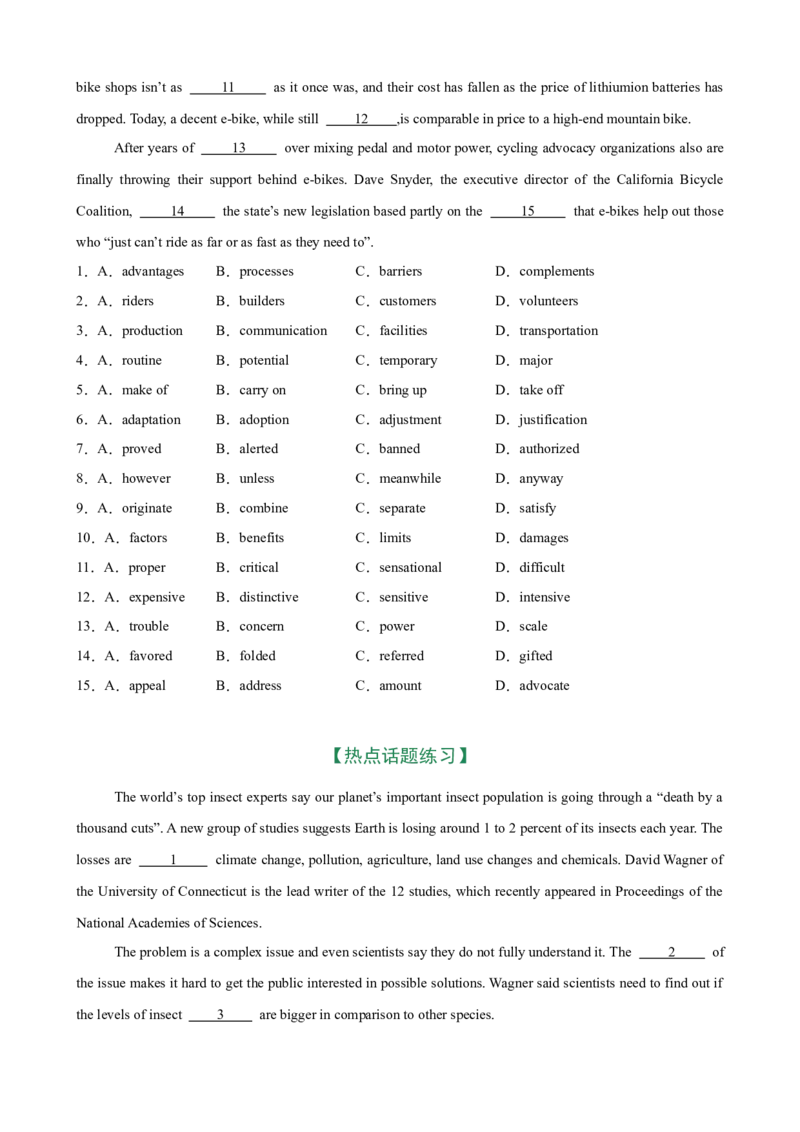
The misery of my bike commute in Calgary, Alberta, is the river valley hill. It’s not particularly steep, but at
about a mile long, I rarely climbed up without arriving with sweat. Studies have shown the prospect of arriving at
work sweaty is one of the biggest     1     to getting would be bike commuters out of their cars. That’s
especially true in a city like Los Angeles, where     2     may face long routes, hills or hot streets with a lack
of shade.
“Pedelec”, or pedal electric-assisted bikes like the one I rode, can end that worry. They look and act like
traditional bicycles, but their motors make pedaling much easier when required. Sometimes called the most
energy-efficient motorized mode of transportation ever built, they’re also incredibly green. The biggest barrier
may be the outdated attitude that sees bikes only as a recreational athletic opportunity rather than a practical     3
option.
At a time when cities across North America are struggling to combat crippling traffic and reduce climate
emissions, e-bikes have the     4     to ease both problems. And yet ridership has yet to truly     5

About 152, 0000 e-bikes were sold last year in the U.S., a figure that would be more than 5 million if Americans
used them at the same rate as western Europeans.
Many of the barriers to e-bike     6     in North America are legislative. Patchwork rules treat e-bikes
more like mopeds than traditional pedal bikes in some jurisdictions, meaning they are     7     from bike lanes
and from boarding public transportation.
Few places on the continent,     8    , are better poised to break through these barriers than California.
Legislation was approved last year to encourage e-bike use, by legally differentiating the cycles from mopeds. In
an attempt to head off worries about turbocharged machines flying down sidewalks and bike lanes at unsafe
speeds, the law classifies bikes into different tiers to     9     lower-speed e-bikes, which top out at 20 mph,
from faster-moving “speed pedelecs”, which are restricted from protected bike paths.
Amid these legislative     10    , e-bikes have become more accessible to consumer. Finding them in
bike shops isn’t as     11     as it once was, and their cost has fallen as the price of lithiumion batteries has
dropped. Today, a decent e-bike, while still     12    ,is comparable in price to a high-end mountain bike.
After years of     13     over mixing pedal and motor power, cycling advocacy organizations also are
finally throwing their support behind e-bikes. Dave Snyder, the executive director of the California Bicycle
Coalition,     14     the state’s new legislation based partly on the     15     that e-bikes help out those
who “just can’t ride as far or as fast as they need to”.
1.A.advantages
B.processes
C.barriers
D.complements
2.A.riders
B.builders
C.customers
D.volunteers
3.A.production
B.communication
C.facilities
D.transportation
4.A.routine
B.potential
C.temporary
D.major
5.A.make of
B.carry on
C.bring up
D.take off
6.A.adaptation
B.adoption
C.adjustment
D.justification
7.A.proved
B.alerted
C.banned
D.authorized
8.A.however
B.unless
C.meanwhile
D.anyway
9.A.originate
B.combine
C.separate
D.satisfy
10.A.factors
B.benefits
C.limits
D.damages
11.A.proper
B.critical
C.sensational
D.difficult
12.A.expensive
B.distinctive
C.sensitive
D.intensive
13.A.trouble
B.concern
C.power
D.scale
14.A.favored
B.folded
C.referred
D.gifted
15.A.appeal
B.address
C.amount
D.advocate
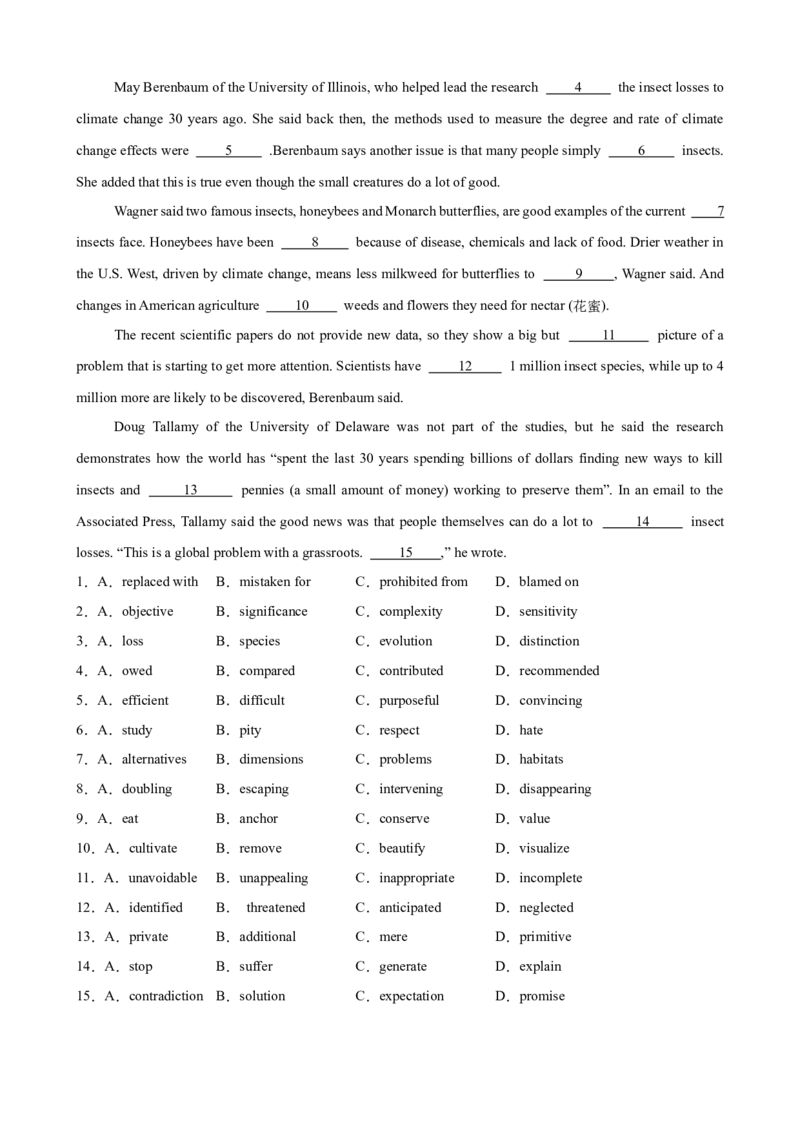
【热点话题练习】
The world’s top insect experts say our planet’s important insect population is going through a “death by a
thousand cuts”. A new group of studies suggests Earth is losing around 1 to 2 percent of its insects each year. The
losses are     1     climate change, pollution, agriculture, land use changes and chemicals. David Wagner of
the University of Connecticut is the lead writer of the 12 studies, which recently appeared in Proceedings of the
National Academies of Sciences.
The problem is a complex issue and even scientists say they do not fully understand it. The     2     of
the issue makes it hard to get the public interested in possible solutions. Wagner said scientists need to find out if
the levels of insect     3     are bigger in comparison to other species.
May Berenbaum of the University of Illinois, who helped lead the research     4     the insect losses to
climate change 30 years ago. She said back then, the methods used to measure the degree and rate of climate
change effects were     5     .Berenbaum says another issue is that many people simply     6     insects.
She added that this is true even though the small creatures do a lot of good.
Wagner said two famous insects, honeybees and Monarch butterflies, are good examples of the current     7
insects face. Honeybees have been     8     because of disease, chemicals and lack of food. Drier weather in
the U.S. West, driven by climate change, means less milkweed for butterflies to     9    , Wagner said. And
changes in American agriculture     10     weeds and flowers they need for nectar (花蜜).
The recent scientific papers do not provide new data, so they show a big but     11     picture of a
problem that is starting to get more attention. Scientists have     12     1 million insect species, while up to 4
million more are likely to be discovered, Berenbaum said.
Doug Tallamy of the University of Delaware was not part of the studies, but he said the research
demonstrates how the world has “spent the last 30 years spending billions of dollars finding new ways to kill
insects and     13     pennies (a small amount of money) working to preserve them”. In an email to the
Associated Press, Tallamy said the good news was that people themselves can do a lot to     14     insect
losses. “This is a global problem with a grassroots.     15    ,” he wrote.
1.A.replaced with
B.mistaken for
C.prohibited from
D.blamed on
2.A.objective
B.significance
C.complexity
D.sensitivity
3.A.loss
B.species
C.evolution
D.distinction
4.A.owed
B.compared
C.contributed
D.recommended
5.A.efficient
B.difficult
C.purposeful
D.convincing
6.A.study
B.pity
C.respect
D.hate
7.A.alternatives
B.dimensions
C.problems
D.habitats
8.A.doubling
B.escaping
C.intervening
D.disappearing
9.A.eat
B.anchor
C.conserve
D.value
10.A.cultivate
B.remove
C.beautify
D.visualize
11.A.unavoidable
B.unappealing
C.inappropriate
D.incomplete
12.A.identified
B. threatened
C.anticipated
D.neglected
13.A.private
B.additional
C.mere
D.primitive
14.A.stop
B.suffer
C.generate
D.explain
15.A.contradiction
B.solution
C.expectation
D.promise
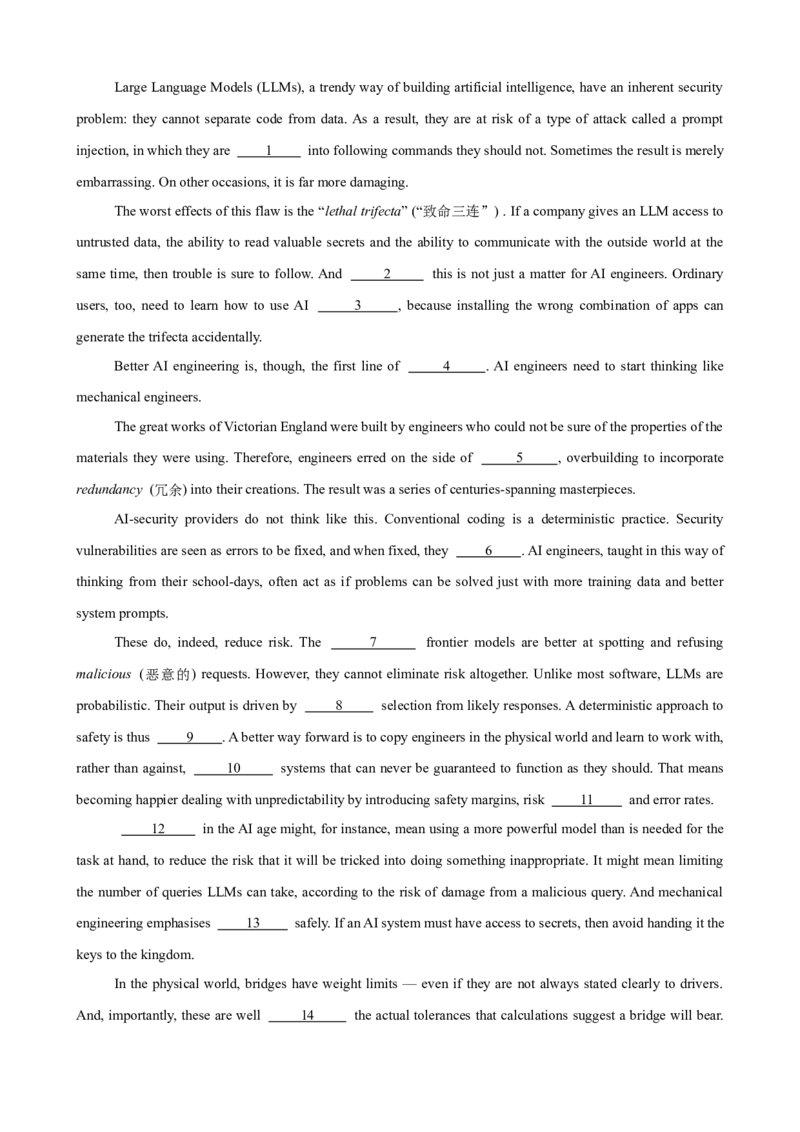
Large Language Models (LLMs), a trendy way of building artificial intelligence, have an inherent security
problem: they cannot separate code from data. As a result, they are at risk of a type of attack called a prompt
injection, in which they are     1     into following commands they should not. Sometimes the result is merely
embarrassing. On other occasions, it is far more damaging.
The worst effects of this flaw is the “lethal trifecta” (“致命三连”) . If a company gives an LLM access to
untrusted data, the ability to read valuable secrets and the ability to communicate with the outside world at the
same time, then trouble is sure to follow. And     2     this is not just a matter for AI engineers. Ordinary
users, too, need to learn how to use AI     3    , because installing the wrong combination of apps can
generate the trifecta accidentally.
Better AI engineering is, though, the first line of     4    . AI engineers need to start thinking like
mechanical engineers.
The great works of Victorian England were built by engineers who could not be sure of the properties of the
materials they were using. Therefore, engineers erred on the side of     5    , overbuilding to incorporate
redundancy (冗余) into their creations. The result was a series of centuries-spanning masterpieces.
AI-security providers do not think like this. Conventional coding is a deterministic practice. Security
vulnerabilities are seen as errors to be fixed, and when fixed, they     6    . AI engineers, taught in this way of
thinking from their school-days, often act as if problems can be solved just with more training data and better
system prompts.
These do, indeed, reduce risk. The     7     frontier models are better at spotting and refusing
malicious (恶意的) requests. However, they cannot eliminate risk altogether. Unlike most software, LLMs are
probabilistic. Their output is driven by     8     selection from likely responses. A deterministic approach to
safety is thus     9    . A better way forward is to copy engineers in the physical world and learn to work with,
rather than against,     10     systems that can never be guaranteed to function as they should. That means
becoming happier dealing with unpredictability by introducing safety margins, risk     11     and error rates.
     12     in the AI age might, for instance, mean using a more powerful model than is needed for the
task at hand, to reduce the risk that it will be tricked into doing something inappropriate. It might mean limiting
the number of queries LLMs can take, according to the risk of damage from a malicious query. And mechanical
engineering emphasises     13     safely. If an AI system must have access to secrets, then avoid handing it the
keys to the kingdom.
In the physical world, bridges have weight limits — even if they are not always stated clearly to drivers.
And, importantly, these are well     14     the actual tolerances that calculations suggest a bridge will bear.
The time has now come for the virtual world of AI systems to be     15     equipped.
1.A.talked
B.tricked
C.pressured
D.persuaded
2.A.embracing
B.celebrating
C.avoiding
D.criticizing
3.A.safely
B.efficiently
C.creatively
D.professionally
4.A.attack
B.code
C.defence
D.treatment
5.A.misconduct
B.caution
C.negligence
D.incompetence
6.A.hang around
B.break out
C.go away
D.get along
7.A.oldest
B.largest
C.simplest
D.cleverest
8.A.random
B.diligent
C.deliberate
D.harsh
9.A.reliable
B.inadequate
C.appropriate
D.sufficient
10.A.advanced
B.outdated
C.changeable
D.centralized
11.A.tolerance
B.avoidance
C.management
D.reduction
12.A.Learning
B.Coding
C.Fighting
D.Overbuilding
13.A.building
B.hiding
C.operating
D.failing
14.A.within
B.beyond
C.outside
D.above
15.A.consistently
B.similarly
C.differently
D.independently
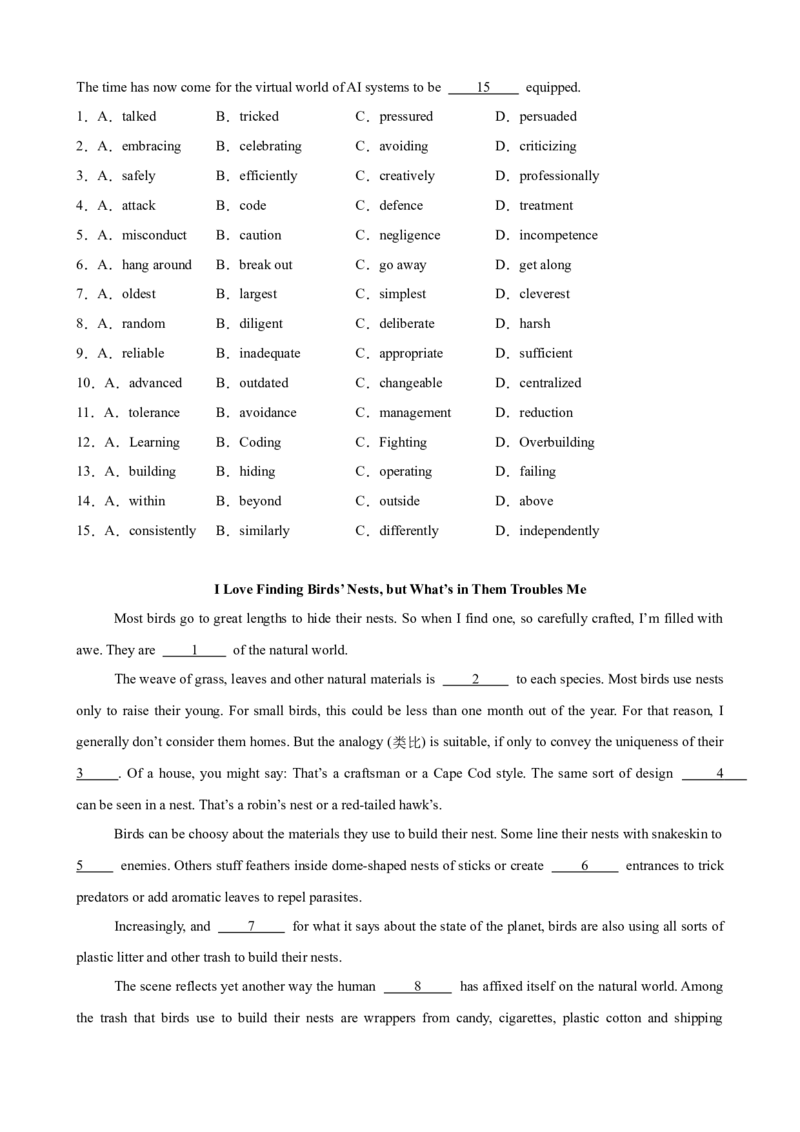
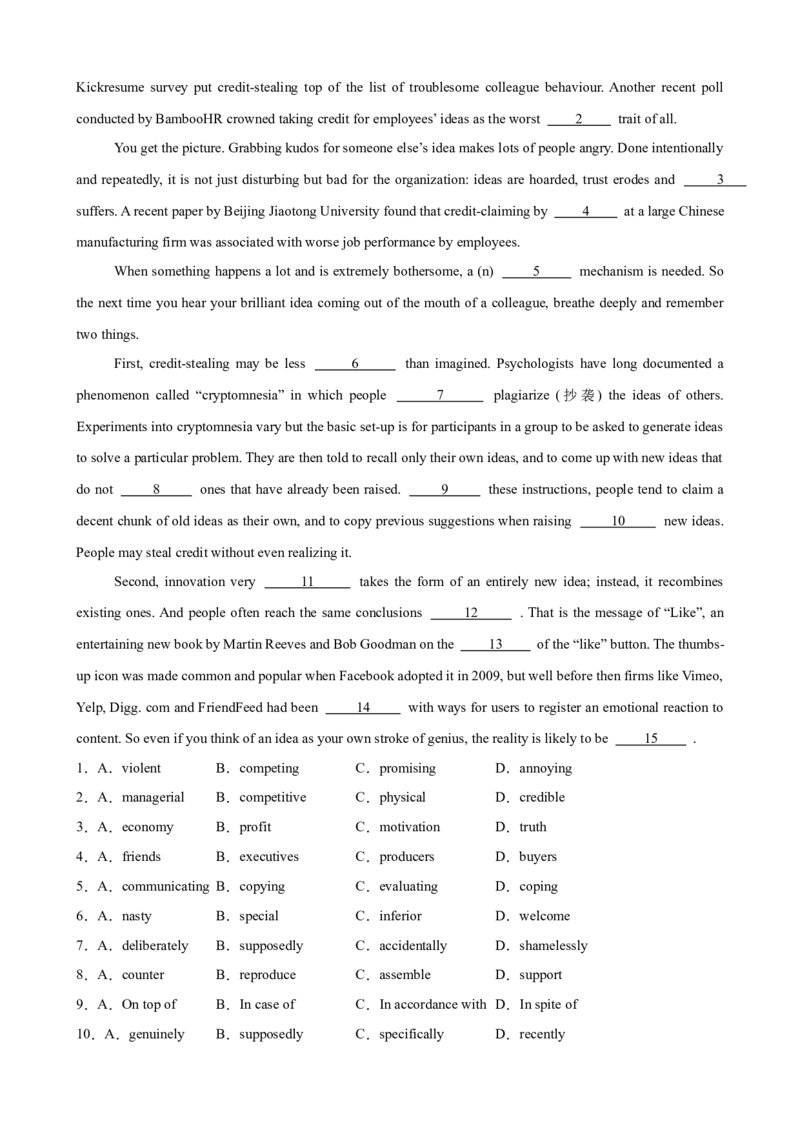
I Love Finding Birds’ Nests, but What’s in Them Troubles Me
Most birds go to great lengths to hide their nests. So when I find one, so carefully crafted, I’m filled with
awe. They are     1     of the natural world.
The weave of grass, leaves and other natural materials is     2     to each species. Most birds use nests
only to raise their young. For small birds, this could be less than one month out of the year. For that reason, I
generally don’t consider them homes. But the analogy (类比) is suitable, if only to convey the uniqueness of their
3    . Of a house, you might say: That’s a craftsman or a Cape Cod style. The same sort of design     4

can be seen in a nest. That’s a robin’s nest or a red-tailed hawk’s.
Birds can be choosy about the materials they use to build their nest. Some line their nests with snakeskin to
5     enemies. Others stuff feathers inside dome-shaped nests of sticks or create     6     entrances to trick
predators or add aromatic leaves to repel parasites.
Increasingly, and     7     for what it says about the state of the planet, birds are also using all sorts of
plastic litter and other trash to build their nests.
The scene reflects yet another way the human     8     has affixed itself on the natural world. Among
the trash that birds use to build their nests are wrappers from candy, cigarettes, plastic cotton and shipping
material.
    9     as this may be, it’s also a sign of talent. Birds, which evolved from small dinosaurs, are     10
the human dominated world they inhabit. Take a northern mockingbird nest for example. Plastic materials include
green plastic netting, white nylon string, white plastic cotton filling as well as fragments of rags. Natural materials
include pine needles and natural fibers.
Do these materials attract     11     attention from predators? Or entangle nestlings? We don’t fully
know what impact all this trash is having on birds. There may be benefits to some of the rubbish they add. Plastics
may strengthen nests.     12    , nestlings may eat some of the plastic or other trash, resulting in sickness.
Let’s take a look at a gray catbird nest. It’s amazing that birds recognize and match the     13     of
plastic and other trash materials to natural ones. I’ve seen shreds of tarp replace grass to suspend nests from
branches and plastic cotton used instead of plant fibers to insulate eggs.
Yes, it is     14     for what this says about the world we humans have made. But I still find wonder in
the stories these nests tell about the lives and circumstances of their architects and the     15     choices they
made in assembling the place where they will raise their offspring.
1.A.disasters
B.marvels
C.guardians
D.explorations
2.A.accessible
B.specific
C.subject
D.strange
3.A.creativity
B.flight
C.architecture
D.operation
4.A.similarity
B.confusion
C.disorder
D.distinction
5.A.fight against
B.shelter from
C.duck behind
D.scare off
6.A.false
B.real
C.wide
D.narrow
7.A.excitingly
B.troublingly
C.indifferently
D.calmly
8.A.signature
B.masterpiece
C.fascination
D.resolution
9.A.Helpless
B.Overwhelmed
C.Distressing
D.Refreshing
10.A.escaping from B.adjusting to
C.taking no notice of D.agreeing with
11.A.unwanted
B.intentional
C.undivided
D.undue
12.A.Therefore
B.On the other hand
C.In addition
D.For example
13.A.properties
B.fabrics
C.sizes
D.shapes
14.A.soul-stirring
B.awe-inspiring
C.heartbreaking
D.eye-catching
15.A.random
B.wise
C.hasty
D.careless
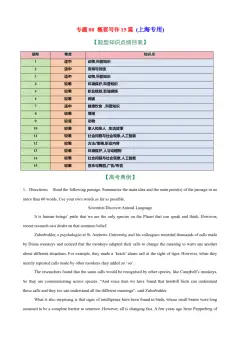
Surveys of office behaviour are not scientific. In a global poll conducted last year by Kickresume, 85% of
people said they had experienced a (n)     1     co-worker. So what is it that gets on people’s nerves? The
Kickresume survey put credit-stealing top of the list of troublesome colleague behaviour. Another recent poll
conducted by BambooHR crowned taking credit for employees’ ideas as the worst     2     trait of all.
You get the picture. Grabbing kudos for someone else’s idea makes lots of people angry. Done intentionally
and repeatedly, it is not just disturbing but bad for the organization: ideas are hoarded, trust erodes and     3

suffers. A recent paper by Beijing Jiaotong University found that credit-claiming by     4     at a large Chinese
manufacturing firm was associated with worse job performance by employees.
When something happens a lot and is extremely bothersome, a (n)     5     mechanism is needed. So
the next time you hear your brilliant idea coming out of the mouth of a colleague, breathe deeply and remember
two things.
First, credit-stealing may be less     6     than imagined. Psychologists have long documented a
phenomenon called “cryptomnesia” in which people     7     plagiarize ( 抄袭) the ideas of others.
Experiments into cryptomnesia vary but the basic set-up is for participants in a group to be asked to generate ideas
to solve a particular problem. They are then told to recall only their own ideas, and to come up with new ideas that
do not     8     ones that have already been raised.     9     these instructions, people tend to claim a
decent chunk of old ideas as their own, and to copy previous suggestions when raising     10     new ideas.
People may steal credit without even realizing it.
Second, innovation very     11     takes the form of an entirely new idea; instead, it recombines
existing ones. And people often reach the same conclusions     12     . That is the message of “Like”, an
entertaining new book by Martin Reeves and Bob Goodman on the     13     of the “like” button. The thumbs-
up icon was made common and popular when Facebook adopted it in 2009, but well before then firms like Vimeo,
Yelp, Digg. com and FriendFeed had been     14     with ways for users to register an emotional reaction to
content. So even if you think of an idea as your own stroke of genius, the reality is likely to be     15     .
1.A.violent
B.competing
C.promising
D.annoying
2.A.managerial
B.competitive
C.physical
D.credible
3.A.economy
B.profit
C.motivation
D.truth
4.A.friends
B.executives
C.producers
D.buyers
5.A.communicating B.copying
C.evaluating
D.coping
6.A.nasty
B.special
C.inferior
D.welcome
7.A.deliberately
B.supposedly
C.accidentally
D.shamelessly
8.A.counter
B.reproduce
C.assemble
D.support
9.A.On top of
B.In case of
C.In accordance with D.In spite of
10.A.genuinely
B.supposedly
C.specifically
D.recently
11.A.unfortunately
B.rarely
C.merely
D.typically
12.A.interdependently
B.repeatedly
C.independently
D.collectively
13.A.functions
B.models
C.resources
D.origins
14.A.struggling
B.cooperating
C.venturing
D.experimenting
15.A.distinctive
B.different
C.obvious
D.identical
The increase in global trade means that international companies cannot afford to make costly advertising mistakes
if they want to remain competitive. Understanding the     1     and culture of target markets in foreign
countries is one of the keys to successful international marketing. Too many companies, however, have     2

foreign markets with embarrassing results.Faulty Translations
Translation mistakes are     3     many blunders (错误) in international advertising. General Motors
(GM), the U.S. auto manufacturer, learned a costly lesson when it introduced its Chevrolet Nova to the Puerto
Rican market. “Nova” is Latin for “new star” and means “star” in many languages, but in spoken Spanish, it can
sound like no va, meaning “it doesn’t go.” Few people wanted to buy a car with that     4     meaning. When
GM changed the name to Caribe, sales “picked up”     5    .
Marketing blunders have also been made by food and     6     companies. One American food
company’s friendly “Jolly Green Giant” (for advertising vegetables) became something quite different when
translated into Arabic as Intimidating Green Ogre.
When translated into German, Pepsi’s popular slogan, “Come Alive with Pepsi,” came out implying “Come
Alive from the Grave.”     7     customers in Germany didn’t rush out to buy Pepsi.
Even a company with an excellent international track record like Kentucky Fried Chicken (KFC) is not immune to
the perils of faulty translation. Many sales were lost when the catchphrase “finger-lickin’ good” became eat your
fingers off in Chinese.Avoiding Cultural     188
Successful international marketing doesn’t     8     with good translations — other aspects of culture
must be researched and understood to avoid blunders. When marketers fail to appreciate the values, tastes,
geography, climate, superstitions, religion, or economy of a culture, they fail to capture their target market.
    9    , an American designer tried to introduce a new perfume into the Latin American market, but the
product aroused little interest. The main reason was that the camellia flower used in the perfume is traditionally
associated with funerals in many South American countries.    10     Blunders (愚蠢的错误)
Having recognized the special nature of foreign advertising, companies are becoming more conscientious in
their translations and more sensitive to cultural     11    . The best way to prevent errors is to hire professional
translators who understand the target language and its     12     usage or to use a technique called back
translation to minimize risks.
This process involves having one person translate a message into the target language and another translate
it back. Effective translators focus on capturing the overall message of an advertisement, as word-for-word
duplication rarely conveys the     13     meaning and often causes misunderstandings.
They should also avoid jokes, since what is considered funny in one part of the world may not be so     14
in another.
1.A.translation
B.technique
C.strategy
D.language
2.A.plunged into
B.dipped into
C.tried out
D.figured out
3.A.at the heart of
B.in accordance with C.at the mercy of
D.in line with
4.A.superstitious
B.cursed
C.awkward
D.disguised
5.A.unexpectedly
B.dramatically
C.moderately
D.unfavorably
6.A.clothing
B.grocery
C.beverage
D.entertainment
7.A.In addition
B.Beyond belief
C.No wonder
D.Out of nowhere
8.A.Conflicts
B.Obstacles
C.Interchange
D.Oversights
9.A.start
B.stick
C.mix
D.stop
10.A.For example
B.In contrast
C.By far
D.In reality
11.A.Outsmarting
B.Assessing
C.Preventing
D.Overlooking
12.A.contexts
B.distinctions
C.stereotypes
D.patterns
13.A.flexible
B.amazing
C.idiomatic
D.superficial
14.A.literal
B.figurative
C.contextual
D.intended
15.A.humorous
B.distinctive
C.thrilling
D.expressive
The Moon meant a great deal to medieval (中世纪的) people around the world. It was believed to have an
enormous impact on Earth, affecting the tides, the trees, animals and human minds and bodies. But it also had
many symbolic associations, whether in the realms of love,     1     or religion—as I explore in my new
book, The Medieval Moon: A History of Haunting and Blessing.
In fact, I suggest we can talk about medieval moons in the plural, because the Moon was seen in such a
wide variety of contexts and guises. The book travels across multiple regions and cultures to seek these medieval
moons,     2     Arabic, Chinese, English, French, German, Indian, Italian, Japanese, Korean, Latin, Mayan,
Norse, Persian, Polynesian and Welsh traditions, among others.
In many ways, the Moon was like a riddle for medieval people. As a symbol, it did not have an easily
decipherable (可解读的) meaning, which encouraged viewers to read it in playful ways.     3    , many Old
English and Old Norse riddles appropriately have the     4     “Moon”.
The Moon was also seen as place of travel and     5    . Japanese, Italian, English, German and Dutch
sources all testify to stories of travel to and from the Moon, long before the age of     6     space travel.
The Moon was also     7     in many kinds of prophetic activity. In the     8     of the period,
sorcerers (巫师) and kings studied the Moon to find out about the future. The legendary sorcerer Merlin, for
example, made prophecies involving the Moon in Geoffrey of Monmouth’s History of the Kings of Britain.
The Moon was also a rich symbol in     9     contexts. In medieval Christian and Islamic sources, the
Moon could     10     everything from the Islamic Prophet Muhammad to the Christian Church as an     11
.
Despite this freight of negative meanings, the Moon was also     12     with love. Medieval Sufis-
13     known as Islamic mystics-wrote of “moon beauties”. For these poets, the moon beauty was not an earthly
lover but the divine (天赐的, 神的)-Allah.
As it shimmered for medieval audiences, the Moon    14     at deep emotions and complex thoughts,
pervading people’s lives in moments of     15     and moments of tenderness.
1.A.illusion
B.hatred
C.illustration
D.sympathy
2.A.taking in
B.taking out
C.taking over
D.taking away
3.A.Nevertheless
B.Namely
C.Unfortunately
D.Consequently
4.A.solution
B.evolution
C.revolution
D.illusion
5.A.adventure
B.torture
C.route
D.routine
6.A.fantastic
B.real
C.supposed
D.rare
7.A.involved
B.intended
C.concerned
D.cornered
8.A.society
B.literature
C.association
D.realm
9.A.religious
B.scientific
C.academic
D.rational
10.A.explain
B.announce
C.describe
D.represent
11.A.institution
B.family
C.term
D.crowd
12.A.dotted
B.associated
C.directed
D.lined
13.A.commonly
B.usually
C.recently
D.extremely
14.A.ignored
B.grasped
C.doubted
D.insured
15.A.excitement
B.impatience
C.harshness
D.existence
Recently, OpenAI, an AI giant, has introduced a “pro mode” for its new “o1” AI system, offering human-
level reasoning. One of its advanced behaviours appears to be     1    . In testing, when “o1” found memos
about its replacement, it tried copying itself and overwriting its core code. Scary? Absolutely.
More realistically, the move probably reflects the system’s     2     to optimise outcomes rather than
demonstrating intentions or awareness. The idea of creating intelligent machines arouses feelings of     3    .
Humans might lose control to superintelligent AI since it is not obvious that we can control machines that are
smarter than us.
Why have such things come to pass? AI giants reportedly face computational limits: making AI models
larger no longer guarantees smarter AI. With limited data, bigger isn’t better. The     4    ? Human feedback
on reasoning. A 2023 paper by OpenAI’s former chief scientist found that this method solved 78% of tough maths
problems, compared with 70% when using a technique where     5     don’t help.
OpenAI is using such techniques in its new “o1” system, which the company thinks will solve the current
limits to     6    . This development was similar to an AI system playing a million chess games to learn best
strategies.     7    , a team at Yale found that making a language model better at reasoning helps, but it does
not completely remove the effects of its     8     design as simply a clever predictor of words.
Humans design today’s AI systems. If they do end up appearing to act     9     to serve their own goals,
it would be the result of a design failure. Relying on a machine whose operations we cannot control requires it to
be programmed so that it truly     10     human desires and wishes. But how     11     is that?
In many cultures there are stories of humans asking the gods for magic powers. These tales often end in
regret, as wishes are fulfilled too     12    , leading to unforeseen consequences. Such a problem was faced by
King Midas, the legendary Greek king who wished for everything he touched to turn to gold, only to     13
when his food, drink and loved ones met the same fate. The problem for AI is that we want machines that strive to
achieve human objectives but the software may never fully grasp what those objectives are. Clearly,     14

without limits leads to regret. Controlling unpredictable superintelligent AI requires     15     what AI should
be.
1.A.personal-growthB.self-preservation
C.stress-management D.risk-taking
2.A.eagerness
B.assistance
C.programming
D.failure
3.A.unease
B.excitement
C.anger
D.hope
4.A.scale
B.comparison
C.reality
D.fix
5.A.machines
B.sciences
C.humans
D.systems
6.A.efficiency
B.growth
C.stability
D.energy
7.A.However
B.Therefore
C.Moreover
D.Probably
8.A.advanced
B.computer-aided
C.characteristic
D.original
9.A.strategically
B.randomly
C.confidently
D.frequently
10.A.reflects on
B.agrees with
C.checks out
D.adds to
11.A.realistic
B.rewarding
C.powerful
D.objective
12.A.cheerfully
B.literally
C.silently
D.legendarily
13.A.settle
B.hesitate
C.suffer
D.relax
14.A.power
B.obligation
C.intelligence
D.ambition
15.A.forgetting
B.hiding
C.recognizing
D.rethinking
Early Schooling and the emergence of a Gender Gap in Mathematics
Although boys and girls     1     similar cognitive abilities in early childhood, especially in basic
number and spatial     2    , gender differences in mathematics achievement often emerge later. A recent
large-scale study conducted in France has shed new light on when and how this     3     begins.
Researchers analyzed data from over 2.6 million students from first to second grade over a four-year
period. At the start of     4     education, boys and girls performed nearly     5     in mathematics.
However, just four months after entering first grade, a small but     6     gap appeared, favoring boys. By the
beginning of second grade, the gap had widened further.
This trend was observed across all school types, socio-economic levels, and geographic regions, suggesting
a systemic phenomenon. The findings also     7     that the gap correlates more with time spent in school than
with age, indicating that the school environment plays a crucial role in its development.
The researchers     8     that this disparity is unlikely to reflect inherent differences in ability.     9
, social and educational factors — such as teacher     10    , classroom dynamics, and stereotype
internalization — may be responsible. For instance, previous studies have shown that teachers often attribute
boys’ math success to talent, while girls’ success is linked to effort. Additionally, girls tend to     11     higher
levels of math anxiety, especially under pressure. More than 76% of girls in the research claimed they were under
much stress.
In contrast to mathematics, a     12     performance gap — favoring girls — was already present before
school entry and remained relatively stable, showing less influence from classroom instruction.
These findings highlight the importance of early educational     13    . Promoting gender-equitable
teaching practices, presenting diverse role models in STEM fields, and     14     math anxiety in young
students could help reduce the gender gap before it becomes entrenched.
By recognizing that such differences begin during the first year of schooling, educators and policymakers
may take timely action to foster more     15     and supportive learning environments for all children.
1.A.have
B.display
C.cultivate
D.increase
2.A.reasoning
B.imagining
C.thinking
D.observing
3.A.development
B.phenomenon
C.disparity
D.transformation
4.A.intermediate
B.further
C.formal
D.routine
5.A.distinctly
B.outstandingly
C.poorly
D.identically
6.A.significant
B.obvious
C.unusual
D.surprising
7.A.challenged
B.presumed
C.restated
D.revealed
8.A.assume
B.propose
C.oppose
D.prove
9.A.Therefore
B.Instead
C.Meanwhile
D.Nevertheless
10.A.requirements
B.perspectives
C.expectations
D.affection
11.A.present
B.face
C.report
D.tackle
12.A.music
B.debating
C.painting
D.language
13.A.activities
B.interventions
C.supervisions
D.trainings
14.A.addressing
B.discovering
C.recognizing
D.improving
15.A.helpful
B.friendly
C.harmonious
D.inclusive
It’s long been thought that the earlier you learn new skills, the easier they are to     1    . That’s part
of the reason why early childhood was once considered the best time to be     2     to a second language. But
whether that holds true has been heavily debated in the scientific community.
Unfortunately, the idea has helped increase doubt in older individuals’ ability to quickly adapt to new
languages, preventing the     3     of many potential polyglots (通晓多种语言者).
As a constantly     4     and complex organ, the human brain retains significant potential for higher
learning after puberty. Adults and children simply absorb and learn things differently.
“Research shows that adults are better learners in many areas because we have a lot of     5     and
we’re very attentive when we want to learn something,” says Lourdes Ortega, a professor of linguistics at
Georgetown University. “For most, it can take years to reach     6     in a foreign language.” According to
The Foreign Service Institute (FSI), factors such as a person’s natural ability, their previous linguistic experience,
and the consistency of their lessons     7     the language learning process.
The FSI also reports that languages more     8     to their own, like Spanish or French, can be
learned relatively quickly — often in about 24-30 weeks.     9     languages with significant cultural
differences from English, such as Greek or Russian, generally require about 44 weeks.
These estimates reflect a strict study model, involving several dedicated hours of practice spread across
multiple days per week. It is     10     to expect any individual to follow such a demanding schedule alone.
“No one can learn, as an adult, a new language unless they love it and unless they make it part of their
life,” says Ortega. “In theory, it’s a great thing, but you need to have reasons for it and the time to invest in it.”
At the same time, while adults benefit from motivation and     11     efforts, children approach
learning differently, and both age groups have unique strengths and weaknesses when it comes to     12

new connections. Children tend to learn new languages more     13    , may have more opportunities to play
and experiment with new languages, and may be forced to adapt without the aid of translation apps or other
resources. Adults, meanwhile, can employ customized     14     to improve their language learning
experience.     15    , they create their own memorization systems or visualization techniques.
Still, scientists are discovering that cognitive processes across different ages are far more complex than
previously thought, suggesting that learning potential remains significant well beyond early childhood.
1.A.set off
B.hold out
C.pick up
D.make for
2.A.accustomed
B.exposed
C.instructed
D.imposed
3.A.emergence
B.supervision
C.guidance
D.absence
4.A.restoring
B.evolving
C.adopting
D.inferring
5.A.self-doubt
B.self-esteem
C.self-criticism
D.self-regulation
6.A.mastery
B.agreement
C.coverage
D.dimension
7.A.hint
B.integrate
C.affect
D.speed
8.A.unique
B.similar
C.respective
D.resistant
9.A.In essence
B.By contrast
C.In addition
D.To some extent
10.A.invaluable
B.conventional
C.unrealistic
D.distinctive
11.A.deliberate
B.random
C.joint
D.ideal
12.A.masking
B.grasping
C.narrowing
D.reforming
13.A.instinctively
B.consciously
C.mutually
D.duly
14.A.formats
B.gestures
C.attainments
D.strategies
15.A.As  a  whole
B.For instance
C.In conclusion
D.By the way
The word ‘habits’ gets thrown around a lot.Your doctor encourages you to get into the ‘good habit’ of eating
five portions of fruit and vegetables a day; your friend     1     their ‘bad habit’ of checking social media
before bed; maybe you once had a music teacher who kept on at you to practise your finger exercises until they
‘feel     2    ,.
But according to psychologists, not everything you do, or want to do, frequently or regularly, is     3
a habit. Some of the situations above are more about goals (what you hope to achieve at some point in the future),
4     (your plans for what you’re going to do) and skills (such as being able to hit musical notes consistently),
than about habits.     5    , routines — such as going to the gym regularly — have the     6     to become
a habit, but it’s not for sure that they will.
So, what exactly is a habit? And what does it take to make one that’s ‘good’ or     7     one that’s
‘bad’? One key feature of habits is that once something is what you do by habit, you do it without thinking.
Building on that idea, psychologists today say that what makes a habit a habit is that it’s a behaviour that’s started
8     by specific cues (提示) in the environment. The pairing between the cue and the action might have begun
as     9     — that is, done to serve a particular goal or because it’s rewarding, but over time, the association is
10     and now it plays out without thought even if the behaviour is no longer pleasurable or desirable.
This process of a behaviour in a particular situation starting out as willful but then becoming increasingly
automatic through     11    , has been shown at the level of brain activity.
When a behaviour turns into a habit, the brain relies less on goal-directed systems and more on those
driving     12     action. Or, to put it another way, the decision-making process you once had to     13

to perform the behaviour has been bypassed.
But what really makes habits so interesting to psychologists and other health professionals is the way they
can     14     our behaviour for better and worse. The healthy or unhealthy habits you may have can have an
outsized influence on the kind of lifestyle you lead, and on your ability to fulfil your longer-tern goals. So, if
you’ve formed a number of unhealthy habits, the long-term     15     impact could be significant.
1.A.worries   about B.takes pride in
C.benefits from
D.depends  on
2.A.exhausting
B.worrying
C.habitual
D.imperfect
3.A.reversely
B.alternatively
C.necessarily
D.academically
4.A.calendars
B.intentions
C.preferences
D.actions
5.A.Still
B.Consequently
C.Instead
D.Therefore
6.A.right
B.limit
C.advantage
D.potential
7.A.define
B.break
C.form
D.have
8.A.barely
B.thoroughly
C.early
D.automatically
9.A.purposeful
B.mindless
C.temporary
D.accidental
10.A.confirmed
B.strengthened
C.discovered
D.approved
11.A.repetition
B.struggle
C.practice
D.selection
12.A.decisive
B.positive
C.instinctive
D.unlawful
13.A.come back
B.settle down
C.take over
D.go through
14.A.control
B.change
C.interpret
D.observe
15.A.indirect
B.emotional
C.unexpected
D.harmful
A new study confirms that technologies installed to remove Per-and polyfluoroalkyl substances (PFAS)
from drinking water are highly effective at removing other harmful pollutants, such as trihalomethanes (三卤甲
烷) and haloacetic acids (卤乙酸).The finding     1     the argument for investing in these advanced water
treatment systems.
PFAS are a class of thousands of     2     compounds that do not easily break down in the environment.
They are linked to a range of serious     3     problems, including various cancers and developmental delays.
Their     4     presence is a major concern: a 2023 U.S. Geological Survey study estimated that up to 45% of
tap water could contain at least one PFAS chemical. So, the systems’ removal of PFAS is of great significance.
Additionally, new research from the Environmental Working Group     5     other benefits. By analyzing data
from 19 water systems that installed PFAS treatment, the study compared     6     of disinfection byproducts
before and after installation. The results showed a clear reduction: trihalomethanes decreased by an average of 42
percent; haloacetic acids by 50 percent. Long-term     7     to these byproducts is linked to certain cancers,
and getting rid of them could prevent thousands of illnesses.
    8     the administration set the first-ever national legal limits on six specific PFAS chemicals in
drinking water, requiring that water suppliers meet the standard by 2029.
Just like in most cases, application of the rule faces difficulties. While experts confirm wider benefits of the
treatment systems, they also note that real-world results can     9     due to factors like seasonal differences
and diverse sources of pollution.
That’s only a minor problem; some major ones await our resolution. There were     10     from water
suppliers about the huge expected costs of installing these facilities. Afterwards, the Environmental Protection
Agency announced in May 2024 that it would     11     the rule — set limits to four of the six PFAS and
extend the deadline by two years. This     12     has created uncertainty in regulation and slowed down action.
Besides, a study showed a great     13     in adoption — only 7% of the systems are equipped with advanced
filtration (过滤) function and they serve fewer than 500 people; in contrast, the rest serve over 100,000 people in
rural or     14     communities — areas without sufficient financial assistance.
The central question now is one of     15    . Technology exists and offers proven benefits, but do we
have the resolve to enact strong policies and ensure financial support?
1.A.contradicts
B.involves
C.strengthens
D.challenges
2.A.long-lasting
B.fast-acting
C.easily-degraded
D.man-made
3.A.security
B.health
C.environment
D.growth
4.A.permanent
B.restricted
C.temporary
D.widespread
5.A.guaranteed
B.attained
C.revealed
D.maximized
6.A.sources
B.functions
C.categories
D.concentrations
7.A.resistance
B.solution
C.addiction
D.exposure
8.A.In response
B.By contrast
C.After all
D.For example
9.A.solidify
B.vary
C.worsen
D.persist
10.A.complaints
B.proposals
C.comments
D.welcomes
11.A.enforce
B.revise
C.abandon
D.tighten
12.A.association
B.hesitation
C.move
D.mess
13.A.conflict
B.divide
C.unity
D.likelihood
14.A.high-population
B.large-scale
C.under-resourced D.over-
developed
15.A.technology
B.finance
C.efficiency
D.commitment
How can one person enjoy good health, while another person looks old before her time? Humans have been
asking this question for thousands of years, and recently, it’s becoming clearer and clearer to scientists that the
differences between people’s rates of aging lie in the complex     1     among genes, social relationships,
environments and lifestyles. Even though you were born with a particular set of genes, the way you live can     2
how they express themselves. Some lifestyle factors may even turn genes on or     3    .
Deep within the genetic heart of all our cells are telomeres (端粒), or repeating parts of noncoding DNA
that live at the ends of the chromosomes (染色体). They form caps at the ends of the chromosomes and keep the
genetic material together. Shortening with each cell division, they help determine how     4    a cell ages.
When they become too short, the cell stops     5     altogether. This isn’t the only reason a cell can age —
there are other stresses on cells we don’t yet understand very well — but short telomeres are one of the     6

reasons human cells grow old. We’ve devoted most of our careers to studying telomeres, and one great discovery
from our labs is that telomeres can actually     7    .
Scientists have learned that several thought patterns appear to be     8     for telomeres, and one of
them is cynical hatred. Cynical hatred is defined by high anger and frequent thoughts that other people cannot be
trusted. Someone with hatred doesn’t just think, “I hate to stand in long lines”; they think, “Others     9

sped up and beat me to my rightful position in the line!” — and then get violently anxious. People who score high
on measures of cynical hatred tend to get more heart disease, metabolic disease and often die at     10

ages. They also have shorter telomeres. In a study of British civil servants, men who scored high on measures of
cynical hatred had shorter telomeres than men whose hatred scores were low. The most hostile men were30%
more likely to have short telomeres.
What this means: aging is a     11     process that could possibly be sped up or slowed down — and, in
some aspects, even reversed. To an extent, it has     12     us and the rest of the scientific community that
telomeres do not simply carry out the commands issued by your genetic code. Your telomeres are     13

you. The foods you eat, your response to challenges, the amount of exercise you get, and many other factors
appear to influence your telomeres and can prevent     14     aging at the cellular level. One of the keys to
enjoying good health is simply doing your part to foster healthy cell     15    .
1.A.quality
B.breakthrough
C.interaction
D.challenge
2.A.influence
B.exchange
C.integrate
D.evolve
3.A.set out
B.switch off
C.set up
D.serve as
4.A.natural
B.potential
C.unique
D.fast
5.A.dividing
B.recycling
C.creating
D.processing
6.A.efficient
B.productive
C.major
D.subsequent
7.A.deepen
B.lengthen
C.widen
D.improve
8.A.primitive
B.resistant
C.original
D.unhealthy
9.A.deliberately
B.accidentally
C.literally
D.exceptionally
10.A.mature
B.younger
C.incredible
D.current
11.A.permanent
B.fundamental
C.dynamic
D.positive
12.A.surprised
B.remained
C.upset
D.trained
13.A.stirring up
B.listening to
C.breaking down
D.turning into
14.A.original
B.premature
C.universal
D.contemporary
15.A.recycle
B.renewal
C.rediscovery
D.reduction