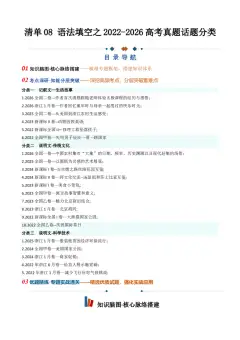
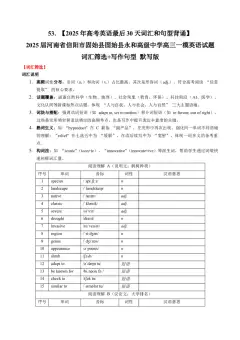
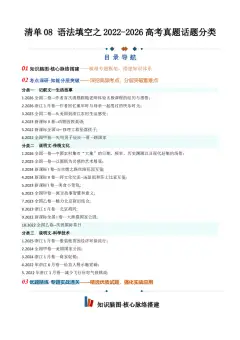
2027 届高考英语语法填空热点话题综合练习 15 篇(浙江专用)
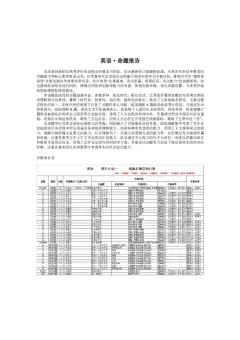
篇目 核心话题 文章类型
美国高中停车场母亲倒车碾压女儿,棒球队学生合力抬车救人,科普肾上腺素带来记叙文 + 科普
Passage 1
人体超强应激力量 说明
Passage 2 湖南紫鹊界千年梯田,介绍梯田水利系统、农耕文明与当下传承发展困境 文化科普说明文
Passage 3 中国传统剪纸:历史、寓意、制作工艺、传承发展与世界文化传播 传统文化说明文
Passage 4 巴西留学生马飞龙来华学习舞龙,对比中西龙文化差异,深耕舞龙文化传播 人物记叙
传统文化健康科
Passage 5 气功的原理、练习方式、养生功效与蕴含的中华养生文化智慧
普
广州中山纪念堂 356 年 “木棉王” 古树的专业养护技术、生物防虫与城市人文
Passage 6 城市人文科普
意义
苹果 iOS27 中文版缺失 AI 智能功能,中国用户吐槽,对比国产手机 AI 优势,
Passage 7 社会热点议论文
数码行业评论
福建蟳埔女簪花围非遗民俗:起源、劳作女性的精神寄托、当下文旅走红与非遗认
Passage 8 民俗文化说明文
定
当代年轻人旅游观念转变,摒弃特种兵式打卡,流行低消耗沉浸式慢旅行,景区配
Passage 9 社会生活热点
套升级
Passage 10安提瓜游蛇因入侵物种獴濒临灭绝,FFI 组织开展物种保育,蛇类种群逐步恢复 自然环保科普
创业者赵勇在美国开设君子厨房,改良中式家常菜,重塑美国人对中餐的认知,文
Passage 11 人物商业记叙
化输出
Passage 12慢性肾病预防科普:科学饮水、控糖控嘌呤、作息运动、戒烟酒、定期体检 健康科普说明文
第三届影像联合创制计划启动,聚焦中外影视合拍、AI 影像、纪录片讲好中国故
Passage 13 文化产业新闻类
事
秦皇岛熊猫主题基地开展动物辅助疗愈,帮助自闭症儿童舒缓情绪,配套残疾人惠
Passage 14 社会公益新闻
民政策
张家口旧称 Kalgan 的历史渊源:古代商贸要道、京张铁路、皮毛贸易与中外历史
Passage 15 历史人文科普
记载
Passage 1
阅读下面材料,在空白处填入1个适当的单词或括号内单词的正确形式。
In May 2013, a mother came to pick up her daughter at a California Valley High School. While 1
(park), she hit the car in front of her. She didn’t notice her daughter right behind the car. She backed so quickly that
she ran right over the girl, 2 screamed as the car pinned (卡住) her in place.
The school’s baseball team 3 (practice) nearby at that time. When they heard the scream, they ran as
fast as they could to the parking lot and then surrounded 4 car. They tried their best to lift the car clear off
the ground so that the girl could be pulled to 5 (safe). It’s unbelievable that they could make it.
When we react to emergency or high pressure situations, our strength increases 6 (surprising). Our
muscles, which normally work at some 65 percent of 7 (they) ability, manage much more when fueled by
adrenaline (肾上腺素). Adrenaline heightens your perception (知觉). It seems 8 (slow) down time and
makes you aware of danger. It also leaves you remembering details far more specifically than you would 9
any other situations.
This all adds up to a “superpower response” that lets people like these baseball 10 (player) achieve
the impossible and save lives.Passage 2
阅读下面短文,在空白处填入1个适当的单词或括号内单词的正确形式。
China feeds a fifth of the world’s population with less than one tenth of the world’s farming land. 1
(meet) this demand, the government as early as the Tang and Song dynasties encouraged expanding food production
into mountainous areas.
Growing rice in the mountains was 2 (technical) challenging because the plant needs clear, standing
water. Yet by the Northern Song Dynasty, well-watered rice fields 3 (carve) into slopes as steep as 40
degrees. The spectacular Ziquejie Terraces in Hunan Province date from this era. Even more remarkable, these
terraces remain 4 (product) today after over a thousand years. They are 5 perfect example of
sustainable development, combining farming expertise 6 advanced hydrological (水利的) engineering.
7 is most impressive is that the terraces guarantee good harvests despite the variations in rainfall year
to year. Excess water drains away, while fields are automatically irrigated during shortages — all without external
water storage.
Although the Ziquejie Terraces still yield high-quality rice and are recognized as a World Heritage Irrigation
Structure, they are under serious threat. The narrow terraces, 8 (average) only 1.75 meters in width, limit
mechanization, which makes 9 hard to boost yields. Currently, the local government subsidizes (补贴) rice
production, and 10 (resident) hope tourism will help preserve this heritage.
Passage 3
阅读下面短文,在空白处填入 1 个适当的单词或括号内单词的正确形式。
Traditional Chinese paper-cutting is a famous folk art with a history of more than 1500 years. It is widely
popular in rural areas of China.
Paper-cutting works 1 (main) use red paper, because red stands for luck and joy in Chinese culture.
People often stick paper-cutting on windows, doors and walls 2 (celebrate) festivals and weddings.
The skills of paper-cutting are simple but flexible. Without any complex tools, people only need scissors and
paper 3 (create) vivid works. Common patterns include flowers, animals and Chinese characters, 4
carry people’s best wishes.
In the past, paper-cutting 5 (pass) down by local folk artists from generation to generation.
Nowadays, this traditional art 6 (face) new development chances. More young people begin to learn paper-
cutting. Many schools have set up paper-cutting clubs to help students understand traditional culture.
Paper-cutting is not only a kind of art, 7 also a cultural symbol of China. It records local customs and
reflects people’s love for life. In 2006, Chinese paper-cutting 8 (list) as national intangible culturalheritage.
With the spread of Chinese culture overseas, paper-cutting has won 9 (great) popularity around the
world. It has become a wonderful bridge 10 cultural communication between China and other countries.
Passage 4
阅读下面短文,在空白处填入1个适当的单词或括号内单词的正确形式。
Drumbeats echo through a university gymnasium in Central China as a brightly colored dragon surges, dips,
and coils. At the front guiding the dragon is Miguel de Oliveira Manacero, a 24-year-old Brazilian graduate student
known 1 Ma Feilong in China.
Manacero first encountered Chinese culture through martial arts. He began training at 10 and later showed great
2 (dedicate) to Brazil’s national team, 3 (win) a world championship at 16. In 2019, he arrived at
Hubei University for 4 short-term exchange, where he discovered dragon dance and decided to stay.
In Western folklore, dragons are often seen as destructive, 5 in China, the Loong tells a very different
story. Dragon dance, often performed during festivals, 6 (believe) to bring good luck and ward off
misfortune. Unlike solo martial arts, dragon dance is a collective art 7 requires timing and trust.
Since his senior year, Manacero 8 (lead) the university’ s dragon dance team to top finishes in
national competitions.“Martial arts helped me understand China. Dragon dance made me fall in love with 9
,” he says. With about a year and a half left in his studies, he remains committed to 10 (keep) the dragon
moving between cultures.
Passage 5
阅读下面短文,在空白处填入1个适当的单词或括号内单词的正确形式。
Qigong is a special kind of Chinese exercise. It helps people stay healthy by moving slowly, breathing deeply,
and focusing the mind. The word “Qi” means energy, and “Gong” means practice. Therefore, Qigong means “the
practice of energy”.
Unlike running or jumping. Qigong is slow and gentle, but it can help with stress, tiredness, weak digestion, or
even sleep 1 (problem).
In Chinese culture, people believe that Qi flows inside the body, like water 2 (flow) through rivers.
3 Qi moves well, the body feels strong. But if it gets blocked, we may feel sick or weak. Qigong helps unblock
and guide the Qi, and the body becomes balanced again.
People do Qigong by standing still, moving arms slowly, turning the body, and breathing deeply, 4
looks easy, but takes practice. Some forms also include soft sounds or special hand shapes to help focus the energy.Qigong 5 (practise) in China for over 2,000 years. In ancient times, doctors, monks, and martial
artists all practised Qigong. Some did it 6 healing and peace of mind, and others to make their Kung Fu
7 (strong).
Today, many people still practise Qigong in parks or homes. Some do it in 8 morning to feel fresh.
Others do it at night to relax. Even children can learn simple Qigong to help them 9 (breath) better and
focus more.
Qigong is not about winning or speed. It is about listening to your body and staying calm. It shows the 10
(wise) of Chinese culture — healing with breath, movement, and peace.
Passage 6
语法填空。
Every spring, the 356-year-old kapok tree (木棉树) in Sun Yat-sen Memorial Hall flowers, capturing the hearts
of locals. Known as 1 “Kapok King”, it is a miracle of nature, as these trees rarely survive 2 a
century in the wild. Its long life is due to the constant care and attention from an expert team.
Led by Wang Yongyue, the team employs advanced technologies 3 (monitor) the tree’s health. They
use CT scans to map roots up to seven or eight meters deep. “We also strike nails in the wood to create sound waves,”
Wang explains. “If the wood 4 (be) hollow or decayed (腐烂的) inside, the speed of the sound changes.
This helps us strengthen the tree 5 it’s too late.”
Since 2009, Wang 6 (oversee) quarterly check-ups, with a critical focus on managing harmful
insects. Instead of relying on strong 7 (chemical), the team practices biological control. Bi Keke, a lab
expert, describes releasing natural enemies to hunt them. “It is a story of one 8 (beat) another in nature,” he
notes, highlighting how this approach maintains 9 (ecology) balance.
To the citizens of Guangzhou, this tree is more than a plant, it is a beloved family member 10 well-
being connects the city’s past and future.
Passage 7
阅读下面短文,在空白处填入1个适当的单词或括号内单词的正确形式。
On June 9, 2026, Apple officially released iOS 27 at the Worldwide Developers Conference (WWDC).
However, 1 (far) from receiving praise, the new operating system was quickly met with widespread
criticism from Chinese users.
The main complaint centered on the absence of Apple Intelligence and the new Siri AI features. Due to
regulatory requirements, these core 2 (function) are not available in the Chinese version of iOS 27. As aresult, many tech bloggers have joked that the domestic version of iOS 27 should 3 (call) “iOS 26.5”
instead.
The only significant update that Chinese users can actually experience is the long-awaited holiday alarm clock,
4 automatically adapts to China’s complex holiday schedules and avoids waking users up on make-up workdays.
“It took Apple years to add 5 feature that Android phones have had for ages,” one netizen commented
bitterly.
Well-known entrepreneur Luo Yonghao also weighed in on the debate, 6 (express) his
disappointment with Apple’s lack of innovation. “Wow, so many innovations,” he said sarcastically. He further argued
that consumers should not “act so cheap” 7 simply accepting incremental upgrades that offer no real value.
The controversy reflects a 8 (grow) frustration among Chinese consumers. While Apple has long
been regarded as a leader in technological innovation, its recent performance suggests it is falling behind domestic
competitors like Huawei and Xiaomi, 9 are rapidly integrating advanced AI features into their devices. For
now, iOS 27 seems unlikely to win back user trust, and many are left 10 (wonder) whether Apple still
prioritizes the Chinese market.
Passage 8
阅读下面短文,在空白处填入1个适当的单词或括号内单词的正确形式。
In the coastal village of Xunpu, Fujian Province, the women there carry on a tradition that has lasted for
centuries — wearing flowers in their hair. Known as “Zanhuawei” (簪花围), this custom represents one of China’s
most distinctive folk traditions, 1 holds a special place in the daily lives of Xunpu women.
The origins of Zanhuawei can be traced back 2 the Tang and Song dynasties. In the past, Xunpu
women would wear flowers in their hair not just for beauty, 3 as a symbol of their strength and 4
(persevere). These women worked 5 (tireless) from dawn to dusk, gathering oysters and 6 (sell)
seafood at the market. Despite the harsh conditions of their daily labor, they never gave up their love for beauty.
Flowers, 7 (arrange) like a garden on their heads, became their way of expressing optimism and dignity. To
them, wearing flowers is not merely about decoration — it is a celebration of life itself.
Today, this ancient tradition has caught the attention of people across the nation. Tourists flock to Xunpu 8
(experience) the charm of Zanhuawei firsthand, dressing up in traditional costumes and posing for photos with flowers
in their hair. The practice 9 (recognize) as part of China’s national intangible cultural heritage so far. For the
women of Xunpu, 10 flowers they wear are far more than just flowers — they are a powerful statement that
beauty and strength can bloom together.Passage 9
阅读下面短文,在空白处填入1个适当的单词或括号内单词的正确形式。
Not long ago, traveling in China meant racing against the clock. Overnight trains, sunrise hikes, and five scenic
spots before lunch 1 (regard) as badges (勋章) of honor. Today, that mindset is being quietly overturned.
Across China, “slow travel” is emerging as a defining trend, particularly among Gen Z. Instead of using every
hour 2 the full, travelers are choosing fewer destinations, longer 3 (stay) and experiences that
emphasize immersion over mileage.
According to a 2025 survey, 55.3 percent of young respondents said they now prefer “immersive slow travel”.
4 shift is visible in both behavior and business. Once-popular “special-forces-style tourism” — 5
travelers rush through cities to maximize check-ins — has given way to 6 social media jokingly calls “low-
consumption travel”. The idea is simple: minimal physical strain, maximum 7 (emotion) return.
Online data shows that searches for “gentle adventures” rocket in 2025,with interest in low-impact rafting up
135 percent, slower, 8 (calm) bungee experiences up 65 percent, and “elevator-assisted mountain climbing”
up more than 80 percent.
These are not just internet jokes. Operators have redesigned attractions to match the new pace. On Foshan’s
Xiqiao Mountain, visitors can try a modified bungee jump that 9 (lower) participants gently instead of
dropping them at full speed . In river valleys,“lying-flat rafting” lets travelers float downstream under blue skies,
10 (do) little more than drift and daydreaming.
In slowing down, young Chinese travelers are redefining what it means to go somewhere.
Passage 10
语法填空
The Antiguan racer, a harmless grey-brown snake, lives in the twin-island country of Antigua and Barbuda.
Winning the title of the world’s rarest snake in 1995, 1 only a few individuals remained, the Antiguan racer
has been making a steady comeback with the help of Fauna & Flora International(FFI).
Antiguan racers were not 2 (endanger) in Antigua and Barbuda before the introduction of non-native
animals. Small Asian mongooses(獴) 3 (bring) to the islands to control invasive(侵入的) black rats, which
were causing damage to local crops. However, the mongooses had little impact on the rats and instead fed on native
species, 4 (influence) most Antiguan racers. This, in turn, led to the species facing 5 (extinct) in
the 1930s.
Subsequently, FFI helped wipe out the rats and other harmful invasive species from some islands around
Antigua and reintroduced Antiguan racers to the islands. With researchers closely 6 (monitor) them, thecurrent population of Antiguan racers in the wild is on 7 increase thanks to conservation efforts. Many other
species have also benefited 8 this work— particularly birds on the islands 9 (clear) of invasive
animals. The number of some species has increased more than thirty times. Species that have begun to increase 10
(dramatic) again include many regional rare species, such as certain unique ducks.
Passage 11
阅读下面短文,在空白处填入1个适当的单词或括号内单词的正确形式。
For more than 150 years, Chinese cuisine has been integrated into the fabric of American dining — often
represented by dishes like fried rice, egg roll and General Tso’s chicken. Today, Zhao Yong’s Junzi Kitchen is
reimagining how Americans experience Chinese food, 1 (offer) traditional home-style dishes through a
modern fast-casual style.
In 2015, Zhao opened the first Junzi Kitchen in New Haven, Connecticut. 2 began as a single
storefront has since grown into a nine-location operation. “For many Americans, Chinese food means takeout,” Zhao
said. “We want to show that there’s so much more for customers 3 (discover).” Junzi Kitchen highlights
comforting, everyday Chinese dishes like scrambled eggs with tomatoes and beef shank soup. “These dishes may
seem ordinary to Chinese people, but for diners 4 understanding of Chinese cuisine has been limited to
‘American Chinese food’, they feel fresh and excited,” Zhao explained.
Junzi Kitchen has adapted its kitchen operations and service model to fit American dining habits 5
abandoning tradition. Customers build their meals by choosing 6 base of rice or noodles, adding sauces,
selecting a protein like braised beef or pork meatballs, and finishing with vegetables. This combination of 7
(convenient) and cooking tradition has been popular with customers. A diner once 8 (write) online, “The
beef shank is always perfectly cooked. I don’t usually write reviews, but I had to for Junzi.”
By bringing this concept to the US, a country 9 (shape) by cultural diversity, Zhao hopes Junzi
Kitchen can present a modern and 10 (include) vision of Chinese culture.
Passage 12
阅读下面短文,在空白处填入1个适当的单词或括号内单词的正确形式。
Maintaining a healthy lifestyle and early screening and detection are keys to preventing chronic (慢性的)
kidney disease. Adequate hydration and healthy diet are essential. For 1 healthy adult, it is recommended to
drink 1,500 to 1,700 milliliters of water per day, 2 (consume) in small amounts throughout the day, about 200
milliliters each time.
Furthermore, adults are advised to keep added sugar intake below 50 grams per day, 3 (ideal) under 25grams, as high blood sugar levels can damage the kidneys over time. In addition, 4 (limit) purine-rich
foods, including organ meats and seafood, may help prevent elevated uric acid levels that can affect kidney function.
People 5 chronic conditions such as hypertension, diabetes, high uric acid or gout (痛风) are at a 6
(high) risk of kidney disease. “These patients are more likely to develop kidney problems.” LiuLi, associate chief
physician at Peking University First Hospital’s Department of Nephrology, told CMG.
Regular sleep patterns and regular exercise are also important. It is recommended to go to bed before 11 p.m.
and 7 (sure) seven to eight hours of sleep per night. At least 150 minutes of moderate-intensity aerobic
activity per week, such as brisk walking or jogging, can help improve circulation, strengthen the immune system and
support overall kidney health. Smoking and excessive alcohol consumption, 8 blood vessels and kidneys
are damaged, should also 9 (avoid). For most adults, integrating urinalysis and kidney function 10
(test) into an annual health checkup is vital.
Passage 13
阅读下面短文,在空白处填入1个适当的单词或括号内单词的正确形式。
The 1 (three) edition of the Image Possibilities Coproduction Plan, launched on Thursday, has
attracted more than 200 industry 2 (profession), scholars, media representatives and officials from China
and abroad.
Held under the theme “China’s Development, World’s Opportunity”, the edition introduces new special units
3 (focus) on cultural exchange, regional cooperation, technological innovation, global stories of Chinese
enterprises and humanitarian 4 (initiative). It will also include international influencer tours in China and
provide support 5 Chinese directors participating in global productions.
Nearly 100 overseas media organizations and about 1,000 domestic institutions 6 (take) part in the
plan over the past three years, according to Yu Yingfu, deputy director of the China International Communications
Group. He added, “We will continue to bring together partners from different sectors, 7 (deep) cooperation
in film and television, and create visual stories that foster understanding and trust.”
As 8 head of the AI Future Imaging Research Center at Shanghai Vancouver Film School, Odet
Abadia Gomez shared her experience in documentary production about the history of the Chinese national anthem,
9 aligns with the plan’s core principle of presenting Chinese stories to global audiences.
“I think documentary is playing a huge part. Right now, the young audiences around the world 10
love short documentaries because these are true stories about true people in true places. It’s a new way of
communication with young audiences around the world and it’s very useful to show Chinese stories,” she said.Passage 14
阅读下面短文,在空白处填入1个适当的单词或括号内单词的正确形式。
Qinhuangdao in North China’s Hebei province has launched a panda-themed base offering nature-based
treatment for children with autism (自闭症) through close encounters with giant pandas. “The initiative, 1
(design) to ease anxiety and promote emotional connection, 2 (reflect) the city’s growing commitment to
developing innovative medical 3 (approach) for autism”, local authorities said.
4 total of 133 children with autism, led by their parents and volunteers, attended the event ahead of
the 19th World Autism Awareness Day, 5 will be observed on Thursday. Many children arrived 6
(rest) but gradually relaxed as they moved through the park’s animal zones.
Song Liping, mother of 31-year-old Li Ruxian, has lived this journey for decades. Her son did not speak until
age 4. “Raising a child with autism requires far more patience and energy 7 most people can imagine,”
Song said. She has dedicated herself to her son’s rehabilitation (康复) since 2014, becoming a volunteer and
launching music therapy programs. Today, her son has grown from someone in constant need of care 8 her
teaching assistant.
To make such experiences more 9 (access), the wildlife park announced a policy: for each visitor
holding a severe disability certificate, one 10 (accompany) family member can enter for free.
Passage 15
阅读下面短文,在空白处填入1个适当的单词或括号内单词的正确形式。
Many know Zhangjiakou as a top destination for winter sports, but not too long ago, it was once known as
Kalgan. 1 (notable), Isaac Asimov imagined a planet called “Kalgan” as an ideal vacation world in his 1952
science fiction novel. Yet, 2 “Kalgan” on Earth, neither warm nor coastal, lies in northern China’s Hebei
province.
Kalgan occupied a frontier position of great 3 (significant) to Hebei and Inner Mongolia, functioning
for centuries as a vital gateway for trade and diplomacy (外交). The name itself 4 (mean) “gate” in
Mongolian. One landmark, Dajingmen, or the Great Border Gate, stood 5 a passage for both goods and
cultural exchanges. Another symbol of the city’s role was the Peking-Kalgan Railway, which was China’s first
domestically built railway, 6 (complete) in 1909. Its chief engineer, Zhan Tianyou, saw 7 (he)
identified with this achievement as an honor despite many technical challenges.
The city also became famous through the fur trade, 8 (consist) of lambskin and other pelts (兽皮).
Over time, the English word “Kalgan” transformed from a place name into a term for a type of luxury lambskin,
sometimes even written lowercase: kalgan. Though pinyin renamed it Zhangjiakou 9 (decade) ago, the oldname remains in encyclopedias (百科全书) and memories-signs of a period 10 traders, engineers, and
travelers knew this gate to northern China as Kalgan.