2022 年高考英语一轮复习讲练测(新教材新高考)
第七讲—动词不定式
【复习概览】
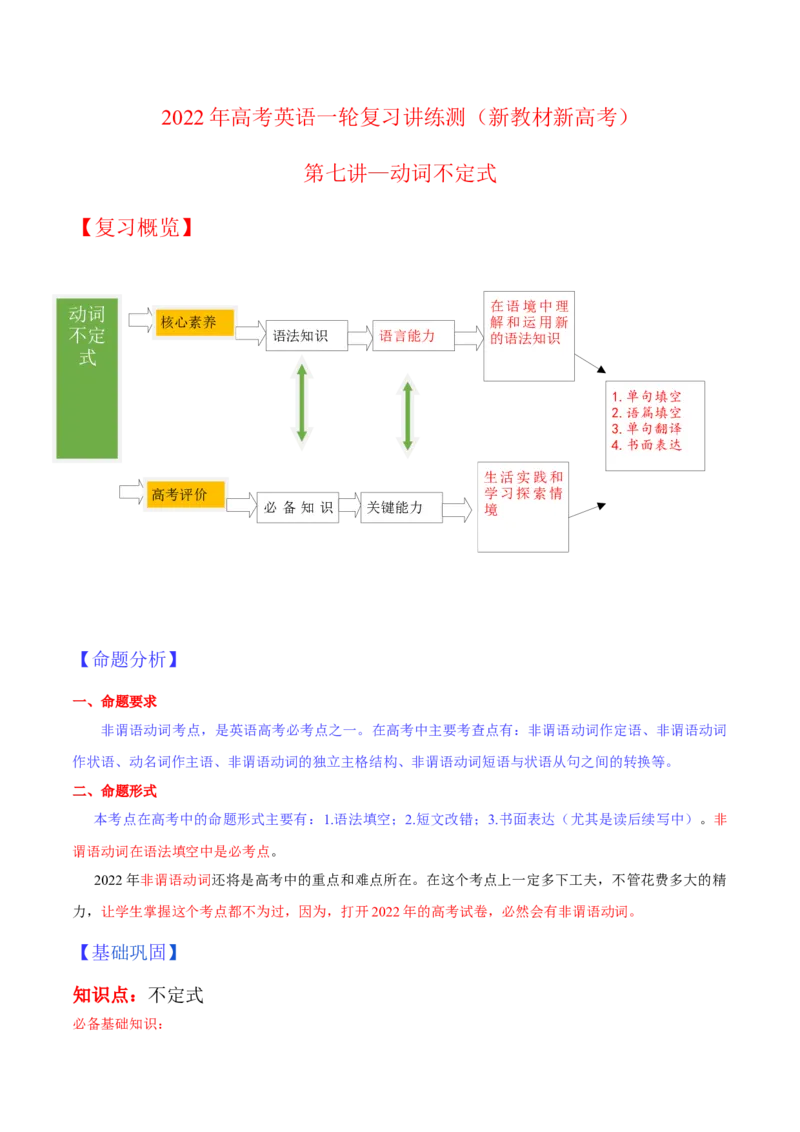
在语境中理
动词
核心素养 解和运用新
不定 语法知识 语言能力 的语法知识
式
1.单句填空
2.语篇填空
3.单句翻译
4.书面表达
生活实践和
高考评价 学习探索情
必 备 知 识 关键能力 境
()
【命题分析】
一、命题要求
非谓语动词考点,是英语高考必考点之一。在高考中主要考查点有:非谓语动词作定语、非谓语动词
作状语、动名词作主语、非谓语动词的独立主格结构、非谓语动词短语与状语从句之间的转换等。
二、命题形式
本考点在高考中的命题形式主要有:1.语法填空;2.短文改错;3.书面表达(尤其是读后续写中)。非
谓语动词在语法填空中是必考点。
2022年非谓语动词还将是高考中的重点和难点所在。在这个考点上一定多下工夫,不管花费多大的精
力,让学生掌握这个考点都不为过,因为,打开2022年的高考试卷,必然会有非谓语动词。
【基础巩固】
知识点:不定式
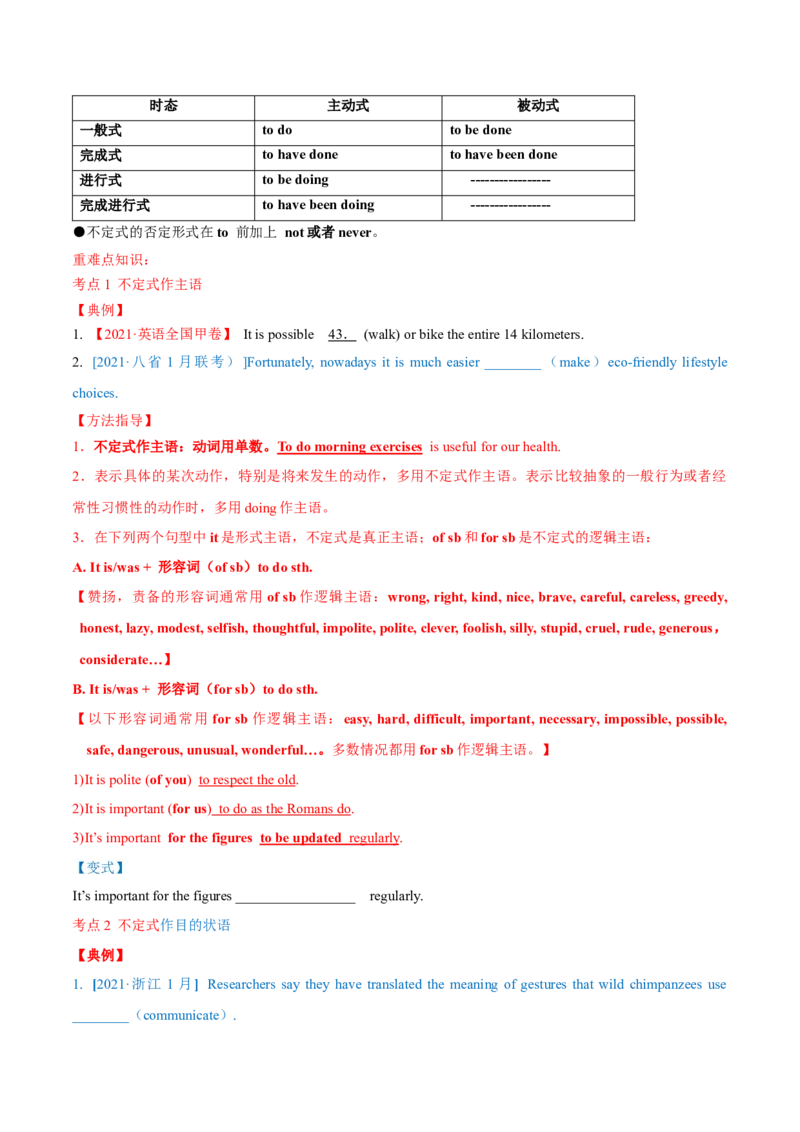
必备基础知识:时态 主动式 被动式
一般式 to do to be done
完成式 to have done to have been done
进行式 to be doing -----------------
完成进行式 to have been doing -----------------
●不定式的否定形式在to 前加上 not或者never。
重难点知识:
考点1 不定式作主语
【典例】
1. 【2021·英语全国甲卷】 It is possible 43 . (walk) or bike the entire 14 kilometers.
2. [2021·八省 1 月联考)]Fortunately, nowadays it is much easier ________(make)eco-friendly lifestyle
choices.
【方法指导】
1.不定式作主语:动词用单数。To do morning exercises is useful for our health.
2.表示具体的某次动作,特别是将来发生的动作,多用不定式作主语。表示比较抽象的一般行为或者经
常性习惯性的动作时,多用doing作主语。
3.在下列两个句型中it是形式主语,不定式是真正主语;of sb和for sb是不定式的逻辑主语:
A. It is/was + 形容词(of sb)to do sth.
【赞扬,责备的形容词通常用of sb作逻辑主语:wrong, right, kind, nice, brave, careful, careless, greedy,
honest, lazy, modest, selfish, thoughtful, impolite, polite, clever, foolish, silly, stupid, cruel, rude, generous,
considerate…】
B. It is/was + 形容词(for sb)to do sth.
【以下形容词通常用 for sb作逻辑主语:easy, hard, difficult, important, necessary, impossible, possible,
safe, dangerous, unusual, wonderful…。多数情况都用for sb作逻辑主语。】
1)It is polite (of you) to respect the old.
2)It is important (for us) to do as the Romans do.
3)It’s important for the figures to be updated regularly .
【变式】
It’s important for the figures _________________ regularly.
考点2 不定式作目的状语
【典例】
1. [2021·浙江 1 月] Researchers say they have translated the meaning of gestures that wild chimpanzees use
________(communicate).2. [2020·海南卷] ______ (survive) in the forest, animals must climb, jump or fly across the gaps.
【方法指导】
1.不定式作目的状语:
1)To complete the project in time, the workers will have to work day and night.
2)To be a winner, you need to give all you have and try your best.
3)Many airlines now allow passengers to print their boarding passes online to save their valuable time.
4)You must set out at once in order not ( so as not ) to be late for school .
5)Many people have to wear glasses to/in order to/so as to see distant objects clearly.
= To/in order to see distant objects clearly, many people have to wear glasses.
(so as to一般不放在句首)
2. to不定式可作目的状语,doing也可作目的状语。区别是doing前常有一个逗号。
1)The man has come to the town, looking for his lost wife.
2)The lawyer listened with full attention, trying not to miss any point.
3. 为了做…, 某人尽所能;尽力做…
do what sb can to do sth:
do all (that) sb can to do sth:
do everything/anything (that)sb can to do sth:
1)You must do everything that you can to save the woman's life.
2)The farmers ought to do what they can to get in all the rice before the heavy rain.
3)We should do all (that) we can to help the poor people to live through the winter.
4. 不定式作结果状语:
so/such…as to…: (如此…以致…)
enough …to …: (足够)
only to …: (结果)
never to…: (结果再也没有)
too… to…: (太…而不能…)
1)She was so silly as to give all her money to the cheat.
2)They came here so early as to see the famous film stars.
3)I am not such a fool as to believe that kind of thing.
4)The boy is old enough to join the Royal Army.
5)My mother’s uncle went abroad in 1936, never to come back home again.
◆only to do/be done: 可译为: “ 结果…” 这是一种预料之外的结果。常含有 “ 惊讶,失望,放心 ”之意。
only doing sth. 表示谓语动词本身的动作造成的结果。
1)She hurried to the station, only to be told that the 9:45 train had left.
2)Tom took a taxi to the airport, only to find his plane high up in the sky.
3)His father died, (only) leaving him 1000 pounds.
●a. too + 形/副 + to do sth: 太…而不能做。 不定式为结果状语。
1)The boy is too young to attend school.
2)The man is running too slowly to catch up with his workmates.
●b. too + 形/副 + to do sth: 非常/很…做。
这种用法too后的形容词常是:easy, anxious, eager, willing, glad, pleased, ready, satisfied等, 并且
too 前常有not, only, but, all, just。
1)We are not too sorry to see the new soldiers leave our hometowns.
2)I am only too pleased to take part in the activity.
3)They know but too well to keep it a secret.
4)My tailors are too ready to do some sewing for the middle school students.
5)Such an earthquake is all too likely to happen again in Japan.
5.不定式作原因状语:
1)I am very happy to see you again.
2)You will be disappointed to fail in the college entrance exams next year.
3)She was sorry to have kept us waiting so long.
4)She was happy to have been staying with her aunt.
5)He jumped with joy to see the nice Christmas presents.
★I. 以下形容词后常接不定式的主动形式:hard, difficult, easy, light, heavy, nice, good, clear, dangerous,
pleasant, interesting, fit, bitter, exciting, comfortable, convenient, amusing, impossible 等后常接主动式不定
式。如形容词前有too或 形容词后有enough时,不定式用主动,被动均可。
1)Chongqing is hard/difficult/easy to find on this map.
2)This machine is very easy to operate. Anybody can learn to use it in a few minutes.
3)I like getting up very early in summer. The morning air is so good to breathe.
4)In many people’s opinion, that company is pleasant to deal with.
5)This building is dangerous/pleasant/comfortable to live in.
6)The medicine is bitter to drink.
7)That flying bird is impossible to catch.8)The food is too hot to eat/to be eaten.
9)My schoolbag is too heavy to carry/to be carried.
10)Her schoolbag is light enough to carry/to be carried.
【变式】
【变式】1
[2020·海南卷] ______(remember)all the questions you have when you are not in the doctor's office, write them
down and bring the list with you to your appointment.
【变式】2
[2021·吉林省长春市普通高中高三质量检测]Several years ago, Wang left Shandong ______ (live) with his
children in Mengshan county.
【变式】3
【江苏省苏锡常镇四市2021届高三教学情况调查(一)】Those of us who watched the lunar voyage of
Apollo11 were amazed as we saw the first man walk on the moon. But 59 . (get) there those astronauts literally
had to break out of the huge gravity pull of the earth.
【变式】4
【2021届江苏省扬州市高三上学期期初调研】China is also actively communicating with Russia and European
countries 45 . (improve)the compatibility of the BDS so that it can better serve its global users.
考点3 不定式作定语
【典例】
1. [2021·八省1月联考)]In my everyday life, I am on an ongoing journey to figure out different ways ________
(reduce)my carbon footprint on the planet.
2. [2021·吉林省吉林市高三第一次调研考试]Another Weibo user wrote, “Thank you for giving me an
opportunity ______ (appreciate) the landscape in the countryside.”
【方法指导】
1.不定式作定语:
1)If there’s a lot of work to do, I’m happy to keep on until it is finished.
2)The ability to express an idea is as important as the idea itself.
3)With the world changing fast, we have something new to deal with all by ourselves every day.
4)Today I have nothing/something to say at the conference.
5)I was watching the clock all through the meeting, as I had a train to catch.
6)We’re having a meeting in half an hour. The decision to be made at the meeting will influence the future of our
company.2.不定式作定语,修饰序数词等;
1)The first person to arrive at the scene was Tony Black from the police station.
2)She was the first/second/third/tenth (student) to come to school today .
3) He is a hardworking student. He is always the first to come and the last to leave.
3.以下不定式短语的介词不能省去,因为它们前面的名词是它的逻辑宾语:
1)I will find a chair to sit on/in.
2)You should find a bright house to live in.
3)The painter needs to find somewhere to live.
4)Do you have a pen to write a letter with?
5)You will have to buy a piece of paper to write the notice on.
6)At the department store there are a lot of cameras to choose from.
7)He is a good person to work with.
4.以下两句主语是不定式短语的逻辑宾语:
1)The soft bed is very comfortable to sleep on.
2)I don’t think the chair is firm enough to stand on.
5.注意下面3句的区别:
1)I will attend the meeting to be held next Tuesday. (表将来, 被动)
2)I attended the meeting held last Friday. (表过去, 完成, 被动)
3)I will attend the meeting being held at the hall now. (表进行,被动)
【变式】
【变式】1
【江苏省无锡市第一中学2020—2021学年高三上学期开学考试】For ByteDance’s 37-year-old founder,Zhang
Yiming, it is part of an ambition 43 . (build)a global software giant. Now that ambition is in jeopardy(危机).
【变式】2
【2021届江苏省泰州中学高三上学期第一次月度检测】There is no easy way 15 . (get) success in language
learning. A good memory is of great help, but it is not enough only to memorize rules from a grammar book.
【变式】3
(2021·山东高三一模)—Did you hear someone ___________ at the door?
—Yes, it must be John. It’s time for him to get here.
A.knocks B.knocking C.knocked D.to knock
【变式】4
(2021·浙江高三月考)With the holiday________(靠近),the experts' suggestion that tickets be bookedonline is very important. (根据汉语提示单词拼写)
考点4 不定式作表语
【典例】
[2021·云贵川桂四省高三上学期联考]Scientists around the world are looking for all kinds of ways to protect and
maybe even revive corals. One option is ______ (create) more marine protected areas-essentially national parks in
the ocean.
【方法指南】
不定式作表语:
不定式作表语时,主语常是: duty, work, job, task, wish, hope, thing, goal, aim,
problem, question, happiness, what, advice, idea…等:
1)Her duty is to look after the old leaders.
2)Their goal is to become a developed district.
3)The problem is where to build the dam.
●to 不定式作表语解释前面do时, to可省去:
1)Yesterday all we did was (to) clean the kitchen and the toilet.
2)What I would like to do today is (to) have a good sleep at home.
3)The only thing you need to do now is (to) fill in/up/out the form immediately.
4)All she wanted to do when she got the first prize in the contest was (to) say thanks to her teachers and parents.
考点5 不定式作宾补
【典例】
【江苏省苏州市2021届八校联盟高三第一次适应性检测】NASA plans to have the astronauts 44 . (leave)
the lander to collect soil and rock, search for water and other resources and carry out experiments.
【方法指导】
不定式作宾语补足语:
ask/beg/require/request/tell/advise/allow/permit/cause/encourage/expect/wish/force/oblige/invite/
need/order/persuade/remind/teach/urge/want/get/like/hate/warn/help/prefer sb to do……:
1)Ms. Hill told the students to copy all the words and expressions in Book Seven.
2)Miss Janson persuaded the boy not to smoke any more.
●在feel, hear, listen to, look at, see, watch, notice, let, make, have等动词在主动语态时,后面作宾语补足语
接的动词前不能加to; 但以上动词如为被动语态,后面接的动词前要加to。
1)Just now I saw a man rush out of the bank carrying a bag of money.
2)Every morning the blind man listens to the birds sing in the park.3)The boss often makes the boy work like a cow.
4)Just now a man was seen to rush out of the bank carrying a bag of money.
5)Paul doesn’t have to be made to learn. He always works hard.
6)The teacher is often listened to to sing the English song at home.
考点5 不定式作宾语
【典例】
1.(2021·天津滨海新区·高三三模)Some elderly people find it hard________ the things that happened
while they were children.
A.remember B.to remember C.remembering D.remembered
2. The two girls are so alike that strangers find ________ difficult to tell one from the other.
A. it B. them C. her D. that
【方法指南】
不定式作宾语:
like/love/want/wish/hope/expect/desire/hate/prefer/continue/manage/try/ask/beg/demand/afford/
offer/fail/start/begin/forget/remember/promise/mean/intend/attempt/decide/determine/learn/agree/
choose/pretend/arrange to do…:
1)The boss promised to pay me 2000 US dollars a month.
2)We decide to study harder than ever before.
3)Please remember to buy some medicine for the patient on your way back home.
●it作形式宾语代不定式: find/think/consider/feel/make it + 形/名 + to 不定式: 发现/认为/使得做…是…
1)We find it necessary to master German and French.
2)I think it a pity to miss such a good chance.
3)We feel/think it our duty to make our country a better place.
4)New technologies have made it possible to produce new products faster and at a lower cost.