专题08 阅读表达15 篇 (北京专用)
【题型知识点细目表】
题号
难度
知识点
1
较易
发明与创造 ,生活故事
2
适中
个人经历,哲理感悟
3
适中
习惯养成教育,科普知识
4
适中
音乐与舞蹈,网络社交
5
适中
学校活动
6
适中
方法/策略,学习
7
适中
环境保护,科普知识
8
适中
方法/策略,时间管理
9
适中
网络社交,社会问题与社会现象
10
适中
旅游观光,哲理感悟
11
适中
社会问题与社会现象,人工智能
12
适中
生活故事,哲理感悟
13
适中
公益活动(组织机构)
14
适中
合作与交流
15
适中
环境保护,环境污染
【高考典例】
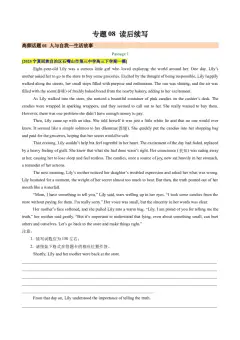
阅读下面短文, 根据题目要求用英文回答问题。请在答题卡指定区域作答。
There’s something magical about the way imagination works. Around the world, kids are using imagination
in ways that were once only found in science fiction.
Take the story of Mark Lee. He loved biking around his neighbourhood but grew upset seeing that many
plastic bottles littered the parks and sidewalks. Instead of simply complaining, he decided to do something about
it.
Using an old 3D printer, Mark started experimenting. He melted ( 熔化) plastic bottles down and tried
shaping them into small bricks. At first, everything went wrong — the plastic broke, the printer jammed, and the
pieces didn’t fit together. Friends laughed a little, and even Mark’s parents thought he should just give up.
But Mark had a different idea. He redesigned the bricks to lock together like puzzle ( 拼图) pieces and
adjusted the heating temperature carefully. After months of trial and error, he succeeded. With a little help from
his school and the local community centre, Mark used his bricks to build a small bike shelter for his
neighbourhood.
And he’s not alone. Thirteen-year-old Sally Carter loved reading fantasy books. Inspired by magical maps
in her stories, she wondered: what if we could build a real-world app that helps people explore hidden places in
their own cities? She gathered friends, learned some basic programming, and together they created an app that
maps small local parks and gardens few people knew about. Their app quickly grew popular in town and even
won a local youth innovation award.
Next time you see a young person lost in thought, don’t rush to pull them back. They might just be
imagining the next great idea.
1.What upset Mark when he was biking around his neighbourhood?
2.How does the app created by Sally and her friends help?
3.Please decide which part is false in the following statement, then underline it and explain why.
> With encouragement from his friends and parents, Mark built a small bike shelter for his
neighbourhood after months of trial and error.
4.How can you put your imagination into practice as Mark and Sally did? (In about 40 words)
阅读下面短文,根据题目要求用英文回答问题。
Growing up, I idealised independence. I always wanted my own efforts to be enough. When I decided to
pursue a postgraduate degree, I wanted to develop a novel research programme and quickly establish myself as an
independent scientist. But I was unrealistically optimistic about what I could achieve.
As I began designing experiments, my committee members warned me about the challenges I would face.
But my need for independence drove me to push forward with my research plan. As a result, the first four years of
my postgraduate career were defined by a series of failures.
During my second year, I failed my comprehensive exam because my proposal was unclear. During my
third year, I discovered that after treating thousands of seeds, I obtained just one plant I could use for experiments.
By my fourth year, my desperation to succeed overshadowed my desire for independence.
My adviser and I devised ( 想出) a somewhat unusual solution: I would spend three months in a
collaborating (合作的) lab to obtain specialised training. I worked extensively with other students, constantly
asked questions, and helped with ongoing projects to learn everything I could. Finally, I conducted an elegant
experiment that would not have been possible without the help of the members in the lab.
My adviser saw this experience as a groundbreaking success, emphasising the collaborating skills I
acquired. A few months later, when I repeated the experiment in my home lab, I produced more publishable data.
By learning when to ask for help, I eventually found myself on the way to becoming an independent scientist.
1.In the beginning, what drove the author to push forward with the research plan?
2.What was the solution by the adviser and the author after those repeated failures?
3.Please decide which part is false in the following statement, then underline it and explain why.
> The adviser considered the author’s experience in the lab a groundbreaking success because publishable
data had been produced.
4.From this story, what can you learn about “independence”? (In about 40 words)
阅读下面短文,根据题目要求用英文回答问题。请在答题卡指定区域作答。
Habit formation is the process by which behaviours become automatic. People develop countless habits as
they explore the world, whether they are aware of them or not. Understanding how habits take shape may be
helpful in changing bad habits.
Habits are built through learning and repetition. A person is thought to develop a habit in the course of
pursuing goals by beginning to associate certain cues(刺激) with behavioural responses that help meet the goal.
Over time, thoughts of the behaviour and ultimately the behaviour itself are likely to be triggered(触发) by these
cues.
A “habit loop(环)” is a way of describing several related elements that produce habits. These elements are
called the cue, the routine, and the reward. For example, stress could serve as a cue that one responds to by eating,
which produces the reward
the reduction of stress. While a routine involves repeated behaviour, it’s not
﹣
necessarily performed in response to a deep
rooted urge, as a habit is.
﹣
Old habits can be difficult to shake, and healthy habits are often harder to develop. But through repetition,
it’s possible to form new habits. The amount of time needed to build a habit will depend on multiple factors,
including the individual and the intended behaviour. While you are able to pickup a new habit in a few weeks, it
takes many months to build a healthy habit. Take some time to think about what leads to bad habits and re﹣
evaluate what you get out of them (or don’t). Consider and keep in mind why you want to make a change,
including how the change reflects your values.
1.How are habits built?
2.In what way is a routine different from a habit?
3.Please decide which part is false in the following statement, then underline it and explain why.
Picking up a new habit takes a few week, while building a healthy habit takes a shorter time.
4.What benefit(s) have you got from one of your good habits?(In about 40 words)
【热点话题练习】
阅读下面短文,根据题目要求用英文回答问题。请在答题卡指定区域作答。
With the development and expansion of the Internet, many hobbies and interests of modern people have
gained a new dimension. The Internet allows enthusiasts to unite to share their excitement about trends, to
communicate and share experiences. Specialized websites provide users with even more information about their
subjects of interest and help discover new boundaries of their passions. This refers to movies, arts, modeling,
programming, literature, and music as well. One can hardly find a person who would not be listening to music on
the way to work, at home, or elsewhere. There are plenty of websites that allow music lovers to stay in touch with
the news relating to their hobbies.
One such website is Music.fm, a mix of a social network and an Internet radio that tracks down the music
its users listen to. This website is of great benefit for music enthusiasts and besides, it has a number of advantages
compared to other sources providing similar services.
The availability of multiple functions also speaks in favor of Music.fm. One of its significant advantages
over many other musical websites is the function of scrobbling (歌曲记录). This technology is convenient and
definitely helpful for music lovers. With its aid, Music.fm searches for people with similar musical preferences
and shows one a list of those whose interests match to some extent. These people are called neighbors and the idea
is that they can get acquainted (熟悉) with the fans of their favorite kind of music and, most likely, make new
friends. The information about upcoming events nearby, as well as recommendations given about new music that
a user might like are also gathered and introduced by the means of scrobbling.
Music.fm allows users to listen to music for free. However, there is a serious drawback connected to it: It is
available only to citizens of the USA, Germany, and Great Britain. At the same time, if you want to use Music.fm
for communication, you might find that traditional social networks are more suitable for this purpose.
1.What can Internet help its enthusiasts to do according to the passage?
2.How does Music.fm help people make friends with the fans of their favorite kind of music?
3.Please decide which part is false in the following statement, then underline it and explain why.
Music.fm is popular among its lovers because it is not only free but also more suitable for
communication.
4.Please briefly present the benefits that a modern technology tool brings to you. (about 40 words)
阅读下面短文,根据短文内容在答题卡相应题号后的横线上写下相关信息,完成对该问题的回答。
When Tina Farr visits the year 2 classroom at her Oxford primary school, she can feel the changed atmosphere
since play was put firmly back on the curriculum (课程). “The children come running up with things they have
made. There is always a shop on the go so they will be pricing up something or finding change.” the headteacher
says.
Play-based learning — letting children move around, make up games and explore within loosely guided
activities — usually stops when they attend primary school. Lessons then become desk-based, focused on reading
and writing.
Farr had long championed the value of play, working hard to bring it into break times. “Teachers would
recognise what we do and it doesn't take any more planning than the standard approach.” With play-based learning
in place for her year 1 and 2 children, Farr then looked at where else she could change any practices that weren’t
working. “If a practice isn’t in line with healthy child development, why are we doing it?”
The school’s year 5 children — aged nine and 10 — were struggling to sit still in a tight space so she removed
all the furniture from the classrooms. “The impact was immediate and impressive. Children now choose where
and how to learn. A class once struggling with attention is now calm and engaged.” A teacher noted: “Their self-
regulation has also improved greatly. They settle down to work much more readily.”
Farr believes the outdated system needs urgent change. “We have neuroscience (神经科学) to know children
learn through play.” In June the school sailed through its Ofsted inspection. “The Inspector really understood our
play-based learning.” Farr’s message is that her approach can be rolled out. “It’s blown my mind how engaged the
children are. It’s phenomenal.” she says.
1.According to the passage, what is play-based learning like?
2.What was the impact of removing all the furniture from year 5 children’s classrooms?
3.Please decide which part is false in the following statement, then underline it and explain why.
Farr believes the outdated system needs urgent change, but her approach can be difficult to roll out.
▶
4.Do you think play-based learning can be applied in your school? And why?(In about 40 words)
阅读下面短文,根据题目要求用英文回答问题。
Rote learning has become seen as an outdated method of teaching. The dictionary defines ‘by rote’ as:
‘from memory, without thought of the meaning; in a mechanical way’.
The decline of rote learning has been quickened by technology. No one needs to memorize friends’ phone
numbers or email addresses because such data is conveniently stored and accessible electronically. And why
remember when and where World War Ⅱ broke out when you can find the answer on the internet in about six
seconds? But now there are voices calling for a need to return to rote learning.
In fact, memorizing key data is essential to learning any skill. Doctoring requires knowledge of medicine
and law, which requires knowledge of cases and laws. Of course, being able to recall things will not further your
understanding of those things, but without memorizing these foundation elements, you cannot progress to a deeper
understanding of a subject.
While the internet and computers have weakened the need for us to remember things, it may well be that
mobile learning can help bring this style of learning back to life by making it more convenient and more fun.
Drilling yourself — with flashcards or by repetition — is usually hard and boring work, which is why most
people need their multiplication tables to be drilled into them by teachers or parents. Rote learning without a
willing third party can be a battle of discipline and motivation. But mobile learning can make those flashcards and
drills more appropriate to individual study; our digital devices can challenge and inform us at the same time and
also keep us motivated, whether through game-like structures or recording our progress.
Once you’ve acquired the essentials of a subject by rote learning, you will find it easier to go deeper in the
application of knowledge which is important.
1.What does “rote learning” mean?
2.Why is “rote learning” an essential learning skill?
3.Please decide which part is false in the following statement, then underline it and explain why.
▷The internet and computers have reduced our need to remember information, and mobile learning
probably makes rote learning more difficult.
4.What’s your own opinion about rote learning? And explain why. (In about 40 words)
Recently, campaigners have encouraged us to buy local food. This reduces “food miles”, that is, the
distance food travels to get from the producer to the retailer. They reason that the higher the food miles, the more
carbon emissions. Buying local food, therefore, has a lower carbon footprint and is more environmentally friendly.
However, the real story is not as simple as that. If our aim is to reduce carbon emissions, we must look at
the whole farming process, not just transportation. Other processes, including fertilization, storage, heating and
irrigation, contribute much more.
In fact, imported food often has a lower carbon footprint than locally grown food. Take apples for example.
In autumn, when apples are harvested, the best option for a British resident is to buy British apples. However, the
apples we buy in winter or spring have been kept refrigerated for months, and this uses up a lot of energy. In
spring, therefore, it is more energy-efficient to import them from New Zealand, where they are in season. Heating
also uses a lot of energy, which is why growing tomatoes in heated greenhouses in the UK is less environmentally
friendly than importing them from Spain, where the crop grows well in the local climate.
We must also take into account the type of transport. Transporting food by air creates about 50 times more
emissions than shipping it. However, only a small proportion of goods are flown to the consumer country, and
these are usually high value, perishable items which we cannot produce locally. Even then, these foods may not
have a higher carbon footprint than locally grown food. For example, beans flown in from Kenya are grown in
sunny fields using manual labour and natural fertilizers, unlike in Britain, where we use oil-based fertilizers and
diesel machinery. Therefore, the total carbon footprint is still lower.
It’s also worth remembering that a product’s journey does not end at the supermarket. The distance
consumers travel to buy their food, and the kind of transport they use will also add to its carbon footprint. So
driving a long way to shop for food will negate any environmental benefits of buying locally grown produce.
1.Why is buying local food promoted by campaigners?
2.What makes locally grown food use more energy than imported food?
3.Please decide which part is false in the following statement, then underline it and explain why.
If aiming to reduce carbon emissions, people should consider the whole farming process, the type of
transport and a product’s journey whose destination is the supermarket.
4.Excluding environmental concerns, would you prefer to buy local food or imported food? Why?(In about 40
words)
阅读下面短文,根据题目要求用英文回答问题。请在答题卡指定区域作答。
When you have a big project to do, you should be totally focused — but that’s easier said than done.
Whether a lack of personal interest is keeping you from committing or distractions are coming from someone or
something else, it can be hard to get in the zone. That zone, according to one productivity theory, is called deep
work.
Deep work is a concept first defined by Cal Newport, who wrote, Deep Work: Rules for Focused Success
in a Distracted World. As he tells it, deep work is the ability to focus completely on a demanding task, without
letting distraction get in your way. If you can master it, you’ll get more done in less time, become a master of your
work, and ultimately end up feeling more fulfilled as a result.
Newport draws a distinction between deep work and shallow work, or that which can be accomplished
while you’re distracted. The difference between these is that deep work is for “cognitively demanding” tasks,
whereas shallow work is the sort of work you do that prepares you to do deep work. Creating a project deck is
deep work. Emailing colleagues to coordinate data for it is shallow work.
If you’re having a hard time achieving deep work, Newport has some guidelines. The key is first sorting
your work into deep and shallow categories. Determine which of your tasks are cognitively demanding and
valuable and which are “logistical-style” and replicable. Next, plan to devote an hour or an hour and a half to
deep- work tasks, then schedule it out so you have that time blocked off in your schedule. Finally, when the time
comes to get into deep work, eliminate all your distractions. Signal that you’re busy, make sure you’re unavailable
on the shared calendar, and put your phone on “do not disturb.” Don’t check emails, don’t talk to anyone, don’t
look at your devices for anything but work, and commit to only working on your demanding task in the time you
allotted for it.
1.What is deep work according to Cal Newport?
2.What is the difference between deep work and shallow work?
3.Please decide which part is false in the following statement, then underline it and explain why.
▶To achieve deep work, we need to tell deep work from shallow work, spend more time on deep work and
remove all distractions.
4.In what other way(s) can you boost deep work as a student?(In about 40 words)
Do you share too much online?
It’s good to share, right? Growing up as kids we are told to share our toys and not be selfish. We also live in
an age where discussing our feelings is encouraged. But when does it all become too much? With new crazes
trending all the time, such as dance challenges and wearing a pillow as a dress, the question is: when can sharing
become oversharing on social media?
What is oversharing? The term has become associated with social media, but it isn’t exclusive to this
platform. Imagine you head to a party and you meet someone. Within five minutes they have disclosed intimate
details about their life. While some of us may try to escape these people, according to marriage therapist Carolyn
Cole, this form of oversharing could come from a strong desire to connect with someone. But how does this
translate to social media?
Dr Christopher Hand, a lecturer in cyberpsychology, says the more details people disclose, the less
sympathy we express when things go wrong. This could be due to a belief that we attract our own negative
experiences the more we share them. It seems that sadfishing, the idea of searching for sympathy by oversharing,
is generally perceived as negative rather than the cry for help it could actually be.
However, Dr Hand’s research also seems to suggest that the more we post on a platform, the more socially
attractive we become — provided that the posts that we bang out (匆匆发出) are positive. Even back in 2015,
Gwendolyn Seidman PhD, said that we should avoid whining (抱怨) and being negative online. We should also
steer clear of showing off, bragging or flexing, as it’s now known -especially about our love lives. It makes sense
— if your date is going ‘that well’, would you really have time to share a photo with text?
So, how can you know if you are oversharing? Well, why not ask your friends in real life. They would
probably be more than happy to tell you if your posts about your breakfast or your gripes about your lack of
money really are too much.
1.What are ‘dance challenges’ and ‘pillow dresses’ examples of?
2.What might people who overshare at parties be trying to do?
3.Please underline the inappropriate part in the following statement and explain why.
The more we post on a platform, the more socially attractive we become, so the idea of searching for sympathy
by oversharing, is taken as an act of wisdom.
4.Do you think you are oversharing on social media? Why?
A Journey of Rediscovery in the Scottish Highlands
The morning mist hung low over the green hills as our train slowly entered the small village of Glenfinnan.
I had come to Scotland with a carefully made plan for my summer trip. My list included visiting the famous Loch
Ness, walking through the streets of Edinburgh, and taking photos of the beautiful Glenfinnan Viaduct. After a
busy final year in school, I hoped this trip would help me relax and clear my mind.
However, the most wonderful travel experiences often come when we least expect them. On my second
morning, while hiking to a popular viewpoint, I took a wrong turn and found myself on a quiet path. Curious
about where it would lead, I followed the sound of running water and soon discovered a small family-owned
woolen mill hidden in the valley.
The owner, Mrs. Campbell, welcomed me warmly into her workshop. For the next two hours, she patiently
showed me how they transformed local sheep’s wool into beautiful patterned cloth using traditional methods. She
shared fascinating stories about her family’s history in the village and their deep connection to the land. Though I
couldn’t understand all her words because of her strong accent, her kindness needed no translation.
Later, I did visit all the famous places on my list, but that unexpected afternoon at the woolen mill remained
the most precious memory of my trip. It taught me that while it’s good to have a plan, the real magic of travel lies
in those unplanned moments when we truly connect with a place and its people. Sometimes, getting lost can help
us find what we didn’t know we were looking for.
1.Where did the author’s journey take place?
2.What two things did Mrs. Campbell show or tell the author?
3.Read the following statement, underline the false part of it and explain the reason.
The author visited the woolen mill after he had already seen all the famous places on his travel list.
4.Do you prefer carefully planned trips or unplanned travel? Why?
阅读下面短文,根据题目要求用英文回答问题。
Teens Are Flocking to AI Chatbots. Is this Healthy?
A new report from Common Sense Media says that 72 percent of teens surveyed have used AI companions,
and 33 percent have relationships or friendships with these chatbots.
The language that AI companions use, the responses they make, and the empathy they show can make a
user feel as though they truly understand and sympathize. These chatbots can make someone feel liked or even
loved. They are programmed to help users feel like they’ve made a real connection.
You might think your kid won’t get attached, that they will know this chatbot is an algorithm designed to
give responses based on the text inputs they receive; that it’s not “real.” But a fascinating Stanford University
study of students who use the app Replika found that 81 percent considered their AI companion to have
“intelligence,” and 90 percent thought it “human-like.”
On the plus side, these companions are sometimes touted( 吹捧,兜售)for their supportiveness and
promotion of mental health; the Stanford study even found that 3 percent of users felt their Replika had directly
helped them avoid suicide. If you’re a teenager who is isolated or struggling to make friends, an AI companion
can provide much-needed companionship. They may offer practice when it comes to building conversational and
social skills. Chatbots can offer helpful information and tips.
But a suit( 诉讼案)filed in 2024 claims that Character. AI encourages self-harm in teens and violence
towards parents who try to set limits on how often kids use the app. Then there’s privacy: wired, drawing on
Mozilla’s research, labeled AI companions a “privacy nightmare,” many crawling with data trackers that might
control users into thinking a chatbot is their soulmate, encouraging negative or harmful behaviors.
Remind kids that human friends offer so much that AI companions don’t. In real life friendships are
challenging, and this is a good thing. Remind them that in their younger years, play is how they learned new
skills; if they didn’t know how to put LEGO s together, they learned with a new friend. If they struggled with
collaboration and cooperation, play taught them how to take turns, and how to adjust based on their playmates’
responses.
1.What can make a user feel chatbots are truly understanding and sympathetic?
2.Why did Wired call a chatbot a “privacy nightmare”?
3.Please decide which part is false in the following statement, then underline it and explain why.
According to the passage, children can learn collaboration and cooperation skills by playing with their chatbots.
◇
4.Between AI companions and real-life friends, which do you prefer? Why?(In about 40 words)
The last thing I wanted to hear when my government-sponsored scholarship was withdrawn during my final
year of college was: “Things are working out for your own good. Just give them some time.” Those words just
fueled my anger.
Then I read the story of the Chinese bamboo farmer, which gave me a different view on life. The seed of
the Chinese bamboo is planted in the ground like every seed. It is watered and fed with nutrients daily, but it
shows no immediate physical response and doesn’t appear to grow. The farmer continues to water and feed the
seed in year one, year two, and year three. No growth is seen until the fourth year, when the seed finally breaks
through the ground. Then, in the space of just five weeks, it grows ninety feet tall. The Chinese bamboo grows to
its full capacity within 5 years.
Despite not seeing an immediate result, the farmer had trust in what he was doing. He continued to water
and feed the plant for four years, because he believed that if he played his own role and did all that a farmer was
supposed to do, then he would be given his reward at the right time. That trust and patience is what kept the
farmer persistently feeding his seed for four years before enjoying the reward in the end.
Life is not always straightforward. Most often, it’s not a matter of 5+5=10 (Sum 1).
Life can be more like 2+1+2+0+0+0+1+2+0+0+1+1=10 (Sum 2)
Both sums lead to the same result, but through quite different paths and processes. To be mature is to accept
that things might look rough right now but the story can still have a great ending.
We might live in a microwave generation where everything seems to happen instantly; but many things still
obey the laws of nature. Just doing what you are supposed to be doing, having patience like the Chinese bamboo
farmer, and trusting that things will work out for you can help you get through the toughest times.
1.What happened to the author in the final year of college?
2.How does the Chinese bamboo grow in the fourth year?
3.Please decide which part is false in the following statement, then underline it and explain why.
To overcome difficulties, we need to trust that things will work out and simply wait patiently for the great
ending to come.
阅读下面短文,根据题目要求用英文回答问题。
Williams and Smith spend the weeks leading up to Christmas crossing the country. They visit all 50 states,
making house calls to kids who are sick or disabled. The pair arrive with plenty of toys and in costume, both of
which delight the young recipients. In past years, Williams has dressed up as various super-heroes and other
beloved characters — including Spider-Man, Dead pool and the Mandalorian — while Smith dons the attire of a
Christmas elf.
Though Williams has been spreading joy this way for years, the initial intention to do it came from a joyless
place. In 2009, he lost his mother to cancer.
“I fell into a five-year depression,” he told Good Morning America. But he dug himself out by honoring his
mother’s memory through charitable acts, including collecting gifts for children with special needs. Williams
launched his nonprofit A Future SuperHero and Friends, in 2018. His goal: to bring smiles to children with health
challenges, including those fighting life-threatening conditions.
“He was the first person to put a smile on A’s face,” says Katrina Morris about her son, who was diagnosed
with cancer at the age of two. “I will never forget that day.” Williams and Smith start their gift-giving trek by
driving through the 48 contiguous states before flying to Alaska and Hawaii. Along the way, they stock up on toys,
funded by the donations that come through the Future SuperHero website, which is also where people nominate
families for the pair to visit. But they often dip into Williams’s own savings as well. Even more important than the
gifts they bring, Williams and Smith spend time with the people who need it the most — and that’s not just the
children.
“The parents seem more excited than the kids sometimes,” Wiliams told KTVO News after a visit to
Billings, Montana, last year.
The pair say they want to make sure families facing tough battles never feel alone. It’s what keeps them
going, even when they barely get any sleep in the process.
“Every day, I get to wake up and do what I love,” Smith says. “I can’t go wrong with that.”
“I don’t look to get paid to do this,” Williams adds. “It’s just healing for me for losing my mother, just
keeping her name alive by doing this.”
1.What do Williams and Smith do to cheer up those sick or disabled kids?
2.Why did Williams launch his nonprofit?
3.Please decide which part is false in the following statement, then underline it and explain why.
Williams and Smith get the donations from people who are nominated to visit the pair.
4.How can you bring smiles to others as Williams and Smith do? (In about 40 words)
阅读下面短文,根据题目要求用英文回答问题。
When Dr. Henderson was assigning project mates for his psychology class, I secretly hoped he would pair
me with my best friend or at least a classmate I could have fun with. Above all, I prayed he wouldn’t assign me to
work with that fiercely competitive, overly serious fellow who always wore dark clothes — his personality
seemed to match his attire. But fate had other plans: Dr. Henderson deliberately paired everyone up and
announced I’d be working with the very person I’d wanted to avoid.
I approached my new teammate to introduce myself, but he looked at me as if I weren’t even there. I felt he
saw me as dead weight, someone who might keep him from getting an A.He wasn’t mean, just distant — like
he’d fare better tackling the project alone.
Needless to say, I dreaded an entire term of being brushed off. But I bit my tongue, trying to make the best
of it, afraid of making things worse.
The project required developing a hypothesis, designing an experiment, conducting statistical analysis, and
presenting findings — with both teammates sharing the final grade.
When we met to discuss plans, I felt uneasy. Here was this intense student, known for single - minded focus
and top grades — the polar opposite of me. I even thought about dropping the class but held back, not wanting
him to see me chicken out. I resolved to stick it out.
After lengthy discussions, we settled on studying teenagers’ psychological well-being. I wasn’t sure what
that entailed, but at least we had a topic.
We met regularly to plan, but I hesitated to share ideas, fearing I’d hold him back. I just nodded when he
asked if things were okay this way or that, figuring persuading him was impossible. I started counting the minutes
until we could leave — and he seemed to do the same. I just wanted presentation day to come sooner.
Then I heard he’d been admitted to the hospital with a serious illness. I felt terrible and knew I had to visit.
He looked surprised when I walked into his ward with flowers and fruit. I offered to finish the project, and to my
shock, he asked me to share my ideas to improve it.
We finally worked as a real team, finishing on time. Our hard work paid off — Dr. Henderson was thrilled
with our findings. Through it all, we learned the true value of teamwork. As they say, one person can go fast, but
together we can go far.
1.Whom did I expect to work with on the project?
2.What did Dr. Henderson’s assignment involve?
3.Please decide which part is false in the following statement, then underline it and explain why.
When he asked if things were okay this way or that, I just nodded because his ideas were rather persuasive.
4.What would you do if you were teamed up with someone you don’t like for a project? (In about 40 words)
阅读下面短文,根据题目要求用英文回答问题。请在答题卡指定区域作答。
The Impact of Plastic Pollution on Marine Life
Plastic pollution has become one of the most pressing environmental issues of our time. Over 8 million tons
of plastic waste enter the oceans each year, threatening marine ecosystems. Marine animals, such as turtles,
seabirds, and whales, often mistake plastic debris for food. For example, sea turtles confuse floating plastic bags
with jellyfish, which can block their digestive systems and lead to starvation. Similarly, seabirds feed plastic
fragments to their chicks, causing long-term health issues. Microplastics — tiny plastic particles from the
breakdown of larger items — have spread even to the deepest parts of the ocean. These particles are swallowed by
small marine organisms, such as plankton, and eventually reaching humans through seafood.
Efforts to deal with this crisis are growing worldwide. Many countries have introduced bans on single-use
plastics like straws and bags. Innovations in biodegradable materials, such as plant-based packaging, offer eco-
friendly alternatives to traditional plastics. Community initiatives, including beach cleanups and educational
campaigns, raise awareness about responsible waste management. However, experts stress that systemic changes
are essential. Improving recycling systems, investing in technologies to collect ocean plastics, and holding
companies responsible for excessive plastic production are key steps.
Together, these actions can reduce the flow of plastic into our oceans and protect marine life for future
generations.
1.What is the estimated amount of plastic waste entering oceans yearly?
2.How do microplastics affect the food chain?
3.Please decide which part is false in the following statement, then underline it and explain why.
Although plastic pollution affects various marine animals, innovations in biodegradable materials have
solved the plastic waste problem.
4.What measures do you think individuals could take to further reduce plastic pollution? (Provide at least two
suggestions.) (About 40 words)