专题09 七选五15 篇 (北京专用)
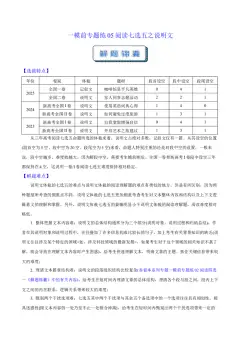
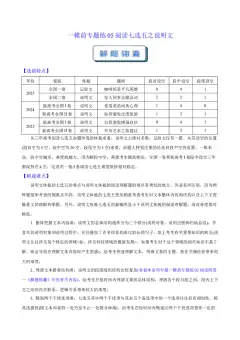
【题型知识点细目表】
题号
难度
知识点
1
较难
方法/策略,哲理感悟
2
适中
科普知识
3
适中
当代教育问题
4
适中
方法/策略,个人保健
5
适中
闲暇活动 ,日常生活
6
适中
方法/策略,学习
7
适中
方法/策略
8
适中
美术与摄影,科普知识
9
适中
方法/策略,日常生活
10
适中
方法/策略,哲理感悟
11
较难
爱好,社会问题与社会现象
12
适中
社会问题与社会现象
13
较难
阅读
14
适中
方法/策略,日常生活
15
适中
方法/策略,自然灾害与防范
【高考典例】
What is adulthood? Societies all over the world view the concept of an adult as self-supporting and self-
directed, because it identifies a point in the life cycle.
As Alice Black points out, today’s parents’ fear of letting kids do more housework has added to their
inability to feel competent and, thus, confident in themselves. Psychologist Robert Turner wrote about this in his
book, The Life Cycle, mentioning a stage when kids learn self-direction and mastery.     1
But Turner’s other cycles are just as important.     2     If these life cycles are delayed, interrupted, or
denied, you feel incapable of accessing your states of self, controlling unpleasant feelings, and manipulating (操
控) the energy that puts together the fabric of your inner world.
Turner wisely said that “doing well” psychologically is being able to roll with the flow of emotions,
manage them, communicate clearly and well with others, and master various skills. This requires an internal locus
(核心) of control, which implies self-control of your thoughts, feelings, and actions.     3     You’re self-
directed and not reliant on the world to tell you who you are. And you know who you are within all this.
So, being an adult isn’t just holding a job. Being an adult is about having a rooted sense of self while being
capable of identifying and managing your emotions and actions.     4     We are a social species, so this is
important.
While raising an adult is a parent’s job, it’s also our responsibility as a society to ensure that we support
schools that nurture (培养) emotional and identity development.

 5
A.It’s also our job to support adults who need help repairing incomplete life cycles.
B.They talk about someone’s inability to support themselves through work.
C.It’s being able to show understanding when communicating with others.
D.In other words, you’re playing the game of life — life isn’t playing you.
E.They teach emotional awareness and management as well as identity.
F.You feel like an 18-year old, especially when playing 80s music.
G.When this stage is denied it creates a sense of insecurity.
If you want to develop maximum credibility ( 可信性), is it better to be a hedgehog ( 刺猬) or a fox?
According to Isaiah Berlin, the hedgehog knows one thing very well, and the fox knows a lot of things.
Is there a clear advantage of one style over the other? Hedgehog thinkers tend to answer yes.     1

And they are usually very credible in doing so. According to Jim Hart, the “hedgehog concept” is one of the
factors that lead companies to greatness. They focus on one thing and do it really well. They figure out what they
are good at.     2     The hedgehog concept makes perfect sense for companies.
    3     Philip Tate has studied the track records of those folks on the Sunday talk shows who make
predictions about what will happen. He has found that hedgehogs are not only wrong more often than foxes, but
that they are less likely to recognise or admit that they are wrong when events do not match their predictions.
The advantage that foxes have is that they are more likely to seek out new information from a broader
range of sources, and are comfortable with uncertainty and new information.     4     They try to include it in
their viewpoint rather than to exclude it from their thinking. They also have a clearer estimation of what they
know and don’t know.
So, which is better? The question can be answered in a foxy hedgehog style.     5     The choice
between being a hedgehog or a fox is a false trade-off. The most effective way to go through life is to try to be that
rare mixture known as foxy hedgehog.
A.In other words, there are clear advantages for each.
B.They are more likely to remember people’s mistakes.
C.Hence, they have the advantage of clarity and confidence.
D.But there can be a downside to concentration on one big thing.
E.However, hedgehogs remain open to others’ reactions and inputs.
F.When something is contradictory to their view, they don’t treat it as exceptional.
G.They come down squarely on one side or the other and fully support their position.
It’s a joyful and stressful time of year in the United States for students and their families as they make
decisions about where to attend college. Families often turn to rankings systems to help make a decision.

 1
When I talk to families as a scholar of higher education, they’re often surprised that teaching excellence is
not counted in rankings.     2
Emerging research suggests that courses in lower-ranked universities, on average, scored higher on
teaching than courses in higher-ranked universities.

 3

  The absence of teaching excellence from the
rankings is surprising given the link between high-quality teaching and student success. Quality teaching is one of
the most important predictors of a wide range of college outcomes.
Rankings, however, are only one reason why a low value is placed on teaching in higher education.
Administrators often don’t view teaching excellence as a way to increase enrolment (注册) or funding.

 4
Research shows that the more time instructors spend on teaching, the lower their salary. What is the result? Many
instructors continue to teach using traditional lectures, which lead to lower success rates.


 5

  Nevertheless, not much will change until schools with high-quality teaching are rewarded with
more resources, higher rankings and increased enrolments. In the long term, universities, organisations that rank
schools, and others should work to make teaching a valued, core part of the mission.
What should students and their families do? They should give strong consideration to universities where
high-quality teaching is valued, even though the schools may be ranked lower.
A.Higher education has achieved its true potential.
B.Therefore, it’s not highly valued in hiring or promotion.
C.Quality teaching has been an important reputation-building factor.
D.However, the rankings ignore a critical factor: the quality of teaching.
E.Efforts to improve teaching at the university level have recently emerged.
F.They’re even more surprised at how teaching is undervalued by universities.
G.In fact, universities often shift emphasis from teaching to other ranking factors.
【热点话题练习】
Walking is becoming a hot research topic among health scientists. It’s arguably the most accessible form of
exercise available to us and mounting research shows it’s good for health. Walking three times a week nearly
halves the recurrence of back pain according to research published in 2024, while another study from that year
found that hitting 10,000 steps a day lowers your risk of heart disease.
     1     In terms of burning calories and weight loss more generally, the research unsurprisingly shows
that walking is less effective than more intense forms of exercise, like running or weightlifting. The amount of
calories you can burn depends on a number of factors, but the average person gets through a modest 250 calories
walking for an hour at a moderate, unstrained pace.
If walking is the only thing you’re doing, it’s unlikely to move the needle very far on the weighing scales.
2     A 2017 study in the Journal of Nutrition found obese and overweight people who walked 2.5 hours a
week, along with following a diet, lost more weight and fat mass than people who just followed the diet.
There are ways to step up your walking, of course.     3     The journal Obesity reports that out of
people on a long-term weight-loss programme, the ones who lost more than 10 percent of their starting weight
were clocking 10,000 steps a day at the 6-, 12-and 18-month intervals. You have to keep it up, in other words.
Next, pick up the pace.     4     Exercise scientists class slow walking as light exercise, but increase
your efforts and it becomes moderate exercise, which is better for your heart, lungs and-muscles. Experts usually
suggest that a pace of 5 km/h is moderate.
Anything else you can do to make the walk harder will also increase the number of calories you burn.
Swinging or pumping your arms is a good example.     5     Walking up hills or on an incline (斜坡) can also
dramatically increase the number of calories you burn because it ramps up your heart rate and the muscle
activation in your legs. One study suggests that an incline of five percent increases the metabolic cost of walking
by 17 percent, while a 10-percent incline increases it by 32 percent.
A.So is walking on uneven land or into a headwind.
B.You can also walk off excess body weight — to an extent.
C.Adding short jogging bursts during walks may boost calorie burning.
D.The most obvious is distance — walk further and you’ll burn more calories.
E.Apparently, there’s a big difference between a gentle stroll and a purposeful walk.
F.Wearing a smartwatch to track incline intensity could optimize walking efficiency.
G.Research shows that it can improve the effects of a calorie-restricted diet, however.
In our constant pursuit of productivity and achievement, we often overlook the quality of our daily
experiences. We fill our hours with tasks, yet wonder why we so frequently feel exhausted, distracted, or
unsatisfied. What if the key to a more fulfilling life isn’t about doing more, but about doing differently?
    1     Activities actually can be divided into different categories. Understanding what each category
truly is helps make better choices.
Pleasing activities are low-effort, high-reward. You don’t need to plan them far in advance or clear out a
full afternoon. It might be a walk in nature, listening to your favorite playlist, or calling a friend just to say hello.
2     One of the biggest misconceptions about fun is that it has to be some grand event. In truth, the most
restorative moments often come from these smaller, everyday pleasures.
Living activities are the activities that stretch you. They might feel challenging at first, but they match with
your values and leave you with a real sense of meaning.     3     These types of experiences take more effort
than Pleasing activities, but they often help us feel more alive.
Yielding activities are activities that require little effort but offer little satisfaction.     4     Or visualize
the repeated check of your inbox without urgency. These activities can be harmless ways to relax. But when
overused, they quietly replace more meaningful experiences.
Once you’ve reflected on how you currently spend your time, try making one small shift each day. Choose
a Pleasing or Living activity you would like to engage in more, even something simple like a short walk or trying
something new that is consistent with your values.

 5
A.Try to change how you handle these activities.
B.Think of the mindless scanning through social media.
C.This begins by recognizing that not all activities affect us equally.
D.These are simple joys that don’t require much but offer a genuine reward.
E.This could be doing the things that leave you exhausted.
F.The goal is to replace distracted moments with engaged ones.
G.It could be learning a new skill that pushes you out of your comfort zone.
 Taking good notes in class is key to understanding lessons and preparing for exams. However, many students
struggle with capturing important information without missing parts of the lecture. Follow these practical steps to
make your notes more useful.
First, come prepared with the right tools.     1     A notebook with divided sections (for main ideas and
details) or a digital note-taking app that lets you organize content easily works best. Avoid using messy loose
papers — they’re easy to lose and hard to review later.
Next, focus on key information, not every word.     2     Teachers often emphasize important points with
phrases like “Remember this” or “This is crucial.” Write down main ideas, key terms, and examples, but skip
unnecessary descriptions or repeated explanations.
Then, use a clear note-taking structure.     3     For example, the “Cornell Method” divides your notebook
page into three parts: a section for questions, one for notes, and a small area at the bottom for a summary. This
structure makes it easier to review and connect ideas later.
    4     If you miss a point, leave a blank space and keep listening — don’t stop to fill it in during the
lecture. After class, ask a classmate or your teacher to help you fill in the gaps. Also, review your notes within 24
hours: this helps reinforce what you’ve learned before you forget it.
Finally, personalize your notes.     5     Use symbols (like “!” for important points) or highlight key terms
in different colors. You can also add your own comments or questions in the margins — this makes the notes more
meaningful to you and helps with active learning.
A.Fix gaps and review promptly after class.
B.Not all note-taking tools are equally effective.
C.Different structures work for different subjects.
D.Personal touches help you engage with the material.
E.Having the right tools can save you time and reduce stress.
F.Write down only what the teacher emphasizes as important.
G.Reviewing notes regularly is more important than taking them.
Some of scientists’ most rewarding moments come when we confront a difficult task. Designing an elegant
experiment or writing a paper are the intellectual challenges that make a career in science so exciting.    1    It
can frustrate and weigh on us, and cause anxiety and stress. We can struggle to maintain focus on our hard tasks,
including the ones we eagerly wish to complete. There is no avoiding these experiences entirely, but there are
some strategies that can help us stay focused.
    2    To solve hard problems, the brain needs ready access to the knowledge it will be using.
Cognitive scientists refer to this collective task knowledge as a task set. However, we can’t hold it all active in our
limited mental workspace, or ‘working memory’, all the time. For example, when writing a scientific paper, we
must bring to mind lots of information. If we have just been at a meeting on a different topic, and then sit down to
write the paper, the information might not be in the forefront of our minds. It must be mentally retrieved in our
working memory before we can start writing.    3    We must spend time and mental effort getting back into
our task set, rather than making progress. For this reason, it is important to create time and space for hard tasks.
Minimize distraction and never multitask. When we do two or more tasks at once, either at the same time or
switching between them, our performance efficiency and quality will suffer. This happens partly because the tasks
use shared cognitive resources, such as working memory. As a result, they will compete for that shared resource
and interfere with one another.

 4
Engage in good problem-solving habits. To perform a hard task, we must structure the task in a way that
will allow us to succeed. For example, a hard task such as doing a geometry proof might involve a structured
process of retrieving, selecting and checking a set of geometry facts. As we do more problems, the facts come to
mind more easily, and we follow familiar plans to evaluate each.

 5

 This is one reason why practice makes
us more efficient and successful at hard tasks, and that experts outperform novices.
Hard tasks are an essential part of our work as scientists. There are no simple tricks or get-smart-quick
schemes that can make hard tasks suddenly effortless. But, if we are able to make space for our work, avoid
multitasking and pursue good problem-solving strategies, we might be more successful at the hard tasks we want
achieve.
A.Take breaks.
B.Make space.
C.Set aside large blocks of time.
D.But doing hard tasks is, in fact, hard.
E.In practice, returning to a hard task in this way comes with a “restart” cost.
F.In general, we can get better at structuring hard problems with experience.
G.When doing a hard task, it is vital to minimize this interference from multi-tasking.
In an era of burnout and endless phone-scrolling, a therapeutic alternative hangs on a gallery wall. When
volunteers at London’s Courtauld Gallery stood before Van Gogh’s Self-Portrait With Bandaged Ear, their stress
fell compared with that of volunteers viewing reproductions (仿制品).     1
That art can lift spirits is well known.

 2

  A study by King’s College London had people wear
sensors while looking at 19th-century post-impressionist masterworks. Half saw originals in galleries; the other
half viewed copies in a lab. Results showed gallery visits reduce stress, cut heart disease risk, and boost the
immune system.
There’s growing evidence to support that opinion. Earlier this summer, Cambridge psychologists conducted
a similar project at Kettle’s Yard Gallery.

 3

  Last year, a UK department’s research noted creative
activities boost physical and mental health, plus bring economic gains — about £1,000 per person yearly from
better work efficiency and fewer doctor trips.


 4

  As art historian Katy Hessel says, “When you experience art, you don’t just see it — you feel it.”
Galleries are quiet, contemplative spaces where we stop scrolling and focus. This helps us “step back” mentally,
as Iris Murdoch wrote: great art “lets us see and enjoy what’s not part of ourselves.”
When creativity is outsourced (外包) to AI, galleries connect us with human genius. We feel Van Gogh’s
pain in his brushstrokes and learn about human suffering.

 5

  Will doctors soon prescribe gallery visits
alongside exercise and healthy eating? These studies urge more investment in the creative sector, ensuring
everyone can access this “cultural workout for the body.” Art is vital to both national economy and public health
— the science speaks for itself.
A.But that it calms the body is a surprising new finding.
B.The government has also taken steps to support cultural facilities.
C.Time spent deeply engaging with art is key to art’s therapeutic effects.
D.They found appreciating artistic beauty frees us from daily mental trapping.
E.Science suggests original art is a viewable medicine with real health benefits.
F.This connection to human emotion and creativity makes art uniquely healing.
G.Many people now prefer digital art experiences over visiting physical galleries.
Recent research showed nature can regulate our sense of time. For many of us, the combined demands of
work, home and family mean that we are always feeling like we don’t have enough time.     1     Permanent
connectivity extends working hours and can make it difficult to switch off from the demands of friends and
family.
The research suggests that the solution to our lack of time may lie in the natural world. Psychologist
Ricardo Correia, at the University of Turku in Finland, found that being in nature may change how we experience
time.

 2
Correia examined studies which compared people’s experiences of time when they performed different
types of tasks in urban and natural environments.

 3

  People report a sense of expanded time when they
were in nature compared to when they were in an urban environment.
For example, people are more likely to perceive a walk in the countryside as longer than a walk of the same
length in the city. Similarly, people report perceiving time as passing more slowly while performing tasks in
natural green environments than in urban environments.

 4
It’s not just our sense of time in the moment which appears to be changed by the natural world, it’s also our
sense of the past and future. Previous research shows that spending time in nature helps to shift our focus from the
immediate moment towards our future needs.

 5
This can help us to prioritize our actions so that we meet our long-term goals rather than living in a
continuous state of “just about keeping our head above water”. This is in part because spending time in nature
appears to make us less impulsive, enabling us to delay instant satisfaction in favour of long-term rewards.
A.He believed that stress can break our sense of time.
B.Nature seems to slow and expand our sense of time.
C.These studies consistently showed the same conclusion.
D.He added that it even gives us the sense of time richness.
E.Time shortage has also been worsened by digital technologies.
F.Spending time in nature is known to have many benefits for wellbeing.
G.Rather than focusing on the demands on time, nature helps us to see the bigger picture.
Martin Luther King, Jr. once said, “Only when it is dark enough can you see the stars.”     1

Darkness and fear may cloud our vision, but moments of light — like flashes in a storm — reveal that our goals
and dreams remain.
When overwhelmed by uncertainty, helplessness often takes over. Yet, as Thich Naht Hanh teaches, “The
only way out is in.”     2     Positive psychology shows that trusting yourself depends on cultivating inner
peace and recognizing your character strengths.
Researchers studied 16,716 individuals from over 50 countries to understand traits linked to self-trust
during uncertainty. They found that those with strong trust consistently reported greater inner peace. This group
excelled in three emotional character strengths — gratitude, love, and hope.

 3
Gratitude, the most studied of the three, is particularly powerful. It focuses on what has already happened,
requiring no invention or manipulation.

 4

  Instead of recalling only average events, asking for “three
things you were grateful for yesterday” directs the brain to retrieve positive experiences. Over time, this reshapes
our perspective, helping us savor moments and feel better. Daily challenges — political, financial, or personal —
are unavoidable, but they need not consume us. By practicing gratitude, we train our minds to notice what uplifts
us. This shift in perception fosters self-trust, reminding us that peace and strength lie within.


 5

  Savor them. This simple practice opens the door to inner peace, proving that storms may rage,
but stars still shine. With gratitude comes self-trust, and with self-trust comes a life of resilience and meaning.
A.Practicing gratitude changes how our brain searches memories.
B.This reminds us that even in difficult times, we can find guidance and hope.
C.Inner strength allows us to shift our focus inward, finding calm amid chaos.
D.Try it now: recall three experiences from the last 24 hours that made you grateful.
E.They promote harmony and resilience, and importantly, they can be taught and developed.
F.These strengths are valuable as they arise naturally in times of crisis and play a vital role in hardship.
G.It mainly helps people forget negative experiences, allowing the brain to erase unpleasant memories over
time.
There’s just something about Labubu. You hear the sound of opening a blind box, see that cheeky smile and
suddenly you’re attracted. But once the excitement fades, you can’t help but wonder, why do we keep chasing
more, even when we already have enough?
Evolutionary psychology gives us a fascinating answer. A lot of what we do comes from what once helped
our ancestors survive.     1     That could mean the difference between thriving (繁荣) and going without.
Over generations, we’ve been wired to find joy in having more than we require.
Labubu represents a modern form of this instinct ( 本能). The blind-box model mirrors ancestral
uncertainty: investing effort toward an uncertain payoff with the possibility of a rare, high-status “secret” find.
The uncertainty of the reward activates dopamine pathways in the brain.     2     This explains why collectors
sometimes keep buying long after they’ve achieved their goal.
    3     When collecting remains a source of joy and social connection, it can be adaptive. Many
Labubu collectors share mini furniture, and fan-made content.     4     But when over-marketing and
rocketing resale prices step in, the whole environment changes. Suddenly, it’s less about the joy of owning
something you love and more about showing off or reselling it for a profit.
In questioning whether hoarding is simply collecting gone mad, it becomes clear that human psychology
hasn’t fundamentally changed. Social media, over-marketing, and resale culture supercharge ancient drives. The
challenge is to keep those drives in balance.     5     Ask yourself: Does it truly spark joy or creativity? In the
end, Labubu is more than a toy. It’s a little mirror, reflecting both our ancient instincts and modern anxieties, and
showing just how easily a fun hobby can tip into full-blown craze.
A.Collect what brings genuine pleasure.
B.But how does collecting slip into disorder?
C.Buyers don’t know which figure they will get.
D.Back then, collecting was about saving tools or food for later use.
E.Collecting becomes a problem when possessions damage our daily life.
F.It makes us “want” the experience even when we already “have” enough.
G.Such are forms of self-expression that enrich rather than mess up our life.
What’s Your preferred playback Speed?
Glen Powell, a Hollywood idol, likes 1x listening speed: “I want to hear people talk at a normal human
rate.” Bowen Yang, an American comedian, prefers his narration fast and loose. “You can round up to 2x”, though
he considers 1.8x the perfect pace. Both men appeared in an advertisement by Audible, an audiobook platform,
which featured various celebrities talking about the speed at which they listen to their chosen titles.     1     “I
listened to your judgmental ad on 2x speed,” one TikTok user said. Some claimed to feel “shamed” by the
advertisement and threatened to cancel their subscriptions.
    2    . A recent survey found that 31% of Americans between the ages of 18 and 29 listen to audio at
playback speeds faster than 1x. The time-saving benefits can be enormous.    3     If you had a ten-hour
journey, you could listen to “Persuasion” in eight hours and 13 minutes at 1x speed. But, if you clicked 1.5x,
you’d hear all about Anne Elliott’s exploits in five and a half hours, leaving space for “Animal Farm” and “The
Little Prince”, with time to spare.
    4    . The average person speaks at a rate of about 150 words per minute, but most brains are capable
of processing information faster than that, says Marcus Pearce, a cognitive scientist. Researchers looked at the test
scores of students who had watched lectures back at varying speeds and found that up to 1.5x there was not much
of a difference in performance, although scores started to decrease noticeably as playback speeds approached or
exceeded 2x.
For audio and video platforms, there is no downside to offering different playback options. The more books
or episodes a subscriber gets through, the better the advertising and sales revenues. But for listeners, the
experience differs greatly between 1x and 2x. audiobook narrators hold that there’s an art of pacing, tone and
suspension to reading aloud.     5     Rhetoric (修辞) often relies on rhythm and pauses for emphasis and
meaning: few actors race through the soliloquies in “Hamlet”, for instance. Yet for many, to speed or not to speed
is no longer a question.
A.A faster pace does not seem to affect listeners’ ability to concentrate.
B.If listeners speed that up too much, they’re losing that part of the performance.
C.It triggered fierce debate online for implying that those who make haste are weird.
D.YouTube claims that its viewers collectively save more than 900 years per day thanks to its fast-playback
feature.
E.The online argument points to the changing way in which audiences, particularly young ones, engage with
digital media.
F.Thus, while younger adults can watch videos at faster speeds without significant consequences, we advise
against older adults doing so
G.This may be especially important as age-related changes in cognition may necessitate adjustments to
instructional videos to optimize learning.
The Art of Reading
Reading or the enjoyment of books has always been regarded among the charms of a cultured life and is
respected and envied by those who rarely give themselves that privilege.

 1
The man who does not have the habit of reading is imprisoned in his immediate world, with respect to
(就……而言) time and space. From this prison, there is no escape. But the moment he takes up a book, he
immediately enters a different world. If it is a good book, he is immediately put in touch with one of the best
talkers in the world.

 2

 . Now to be able to live two hours out of twelve in a different world and take
one’s thoughts off the claims of the immediate present is, of course, a privilege to be envied by people shut up in
their body prison.
But there is more to it than this.

 3

 . Even if it is a book about physical events, there is a difference
between seeing such events in person and reading about them in books, for then the reader becomes a detached
spectator. The best reading is therefore that which leads us into this contemplative mood, and not that which is
merely occupied with the report of events.
The best formula for the object of reading, in my opinion, was stated by Huang Shanku, a Song poet. He
said, “A scholar who hasn’t read anything for three days feels that his talk has no flavor, and his own face
becomes hateful to look at.” What he means is that reading gives a man a certain charm and flavor, which is the
entire object of reading.

 4


 5

 . This charm of appearance must evidently be interpreted as something other than physical
beauty. As for the flavor of speech, it all depends on one’s way of reading. If a reader gets the flavor of books, he
will show that flavor in his conversations, and if he has flavor in his conversations, he cannot help also having a
flavor in his writing.
A.And only reading with this object can be called an art.
B.When the mood for reading comes, one can read anywhere.
C.The reader is always carried away into a world of thought and reflection.
D.Such an understanding of the art of reading completely excludes the idea of reading as a duty or as an
obligation.
E.Reading for the cultivation of personal charm of appearance and flavor in speech is then the only admissible
kind of reading.
F.This is easy to understand when we compare the difference between the life of a man who does no reading and
that of a man who does.
G.This talker leads him on and carries him into a different world or discusses with him some aspect of life that
the reader knows nothing about.
Modern life offers us endless ways to fill our days, yet not all activities bring the same sense of satisfaction.
1     By understanding the different kinds of activities we engage in, we can make more intentional choices and
create a life that feels both meaningful and enjoyable.
We can divide daily activities into four categories: Pleasing, Living, Agonizing, and Yielding.
Pleasing activities are low-effort, high-reward moments. They require little planning or time — like taking
a walk in nature, listening to a favorite playlist, or calling a friend just to say hello.     2     In reality, the most
restorative experiences often come from these smaller, everyday pleasures.
    3     They may feel challenging at first, but they match your values and leave you with a strong
sense of meaning. This could be learning a new skill or stepping out of your comfort zone by completing a
demanding project. Such experiences take more effort than Pleasing activities, but they make you feel more alive
and are essential for personal growth.
In contrast to these fulfilling experiences, Agonizing activities are those you feel obliged to do but that
drain(榨干) your energy and bring little enjoyment. They can include unpleasant tasks, self-imposed obligations,
or chores you would avoid if given the choice.     4     The goal is not to remove all Agonizing activities but
to improve how you approach them, making them less draining or more purposeful.
Yielding activities demand little effort but also offer little satisfaction. These include mindless scrolling
through social media, watching mediocre entertainment, or repeatedly checking your inbox without urgency. In
small doses (剂量), such activities can be harmless ways to relax.

 5
Once you've reflected on how you spend your time, aim for one small shift each day. Choose a Pleasing or
Living activity you want to do more — perhaps a short walk, trying something new, or working on a project
aligned with your values. Gradually replace moments that leave you drained or distracted with those that make
you feel engaged and present.
A.Living activities are the activities that stretch you beyond your limits.
B.The benefits of these activities are often immediate but rarely last long.
C.Some lift us instantly, others challenge us, while some tire us out unnoticed.
D.These simple joys are often overlooked as people believe fun must involve a big event.
E.Unlike Pleasing activities, Living activities are the tasks that demand your full attention.
F.But over time, they can replace meaningful experiences and distract you from true desires.
G.While some are unavoidable, many turn out to be optional when you examine them honestly.
Get Moving When a Storm Threatens
When a storm is forecast to impact your area, take action immediately to be ready. Ideally, longer-term
preparedness actions such as having disaster supplies and an evacuation plan will have already been done before
hurricane season, when the stores are stocked and time is on your side.

 1
Protect your home. While longer-term home improvement needs to be done well ahead of time, when a
storm threatens there are short-term actions to help protect your property. Board up windows, secure loose outdoor
items, and secure all exterior doors.

 2

  If you are evacuating, unplug electrical equipment such as radios,
televisions and small appliances (freezers and refrigerators also need to be unplugged if there is a risk of
flooding). If you are instructed to do so, shut off water, gas and electricity before leaving.
Determine sheltering options and consider your pets.

 3

  If you have pets, find a place where they
can stay — most public shelters only allow service animals. In general, have multiple sheltering options, including
distant ones such as a friend’s home outside of the impact area, or a motel. Depending on the circumstances, your
home may need to be your shelter — make sure it is prepared and that you know the safest places inside.
Ready your go-bag. Have a go bag ready to take things with you if you need to leave in a hurry. In addition
to basic survival needs, don’t forget other supplies such as chargers and hygiene products.

 4

  While
preparing these basic needs, don’t forget to keep your phone charged. Your go-bag should also contain important
personal and property documents, including your written communication plan.
Help your neighbors, especially the elderly and other vulnerable people. Many people rely on their
neighbors before and after a disaster, and there are many ways you can help them. Help them prepare for a storm,
and help them evacuate if needed.

 5
Follow evacuation orders if given. Always follow evacuation orders from local authorities — don’t wait for
a hurricane to intensify before deciding to follow the order. You want to leave early enough to avoid being trapped
by severe weather.
A.Plan to have enough for at least three days.
B.When a storm threatens, there’s a lot more to do.
C.Take action today to be better prepared for when the worst happens.
D.Move your vehicle to a safe location if you’re not using it to evacuate.
E.Check with local officials to find out what shelter spaces are available.
F.Unplug electrical equipment and check to see if any neighbors need a ride.
G.Share the latest forecast information with them so that they know what to expect.