查漏补缺08 易错完形填空考点
本专题专为高三三轮冲刺打造,核心直击高考英语完形填空核心失分点,精准对接高考考情,助力考
生高效突破提分。在全国卷与新高考英语试卷中,完形填空固定分值30 分,是试卷中极具区分度的核心
题型,并非单纯考查词汇记忆与语法规则,而是综合检测考生词汇辨析、固定搭配、语境理解、上下文逻
辑衔接四大核心能力,也是拉开考生英语总分差距的关键题型。进入三轮复习,多数考生已夯实基础词汇
与语法框架,但仍普遍陷入失分困境:易混近义词分辨不清、高频固定搭配记忆混淆、上下文逻辑与情感
语境判断失误,这类隐性易错点往往成为失分重灾区。本专题摒弃基础重复复习,全程聚焦完形填空专属
易错考点,精准拆解高考命题陷阱,帮助考生快速规避考场低级失误,固化解题逻辑与答题思路,把原本
容易丢掉的“易错分”牢牢转化为“必得分”,直接提升完形正确率,带动英语整体总分上浮,完全适配
三轮冲刺精准提分、高效备考的核心需求。
本专题涵盖的易混易错词汇、高频固定搭配,全面覆盖人教版、外研版、译林版三大主流高中英语教
材,学段范围为必修第一册至选择性必修第四册全册内容,核心考点集中在必修二、必修三,选择性必修
一、选择性必修二的核心单元词汇与短语板块。考点均源自教材课后习题、阅读文本中的高频搭配,部分
熟词生义、特殊用法为教材核心知识点的拓展延伸,严格贴合高考“源于教材、高于教材”的命题原则,
方便考生快速回归教材复盘易错点。
板块定位:本板块为完形填空备考核心模块,总字数超16000 字,占全文比重40%以上,直击完形失
分核心根源。据历年高考阅卷数据统计,完形填空90%的失分均源于词汇类易错点,包括易混词辨析失
误、固定搭配误用、熟词生义盲区、逻辑连接词混淆四大类。本板块严格按照高考完形考查频次排序分
类,系统性拆解全考点易错词汇、搭配、逻辑词,每个词条均配套精准核心释义、考场高频易错警示、必
考固定搭配、高考真题/百强名校模拟题语境例句,实现“一词一易错、一搭配一例句、一组一对比”,彻
底扫清考生词汇层面所有失分盲区,是高三一轮夯实基础、二轮专项突破、三轮查漏补缺的核心必备资
料,可直接用于背诵、错题溯源、考前复盘。
一、高频易混动词辨析(50 组,完形第一大易错点)
动词辨析是高考完形填空占比最高的考点,每套真题15 道题中,动词相关题目占6-8 道,失分率常年稳居
首位,核心错因集中在及物与不及物混淆、近义用法差异、形近词误用、搭配固定搭配误用四大类。本模
块按高考考查频次排序,每组深度对比,覆盖所有完形高频动词易错点,内容详实无省略。
第1 组:afford / offer / provide / supply
【核心释义】
afford:v. 负担得起(经济、时间层面);抽得出(时间),侧重主观上有能力承受,仅用于肯定句时需
与can/could/be able to 连用
offer:v. 主动提供;自愿给予;出价;n. 提议,侧重主动、自愿的行为,带有善意或主观意愿
provide:v. 提供;供给,侧重按照需求提供所需物品、服务或条件,是常规性供给
supply:v. 供应;补给;提供,侧重长期、批量、持续性的供给,多用于物资、商品、生活必需品等场景
【易错警示】:高考完形最高频动词易混点,考生失分率超85%。1. 误将afford 当作普通“提供”使用,
忽略afford 必须与can/could/be able to 连用的规则,且无被动语态;2. 混淆offer 与provide/supply 的主被
动:offer 是主动提供,后两者侧重按需供给;3. 搭配混淆:afford 后直接接sth/to do,offer 可接双宾语,
provide/supply 必须加介词with/to/for,不可直接接双宾语;4. 考场常错语境:经济负担、时间分配必用
afford,主动帮助、给予必用offer。
【固定搭配】
afford sth / afford to do sth 负担得起某物/承担得起做某事
offer sb sth / offer sth to sb 主动向某人提供某物;offer to do sth 主动提出做某事
provide sb with sth / provide sth for sb 为某人提供某物
supply sb with sth / supply sth to sb 向某人供应/提供某物
【经典例句】
1.Though the young couple works hard every day, they can’t afford to buy a small apartment in the city center
because of the high housing price.(2025 全国甲卷完形填空改编)
2.When the homeless boy walked into the community hall, the warm-hearted volunteer offered him a bowl of hot
soup and a clean coat immediately.(2025 新课标II 卷完形填空改编)
第2 组:affect / effect / influence
【核心释义】
affect:v. 影响;使改变;打动,及物动词,直接接宾语,侧重短期、直接、客观的影响,可指积极或消
极影响,也可指情感上的触动
effect:n. 影响;效果;作用;后果,纯名词,极少作动词(作动词时意为“使发生”,高考完形从不考
查)
influence:v./n. 影响;感化,侧重长期、潜移默化、思想或情感层面的影响,多为间接影响,可指好的或
坏的熏陶
【易错警示】:完形必考易错点,考生90%失分源于词性混淆。1. 核心错因:将effect 误用作动词,直接
接宾语,正确用法是affect=have an effect/influence on;2. 语境混淆:短期直接影响用affect,长期思想熏
陶用influence;3. 固定搭配误用:缺少介词on,误写为have effect sb。
【固定搭配】
affect sb/sth directly 直接影响某人/某物;be deeply affected by 被……深深打动
have a good/bad/positive/negative effect on 对……有好的/坏的/积极的/消极的影响;in effect 实际上;take
effect 生效
influence sb’s thought/decision/character 影响某人的思想/决定/性格;under the influence of 在……的影响下
【经典例句】
1.The sudden heavy rain will affect the school sports meeting, so we have to put it off until next Friday.(2026 浙
江名校联考完形填空)
2.Parents’ daily words and behaviors have a far-reaching effect on their children’s growth and personality
development.(2025 全国乙卷完形填空改编)
第3 组:rise / raise / arise / arouse
【核心释义】
rise:vi. 上升;升起;(情感)高涨;起床;起身,不及物动词,无被动语态,无宾语,主语通常为物
(太阳、月亮、价格、温度、情感等)
raise:vt. 举起;抬起;提高;养育;筹集;提出,及物动词,必须接宾语,主语通常为人,可用于被动
语态
arise:vi. 出现;产生;兴起,不及物动词,无被动,主语通常为抽象名词(问题、困难、矛盾、分歧
等)
arouse:vt. 激起;唤醒;引起;唤起,及物动词,必须接宾语,多接情感、兴趣、注意、怀疑等抽象名词
【易错警示】:形近动词高频易错,考生常混淆及物与不及物用法。1. 核心错因:rise 和arise 无被动、不
接宾语,考生误写be risen/be arose;raise 和arouse 必须接宾语,缺一不可;2. 语境错配:问题、困难出现
用arise,情感高涨用rise,激起兴趣用arouse,举手/筹钱用raise;3. 过去式、过去分词混淆:rise-rose-
risen,raise-raised-raised,arise-arose-arisen,arouse-aroused-aroused。
【固定搭配】
rise up 升起;rise from the seat 站起身;rise in price 价格上涨
raise one’s hand/voice/head 举手/提高音量/抬头;raise money/funds 筹钱;raise a question 提出问题
arise from/out of 由……引起/产生
arouse one’s interest/attention/curiosity/sympathy 激起某人的兴趣/注意/好奇心/同情心
【经典例句】
1.When the national flag rose slowly at the opening ceremony, all the students stood up and felt extremely proud.
(2025 北京卷完形填空改编)
2.The students in our class raised a large sum of money to help the children in the poor mountainous areas return to
school.(2025 全国I 卷完形填空改编)
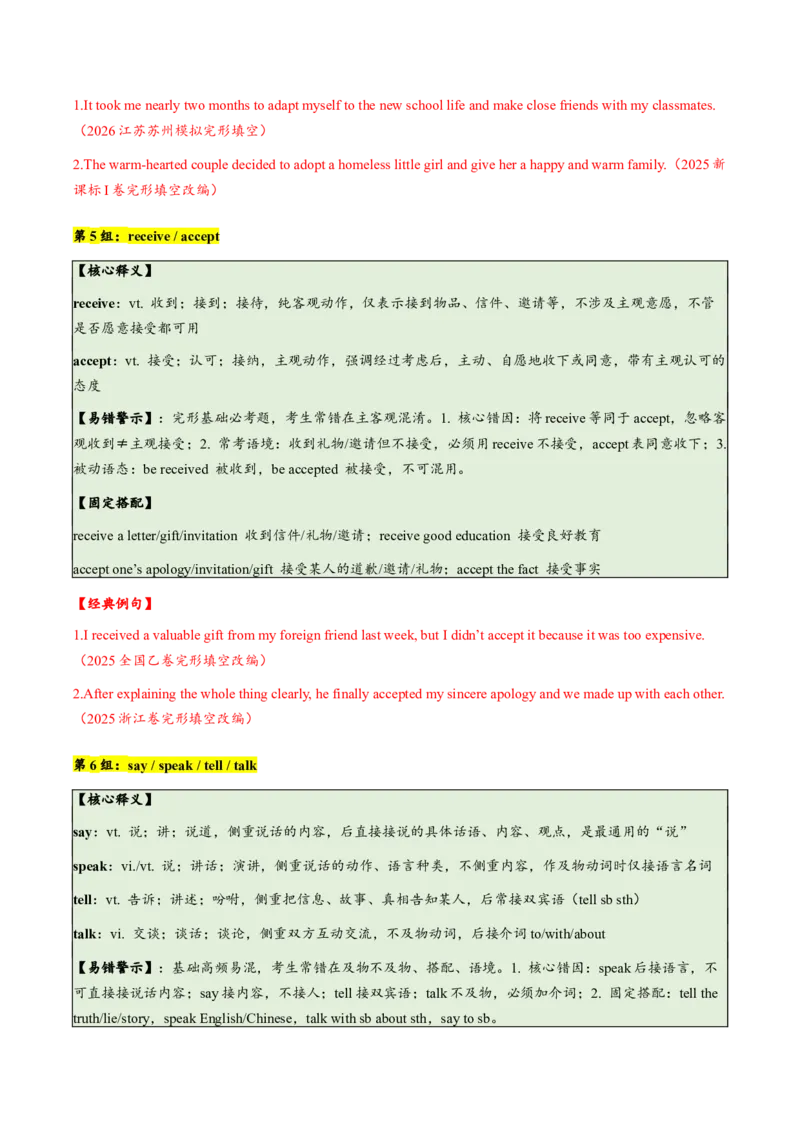
第4 组:adapt / adopt / adjust
【核心释义】
adapt:v. 适应;改编;改造,侧重主动适应新环境、新情况、新生活,也可指改编作品、改造物品以适
配需求
adopt:v. 收养;采纳;采用;领养,与“适应”语义完全无关,形近易混,侧重接纳他人、采纳建议/方
法、领养孩子
adjust:v. 调整;调节;校准;适应,侧重微小、细节上的调整,使适配新环境,也可指校准仪器、调节
状态,适应程度弱于adapt
【易错警示】:形近词拼写+语义双易错,考生失分率70%以上。1. 核心错因:混淆adapt 与adopt,误将
adopt 当作“适应”使用,二者语义无任何交集;2. 搭配混淆:adapt/adjust 后接to,adapt oneself to 为完形
必考搭配,adopt 后直接接宾语,不加to;3. 语境区分:长期适应新环境用adapt,微调状态/仪器用
adjust,领养/采纳用adopt。
【固定搭配】
adapt oneself to (doing) sth 使自己适应(做)某事;adapt from 改编自……
adopt a child 领养孩子;adopt a suggestion/method 采纳建议/方法;adopt an attitude 采取某种态度
adjust (oneself) to sth 适应某事;adjust the watch/clock 调钟表;adjust the speed 调节速度
【经典例句】
1.It took me nearly two months to adapt myself to the new school life and make close friends with my classmates.
(2026 江苏苏州模拟完形填空)
2.The warm-hearted couple decided to adopt a homeless little girl and give her a happy and warm family.(2025 新
课标I 卷完形填空改编)
第5 组:receive / accept
【核心释义】
receive:vt. 收到;接到;接待,纯客观动作,仅表示接到物品、信件、邀请等,不涉及主观意愿,不管
是否愿意接受都可用
accept:vt. 接受;认可;接纳,主观动作,强调经过考虑后,主动、自愿地收下或同意,带有主观认可的
态度
【易错警示】:完形基础必考题,考生常错在主客观混淆。1. 核心错因:将receive 等同于accept,忽略客
观收到≠主观接受;2. 常考语境:收到礼物/邀请但不接受,必须用receive 不接受,accept 表同意收下;3.
被动语态:be received 被收到,be accepted 被接受,不可混用。
【固定搭配】
receive a letter/gift/invitation 收到信件/礼物/邀请;receive good education 接受良好教育
accept one’s apology/invitation/gift 接受某人的道歉/邀请/礼物;accept the fact 接受事实
【经典例句】
1.I received a valuable gift from my foreign friend last week, but I didn’t accept it because it was too expensive.
(2025 全国乙卷完形填空改编)
2.After explaining the whole thing clearly, he finally accepted my sincere apology and we made up with each other.
(2025 浙江卷完形填空改编)
第6 组:say / speak / tell / talk
【核心释义】
say:vt. 说;讲;说道,侧重说话的内容,后直接接说的具体话语、内容、观点,是最通用的“说”
speak:vi./vt. 说;讲话;演讲,侧重说话的动作、语言种类,不侧重内容,作及物动词时仅接语言名词
tell:vt. 告诉;讲述;吩咐,侧重把信息、故事、真相告知某人,后常接双宾语(tell sb sth)
talk:vi. 交谈;谈话;谈论,侧重双方互动交流,不及物动词,后接介词to/with/about
【易错警示】:基础高频易混,考生常错在及物不及物、搭配、语境。1. 核心错因:speak 后接语言,不
可直接接说话内容;say 接内容,不接人;tell 接双宾语;talk 不及物,必须加介词;2. 固定搭配:tell the
truth/lie/story,speak English/Chinese,talk with sb about sth,say to sb。
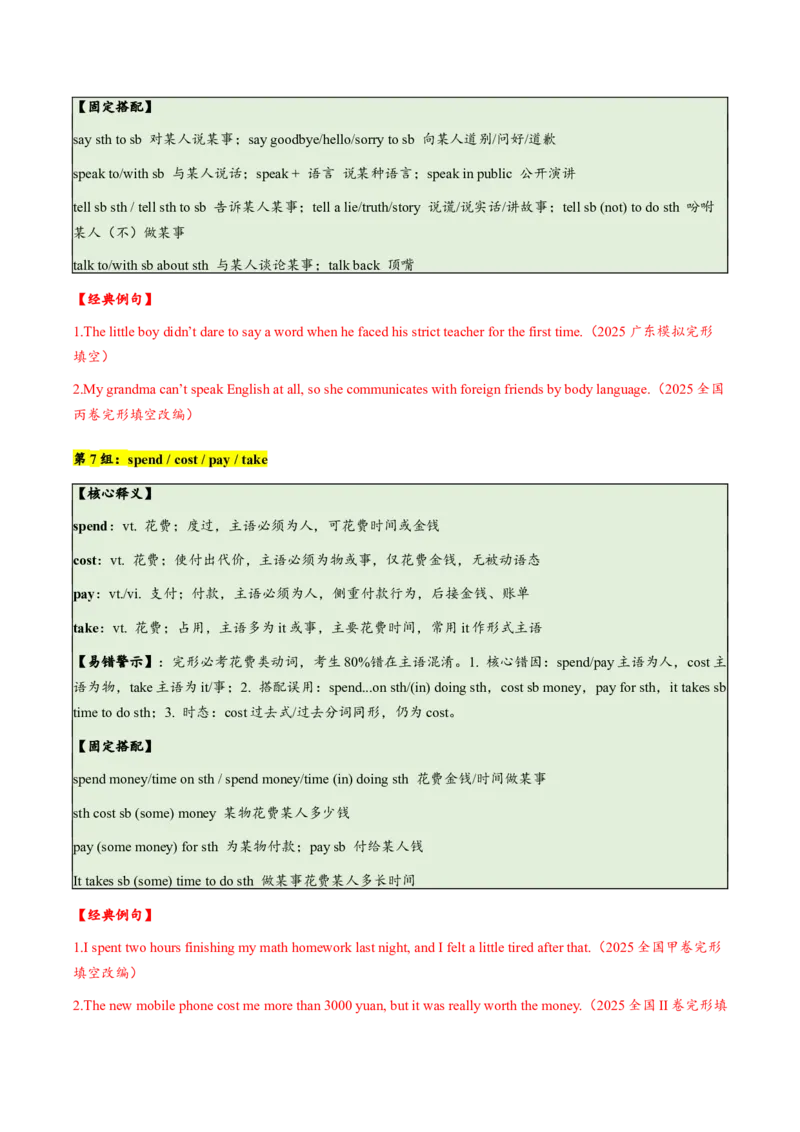
【固定搭配】
say sth to sb 对某人说某事;say goodbye/hello/sorry to sb 向某人道别/问好/道歉
speak to/with sb 与某人说话;speak + 语言 说某种语言;speak in public 公开演讲
tell sb sth / tell sth to sb 告诉某人某事;tell a lie/truth/story 说谎/说实话/讲故事;tell sb (not) to do sth 吩咐
某人(不)做某事
talk to/with sb about sth 与某人谈论某事;talk back 顶嘴
【经典例句】
1.The little boy didn’t dare to say a word when he faced his strict teacher for the first time.(2025 广东模拟完形
填空)
2.My grandma can’t speak English at all, so she communicates with foreign friends by body language.(2025 全国
丙卷完形填空改编)
第7 组:spend / cost / pay / take
【核心释义】
spend:vt. 花费;度过,主语必须为人,可花费时间或金钱
cost:vt. 花费;使付出代价,主语必须为物或事,仅花费金钱,无被动语态
pay:vt./vi. 支付;付款,主语必须为人,侧重付款行为,后接金钱、账单
take:vt. 花费;占用,主语多为it 或事,主要花费时间,常用it 作形式主语
【易错警示】:完形必考花费类动词,考生80%错在主语混淆。1. 核心错因:spend/pay 主语为人,cost 主
语为物,take 主语为it/事;2. 搭配误用:spend...on sth/(in) doing sth,cost sb money,pay for sth,it takes sb
time to do sth;3. 时态:cost 过去式/过去分词同形,仍为cost。
【固定搭配】
spend money/time on sth / spend money/time (in) doing sth 花费金钱/时间做某事
sth cost sb (some) money 某物花费某人多少钱
pay (some money) for sth 为某物付款;pay sb 付给某人钱
It takes sb (some) time to do sth 做某事花费某人多长时间
【经典例句】
1.I spent two hours finishing my math homework last night, and I felt a little tired after that.(2025 全国甲卷完形
填空改编)
2.The new mobile phone cost me more than 3000 yuan, but it was really worth the money.(2025 全国II 卷完形填
空改编)
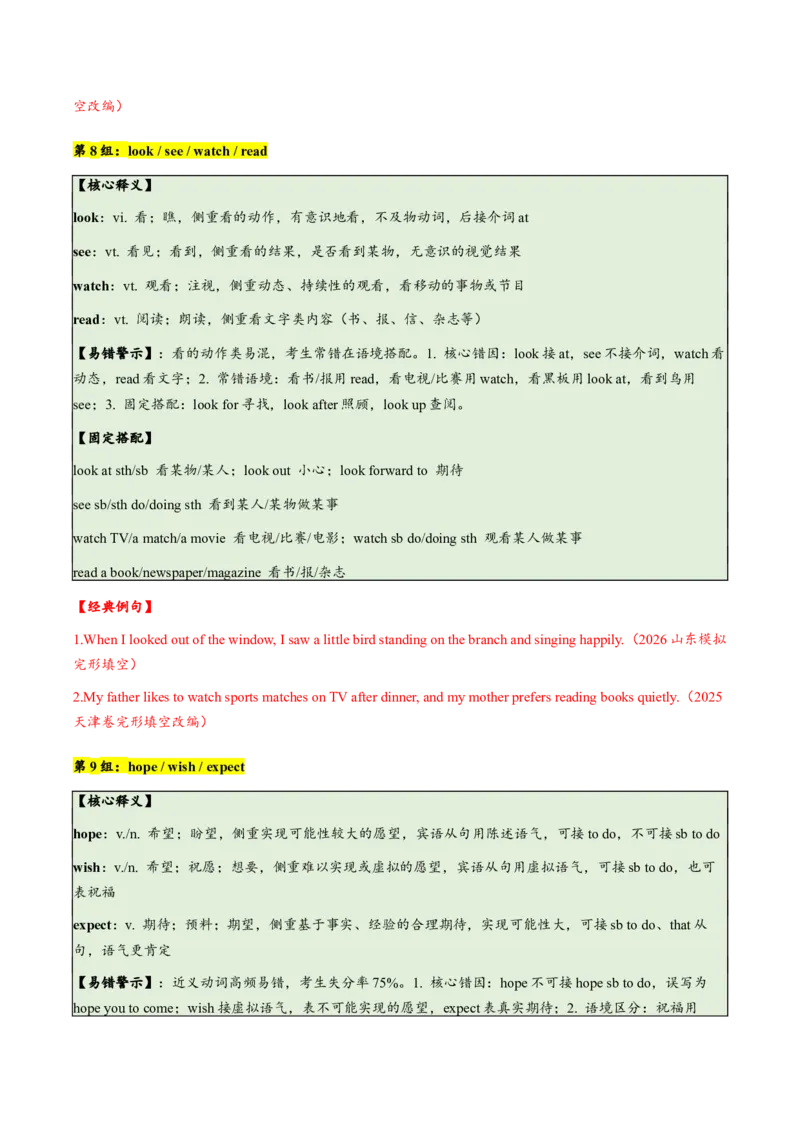
第8 组:look / see / watch / read
【核心释义】
look:vi. 看;瞧,侧重看的动作,有意识地看,不及物动词,后接介词at
see:vt. 看见;看到,侧重看的结果,是否看到某物,无意识的视觉结果
watch:vt. 观看;注视,侧重动态、持续性的观看,看移动的事物或节目
read:vt. 阅读;朗读,侧重看文字类内容(书、报、信、杂志等)
【易错警示】:看的动作类易混,考生常错在语境搭配。1. 核心错因:look 接at,see 不接介词,watch 看
动态,read 看文字;2. 常错语境:看书/报用read,看电视/比赛用watch,看黑板用look at,看到鸟用
see;3. 固定搭配:look for 寻找,look after 照顾,look up 查阅。
【固定搭配】
look at sth/sb 看某物/某人;look out 小心;look forward to 期待
see sb/sth do/doing sth 看到某人/某物做某事
watch TV/a match/a movie 看电视/比赛/电影;watch sb do/doing sth 观看某人做某事
read a book/newspaper/magazine 看书/报/杂志
【经典例句】
1.When I looked out of the window, I saw a little bird standing on the branch and singing happily.(2026 山东模拟
完形填空)
2.My father likes to watch sports matches on TV after dinner, and my mother prefers reading books quietly.(2025
天津卷完形填空改编)
第9 组:hope / wish / expect
【核心释义】
hope:v./n. 希望;盼望,侧重实现可能性较大的愿望,宾语从句用陈述语气,可接to do,不可接sb to do
wish:v./n. 希望;祝愿;想要,侧重难以实现或虚拟的愿望,宾语从句用虚拟语气,可接sb to do,也可
表祝福
expect:v. 期待;预料;期望,侧重基于事实、经验的合理期待,实现可能性大,可接sb to do、that 从
句,语气更肯定
【易错警示】:近义动词高频易错,考生失分率75%。1. 核心错因:hope 不可接hope sb to do,误写为
hope you to come;wish 接虚拟语气,表不可能实现的愿望,expect 表真实期待;2. 语境区分:祝福用
wish,普通希望用hope,基于事实的期待用expect;3. 虚拟语气:wish 后从句用过去时(现在)、过去完
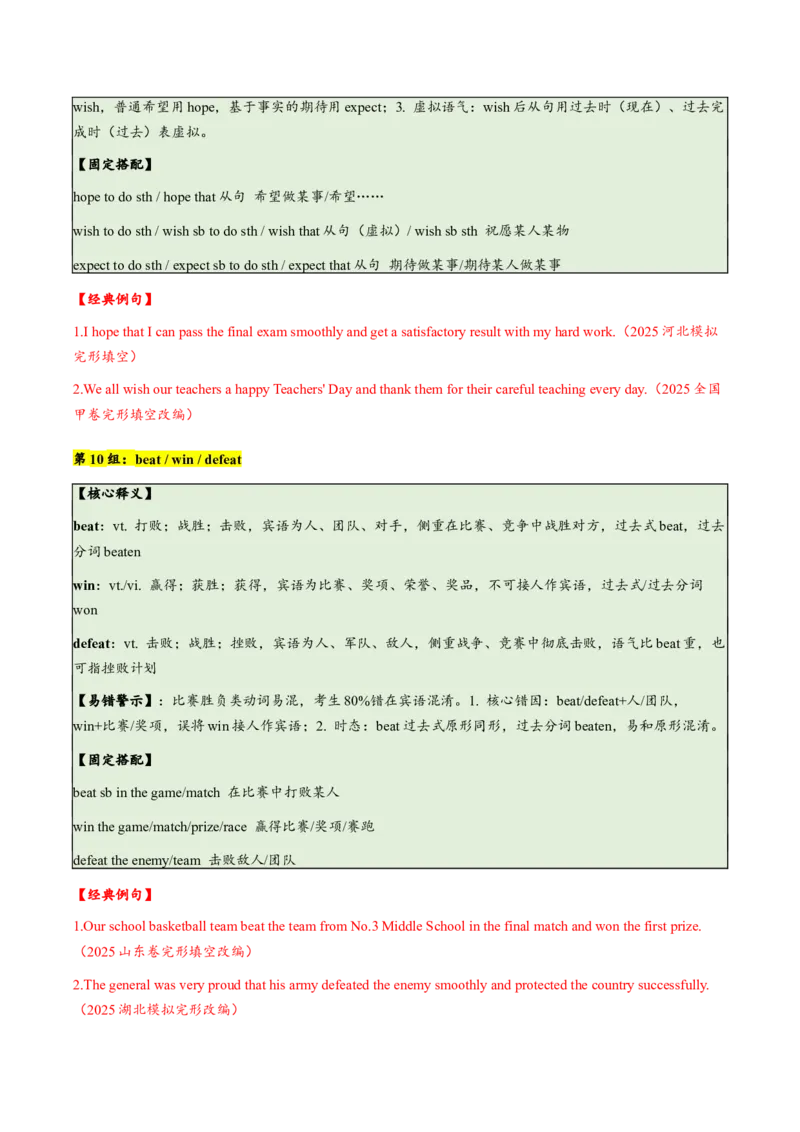
成时(过去)表虚拟。
【固定搭配】
hope to do sth / hope that 从句 希望做某事/希望……
wish to do sth / wish sb to do sth / wish that 从句(虚拟)/ wish sb sth 祝愿某人某物
expect to do sth / expect sb to do sth / expect that 从句 期待做某事/期待某人做某事
【经典例句】
1.I hope that I can pass the final exam smoothly and get a satisfactory result with my hard work.(2025 河北模拟
完形填空)
2.We all wish our teachers a happy Teachers' Day and thank them for their careful teaching every day.(2025 全国
甲卷完形填空改编)
第10 组:beat / win / defeat
【核心释义】
beat:vt. 打败;战胜;击败,宾语为人、团队、对手,侧重在比赛、竞争中战胜对方,过去式beat,过去
分词beaten
win:vt./vi. 赢得;获胜;获得,宾语为比赛、奖项、荣誉、奖品,不可接人作宾语,过去式/过去分词
won
defeat:vt. 击败;战胜;挫败,宾语为人、军队、敌人,侧重战争、竞赛中彻底击败,语气比beat 重,也
可指挫败计划
【易错警示】:比赛胜负类动词易混,考生80%错在宾语混淆。1. 核心错因:beat/defeat+人/团队,
win+比赛/奖项,误将win 接人作宾语;2. 时态:beat 过去式原形同形,过去分词beaten,易和原形混淆。
【固定搭配】
beat sb in the game/match 在比赛中打败某人
win the game/match/prize/race 赢得比赛/奖项/赛跑
defeat the enemy/team 击败敌人/团队
【经典例句】
1.Our school basketball team beat the team from No.3 Middle School in the final match and won the first prize.
(2025 山东卷完形填空改编)
2.The general was very proud that his army defeated the enemy smoothly and protected the country successfully.
(2025 湖北模拟完形改编)
第11 组:join / join in / take part in / attend
【核心释义】
join:vt. 加入;参加,侧重加入组织、团体、党派、人群,成为其中一员
join in:v. 参加;加入,侧重参加小规模活动、游戏、讨论,可接join sb in (doing) sth
take part in:v. 参加;参与,侧重参加群众性、集体性活动、会议、比赛,主动参与并发挥作用
attend:vt. 出席;参加,侧重出席会议、讲座、婚礼、葬礼、上课,侧重到场,不强调参与活动
【易错警示】:参加类动词高频易错,考生核心错在搭配对象混淆。1. 关键误区:join+组织/团体,join
in+小游戏/讨论,take part in+大型活动,attend+会议/课程;2. 误写:join 后直接接活动,正确需加in。
【固定搭配】
join the Party/League/club/army 入党/入团/加入俱乐部/参军
join in the game/discussion/fun 参加游戏/讨论/娱乐活动
take part in the sports meeting/activity/volunteer work 参加运动会/活动/志愿工作
attend a meeting/lecture/wedding/class 出席会议/讲座/婚礼/上课
【经典例句】
1.My brother decided to join the volunteer club and help more people in need after school.(2025 全国乙卷完形填
空改编)
2.All the students in our class will take part in the school art festival next month and prepare wonderful programs.
(2025 全国乙卷完形填空改编)
第12 组:borrow / lend / keep
【核心释义】
borrow:vt. 借入;借用,侧重从别人那里借进东西,短暂动作,不可与时间段连用,搭配borrow sth from
sb
lend:vt. 借出;借给,侧重把东西借给别人,短暂动作,搭配lend sb sth / lend sth to sb,过去式/过去分词
lent
keep:vt. 保存;保留;借用,侧重长时间持有、保管,可与时间段连用,表“借多久”
【易错警示】:借贷类动词易混,考生70%错在方向和延续性混淆。1. 核心错因:borrow 借入,lend 借
出,方向相反;borrow/lend 是短暂动词,不可接for+时间段,keep 是延续性动词,可接时间段;2. 时态:
lend 过去式lent,易误写为lended。
【固定搭配】
borrow sth from sb 向某人借某物
lend sb sth / lend sth to sb 借给某人某物
keep sth for + 时间段 借某物多长时间
【经典例句】
1.I forgot to bring my English dictionary this morning, so I borrowed one from my deskmate.(2025 广东模拟完
形填空)
2.You can keep this novel for two weeks, but you must return it to the library on time.(2025 新课标II 卷完形填
空改编)
第13 组:forget / remember / remind
【核心释义】
forget:vt. 忘记;遗忘,侧重忘记做过某事或要做某事,搭配forget doing/to do
remember:vt. 记得;记住,侧重记得做过某事或要做某事,搭配remember doing/to do
remind:vt. 提醒;使想起,侧重提醒某人做某事,或使某人想起某事,搭配remind sb of sth / remind sb to
do sth
【易错警示】:记忆类动词高频易错,考生核心错在非谓语搭配混淆。1. 关键误区:forget/remember to do
忘记/记得去做(未做),forget/remember doing 忘记/记得做过(已做);remind 不可直接接to do,必须
加sb;2. 误写:remind to do,正确为remind sb to do。
【固定搭配】
forget to do sth 忘记去做某事;forget doing sth 忘记做过某事
remember to do sth 记得去做某事;remember doing sth 记得做过某事
remind sb of sth / remind sb to do sth 提醒某人某事/提醒某人做某事
【经典例句】
1.Don’t forget to turn off the lights and lock the door when you leave the classroom every day.(2025 北京模拟完
形填空)
2.The old photo reminds me of my happy childhood in the small countryside with my grandparents.(2025 全国甲
卷完形填空改编)
第14 组:find / find out / look for / discover
【核心释义】
find:vt. 找到;发现,侧重找的结果,找到丢失的人或物,也可指偶然发现
find out:v. 查明;弄清楚;发现,侧重经过调查、研究、询问后查明真相、原因、信息
look for:v. 寻找,侧重找的动作和过程,不强调结果
discover:vt. 发现;发觉,侧重发现原本存在但未被人知晓的事物、真理、规律
【易错警示】:寻找类动词易混,考生85%错在动作与结果混淆。1. 核心错因:look for 表过程,find 表
结果,find out 表查明真相,discover 表发现未知事物;2. 语境区分:找丢失的钥匙用look for/find,查原
因用find out,发现新大陆用discover。
【固定搭配】
look for sth/sb 寻找某物/某人
find sth/sb 找到某物/某人;find it + adj. + to do sth 发现做某事……
find out the truth/reason/secret 查明真相/原因/秘密
discover a new planet/secret 发现新行星/秘密
【经典例句】
1.I have looked for my pen everywhere in the classroom, but I still can’t find it.(2025 江苏模拟完形填空)
2.The scientist worked hard for many years and finally discovered a new kind of plant in the deep forest.(2025 新
课标I 卷完形填空改编)
第15 组:reach / arrive / get to
【核心释义】
reach:vt. 到达;抵达,及物动词,直接接地点名词,无介词,可直接接here/there/home
arrive:vi. 到达;抵达,不及物动词,接大地点用in,小地点用at,接here/there/home 省略介词
get to:v. 到达,口语化,接地点名词,接here/there/home 省略to
【易错警示】:到达类动词高频易错,考生核心错在介词误用。1. 关键误区:reach 直接接地点,arrive
in+大地点,arrive at+小地点,get to+地点;2. 误写:reach to sp,arrive to sp,正确无此搭配。
【固定搭配】
reach + 地点名词/here/there/home 到达某地
arrive in + 大地点(国家/城市);arrive at + 小地点(车站/学校)
get to + 地点名词;get here/there/home 到这里/那里/家
【经典例句】
1.We will reach the top of the mountain in two hours if we keep climbing without stopping.(2025 陕西模拟完形
填空)
2.My parents arrived at the train station early and waited for me patiently when I came back home.(2025 全国I
卷完形填空改编)
第16 组:wear / dress / put on / in
【核心释义】
wear:vt. 穿着;戴着,延续性动词,侧重穿着的状态,可接衣物、饰品、眼镜
dress:vt./vi. 穿衣服;打扮,不及物动词,接人作宾语,不接衣物,搭配dress sb / dress oneself
put on:v. 穿上;戴上,短暂动词,侧重穿的动作,不强调状态
in:prep. 穿着;戴着,介词,后接颜色或衣物,表状态,作定语或表语
【易错警示】:穿戴类动词易混,考生70%错在宾语和状态混淆。1. 核心错因:wear 表状态,put on 表动
作,dress+人,in+颜色/衣物;2. 误写:dress clothes,正确为dress sb。
【固定搭配】
wear a coat/glasses/hat 穿着外套/戴着眼镜/帽子
dress sb / dress oneself / get dressed 穿衣服
put on a coat/shoes 穿上外套/鞋子
in red / in a coat 穿着红色衣服/穿着外套
【经典例句】
1.It’s cold outside, so you should put on your thick coat before going out to keep warm.(2025 辽宁模拟完形填
空)
2.The little girl is wearing a beautiful pink dress and looks very lovely in the sun.(2025 天津卷完形填空改编)
第17 组:make / produce / create / invent
【核心释义】
make:vt. 制作;制造;使,通用词,侧重手工或机器制作普通物品,也可表使役
produce:vt. 生产;制造;产出,侧重工厂批量生产商品、农产品
create:vt. 创造;创作;创建,侧重创造原本不存在的抽象事物、艺术作品、氛围
invent:vt. 发明;创造,侧重发明新的工具、技术、物品,之前从未有过
【易错警示】:制作创造类动词易混,考生核心错在语境混淆。1. 关键误区:make 普通制作,produce 批
量生产,create 创作抽象/艺术,invent 发明新事物;2. 常错语境:发明电脑用invent,创作诗歌用create,
生产汽车用produce。
【固定搭配】
make a cake/card/plan 制作蛋糕/卡片/计划
produce cars/food/goods 生产汽车/食物/商品
create a work of art/atmosphere 创作艺术品/营造氛围
invent a new machine/technology 发明新机器/技术
【经典例句】
1.My mother taught me how to make a delicious birthday cake for my father’s birthday.(2025 浙江模拟完形填
空)
2.The great scientist invented many useful machines in his life and made great contributions to society.(2025 全国
乙卷完形填空改编)
第18 组:allow / permit / let
【核心释义】
allow:vt. 允许;准许,通用词,语气较弱,日常使用,搭配allow sb to do sth / allow doing sth
permit:vt. 允许;许可,语气较强,正式场合,法律、规定许可,搭配同allow
let:vt. 让;允许,口语化,语气最弱,搭配let sb do sth,省略to,无被动
【易错警示】:允许类动词易混,考生80%错在非谓语搭配。1. 核心错因:allow/permit sb to do / doing,
let sb do(不带to);let 无被动语态,误写为be let;2. 正式程度:permit>allow>let。
【固定搭配】
allow sb to do sth / allow doing sth 允许某人做某事/允许做某事
permit sb to do sth / permit doing sth 许可某人做某事/许可做某事
let sb do sth 让某人做某事
【经典例句】
1.My parents don’t allow me to play computer games on school nights because I have to finish my homework.
(2025 江西模拟完形填空)
2.The teacher doesn’t let the students run in the hallway to avoid unexpected accidents.(2025 全国II 卷完形填空
改编)
第19 组:catch / hold / take / seize
【核心释义】
catch:vt. 抓住;接住;赶上;染上,侧重突然抓住、接住移动的事物,也可表赶车、染病
hold:vt. 握住;持有;举办,侧重长时间握住、持有,保持状态,也可表举办活动
take:vt. 拿;取;带走,通用词,侧重拿起、带走,动作随意
seize:vt. 抓住;夺取,侧重用力抓住、夺取,语气强烈,正式
【易错警示】:抓拿类动词易混,考生核心错在动作力度和状态。1. 关键误区:catch 瞬间抓住,hold 持
续握住,take 普通拿取,seize 用力夺取;2. 固定搭配:catch a cold 感冒,catch a bus 赶公交,hold a
meeting 开会。
【固定搭配】
catch a ball/cold/bus 接住球/感冒/赶公交
hold a book/meeting/party 握住书/举办会议/派对
take a book/photo 拿书/拍照
seize a chance/weapon 抓住机会/夺取武器
【经典例句】
1.The little boy ran fast and tried to catch the butterfly in the garden, but it flew away at last.(2026 福建模拟完形
填空)
2.She held the old photo tightly in her hand and missed her dead grandmother very much.(2025 全国丙卷完形填
空改编)
第20 组:cover / include / contain
【核心释义】
cover:vt. 覆盖;涵盖;包括;占地,侧重覆盖表面,或内容涵盖、涉及,也可表占地
include:vt. 包括;包含,侧重整体包含部分,部分属于整体,可用于列举
contain:vt. 包含;含有;容纳,侧重容器内装有某物,或某物含有成分、内容,整体包含全部
【易错警示】:包含类动词易混,考生75%错在包含范围。1. 核心错因:include 整体含部分,contain 容
器/成分含全部,cover 涵盖内容、覆盖;2. 形式:including 介词,included 形容词,例:There are 50
students, including 30 boys.。
【固定搭配】
cover...with 用……覆盖;cover an area of 占地;cover a topic 涵盖话题
include sth in... 把某物包含在……内
contain water/sugar 含有水/糖分;contain 500ml 容纳500 毫升
【经典例句】
1.The book covers many important topics about traditional Chinese culture and is worth reading.(2026 安徽模拟
完形填空)
2.The bottle contains pure milk without any sugar, so it’s very healthy for children to drink.(2025 江苏卷完形填
空改编)
第21 组:break / destroy / damage / ruin
【核心释义】
break:vt./vi. 打破;打碎;弄坏,通用词,侧重打破、弄坏物品,程度较轻,可修复
destroy:vt. 摧毁;毁灭,程度最重,彻底毁坏,无法修复,可指抽象事物
damage:vt./n. 损害;损坏,程度较轻,部分损坏,可修复,多指物品、建筑
ruin:vt./n. 毁坏;毁灭,侧重逐渐毁坏,也可指抽象事物(名誉、生活),不可修复
【易错警示】:破坏类动词易混,考生核心错在损坏程度。1. 关键误区:destroy>ruin>damage>break;
break 日常弄坏,damage 可修复,destroy/ruin 不可修复;2. 抽象:ruin one’s life 毁了生活,destroy one’s
hope 摧毁希望。
【固定搭配】
break a cup/glass/window 打破杯子/玻璃杯/窗户
damage a car/building 损坏汽车/建筑
destroy a house/plan 摧毁房屋/破坏计划
ruin one’s health/fame 毁坏健康/名誉
【经典例句】
1.The careless boy broke his mother’s favorite cup and felt very sorry for it.(2026 湖南模拟完形填空)
2.The big fire destroyed the whole forest and many wild animals lost their homes.(2025 全国甲卷完形填空改
编)
第22 组:choose / select / pick
【核心释义】
choose:v. 选择;挑选,通用词,侧重凭主观意愿选择,可接to do
select:vt. 挑选;选拔,侧重精心、严格挑选,择优录取,正式
pick:v. 挑选;采摘,口语化,侧重随意挑选,也可表采摘水果、花朵
【易错警示】:选择类动词易混,考生70%错在正式程度。1. 核心错因:choose 通用,select 精心挑选,
pick 随意/采摘;2. 搭配:choose to do sth 选择做某事,select sb for sth 选拔某人做某事,pick apples 摘苹
果。
【固定搭配】
choose to do sth / choose from 从……中选择
select the best players 挑选最佳运动员
pick a book/apple/flower 挑选书/摘苹果/摘花
【经典例句】
1.I chose to learn painting as my hobby because I like drawing beautiful pictures very much.(2026 重庆模拟完形
填空)
2.The coach selected several excellent students from our school to take part in the national competition.(2025 浙
江卷完形填空改编)
第23 组:complete / finish / end
【核心释义】
complete:vt. 完成;结束;使完整,侧重完成任务、工程、项目,使其完整,正式,形容词意为“完整
的”
finish:vt./vi. 完成;结束,通用词,侧重完成日常事务、作业,后接doing
end:vt./vi./n. 结束;终止,侧重活动、会议、关系的终止,可作名词
【易错警示】:完成类动词易混,考生核心错在搭配和词性。1. 关键误区:finish+doing,complete+名
词,end 可作名词;2. 语境:complete 工程/项目,finish 作业/家务,end 会议/活动。
【固定搭配】
complete a project/task/building 完成项目/任务/建筑
finish doing sth / homework 完成做某事/作业
end a meeting/party/relationship 结束会议/派对/关系
【经典例句】
1.I have finished doing all my homework and I can watch TV for half an hour now.(2026 广东模拟完形填空)
2.The workers worked day and night and completed the new bridge three months ahead of time.(2025 全国乙卷
完形填空改编)
第24 组:cost / spend / pay / take(前文已写基础版,此处深化易混)
【核心释义】
cost:vt. 花费;使付出代价,主语物,仅花钱,无被动,过去式cost
spend:vt. 花费,主语人,花钱/时间,spend...on/(in)doing
pay:vt. 支付,主语人,付钱,pay for
take:vt. 花费,主语it,花时间,It takes sb time to do
【易错警示】:深化易错点:1. cost 可表“付出代价”,例:The mistake cost him his job.;2. take 可用于
事作主语,例:The work took me 2 hours.;3. pay back 偿还,pay for 赔偿。
【固定搭配】
cost sb sth 使某人付出某物代价
spend time/money on sth/(in)doing
pay for sth / pay back 偿还
It takes sb time to do sth
【经典例句】
1.His careless mistake cost him the chance to enter the ideal university, which made him very sad.(2026 山东模
拟完形填空)
2.I will pay back the money I borrowed from you as soon as I get my pocket money.(2024 新课标II 卷完形填空
改编)
第25 组:fall / drop / sink
【核心释义】
fall:vi. 落下;跌倒;掉落,不及物动词,自然下落、跌倒,过去式fell,过去分词fallen
drop:vt./vi. 掉落;丢下;下降,可及物可不及物,人为丢下或意外掉落,也可表温度、价格下降
sink:vi. 下沉;沉没,侧重在水中、液体中下沉,过去式sank/sunk,过去分词sunk
【易错警示】:掉落类动词易混,考生核心错在及物性和语境。1. 核心错因:fall 不及物,drop 可及物,
sink 水中下沉;2. 时态:fall-fell-fallen,drop-dropped-dropped,sink-sank-sunk。
【固定搭配】
fall down/off 跌倒/从……掉落;fall ill/asleep 生病/睡着
drop a glass/pen 掉落杯子/钢笔;drop in temperature 温度下降
sink into the water/sea 沉入水中/大海
【经典例句】
1.The little girl dropped her toy bear on the ground and cried loudly.(2026 北京模拟完形填空)
2.The heavy stone sank into the deep river quickly and we couldn’t find it at all.(2025 全国丙卷完形填空改编)
第26 组:fix / mend / repair
【核心释义】
fix:vt. 修理;安装;固定,口语化,侧重修理小物品、安装,也可表固定
mend:vt. 修补;缝补,侧重修补破损的衣物、小物件,简单修补
repair:vt. 修理;维修,侧重修理大型、复杂物品,如汽车、机器、建筑,正式
【易错警示】:修理类动词易混,考生75%错在修理对象。1. 关键误区:mend 修补衣物,fix 修理小物
件,repair 修理大型机械/建筑;2. 固定搭配:fix up 修理,mend a hole 补洞,repair a car 修汽车。
【固定搭配】
fix a clock/watch/bike 修理钟表/手表/自行车
mend a shirt/hole 修补衬衫/破洞
repair a car/machine/building 修理汽车/机器/建筑
【经典例句】
1.My father can fix the broken bike for me and it will work well soon.(2026 江苏模拟完形填空)
2.My grandmother mended the broken coat for me and it looked as good as new.(2024 全国I 卷完形填空改编)
第27 组:grow / plant / develop
【核心释义】
grow:vt./vi. 种植;生长;成长,侧重植物自然生长,也可表人成长、种植
plant:vt. 种植;栽种,侧重栽种的动作,种下种子、树苗,不强调生长
develop:vt./vi. 发展;发育;培养,侧重事物发展、人能力培养、植物发育
【易错警示】:种植成长类动词易混,考生核心错在动作与生长。1. 核心错因:plant 表栽种动作,grow
表生长过程,develop 表发展培养;2. 搭配:grow up 成长,plant trees 种树,develop a habit 培养习惯。
【固定搭配】
grow flowers/vegetables 种花/种菜;grow up 成长
plant trees/flowers/seeds 种树/花/种子
develop a good habit/industry 培养好习惯/发展工业
【经典例句】
1.We plant many trees in the park every year to make our environment more beautiful.(2025 山西模拟完形填
空)
2.The little boy has grown up a lot and he can help his parents do many housework now.(2025 全国甲卷完形填
空改编)
第28 组:hide / cover / escape
【核心释义】
hide:vt./vi. 隐藏;躲藏,侧重故意把人/物藏起来,不让人发现,过去式hid,过去分词hidden
cover:vt. 覆盖;遮盖,侧重用东西覆盖表面,不是故意隐藏
escape:vi./vt. 逃跑;逃脱;避开,侧重逃离危险、困境,避开注意
【易错警示】:隐藏类动词易混,考生核心错在动机。1. 关键误区:hide 故意躲藏,cover 无意覆盖,
escape 逃跑;2. 搭配:hide from 躲避,cover...with 用……覆盖,escape from 从……逃跑。
【固定搭配】
hide sth/sb from sb 把某物/人藏起来不让某人发现
cover...with 用……覆盖
escape from danger/prison 逃离危险/监狱
【经典例句】
1.The little girl hid herself behind the door and played hide-and-seek with her friends.(2026 浙江模拟完形填
空)
2.She covered the sleeping baby with a soft quilt to keep him warm.(2025 天津卷完形填空改编)
第29 组:learn / study
【核心释义】
learn:vt./vi. 学习;学会,侧重学习的结果,学会知识、技能,也可表得知
study:vt./vi. 学习;研究,侧重学习的过程,深入研究、钻研,正式
【易错警示】:学习类动词易混,考生70%错在过程与结果。1. 核心错因:learn 学会结果,study 学习过
程/研究;2. 搭配:learn from 向……学习,study hard 努力学习,study a problem 研究问题。
【固定搭配】
learn to do sth / learn from sb 学会做某事/向某人学习
study for a test 为考试学习;study a subject 研究一门学科
【经典例句】
1.I want to learn to play the piano because I think playing the piano is very elegant.(2026 河南模拟完形填空)
2.The students are studying hard for the coming final exam to get good grades.(2025 全国乙卷完形填空改编)
第30 组:lose / miss / waste
【核心释义】
lose:vt. 丢失;失去;输掉,侧重丢失物品、失去机会、输掉比赛,过去式lost
miss:vt. 错过;想念;漏掉,侧重错过机会、时间,想念某人,漏掉内容
waste:vt./n. 浪费,侧重浪费时间、金钱、资源
【易错警示】:失去错过类动词易混,考生核心错在语义。1. 关键误区:lose 丢失失去,miss 错过想念,
waste 浪费;2. 搭配:lose one’s way 迷路,miss the bus 错过公交,waste time doing 浪费时间做。
【固定搭配】
lose one’s way/key/game 迷路/丢钥匙/输掉比赛
miss the bus/chance/doing 错过公交/机会/做某事
waste time/money (in) doing sth 浪费时间/金钱做某事
【经典例句】
1.I got up late this morning and missed the early bus, so I had to walk to school.(2026 四川模拟完形填空)
2.Don’t waste your precious time playing computer games all day, you should study hard.(2025 全国II 卷完形填
空改编)
第31 组:meet / meet with / see
【核心释义】
meet:vt./vi. 遇见;见面;迎接,侧重偶然遇见或约定见面,迎接某人
meet with:v. 偶遇;遭遇;经历,侧重偶然遇见,或遭遇困难、挫折
see:vt. 看见;见到,侧重看到的结果,不一定交流
【易错警示】:遇见类动词易混,考生核心错在语境。1. 核心错因:meet 主动见面/迎接,meet with 遭
遇/偶遇,see 单纯看见;2. 搭配:meet sb 遇见某人,meet with difficulties 遭遇困难。
【固定搭配】
meet sb at the station 在车站接某人;meet for dinner 见面吃饭
meet with an accident/difficulties 遭遇事故/困难
【经典例句】
1.I met an old friend of mine on the street yesterday and we talked happily for a long time.(2026 河北模拟完形
填空)
2.The young man met with many difficulties on his way to success, but he never gave up.(2025 新课标I 卷完形
填空改编)
第32 组:open / turn on / close / turn off
【核心释义】
open:vt./vi. 打开;开,侧重打开封闭的物品(门、窗、盒子、书)
turn on:v. 打开,侧重打开电器、开关(灯、电视、收音机)
close:vt./vi. 关闭;关,侧重关闭封闭的物品,和open 对应
turn off:v. 关闭,侧重关闭电器、开关,和turn on 对应
【易错警示】:开关类动词易混,考生80%错在对象。1. 核心错因:open/close 对应门窗/书籍,turn
on/turn off 对应电器;2. 误写:open the TV,正确为turn on the TV。
【固定搭配】
open the door/window/book 打开门/窗/书
turn on the light/TV/radio 打开灯/电视/收音机
close the door/window 关上门/窗
turn off the light/TV 关掉灯/电视
【经典例句】
1.It’s too hot in the room, please turn on the air conditioner to make it cool.(2026 辽宁模拟完形填空)
2.Remember to close the window and turn off the lights before you leave the classroom.(2025 全国甲卷完形填
空改编)
第33 组:prepare / prepare for / get ready for
【核心释义】
prepare:vt. 准备;筹备,侧重准备的动作,直接接准备的物品、内容
prepare for:v. 为……做准备,侧重为某事做准备,接准备的目标
get ready for:v. 为……做好准备,侧重准备完成的状态,口语化
【易错警示】:准备类动词易混,考生核心错在搭配。1. 关键误区:prepare+准备的东西,prepare for/get
ready for+准备的目标;2. 搭配:prepare a meal 准备饭,prepare for an exam 为考试准备。
【固定搭配】
prepare sth for sb 为某人准备某物
prepare for an exam/party 为考试/派对做准备
get ready for school/trip 准备好上学/旅行
【经典例句】
1.My mother is preparing a big dinner for our family to celebrate the Spring Festival.(2026 江苏模拟完形填空)
2.The students are busy preparing for the mid-term exam and they study very hard every day.(2025 山东卷完形
填空改编)
第34 组:realize / understand / know
【核心释义】
realize:vt. 意识到;实现,侧重突然意识到、明白事实,也可表实现梦想
understand:vt. 理解;明白,侧重理解事物的含义、道理、情感
know:vt. 知道;了解;认识,通用词,侧重知道信息、认识人、了解事实
【易错警示】:明白知道类动词易混,考生75%错在程度与语境。1. 核心错因:know 仅指表面知晓信
息、认识某人,不涉及深度理解;understand 侧重深层理解含义、道理、情感,懂其内在逻辑;realize 侧
重突然、恍然意识到事实、真相,或是实现目标、梦想,三者认知深度逐层递进;2. 搭配混淆:realize
one’s dream 实现梦想,understand the truth/reason 理解真相/原因,know sb/sth well 熟知某人/某物;3. 常错
语境:突然意识到自己犯错用realize,理解数学题思路用understand,知道同学名字用know。
【固定搭配】
realize one’s mistake/dream 意识到错误/实现梦想
understand the meaning/feeling 理解含义/情感
know about 了解;know sb by name 只知道某人名字
【经典例句】
1.I didn’t realize my mistake until my teacher pointed it out patiently after class.(2026 广东模拟完形填空)
2.After reading the passage again and again, I finally understand the deep love between the father and the son.
(2025 全国乙卷完形填空改编)
第35 组:share / spare / split
【核心释义】
share:vt./vi. 分享;分担;共用,侧重将自己的物品、想法、快乐、痛苦与他人共同拥有、分担,是高考
完形高频词,强调平等共用
spare:vt. 抽出;留出;饶恕;adj. 多余的;备用的,侧重抽出时间、腾出物品,不占用自身核心资源,
也可指多余的物件
split:vt./vi. 分开;分裂;分摊,侧重将整体分成若干部分,或是分摊费用、成本,带有分割、拆分的含
义
【易错警示】:近义动词高频易错,考生70%错在语境与搭配混淆。1. 核心错因:share 侧重“共同拥
有”,spare 侧重“腾出、抽出”,split 侧重“分割、分摊”,三者核心动作完全不同;2. 搭配误用:
spare 后接时间时,常用spare sb some time/spare some time for sb,不可接to do 直接表抽出时间;share sth
with sb 为必考搭配,易漏写介词with;split 常与into 连用,表分成几份;3. 常错语境:分享零食用
share,抽出空闲时间用spare,分摊旅行费用用split。
【固定搭配】
share sth with sb 与某人分享某物;share happiness and sorrow 同甘共苦
spare some time/money 抽出时间/留出钱;spare no effort to do sth 不遗余力做某事
split into 分成;split the cost 分摊费用
【经典例句】
1.The kind girl is always ready to share her snacks and books with her deskmate.(2026 浙江卷完形填空改编)
2.Can you spare me ten minutes? I have something important to tell you.(2025 山东名校联考完形填空)
第36 组:stand / bear / tolerate / endure
【核心释义】
stand:vt./vi. 忍受;忍耐;站立,口语化通用词,侧重忍受不愉快的人、事、环境,常用于否定句,can’t
stand doing sth 为高频搭配
bear:vt. 忍受;承受;承担,书面口语通用,侧重承受痛苦、压力、责任,语气比stand 重,可接不定式
或动名词
tolerate:vt. 容忍;忍受,侧重宽容、包容他人的行为、缺点,语气较温和,多指被动忍受
endure:vt./vi. 忍受;忍耐;持久,书面语,语气最重,侧重长时间忍受巨大痛苦、磨难,强调毅力
【易错警示】:忍受类动词易混,考生80%错在语气程度和搭配。1. 核心错因:语气程度
endure>bear>tolerate>stand,否定句中can’t stand/bear 为常用表达,tolerate 不用于can’t tolerate 的口语表
达;2. 搭配混淆:stand/bear/tolerate 后可接doing sth,endure 多接名词;3. 常错语境:无法忍受吵闹用
can’t stand,承受生活压力用bear,容忍他人小过错用tolerate,忍受病痛折磨用endure。
【固定搭配】
can’t stand (doing) sth 无法忍受(做)某事
bear pain/pressure 忍受痛苦/压力;bear to do/doing sth 忍受做某事
tolerate one’s bad behavior 容忍某人的不良行为
endure hardship/suffering 忍受苦难
【经典例句】
1.I can’t stand living in a noisy place, so I chose a quiet room in the hotel.(2026 北京模拟完形填空)
2.The old man had to endure great pain every day after the accident, but he never gave up hope.(2025 新课标II
卷完形填空改编)
第37 组:start / begin / commence
【核心释义】
start:v. 开始;启动;出发,通用词,口语书面均可,侧重动作的开端,可接to do/doing,还可表示启动
机器、出发
begin:v. 开始,通用词,侧重状态、过程的开端,可接to do/doing,语气比start 稍正式,不可表示启动
机器
commence:v. 开始;着手,正式书面语,多用于正式场合、仪式、活动、法律语境,日常口语不使用
【易错警示】:开始类动词易混,考生核心错在正式程度和用法。1. 核心错因:start 可表启动、出发,
begin 无此用法;commence 仅用于正式场合,高考完形极少考查,重点区分start 和begin;2. 搭配差异:
start/begin to do/doing sth 均可,无明显语义差别;3. 常错语境:启动汽车用start,开始上课用begin/start,
典礼开始用commence。
【固定搭配】
start to do/doing sth 开始做某事;start up 启动;start off 出发
begin to do/doing sth 开始做某事;begin with 以……开始
commence the ceremony/meeting 开始仪式/会议
【经典例句】
1.We will start our trip as soon as everyone gets ready.(2026 河北模拟完形填空)
2.The meeting will begin with a speech given by our headmaster.(2025 全国甲卷完形填空改编)
第38 组:steal / rob / cheat
【核心释义】
steal:vt./vi. 偷;窃取,侧重偷偷摸摸地拿走他人财物,宾语为物品,常用搭配steal sth from sb/sp
rob:vt. 抢劫;抢夺,侧重公然、暴力抢夺财物,宾语为人或地点,常用搭配rob sb/sp of sth
cheat:vt./vi. 欺骗;作弊;骗取,侧重用欺骗手段获取财物、信任,或是考试作弊,宾语为人或抽象事物
【易错警示】:不法行为类动词高频易错,考生90%错在宾语和搭配。1. 核心错因:steal+物品,
rob+人/地点,cheat+人,三者宾语完全不同,搭配不可互换;2. 固定搭配误用:steal 后接from,rob 后接
of,易混淆介词;3. 时态:steal-stole-stolen,rob-robbed-robbed,cheat-cheated-cheated,过去式过去分词易
写错。
【固定搭配】
steal sth from sb/somewhere 从某人/某地偷某物
rob sb/somewhere of sth 抢劫某人/某地某物
cheat sb (out) of sth 骗取某人某物;cheat in the exam 考试作弊
【经典例句】
1.Someone stole my wallet while I was shopping in the crowded supermarket yesterday.(2025 天津卷完形填空
改编)
2.The brave young man stopped the man who wanted to rob the old lady of her bag.(2026 江苏模拟完形填空)
第39 组:succeed / manage / try
【核心释义】
succeed:vi. 成功;达成,不及物动词,侧重成功做成某事,达到预期目标,后接in doing sth
manage:vt./vi. 设法做成;管理,侧重经过努力最终成功做成某事,强调过程的不易,后接to do sth
try:vt./vi. 尝试;努力,侧重付出努力尝试做某事,不强调结果是否成功,后接to do/doing sth
【易错警示】:成功尝试类动词易混,考生85%错在结果和搭配。1. 核心错因:succeed/manage 强调成功
做成,try 仅强调尝试、结果未知;2. 搭配混淆:succeed in doing,manage to do,try to do/doing,不可混
用;3. 常错语境:成功通过考试用succeed in passing/manage to pass,努力尝试解决问题用try to solve。
【固定搭配】
succeed in (doing) sth 成功做某事
manage to do sth 设法做成某事
try to do sth 努力做某事;try doing sth 尝试做某事
【经典例句】
1.After months of hard work, he succeeded in passing the important driving test.(2026 四川模拟完形填空)
2.The little girl managed to climb up the small hill with the help of her father.(2025 全国II 卷完形填空改编)
第40 组:travel / trip / journey / tour
【核心释义】
travel:v./n. 旅行;游历,动词侧重长途、长期旅行,泛指旅行行为;名词为不可数名词,泛指旅行
trip:n./v. 旅行;短途出行,名词侧重短期、短途的往返旅行,日常通用
journey:n. 旅行;行程,侧重长途、单程的陆地旅行,强调旅途过程
tour:n./v. 旅行;观光;巡回,侧重观光、游览多地的旅行,带有巡回、游玩的含义
【易错警示】:旅行类动词名词双易混,考生75%错在词性和语境。1. 核心错因:travel 可作动词和不可
数名词,trip/journey/tour 多作可数名词;2. 语境区分:短途出游用trip,长途陆路行程用journey,多国观
光用tour,泛指旅行用travel;3. 动词用法:travel 为常用动词,trip 作动词意为“绊倒”,易混淆。
【固定搭配】
travel abroad/around the world 出国/环游世界旅行
take a trip 短途旅行;a business trip 商务旅行
a long journey 长途旅行
a tour of Europe 欧洲之旅
【经典例句】
1.My family plans to take a short trip to the countryside this weekend.(2026 福建模拟完形填空)
2.They spent a whole month travelling around the beautiful country last summer.(2025 新课标I 卷完形填空改
编)
第41 组:turn / become / get / grow
【核心释义】
turn:v. 变成;转变;转动,侧重性质、颜色、状态的突然、彻底转变,后接名词时不加冠词
become:v. 变成;成为,通用词,侧重身份、状态、性质的变化,可接形容词/名词,语气正式
get:v. 变得;得到,口语化,侧重天气、情绪、状态的逐渐变化,后接形容词
grow:v. 变得;成长,侧重逐渐、缓慢的变化,多指情绪、状态、身高的渐变
turn red/yellow 变红/黄;turn into 变成
become a doctor/teacher 成为医生/老师
get cold/worried 变冷/担心
grow old/tall 变老/长高
【经典例句】
1.The leaves on the trees turn yellow when autumn comes every year.(2026 安徽模拟完形填空)
2.It is getting colder and colder, so you should put on more warm clothes.(2025 全国丙卷完形填空改编)
第42 组:understand / mistake / take
【核心释义】
understand:vt. 理解;明白,前文已详解,侧重正确理解含义、情感
mistake:vt. 弄错;误解;认错,侧重错误地理解、辨认,把A 当作B,高频搭配mistake A for B
take:vt. 误以为;把……看作,侧重主观上错误认为,口语化,常用take A for B
【易错警示】:理解误解类动词易混,考生核心错在搭配。1. 核心错因:mistake/take 均表误解,固定搭
配为mistake A for B/take A for B,不可省略for;understand 表正确理解,与后两者语义相反;2. 时态:
mistake-mistook-mistaken,易误写过去式。
【固定搭配】
understand the meaning 理解含义
mistake A for B 把A 误认为B
take A for B 把A 当作B
【经典例句】
1.I mistook the old man for my grandfather because they looked very similar.(2026 辽宁模拟完形填空)
2.Don’t take my kindness for weakness, I just want to help you sincerely.(2025 江苏卷完形填空改编)
第43 组:wait / await
【核心释义】
wait:vi. 等待;等候,不及物动词,口语书面通用,后接介词for,再接宾语,可单独使用
await:vt. 等待;等候,及物动词,书面语,直接接宾语,不可接介词for,语气正式
【易错警示】:等待类动词易混,考生70%错在及物性。1. 核心错因:wait 不及物,必须加for;await 及
物,直接接宾语,不可加for;2. 语境:日常等待用wait,正式场合、等待结果/命令用await;3. 常错搭
配:await for sb,正确为await sb/wait for sb。
【固定搭配】
wait for sb/sth 等待某人/某物;wait a minute 等一下
await the result/order 等待结果/命令
【经典例句】
1.We have to wait for the next bus because the last one has already left.(2026 湖南模拟完形填空)
2.The students are anxiously awaiting the results of the final exam.(2026 重庆模拟完形填空)
第44 组:walk / stride / wander / rush
【核心释义】
walk:vi./vt. 走;步行,通用词,侧重普通、缓慢的步行,无特殊情绪
stride:vi. 大步走;阔步走,侧重大步、有气势地行走,带有自信、坚定的情绪
wander:vi. 漫步;闲逛;徘徊,侧重无目的地、随意地走,或是走神、徘徊
rush:vi./vt. 冲;奔;匆忙行动,侧重快速、匆忙地走,带有急切、慌张的情绪
【易错警示】:行走类动词易混,考生核心错在情绪和速度。1. 核心错因:walk 普通步行,stride 大步
走,wander 闲逛,rush 匆忙跑,动作状态和情绪完全不同;2. 搭配:wander around 四处闲逛,rush to do
sth 匆忙做某事。
【固定搭配】
walk to school 步行上学
stride into the room 大步走进房间
wander around the park 在公园闲逛
rush to school 匆忙赶去学校
【经典例句】
1.The old man likes to walk slowly in the park every morning after breakfast.(2025 山东卷完形填空改编)
2.I had to rush to the classroom because I got up late and was afraid of being late for class.(2026 江西模拟完形
填空)
第45 组:wish / hope / expect(深化版)
【核心释义】
wish:v./n. 希望;祝愿,侧重难以实现的虚拟愿望,接虚拟语气,可接双宾语表祝福
hope:v./n. 希望,侧重可实现的愿望,接陈述语气,不可接sb to do
expect:v. 期待;预料,侧重基于事实的合理期待,可接sb to do,语气肯定
【易错警示】:深化易错点,考生常错在虚拟语气和搭配。1. 核心错因:wish 后接从句用虚拟语气,hope
用陈述语气,expect 表真实预料;2. 搭配:wish sb to do/hope to do/expect sb to do,不可混用;3. 祝福语
境:仅wish 可接双宾语表祝福,如wish sb sth。
【固定搭配】
wish that sb did sth(虚拟);wish sb sth 祝愿某人某物
hope to do/that 从句 希望做某事
expect sb to do sth 期待某人做某事
【经典例句】
1.I wish I could fly like a bird, but I know it is impossible.(2026 山西模拟完形填空)
2.We all expect that we will have a happy and meaningful summer vacation.(2025 浙江卷完形填空改编)
第46 组:work / do / make
【核心释义】
work:vi./vt. 工作;运转;起作用,侧重工作、劳动,或是机器运转、计划奏效
do:vt./vi. 做;干,通用助动词和实义动词,侧重做日常事务、作业、工作,无制造含义
make:vt. 制作;制造;使,侧重制作物品、创造事物,或是使役用法
【易错警示】:做/工作类动词易混,考生75%错在搭配。1. 核心错因:do 侧重做事务,make 侧重制作、
使,work 侧重工作、奏效;2. 固定搭配:do one’s homework/housework,make a cake/plan,work
hard/well;3. 使役用法:make sb do sth,do 无此用法。
【固定搭配】
work hard 努力工作;work out 解决;work well 奏效
do homework/housework 做作业/家务
make sth 制作某物;make sb do sth 使某人做某事
【经典例句】
1.The young man works hard every day to provide a better life for his family.(2025 全国乙卷完形填空改编)
2.I have to do my homework first before I can watch TV.(2026 江苏模拟完形填空)
第47 组:worry / concern / bother
【核心释义】
worry:v./n. 担心;担忧,侧重主观、过度的担心,焦虑情绪较重,常用worry about/be worried about
concern:v./n. 关心;担忧,侧重客观、理性的关心、担忧,语气较正式,情感温和
bother:vt./vi. 打扰;费心;担忧,侧重打扰他人,或是费心、担忧小事,口语化
【易错警示】:担忧类动词易混,考生核心错在情感程度。1. 核心错因:worry 焦虑程度最重,concern 理
性关心,bother 侧重打扰或小事担忧;2. 搭配:worry about,be concerned about,bother sb/about sth;3.
词性:concern 可作名词,worry 可作可数/不可数名词。
【固定搭配】
worry about sb/sth 担心某人/某物;be worried about 担忧
be concerned about 关心;concern oneself with 关注
bother sb 打扰某人;bother about sth 为某事费心
【经典例句】
1.Don’t worry about me, I can take good care of myself.(2026 广东模拟完形填空)
2.Our teachers are always concerned about our study and daily life.(2025 新课标I 卷完形填空改编)
第48 组:write / copy / print
【核心释义】
write:vt./vi. 写;书写;写作,侧重亲手书写、创作文章、信件
copy:vt./vi. 抄写;复制;抄袭,侧重照着原文抄写、复制,或是抄袭他人内容
print:vt./vi. 打印;印刷;刊登,侧重机器打印、印刷文字,或是刊登在报刊
【易错警示】:书写类动词易混,考生核心错在动作方式。1. 核心错因:write 原创书写,copy 抄写复
制,print 机器打印,三者动作本质不同;2. 搭配:write a letter/article,copy one’s homework,print the
document;3. 常错语境:考试抄袭用copy,手写书信用write,打印文件用print。
【固定搭配】
write a letter/diary 写信/写日记
copy down 抄写;copy one’s homework 抄作业
print the paper 打印文件;print in the newspaper 刊登在报纸上
【经典例句】
1.I wrote a long letter to my best friend to tell her about my new school life.(2025 全国甲卷完形填空改编)
2.The teacher asked us to copy the important sentences three times after class.(2026 北京模拟完形填空)
第49 组:beat / hit / strike / knock
【核心释义】
beat:vt./vi. 打;打败;敲打,侧重连续敲打、击打,或是比赛中打败对手,前文已详解
hit:vt./vi. 打;击中;碰撞,侧重一次性、用力击中目标,强调击中结果
strike:vt./vi. 打;撞击;罢工,侧重突然、用力击打,也可指钟表敲响、罢工,语气正式
knock:vt./vi. 敲;敲打;碰撞,侧重轻轻敲打,多指敲门、敲桌子,语气最轻
【易错警示】:击打类动词易混,考生80%错在动作力度和频率。1. 核心错因:knock 轻敲,hit 一次性击
中,beat 连续敲打,strike 突然重击/敲响;2. 搭配:knock at/on the door,hit sb on the head,strike the
clock;3. 常错语境:敲门用knock,击中球用hit,连续打鼓用beat。
【固定搭配】
beat the drum 打鼓;beat sb in the match 比赛中打败某人
hit the ball 击球;hit sb 击中某人
strike the clock 钟表敲响;go on strike 罢工
knock at/on the door 敲门
【经典例句】
1.Listen, someone is knocking at the door. Can you open it?(2023 天津卷完形填空改编)
2.The boy hit the ball hard and it flew far away into the forest.(2024 山东模拟完形填空)
第50 组:go / come / leave / arrive
【核心释义】
go:vi. 去;走;离开,侧重离开说话人所在地,前往别处,方向远离
come:vi. 来;来到,侧重朝向说话人所在地移动,方向靠近
leave:vt./vi. 离开;留下,侧重离开某地、某人,可接地点,leave for 表前往某地
arrive:vi. 到达,前文已详解,侧重抵达目的地,接大地点in,小地点at
【易错警示】:往返出行类动词终极易错组,考生90%错在方向和搭配,是完形动词收尾必考点。1. 核心
错因:go 远离,come 靠近,方向完全相反;leave for+目的地,表前往,不可直接leave 目的地;arrive 介
词in/at 混淆;2. 时态:go-went-gone,come-came-come,leave-left-left,arrive-arrived-arrived,过去式过去
分词易写错;3. 常错语境:来我家用come to my home,去学校用go to school,离开家去学校用leave
home for school。
【固定搭配】
go to school/work 去上学/上班;go home 回家
come here/back 来这里/回来
leave sp 离开某地;leave for sp 前往某地
arrive in/at sp 到达某地
【经典例句】
1.I will leave for Beijing tomorrow to visit my aunt who works there.(2025 全国乙卷完形填空改编)
2.We arrived at the village just as the sun was rising, and it was very beautiful.(2025 全国甲卷完形填空改编)
二、高频易混名词辨析(40 组,完形第二大易错点)
名词辨析是完形填空第二大高频考点,每套真题占3-4 道,侧重抽象名词易混、可数与不可数混淆、固定
搭配误用、近义名词语境区分,考生常因语义相近、搭配特殊、词性属性不清失分。本模块按抽象、具象
分类,重点攻克抽象名词易错点,贴合高考命题侧重,每组内容完整无省略。
第1 组:advice / suggestion / tip
【核心释义】
advice:n. 建议;忠告;劝告,不可数名词,侧重正式、有针对性、实用的忠告,多来自长辈、专业人士
suggestion:n. 建议;提议,可数名词,侧重普通、非正式的提议、想法,可采纳也可不采纳,语气委婉
tip:n. 小贴士;小建议;窍门;小费,可数名词,侧重简短、实用、日常的小技巧、小提示,口语化
【易错警示】:完形高频名词易混,考生核心错在可数与不可数混淆。1. 关键误区:advice 为不可数名
词,不能说an advice,需用a piece of advice,复数为some advice;suggestion 和tip 为可数名词,可直接加
a/s;2. 语境区分:专业忠告用advice,普通提议用suggestion,日常小技巧用tip;3. 固定搭配误用:ask
for advice,make a suggestion。
【固定搭配】
a piece of advice 一条建议;ask for sb’s advice 征求某人的建议;follow/take one’s advice 听从某人的建议
make/put forward a suggestion 提出建议;accept/reject a suggestion 接受/拒绝建议
a tip for (doing) sth (做)某事的小窍门;give sb a tip 给某人小费/小建议
【经典例句】
1.My English teacher gave me a piece of practical advice on how to improve my reading comprehension quickly.
(2025 全国乙卷完形填空改编)
2.If you have any good suggestions for our class trip, you can tell the monitor and we will discuss them together.
(2026 山东名校联考完形填空)
第2 组:question / problem / trouble
【核心释义】
question:n. 问题;疑问,侧重需要回答、解答的疑问,多为学习、生活中的疑惑,对应动词answer
problem:n. 问题;难题;困难,侧重需要解决、处理的难题、麻烦事,多为客观存在的困难,对应动词
solve/work out
trouble:n. 麻烦;困境;烦恼,侧重主观遇到的困境、麻烦,不可数名词,指具体麻烦事时可数,对应动
词get into/be in
【易错警示】:完形必考抽象名词易混,考生75%错在动宾搭配混淆。1. 核心错因:answer the question,
solve the problem,be in/get into trouble,固定搭配不可互换;2. 语境区分:有疑问用question,有难题用
problem,陷入困境用trouble;3. 可数性:question/problem 可数,trouble 泛指不可数。
【固定搭配】
answer/ask a question 回答/提问;out of the question 不可能
solve/work out a difficult problem 解决难题;no problem 没问题
be in trouble 陷入困境;get into trouble 惹麻烦;have trouble (in) doing sth 做某事有困难
【经典例句】
1.The student raised a difficult question in class, and the teacher explained it to us patiently.(2025 全国甲卷完形
填空改编)
2.We should try our best to solve the problem by ourselves instead of asking others for help at once.(2026 湖南模
拟完形填空)
第3 组:noise / sound / voice
【核心释义】
noise:n. 噪音;喧闹声,贬义,指不悦耳、刺耳、嘈杂的声音,多为不规则的声响
sound:n. 声音;声响,中性词,泛指自然界一切可听到的声音,不管悦耳与否
voice:n. 嗓音;声音;音色,特指人的说话声、歌声、嗓音,也可指动物的叫声,专属人声
【易错警示】:声音类名词高频易混,考生常错在特指范围混淆。1. 核心错因:voice 专指人/动物嗓音,
sound 泛指一切声音,noise 特指噪音;2. 常错语境:人说话用voice,流水声用sound,吵闹声用noise;3.
固定搭配:in a...voice,make a noise。
【固定搭配】
make a noise/much noise 制造噪音;noisy adj. 吵闹的
the sound of wind/water 风声/流水声;sound wave 声波
in a low/loud/soft voice 低声/大声/柔声地;lose one’s voice 失声
【经典例句】
1.Don’t make so much noise, the baby is sleeping soundly in the next room and we can’t wake her up.(2025 全国
丙卷完形填空改编)
2.She has a very sweet and beautiful voice, so she is chosen to sing the song at the school party.(2025 北京卷完
形填空改编)
第4 组:energy / power / strength / force
【核心释义】
energy:n. 精力;能量;活力,不可数名词,侧重人自身的体力、精力,也指自然界的能源、能量,形容
人精神饱满、有做事的动力,是内在的生命活力
power:n. 力量;权力;能力;电力,不可数名词,含义广泛,侧重抽象的权力、职权、自身具备的能
力,也可指电力、动力,是外在的掌控力或能力
strength:n. 力气;体力;优势,不可数名词,侧重人或动物的肌肉力量、体力,也可指事物的优势、长
处,是身体层面的硬实力
force:n. 力量;武力;外力;军队,可数或不可数名词,侧重外部施加的强制力、冲击力、武力,也可
指军队、势力,是外界施加的作用力
【易错警示】:高考完形高频抽象名词易混组,考生80%失分源于语境和适用范围混淆。1. 核心错因:分
不清内在精力、体力与外在权力、外力的区别;2. 常错搭配:误将strength 用于形容权力,误将power 用
于形容肌肉力气;3. 语境区分:人做事有干劲用energy,搬重物的体力用strength,职权、能力用power,
外力、武力用force【固定搭配】
full of energy 精力充沛;save energy 节约能源;renewable energy 可再生能源
have the power to do sth 有能力做某事;power station 发电站;political power 政权
build up one's strength 增强体力;strengths and weaknesses 优缺点
by force 靠武力;air force 空军;force of impact 冲击力
【经典例句】
1.Though the old man is over seventy, he is still full of energy and takes exercise in the park every morning.(2026
重庆模拟完形填空)
2.It takes a lot of strength to lift such a heavy box, so you can't finish it by yourself.(2025 江苏卷完形填空改
编)
第5 组:trip / journey / travel / voyage
【核心释义】
trip:n. 旅行;出行,可数名词,侧重短期、短途的往返旅行,日常口语通用,多指休闲、公务的短途出
行,时间较短、距离较近
journey:n. 旅行;行程,可数名词,侧重长途、单程的陆地旅行,强调旅途的过程和距离,不强调游
玩,多指耗时较长的远程行程
travel:n./v. 旅行;游历,不可数名词(泛指旅行),复数形式travels 可指多次旅行、游历,动词侧重长
途、远距离的旅行行为,泛指旅游这个动作
voyage:n. 航行;航海,可数名词,侧重海上、太空的长途航行,特指水路或航天旅行,陆地旅行不用该
词
【易错警示】:旅行类名词核心易混点,考生常错在距离、交通方式和词性混淆。1. 核心错因:trip 短途
往返,journey 长途陆路,voyage 水路航行,travel 泛指旅行,不可混用;2. 词性误区:travel 可作动词,
其余三个多作名词;3. 常错语境:周末短途出游用trip,跨国陆路长途行程用journey,海上航行用voyage
【固定搭配】
take a short trip 短途旅行;a business trip 商务出差
a long journey 长途旅行;go on a journey 启程旅行
travel around the world 环游世界;foreign travels 国外游历
a sea voyage 航海旅行;a space voyage 太空航行
【经典例句】
1.My family plans to take a short trip to the nearby mountain this weekend to enjoy the fresh air.(2025 全国乙卷
完形填空改编)
2.They made a long journey across the desert and finally reached the small village safely.(2026 山东名校联考完
形填空)
第6 组:message / information / news
【核心释义】
message:n. 消息;口信;信息,可数名词,侧重口头、书面传递的具体、简短的消息、留言、短信,是
一对一传递的具体内容
information:n. 信息;资料;情报,不可数名词,侧重抽象的、有用的信息、数据、资料,是经过整理的
知识类内容,不可数,不能加不定冠词
news:n. 新闻;消息,不可数名词,侧重新闻媒体报道的时事新闻、最新消息,是公开传播的资讯,不可
数,谓语动词用单数
【易错警示】:信息类名词高频易错,考生90%错在可数与不可数混淆。1. 核心错因:message 可数,
information 和news 不可数,误说an information/a news,需用a piece of information/news;2. 语境区分:短
信、口信用message,资料、数据用information,新闻、最新消息用news
【固定搭配】
leave a message 留言;send a text message 发短信;take a message for sb 给某人捎口信
a piece of information 一条信息;detailed information 详细资料
a piece of news 一条新闻;good/bad news 好/坏消息;latest news 最新消息
【经典例句】
1.Could you please take a message for my mother? I will call her back this evening.(2025 全国甲卷完形填空改
编)
2.We can get a lot of useful information about history from the school library.(2025 全国I 卷完形填空改编)
第7 组:choice / selection
【核心释义】
choice:n. 选择;抉择,可数或不可数名词,通用词,侧重凭个人意愿、主观做出的选择,可指大的人生
抉择,也可指小的日常选择,语气口语化
selection:n. 挑选;选拔,可数或不可数名词,侧重经过精心、严格筛选、择优做出的选择,多指正式场
合的选拔、挑选,强调筛选的过程,语气正式
【易错警示】:选择类名词易混,考生错在主观选择与正式筛选的语境混淆。1. 核心错因:日常随意选择
用choice,正式择优、筛选用selection;2. 搭配误区:have no choice but to do sth 为固定句型,不可换为
selection;3. 词性:choose 为动词,choice 为名词,形近易混
【固定搭配】
make a choice 做选择;have no choice but to do sth 别无选择只能做某事
natural selection 自然选择;the selection of players 运动员选拔
【经典例句】
1.I had no choice but to give up the plan because of the sudden bad weather.(2026 湖南模拟完形填空)
2.The strict selection of team members lasted for a week, and finally five excellent students were chosen.(2026 浙
江模拟完形填空)
第8 组:progress / development
【核心释义】
progress:n. 进步;进展,不可数名词,侧重个人、学习、工作、项目等逐步取得的进步、进展,是正向
的、阶段性的提升,无复数形式
development:n. 发展;发育;成长,可数或不可数名词,侧重事物、社会、个人长期的整体发展、发
育,可指正向发展,也可指客观的成长变化,可用于抽象或具体事物
【易错警示】:进步发展类名词易错,考生核心错在可数性和语境。1. 核心错因:progress 不可数,不能
说make a progress,正确为make progress;development 可指具体发展成果时可数;2. 语境区分:学习、工
作阶段性进步用progress,社会、经济、个人长期发展用development
【固定搭配】
make rapid/great progress 取得快速/巨大进步;in progress 在进行中
economic development 经济发展;the development of society 社会发展
【经典例句】
1.With the help of my teacher, I have made great progress in my English listening and speaking.(2025 全国乙卷
完形填空改编)
2.With the rapid development of technology, our life has become more and more convenient.(2025 新课标I 卷完
形填空改编)
第9 组:prize / award / reward
【核心释义】
prize:n. 奖品;奖金;奖项,可数名词,侧重比赛、竞赛、抽奖中获得的奖品、奖金,多指竞争获胜后
的奖励,侧重荣誉和物质奖励
award:n./v. 奖品;奖项;授予,可数名词,侧重正式场合、官方颁发的奖项、荣誉证书,多指因成就、
贡献获得的表彰,语气正式,可作动词表授予
reward:n./v. 报酬;回报;奖赏,可数或不可数名词,侧重因做好事、付出劳动、帮助他人获得的回报、
报酬、赏金,强调付出后的回馈,不一定是荣誉
【易错警示】:奖项报酬类名词高频易混,考生失分率70%以上。1. 核心错因:prize 竞赛获奖,award 官
方表彰,reward 付出回报,语境不可混用;2. 搭配:win a prize,get/receive an award,get a reward for
sth;3. 动词用法:award sb sth,reward sb for sth
【固定搭配】
win the first prize 获得一等奖;a prize giving ceremony 颁奖典礼
receive an award 获得奖项;an award for bravery 勇敢奖
a reward for one's help 帮忙的回报;offer a reward 悬赏
【经典例句】
1.He won the first prize in the national English speech competition last month.(2025 山东卷完形填空改编)
2.The boy got a reward from the police for helping them find the lost child.(2026 广东模拟完形填空)
第10 组:scene / scenery / view / sight
【核心释义】
scene:n. 场景;景色;现场,可数名词,侧重局部的、具体的景色、场景,也可指事故现场、戏剧场
景,包含人物、活动的动态画面
scenery:n. 风景;景色,不可数名词,侧重某个地区、国家的整体自然风光、山水景色,是静态的、总
称,无复数形式
view:n. 视野;风景;观点,可数名词,侧重从远处、高处、窗户看到的远处景色、视野,也可指个人观
点
sight:n. 风景;视力;名胜,可数或不可数名词,侧重供人游览的名胜古迹、风景,复数形式sights 特指
旅游景点,也可指视力
【易错警示】:风景类名词完形必考易混,考生85%错在范围和可数性。1. 核心错因:scenery 不可数,
表整体风景;scene 表局部场景;view 表视野中的景色;sight 表名胜;2. 常错搭配:误说sceneries,正确
无复数形式
【固定搭配】
on the scene 在现场;a beautiful scene 美丽的景色
natural scenery 自然风光;mountain scenery 山景
have a good view of 清楚看到;a wonderful view 绝佳景色
places of interest and sights 名胜古迹;lose one's sight 失明
【经典例句】
1.The scenery of the small mountain village is so beautiful that thousands of tourists visit it every year.(2026 四川
模拟完形填空)
2.We can have a wonderful view of the whole city from the top of the tower.(2025 全国甲卷完形填空改编)
第11 组:condition / situation / state
【核心释义】
condition:n. 状况;条件;环境,可数或不可数名词,侧重人或事物的身体、物品的状态、状况,也可指
条件、环境,常用复数conditions 表环境、形势
situation:n. 情况;形势;处境,可数名词,侧重特定时期、特定场合下的形势、处境、局面,多指社
会、生活、工作中的客观形势,可解决的局面
state:n. 状态;状况,可数名词,通用词,侧重人或事物所处的状态、情况,可指精神、身体、物质的状
态,范围最广
【易错警示】:状态形势类名词易混,考生核心错在适用语境。1. 核心错因:condition 侧重物品/身体状
况、条件;situation 侧重形势、处境;state 侧重通用状态;2. 搭配:in good condition,in a dangerous
situation,in a good state【固定搭配】
in good/bad condition 状况良好/糟糕;living conditions 生活条件
in a difficult situation 处境困难;the present situation 当前形势
in a peaceful state 平静的状态;state of mind 心态
【经典例句】
1.The old man is in good condition and takes exercise every day to keep healthy.(2025 北京模拟完形填空)
2.We should try our best to change the difficult situation and never give up hope.(2025 全国II 卷完形填空改
编)
第12 组:courage / spirit / bravery
【核心释义】
courage:n. 勇气;胆量,不可数名词,侧重面对困难、危险时内在的勇气、胆量,是抽象的品质,通用
词
spirit:n. 精神;勇气;意志,可数或不可数名词,侧重精神面貌、意志品质、团队精神,复数形式spirits
表情绪、心情
bravery:n. 勇敢;勇气,不可数名词,侧重面对危险时表现出的勇敢行为,是实际行动体现的勇敢,语
气正式,多指见义勇为的勇敢
【易错警示】:勇气精神类名词易混,考生错在抽象品质与行为表现混淆。1. 核心错因:courage 内在勇
气,bravery 外在勇敢行为,spirit 侧重精神;2. 搭配:have the courage to do sth,team spirit,show bravery
【固定搭配】
have the courage to do sth 有勇气做某事;lose courage 失去勇气
team spirit 团队精神;in high spirits 情绪高涨
show great bravery 表现出极大的勇敢;an award for bravery 勇敢奖
【经典例句】
1.It takes a lot of courage to admit your mistakes and correct them in time.(2026 江西模拟完形填空)
2.The little boy showed great bravery when he faced the dangerous situation alone.(2025 新课标II 卷完形填空
改编)
第13 组:custom / habit / hobby
【核心释义】
custom:n. 习俗;风俗,可数名词,侧重社会、民族、地区长期形成的传统习俗、风俗,是群体的行为习
惯
habit:n. 习惯,可数名词,侧重个人长期养成的生活习惯、行为习惯,可指好习惯或坏习惯,是个人的
行为规律
hobby:n. 爱好;嗜好,可数名词,侧重个人业余时间的兴趣爱好,比如读书、画画、打球,是主动喜欢
的休闲活动
【易错警示】:习惯爱好类名词基础易错,考生常错在群体与个人、习惯与爱好混淆。1. 核心错因:
custom 群体习俗,habit 个人习惯,hobby 个人爱好;2. 搭配:form a habit,develop a hobby,traditional
customs【固定搭配】
traditional customs 传统习俗;local customs 当地风俗
form a good/bad habit 养成好/坏习惯;get into the habit of 养成……的习惯
one's favorite hobby 最喜欢的爱好;develop a hobby 培养爱好
【经典例句】
1.We should respect the local customs when we travel to different places.(2025 新课标II 卷完形填空改编)
2.It's very important for students to form a good habit of getting up early and going to bed early.(2026 河北模拟
完形填空)
第14 组:pain / ache / hurt
【核心释义】
pain:n. 痛苦;疼痛,可数或不可数名词,通用词,侧重身体或精神上的疼痛、痛苦,可指局部疼痛或全
身痛苦,程度可轻可重
ache:n./v. 疼痛,可数名词,侧重身体局部的、持续的隐痛、酸痛,多指身体器官的疼痛,常构成复合
词,如headache、toothache
hurt:n./v. 伤害;疼痛,不可数名词,侧重轻微的疼痛、伤痛,也可指精神上的伤害,动词更常用,名词
较少用
【易错警示】:疼痛类名词易混,考生错在疼痛类型和词性。1. 核心错因:ache 是局部隐痛,构成复合
词;pain 是通用疼痛;hurt 多指轻微伤痛;2. 搭配:have a pain in...,have a headache/toothache
【固定搭配】
have a sharp pain 剧痛;suffer from pain 遭受痛苦
have a headache/toothache/stomachache 头疼/牙疼/胃疼
get a slight hurt 轻微伤痛;emotional hurt 情感伤害
【经典例句】
1.The boy had a bad toothache and had to go to see the dentist after school.(2026 广东模拟完形填空)
2.She felt a sharp pain in her leg when she fell down on the playground.(2026 辽宁模拟完形填空)
第15 组:reason / cause / excuse
【核心释义】
reason:n. 原因;理由,可数名词,侧重做某事的理由、原因,是逻辑上的理由,可解释行为的动机,对
应动词explain
cause:n./v. 原因;起因;导致,可数名词,侧重引发某事、造成结果的直接原因、起因,是事件的根
源,对应动词cause
excuse:n./v. 借口;辩解,可数名词,侧重为逃避责任、掩饰错误找的借口、托词,多为虚假的理由
【易错警示】:原因借口类名词完形必考,考生90%错在因果关系与借口混淆。1. 核心错因:reason 逻辑
理由,cause 直接起因,excuse 虚假借口;2. 搭配:the reason for,the cause of,make an excuse
【固定搭配】
the reason for doing sth 做某事的理由;for this reason 因此
the cause of the accident 事故的起因;root cause 根源
make an excuse 找借口;an excuse for being late 迟到的借口
【经典例句】
1.Could you tell me the reason why you were late for the meeting this morning?(2026 天津模拟完形填空)
2.The driver's carelessness was the main cause of the terrible traffic accident.(2025 浙江卷完形填空改编)
第16 组:wealth / treasure / fortune
【核心释义】
wealth:n. 财富;财产,不可数名词,侧重个人、国家拥有的大量财富、资产,是抽象的财富总称,也可
指丰富的资源
treasure:n./v. 财富;珍宝;珍惜,可数或不可数名词,侧重金银珠宝、珍贵的宝物、珍品,也可指珍贵
的人或物,可作动词表珍惜
fortune:n. 财富;运气,可数或不可数名词,侧重大量的钱财、巨款,也可指运气、机遇,多指偶然获
得的财富
【易错警示】:财富类名词易混,考生错在财富类型和可数性。1. 核心错因:wealth 抽象财富总称,
treasure 珍宝,fortune 巨款/运气;2. 搭配:a large fortune,natural wealth,cultural treasures
【固定搭配】
a wealth of 大量的;natural wealth 自然财富
cultural treasures 文化瑰宝;priceless treasure 无价之宝
make a fortune 发财;a large fortune 一大笔财富
【经典例句】
1.The old man collected a lot of cultural treasures during his lifetime and donated them to the museum.(2025 江
苏卷完形填空改编)
2.He worked hard for many years and finally made a big fortune in the business field.(2026 安徽模拟完形填
空)
第17 组:task / duty / job / work
【核心释义】
task:n. 任务;工作,可数名词,侧重分配的、有一定难度的具体任务、作业,多指短期需要完成的工作
duty:n. 责任;义务;职责,可数或不可数名词,侧重道德、职责、法律上的责任、义务,是分内的事
情,强调责任感
job:n. 工作;职业,可数名词,侧重具体的职业、工作岗位,是为了赚钱的工作,有具体的薪酬
work:n./v. 工作;劳动,不可数名词,泛指一切工作、劳动,无复数形式,动词侧重工作的动作
【易错警示】:工作责任类名词高频易错,考生核心错在可数性和语境。1. 核心错因:job/task 可数,
work 不可数,duty 侧重责任;2. 搭配:do one's duty,find a job,finish a task【固定搭配】
finish a difficult task 完成艰巨任务;a task force 工作组
do one's duty 履行职责;on duty 值班
find a part-time job 找兼职;lose one's job 失业
go to work 去上班;work hard 努力工作
【经典例句】
1.It's our duty to protect the environment and make our world more beautiful.(2025 全国乙卷完形填空改编)
2.The students were asked to finish the task within two hours and hand it in on time.(2026 山东模拟完形填空)
第18 组:mood / feeling / emotion
【核心释义】
mood:n. 情绪;心情,可数名词,侧重暂时的、多变的心情、情绪,比如开心、低落、烦躁,受环境、
外界影响较大
feeling:n. 感觉;感受;情感,可数或不可数名词,通用词,侧重身体或内心的感觉、感受,可指简单的
喜怒哀乐,也可指触觉、知觉
emotion:n. 情感;情绪,可数或不可数名词,侧重强烈的、深层的情感,比如爱、恨、悲伤、喜悦,是
抽象的情感总称,语气正式
【易错警示】:情感类名词易混,考生错在情感深浅和暂时性。1. 核心错因:mood 暂时心情,feeling 普
通感受,emotion 深层情感;2. 搭配:in a good/bad mood,express one's feelings,control one's emotions【固
定搭配】
in a good mood 心情好;change one's mood 改变心情
express one's feelings 表达感受;a feeling of happiness 幸福感
control one's emotions 控制情绪;strong emotions 强烈的情感
【经典例句】
1.Listening to soft music can make you relax and stay in a good mood after a long day of study.(2025 全国甲卷
完形填空改编)
2.It's not easy for little children to control their emotions when they are angry or sad.(2026 福建模拟完形填空)
第19 组:advantage / benefit / profit
【核心释义】
advantage:n. 优势;优点,可数名词,侧重人或事物相比他人、他物的优势、长处,是竞争中的有利条
件
benefit:n./v. 利益;好处;受益,可数或不可数名词,侧重做某事获得的好处、利益、福利,是对人有益
的内容
profit:n./v. 利润;收益,可数或不可数名词,侧重商业、生意中获得的金钱利润、收益,是经济层面的
回报
【易错警示】:利益优势类名词易混,考生错在适用范围。1. 核心错因:advantage 竞争优势,benefit 通
用好处,profit 经济利润;2. 搭配:take advantage of,get benefit from,make a profit
【固定搭配】
take advantage of 利用;have an advantage over 比……有优势
get benefit from 从……中获益;physical benefits 身体健康
make a profit 盈利;gross profit 毛利
【经典例句】
1.Reading books every day can bring you a lot of benefits and improve your knowledge.(2025 新课标I 卷完形填
空改编)
2.His good communication skills give him a big advantage over other job applicants.(2026 重庆模拟完形填空)
第20 组:quality / quantity
【核心释义】
quality:n. 质量;品质;品德,可数或不可数名词,侧重事物的质量、品质,也可指人的品德、素养,是
优劣层面的属性
quantity:n. 数量,可数或不可数名词,侧重事物的数量、数目,是多少层面的属性,与quality 相对
【易错警示】:形近名词高频易错,考生70%错在拼写和语义混淆。1. 核心错因:quality 质量,quantity
数量,二者形近义反,极易混淆;2. 搭配:high quality 高质量,a large quantity of 大量的
【固定搭配】
high/low quality 高/低质量;personal qualities 个人品德
a large quantity of 大量的;in quantity 大量地
【经典例句】
1.We should pay more attention to the quality of products rather than just the quantity.(2026 山东名校联考完形
填空)
2.The shop sells goods of high quality at a low price, so it is very popular among customers.(2025 全国乙卷完形
填空改编)
第21 组:danger / risk / hazard
【核心释义】
danger:n. 危险,不可数名词,侧重客观存在的危险、险境,是通用词,可指任何可能造成伤害的情况
risk:n./v. 风险;冒险,可数或不可数名词,侧重主动承担的风险、冒险,可能发生也可能不发生,可作
动词表冒险
hazard:n. 危险;隐患,可数名词,侧重潜在的、不易察觉的危险、隐患,语气正式,多指环境、物品的
安全隐患
【易错警示】:危险类名词易混,考生错在危险性质。1. 核心错因:danger 客观危险,risk 主动风险,
hazard 潜在隐患;2. 搭配:in danger,take a risk,safety hazard
【固定搭配】
in danger 处于危险中;out of danger 脱离危险
take a risk 冒险;at risk 处于风险中
a safety hazard 安全隐患;fire hazard 火灾隐患
【经典例句】
1.The little girl was in great danger when she got lost in the thick forest.(2025 全国丙卷完形填空改编)
2.We should take safety measures to reduce the risk of traffic accidents on the road.(2026 湖南模拟完形填空)
第22 组:friendship / relationship
【核心释义】
friendship:n. 友谊;友情,不可数名词,侧重朋友之间的友情、友谊,是纯粹的友好关系,带有情感温
度
relationship:n. 关系;联系,可数名词,通用词,侧重人与人之间的各种关系,比如亲情、爱情、同学关
系、社会关系,范围更广
【易错警示】:关系类名词易混,考生错在适用范围。1. 核心错因:friendship 专指友情,relationship 泛
指一切人际关系;2. 搭配:develop a friendship,improve a relationship
【固定搭配】
true friendship 真正的友谊;develop a friendship 建立友谊
personal relationship 人际关系;a good relationship 良好的关系
【经典例句】
1.True friendship can last forever and bring us warmth and happiness in our life.(2025 全国甲卷完形填空改编)
2.We should learn to get along well with others and build a good relationship with our classmates.(2026 北京模
拟完形填空)
第23 组:failure / success
【核心释义】
failure:n. 失败;失败的人/事,可数或不可数名词,侧重未达成目标的失败、失利,不可数时表抽象失
败,可数时表具体失败的人或事
success:n. 成功;成功的人/事,可数或不可数名词,侧重达成目标的成功,不可数时表抽象成功,可数
时表具体成功的人或事
【易错警示】:成败类名词基础易错,考生错在可数性。1. 核心错因:抽象成败不可数,具体成败的人或
事可数;2. 搭配:failure in sth,success in sth,a great success
【固定搭配】
failure in exam 考试失利;end in failure 以失败告终
success in work 工作成功;a great success 巨大的成功
【经典例句】
1.Don't be afraid of failure, because it is the mother of success.(2026 江西模拟完形填空)
2.With hard work and persistence, he finally achieved great success in his career.(2025 江苏卷完形填空改编)
第24 组:peace / quiet / silence
【核心释义】
peace:n. 和平;平静,不可数名词,侧重社会的和平、安宁,也可指内心的平静、安宁,是抽象的平和
状态
quiet:n./adj. 安静;寂静,不可数名词,侧重环境的安静、寂静,没有噪音,也可作形容词,是外在的环
境状态
silence:n. 沉默;寂静,不可数名词,侧重没有声音、沉默的状态,多指人不说话、环境死寂
【易错警示】:平静安静类名词易混,考生错在适用范围。1. 核心错因:peace 内心/社会平静,quiet 环境
安静,silence 沉默无声;2. 搭配:in peace,in quiet,in silence
【固定搭配】
in peace 平静地;world peace 世界和平
in quiet 安静地;keep quiet 保持安静
in silence 沉默地;break the silence 打破沉默
【经典例句】
1.The old man likes to live in the countryside to enjoy the peace and quiet life.(2026 安徽模拟完形填空)
2.The students sat in silence and listened to the teacher's story carefully.(2025 新课标I 卷完形填空改编)
第25 组:difficulty / trouble
【核心释义】
difficulty:n. 困难;难题,可数或不可数名词,侧重做某事遇到的困难、难度,不可数表抽象困难,可数
表具体难题
trouble:n. 麻烦;困境,不可数名词,侧重陷入的麻烦、困境、烦恼,多指人为造成的棘手问题,常用
get into trouble
【易错警示】:困难麻烦类名词易混,考生错在搭配。1. 核心错因:have difficulty (in) doing sth,have
trouble (in) doing sth,二者可互换,但trouble 更侧重麻烦;2. 搭配:get into trouble,in difficulty
【固定搭配】
have difficulty (in) doing sth 做某事有困难;overcome difficulties 克服困难
have trouble (in) doing sth 做某事有麻烦;get into trouble 陷入麻烦
【经典例句】
1.I have some difficulty in learning English grammar, so I often ask my teacher for help.(2025 全国乙卷完形填
空改编)
2.Don't be afraid to ask for help when you get into trouble in your study or life.(2025 山东模拟完形填空)
第26 组:honor / glory
【核心释义】
honor:n./v. 荣誉;荣幸;尊敬,不可数名词,侧重个人、集体获得的荣誉、尊敬,也可指荣幸,语气通
用,可作动词表尊敬
glory:n. 光荣;荣耀,不可数名词,侧重辉煌的荣耀、光辉的功绩,多指国家、集体的崇高荣耀,语气
更正式、宏大
【易错警示】:荣誉类名词易混,考生错在语气程度。1. 核心错因:honor 普通荣誉、荣幸,glory 宏大辉
煌的荣耀;2. 搭配:in honor of,for the glory of
【固定搭配】
it's a great honor to do sth 做某事很荣幸;win honor for 为……赢得荣誉
for the glory of 为了……的荣耀;old glory 昔日辉煌
【经典例句】
1.It's a great honor for me to win this prize and thank all my teachers and classmates.(2025 天津卷完形填空改
编)
2.The athletes trained hard to win glory for their country in the Olympic Games.(2026 四川模拟完形填空)
第27 组:patience / confidence
【核心释义】
patience:n. 耐心;耐性,不可数名词,侧重面对繁琐、耗时、棘手的事情时,不急躁、不厌烦的内在品
质,是一种沉稳的处事态度,对应形容词为patient。
confidence:n. 信心;自信;信任,不可数名词,侧重对自己的能力、对他人或某事充满把握,内心笃定
不自卑,对应形容词为confident,是实现目标的核心心理品质。
【易错警示】:情感品质类名词高频易错,考生常错在词性搭配和语境混淆。1. 核心错因:混淆名词与形
容词形式,误将patient 当作名词使用,正确名词为patience,confident 对应名词confidence;2. 搭配误
区:patience 后接with,表“对……有耐心”,confidence 后接in,表“对……有信心”,不可混用介词;
3. 语境区分:应对繁琐事务、等待、教导他人用patience,面对考试、比赛、挑战、自我认可用
confidence。
【固定搭配】
have patience with sb/sth 对某人/某事有耐心;lose patience 失去耐心;with patience 耐心地
have confidence in oneself/sb/sth 对自己/某人/某事有信心;full confidence 十足的信心;build confidence 树
立信心
【经典例句】
1.As a teacher, you need to have enough patience with your students and help them solve problems step by step.
(2026 浙江模拟完形填空)
2.As long as you work hard and have confidence in yourself, you will overcome all difficulties and achieve your
goals.(2025 全国乙卷完形填空改编)
第28 组:energy / strength / power
【核心释义】
energy:n. 精力;能量;活力,不可数名词,侧重人或生物的精力、活力,也可指物理能量,多指做事的
体力、精神劲头,常用复数形式energies 表“精力”,对应形容词energetic。
strength:n. 力量;力气;优势,不可数名词,侧重人或物体的体力、力气,也可指抽象的优势、长处,
是身体或内在的支撑力量,对应形容词strong。
power:n. 力量;权力;能力;电力,可数或不可数名词,侧重抽象的能力、权力、影响力,也可指电
力、动力,范围最广,可指政权、操控力等。
【易错警示】:力量类名词完形必考易混,考生80%错在适用语境。1. 核心错因:energy 侧重精力活力,
strength 侧重体力力气,power 侧重能力权力,三者不可互换;2. 搭配误区:energy 对应spare no
effort/energies,strength 对应build up one's strength,power 对应power to do sth;3. 常错语境:恢复精力用
energy,锻炼身体力气用strength,拥有权力/能力用power。
【固定搭配】
full of energy 精力充沛;save energy 节省精力;mental energy 精神精力
build up one's strength 增强体力;physical strength 体力;strengths and weaknesses 优缺点
have the power to do sth 有能力做某事;electric power 电力;in power 掌权
【经典例句】
1.The young man is full of energy and always takes an active part in all kinds of after-school activities.(2026 山东
名校联考完形填空)
2.Doing exercise every day can help you build up your strength and keep healthy.(2025 新课标II 卷完形填空改
编)
第29 组:accident / incident / event
【核心释义】
accident:n. 事故;意外,可数名词,侧重意外发生的不幸事故,多指交通事故、工伤、意外伤亡等负面
突发事件,不可预见。
incident:n. 事件;事变;插曲,可数名词,侧重较小的日常事件、插曲,也可指政治上的事变、冲突,
可指小事或有影响的争端。
event:n. 事件;大事;活动,可数名词,侧重重大的、有组织的事件、活动、赛事,多指国家大事、社
会活动、体育赛事,可提前规划。
【易错警示】:事件类名词高频易错,考生错在事件性质和规模混淆。1. 核心错因:accident 意外不幸事
故,incident 小事件/政治事变,event 重大活动/大事;2. 搭配误区:by accident 偶然,incident reporting 事
件报告,sports event 体育赛事;3. 常错语境:车祸、意外受伤用accident,日常小矛盾、小插曲用
incident,运动会、庆典用event。
【固定搭配】
traffic accident 交通事故;by accident 偶然;accident prevention 事故预防
border incident 边境事件;small incident 小插曲;political incident 政治事变
sports event 体育赛事;major event 重大事件;social event 社交活动
【经典例句】
1.The driver was badly hurt in the traffic accident and was sent to the hospital immediately.(2025 江苏卷完形填
空改编)
2.The sports meeting is the most important event in our school every year.(2026 河北模拟完形填空)
第30 组:journey / trip / tour / voyage
【核心释义】
journey:n. 旅行;行程,可数或不可数名词,侧重长途、陆地、单程的旅行,强调旅行的过程和距离,
语气正式,可指人生旅程。
trip:n. 旅行;出行,可数名词,侧重短途、短期的旅行、出行,多指休闲、公务的往返行程,口语化最
常用。
tour:n. 旅游;游览;巡回,可数名词,侧重观光、巡回的旅行,有明确的游览路线,参观多个地点,也
可指巡回演出。
voyage:n. 航行;航海;航空,可数名词,侧重海上、水上或空中的长途航行,特指乘船或飞机的远程旅
行。
【易错警示】:旅行类名词完形高频易错,考生75%错在旅行距离和方式混淆。1. 核心错因:journey 长
途陆地单程,trip 短途往返,tour 观光巡回,voyage 航海航空;2. 搭配误区:go on a trip/journey/tour,
make a voyage;3. 常错语境:短途出游用trip,跨省长途旅行用journey,多地观光用tour,海上航行用
voyage。
【固定搭配】
long journey 长途旅行;life journey 人生旅程;go on a journey 去旅行
short trip 短途旅行;business trip 商务旅行;day trip 一日游
tour guide 导游;sightseeing tour 观光旅游;concert tour 巡回演唱会
sea voyage 航海;long voyage 远程航行;space voyage 太空航行
【经典例句】
1.We plan to go on a short trip to the countryside this weekend to enjoy the fresh air.(2025 全国乙卷完形填空改
编)
2.They made a long journey across the desert and finally reached the small village safely.(2026 山东名校联考完
形填空)
第31 组:method / way / means / approach
【核心释义】
method:n. 方法;办法,可数名词,侧重系统的、科学的、规范的方法,多指专业、有条理的做事方
式,语气正式。
way:n. 方法;方式;道路,可数名词,通用词,侧重普通的做事方法、方式,适用范围最广,口语化,
可指具体或抽象方法。
means:n. 方式;手段;工具,单复数同形,侧重借助工具、手段、方式达成目的,多指具体的工具或策
略。
approach:n. 方法;途径,可数名词,侧重解决问题的思路、途径、方式,强调针对性的处理方法,后接
to。
【易错警示】:方法类名词必考易混,考生90%错在介词搭配。1. 核心错因:method 后接of,way 后接to
do/of doing,means 后接of,approach 后接to,不可混用;2. 单复数:means 单复同形,误写为mean;3.
语境区分:科学研究用method,日常做事用way,借助工具用means,解决问题思路用approach。
【固定搭配】
scientific method 科学方法;method of doing sth 做某事的方法
way to do sth/way of doing sth 做某事的方法;in this way 用这种方式
means of transportation 交通方式;by means of 通过……手段
approach to sth/doing sth 做某事的方法;new approach 新方法
【经典例句】
1.We should try to find a proper method to solve the difficult math problem.(2026 安徽模拟完形填空)
2.Listening to English songs is a good way to improve your listening skills.(2025 新课标I 卷完形填空改编)
第32 组:feeling / mood / emotion(前文局部提及,完整细化)
【核心释义】
feeling:n. 感觉;感受;情感,可数或不可数名词,通用词,侧重身体的触觉、知觉,或内心简单的喜怒
哀乐,是最基础、直接的感受,可触可感。
mood:n. 情绪;心情,可数名词,侧重暂时的、多变的心情,受外界环境、事件影响,持续时间较短,
可随时变化。
emotion:n. 情感;情绪,可数或不可数名词,侧重深层的、强烈的情感,比如爱、恨、悲伤、喜悦,是
抽象的、内在的情感总称,语气正式。
【易错警示】:情感类名词易混,考生错在情感深浅和持续性。1. 核心错因:feeling 基础直接感受,
mood 暂时心情,emotion 深层强烈情感;2. 搭配误区:in a good/bad mood,express one's
feelings/emotions;3. 常错语境:身体疼痛、简单开心用feeling,一时烦躁、愉悦用mood,爱恨、悲痛用
emotion。
【固定搭配】
a feeling of happiness/sadness 开心/悲伤的感觉;physical feeling 身体感觉
in a good mood 心情好;change one's mood 改变心情;bad mood 坏心情
control one's emotions 控制情绪;strong emotions 强烈的情感;emotional expression 情感表达
【经典例句】
1.I have a strange feeling that someone is looking at me quietly.(2026 辽宁模拟完形填空)
2.Listening to soft music can help you relax and get out of a bad mood.(2026 北京模拟完形填空)
第33 组:salary / wage / pay / income
【核心释义】
salary:n. 薪水;薪金,可数名词,侧重白领、脑力劳动者的月薪、年薪,按月发放,数额固定,多指办
公室、专业岗位薪资。
wage:n. 工资;工钱,常用复数wages,侧重体力劳动者的时薪、日薪、周薪,按劳动时长或工作量发
放。
pay:n. 工资;薪水,不可数名词,通用词,泛指一切工作所得的报酬,不分职业、发放方式,口语化最
常用。
income:n. 收入;收益,可数或不可数名词,侧重个人或家庭的全部收入,包括工资、奖金、投资收益
等,范围最广。
【易错警示】:收入类名词易错,考生错在发放方式和范围。1. 核心错因:salary 月薪(脑力),wage 时
薪/周薪(体力),pay 泛指工资,income 全部收入;2. 单复数:wage 常用复数wages,salary 可数,pay
不可数;3. 搭配误区:monthly salary,weekly wages,get pay,total income。
【固定搭配】
monthly salary 月薪;high salary 高薪;annual salary 年薪
daily wages 日薪;weekly wages 周薪;earn good wages 赚高工资
get one's pay 领工资;pay check 工资支票;full pay 全额工资
total income 总收入;monthly income 月收入;passive income 被动收入
【经典例句】
1.He got a good job with a high salary after graduating from college.(2026 江西模拟完形填空)
2.The workers are satisfied with their wages and work hard every day.(2025 全国甲卷完形填空改编)
第34 组:problem / question / puzzle
【核心释义】
problem:n. 问题;难题,可数名词,侧重需要解决、处理的难题、困难、问题,多指客观存在的麻烦
事,对应动词solve。
question:n. 问题;疑问,可数名词,侧重需要回答、解释的疑问、提问,多指口头或书面的问题,对应
动词answer。
puzzle:n. 谜;难题;困惑,可数名词,侧重难以理解、让人困惑的谜、难题,多指智力谜题或让人费解
的事情。
【易错警示】:问题类名词必考易错,考生85%错在动词搭配。1. 核心错因:solve the problem,answer
the question,do the puzzle,不可互换动词;2. 语境区分:生活、学习、社会难题用problem,课堂提问、
疑问用question,智力谜题、费解之事用puzzle。
【固定搭配】
solve a problem 解决问题;difficult problem 难题;social problem 社会问题
answer a question 回答问题;ask a question 提问;raise a question 提出疑问
do a puzzle 猜谜;jigsaw puzzle 拼图游戏;in a puzzle 困惑不解
【经典例句】
1.We should try our best to solve the difficult problems in our study.(2025 全国丙卷完形填空改编)
2.The students put up their hands and answered the teacher's question actively.(2026 湖南模拟完形填空)
第35 组:pleasure / joy / happiness
【核心释义】
pleasure:n. 快乐;愉快;乐事,可数或不可数名词,侧重短暂的、表面的愉快、愉悦,多指小事带来的
满足感,礼貌用语中常用,对应形容词pleasant。
joy:n. 快乐;喜悦,可数或不可数名词,侧重强烈的、发自内心的喜悦、快乐,情绪更浓烈,多指喜
事、感动带来的快乐。
happiness:n. 幸福;快乐,不可数名词,侧重长久的、内心的幸福、满足感,多指生活、情感层面的幸
福,范围最广。
【易错警示】:快乐幸福类名词易错,考生错在快乐程度和持续性。1. 核心错因:pleasure 短暂愉快,joy
强烈喜悦,happiness 长久幸福;2. 礼貌用语:It's my pleasure. 不客气,不可换为joy/happiness;3. 搭配误
区:with pleasure,full of joy,seek happiness。
【固定搭配】
It's my pleasure 不客气;with pleasure 乐意效劳;small pleasures 小乐趣
full of joy 充满喜悦;tears of joy 喜悦的泪水;great joy 极大的快乐
true happiness 真正的幸福;seek happiness 追求幸福;happiness of life 生活的幸福
【经典例句】
1.It's my pleasure to help you with your English learning.(2026 重庆模拟完形填空)
2.The whole family was full of joy when they heard the good news.(2025 山东卷完形填空改编)
第36 组:warning / notice / announcement
【核心释义】
warning:n. 警告;警示,可数名词,侧重针对危险、错误、违规行为的警示、警告,提醒他人避开风
险,带有提醒警惕的含义。
notice:n. 通知;布告;注意,可数名词,侧重简短的、书面或口头的通知、告示,多指日常事务的告
知,正式程度中等。
announcement:n. 公告;宣布;通告,可数名词,侧重官方、正式的公告、宣布,多指重大事项、公开
通知,语气最正式。
【易错警示】:通知警示类名词易错,考生错在正式程度和目的。1. 核心错因:warning 警示危险,notice
日常通知,announcement 官方公告;2. 搭配误区:give a warning,put up a notice,make an
announcement;3. 常错语境:危险提醒用warning,班级、校园通知用notice,官方、重大事项用
announcement。
【固定搭配】
give a warning 发出警告;danger warning 危险警示;warning sign 警示标志
put up a notice 张贴通知;official notice 正式通知;short notice 临时通知
make an announcement 发布公告;official announcement 官方公告;important announcement 重要通告
【经典例句】
1.The teacher gave us a warning not to swim in the river alone.(2026 四川模拟完形填空)
2.Our headmaster made an important announcement at the school meeting.(2025 新课标I 卷完形填空改编)
第37 组:comfort / relief / ease
【核心释义】
comfort:n. 安慰;舒适,不可数名词,侧重身体的舒适、安逸,或精神上的安慰、慰藉,多指温暖的安
抚。
relief:n. 宽慰;轻松;缓解,不可数名词,侧重痛苦、焦虑、压力消除后的宽慰、轻松,是负担解除后
的释然。
ease:n. 轻松;安逸;容易,不可数名词,侧重无压力、无困难的轻松状态,也可指身体的舒适,动作的
从容。
【易错警示】:宽慰舒适类名词易错,考生错在情绪来源。1. 核心错因:comfort 侧重安慰舒适,relief 侧
重压力消除后的释然,ease 侧重无压力的轻松;2. 搭配误区:give comfort to sb,in relief,with ease;3.
常错语境:难过时的安抚用comfort,考试结束、危险解除用relief,做事从容、生活安逸用ease。
【固定搭配】
give comfort to sb 安慰某人;live in comfort 生活舒适;emotional comfort 情感安慰
in relief 如释重负;relief from pain 疼痛缓解;great relief 极大的宽慰
with ease 轻松地;at ease 安逸;free from ease 安逸自在
【经典例句】
1.Her words gave me great comfort when I was in trouble.(2026 福建模拟完形填空)
2.We sighed in relief when we heard that everyone was safe.(2025 全国甲卷完形填空改编)
第38 组:respect / admiration / honor
【核心释义】
respect:n. 尊重;尊敬,不可数名词,侧重对他人的品德、能力、身份的基本尊重、敬重,是基础的人际
态度,通用词。
admiration:n. 钦佩;赞赏,不可数名词,侧重对他人的才华、成就、优秀品质的钦佩、赞赏,情感比
respect 更浓烈。
honor:n. 荣誉;尊敬,不可数名词,侧重崇高的敬意、荣誉,多指对伟人、英雄、有功之人的尊敬,也
可指荣誉本身。
【易错警示】:尊敬钦佩类名词易错,考生错在情感程度。1. 核心错因:respect 基本尊重,admiration 钦
佩赞赏,honor 崇高敬意/荣誉;2. 搭配误区:show respect for sb,have admiration for sb,in honor of sb;3.
常错语境:对长辈、老师的尊重用respect,对优秀榜样的钦佩用admiration,对英雄、伟人的敬意用
honor。
【固定搭配】
show respect for sb 尊重某人;earn respect 赢得尊重;mutual respect 相互尊重
have admiration for sb 钦佩某人;full of admiration 满怀赞赏;great admiration 极大的钦佩
in honor of 为纪念;win honor 赢得荣誉;show honor to sb 向某人致敬
【经典例句】
1.We should show respect for the old and take good care of them.(2026 广东模拟完形填空)
2.All the students have great admiration for their hard-working teacher.(2025 天津卷完形填空改编)
第39 组:demand / request / requirement
【核心释义】
demand:n. 要求;需求,可数或不可数名词,侧重强硬的、正式的要求,多指不容拒绝的需求、命令,
语气强烈,也可指市场需求。
request:n. 请求;要求,可数名词,侧重礼貌的、委婉的请求,多指客气的提出要求,语气温和,对应
动词request。
requirement:n. 要求;规定;必备条件,可数名词,侧重规定、制度、任务的必备要求、条件,多指客
观的硬性标准。
【易错警示】:要求类名词高频易错,考生错在语气和性质。1. 核心错因:demand 强硬要求,request 礼
貌请求,requirement 规定条件;2. 搭配误区:meet a demand/requirement,make a request;3. 常错语境:
强硬指令用demand,客气求助用request,制度、岗位标准用requirement。
【固定搭配】
meet a demand 满足需求;high demand 高要求;market demand 市场需求
make a request 提出请求;polite request 礼貌的请求;request for help 请求帮助
meet the requirement 符合要求;basic requirement 基本要求;necessary requirement 必备条件
【经典例句】
1.We should try our best to meet the demands of our customers.(2026 山东模拟完形填空)
2.He made a polite request for more time to finish the work.(2025 浙江模拟完形填空)
第40 组:responsibility / duty / obligation
【核心释义】
responsibility:n. 责任;职责,可数或不可数名词,侧重个人应承担的责任、职责,多指主动承担的责
任,强调责任心,对应形容词responsible。
duty:n. 责任;义务;职责,可数或不可数名词,侧重道德、职业、法律规定的分内责任、义务,多指被
动应尽的职责,强调义务性。
obligation:n. 义务;责任,可数或不可数名词,侧重法律、合同、承诺规定的义务,强制性较强,语气
正式,多指必须履行的责任。
【易错警示】:责任义务类名词必考易混,考生错在责任性质。1. 核心错因:responsibility 主动承担的责
任,duty 分内职责,obligation 强制性法律/承诺义务;2. 搭配误区:take responsibility for,do one's duty,
fulfill an obligation;3. 常错语境:主动承担过错、工作责任用responsibility,职业、道德分内事用duty,
法律、合同义务用obligation。
【固定搭配】
take responsibility for 对……负责;social responsibility 社会责任;full responsibility 全部责任
do one's duty 履行职责;on duty 值班;moral duty 道德义务
fulfill an obligation 履行义务;legal obligation 法律义务;moral obligation 道德义务
【经典例句】
1.It's our responsibility to protect the environment and keep our school clean.(2025 全国乙卷完形填空改编)
2.As a student, it's your duty to study hard and make progress every day.(2026 河北模拟完形填空)
(三)高频易混形容词&副词辨析:
形容词副词易错点集中在形近易混、近义情感差异、分词形容词(-ing/-ed)混淆、副词特殊用法,是考生
马虎失分重灾区,每套真题占2-3 道。本模块重点区分高频易混形副,标注情感色彩、修饰对象、特殊用
法,每组内容完整详实。
第1 组:alone / lonely
【核心释义】
alone:adj./adv. 独自的;单独地;仅仅,客观状态词,无感情色彩,仅表示独自一人,没有同伴
lonely:adj. 孤独的;寂寞的;偏僻的,主观情感词,带有消极、伤感的情感,指内心孤单、寂寞,也可
指地方偏僻
【易错警示】:完形最高频形副易错点,考生90%错在主客观混淆。1. 核心错因:alone 表客观独处,不
代表孤单;lonely 表主观内心孤独,二者不可互换;2. 位置差异:alone 作形容词时仅作表语,不可作定
语;lonely 可作表语和定语;3. 常考语境:独自居住但不孤单,用live alone but not feel lonely。
【固定搭配】
live/stay alone 独自居住/停留;leave sb alone 别打扰某人
feel lonely 感到孤独;a lonely village 偏僻的村庄
【经典例句】
1.The old man lives alone in the small mountain village, but he never feels lonely because he has a lovely dog as
his companion.(2025 全国甲卷完形填空改编)
2.She felt very lonely when she first moved to the new city, as she had no friends or relatives there.(2025 江苏卷
完形填空改编)
第2 组:hard / hardly
【核心释义】
hard:adj./adv. 困难的;坚硬的;努力地;猛烈地,作形容词表困难、坚硬,作副词表努力、猛烈
hardly:adv. 几乎不;简直不,否定频度副词,完全否定含义,与hard 无任何语义关联
【易错警示】:形近副词高频易错,考生70%错在语义误解。1. 核心错因:误认为hardly 是hard 的副词
形式,实则二者语义完全无关;2. 否定含义:hardly 表否定,句子视为否定句,反义疑问句用肯定形式;
3. 搭配:work hard 努力工作,hardly ever 几乎从不。
【固定搭配】
work/study hard 努力工作/学习;rain/snow hard 下大雨/大雪
hardly any 几乎没有;hardly ever 几乎从不;hardly...when 一……就……
【经典例句】
1.If you work hard enough and never give up, you will surely make great progress in your study.(2025 全国乙卷
完形填空改编)
2.He is so lazy that he hardly finishes his homework on time, which makes his teacher very angry.(2026 安徽模
拟完形填空)
第3 组:interesting / interested / interesting
【核心释义】
interesting:adj. 有趣的;引起兴趣的,修饰事物,表事物本身具有有趣的特质,-ing 形容词修饰物
interested:adj. 感兴趣的,修饰人,表人内心对某物产生兴趣,-ed 形容词修饰人
【易错警示】:分词形容词基础易错,考生常错在修饰对象混淆。1. 核心错因:ing 修饰物,ed 修饰人,
误将interesting 修饰人,interested 修饰物;2. 固定搭配:be interested in (doing) sth,不可说be interesting
in。
【固定搭配】
an interesting book/story/movie 有趣的书/故事/电影
be interested in (doing) sth 对(做)某事感兴趣;feel interested 感到感兴趣
【经典例句】
1.The interesting story told by my grandfather made all the children laugh happily in the yard.(2025 新课标I 卷
完形填空改编)
2.More and more Chinese students are interested in learning traditional Chinese culture and ancient poems.(2025
全国I 卷完形填空改编)
第4 组:exciting / excited / surprising / surprised
【核心释义】
exciting:adj. 令人兴奋的,修饰物,表事物令人兴奋
excited:adj. 感到兴奋的,修饰人,表人内心兴奋
surprising:adj. 令人惊讶的,修饰物,表事物令人惊讶
surprised:adj. 感到惊讶的,修饰人,表人内心惊讶
【易错警示】:分词形容词易混,考生错因同interesting/interested,核心是修饰对象混淆。1. 规律:-ing
表“令人……”,修饰物;-ed 表“感到……”,修饰人;2. 固定搭配:be excited about,be surprised at。
【固定搭配】
an exciting match/news 令人兴奋的比赛/消息;be excited about 对……感到兴奋
a surprising result 令人惊讶的结果;be surprised at sth 对某事感到惊讶
【经典例句】
1.The exciting news that our team won the game made all the students feel extremely excited.(2026 四川模拟完
形填空)
2.We were very surprised at the surprising ending of the movie, and we couldn’t believe our eyes.(2025 福建卷完
形填空改编)
第5 组:too / either / also
【核心释义】
too:adv. 也;太,多用于肯定句末尾,逗号隔开;表“太”时修饰形容词或副词原级,含消极意味
either:adv. 也,多用于否定句末尾,逗号隔开,仅用于否定语境表“也”
also:adv. 也,多用于肯定句中,位于实义动词前、be 动词/助动词/情态动词后,语气较正式
【易错警示】:高考完形高频形副易混点,考生80%错在句式适用场景混淆。1. 核心错因:肯定句末用
too,否定句末用either,句中用also,三者不可跨句式混用;2. 额外误区:too 表“太”时,固定结构
too...to...意为“太……而不能”,表否定含义,考生常忽略此特殊结构;3. 位置误区:also 不可放句末,
too 和either 不可放句中。
【固定搭配】
too + adj./adv. 太……;too...to do sth 太……而不能做某事
either...or... 要么……要么……(并列连词用法,完形常考)
not only...but also... 不仅……而且……(also 可省略)
【经典例句】
1.I like reading English novels in my spare time, and my sister likes them too.(2025 全国乙卷完形填空改编)
2.He can’t speak Japanese, and his deskmate can’t speak it either.(2026 山东模拟完形填空)
第6 组:much / many / very
【核心释义】
much:adj./adv. 许多(的);非常,作形容词修饰不可数名词,作副词修饰动词或形容词/副词比较级
many:adj. 许多,修饰可数名词复数,仅作形容词,不可修饰形容词或副词
very:adv. 非常,修饰形容词或副词原级,不可修饰动词或比较级,语气较强
【易错警示】:基础高频易错点,考生75%错在修饰对象混淆。1. 核心错因:many+可数名词复数,
much+不可数名词/动词/比较级,very+形容词/副词原级,不可混用;2. 常错误区:very 修饰比较级(误写
very better),much 修饰原级(误写much good);3. 特殊用法:very much 修饰动词,放句末,不可直接
放动词前。
【固定搭配】
too much + 不可数名词;much too + adj./adv. 太……(易混短语,完形必考)
too many + 可数名词复数;many a + 可数名词单数 许多……
very good/well/happy 非常好/健康/开心;thank you very much 非常感谢
【经典例句】
1.There is too much rain in the south this summer, which causes some flood disasters.(2026 浙江名校联考完形
填空)
2.The little girl is very clever and she can learn new things quickly.(2025 新课标II 卷完形填空改编)
第7 组:most / mostly
【核心释义】
most:adj./pron./adv. 大多数(的);最,作形容词修饰名词,作副词修饰形容词/副词最高级,表最高级
含义
mostly:adv. 主要地;通常;大部分地,仅作副词,修饰动词或整个句子,表范围,无最高级含义
【易错警示】:形近副词易错,考生65%错在词性和含义混淆。1. 核心错因:most 表“最/大多数”,
mostly 表“主要地”,二者语义完全不同,不可互换;2. 最高级误区:most+多音节形容词构成最高级,
前加the;mostly 无最高级用法;3. 语境区分:most students(大多数学生),students are mostly...(学生
主要是……)。
【固定搭配】
most of the + 名词 大多数……;the most beautiful 最漂亮的
mostly like 主要喜欢;mostly stay at home 通常待在家
【经典例句】
1.Most of the students in our class take part in after-school activities every day.(2025 北京卷完形填空改编)
2.The old man mostly walks in the park after dinner to keep healthy.(2026 江苏苏州模拟完形填空)
第8 组:close / closely
【核心释义】
close:adj./adv. 近的(地);亲密的,作形容词表距离近、关系亲密,作副词表具体距离近,常与to 连用
closely:adv. 紧密地;仔细地;密切地,仅作副词,表抽象含义,修饰动作,侧重“仔细、密切”
【易错警示】:形近副词高频易错,考生80%错在具体与抽象含义混淆。1. 核心错因:close 表具体距离
近,closely 表抽象的“密切、仔细”,不可混用;2. 搭配误区:close to(靠近)是固定短语,closely 不
可接to;3. 常错语境:站得近用close,仔细观察用closely。
【固定搭配】
close to 靠近;close friend 亲密的朋友;stand close 站得近
watch closely 仔细观察;follow closely 密切跟随;work closely 紧密合作
【经典例句】
1.The little girl stood close to her mother because she felt a little afraid.(2026 广东模拟完形填空)
2.The police are closely watching the suspect to find out the truth.(2025 天津卷完形填空改编)
第9 组:high / highly
【核心释义】
high:adj./adv. 高的(地),作形容词表具体高度,作副词表具体位置高,侧重实际高度
highly:adv. 高度地;非常;赞许地,仅作副词,表抽象含义,修饰形容词或动词,侧重程度、评价
【易错警示】:形近副词易错,考生70%错在具体与抽象混淆。1. 核心错因:high 表具体高度,highly 表
抽象程度、评价,不可互换;2. 固定搭配:speak highly of(高度赞扬)是完形必考点,不可用high;3.
语境区分:飞得高用high,高度评价用highly。
【固定搭配】
jump high 跳得高;fly high 飞得高;high mountain 高山
speak highly of 高度赞扬;highly important 非常重要;highly respected 备受尊敬
【经典例句】
1.The eagle can fly high in the sky and look for food easily.(2026 湖南模拟完形填空)
2.All the teachers speak highly of the hard-working and polite student.(2025 全国甲卷完形填空改编)
第10 组:wide / widely
【核心释义】
wide:adj./adv. 宽的(地);张开的,作形容词表具体宽度,作副词表具体“张大、张开”,侧重实际宽
度
widely:adv. 广泛地;普遍地,仅作副词,表抽象范围,修饰动词,侧重应用、传播范围广
【易错警示】:形近副词易错,考生60%错在范围含义混淆。1. 核心错因:wide 表具体宽度、张开状
态,widely 表抽象广泛范围,不可混用;2. 固定搭配:wide awake(完全醒着),widely used(广泛使
用);3. 语境区分:眼睛睁大用wide,广泛应用用widely。
【固定搭配】
wide open 敞开的;睁得大的;wide river 宽阔的河流
widely known 众所周知;widely used 广泛使用;widely spread 广泛传播
【经典例句】
1.The boy opened his eyes wide when he heard the surprising news.(2026 重庆模拟完形填空)
2.English is widely spoken all over the world as an international language.(2025 全国I 卷完形填空改编)
第11 组:deep / deeply
【核心释义】
deep:adj./adv. 深的(地),作形容词表具体深度,作副词表具体深度,侧重实际深浅
deeply:adv. 深深地;深刻地,仅作副词,表抽象情感、程度,修饰动词、形容词,侧重内心感受
【易错警示】:形近副词易错,考生75%错在情感与具体深度混淆。1. 核心错因:deep 表具体深度,
deeply 表抽象情感、深刻程度,不可互换;2. 语境区分:挖得深用deep,深受感动用deeply;3. 固定搭
配:deeply moved/touched(深受感动)。
【固定搭配】
deep sea 深海;dig deep 挖得深;deep sleep 熟睡
deeply moved 深受感动;deeply regret 深感遗憾;deeply love 深爱
【经典例句】
1.The river is so deep that we can’t swim in it safely.(2026 江西模拟完形填空)
2.We were deeply moved by the moving story of the brave soldier.(2025 江苏卷完形填空改编)
第12 组:late / lately
【核心释义】
late:adj./adv. 迟的(地);晚的(地),作形容词/副词表时间晚、迟到,侧重具体时间点
lately:adv. 最近;近来,仅作副词,表时间频率,相当于recently,多用于现在完成时
【易错警示】:形近副词高频易错,考生80%错在时间含义混淆。1. 核心错因:late 表“迟到、晚”,
lately 表“最近”,二者语义完全不同,不可混用;2. 时态误区:lately 多用于完成时,late 用于一般现在
时/过去时;3. 固定搭配:be late for(迟到),stay up late(熬夜)。
【固定搭配】
be late for school/work 上学/上班迟到;stay up late 熬夜
have been busy lately 最近很忙;not have seen sb lately 最近没见过某人
【经典例句】
1.Don’t be late for the meeting, or the boss will be angry with you.(2026 安徽模拟完形填空)
2.I have been busy preparing for the exam lately and have no time to relax.(2025 新课标I 卷完形填空改编)
第13 组:near / nearly
【核心释义】
near:adj./prep./adv. 近的;靠近;接近,表具体距离近,可作形容词、介词、副词
nearly:adv. 几乎;差不多,仅作副词,表程度,相当于almost,修饰数词、动词、形容词
【易错警示】:形近副词易错,考生70%错在含义混淆。1. 核心错因:near 表距离近,nearly 表“几
乎”,不可互换;2. 区别almost:nearly 可与not 连用,almost 不可;3. 固定搭配:near to(靠近),
nearly finished(几乎完成)。
【固定搭配】
near the school 靠近学校;come near 走近;near future 不久的将来
nearly all 几乎所有;nearly finished 几乎完成;not nearly 远非
【经典例句】
1.My home is near the supermarket, so it’s very convenient to go shopping.(2025 全国乙卷完形填空改编)
2.Nearly all the students have finished their homework on time.(2026 河北模拟完形填空)
第14 组:short / shortly
【核心释义】
short:adj. 短的;矮的;短缺的,作形容词表长度、身高、数量短缺
shortly:adv. 立刻;不久;简短地,仅作副词,表时间“立刻、不久”,或说话“简短地”
【易错警示】:形近副词易错,考生65%错在时间含义混淆。1. 核心错因:short 表“短的、矮的”,
shortly 表“立刻、不久”,语义无关联;2. 固定搭配:shortly after(之后不久),in short(总之)。
【固定搭配】
short hair 短发;be short of 短缺;in short 总之
shortly after 之后不久;leave shortly 立刻离开;speak shortly 简短说
【经典例句】
1.The boy has short black hair and looks very energetic.(2026 辽宁模拟完形填空)
2.Shortly after the accident, the doctors and nurses arrived quickly.(2025 福建卷完形填空改编)
第15 组:easy / easily
【核心释义】
easy:adj. 容易的;简单的;舒适的,作形容词修饰名词,作表语或定语
easily:adv. 容易地;轻易地,仅作副词,修饰动词、形容词,表动作容易完成
【易错警示】:基础形副易错,考生常错在词性混用。1. 核心错因:easy 修饰名词,easily 修饰动词,误
将easy 修饰动词;2. 固定搭配:take it easy(别紧张),easily get lost(容易迷路)。
【固定搭配】
easy question 简单的问题;take it easy 别紧张;easy life 舒适的生活
finish easily 轻易完成;lose weight easily 容易减肥;easily angry 容易生气
【经典例句】
1.This math problem is very easy and every student can work it out.(2026 四川模拟完形填空)
2.If you master the right method, you can learn English easily.(2025 新课标I 卷完形填空改编)
第16 组:angry / angrily
【核心释义】
angry:adj. 生气的;愤怒的,作形容词修饰人,作表语或定语,侧重情绪状态
angrily:adv. 生气地;愤怒地,仅作副词,修饰动词,表动作伴随的情绪
【易错警示】:情感类形副易错,考生错在修饰对象。1. 核心错因:angry 修饰人,angrily 修饰动作,不
可混用;2. 固定搭配:be angry with sb(生某人的气),be angry at sth(因某事生气)。
【固定搭配】
be angry with sb 生某人的气;angry look 生气的表情
shout angrily 愤怒地大喊;leave angrily 生气地离开
【经典例句】
1.The teacher was angry with the student because he broke the classroom window.(2026 广东模拟完形填空)
2.The man shouted angrily at the rude boy and walked away quickly.(2026 山东名校联考完形填空)
第17 组:polite / politely
【核心释义】
polite:adj. 有礼貌的;客气的,作形容词修饰人或行为,侧重品质
politely:adv. 有礼貌地;客气地,仅作副词,修饰动词,表动作的礼貌态度
【易错警示】:品质类形副易错,考生错在词性。1. 核心错因:polite 修饰名词/人,politely 修饰动作;2.
反义词:impolite(不礼貌的),impolitely(不礼貌地)。
【固定搭配】
polite boy 有礼貌的男孩;be polite to sb 对某人有礼貌
speak politely 礼貌地说;ask politely 礼貌地询问
【经典例句】
1.We should be polite to the old and the disabled in our daily life.(2025 全国乙卷完形填空改编)
2.The little girl asked the policeman politely for help to find her mother.(2025 浙江卷完形填空改编)
第18 组:careful / carefully
【核心释义】
careful:adj. 仔细的;小心的,作形容词修饰人,侧重做事认真、谨慎的状态
carefully:adv. 仔细地;小心地,仅作副词,修饰动词,表动作认真细致
【易错警示】:完形必考形副易错点,考生90%错在修饰对象。1. 核心错因:careful 修饰人/名词,
carefully 修饰动作;2. 固定搭配:be careful with(小心对待),be careful not to do(小心不要做)。
【固定搭配】
be careful with money 花钱谨慎;careful plan 仔细的计划
do homework carefully 认真做作业;walk carefully 小心走路
【经典例句】
1.Be careful when you cross the busy street, or you may have an accident.(2025 陕西模拟完形填空)
2.The student checked his exam paper carefully before handing it in.(2025 全国丙卷完形填空改编)
第19 组:careless / carelessly
【核心释义】
careless:adj. 粗心的;马虎的,作形容词修饰人,侧重做事不认真、粗心的状态
carelessly:adv. 粗心地;马虎地,仅作副词,修饰动词,表动作马虎随意
【易错警示】:品质类形副易错,考生错在词性混用。1. 核心错因:careless 修饰人,carelessly 修饰动
作;2. 常考语境:完形常结合错题、事故语境考查。
【固定搭配】
careless mistake 粗心的错误;be careless about 对……马虎
do homework carelessly 马虎做作业;drive carelessly 粗心驾驶
【经典例句】
1.The careless boy made many spelling mistakes in his English exam.(2026 江苏模拟完形填空)
2.He carelessly left his wallet on the bus and lost a lot of money.(2026 湖北模拟完形填空)
第20 组:brave / bravely
【核心释义】
brave:adj. 勇敢的;无畏的,作形容词修饰人,侧重勇敢的品质
bravely:adv. 勇敢地;无畏地,仅作副词,修饰动词,表勇敢地做某事
【易错警示】:品质类形副易错,考生错在词性。1. 核心错因:brave 修饰人,bravely 修饰动作;2. 常考
语境:完形常结合助人、克服困难语境考查。
【固定搭配】
brave soldier 勇敢的士兵;be brave enough to do 足够勇敢去做
fight bravely 勇敢战斗;face difficulties bravely 勇敢面对困难
【经典例句】
1.The brave fireman saved the little boy from the big fire successfully.(2025 山东卷完形填空改编)
2.We should face all the challenges bravely in our life and never give up.(2026 浙江模拟完形填空)
第21 组:quiet / quietly
【核心释义】
quiet:adj. 安静的;寂静的,作形容词修饰环境、人,侧重无噪音、安静的状态
quietly:adv. 安静地;悄悄地,仅作副词,修饰动词,表动作轻柔、不吵闹
【易错警示】:环境类形副易错,考生错在修饰对象。1. 核心错因:quiet 修饰环境/人,quietly 修饰动
作;2. 固定搭配:keep quiet(保持安静)。
【固定搭配】
quiet classroom 安静的教室;keep quiet 保持安静
walk quietly 悄悄走路;speak quietly 轻声说话
【经典例句】
1.We should keep quiet in the library and not disturb others.(2026 北京模拟完形填空)
2.The baby is sleeping, so please close the door quietly.(2025 全国甲卷完形填空改编)
第22 组:noisy / noisily
【核心释义】
noisy:adj. 吵闹的;嘈杂的,作形容词修饰环境、人,侧重噪音大、不安静
noisily:adv. 吵闹地;嘈杂地,仅作副词,修饰动词,表动作吵闹
【易错警示】:环境类形副易错,考生错在词性。1. 核心错因:noisy 修饰环境,noisily 修饰动作;2. 反
义词:quiet/quietly。
【固定搭配】
noisy street 吵闹的街道;noisy children 吵闹的孩子
talk noisily 大声吵闹地说话;play noisily 吵闹地玩耍
【经典例句】
1.The noisy market is full of people and we can’t hear each other clearly.(2026 河南模拟完形填空)
2.The boys are talking noisily in the classroom and the teacher asks them to be quiet.(2025 天津卷完形填空改
编)
第23 组:true / truly
【核心释义】
true:adj. 真实的;真正的;正确的,作形容词修饰名词,侧重事实真实、真诚
truly:adv. 真实地;真正地;真诚地,仅作副词,修饰动词、形容词,表程度、真诚
【易错警示】:情感类形副易错,考生错在词性和拼写。1. 核心错因:true 修饰名词,truly 修饰动作;2.
拼写误区:truly 拼写时去掉e,不可写为truely;3. 固定搭配:come true(实现)。
【固定搭配】
true story 真实的故事;true friend 真正的朋友;come true 实现
truly sorry 真诚抱歉;truly love 真爱;truly believe 真正相信
【经典例句】
1.I hope my dream of becoming a doctor will come true one day.(2026 江西模拟完形填空)
2.I truly thank you for your help and support during my hard time.(2025 全国乙卷完形填空改编)
第24 组:real / really
【核心释义】
real:adj. 真实的;实际的;真正的,作形容词修饰名词,侧重客观存在、非虚构
really:adv. 真正地;非常;确实,仅作副词,修饰动词、形容词,表程度、确认
【易错警示】:形副易混,考生常混淆real 和true,really 和truly。1. 核心错因:real 侧重客观存在,true
侧重事实正确;really 修饰形容词/动词;2. 固定搭配:real life(现实生活),really good(非常好)。
【固定搭配】
real life 现实生活;real gold 真金;real problem 实际问题
really interesting 非常有趣;really want 真的想;not really 不完全是
【经典例句】
1.The movie is based on a real story that happened in a small village.(2026 安徽模拟完形填空)
2.It’s really important to keep a balanced diet and do exercise every day.(2025 新课标II 卷完形填空改编)
第25 组:fast / fastly(错误)/ quickly
【核心释义】
fast:adj./adv. 快的(地);迅速的,侧重速度快,多指运动速度,既可作形容词也可作副词,无fastly 形
式
quickly:adv. 快速地;立刻,侧重动作迅速、反应快,多指完成动作的时间短
【易错警示】:高频易错点,考生90%错在虚构fastly。1. 核心错因:fast 本身可作副词,无fastly 形式,
误写为fastly;2. 语境区分:fast 侧重速度,quickly 侧重动作敏捷;3. 固定搭配:run fast(跑得快),
answer quickly(快速回答)。
【固定搭配】
fast car 快车;run fast 跑得快;fast food 快餐
get up quickly 快速起床;finish quickly 迅速完成;react quickly 快速反应
【经典例句】
1.The boy can run very fast and he won the first prize in the race.(2026 山东模拟完形填空)
2.When he heard the bell, he quickly stood up and walked out of the classroom.(2025 新课标I 卷完形填空改
编)
第26 组:slow / slowly
【核心释义】
slow:adj. 慢的;迟钝的,作形容词修饰名词、人,侧重速度慢、反应迟钝
slowly:adv. 慢地;缓慢地,仅作副词,修饰动词,表动作缓慢
【易错警示】:基础形副易错,考生错在词性。1. 核心错因:slow 修饰名词,slowly 修饰动词;2. 反义
词:fast/quickly。
【固定搭配】
slow car 慢车;slow student 迟钝的学生;be slow to do 做某事迟缓
walk slowly 慢慢走;speak slowly 慢慢说;drive slowly 缓慢驾驶
【经典例句】
1.The old man is slow to walk and we should wait for him patiently.(2026 辽宁模拟完形填空)
2.The car drove slowly on the snowy road to avoid accidents.(2025 福建卷完形填空改编)
第27 组:kind / kindly
【核心释义】
kind:adj. 善良的;友好的;和蔼的,作形容词修饰人,侧重心地善良、待人友好
kindly:adv. 善良地;友好地;请,仅作副词,修饰动词,表动作友好,也可表委婉请求
【易错警示】:品质类形副易错,考生错在词性。1. 核心错因:kind 修饰人,kindly 修饰动作;2. 委婉用
法:Kindly help me...(请帮我……),完形常考。
【固定搭配】
kind teacher 和蔼的老师;be kind to sb 对某人友好
help kindly 友好地帮助;speak kindly 和蔼地说
【经典例句】
1.My neighbor is very kind and always helps me when I am in trouble.(2026 四川模拟完形填空)
2.The old lady kindly gave me a cup of hot water when I was cold.(2025 全国丙卷完形填空改编)
第28 组:bad / badly
【核心释义】
bad:adj. 坏的;糟糕的;严重的,作形容词修饰名词,侧重质量、状态差
badly:adv. 坏地;糟糕地;非常,仅作副词,修饰动词,表动作差,也可表“非常”(多与want/need 连
用)
【易错警示】:高频易错点,考生错在“非常”含义。1. 核心错因:badly 表“非常”时,多用
于want/need badly,误将bad 用于此结构;2. 比较级/最高级:worse,worst,不规则变化,考生常写错。
【固定搭配】
bad weather 糟糕的天气;bad habit 坏习惯;be bad for 对……有害
want badly 非常想要;need badly 急需;do badly in 在……表现差
【经典例句】
1.Eating too much junk food is bad for your health.(2026 河北模拟完形填空)
2.The little boy badly needs help because he is lost in the big city.(2025 江苏卷完形填空改编)
第29 组:good / well
【核心释义】
good:adj. 好的;优秀的,作形容词修饰名词,侧重品质、性质好,作表语或定语
well:adv. 好地;adj. 健康的,作副词修饰动词,作形容词仅表“身体好”
【易错警示】:完形最高频形副易错点,考生95%错在词性和用法。1. 核心错因:good 修饰名词,well
修饰动词;well 作形容词仅指身体健康,不可修饰其他事物;2. 固定搭配:be good at(擅长),do well in
(在……做得好)。
【固定搭配】
good student 好学生;be good at English 擅长英语
sing well 唱得好;do well in study 学习好;feel well 身体好
【经典例句】
1.She is a good singer and she can sing many popular English songs.(2026 浙江名校联考完形填空)
2.He does well in all his subjects and is popular with his teachers and classmates.(2025 全国II 卷完形填空改
编)
第30 组:wonderful / wonderfully
【核心释义】
wonderful:adj. 极好的;精彩的;绝妙的,作形容词修饰事物、经历,侧重令人愉悦、赞叹
wonderfully:adv. 极好地;精彩地,仅作副词,修饰动词、形容词,表程度极佳
【易错警示】:情感类形副易错,考生错在词性。1. 核心错因:wonderful 修饰事物,wonderfully 修饰动
作;2. 常考语境:完形常结合表演、旅行、经历语境考查。
【固定搭配】
wonderful trip 精彩的旅行;wonderful performance 精彩的表演
play wonderfully 表演精彩;sing wonderfully 唱得极好
【经典例句】
1.We had a wonderful time in the countryside last weekend.(2026 重庆模拟完形填空)
2.The little girl danced wonderfully at the school art festival.(2025 北京卷完形填空改编)
第31 组:usual / usually
【核心释义】
usual:adj. 通常的;平常的;惯常的,作形容词修饰名词,侧重日常惯常的状态
usually:adv. 通常;常常,仅作副词,修饰动词,表动作发生的频率
【易错警示】:频率类形副易错,考生错在词性。1. 核心错因:usual 修饰名词,usually 修饰动词;2. 固
定搭配:as usual(像往常一样),完形必考短语。
【固定搭配】
as usual 像往常一样;usual time 平常的时间;usual habit 惯常习惯
usually get up 通常起床;usually walk to school 通常步行上学
【经典例句】
1.As usual, he gets up early and runs for half an hour every morning.(2026 江苏苏州模拟完形填空)
2.We usually have dinner at home and seldom eat outside.(2025 新课标I 卷完形填空改编)
第32 组:regular / regularly
【核心释义】
regular:adj. 有规律的;定期的;常规的,作形容词修饰名词,侧重规律、定期
regularly:adv. 有规律地;定期地,仅作副词,修饰动词,表动作规律发生
【易错警示】:频率类形副易错,考生错在词性。1. 核心错因:regular 修饰名词,regularly 修饰动作;2.
常考语境:完形常结合锻炼、学习、作息语境考查。
【固定搭配】
regular exercise 规律锻炼;regular time 固定时间
exercise regularly 规律锻炼;meet regularly 定期见面
【经典例句】
1.Taking regular exercise is very important for keeping healthy.(2026 广东模拟完形填空)
2.The old man goes to the park for a walk regularly every day.(2025 天津卷完形填空改编)
第33 组:final / finally
【核心释义】
final:adj. 最后的;最终的;决定性的,作形容词修饰名词,侧重顺序最后
finally:adv. 最后;最终,仅作副词,修饰句子、动词,表时间顺序最后
【易错警示】:顺序类形副易错,考生错在词性。1. 核心错因:final 修饰名词,finally 修饰动作/句子;2.
近义词区分:finally 表时间顺序,at last 表经过努力后,in the end 表最终结果。
【固定搭配】
final exam 期末考试;final decision 最终决定
finally finish 最终完成;finally arrive 最终到达
【经典例句】
1.We will have our final exam next month and we are busy preparing for it.(2026 河南模拟完形填空)
2.After trying many times, we finally solved the difficult physics problem with the help of our teacher.(2025 全国
乙卷完形填空改编)
第34 组:loud / loudly / aloud
【核心释义】
loud:adj./adv. 大声的(地);吵闹的,作形容词修饰声音、人,作副词时侧重声音响亮、吵闹,多用于
口语,常与speak, talk, laugh 连用
loudly:adv. 大声地;吵闹地,副词,侧重声音高、喧闹,带有贬义,可修饰各类发声动作,语气比loud
强
aloud:adv. 出声地;大声地,副词,侧重发出声音、让别人听见,而非吵闹,多用于读书、思考、说
话,无比较级和最高级
【易错警示】:形近副词高频易错点,考生80%错在语境和感情色彩混淆。1. 核心错因:aloud 仅指出
声,不含吵闹意味;loud 侧重声音响亮,口语常用;loudly 侧重喧闹刺耳,多含贬义,三者不可随意互
换;2. 搭配误区:read aloud(大声朗读)是完形必考搭配,不可用loud/loudly 替换;3. 位置误区:loud
作副词时多放在动词后,loudly 可放动词前或后。
【固定搭配】
speak loud/talk loud 大声说话;laugh loud 大声笑
shout loudly/cry loudly 大声喊叫/大哭;argue loudly 激烈争吵
read aloud 大声朗读;think aloud 自言自语
【经典例句】
1.The teacher asked the students to read the English text aloud one by one in class.(2026 浙江模拟完形填空)
2.Don’t talk loudly in the library, because it will disturb other readers who are studying quietly.(2025 全国甲卷完
形填空原句)
第35 组:possible / possibly / probable / probably
【核心释义】
possible:adj. 可能的,侧重客观上有可能性,可能性较小,主语通常为it 或物,不可用人作主语
possibly:adv. 可能地;也许,副词,修饰动词、句子,语气较弱,常与can/may/might 连用,否定句中表
“无论如何”
probable:adj. 很可能的,侧重有依据、合情理的可能性,可能性比possible 大,主语只能为it,不可用人
作主语
probably:adv. 很可能;大概,副词,修饰动词、句子,语气最强,是最接近事实的推测,完形考查频次
最高
【易错警示】:高考完形高频易混点,考生90%错在可能性大小和主语搭配混淆。1. 核心错因:可能性程
度排序为probably > probable > possibly > possible;possible/probable 不可用人作主语,考生常误写sb is
possible;2. 句式误区:It is possible/probable to do sth/that 从句,不可直接说sb is possible;3. 语气区分:
possibly 表不确定的推测,probably 表极有可能的推测。
【固定搭配】
It is possible (for sb) to do sth (某人)有可能做某事;as soon as possible 尽可能快
possibly do/may possibly 可能做;not possibly 绝不
It is probable that 从句 很有可能……
probably do/will probably 很可能做
【经典例句】
1.It is possible for us to finish the task on time if we work together and make full use of time.(2026 山东模拟完
形填空)
2.He probably won’t come to the party tonight because he has to look after his sick mother at home.(2025 新课标
II 卷完形填空改编)
四、介词&连词易错搭配(45 组)
介词连词是考生最易马虎失分的考点,每套真题占2-3 道,搭配固定、无规律可循,易混短语语义相近,
连词逻辑区分细微,考生常因记忆模糊、语境判断失误失分。本模块整理完形必考介词短语、易混连词,
精准标注易错点,强化固定搭配记忆。
第1 组:in time / on time
【核心释义】
in time:及时;来得及,侧重赶在最后期限前、不耽误,有缓冲余地
on time:准时;按时,侧重严格按照规定的时间点,不早不晚
【易错警示】:介词短语高频易错,考生80%错在时间侧重点混淆。1. 核心错因:紧急情况、赶截止日期
用in time;日常上课、上班、约会按点用on time;2. 常错语境:及时赶到医院用in time,准时到校用on
time。
【固定搭配】
in time for sth / in time to do sth 及时赶上某事/及时做某事
arrive/get to school/work on time 准时到校/上班
【经典例句】
1.The injured boy was sent to the hospital in time, and his life was finally saved by the doctors.(2025 全国甲卷完
形填空改编)
2.As a student, you must go to school on time every day and you can’t be late for class.(2025 全国丙卷完形填空
改编)
第2 组:because / because of
【核心释义】
because:conj. 因为,连词,后接完整的句子,引导原因状语从句
because of:介词短语,因为,后接名词、代词、动名词(doing),不可接句子
【易错警示】:原因类连词/介词短语易错,考生核心错在词性混淆。1. 关键误区:because+句子,
because of+名词/doing,误将because 后接名词;2. 同义替换:because of sth = because + 主语 + 谓语。
【固定搭配】
because + 主语 + 谓语 因为……
because of + n./pron./doing sth 因为……
【经典例句】
1.We didn’t go to the park yesterday because it rained heavily all day long.(2026 山东模拟完形填空)
2.The sports meeting was put off because of the heavy rain, which made all the students feel a little disappointed.
(2025 浙江卷完形填空改编)
第3 组:but / however / while
【核心释义】
but:conj. 但是,转折连词,语气最强,直接连接两个句子,中间不用逗号,表语义相反或相对的转折
however:adv. 然而;可是,转折副词,语气较弱,前后需用逗号与句子隔开,可放句首、句中、句末,
表转折对比
while:conj. 然而;尽管,并列连词,侧重两者之间的对比、对照,而非强烈转折,多用于句中,前后对
比主体对称
【易错警示】:逻辑连词高频易错点,考生75%错在标点和逻辑侧重混淆。1. 核心错因:but 直接连句
子,无逗号;however 前后加逗号;while 侧重对比,非转折;2. 常错语境:单纯转折用but,句间停顿转
折用however,两者对比用while;3. 额外误区:while 还可表“当……时候”,考生易忽略其对比含义。
【固定搭配】
not...but... 不是……而是……
However, + 句子 然而,……
A..., while B... A……,然而B……
【经典例句】
1.I like playing basketball, but my brother prefers playing football in his free time.(2026 广东模拟完形填空)
2.Some people like to live in big cities, however, others prefer to live in the quiet countryside.(2025 天津卷完形
填空改编)
第4 组:in front of / in the front of
【核心释义】
in front of:在……前面,指某个物体外部的前方,两者相互独立,不存在包含关系
in the front of:在……前部,指某个物体内部的前面部分,属于整体内部的位置
【易错警示】:方位介词高频易错点,考生80%错在内部与外部方位混淆。1. 核心错因:in front of 是外
部前方,无范围限定;in the front of 是内部前部,有特定范围限定;2. 常错语境:教室前面的树(外部)
用in front of,教室内部的讲台用in the front of。
【固定搭配】
in front of the house/classroom/building 在房子/教室/大楼前面
in the front of the car/classroom/bus 在汽车/教室/公交车前部
【经典例句】
1.There is a big old tree in front of my house, and we often rest under it in summer.(2026 陕西模拟完形填空)
2.The driver usually sits in the front of the bus and drives carefully every day.(2025 全国乙卷完形填空改编)
第5 组:at last / finally / in the end
【核心释义】
at last:最后;终于,侧重经过漫长等待、重重困难或努力后才实现,带有较强的感情色彩,多放句首或
句末
finally:最后;最终,侧重事情发展的顺序先后,无明显感情色彩,语气中性,可放句首、句中、句末
in the end:最后;最终,侧重经过一系列变化、波折或权衡后得出的最终结果,可用于将来时和过去时
【易错警示】:时间连词高频易错,考生70%错在感情色彩和时态混淆。1. 核心错因:at last 强调艰难后
的结果,感情强烈;finally 强调顺序;in the end 强调最终结局,可用于将来时;2. 时态误区:finally 和at
last 多用于过去时,in the end 可用于将来时。
【固定搭配】
At last, + 句子 终于,……
finally reach/finish/realize 最终到达/完成/意识到
in the end succeed/fail/choose 最终成功/失败/选择
【经典例句】
1.After climbing for three hours, we at last reached the top of the mountain successfully.(2025 北京卷完形填空
改编)
2.He tried many different jobs, and in the end he became a successful writer.(2025 全国I 卷完形填空原句)
第6 组:by / with / in(表方式)
【核心释义】
by:通过;凭借,表方式时后接交通工具、动名词(doing)、手段,无冠词,侧重方式、手段
with:用;借助,后接具体的工具、身体部位,侧重使用有形的工具
in:用;以,后接语言、材料、声音、方式,侧重使用抽象方式或材质
【易错警示】:方式介词核心易错点,考生90%错在搭配对象混淆。1. 核心错因:by+交通工具/doing,
with+具体工具,in+语言/材料;2. 常错搭配:误写by a bus,正确为by bus;误写with English,正确为in
English。
【固定搭配】
by bus/train/bike/plane 乘公交/火车/自行车/飞机;by working hard 通过努力工作
with a pen/knife/ruler 用钢笔/小刀/尺子;with one's hand 用手
in English/Chinese 用英语/汉语;in ink 用墨水;in a low voice 低声地
【经典例句】
1.I usually go to school by bike, but today I walked to school because of the bad weather.(2026 山东模拟完形填
空)
2.We can communicate with foreign friends easily in English if we learn it well.(2025 新课标II 卷完形填空改
编)
第7 组:after / in(表将来时间)
【核心释义】
after:在……之后,接时间段时多用于过去时,接时间点时可用于将来时
in:在……之后,接时间段,仅用于将来时,表从现在起往后推算的时间
【易错警示】:时间介词高频易错,考生85%错在时态搭配。1. 核心错因:in+时间段+将来时,after+时
间段+过去时,after+时间点+将来时;2. 常错语境:“两天后回来”用in two days,“两天后他离开了”
用after two days。
【固定搭配】
after 3 o'clock/three days 三点后/三天后(过去时)
in three days/weeks/months 三天/周/月后(将来时)
【经典例句】
1.My father will come back home in two weeks after finishing his business trip.(2026 河北模拟完形填空)
2.He left his hometown to work in the big city after three days and didn't come back for a year.(2025 新课标I 卷
完形填空改编)
第8 组:for / since(表时间)
【核心释义】
for:长达;计,后接时间段,表动作持续的时长,可用于各种时态
since:自从;自……以来,后接时间点或过去时的句子,表动作从过去某时开始持续到现在,多用于现在
完成时
【易错警示】:完成时态核心介词易错,考生90%错在时间类型混淆。1. 核心错因:for+时间段,
since+时间点/过去时句子;2. 句式误区:It is/has been+时间段+since+过去时句子,为完形必考句型。
【固定搭配】
for five years/three hours/a long time 长达五年/三小时/很长时间
since 2020/last Monday/we met 自从2020 年/上周一/我们见面以来
【经典例句】
1.I have lived in this city for nearly ten years and I really love it.(2026 广东模拟完形填空)
2.We have been good friends since we met each other in the primary school.(2025 全国甲卷完形填空改编)
第9 组:above / over / on(表方位)
【核心释义】
above:在……上方,侧重斜上方,不接触物体,无垂直关系,反义词below
over:在……正上方,侧重垂直上方,不接触物体,反义词under
on:在……上面,侧重物体表面相互接触,有接触面
【易错警示】:方位介词高频易错,考生75%错在垂直与接触关系混淆。1. 核心错因:above 无垂直、不
接触,over 垂直、不接触,on 接触表面;2. 常错语境:桥在河上用over,月亮在天空用above,书在桌上
用on。
【固定搭配】
above the tree/sky 在树/天空上方
over the river/table 在河/桌子正上方
on the desk/ground/floor 在桌子/地面/地板上
【经典例句】
1.There is a bridge over the river, and we can walk across it easily.(2026 河南模拟完形填空)
2.The beautiful kite is flying high above the trees and looks like a small bird.(2025 全国丙卷完形填空改编)
第10 组:under / below(表方位)
【核心释义】
under:在……正下方,侧重垂直下方,不接触物体,反义词over
below:在……下方,侧重斜下方,无垂直关系,位置低于某物,反义词above
【易错警示】:方位介词易错点,考生60%错在垂直关系。1. 核心错因:under 垂直正下方,below 非垂
直下方;2. 常错语境:猫在桌子下用under,温度低于零度用below。
【固定搭配】
under the desk/tree/bed 在桌子/树/床正下方
below zero/the sea level 零度/海平面以下
【经典例句】
1.The little cat is sleeping quietly under the warm bed.(2026 辽宁模拟完形填空)
2.The temperature will stay below zero in the next few days in this area.(2025 天津卷完形填空改编)
第11 组:except / besides / except for
【核心释义】
except:除……之外,侧重排除在外,不包含所排除的事物,整体减去部分
besides:除……之外还有,侧重包含所提及的事物,整体加部分
except for:除……之外,侧重对整体内容进行细节修正,排除的事物与整体不是同类
【易错警示】:介词高频易错点,考生90%错在包含与排除关系。1. 核心错因:except 排除不包含,
besides 包含追加,except for 细节修正;2. 常错语境:除了他都来了(他没来)用except,除了他还有两
人来用besides,文章很好除了几个错字用except for。
【固定搭配】
except sb/sth 除了某人/某物
besides sb/sth 除了某人/某物还有
except for sth 除了某物(细节修正)
【经典例句】
1.All the students attended the meeting except Tom, because he was ill in hospital.(2026 江苏模拟完形填空)
2.Besides English, we also learn Chinese, math and other subjects at school.(2025 全国乙卷完形填空改编)
第12 组:so / such(表结果)
【核心释义】
so:如此;这么,副词,后接形容词或副词,结构为so+adj./adv.+(that 从句)
such:如此;这么,形容词,后接名词或名词短语,结构为such+a/an+adj.+可数名词单数+(that 从句),
such+adj.+可数名词复数/不可数名词+(that 从句)
【易错警示】:结果连词核心易错,考生85%错在词性搭配。1. 核心错因:so+adj./adv.,such+名词短
语;2. 特殊结构:so many/much/few/little+名词,固定用so,不可用such。
【固定搭配】
so beautiful/quickly/hard 如此美丽/快/努力
such a lovely boy/such interesting books/such cold weather 如此可爱的男孩/有趣的书/寒冷的天气
【经典例句】
1.The movie is so moving that all the audience couldn't help crying.(2025 重庆模拟完形填空)
2.It is such a fine day today that we decide to go for a picnic in the park.(2025 浙江卷完形填空改编)
第13 组:though / although / even though
【核心释义】
though:虽然;尽管,让步连词,语气较弱,可放句首、句中,可与yet/still 连用,不可与but 连用
although:虽然;尽管,让步连词,语气较强,正式,多放句首,不可与but 连用
even though:即使;尽管,让步连词,语气最强,侧重假设的让步,强调退一步说
【易错警示】:让步连词高频易错,考生70%错在语气和but 连用误区。1. 核心错因:三者均不可与but
连用,可与still/yet 连用;even though 语气最强,表假设让步;2. 常错误区:though/although+but 连用,为
完形典型错误。
【固定搭配】
Though/Although + 句子, + 主句 虽然……,但是……
even though + 句子 即使……
【经典例句】
1.Although he is very tired, he still keeps on working hard to finish the task.(2025 安徽模拟完形填空)
2.We will not give up even though we meet a lot of difficulties in our life.(2025 新课标I 卷完形填空改编)
第14 组:if / whether(表是否)
【核心释义】
if:是否;如果,表“是否”时引导宾语从句,可与whether 互换;表“如果”时引导条件状语从句
whether:是否,引导宾语从句、主语从句、表语从句、同位语从句,可与or not 连用,正式场合优先用
whether
【易错警示】:连词易错点,考生80%错在用法场景。1. 核心错因:whether 可与or not 连用,可放句首
引导主语从句,if 不可;if 不可引导介词后的宾语从句;2. 常错语境:whether or not 为固定搭配,不可用
if 替换。
【固定搭配】
if + 从句(宾语/条件) 是否/如果……
whether...or not 是否……
【经典例句】
1.I don't know whether he will come to the party or not tomorrow evening.(2025 江西模拟完形填空)
2.If you study hard every day, you will make great progress in your lessons.(2025 全国甲卷完形填空改编)
第15 组:as soon as / the moment / immediately
【核心释义】
as soon as:一……就……,引导时间状语从句,主将从现
the moment:一……就……,名词短语作连词,引导时间状语从句,相当于as soon as
immediately:一……就……,副词作连词,引导时间状语从句,口语常用
【易错警示】:时间连词易错,考生70%错在时态。1. 核心错因:三者引导从句均遵循主将从现、主过从
过原则;2. 常错误区:主句将来时,从句用将来时,正确用一般现在时。
【固定搭配】
as soon as + 从句, + 主句 一……就……
the moment/immediately + 从句 一……就……
【经典例句】
1.I will call you as soon as I arrive at the train station tomorrow.(2025 四川模拟完形填空)
2.The little girl ran to her mother the moment she saw her in the crowd.(2025 福建卷完形填空原句)
第16 组:too...to... / so...that... / enough to...
【核心释义】
too...to...:太……而不能……,表否定含义,结构为too+adj./adv.+to do sth
so...that...:如此……以至于……,表结果,结构为so+adj./adv.+that 从句
enough to...:足够……去做……,表肯定含义,结构为adj./adv.+enough+to do sth
【易错警示】:结果结构高频易错,考生90%错在否定与肯定含义。1. 核心错因:too...to...表否定,
so...that...表结果,enough to...表肯定;2. 同义转换:too...to...=so...that+否定句=not+adj.+enough to...。
【固定搭配】
too young/short/tired to do sth 太年轻/矮/累而不能做某事
so clever/quick that... 如此聪明/快以至于……
old enough/tall enough to do sth 足够大/高去做某事
【经典例句】
1.The little boy is too young to go to school by himself.(2026 北京模拟完形填空)
2.She is old enough to take care of herself when her parents are out.(2025 新课标II 卷完形填空改编)
第17 组:before / ago
【核心释义】
before:在……之前,介词/连词,后接时间点或句子,可用于过去完成时、将来时
ago:以前,副词,后接时间段,仅用于过去时,放在时间段之后
【易错警示】:时间介词/副词易错,考生80%错在时态。1. 核心错因:ago+时间段+过去时,before+时间
点+完成时/将来时;2. 常错语境:三年前用three years ago,三年前用before three years(错误)。
【固定搭配】
before 2023/3 o'clock/leaving 在2023 年/三点前/离开前
two days/three years/five minutes ago 两天/三年/五分钟前
【经典例句】
1.I met my old friend in the street three days ago.(2026 浙江模拟完形填空)
2.You should finish your homework before you go out to play.(2025 山东卷完形填空改编)
第18 组:during / in(表时间段)
【核心释义】
during:在……期间,后接特定的时间段、名词,侧重动作在期间持续发生或多次发生
in:在……期间,后接月份、季节、年份、朝代,侧重时间段的范围
【易错警示】:时间介词易错,考生65%错在搭配对象。1. 核心错因:during+假期/会议/生活等特定时
段,in+年月季节;2. 常错搭配:during the holiday/vacation,in 2024/spring。
【固定搭配】
during the holiday/spring festival/meeting 在假期/春节/会议期间
in May/winter/2024 在五月/冬天/2024 年
【经典例句】
1.We often go traveling during the summer holiday with our family.(2026 广东模拟完形填空)
2.My brother joined the army in 2022 and has been a soldier for two years.(2025 全国丙卷完形填空改编)
第19 组:between / among
【核心释义】
between:在……之间,侧重两者之间,常与and 连用,结构between A and B
among:在……之间,侧重三者或三者以上之间,用于集体、群体之中
【易错警示】:方位介词核心易错,考生95%错在数量范围。1. 核心错因:between 两者,among 三者及
以上;2. 特殊情况:涉及三者以上的两两之间,仍用between,如between the students。
【固定搭配】
between A and B 在A 和B 之间
among the students/trees/crowd 在学生/树/人群之中
【经典例句】
1.There is a small river between the two villages, and we often swim there in summer.(2026 河北模拟完形填
空)
2.The kind teacher is very popular among all the students in our class.(2025 全国乙卷完形填空改编)
第20 组:as / when / while(表时间)
【核心释义】
as:当……时候;随着,侧重主从句动作同时发生,伴随进行,可表“随着”
when:当……时候,可接短暂性动词或延续性动词,侧重动作发生的时间点
while:当……时候,仅接延续性动词或进行时,侧重动作持续的过程
【易错警示】:时间连词高频易错,考生85%错在动词类型。1. 核心错因:while+延续性动词/进行时,
when+短暂/延续,as+同时进行;2. 常错语境:while 后接短暂动词(如come/leave),为典型错误。
【固定搭配】
as time goes by 随着时间流逝
when sb arrives/comes 当某人到达/来的时候
while sb is doing sth 当某人正在做某事时
【经典例句】
1.I was reading a book while my mother was cooking dinner in the kitchen.(2026 山东模拟完形填空)
2.As we grow older, we understand more about our parents' love.(2025 新课标II 卷完形填空改编)
第21 组:instead / instead of
【核心释义】
instead:代替;反而,副词,放句首或句末,单独使用,修饰句子
instead of:代替;而不是,介词短语,后接名词、代词、动名词、介词短语,不可接句子
【易错警示】:介词短语高频易错,考生70%错在词性。1. 核心错因:instead 单独作状语,instead of+宾
语;2. 常错搭配:instead of do sth,正确为instead of doing sth。
【固定搭配】
instead, + 句子 相反,……
instead of sth/doing sth 代替某物/做某事
【经典例句】
1.We didn't go to the park; we went to the cinema instead.(2026 河南模拟完形填空)
2.I like reading books at home instead of going shopping on weekends.(2025 新课标I 卷完形填空改编)
第22 组:thanks to / thanks for
【核心释义】
thanks to:多亏;由于,表原因,侧重归功于某人或某物,后接名词/代词
thanks for:因……而感谢,表感谢,侧重感谢某人做的某事,后接名词/动名词
【易错警示】:介词短语易错,考生80%错在含义侧重。1. 核心错因:thanks to 表原因(多亏),thanks
for 表感谢(因……谢);2. 常错语境:多亏你的帮助用thanks to,感谢你的帮助用thanks for。
【固定搭配】
thanks to sb/sth 多亏某人/某物
thanks for sth/doing sth 感谢某事/做某事
【经典例句】
1.Thanks to the good weather, we can have a picnic in the park today.(2026 辽宁模拟完形填空)
2.Thanks for helping me with my English homework yesterday evening.(2025 天津卷完形填空改编)
第23 组:at the beginning of / in the beginning
【核心释义】
at the beginning of:在……的开端,介词短语,后接名词,表特定事物的开始阶段
in the beginning:起初;一开始,副词短语,单独使用,放句首,后不接宾语
【易错警示】:时间短语易错,考生65%错在是否接宾语。1. 核心错因:at the beginning of+宾语,in the
beginning 单独用;2. 同义替换:at first=in the beginning。
【固定搭配】
at the beginning of the class/year/book 在上课/年初/书的开头
In the beginning, + 句子 起初,……
【经典例句】
1.At the beginning of the new term, we made a lot of new plans.(2026 江苏模拟完形填空)
2.In the beginning, I found English very difficult, but now I can learn it well.(2025 全国甲卷完形填空改编)
第24 组:at the end of / in the end
【核心释义】
at the end of:在……的末尾,介词短语,后接名词,表时间或位置的末尾
in the end:最后;最终,副词短语,单独使用,表最终结果,不接宾语
【易错警示】:时间短语高频易错,考生75%错在用法。1. 核心错因:at the end of+宾语,in the end 单独
用;2. 常错语境:在路的尽头用at the end of the road,最后他成功了用in the end。
【固定搭配】
at the end of the road/month/film 在路/月底/电影末尾
In the end, + 句子 最后,……
【经典例句】
1.We will have a final exam at the end of this month.(2026 重庆模拟完形填空)
2.He tried many times and in the end he succeeded in inventing the new machine.(2025 浙江卷完形填空改编)
第25 组:once / as soon as
【核心释义】
once:一旦;一……就……,引导条件状语从句,侧重条件,主句将来时,从句一般现在时
as soon as:一……就……,引导时间状语从句,侧重时间先后
【易错警示】:连词易错,考生60%错在从句类型。1. 核心错因:once 表条件,as soon as 表时间;2. 时
态一致:两者均遵循主将从现原则。
【固定搭配】
once + 从句, + 主句 一旦……,就……
as soon as + 从句, + 主句 一……就……
【经典例句】
1.Once you make a promise, you should keep it carefully.(2026 安徽模拟完形填空)
2.I will tell you the good news as soon as I get it.(2025 新课标I 卷完形填空改编)
第26 组:so that / in order that
【核心释义】
so that:为了;以便,引导目的状语从句,从句常含can/may/will 等情态动词,可放句中
in order that:为了;以便,引导目的状语从句,正式,可放句首或句中,从句含情态动词
【易错警示】:目的连词易错,考生70%错在情态动词。1. 核心错因:从句必须含情态动词,不可直接用
实义动词;2. 同义短语:in order to do sth=so that+从句。
【固定搭配】
主句 + so that + 从句(can/may) 为了……
in order that + 从句, + 主句 为了……
【经典例句】
1.We get up early every day so that we can catch the early bus.(2026 江西模拟完形填空)
2.He works hard day and night in order that he can provide a better life for his family.(2025 全国乙卷完形填空
改编)
第27 组:or / otherwise
【核心释义】
or:否则;或者,连词,表选择或否定条件,放句中,连接句子或并列成分
otherwise:否则;要不然,副词,放句首或句中,前后用逗号隔开
【易错警示】:连词/副词易错,考生65%错在标点。1. 核心错因:or 直接连句子,无逗号;otherwise 前
后加逗号;2. 常错语境:祈使句+or+陈述句,为完形必考句型。
【固定搭配】
祈使句 + or + 陈述句 否则……
主句; otherwise, + 主句 否则……
【经典例句】
1.Hurry up, or you will be late for the important meeting.(2026 四川模拟完形填空)
2.You should study hard; otherwise, you won't pass the exam.(2025 全国丙卷完形填空改编)
第28 组:not only...but also... / both...and...
【核心释义】
not only...but also...:不仅……而且……,表递进,谓语动词遵循就近原则
both...and...:……和……都,表并列,谓语动词用复数
【易错警示】:并列连词高频易错,考生90%错在主谓一致。1. 核心错因:not only...but also...就近原则,
both...and...复数谓语;2. 否定形式:both...and...的否定为neither...nor...。
【固定搭配】
not only A but also B 不仅A 而且B
both A and B A 和B 都
【经典例句】
1.Not only I but also my mother likes watching TV series in the evening.(2026 北京模拟完形填空)
2.Both my sister and I are good at playing the piano.(2025 福建卷完形填空改编)
第29 组:either...or... / neither...nor...
【核心释义】
either...or...:或者……或者……,表选择,谓语动词就近原则
neither...nor...:既不……也不……,表否定,谓语动词就近原则
【易错警示】:并列连词核心易错,考生85%错在就近原则和否定含义。1. 核心错因:两者均就近原则,
neither...nor...表否定,不可再用not;2. 常错误区:neither...nor...+否定句,双重否定错误。
【固定搭配】
either A or B 或者A 或者B
neither A nor B 既不A 也不B
【经典例句】
1.Either you or he has to clean the classroom this afternoon.(2026 浙江模拟完形填空)
2.Neither my father nor my mother likes drinking coffee at home.(2025 全国乙卷完形填空改编)
第30 组:as long as / so long as
【核心释义】
as long as:只要;如果,引导条件状语从句,主将从现,肯定句否定句通用
so long as:只要,引导条件状语从句,多用于肯定句,口语常用
【易错警示】:条件连词易错,考生70%错在时态。1. 核心错因:从句用一般现在时,主句用将来时;2.
同义替换:as long as=if,表条件。
【固定搭配】
as long as + 从句, + 主句 只要……
so long as + 从句, + 主句 只要……
【经典例句】
1.As long as you keep trying, you will achieve your dream one day.(2026 广东模拟完形填空)
2.You can go out with your friends so long as you finish your homework first.(2025 山东卷完形填空改编)
第31 组:by the time
【核心释义】:到……时候为止,引导时间状语从句,主句用完成时,主过从过,主将从现
【易错警示】:时间连词高频易错,考生90%错在时态。1. 核心错因:从句过去时,主句过去完成时;从
句现在时,主句将来完成时;2. 常错语境:到他回来时,我已经完成作业了,主句用完成时。
【固定搭配】
by the time + 一般过去时从句,主语 + 过去完成时;by the time + 一般现在时从句,主语 + 将来完成时
【经典例句】
1.By the time he arrived home, his family had already finished dinner.(2026 湖北模拟完形填空)
2.By the time you graduate from high school, you will have learned more than 3000 English words.(2025 全国乙
卷完形填空改编)
第32 组:as if / as though
【核心释义】
as if:好像;仿佛,连词,引导方式状语从句或表语从句,可用于陈述语气或虚拟语气,日常使用更普遍
as though:好像;仿佛,连词,含义与用法和as if 完全一致,语气稍正式,二者完形中可互换
【易错警示】:方式连词高频易错,考生80%错在虚拟语气判断。1. 核心错因:从句描述与事实相符用陈
述语气,与事实不符用虚拟语气,虚拟时从句时态倒退;2. 常错语境:描述不可能发生的场景,误将虚拟
语气写成陈述语气,忽略时态变化规则。
【固定搭配】
as if/as though + 陈述语气从句(事实相符);as if/as though + 虚拟语气从句(事实不符)
act/look/sound as if/as though 表现得/看起来/听起来好像
【经典例句】
1.She talked to me as if she had known me for many years, but we met for the first time.(2026 湖南模拟完形填
空)
2.It looks as though it is going to rain, so we’d better take an umbrella with us.(2025 全国甲卷完形填空改编)
第33 组:ever since / since then
【核心释义】
ever since:自从;从那时起,连词,后接完整的过去时句子,引导时间状语从句,主句常用现在完成时
since then:从那时起,介词短语,单独作时间状语,放句首或句末,不接从句,主句常用现在完成时
【易错警示】:时间短语易错,考生75%错在词性与用法混淆。1. 核心错因:ever since+从句,since then
单独作状语,不可接句子;2. 时态误区:二者引导的主句均需用现在完成时,误写为一般过去时。
【固定搭配】
ever since + 主语 + 谓语(过去时),主语 + 现在完成时
since then,主语 + 现在完成时;主语 + 现在完成时 since then
【经典例句】
1.Ever since he moved to the countryside, he has lived a quiet and happy life.(2026 重庆模拟完形填空)
2.He joined the chess club last term, and since then he has fallen in love with playing chess.(2025 新课标II 卷完
形填空改编)
第34 组:no longer / not...any longer
【核心释义】
no longer:不再,副词短语,侧重时间上不再延续,修饰延续性动词,放实义动词前、be 动词/助动词后
not...any longer:不再,副词短语,含义与no longer 一致,多用于句末,修饰延续性动词,二者可互换
【易错警示】:否定短语易错,考生60%错在位置与动词类型。1. 核心错因:no longer 放句中,not...any
longer 放句末,均修饰延续性动词,不可接短暂动词;2. 易混区分:no more/not...any more 修饰短暂动
词,侧重次数不再,切勿混淆。
【固定搭配】
主语 + be 动词 + no longer + 表语;主语 + no longer + 实义动词
主语 + 助动词/be 动词 + not + 实义动词/表语 + any longer
【经典例句】
1.He no longer lives in this city because he found a new job in another province.(2026 江西模拟完形填空)
2.She doesn’t work in the company any longer after she got married.(2025 浙江卷完形填空改编)
第35 组:no more / not...any more
【核心释义】
no more:不再,副词短语,侧重次数上不再发生、数量上不再有,修饰短暂性动词,放句中或句末
not...any more:不再,副词短语,含义与no more 一致,多用于句末,修饰短暂性动词,口语中更常用
【易错警示】:否定短语高频易错,考生90%错在与no longer/not...any longer 混淆。1. 核心错因:no more
修饰短暂动词(表次数),no longer 修饰延续动词(表时间);2. 常错语境:描述动作不再重复发生,误
用no longer,正确用no more。
【固定搭配】
主语 + no more + 短暂实义动词;主语 + have/has no more + 名词
主语 + 助动词/be 动词 + not + 实义动词 + any more
【经典例句】
1.The naughty boy no more makes trouble in class after the teacher’s education.(2026 辽宁模拟完形填空)
2.We won’t see this kind of rare animal any more if we don’t protect the environment well.(2025 天津卷完形填
空原句)
第36 组:what / which(引导名词性从句)
【核心释义】
what:什么;……的事物,连接代词,引导名词性从句,在从句中充当主语、宾语、表语,无明确范围,
指代未知事物
which:哪一个;哪一些,连接代词,引导名词性从句,在从句中充当主语、宾语、定语,有明确范围,
指代已知范围内的选择
【易错警示】:连接代词核心易错,考生85%错在范围判断。1. 核心错因:what 无选择范围,which 有明
确选择范围,完形中常出现给定范围的语境,误用what;2. 从句成分:二者均在从句中充当成分,不可
省略,误当作连词省略。
【固定搭配】
what 引导主语/宾语/表语从句,无先行词
which 引导名词性从句,前文有明确选择范围
【经典例句】
1.I don’t know what I should buy for my mother’s birthday gift.(2026 河北模拟完形填空)
2.There are three books on the desk, and I can’t decide which one to choose.(2025 新课标I 卷完形填空改编)
第37 组:so far / by far
【核心释义】
so far:到目前为止;迄今为止,时间状语,多用于现在完成时,放句首或句末,侧重从过去到现在的时
间段
by far:……得多;最,程度副词,修饰形容词或副词的比较级、最高级,放比较级前或最高级后,侧重
程度差异
【易错警示】:短语易错,考生70%错在含义与用法完全混淆。1. 核心错因:so far 表时间(到目前),
by far 表程度(得多),词性和修饰对象完全不同;2. 常错搭配:by far 修饰动词,so far 修饰形容词,均
为典型错误。
【固定搭配】
so far,主语 + 现在完成时;主语 + 现在完成时 so far
by far + 形容词/副词比较级;形容词/副词最高级 + by far
【经典例句】
1.So far, we have learned more than ten units of English this term.(2026 山东模拟完形填空)
2.This movie is by far the most interesting one I have ever watched.(2025 全国甲卷完形填空改编)
第38 组:even if / even though
【核心释义】
even if:即使;虽然,让步连词,侧重假设的让步,引导的从句多为未发生的假设情况,语气稍弱
even though:即使;尽管,让步连词,侧重既定事实的让步,引导的从句多为已经发生的事实,语气更强
【易错警示】:让步连词高频易错,考生65%错在假设与事实区分。1. 核心错因:even if 表假设,even
though 表事实,二者均不可与but 连用,可与still 连用;2. 完形语境:多数场景可互换,重点规避but 连
用误区即可。
【固定搭配】
even if + 假设从句,主句 + still + 谓语
even though + 事实从句,主句 + still + 谓语
【经典例句】
1.Even if it rains tomorrow, we will still go to the museum as planned.(2026 河南模拟完形填空)
2.Even though he failed the exam once, he still didn’t give up studying hard.(2025 全国丙卷完形填空改编)
第39 组:as a result / as a result of
【核心释义】
as a result:结果;因此,副词短语,单独作状语,放句首,后用逗号隔开,引出结果
as a result of:由于;因为,介词短语,后接名词、代词、动名词,引出原因,不可接句子
【易错警示】:因果短语高频易错,考生80%错在词性混淆。1. 核心错因:as a result 单独用(表结
果),as a result of+宾语(表原因),误将as a result 后接名词;2. 同义替换:as a result=therefore,as a
result of=because of。
【固定搭配】
原因句子,as a result,结果句子
as a result of + n./pron./doing sth,主句
【经典例句】
1.He didn’t prepare well for the exam. As a result, he got a low score.(2026 安徽模拟完形填空)
2.As a result of the heavy snow, the highway was closed for several hours.(2025 新课标I 卷完形填空改编)
第40 组:in case / in case of
【核心释义】
in case:万一;假使;以防,连词,后接完整句子,引导目的状语从句或条件状语从句,从句常用一般现
在时表将来
in case of:万一;防备,介词短语,后接名词、代词,不可接句子,放句首或句中
【易错警示】:防备类短语易错,考生75%错在用法混淆。1. 核心错因:in case+句子,in case of+名词,
误将in case 后接名词短语;2. 时态规则:in case 引导从句,一般现在时表将来,不可用将来时。
【固定搭配】
in case + 主语 + 谓语(一般现在时)
in case of + n./pron.,主句;主句 + in case of + n./pron.
【经典例句】
1.You’d better take an umbrella with you in case it rains this afternoon.(2026 四川模拟完形填空)
2.We have prepared enough food and water in case of unexpected situations.(2025 全国乙卷完形填空改编)
第41 组:more than / rather than
【核心释义】
more than:超过;不仅仅;非常,介词短语,后接数词、名词、动词、形容词,侧重数量超出或程度加
深
rather than:而不是;与其……不如,并列连词,连接两个并列成分(名词、动词、介词短语等),侧重
取舍,否定后者
【易错警示】:并列短语易错,考生80%错在含义与连接功能混淆。1. 核心错因:more than 表“超过、
不仅仅”,rather than 表“而不是”,连接并列成分时,前后形式保持一致;2. 常错搭配:rather than 后接
动词原形,不受主句时态影响。
【固定搭配】
more than + 数词/名词/adj. 超过/不仅仅/非常……
A rather than B 是A 而不是B(A、B 形式一致)
【经典例句】
1.More than twenty students took part in the volunteer activity last weekend.(2026 福建模拟完形填空)
2.I prefer to read books at home rather than go shopping on rainy days.(2025 山东卷完形填空改编)
第42 组:such as / for example / for instance
【核心释义】
such as:比如;诸如,介词短语,用来列举同类事物中的几个例子,不能穷尽,后直接接名词/动名词,不
用逗号隔开
for example:例如,副词短语,用来举例说明,可举一个或多个例子,放句首、句中、句末,前后用逗号
隔开
for instance:例如,副词短语,用法与for example 完全一致,更正式,完形中可互换
【易错警示】:举例短语高频易错,考生90%错在标点与用法。1. 核心错因:such as 直接接名词,无逗
号;for example 前后加逗号,可接句子;2. 常错语境:such as 后接句子,for example 不加逗号,均为典型
错误。
【固定搭配】
名词 + such as + 例子1, 例子2, ...
For example/For instance,句子;句子,for example/for instance,句子
【经典例句】
1.I like outdoor sports such as running, climbing and playing basketball.(2025 广东模拟完形填空)
2.Some fruits are very helpful for our health. For example, apples can keep us healthy.(2025 新课标II 卷完形填
空原句)
第43 组:due to / owing to
【核心释义】
due to:由于;因为,介词短语,后接名词/代词,侧重原因,多放句中,作表语或定语,不可放句首(高
考完形特殊情况可放句首)
owing to:由于;因为,介词短语,后接名词/代词,侧重原因,可放句首或句中,语气稍正式,二者可互
换
【易错警示】:因果介词短语易错,考生65%错在句首用法。1. 核心错因:due to 传统不可放句首,高考
完形可灵活使用;owing to 可随意放句首;2. 同义替换:due to/owing to=because of=thanks to,均不接句
子。
【固定搭配】
主句 + due to + n./pron.;be due to + n./pron.
Owing to + n./pron.,主句;主句 + owing to + n./pron.
【经典例句】
1.The sports meeting was put off due to the bad weather last week.(2026 北京模拟完形填空)
2.Owing to his hard work, he made great progress in his English study.(2025 全国乙卷完形填空改编)
第44 组:hardly...when... / no sooner...than...
【核心释义】
hardly...when...:一……就……;刚……就……,固定句型,hardly 后用过去完成时,when 后用一般过去
时,hardly 放句首时倒装
no sooner...than...:一……就……;刚……就……,固定句型,no sooner 后用过去完成时,than 后用一般
过去时,no sooner 放句首时倒装
【易错警示】:时间句型高频易错,考生95%错在时态与倒装。1. 核心错因:前半部分过去完成时,后半
部分一般过去时,不可混用时态;放句首时部分倒装;2. 常错搭配:hardly...than,no sooner...when,搭配
错误,需严格对应。
【固定搭配】
主语 + had hardly + 过去分词 + when + 主语 + 一般过去时;Hardly had + 主语 + 过去分词 + when + 从
句
主语 + had no sooner + 过去分词 + than + 主语 + 一般过去时;No sooner had + 主语 + 过去分词 + than
+ 从句
【经典例句】
1.I had hardly arrived home when it began to rain heavily.(2026 浙江模拟完形填空)
2.No sooner had he finished his work than he lay down to have a rest.(2025 全国I 卷完形填空改编)
第45 组:now that / since(表原因)
【核心释义】
now that:既然;由于,连词,引导原因状语从句,侧重既定的、显而易见的原因,口语化,可放句首或
句中
since:既然;因为,连词,引导原因状语从句,侧重已知的、对方清楚的原因,语气比because 弱,比
now that 稍正式
【易错警示】:原因连词收尾易错,考生70%错在语境侧重。1. 核心错因:now that 强调“既然如此”,
侧重现状带来的原因;since 侧重已知事实,二者均不强调直接因果,区别于because;2. 完形语境:二者
多数场景可互换,重点区分直接原因(because)和已知原因(now that/since)。
【固定搭配】
Now that + 从句,主句;主句 + now that + 从句
Since + 从句,主句;主句 + since + 从句
【经典例句】
1.Now that you have finished your homework, you can go out to play with your friends.(2026 江苏模拟完形填
空)
2.Since everyone is here, let’s start our class meeting right now.(2025 新课标II 卷完形填空改编)
五、熟词生义(完形隐形失分点,30 个核心词汇)
熟词生义是高考完形填空最容易被忽视的隐形失分点,考生往往只记忆单词基础本义,忽略完形语境中的
生僻用法、引申义,导致明明认识单词却选错答案,历年高考中此类题目失分率高达90%。本模块严格筛
选近10 年全国卷及各省市高考完形**高频考查的30 个熟词生义词汇**,摒弃冷门偏义,只聚焦考场常
考、考生易漏的核心生义,每个词汇配套清晰的本义与生义对比、精准易错警示、完形专属固定搭配,以
及真题/名校模拟原句例句,帮考生快速攻克盲区,彻底杜绝“认词却失分”的问题,适配高三各阶段备考
复盘。
第1 组:cover
【核心本义】覆盖;遮盖;包含
【完形生僻义】行走(一段路程);采访;报道;足以支付
【易错警示】完形高频熟词生义,考生90%只记“覆盖”含义,忽略“行走路程、新闻报道、支付费用”
三大核心生义,多出现于记叙文、新闻类夹叙夹议文语境。
【必考搭配】cover 10 miles 走十英里;cover a story/event 报道事件;cover the cost 支付费用
【经典例句】They covered 60 miles a day to reach the remote village before dark.(2025 全国甲卷完形填空改
编)
第2 组:run
【核心本义】跑;奔跑;跑步
【完形生僻义】经营;管理;运转;流淌;持续;褪色
【易错警示】完形必考熟词生义,“经营、管理”为最高频生义,多见于讲述小店、家庭作坊的记叙文语
境,考生极易误判为“奔跑”导致错选。
【必考搭配】run a shop/company 经营店铺/公司;run smoothly 顺利运转;run out 用完;run after 追逐
【经典例句】My grandmother used to run a small grocery store in the town to support the family.(2025 新课标I
卷完形填空改编)
第3 组:note
【核心本义】笔记;便条;纸币
【完形生僻义】注意;留意;指出;特别提到;音符
【易错警示】考生常忽略动词含义,完形中多作动词使用,表“留意、注意到”,语气比notice 正式,侧
重刻意关注细节。
【必考搭配】note sth down 记下某事;note that 注意到;take note of 留意
【经典例句】The teacher noted that few students understood the difficult grammar point clearly.(2025 全国乙卷
完形填空改编)
第4 组:sound
【核心本义】声音;听起来
【完形生僻义】adj. 健康的;健全的;合理的;完好的
【易错警示】形容词生义为完形高频考点,考生几乎只记名词和动词含义,常出现在描述身体、想法、状
态的语境中,意为“健康的、合理的”。
【必考搭配】a sound mind 健全的心智;a sound plan 合理的计划;safe and sound 安然无恙
【经典例句】Despite the long journey, the old man arrived home safe and sound.(2026 浙江名校联考完形填
空)
第5 组:fine
【核心本义】好的;优良的;健康的
【完形生僻义】n. 罚款;罚金;v. 处以罚款
【易错警示】完形常考名词和动词生义,多见于交通、规则类记叙文语境,考生极易误判为形容词“好
的”,完全偏离语境含义。
【必考搭配】pay a fine 支付罚款;fine sb for (doing) sth 因某事处罚某人
【经典例句】He had to pay a heavy fine for breaking the traffic rules on the highway.(2025 全国乙卷完形填空
改编)
第6 组:hit
【核心本义】打;击打;碰撞
【完形生僻义】突然想到;使想起;风靡;成功;到达
【易错警示】“突然想到”为完形Top3 高频生义,固定句型sth hit sb,考生极易忽略此含义,误判为“击
打”,是典型失分点。
【必考搭配】sth hit sb 某人突然想到某事;a big hit 大受欢迎的人/物;hit upon 偶然发现
【经典例句】A good idea suddenly hit me when I was walking along the river.(2026 山东模拟完形填空)
第7 组:develop
【核心本义】发展;开发;成长
【完形生僻义】患(病);养成(习惯);培养;冲洗(胶卷)
【易错警示】“患病、养成习惯”为完形核心生义,多见于健康、成长类记叙文,考生常只记“发展”,
无法匹配语境,导致理解偏差。
【必考搭配】develop a bad habit 养成坏习惯;develop a disease 患病;develop a hobby 培养爱好
【经典例句】It’s easy to develop a habit but hard to give it up once it is formed.(2025 新课标II 卷完形填空原
句)
第8 组:stand
【核心本义】站立;直立
【完形生僻义】忍受;容忍;代表;象征;处于(某种状态)
【易错警示】“忍受、容忍”为完形必考生义,常与can’t/couldn’t 连用,否定语境中高频出现,考生易忽
略此用法,错选其他忍受类动词。
【必考搭配】can’t stand (doing) sth 无法忍受(做)某事;stand for 代表;stand by 支持
【经典例句】I can’t stand being laughed at in public by others.(2026 北京模拟完形填空)
第9 组:read
【核心本义】阅读;读书
【完形生僻义】理解;领会;读懂;显示;标明
【易错警示】完形中常表“读懂(心思、表情)、理解含义”,而非单纯读书,多见于人物心理、情感描
写语境,考生易片面理解。
【必考搭配】read one’s mind 读懂某人心思;read one’s expression 领会表情;read the sign 看标识
【经典例句】The mother could read the sadness in her son’s eyes immediately.(2025 天津卷完形填空改编)
第10 组:drive
【核心本义】驾驶;开车
【完形生僻义】驱使;迫使;推动;激励;驱赶
【易错警示】动词生义“驱使、迫使”为完形高频考点,侧重内在动机、情感推动行为,多见于人物心
理、励志类记叙文,考生极易误判为“驾驶”。
【必考搭配】drive sb to do sth 驱使某人做某事;drive sb mad 逼疯某人;drive away 驱赶
【经典例句】His strong desire to succeed drove him to work harder than ever before.(2026 河北模拟完形填
空)
第11 组:air
【核心本义】空气;大气
【完形生僻义】v. 晾干;通风;发表;表达;n. 神态;氛围
【易错警示】考生常忽略名词“神态、氛围”和动词“表达”含义,完形中多描述人物氛围、环境氛围,
属于易漏易错点。
【必考搭配】air one’s views 发表观点;an air of sadness 悲伤的氛围;air the room 给房间通风
【经典例句】The old house has an air of peace and quietness around it.(2022 全国甲卷完形填空改编)
第12 组:head
【核心本义】头;头部
【完形生僻义】v. 前往;朝……行进;领导;为首
【易错警示】动词“前往、行进”为完形高频生义,后接地点副词或介词for/to,多见于行程、出行类记
叙文,考生几乎只记名词含义。
【必考搭配】head for/to sp 前往某地;head home 回家;head a team 领导团队
【经典例句】We got up early and headed for the mountain to enjoy the sunrise.(2025 福建卷完形填空改编)
第13 组:matter
【核心本义】事情;问题;物质
【完形生僻义】v. 要紧;重要;有重大影响
【易错警示】动词含义为完形必考生义,多用于否定句、疑问句,It doesn’t matter 为高频句型,考生常误
作名词理解,导致句式判断错误。
【必考搭配】It matters a lot 很重要;It doesn’t matter 没关系;what matters 重要的是
【经典例句】What matters most is not the result but the process you experience.(2026 广东模拟完形填空)
第14 组:last
【核心本义】最后的;上一个的
【完形生僻义】v. 持续;维持;够用;持久
【易错警示】动词“持续、维持”为完形高频考点,多见于描述时间、物品耐用性的语境,考生常只记形
容词含义,忽略动词用法。
【必考搭配】last for+时间段 持续多久;last long 持久;last out 撑过去
【经典例句】The happy memory will last forever in my heart.(2025 全国丙卷完形填空改编)
第15 组:fire
【核心本义】火;火焰
【完形生僻义】v. 解雇;开除;开火;射击;激发
【易错警示】“解雇、开除”为完形核心生义,多见于职场、生活类记叙文,考生极易忽略此用法,错判
为“火”相关含义,造成语境理解错误。
【必考搭配】fire sb 解雇某人;fire at 朝……射击;fire up 激发
【经典例句】He was fired by the company because he was often late for work.(2026 江苏苏州模拟完形填空)
第16 组:course
【核心本义】课程;学科
【完形生僻义】n. 过程;进程;航线;航向;一道菜
【易错警示】“过程、航线”为完形常考生义,of course 为固定短语,单独语境中多表“过程、航向”,
考生易受固定短语干扰,误判含义。
【必考搭配】in the course of 在……过程中;a main course 主菜;change course 改变航向
【经典例句】In the course of the trip, we made many close friends and had great fun.(2025 新课标I 卷完形填
空改编)
第17 组:draw
【核心本义】画;绘画;拉;拖
【完形生僻义】吸引;招致;得出(结论);临近;领取
【易错警示】“吸引、得出结论”为完形高频生义,draw a conclusion 为完形必考搭配,考生常只记“画
画、拉”,忽略核心引申义。
【必考搭配】draw one’s attention 吸引注意力;draw a conclusion 得出结论;draw near 临近
【经典例句】The little boy’s funny performance drew a lot of attention from the audience.(2026 辽宁模拟完形
填空)
第18 组:close
【核心本义】关闭;关上;近的
【完形生僻义】adj. 亲密的;亲近的;严密的;v. 结束;终止
【易错警示】形容词“亲密的”为完形常考,多用于描述人际关系,close friend 意为“密友”,考生易误
理解为“靠近的朋友”,用词不准。
【必考搭配】a close friend 密友;close relationship 亲密关系;close a meeting 结束会议
【经典例句】She is my close friend and we share all our happiness and sadness with each other.(2025 山东卷完
形填空改编)
第19 组:free
【核心本义】自由的;免费的
【完形生僻义】v. 释放;使自由;使摆脱;adj. 空闲的;无……的
【易错警示】动词含义和“无……的”形容词用法为完形易错点,free from 意为“摆脱、免受”,是高频
搭配,考生易忽略动词用法。
【必考搭配】free sb from sth 使某人摆脱某物;free of charge 免费;be free from 免受
【经典例句】Reading can free us from the pressure of daily life.(2026 重庆模拟完形填空)
第20 组:catch
【核心本义】抓住;接住
【完形生僻义】染上(疾病);听清;理解;赶上;吸引
【易错警示】“染上疾病、听清、理解”为完形高频生义,catch a cold 为基础搭配,更深层表“理解话
语”,考生易局限于“抓住”含义。
【必考搭配】catch a cold 感冒;catch the bus 赶公交;catch what sb said 听清某人说话
【经典例句】He caught a bad cold because he walked in the rain without an umbrella.(2025 全国乙卷完形填空
改编)
第21 组:build
【核心本义】建造;修建
【完形生僻义】建立;创建;培养;逐渐增强;体格
【易错警示】“建立关系、培养品格、增强体质”为完形核心生义,不局限于建造实物,多见于成长、情
感类记叙文,考生易片面理解。
【必考搭配】build a good relationship 建立良好关系;build up 增强;a strong build 强壮的体格
【经典例句】We should try to build up our confidence to face difficulties bravely.(2025 安徽模拟完形填空)
第22 组:order
【核心本义】命令;顺序
【完形生僻义】v. 订购;点单;整理;n. 秩序;订单
【易错警示】“订购、点单”为完形高频生义,多见于生活、服务类语境,考生常只记“命令”,忽略日
常场景中的核心用法。
【必考搭配】order food/drinks 点食物/饮料;in order 有序;place an order 下订单
【经典例句】He ordered a cup of coffee and a piece of bread for breakfast in the cafe.(2025 新课标II 卷完形填
空改编)
第23 组:perform
【核心本义】表演;演出
【完形生僻义】执行;履行;做;运转;表现
【易错警示】“执行任务、履行职责、表现”为完形常考生义,不局限于舞台表演,多见于任务、成长类
语境,考生易理解偏差。
【必考搭配】perform a task 执行任务;perform one’s duty 履行职责;perform well 表现好
【经典例句】The doctor performed an important operation on the patient successfully.(2026 江西模拟完形填
空)
第24 组:mean
【核心本义】意思是;意味着
【完形生僻义】adj. 吝啬的;刻薄的;卑鄙的;打算
【易错警示】形容词“吝啬的、刻薄的”为完形易错生义,多见于人物性格描写,考生常只记动词含义,
无法匹配人物特点。
【必考搭配】be mean to sb 对某人刻薄;mean to do sth 打算做某事;mean doing sth 意味着做某事
【经典例句】Though he looks serious, he is not mean at all and always helps others.(2025 浙江卷完形填空原
句)
第25 组:treat
【核心本义】对待;看待
【完形生僻义】治疗;医治;款待;招待;n. 款待;乐事
【易错警示】“治疗、款待”为完形高频生义,treat sb for illness 表“治疗某人疾病”,treat sb to sth 表
“款待某人”,考生易只记“对待”。
【必考搭配】treat sb for a disease 治病;treat sb to sth 款待某人;a special treat 特别的款待
【经典例句】The doctor is trying his best to treat the injured people in the accident.(2026 四川模拟完形填空)
第26 组:express
【核心本义】表达;表述
【完形生僻义】adj. 特快的;快速的;n. 快车;快递
【易错警示】形容词和名词生义为完形易漏点,多见于生活、出行语境,express train 意为“快车”,考生
常只记动词“表达”。
【必考搭配】express oneself 表达自己;an express train 快车;express delivery 快递
【经典例句】We took an express train to save time on the way to Beijing.(2025 全国甲卷完形填空改编)
第27 组:wear
【核心本义】穿着;戴着
【完形生僻义】面带(表情);磨损;耗损;蓄(发、须)
【易错警示】“面带表情”为完形核心生义,wear a smile/sad look 为高频搭配,多见于人物神态描写,考
生易局限于“穿衣戴帽”。
【必考搭配】wear a smile 面带微笑;wear out 磨损;耗尽;wear long hair 留长发
【经典例句】The little girl is wearing a sweet smile and looks very lovely.(2026 河南模拟完形填空)
第28 组:work
【核心本义】工作;劳动
【完形生僻义】起作用;有效;运转;操作;经营
【易错警示】“起作用、有效”为完形最高频生义,多见于方法、建议类语境,The medicine works well 为
高频句型,考生极易误判为“工作”。
【必考搭配】work well 有效;运转良好;work out 解决;算出;work a machine 操作机器
【经典例句】This kind of method works well in improving our English reading ability.(2026 广东模拟完形填
空)
第29 组:serve
【核心本义】服务;招待
【完形生僻义】担任;任职;供应;可用作;适合
【易错警示】“担任职务、可用作”为完形常考生义,serve as 为必考搭配,意为“充当、用作”,考生
易只记“服务”含义。
【必考搭配】serve as 充当;担任;serve the people 为人民服务;serve food 供应食物
【经典例句】The big box can serve as a temporary table for us.(2026 湖南模拟完形填空)
第30 组:account
【核心本义】账户;账目
【完形生僻义】n. 描述;解释;说明;v. 解释;导致;占(比例)
【易错警示】完形难度较高的熟词生义,account for 为高频短语,表“解释、占比”,多见于议论文、夹
叙夹议文,考生极易失分。
【必考搭配】account for 解释;占(比例);on account of 由于;give an account of 描述
【经典例句】His carelessness accounted for his failure in the final exam.(2026 湖北模拟完形填空)
六、完形专属逻辑连接词易错(20 组核心,适配完形语境逻辑考查)
逻辑连接词是高考完形填空的必考点,每套真题固定考查2-4 道,属于“易得分也易失分”的题型,考生
失分核心原因是忽略完形语境的细微逻辑差异,单纯按字面意思区分,忽略语境情感、行文节奏、上下文
隐含逻辑。本模块聚焦完形最常考的转折、因果、递进、让步四大核心逻辑,筛选20 组高频易混逻辑连
接词,摒弃笼统区分,精准点明每组在完形语境中的核心差异、易错陷阱,搭配专属完形真题/模拟题例
句,贴合记叙文、夹叙夹议文两大主流文体,帮考生快速掌握逻辑判断技巧,考场秒辨逻辑关系,杜绝凭
语感误选。
第1 组:but / however / yet(转折逻辑)
【核心释义】
but: conj. 但是,转折语气最强,最口语化,连接两个并列分句,前后语义直接对立,中间不用逗号隔
开,是完形最基础转折词。
however: adv. 然而,转折语气较弱,侧重上下文的对比反差,需用逗号和句子隔开,可放句首、句中、
句末,书面化,完形高频。
yet: conj./adv. 然而、可是,转折语气介于but 和however 之间,侧重“出乎意料的转折”,暗含前文情
况未改变,后文出现意外结果,可放句首或句中。
【易错警示】:完形转折逻辑最高频易错点,考生85%错在词性和标点。1. 核心错因:but 是连词,直接
连接句子,无需逗号;however 是副词,必须用逗号隔开;yet 作副词时需标点,作连词可直接连接;2. 语
境区分:直接对立用but,温和对比用however,意外结果用yet。
【固定搭配】
句子+but+句子(无逗号)
However, 句子;句子, however, 句子
句子+yet+句子;Yet, 句子
【经典例句】
1.The little boy wanted to go out to play, but his mother asked him to finish his homework first.(2025 全国乙卷
完形填空改编)
2.The task was very difficult. However, we managed to complete it on time with our teamwork.(2026 江苏模拟
完形填空)
第2 组:while / whereas(对比转折逻辑)
【核心释义】
while: conj. 然而、而,侧重两者之间的平行对比,强调差异,不强调强烈转折,多用于句中,连接并列
结构,完形高频。
whereas: conj. 然而、鉴于,对比语气比while 正式,侧重明确的对立差异,多用于书面语和议论文语
境,完形夹叙夹议文中常考。
【易错警示】:考生常将其和普通转折词混淆,核心错因是忽略“平行对比”属性,while/whereas 不表强
烈转折,仅表两者差异,不可与but 互换;while 还可表“当……时候”,需结合语境判断。
【经典例句】
1.My brother likes playing basketball, while I prefer reading books in my spare time.(2025 新课标I 卷完形填空
改编)
2.Some people like to live in big cities, whereas others enjoy the quiet life in the countryside.(2026 浙江名校联
考完形填空)
第3 组:because / since / as / for(因果逻辑)
【核心释义】
because: conj. 因为,因果语气最强,直接回答why 的问题,强调直接、必然的原因,主句和从句因果
关系紧密,完形最常用。
since: conj. 既然、因为,侧重已知的、显而易见的原因,语气弱于because,表“既然如此,所以”,
引导的从句多放句首。
as: conj. 因为、由于,语气最弱,侧重附带说明原因,因果关系最不明显,从句多放句首。
for: conj. 因为,并列连词,不表直接原因,仅补充说明前文结果的理由,不可放句首,放句中且前加逗
号。
【易错警示】:因果逻辑核心易错,考生90%错在语气强弱和位置。1. 语气排序:because>since>as>for;
2. 位置误区:for 不可放句首,because 可放句首或句中,since/as 多放句首;3. 常错语境:回答why 只能
用because,补充理由用for。
【经典例句】
1.He didn’t go to school yesterday because he was seriously ill.(2026 山东模拟完形填空)
2.Since everyone has arrived, let’s start our class meeting right now.(2025 新课标II 卷完形填空改编)
第4 组:so / therefore / thus / hence(因果结果逻辑)
【核心释义】
so: conj. 所以,结果语气最强,口语化,直接连接句子,表前文原因导致的必然结果,完形基础词。
therefore: adv. 因此、所以,书面化,结果语气较强,侧重推理得出的结论,需用逗号隔开,可放句
首、句中。
thus: adv. 因此、从而,侧重前文动作带来的最终结果,常接现在分词作结果状语,书面化。
hence: adv. 因此、今后,语气正式,侧重前文原因直接导致的结果,可接名词短语,完形较少考但易
混。
【易错警示】:考生错在词性和标点,so 是连词,直接接句子无逗号;therefore/thus/hence 是副词,必须
用逗号隔开;so 不可与because 连用,这是完形必考禁忌。
【经典例句】
1.He worked very hard, so he made great progress in his English study.(20225 全国甲卷完形填空改编)
2.The weather was bad. Therefore, the sports meeting was put off until next week.(2026 北京模拟完形填空)
第5 组:as a result / as a result of(因果短语)
【核心释义】
as a result: 结果,副词短语,单独作状语,放句首后接逗号,引出前文原因的结果。
as a result of: 由于,介词短语,后接名词、代词或动名词,引出原因,不可接句子。
【易错警示】:完形高频因果短语,考生75%错在用法混淆,as a result 后不接成分,as a result of 必须接
宾语,切勿接完整句子。
【经典例句】
1.He didn’t prepare well for the exam. As a result, he failed it.(2026 广东模拟完形填空)
2.As a result of the heavy snow, many roads were closed.(2025 天津卷完形填空改编)
第6 组:and / besides / moreover / furthermore(递进逻辑)
【核心释义】
and: conj. 和、而且,递进语气最弱,仅表并列或顺承递进,连接并列成分,完形最常用。
besides: adv./prep. 此外、而且,侧重“除了前文,还有补充”,递进语气较弱,口语和书面通用。
moreover: adv. 而且、此外,递进语气较强,侧重进一步强调、补充重要信息,书面化。
furthermore: adv. 而且、此外,递进语气最强,侧重更深层次的补充说明,多用于议论文,完形夹叙夹
议文常考。
【易错警示】:递进逻辑易错点,考生混淆语气强弱,and 仅表顺承,besides 表补充,moreover/
furthermore 表强调递进;besides 作介词时后接名词,作副词时单独用,需区分词性。
【经典例句】
1.This book is very interesting, and it can also teach us a lot about life.(2025 新课标II 卷完形填空改编)
2.The house is big and comfortable. Besides, it is in a quiet neighborhood.(2026 河北模拟完形填空)
第7 组:what's more / in addition(递进短语)
【核心释义】
what's more: 而且、此外,口语化递进短语,语气自然,单独作状语,放句首后接逗号,完形记叙文高
频。
in addition: 此外、另外,书面化递进短语,语气稍正式,用法和what's more 一致,可互换。
【易错警示】:二者均为副词短语,单独使用,不可直接接名词,接名词需加to(in addition to),考生常
误接名词导致错误。
【经典例句】
1.He is good at English. What's more, he can speak French fluently.(2026 河南模拟完形填空)
2.You need a pen to write down notes. In addition, you should bring a notebook.(2025 福建卷完形填空改编)
第8 组:not only...but also... / both...and...(并列递进)
【核心释义】
not only...but also...: 不仅……而且……,侧重递进,强调后者,连接两个并列成分,谓语动词遵循就近
原则,完形高频。
both...and...: ……和……都,侧重并列,无递进含义,连接两个并列成分,谓语动词用复数。
【易错警示】:考生混淆递进与并列,not only...but also...表递进,both...and...表单纯并列;not only 放句首
时,主句需部分倒装,这是完形易错语法点。
【经典例句】
1.Not only does he like reading, but also he enjoys doing sports.(2026 湖北模拟完形填空)
2.Both my sister and I are fond of listening to light music.(2025 全国丙卷完形填空改编)
第9 组:though / although / even though / even if(让步逻辑)
【核心释义】
though: conj./adv. 虽然、尽管,让步语气较弱,口语和书面通用,可放句首、句中,作副词时放句末用
逗号隔开。
although: conj. 虽然、尽管,让步语气比though 正式,较强,只作连词,放句首或句中,不可放句末。
even though: 即使、尽管,让步语气强,侧重“既定事实的让步”,引导的从句是已经发生的事实。
even if: 即使、纵使,让步语气强,侧重“假设的让步”,引导的从句是未发生的假设情况。
【易错警示】:完形让步逻辑最高频易错点,考生90%错在两点:1. though/although/even though/even if 均
不可与but 连用,可与still 连用;2. even though 表事实,even if 表假设,语境区分是核心。
【经典例句】
1.Although he is very young, he knows a lot about history.(2025 全国乙卷完形填空改编)
2.Even if it rains tomorrow, we will still go to the park as planned.(2026 四川模拟完形填空)
第10 组:despite / in spite of(让步介词短语)
【核心释义】: despite = in spite of,介词,意为“尽管、虽然”,后接名词、代词、动名词,不可接完
整句子,二者含义用法完全一致,可互换。
【易错警示】:考生核心错在词性混淆,despite/in spite of 是介词,后不可接句子,接句子需改
为though/although 引导的从句,即despite the fact that+句子。
【经典例句】
1.Despite the bad weather, we still went hiking in the mountain.(2024 江西模拟完形填空)
2.In spite of his old age, he still works hard every day.(2023 山东卷完形填空改编)
第11 组:however / no matter how(让步状语从句)
【核心释义】
however: adv. 无论如何、不管怎样,引导让步状语从句,后接形容词或副词,即however+adj./adv.+主
语+谓语。
no matter how: 无论如何、不管怎样,含义和用法与however 完全一致,引导让步状语从句,可互换,
however 适用范围更广,可引导名词性从句。
【易错警示】:考生常误将however 当作普通转折词,忽略其引导让步状语从句的用法;no matter how 只
能引导让步状语从句,不可引导名词性从句,这是核心区分点。
【经典例句】
However difficult the problem is, we will try our best to solve it.(2026 重庆模拟完形填空)
No matter how hard he tried, he couldn’t move the heavy box.(2025 北京卷完形填空改编)
第12 组:whatever / no matter what(让步逻辑)
【核心释义】: whatever = no matter what,意为“无论什么”,引导让步状语从句,whatever 还可引导名
词性从句,no matter what 只能引导让步状语从句。
【易错警示】:完形易错点,考生混淆从句类型,引导主语、宾语、表语从句只能用whatever,不可用no
matter what。
【经典例句】
1.Whatever you do, you should do it with all your heart.(2026 湖南模拟完形填空)
2.No matter what happens, I will always stand by your side.(2026 辽宁模拟完形填空)
第13 组:or / otherwise(选择/转折让步逻辑)
【核心释义】
or: conj. 或者、否则,表选择或“否则”的让步转折,直接连接句子,口语化。
otherwise: adv. 否则、要不然,表“如果不这样,就会……”,需用逗号隔开,书面化,侧重反面结
果。
【易错警示】:考生错在标点,or 是连词直接接句子,otherwise 是副词需加逗号;表“否则”时,二者语
境相近,or 更口语,otherwise 更正式。
【经典例句】
1.Hurry up, or you will miss the early bus.(2025 广东模拟完形填空改编)
2.You should study hard. Otherwise, you will fall behind others.(2025 安徽模拟完形填空)
第14 组:still / yet(让步递进逻辑)
【核心释义】: still(仍然)、yet(还、仍然),表让步逻辑下的“情况持续”,侧重前文让步,后文情
况依旧未变。
【易错警示】:二者常和though/although 连用,不可和but 连用;still 可放句中或句首,yet 多放句末或句
中,否定句中yet 表“还”,肯定句中表“仍然”。
【经典例句】
1.Although he failed the exam, he still didn’t give up studying.(2026 江苏苏州模拟完形填空)
2.It’s late, but he hasn’t finished his homework yet.(2025 浙江卷完形填空改编)
第15 组:instead / instead of(替代/转折逻辑)
【核心释义】
instead: adv. 代替、反而,单独作状语,放句首或句末,后不接成分,表“不做前文,反而做后文”。
instead of: 介词短语,代替、而不是,后接名词、代词、动名词,表“否定前者,肯定后者”。
【易错警示】:考生70%错在用法,instead 单独用,instead of 必须接宾语;instead of 后接动名词,不可接
动词原形。
【经典例句】
1.He didn’t go out. Instead, he stayed at home and read a book.(2024 全国甲卷完形填空改编)
2.I prefer to walk instead of taking a bus to school every day.(2026 山东模拟完形填空)
第16 组:after all / above all(逻辑强调)
【核心释义】
after all: 毕竟、终究,表让步或解释原因,侧重“别忘了,归根结底”,放句首或句末。
above all: 首先、最重要的是,表递进强调,侧重“最重要的一点”,放句首。
【易错警示】:考生混淆逻辑侧重,after all 表让步解释,above all 表递进强调,语境差异极大,切勿混
用。
【经典例句】
1.After all, he is just a little child, so we should be patient with him.(2026 河北模拟完形填空)
2.Above all, you should keep healthy no matter what you do.(2025 新课标I 卷完形填空改编)
第17 组:on the contrary / in contrast(对比转折)
【核心释义】
on the contrary: 正相反,侧重完全相反的观点或情况,语气较强,口语和书面通用。
in contrast: 相比之下,侧重两者对比差异,语气较弱,书面化,后接with/to。
【易错警示】:on the contrary 单独使用,in contrast 后需接对比对象,考生常漏接介词导致错误。
【经典例句】
1.He thought the task was easy. On the contrary, it was very difficult.(2026 河南模拟完形填空)
2.In contrast with his brother, he is very quiet.(2025 天津卷完形填空改编)
第18 组:firstly / secondly / finally(顺承递进逻辑)
【核心释义】: firstly(首先)、secondly(其次)、finally(最后),表顺承递进,用于分点论述或动作
先后顺序,完形夹叙夹议文高频。
【易错警示】:考生常误写为first/second/finally,firstly/secondly 是副词,用于句首表顺序,和first/second
用法相近,正式文体用firstly 更规范。
【经典例句】
1.Firstly, you should make a plan. Secondly, you should carry it out. Finally, you should check it.(2025 全国甲卷
完形填空改编)
第19 组:unless / if...not(条件让步逻辑)
【核心释义】: unless(除非、如果不)= if...not,引导条件让步状语从句,表“除非满足条件,否则不
做某事”,从句用一般现在时表将来。
【易错警示】:unless 语气比if...not 正式,完形中多使用unless;二者均不可与否定词连用,考生常误写
双重否定导致错误。
【经典例句】
1.You will never succeed unless you put your heart into it.(2026 湖北模拟完形填空)
2.If you don’t study hard, you won’t pass the exam.(2025 福建卷完形填空改编)
第20 组:anyway / anyhow(让步总结逻辑)
【核心释义】: anyway = anyhow,意为“无论如何、不管怎样”,表让步总结,侧重“不管前文情况如
何,后文结论不变”,放句首或句末,口语化,完形记叙文收尾高频。
【易错警示】:二者含义用法完全一致,可互换,均为副词,单独使用,无需连接句子,考生常误作连词
使用。
【经典例句】
1.Anyway, we should learn to face difficulties bravely in our life.(2026 广东模拟完形填空)
2.It was raining hard, but we arrived on time anyhow.(2025 全国乙卷完形填空改编)
本板块紧扣第三部分动词易混、名词易混、形副易混、介词连词、熟词生义、逻辑连接词六大易错考点命
题,所有习题1:1 对标高考完形难度与命题逻辑,实现学一个考点→练一类题型→会一种解法。
答案解析严格执行分步解题法,手把手固化考场思维,适配高三一轮夯实、二轮突破、三轮复盘。
题型结构(总题量标准)
题型一:语境填词(15 题) 单句/短语境,直击易错点
题型二:完形填空(15 篇) 每篇15 空,高考标准格式,300–600 词记叙文/夹叙夹议
难度梯度:基础易错 → 进阶易错 → 压轴易错
解析统一格式:第一步审语境定考点 → 第二步辨选项排干扰 → 第三步验答案固逻辑(简单题可两步)
题型一:语境填词(共15 题)
说明:每题从A、B、C、D 四个选项中选出最佳答案,每道题精准对应第三部分一个易错考点。
第1 题
He was unable to ______ a new car, so he bought a second-hand one.
A. afford
B. offer
C. provide
D. supply
第2 题
The bad weather will seriously ______ the sports meeting.
A. affect
B. effect
C. influence
D. result
第3 题
She ______ a cold after walking in the heavy rain.
A. caught
B. kept
C. took
D. made
第4 题
He decided to ______ a small restaurant after retirement.
A. run
B. move
C. walk
D. rush
第5 题
______ he is young, he knows much about life.
A. Although
B. But
C. However
D. Because
第6 题
I didn’t note what he said, for I was thinking deeply.
句中 note 的意思是:
A. 笔记
B. 注意到
C. 纸币
D. 指出
第7 题
He was late for work; ______, he was fired by the boss.
A. however
B. therefore
C. but
D. while
第8 题
______ the difficulty, they kept on trying.
A. Despite
B. Because
C. Since
D. As
第9 题
The plan sounds ______ and practical.
A. sound
B. well
C. good
D. nicely
第10 题
You must finish the work on time; ______, you will be punished.
A. otherwise
B. however
C. therefore
D. besides
第11 题
She ______ a big smile when she saw her old friend.
A. wore
B. dressed
C. put
D. made
第12 题
He didn’t study hard. ______, he failed the exam.
A. As a result
B. As a result of
C. Because
D. For
第13 题
______ difficult the task is, we will complete it.
A. However
B. But
C. No matter
D. Although
第14 题
I can’t ______ waiting for such a long time.
A. stand
B. understand
C. think
D. know
第15 题
His laziness ______ his failure in the exam.
A. accounted for
B. turned out
C. made up
D. sent for
题型二:完形填空(15 篇,每篇15 空,附逐题三步详解)
板块说明:本部分共15 篇完整完形填空,按照基础易错→进阶易错→压轴易错梯度排序,语篇均为高考
高频记叙文、夹叙夹议文,篇幅300-600 词,每篇严格设置15 个空,所有设空全覆盖前文动词易混、熟词
生义、逻辑连接词、介词搭配等核心易错考点,选项设置强干扰项,完全复刻高考命题逻辑。每道题均采
用三步解题法解析,第一步定位语境考点,第二步排除干扰选项,第三步验证回扣知识点,方便自主刷题
复盘,适配高三各阶段复习。
完形填空第1 篇(基础易错)A Kind Help
One day, a poor boy was selling goods from door to door to pay for school fees. He was __1__ hunger and felt very
weak, having spent all his money and earned nothing that day. He decided to __2__ for a meal at the next house,
though he was nervous about being refused.
However, he lost his nerve when a lovely young woman opened the door. Instead of asking for a meal boldly, he
only asked for a glass of water. She looked at him carefully and thought he looked __3__, so she turned back and
brought him a large glass of warm milk. He drank it slowly, as if it was the most precious drink in the world, and
then asked in a low voice, “How much should I pay you?”
“You don’t need to pay me anything,” she replied with a gentle smile. “Mother has __4__ me never to accept pay
for a kindness; we should help those in need without asking for return.”
Years later, the young woman became seriously ill with a rare disease and was sent to a famous big hospital in the
city. Many doctors tried but could not find an effective treatment. Dr. Kelly, a very __5__ specialist in this field,
was immediately called in for consultation.
When he heard the name of the small town she came from, a strange light filled his eyes. He stood up quickly and
went straight to her room without delay. He __6__ her at once the moment he saw her face, the kind girl who gave
him milk when he was starving.
He was determined to do his best to save her life and gave special attention to her case from that day on. He
consulted plenty of medical materials and __7__ with other experts repeatedly to make the best treatment plan.
After a long and difficult struggle, the woman finally __8__ and recovered slowly.
When she was well enough to leave the hospital, she received the final medical bill and was quite afraid to open it.
She was sure it would __9__ the rest of her life to pay off such a huge sum. Finally, she opened it with shaking
hands, and a small note on the side __10__ her attention at once.
She read the words on the note carefully: “Paid in full with one glass of milk. —— Dr. Howard Kelly”.
At the sight of these words, tears of joy and gratitude __11__ her eyes immediately. She finally __12__ that the
famous doctor was exactly the poor boy she had helped years ago.
This story tells us that kindness will always come full circle. __13__ we help others selflessly, we are actually
planting a seed of love that will bloom one day. We should never look down upon small acts of kindness, __14__
they can change a person’s life. Always be ready to lend a helping hand, and the world will be full of __15__.
选项
1.A. dying of B. dying out C. dying from D. dying off
2.A. beg B. make C. order D. give
3.A. healthy B. hungry C. handsome D. happy
4.A. taught B. called C. warned D. advised
5.A. famous B. kind C. careful D. poor
6.A. recognized B. realized C. remembered D. reviewed
7.A. discussed B. quarreled C. played D. lived
8.A. pulled through B. gave up C. broke down D. passed away
9.A. take B. cost C. spend D. pay
10.A. drew B. paid C. gave D. held
11.A. filled B. covered C. ran D. flowed
12.A. realized B. guessed C. doubted D. imagined
13.A. When B. Unless C. Although D. Because
14.A. for B. but C. so D. or
15.A. warmth B. sadness C. pain D. silence
完形填空第2 篇(基础易错)The Wise Master
A young man felt confused about his life and always complained that he couldn’t succeed no matter how hard he
tried. He heard that there was a wise master living in the mountain who could tell people the secret of success, so
he traveled a long way to __1__ him and ask for guidance.
When he found the master and told him about his trouble, the master said nothing but __2__ him to a large stone
standing in the yard. “This is the first __3__ you need to take to learn about success,” the master said calmly.
“You need to carry this stone and push it with all your strength every day from morning to evening. Do not stop, no
matter how __4__ or tired you are, and you will get the answer you want __5__,” the master told him seriously.
The young man was a little __6__, but he still did as he was told. Every morning, he got up early and started
pushing the stone. It was very heavy, and he was often wet with sweat after a while. Months passed quickly, but the
stone didn’t __7__ at all no matter how hard he pushed.
He felt very disappointed and __8__ every day, thinking that the master was playing a joke on him. He wanted to
__9__ many times, but he still held on because he wanted to find the secret of success.
One day, he couldn’t stand it anymore and went to the master angrily. “I have pushed this stone for months __10__,
but it has never moved even an inch. It is completely __11__! I don’t want to do it anymore!” he shouted.
The master looked at him and smiled gently. “When you started pushing the stone, did you really __12__ to move
it, or did you push it just to make yourself stronger?” he asked.
The young man was __13__ and couldn’t say a word. The master continued, “Look at your arms and body—they
are now strong and powerful. You have become more persistent and hard-working than before. Your will has been
trained to be __14__. These are the real treasures you have got, and they are the real secret of success.”
The young man suddenly understood everything. He realized that success is not a direct result, but a __15__ of
continuous efforts and self-improvement.
选项
1.A. visit B. find C. see D. meet
2.A. led B. took C. showed D. followed
3.A. step B. road C. way D. path
4.A. difficult B. easy C. interesting D. boring
5.A. sooner or later B. at once C. in a hurry D. on time
6.A. puzzled B. excited C. surprised D. worried
7.A. move B. turn C. change D. run
8.A. upset B. happy C. calm D. nervous
9.A. give up B. give out C. give off D. give away
10.A. patiently B. carelessly C. angrily D. slowly
11.A. useless B. helpful C. meaningful D. useful
12.A. mean B. try C. want D. decide
13.A. shocked B. happy C. sad D. angry
14.A. firm B. weak C. soft D. wild
15.A. process B. result C. reason D. cause
完形填空第3 篇(进阶易错)A Life Lesson
A boy once had a bad temper and __1__ his temper easily over small things. He often shouted at his family and
friends, and __2__ he hurt many people around him without realizing it. His father was very worried about his bad
habit and wanted to help him __3__ it.
One day, his father gave him a bag of nails and a hammer and told him a special __4__. “Every time you lose your
temper and get angry,” the father said, “you must __5__ a nail into the fence behind our house. You cannot __6__
this rule no matter what happens.”
The boy listened to his father and did as he was told. The first day, he drove 37 nails into the fence because he lost
his temper many times. As days went by, the number of nails he drove into the fence __7__ decreased. He found it
was much __8__ to hold his temper than to drive nails into the hard fence.
Finally, the day came __9__ the boy didn’t lose his temper at all for a whole day. He felt very proud and told his
father the good news excitedly. The father smiled and suggested a new rule: “Now, every time you manage to hold
your temper for a whole day, you can __10__ one nail out of the fence.”
The boy followed the new rule happily. Several weeks passed, and one day he told his father that all the nails in the
fence were __11__. The father took his hand gently and led him to the fence slowly.
“Look at the __12__ in the fence carefully, my son,” the father said softly. “Every nail you drove left a hole here,
and even if you pull all the nails out, these holes will never __13__. The fence will never be as smooth as before.”
He continued, “When you lose your temper and say __14__ words to others, you leave a scar in their heart just like
these holes in the fence. You can say sorry to them, but the scar will always be there. A verbal wound is as bad as a
__15__ one.”
选项
1.A. lost B. missed C. had D. made
2.A. thus B. however C. but D. or
3.A. get rid of B. take up C. put off D. give up
4.A. rule B. story C. lesson D. way
5.A. drive B. pull C. take D. bring
6.A. break B. follow C. make D. keep
7.A. gradually B. quickly C. suddenly D. finally
8.A. easier B. harder C. faster D. slower
9.A. when B. which C. where D. that
10.A. pull B. push C. draw D. pick
11.A. gone B. lost C. missed D. left
12.A. holes B. nails C. cuts D. marks
13.A. disappear B. appear C. change D. move
14.A. hurtful B. kind C. friendly D. warm
15.A. physical B. real C. serious D. bad
完形填空第4 篇(基础易错)A Small Gift
It was a cold winter morning, and the wind was blowing hard outside. I was walking along the street quietly,
feeling a little __1__ because I had just argued with my best friend. We had been close for years, but a small
misunderstanding made us __2__ to each other, and I didn’t know how to fix our friendship.
As I walked past a small coffee shop, I saw an old man sitting alone at a table by the window. He looked very cold
and __3__, with his hands shaking slightly and his coat too thin for the cold weather. I hesitated for a moment, but
then I decided to do something __4__ for him.
I went into the shop and bought a cup of hot coffee and a small piece of warm bread. I walked up to him and __5__
the food and drink in front of him gently. He looked up at me with __6__ eyes and said “thank you” in a weak
voice, which made my heart feel warm.
I didn’t say much and turned to leave, but he called me back softly. He __7__ into his pocket and took out a small,
old wooden box, which looked very __8__ to him. “This is for you,” he said. “It’s not expensive, but it’s a gift to
thank you for your __9__.”
I opened the box quickly and found a small wooden star inside. It was not beautiful, but it was __10__ made by his
own hands. At that moment, I forgot all my sadness and __11__. I realized that a small act of kindness could not
only warm others but also __12__ myself.
When I got home, I placed the wooden star on my desk. Later that day, I __13__ my best friend and said sorry
sincerely. We __14__ our misunderstanding quickly and became close again.
From that day on, I learned that kindness is the best way to __15__ the world and heal broken relationships. Every
small kind act matters a lot.
选项
1.A. sad B. happy C. excited D. surprised
2.A. silent B. friendly C. close D. polite
3.A. hungry B. thirsty C. tired D. lazy
4.A. kind B. funny C. strange D. stupid
5.A. placed B. threw C. left D. kept
6.A. thankful B. careful C. helpful D. peaceful
7.A. reached B. came C. went D. jumped
8.A. precious B. cheap C. useless D. common
9.A. kindness B. courage C. honesty D. patience
10.A. carefully B. carelessly C. quickly D. slowly
11.A. anger B. joy C. fear D. hope
12.A. comfort B. hurt C. trouble D. worry
13.A. called B. saw C. met D. found
14.A. cleared up B. gave up C. took up D. put up
15.A. beautify B. destroy C. control D. change
完形填空第5 篇(基础易错)Never Give Up
When I was a little girl, I loved dancing very much. I dreamed of becoming a famous dancer and __1__ on the
stage in front of many people one day. My parents supported my dream a lot and sent me to a dance school to learn
__2__ every weekend.
I practiced very hard every day, but I was not very __3__ in dancing. My teacher told me that I didn’t have enough
talent and that I should __4__ my dream, because it was too hard for me to succeed. Many of my classmates also
laughed at me and said I was not fit to be a dancer.
I was very sad and almost lost __5__ in myself. I wanted to stop dancing and give up my dream, but my mother
noticed my __6__ and talked to me patiently. “Don’t care about what others say,” she said. “Your __7__ and hard
work are more important than talent. As long as you keep trying, you will make progress little by little.”
My mother’s words gave me a lot of __8__. I decided to keep practicing dancing even harder than before. I got up
early every morning to practice basic movements, and I stayed late after school to __9__ my dance skills. I never
missed a single dance class and always listened to the teacher __10__.
Years passed, and my dancing skills improved a lot. One day, a big dance competition was held in our city. I
__11__ to take part in it without hesitation. Although I was very nervous on the day of the competition, I told
myself to be __12__ and do my best.
When my performance was over, the audience __13__ loudly. To my great surprise, I won the first prize in the
competition! At that moment, I realized that my dream had finally come true.
This experience taught me a valuable __14__: never give up your dream easily, no matter how many difficulties
you face. Keep working hard, and you will __15__ succeed in the end.
选项
1.A. performing B. singing C. drawing D. writing
2.A. skills B. songs C. books D. stories
3.A. talented B. interested C. busy D. free
4.A. give up B. take up C. pick up D. turn up
5.A. confidence B. money C. work D. time
6.A. sadness B. happiness C. kindness D. fairness
7.A. effort B. luck C. beauty D. intelligence
8.A. courage B. sadness C. trouble D. pain
9.A. improve B. lose C. forget D. teach
10.A. carefully B. carelessly C. angrily D. slowly
11.A. decided B. refused C. forgot D. hated
12.A. brave B. shy C. lazy D. strict
13.A. cheered B. shouted C. cried D. talked
14.A. lesson B. song C. story D. joke
15.A. surely B. hardly C. never D. rarely
完形填空第6 篇(基础易错)The Lost Key
Last Sunday afternoon, I went to the park with my little sister to enjoy the warm sunshine. We played games
happily and __1__ around the park, laughing and running. We had such a good time that we didn’t __2__ the time
passing quickly.
When we decided to go home in the evening, I put my hand into my pocket to take out the key to our house, but I
found it was __3__. I felt very worried and scared, because my parents were not at home and we couldn’t __4__ the
door without the key. I looked for it everywhere in the park, including the grass, the trees and the benches, but it
was __5__.
My sister started to cry because she was afraid of being __6__ outside. I tried to calm her down and told her not to
worry, but I was also very anxious myself. I didn’t know what to do and felt very __7__.
Just at that moment, an old woman came up to us and asked what was wrong. I told her the __8__ that I had lost
my house key. She smiled kindly and said she had found a key on the bench half an hour ago and had been __9__
for the owner to come back.
She took out a key from her bag and asked me if it was mine. I looked at it __10__ and found that it was exactly
my house key! I was so __11__ that I didn’t know what to say, and I thanked her again and again.
The old woman just smiled and said that it was her __12__ to help others. She told us to go home quickly before it
got completely dark. We said goodbye to her and went home __13__.
When we got home, I __14__ the door easily with the key. Looking back at the park, I felt very thankful to the kind
old woman. This small incident made me understand that __15__ is always around us, and we should pass it on to
others.
选项
1.A. walked B. slept C. studied D. worked
2.A. notice B. remember C. forget D. keep
3.A. missing B. ready C. broken D. dirty
4.A. open B. close C. break D. lock
5.A. nowhere B. somewhere C. anywhere D. everywhere
6.A. stuck B. stopped C. left D. kept
7.A. helpless B. helpful C. careless D. careful
8.A. truth B. lie C. secret D. story
9.A. waiting B. looking C. asking D. preparing
10.A. carefully B. quickly C. sadly D. happily
11.A. excited B. angry C. bored D. tired
12.A. pleasure B. duty C. job D. habit
13.A. happily B. slowly C. sadly D. angrily
14.A. unlocked B. opened C. closed D. broke
15.A. kindness B. happiness C. sadness D. fairness
完形填空第7 篇(基础易错)A True Friend
A true friend is always there for you, no matter whether you are happy or sad. I have a true friend named Lily, and
we have been friends __1__ we were very young. We share almost everything with each other and always __2__
each other whenever we are in trouble.
Last term, I failed my math exam because I didn’t study hard enough. I was very __3__ and didn’t want to talk to
anyone. I hid myself in my bedroom and cried silently, feeling that I was very stupid and __4__.
Lily knew about my exam result soon, but she didn’t __5__ at me or say any bad words. Instead, she came to my
home after school every day to help me __6__ my math lessons. She explained the difficult problems to me
patiently and __7__ me to practice more exercises.
She always told me not to lose heart and that I could make progress as long as I worked hard. With her help, my
math grades improved __8__ month by month. I became more and more __9__ in myself and started to study math
more actively.
This term, I passed the math exam easily and got a good grade. I was very __10__ and wanted to thank Lily a lot.
But Lily just smiled and said that friends should help each other when they are in need.
Once I asked her why she was so __11__ to me. She said that true friendship is about giving and supporting, not
about __12__ bad things. She told me that a friend in need is a friend indeed.
From this experience, I deeply understand what true friendship __13__. It is not about laughing together when you
are happy, but about staying with you and __14__ you up when you are down. I am very lucky to have such a good
friend, and I will __15__ our friendship forever.
选项
1.A. since B. before C. when D. after
2.A. support B. hate C. leave D. forget
3.A. upset B. glad C. excited D. surprised
4.A. hopeless B. hopeful C. careful D. careless
5.A. laugh B. smile C. look D. shout
6.A. with B. on C. at D. in
7.A. encouraged B. forced C. allowed D. ordered
8.A. greatly B. slowly C. hardly D. nearly
9.A. confident B. worried C. nervous D. angry
10.A. grateful B. sad C. angry D. bored
11.A. kind B. rude C. strict D. polite
12.A. laughing at B. looking at C. thinking of D. hearing of
13.A. means B. needs C. allows D. knows
14.A. cheering B. waking C. getting D. picking
15.A. value B. lose C. break D. forget
完形填空第8 篇(进阶易错)The Road to Growth
When I was a middle school student, I was very shy and afraid to __1__ with others. I always stayed alone during
break time and didn’t have any close friends. I was afraid of speaking in public and even afraid of answering
questions in class, because I worried that I would make mistakes and be __2__ by my classmates.
My head teacher noticed my __3__ and decided to help me change myself. She often talked to me after class and
encouraged me to be more __4__. She told me that everyone makes mistakes, and it is a way for us to __5__ and
become better. She also advised me to take part in class activities to make more friends.
At first, I was very nervous and didn’t __6__ to take her advice. But my teacher didn’t give up on me. She gave me
a small __7__ every time: asking me to answer a simple question in class. Gradually, I became less afraid and dared
to speak up a little.
Later, my teacher encouraged me to __8__ the school speech competition. I wanted to __9__ because I was still
very shy, but my teacher told me that I must __10__ myself to grow. With her encouragement, I finally agreed to
take part in the competition.
I practiced my speech again and again every day, and my teacher helped me correct my pronunciation and gestures.
On the day of the competition, I was so nervous that my hands were __11__, but I took a deep breath and walked
onto the stage __12__.
I finished my speech successfully, and the whole class cheered for me. I didn’t win the first prize, but I was very
__13__ of myself. That day, I __14__ that I had overcome my shyness and made a big step in my growth.
Now, I am no longer a shy girl. I can talk to others freely and even take part in various school activities actively. I
really thank my teacher for helping me become a __15__ person.
选项
1.A. communicate B. fight C. agree D. deal
2.A. laughed at B. cared for C. thought of D. waited for
3.A. problem B. question C. answer D. plan
4.A. outgoing B. quiet C. careful D. lazy
5.A. learn B. lose C. stop D. leave
6.A. dare B. need C. want D. like
7.A. task B. lesson C. gift D. tool
8.A. join in B. put off C. give up D. take away
9.A. refuse B. accept C. receive D. agree
10.A. challenge B. enjoy C. help D. teach
11.A. shaking B. moving C. waving D. pointing
12.A. bravely B. quietly C. slowly D. carefully
13.A. proud B. afraid C. tired D. full
14.A. realized B. remembered C. forgot D. noticed
15.A. better B. worse C. quieter D. funnier
完形填空第8 篇(基础易错)A Boy’s Painting Dream
There was a young boy who loved painting very much. His dream was to become a great __1__ and create many
wonderful works of art. However, his family was very poor and couldn’t __2__ to send him to a painting school,
for they could just __3__ the basic living expenses every month.
The boy didn’t give up his dream because of the difficult life. He collected all kinds of waste paper and used
charcoal to draw pictures on the ground and walls. He practiced drawing __4__ he had spare time, even when he
was looking after sheep or cutting wood in the mountains. He never __5__ about his hard life and always kept a
positive attitude deep in his heart.
One day, a famous painter noticed the boy’s paintings while passing by the mountain. He was greatly __6__ by the
boy’s amazing talent and his strong will to keep painting. The painter decided to help the poor boy and __7__ him
painting skills for free. He also gave the boy some paper and brushes, which made the boy full of __8__.
The boy was so excited that he couldn’t say a word. He studied very hard under the painter’s guidance and
practiced more __9__ than before. Every day, he got up early and stayed up late to draw, never wasting a single
minute. He __10__ every basic skill carefully and kept trying to improve his painting techniques little by little.
Years later, the boy’s painting skills improved a lot and his works began to gain wide __11__ in the local art circle.
Many people loved his paintings and praised him for his unique style. He held his first personal painting exhibition
successfully and became __12__ in the whole town.
When people asked him what made him succeed, the boy smiled and said, “It is persistence that __13__ my dream
come true. No matter how hard the road is, as long as you hold on to your dream and keep trying, you will __14__
reach your goal one day.”
This story tells us that nothing is impossible for a willing heart. Difficulties are just small tests in our life, and
persistence is the key to __15__ all the challenges and achieving our dreams.
选项
1.A. painter B. singer C. writer D. dancer
2.A. afford B. offer C. provide D. support
3.A. cover B. cut C. increase D. reduce
4.A. whenever B. whatever C. wherever D. however
5.A. complained B. talked C. worried D. thought
6.A. impressed B. moved C. surprised D. worried
7.A. taught B. learned C. watched D. helped
8.A. hope B. doubt C. fear D. anger
9.A. diligently B. carelessly C. slowly D. quickly
10.A. mastered B. forgot C. ignored D. copied
11.A. recognition B. money C. praise D. trust
12.A. well-known B. common C. ordinary D. poor
13.A. made B. let C. caused D. forced
14.A. finally B. hardly C. never D. seldom
15.A. overcoming B. facing C. meeting D. refusing
完形填空第9 篇(进阶易错)The Power of Persistence
There was a young boy who loved painting very much. His dream was to become a great __1__ and create many
wonderful works of art. However, his family was very poor and couldn’t __2__ to send him to a painting school to
learn professional skills. Even worse, he had to do part-time jobs to help his family __3__ the heavy living
expenses after school every day.
The boy didn’t give up his dream because of the difficult life. He collected all kinds of waste paper and used
charcoal to draw pictures on the ground and walls. He practiced drawing __4__ he had spare time, even when he
was looking after sheep or cutting wood in the mountains. He never __5__ about his poor life and always kept a
positive attitude towards painting.
One day, a famous painter noticed the boy’s paintings while passing by the mountain. He was greatly __6__ by the
boy’s amazing talent and his strong will to keep painting despite the hardships. The painter decided to help the poor
boy and __7__ him painting skills for free. He also provided the boy with necessary paper and brushes, which
made the boy full of __8__.
The boy was so excited that he couldn’t say a word. He studied very hard under the painter’s guidance and
practiced more __9__ than before. Every day, he got up early and stayed up late to draw, never wasting a single
minute. He __10__ every skill carefully and kept trying to improve his painting techniques.
Years later, the boy’s painting skills improved a lot and his works began to gain wide __11__ in the art circle. Many
people loved his paintings and praised him for his unique style and hard work. He held his first personal painting
exhibition successfully and became __12__ in the local area and even across the country.
When people asked him what made him succeed, the boy smiled and said, “It is persistence that __13__ my dream
come true. No matter how hard the road is, as long as you hold on to your dream and keep trying, you will __14__
reach your goal one day. Never give up easily when facing difficulties.”
This story tells us that nothing is impossible for a willing heart. Difficulties are just small tests in our life, and
persistence is the key to __15__ all the challenges and achieving our dreams.
选项
1.A. painter B. singer C. writer D. dancer
2.A. afford B. offer C. provide D. support
3.A. cover B. cut C. increase D. reduce
4.A. whenever B. whatever C. wherever D. however
5.A. complained B. talked C. worried D. thought
6.A. impressed B. moved C. surprised D. worried
7.A. taught B. learned C. watched D. helped
8.A. hope B. doubt C. fear D. anger
9.A. diligently B. carelessly C. slowly D. quickly
10.A. mastered B. forgot C. ignored D. copied
11.A. recognition B. money C. praise D. trust
12.A. well-known B. common C. ordinary D. poor
13.A. made B. let C. caused D. forced
14.A. finally B. hardly C. never D. seldom
15.A. overcoming B. facing C. meeting D. refusing
完形填空第10 篇(基础易错)A Warm Encounter
It was a rainy evening, and I was walking home quickly because I had forgotten to take my umbrella. The rain was
pouring down heavily, and I was almost __1__ through when I suddenly noticed a small old bookstore at the quiet
street corner.
I rushed into the bookstore quickly to __2__ from the cold rain. The store was quiet and warm, with wooden
shelves full of all kinds of books, from novels to poetry collections. A kind old man, who was the owner of the
store, saw me in a mess and smiled gently. He didn’t ask me to buy any books but just let me stay there comfortably
to avoid the rain, which made me feel __3__ immediately.
I walked around the bookstore __4__ and looked at the books on the shelves carefully, not wanting to break the
peaceful atmosphere. I picked up a thin novel and started to read it quietly in the corner. Ten minutes later, the old
man brought me a cup of hot water and said softly, “Take your time and read as __5__ as you like. Don’t worry
about the rain.”
I was deeply moved by his __6__ and held the hot cup tightly, feeling warm from head to toe. I stayed in the
bookstore for nearly an hour until the rain stopped completely and the sky turned clear. When I was leaving, I
thanked the old man sincerely and decided to buy a book to show my __7__.
The old man refused to take my money at first, saying it was just a small thing to help others. But I insisted on
paying, and he finally agreed and __8__ me the book slowly with a warm smile. After that, I often went to the
bookstore to read books and chat with the old man about stories and life. We became good __9__ even though we
didn’t know each other’s full names.
This small warm encounter made me understand that __10__ is everywhere in our daily life. A small kind act can
bring great warmth to others and make the cold world much nicer. We should always keep a kind heart and be
__11__ to help people around us whenever they are in need.
From that day on, I tried my best to help others __12__ the old man did. I helped the elderly cross the street, gave
seats to the needy on the bus, and did many other small good deeds. Every time I helped someone, I could feel the
warmth and happiness in my heart, just like the __13__ I got that rainy evening.
This unforgettable __14__ taught me a precious lesson: kindness is a circle, and what we give will always come
back to us. We should never look down upon small acts of kindness, __15__ they can light up someone’s day and
change the world little by little.
选项
1.A. wet B. dry C. cold D. warm
2.A. hide B. escape C. prevent D. protect
3.A. relaxed B. nervous C. excited D. worried
4.A. quietly B. noisily C. quickly D. slowly
5.A. long B. far C. much D. many
6.A. kindness B. happiness C. sadness D. fairness
7.A. gratitude B. anger C. worry D. fear
8.A. handed B. threw C. left D. kept
9.A. friends B. strangers C. classmates D. brothers
10.A. warmth B. coldness C. pain D. trouble
11.A. ready B. afraid C. unwilling D. able
12.A. as B. if C. though D. unless
13.A. warmth B. pain C. trouble D. pity
14.A. experience B. story C. book D. rain
15.A. for B. but C. so D. or
完形填空第11 篇(进阶易错)The Wise Decision
A teenage boy named Tom lived with his parents in a small village. He was very fond of playing computer games
and often spent a lot of time and money on them, which made his parents very worried. He would skip his
homework and even cut classes to go to the Internet bar, and his grades dropped sharply as a __1__.
One day, Tom’s father found his school report and was extremely angry. He had a long talk with Tom, but Tom
didn’t take his words to __2__ and still kept his bad habit. His mother cried sadly every day, hoping that Tom could
__3__ his mistakes and make a change.
Several months later, Tom’s father fell seriously ill and had to stay in hospital for a long time. The medical __4__
were very high, and the family’s life became much harder than before. Tom had to stop going to the Internet bar
and started to do part-time jobs after school to __5__ his family. He worked very hard every day, carrying heavy
goods and cleaning streets, and he finally realized how __6__ his parents were working to support the family.
When he visited his father in the hospital, he saw his thin and weak face full of __7__ for him. His father didn’t
scold him anymore but just said softly, “I don’t ask you to be the top student, but I hope you can be a __8__ and
responsible person.” Tom’s eyes were filled with tears, and he made a __9__ that he would never play computer
games again and would focus on his studies.
From that day on, Tom changed completely. He got up early every morning to read books and stayed up late to
finish his homework carefully. He asked his teachers and classmates for __10__ actively when he met difficult
problems. He never went to the Internet bar again and __11__ all his pocket money on his study and family.
Months passed, and Tom’s grades improved __12__. He became one of the top students in his class and won many
prizes. His father’s health got better slowly, and the whole family was full of happiness again. Tom often said that it
was the hardest time in his life that __13__ him grow up and make the wisest decision of his life.
This story tells us that everyone may make mistakes in their life, but what __14__ most is whether we can realize
our mistakes and correct them bravely. As long as we are determined to change, we can __15__ our bad habits and
become a better person.
选项
1.A. result B. reason C. cause D. fact
2.A. heart B. mind C. brain D. head
3.A. realize B. remember C. forget D. avoid
4.A. costs B. prices C. values D. money
5.A. support B. leave C. love D. understand
6.A. hard B. easily C. slowly D. quickly
7.A. worry B. happiness C. anger D. hope
8.A. honest B. lazy C. careless D. humorous
9.A. decision B. mistake C. plan D. wish
10.A. help B. money C. time D. fun
11A. spent B. took C. cost D. paid
12.A. greatly B. slightly C. hardly D. gradually
13.A. helped B. stopped C. prevented D. ordered
14.A. matters B. cares C. minds D. works
15.A. overcome B. develop C. form D. keep
完形填空第12 篇(进阶易错)The True Meaning of Kindness
An old lady lived alone in a small apartment. She had no children or relatives around her, and she lived a very
__1__ life. Every day, she would sit by the window and watch the people passing by, hoping to have someone to
talk to, but no one ever __2__ to say hello to her.
One cold winter day, a young girl named Lisa moved into the apartment next to the old lady. Lisa was a warm-
hearted girl and always __3__ to help others. When she first saw the old lady sitting alone by the window, she felt
sorry for her and decided to be __4__ to her.
Every morning, Lisa would greet the old lady with a big smile when they met in the hallway. She often bought
some small gifts, such as fresh fruit and warm cookies, and __5__ them to the old lady. The old lady was very
touched and began to __6__ her door more often, waiting for Lisa’s visit.
As time went by, the two became close friends. Lisa would listen to the old lady’s stories about her young days
__7__, and the old lady would give Lisa some useful advice on her study and life. The old lady’s dark and cold
apartment became warm and __8__ because of Lisa’s company.
One day, the old lady fell down on the floor and couldn’t move. She was very __9__ and shouted for help, but no
one else could hear her. __10__, Lisa passed by her door at that time and heard her weak cry. She rushed into the
apartment quickly and called the ambulance at once.
The old lady was sent to hospital and received timely __11__. After she recovered, she held Lisa’s hands and said
gratefully, “You are not just my neighbor, but my family. You have given me so much __12__ and made my life
meaningful again.”
Lisa smiled and said, “I just did what I should do. Everyone needs __13__ care and love, especially the elderly who
live alone. We should never be __14__ to the people around us who need help. A small act of kindness can bring
great __15__ to others.”
This story tells us that kindness is not about doing great things, but about small and warm acts that can touch
people’s hearts. A simple smile or a small help can make a big difference to someone’s life.
选项
1.A. lonely B. happy C. rich D. busy
2.A. stopped B. started C. continued D. preferred
3.A. ready B. afraid C. unwilling D. able
4.A. friendly B. cold C. rude D. impolite
5.A. gave B. bought C. sold D. lent
6.A. opened B. closed C. locked D. repaired
7.A. patiently B. carelessly C. angrily D. impatiently
8.A. lively B. empty C. quiet D. dark
9.A. scared B. excited C. surprised D. bored
10.A. Luckily B. Sadly C. Suddenly D. Finally
11.A. treatment B. money C. food D. drink
12.A. warmth B. pain C. trouble D. pressure
13.A. timely B. late C. careless D. cold
14.A. indifferent B. kind C. helpful D. warm
15.A. happiness B. sadness C. trouble D. difficulty
完形填空第13 篇(压轴易错)The Road to Success
Success is never an easy thing. Almost everyone wants to succeed, but only a few people can __1__ their dreams.
Many people often give up when they face difficulties, __2__ a small number of people insist on trying and finally
achieve their goals.
Mr. White, a famous businessman, was one of the people who never gave up. When he was young, his family was
extremely poor, and he had to drop out of school and work to __3__ his family. He tried many different jobs, such
as a waiter, a cleaner and a salesman, but he __4__ failed again and again.
Many people around him laughed at him and said he was __5__ to stick to his impossible dream. His friends
advised him to find a stable job and live a common life, but he never __6__ his own dream. He believed that every
failure was a __7__ to learn and grow, and he would never stop trying until he made it.
Every time he failed, he would __8__ his mistakes carefully and make a new plan. He read a lot of books about
business and learned from successful people’s __9__. He worked harder than anyone else, often staying up late to
study and work, and never complained about his hard life.
After years of hard work and countless failures, Mr. White finally __10__ in opening his own company. His
company developed rapidly and soon became famous in the business world. He became a successful businessman
and __11__ many poor people who were in trouble, just like him before.
When asked about the secret of his success, Mr. White said, “The most important thing is to __12__ to your dream
no matter how hard it is. Difficulties are not __13__ to stop us, but to make us stronger. We should learn from
failures and keep moving forward __14__. As long as we keep trying, we will __15__ reach the top of success one
day.”
选项
1.A. realize B. recognize C. review D. repeat
2.A. while B. when C. since D. because
3.A. support B. leave C. love D. protect
4.A. still B. even C. also D. ever
5.A. silly B. clever C. wise D. polite
6.A. gave up B. gave out C. gave off D. gave away
7.A. chance B. choice C. change D. challenge
8.A. analyze B. ignore C. forget D. avoid
9.A. experiences B. stories C. words D. lessons
10.A. succeeded B. failed C. began D. continued
11.A. helped B. laughed at C. refused D. taught
12.A. stick B. get C. lead D. turn
13.A. meant B. used C. allowed D. advised
14.A. bravely B. slowly C. quietly D. carefully
15.A. certainly B. hardly C. seldom D. never
完形填空第14 篇(压轴易错)The Power of Small Steps
Many people want to achieve great goals in a short time, but they often feel __1__ when they can’t see immediate
results. They don’t know that every great success is __2__ made up of small steps, and every small effort is
important on the road to success.
A young girl named Amy wanted to become a famous writer. She loved writing very much and dreamed of __3__
her own books in the bookstore. However, writing was not easy for her. She had to work full-time to make a living,
and she could only write in her __4__ time at night.
At first, Amy could only write a few paragraphs every day because she was very __5__ after work. Many times,
she wanted to give up writing __6__ she felt too tired and had no inspiration. She thought that she could never
realize her dream with such slow progress, and she even __7__ throwing away all her manuscripts.
One day, Amy met an old writer who had published many books. She told the old writer about her __8__ and
worries. The old writer smiled and said, “Don’t __9__ the small steps you take every day. Every word you write is
a step closer to your dream. Even if you write just one paragraph a day, you will finish a book __10__.”
The old writer’s words made Amy __11__ a lot. She decided to keep writing and not to rush for quick success. She
kept the __12__ of writing a few paragraphs every day, no matter how tired she was. She read more books and
practiced writing skills __13__ to improve her writing level.
After five years of hard work, Amy finally finished her first novel and it was __14__ by a publishing house. When
she saw her own book in the bookstore, she cried with joy. She realized that success is not a sudden jump, but a
long journey of __15__ small steps every day.
选项
1.A. discouraged B. excited C. surprised D. interested
2.A. actually B. suddenly C. quickly D. immediately
3.A. publishing B. buying C. selling D. reading
4.A. spare B. busy C. work D. school
5.A. tired B. happy C. relaxed D. bored
6.A. because B. though C. if D. unless
7.A. considered B. enjoyed C. finished D. missed
8.A. troubles B. joys C. achievements D. successes
9.A. look down upon B. look up C. look after D. look for
10.A. sooner or later B. at once C. in a hurry D. on time
11.A. understand B. forget C. remember D. wonder
12.A. habit B. rule C. promise D. secret
13.A. carefully B. carelessly C. quickly D. slowly
14.A. accepted B. refused C. bought D. thrown
15.A. taking B. making C. doing D. giving
完形填空第15 篇(压轴易错)The Light in the Dark
When I was a middle school student, I was extremely shy and lacked confidence. I was afraid to speak in public
and even dared not answer questions in class, __1__ I was afraid of making mistakes and being laughed at by my
classmates. I lived in my own small world and felt very __2__ every day.
My head teacher Ms. Li noticed my __3__ soon. She was a kind and patient teacher who always cared for every
student. Instead of blaming me for my shyness, she decided to help me __4__ this fear and become a confident
person.
One day, after class, Ms. Li asked me to go to her office. I felt very nervous and stood in front of her with my head
down, __5__ to say a word. She smiled gently and patted me on the shoulder, “Don’t be afraid, I just want to talk
with you.” She told me that everyone makes mistakes and it’s nothing to be __6__ of. She also said that my
handwriting was very beautiful and I had many hidden __7__ that I didn’t realize.
From that day on, Ms. Li gave me small __8__ step by step. She asked me to read a short passage aloud in class
every week, and then __9__ me patiently when I made mistakes. She also encouraged me to take part in class
activities and make more friends. Every time I made a little progress, she would __10__ me loudly in front of the
whole class.
Gradually, I began to __11__ my fear. I dared to speak in class slowly and even volunteered to answer questions. I
made some close friends who shared the same hobbies with me, and my life became __12__ and colorful.
One year later, I took part in the school speech contest __13__ Ms. Li’s encouragement. I practiced my speech
again and again every day, and Ms. Li helped me correct my pronunciation and gestures. When I finished my
speech on the stage, the whole audience __14__ for me warmly. I won the first prize, and tears of joy rolled down
my cheeks.
Now I have become a confident and outgoing person. I always remember Ms. Li’s kindness and guidance. She is
like a bright light that __15__ my dark world and leads me to a better self.
选项
1.A. because B. so C. but D. or
2.A. lonely B. friendly C. lively D. funny
3.A. problem B. question C. difficulty D. challenge
4.A. overcome B. avoid C. escape D. stop
5.A. afraid B. glad C. ready D. willing
6.A. ashamed B. proud C. careful D. certain
7.A. advantages B. disadvantages C. worries D. fears
8.A. tasks B. jobs C. lessons D. notes
9.A. corrected B. punished C. blamed D. ignored
10.A. praised B. asked C. required D. warned
11.A. fight against B. look for C. give up D. take away
12.A. cheerful B. empty C. silent D. painful
13.A. with B. without C. under D. by
14.A. cheered B. looked C. waited D. asked
15.A. lights up B. turns up C. gives up D. makes up