专题19 完形填空(清单+专项训练)
目录
完形填空终极必记词汇清单
完形填空终极必记词汇易错点专项突破
完形填空终极必记词汇临考抢分技巧
完形填空终极必记词汇必练题型
完形填空终极必记词汇综合小测
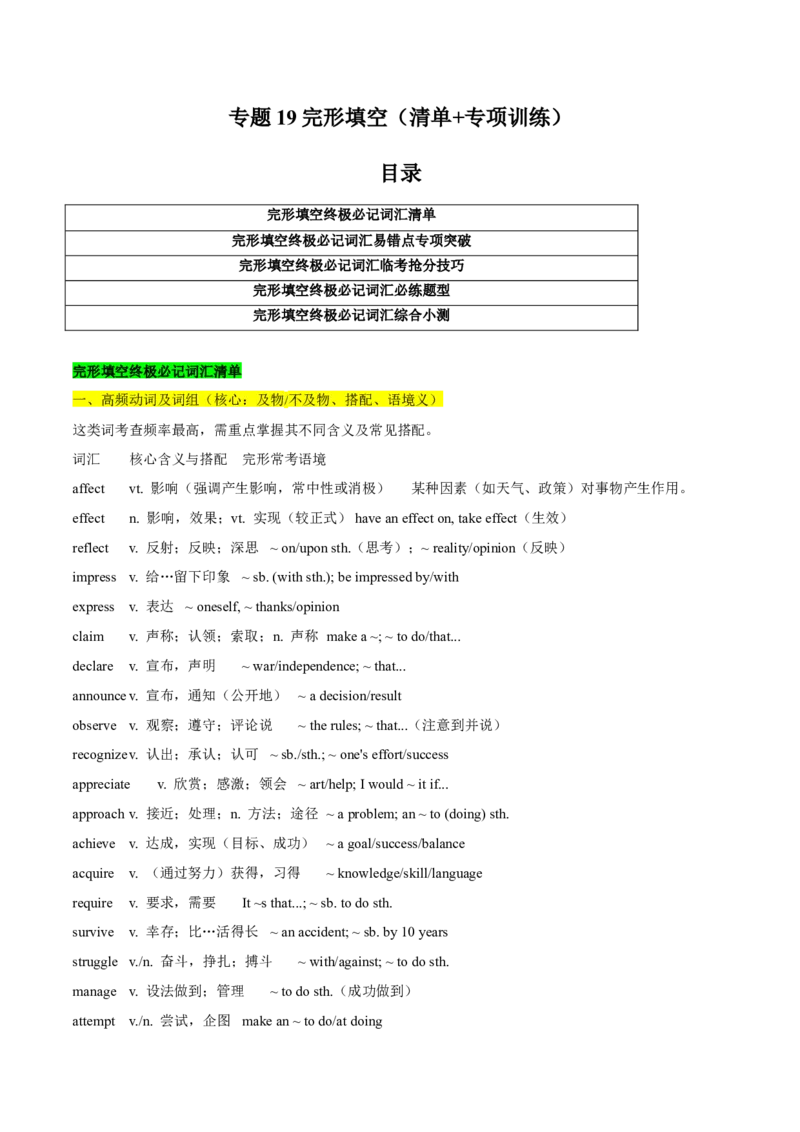
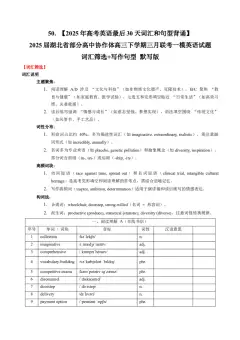
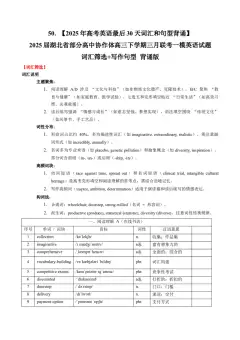
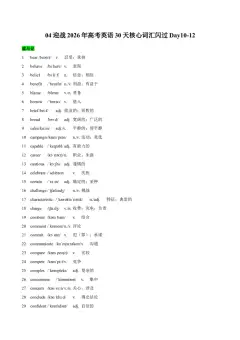
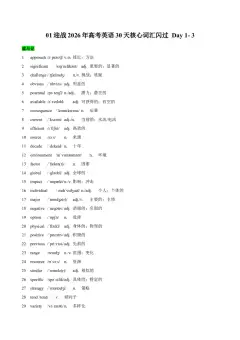
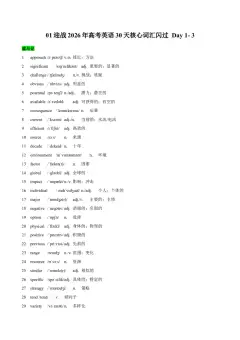
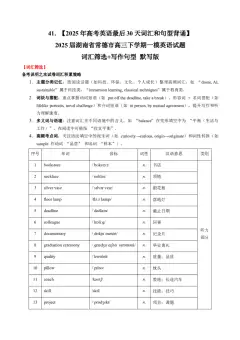
完形填空终极必记词汇清单
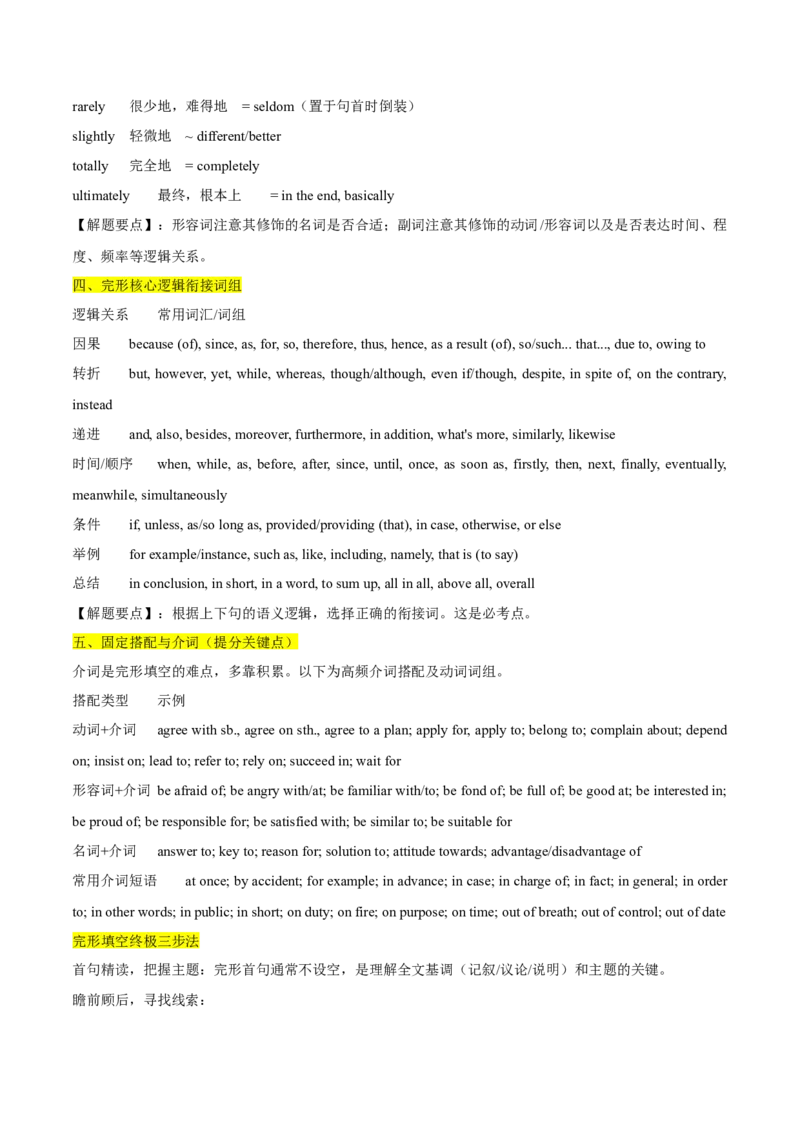
一、高频动词及词组(核心:及物/不及物、搭配、语境义)
这类词考查频率最高,需重点掌握其不同含义及常见搭配。
词汇
核心含义与搭配
完形常考语境
affect
vt. 影响(强调产生影响,常中性或消极)
某种因素(如天气、政策)对事物产生作用。
effect
n. 影响,效果;vt. 实现(较正式)have an effect on, take effect(生效)
reflect
v. 反射;反映;深思
~ on/upon sth.(思考);~ reality/opinion(反映)
impress
v. 给…留下印象
~ sb. (with sth.); be impressed by/with
express
v. 表达
~ oneself, ~ thanks/opinion
claim
v. 声称;认领;索取;n. 声称make a ~; ~ to do/that...
declare
v. 宣布,声明
~ war/independence; ~ that...
announce v. 宣布,通知(公开地)
~ a decision/result
observe
v. 观察;遵守;评论说
~ the rules; ~ that...(注意到并说)
recognizev. 认出;承认;认可
~ sb./sth.; ~ one's effort/success
appreciate
v. 欣赏;感激;领会
~ art/help; I would ~ it if...
approach v. 接近;处理;n. 方法;途径~ a problem; an ~ to (doing) sth.
achieve
v. 达成,实现(目标、成功)
~ a goal/success/balance
acquire
v. (通过努力)获得,习得
~ knowledge/skill/language
require
v. 要求,需要
It ~s that...; ~ sb. to do sth.
survive
v. 幸存;比…活得长
~ an accident; ~ sb. by 10 years
struggle v./n. 奋斗,挣扎;搏斗
~ with/against; ~ to do sth.
manage
v. 设法做到;管理
~ to do sth.(成功做到)
attempt
v./n. 尝试,企图make an ~ to do/at doing
afford
v. 负担得起(费用、时间、后果)
can/could ~ sth./to do sth.
offerv. 提供;主动提出;n. 提议
~ help/a job; ~ to do sth.
provide
v. 提供
~ sth. for sb.; ~ sb. with sth.
supply
v./n. 供应,供给~ sth. to sb.; in short ~
apply
v. 申请;应用;涂抹
~ for a job; ~ A to B(将A 应用于B)
engage
v. 从事;吸引;订婚
~ in sth.; ~ one's attention
contribute
v. 贡献;捐助;投稿;促成
~ to sth.(促成/投稿给);~ money
attribute v. 把…归因于
~ A to B(将A 归因于B)
distribute v. 分发,分配
~ sth. to/among sb.
replace
v. 替换,代替
~ A with B(用B 替换A)
exchange v./n. 交换,交流~ A for B; in ~ for
relieve
v. 缓解,减轻;解除
~ pain/stress/boredom
release
v. 释放;发布;解雇
~ from prison; ~ a movie/news
ignore
v. 忽视,不理睬(主观故意)
~ the fact/sb.'s advice
neglect
v./n. 疏忽,忽略(疏于照管)~ one's duty/health
overlook v. 忽视;俯瞰;宽容
~ a mistake(忽略错误)
【解题要点】:动词选择时,一看主谓搭配是否合理(人/物做主语),二看动宾搭配是否地道,三看是否
与前后介词构成固定词组。
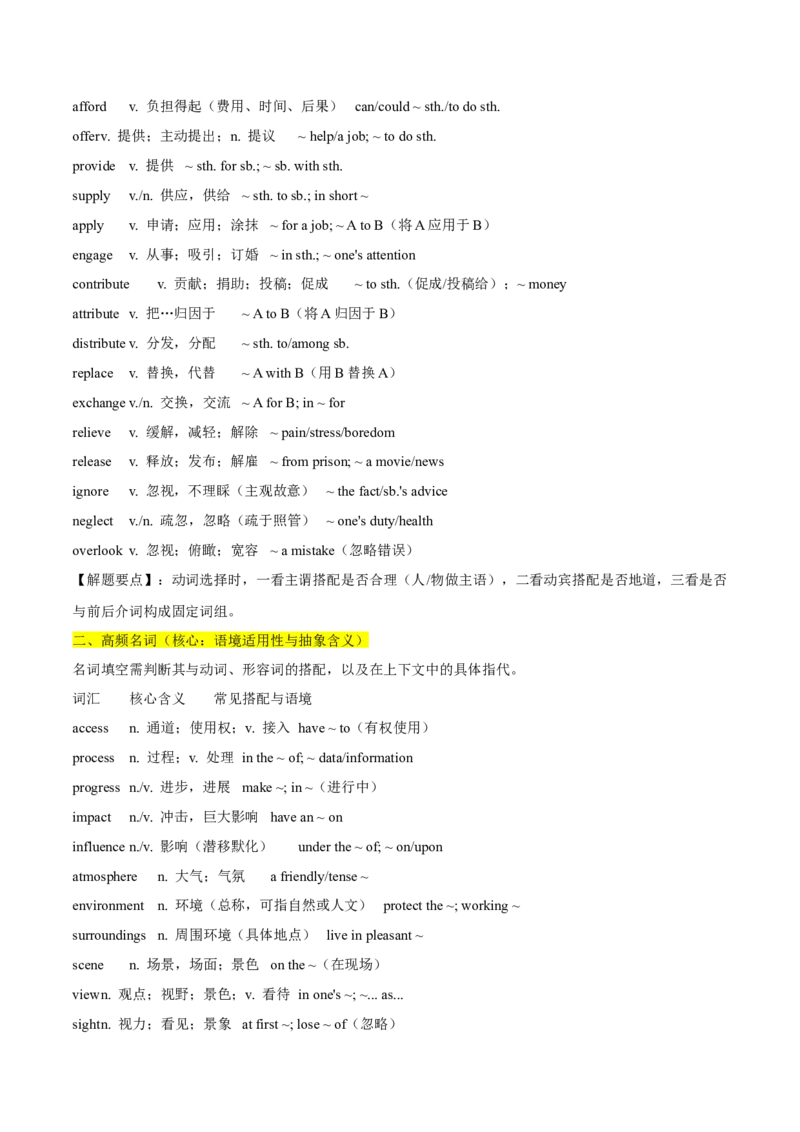
二、高频名词(核心:语境适用性与抽象含义)
名词填空需判断其与动词、形容词的搭配,以及在上下文中的具体指代。
词汇
核心含义
常见搭配与语境
access
n. 通道;使用权;v. 接入have ~ to(有权使用)
process
n. 过程;v. 处理in the ~ of; ~ data/information
progress n./v. 进步,进展make ~; in ~(进行中)
impact
n./v. 冲击,巨大影响have an ~ on
influence n./v. 影响(潜移默化)
under the ~ of; ~ on/upon
atmosphere
n. 大气;气氛
a friendly/tense ~
environment
n. 环境(总称,可指自然或人文)protect the ~; working ~
surroundings n. 周围环境(具体地点)live in pleasant ~
scene
n. 场景,场面;景色on the ~(在现场)
viewn. 观点;视野;景色;v. 看待in one's ~; ~... as...
sightn. 视力;看见;景象at first ~; lose ~ of(忽略)
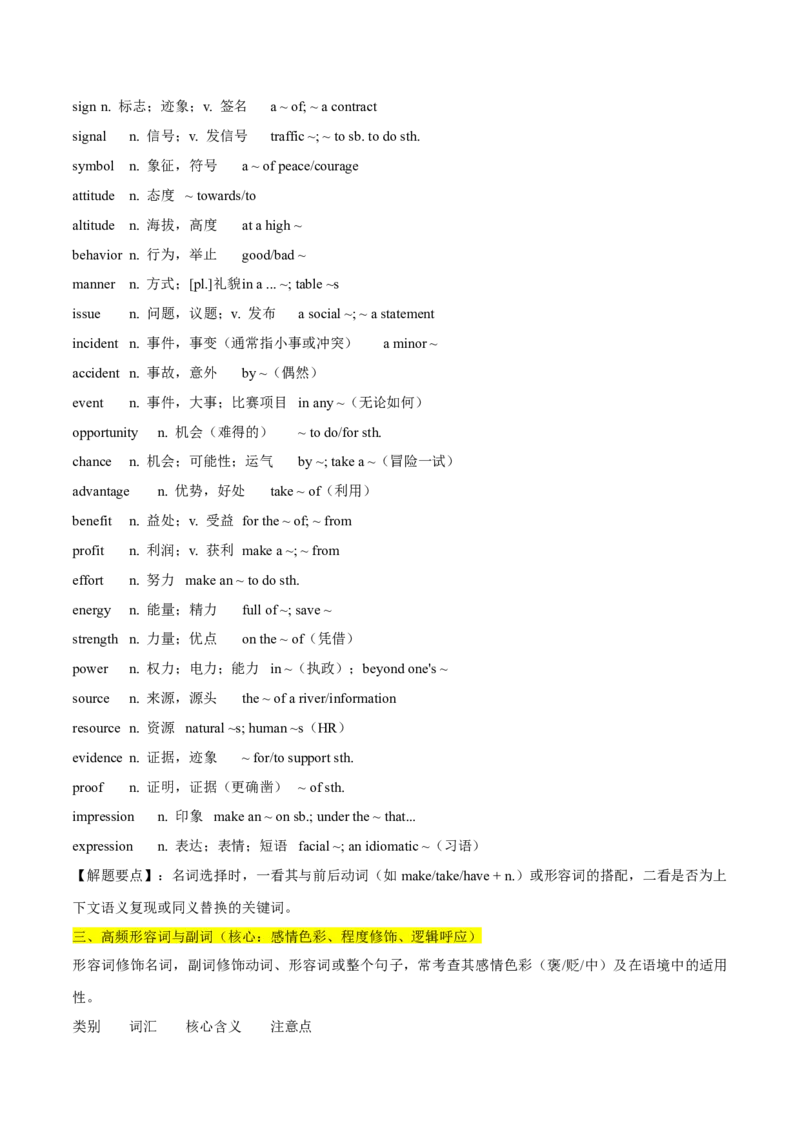
sign n. 标志;迹象;v. 签名
a ~ of; ~ a contract
signal
n. 信号;v. 发信号
traffic ~; ~ to sb. to do sth.
symbol
n. 象征,符号
a ~ of peace/courage
attitude
n. 态度~ towards/to
altitude
n. 海拔,高度
at a high ~
behavior n. 行为,举止
good/bad ~
manner
n. 方式;[pl.]礼貌in a ... ~; table ~s
issue
n. 问题,议题;v. 发布
a social ~; ~ a statement
incident n. 事件,事变(通常指小事或冲突)
a minor ~
accident n. 事故,意外
by ~(偶然)
event
n. 事件,大事;比赛项目in any ~(无论如何)
opportunity
n. 机会(难得的)
~ to do/for sth.
chance
n. 机会;可能性;运气
by ~; take a ~(冒险一试)
advantage
n. 优势,好处
take ~ of(利用)
benefit
n. 益处;v. 受益for the ~ of; ~ from
profit
n. 利润;v. 获利make a ~; ~ from
effort
n. 努力make an ~ to do sth.
energy
n. 能量;精力
full of ~; save ~
strength n. 力量;优点
on the ~ of(凭借)
power
n. 权力;电力;能力in ~(执政);beyond one's ~
source
n. 来源,源头
the ~ of a river/information
resource n. 资源natural ~s; human ~s(HR)
evidence n. 证据,迹象
~ for/to support sth.
proof
n. 证明,证据(更确凿)~ of sth.
impression
n. 印象make an ~ on sb.; under the ~ that...
expression
n. 表达;表情;短语facial ~; an idiomatic ~(习语)
【解题要点】:名词选择时,一看其与前后动词(如make/take/have + n.)或形容词的搭配,二看是否为上
下文语义复现或同义替换的关键词。
三、高频形容词与副词(核心:感情色彩、程度修饰、逻辑呼应)
形容词修饰名词,副词修饰动词、形容词或整个句子,常考查其感情色彩(褒/贬/中)及在语境中的适用
性。
类别
词汇
核心含义
注意点
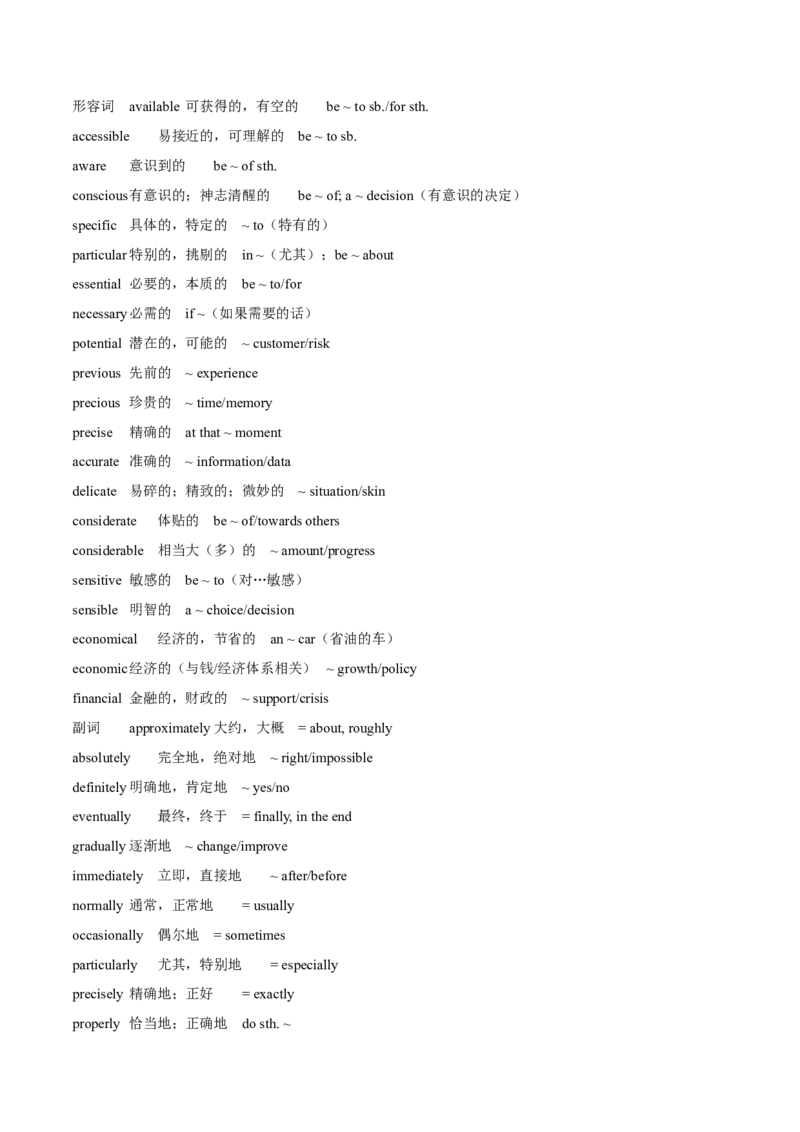
形容词
available 可获得的,有空的
be ~ to sb./for sth.
accessible
易接近的,可理解的
be ~ to sb.
aware
意识到的
be ~ of sth.
conscious有意识的;神志清醒的
be ~ of; a ~ decision(有意识的决定)
specific
具体的,特定的
~ to(特有的)
particular 特别的,挑剔的
in ~(尤其);be ~ about
essential 必要的,本质的
be ~ to/for
necessary必需的
if ~(如果需要的话)
potential 潜在的,可能的
~ customer/risk
previous 先前的
~ experience
precious 珍贵的
~ time/memory
precise
精确的
at that ~ moment
accurate 准确的
~ information/data
delicate
易碎的;精致的;微妙的
~ situation/skin
considerate
体贴的
be ~ of/towards others
considerable
相当大(多)的
~ amount/progress
sensitive 敏感的
be ~ to(对…敏感)
sensible 明智的
a ~ choice/decision
economical
经济的,节省的
an ~ car(省油的车)
economic经济的(与钱/经济体系相关)~ growth/policy
financial 金融的,财政的
~ support/crisis
副词
approximately 大约,大概
= about, roughly
absolutely
完全地,绝对地
~ right/impossible
definitely 明确地,肯定地
~ yes/no
eventually
最终,终于
= finally, in the end
gradually 逐渐地
~ change/improve
immediately
立即,直接地
~ after/before
normally 通常,正常地
= usually
occasionally
偶尔地
= sometimes
particularly
尤其,特别地
= especially
precisely 精确地;正好
= exactly
properly 恰当地;正确地
do sth. ~
rarely
很少地,难得地
= seldom(置于句首时倒装)
slightly
轻微地
~ different/better
totally
完全地
= completely
ultimately
最终,根本上
= in the end, basically
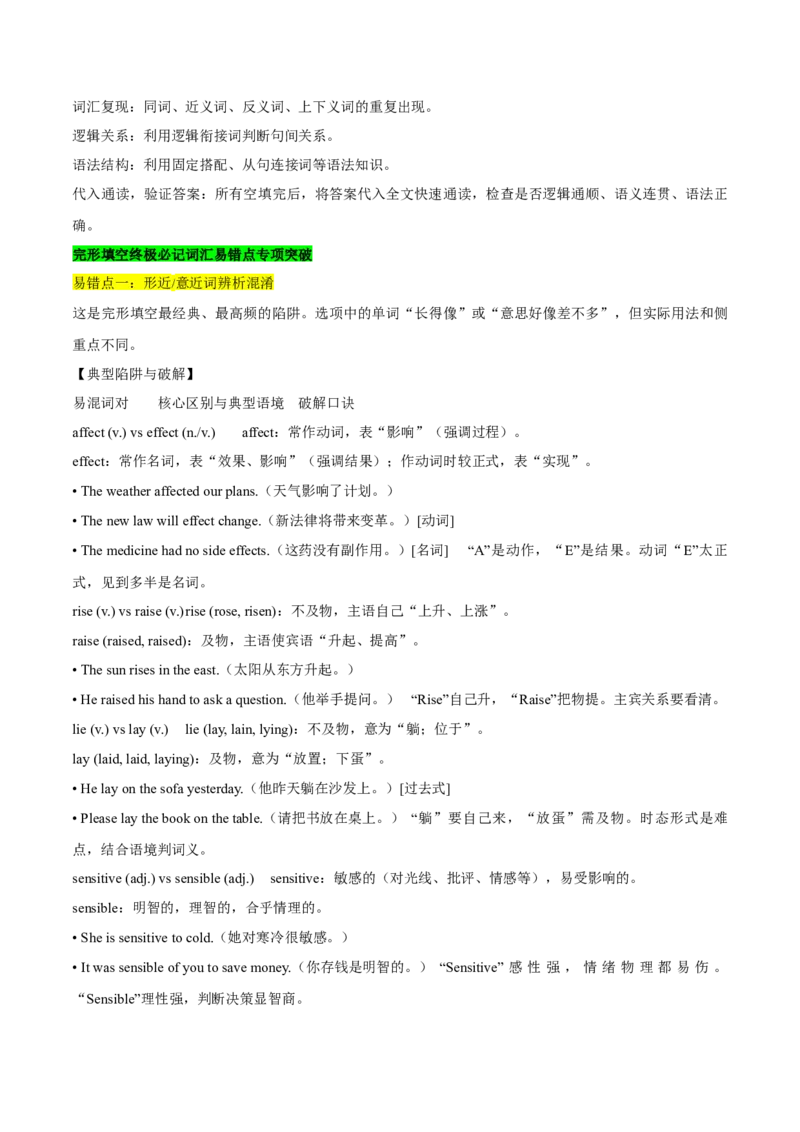
【解题要点】:形容词注意其修饰的名词是否合适;副词注意其修饰的动词/形容词以及是否表达时间、程
度、频率等逻辑关系。
四、完形核心逻辑衔接词组
逻辑关系
常用词汇/词组
因果
because (of), since, as, for, so, therefore, thus, hence, as a result (of), so/such... that..., due to, owing to
转折
but, however, yet, while, whereas, though/although, even if/though, despite, in spite of, on the contrary,
instead
递进
and, also, besides, moreover, furthermore, in addition, what's more, similarly, likewise
时间/顺序
when, while, as, before, after, since, until, once, as soon as, firstly, then, next, finally, eventually,
meanwhile, simultaneously
条件
if, unless, as/so long as, provided/providing (that), in case, otherwise, or else
举例
for example/instance, such as, like, including, namely, that is (to say)
总结
in conclusion, in short, in a word, to sum up, all in all, above all, overall
【解题要点】:根据上下句的语义逻辑,选择正确的衔接词。这是必考点。
五、固定搭配与介词(提分关键点)
介词是完形填空的难点,多靠积累。以下为高频介词搭配及动词词组。
搭配类型
示例
动词+介词
agree with sb., agree on sth., agree to a plan; apply for, apply to; belong to; complain about; depend
on; insist on; lead to; refer to; rely on; succeed in; wait for
形容词+介词be afraid of; be angry with/at; be familiar with/to; be fond of; be full of; be good at; be interested in;
be proud of; be responsible for; be satisfied with; be similar to; be suitable for
名词+介词
answer to; key to; reason for; solution to; attitude towards; advantage/disadvantage of
常用介词短语
at once; by accident; for example; in advance; in case; in charge of; in fact; in general; in order
to; in other words; in public; in short; on duty; on fire; on purpose; on time; out of breath; out of control; out of date
完形填空终极三步法
首句精读,把握主题:完形首句通常不设空,是理解全文基调(记叙/议论/说明)和主题的关键。
瞻前顾后,寻找线索:
词汇复现:同词、近义词、反义词、上下义词的重复出现。
逻辑关系:利用逻辑衔接词判断句间关系。
语法结构:利用固定搭配、从句连接词等语法知识。
代入通读,验证答案:所有空填完后,将答案代入全文快速通读,检查是否逻辑通顺、语义连贯、语法正
确。
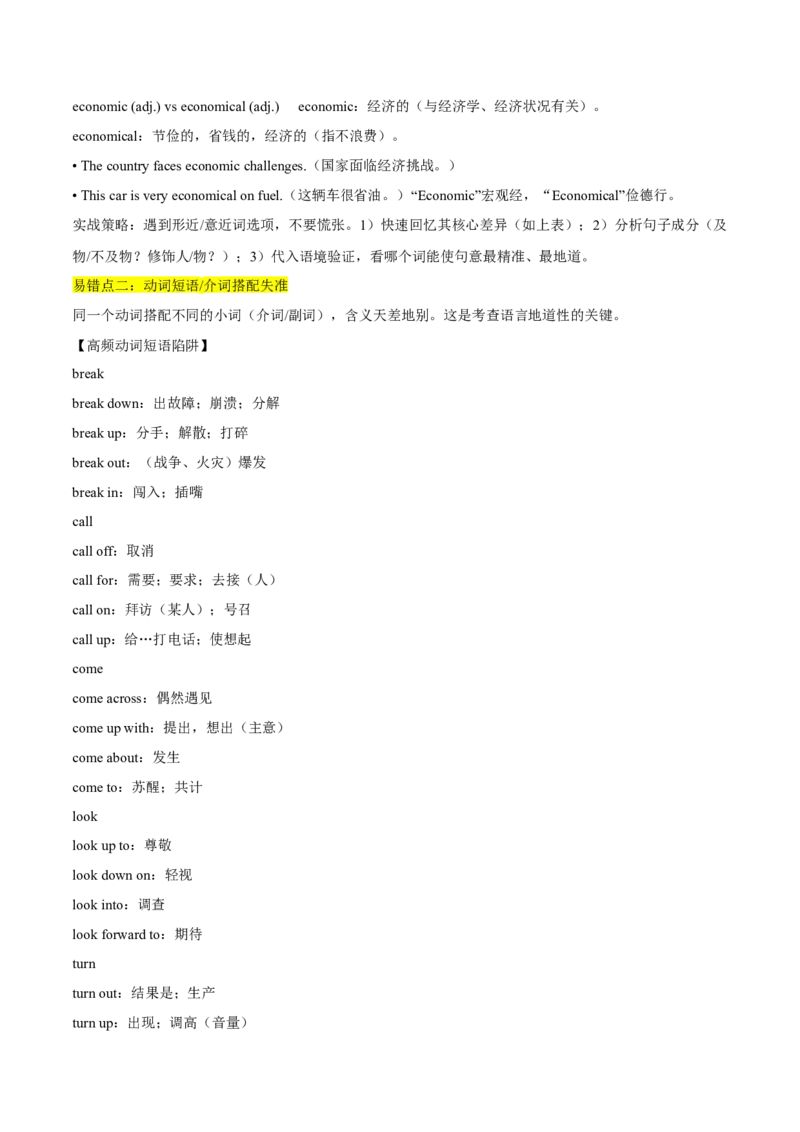
完形填空终极必记词汇易错点专项突破
易错点一:形近/意近词辨析混淆
这是完形填空最经典、最高频的陷阱。选项中的单词“长得像”或“意思好像差不多”,但实际用法和侧
重点不同。
【典型陷阱与破解】
易混词对
核心区别与典型语境
破解口诀
affect (v.) vs effect (n./v.)
affect:常作动词,表“影响”(强调过程)。
effect:常作名词,表“效果、影响”(强调结果);作动词时较正式,表“实现”。
• The weather affected our plans.(天气影响了计划。)
• The new law will effect change.(新法律将带来变革。)[动词]
• The medicine had no side effects.(这药没有副作用。)[名词]
“A”是动作,“E”是结果。动词“E”太正
式,见到多半是名词。
rise (v.) vs raise (v.)rise (rose, risen):不及物,主语自己“上升、上涨”。
raise (raised, raised):及物,主语使宾语“升起、提高”。
• The sun rises in the east.(太阳从东方升起。)
• He raised his hand to ask a question.(他举手提问。)“Rise”自己升,“Raise”把物提。主宾关系要看清。
lie (v.) vs lay (v.)
lie (lay, lain, lying):不及物,意为“躺;位于”。
lay (laid, laid, laying):及物,意为“放置;下蛋”。
• He lay on the sofa yesterday.(他昨天躺在沙发上。)[过去式]
• Please lay the book on the table.(请把书放在桌上。)“躺”要自己来,“放蛋”需及物。时态形式是难
点,结合语境判词义。
sensitive (adj.) vs sensible (adj.)
sensitive:敏感的(对光线、批评、情感等),易受影响的。
sensible:明智的,理智的,合乎情理的。
• She is sensitive to cold.(她对寒冷很敏感。)
• It was sensible of you to save money.(你存钱是明智的。)“Sensitive” 感性强,情绪物理都易伤。
“Sensible”理性强,判断决策显智商。
economic (adj.) vs economical (adj.)
economic:经济的(与经济学、经济状况有关)。
economical:节俭的,省钱的,经济的(指不浪费)。
• The country faces economic challenges.(国家面临经济挑战。)
• This car is very economical on fuel.(这辆车很省油。)“Economic”宏观经,“Economical”俭德行。
实战策略:遇到形近/意近词选项,不要慌张。1)快速回忆其核心差异(如上表);2)分析句子成分(及
物/不及物?修饰人/物?);3)代入语境验证,看哪个词能使句意最精准、最地道。
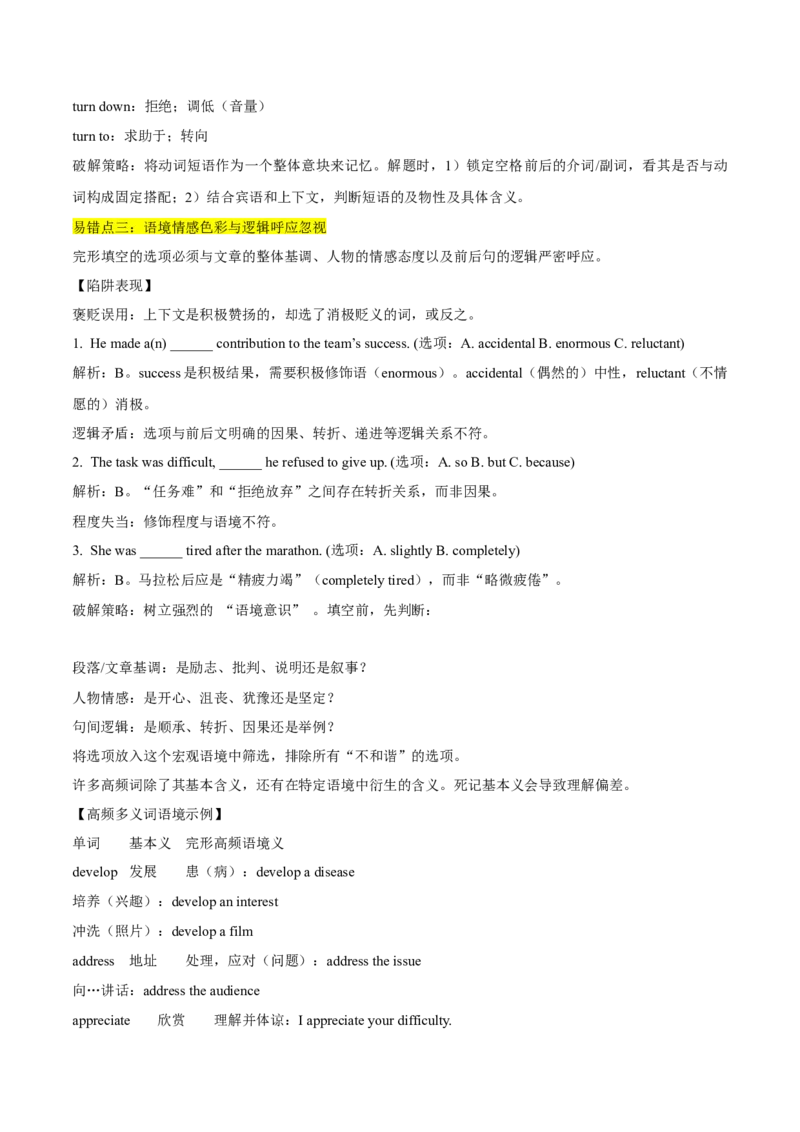
易错点二:动词短语/介词搭配失准
同一个动词搭配不同的小词(介词/副词),含义天差地别。这是考查语言地道性的关键。
【高频动词短语陷阱】
break
break down:出故障;崩溃;分解
break up:分手;解散;打碎
break out:(战争、火灾)爆发
break in:闯入;插嘴
call
call off:取消
call for:需要;要求;去接(人)
call on:拜访(某人);号召
call up:给…打电话;使想起
come
come across:偶然遇见
come up with:提出,想出(主意)
come about:发生
come to:苏醒;共计
look
look up to:尊敬
look down on:轻视
look into:调查
look forward to:期待
turn
turn out:结果是;生产
turn up:出现;调高(音量)
turn down:拒绝;调低(音量)
turn to:求助于;转向
破解策略:将动词短语作为一个整体意块来记忆。解题时,1)锁定空格前后的介词/副词,看其是否与动
词构成固定搭配;2)结合宾语和上下文,判断短语的及物性及具体含义。
易错点三:语境情感色彩与逻辑呼应忽视
完形填空的选项必须与文章的整体基调、人物的情感态度以及前后句的逻辑严密呼应。
【陷阱表现】
褒贬误用:上下文是积极赞扬的,却选了消极贬义的词,或反之。
1. He made a(n) ______ contribution to the team’s success. (选项:A. accidental B. enormous C. reluctant)
解析:B。success 是积极结果,需要积极修饰语(enormous)。accidental(偶然的)中性,reluctant(不情
愿的)消极。
逻辑矛盾:选项与前后文明确的因果、转折、递进等逻辑关系不符。
2. The task was difficult, ______ he refused to give up. (选项:A. so B. but C. because)
解析:B。“任务难”和“拒绝放弃”之间存在转折关系,而非因果。
程度失当:修饰程度与语境不符。
3. She was ______ tired after the marathon. (选项:A. slightly B. completely)
解析:B。马拉松后应是“精疲力竭”(completely tired),而非“略微疲倦”。
破解策略:树立强烈的 “语境意识” 。填空前,先判断:
段落/文章基调:是励志、批判、说明还是叙事?
人物情感:是开心、沮丧、犹豫还是坚定?
句间逻辑:是顺承、转折、因果还是举例?
将选项放入这个宏观语境中筛选,排除所有“不和谐”的选项。
许多高频词除了其基本含义,还有在特定语境中衍生的含义。死记基本义会导致理解偏差。
【高频多义词语境示例】
单词
基本义
完形高频语境义
develop
发展
患(病):develop a disease
培养(兴趣):develop an interest
冲洗(照片):develop a film
address
地址
处理,应对(问题):address the issue
向…讲话:address the audience
appreciate
欣赏
理解并体谅:I appreciate your difficulty.
增值:Land appreciates in value.
fair 公平的
相当的:a fair chance
(肤色)白皙的;(头发)金色的:fair skin/hair
(天气)晴朗的:fair weather
industry 工业
勤奋,勤劳:a student of great industry
sharp
锋利的
(时间)整点:at 9 o’clock sharp
急剧的:a sharp turn
敏锐的:sharp eyes/mind
破解策略:当遇到熟悉单词,但代入基本义后句意不通时,立即警觉!思考它是否有引申义、专业义或固
定语境义。结合上下文进行合理推测。
完形填空终极必记词汇临考抢分技巧
目标:在12-15 分钟内高质量完成一篇完形填空。
核心:70%靠语境逻辑,30%靠词汇语法。你不是在填独立的词,而是在复原一个完整的故事或论证。
【三遍阅读法】
第一遍:跳空速读,把握主线
动作:遇到空格,直接跳过。以最快速度通读全文,不纠结任何选项。
目标:抓住四大核心信息:
文体与主题:是记叙文(故事)、说明文还是议论文?主要讲什么?(如:一个关于坚持的故事)
基本脉络:起因、经过、结果/论点、论据、结论。
主角与基调:主人公是谁?整体情感基调是积极、消极还是中立?
首尾句重点读:首句常点明主题,尾句常升华主旨。
【第一遍口诀】:“跳过去,看整体;抓文体,明基调。”
第二遍:逐空精读,逻辑破题
这是得分的关键阶段。对每个空格,执行以下 “四步定乾坤” 操作:
第一步:定范围,看三点
空前一句:找逻辑词(but, so, because 等)和提示信息。
空所在句:分析句子结构,判断所填词的词性(名、动、形、副、连)。
空后一句:验证逻辑,看是否有复现词或同义线索。
黄金法则:80%的答案线索就在这三点内。
第二步:辨选项,抓核心
如果选项是形近/意近词(如 affect/effect, rise/raise),立即运用 “核心区别口诀”(见易错点专项)快速
辨析。
如果选项是动词短语/介词搭配,重点看空格前后的介词或副词,进行匹配。
第三步:套逻辑,验色彩
将每个选项代入,看是否与上下文构成合理的因果、转折、递进等逻辑关系。
检查选项的感情色彩(褒/贬/中)是否与段落或人物当时的情感一致。
第四步:做标记,速决断
确定无疑的答案,直接选定。
在两个选项间犹豫时,快速对比:
哪个与“三点”内的线索连接更直接、更紧密?
哪个更符合故事的整体走向和人物性格?
选定一个,做上标记,暂时不再回头。避免陷入长时间纠结。
【第二遍口诀】:“瞻前顾后定词性,逻辑色彩双验证,犹豫对比选最顺。”
第三遍:代入通读,终极安检
动作:将所有选定的答案代入原文,流畅地、不出声地快速默读一遍。
目标:凭语感和整体逻辑进行最后把关。
重点检查:
逻辑流是否绝对顺畅?有没有生硬或别扭的地方?
固定搭配是否100%正确?(这是检查的重点)
主谓一致、时态语态有无低级错误?
原则:除非发现确凿的硬伤(如搭配错误、逻辑明显矛盾),否则绝不轻易更改第二遍的答案。考场上
“第一感觉”往往更可靠。
【第三遍口诀】:“整体读,找别扭;非确凿,不改稿。”
【四大抢分必杀技】
1. 利用“词汇复现”和“同义转述”
答案常常是上下文中关键词的 “原词复现”、“近义词” 或 “反义词”。
动作:精读时,有意识地在“三点”范围内搜索与选项可能构成复现或同义的词。
2. 锁定“故事发展”和“情感曲线”
记叙文中,人物的情感和事件发展是动态的。填空必须符合这个动态过程。
动作:在心中画一条简单的“情感/事件发展线”。每填一空,都问自己:“以主人公此刻的心情/处境,
他会怎么做/怎么想?”
3. “夹逼法”解决难题
当某空难以确定时,暂时跳过,继续往下做。
往往在做了后面几空之后,前面的语境会因为后续内容的补充而变得清晰,答案自然浮现。
动作:在第二遍阅读时,若某空超过1 分钟无解,果断标记并跳过,全部做完后再回头解决。
4. 选项分布概率参考(绝境求生用)
在完全无法确定、必须猜测的情况下,可以知道:高考完形填空的选项分布通常比较均匀,ABCD 四个选
项作为正确答案出现的次数大致在4-6 次之间,极少出现某一个选项出现7 次以上的情况。
注意:这仅是最后无奈之下的辅助参考,绝不能作为主要解题依据。核心永远是上下文逻辑。
【临考30 分钟 · 终极清单】
进考场前,将这五点刻在脑子里:
流程大于感觉:死守“三遍阅读法”,尤其第一遍坚决不填空。
眼睛只看三点:解题时,80%的注意力集中在“空前、空本句、空后”。
逻辑是生命线:每填一空,必须能说出它与上下文是什么逻辑关系(因果?转折?)。
搭配是试金石:遇到介词、短语,用搭配来验证,一验一个准。
不改就是赢:检查时,没有铁证,坚决不改答案。
完形填空终极必记词汇必练题型
一、 终极必记核心词汇(分类记忆)
完形填空重点考查词汇在语境中的精确运用
1. 动词(重中之重)
表示“变化”: increase/decrease, expand/contract, improve/deteriorate, strengthen/weaken, promote/hinder
表示“情感态度”: admire/despise, appreciate, regret, hesitate, determine, inspire, encourage, frustrate
常见短语动词: give up, carry out, figure out, point out, turn out, look into, come across, put up with
2. 名词(常为关键信息词)
抽象概念: determination, perseverance, confidence, obstacle, dilemma, compromise, opportunity, consequence
具体事物: evidence, clue, symptom, gesture, expression, scene, atmosphere
3. 形容词/副词(体现情感色彩与逻辑)
评价类: remarkable, ordinary, appropriate, challenging, significant, potential
情感类: delighted, anxious, astonished, guilty, embarrassed
逻辑副词: consequently, meanwhile, nevertheless, otherwise, eventually
4. 高频逻辑连接词
因果: therefore, thus, as a result, due to
转折: however, yet, whereas, on the contrary
递进: moreover, furthermore, besides
对比: while, by contrast, on the other hand
二、 必练经典题型与解题策略
题型1:词义辨析(最常考)
关键: 结合上下文,区分近义词的细微差别。
例题:He felt so ______ that he couldn't even look at her.
A. ashamed B. guilty C. anxious D. shy
解析: 句意为“羞愧到不敢看她”,ashamed(因行为感到羞耻)最贴合。guilty 侧重“内疚”,anxious
是“焦虑”,shy 是“害羞”,程度不符。
题型2:固定搭配
关键: 熟记常见动宾、介宾、形容词搭配。
例题:She has a gift ______ languages.
A. for B. in C. with D. at
解析: “have a gift for”是固定搭配,意为“有…天赋”。
题型3:逻辑关系
关键: 通过连接词、代词、重复信息把握文章脉络。
例题:It was raining heavily. ______, the football match continued.
A. Therefore B. However C. Besides D. Meanwhile
解析: 前后句意转折,选 However。
题型4:上下文复现
关键: 答案常在前文近义词、反义词或同根词处有提示。
例题:His ______ was obvious: he wanted to win. This desire drove him to practice day and night.
A. fear B. goal C. doubt D. interest
解析: 下句“desire”对应“想赢”的愿望,故 goal(目标)最一致。
三、 四步解题法(考场实战)
速读首句,把握主题。 首句通常不设空,是理解文章基调的关键。
通读全文,理解大意。 第一遍快速阅读,忽略空格,抓住故事主线或论述逻辑。
逐题推敲,先易后难。
根据上下文语境、逻辑关系、固定搭配直接判断简单题。
难题先标记,通过后文线索或排除法解决。
复核全文,检查逻辑。 将所有答案代入通读,确保情节连贯、语法正确、逻辑通顺。
四、 高频场景词汇归纳
校园学习: assignment, deadline, scholarship, concentrate, participate
成长经历: overcome, setback, mature, insight, reflect
社会互动: cooperate, conflict, apologize, forgive, impression
情感心理: confused, relieved, grateful, optimistic, frustrated
完形填空终极必记词汇综合小测
(一)
Ursula has always called the beautiful small town of Beaverton her home. Although she’d had childhood     1
of exploring the world and studied international business with a desire to pursue a     2     in Toronto, finding a
job proved more     3     than she’d expected.
“I decided that if nobody was going to     4     me, I would just create a job for myself,” says Ursula.
She was born and raised on a large family farm, so the     5     of an agriculture tourism business came
naturally to her and began to     6    .
“I     7     the plan to my family, and asked if they could rent me a small 10 acres (英亩). They     8
at first, unwilling to take a risk, but I finally     9     to get the green light,” she says.
Four years later, those beautiful 10 acres of fields had turned into 20 acres filled with over 400,000
sunflowers. “    10    , I had little confidence in the beginning,” says Ursula, "but the Sunflower Farm rose to
fame and has become one of the most sought-after     11     in the province.”
While many visitors have never been to a farm at all,     12     a sunflower farm, the unique setting
allows them to     13     the city for a while, breathe in the fresh air, gain a newfound     14     for
agriculture, and maybe even     15     with their farming roots and what they may have taken for granted for
too long.
1.A.stories
B.needs
C.habits
D.dreams
2.A.career
B.degree
C.hobby
D.project
3.A.practical
B.important
C.difficult
D.dangerous
4.A.invite
B.notice
C.hire
D.cover
5.A.issue
B.idea
C.truth
D.founder
6.A.gain ground
B.take root
C.work wonders
D.raise concerns
7.A.proposed
B.adapted
C.preferred
D.proved
8.A.apologized
B.refused
C.panicked
D.regretted
9.A.pretended
B.returned
C.promised
D.managed
10.A.Supposedly
B.Admittedly
C.Similarly
D.Consequently
11.A.occupations
B.solutions
C.institutions
D.destinations
12.A.let alone
B.except for
C.such as
D.regardless of
13.A.miss
B.leave
C.seize
D.tour
14.A.demand
B.support
C.appreciation
D.excuse
15.A.deal
B.part
C.compete
D.reconnect
(二)
On December 12, 2025, the St. Moritz stop of the FIS Alpine Ski World Cup witnessed a scene that    16
the very essence of sports spirit. Lindsey Vonn, the 41-year-old skiing legend, stood at the top of the podium once
again after winning the women’s downhill event. This was not just another victory; it was a triumph that    17
every adversity.
Having retired in 2018 and undergone a complete surgery of knee replacement, Vonn’s return to the World
Cup circuit was itself a    18   . Many doubted her body could bear the    19    demands of elite competition.
Yet, after eleven months of tough recovery period, she was back, not merely to participate, but to    20   .
The race was a    21    of skill and courage against younger, powerful opponents. Vonn, however, seemed
to    22    a different plane. Her technique, refined by decades of experience, appeared effortless. But those who
knew her story understood the immense    23    behind each turn. Every landing on her surgically rebuilt knee
was a    24    of will over physical limitation.
As she crossed the finish line with the fastest time, the crowd erupted. This was her 83rd World Cup victory,
but definitely her most    25   . She had become the oldest skier ever to win a World Cup race. In that moment,
the result    26    more than a statistic; it was a powerful message of overcoming everything.
In post-race interviews, Vonn’s focus was not on the record but on the journey. “It was the love for skiing
that carried me through the pain,” she said. Her story    27    a universal truth: passion and perseverance can
conquer seemingly    28    obstacles. She proved that    29    is not defined by age or a perfect body, but by
the fire within. Lindsey Vonn’s comeback serves as an enduring    30    that with unwavering determination,
comebacks are always possible.
16.A.captured
B.escaped
C.questioned
D.altered
17.A.overcame
B.calculated
C.followed
D.acknowledged
18.A.mystery
B.ceremony
C.miracle
D.routine
19.A.financial
B.intellectual
C.political
D.physical
20.A.retreat
B.observe
C.compete
D.celebrate
21.A.test
B.memory
C.truth
D.theory
22.A.describe
B.imagine
C.occupy
D.fear
23.A.luck
B.effort
C.strategy
D.hesitation
24.A.surrender
B.task
C.challenge
D.cheer
25.A.predictable
B.profitable
C.controversial
D.meaningful
26.A.represented
B.classified
C.replaced
D.ignored
27.A.deserved
B.hid
C.challenged
D.conveyed
28.A.overwhelming B.minor
C.imaginary
D.popular
29.A.greatness
B.wealth
C.fame
D.beauty
30.A.warning
B.reminder
C.rule
D.secret
(三)
It was a cool Autumn night at London’s Bridewell Centre. Emma Li’s heart     31     as the audience
filled the seats. Her play Beyond Crossroads was about to begin.
Working with five partners from Europe, Singapore and China, Emma was both producer and leading     32
. On top of rehearsing (排练) her lines, she had to     33     budgets and promotion, which was incredibly
34    .
The performance aims to explore cross-cultural works     35     East and West influences, bringing
36     stories to the international stage. Beyond Crossroads draws on Emma’s personal experiences, reflecting
on the growth and     37     of cross-cultural youth. It tells the story of how a Chinese student Annie, whose
family runs a large supermarket named Crossroads in London,     38     between pursuing a law career and the
expectation to take over the family business. The supermarket, Crossroads, is central to the play: a business     39
from Annie’s grandfather and a point of     40     between personal ambition and family legacy (传承). The
show captures the     41     of young people facing family expectations and future decisions.
In the final     42     of the play, when Annie confidently appeared in a(n)     43     wearing a
lawyer’s gown (袍), thunderous applause erupted throughout the theater. “This is my life! I think I should get to
think what I really want,” the audience kept saying, which inspired Emma a lot and she decided to continue
bringing more     44     cross-cultural stories to the stage.
For Emma Li, the message of the play remains clear: it is about the     45     to listen to your own heart,
whether it leads you down a familiar path or an entirely new one.
31.A.sank
B.raced
C.stopped
D.ached
32.A.dancer
B.director
C.actress
D.manager
33.A.ignore
B.limit
C.avoid
D.handle
34.A.exciting
B.challenging
C.inviting
D.disappointing
35.A.composing
B.considering
C.combining
D.comparing
36.A.authentic
B.traditional
C.fictional
D.popular
37.A.fears
B.regrets
C.choices
D.secrets
38.A.distinguishes
B.balances
C.switches
D.struggles
39.A.hung up
B.passed down
C.left behind
D.worked out
40.A.conflict
B.understanding
C.communication
D.agreement
41.A.joy
B.confidence
C.trouble
D.dilemma
42.A.sight
B.setting
C.scene
D.shot
43.A.courtroom
B.supermarket
C.apartment
D.store
44.A.interesting
B.meaningful
C.fresh
D.local
45.A.right
B.chance
C.ability
D.courage
(四)
Last summer, I returned to my grandmother’s home in my childhood town. The woman who once moved
with boundless     46     now seemed aged, her steps carefully     47    . Her hands, which had once
worked with purpose, now shook while she held her tea. I saw the     48    , yet it never weakened her role as
our family’s heart. She had simply learned to move at a different     49    .
One afternoon, I was     50     the roses in her garden, growing impatient with how much there was to
do. I wanted to finish quickly. My grandmother’s eyes,     51    , stayed on the flowers. “I used to rush through
all this,” she said softly. “Now I find     52     in watching them grow, letting time     53     as it will.”
Her voice held no regret, only peaceful     54    , as if she had discovered a new way to love life.
In the following days, we shared     55     moments — small tasks and quiet talks. I had always     56
to finish things, but watching her, I saw a new way of being. Each moment was intentional; in her stillness lay a
warmth I had never     57     before.
As I prepared to leave, she smiled. “Love isn’t always about     58     actions,” she said. “It’s in the little
things — how plants     59    , or how we sit together.” I finally understood: True love lies in the patience and
60     we give one another.
46.A.happiness
B.energy
C.courage
D.expectation
47.A.challenged
B.recorded
C.measured
D.observed
48.A.function
B.trick
C.course
D.change
49.A.pace
B.association
C.style
D.pattern
50.A.tending to
B.showing up
C.holding up
D.pulling up
51.A.otherwise
B.therefore
C.moreover
D.however
52.A.future
B.distance
C.comfort
D.secret
53.A.pass
B.pause
C.predict
D.interpret
54.A.excitement
B.loneliness
C.determination
D.acceptance
55.A.fancy
B.urgent
C.complex
D.simple
56.A.refused
B.rushed
C.hesitated
D.planned
57.A.convinced
B.appreciated
C.noticed
D.disturbed
58.A.generous
B.silent
C.grand
D.reliable
59.A.grow
B.die
C.fade
D.vary
60.A.promise
B.presence
C.hope
D.wealth
(五)
Liam’s hands shook as he laid the crumpled (变皱的) paper on the dining table. His parents would be home
from work any minute. The third-grader had spent an afternoon on it—a “Best Dad”     61    . He had used lots
of glitter (闪光) glue, which     62     the table in little silver spots. Small pieces of construction paper     63
the floor, and a half-melted glue stick sat beside a(n)     64     blue crayon (蜡笔). Liam only cared about his
own     65     and paid no attention to the mess he made.
After a moment, the front     66     was opened. Liam jumped up, presenting the certificate forward and
said, “Look at what I made!” His dad’s eyes lit up, but his mom’s     67    . “Liam, have you seen this table?”
She said with her     68     rising, “I just cleaned this morning! Now I’ll have to wipe the     69     off
again.” “But it’s for Dad’s birthday,” Liam replied. “    70     the circumstances, you ought to know better than
to make a mess like this,” his mom said     71    .
Liam’s dad knelt beside him and said, “Wow! Did you draw the tie? That’s just like mine.” Liam nodded and
said, “Mom didn’t even look at it.” Later, as his dad helped him     72    , his dad said softly,“Sometimes,
people get so preoccupied with the mess that they overlook the most     73     part.” Liam stared at the     74
certificate, now displayed on the fridge. Maybe next time, he thought, she would     75     it. And indeed, she
saw it the following day.
61.A.picture
B.chart
C.certificate
D.headline
62.A.decorated
B.covered
C.trapped
D.surrounded
63.A.reflected
B.approached
C.outlined
D.littered
64.A.broken
B.delicate
C.expensive
D.common
65.A.achievement
B.emotion
C.requirement
D.contribution
66.A.curtain
B.package
C.door
D.envelope
67.A.closed
B.deepened
C.softened
D.narrowed
68.A.voice
B.power
C.volume
D.figure
69.A.present
B.glue
C.tool
D.food
70.A.Apart from
B.Instead of
C.Regardless of
D.On account of
71.A.gently
B.firmly
C.casually
D.hesitantly
72.A.settle in
B.carry on
C.step back
D.tidy up
73.A.familiar
B.precious
C.controversial
D.influential
74.A.special
B.outstanding
C.elegant
D.formal
75.A.represent
B.define
C.preserve
D.perceive