专题08 介词与代词(清单+专项训练)
目录
介词与代词语法清单
介词与代词语法易错点专项突破
介词与代词语法临考抢分技巧
介词与代词语法必练题型
介词与代词语法综合小测
介词与代词语法清单
一、介词 (Prepositions)
1. 时间介词
at:具体时刻(at 7:00)、节日(at Christmas)、固定短语(at night)
on:具体某天/日期(on Monday)、特定早晚(on the morning of May 1st)
in:年月季节世纪(in 2024)、早晚(in the morning)、一段时间后(in two days)
for:持续时间(for three years)
since:过去某时间点至今(since 2010)
by:截止到某时间(by tomorrow)
during:在…期间(during the holiday)
until/till:动作持续到某时间(wait until 10 p.m.)
2. 地点/方位介词
at:较小地点(at the door)、具体地址(at 123 Main Street)
in:较大范围(in China)、内部(in the room)
on:表面(on the wall)、左右岸(on the left)、楼层(on the second floor)
to:方向(go to school)、不接壤(Japan is to the east of China)
into:进入内部(jump into the water)
out of:从…出来
across:横穿表面(across the street)
through:穿过空间(through the forest)
between:两者之间
among:三者或以上之间
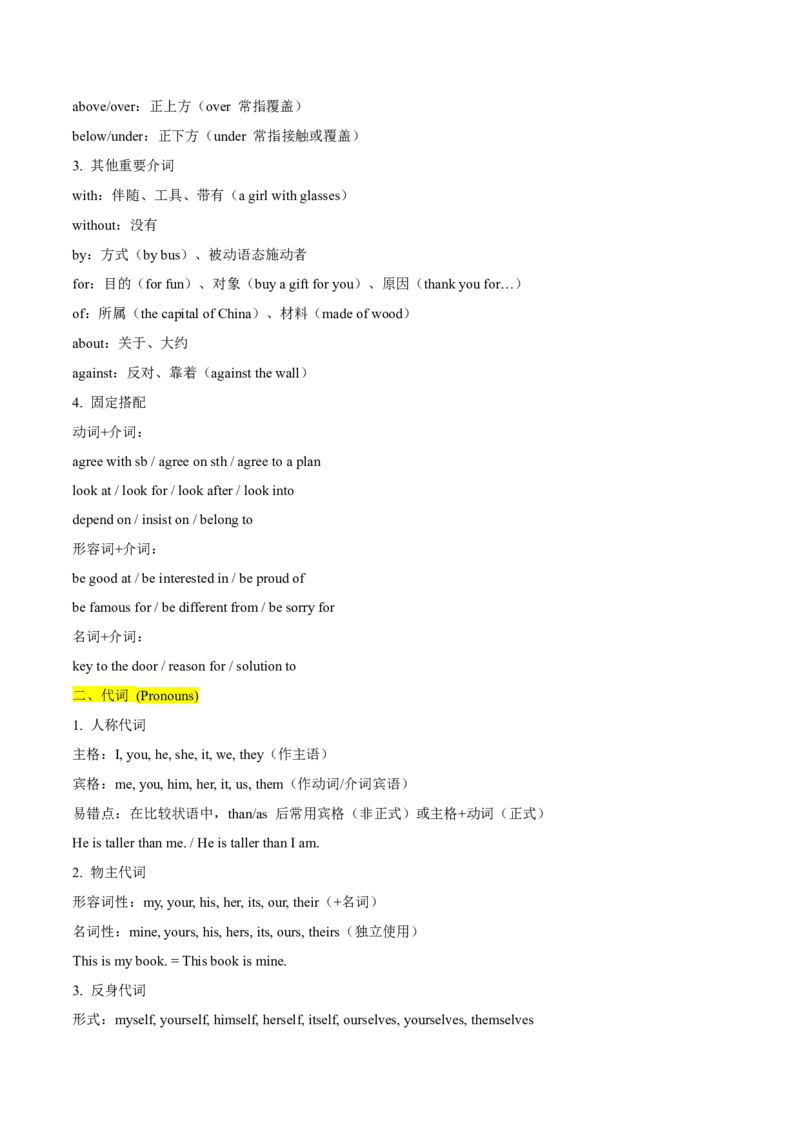
above/over:正上方(over 常指覆盖)
below/under:正下方(under 常指接触或覆盖)
3. 其他重要介词
with:伴随、工具、带有(a girl with glasses)
without:没有
by:方式(by bus)、被动语态施动者
for:目的(for fun)、对象(buy a gift for you)、原因(thank you for…)
of:所属(the capital of China)、材料(made of wood)
about:关于、大约
against:反对、靠着(against the wall)
4. 固定搭配
动词+介词:
agree with sb / agree on sth / agree to a plan
look at / look for / look after / look into
depend on / insist on / belong to
形容词+介词:
be good at / be interested in / be proud of
be famous for / be different from / be sorry for
名词+介词:
key to the door / reason for / solution to
二、代词 (Pronouns)
1. 人称代词
主格:I, you, he, she, it, we, they(作主语)
宾格:me, you, him, her, it, us, them(作动词/介词宾语)
易错点:在比较状语中,than/as 后常用宾格(非正式)或主格+动词(正式)
He is taller than me. / He is taller than I am.
2. 物主代词
形容词性:my, your, his, her, its, our, their(+名词)
名词性:mine, yours, his, hers, its, ours, theirs(独立使用)
This is my book. = This book is mine.
3. 反身代词
形式:myself, yourself, himself, herself, itself, ourselves, yourselves, themselves
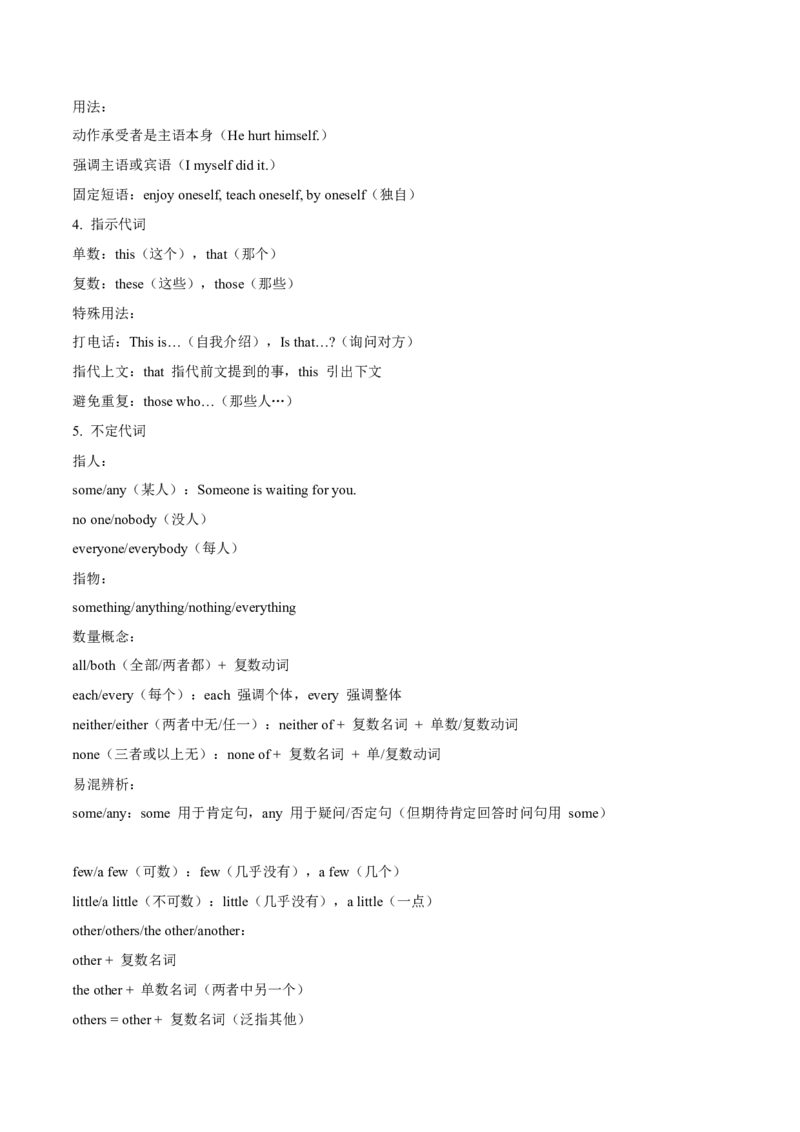
用法:
动作承受者是主语本身(He hurt himself.)
强调主语或宾语(I myself did it.)
固定短语:enjoy oneself, teach oneself, by oneself(独自)
4. 指示代词
单数:this(这个),that(那个)
复数:these(这些),those(那些)
特殊用法:
打电话:This is…(自我介绍),Is that…?(询问对方)
指代上文:that 指代前文提到的事,this 引出下文
避免重复:those who…(那些人…)
5. 不定代词
指人:
some/any(某人):Someone is waiting for you.
no one/nobody(没人)
everyone/everybody(每人)
指物:
something/anything/nothing/everything
数量概念:
all/both(全部/两者都)+ 复数动词
each/every(每个):each 强调个体,every 强调整体
neither/either(两者中无/任一):neither of + 复数名词 + 单数/复数动词
none(三者或以上无):none of + 复数名词 + 单/复数动词
易混辨析:
some/any:some 用于肯定句,any 用于疑问/否定句(但期待肯定回答时问句用 some)
few/a few(可数):few(几乎没有),a few(几个)
little/a little(不可数):little(几乎没有),a little(一点)
other/others/the other/another:
other + 复数名词
the other + 单数名词(两者中另一个)
others = other + 复数名词(泛指其他)
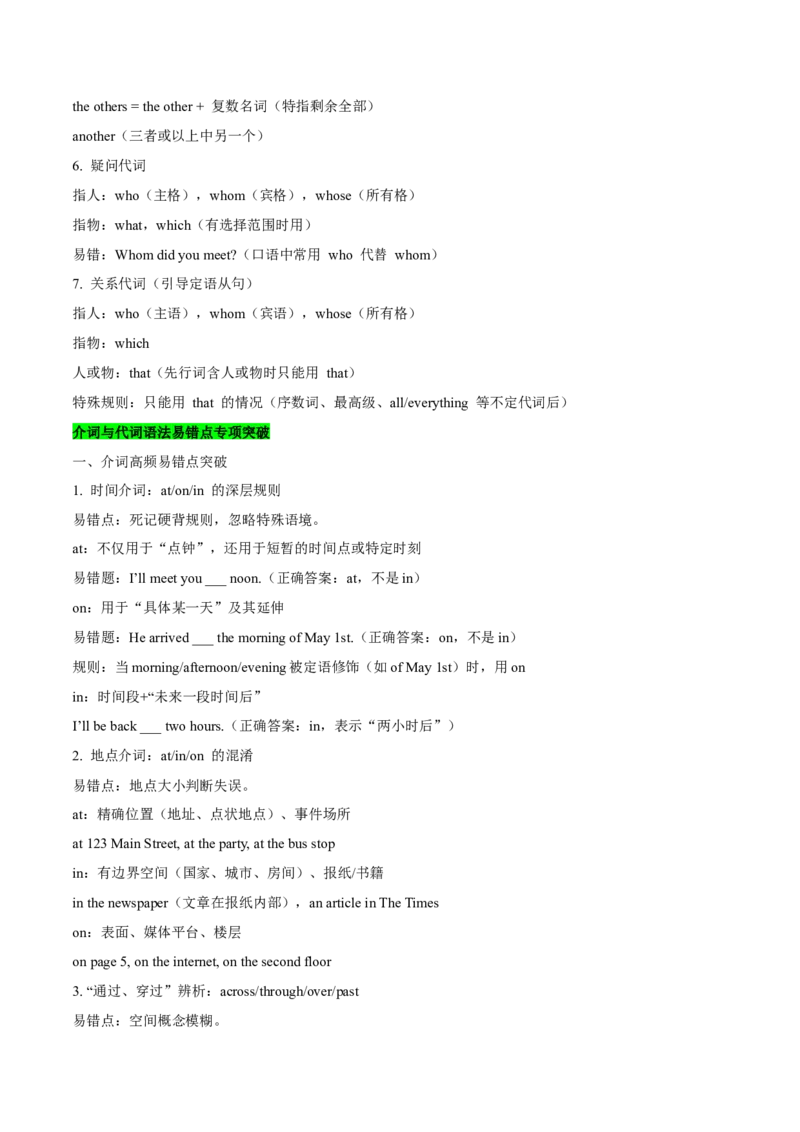
the others = the other + 复数名词(特指剩余全部)
another(三者或以上中另一个)
6. 疑问代词
指人:who(主格),whom(宾格),whose(所有格)
指物:what,which(有选择范围时用)
易错:Whom did you meet?(口语中常用 who 代替 whom)
7. 关系代词(引导定语从句)
指人:who(主语),whom(宾语),whose(所有格)
指物:which
人或物:that(先行词含人或物时只能用 that)
特殊规则:只能用 that 的情况(序数词、最高级、all/everything 等不定代词后)
介词与代词语法易错点专项突破
一、介词高频易错点突破
1. 时间介词:at/on/in 的深层规则
易错点:死记硬背规则,忽略特殊语境。
at:不仅用于“点钟”,还用于短暂的时间点或特定时刻
易错题:I’ll meet you ___ noon.(正确答案:at,不是in)
on:用于“具体某一天”及其延伸
易错题:He arrived ___ the morning of May 1st.(正确答案:on,不是in)
规则:当morning/afternoon/evening 被定语修饰(如of May 1st)时,用on
in:时间段+“未来一段时间后”
I’ll be back ___ two hours.(正确答案:in,表示“两小时后”)
2. 地点介词:at/in/on 的混淆
易错点:地点大小判断失误。
at:精确位置(地址、点状地点)、事件场所
at 123 Main Street, at the party, at the bus stop
in:有边界空间(国家、城市、房间)、报纸/书籍
in the newspaper(文章在报纸内部),an article in The Times
on:表面、媒体平台、楼层
on page 5, on the internet, on the second floor
3. “通过、穿过”辨析:across/through/over/past
易错点:空间概念模糊。
across:横穿平面(街道、广场)
walk across the square
through:穿过三维空间(森林、人群、隧道)
drive through the tunnel
over:越过上方(桥、障碍物)
jump over the fence
past:从旁边经过
walk past the post office
4. 动词+介词固定搭配陷阱
易错点:一词多配,意义不同。
look
look at(看) look for(寻找)look after(照顾)look into(调查)
agree
agree with sb./观点(同意某人)
agree to 计划/建议(同意某事)
agree on 某事(就…达成一致)
介词选择影响及物性
易错:He is searching the room.(×,意为“搜查房间”)
正确:He is searching for his keys in the room.(√,意为“寻找钥匙”)
5. “除了”辨析:besides/except/except for/but
易错点:逻辑关系混淆。
besides:包括性除了(“…也”)
Besides English, he speaks French.(英语和法语都会)
except:排除性除了(同类排除)
Everyone passed except Tom.(Tom 没通过)
except for:整体肯定,细节修正(不同类排除)
The article is good except for a few spelling mistakes.
but:常与all, none, nobody 等连用
Nobody but Tom knows the answer.
二、代词高频易错点突破
1. 人称代词主格/宾格误用
易错点:尤其在复合主语/宾语和比较结构中。
复合主语/宾语:
易错:Between you and I, this is a secret.(×)
正确:Between you and me, this is a secret.(√)
规则:介词后永远用宾格
比较结构(than/as):
易错:He is taller than me.(口语可接受,但正式语境有风险)
分析:than 后可接宾格(me)或主格+动词(I am)
安全策略:补全省略部分判断
He is taller than I (am). → 主格
He likes her more than (he likes) me. → 宾格
2. 反身代词的三大陷阱
易错点:滥用、遗漏、固定搭配。
陷阱1:非宾语同指时不用反身代词
易错:I bought a gift for myself.(×,如果礼物是给别人)
正确:I bought a gift for my sister.
检验:只有当主语和宾语是同一人时才用反身代词
陷阱2:某些动词必须/不能用反身代词
必须用:enjoy oneself, teach oneself, hurt oneself
不能用:concentrate (on), feel, relax(直接加宾语)
易错:I feel myself happy.(×)
正确:I feel happy.(√)
陷阱3:by oneself ≠ for oneself
by oneself = alone(独自)
for oneself = independently(独立地,为自己)
3. 不定代词数量一致陷阱
易错点:主谓一致、指代一致。
all/both + 复数动词
易错:All is here.(×,指人时)
正确:All are here.(√)
each/every + 单数动词
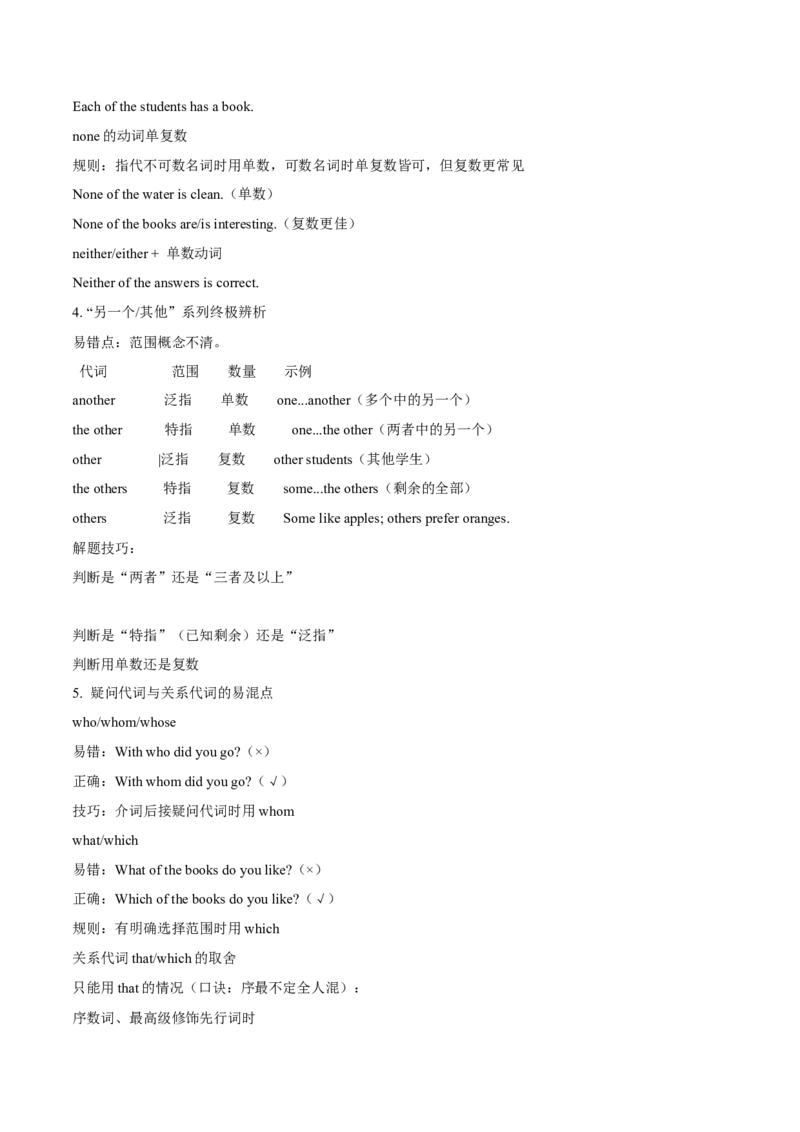
Each of the students has a book.
none 的动词单复数
规则:指代不可数名词时用单数,可数名词时单复数皆可,但复数更常见
None of the water is clean.(单数)
None of the books are/is interesting.(复数更佳)
neither/either + 单数动词
Neither of the answers is correct.
4. “另一个/其他”系列终极辨析
易错点:范围概念不清。
 代词         范围    数量    示例
another       泛指    单数    one...another(多个中的另一个)
the other      特指     单数     one...the other(两者中的另一个)
other        |泛指    复数    other students(其他学生)
the others     特指     复数    some...the others(剩余的全部)
others        泛指     复数    Some like apples; others prefer oranges.
解题技巧:
判断是“两者”还是“三者及以上”
判断是“特指”(已知剩余)还是“泛指”
判断用单数还是复数
5. 疑问代词与关系代词的易混点
who/whom/whose
易错:With who did you go?(×)
正确:With whom did you go?(√)
技巧:介词后接疑问代词时用whom
what/which
易错:What of the books do you like?(×)
正确:Which of the books do you like?(√)
规则:有明确选择范围时用which
关系代词that/which 的取舍
只能用that 的情况(口诀:序最不定全人混):
序数词、最高级修饰先行词时
This is the best book that I have ever read.
不定代词(all, everything, nothing 等)后
All that glitters is not gold.
先行词既有人又有物时
They talked about the people and things that they remembered.
先行词被the only, the very, the last 修饰时
三、实战解题策略
1. 介词搭配三步法
判断结构:动词+介词?形容词+介词?名词+介词?
回忆搭配:默念常见搭配组块(如be interested in)
检查逻辑:介词含义是否符合句意(如look at“看” vs. look for“寻找”)
2. 代词指代“追踪法”
定位代词:找到句子中的代词
向前追溯:在上下文中找到它所指代的名词
一致性检查:
单复数一致吗?
人称一致吗?
逻辑合理吗?
3. 比较结构“还原法”
遇到than/as 后的代词不确定时:
补全省略部分
He likes you more than (he likes) me.(宾格)
He likes you more than I (do).(主格)
根据补全后的逻辑判断
4. 不定代词“范围分析法”
           ┌─ 有范围 → which
疑问代词 ──┤
           └─ 无范围 → what
           ┌─ 两者:neither/either
不定代词 ──┤ 三者及以上:none/all
           │
           └─ 肯定/邀请:some
              疑问/否定:any
四、经典易错题即时检测
介词题:The conference will be held ___ the morning of June 1st.
A. in B. on C. at D. by
代词题:Between you and ___, I don’t trust him.
A. I B. me C. myself D. mine
综合题:He is taller than ___ in his class.
A. any student B. any other student C. other students D. the other student
介词与代词语法临考抢分技巧
一、介词核心考点(抓“固定搭配”与“语境判断”)
介词考的不是“意思”,而是 “习惯搭配”和“逻辑关系”。
抢分三步法:
先看搭配:题空前后是否有固定短语(动词短语、形容词短语、名词短语)。
再辨逻辑:如果没有固定搭配,分析句子需要何种逻辑关系(时间、地点、方式、原因等)。
最后排除:结合上下文,排除明显不符合语境的选项。
必须掌握的6 类高频介词:
介词
核心用法
经典例句
at
瞬间点、较小地点、具体时刻
arrive at (小地点),at night,be good at
in
时间段、较大范围、穿着、状态
in the morning, in China, in red, in surprise
on
具体某天/日期、表面、关于
on Monday, on the desk, a book on birds
by
方式、手段、截止时间、被动施动者
by bus, by the end of, written by him
for
目的、原因、时间段、为了
leave for Beijing, thank you for, for two years
with 伴随、用工具、具有、带着
with my friend, write with a pen, a girl with glasses
【临考特训】 重点记忆这些高频短语:
动词+介词:think of/about, depend on, deal with, belong to, listen to
形容词+介词:be proud of, be familiar with, be different from, be interested in
名词+介词:key to, answer to, reason for, advantage of
二、代词核心考点(抓“指代清晰”与“句法功能”)
代词的关键是 “指代谁?在句中做什么成分?”。
四大抢分要点:
1. 人称代词/物主代词——看“格”
主格 (I, he, they) 做主语。
宾格 (me, him, them) 做宾语或介词宾语。
形容词性物主代词 (my, his, their) + 名词。
名词性物主代词 (mine, his, theirs) 独立使用,相当于“形容词性物主代词+名词”。
真题陷阱:This book is not mine. It must be ______ (your / yours). 答案:yours (相当于 your book)。
2. 反身代词——记“自己”和“强调”
动作反射回主语本身时用:He taught himself English.
强调主语或宾语:I myself finished the work. / I want to see the manager himself.
固定搭配:enjoy oneself, by oneself, help oneself to
3. 不定代词——辨“范围”与“数量”
这是丢分重灾区!抓住两组核心矛盾:
分组
易混词
关键区别
速记口诀
两者
both / either / neither
both“(两者)都”,either“(两者中)任一”,neither“(两者)都不”
“ 两都、
任一、两不”
三者及以上
all / any / noneall“(三者及以上)全部”,any“(三者及以上)任一”,none“(三者及以上)全不”
“全、任一、全不”
一些
some / any
some 用于肯定句或期待肯定回答的疑问句;any 用于否定句、疑问句或条件句“
肯
some 疑否any”
另一个
another / the other another“泛指另一个(无范围)”,the other“特指两者中的另一个” “
泛
指
an,特指the”
特别提醒:everyone/everybody 后接代词时,正式文体用 he/his,但口语和现代考试中常用 they/their 避免
性别歧视。Anyone who fails must do ______ homework again. 答案:their。
4. 关系代词(定语从句)——看“从句缺什么”
缺主语/宾语指人:用 who/that
缺主语/宾语指物:用 which/that
缺定语(表所属):用 whose (人或物均可)
缺状语(地点/时间/原因):用 where/when/why
速判法:把先行词代入定语从句,看它在从句中充当什么成分,缺什么补什么。
三、临场实战抢分策略
先读全句,后看选项:不要被选项干扰,先理解句意和结构。
圈定“信号词”:
介词题:圈出空前的动词、形容词、名词,以及空后的名词。
代词题:圈出该代词所指代的先行词,判断单复数、性别。
用“还原法”解难题:
把不定代词如 something, nothing 代入后,判断句子逻辑是否通顺。
把定语从句还原为两个简单句,确定关系词。
终极检查:
介词:这个搭配是否常见?逻辑是否合理?
代词:指代是否明确?会不会产生歧义?格是否正确?
介词与代词语法必练题型
题型1:固定搭配题(高频)
特征:四个介词选项,空格前或后是常见动词/形容词/名词。
【例题】
He promised to look ______ the matter as soon as he got back to the office.
A. into B. after C. for D. up
抢分技巧:考前集中过一遍高频动词短语(尤其带look, come, get, turn, take, put, break 等小词)。
题型2:语境逻辑题
特征:句子无明显固定搭配,需根据语境判断逻辑关系(时间、地点、原因、方式等)。
【例题】
The conference will be held ______ September 10th ______ 15th.
A. from…to B. between…and C. on…until D. at…through
抢分技巧:熟记时间/地点/原因等逻辑的常用介词(during, through, until, by, across, because of, due to
等)。
题型3:介词与从句结合题
特征:介词后接宾语从句或“疑问词+不定式”。
【例题】
We are discussing the question ______ we should invest more money in AI.
A. of B. about C. whether D. on
抢分技巧:记住“名词+of+whether/疑问词”结构,如the problem of how to do it。
二、代词必练题型
题型1:不定代词辨析题(高频易错!)
特征:选项为some/any/no/every 及其复合代词,或both/all/neither/none 等。
【例题】
—Which of the two novels do you prefer?
—Actually I don’t like ______ of them. They’re both boring.
A. either B. neither C. any D. none
抢分技巧:遇到two 或both,锁定both/either/neither;遇到three 或all,锁定all/any/none。
题型2:代词指代一致题
特征:空格处代词需与上下文指代对象在数、格、性别上一致。
【例题】
Each student must bring ______ own lunch to the picnic.
A. his B. her C. their D. one’s
抢分技巧:注意everyone, somebody, each 等不定代词在题中的指代,近年高考倾向接受they/their 指代单
数。
题型3:关系代词选择题(定语从句)
特征:空格引导定语从句,选项为that, which, who, whom, whose, as 等。
【例题】
The book ______ cover is red was written by my teacher.
A. which B. whose C. that D. whom
抢分技巧:拆解从句,看先行词在从句中充当的成分:缺主语/宾语→用that/which/who;缺定语→用
whose;缺状语→用where/when/why。
题型4:反身代词固定搭配题
特征:空格出现在固定短语中。
【例题】
Don’t worry about me. I can take good care of ______.
A. me B. myself C. us D. ourselves
抢分技巧:熟记含反身代词的短语:enjoy oneself, teach oneself, help oneself to, by oneself, for oneself
等。
三、综合混合题型(近年趋势)
【例题】
I agree with most of what you said, but I don’t agree with ______.
A. everything B. anything C. something D. nothing
抢分技巧:not 与all/both/every 连用表示“部分否定”,是经典陷阱。
介词与代词语法综合小测
一、单项选择题(每题2 分,共30 分)
1. —Who is that girl standing over there?
—Oh, it’s Lucy. I met ______ at the school gate yesterday.( )
A. her  B. she  C. hers  D. herself
2. This book is ______ than that one. I prefer to read the thicker one.( )
A. thin  B. thinner  C. the thinnest  D. more thin
3. My parents often tell me to be careful ______ fire when I am alone at home.( )
A. with  B. of  C. about  D. all of the above
4. —Which pen do you want, the red one or the blue one?
—______. I just need a pen to write with.( )
A. Both  B. Either  C. Neither  D. None
5. The meeting will start ______ 9:00 a.m. ______ Monday morning. Don’t be late.( )
A. at; on  B. in; on  C. at; in  D. on; at
6. —Is this dictionary ______?
—No, it’s not mine. It must be ______ else’s.( )
A. your; someone  B. yours; someone  C. your; anyone  D. yours; anyone
7. We should learn to care for ______ and help each other in our daily life.( )
A. one another  B. each other  C. A and B  D. none
8. The bridge ______ the river is very beautiful. Many people take photos of it every day.( )
A. over  B. on  C. above  D. under
9. —How many apples do we have?
—Only three. We need to buy ______ more to make apple pie.( )
A. a few  B. a little  C. few  D. little
10. He spent two hours ______ his homework last night. He finished it at 10 o’clock.( )
A. in  B. on  C. with  D. for
11. —Who helped you clean the room yesterday?
—No one. I cleaned it ______.( )
A. myself  B. himself  C. herself  D. itself
12. There is a big tree ______ the front of our classroom. We can see it from the window.( )
A. in  B. on  C. at  D. to
13. These books are not ours. They belong to ______. Their names are on the covers.( )
A. they  B. them  C. their  D. theirs
14. She is interested ______ painting. She often spends her free time painting pictures.( )
A. in  B. at  C. on  D. with
15. —Which of the two shirts do you like better?
—______ is OK. I don’t mind.( )
A. Both  B. Either  C. Neither  D. All
二、语法填空(每题2 分,共20 分)
阅读下面短文,在空白处填入适当的介词或代词,使短文意思完整、语法正确。
My best friend is Lily. We go to the same school and we often go home together. Yesterday afternoon, I forgot to
take 16. ______ (I) umbrella. It started to rain heavily when we were leaving school. Lily gave me 17. ______ (she)
umbrella and said, “You can take mine. I live closer to school than you.” I thanked her and we walked 18. ______
the rain to the bus stop. On the bus, there was only one seat left. Lily let me sit there and she stood 19. ______ me. I
felt very warm.
Today is Lily’s birthday. I bought a birthday gift 20. ______ her. It’s a beautiful notebook. I wrote some best wishes
21. ______ the first page. I hope she will like it. Lily is always kind to me. She often helps me 22. ______ my
English. When I am in trouble, she is always there for me. I think 23. ______ is lucky for me to have such a good
friend. We promise to be good friends forever and help 24. ______ other all the time. I believe our friendship will
last 25. ______ a long time.