考点 17 语法填空之传统文化、节日、食物
Part 1 题型详解:
语法填空又称开放式语篇填空,这种命题形式以语篇为核心,体现了新课改由语法知识到语法技能的
语法教学观念的转变以及当今高考英语改革的趋势。突出语篇,强调在语篇中测试学生的英语语言知识
和技能。
Part 2 常见话题:
文化是一个国家、一个民族的灵魂。文化强,民族强。这在高考语法填空中也有所体现。近几年从全
国卷到各地模拟卷,都有所体现。通过在语法填空中讲述与文化相关的内容、能加深考生对中国传统文化
的了解,坚定文化自信并能够继承和弘扬中国传统文化。
Part 3 常见题目设置及解题技巧:
1.给出提示词的空格,考查形容词、副词、动词、名词,数词,以动词发散的各考点是这几年的考查重点。
--提示词为名词的情况,通常可以变成单数、复数或者所有格。
--提示词为代词,通常考查人称代词(注意主宾格)、反身代词、物主代词(注意形容词性和名词性的区
别)等。
--提示词为形容词、通常副词,通常考查相互转换及比较级或者最高级。
--提示词为数词,考查基数词、序数词及相关的固定搭配。
--提示词为动词,通常考查动词的谓语(时态、语态、人称)和非谓语情况(to do , doing, done)。
--提示词的派生情况,多出现在名词、动词、形容词和副词当中,这类题型考查学生对词根、词缀及构词
法的掌握。
2.没有给出提示词的空格,考查介词、冠词、连词、代词
--考查固定短语结构
--考查常见从句(定语从句、名词性从句、状语从句)对引导词的掌握。
--考查动词短语结构。
--考查短语介词结构及常用的介词in, at, on, before, during等。
--考查连词、关联短语结构,如and, but, so , for ,while 等。
--考查冠词a, an, the之间的判断
Part 4 真题检测
2023年新课标全国Ⅰ卷英语真题
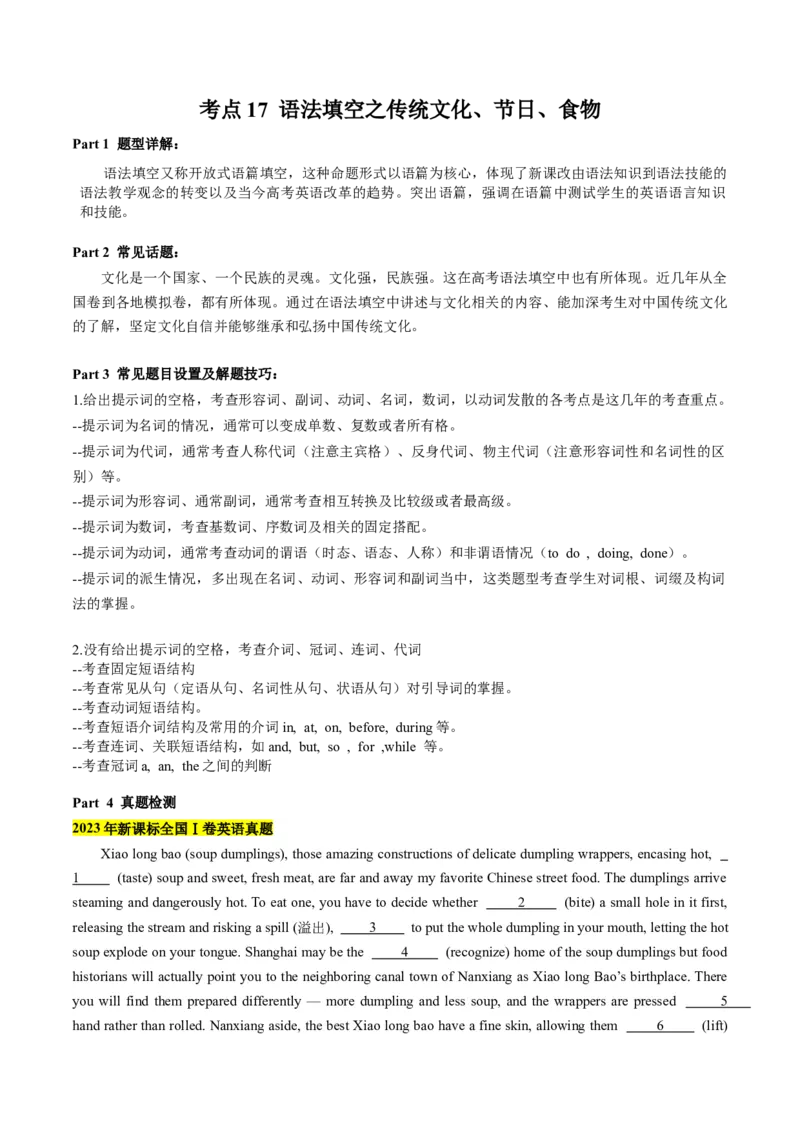
Xiao long bao (soup dumplings), those amazing constructions of delicate dumpling wrappers, encasing hot,
1 (taste) soup and sweet, fresh meat, are far and away my favorite Chinese street food. The dumplings arrive
steaming and dangerously hot. To eat one, you have to decide whether 2 (bite) a small hole in it first,
releasing the stream and risking a spill (溢出), 3 to put the whole dumpling in your mouth, letting the hot
soup explode on your tongue. Shanghai may be the 4 (recognize) home of the soup dumplings but food
historians will actually point you to the neighboring canal town of Nanxiang as Xiao long Bao’s birthplace. There
you will find them prepared differently — more dumpling and less soup, and the wrappers are pressed 5
hand rather than rolled. Nanxiang aside, the best Xiao long bao have a fine skin, allowing them 6 (lift)out of the steamer basket without allowing them tearing or spilling any of 7 (they) contents. The meat
should be fresh with 8 touch of sweetness and the soup hot, clear and delicious.
No matter where I buy them, one steamer is 9 (rare) enough, yet two seems greedy, so I am always
left 10 (want) more next time.
2023年全国乙卷英语真题
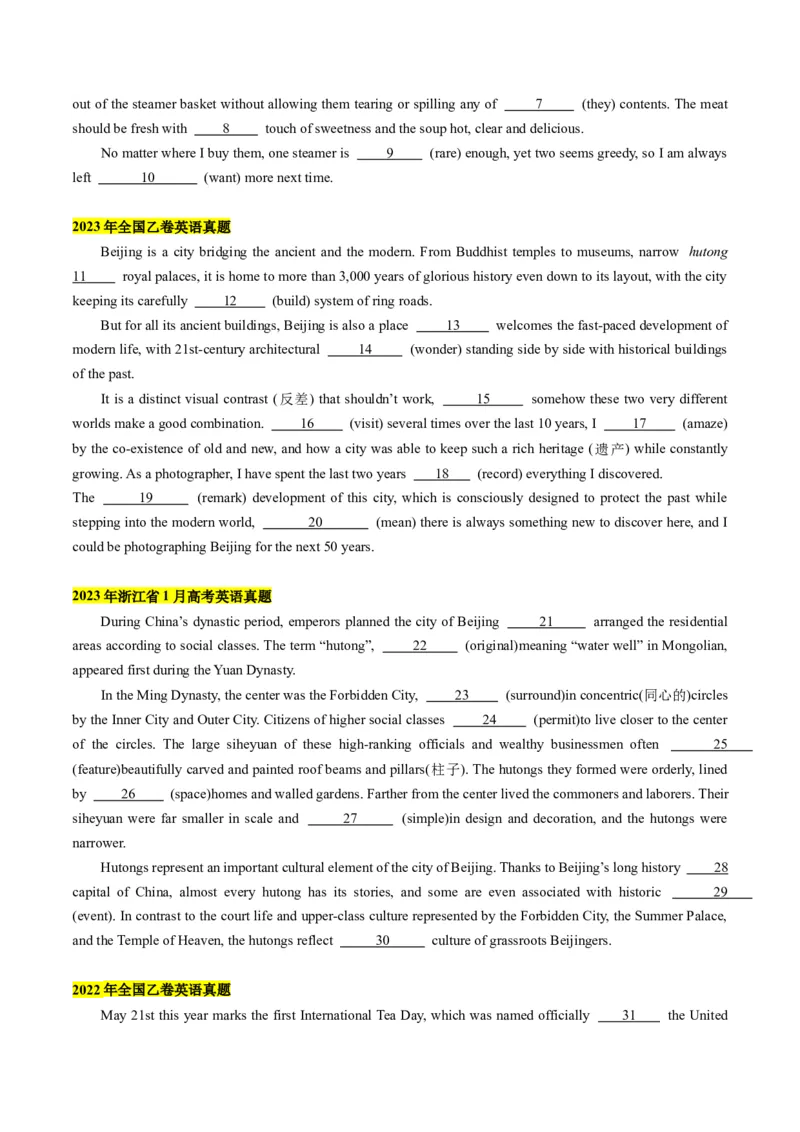
Beijing is a city bridging the ancient and the modern. From Buddhist temples to museums, narrow hutong
11 royal palaces, it is home to more than 3,000 years of glorious history even down to its layout, with the city
keeping its carefully 12 (build) system of ring roads.
But for all its ancient buildings, Beijing is also a place 13 welcomes the fast-paced development of
modern life, with 21st-century architectural 14 (wonder) standing side by side with historical buildings
of the past.
It is a distinct visual contrast (反差) that shouldn’t work, 15 somehow these two very different
worlds make a good combination. 16 (visit) several times over the last 10 years, I 17 (amaze)
by the co-existence of old and new, and how a city was able to keep such a rich heritage (遗产) while constantly
growing. As a photographer, I have spent the last two years 18 (record) everything I discovered.
The 19 (remark) development of this city, which is consciously designed to protect the past while
stepping into the modern world, 20 (mean) there is always something new to discover here, and I
could be photographing Beijing for the next 50 years.
2023年浙江省1月高考英语真题
During China’s dynastic period, emperors planned the city of Beijing 21 arranged the residential
areas according to social classes. The term “hutong”, 22 (original)meaning “water well” in Mongolian,
appeared first during the Yuan Dynasty.
In the Ming Dynasty, the center was the Forbidden City, 23 (surround)in concentric(同心的)circles
by the Inner City and Outer City. Citizens of higher social classes 24 (permit)to live closer to the center
of the circles. The large siheyuan of these high-ranking officials and wealthy businessmen often 25
(feature)beautifully carved and painted roof beams and pillars(柱子). The hutongs they formed were orderly, lined
by 26 (space)homes and walled gardens. Farther from the center lived the commoners and laborers. Their
siheyuan were far smaller in scale and 27 (simple)in design and decoration, and the hutongs were
narrower.
Hutongs represent an important cultural element of the city of Beijing. Thanks to Beijing’s long history 28
capital of China, almost every hutong has its stories, and some are even associated with historic 29
(event). In contrast to the court life and upper-class culture represented by the Forbidden City, the Summer Palace,
and the Temple of Heaven, the hutongs reflect 30 culture of grassroots Beijingers.
2022年全国乙卷英语真题
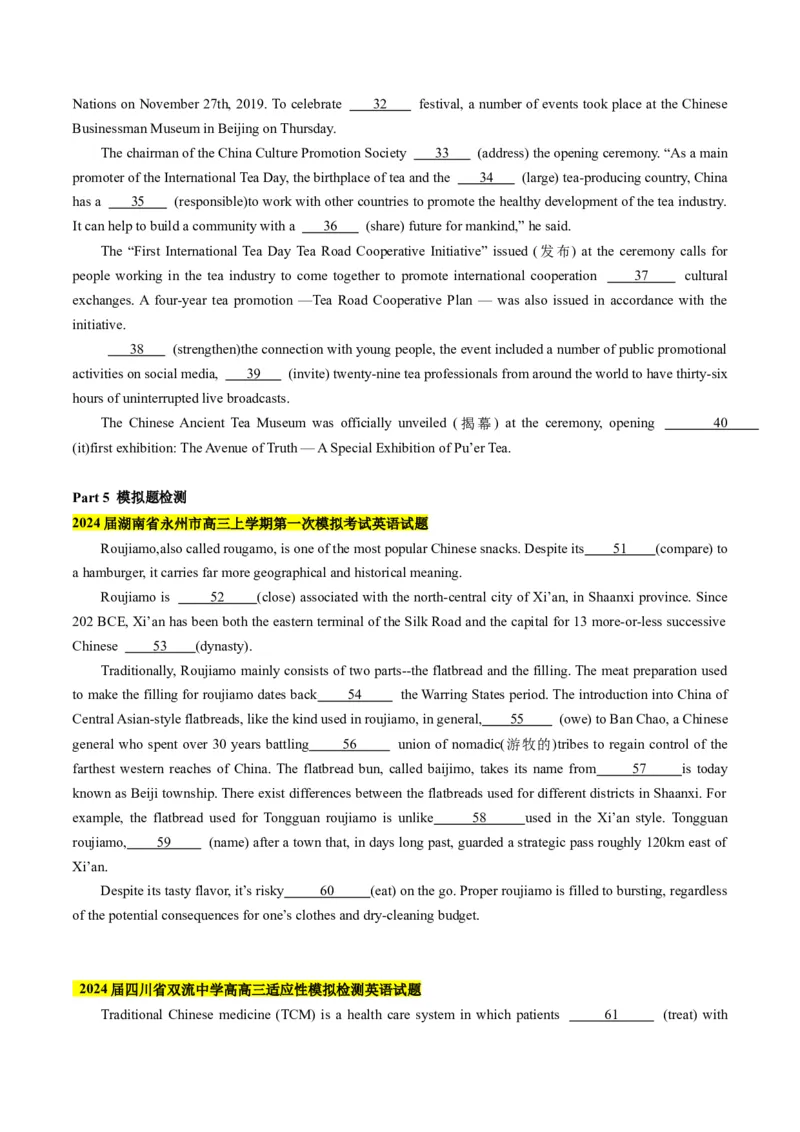
May 21st this year marks the first International Tea Day, which was named officially 31 the UnitedNations on November 27th, 2019. To celebrate 32 festival, a number of events took place at the Chinese
Businessman Museum in Beijing on Thursday.
The chairman of the China Culture Promotion Society 33 (address) the opening ceremony. “As a main
promoter of the International Tea Day, the birthplace of tea and the 34 (large) tea-producing country, China
has a 35 (responsible)to work with other countries to promote the healthy development of the tea industry.
It can help to build a community with a 36 (share) future for mankind,” he said.
The “First International Tea Day Tea Road Cooperative Initiative” issued (发布) at the ceremony calls for
people working in the tea industry to come together to promote international cooperation 37 cultural
exchanges. A four-year tea promotion —Tea Road Cooperative Plan — was also issued in accordance with the
initiative.
38 (strengthen)the connection with young people, the event included a number of public promotional
activities on social media, 39 (invite) twenty-nine tea professionals from around the world to have thirty-six
hours of uninterrupted live broadcasts.
The Chinese Ancient Tea Museum was officially unveiled (揭幕) at the ceremony, opening 40
(it)first exhibition: The Avenue of Truth — A Special Exhibition of Pu’er Tea.
Part 5 模拟题检测
2024届湖南省永州市高三上学期第一次模拟考试英语试题
Roujiamo,also called rougamo, is one of the most popular Chinese snacks. Despite its 51 (compare) to
a hamburger, it carries far more geographical and historical meaning.
Roujiamo is 52 (close) associated with the north-central city of Xi’an, in Shaanxi province. Since
202 BCE, Xi’an has been both the eastern terminal of the Silk Road and the capital for 13 more-or-less successive
Chinese 53 (dynasty).
Traditionally, Roujiamo mainly consists of two parts--the flatbread and the filling. The meat preparation used
to make the filling for roujiamo dates back 54 the Warring States period. The introduction into China of
Central Asian-style flatbreads, like the kind used in roujiamo, in general, 55 (owe) to Ban Chao, a Chinese
general who spent over 30 years battling 56 union of nomadic(游牧的)tribes to regain control of the
farthest western reaches of China. The flatbread bun, called baijimo, takes its name from 57 is today
known as Beiji township. There exist differences between the flatbreads used for different districts in Shaanxi. For
example, the flatbread used for Tongguan roujiamo is unlike 58 used in the Xi’an style. Tongguan
roujiamo, 59 (name) after a town that, in days long past, guarded a strategic pass roughly 120km east of
Xi’an.
Despite its tasty flavor, it’s risky 60 (eat) on the go. Proper roujiamo is filled to bursting, regardless
of the potential consequences for one’s clothes and dry-cleaning budget.
2024届四川省双流中学高高三适应性模拟检测英语试题
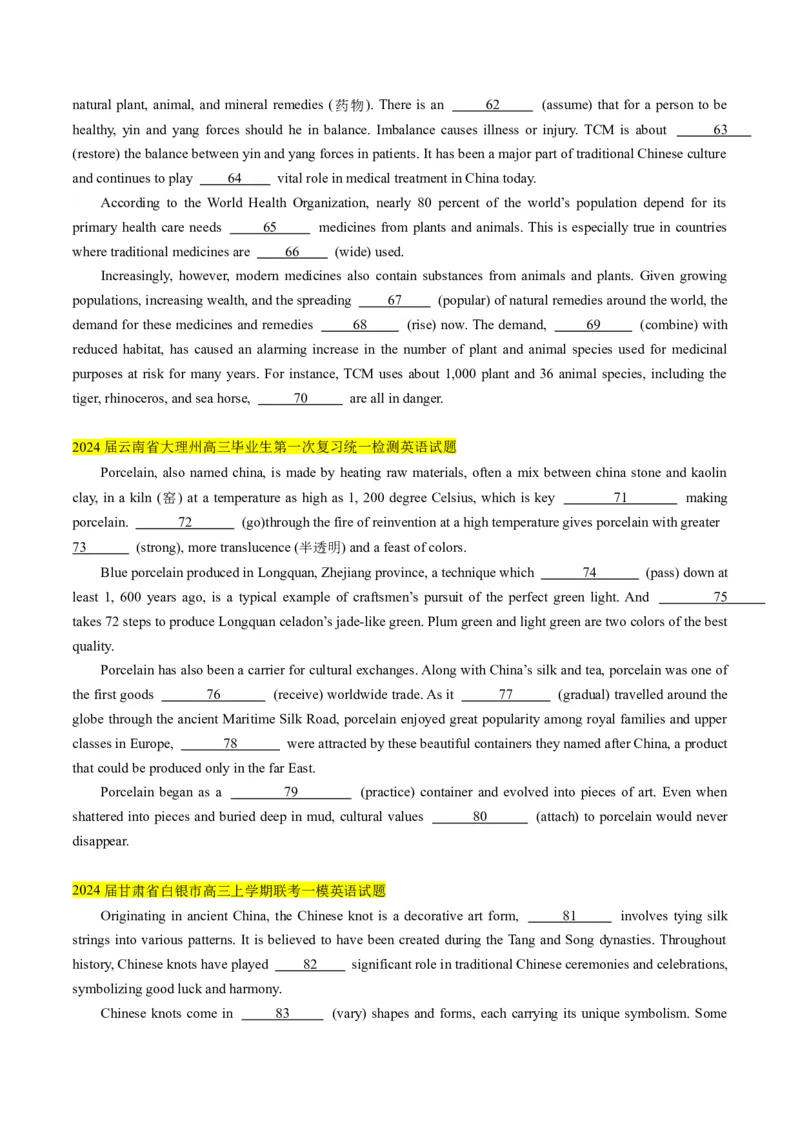
Traditional Chinese medicine (TCM) is a health care system in which patients 61 (treat) withnatural plant, animal, and mineral remedies (药物). There is an 62 (assume) that for a person to be
healthy, yin and yang forces should he in balance. Imbalance causes illness or injury. TCM is about 63
(restore) the balance between yin and yang forces in patients. It has been a major part of traditional Chinese culture
and continues to play 64 vital role in medical treatment in China today.
According to the World Health Organization, nearly 80 percent of the world’s population depend for its
primary health care needs 65 medicines from plants and animals. This is especially true in countries
where traditional medicines are 66 (wide) used.
Increasingly, however, modern medicines also contain substances from animals and plants. Given growing
populations, increasing wealth, and the spreading 67 (popular) of natural remedies around the world, the
demand for these medicines and remedies 68 (rise) now. The demand, 69 (combine) with
reduced habitat, has caused an alarming increase in the number of plant and animal species used for medicinal
purposes at risk for many years. For instance, TCM uses about 1,000 plant and 36 animal species, including the
tiger, rhinoceros, and sea horse, 70 are all in danger.
2024届云南省大理州高三毕业生第一次复习统一检测英语试题
Porcelain, also named china, is made by heating raw materials, often a mix between china stone and kaolin
clay, in a kiln (窑) at a temperature as high as 1, 200 degree Celsius, which is key 71 making
porcelain. 72 (go)through the fire of reinvention at a high temperature gives porcelain with greater
73 (strong), more translucence (半透明) and a feast of colors.
Blue porcelain produced in Longquan, Zhejiang province, a technique which 74 (pass) down at
least 1, 600 years ago, is a typical example of craftsmen’s pursuit of the perfect green light. And 75
takes 72 steps to produce Longquan celadon’s jade-like green. Plum green and light green are two colors of the best
quality.
Porcelain has also been a carrier for cultural exchanges. Along with China’s silk and tea, porcelain was one of
the first goods 76 (receive) worldwide trade. As it 77 (gradual) travelled around the
globe through the ancient Maritime Silk Road, porcelain enjoyed great popularity among royal families and upper
classes in Europe, 78 were attracted by these beautiful containers they named after China, a product
that could be produced only in the far East.
Porcelain began as a 79 (practice) container and evolved into pieces of art. Even when
shattered into pieces and buried deep in mud, cultural values 80 (attach) to porcelain would never
disappear.
2024届甘肃省白银市高三上学期联考一模英语试题
Originating in ancient China, the Chinese knot is a decorative art form, 81 involves tying silk
strings into various patterns. It is believed to have been created during the Tang and Song dynasties. Throughout
history, Chinese knots have played 82 significant role in traditional Chinese ceremonies and celebrations,
symbolizing good luck and harmony.
Chinese knots come in 83 (vary) shapes and forms, each carrying its unique symbolism. Somepopular designs include the “Double Coin Knot” representing wealth and success, the “Button Knot” symbolizing
unity and friendship, and the “Good Luck Knot” signifying blessings and good fortune. These knots can be further
decorated with beads, tassels or other decorations 84 (enhance) their beauty.
Chinese knots hold great significance in Chinese culture and are often used for decorative 85
(purpose) or as accessories (饰品). They can be seen on traditional clothing, handbags, home decorations, and even
used as bookmarks. During festive occasions 86 Chinese New Year or weddings, these knots are 87
(common) used as decorations to create an auspicious (吉祥的) and joyful atmosphere.
In recent years, the art of Chinese knots 88 (gain) international recognition, with enthusiasts and
collectors 89 (appreciate) its beauty and cultural value. Workshops and exhibitions 90
(hold) worldwide, allowing people to learn about this unique form of art and even try their hand at making their
own Chinese knots.
2024届河南省信阳市浉河区信阳高级中学高三上学期一模英语试题
In the Chinese lunar calendar, Sanfu, also called the dog days, refers to the three 10-day periods that are
predicted to be the 91 (hot) days of the year, which are called Toufu, Zhongfu and Mofu.
Sanfu usually comes between mid-July to mid-August. It is said that 92 (receive) Sanfutie during the
hottest summer days is 93 (benefit) for our health. Many people regard it 94 an effective solution
for winter ills in summer. The treatment is based on the principle of yin and yang, 95 believes the balance
of both elements in the body is vital for good health.
People eat differently in this period of time. When the dog days come, people tend 96 (lose) their
appetites, and jiaozi, or boiled dumplings, can refresh people’s feelings toward food. Actually jiaozi is an all-time
classic, which people eat at Liqiu, the start of autumn, and Dongzhi, the start of winter. The second phase of Sanfu
is 97 (traditional) a time for consuming noodles because it 98 (believe) to help people sweat and
99 (relief) internal heat. As Mofu comes, the weather turns cool, and 100 is easy to get cold if a
person keeps eating noodles in sweat. People, especially those living in North China, prefer the Chinese egg
pancake by custom.
2023届广东省深圳市高三年级第二次调研考试英语试题
Every year during the Spring Festival, a small village east of Beijing puts on a special show. It’s about-15°C,
and a man dressed in a straw hat and sheepskin coat 101 (throw)spoon after spoon of heavy molten
iron(铁水) at a massive,icy wall.The collision(碰撞)between the 1,600℃ liquid metal and the frozen brick
creates a waterfall of sparks(火花) 102 (fall) over him, equally beautiful and dangerous.
This is a performance 103 requires extraordinary courage, skill and strength. Known as Da Shuhua, it
has a history of 500 years in Nuanquan, a highly-developed steel town.Da Shuhua translates literally into “beating
down the tree flowers,” 104 agricultural activity of hitting fruit trees to stimulate growth.
In ancient times, fireworks weren’t always 105 (wide) affordable. So people in Nuanquan made use of
scrap iron and developed Da Shuhua as a way 106 (celebrate) festivals.As a result,they brought firework
displays 107 a whole new level.Today,Da Shuhua has become more popular than ever,due to 108 (ban)on fireworks to reduce air
pollution in some parts of China. Every year, this unique firework display attracts tons of people in spite of the
freezing cold weather 109 draws attention for its protection. Since 2021,it 110 (list) as an
intangible cultural heritage of China.
2023届广东省深圳市大湾区高三一模英语试题
The approaching of a new year is always exciting. The Little New Year, 111 is also called the Minor
New Year’s Day, usually falls roughly a week before 112 Lunar New Year. In 2023, it will fall on Jan.
14th and 15th. The Chinese Little New Year is not a 113 (fix) festival as it varies with local 114
(custom).
Worshiping Kitchen God is the most important activity in 115 (celebrate) of the Chinese Little New
Year. According to the folklore, the Kitchen God would report 116 the Jade Emperor on the good and evil
deeds of every family on the 23rd of the 12th lunar month for the Emperor to reward or punish. While 117
(offer) sacrifice to the Kitchen God, people place candy, water, beans and hay on the table in front of the Kitchen
God image.
Other activities during the festival 118 (main) include sweeping dust and making Chinese paper cuts
for window decoration. Chinese Little New Year also means that Chinese people begin to prepare special purchases
for the Spring Festival and are ready 119 (spend) a clean Spring Festival. Above all, it suggests a new
year with a new image and 120 (express) the good wishes of Chinese people to ring out the Old Year and
ring in the New Year.
2023届浙江省杭州市高三下学期教学质量检测(二模)英语试题
It’s common to see a barista (咖啡师) create coffee art, but it’s a whole different ball game doing the same
thing with tea. Han Zheming, 121 80-year-old Shanghai resident, has managed 122 (perfect)
the skill, creating tea art in cups, or dian cha (点茶) in Chinese, which used to be a routine during the Song Dynasty
(960-1279). Over the past decades, he 123 (use) tea and spoons to create nearly 200 patterns 124
(base) on ancient paintings.
It’s also his intention to bring the old ritual back to modern life and have more people appreciate 125
(it) charm. Dian cha in modern brewing enhances the taste of tea, Han says. ‘‘It is similar 126 the foam
on top of a cup of coffee, except that it is made of tea rather than milk.”
Chinese tea culture started to enjoy 127 (popular) during the Tang Dynasty (618-907) and flourished
throughout the Song Dynasty, 128 tea had become a necessity for almost everyone, from nobles and
scholars to common people, just like other important items, such as rice, oil and salt, as suggested by Song
politician and thinker Wang Anshi.
129 (total) different from the method of brewing tea during the Tang period, in the Song Dynasty,
the popular way of having tea was through dian cha. The action of pouring hot water over fine powdered tea is
called dian, hence the name dian cha, which 130 (list) as an intangible cultural heritage of Runzhoudistrict, Zhenjiang city, Jiangsu province, in 2019.
2023届江苏省苏北七市高三二模英语试题
Jingxi Taiping Drum is a traditional form of dancing. With its display of profound cultural elements, it 131
(include) in the first batch (批次) of China’s national intangible cultural heritage (非物质文化遗产) items in 2006.
The 132 (early) historical references of this art date back to the Spring and Autumn Period. At the
beginning of the Qing Dynasty, it started to gain 133 (popular) in and around the capital, and then it was
introduced to Mentougou District of Beijing.
In ancient times, the drums were played 134 New Year’s Eve at the imperial palace to bring peace.
As a result, the performance also became known as the “New Year Drum” by Beijingers. This type of drum dance
is commonly seen 135 (perform) during the last and first month of the lunar year in many local festive
activities, thus expressing 136 (people) hope of a peaceful and prosperous year to come.
During a given performance, drummers perform various dance moves while 137 (hold) the drum in
their left hands and a mallet in their right hands. Traditional Chinese aesthetic (美学的) concepts are reflected in
the drum playing, all of 138 represent distinctive local features.
In the past decades, efforts 139 (make) by Mentougou District to preserve this signature folk dance
culture. Today, the time-honored folk art of the Jingxi Taiping Drum is being taken up by the young people 140
is presenting its lively artistic charm (魅力) on a global stage. ·
2023届河北省衡水中学高三上学期四调考试英语试题
Anyone who has an interest in Dunhuang will have heard of Fan Jinshi. The Chinese archaeologist 141
has spent more than half a century researching and preserving the caves at the heart of the ancient Silk Road in
Gansu Province 142 (know) as the “Daughter of Dunhuang” in her field, though “protector” is probably a
more fitting 143 (describe).
Fan has been studying the historical site since the early 1960s, first as an archaeology undergraduate from
Peking University, then as a conservationist when she 144 (become) the deputy director of the Dunhuang
Research Academy in 1984, which serves to prevent the ancient site 145 being destroyed.
“It is over a thousand years old. It is an old person, an 146 (extreme) weak old person. It has 147
(variety) illnesses. If you are a little careless, it could be gone. Gone forever,” Fan says.
Today, thanks to the work of great 148 (archaeologist) such as Fan, Dunhuang is proud of the world’s
largest and best-preserved collection of Buddhist relics 149 (date) from the 15th to the 13th centuries. The
main Mogao site is made up of 735 caves spread across a 1,700-metre-wide cliff face, containing 45,000 square
metres of murals(壁画) 150 more than 2,000 colourful sculptures.
2023届江苏省苏北四市(徐州连云港宿迁淮安)高三上学期第一次调研测试英语试题
Consisting of a bamboo frame and a 151 (delicate) painted paper surface, Chinese oil-paper
umbrellas have long been viewed as a symbol of China’s tradition of cultural craftsmanship and poetic beauty. Notjust are they an instrument to keep off rain or sunlight, but also works of art 152 (possess)rich cultural
significance and aesthetic(美的)value.
The first oil-paper umbrellas appeared during Eastern Han Dynasty (25-220).Later,they 153 (bring)
overseas to Japan and ancient Korea during the Tang Dynasty (618-907),which is 154 they were known
as “Tang umbrellas”.
It takes quite a lot of time and effort to make a traditional Chinese oil-paper umbrella 155 hand. For
example,in Fenshui township in Luzhou, Sichuan Province,craftsmenmust complete more than 90 steps and use
over 100 different tools 156 (create) a single handmade oil-paper umbrella.
Since the appearance of modern mechanical umbrellas, traditional oil-paper umbrellas 157 (suffer)
from declining sales, while 158 number of craftsmen has been on thedecrcase. Fortunately, with the
159 (include) of Fenshui oil-paper umbrellas as one ofChina’s national intangible cultural heritages in 2008,
things have been improving. These greatitems appear in many fashion shows and media publications due to the
positive publicity 160 they have received.
2023届山东省济南市,滨州市高三一模英语试题
When you set foot in Nanhan village, Hebei Province, you will be amazed at what you see. An ancient stone
gate first greets your eyes 161 the entrance to the village. As you explore it 162 (far), rows of
ancient buildings and carved doorways spring into view.
Nanhan has a long history of producing 163 have been widely recognized as fine crafts (工艺品) at
home and abroad. Although there has been back and forth in the village development, the villagers’ craftsmanship
has managed to survive the test of time and get 164 (carry) forward. With the support of local authorities,
the traditional crafts business has expanded over the years and increased the locals’ income. They have come to
believe that possessing a handicraft skill can enable them 165 (make) a living. Liu Junchao, the youngest
craftsman in the village, 166 (start) to learn about craftsmanship at a workshop in the village after
graduation from high school. He is now preparing to build a public cultural and creative education center to provide
free 167 (train) for young people who are interested in learning handicrafts, and will also use short-video
platforms to release free teaching 168 (video).
The village has stepped up support for local craftsmen and carried out education for villagers, so more people
can commit 169 (they) to taking up local craftsmanship. The idea is to carve out 170 new road
of beautiful countryside that is ideal for living, working and traveling.
2023届辽宁省沈阳市第二中学高三第三次模拟考试英语试题
In and around China’s southwestern Sichuan Province, one can often find folk artists producing sugar painting
with liquid sugar along the streets and in the parks.
According to some academic studies, sugar painting 171 (date)back to the Ming Dynasty when sugar
animals and figures were made in moulds (模具) as part of a sacrifice in 172 (religion) ceremonies. In the
Qing Dynasty, sugar painting gained more popularity. The production techniques were upgraded and the patterns
became more various, most of 173 stood for good luck such as the fish, dragon and monkey. Afterward, thefolk artists in Sichuan developed this art by adding techniques of the Chinese shadow puppet and Chinese paper
cutting, the moulds 174 (replace) with a small bronze spoon. As time passed 175 , the
contemporary form of sugar painting has gradually evolved.
Although the number of sugar painters has 176 (remarkable) decreased, due to its unique charm ,
177 certain number of artists are making efforts 178 (preserve) it by offering classes, holding relevant
activities such as sugar painting contests and applying to be added to the list of National Intangible Cultural
Heritage.
Nowadays, having already been listed as Provincial Intangible Culture Heritage by the Sichuan Provincial
Government, this art is engaging 179 (it) in the general public entertainment. Moreover, the sugar
painting artists have gained increasing 180 (recognize).
2023届湖北省华中师范大学第一附属中学高三第二次学业质量评价检测英语试题
The archaeological ruins of Liangzhu in Hangzhou, Zhejiang province, which date back 5,300 years, were
included onto the UNESCO World Heritage list 181 a cultural site on July 9, 2019, 182
(bring) the total number of the Asian country’s sites on the list to 55.
The ruins, 183 core area covers 14.3 square kilometers in the northwest of Hangzhou, are
considered as important representation of early urban civilization, with rice-growing agriculture as the 184
(economy) foundation.
The heritage site includes city ruins with palace remains, 11 early-stage dams, 185 high-level
cemetery sites. The site is also known for its abundance of ceremonial jade, which shows 186
complicated ritual system and indicates a kingdom with a combined authority of god and kingship.
For example, cong — the jade piece that forms a rectangle tube with a circular inner section — is 187
(type) of artifact unearthed in Liangzhu. In 1986, the biggest known item of this kind, which weighs 6.5 kilograms
and 188 (refer) to as the “King of Cong”, was discovered in Fanshan Cemetery in the city ruins.
189 (find) in 2007, walls of the ruins and the surrounding water conservation system combined to display
a massive infrastructure base, construction of which is estimated 190 (take) 4, 000 people a decade to
accomplish.